

- Industry Size (2026)
- USD 5.57 Bn
- Forecast (2036)
- USD 11.06 Bn
- CAGR (2026 to 2036)
- 7.1%
Abbe Refractometers Market Size, Market Forecast and Outlook By FMI
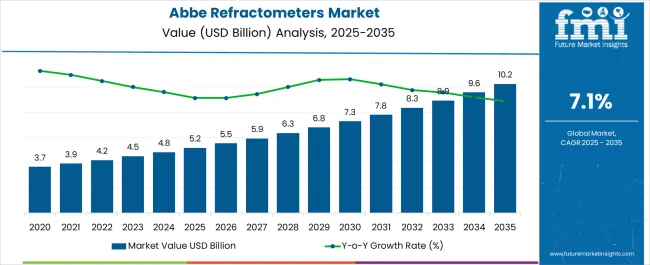
The Abbe Refractometers market was valued at USD 5.20 billion in 2025, projected to reach USD 5.57 billion in 2026, and is forecast to expand to USD 11.06 billion by 2036 at a 7.1% CAGR. As per FMI, the absolute dollar opportunity across the forecast period amounts to USD 5.49 billion, reflecting steady conversion of latent demand into measurable procurement activity across end-use buyer segments.
Summary of Abbe Refractometers Market
- Market Snapshot
- The market is valued at USD 5.20 billion in 2025 and is projected to reach USD 11.06 billion by 2036.
- The industry is expected to grow at a 7.1% CAGR from 2026 to 2036, creating an incremental opportunity of USD 5.49 billion.
- The market remains a specification-driven category where product performance, regulatory compliance, and supply chain reliability define competitive positioning.
- Demand and Growth Drivers
- Demand is rising as end-use sectors face tightening performance specifications and compliance requirements that favour qualified product sources.
- Technology upgrade cycles and capacity expansion programmes across primary verticals are accelerating procurement schedules.
- Growth is further supported by expanding capacity in Asia Pacific and policy incentive frameworks in North America and Europe.
- Among key countries, China at 9.6%, India at 8.9%, Germany at 8.2%, Brazil at 7.5%, USA at 6.7%, UK at 6%, Japan at 5.3%.
- Product and Segment View
- The market includes abbe refractometers are optical instruments that measure the refractive index of liquids, solids, and semi-solids by passing light through a sample placed between calibrated prisms, used for material purity verification, concentration measurement, and quality control across regulated industries.
- Digital Abbe Refractometers leads by Product Type with 60% share in 2026.
- Pharmaceutical leads by End User with 35% share in 2026.
- Scope includes market scope includes global and regional revenue sizing for abbe refractometers segmented by product type and end user.
- Geography and Competitive Outlook
- China and India are the fastest-growing markets, while mature economies sustain high-value demand through established procurement channels.
- Competition is shaped by product specification compliance, distribution network breadth, and supplier qualification track records.
- Key players include Bellingham + Stanley, A Xylem Brand, A.KRISS Optronic, J.P Selecta, Reichert, Schmidt+Haensch GmbH & Co., Optika Srl, AFAB Enterprises.
- Analyst Opinion at FMI
- Nikhil Kaitwade, Principal Consultant at Future Market Insights, opines: 'In my analysis, I have observed that the Abbe Refractometers market is transitioning from commodity procurement to specification-driven sourcing structures. Buyers delaying alignment with updated qualification frameworks risk supply disruptions as certified suppliers prioritize long-term contract holders. Capital allocation toward qualified capacity and regional distribution infrastructure will define competitive positioning through the forecast period.'
- Strategic Implications / Executive Takeaways
- Suppliers must secure product qualification certifications ahead of procurement cycle deadlines to qualify for multi-year contract awards.
- Capital project directors should prioritize capacity expansion in high-growth geographies where demand density and incentive frameworks reduce payback periods.
- Product development teams must invest in next-generation specification compliance capabilities to maintain competitiveness.
Future Market Insights analysis indicates that the pharmaceutical industry's quality control laboratories are the primary procurement channel for Abbe refractometers, where refractive index measurement serves as a critical purity verification parameter for active pharmaceutical ingredients and excipients. Digital Abbe refractometers are displacing analog models across regulated environments, as automatic temperature compensation, data logging, and 21 CFR Part 11 compliance features reduce operator variability and audit documentation burden. FMI is of the opinion that the food and beverage sector's adoption of refractometry for Brix measurement, sugar content verification, and adulteration detection adds steady procurement volume through quality assurance laboratory equipment refresh cycles. Academic research institutions and chemical analysis laboratories maintain a baseline demand channel for both digital and analog configurations.
All tracked country markets reflect differentiated growth trajectories. China leads at 9.6% CAGR, propelled by pharmaceutical GMP laboratory equipment modernization mandates and expanding food safety testing infrastructure. India leads at 8.9% CAGR, supported by FSSAI food testing laboratory expansion and pharmaceutical quality control equipment procurement under PLI schemes. Germany leads at 8.2% CAGR, driven by Schmidt+Haensch and Anton Paar domestic production and pharmaceutical industry laboratory equipment procurement cycles. Brazil leads at 7.5% CAGR, backed by ANVISA pharmaceutical laboratory modernization mandates and sugarcane industry Brix measurement equipment upgrades. USA leads at 6.7% CAGR, anchored by FDA-regulated pharmaceutical QC laboratory equipment refresh cycles and food safety testing programme procurement. UK leads at 6% CAGR, sustained by MHRA pharmaceutical laboratory compliance requirements and university chemistry department equipment budgets. Japan registers a 5.3% pace, driven by pharmaceutical industry precision measurement culture and domestic optical instrument manufacturer production cycles.
Abbe Refractometers Market Key Takeaways
| Metric | Details |
|---|---|
| Industry Size (2026) | USD 5.57 billion |
| Industry Value (2036) | USD 11.06 billion |
| CAGR (2026-2036) | 7.1% |
Source: Future Market Insights, 2026
Abbe Refractometers Market Definition
Abbe refractometers are optical instruments that measure the refractive index of liquids, solids, and semi-solids by passing light through a sample placed between calibrated prisms, used for material purity verification, concentration measurement, and quality control across regulated industries. The market covers digital and analog configurations deployed in pharmaceutical, medical, chemical, food and beverage, and academic research laboratory environments. Primary procurement is driven by pharmacopoeia-mandated purity testing, food safety Brix measurement, and chemical process control applications.
Abbe Refractometers Market Inclusions
Market scope includes global and regional revenue sizing for Abbe refractometers segmented by product type and end user. Coverage spans digital and analog configurations across pharmaceutical, medical, chemical, food and beverage, and academic verticals with a 2026 to 2036 forecast period and country-level analysis.
Abbe Refractometers Market Exclusions
The scope excludes inline process refractometers, handheld digital refractometers without Abbe prism configurations, and polarimeters. Complete laboratory information management systems and general-purpose spectrophotometers are excluded. Refractometer consumables and replacement prisms sold separately fall outside the valuation boundary.
Abbe Refractometers Market Research Methodology
- Primary Research: Analysts engaged with procurement leads, product specification engineers, and supply chain managers to map purchase decision triggers and qualification requirements.
- Desk Research: Data collection phases aggregated regulatory standards documentation, industry association publications, and company disclosure filings.
- Market-Sizing and Forecasting: Baseline values derive from a bottom-up aggregation of product shipments and contract values, applying region-specific adoption curves to project demand velocity.
- Data Validation and Update Cycle: Projections are tested against publicly reported revenue guidance from leading suppliers and cross-referenced with trade association data.
Why is the Abbe Refractometers Market Growing?
The Abbe Refractometers market is experiencing steady growth driven by the increasing demand for precise measurement of refractive indices across various industries. The future outlook of this market is shaped by advancements in digital technology, which have enhanced measurement accuracy, data recording, and ease of use.
Growing adoption of automated laboratory instruments and the need for high-precision quality control in pharmaceuticals, chemicals, and research laboratories are key factors supporting market expansion. Increasing investments in research and development and the rising emphasis on compliance with stringent quality standards are further driving the adoption of advanced refractometers.
Additionally, the shift from traditional manual instruments to digital models has created opportunities for more efficient and reliable analysis, reducing human error and improving workflow efficiency As industries continue to prioritize operational accuracy, process optimization, and regulatory adherence, the demand for Abbe Refractometers is expected to maintain consistent growth in both established and emerging markets.
Segmental Analysis
The abbe refractometers market is segmented by product type, end user, and geographic regions. By product type, abbe refractometers market is divided into Digital Abbe Refractometers and Analog Abbe Refractometers. In terms of end user, abbe refractometers market is classified into Pharmaceutical, Medical, Chemical, Food And Beverage, and Academic Research Institutions. Regionally, the abbe refractometers industry is classified into North America, Latin America, Western Europe, Eastern Europe, Balkan & Baltic Countries, Russia & Belarus, Central Asia, East Asia, South Asia & Pacific, and the Middle East & Africa.
Insights into the Digital Abbe Refractometers Segment

The digital Abbe Refractometers segment is projected to hold 60.0% of the market revenue share in 2026, making it the leading product type. The growth of this segment is driven by the superior precision, repeatability, and user-friendly interface provided by digital models. Digital Abbe Refractometers offer automated data acquisition and advanced analytical capabilities, which enhance laboratory efficiency and reduce the risk of human error.
The widespread adoption of digital instruments is further supported by their compatibility with modern laboratory information management systems and their ability to facilitate real-time monitoring and reporting. Industries demanding high accuracy and streamlined workflows, such as pharmaceuticals and chemicals, have increasingly favored digital models.
Additionally, the flexibility to measure a wide range of substances with minimal manual intervention has reinforced the segment’s dominance Continuous innovation in digital refractometry technology is expected to sustain the growth of this segment in the coming years.
Insights into the Pharmaceutical End-User Segment

The pharmaceutical end-user segment is anticipated to account for 35.0% of the Abbe Refractometers market revenue in 2026, establishing it as the leading end-use industry. This growth is primarily driven by the critical need for precise quality control during drug formulation and production processes. The use of Abbe Refractometers enables accurate measurement of refractive indices, which is essential for ensuring consistency, purity, and compliance with regulatory standards.
Rising investments in pharmaceutical R&D and the increasing production of complex formulations have further supported demand for reliable analytical instruments. The integration of digital Abbe Refractometers in laboratories facilitates efficient data collection, reduces error, and accelerates testing processes.
As pharmaceutical companies continue to emphasize process optimization, quality assurance, and regulatory adherence, the adoption of advanced refractometers is expected to remain strong The segment’s dominance is reinforced by the growing requirement for accurate and reproducible results in both research and production settings.
Market Overview
Abbe refractometers are specially designed scientific instruments that are often utilized for a wide range of purposes, especially in the chemical, pharmaceuticals, and oil and gas industries. These can be used to measure the content by weight of elements, such as sugar crystals, as well as to determine solids, namely, fat, sugar, and salt concentrations.
It is mainly used to measure the refractive index of numerous samples that are available in solid and liquid state. It delivers the benefit of measuring the refractive index at several densities, pressures, and temperatures. Many organizations are set to use these for measuring the refractive index of viscous materials and foils.
The ability of these devices to measure dispersion, provide convenient reading angles, and horizontally load a prism is expected to bode well for the abbe refractometers market share in the upcoming years. In the food and beverage industry, these are likely to be utilized for testing food, controlling purity, and detecting sugar concentration.
Analysis of Abbe Refractometers Market By Key Countries
.webp "Top Country Growth Comparison Abbe Refractometers Market Cagr (2026 2036)")
| Country | CAGR |
|---|---|
| China | 9.6% |
| India | 8.9% |
| Germany | 8.2% |
| Brazil | 7.5% |
| USA | 6.7% |
| UK | 6.0% |
| Japan | 5.3% |
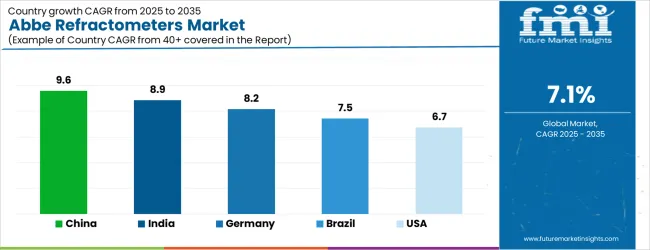
The Abbe Refractometers Market is expected to register a CAGR of 7.1% during the forecast period, exhibiting varied country level momentum. China leads with the highest CAGR of 9.6%, followed by India at 8.9%. Developed markets such as Germany, France, and the UK continue to expand steadily, while the USA is likely to grow at consistent rates. Japan posts the lowest CAGR at 5.3%, yet still underscores a broadly positive trajectory for the global Abbe Refractometers Market. In 2026, Germany held a dominant revenue in the Western Europe market and is expected to grow with a CAGR of 8.2%. The USA Abbe Refractometers Market is estimated to be valued at USD 2.0 billion in 2026 and is anticipated to reach a valuation of USD 2.0 billion by 2036. Sales are projected to rise at a CAGR of 6.7% over the forecast period between 2026 and 2036. While Japan and South Korea markets are estimated to be valued at USD 252.1 million and USD 170.8 million respectively in 2026.
Key Players in the Abbe Refractometers Market
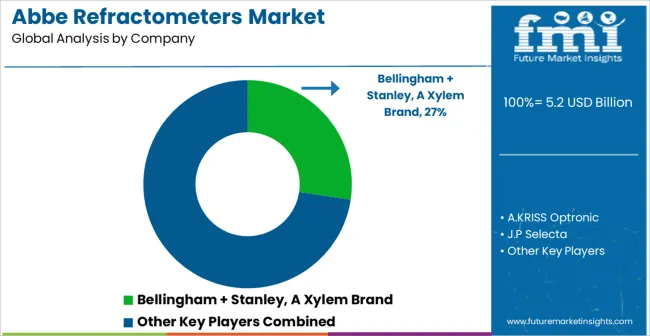
- Bellingham + Stanley, A Xylem Brand
- A.KRISS Optronic
- J.P Selecta
- Reichert
- Schmidt+Haensch GmbH & Co.
- Optika Srl
- AFAB Enterprises
- Anton Paar
- Auxilab
Scope of the Report
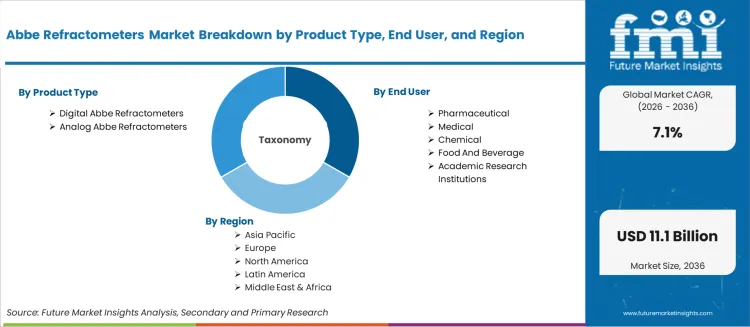
| Metric | Value |
|---|---|
| Quantitative Units | USD 5.57 billion to USD 11.06 billion, at a CAGR of 7.1% |
| Market Definition | Abbe refractometers are optical instruments that measure the refractive index of liquids, solids, and semi-solids by passing light through a sample placed between calibrated prisms, used for material purity verification, concentration measurement, and quality control across regulated industries. The market covers digital and analog configurations deployed in pharmaceutical, medical, chemical, food and beverage, and academic research laboratory environments. |
| Segmentation | Product Type: Digital Abbe Refractometers, Analog Abbe Refractometers; End User: Pharmaceutical, Medical, Chemical, Food and Beverage, Academic Research Institutions |
| Regions Covered | North America, Latin America, Europe, East Asia, South Asia, Oceania, Middle East & Africa |
| Countries Covered | China, India, Germany, Brazil, USA, UK, Japan, and 40 plus countries |
| Key Companies Profiled | Bellingham + Stanley, A Xylem Brand, A.KRISS Optronic, J.P Selecta, Reichert, Schmidt+Haensch GmbH & Co., Optika Srl, AFAB Enterprises, Anton Paar, Auxilab |
| Forecast Period | 2026 to 2036 |
| Approach | Forecasting models apply a bottom-up methodology starting with global installed base and consumption metrics, projecting conversion rates to advanced specifications. |
Abbe Refractometers Market by Segments
Product Type:
- Digital Abbe Refractometers
- Analog Abbe Refractometers
End User:
- Pharmaceutical
- Medical
- Chemical
- Food And Beverage
- Academic Research Institutions
Region:
- North America
- USA
- Canada
- Mexico
- Latin America
- Brazil
- Chile
- Rest of Latin America
- Western Europe
- Germany
- UK
- Italy
- Spain
- France
- Nordic
- BENELUX
- Rest of Western Europe
- Eastern Europe
- Russia
- Poland
- Hungary
- Balkan & Baltic
- Rest of Eastern Europe
- East Asia
- China
- Japan
- South Korea
- South Asia and Pacific
- India
- ASEAN
- Australia & New Zealand
- Rest of South Asia and Pacific
- Middle East & Africa
- Kingdom of Saudi Arabia
- Other GCC Countries
- Turkiye
- South Africa
- Other African Union
- Rest of Middle East & Africa
Bibliography
- 1. United States Pharmacopeia. (2024). USP General Chapter 831: Refractive index measurement requirements. USP.
- 2. International Organization for Standardization. (2024). ISO 10842: Optics and photonics, refractometers, general requirements. ISO.
- 3. Anton Paar GmbH. (2025). Annual Report 2024: Laboratory instrumentation segment review. Anton Paar.
- 4. European Pharmacopoeia Commission. (2024). Ph. Eur. 2.2.6: Refractive index measurement, updated procedures. EDQM.
- 5. Food and Drug Administration. (2024). 21 CFR Part 211: Current good manufacturing practice, laboratory control requirements. FDA.
This bibliography is provided for reader reference. The full Future Market Insights report contains the complete reference list with primary research documentation.
Frequently Asked Questions
How large is the demand for Abbe Refractometers in the global market in 2026?
Demand for Abbe Refractometers in the global market is estimated to be valued at USD 5.57 billion in 2026.
What will be the market size of Abbe Refractometers in the global market by 2036?
Market size for Abbe Refractometers is projected to reach USD 11.06 billion by 2036.
What is the expected demand growth for Abbe Refractometers between 2026 and 2036?
Demand for Abbe Refractometers is expected to grow at a CAGR of 7.1% between 2026 and 2036.
Which Product Type is poised to lead global sales by 2026?
Digital Abbe Refractometers accounts for 60% in 2026 based on established procurement patterns across primary end-use sectors.
What is driving demand in China?
China leads with a 9.6% CAGR through 2036, driven by expanding capacity, policy support, and growing end-user adoption.
What is the India growth outlook in this report?
India is projected to grow at a CAGR of 8.9% during 2026 to 2036.
What is Abbe Refractometers and what is it mainly used for?
Abbe refractometers are optical instruments that measure the refractive index of liquids, solids, and semi-solids by passing light through a sample placed between calibrated prisms, used for material purity verification, concentration measurement, and quality control across regulated industries. The market covers digital and analog configurations deployed in pharmaceutical, medical, chemical, food and beverage, and academic research laboratory environments.
How does FMI build and validate the Abbe Refractometers forecast?
Forecasting models apply a bottom-up methodology starting with global installed base metrics and cross-validate projections against quarterly industry revenue volumes and primary research inputs.
Preview the report firsthand - request a free sample
Get SampleGet the brochure for pricing and purchase details.
Get PDFTable of Content
- Executive Summary
- Global Market Outlook
- Demand-side Trends
- Supply-side Trends
- Technology Roadmap Analysis
- Analysis and Recommendations
- Market Overview
- Market Coverage / Taxonomy
- Market Definition / Scope / Limitations
- Research Methodology
- Chapter Orientation
- Analytical Lens and Working Hypotheses
- Market Structure, Signals, and Trend Drivers
- Benchmarking and Cross-market Comparability
- Market Sizing, Forecasting, and Opportunity Mapping
- Research Design and Evidence Framework
- Desk Research Programme (Secondary Evidence)
- Company Annual and Sustainability Reports
- Peer-reviewed Journals and Academic Literature
- Corporate Websites, Product Literature, and Technical Notes
- Earnings Decks and Investor Briefings
- Statutory Filings and Regulatory Disclosures
- Technical White Papers and Standards Notes
- Trade Journals, Industry Magazines, and Analyst Briefs
- Conference Proceedings, Webinars, and Seminar Materials
- Government Statistics Portals and Public Data Releases
- Press Releases and Reputable Media Coverage
- Specialist Newsletters and Curated Briefings
- Sector Databases and Reference Repositories
- FMI Internal Proprietary Databases and Historical Market Datasets
- Subscription Datasets and Paid Sources
- Social Channels, Communities, and Digital Listening Inputs
- Additional Desk Sources
- Expert Input and Fieldwork (Primary Evidence)
- Primary Modes
- Qualitative Interviews and Expert Elicitation
- Quantitative Surveys and Structured Data Capture
- Blended Approach
- Why Primary Evidence is Used
- Field Techniques
- Interviews
- Surveys
- Focus Groups
- Observational and In-context Research
- Social and Community Interactions
- Stakeholder Universe Engaged
- C-suite Leaders
- Board Members
- Presidents and Vice Presidents
- R&D and Innovation Heads
- Technical Specialists
- Domain Subject-matter Experts
- Scientists
- Physicians and Other Healthcare Professionals
- Governance, Ethics, and Data Stewardship
- Research Ethics
- Data Integrity and Handling
- Primary Modes
- Tooling, Models, and Reference Databases
- Desk Research Programme (Secondary Evidence)
- Data Engineering and Model Build
- Data Acquisition and Ingestion
- Cleaning, Normalisation, and Verification
- Synthesis, Triangulation, and Analysis
- Quality Assurance and Audit Trail
- Market Background
- Market Dynamics
- Drivers
- Restraints
- Opportunity
- Trends
- Scenario Forecast
- Demand in Optimistic Scenario
- Demand in Likely Scenario
- Demand in Conservative Scenario
- Opportunity Map Analysis
- Product Life Cycle Analysis
- Supply Chain Analysis
- Investment Feasibility Matrix
- Value Chain Analysis
- PESTLE and Porter’s Analysis
- Regulatory Landscape
- Regional Parent Market Outlook
- Production and Consumption Statistics
- Import and Export Statistics
- Market Dynamics
- Global Market Analysis 2021 to 2025 and Forecast, 2026 to 2036
- Historical Market Size Value (USD Million) Analysis, 2021 to 2025
- Current and Future Market Size Value (USD Million) Projections, 2026 to 2036
- Y-o-Y Growth Trend Analysis
- Absolute $ Opportunity Analysis
- Global Market Pricing Analysis 2021 to 2025 and Forecast 2026 to 2036
- Global Market Analysis 2021 to 2025 and Forecast 2026 to 2036, By Product Type
- Introduction / Key Findings
- Historical Market Size Value (USD Million) Analysis By Product Type , 2021 to 2025
- Current and Future Market Size Value (USD Million) Analysis and Forecast By Product Type , 2026 to 2036
- Digital Abbe Refractometers
- Analog Abbe Refractometers
- Digital Abbe Refractometers
- Y-o-Y Growth Trend Analysis By Product Type , 2021 to 2025
- Absolute $ Opportunity Analysis By Product Type , 2026 to 2036
- Global Market Analysis 2021 to 2025 and Forecast 2026 to 2036, By End User
- Introduction / Key Findings
- Historical Market Size Value (USD Million) Analysis By End User, 2021 to 2025
- Current and Future Market Size Value (USD Million) Analysis and Forecast By End User, 2026 to 2036
- Pharmaceutical
- Medical
- Chemical
- Food And Beverage
- Academic Research Institutions
- Pharmaceutical
- Y-o-Y Growth Trend Analysis By End User, 2021 to 2025
- Absolute $ Opportunity Analysis By End User, 2026 to 2036
- Global Market Analysis 2021 to 2025 and Forecast 2026 to 2036, By Region
- Introduction
- Historical Market Size Value (USD Million) Analysis By Region, 2021 to 2025
- Current Market Size Value (USD Million) Analysis and Forecast By Region, 2026 to 2036
- North America
- Latin America
- Western Europe
- Eastern Europe
- East Asia
- South Asia and Pacific
- Middle East & Africa
- Market Attractiveness Analysis By Region
- North America Market Analysis 2021 to 2025 and Forecast 2026 to 2036, By Country
- Historical Market Size Value (USD Million) Trend Analysis By Market Taxonomy, 2021 to 2025
- Market Size Value (USD Million) Forecast By Market Taxonomy, 2026 to 2036
- By Country
- USA
- Canada
- Mexico
- By Product Type
- By End User
- By Country
- Market Attractiveness Analysis
- By Country
- By Product Type
- By End User
- Key Takeaways
- Latin America Market Analysis 2021 to 2025 and Forecast 2026 to 2036, By Country
- Historical Market Size Value (USD Million) Trend Analysis By Market Taxonomy, 2021 to 2025
- Market Size Value (USD Million) Forecast By Market Taxonomy, 2026 to 2036
- By Country
- Brazil
- Chile
- Rest of Latin America
- By Product Type
- By End User
- By Country
- Market Attractiveness Analysis
- By Country
- By Product Type
- By End User
- Key Takeaways
- Western Europe Market Analysis 2021 to 2025 and Forecast 2026 to 2036, By Country
- Historical Market Size Value (USD Million) Trend Analysis By Market Taxonomy, 2021 to 2025
- Market Size Value (USD Million) Forecast By Market Taxonomy, 2026 to 2036
- By Country
- Germany
- UK
- Italy
- Spain
- France
- Nordic
- BENELUX
- Rest of Western Europe
- By Product Type
- By End User
- By Country
- Market Attractiveness Analysis
- By Country
- By Product Type
- By End User
- Key Takeaways
- Eastern Europe Market Analysis 2021 to 2025 and Forecast 2026 to 2036, By Country
- Historical Market Size Value (USD Million) Trend Analysis By Market Taxonomy, 2021 to 2025
- Market Size Value (USD Million) Forecast By Market Taxonomy, 2026 to 2036
- By Country
- Russia
- Poland
- Hungary
- Balkan & Baltic
- Rest of Eastern Europe
- By Product Type
- By End User
- By Country
- Market Attractiveness Analysis
- By Country
- By Product Type
- By End User
- Key Takeaways
- East Asia Market Analysis 2021 to 2025 and Forecast 2026 to 2036, By Country
- Historical Market Size Value (USD Million) Trend Analysis By Market Taxonomy, 2021 to 2025
- Market Size Value (USD Million) Forecast By Market Taxonomy, 2026 to 2036
- By Country
- China
- Japan
- South Korea
- By Product Type
- By End User
- By Country
- Market Attractiveness Analysis
- By Country
- By Product Type
- By End User
- Key Takeaways
- South Asia and Pacific Market Analysis 2021 to 2025 and Forecast 2026 to 2036, By Country
- Historical Market Size Value (USD Million) Trend Analysis By Market Taxonomy, 2021 to 2025
- Market Size Value (USD Million) Forecast By Market Taxonomy, 2026 to 2036
- By Country
- India
- ASEAN
- Australia & New Zealand
- Rest of South Asia and Pacific
- By Product Type
- By End User
- By Country
- Market Attractiveness Analysis
- By Country
- By Product Type
- By End User
- Key Takeaways
- Middle East & Africa Market Analysis 2021 to 2025 and Forecast 2026 to 2036, By Country
- Historical Market Size Value (USD Million) Trend Analysis By Market Taxonomy, 2021 to 2025
- Market Size Value (USD Million) Forecast By Market Taxonomy, 2026 to 2036
- By Country
- Kingdom of Saudi Arabia
- Other GCC Countries
- Turkiye
- South Africa
- Other African Union
- Rest of Middle East & Africa
- By Product Type
- By End User
- By Country
- Market Attractiveness Analysis
- By Country
- By Product Type
- By End User
- Key Takeaways
- Key Countries Market Analysis
- USA
- Pricing Analysis
- Market Share Analysis, 2025
- By Product Type
- By End User
- Canada
- Pricing Analysis
- Market Share Analysis, 2025
- By Product Type
- By End User
- Mexico
- Pricing Analysis
- Market Share Analysis, 2025
- By Product Type
- By End User
- Brazil
- Pricing Analysis
- Market Share Analysis, 2025
- By Product Type
- By End User
- Chile
- Pricing Analysis
- Market Share Analysis, 2025
- By Product Type
- By End User
- Germany
- Pricing Analysis
- Market Share Analysis, 2025
- By Product Type
- By End User
- UK
- Pricing Analysis
- Market Share Analysis, 2025
- By Product Type
- By End User
- Italy
- Pricing Analysis
- Market Share Analysis, 2025
- By Product Type
- By End User
- Spain
- Pricing Analysis
- Market Share Analysis, 2025
- By Product Type
- By End User
- France
- Pricing Analysis
- Market Share Analysis, 2025
- By Product Type
- By End User
- India
- Pricing Analysis
- Market Share Analysis, 2025
- By Product Type
- By End User
- ASEAN
- Pricing Analysis
- Market Share Analysis, 2025
- By Product Type
- By End User
- Australia & New Zealand
- Pricing Analysis
- Market Share Analysis, 2025
- By Product Type
- By End User
- China
- Pricing Analysis
- Market Share Analysis, 2025
- By Product Type
- By End User
- Japan
- Pricing Analysis
- Market Share Analysis, 2025
- By Product Type
- By End User
- South Korea
- Pricing Analysis
- Market Share Analysis, 2025
- By Product Type
- By End User
- Russia
- Pricing Analysis
- Market Share Analysis, 2025
- By Product Type
- By End User
- Poland
- Pricing Analysis
- Market Share Analysis, 2025
- By Product Type
- By End User
- Hungary
- Pricing Analysis
- Market Share Analysis, 2025
- By Product Type
- By End User
- Kingdom of Saudi Arabia
- Pricing Analysis
- Market Share Analysis, 2025
- By Product Type
- By End User
- Turkiye
- Pricing Analysis
- Market Share Analysis, 2025
- By Product Type
- By End User
- South Africa
- Pricing Analysis
- Market Share Analysis, 2025
- By Product Type
- By End User
- USA
- Market Structure Analysis
- Competition Dashboard
- Competition Benchmarking
- Market Share Analysis of Top Players
- By Regional
- By Product Type
- By End User
- Competition Analysis
- Competition Deep Dive
- Bellingham + Stanley, A Xylem Brand
- Overview
- Product Portfolio
- Profitability by Market Segments (Product/Age /Sales Channel/Region)
- Sales Footprint
- Strategy Overview
- Marketing Strategy
- Product Strategy
- Channel Strategy
- A.KRISS Optronic
- J.P Selecta
- Reichert
- Schmidt+Haensch GmbH & Co.
- Optika Srl
- AFAB Enterprises
- Anton Paar
- Auxilab
- Bellingham + Stanley, A Xylem Brand
- Competition Deep Dive
- Assumptions & Acronyms Used


