

- Industry Size (2026)
- USD 1.0 Bn
- Forecast (2036)
- USD 2.4 Bn
- CAGR (2026 to 2036)
- 9.2%
Drilling Liquid Level Monitoring Equipment Market Forecast and Outlook 2026 to 2036
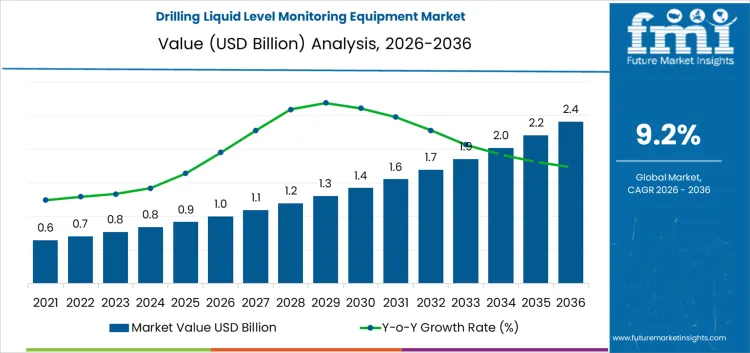
The drilling liquid level monitoring equipment market is projected at USD 1 billion in 2026 and USD 2.4 billion by 2036, reflecting a 9.20% CAGR. Use begins on rigs where early loss or gain detection governs well control routines and reporting discipline. Tool choice follows pit geometry, mud type, and integration with rig control systems rather than catalog preference. Once a rig standardizes alarm logic and display layouts, equipment families remain fixed across campaigns. Crews value response time, false alarm suppression, and sensor cleaning access. Handover procedures embed calibration checks into daily routines. Procurement reviews documentation depth, service reach, and spares lead times before award.
Operating performance, not feature lists, separates suppliers in this segment. Install bases expand through retrofits tied to safety audits and contract renewals. Workshop planning covers sensor refurbishment, cable assemblies, and controller updates to meet field schedules. Acceptance depends on simulated gain and loss trials witnessed by supervisors. Data export formats must align with reporting systems and remote monitoring centers. Training reduces nuisance trips and alarm fatigue. Inventory policies stage probes and boards near active basins. Engineering change control protects interface stability. Commercial outcomes follow uptime, calibration discipline, and field support quality rather than short term pricing moves.
Quick Stats for Drilling Liquid Level Monitoring Equipment Market
- Drilling Liquid Level Monitoring Equipment Market Value (2026): USD 1.0 billion
- Drilling Liquid Level Monitoring Equipment Market Forecast Value (2036): USD 2.4 billion
- Drilling Liquid Level Monitoring Equipment Market Forecast CAGR 2026 to 2036: 9.2%
- Leading Equipment Type in Drilling Liquid Level Monitoring Equipment Market: Ultrasonic level transmitters
- Leading Application in Drilling Liquid Level Monitoring Equipment Market: Oil and gas drilling rigs
- Key Growth Regions in Drilling Liquid Level Monitoring Equipment Market: Asia Pacific, Europe, North America
- Top Players in Drilling Liquid Level Monitoring Equipment Market: Emerson, Siemens, Honeywell, ABB, Endress+Hauser, VEGA Grieshaber, Schneider Electric
What Is the Growth Forecast for the Drilling Liquid Level Monitoring Equipment Market through 2036?
Risk management practice and well control procedures shape demand for the drilling liquid level monitoring equipment market more than the number of active rigs. In 2026, at about USD 1.0 billion, installations are concentrated on offshore platforms, high pressure onshore wells, and complex drilling programs where early detection of fluid loss or gain reduces non-productive time and safety exposure. Sensor selection and system layout are fixed during rig or project planning, which ties purchasing to capital and contract cycles rather than to daily drilling activity. Uptake grows as operators extend continuous monitoring standards across more assets and contractors adopt unified safety specifications.
Data reliability and integration depth guide the later phase of the drilling liquid level monitoring equipment market. As value approaches roughly USD 2.4 billion by 2036, buyers focus on measurement stability, alarm credibility, and compatibility with rig control systems. Product development shifts toward higher resolution sensing and more robust enclosures for harsh environments. Deployment effort increases as installation and calibration procedures become more standardized across fleets. The move from about one billion into the mid two billion reflects accumulated adoption across offshore and onshore programs rather than a single exploration cycle. Suppliers that combine dependable instrumentation, strong field support, and predictable performance tend to secure long term supply positions.
Drilling Liquid Level Monitoring Equipment Market Key Takeaways
| Metric | Value |
|---|---|
| Market Value (2026) | USD 1.0 billion |
| Forecast Value (2036) | USD 2.4 billion |
| Forecast CAGR 2026 to 2036 | 9.2% |
How Is the Drilling Liquid Level Monitoring Equipment Market Improving Well Control and Loss Detection?
Drilling liquid level monitoring equipment tracks pit volumes during drilling operations continuously. Past practice relied on manual gauging and checks that missed rapid losses. Modern systems combine ultrasonic, pressure, and radar sensors with local control panels. They provide alarms when influx or losses exceed thresholds set by crews. Integration with mud logging links level changes to flow and gas indicators. Placement follows pit layout, shaker lines, and safety zoning within drilling site.
Operators specify accuracy, response time, washdown resistance, and compatibility with site power. Use concentrates in deep wells, managed pressure drilling, and high consequence formations. Installation decisions follow well program risk, not convenience or instrument availability alone. Reliable measurement reduces nonproductive time and supports timely shut in responses procedures.
Buying decisions involve drilling engineers, HSE teams, and rig maintenance supervisors together. Initial field trials favored portable units but programs now demand fixed redundancy. Suppliers compete on calibration stability, enclosure sealing, and clear fault diagnostics outputs.
Crews evaluate total cost through downtime risk, spares coverage, and training time. Data must integrate with rig control systems and remote operations centers reliably. Vendors provide commissioning, periodic verification, and replacement plans aligned with well schedules. Standardization reduces spares variety and shortens recovery after sensor damage or blockage. Contracts often include service levels tied to alarm availability and reporting continuity. Demand grows with deeper wells, narrower margins, and stricter well control practices. Vendors retaining approvals and consistent firmware keep positions across long drilling campaigns.
What Is Driving Demand for Drilling Liquid Level Monitoring Equipment Across Key Applications in 2026?
Specification in Drilling Liquid Level Monitoring Equipment Market is driven by safety management systems, process control requirements, and regulatory reporting obligations rather than by routine instrumentation upgrades. Level monitoring becomes part of the approved drilling fluid management plan and is tied to well control, loss detection, and inventory accountability. Once sensor type and integration method are selected, the configuration is fixed within rig procedures and control system logic. This links demand to rig deployments, fleet upgrades, and compliance programs. Segment structure reflects differences in measurement principle, tolerance to vibration and contamination, and integration with control rooms. Buyers prioritize reliability, fault detection behavior, and calibration stability because level measurement errors carry operational and safety consequences.
How Does Equipment Type Selection Influence Measurement Reliability and Maintenance Burden in the Drilling Liquid Level Monitoring Equipment Market?
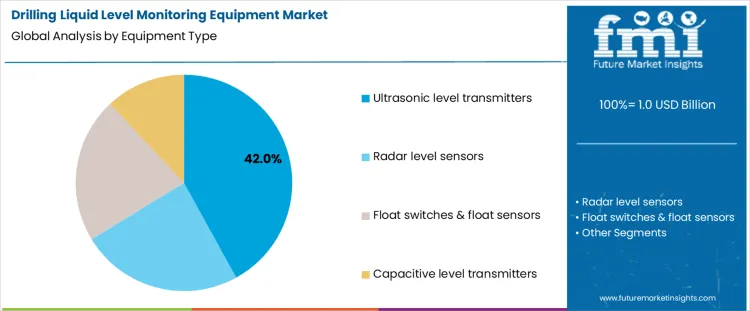
Ultrasonic level transmitters represent about 42% of demand in the Drilling Liquid Level Monitoring Equipment Market because they provide non contact measurement and can be installed without process penetration in many tank and pit configurations. This reduces leakage risk and simplifies maintenance access. Radar level sensors are selected for harsher environments and higher accuracy requirements, though they involve higher initial cost and more complex configuration. Float switches and float sensors serve basic level detection and alarm functions, where simplicity and mechanical robustness are prioritized over continuous measurement. Capacitive level transmitters are applied where space is limited or specific fluid properties support stable readings, which requires careful calibration and periodic verification.
From an operational standpoint, equipment type choice establishes inspection routines and failure response procedures. Ultrasonic devices require periodic cleaning and verification of signal path integrity. Radar systems impose more detailed setup and diagnostics but offer stable performance in vapor or foam conditions. Float based devices require mechanical inspection and can be affected by debris or coating. Capacitive sensors demand monitoring of probe condition and dielectric changes. Once a rig or drilling unit standardizes on a sensor family, change is avoided because control system interfaces, spares, and training are aligned. Demand by type therefore follows fleet standardization policies rather than short term procurement considerations.
Why Does Application Mix Define Volume Distribution and Specification Rigor in the Drilling Liquid Level Monitoring Equipment Market?
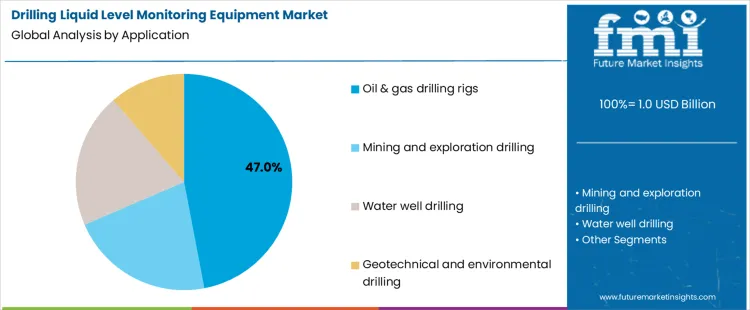
Oil and gas drilling rigs account for about 47% of demand in the Drilling Liquid Level Monitoring Equipment Market because they operate multiple mud tanks and pits under strict well control and reporting requirements. Continuous level visibility supports loss detection, kick response, and inventory management. Mining and exploration drilling applies monitoring to manage process fluids and waste, though at lower volumes and with more variable site conditions. Water well drilling uses simpler systems focused on basic level indication and protection. Geotechnical and environmental drilling emphasizes data integrity and documentation, which increases specification detail despite smaller scale deployments.
Application mix also shapes procurement and qualification practices. Oil and gas operators apply corporate standards and fleet wide specifications, which supports volume purchases and long approval cycles. Mining and water well contractors purchase per project, creating irregular demand patterns. Environmental and geotechnical users specify equipment to meet reporting and compliance requirements, increasing documentation and calibration expectations. The resulting structure concentrates volume in oil and gas operations while technical scrutiny increases in regulated investigative work. Segment shares therefore move with drilling activity cycles, fleet upgrade programs, and regulatory inspection intensity rather than with general instrumentation market trends.
How Is the Drilling Liquid Level Monitoring Equipment Market Being Defined By Well Control Discipline And Operational Risk Management?
The Drilling Liquid Level Monitoring Equipment Market is shaped by how drilling operators manage fluid balance, early kick detection, and loss prevention during complex well operations. Liquid level behavior inside tanks and pits provides direct signals about downhole conditions, which makes monitoring equipment part of the safety and decision chain rather than simple measurement hardware. Buyers focus on reliability, response time, and integration with existing drilling control systems. Selection decisions involve drilling engineering, well control specialists, and rig operations teams. This positions liquid level monitoring equipment as an operational risk management tool rather than as an auxiliary instrument.
How Is Rig Standardization Changing Equipment Expectations in The Drilling Liquid Level Monitoring Equipment Market?
Drilling contractors increasingly aim to standardize rig equipment packages across fleets to simplify training, maintenance, and spares management. This is changing expectations in the Drilling Liquid Level Monitoring Equipment Market toward systems that fit repeatable rig layouts and consistent control room interfaces. Buyers prefer monitoring solutions that integrate smoothly with existing data systems and alarm workflows. This reduces operator confusion and supports faster decision-making. As a result, suppliers are evaluated on system compatibility, documentation quality, and long-term product continuity rather than on one-off features for individual rigs.
Where Is Ongoing Demand Being Built in The Drilling Liquid Level Monitoring Equipment Market?
Ongoing demand is being built through new rig deliveries, rig upgrades, and retrofitting of older units to meet stricter operating standards. Each rig modernization project creates an opportunity to install or replace liquid level monitoring systems. The Drilling Liquid Level Monitoring Equipment Market also benefits from the need to add redundancy and backup monitoring channels in critical operations. There is opportunity for suppliers that can support installation, calibration, and training services alongside hardware delivery, creating repeat business tied to fleet maintenance cycles rather than to single drilling campaigns.
Why Do Cost Pressure and Installation Complexity Limit Wider Deployment In The Drilling Liquid Level Monitoring Equipment Market?
Some operators still rely on simpler or manual methods for monitoring tank levels, especially on less complex wells. Installing automated monitoring systems requires integration work, sensor placement planning, and operator training, which adds cost and downtime. The Drilling Liquid Level Monitoring Equipment Market also faces budget scrutiny because drilling programs prioritize spending on core drilling and completion equipment. When risk perception is low, monitoring upgrades are often deferred. These factors slow broader adoption and keep advanced systems concentrated in higher complexity or higher risk drilling operations.
What is the Demand for Drilling Liquid Level Monitoring Equipment by Country?
| Country | CAGR |
|---|---|
| USA | 8.5% |
| UK | 8.0% |
| China | 9.8% |
| India | 10.5% |
| Brazil | 8.7% |
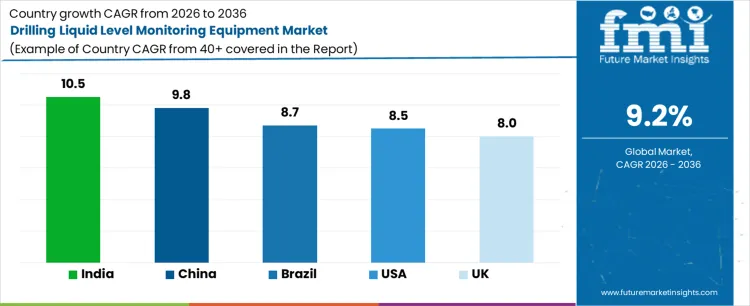
Demand for drilling liquid level monitoring equipment is increasing as oil and gas operators, geothermal developers, and mining contractors focus on better well control, safety, and process visibility. India leads with a 10.5% CAGR, supported by new exploration activity, onshore drilling programs, and higher emphasis on operational safety in domestic fields. China follows at 9.8%, driven by large scale drilling campaigns and wider use of automated rig monitoring systems. Brazil records 8.7%, reflecting offshore and onshore project activity and stricter safety practices. The USA grows at 8.5%, shaped by shale operations and equipment upgrades. The UK, at 8.0%, reflects steady demand from North Sea operations and regulated drilling environments.
How Do Rig Modernization and Safety Compliance Shape Demand in the United States?
Rig safety programs keep the drilling liquid level monitoring equipment market in the United States on an 8.5% CAGR path. Offshore platforms, shale fields, and geothermal projects account for most installations. Drilling contractors specify systems based on response time, sensor stability, and integration with mud logging units. Procurement follows rig upgrade packages rather than individual device purchases. Installation planning considers vibration exposure, temperature ranges, and power supply stability. Maintenance teams track calibration intervals and alarm reliability. Replacement demand appears after audit findings or control system upgrades. Service companies manage spares and field support across basins. Documentation supports well control reviews and regulatory inspections. Training programs for crews influence operating discipline. Investment cycles follow fleet refurbishment plans. Commercial position depends on preferred vendor status and dependable field performance across multiple drilling campaigns.
Why Do Verification Protocols and Operator Standards Guide Adoption in the United Kingdom?
Operator safety frameworks place the drilling liquid level monitoring equipment market in the United Kingdom on an 8.0% CAGR trajectory. North Sea assets and onshore test wells represent the main application base. Equipment selection follows performance verification and functional safety documentation. Engineering teams define interface requirements with control and data acquisition systems. Procurement aligns with platform maintenance programs and rig life extension projects. Installation work follows shutdown schedules and inspection windows. Maintenance planning focuses on sensor drift, cabling condition, and alarm validation. Replacement occurs after audit observations or system modernization programs. Service providers manage offshore logistics and calibration support. Records remain part of well control documentation files. Crew training influences alarm response discipline. Commercial access depends on operator approval lists and inspection outcomes rather than price competition for short cycle equipment orders.
What Role Do Large Scale Field Development Programs Play in China?
National energy development programs place the drilling liquid level monitoring equipment market in China on a 9.8% growth path. Onshore oil fields, shale projects, and gas storage developments drive most demand. Design institutes define standard instrumentation packages for drilling sites. Local manufacturing supports volume supply and service availability. Procurement aggregates requirements through project groups and regional operators. Installation teams integrate sensors with existing rig control systems. Quality teams track performance during acceptance tests and trial runs. Replacement activity follows equipment aging or control system changes. Logistics planning supports remote site deployment. Data management systems archive readings and alarms. Training programs support consistent operation. Payment schedules follow project milestones. Commercial success depends on placement within national field programs and long term operator supply agreements rather than fragmented sales to small independent contractors.
How Do Exploration Expansion and Contractor Led Operations Shape Demand in India?
Exploration activity growth fixes the drilling liquid level monitoring equipment market in India at a 10.5% CAGR. Onshore blocks, offshore developments, and workover campaigns represent key application areas. Procurement decisions focus on reliability, local service access, and compatibility with existing control systems. Many installations occur through turnkey drilling service contracts. Installation planning considers heat exposure, dust conditions, and power quality. Maintenance teams schedule calibration and functional checks. Replacement demand follows inspection findings or rig refurbishment cycles. Service partners manage inventory and field response across basins. Documentation supports regulatory well control audits. Training for rig crew’s influences alarm handling discipline. Investment timing follows exploration budgets and drilling schedules. Commercial results depend on inclusion in contractor equipment lists and maintaining service coverage rather than competition for one-time equipment supply orders.
How Do Offshore Projects and Production Stability Programs Shape Spending in Brazil?
Offshore development activity keeps the drilling liquid level monitoring equipment market in Brazil near an 8.7% CAGR. Deepwater platforms, appraisal wells, and workover operations form the main demand base. Engineering teams specify systems based on reliability under motion and pressure conditions. Procurement follows platform upgrade programs and new rig deployments. Import logistics influence lead times and spare availability. Installation work aligns with maintenance campaigns and shutdown windows. Maintenance planning focuses on sensor integrity and control interface stability. Replacement occurs after inspection findings or automation upgrades. Service companies coordinate offshore support and calibration services. Records remain part of safety management systems. Crew training supports consistent alarm response. Commercial position depends on operator approvals and dependable offshore service capability rather than competition for isolated equipment supply.
How Do Instrumentation Suppliers Compete for Measurement Authority in the Drilling Liquid Level Monitoring Equipment Market?
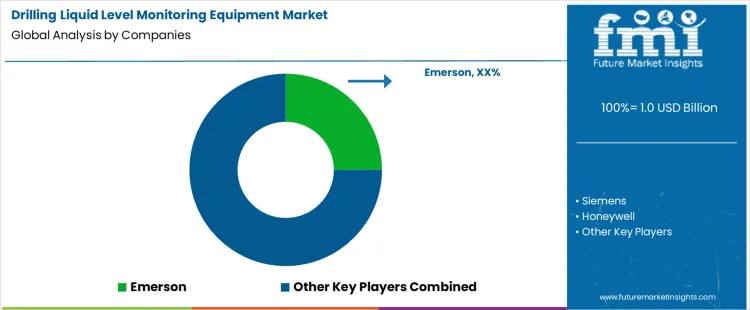
Drilling liquid level monitoring equipment selection starts during wellsite design and hazard review rather than at routine procurement stage. Engineers define tank geometry, fluid properties, foam risk, temperature range, and integration with control systems. Emerson, Siemens, Honeywell, ABB, Endress+Hauser, VEGA, Schneider Electric compete during that engineering gate. Once a measurement principle enters control narratives and safety files, change triggers new reviews and site acceptance tests. Emerson and Honeywell place instruments through control system alignment and service coverage. ABB and Siemens link level devices with automation architectures. Endress+Hauser and VEGA focus on radar and guided wave technologies with strong application fit. Schneider Electric supports packages tied to digital control platforms and panel integration. Qualification cycles keep positions stable across drilling campaigns.
Competitive outcomes follow reliability records, installation practices, and field service reach rather than catalog breadth. Operators review echo stability, false reflection handling, foam tolerance, temperature drift, and diagnostic reporting. Maintenance teams value instruments that support remote verification and predictable calibration intervals. Project teams favor suppliers that deliver documentation sets aligned with safety cases and commissioning checklists. Emerson benefits from installed base inside upstream control environments. Honeywell secures positions where safety systems and process control share common governance. ABB and Siemens win where automation standards guide vendor lists. Endress+Hauser holds share in applications that demand measurement credibility across fluid conditions. VEGA competes through focused radar performance and application engineering. Schneider Electric supports projects that standardize on its control platforms. Market positions vary by operator policy, regional service access, and drilling program complexity.
Key Players of Drilling Liquid Level Monitoring Equipment Market
- Emerson
- Siemens
- Honeywell
- ABB
- Endress+Hauser
- VEGA Grieshaber
- Schneider Electric
Scope of the Report
| Items | Values |
|---|---|
| Quantitative Units (2026) | USD billion |
| Equipment Type | Ultrasonic level transmitters, Radar level sensors, Float switches and float sensors, Capacitive level transmitters |
| Application | Oil and gas drilling rigs, Mining and exploration drilling, Water well drilling, Geotechnical and environmental drilling |
| Region | Asia Pacific, Europe, North America, Latin America, Middle East & Africa |
| Countries Covered | China, Japan, South Korea, India, Australia & New Zealand, ASEAN, Germany, United Kingdom, France, Italy, Spain, Nordic, BENELUX, United States, Canada, Mexico, Brazil, Chile, Saudi Arabia, Turkey, South Africa, and other regional markets |
| Key Companies Profiled | Emerson, Siemens, Honeywell, ABB, Endress+Hauser, VEGA Grieshaber, Schneider Electric |
| Additional Attributes | Dollar by sales by equipment type and application; demand driven by well control standards and safety audits; selection governed by sensor reliability, alarm credibility, and integration with rig control systems; purchasing tied to fleet upgrades, retrofits, and calibration requirements rather than short term drilling activity. |
Drilling Liquid Level Monitoring Equipment Market Segmentation
Equipment Type:
- Ultrasonic level transmitters
- Radar level sensors
- Float switches & float sensors
- Capacitive level transmitters
Application:
- Oil & gas drilling rigs
- Mining and exploration drilling
- Water well drilling
- Geotechnical and environmental drilling
Region:
- Asia Pacific
- China
- Japan
- South Korea
- India
- Australia & New Zealand
- ASEAN
- Rest of Asia Pacific
- Europe
- Germany
- United Kingdom
- France
- Italy
- Spain
- Nordic
- BENELUX
- Rest of Europe
- North America
- United States
- Canada
- Mexico
- Latin America
- Brazil
- Chile
- Rest of Latin America
- Middle East & Africa
- Kingdom of Saudi Arabia
- Other GCC Countries
- Turkey
- South Africa
- Other African Union
- Rest of Middle East & Africa
Bibliography
- U.S. Department of the Interior, Bureau of Safety and Environmental Enforcement. (2023). 30 CFR Part 250 Subpart G: Well operations and equipment (Regulation).
- International Organization for Standardization. (2014). ISO/TS 16530-2: Well integrity — Part 2: Cementing and evaluation (Technical Specification).
- Occupational Safety and Health Administration. (2023). Drilling and well control eTool: Well control and drilling fluid pressure monitoring (OSHA Guidance).
Frequently Asked Questions
How big is the drilling liquid level monitoring equipment market in 2026?
The global drilling liquid level monitoring equipment market is estimated to be valued at USD 1.0 billion in 2026.
What will be the size of drilling liquid level monitoring equipment market in 2036?
The market size for the drilling liquid level monitoring equipment market is projected to reach USD 2.4 billion by 2036.
How much will be the drilling liquid level monitoring equipment market growth between 2026 and 2036?
The drilling liquid level monitoring equipment market is expected to grow at a 9.2% CAGR between 2026 and 2036.
What are the key product types in the drilling liquid level monitoring equipment market?
The key product types in drilling liquid level monitoring equipment market are ultrasonic level transmitters , radar level sensors, float switches & float sensors and capacitive level transmitters.
Which application segment to contribute significant share in the drilling liquid level monitoring equipment market in 2026?
In terms of application, oil & gas drilling rigs segment to command 47.0% share in the drilling liquid level monitoring equipment market in 2026.
Preview the report firsthand - request a free sample
Get SampleGet the brochure for pricing and purchase details.
Get PDFTable of Content
- Executive Summary
- Global Market Outlook
- Demand-side Trends
- Supply-side Trends
- Technology Roadmap Analysis
- Analysis and Recommendations
- Market Overview
- Market Coverage / Taxonomy
- Market Definition / Scope / Limitations
- Market Background
- Market Dynamics
- Drivers
- Restraints
- Opportunity
- Trends
- Scenario Forecast
- Demand in Optimistic Scenario
- Demand in Likely Scenario
- Demand in Conservative Scenario
- Opportunity Map Analysis
- Product Life Cycle Analysis
- Supply Chain Analysis
- Investment Feasibility Matrix
- Value Chain Analysis
- PESTLE and Porter’s Analysis
- Regulatory Landscape
- Regional Parent Market Outlook
- Production and Consumption Statistics
- Import and Export Statistics
- Market Dynamics
- Global Market Analysis 2021 to 2025 and Forecast, 2026 to 2036
- Historical Market Size Value (USD Million) Analysis, 2021 to 2025
- Current and Future Market Size Value (USD Million) Projections, 2026 to 2036
- Y-o-Y Growth Trend Analysis
- Absolute $ Opportunity Analysis
- Global Market Pricing Analysis 2021 to 2025 and Forecast 2026 to 2036
- Global Market Analysis 2021 to 2025 and Forecast 2026 to 2036, By Equipment Type
- Introduction / Key Findings
- Historical Market Size Value (USD Million) Analysis By Equipment Type , 2021 to 2025
- Current and Future Market Size Value (USD Million) Analysis and Forecast By Equipment Type , 2026 to 2036
- Ultrasonic level transmitters
- Radar level sensors
- Float switches & float sensors
- Capacitive level transmitters
- Ultrasonic level transmitters
- Y-o-Y Growth Trend Analysis By Equipment Type , 2021 to 2025
- Absolute $ Opportunity Analysis By Equipment Type , 2026 to 2036
- Global Market Analysis 2021 to 2025 and Forecast 2026 to 2036, By Application
- Introduction / Key Findings
- Historical Market Size Value (USD Million) Analysis By Application, 2021 to 2025
- Current and Future Market Size Value (USD Million) Analysis and Forecast By Application, 2026 to 2036
- Oil & gas drilling rigs
- Mining and exploration drilling
- Water well drilling
- Geotechnical and environmental drilling
- Oil & gas drilling rigs
- Y-o-Y Growth Trend Analysis By Application, 2021 to 2025
- Absolute $ Opportunity Analysis By Application, 2026 to 2036
- Global Market Analysis 2021 to 2025 and Forecast 2026 to 2036, By Region
- Introduction
- Historical Market Size Value (USD Million) Analysis By Region, 2021 to 2025
- Current Market Size Value (USD Million) Analysis and Forecast By Region, 2026 to 2036
- North America
- Latin America
- Western Europe
- Eastern Europe
- East Asia
- South Asia and Pacific
- Middle East & Africa
- Market Attractiveness Analysis By Region
- North America Market Analysis 2021 to 2025 and Forecast 2026 to 2036, By Country
- Historical Market Size Value (USD Million) Trend Analysis By Market Taxonomy, 2021 to 2025
- Market Size Value (USD Million) Forecast By Market Taxonomy, 2026 to 2036
- By Country
- USA
- Canada
- Mexico
- By Equipment Type
- By Application
- By Country
- Market Attractiveness Analysis
- By Country
- By Equipment Type
- By Application
- Key Takeaways
- Latin America Market Analysis 2021 to 2025 and Forecast 2026 to 2036, By Country
- Historical Market Size Value (USD Million) Trend Analysis By Market Taxonomy, 2021 to 2025
- Market Size Value (USD Million) Forecast By Market Taxonomy, 2026 to 2036
- By Country
- Brazil
- Chile
- Rest of Latin America
- By Equipment Type
- By Application
- By Country
- Market Attractiveness Analysis
- By Country
- By Equipment Type
- By Application
- Key Takeaways
- Western Europe Market Analysis 2021 to 2025 and Forecast 2026 to 2036, By Country
- Historical Market Size Value (USD Million) Trend Analysis By Market Taxonomy, 2021 to 2025
- Market Size Value (USD Million) Forecast By Market Taxonomy, 2026 to 2036
- By Country
- Germany
- UK
- Italy
- Spain
- France
- Nordic
- BENELUX
- Rest of Western Europe
- By Equipment Type
- By Application
- By Country
- Market Attractiveness Analysis
- By Country
- By Equipment Type
- By Application
- Key Takeaways
- Eastern Europe Market Analysis 2021 to 2025 and Forecast 2026 to 2036, By Country
- Historical Market Size Value (USD Million) Trend Analysis By Market Taxonomy, 2021 to 2025
- Market Size Value (USD Million) Forecast By Market Taxonomy, 2026 to 2036
- By Country
- Russia
- Poland
- Hungary
- Balkan & Baltic
- Rest of Eastern Europe
- By Equipment Type
- By Application
- By Country
- Market Attractiveness Analysis
- By Country
- By Equipment Type
- By Application
- Key Takeaways
- East Asia Market Analysis 2021 to 2025 and Forecast 2026 to 2036, By Country
- Historical Market Size Value (USD Million) Trend Analysis By Market Taxonomy, 2021 to 2025
- Market Size Value (USD Million) Forecast By Market Taxonomy, 2026 to 2036
- By Country
- China
- Japan
- South Korea
- By Equipment Type
- By Application
- By Country
- Market Attractiveness Analysis
- By Country
- By Equipment Type
- By Application
- Key Takeaways
- South Asia and Pacific Market Analysis 2021 to 2025 and Forecast 2026 to 2036, By Country
- Historical Market Size Value (USD Million) Trend Analysis By Market Taxonomy, 2021 to 2025
- Market Size Value (USD Million) Forecast By Market Taxonomy, 2026 to 2036
- By Country
- India
- ASEAN
- Australia & New Zealand
- Rest of South Asia and Pacific
- By Equipment Type
- By Application
- By Country
- Market Attractiveness Analysis
- By Country
- By Equipment Type
- By Application
- Key Takeaways
- Middle East & Africa Market Analysis 2021 to 2025 and Forecast 2026 to 2036, By Country
- Historical Market Size Value (USD Million) Trend Analysis By Market Taxonomy, 2021 to 2025
- Market Size Value (USD Million) Forecast By Market Taxonomy, 2026 to 2036
- By Country
- Kingdom of Saudi Arabia
- Other GCC Countries
- Turkiye
- South Africa
- Other African Union
- Rest of Middle East & Africa
- By Equipment Type
- By Application
- By Country
- Market Attractiveness Analysis
- By Country
- By Equipment Type
- By Application
- Key Takeaways
- Key Countries Market Analysis
- USA
- Pricing Analysis
- Market Share Analysis, 2025
- By Equipment Type
- By Application
- Canada
- Pricing Analysis
- Market Share Analysis, 2025
- By Equipment Type
- By Application
- Mexico
- Pricing Analysis
- Market Share Analysis, 2025
- By Equipment Type
- By Application
- Brazil
- Pricing Analysis
- Market Share Analysis, 2025
- By Equipment Type
- By Application
- Chile
- Pricing Analysis
- Market Share Analysis, 2025
- By Equipment Type
- By Application
- Germany
- Pricing Analysis
- Market Share Analysis, 2025
- By Equipment Type
- By Application
- UK
- Pricing Analysis
- Market Share Analysis, 2025
- By Equipment Type
- By Application
- Italy
- Pricing Analysis
- Market Share Analysis, 2025
- By Equipment Type
- By Application
- Spain
- Pricing Analysis
- Market Share Analysis, 2025
- By Equipment Type
- By Application
- France
- Pricing Analysis
- Market Share Analysis, 2025
- By Equipment Type
- By Application
- India
- Pricing Analysis
- Market Share Analysis, 2025
- By Equipment Type
- By Application
- ASEAN
- Pricing Analysis
- Market Share Analysis, 2025
- By Equipment Type
- By Application
- Australia & New Zealand
- Pricing Analysis
- Market Share Analysis, 2025
- By Equipment Type
- By Application
- China
- Pricing Analysis
- Market Share Analysis, 2025
- By Equipment Type
- By Application
- Japan
- Pricing Analysis
- Market Share Analysis, 2025
- By Equipment Type
- By Application
- South Korea
- Pricing Analysis
- Market Share Analysis, 2025
- By Equipment Type
- By Application
- Russia
- Pricing Analysis
- Market Share Analysis, 2025
- By Equipment Type
- By Application
- Poland
- Pricing Analysis
- Market Share Analysis, 2025
- By Equipment Type
- By Application
- Hungary
- Pricing Analysis
- Market Share Analysis, 2025
- By Equipment Type
- By Application
- Kingdom of Saudi Arabia
- Pricing Analysis
- Market Share Analysis, 2025
- By Equipment Type
- By Application
- Turkiye
- Pricing Analysis
- Market Share Analysis, 2025
- By Equipment Type
- By Application
- South Africa
- Pricing Analysis
- Market Share Analysis, 2025
- By Equipment Type
- By Application
- USA
- Market Structure Analysis
- Competition Dashboard
- Competition Benchmarking
- Market Share Analysis of Top Players
- By Regional
- By Equipment Type
- By Application
- Competition Analysis
- Competition Deep Dive
- Emerson
- Overview
- Product Portfolio
- Profitability by Market Segments (Product/Age /Sales Channel/Region)
- Sales Footprint
- Strategy Overview
- Marketing Strategy
- Product Strategy
- Channel Strategy
- Siemens
- Honeywell
- ABB
- Endress+Hauser
- VEGA Grieshaber
- Schneider Electric
- Emerson
- Competition Deep Dive
- Assumptions & Acronyms Used
- Research Methodology


