

- Industry Size (2026)
- USD 24.8 Bn
- Forecast (2036)
- USD 49.7 Bn
- CAGR (2026 to 2036)
- 7.2%
Liquid Soap Market Size, Market Forecast and Outlook By FMI
Valued at USD 23.0 billion in 2025, the liquid soap market is projected to reach USD 24.8 billion in 2026. The market is forecast to grow to USD 49.7 billion by 2036, registering a compound annual growth rate of 7.2% over the assessment period.
The liquid soap market is expanding due to sustained hygiene awareness across households, workplaces, healthcare facilities, and food service environments. Institutional buyers are increasing procurement volumes to comply with stricter sanitation protocols and internal audit standards. Liquid formats offer controlled dispensing, reduced cross contamination risk, and compatibility with automated dispensers, making them suitable for high traffic settings. Corporate offices, airports, malls, and hospitals are allocating higher budgets toward touch free washroom infrastructure, directly supporting demand for liquid hand wash systems.
Summary of Liquid Soap Market
- Liquid Soap Market Definition
- The industry includes water-based cleaning solutions formulated for personal care and domestic hygiene, serving usage across homes, corporate spaces, healthcare units, educational institutions, and other organized facilities requiring routine sanitation.
- Demand Drivers in the Market
- Growing focus on hygiene standards supports higher adoption of liquid soaps for routine handwashing and structured sanitation practices across households and workplaces.
- User-friendly packaging formats increase preference for pump bottles that enable measured dispensing, reduce wastage, and improve overall convenience in daily use.
- Advancements in formulation technology introduce moisturizing agents that help prevent skin dryness while sustaining effective cleansing performance for frequent usage.
- Key Segments Analyzed in the Report
- Product Type: Hand Wash (39%) versus body cleansing products and household cleaning variants.
- Distribution Channel: Supermarkets and Hypermarkets (44%) versus convenience stores and online platforms.
- Geography: High-growth Asia Pacific versus mature North American and European markets.
- Analyst Opinion at FMI
- Nandini Roy Choudhury, Senior Consultant for Consumer Products at Future Market Insights, states, “The revised Liquid Soap Market Report for 2026 to 2036 highlights evolving ingredient disclosure norms that push brands toward clearer labeling practices across retail shelves. My assessment shows that stricter dermatological validation benchmarks influence formulation timelines, while demand for fragrance-free variants may create entry barriers for manufacturers targeting sensitive skin user groups.”
- Strategic Implications/Executive Takeaways
- Move emphasis away from single-use packaging formats toward refillable dispenser models that reduce plastic consumption and encourage repeat purchases.
- Position ingredient transparency as a central communication pillar, ensuring clear labeling and formulation disclosure guide consumer trust and brand credibility.
- Strengthen in-house dermatological testing capabilities to shorten reformulation timelines and maintain alignment with evolving regulatory and safety standards.
- Methodology
- Validated through direct retail sales data and household consumption surveys.
- Zero reliance on speculative personal care trend forecasting.
- Based on verifiable brand performance metrics and confirmed distribution agreements.
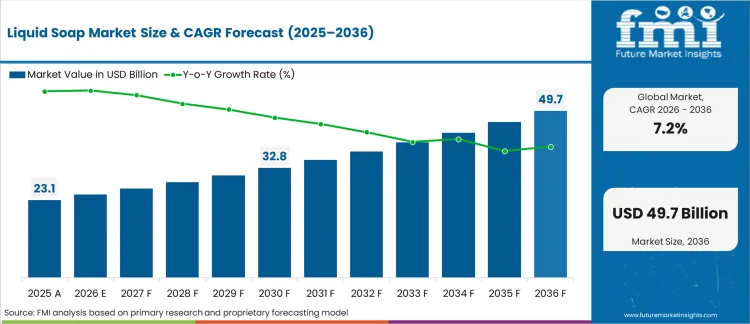
Product innovation is accelerating repeat purchases and value growth. Manufacturers are introducing dermatologically tested, pH balanced, and moisturizing formulations to address frequent handwashing concerns. Antibacterial and herbal variants are gaining traction in emerging markets where consumers seek visible hygiene cues. Refill packs and bulk packaging formats are improving cost efficiency for both retail and institutional buyers. Brands are investing in fragrance differentiation and skin care positioning to move beyond basic cleansing toward value added personal care.
Supermarkets allocate larger shelf space to liquid hand wash compared to bar soap due to higher price realization per unit. eCcommerce platforms enable subscription models and bundle offerings with other home care products, increasing basket size. Urban households with higher disposable income prefer pump based dispensers for convenience and aesthetics. Growth in organized retail penetration across Asia Pacific, Latin America, and parts of Africa is widening product accessibility. Expansion in hospitality, healthcare infrastructure, and food processing units globally continues to generate stable bulk demand, supporting long term revenue visibility for manufacturers and investors.
Many prominent market players are focusing on enhancing their product portfolios to strengthen their position. For example, in July 2024, Reckitt Benckiser Group Plc unveiled its decision to majorly focus on a portfolio of market-leading Powerbrands including the health and hygiene brands such as Dettol, Harpic, Finish, Vanish, and others. Kris Licht, Chief Executive Officer commented “Today we announce an important step forward to firmly establish Reckitt as a world-class consumer health and hygiene company, with one of the strongest growth and margin profiles in the industry.” [1]
Liquid Soap Market Key Takeaways
| Metric | Value |
|---|---|
| Market Value (2026) | USD 24.8 billion |
| Market Forecast Value (2036) | USD 49.7 billion |
| Forecast CAGR (2026-2036) | 7.2% |
Source: FMI analysis based on proprietary forecasting model and primary research
Liquid Soap Market Definition
Liquid soap is a widely used cleansing format for personal care and surface hygiene, typically packaged in pump bottles for controlled dispensing in residential and institutional environments. The market includes global formulation, manufacturing, and retail distribution of liquid surfactant solutions, incorporating fragrance blends, skin-conditioning agents, antibacterial compounds, and performance enhancers tailored for varied hygiene and cleaning applications.
Liquid Soap Market Inclusions
The report delivers an in-depth evaluation of market dynamics, presenting global and regional market size analysis in both volume and value terms, along with a 2026-2036 forecast. It provides detailed segmentation by product type, distribution channel, and application, covering hand wash, body wash, dish wash, and laundry detergent categories across household, commercial, healthcare, and food service sectors.
Liquid Soap Market Exclusions
The scope excludes bar soaps, powder detergents, industrial-grade cleaning chemicals, and medical scrub formulations. It does not cover packaging component suppliers, fragrance houses, or surfactant manufacturers, concentrating solely on finished, consumer-ready liquid soap products for personal and household use. Professional cleaning services and large institutional supply contracts with limited brand differentiation remain outside the study framework.
Liquid Soap Market Research Methodology
- Primary Research: Interviews were conducted with personal care manufacturers, retail category managers, distribution executives, formulation chemists, and packaging suppliers across major markets. Hygiene consultants clarified ingredient standards and regulatory requirements.
- Desk Research: Consumer purchase data from retail analytics platforms, household penetration rates from consumer surveys, and import/export statistics from trade organizations supported market benchmarking.
- Market-Sizing and Forecasting: A hybrid top-down and bottom-up model was developed. Demand was reconstructed from brand sales figures, retail shelf space allocation data, and household consumption patterns, then validated against manufacturing capacity and distribution network coverage.
- Data Validation and Update Cycle: Outputs undergo variance checks across retail and wholesale datasets, cross-verification with consumer goods industry associations, and structured expert review prior to release.
Segmental Analysis
Liquid Soap Market Analysis by Product Type
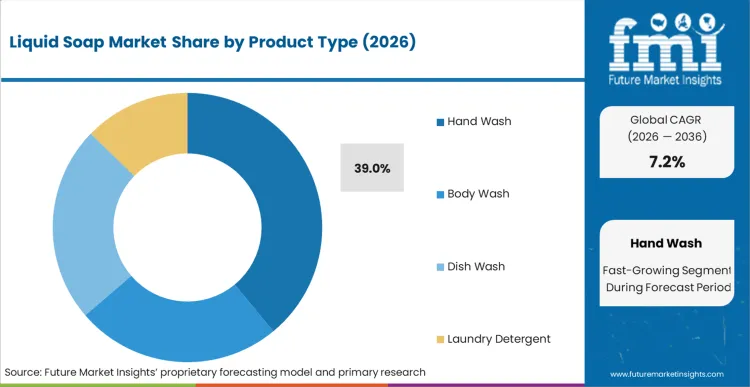
The hand wash segment is poised to capture 39% share in 2026. Frequent handwashing has increased demand for moisturizing, sulfate free, and pH balanced formulations. Liquid hand wash enables easier integration of emollients, botanical extracts, and dermatologically tested ingredients. Premium variants with fragrance layering and cosmetic positioning are generating higher price realization per unit. This moves the category beyond basic utility into daily personal care.
- Touchless Dispensing Compatibility: Liquid hand wash formulations are being optimized for automatic and sensor-based dispensers installed across corporate offices, airports, healthcare facilities, and hospitality chains. Manufacturers are adjusting viscosity levels to ensure smooth flow and prevent clogging in high-usage environments. This alignment with smart washroom infrastructure increases institutional procurement contracts and supports long-term supply agreements with facility management firms.
- Refill and Bulk Packaging Engineering: Producers are redesigning packaging architecture to support large-volume refill pouches and concentrated formats that reduce plastic intensity per wash cycle. Supply chain teams are prioritizing lightweight materials and stack-efficient designs to lower logistics costs. Bulk SKUs improve margin stability for organized retail and enable subscription-based replenishment models across digital channels, strengthening predictable revenue streams.
Liquid Soap Market Analysis by Distribution Channel
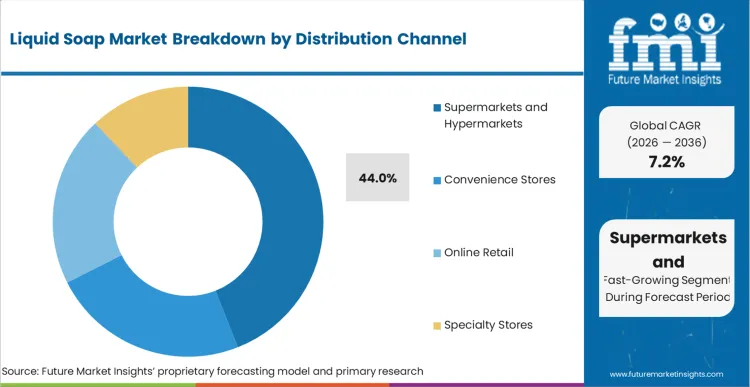
The supermarkets and hypermarkets segment is slated to occupy a 44% market share in 2026. Liquid soaps are widely sold through supermarkets and hypermarkets due to high shelf visibility and strong impulse conversion. Large retail formats allocate dedicated personal care aisles, enabling brands to display multiple SKUs, refill packs, and bundled offers in one location. End-cap placements and promotional islands improve product discovery and accelerate volume turnover. For manufacturers, these stores provide scale-driven sell-through supported by in-store marketing investments.
- Shelf Space Monetization: Supermarkets and hypermarkets prioritize liquid soaps due to higher revenue per linear foot compared to traditional bar formats. Wider SKU portfolios allow retailers to optimize assortment planning across economy, family, and premium variants. Planogram positioning near complementary categories such as paper towels and surface cleaners increases cross-category basket expansion and strengthens category contribution to overall store profitability.
- Private Label Expansion: Large retail chains are introducing in-house liquid soap brands positioned at competitive price points. These private label ranges improve retailer margins and create pricing tiers within the same shelf. Control over sourcing and packaging specifications enables cost efficiency while maintaining quality benchmarks. This strategy strengthens retailer bargaining power with national brands and drives higher overall category penetration across diverse income segments.
Liquid Soap Market Drivers, Restraints, and Opportunities
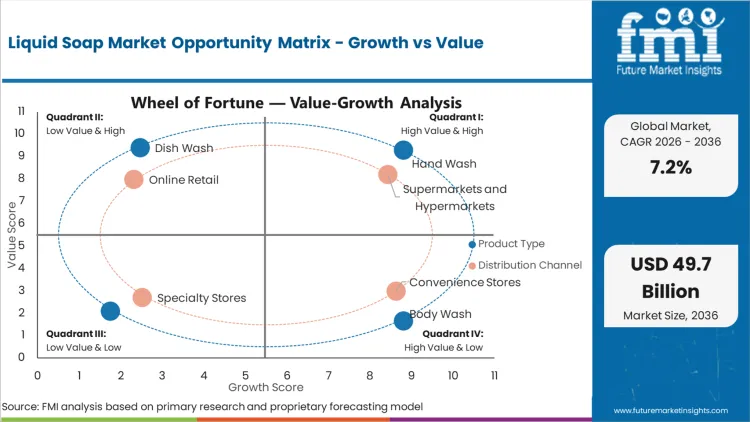
Rising incidence of hygiene-related illnesses is strengthening demand for liquid soap, hand sanitizer, and hand wash. Millions of foodborne illness cases occur annually across the globe, many linked to inadequate hand hygiene. As per the Food Safety and Inspection Service of the USA Department of Agriculture, the USA reports nearly 48 million cases of foodborne diseases and 3,000 mortalities every year. [2] Hospital-acquired infections continue to impose financial penalties on healthcare facilities under federal reimbursement frameworks, pushing stricter handwashing compliance. Schools and childcare centers are adopting monitored hygiene protocols to reduce absenteeism driven by gastrointestinal and respiratory infections. Corporate offices are incorporating hygiene performance indicators within facility audits. These measurable health and productivity risks are translating into sustained institutional procurement of liquid soap systems.
Raw material volatility is constraining margin stability. Surfactants, fragrance compounds, and packaging resins are exposed to petrochemical price fluctuations, impacting production economics. Small and mid-scale manufacturers face pressure from large retailers demanding price competitiveness and private label benchmarking. Environmental scrutiny around plastic waste is increasing regulatory compliance costs, particularly in Europe and parts of North America where extended producer responsibility frameworks are tightening packaging accountability. In emerging markets, price-sensitive consumers continue to prefer low-cost bar soap, limiting liquid soap penetration outside urban centers. Supply chain disruptions and freight cost variability further affect inventory planning and working capital cycles.
Refill ecosystem development presents a scalable growth avenue. Concentrated liquid soap cartridges compatible with smart dispensing systems can lower per wash cost and reduce packaging intensity. Public infrastructure upgrades across Asia Pacific and Middle East airports, metro stations, and commercial complexes create institutional demand visibility. Integration of skin care positioning, including dermatologist-tested and sensitive-skin variants, supports premium trade-up in organized retail. Expansion of private label programs within hypermarkets offers contract manufacturing opportunities. Digital subscription models linked with household essentials can stabilize recurring revenue streams. Sustainability-linked packaging innovation, including mono-material pouches and recyclable pumps, strengthens brand positioning among environmentally conscious urban consumers.
Regional Analysis
Based on regional analysis, the liquid soap market is segmented into North America, Latin America, Europe, East Asia, South Asia, Oceania and Middle East & Africa across 40 countries. The full report also offers market attractiveness analysis based on regional trends.
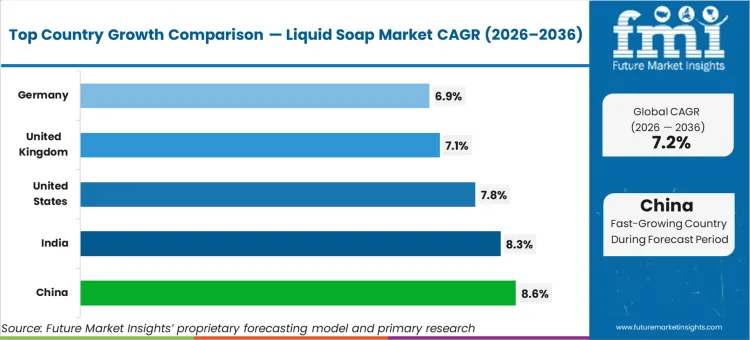
.webp "Top Country Growth Comparison Liquid Soap Market Cagr (2026 2036)")
| Country | CAGR (2026 to 2036) |
|---|---|
| United States | 7.8% |
| United Kingdom | 7.1% |
| Germany | 6.9% |
| China | 8.6% |
| India | 8.3% |
Source: Market analysis based on proprietary forecasting model and primary research
North America Liquid Soap Market Analysis
The North America liquid soap market is expanding due to hygiene compliance across healthcare, food service, and commercial workplaces. In February 2024, the U.S. government expanded the EPA program to bring wastewater sanitation services to rural America. [3] In the United States, enforcement of hand hygiene standards in hospitals and food processing units has increased monitored washroom installations. Touchless dispenser deployment across airports, malls, and corporate offices is driving steady refill demand. Public infrastructure upgrades in urban centers are further supporting high-volume liquid soap procurement contracts.
- United States: Sales of liquid soap in the United States are projected to grow at 7.8% CAGR from 2026 to 2036. Food processing and restaurant chains operate under the U.S. Food and Drug Administration Food Code guidelines, requiring documented handwashing practices. This has increased standardized dispenser installations across commercial kitchens and quick-service outlets. Corporate offices are incorporating hygiene audits into facility management contracts, expanding bulk procurement agreements with soap manufacturers.
The report provides an extensive evaluation of growth across North America, featuring country-level insights for the United States and Canada. It examines hygiene behavior patterns, shifts in retail formats, and category-wise market progression, highlighting how product segmentation and channel strategies influence competitive positioning and revenue generation across the regional landscape.
Asia Pacific Liquid Soap Market Analysis
Government-led public health programs in several countries are strengthening hygiene adoption in schools and healthcare centers. Institutional procurement volumes are rising as public hospitals standardize liquid formats for infection control compliance. Private healthcare expansion across metropolitan clusters is further driving consistent bulk demand. Retail modernization is a major growth lever. Expansion of hypermarkets, convenience chains, and digital commerce platforms is improving product accessibility beyond tier-one cities. Consumers are trading up from bar soap to pump-based liquid formats due to convenience and aspirational lifestyle alignment.
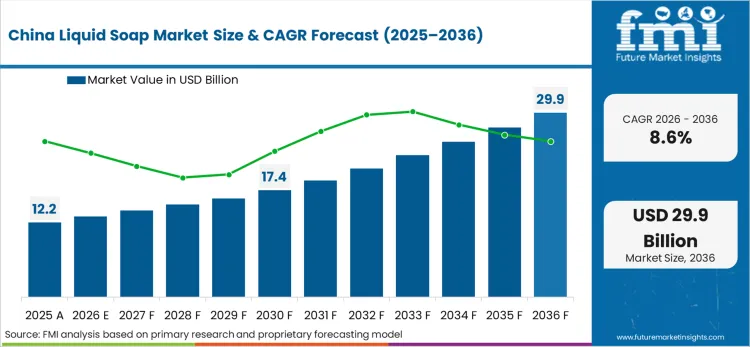
- China: The demand for liquid soap in China is poised to grow at 8.6% CAGR during the study period. Rapid development of commercial complexes, metro networks, airports, and Grade A office buildings has increased installation of automatic dispensing systems that require liquid refill formats. Public hospital upgrades and infection control monitoring are raising per capita soap consumption within institutional environments. In June 2024, many health authorities have rolled out new measures to ensure robust emergency response to acute infectious disease outbreaks. [4]
- India: The Indian liquid soap market is anticipated to grow at 8.3% CAGR during the forecast period. India’s liquid soap market is progressing due to expanding urban sanitation infrastructure and rising penetration of organized retail. Government-led hygiene programs across schools and public institutions have increased handwashing frequency awareness, translating into higher adoption of liquid formats in urban households.
The comprehensive study evaluates the liquid soap market across East and South Asia from 2021 to 2036, assessing retail structure expansion, channel performance trends, and product variant distribution in China, Japan, South Korea, India, Singapore, and Australia. It outlines pricing tier strategies that support brand penetration and competitive positioning within diverse consumer income segments across these regional markets.
Europe Liquid Soap Market Analysis
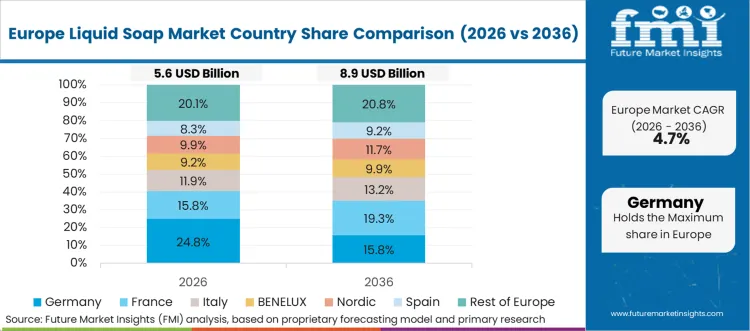
Modern retail density across Germany, France, Italy, and Spain supports high category visibility. Private label penetration is strong, driving competitive pricing and deeper household adoption. Growth in hospitality, tourism recovery, and commercial real estate upgrades is increasing consumption across airports, hotels, and office complexes. Digital commerce channels are supporting subscription refill models, improving repeat purchase rates. Stable supply chains and established FMCG distribution networks across the region continue to support sustained revenue growth for liquid soap manufacturers.
- Germany: Demand for liquid soap in Germany is estimated to grow at 6.9% CAGR during the study period. Germany’s liquid soap market is advancing under a strong regulatory and compliance framework. Workplace hygiene standards monitored by the Federal Institute for Occupational Safety and Health require documented sanitation measures across industrial sites, offices, and public facilities. [5] Healthcare hygiene protocols aligned with national infection control guidelines are increasing monitored handwashing frequency in hospitals and eldercare centers, driving institutional refill demand.
- United Kingdom: The sales of liquid soap are slated to expand at 7.1% CAGR from 2026 to 2036. Workplace sanitation guidance from the Health and Safety Executive has led corporate offices, manufacturing plants, and logistics hubs to formalize hygiene audits. This is supporting standardized liquid soap installations in commercial washrooms. Hospitality recovery and expansion of quick-service restaurants are creating structured institutional procurement cycles.
The European liquid soap market analysis delivers country-level insights for the United Kingdom, Germany, France, Italy, Spain, the Netherlands, and Scandinavia. It provides detailed evaluation of ingredient compliance frameworks and examines the uptake of eco-conscious packaging formats, outlining how regulatory standards and sustainability preferences shape product development and competitive positioning across the region.
Competitive Landscape for Liquid Soap Market Players
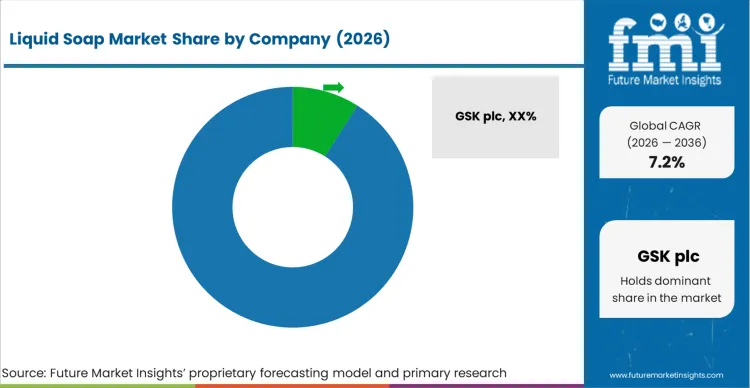
The liquid soap market is characterized by strong participation from global FMCG corporations, regional manufacturers, and private label suppliers. Multinational players such as Unilever, Procter & Gamble, and Reckitt leverage diversified personal care portfolios and established retail relationships to secure dominant shelf presence. These companies focus on dermatologically tested formulations, fragrance differentiation, and sustainable packaging to protect brand equity and pricing power.
Private label competition is intensifying across supermarkets and hypermarkets. Large retail groups are expanding in-house liquid soap ranges to improve margin capture and pricing flexibility. Contract manufacturers are benefiting from this shift by scaling production capacity and offering customized formulations aligned with retailer specifications.
Operational efficiency and supply chain integration remain key competitive factors. Companies are investing in automated filling lines, lightweight packaging design, and regional distribution hubs to improve cost control. Institutional contracts with healthcare, hospitality, and corporate facility management firms provide stable bulk revenue streams. Digital commerce expansion is enabling subscription refill models and direct-to-consumer sales, increasing customer lifetime value. Sustainability compliance and refill ecosystem development are emerging as long-term differentiation levers within the competitive environment.
Recent Developments
The report includes comprehensive coverage of key industry developments and competitive positioning:
- In March 2025, Lifebuoy rolled out Skin Solutions range to target the premium personal soaps and body washes space. This range has been launched in Vietnam in 2024 and enjoyed success. [6]
Key Players in Liquid Soap Market
- GSK plc
- Unilever PLC
- Colgate-Palmolive Company
- Cleenol Group Ltd
- Christina May Ltd
- Godrej Consumer Products Limited
- Reckitt Benckiser Group plc (Reckitt)
- Hindustan Unilever Limited
- Henkel AG & Co. KGaA
Scope of the Report
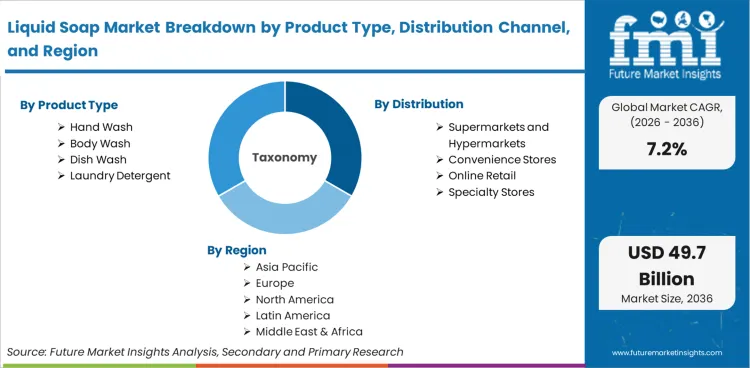
| Metric | Value |
|---|---|
| Quantitative Units | USD 24.8 billion (2026) to USD 49.7 billion (2036), at a CAGR of 7.2% |
| Market Definition | The liquid soap market comprises the global development, production, and distribution of water-based surfactant solutions including hand wash, body wash, and household cleaning products designed for dispensing applications across residential and commercial settings. |
| Product Type Segmentation | Hand Wash, Body Wash, Dish Wash, Laundry Detergent |
| Distribution Channel Coverage | Supermarkets and Hypermarkets, Convenience Stores, Online Retail, Specialty Stores |
| Application Segmentation | Household Use, Commercial Establishments, Healthcare Facilities, Food Service Operations |
| Regions Covered | North America, Latin America, Europe, East Asia, South Asia, Oceania, Middle East and Africa |
| Countries Covered | United States, Canada, United Kingdom, Germany, France, China, Japan, India, Brazil, UAE and 40 countries |
| Key Companies Profiled | GSK plc, Unilever PLC, Colgate-Palmolive Company, Cleenol Group Ltd, Christina May Ltd, Godrej Consumer Products Limited, Reckitt Benckiser Group plc (Reckitt), Hindustan Unilever Limited, Henkel AG & Co. KGaA |
| Forecast Period | 2026 to 2036 |
| Approach | Hybrid top down and bottom up market modeling validated through retail sales tracking and household consumption surveys, supported by distribution network verification and purchase pattern analysis |
Liquid Soap Market Analysis by Segments
Product Type:
- Hand Wash
- Body Wash
- Dish Wash
- Laundry Detergent
Distribution Channel:
- Supermarkets and Hypermarkets
- Convenience Stores
- Online Retail
- Specialty Stores
- Others (direct sales, institutional supply)
Application:
- Household Use
- Commercial Establishments
- Healthcare Facilities
- Food Service Operations
Region:
- Asia Pacific
- China
- Japan
- South Korea
- India
- Australia
- Singapore
- Thailand
- Rest of Asia Pacific
- Europe
- United Kingdom
- Germany
- France
- Italy
- Spain
- Netherlands
- Scandinavia
- Switzerland
- Rest of Europe
- North America
- United States
- Canada
- Latin America
- Brazil
- Mexico
- Argentina
- Rest of Latin America
- Middle East & Africa
- United Arab Emirates
- Saudi Arabia
- South Africa
- Israel
- Rest of Middle East & Africa
Bibliography
- [1] Reckitt Benckiser Group plc. (2024, July 24). Reckitt to sharpen its portfolio and simplify organisation for accelerated growth and value creation [Press release].
- [2] USA Department of Agriculture, Food Safety and Inspection Service. (n.d.). Foodborne illness and disease. FSIS.
- [3] USA Environmental Protection Agency. (2024, February 13). Biden-Harris administration expands EPA program to bring wastewater sanitation services to 150 more underserved communities across Rural America as part of Investing in America Agenda [News release].
- [4] State Council Information Office. (2024, June 6). China opposes words, deeds that escalate tensions on the Korean Peninsula [Press release]. State Council Information Office.
- [5] Federal Institute for Occupational Safety and Health (BAuA). (n.d.). About BAuA.
- [6] Unilever. (2025, March 14). Premium skincare meets hygiene in Lifebuoy’s Skin Solutions range.
This bibliography is provided for reader reference and is not exhaustive. The full report contains the complete reference list and detailed citations.
This Report Addresses
- Market intelligence to enable strategic decision making across established and emerging personal care markets
- Market size estimation and 10-year revenue forecasts from 2026 to 2036, supported by validated retail sales data and household consumption surveys
- Growth opportunity mapping across product types and application segments with emphasis on formulation optimization
- Segment and regional revenue forecasts covering hand wash, body cleansing products, household cleaning variants, and retail distribution networks
- Competition strategy assessment including ingredient transparency requirements, packaging innovation positioning, and dermatological certification adoption
- Product development tracking including moisturizing additive innovations, antibacterial formulation trends, and eco-packaging capabilities
- Market access analysis covering distribution agreements, retail category partnerships, and private label engagement programs
- Market report delivery in PDF, Excel, PPT, and interactive dashboard formats for executive and operational use
Frequently Asked Questions
How large is the demand for Liquid Soap in the global market in 2026?
Demand for Liquid Soap in the global market is estimated to be valued at USD 24.8 billion in 2026.
What will be the market size of Liquid Soap in the global market by 2036?
Market size for Liquid Soap is projected to reach USD 49.7 billion by 2036.
What is the expected demand growth for Liquid Soap in the global market between 2026 and 2036?
Demand for Liquid Soap in the global market is expected to grow at a CAGR of 7.2% between 2026 and 2036.
Which Product Type is poised to lead global sales by 2026?
Hand Wash is expected to be the dominant product type, capturing approximately 39.0% of global market share in 2026 due to antibacterial formulations and moisturizing ingredient systems.
How significant is the role of Supermarkets and Hypermarkets in driving Liquid Soap adoption in 2026?
Supermarkets and hypermarkets represent a primary distribution channel, projected to hold approximately 44% share of the total market in 2026 as product range visibility and bulk purchase programs maintain physical retail relevance.
What is Driving Liquid Soap Demand in the United States?
Antibacterial product adoption and increased premium formulation availability across retail categories are driving growth.
What Consumer Trends are Referenced for the United States?
Hygiene protocol expansion and packaging convenience preferences are referenced as key consumer behavior shifts.
What is the United States Growth Outlook in this Report?
The United States is projected to grow at a CAGR of 7.8% during 2026 to 2036.
Why is Europe described as Important for Product Development in this Report?
Growth is driven by ingredient regulation compliance and environmental packaging standards that establish formulation specifications.
What Type of Product Development Dominates in Europe?
Organic certified formulations with refillable packaging systems and eco-friendly ingredient profiles dominate regional market segments.
What is Germany Growth Outlook in this Report?
Germany is projected to expand at a CAGR of 6.9% during 2026 to 2036.
Does the Report Cover China in its Regional Analysis?
China is included within East Asia under the regional scope of analysis.
What are the Sources referred to for analyzing the Market in China?
Urbanization statistics, retail modernization data, and domestic brand performance tracking covering purchase patterns, price sensitivity analysis, and product format preferences are cited as primary reference sources.
What is the Main Development Theme Linked to China in Asia Coverage?
Asia Pacific development is associated with urbanization acceleration enabling product standardization across metropolitan areas.
Does the Report Cover India in its Regional Analysis?
India is included within South Asia under the regional coverage framework.
What is the Main India Related Development Theme in Asia Coverage?
Rising middle-class purchasing power creating foundation for packaged personal care adoption and local manufacturing using cost-effective production methods is emphasized.
Which Distribution Strategies are Strategically Important for Asia Pacific Market Entry?
Retail format partnerships and private label programs are prioritized for cost-effective brand building across regional markets.
What is Liquid Soap and What is It Mainly Used For?
Liquid soap involves water-based surfactant formulations primarily used for personal hygiene and household cleaning including residential bathrooms, commercial facilities, and institutional operations.
What does Liquid Soap Market Mean in this Report?
Liquid soap market refers to global development, manufacturing, and retail distribution of cleansing products across various application categories and consumer segments.
What is Included in the Scope of this Liquid Soap Market Report?
Scope covers products by type, key distribution channels such as supermarkets and online platforms, and application segments including household use, commercial establishments, and healthcare facilities.
What is Excluded from the Scope of this Report?
Bar soap formats, powder detergents, industrial cleaning chemicals, and specialized medical scrub solutions are excluded unless part of liquid soap product offerings.
What does Market Forecast Mean on this Page?
Market forecast represents model-based projections built on retail sales trends and household consumption assumptions for strategic planning purposes.
How is the Liquid Soap Market Forecast Built and Validated?
Forecast is developed using hybrid modeling validated through retail point-of-sale data, household consumption surveys, and distribution network verification.
What does Zero Reliance on Speculative Third Party Market Research Mean Here?
Market analysis is based on verifiable sales figures, household penetration data, and consumption patterns rather than speculative personal care trend predictions.
Preview the report firsthand - request a free sample
Get SampleGet the brochure for pricing and purchase details.
Get PDFTable of Content
- Executive Summary
- Global Market Outlook
- Demand-side Trends
- Supply-side Trends
- Technology Roadmap Analysis
- Analysis and Recommendations
- Market Overview
- Market Coverage / Taxonomy
- Market Definition / Scope / Limitations
- Research Methodology
- Chapter Orientation
- Analytical Lens and Working Hypotheses
- Market Structure, Signals, and Trend Drivers
- Company Annual and Sustainability Reports
- Peer-reviewed Journals and Academic Literature
- Corporate Websites, Product Literature, and Technical Notes
- Earnings Decks and Investor Briefings
- Statutory Filings and Regulatory Disclosures
- Technical White Papers and Standards Notes
- Trade Journals, Industry Magazines, and Analyst Briefs
- Conference Proceedings, Webinars, and Seminar Materials
- Government Statistics Portals and Public Data Releases
- Press Releases and Reputable Media Coverage
- Specialist Newsletters and Curated Briefings
- Sector Databases and Reference Repositories
- FMI Internal Proprietary Databases and Historical Market Datasets
- Subscription Datasets and Paid Sources
- Social Channels, Communities, and Digital Listening Inputs
- Additional Desk Sources
- Expert Input and Fieldwork (Primary Evidence)
- Primary Modes
- Qualitative Interviews and Expert Elicitation
- Quantitative Surveys and Structured Data Capture
- Blended Approach
- Why Primary Evidence is Used
- Field Techniques
- Interviews
- Surveys
- Focus Groups
- Observational and In-context Research
- Social and Community Interactions
- Stakeholder Universe Engaged
- C-suite Leaders
- Board Members
- Presidents and Vice Presidents
- R&D and Innovation Heads
- Technical Specialists
- Domain Subject-matter Experts
- Scientists
- Physicians and Other Healthcare Professionals
- Governance, Ethics, and Data Stewardship
- Research Ethics
- Data Integrity and Handling
- Primary Modes
- Tooling, Models, and Reference Databases
- Data Engineering and Model Build
- Data Acquisition and Ingestion
- Cleaning, Normalisation, and Verification
- Synthesis, Triangulation, and Analysis
- Quality Assurance and Audit Trail
- Market Background
- Market Dynamics
- Drivers
- Restraints
- Opportunity
- Trends
- Scenario Forecast
- Demand in Optimistic Scenario
- Demand in Likely Scenario
- Demand in Conservative Scenario
- Opportunity Map Analysis
- Product Life Cycle Analysis
- Supply Chain Analysis
- Investment Feasibility Matrix
- Value Chain Analysis
- PESTLE and Porter’s Analysis
- Regulatory Landscape
- Regional Parent Market Outlook
- Production and Consumption Statistics
- Import and Export Statistics
- Market Dynamics
- Global Market Analysis 2021 to 2025 and Forecast, 2026 to 2036
- Historical Market Size Value (USD Million) Analysis, 2021 to 2025
- Current and Future Market Size Value (USD Million) Projections, 2026 to 2036
- Y-o-Y Growth Trend Analysis
- Absolute $ Opportunity Analysis
- Global Market Pricing Analysis 2021 to 2025 and Forecast 2026 to 2036
- Global Market Analysis 2021 to 2025 and Forecast 2026 to 2036, By Product Type
- Introduction / Key Findings
- Historical Market Size Value (USD Million) Analysis By Product Type , 2021 to 2025
- Current and Future Market Size Value (USD Million) Analysis and Forecast By Product Type , 2026 to 2036
- Hand Wash
- Body Wash
- Dish Wash
- Laundry Detergent
- Hand Wash
- Y-o-Y Growth Trend Analysis By Product Type , 2021 to 2025
- Absolute $ Opportunity Analysis By Product Type , 2026 to 2036
- Global Market Analysis 2021 to 2025 and Forecast 2026 to 2036, By Distribution Channel
- Introduction / Key Findings
- Historical Market Size Value (USD Million) Analysis By Distribution Channel, 2021 to 2025
- Current and Future Market Size Value (USD Million) Analysis and Forecast By Distribution Channel, 2026 to 2036
- Supermarkets and Hypermarkets
- Convenience Stores
- Online Retail
- Specialty Stores
- Supermarkets and Hypermarkets
- Y-o-Y Growth Trend Analysis By Distribution Channel, 2021 to 2025
- Absolute $ Opportunity Analysis By Distribution Channel, 2026 to 2036
- Global Market Analysis 2021 to 2025 and Forecast 2026 to 2036, By Region
- Introduction
- Historical Market Size Value (USD Million) Analysis By Region, 2021 to 2025
- Current Market Size Value (USD Million) Analysis and Forecast By Region, 2026 to 2036
- North America
- Latin America
- Western Europe
- Eastern Europe
- East Asia
- South Asia and Pacific
- Middle East & Africa
- Market Attractiveness Analysis By Region
- North America Market Analysis 2021 to 2025 and Forecast 2026 to 2036, By Country
- Historical Market Size Value (USD Million) Trend Analysis By Market Taxonomy, 2021 to 2025
- Market Size Value (USD Million) Forecast By Market Taxonomy, 2026 to 2036
- By Country
- USA
- Canada
- Mexico
- By Product Type
- By Distribution Channel
- By Country
- Market Attractiveness Analysis
- By Country
- By Product Type
- By Distribution Channel
- Key Takeaways
- Latin America Market Analysis 2021 to 2025 and Forecast 2026 to 2036, By Country
- Historical Market Size Value (USD Million) Trend Analysis By Market Taxonomy, 2021 to 2025
- Market Size Value (USD Million) Forecast By Market Taxonomy, 2026 to 2036
- By Country
- Brazil
- Chile
- Rest of Latin America
- By Product Type
- By Distribution Channel
- By Country
- Market Attractiveness Analysis
- By Country
- By Product Type
- By Distribution Channel
- Key Takeaways
- Western Europe Market Analysis 2021 to 2025 and Forecast 2026 to 2036, By Country
- Historical Market Size Value (USD Million) Trend Analysis By Market Taxonomy, 2021 to 2025
- Market Size Value (USD Million) Forecast By Market Taxonomy, 2026 to 2036
- By Country
- Germany
- UK
- Italy
- Spain
- France
- Nordic
- BENELUX
- Rest of Western Europe
- By Product Type
- By Distribution Channel
- By Country
- Market Attractiveness Analysis
- By Country
- By Product Type
- By Distribution Channel
- Key Takeaways
- Eastern Europe Market Analysis 2021 to 2025 and Forecast 2026 to 2036, By Country
- Historical Market Size Value (USD Million) Trend Analysis By Market Taxonomy, 2021 to 2025
- Market Size Value (USD Million) Forecast By Market Taxonomy, 2026 to 2036
- By Country
- Russia
- Poland
- Hungary
- Balkan & Baltic
- Rest of Eastern Europe
- By Product Type
- By Distribution Channel
- By Country
- Market Attractiveness Analysis
- By Country
- By Product Type
- By Distribution Channel
- Key Takeaways
- East Asia Market Analysis 2021 to 2025 and Forecast 2026 to 2036, By Country
- Historical Market Size Value (USD Million) Trend Analysis By Market Taxonomy, 2021 to 2025
- Market Size Value (USD Million) Forecast By Market Taxonomy, 2026 to 2036
- By Country
- China
- Japan
- South Korea
- By Product Type
- By Distribution Channel
- By Country
- Market Attractiveness Analysis
- By Country
- By Product Type
- By Distribution Channel
- Key Takeaways
- South Asia and Pacific Market Analysis 2021 to 2025 and Forecast 2026 to 2036, By Country
- Historical Market Size Value (USD Million) Trend Analysis By Market Taxonomy, 2021 to 2025
- Market Size Value (USD Million) Forecast By Market Taxonomy, 2026 to 2036
- By Country
- India
- ASEAN
- Australia & New Zealand
- Rest of South Asia and Pacific
- By Product Type
- By Distribution Channel
- By Country
- Market Attractiveness Analysis
- By Country
- By Product Type
- By Distribution Channel
- Key Takeaways
- Middle East & Africa Market Analysis 2021 to 2025 and Forecast 2026 to 2036, By Country
- Historical Market Size Value (USD Million) Trend Analysis By Market Taxonomy, 2021 to 2025
- Market Size Value (USD Million) Forecast By Market Taxonomy, 2026 to 2036
- By Country
- Kingdom of Saudi Arabia
- Other GCC Countries
- Turkiye
- South Africa
- Other African Union
- Rest of Middle East & Africa
- By Product Type
- By Distribution Channel
- By Country
- Market Attractiveness Analysis
- By Country
- By Product Type
- By Distribution Channel
- Key Takeaways
- Key Countries Market Analysis
- USA
- Pricing Analysis
- Market Share Analysis, 2025
- By Product Type
- By Distribution Channel
- Canada
- Pricing Analysis
- Market Share Analysis, 2025
- By Product Type
- By Distribution Channel
- Mexico
- Pricing Analysis
- Market Share Analysis, 2025
- By Product Type
- By Distribution Channel
- Brazil
- Pricing Analysis
- Market Share Analysis, 2025
- By Product Type
- By Distribution Channel
- Chile
- Pricing Analysis
- Market Share Analysis, 2025
- By Product Type
- By Distribution Channel
- Germany
- Pricing Analysis
- Market Share Analysis, 2025
- By Product Type
- By Distribution Channel
- UK
- Pricing Analysis
- Market Share Analysis, 2025
- By Product Type
- By Distribution Channel
- Italy
- Pricing Analysis
- Market Share Analysis, 2025
- By Product Type
- By Distribution Channel
- Spain
- Pricing Analysis
- Market Share Analysis, 2025
- By Product Type
- By Distribution Channel
- France
- Pricing Analysis
- Market Share Analysis, 2025
- By Product Type
- By Distribution Channel
- India
- Pricing Analysis
- Market Share Analysis, 2025
- By Product Type
- By Distribution Channel
- ASEAN
- Pricing Analysis
- Market Share Analysis, 2025
- By Product Type
- By Distribution Channel
- Australia & New Zealand
- Pricing Analysis
- Market Share Analysis, 2025
- By Product Type
- By Distribution Channel
- China
- Pricing Analysis
- Market Share Analysis, 2025
- By Product Type
- By Distribution Channel
- Japan
- Pricing Analysis
- Market Share Analysis, 2025
- By Product Type
- By Distribution Channel
- South Korea
- Pricing Analysis
- Market Share Analysis, 2025
- By Product Type
- By Distribution Channel
- Russia
- Pricing Analysis
- Market Share Analysis, 2025
- By Product Type
- By Distribution Channel
- Poland
- Pricing Analysis
- Market Share Analysis, 2025
- By Product Type
- By Distribution Channel
- Hungary
- Pricing Analysis
- Market Share Analysis, 2025
- By Product Type
- By Distribution Channel
- Kingdom of Saudi Arabia
- Pricing Analysis
- Market Share Analysis, 2025
- By Product Type
- By Distribution Channel
- Turkiye
- Pricing Analysis
- Market Share Analysis, 2025
- By Product Type
- By Distribution Channel
- South Africa
- Pricing Analysis
- Market Share Analysis, 2025
- By Product Type
- By Distribution Channel
- USA
- Market Structure Analysis
- Competition Dashboard
- Competition Benchmarking
- Market Share Analysis of Top Players
- By Regional
- By Product Type
- By Distribution Channel
- Competition Analysis
- Competition Deep Dive
- GSK plc
- Overview
- Product Portfolio
- Profitability by Market Segments (Product/Age /Sales Channel/Region)
- Sales Footprint
- Strategy Overview
- Marketing Strategy
- Product Strategy
- Channel Strategy
- Unilever PLC
- Colgate-Palmolive Company
- Cleenol Group Ltd
- Christina May Ltd
- Godrej Consumer Products Limited
- Reckitt Benckiser Group plc (Reckitt)
- GSK plc
- Competition Deep Dive
- Assumptions & Acronyms Used


