

- Market Size (2026)
- USD 90.0 Mn
- Forecast (2036)
- USD 229.2 Mn
- CAGR (2026 to 2036)
- 9.8%
Active Hybrid Humidification Incubator Market Size, Market Forecast and Outlook By FMI
USD 90.0 million in 2026 and USD 229.2 million by 2036 at a 9.8% CAGR.
The active hybrid humidification incubator industry value is anticipated to scale from USD 82.0 million in 2025 to USD 229.2 million by 2036 at 9.8% CAGR due to laboratories shifting toward CO2 incubators with faster humidity recovery and stronger chamber stability. Direct supplier sales are forecast to represent 61.0% share in 2026 as pharmaceutical and biotech buyers prefer demonstrations and service contracts before purchase approval. Pharmaceutical and biotech companies are expected to secure 58.0% share in 2026, led by cell-culture programs requiring repeatable humidity behavior and contamination-control assurance.
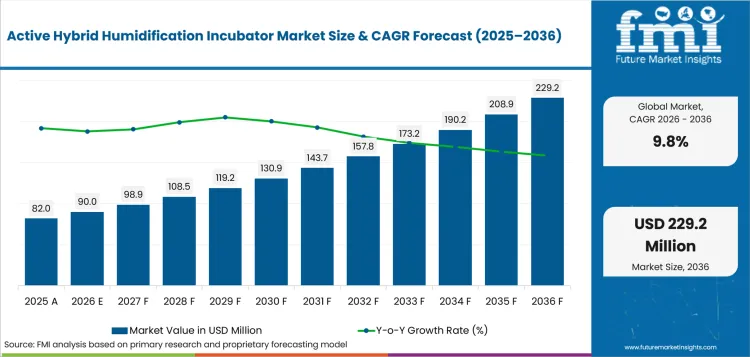
| Metric | Value |
|---|---|
| 2025 Market Size | USD 82.0 million |
| 2026 Market Size | USD 90.0 million |
| 2036 Market Size | USD 229.2 million |
| Forecast CAGR | 9.8% from 2026 to 2036 |
| Leading Sales Channel | Direct Supplier Sales |
| Direct Supplier Sales Share in 2026 | 61.0% |
| Leading End User | Pharmaceutical and Biotech Companies |
| Pharmaceutical and Biotech Companies Share in 2026 | 58.0% |
| Fastest-growing Country | China |
| China CAGR | 11.2% by 2036 |
| Market Signal | Commercial Impact |
|---|---|
| Demand and Growth Drivers | Active hybrid humidification incubator demand is expected to expand steadily through 2036, driven by cell-culture quality needs and stronger service expectations across premium laboratory equipment.
|
| Product and Segment View | Direct supplier sales, pharmaceutical and biotech companies, and the 150-250 liter capacity segment are expected to lead their respective market categories.
|
| Geography and Growth Outlook | China and India are projected to remain the primary growth markets as biotechnology investment and laboratory infrastructure continue to expand.
|
| Competitive Landscape | Competition is centered on contamination control, humidity recovery performance, and laboratory service capabilities.
|
| Analyst Perspective | Active hybrid humidification is evolving into a workflow protection feature for advanced laboratory environments.
- Anurag Sharma, Principal Consultant for Technology at FMI |
Lab infrastructure planning is moving toward equipment that protects cultures during repeated chamber access. PHCbi states that its active humidification model reduces humidity setpoint recovery from 16 minutes to 8 minutes, with active steam generation from 80% to 90% humidity before passive stabilization above 91%. NIH reported USD 35.3 billion in competing and noncompeting grants during fiscal year 2025, strengthening the research base for advanced laboratory equipment. United Kingdom officials committed up to GBP 520.0 million for life sciences manufacturing support, while India’s BioE3 biofoundry and biomanufacturing hub call received 253 proposals. Premium CO2 incubator suppliers can use recovery proof and service coverage to support higher-value laboratory purchases.
Which factors support expansion in the active hybrid humidification incubator market?
Premium CO2 incubator revenue is supported by humidity recovery proof and cell-culture quality requirements.
- Market value is supported by finished active hybrid CO2 incubator revenue before service contracts and distributor margins add incremental sales.
- Supplier pricing reflects active steam generation and service documentation before capacity affects final unit cost.
- Revenue improves as pharmaceutical laboratories convert passive water-pan chambers into systems with measurable recovery claims.
- Buyer trust rises as vendors document humidity setpoint recovery and post-installation calibration support.
Why is the active hybrid humidification incubator market growing?
Cell-culture laboratories are moving toward CO2 incubators recovering humidity faster after door access and help protect sensitive samples.
Growth outlook is supported by higher use of controlled culture systems in biologics, cell therapy, and new-drug development. China’s medical product regulator announced a 30-day clinical trial review channel in October 2025 for eligible Class I innovative drugs, including biological products. Faster movement from research planning toward clinical work increases demand for incubators supporting validated culture conditions. PHCbi’s active hybrid humidification claim also gives buyers a measurable comparison point by reducing setpoint recovery from 16 minutes to 8 minutes. Laboratories handling organoids and small-volume plates can justify premium CO2 incubators more easily as evaporation control becomes part of result quality.
How is the active hybrid humidification incubator market segmented?
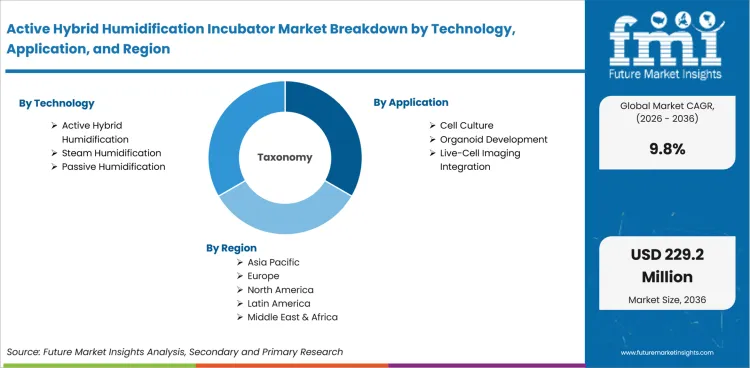
Active hybrid humidification incubator industry is segmented by technology, application, capacity, end user, and sales channel.
- Active hybrid humidification is projected to secure 52.0% share in 2026, led by internal humidity sensing and passive stabilization after active steam generation.
- Cell culture is anticipated to hold 46.0% share in 2026, as mammalian culture work creates the largest replacement base for premium CO2 incubators.
- The 150-250 liter capacity band is expected to capture 55.0% share in 2026, supported by shared laboratory layouts that need stackable units and stable chamber behavior.
- Pharmaceutical and biotech companies are forecast to represent 58.0% share in 2026, guided by validation documents and sample-protection requirements.
- Direct supplier sales are projected to account for 61.0% share in 2026, reflected by buyer need for demonstrations and direct service accountability.
Why does active hybrid humidification lead technology demand?
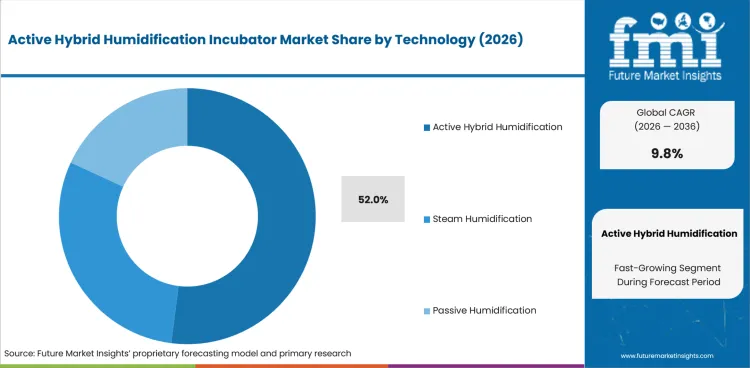
- Active hybrid humidification is projected to account for 52.0% share in 2026, influenced by faster setpoint recovery and better humidity control during repeated chamber access.
- Steam humidification gains use in laboratories that need rapid recovery. Cleaning burden and condensation control can limit wider adoption.
Which application leads the active hybrid humidification incubator market?
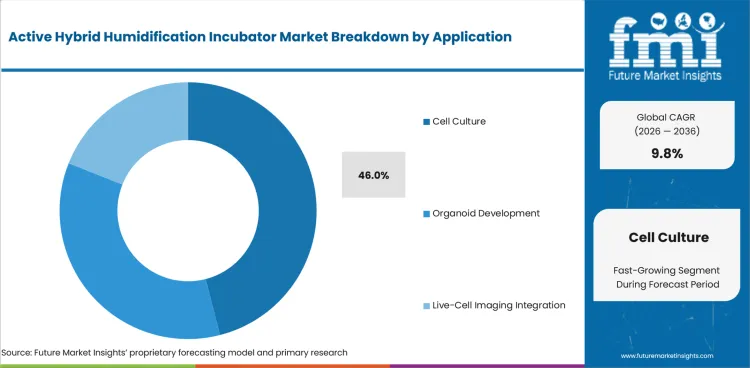
- Cell culture is anticipated to hold 46.0% share in 2026, supported by the large installed base of mammalian culture laboratories and routine CO2 incubator replacement.
- Organoid development records faster adoption as three-dimensional cultures need stronger humidity consistency across longer culture periods.
Which capacity range leads active hybrid humidification incubator purchases?
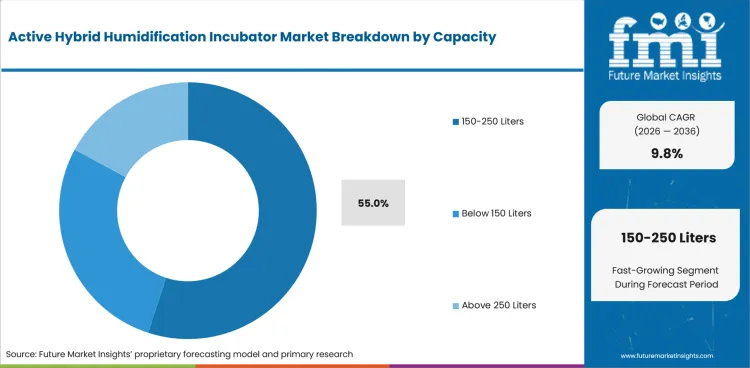
- The 150-250 liter range is forecast to secure 55.0% share in 2026, reflected by stackable use, shared laboratory planning, and efficient chamber recovery.
- Above 250 liters units gain value in process teams needing higher throughput. Longer access cycles are likely to increase recovery scrutiny.
Which end user leads active hybrid humidification incubator demand?
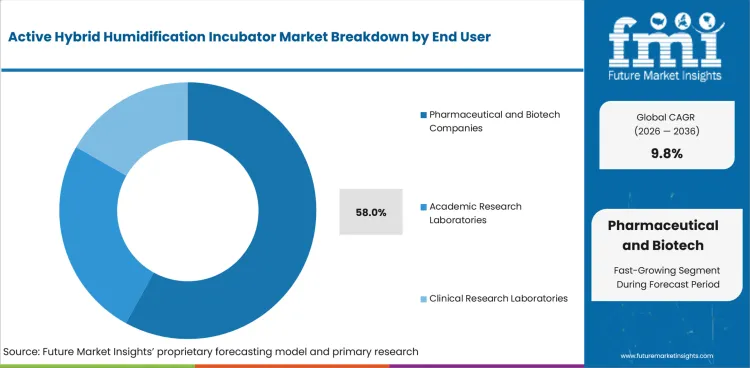
- Pharmaceutical and biotech companies are expected to represent 58.0% share in 2026, shaped by validation needs and internal quality review.
- Academic research laboratories gain adoption as core facilities add shared incubators for cell culture and live-cell support work.
Which sales channel leads active hybrid humidification incubator demand?
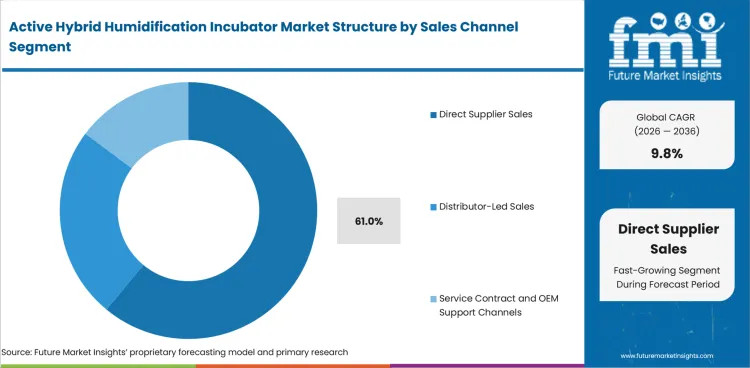
- Direct supplier sales are projected to account for 61.0% share in 2026, led by technical demonstrations and post-installation service needs.
- Distributor-led sales remain important in fast-growth countries as local training and spare-parts access influence repeat purchase decisions.
What are the driver, restraints, and opportunities in the active hybrid humidification incubator market?
Door-opening recovery performance supports growth while service complexity limits passive-system replacement speed.
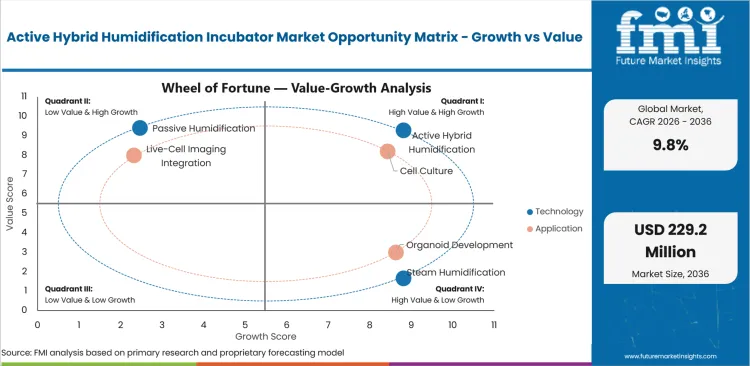
- Driver: Door-opening recovery performance gives buyers a measurable reason to replace passive systems.
- Restraint: Active humidity systems require calibration support and user training.
- Opportunity: Organoid and live-cell workflows promote specialty demand for stable humidity under frequent access.
Active Hybrid Humidification Incubator Market Demand Outlook
Demand outlook is shaped by active cell-culture workflows, and stronger laboratory equipment qualification. NIH reported that nearly 82% of its nearly USD 48.0 billion budget supports extramural research through almost 50,000 competitive grants. Active hybrid humidification incubators benefit as universities, medical schools, and research institutions keep investing in cell-culture infrastructure. Buyers need proof that humidity recovery are likely to support plate-based culture and live-cell support without adding excess condensation or cleaning difficulty.
Service and Qualification Pressure in Premium Incubators
Service complexity restrains upgrades as active humidity systems include sterilization routines and calibration checks. Thermo Fisher’s Vios iDx material states, its advanced HEPA filtration can filter the entire chamber air volume in 60 seconds, while its sterilization cycle reaches 180°C and supports a 12-log sterility assurance claim. Specialized performance claims require trained users and documented maintenance. Laboratories with limited field-service access may delay replacement of passive systems until vendors provide service contracts and fast spare-parts coverage.
Organoid and Live-Cell Workflow Opportunity
Organoid and live-cell support workflows create an opportunity as small-volume cultures need stable humidity over long experimental periods. United Kingdom officials announced more than GBP 80.0 million in April 2026 for life sciences manufacturing projects, including activity aligned with near-patient biomanufacturing of cell and vaccine therapies. Advanced culture workflows connected to such programs require incubators protecting samples through repeated access. Suppliers combining humidity recovery proof with clean chamber design and service documentation should gain stronger acceptance.
Who are the leading companies in the active hybrid humidification incubator market?
PHCbi, Thermo Fisher Scientific, BINDER, Memmert and NuAire.
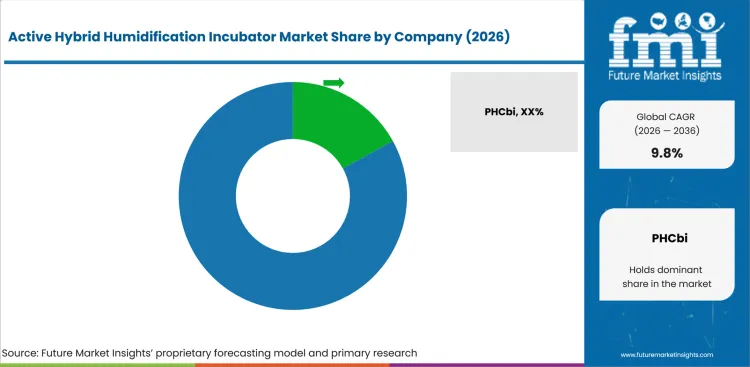
- Global suppliers hold an advantage led by specialized CO2 incubator portfolios and established field support.
- Specialist suppliers gain buyer confidence by solving humidity-control and contamination-control problems for sensitive workflows.
- Distributor-backed suppliers gain acceptance in fast-growth countries as local service quality influences buyer trust after installation.
- Service-ready equipment portfolios support specialized placement based on cleaning guidance and validation documentation.
Competition in the market is shaped by humidity recovery depth and service access. PHCbi has the clearest active hybrid position through Cell-IQ and related compact active-humidification products. Thermo Fisher Scientific benefits from wide laboratory relationships and active humidity options in its incubator portfolio. BINDER and Memmert add engineering credibility around humidification and chamber stability. Buyers assess recovery data and service support before approving specialized CO2 incubator purchases. Humidity recovery proof has become a competitive separator as sensitive cell-culture work moves beyond routine passive water-pan systems. NuAire competes through active humidity guidance and practical user support.
Regional and specialist players can profit through application knowledge and stronger after-sales discipline. Esco Lifesciences supports related laboratory and IVF equipment channels, while Eppendorf adds value through established laboratory relationships. Suppliers with documented cleaning steps and calibration support should gain more durable listing decisions. Vendors relying only on chamber capacity claims are expected to face weaker acceptance in pharmaceutical and academic core facilities.
How do top active hybrid humidification incubator companies compare?
PHCbi and Thermo Fisher Scientific score strongest on humidity recovery depth while BINDER and Memmert strengthen the engineering benchmark.
| Company | Humidity Recovery Depth | Contamination-Control Portfolio | Service and Validation Support | Channel Reach | Geographic Footprint |
|---|---|---|---|---|---|
| PHCbi | High | High | Strong | Very Strong | Global |
| Thermo Fisher Scientific | High | Strong | High | Very Strong | Global |
| BINDER | High | High | Strong | Strong | Global |
| Memmert | High | Strong | Strong | Strong | Global |
| Eppendorf | Medium | Strong | High | Strong | Global |
| NuAire | High | Medium | Strong | Moderate | North America and export markets |
| Esco Lifesciences | Medium | Medium | Moderate | Strong | Global laboratory channels |
Source: Future Market Insights competitive analysis, 2026.
Who are the key players in the active hybrid humidification incubator market?
PHCbi, Thermo Fisher Scientific and BINDER are listed with Memmert and NuAire among other suppliers.
Key global companies leading the active hybrid humidification incubator market include:
- PHCbi
- Thermo Fisher Scientific
- Eppendorf
- BINDER
- Memmert
- NuAire
- Esco Lifesciences
- Selected scientific distributors
Key Developments in Active Hybrid Humidification Incubator Market
- In June 2026, PHC Corporation of North America launched Cell-IQ CO2 incubators with active hybrid humidification, using active steam generation and an internal humidity sensor to control humidity at 80% to 90% with passive water-pan support.
- In November 2025, Thermo Fisher Scientific highlighted Vios iDx CO2 incubators with a 180°C Steri-Run high-temperature sterilization cycle and Cell Locker chambers designed to segregate sensitive cultures.
- In January 2025, NuAire published active versus passive humidity control guidance for CO2 incubators, explaining active humidity applications for cell cultures and embryos.
Key Players in the Active Hybrid Humidification Incubator Market
Global Incubation Suppliers
- PHCbi
- Thermo Fisher Scientific
- Eppendorf
- BINDER
Regional and Specialist Players
- Memmert
- NuAire
Application-Focused Players
- Esco Lifesciences
- Selected scientific distributors
Which countries are growing fastest in the active hybrid humidification incubator market?
China 11.2% CAGR, India 10.8% CAGR, South Korea 10.1% CAGR, United States 9.3% CAGR, Japan 9.1% CAGR, Germany 8.9% CAGR, United Kingdom 8.7% CAGR, and France 8.6% CAGR through 2036.
.webp "Top Country Growth Comparison Active Hybrid Humidification Incubator Market Cagr (2026 2036)")
| Country | CAGR |
|---|---|
| China | 11.2% |
| India | 10.8% |
| South Korea | 10.1% |
| United States | 9.3% |
| Japan | 9.1% |
| Germany | 8.9% |
| United Kingdom | 8.7% |
| France | 8.6% |
Source: Future Market Insights, 2026.
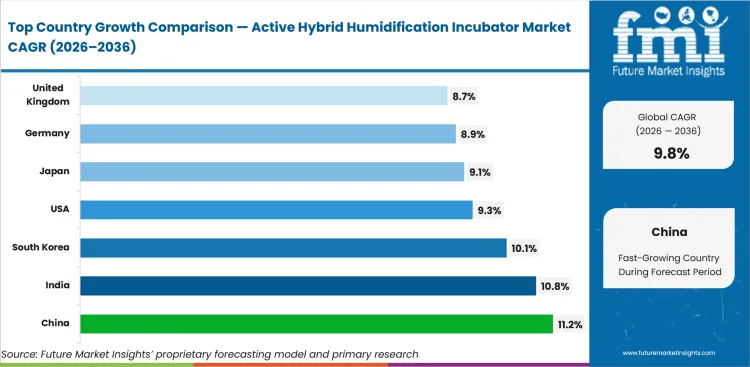
How do country-level CAGRs compare in the active hybrid humidification incubator market?
China leads country growth while France records the most cautious expansion outlook among profiled markets.
- China is forecast to record 11.2% CAGR by 2036, driven by new-drug review reform influencing faster laboratory infrastructure planning.
- India is expected to expand at 10.8% CAGR from 2026 to 2036, led by BioE3-linked biofoundries and biomanufacturing hubs promoting equipment demand.
- South Korea is projected to grow at 10.1% CAGR through 2036 due to compact biopharma clusters increasing demand for premium incubators.
- United States is estimated to rise at 9.3% CAGR by 2036 with NIH-backed research activity supporting advanced cell-culture purchases.
- Japan is expected to advance at 9.1% CAGR over the forecast period since regenerative medicine programs increase controlled culture needs.
- Germany is forecast to grow at 8.9% CAGR through 2036, reflecting gene and cell therapy strategy influencing translational research infrastructure.
- United Kingdom is projected to post 8.7% CAGR by 2036, backed by life sciences manufacturing grants propelling controlled laboratory expansion.
- France is anticipated to record 8.6% CAGR through 2036, guided by bioproduction priorities supporting specialized incubator use.
What is the active hybrid humidification incubator market outlook in China?
A 11.2% CAGR through 2036 reflects new-drug activity and demand for controlled cell-culture infrastructure.
Country Market Snapshot Table
| Parameter | Value |
|---|---|
| Market Size in 2025 (Value) | USD 10.4 million |
| Market Size in 2026 (Value) | USD 11.6 million |
| Market Forecast in 2036 (Value) | USD 33.5 million |
| CAGR (2026 to 2036) | 11.2% |
| Years Considered | 2021 to 2036 |
| Base Year | 2025 |
| Forecast Period | 2026 to 2036 |
| Units Considered | Value (USD million) |
| Leading Sub-Region | Shanghai, Beijing, Suzhou, and Shenzhen biotech corridors |
China Active Hybrid Humidification Incubator Market Outlook
Industry in China is shaped by new-drug review reform and rapid biotech laboratory expansion. Buyers in Shanghai, Beijing, Suzhou, and Shenzhen are expected to prioritize incubators supporting validated culture conditions.
Local distributors need to prove service speed and installation quality as imported premium systems face price comparison against domestic lab equipment. Suppliers with Chinese documentation and responsive field teams should gain stronger repeat orders.
Key Growth Drivers
- New-drug review reform supports faster laboratory planning, supported by NMPA’s 2025 pathway shortening eligible innovative drug clinical trial review to 30 working days.
- Innovative medicine pipelines strengthen cell-culture equipment demand, reinforced through China’s 48 first-in-class innovative drug approvals across nearly 20 therapeutic areas in 2024.
- Biotech parks in Shanghai and Suzhou increase demand for shared incubator rooms and service-backed premium equipment across early development laboratories.
- Contract research buyers prefer systems with measurable humidity recovery claims as project timelines require stable cell-culture conditions.
Key Restraints
- Local price competition limits premium imported equipment adoption as buyers compare active humidity claims against lower-cost domestic CO2 incubators.
- Service gaps outside major clusters can delay installation and spare-parts access for imported active humidity systems.
- Pilot approval rules can slow wider equipment-linked clinical planning, indicated by China’s guideline allowing selected pilots to cut clinical test approval timelines from 60 working days to 30 working days only after approval.
What makes China unique
China is unique due to fast new-drug review reform and dense biotech park demand across major coastal research clusters.
Key Companies
- PHCbi
- Thermo Fisher Scientific
- Eppendorf
- BINDER
- Memmert
- NuAire
- Shanghai Boxun Medical Biological Instrument Corp.
Sales & Marketing Channels
- Direct supplier sales
- Scientific equipment distributors
- Biotech park equipment vendors
- Pharmaceutical account teams
- Academic procurement offices
- Service contract channels
Country Segment Breakdown Table
| Segment | Sub-Segments |
|---|---|
| By Technology | Active Hybrid Humidification · Steam Humidification · Passive Humidification |
| By Application | Cell Culture · Organoid Development · Live-Cell Imaging Integration |
| By Capacity | Below 150 Liters · 150-250 Liters · Above 250 Liters |
| By End User | Pharmaceutical and Biotech Companies · Academic Research Laboratories · Clinical Research Laboratories |
| By Sales Channel | Direct Supplier Sales · Distributor-Led Sales · Service Contract and OEM Support Channels |
| Key Sub-Regions Covered, Biotech Clusters | Shanghai · Beijing · Suzhou · Shenzhen · Guangzhou · Hangzhou |
Frequently Asked Questions
How fast is China active hybrid humidification incubator market growing?
Sales in China are ready to scale at 11.2% CAGR from 2026 to 2036, guided by new-drug activity and biotech cluster expansion.
Who leads China active hybrid humidification incubator market?
PHCbi, Thermo Fisher Scientific, Eppendorf, BINDER, Memmert, NuAire, and local equipment suppliers compete based on technical proof and service reach.
What is driving adoption in China active hybrid humidification incubator market?
New-drug review reform and biotech park activity are moving laboratories toward CO2 incubators with stronger humidity recovery proof.
What is driving active hybrid humidification incubator growth in India?
A 10.8% CAGR through 2036 is supported by BioE3-linked biomanufacturing hubs and fast-growing biotech laboratory infrastructure.
Country Market Snapshot Table
| Parameter | Value |
|---|---|
| Market Size in 2025 (Value) | USD 6.3 million |
| Market Size in 2026 (Value) | USD 7.0 million |
| Market Forecast in 2036 (Value) | USD 19.5 million |
| CAGR (2026 to 2036) | 10.8% |
| Years Considered | 2021 to 2036 |
| Base Year | 2025 |
| Forecast Period | 2026 to 2036 |
| Units Considered | Value (USD million) |
| Leading Sub-Region | Bengaluru, Hyderabad, Pune, and National Capital Region |
India Active Hybrid Humidification Incubator Market Outlook
The market in India is driven by academic biotech expansion and project-linked biomanufacturing planning. Bengaluru and Hyderabad lead early adoption, while Pune and the National Capital Region add demand from research institutes and private laboratories.
Premium adoption will scale faster as vendors combine humidity-control claims with installation support and affordable maintenance. Distributor training remains a purchase filter for laboratories outside major metro clusters.
Key Growth Drivers
- BioE3 policy supports long-term biomanufacturing infrastructure planning, backed by India’s approval of high-performance biomanufacturing support across 6 thematic sectors.
- Biofoundry planning creates laboratory equipment opportunities. The first BioE3 biofoundry and biomanufacturing hub call received 253 proposals after its 2024 issue.
- Academic core facilities increasingly need mid-size CO2 incubators as shared cell-culture workflows expand across biotechnology institutes.
- Private biotech buyers prefer direct demonstrations as active humidity claims need proof before premium equipment approval.
Key Restraints
- Budget sensitivity can limit premium system adoption outside major life science corridors.
- Service coverage remains uneven across tier-two cities, making calibration support and water-management training important.
- Proposal-to-installation timelines can slow equipment orders as the BioE3 hub review used a 4-stage evaluation process before final project movement.
What makes India unique
India is unique due to BioE3 policy momentum and a fast-expanding biotech start-up base across multiple laboratory clusters.
Key Companies
- Thermo Fisher Scientific
- PHCbi
- Eppendorf India
- Esco Lifesciences
- BINDER
- Memmert
- Scientific equipment distributors
Sales & Marketing Channels
- Direct supplier sales
- Scientific equipment distributors
- Academic tender channels
- Biotech incubator networks
- Pharmaceutical account teams
- Service contract channels
Country Segment Breakdown Table
| Segment | Sub-Segments |
|---|---|
| By Technology | Active Hybrid Humidification · Steam Humidification · Passive Humidification |
| By Application | Cell Culture · Organoid Development · Live-Cell Imaging Integration |
| By Capacity | Below 150 Liters · 150-250 Liters · Above 250 Liters |
| By End User | Pharmaceutical and Biotech Companies · Academic Research Laboratories · Clinical Research Laboratories |
| By Sales Channel | Direct Supplier Sales · Distributor-Led Sales · Service Contract and OEM Support Channels |
| Key Sub-Regions Covered, Biotech Corridors | Bengaluru · Hyderabad · Pune · National Capital Region · Chennai · Ahmedabad |
Frequently Asked Questions
How fast is India active hybrid humidification incubator market growing?
Sector in India is anticipated to grow at 10.8% CAGR from 2026 to 2036, reflecting BioE3-linked laboratory demand.
Who leads India active hybrid humidification incubator market?
Thermo Fisher Scientific, PHCbi, Eppendorf, Esco Lifesciences, BINDER, and distributor-led suppliers compete on service and price.
What is driving adoption in India active hybrid humidification incubator market?
BioE3 biofoundry planning and biotech laboratory expansion are moving buyers toward premium CO2 incubators.
What is the active hybrid humidification incubator market outlook in South Korea?
A 10.1% CAGR through 2036 is supported by biopharma manufacturing depth and compact research clusters.
Country Market Snapshot Table
| Parameter | Value |
|---|---|
| Market Size in 2025 (Value) | USD 5.4 million |
| Market Size in 2026 (Value) | USD 5.9 million |
| Market Forecast in 2036 (Value) | USD 15.5 million |
| CAGR (2026 to 2036) | 10.1% |
| Years Considered | 2021 to 2036 |
| Base Year | 2025 |
| Forecast Period | 2026 to 2036 |
| Units Considered | Value (USD million) |
| Leading Sub-Region | Seoul, Incheon, Daejeon, and Osong biomanufacturing corridor |
South Korea Active Hybrid Humidification Incubator Market Outlook
Sector in South Korea is reflected by biopharmaceutical manufacturing strength and compact laboratory clusters. Seoul, Incheon, Daejeon, and Osong concentrate buyers requiring responsive service and compact chamber layouts.
Distributor quality can decide whether imported systems gain repeat orders outside Seoul. Established suppliers must support application training and calibration.
Key Growth Drivers
- Biopharma depth supports premium laboratory equipment adoption. Invest Korea reported 41 new drugs approved by MFDS as of 2025, reflecting a stronger domestic innovation base.
- Training infrastructure supports cell-culture process skills. WHO’s 2025 antibody manufacturing program in Korea used three weekly modules covering upstream along with downstream and quality practices.
- Incheon and Osong manufacturing clusters influence demand for reliable CO2 incubators used in biologics and cell-culture workflows.
- Pharmaceutical and contract research buyers value compact systems being able to support shared rooms without long recovery delays.
Key Restraints
- Imported premium systems face channel pressure as buyers expect fast local service and Korean-language operating support.
- Smaller academic labs may delay upgrades if service contracts add too much cost to the initial system purchase.
- Advanced manufacturing training lasts 3 weeks in the WHO-supported program, reflecting the skill depth needed for process and quality-control work.
What makes South Korea unique
South Korea is unique due to compact biopharma clusters and strong expectations for responsive technical support.
Key Companies
- Thermo Fisher Scientific
- PHCbi
- Eppendorf
- BINDER
- Memmert
- Esco Lifesciences
- Local scientific distributors
Sales & Marketing Channels
- Direct supplier sales
- Scientific equipment distributors
- Pharmaceutical account teams
- Contract research channels
- Academic tender channels
- Service contract channels
Country Segment Breakdown Table
| Segment | Sub-Segments |
|---|---|
| By Technology | Active Hybrid Humidification · Steam Humidification · Passive Humidification |
| By Application | Cell Culture · Organoid Development · Live-Cell Imaging Integration |
| By Capacity | Below 150 Liters · 150-250 Liters · Above 250 Liters |
| By End User | Pharmaceutical and Biotech Companies · Academic Research Laboratories · Clinical Research Laboratories |
| By Sales Channel | Direct Supplier Sales · Distributor-Led Sales · Service Contract and OEM Support Channels |
| Key Sub-Regions Covered, Biopharma Clusters | Seoul · Incheon · Daejeon · Osong · Suwon · Busan |
Frequently Asked Questions
How fast is South Korea active hybrid humidification incubator market growing?
Sales in South Korea are ready to scale at 10.1% CAGR from 2026 to 2036, guided by biopharma cluster demand.
Who leads South Korea active hybrid humidification incubator market?
Thermo Fisher Scientific, PHCbi, Eppendorf, BINDER, Memmert, Esco Lifesciences, and specialist distributors compete based on service depth.
What is driving adoption in South Korea active hybrid humidification incubator market?
Biopharma manufacturing and quality-control training are moving buyers toward CO2 incubators with stronger chamber performance.
What is the active hybrid humidification incubator market outlook in the United States?
A 9.3% CAGR through 2036 reflects biomedical research funding and premium cell-culture infrastructure demand.
Country Market Snapshot Table
| Parameter | Value |
|---|---|
| Market Size in 2025 (Value) | USD 21.2 million |
| Market Size in 2026 (Value) | USD 23.2 million |
| Market Forecast in 2036 (Value) | USD 56.5 million |
| CAGR (2026 to 2036) | 9.3% |
| Years Considered | 2021 to 2036 |
| Base Year | 2025 |
| Forecast Period | 2026 to 2036 |
| Units Considered | Value (USD million) |
| Leading Sub-Region | Boston-Cambridge, San Diego, Bay Area, and Research Triangle |
United States Active Hybrid Humidification Incubator Market Outlook
United States demand is shaped by NIH-backed biomedical research and mature supplier service networks. Pharmaceutical buyers use demonstrations and validation documents before premium incubators enter shared laboratories.
Academic core facilities create repeat demand for mid-size stackable units. Biotech buyers in Boston-Cambridge, San Diego, the Bay Area, and Research Triangle add demand for chamber recovery proof and service reliability.
Key Growth Drivers
- Biomedical research funding supports laboratory equipment renewal. NIH awarded USD 35.3 billion in competing and noncompeting grants during fiscal year 2025.
- Research project grant activity supports advanced laboratory capacity. NIH Data Book updates show more than USD 26.5 billion in research project grant funding during fiscal year 2025.
- Biotech facilities need incubators that support repeat access during plate-based assays and cell therapy support work.
- Supplier service networks make direct sales practical for regulated laboratories that need installation and qualification support.
Key Restraints
- Premium system pricing can slow passive-system replacement in academic laboratories with fixed annual budgets.
- Field-service demand can strain suppliers during multi-site installations across large research campuses.
- NIH engaged more than 31,000 volunteer peer reviewers in fiscal year 2025, showing how competitive grant review can slow equipment timing before funds reach laboratories.
What makes the United States unique
United States is unique due to NIH-funded research scale and dense biotech clusters with mature premium equipment channels.
Key Companies
- PHCbi
- Thermo Fisher Scientific
- Eppendorf North America
- NuAire
- BINDER
- Memmert
- Esco Lifesciences
Sales & Marketing Channels
- Direct supplier sales
- Scientific equipment distributors
- Pharmaceutical account teams
- Academic core facility tenders
- Service contract channels
- OEM support channels
Country Segment Breakdown Table
| Segment | Sub-Segments |
|---|---|
| By Technology | Active Hybrid Humidification · Steam Humidification · Passive Humidification |
| By Application | Cell Culture · Organoid Development · Live-Cell Imaging Integration |
| By Capacity | Below 150 Liters · 150-250 Liters · Above 250 Liters |
| By End User | Pharmaceutical and Biotech Companies · Academic Research Laboratories · Clinical Research Laboratories |
| By Sales Channel | Direct Supplier Sales · Distributor-Led Sales · Service Contract and OEM Support Channels |
| Key Sub-Regions Covered, Research Clusters | Boston-Cambridge · San Diego · Bay Area · Research Triangle · Maryland · New Jersey |
Frequently Asked Questions
How fast is United States active hybrid humidification incubator market growing?
Sector in the United States is anticipated to grow at 9.3% CAGR from 2026 to 2036, reflecting NIH-backed research demand.
Who leads United States active hybrid humidification incubator market?
PHCbi, Thermo Fisher Scientific, Eppendorf, NuAire, BINDER, Memmert, and Esco Lifesciences compete through established portfolios.
What is driving adoption in United States active hybrid humidification incubator market?
Biomedical research funding and dense biotech clusters are moving laboratories toward CO2 incubators with measurable humidity recovery.
What is the active hybrid humidification incubator market outlook in Japan?
A 9.1% CAGR through 2036 is supported by regenerative medicine programs and strong laboratory discipline.
Country Market Snapshot Table
| Parameter | Value |
|---|---|
| Market Size in 2025 (Value) | USD 8.1 million |
| Market Size in 2026 (Value) | USD 8.8 million |
| Market Forecast in 2036 (Value) | USD 21.1 million |
| CAGR (2026 to 2036) | 9.1% |
| Years Considered | 2021 to 2036 |
| Base Year | 2025 |
| Forecast Period | 2026 to 2036 |
| Units Considered | Value (USD million) |
| Leading Sub-Region | Tokyo, Osaka, Kyoto, and Kobe research corridors |
Japan Active Hybrid Humidification Incubator Market Outlook
Japan demand is shaped by regenerative medicine depth and strong preference for reliable chamber operation. PHCbi’s domestic recognition supports specialized CO2 incubator acceptance.
Buyers value compact systems that can protect samples without adding workflow disruption. Service discipline and documentation quality remain important for pharmaceutical and university laboratories.
Key Growth Drivers
- Regenerative medicine programs increase controlled culture needs, supported by Japan’s 2026 approval of 2 iPS cell-based regenerative medicine products.
- Regenerative product pipelines strengthen premium incubator demand, evidenced by 26 regenerative medical products approved under Japan’s PMD Act in 2026.
- Tokyo, Osaka, Kyoto, and Kobe research corridors create demand for compact active humidity systems used in cell-culture and regenerative medicine workflows.
- Domestic supplier recognition supports premium adoption as buyers prefer stable support and familiar service standards.
Key Restraints
- High buyer expectations for compact design and reliability can slow adoption of imported systems without strong local support.
- Academic laboratories may delay replacement if active systems require more cleaning and water-management discipline than passive pans.
- Conditional approval requirements add documentation pressure, with Japan’s October 2025 handling notice requiring use-results surveillance reports for conditional and time-limited regenerative medical products to be submitted within 2 months.
What makes Japan unique
Japan is unique due to regenerative medicine depth and strong domestic familiarity with premium CO2 incubation technology.
Key Companies
- PHCbi
- Thermo Fisher Scientific
- Eppendorf
- BINDER
- Memmert
- Esco Lifesciences
- Japanese scientific distributors
Sales & Marketing Channels
- Direct supplier sales
- Scientific equipment distributors
- Pharmaceutical account teams
- University research tenders
- Service contract channels
- OEM support channels
Country Segment Breakdown Table
| Segment | Sub-Segments |
|---|---|
| By Technology | Active Hybrid Humidification · Steam Humidification · Passive Humidification |
| By Application | Cell Culture · Organoid Development · Live-Cell Imaging Integration |
| By Capacity | Below 150 Liters · 150-250 Liters · Above 250 Liters |
| By End User | Pharmaceutical and Biotech Companies · Academic Research Laboratories · Clinical Research Laboratories |
| By Sales Channel | Direct Supplier Sales · Distributor-Led Sales · Service Contract and OEM Support Channels |
| Key Sub-Regions Covered, Research Corridors | Tokyo · Osaka · Kyoto · Kobe · Yokohama · Tsukuba |
Frequently Asked Questions
How fast is Japan active hybrid humidification incubator market growing?
Sales in Japan are ready to scale at 9.1% CAGR from 2026 to 2036, supported by regenerative medicine laboratory needs.
Who leads Japan active hybrid humidification incubator market?
PHCbi, Thermo Fisher Scientific, Eppendorf, BINDER, Memmert, Esco Lifesciences, and specialist distributors compete depending on technical proof.
What is driving adoption in Japan active hybrid humidification incubator market?
Regenerative medicine programs and compact laboratory planning are moving buyers toward active humidity CO2 incubators.
What is the active hybrid humidification incubator market outlook in Germany?
A 8.9% CAGR through 2036 is supported by gene and cell therapy strategy and high-specification laboratory buyers.
Country Market Snapshot Table
| Parameter | Value |
|---|---|
| Market Size in 2025 (Value) | USD 7.7 million |
| Market Size in 2026 (Value) | USD 8.4 million |
| Market Forecast in 2036 (Value) | USD 19.7 million |
| CAGR (2026 to 2036) | 8.9% |
| Years Considered | 2021 to 2036 |
| Base Year | 2025 |
| Forecast Period | 2026 to 2036 |
| Units Considered | Value (USD million) |
| Leading Sub-Region | Berlin, Munich, Rhine-Neckar, and North Rhine-Westphalia |
Germany Active Hybrid Humidification Incubator Market Outlook
Demand in Germany is shaped by gene and cell therapy strategy and strict buyer review of chamber construction. Buyers compare sterilization cycles and data output before price.
BINDER and Memmert benefit from domestic credibility, while global suppliers need strong service proof to compete in premium accounts. Translational research programs are expected to support mid-size active humidity incubator purchases.
Key Growth Drivers
- Germany’s National Strategy for Gene and Cell Therapies involved more than 150 experts from science and society.
- The strategy is implemented across eight interactive fields of action, including GMP production capacity and patient care.
- Domestic engineering expectations favor suppliers providing chamber construction proof and accurate humidity recovery data.
- Pharmaceutical and academic buyers value service contracts supporting calibration and long-term system reliability.
Key Restraints
- German buyers can delay premium purchases until technical documents satisfy internal facility and quality teams.
- Domestic competition creates higher proof requirements for global suppliers aligning with BINDER and Memmert service strength.
- The National Network Office’s first-year goals included 3 practical activities, showing that coordination and training remain ongoing tasks for GCT expansion.
What makes Germany unique
Germany is unique due to domestic incubator engineering strength and coordinated gene and cell therapy strategy.
Key Companies
- BINDER
- Memmert
- PHCbi
- Thermo Fisher Scientific
- Eppendorf
- NuAire
- Esco Lifesciences
Sales & Marketing Channels
- Direct supplier sales
- Scientific equipment distributors
- Pharmaceutical account teams
- Academic tenders
- Service contract channels
- Validation-support channels
Country Segment Breakdown Table
| Segment | Sub-Segments |
|---|---|
| By Technology | Active Hybrid Humidification · Steam Humidification · Passive Humidification |
| By Application | Cell Culture · Organoid Development · Live-Cell Imaging Integration |
| By Capacity | Below 150 Liters · 150-250 Liters · Above 250 Liters |
| By End User | Pharmaceutical and Biotech Companies · Academic Research Laboratories · Clinical Research Laboratories |
| By Sales Channel | Direct Supplier Sales · Distributor-Led Sales · Service Contract and OEM Support Channels |
| Key Sub-Regions Covered, Research Clusters | Berlin · Munich · Heidelberg · Rhine-Neckar · Cologne · Düsseldorf |
Frequently Asked Questions
How fast is Germany active hybrid humidification incubator market growing?
Sector in Germany is anticipated to grow at 8.9% CAGR from 2026 to 2036, reflecting gene and cell therapy infrastructure demand.
Who leads Germany active hybrid humidification incubator market?
BINDER, Memmert, PHCbi, Thermo Fisher Scientific, Eppendorf, NuAire, and Esco Lifesciences compete through chamber quality and service.
What is driving adoption in Germany active hybrid humidification incubator market?
Gene and cell therapy strategy and high-specification buyer review are moving laboratories toward validated active humidity systems.
What is the active hybrid humidification incubator market outlook in the United Kingdom?
A 8.7% CAGR through 2036 is supported by life sciences manufacturing support and research cluster demand.
Country Market Snapshot Table
| Parameter | Value |
|---|---|
| Market Size in 2025 (Value) | USD 5.8 million |
| Market Size in 2026 (Value) | USD 6.3 million |
| Market Forecast in 2036 (Value) | USD 14.5 million |
| CAGR (2026 to 2036) | 8.7% |
| Years Considered | 2021 to 2036 |
| Base Year | 2025 |
| Forecast Period | 2026 to 2036 |
| Units Considered | Value (USD million) |
| Leading Sub-Region | Cambridge, Oxford, London, and West Midlands life sciences corridors |
United Kingdom Active Hybrid Humidification Incubator Market Outlook
The market in United Kingdom is led by life sciences sector planning and strong research clusters. Cambridge, Oxford, London, and the West Midlands influence demand for specialized CO2 incubators used in controlled cell-culture work.
Public and university purchase cycles can remain structured, so suppliers must support tenders with recovery data and service documentation. Private biopharma sites move faster once humidity recovery connects directly to sample protection.
Key Growth Drivers
- Life sciences manufacturing support strengthens equipment planning. The Life Sciences Innovative Manufacturing Fund committed up to GBP 520.0 million for manufacturing investments.
- United Kingdom officials announced more than GBP 80.0 million in April 2026 for life sciences manufacturing projects, supporting advanced therapy and vaccine-related capacity.
- Cambridge, Oxford, London, and West Midlands clusters create concentrated demand for specialized chamber control and laboratory service support.
- Direct supplier demonstrations help buyers compare humidity recovery with chamber cleaning and contamination-control features.
Key Restraints
- Public and university purchase cycles can slow specialty equipment decisions even after technical users approve active humidity claims.
- Tender documentation requirements are projected to lengthen orders for vendors that lack local service and validation support.
- Funding-stage review can delay equipment-linked project timelines, reflected by the LSIMF application process requiring 3 sections before formal capital grant assessment.
What makes the United Kingdom unique
United Kingdom is unique due to concentrated academic clusters and public manufacturing support for life sciences.
Key Companies
- Thermo Fisher Scientific
- PHCbi
- Eppendorf
- BINDER
- Memmert
- NuAire
- Esco Lifesciences
Sales & Marketing Channels
- Direct supplier sales
- Scientific equipment distributors
- University tender channels
- Pharmaceutical account teams
- Service contract channels
- Validation-support channels
Country Segment Breakdown Table
| Segment | Sub-Segments |
|---|---|
| By Technology | Active Hybrid Humidification · Steam Humidification · Passive Humidification |
| By Application | Cell Culture · Organoid Development · Live-Cell Imaging Integration |
| By Capacity | Below 150 Liters · 150-250 Liters · Above 250 Liters |
| By End User | Pharmaceutical and Biotech Companies · Academic Research Laboratories · Clinical Research Laboratories |
| By Sales Channel | Direct Supplier Sales · Distributor-Led Sales · Service Contract and OEM Support Channels |
| Key Sub-Regions Covered, Research Corridors | Cambridge · Oxford · London · Stevenage · West Midlands · Manchester |
Frequently Asked Questions
How fast is United Kingdom active hybrid humidification incubator market growing?
Sales in United Kingdom are ready to scale at 8.7% CAGR from 2026 to 2036, backed by life sciences manufacturing support.
Who leads United Kingdom active hybrid humidification incubator market?
Thermo Fisher Scientific, PHCbi, Eppendorf, BINDER, Memmert, NuAire, and Esco Lifesciences compete through service and validation support.
What is driving adoption in United Kingdom active hybrid humidification incubator market?
Life sciences manufacturing support and academic research clusters are moving buyers toward premium active humidity CO2 incubators.
What is the active hybrid humidification incubator market outlook in France?
A 8.6% CAGR through 2036 is supported by bioproduction priorities and controlled culture infrastructure demand.
Country Market Snapshot Table
| Parameter | Value |
|---|---|
| Market Size in 2025 (Value) | USD 4.9 million |
| Market Size in 2026 (Value) | USD 5.3 million |
| Market Forecast in 2036 (Value) | USD 12.1 million |
| CAGR (2026 to 2036) | 8.6% |
| Years Considered | 2021 to 2036 |
| Base Year | 2025 |
| Forecast Period | 2026 to 2036 |
| Units Considered | Value (USD million) |
| Leading Sub-Region | Paris-Saclay, Lyon, Strasbourg, and Nantes bioproduction corridors |
France Active Hybrid Humidification Incubator Market Outlook
France demand is shaped by bioproduction priorities, public research tenders, and pharmaceutical laboratory upgrades. Paris-Saclay and Lyon lead early demand, while Strasbourg and Nantes add project-linked opportunities.
French-language documentation and service coverage can influence supplier selection outside the largest hubs. Premium systems need clear justification through humidity recovery and contamination-control claims.
Key Growth Drivers
- France 2030 aims to produce at least 20 biomedicines in France by 2030, supporting demand for controlled bioproduction tools.
- French bioproduction sources reported 132 businesses producing biomedicines and 587 biomedicines in development, creating a buyer base for controlled culture infrastructure.
- Paris-Saclay and Lyon clusters create demand for mid-size incubators that support cell culture and translational workflows.
- Pharmaceutical laboratories prefer suppliers with service coverage and clear cleaning instructions for active humidity systems.
Key Restraints
- Public tender cycles can slow premium equipment purchases in research institutes and hospital-linked laboratories.
- Smaller laboratories may prefer passive systems until active humidity service costs are clearly defined.
- France was reported as producing 8 biomedicines within its own territory, showing a narrower current production base versus future national ambition.
What makes France unique
France is unique due to national bioproduction ambition and concentrated public research corridors.
Key Companies
- Thermo Fisher Scientific
- PHCbi
- Eppendorf
- BINDER
- Memmert
- NuAire
- Esco Lifesciences
Sales & Marketing Channels
- Direct supplier sales
- Scientific equipment distributors
- Pharmaceutical account teams
- Public tender channels
- Service contract channels
- Validation-support channels
Country Segment Breakdown Table
| Segment | Sub-Segments |
|---|---|
| By Technology | Active Hybrid Humidification · Steam Humidification · Passive Humidification |
| By Application | Cell Culture · Organoid Development · Live-Cell Imaging Integration |
| By Capacity | Below 150 Liters · 150-250 Liters · Above 250 Liters |
| By End User | Pharmaceutical and Biotech Companies · Academic Research Laboratories · Clinical Research Laboratories |
| By Sales Channel | Direct Supplier Sales · Distributor-Led Sales · Service Contract and OEM Support Channels |
| Key Sub-Regions Covered, Bioproduction Corridors | Paris-Saclay · Lyon · Strasbourg · Nantes · Marseille · Toulouse |
Frequently Asked Questions
How fast is France active hybrid humidification incubator market growing?
Sector in France is anticipated to grow at 8.6% CAGR from 2026 to 2036, reflecting bioproduction and research demand.
Who leads France active hybrid humidification incubator market?
Thermo Fisher Scientific, PHCbi, Eppendorf, BINDER, Memmert, NuAire, and Esco Lifesciences compete through service and documentation.
What is driving adoption in France active hybrid humidification incubator market?
Bioproduction priorities and controlled culture workflows are moving buyers toward premium active humidity incubators.
Active Hybrid Humidification Incubator Market - Report Scope
| Parameter | Details |
|---|---|
| Forecast period | 2026 to 2036 |
| Historical period | 2021 to 2025 |
| Quantitative unit | Value in USD million and CAGR |
| By technology | Active hybrid humidification, steam humidification, passive humidification |
| By application | Cell culture, organoid development, live-cell imaging integration |
| By capacity | Below 150 Liters, 150-250 Liters, above 250 Liters |
| By end user | Pharmaceutical and biotech companies, academic research laboratories, clinical research laboratories |
| By sales channel | Direct supplier sales, distributor-led sales, service contract and OEM support channels |
| Regions covered | North America, Europe, East Asia, South Asia, Middle East, Rest of World |
| Countries covered | United States, United Kingdom, Germany, France, Japan, China, South Korea, India |
| Key companies profiled | PHCbi, Thermo Fisher Scientific, Eppendorf, BINDER, Memmert, NuAire, Esco Lifesciences |
| Approach | Feature-based product screening using premium CO2 incubator volume, capacity bands, service requirements, segment use rates, and country-level adoption signals |
Source: Future Market Insights, 2026.
Active Hybrid Humidification Incubator Market - Scope & Definition
| Attribute | Detail |
|---|---|
| Market Definition | CO2 incubators using active steam or vapor generation with passive humidity stabilization inside controlled cell-culture chambers |
| Functions Covered | Humidity recovery, chamber stabilization, sample protection, contamination-control support, and controlled CO2 incubation |
| Applications Covered | Cell culture, organoid development, and live-cell imaging support workflows |
| End-Use Industries | Pharmaceutical research, biotechnology research, academic laboratories, clinical research, and contract research organizations |
| Grades Covered | Below 150 Liters, 150-250 Liters, and above 250 Liters capacity formats |
| Inclusions | Active hybrid humidification incubators, steam humidification incubators, and passive humidification incubators used for controlled research cell culture |
| Exclusions | Infant incubators, dry ovens, plant growth chambers, BOD incubators, and passive water-pan units without active recovery technology |
Active Hybrid Humidification Incubator Market - Research Methodology
| Method | Description |
|---|---|
| Primary Research | FMI analyst interviews with laboratory equipment suppliers, pharmaceutical buyers, biotech users, academic core facilities, distributors, and service teams across major research markets |
| Desk Research | Review of official company product data, laboratory equipment specifications, public research funding information, life sciences policy references, and regenerative medicine program documents |
| Market Sizing & Forecasting | Feature-based product screening using premium CO2 incubator volumes, capacity bands, service requirements, segment use rates, and country-level adoption signals |
| Data Validation | Cross-verification using supplier portfolios, humidity recovery claims, chamber-control specifications, research infrastructure signals, and expert review of cell-culture equipment demand |
Active Hybrid Humidification Incubator Market Breakdown by Technology, Application, Capacity, End User, Sales Channel, and Region
Active Hybrid Humidification Incubator Market by Segments By Technology
- Active Hybrid Humidification
- Steam Humidification
- Passive Humidification
Active Hybrid Humidification Incubator Market by Segments By Application
- Cell Culture
- Organoid Development
- Live-Cell Imaging Integration
Active Hybrid Humidification Incubator Market by Segments By Capacity
- Below 150 Liters
- 150-250 Liters
- Above 250 Liters
Active Hybrid Humidification Incubator Market by Segments By End User
- Pharmaceutical and Biotech Companies
- Academic Research Laboratories
- Clinical Research Laboratories
Active Hybrid Humidification Incubator Market by Segments By Sales Channel
- Direct Supplier Sales
- Distributor-Led Sales
- Service Contract and OEM Support Channels
Active Hybrid Humidification Incubator Market by Segments By Region
- North America
- Europe
- East Asia
- South Asia
- Middle East
- Rest of World
Research Sources and Bibliography
- Alliance for Regenerative Medicine. (2026). Cell and gene therapies: Innovative technologies.
- BIRAC. (2025). Call for proposals under BioE3 policy.
- BIRAC. (2026). Biofoundries and biomanufacturing hubs under BioE3.
- BIRAC. (2026). India BioEconomy Report.
- BINDER GmbH. (2026). CO2 incubator product information.
- Department for Business and Trade, Department of Health and Social Care, Department for Science, Innovation and Technology, and Office for Life Sciences. (2025, July 16). Life Sciences Sector Plan.
- Department for Science, Innovation and Technology. (2024, October 31). Life Sciences Innovative Manufacturing Fund.
- Department for Science, Innovation and Technology. (2024, October 30). Life Sciences Innovative Manufacturing Fund application guide.
- French Healthcare. (2025). French bioproduction: Unparalleled dynamism.
- Japan Agency for Medical Research and Development. (2025, September 24). Project for Regenerative Medicine and Cell and Gene Therapies.
- Japan Agency for Medical Research and Development. (2026, March 23). Japan’s R&D and application practices toward the realization of regenerative medicine using induced pluripotent stem cells.
- Memmert GmbH. (2026). CO2 incubator ICO product information.
- National Institutes of Health. (2025, June 13). Budget.
- National Institutes of Health. (2026, March 12). Fiscal Year 2025 by the numbers: Extramural grant investments in research.
- National Institutes of Health. (2026, April 24). Explore the NIH Data Book: New fiscal year 2025 updates.
- National Medical Products Administration. (2025, March 21). Measures facilitate approval of 48 first-in-class innovative drugs.
- National Medical Products Administration. (2025, October 14). Announcement on optimizing of the review and approval process for clinical trials of innovative drugs.
- NuAire. (2025, January 20). Active vs. passive humidity control in CO2 incubators.
- PHC Corporation of North America. (2026, June 18). PHC launches Cell-IQ CO2 incubators with active humidity control.
- PHCbi. (2026). CO2 incubator with active humidification product information.
- Pharmaceuticals and Medical Devices Agency. (2025, October 7). Regulatory updates on regenerative medical products in Japan.
- Pharmaceuticals and Medical Devices Agency. (2026, May 20). Japan’s regulatory framework and recent updates on regenerative medical products.
- State Council of the People’s Republic of China. (2025, January 3). China deepens comprehensive reform to strengthen drug, medical device regulation.
- Thermo Fisher Scientific. (2025). Vios iDx CO2 incubators product literature.
- Thermo Fisher Scientific. (2025, November 10). Mastering tomorrow’s cell culture challenges.
- World Health Organization. (2025, July 3). Call for applications: 2025 hands-on training for antibody manufacturing organised by the Global Training Hub for Biomanufacturing in the Republic of Korea.
- Pharmaceuticals and Medical Devices Agency. (2025, October 6). Handling of conditional and time-limited approval for regenerative medical products.
This bibliography is provided for reader reference and is not exhaustive. The full report contains the complete reference list and detailed citations.
This Report Answers
- Market size estimates for 2026 and forecasts through 2036 for the active hybrid humidification incubator market.
- Insights across regional and country-level markets using laboratory equipment adoption signals.
- Analysis of demand drivers, humidity recovery requirements, workflow patterns, and buyer purchase behavior.
- Evaluation of key end users and sales channels, including pharmaceutical buyers and direct supplier sales.
- Assessment of active hybrid humidification, steam humidification, and passive humidification adoption across premium CO2 incubators.
- Identification of opportunities across technology, application, capacity, end-user, and sales-channel segments.
- Evaluation of product specification trends, contamination-control needs, service support, and distributor channel structure.
- Country-level growth analysis covering China, India, South Korea, United States, Japan, Germany, United Kingdom, and France.
- Assessment of competition, including leading CO2 incubator manufacturers and specialist laboratory equipment suppliers.
- Analysis of premium incubator purchase factors, including recovery speed, cleaning support, chamber control, and maintenance needs.
- Regional outlooks across North America, Europe, East Asia, South Asia, Middle East, and Rest of World.
- Delivery of market data, forecasts, and supporting analysis in PDF and Excel formats.
Frequently Asked Questions
What is the growth prospect for active hybrid humidification incubators?
Demand for active hybrid humidification incubators is expected to rise at a considerable pace as laboratories shift toward CO2 incubators with faster humidity recovery and stronger chamber stability.
Which companies are expected to shape the active hybrid humidification incubator market?
PHCbi, Thermo Fisher Scientific, Eppendorf, BINDER, Memmert, NuAire, and Esco Lifesciences are expected to shape competition through premium CO2 incubator portfolios and service support.
Why are pharmaceutical and biotech companies investing in active hybrid humidification incubators?
Pharmaceutical and biotech companies are investing in active hybrid humidification incubators to protect sensitive cultures and support controlled research workflows.
Why are direct supplier sales important in the active hybrid humidification incubator market?
Direct supplier sales support product demonstrations, installation guidance, validation documentation, and service accountability across premium laboratory equipment purchases.
Which applications are gaining attention in active hybrid humidification incubators?
Cell culture and organoid development are gaining attention as laboratories need stronger humidity recovery during repeated chamber access.
How do service requirements influence active hybrid humidification incubator adoption?
Service requirements influence adoption through calibration, reservoir management, cleaning routines, and spare-parts access.
Why is humidity recovery important for active hybrid humidification incubators?
Humidity recovery is important since faster recovery after chamber access helps reduce evaporation risk in plate-based and small-volume culture workflows.
What role does capacity play in active hybrid humidification incubator selection?
Capacity affects chamber recovery, space use, stackability, and sample separation across shared research laboratories.
How do distributors support active hybrid humidification incubator adoption in fast-growth countries?
Distributors support adoption through local installation, training, spare-parts access, calibration support, and post-sale service coverage.
Preview the report firsthand - request a free sample
Get SampleGet the brochure for pricing and purchase details.
Get PDFTable of Content
- Key Takeaways
- Market Size and CAGR
- Top Growth Driver
- Fastest Growing Segment
- Leading Region
- Key Companies
- Emerging Opportunities
- Executive Summary
- Global Market Outlook
- Demand-side Trends
- Supply-side Trends
- Technology Roadmap Analysis
- Analysis and Recommendations
- Analyst Perspective (What is happening? Why now? What should investors know?)
- Key Questions Answered
- How large is the market?
- What is the CAGR?
- What are key trends?
- Which region dominates?
- Who are the leaders?
- Market Overview
- Market Coverage / Taxonomy
- Market Definition / Scope / Limitations
- Research Methodology
- Chapter Orientation
- Analytical Lens and Working Hypotheses
- Market Structure, Signals, and Trend Drivers
- Benchmarking and Cross-market Comparability
- Market Sizing, Forecasting, and Opportunity Mapping
- Research Design and Evidence Framework
- Desk Research Programme (Secondary Evidence)
- Expert Input and Fieldwork (Primary Evidence)
- Tooling, Models, and Reference Databases
- Data Engineering and Model Build
- Quality Assurance and Audit Trail
- Market Background
- Market Dynamics (Drivers, Restraints, Opportunity, Trends)
- Scenario Forecast (Optimistic, Likely, Conservative)
- Impact Analysis
- AI Impact
- Sustainability Impact
- Regulatory Impact
- Technology Impact
- Consumer / Buyer Analysis
- Purchase Drivers
- Adoption Barriers
- Buyer Journey
- Opportunity Map Analysis
- Product Life Cycle Analysis
- Supply Chain Analysis
- Investment Feasibility Matrix
- Value Chain Analysis
- PESTLE and Porter's Analysis
- Regulatory Landscape
- Regional Parent Market Outlook
- Production and Consumption Statistics
- Import and Export Statistics
- Global Market Analysis and Forecast, 2021 to 2036
- Historical Market Size Value (USD Million) Analysis, 2021 to 2025
- Current and Future Market Size Value (USD Million) Projections, 2026 to 2036
- Y-o-Y Growth Trend Analysis
- Absolute $ Opportunity Analysis
- Global Market Pricing Analysis, 2021 to 2036
- Global Market Analysis and Forecast, By Technology, 2021 to 2036
- Introduction / Key Findings
- Historical Market Size Value (USD Million) Analysis By Technology, 2021 to 2025
- Current and Future Market Size Value (USD Million) Analysis and Forecast By Technology, 2026 to 2036
- Active Hybrid Humidification
- Steam Humidification
- Passive Humidification
- Active Hybrid Humidification
- Y-o-Y Growth Trend Analysis By Technology, 2021 to 2025
- Absolute $ Opportunity Analysis By Technology, 2026 to 2036
- Global Market Analysis and Forecast, By Application, 2021 to 2036
- Introduction / Key Findings
- Historical Market Size Value (USD Million) Analysis By Application, 2021 to 2025
- Current and Future Market Size Value (USD Million) Analysis and Forecast By Application, 2026 to 2036
- Cell Culture
- Organoid Development
- Live-Cell Imaging Integration
- Cell Culture
- Y-o-Y Growth Trend Analysis By Application, 2021 to 2025
- Absolute $ Opportunity Analysis By Application, 2026 to 2036
- Global Market Analysis and Forecast, By Capacity, 2021 to 2036
- Introduction / Key Findings
- Historical Market Size Value (USD Million) Analysis By Capacity, 2021 to 2025
- Current and Future Market Size Value (USD Million) Analysis and Forecast By Capacity, 2026 to 2036
- 150-250 Liters
- Below 150 Liters
- Above 250 Liters
- 150-250 Liters
- Y-o-Y Growth Trend Analysis By Capacity, 2021 to 2025
- Absolute $ Opportunity Analysis By Capacity, 2026 to 2036
- Global Market Analysis and Forecast, By End User, 2021 to 2036
- Introduction / Key Findings
- Historical Market Size Value (USD Million) Analysis By End User, 2021 to 2025
- Current and Future Market Size Value (USD Million) Analysis and Forecast By End User, 2026 to 2036
- Pharmaceutical and Biotech Companies
- Academic Research Laboratories
- Clinical Research Laboratories
- Pharmaceutical and Biotech Companies
- Y-o-Y Growth Trend Analysis By End User, 2021 to 2025
- Absolute $ Opportunity Analysis By End User, 2026 to 2036
- Global Market Analysis and Forecast, By Sales Channel, 2021 to 2036
- Introduction / Key Findings
- Historical Market Size Value (USD Million) Analysis By Sales Channel, 2021 to 2025
- Current and Future Market Size Value (USD Million) Analysis and Forecast By Sales Channel, 2026 to 2036
- Direct Supplier Sales
- Distributor-Led Sales
- Service Contract and OEM Support Channels
- Direct Supplier Sales
- Y-o-Y Growth Trend Analysis By Sales Channel, 2021 to 2025
- Absolute $ Opportunity Analysis By Sales Channel, 2026 to 2036
- Global Market Analysis and Forecast, By Region, 2021 to 2036
- Introduction
- Historical Market Size Value (USD Million) Analysis By Region, 2021 to 2025
- Current Market Size Value (USD Million) Analysis and Forecast By Region, 2026 to 2036
- North America
- Latin America
- Western Europe
- Eastern Europe
- East Asia
- South Asia and Pacific
- Middle East & Africa
- Market Attractiveness Analysis By Region
- North America Market Analysis and Forecast, By Country, 2021 to 2036
- Historical Market Size Value (USD Million) Trend Analysis By Market Taxonomy, 2021 to 2025
- Market Size Value (USD Million) Forecast By Market Taxonomy, 2026 to 2036
- By Country
- USA
- Canada
- Mexico
- By Technology
- By Application
- By Capacity
- By End User
- By Sales Channel
- By Country
- Market Attractiveness Analysis
- By Country
- By Technology
- By Application
- By Capacity
- By End User
- By Sales Channel
- Key Takeaways
- Latin America Market Analysis and Forecast, By Country
- Historical Market Size Value (USD Million) Trend Analysis By Market Taxonomy, 2021 to 2025
- Market Size Value (USD Million) Forecast By Market Taxonomy, 2026 to 2036
- By Country
- Brazil
- Chile
- Rest of Latin America
- By Technology
- By Application
- By Capacity
- By End User
- By Sales Channel
- By Country
- Market Attractiveness Analysis
- By Country
- By Technology
- By Application
- By Capacity
- By End User
- By Sales Channel
- Key Takeaways
- Western Europe Market Analysis and Forecast, By Country
- Historical Market Size Value (USD Million) Trend Analysis By Market Taxonomy, 2021 to 2025
- Market Size Value (USD Million) Forecast By Market Taxonomy, 2026 to 2036
- By Country
- Germany
- UK
- Italy
- Spain
- France
- Nordic
- BENELUX
- Rest of Western Europe
- By Technology
- By Application
- By Capacity
- By End User
- By Sales Channel
- By Country
- Market Attractiveness Analysis
- By Country
- By Technology
- By Application
- By Capacity
- By End User
- By Sales Channel
- Key Takeaways
- Eastern Europe Market Analysis and Forecast, By Country
- Historical Market Size Value (USD Million) Trend Analysis By Market Taxonomy, 2021 to 2025
- Market Size Value (USD Million) Forecast By Market Taxonomy, 2026 to 2036
- By Country
- Russia
- Poland
- Hungary
- Balkan & Baltic
- Rest of Eastern Europe
- By Technology
- By Application
- By Capacity
- By End User
- By Sales Channel
- By Country
- Market Attractiveness Analysis
- By Country
- By Technology
- By Application
- By Capacity
- By End User
- By Sales Channel
- Key Takeaways
- East Asia Market Analysis and Forecast, By Country
- Historical Market Size Value (USD Million) Trend Analysis By Market Taxonomy, 2021 to 2025
- Market Size Value (USD Million) Forecast By Market Taxonomy, 2026 to 2036
- By Country
- China
- Japan
- South Korea
- By Technology
- By Application
- By Capacity
- By End User
- By Sales Channel
- By Country
- Market Attractiveness Analysis
- By Country
- By Technology
- By Application
- By Capacity
- By End User
- By Sales Channel
- Key Takeaways
- South Asia and Pacific Market Analysis and Forecast, By Country
- Historical Market Size Value (USD Million) Trend Analysis By Market Taxonomy, 2021 to 2025
- Market Size Value (USD Million) Forecast By Market Taxonomy, 2026 to 2036
- By Country
- India
- ASEAN
- Australia & New Zealand
- Rest of South Asia and Pacific
- By Technology
- By Application
- By Capacity
- By End User
- By Sales Channel
- By Country
- Market Attractiveness Analysis
- By Country
- By Technology
- By Application
- By Capacity
- By End User
- By Sales Channel
- Key Takeaways
- Middle East & Africa Market Analysis and Forecast, By Country
- Historical Market Size Value (USD Million) Trend Analysis By Market Taxonomy, 2021 to 2025
- Market Size Value (USD Million) Forecast By Market Taxonomy, 2026 to 2036
- By Country
- Kingdom of Saudi Arabia
- Other GCC Countries
- Türkiye
- South Africa
- Other African Union
- Rest of Middle East & Africa
- By Technology
- By Application
- By Capacity
- By End User
- By Sales Channel
- By Country
- Market Attractiveness Analysis
- By Country
- By Technology
- By Application
- By Capacity
- By End User
- By Sales Channel
- Key Takeaways
- Key Countries Market Analysis
- USA
- Pricing Analysis
- Market Share Analysis, 2025
- By Technology
- By Application
- By Capacity
- By End User
- By Sales Channel
- Canada
- Pricing Analysis
- Market Share Analysis, 2025
- By Technology
- By Application
- By Capacity
- By End User
- By Sales Channel
- Mexico
- Pricing Analysis
- Market Share Analysis, 2025
- By Technology
- By Application
- By Capacity
- By End User
- By Sales Channel
- Brazil
- Pricing Analysis
- Market Share Analysis, 2025
- By Technology
- By Application
- By Capacity
- By End User
- By Sales Channel
- Chile
- Pricing Analysis
- Market Share Analysis, 2025
- By Technology
- By Application
- By Capacity
- By End User
- By Sales Channel
- Germany
- Pricing Analysis
- Market Share Analysis, 2025
- By Technology
- By Application
- By Capacity
- By End User
- By Sales Channel
- UK
- Pricing Analysis
- Market Share Analysis, 2025
- By Technology
- By Application
- By Capacity
- By End User
- By Sales Channel
- Italy
- Pricing Analysis
- Market Share Analysis, 2025
- By Technology
- By Application
- By Capacity
- By End User
- By Sales Channel
- Spain
- Pricing Analysis
- Market Share Analysis, 2025
- By Technology
- By Application
- By Capacity
- By End User
- By Sales Channel
- France
- Pricing Analysis
- Market Share Analysis, 2025
- By Technology
- By Application
- By Capacity
- By End User
- By Sales Channel
- India
- Pricing Analysis
- Market Share Analysis, 2025
- By Technology
- By Application
- By Capacity
- By End User
- By Sales Channel
- ASEAN
- Pricing Analysis
- Market Share Analysis, 2025
- By Technology
- By Application
- By Capacity
- By End User
- By Sales Channel
- Australia & New Zealand
- Pricing Analysis
- Market Share Analysis, 2025
- By Technology
- By Application
- By Capacity
- By End User
- By Sales Channel
- China
- Pricing Analysis
- Market Share Analysis, 2025
- By Technology
- By Application
- By Capacity
- By End User
- By Sales Channel
- Japan
- Pricing Analysis
- Market Share Analysis, 2025
- By Technology
- By Application
- By Capacity
- By End User
- By Sales Channel
- South Korea
- Pricing Analysis
- Market Share Analysis, 2025
- By Technology
- By Application
- By Capacity
- By End User
- By Sales Channel
- Russia
- Pricing Analysis
- Market Share Analysis, 2025
- By Technology
- By Application
- By Capacity
- By End User
- By Sales Channel
- Poland
- Pricing Analysis
- Market Share Analysis, 2025
- By Technology
- By Application
- By Capacity
- By End User
- By Sales Channel
- Hungary
- Pricing Analysis
- Market Share Analysis, 2025
- By Technology
- By Application
- By Capacity
- By End User
- By Sales Channel
- Kingdom of Saudi Arabia
- Pricing Analysis
- Market Share Analysis, 2025
- By Technology
- By Application
- By Capacity
- By End User
- By Sales Channel
- Türkiye
- Pricing Analysis
- Market Share Analysis, 2025
- By Technology
- By Application
- By Capacity
- By End User
- By Sales Channel
- South Africa
- Pricing Analysis
- Market Share Analysis, 2025
- By Technology
- By Application
- By Capacity
- By End User
- By Sales Channel
- USA
- Market Structure Analysis
- Competition Dashboard
- Competition Benchmarking
- Market Share Analysis of Top Players
- By Regional
- By Technology
- By Application
- By Capacity
- By End User
- By Sales Channel
- Emerging Startups
- Innovation Benchmarking
- Competition Analysis
- Competition Deep Dive
- PHCbi
- Overview
- Product Portfolio
- Profitability by Market Segments (Product/Region/Sales Channel)
- Sales Footprint
- Strategy Overview
- Marketing Strategy
- Product Strategy
- Channel Strategy
- Thermo Fisher Scientific
- Eppendorf
- BINDER
- Memmert
- NuAire
- Esco Lifesciences
- PHCbi
- Case Studies
- Success Stories
- Recent Developments
- Competition Deep Dive
- Assumptions & Acronyms Used


