

- Market Size (2026)
- USD 3.5 Bn
- Forecast (2036)
- USD 6.0 Bn
- CAGR (2026 to 2036)
- 5.5%
How big is Bio-Active Peptides Market in 2026?
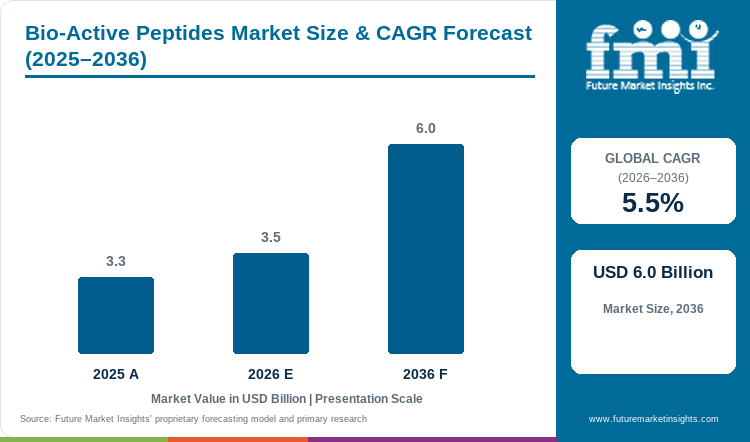
USD 3.5 billion in 2026 and USD 6.0 billion by 2036, expanding at a 5.5% CAGR.
Demand in the bio-active peptides market is anticipated to expand at a 5.5% CAGR over the forecast period, building from USD 3.3 billion in 2025 to USD 3.5 billion in 2026, before pushing valuation to USD 6.0 billion by 2036. Formulators are evaluating controlled peptide composition alongside taste and processing behavior. Glanbia Nutritionals documented PepForm leucine and citrulline peptides with high solubility and no bitterness in June 2025. Its 2025 bioactives portfolio included Collameta collagen tripeptides for skin and joint applications. Repeat placement for protein hydrolysate ingredients depends on controlled composition plus workable taste and processing behavior under commercial production conditions.
National claim rules can alter the commercial route for the same peptide ingredient. Japan's Foods with Function Claims system permits specified health-function labeling under the business operator's responsibility. The Consumer Affairs Agency's 2026 booklet requires safety and functionality information before commercial sale. Ingredient dossiers therefore need defined composition and benefit evidence before a peptide enters a notified food.
Key Takeaways
- Demand is rising for peptide preparations that solve defined digestibility or formulation problems more efficiently than intact protein at the intended dose.
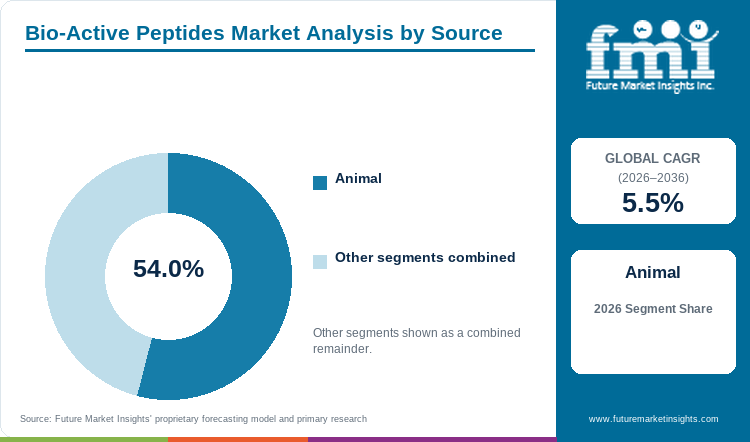
- Animal is likely to capture 54.0% of source-category demand in 2026, supported by established dairy and collagen hydrolysis routes.
- Powder is set to lead the form category with 78.0% share in 2026, attributable to compact shipping and simpler dry-blend dosing.
- Application support gives peptide suppliers higher-value placement opportunities by shortening formulation work for specialized nutrition brands.
- Evidence gaps and claim restrictions can delay ingredient qualification for physiological positions that exceed reproducible human or application performance.
- Some of the key players in this market include Glanbia Nutritionals, Arla Foods Ingredients, FrieslandCampina Ingredients, Kerry Group, dsm-firmenich, and Rousselot (Darling Ingredients).
Analyst Perspective
"Bio-active peptide suppliers earn premium placement by maintaining composition control during application testing and the buyer's evidence review. Buyers complete commercial selection once taste and processing behavior align with permitted benefit language inside the finished product."
- Anurag Sharma, Principal Consultant, Future Market Insights
How is the bio-active peptides market segmented?
The market is segmented by Source (Animal, Marine, Plant) and Form (Powder, Liquid).
The bio-active peptides market is segmented by source and form within the commercial ingredient boundary. Source includes animal, marine, and plant ingredients, while form covers powder and liquid offerings. Revenue is measured at the ingredient sale point and excludes finished supplements, intact proteins, free amino acids, and standalone processing enzymes.
How do dairy and collagen hydrolysis routes shape animal-derived peptide selection?
Animal-derived peptides draw on established dairy and collagen hydrolysis routes that support specialized nutrition formulations with controlled composition. Arla Foods Ingredients reported in March 2026 that a clinical study of Lacprodan IF-3070 enrolled 251 newborns at six hospitals. Researchers evaluated the partially hydrolyzed whey ingredient for growth and tolerance in healthy infants. Ingredient-level clinical work gives formulators product-specific evidence that general familiarity with dairy sources does not provide. Collagen preparations follow a separate route that requires peptide source and composition to remain consistent at commercial dose. Repeat orders depend on each preparation retaining its intended profile throughout the customer's approved formulation process.
- Animal is projected to account for 54.0% of the source category in 2026, reinforced by established dairy and collagen hydrolysis routes.
- Clinical nutrition formulations require stable collagen peptide profiles and dairy hydrolysate profiles with acceptable taste and processing behavior for repeat commercial orders.
What makes powder practical for dosing and reconstitution of peptide ingredients?
Powder formats avoid shipping water and let formulators meter peptide ingredients into dry blends or reconstituted nutrition products. dsm-firmenich's 2025 HNC product brochure describes PeptoPro as a highly hydrolyzed casein peptide powder with instant solubility and low bitterness. Peptide concentration has little commercial value unless the powder disperses reliably during routine processing. Manufacturers are adjusting dose during blending instead of purchasing a pre-diluted liquid ingredient. Customers are testing reconstitution behavior and sensory performance under their own commercial production conditions. Repeat purchasing depends on the powder retaining those properties during storage and routine production handling.
- Powder is projected to hold 78.0% of form demand in 2026, driven by storage efficiency and easier dry-blend dosing.
- Processors use casein hydrolysate powders for rapid dissolution without transporting liquid bulk through specialized-nutrition supply chains.
What are the drivers, restraints and opportunities in the Bio-Active Peptides Market?
Defined-function peptide preparations expand demand while substantiation and sensory limits slow qualification, leaving room for application-ready ingredients with repeatable composition.
- Driver: Defined peptide preparations expand buying options by solving digestibility or formulation requirements that intact proteins cannot address efficiently.
- Restraint: Claim substantiation and variable peptide profiles can extend qualification before a brand commits an ingredient to commercial launch.
- Opportunity: Application-ready peptide formats attract more formulation attention with reproducible composition and relevant technical support.
Defined peptide compositions move commercial buying beyond undifferentiated protein inputs
Peptide demand is rising for preparations that solve specific formulation or physiological requirements more directly than intact protein. Rousselot received patents in Europe plus Japan and China for Colartix in September 2025. The composition combines collagen peptides with chondroitin sulfate for joint-care supplements at a one-gram daily dose. Patent protection gives nutrition brands a defined composition and use case that differs from standard collagen enrichment. Nutrition brands evaluate sports nutrition ingredients for dose efficiency alongside taste and processing performance before approving repeat formulations. Repeat placement depends on preserving the stated peptide profile inside the finished product and substantiating the proposed benefit.
Claim substantiation can slow conversion from peptide science to commercial positioning
Commercial friction arises from peptide science that cannot be translated into a legally supportable claim at the intended dose. FDA's September 2026 dietary supplement guidance requires firms using structure/function claims to hold substantiation showing that the statement is truthful and not misleading. Current good manufacturing practices also protect supplement identity and composition before products reach the market. Regulatory requirements make ingredient documentation part of the buying decision before brands commit a peptide preparation to launch. Weak human evidence or variable peptide profiles can extend formulation work and narrow the benefit language available to the finished product. Better evidence can shorten review without converting a supplement claim into an unapproved disease-treatment position.
Application-specific peptide formats create room for higher-value formulation support
Suppliers capture more value by providing peptide preparations with an application route that formulators can test quickly. Rousselot's December 2025 FI Europe program placed Nextida GC in beverage and snack prototypes beside other collagen peptide formats. The prototypes gave formulation teams a direct basis for comparing taste and dose inside recognizable product formats. Plant protein hydrolysate development is expanding non-dairy sourcing options for brands that require reliable processing performance. The commercial opportunity depends on reproducible composition plus application support and benefit evidence that match destination-market requirements. Clear application evidence can shorten qualification without turning a specialized peptide preparation into a generic protein proposition.
Which country CAGRs are included in the Bio-Active Peptides Market?
| Country | CAGR |
|---|---|
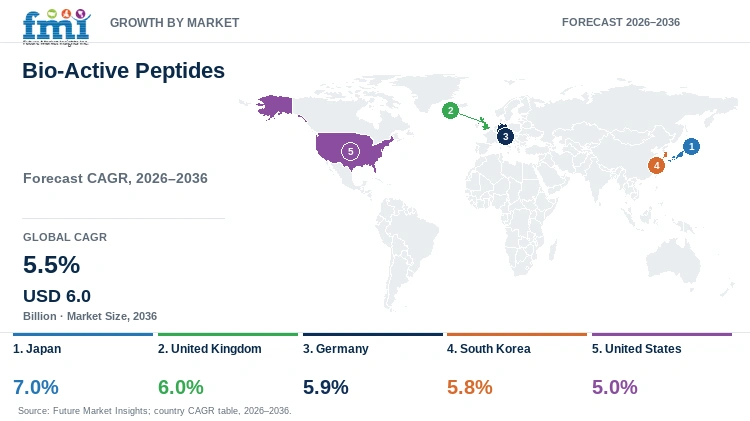
| Japan | 7.0% |
| United Kingdom | 6.0% |
| Germany | 5.9% |
| South Korea | 5.8% |
| United States | 5.0% |
How do country-level CAGRs compare in the Bio-Active Peptides Market?
The country range spans 2.0 percentage points from Japan at 7.0% to the United States at 5.0%. The United Kingdom is forecast at 6.0%, followed by Germany at 5.9% and South Korea at 5.8%. These rates compare forecast pace instead of current revenue scale and do not establish present market size. Differences in claim routes and product qualification can therefore produce separate entry conditions inside a narrow numerical band.
- Japan's notification route requires brands to prepare safety and functionality information before specified benefit language reaches commercial food labeling.
- Great Britain limits commercial nutrition and health claims to authorized entries and Northern Ireland follows a separate policy route.
- Germany keeps hydrolyzed-protein nutrition claims close to product-specific evidence since broad ingredient assumptions cannot replace suitability data.
- South Korea's functional-ingredient recognition process places composition records and defined specifications inside the route to regulated health-food use.
- United States supplement labeling permits structure/function positioning without premarket claim approval and firms remain responsible for substantiation and required notifications.
Comparable CAGRs can produce different entry conditions. Each country converts ingredient evidence into commercial claims under its own national rules and qualification procedures. The full report provides country-level CAGR analysis across North America, Latin America, Western Europe, Eastern Europe, East Asia, South Asia and Pacific, and the Middle East and Africa.
Country-wise Analysis
- Japan's functional-food system gives brands a formal route for communicating specified benefits through pre-sale information requirements. Adoption of bio-active peptide ingredients in Japan is estimated to expand at 7.0% CAGR through 2036. The outlook is supported by the Foods with Function Claims notification route. The Consumer Affairs Agency's 2026 booklet states that Foods with Function Claims may display specified health functions under the business operator's responsibility. Functional food ingredients require clear composition and substantiation records for downstream brands using the intended benefit language. A compliant claim does not compensate for a peptide preparation that fails at its intended dose, so taste and processing behavior remain separate commercial tests.
- United Kingdom suppliers face separate market-access routes under different food-policy responsibilities in Great Britain and Northern Ireland. Bio-active peptide demand in the United Kingdom is forecast to rise at 6.0% CAGR over the forecast period. The outlook is influenced by the split regulatory structure. The Great Britain nutrition and health claims register was updated in May 2026 and now permits only authorized claims in England, Scotland and Wales. Food Standards Agency guidance assigns nutrition policy responsibilities in Northern Ireland alongside the Department of Health. Nutraceutical ingredients require jurisdiction-specific documentation since legal compliance and formulation performance remain separate qualification requirements for commercial use.
- Germany treats specialized nutrition as a product-specific evidence problem instead of a broad supplement-demand question. The German bio-active peptides market is projected to record 5.9% CAGR during the assessment period. The outlook is shaped by product-specific evidence requirements in specialized nutrition. In February 2026 the Federal Institute for Risk Assessment found insufficient evidence for health benefits from the assessed probiotic infant formulas and noted uncertainty for formulas using hydrolyzed protein. Whey protein hydrolysates used in German early-life nutrition require stable composition and product-specific suitability evidence before formulators rely on a proposed nutritional position. Review requirements can extend qualification despite established buying routines for medical and early-life nutrition.
- South Korea places functional-ingredient specifications and supporting information inside a formal recognition process for regulated health foods. Bio-active peptide demand in South Korea is predicted to advance at 5.8% CAGR through 2036. The outlook is tied to the formal functional-ingredient recognition process. The Ministry of Food and Drug Safety registered Regulation 2026-33 in August 2026 for functional ingredient recognition and standards. Marine collagen suppliers entering functional propositions must maintain repeatable composition records that withstand the recognition process. Documentation quality shapes commercial access since source differentiation alone does not establish a permitted functional position or shorten ingredient review.
- United States supplement channels permit structure/function positioning without general premarket claim approval and marketers remain responsible for truthful labeling. Bio-active peptide sales in the United States are forecast to expand at 5.0% CAGR by 2036. The outlook is reinforced by mature supplement channels with established claim procedures. FDA's 2026 consumer update states that dietary supplement companies using structure/function claims must submit the required notification and carry the statutory disclaimer. Protein ingredient suppliers need documentation that matches both the peptide composition and the proposed use before brands finalize labeling. Qualified formulations can support repeat demand without product-by-product preapproval for the finished supplement.
Who are the notable companies in the Bio-Active Peptides Market?
Glanbia Nutritionals, Arla Foods Ingredients, FrieslandCampina Ingredients, Kerry Group, dsm-firmenich, and Rousselot (Darling Ingredients)
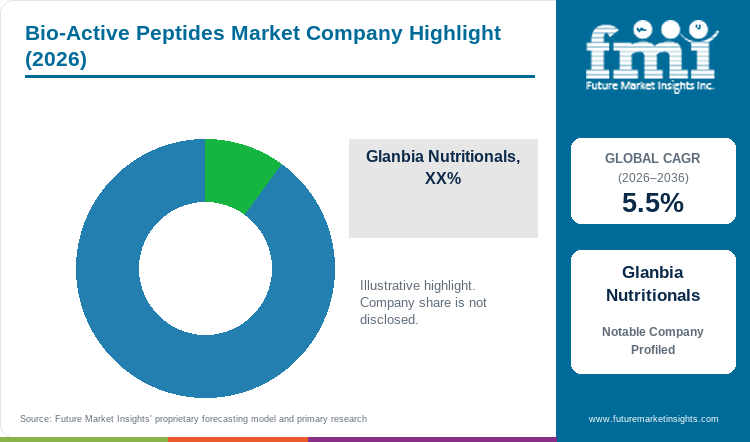
Competition centers on suppliers that can document a direct peptide or protein-hydrolysate ingredient and support its use inside specialized nutrition. Entry is difficult for portfolios limited to intact protein or finished products because those offers do not replace a qualifying peptide preparation within the defined ingredient boundary.
- Glanbia Nutritionals and Rousselot (Darling Ingredients) compete with direct peptide platforms tied to defined functional positions and application support.
- Arla Foods Ingredients and FrieslandCampina Ingredients use dairy-derived peptide or hydrolysate expertise for early-life and specialized nutrition applications.
- Kerry Group and dsm-firmenich supply hydrolysate or dairy-peptide routes that address formulation performance alongside specialized nutrition requirements.
Competitive Benchmarking: Bio-Active Peptides Market
| Company | Direct Peptide or Hydrolysate Range | Source Breadth | Application Integration | Geographic Reach |
|---|---|---|---|---|
| Glanbia Nutritionals | High | High | High | Multi-region nutrition markets |
| Arla Foods Ingredients | High | Low | High | Global nutrition markets |
| FrieslandCampina Ingredients | High | Medium | Medium | Global nutrition markets |
| Kerry Group | High | Medium | High | Global food and nutrition markets |
| dsm-firmenich | Medium | Low | High | Global health and nutrition markets |
| Rousselot (Darling Ingredients) | High | High | High | Global collagen and nutrition markets |
Scoring basis: High range breadth requires multiple documented peptide or hydrolysate families and Medium identifies one direct platform. High source breadth requires three verified source families with Medium requiring two and Low identifying one. High application integration requires documented support in at least three nutrition or food formats with Medium requiring two and Low identifying one.
Key Developments in the Bio-Active Peptides Market
- In June 2026, Rousselot (Darling Ingredients) received a United States patent covering the production process and dietary-supplement use of its Nextida GC collagen peptide composition.
- In December 2025, Arla Foods Ingredients launched Lacprodan CGMP-30 with reduced phenylalanine content for medical-nutrition formulations used in phenylketonuria management.
- In September 2025, FrieslandCampina Ingredients opened an expanded Singapore application center with 30% more R&D space for specialized nutrition formulation and regional application testing.
Key Players in the Bio-Active Peptides Market
Bioactive peptide and collagen platforms
- Glanbia Nutritionals
- Rousselot (Darling Ingredients)
Dairy peptide and hydrolysate specialists
- Arla Foods Ingredients
- FrieslandCampina Ingredients
- dsm-firmenich
Dairy and plant protein hydrolysate suppliers
- Kerry Group
Bio-Active Peptides Market - Report Scope
| Coverage field | Report scope |
|---|---|
| Market breakdown | By source, form and region. |
| Quantitative Units | USD billion. |
| Market Definition | Commercial revenue from qualifying bio-active peptide ingredients and peptide-rich protein hydrolysates sold in animal, marine or plant source categories and powder or liquid form. Finished supplements, intact proteins, free amino acids and standalone enzymes are outside the revenue boundary. |
| Regions Covered | North America, Latin America, Western Europe, Eastern Europe, East Asia, South Asia and Pacific, and Middle East and Africa. |
| Countries Covered | Japan, United Kingdom, Germany, South Korea, United States, and 20+ countries included in the full report. |
| Key Companies Profiled | Glanbia Nutritionals, Arla Foods Ingredients, FrieslandCampina Ingredients, Kerry Group, dsm-firmenich, and Rousselot (Darling Ingredients). |
| Forecast Period | 2026 to 2036. |
| Approach | Primary and secondary research with market triangulation. |
Bio-Active Peptides Market - Research Methodology
| Method | Approach |
|---|---|
| Primary Research | Primary research examines purchasing decisions, ingredient qualification, application requirements, pricing, supply reliability and technical support among manufacturers, ingredient suppliers, distributors and specialized-nutrition buyers. These inputs are incorporated when documented and reconciled with the defined ingredient boundary. |
| Desk Research | Desk research covered government statistics, regulatory publications, trade data, industry associations, technical literature, standards, company filings, product information, and official corporate announcements. Sources were reviewed for relevance, publication date, geographic coverage, and consistency with the defined market scope. Claims relating to performance, applications, approvals, capacity, investment and commercial activity were retained when credible public evidence supported them. |
| Market Sizing and Forecasting | The market model combined the baseline value with historical performance, segment structure, pricing and volume indicators, adoption levels, company participation, and country-level demand conditions. Forecast assumptions considered economic activity, investment trends, regulatory developments, technology adoption, purchasing cycles, supply availability, and barriers to wider market use. Segment and regional estimates were reconciled before the final market total was calculated. |
| Data Validation | Estimates were checked against independent indicators including public data, regulatory sources, company activity, trade patterns and industry developments. Validation also tested whether products, applications and company revenues fell within the defined market boundary. Out-of-scope categories, unsupported claims and overlapping revenues were excluded to reduce double counting. |
Bio-Active Peptides Market by Segments
Bio-Active Peptides Market segmented by Source:
- Animal
- Marine
- Plant
Bio-Active Peptides Market segmented by Form:
- Powder
- Liquid
Bio-Active Peptides Market by Region:
- North America
- United States
- Canada
- Latin America
- Brazil
- Mexico
- Argentina
- Chile
- Western Europe
- Germany
- France
- United Kingdom
- Italy
- Spain
- Benelux
- Nordics
- Eastern Europe
- Poland
- Czech Republic
- Romania
- Hungary
- East Asia
- China
- Japan
- South Korea
- South Asia and Pacific
- India
- ASEAN
- Australia and New Zealand
- Middle East and Africa
- GCC Countries
- South Africa
- Türkiye
- Israel
Research Sources and Bibliography
- Glanbia Nutritionals. (2025, June 10). Trends to watch in bioactives for 2025.
- Consumer Affairs Agency, Government of Japan. (2026). Toward a safe, secure, and prosperous society.
- Arla Foods Ingredients. (2026, March 23). Infant formula containing Lacprodan® IF-3070 supports healthy growth, clinical study finds.
- dsm-firmenich. (2025). HNC 2025 product brochure.
- Rousselot, Darling Ingredients. (2025, September 2). Rousselot receives European, Japanese and Chinese patents for Colartix®.
- USA Food and Drug Administration. (2026, September). Questions and answers on dietary supplements.
- Rousselot, Darling Ingredients. (2025, December 2). FI Europe.
- Department of Health and Social Care. (2026, May 19). Great Britain nutrition and health claims (NHC) register.
- Food Standards Agency. (n.d.). Nutrition in Northern Ireland for businesses. Retrieved September 17, 2026.
- German Federal Institute for Risk Assessment. (2026, February 3). Gesundheitlicher Nutzen von Säuglingsnahrung mit Zusatz von ‘Probiotika’ wissenschaftlich weiterhin nicht belegt.
- Ministry of Food and Drug Safety, Republic of Korea. (2026, August 13). Regulation on Recognition of Functional Ingredient and of Standard·Specification for Health Functional Foods (No. 2026-33).
- USA Food and Drug Administration. (2026). Is It Really ‘FDA Approved’?.
- Glanbia Nutritionals. (2025). Supporting strength in ASPAC.
- FrieslandCampina Ingredients. (n.d.). Peptides and hydrolysates. Retrieved September 17, 2026.
- Kerry Group. (n.d.). Proteins. Retrieved September 17, 2026.
- Rousselot, Darling Ingredients. (n.d.). Collagen peptides. Retrieved September 17, 2026.
- Darling Ingredients. (2026, June 3). Darling Ingredients’ health brand Rousselot receives USA patent for Nextida® GC, the first collagen peptide composition supporting blood glucose regulation.
- Arla Foods Ingredients. (2025, December 10). New CGMP ingredient has even lower phenylalanine content.
- FrieslandCampina Ingredients. (2025, September 15). FrieslandCampina Ingredients expands R&D capabilities with new state-of-the-art application centre in Singapore.
- FrieslandCampina Ingredients. (2026, May 5). FrieslandCampina announces major investment programme to accelerate growth in high-value whey proteins.
- Rousselot, Darling Ingredients. (2025, April 15). Rousselot to showcase Nextida® collagen peptides Vitafoods Europe 2025.
- Glanbia Nutritionals. (2025, May 8). FBIF 2025 | Glanbia
- Arla Foods Ingredients. (2025, May 20). Arla Foods Ingredients and Brenntag expand collaboration into Southeast Asia.
- Rousselot, Darling Ingredients. (2025, April 24). Rousselot granted Upcycled Certified® status for Peptan® collagen peptides range.
- Glanbia Nutritionals. (2025, October 8). ¡Acompáñanos en Octubre a The Food Tech Summit & Expo 2025!
- Kerry Group. (2025, May 12). Consistent Protein Hydrolysates for Monoclonal Antibody (mAb) Production.
- Rousselot, Darling Ingredients. (2025, October 29). SupplySide Global.
- FrieslandCampina Ingredients. (2026, May 15). FrieslandCampina Ingredients opens new North America Application Center to support the development of protein and prebiotic solutions.
This bibliography is provided for reader reference and is not exhaustive. The full report contains the complete reference list and detailed citations.
This Report Answers
- How does the 2026 valuation frame commercial peptide ingredient demand?
- Which formulation requirements convert peptide functionality into recurring ingredient purchases?
- Which source category carries the larger estimated share during 2026?
- Why does powder account for most form-category demand during 2026?
- Which evidence gaps can delay qualification of bio-active peptide ingredients?
- How do national claim systems change peptide commercialization routes through 2036?
- Which country conditions explain the five profiled growth rates through 2036?
- Which companies supply direct peptide ingredients or qualifying protein hydrolysates?
- Which recent company actions change peptide differentiation and application support?
- What evidence and formulation checks matter before repeat ingredient orders?
Frequently Asked Questions
How big is the bio-active peptides market in 2026?
The bio-active peptides market is valued at USD 3.5 billion in 2026 and is projected to reach USD 6.0 billion by 2036. Expansion depends on peptide compositions that also perform reliably inside finished nutrition formulations during customer qualification.
What is the CAGR of the bio-active peptides market through 2036?
The bio-active peptides market is projected to grow at 5.5% CAGR between 2026 and 2036. Commercial conversion depends on suppliers maintaining controlled peptide composition alongside workable taste and processing behavior.
Which source category leads the bio-active peptides market in 2026?
The animal segment is estimated to hold 54.0% of source-category demand in 2026, supported by established dairy and collagen hydrolysis routes. Customers still require ingredient-specific composition and application evidence before approving repeat commercial orders.
Which form category leads the bio-active peptides market in 2026?
The powder segment is projected to hold 78.0% of form-category demand in 2026, attributable to concentrated formats that simplify dosing and distribution. Qualification still depends on solubility and sensory behavior inside the customer's production process and storage conditions.
Which countries carry the highest profiled growth rates through 2036?
Japan is projected at 7.0% CAGR through 2036. The United Kingdom follows at 6.0%, Germany at 5.9%, and South Korea at 5.8%, with national claim and ingredient-recognition systems requiring different supporting documentation.
Which companies are active in the bio-active peptides market?
Key companies include Glanbia Nutritionals and Arla Foods Ingredients plus FrieslandCampina Ingredients and Kerry Group alongside dsm-firmenich and Rousselot (Darling Ingredients). Their portfolios cover direct peptide preparations and qualifying hydrolysates used in specialized nutrition and medical nutrition channels.
Preview the report firsthand - request a free sample
Get SampleGet the brochure for pricing and purchase details.
Get PDFTable of Content
- Key Takeaways
- Market Size and CAGR
- Top Growth Driver
- Fastest Growing Segment
- Leading Region
- Key Companies
- Emerging Opportunities
- Executive Summary
- Global Market Outlook
- Demand-side Trends
- Supply-side Trends
- Technology Roadmap Analysis
- Analysis and Recommendations
- Analyst Perspective (What is happening? Why now? What should investors know?)
- Key Questions Answered
- How large is the market?
- What is the CAGR?
- What are key trends?
- Which region dominates?
- Who are the leaders?
- Market Overview
- Market Coverage / Taxonomy
- Market Definition / Scope / Limitations
- Research Methodology
- Chapter Orientation
- Analytical Lens and Working Hypotheses
- Market Structure, Signals, and Trend Drivers
- Benchmarking and Cross-market Comparability
- Market Sizing, Forecasting, and Opportunity Mapping
- Research Design and Evidence Framework
- Desk Research Programme (Secondary Evidence)
- Expert Input and Fieldwork (Primary Evidence)
- Tooling, Models, and Reference Databases
- Data Engineering and Model Build
- Quality Assurance and Audit Trail
- Market Background
- Market Dynamics (Drivers, Restraints, Opportunity, Trends)
- Scenario Forecast (Optimistic, Likely, Conservative)
- Impact Analysis
- AI Impact
- Sustainability Impact
- Regulatory Impact
- Technology Impact
- Consumer / Buyer Analysis
- Purchase Drivers
- Adoption Barriers
- Buyer Journey
- Opportunity Map Analysis
- Product Life Cycle Analysis
- Supply Chain Analysis
- Investment Feasibility Matrix
- Value Chain Analysis
- PESTLE and Porter's Analysis
- Regulatory Landscape
- Regional Parent Market Outlook
- Production and Consumption Statistics
- Import and Export Statistics
- Global Market Analysis and Forecast, 2021 to 2036
- Historical Market Size Value (USD Billion) Analysis, 2021 to 2025
- Current and Future Market Size Value (USD Billion) Projections, 2026 to 2036
- Y-o-Y Growth Trend Analysis
- Absolute $ Opportunity Analysis
- Global Market Pricing Analysis, 2021 to 2036
- Global Market Analysis and Forecast, By Source, 2021 to 2036
- Introduction / Key Findings
- Historical Market Size Value (USD Billion) Analysis By Source, 2021 to 2025
- Current and Future Market Size Value (USD Billion) Analysis and Forecast By Source, 2026 to 2036
- Animal
- Marine
- Plant
- Y-o-Y Growth Trend Analysis By Source, 2021 to 2025
- Absolute $ Opportunity Analysis By Source, 2026 to 2036
- Global Market Analysis and Forecast, By Form, 2021 to 2036
- Introduction / Key Findings
- Historical Market Size Value (USD Billion) Analysis By Form, 2021 to 2025
- Current and Future Market Size Value (USD Billion) Analysis and Forecast By Form, 2026 to 2036
- Powder
- Liquid
- Y-o-Y Growth Trend Analysis By Form, 2021 to 2025
- Absolute $ Opportunity Analysis By Form, 2026 to 2036
- Global Market Analysis and Forecast, By Region, 2021 to 2036
- Introduction
- Historical Market Size Value (USD Billion) Analysis By Region, 2021 to 2025
- Current Market Size Value (USD Billion) Analysis and Forecast By Region, 2026 to 2036
- North America
- Latin America
- Western Europe
- Eastern Europe
- East Asia
- South Asia and Pacific
- Middle East and Africa
- Market Attractiveness Analysis By Region
- North America Market Analysis and Forecast, By Country, 2021 to 2036
- Historical Market Size Value (USD Billion) Trend Analysis By Market Taxonomy, 2021 to 2025
- Market Size Value (USD Billion) Forecast By Market Taxonomy, 2026 to 2036
- By Country
- United States
- Canada
- By Source
- By Form
- By Country
- Market Attractiveness Analysis
- By Country
- By Source
- By Form
- Key Takeaways
- Latin America Market Analysis and Forecast, By Country
- Historical Market Size Value (USD Billion) Trend Analysis By Market Taxonomy, 2021 to 2025
- Market Size Value (USD Billion) Forecast By Market Taxonomy, 2026 to 2036
- By Country
- Brazil
- Mexico
- Argentina
- Chile
- By Source
- By Form
- By Country
- Market Attractiveness Analysis
- By Country
- By Source
- By Form
- Key Takeaways
- Western Europe Market Analysis and Forecast, By Country
- Historical Market Size Value (USD Billion) Trend Analysis By Market Taxonomy, 2021 to 2025
- Market Size Value (USD Billion) Forecast By Market Taxonomy, 2026 to 2036
- By Country
- Germany
- France
- United Kingdom
- Italy
- Spain
- Benelux
- Nordics
- By Source
- By Form
- By Country
- Market Attractiveness Analysis
- By Country
- By Source
- By Form
- Key Takeaways
- Eastern Europe Market Analysis and Forecast, By Country
- Historical Market Size Value (USD Billion) Trend Analysis By Market Taxonomy, 2021 to 2025
- Market Size Value (USD Billion) Forecast By Market Taxonomy, 2026 to 2036
- By Country
- Poland
- Czech Republic
- Romania
- Hungary
- By Source
- By Form
- By Country
- Market Attractiveness Analysis
- By Country
- By Source
- By Form
- Key Takeaways
- East Asia Market Analysis and Forecast, By Country
- Historical Market Size Value (USD Billion) Trend Analysis By Market Taxonomy, 2021 to 2025
- Market Size Value (USD Billion) Forecast By Market Taxonomy, 2026 to 2036
- By Country
- China
- Japan
- South Korea
- By Source
- By Form
- By Country
- Market Attractiveness Analysis
- By Country
- By Source
- By Form
- Key Takeaways
- South Asia and Pacific Market Analysis and Forecast, By Country
- Historical Market Size Value (USD Billion) Trend Analysis By Market Taxonomy, 2021 to 2025
- Market Size Value (USD Billion) Forecast By Market Taxonomy, 2026 to 2036
- By Country
- India
- ASEAN
- Australia and New Zealand
- By Source
- By Form
- By Country
- Market Attractiveness Analysis
- By Country
- By Source
- By Form
- Key Takeaways
- Middle East and Africa Market Analysis and Forecast, By Country
- Historical Market Size Value (USD Billion) Trend Analysis By Market Taxonomy, 2021 to 2025
- Market Size Value (USD Billion) Forecast By Market Taxonomy, 2026 to 2036
- By Country
- GCC Countries
- South Africa
- Türkiye
- Israel
- By Source
- By Form
- By Country
- Market Attractiveness Analysis
- By Country
- By Source
- By Form
- Key Takeaways
- Key Countries Market Analysis
- United States
- Pricing Analysis
- Market Share Analysis, 2025
- By Source
- By Form
- Canada
- Pricing Analysis
- Market Share Analysis, 2025
- By Source
- By Form
- Mexico
- Pricing Analysis
- Market Share Analysis, 2025
- By Source
- By Form
- Brazil
- Pricing Analysis
- Market Share Analysis, 2025
- By Source
- By Form
- Chile
- Pricing Analysis
- Market Share Analysis, 2025
- By Source
- By Form
- Germany
- Pricing Analysis
- Market Share Analysis, 2025
- By Source
- By Form
- United Kingdom
- Pricing Analysis
- Market Share Analysis, 2025
- By Source
- By Form
- Italy
- Pricing Analysis
- Market Share Analysis, 2025
- By Source
- By Form
- Spain
- Pricing Analysis
- Market Share Analysis, 2025
- By Source
- By Form
- France
- Pricing Analysis
- Market Share Analysis, 2025
- By Source
- By Form
- India
- Pricing Analysis
- Market Share Analysis, 2025
- By Source
- By Form
- ASEAN
- Pricing Analysis
- Market Share Analysis, 2025
- By Source
- By Form
- Australia and New Zealand
- Pricing Analysis
- Market Share Analysis, 2025
- By Source
- By Form
- China
- Pricing Analysis
- Market Share Analysis, 2025
- By Source
- By Form
- Japan
- Pricing Analysis
- Market Share Analysis, 2025
- By Source
- By Form
- South Korea
- Pricing Analysis
- Market Share Analysis, 2025
- By Source
- By Form
- Poland
- Pricing Analysis
- Market Share Analysis, 2025
- By Source
- By Form
- Hungary
- Pricing Analysis
- Market Share Analysis, 2025
- By Source
- By Form
- Türkiye
- Pricing Analysis
- Market Share Analysis, 2025
- By Source
- By Form
- South Africa
- Pricing Analysis
- Market Share Analysis, 2025
- By Source
- By Form
- United States
- Market Structure Analysis
- Competition Dashboard
- Competition Benchmarking
- Market Share Analysis of Top Players
- By Regional
- By Source
- By Form
- Emerging Startups
- Innovation Benchmarking
- Competition Analysis
- Competition Deep Dive
- Glanbia Nutritionals
- Overview
- Product Portfolio
- Profitability by Market Segments
- Sales Footprint
- Strategy Overview
- Marketing Strategy
- Product Strategy
- Channel Strategy
- Arla Foods Ingredients
- FrieslandCampina Ingredients
- Kerry Group
- dsm-firmenich
- Rousselot (Darling Ingredients)
- Glanbia Nutritionals
- Case Studies
- Success Stories
- Recent Developments
- Competition Deep Dive
- Assumptions & Acronyms Used


