

- Market Size (2026)
- USD 326.8 Mn
- Forecast (2036)
- USD 879.0 Mn
- CAGR (2026 to 2036)
- 10.4%
How big is Bio-Based Fresh Food Wraps Market in 2026?
USD 326.8 million in 2026 and USD 879.0 million by 2036 at a 10.4% CAGR.
Bio-based fresh food wraps are projected to expand from USD 326.8 million in 2026 to USD 879.0 million by 2036 at a 10.4% CAGR. Regulation is changing specifications for biodegradable food packaging because commercial approval now requires documented material reduction and end-of-life claims. The European Commission confirmed in February 2025 that Regulation (EU) 2025/40 entered force on February 11 and generally applies from August 12, 2026.
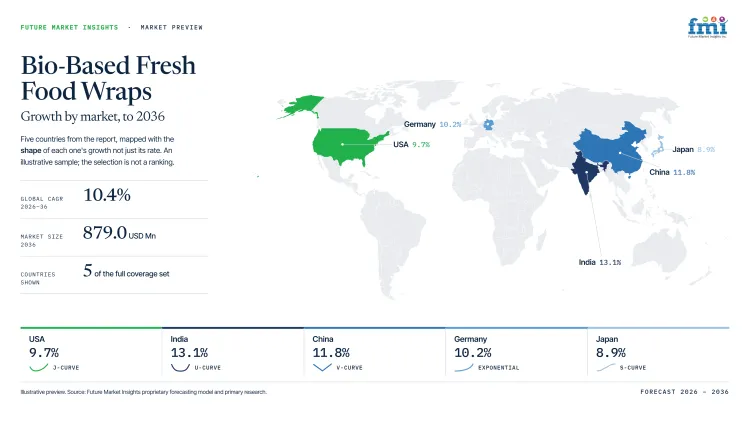
Country growth paths differ materially because packaging rules interact with local recovery systems and converter qualification requirements. Germany is projected at 10.2% CAGR compared with Japan at 8.9% across the assessment period. Germany's Environment Agency reported in March 2026 that 69.4% of packaging waste was recycled in 2023, giving paper-based formats a clearer recovery reference. Japanese orders depend more heavily on local line trials and presentation standards during commercial qualification programs.
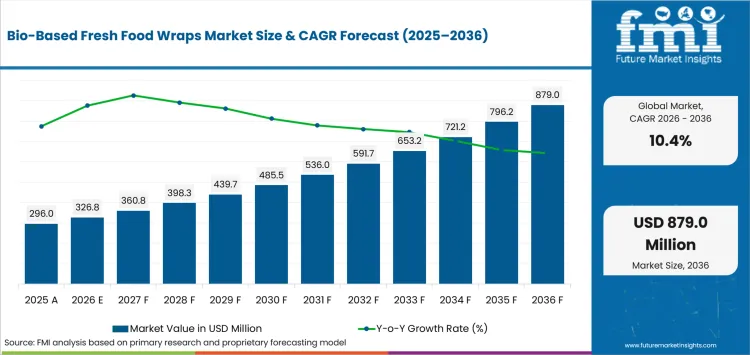
Key Takeaways of Bio-Based Fresh Food Wraps Market
- Food brands and retailers are testing renewable wraps that protect fresh products while meeting documented food-contact and end-of-life requirements.
- Beeswax wraps are projected to account for 26.0% by product type in 2026 due to simple household adoption.
- Wood cellulose is estimated to hold 30.0% share in 2026 owing to familiar paper and film conversion routes.
- Fully bio-based products are anticipated to represent 48.0% of content demand in 2026 because the claim is easier to specify.
- Commercial conversion remains constrained by barrier testing and disposal routes that differ across foods and local waste systems.
- Bee's Wrap, delfort, Futamura, TIPA, Vegware (Novolex), If You Care, Ahlstrom and Koehler Paper are some notable players.
Analyst Perspective
"Fresh-food wrap suppliers earn repeat orders by matching a renewable structure to the food’s moisture profile and the customer’s actual disposal route. Household products reward simple care instructions, while commercial rollstock requires machine trials and evidence that barrier performance survives storage and handling."
- Nandini Roy Choudhury, Principal Consultant, Future Market Insights
How is the Bio-Based Fresh Food Wraps Market segmented?
The bio-based fresh food wraps market is segmented by product type, feedstock, bio-based content, application, end use, sales channel and region.
Market taxonomy covers product type, feedstock, bio-based content, application, end use, sales channel and region for analysis. Product types include beeswax, PLA, cellulose film and bio-coated paper wraps, with feedstocks spanning wood cellulose, corn starch, wax systems and agricultural residues. Content ranges below 50% to fully bio-based, while applications and channels cover produce, dairy, snacks, bakery, household, foodservice, grocery, online, specialty retail, distributors and direct OEM supply.
What makes beeswax wraps central to the product type category?
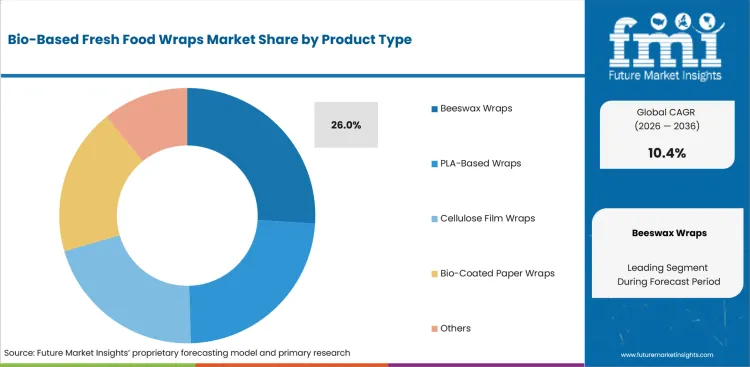
Reusable cloth formats within biodegradable wrap systems address household storage without packaging machinery or formal qualification. Hand warmth seals produce and cheese, although heat exposure and care requirements restrict raw-meat use.
- Based on product type, beeswax wraps are projected to account for 26.0% in 2026 due to immediate household usability and a clear replacement task.
- B Lab identifies Bee's Wrap as a certified B Corporation manufacturing reusable food wraps in Vermont. Its profile (as of August 2026) confirms a washable format for produce and cheese, making use instructions and cleaning expectations central to repeat household purchases.
Why does wood cellulose lead the feedstock category?
Wood cellulose supports transparent regenerated film and barrier-coated papers across household and commercial fresh-food uses. Paper and film processors can adjust grease resistance and sealing behavior, yet each structure needs testing against the intended food and equipment.
- By feedstock, wood cellulose is estimated to hold 30.0% in 2026 owing to established papermaking assets and familiar converting routes.
- Cellulose-based rollstock still requires full-structure testing during qualification because coatings alter moisture protection and recovery claims. Regular orders depend on stable film gauge and print quality across the customer's installed wrapping equipment and commercial storage conditions for fresh foods.
How does fully bio-based content shape the bio-based content category?
A fully bio-based claim gives food brands a clear material-origin threshold during specification reviews. The claim remains separate from compostability and recyclability, so each coating and bio-based food-contact adhesive needs its own supporting record.
- In 2026, fully bio-based products are expected to lead bio-based content with 48.0% share because complete renewable-content claims are easier to document.
- Third-party carbon testing can confirm biological content without proving food performance or the intended disposal route. Food brands therefore review seal strength and moisture control alongside material origin during formal approval for retail and foodservice programs.
What supports fresh produce in the application category?
Fresh-produce wraps within botanical packaging applications must control moisture without trapping conditions that shorten shelf life. Irregular shapes also require tear resistance and flexible handling, while transparent formats preserve visibility during cold storage and retail display.
- By application, fresh produce is forecast to represent 27.0% in 2026 driven by frequent wrapping needs around cut surfaces and delicate products.
- Households can mold reusable sheets around cut fruit without equipment changes during routine food storage. Commercial packers need permeability and cold-chain evidence matched to each crop before running cellulose film or coated paper in regular production.
What are the drivers, restraints and opportunities in the Bio-Based Fresh Food Wraps Market?
Regulation expands material trials, qualification and collection gaps delay repeat orders, and verified line-ready formats provide the strongest revenue route.
- Driver: Food brands are reviewing renewable wraps as packaging rules tighten chemical and material requirements across commercial fresh-food programs.
- Restraint: Food-contact proof and inconsistent recovery routes extend commercial qualification across fresh-food applications and regional disposal systems.
- Opportunity: Documented bio-based content and reliable barriers support larger orders on existing wrapping equipment with lower switching risk.
Chemical Rules Change Material Screening
Food brands compare renewable wraps with conventional structures under tighter chemical and packaging rules. The FDA made 35 PFAS food-contact notifications ineffective in January 2025 and set a June 2025 compliance date. The authorization change increases screening of grease-resistant papers and non-fluorinated barriers during approval of materials for fresh and greasy foods.
Collection Access Limits Commercial Conversion
Compostability claims do not secure commercial orders without local collection and verified food protection. EPA guidance connects certified compostable serviceware purchases with an accepting facility plus contracted collection or hauling. Packaging teams therefore qualify use performance and post-use handling for every sales area before adopting a new fresh-food wrap.
Documented Structures Reduce Switching Risk
Commercial orders favor plant-based shrink wrap and paper formats that pair renewable content with line-ready barriers and credible disposal instructions. delfort launched thinwrap transparent gloss HS in September 2025 for heat-sealed food packs and viewing windows. The direct-food-contact paper gives processors a recyclable option where product visibility and sealing performance must fit existing wrapping operations.
Which country CAGRs are profiled in the Bio-Based Fresh Food Wraps Market?
| Country | CAGR |
|---|---|
| Brazil | 10.9% |
| United Kingdom | 10.5% |
| Germany | 10.2% |
| USA | 9.7% |
| Japan | 8.9% |
How do country-level CAGRs compare in the Bio-Based Fresh Food Wraps Market?
The profiled forecasts span two percentage points and describe expansion speed instead of current market size. Brazil and the United Kingdom form the upper band while Germany, the USA and Japan advance within a tighter range.
- Brazil benefits from increasing demand for sustainable packaging and growing use of bio-based materials in fresh food applications.
- The United Kingdom supports market growth through retailer sustainability commitments and reduced-plastic packaging initiatives.
- Germany reflects strong adoption driven by circular economy goals and demand for recyclable and renewable packaging solutions.
- The USA continues to expand through innovation in bio-based materials and increasing focus on environmentally responsible food packaging.
- Japan maintains steady demand through packaging quality requirements and gradual adoption of sustainable packaging alternatives.
Comparable CAGRs can produce different market entry conditions across national packaging systems and fresh-food converting networks. The full report provides country-level CAGR analysis across North America, Latin America, Europe, East Asia, South Asia and Pacific, and the Middle East and Africa.
Country-wise Analysis
- Brazilian paper converters and regional food distributors give cellulose-based wraps a practical route into produce and bakery accounts across large urban retail networks that handle short shelf-life products and frequent temperature changes during regional distribution. Bio-based fresh food wrap sales in Brazil are forecast to expand at 10.9% CAGR by 2036, shaped by Decree 12,688 of October 2025 establishing national reverse-logistics obligations for plastic packaging. Mixed paper-plastic structures fall outside parts of that system and municipal recovery remains uneven, requiring local converting plus claims that match actual collection routes and withstand heat or humidity across intended sales areas.
- United Kingdom grocery chains and contract foodservice operators use centralized specifications with formal review processes that convert verified recyclability data into major national purchasing decisions across fresh produce and prepared-food programs. The country's bio-based fresh food wraps outlook is anticipated to advance at 10.5% CAGR over the assessment period, aided by September 2025 guidance requiring liable producers to assign formal packaging recyclability ratings. Amber or red ratings can increase fee exposure and compostable formats need accepted local collection services, so producers must pair food-contact evidence with seal trials and disposal instructions during commercial national rollout across regional waste contracts.
- German food brands work with an established paper recovery network and a technically experienced processor base that can test grease barriers across high-speed fresh-food wrapping operations and major national grocery specifications. The German bio-based fresh food wraps sector is projected to record 10.2% CAGR during the assessment period, reinforced by August 2025 federal minimum standards that define formal recyclability assessment for paper-based structures. Renewable fiber does not automatically secure favorable classification because coatings and seals can disrupt recovery, so material producers need complete structure data plus machine evidence supporting the declared paper route during regular commercial qualification programs nationwide.
- United States demand spans reusable household brands and commercial packaging programs sold across many state jurisdictions and large national retailer networks with different recovery services plus packaging rules for commercial fresh-food formats. By 2036, the USA is projected to grow at 9.7% CAGR, influenced by EPA findings from July 2026 that 88% of states and territories lacked data on plastic types in commerce. Federal food-contact review and state-by-state compliance extend qualification timelines, so wrap producers need tested barriers plus claims that remain accurate across intended sales regions and the regional collection systems serving each account during repeat purchasing cycles.
- Japanese food manufacturers place strong weight on clean presentation and repeatable line behavior for thin wraps used around produce or prepared foods across national convenience retail channels and strict quality expectations. Adoption of bio-based fresh food wraps in Japan is estimated to expand at 8.9% CAGR through 2036, supported by the Environment Ministry’s March 2026 plan showing separate paper-packaging collection in 904 municipalities. Local trials can remain lengthy because odor and print quality affect shelf acceptance, so overseas film and paper producers need consistent properties plus technical support that protects output on established packing equipment during repeat production runs.
Who are the notable companies in the Bio-Based Fresh Food Wraps Market?
Bee's Wrap, delfort, Futamura, TIPA, Vegware (Novolex), If You Care, Ahlstrom and Koehler Paper are the notable companies serving this market.
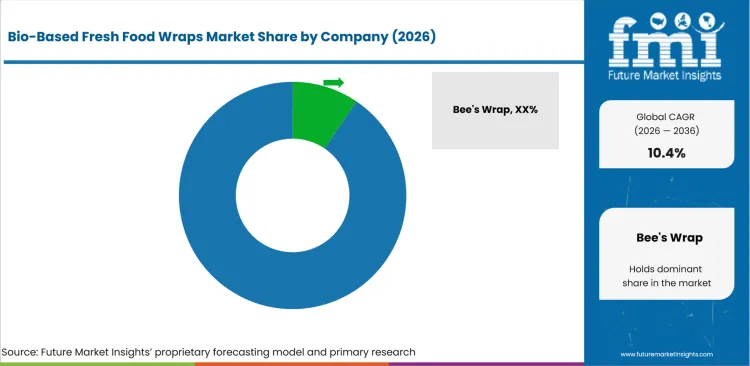
The market remains fragmented across household brands and cellulose-film producers that serve distinct household and commercial wrapping needs. Barrier-paper manufacturers and foodservice platforms compete on application support because no single material suits every fresh-food task. Entry into plastic food wrap replacement programs requires food-contact records plus barrier data matched to each format. Commercial rollstock also needs machine evidence and a credible local end-of-life route within each sales region.
- Bee's Wrap and If You Care compete for household purchases with reusable or plant-wax formats that depend on clear care instructions.
- Futamura, TIPA and Vegware (Novolex) address commercial applications with compostable films or foodservice systems that require verified collection routes.
- delfort and Ahlstrom supply fiber-based wrap materials alongside Koehler Paper for commercial fresh-food converting programs. Their competition centers on grease control and sealing behavior with compatibility across paper recovery systems.
Competitive Benchmarking: Bio-Based Fresh Food Wraps Market
| Company | Consumer-Ready Wrap Formats | Barrier and Seal Capability | Verified End-of-Life Evidence | Geographic Reach |
|---|---|---|---|---|
| Bee's Wrap | Medium | Medium | Medium | North America and selected international retail |
| delfort | Low | High | Medium | Europe with international barrier-paper sales |
| Futamura | Low | High | High | Europe, Americas and Asia-Pacific |
| TIPA | Low | High | High | Europe, North America and Australia |
| Vegware (Novolex) | High | Medium | High | Europe and global foodservice distribution |
| If You Care | High | Medium | High | North America and international retail |
| Ahlstrom | Low | High | High | Global material supply |
| Koehler Paper | Low | High | Medium | Europe with international sales partners |
Key Developments in the Bio-Based Fresh Food Wraps Market
- In April 2026, Futamura and Biopap reinforced their twenty-five-year collaboration around NatureFlex-lined compostable foodservice trays. The structures combine direct food-contact approval with oxygen and grease barriers across temperatures from -90°C to 175°C.
- In September 2025, TIPA launched four high-barrier compostable films and laminates for single-serve foods and dry products. The additions target moisture and oxygen protection on conventional packaging machinery while expanding paper and transparent print options.
Key Players in the Bio-Based Fresh Food Wraps Market
Household Wrap Brands
- Bee's Wrap
- If You Care
Compostable Film and Foodservice Platforms
- Futamura
- TIPA
- Vegware (Novolex)
Fiber-Based Barrier Material Suppliers
- delfort
- Ahlstrom
- Koehler Paper
Bio-Based Fresh Food Wraps Market - Report Scope
| Coverage field | Report scope |
|---|---|
| Market breakdown | By product type, feedstock, bio-based content, application, end use, sales channel and region. |
| Quantitative Units | Revenue in USD million and CAGR in %. |
| Market Definition | Commercial bio-based sheets, films, coated papers and reusable wraps sold for direct fresh-food wrapping. Packaged-food revenue, rigid containers, raw feedstocks and conventional petrochemical cling film are excluded. |
| Regions Covered | North America, Latin America, Western Europe, Eastern Europe, East Asia, South Asia and Pacific and Middle East and Africa. |
| Countries Covered | Brazil, United Kingdom, Germany, USA, Japan, and 20+ countries included in the full report. |
| Key Companies Profiled | Bee's Wrap, delfort, Futamura, TIPA, Vegware (Novolex), If You Care, Ahlstrom and Koehler Paper. |
| Forecast Period | 2026 to 2036. |
| Approach | Primary and secondary research with market triangulation. |
Bio-Based Fresh Food Wraps Market - Research Methodology
| Method | Approach |
|---|---|
| Primary Research | FMI analysts gathered input from manufacturers, service providers, technology developers, distributors, end users, procurement teams, and subject-matter experts. Interviews examined purchasing decisions, product or service evaluation, adoption barriers, approval requirements, pricing considerations, and expectations for technical or commercial support. Respondents were also asked what evidence is required before a trial, pilot, or initial order develops into regular purchasing. |
| Desk Research | Desk research covered government statistics, regulatory publications, trade data, industry associations, technical literature, standards, company filings, product information, and official corporate announcements. Sources were reviewed for relevance, publication date, geographic coverage, and consistency with the defined market scope. Claims relating to performance, applications, approvals, capacity, investment, and commercial activity were retained only when supported by credible public evidence. |
| Market Sizing and Forecasting | The market model combined the baseline value with historical performance, segment structure, pricing and volume indicators, adoption levels, company participation, and country-level demand conditions. Forecast assumptions considered economic activity, investment trends, regulatory developments, technology adoption, purchasing cycles, supply availability, and barriers to wider market use. Segment and regional estimates were reconciled before the final market total was calculated. |
| Data Validation | Estimates were checked against multiple independent indicators, including public data, company activity, trade patterns, industry developments, and findings from primary interviews. Validation also tested whether products, services, applications, and company revenues fell within the defined market boundaries. Adjacent categories, unsupported claims, overlapping revenues, and activities without direct market relevance were excluded to reduce double counting and maintain consistency across segments and countries. |
Bio-Based Fresh Food Wraps Market by Segments
Bio-Based Fresh Food Wraps Market segmented by Product Type:
- Beeswax Wraps
- PLA-Based Wraps
- Cellulose Film Wraps
- Bio-Coated Paper Wraps
- Others
Bio-Based Fresh Food Wraps Market segmented by Feedstock:
- Wood Cellulose
- Corn - Starch (PLA)
- Beeswax & Plant Waxes
- Bagasse - Agri-Residue
- Others
Bio-Based Fresh Food Wraps Market segmented by Bio-Based Content:
- 100% Bio-Based
- 75-99%
- 50-74%
- Below 50%
Bio-Based Fresh Food Wraps Market segmented by Application:
- Fresh Produce
- Cheese & Dairy
- Sandwiches & Snacks
- Bakery
- Others
Bio-Based Fresh Food Wraps Market segmented by End Use:
- Household - Consumer
- Foodservice
- Grocery Retail
- Others
Bio-Based Fresh Food Wraps Market segmented by Sales Channel:
- Online - E-commerce
- Specialty Retail
- Packaging Distributors
- Direct - OEM Supply
Bio-Based Fresh Food Wraps Market by Region:
- North America
- United States
- Canada
- Latin America
- Brazil
- Mexico
- Chile
- Rest of Latin America
- Western Europe
- Germany
- United Kingdom
- Italy
- Spain
- France
- Nordics
- Benelux
- Rest of Western Europe
- Eastern Europe
- Russia
- Poland
- Hungary
- Balkan and Baltic States
- Rest of Eastern Europe
- East Asia
- China
- Japan
- South Korea
- South Asia and Pacific
- India
- ASEAN
- Australia and New Zealand
- Rest of South Asia and Pacific
- Middle East and Africa
- Kingdom of Saudi Arabia
- Other GCC Countries
- Türkiye
- South Africa
- Other African Union Countries
- Rest of Middle East and Africa
Research Sources and Bibliography
- European Commission. (2025, February 11). New rules enter into force for a more sustainable and competitive packaging economy.
- German Environment Agency. (2026, March 5). Verpackungsabfälle.
- B Lab Global. (Retrieved August 7, 2026). BEE'S WRAP - Certified B Corporation - B Lab.
- USA Food and Drug Administration. (2025, January 3). FDA Determines Authorization for 35 Food Contact Notifications Related to PFAS Are No Longer Effective.
- USA Environmental Protection Agency. (2026, January 5). Cafeteria and Food Services Model Contract Language.
- delfort. (2025, September 15). see what’s inside: transparent and heat-sealable paper for food and non-food.
- Presidência da República. (2025, October 21). Decreto nº 12.688, de 21 de outubro de 2025.
- Department for Environment, Food & Rural Affairs, Environment Agency, and Natural Resources Wales. (2024, December 23). Recyclability assessment methodology: how to assess your packaging waste.
- German Environment Agency. (2025, August 29). Recyclingfähigkeit von Verpackungen: Mindeststandard 2025.
- USA Environmental Protection Agency. (2026, July 31). USA Recycling Infrastructure Assessment and State Data Collection Reports.
- Ministry of the Environment, Japan. (2026, March 31).
- Ahlstrom. (2026, June 17). Ahlstrom renews CMA-W compostability certification for GVP food-grade portfolio.
- Futamura. (2026, April 24). Futamura and Biopap Advance Compostable Food Service Solutions.
- TIPA. (2025, September 22). TIPA® Compostable Packaging Launches Breakthrough High-Barrier Solutions for Flexible Packaging.
- Vegware. (Retrieved August 7, 2026). Vegware Quality Policy.
- If You Care. (Retrieved August 7, 2026). Our Certifications.
- Koehler Paper. (2025, September 11). High Gloss for Paper Packaging with Koehler Paper Barrier Paper.
- TIPA. (2025, October 20). TIPA® Acquires SEALPAP®: Delivering Full-Service Sustainable Packaging for a Circular Future.
- Ahlstrom. (2025, April 7). Ahlstrom receives home compostable certification in Australia and New Zealand for Sulpack® Flexible packaging.
This bibliography is provided for reader reference and is not exhaustive. The full report contains the complete reference list and detailed citations
This Report Answers
- How large is the Bio-Based Fresh Food Wraps Market in 2026 and 2036?
- Which packaging rules are changing material screening for fresh-food wraps?
- Why do beeswax wraps account for 26.0% of product type demand in 2026?
- How does wood cellulose influence barrier design and converter qualification?
- Why do fully bio-based formats represent 48.0% of content demand in 2026?
- How do the five profiled country growth rates translate into different market entry conditions?
- Which companies serve household wraps, compostable films, foodservice formats and fiber-based barriers?
- What limits commercial conversion across food-contact proof and post-use collection?
- Which recent company developments change qualification depth or market access?
Frequently Asked Questions
How big is the Bio-Based Fresh Food Wraps Market in 2026?
The bio-based fresh food wraps market is valued at USD 326.8 million in 2026 and is forecast at USD 879.0 million by 2036. Commercial growth depends on renewable wraps meeting food-contact requirements plus the barrier and seal conditions of each fresh-food application.
What is the CAGR of the Bio-Based Fresh Food Wraps Market from 2026 to 2036?
The bio-based fresh food wraps market is projected to expand at 10.4% CAGR from 2026 to 2036. Regulation increases material screening and trials, while repeat orders depend on verified machine performance and an end-of-life route available in the intended sales area.
Which product type is projected to lead the Bio-Based Fresh Food Wraps Market?
Beeswax wraps are projected to account for 26.0% in 2026. Their position reflects direct household usability without converter trials, although heat limits and care requirements restrict suitable fresh foods.
How much will the Bio-Based Fresh Food Wraps Market add between 2026 and 2036?
The bio-based fresh food wraps market is forecast to add USD 552.2 million between 2026 and 2036. The incremental value reflects wider household adoption plus commercial qualification of cellulose films and coated papers that meet food protection and disposal requirements.
Which companies are active in the Bio-Based Fresh Food Wraps Market?
Companies active in the bio-based fresh food wraps market: Bee's Wrap, delfort, Futamura, TIPA, Vegware (Novolex), If You Care, Ahlstrom and Koehler Paper. Their verified roles cover reusable household wraps, compostable films, foodservice packaging and fiber-based barrier materials.
Preview the report firsthand - request a free sample
Get SampleGet the brochure for pricing and purchase details.
Get PDFTable of Content
- Key Takeaways
- Market Size and CAGR
- Top Growth Driver
- Fastest Growing Segment
- Leading Region
- Key Companies
- Emerging Opportunities
- Executive Summary
- Global Market Outlook
- Demand-side Trends
- Supply-side Trends
- Technology Roadmap Analysis
- Analysis and Recommendations
- Analyst Perspective (What is happening? Why now? What should investors know?)
- Key Questions Answered
- How large is the market?
- What is the CAGR?
- What are key trends?
- Which region dominates?
- Who are the leaders?
- Market Overview
- Market Coverage / Taxonomy
- Market Definition / Scope / Limitations
- Research Methodology
- Chapter Orientation
- Analytical Lens and Working Hypotheses
- Market Structure, Signals, and Trend Drivers
- Benchmarking and Cross-market Comparability
- Market Sizing, Forecasting, and Opportunity Mapping
- Research Design and Evidence Framework
- Desk Research Programme (Secondary Evidence)
- Expert Input and Fieldwork (Primary Evidence)
- Tooling, Models, and Reference Databases
- Data Engineering and Model Build
- Quality Assurance and Audit Trail
- Market Background
- Market Dynamics (Drivers, Restraints, Opportunity, Trends)
- Scenario Forecast (Optimistic, Likely, Conservative)
- Impact Analysis
- AI Impact
- Sustainability Impact
- Regulatory Impact
- Technology Impact
- Consumer / Buyer Analysis
- Purchase Drivers
- Adoption Barriers
- Buyer Journey
- Opportunity Map Analysis
- Product Life Cycle Analysis
- Supply Chain Analysis
- Investment Feasibility Matrix
- Value Chain Analysis
- PESTLE and Porter's Analysis
- Regulatory Landscape
- Regional Parent Market Outlook
- Production and Consumption Statistics
- Import and Export Statistics
- Global Market Analysis and Forecast, 2021 to 2036
- Historical Market Size Value (USD Million) Analysis, 2021 to 2025
- Current and Future Market Size Value (USD Million) Projections, 2026 to 2036
- Y-o-Y Growth Trend Analysis
- Absolute $ Opportunity Analysis
- Global Market Pricing Analysis, 2021 to 2036
- Global Market Analysis and Forecast, By Product Type, 2021 to 2036
- Introduction / Key Findings
- Historical Market Size Value (USD Million) Analysis By Product Type, 2021 to 2025
- Current and Future Market Size Value (USD Million) Analysis and Forecast By Product Type, 2026 to 2036
- Beeswax Wraps
- PLA-Based Wraps
- Cellulose Film Wraps
- Bio-Coated Paper Wraps
- Others
- Beeswax Wraps
- Y-o-Y Growth Trend Analysis By Product Type, 2021 to 2025
- Absolute $ Opportunity Analysis By Product Type, 2026 to 2036
- Global Market Analysis and Forecast, By Feedstock, 2021 to 2036
- Introduction / Key Findings
- Historical Market Size Value (USD Million) Analysis By Feedstock, 2021 to 2025
- Current and Future Market Size Value (USD Million) Analysis and Forecast By Feedstock, 2026 to 2036
- Wood Cellulose
- Corn - Starch (PLA)
- Beeswax & Plant Waxes
- Bagasse - Agri-Residue
- Others
- Wood Cellulose
- Y-o-Y Growth Trend Analysis By Feedstock, 2021 to 2025
- Absolute $ Opportunity Analysis By Feedstock, 2026 to 2036
- Global Market Analysis and Forecast, By Bio-Based Content, 2021 to 2036
- Introduction / Key Findings
- Historical Market Size Value (USD Million) Analysis By Bio-Based Content, 2021 to 2025
- Current and Future Market Size Value (USD Million) Analysis and Forecast By Bio-Based Content, 2026 to 2036
- 100% Bio-Based
- 75-99%
- 50-74%
- Below 50%
- 100% Bio-Based
- Y-o-Y Growth Trend Analysis By Bio-Based Content, 2021 to 2025
- Absolute $ Opportunity Analysis By Bio-Based Content, 2026 to 2036
- Global Market Analysis and Forecast, By Application, 2021 to 2036
- Introduction / Key Findings
- Historical Market Size Value (USD Million) Analysis By Application, 2021 to 2025
- Current and Future Market Size Value (USD Million) Analysis and Forecast By Application, 2026 to 2036
- Fresh Produce
- Cheese & Dairy
- Sandwiches & Snacks
- Bakery
- Others
- Fresh Produce
- Y-o-Y Growth Trend Analysis By Application, 2021 to 2025
- Absolute $ Opportunity Analysis By Application, 2026 to 2036
- Global Market Analysis and Forecast, By End Use, 2021 to 2036
- Introduction / Key Findings
- Historical Market Size Value (USD Million) Analysis By End Use, 2021 to 2025
- Current and Future Market Size Value (USD Million) Analysis and Forecast By End Use, 2026 to 2036
- Household - Consumer
- Foodservice
- Grocery Retail
- Others
- Household - Consumer
- Y-o-Y Growth Trend Analysis By End Use, 2021 to 2025
- Absolute $ Opportunity Analysis By End Use, 2026 to 2036
- Global Market Analysis and Forecast, By Sales Channel
- Introduction / Key Findings
- Historical Market Size Value (USD Million) Analysis By Sales Channel, 2021 to 2025
- Current and Future Market Size Value (USD Million) Analysis and Forecast By Sales Channel, 2026 to 2036
- Online - E-commerce
- Specialty Retail
- Packaging Distributors
- Direct - OEM Supply
- Online - E-commerce
- Y-o-Y Growth Trend Analysis By Sales Channel, 2021 to 2025
- Absolute $ Opportunity Analysis By Sales Channel, 2026 to 2036
- Global Market Analysis and Forecast, By Region, 2021 to 2036
- Introduction
- Historical Market Size Value (USD Million) Analysis By Region, 2021 to 2025
- Current Market Size Value (USD Million) Analysis and Forecast By Region, 2026 to 2036
- North America
- Latin America
- Western Europe
- Eastern Europe
- East Asia
- South Asia and Pacific
- Middle East & Africa
- Market Attractiveness Analysis By Region
- North America Market Analysis and Forecast, By Country, 2021 to 2036
- Historical Market Size Value (USD Million) Trend Analysis By Market Taxonomy, 2021 to 2025
- Market Size Value (USD Million) Forecast By Market Taxonomy, 2026 to 2036
- By Country
- USA
- Canada
- By Product Type
- By Feedstock
- By Bio-Based Content
- By Application
- By End Use
- By Sales Channel
- By Country
- Market Attractiveness Analysis
- By Country
- By Product Type
- By Feedstock
- By Bio-Based Content
- By Application
- By End Use
- By Sales Channel
- Key Takeaways
- Latin America Market Analysis and Forecast, By Country
- Historical Market Size Value (USD Million) Trend Analysis By Market Taxonomy, 2021 to 2025
- Market Size Value (USD Million) Forecast By Market Taxonomy, 2026 to 2036
- By Country
- Brazil
- Mexico
- Chile
- Rest of Latin America
- By Product Type
- By Feedstock
- By Bio-Based Content
- By Application
- By End Use
- By Sales Channel
- By Country
- Market Attractiveness Analysis
- By Country
- By Product Type
- By Feedstock
- By Bio-Based Content
- By Application
- By End Use
- By Sales Channel
- Key Takeaways
- Western Europe Market Analysis and Forecast, By Country
- Historical Market Size Value (USD Million) Trend Analysis By Market Taxonomy, 2021 to 2025
- Market Size Value (USD Million) Forecast By Market Taxonomy, 2026 to 2036
- By Country
- Germany
- UK
- Italy
- Spain
- France
- Nordic
- BENELUX
- Rest of Western Europe
- By Product Type
- By Feedstock
- By Bio-Based Content
- By Application
- By End Use
- By Sales Channel
- By Country
- Market Attractiveness Analysis
- By Country
- By Product Type
- By Feedstock
- By Bio-Based Content
- By Application
- By End Use
- By Sales Channel
- Key Takeaways
- Eastern Europe Market Analysis and Forecast, By Country
- Historical Market Size Value (USD Million) Trend Analysis By Market Taxonomy, 2021 to 2025
- Market Size Value (USD Million) Forecast By Market Taxonomy, 2026 to 2036
- By Country
- Russia
- Poland
- Hungary
- Balkan & Baltic
- Rest of Eastern Europe
- By Product Type
- By Feedstock
- By Bio-Based Content
- By Application
- By End Use
- By Sales Channel
- By Country
- Market Attractiveness Analysis
- By Country
- By Product Type
- By Feedstock
- By Bio-Based Content
- By Application
- By End Use
- By Sales Channel
- Key Takeaways
- East Asia Market Analysis and Forecast, By Country
- Historical Market Size Value (USD Million) Trend Analysis By Market Taxonomy, 2021 to 2025
- Market Size Value (USD Million) Forecast By Market Taxonomy, 2026 to 2036
- By Country
- China
- Japan
- South Korea
- By Product Type
- By Feedstock
- By Bio-Based Content
- By Application
- By End Use
- By Sales Channel
- By Country
- Market Attractiveness Analysis
- By Country
- By Product Type
- By Feedstock
- By Bio-Based Content
- By Application
- By End Use
- By Sales Channel
- Key Takeaways
- South Asia and Pacific Market Analysis and Forecast, By Country
- Historical Market Size Value (USD Million) Trend Analysis By Market Taxonomy, 2021 to 2025
- Market Size Value (USD Million) Forecast By Market Taxonomy, 2026 to 2036
- By Country
- India
- ASEAN
- Australia & New Zealand
- Rest of South Asia and Pacific
- By Product Type
- By Feedstock
- By Bio-Based Content
- By Application
- By End Use
- By Sales Channel
- By Country
- Market Attractiveness Analysis
- By Country
- By Product Type
- By Feedstock
- By Bio-Based Content
- By Application
- By End Use
- By Sales Channel
- Key Takeaways
- Middle East & Africa Market Analysis and Forecast, By Country
- Historical Market Size Value (USD Million) Trend Analysis By Market Taxonomy, 2021 to 2025
- Market Size Value (USD Million) Forecast By Market Taxonomy, 2026 to 2036
- By Country
- Kingdom of Saudi Arabia
- Other GCC Countries
- Türkiye
- South Africa
- Other African Union
- Rest of Middle East & Africa
- By Product Type
- By Feedstock
- By Bio-Based Content
- By Application
- By End Use
- By Sales Channel
- By Country
- Market Attractiveness Analysis
- By Country
- By Product Type
- By Feedstock
- By Bio-Based Content
- By Application
- By End Use
- By Sales Channel
- Key Takeaways
- Key Countries Market Analysis
- USA
- Pricing Analysis
- Market Share Analysis, 2025
- By Product Type
- By Feedstock
- By Bio-Based Content
- By Application
- By End Use
- By Sales Channel
- Canada
- Pricing Analysis
- Market Share Analysis, 2025
- By Product Type
- By Feedstock
- By Bio-Based Content
- By Application
- By End Use
- By Sales Channel
- Mexico
- Pricing Analysis
- Market Share Analysis, 2025
- By Product Type
- By Feedstock
- By Bio-Based Content
- By Application
- By End Use
- By Sales Channel
- Brazil
- Pricing Analysis
- Market Share Analysis, 2025
- By Product Type
- By Feedstock
- By Bio-Based Content
- By Application
- By End Use
- By Sales Channel
- Chile
- Pricing Analysis
- Market Share Analysis, 2025
- By Product Type
- By Feedstock
- By Bio-Based Content
- By Application
- By End Use
- By Sales Channel
- Germany
- Pricing Analysis
- Market Share Analysis, 2025
- By Product Type
- By Feedstock
- By Bio-Based Content
- By Application
- By End Use
- By Sales Channel
- UK
- Pricing Analysis
- Market Share Analysis, 2025
- By Product Type
- By Feedstock
- By Bio-Based Content
- By Application
- By End Use
- By Sales Channel
- Italy
- Pricing Analysis
- Market Share Analysis, 2025
- By Product Type
- By Feedstock
- By Bio-Based Content
- By Application
- By End Use
- By Sales Channel
- Spain
- Pricing Analysis
- Market Share Analysis, 2025
- By Product Type
- By Feedstock
- By Bio-Based Content
- By Application
- By End Use
- By Sales Channel
- France
- Pricing Analysis
- Market Share Analysis, 2025
- By Product Type
- By Feedstock
- By Bio-Based Content
- By Application
- By End Use
- By Sales Channel
- India
- Pricing Analysis
- Market Share Analysis, 2025
- By Product Type
- By Feedstock
- By Bio-Based Content
- By Application
- By End Use
- By Sales Channel
- ASEAN
- Pricing Analysis
- Market Share Analysis, 2025
- By Product Type
- By Feedstock
- By Bio-Based Content
- By Application
- By End Use
- By Sales Channel
- Australia & New Zealand
- Pricing Analysis
- Market Share Analysis, 2025
- By Product Type
- By Feedstock
- By Bio-Based Content
- By Application
- By End Use
- By Sales Channel
- China
- Pricing Analysis
- Market Share Analysis, 2025
- By Product Type
- By Feedstock
- By Bio-Based Content
- By Application
- By End Use
- By Sales Channel
- Japan
- Pricing Analysis
- Market Share Analysis, 2025
- By Product Type
- By Feedstock
- By Bio-Based Content
- By Application
- By End Use
- By Sales Channel
- South Korea
- Pricing Analysis
- Market Share Analysis, 2025
- By Product Type
- By Feedstock
- By Bio-Based Content
- By Application
- By End Use
- By Sales Channel
- Russia
- Pricing Analysis
- Market Share Analysis, 2025
- By Product Type
- By Feedstock
- By Bio-Based Content
- By Application
- By End Use
- By Sales Channel
- Poland
- Pricing Analysis
- Market Share Analysis, 2025
- By Product Type
- By Feedstock
- By Bio-Based Content
- By Application
- By End Use
- By Sales Channel
- Hungary
- Pricing Analysis
- Market Share Analysis, 2025
- By Product Type
- By Feedstock
- By Bio-Based Content
- By Application
- By End Use
- By Sales Channel
- Kingdom of Saudi Arabia
- Pricing Analysis
- Market Share Analysis, 2025
- By Product Type
- By Feedstock
- By Bio-Based Content
- By Application
- By End Use
- By Sales Channel
- Türkiye
- Pricing Analysis
- Market Share Analysis, 2025
- By Product Type
- By Feedstock
- By Bio-Based Content
- By Application
- By End Use
- By Sales Channel
- South Africa
- Pricing Analysis
- Market Share Analysis, 2025
- By Product Type
- By Feedstock
- By Bio-Based Content
- By Application
- By End Use
- By Sales Channel
- USA
- Market Structure Analysis
- Competition Dashboard
- Competition Benchmarking
- Market Share Analysis of Top Players
- By Regional
- By Product Type
- By Feedstock
- By Bio-Based Content
- By Application
- By End Use
- By Sales Channel
- Emerging Startups
- Innovation Benchmarking
- Competition Analysis
- Competition Deep Dive
- Bee's Wrap
- Overview
- Product Portfolio
- Profitability by Market Segments
- Sales Footprint
- Strategy Overview
- Marketing Strategy
- Product Strategy
- Channel Strategy
- Abeego
- Futamura
- TIPA
- Vegware (Novolex)
- If You Care
- Ahlstrom
- Delfort
- Seaman Paper
- Koehler Paper
- Bee's Wrap
- Case Studies
- Success Stories
- Recent Developments
- Competition Deep Dive
- Assumptions & Acronyms Used


