

- Market Size (2026)
- USD 571.4 Mn
- Forecast (2036)
- USD 1166.8 Mn
- CAGR (2026 to 2036)
- 7.4%
How big is Recyclable Fresh Food Wraps Market in 2026?
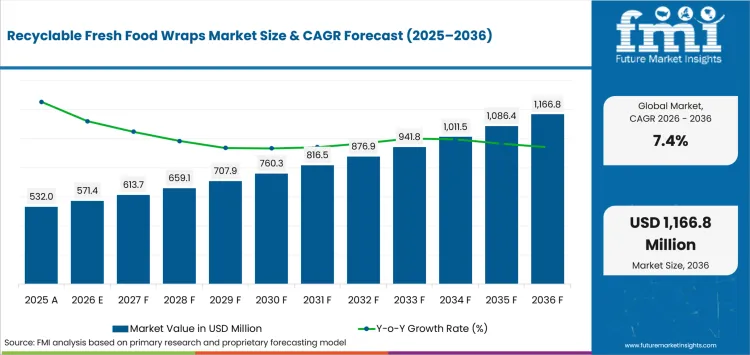
USD 571.4 million in 2026 and USD 1,166.8 million by 2036 at a 7.4% CAGR.
Demand for recyclable fresh food wraps is projected to expand at 7.4% CAGR between 2026 and 2036. Market value is expected to rise from USD 571.4 million in 2026 to USD 1,166.8 million by 2036. European packaging rules entered into force in February 2025 with stronger recyclability requirements for packaging sales. The timetable places flexible packaging paper structures under technical review by foodservice and grocery companies. Approved wraps must preserve grease and moisture control and coatings must remain compatible with fiber recovery routes.
Country conditions separate regulatory intent from workable recovery routes across major foodservice and grocery programs. In October 2025, the USA Environmental Protection Agency stated that recyclable food-service items require local acceptance and at least two-stream sorting. Clear bin labels must identify accepted products and prevent food contamination from weakening collected fiber. This threshold favors fresh food packaging with reliable barriers and simple disposal instructions across each outlet. Germany and the United Kingdom benefit from mature collection systems but Brazil and Japan require localized qualification.
Key Takeaways of Recyclable Fresh Food Wraps Market
- Demand is supported by packaging rules that convert recyclable design and disposal evidence into formal fresh-food wrap specifications.
- In 2026, uncoated recyclable wraps are projected to account for 30.0% due to broad short-hold food applications.
- Virgin fiber is estimated to represent 40.0% in 2026 owing to controlled food-contact quality and converting consistency.
- Grease barrier is forecast to capture 34.0% in 2026 driven by frequent bakery and foodservice exposure to oils.
- Moisture exposure and excessive coating weight can weaken repulpability or raise converted costs during commercial qualification.
- Mondi, Ahlstrom, UPM Specialty Papers, Sappi, Koehler Paper, Seaman Paper, Royal Vaassen and Walki are some notable players in the sector.
Analyst Perspective
"Fresh-food wraps should be judged by the weakest point in the approved structure instead of paper content alone. Commercial value appears once barrier data and line trials support local recovery claims without raising spoilage or packing risk."
- Nandini Roy Choudhury, Principal Consultant, Future Market Insights
How is the Recyclable Fresh Food Wraps Market segmented?
The recyclable fresh food wraps market is segmented by product type, material, barrier, application, end use, sales channel and region.
Product types include uncoated recyclable wraps, dispersion-coated recyclable wraps, repulpable barrier wraps, mono-paper laminate wraps and others while materials cover virgin fiber, recycled fiber, bagasse or agri-fiber and others. Barrier classes comprise grease barrier, moisture barrier, dual barrier and no barrier while applications include QSR and sandwiches, meat and seafood, bakery, fresh produce and others. End uses cover foodservice, grocery retail, food processing and others while sales channels include direct - OEM supply, packaging distributors, online or e-commerce and others.
What makes uncoated recyclable wraps central to the product type category?
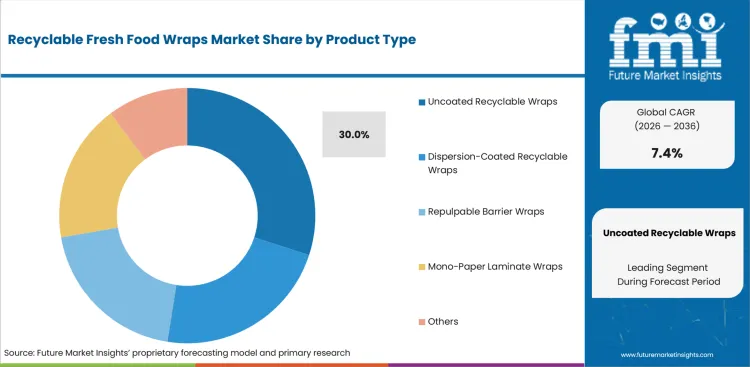
Uncoated wraps suit dry or short-hold foods that need handling protection without extended moisture resistance. Their simple construction reduces coating-related rejects and supports rapid folding across bakery or sandwich service.
- Based on product type, uncoated recyclable wraps are projected to account for 30.0% in 2026 due to broad short-hold food use.
- Bakery counters use liners and interleaving sheets that require wet strength plus controlled grease migration. These applications overlap with greaseproof paper sheets but favor simpler structures during limited exposure periods. Outlet trials also examine print rub and tear resistance during rapid counter handling and storage.
Why does virgin fiber lead the material category?
Virgin fiber gives paper producers a controlled furnish and stable direct-contact surface that supports coating and sealing across lower basis weights during repeat high-speed commercial converting runs.
- By material, virgin fiber is estimated to hold 40.0% in 2026 owing to dependable food-contact and converting performance.
- Food companies qualify odor control and surface uniformity before adding seal or barrier chemistry to direct-contact structures. Recycled fiber remains practical for selected indirect-contact structures with less demanding hygiene and surface-control requirements. Virgin fiber retains broader use as consistent inputs simplify declarations and recurring line checks across food-grade packaging programs.
How does grease barrier anchor the barrier category?
Grease resistance prevents staining and surface weakening around hot sandwiches or bakery items and protects print quality without requiring stronger moisture control for wetter foods.
- In 2026, grease barrier is expected to lead the barrier category with 34.0% share owing to oil exposure across high-volume foodservice uses.
- UPM Specialty Papers and Orkla Suomi introduced a recyclable commercial paper chocolate wrapper in March 2025. The structure used cold-seal lacquer on existing flowpack equipment during a six-month pilot and completed shelf-life testing. The trial explains how barrier-coated papers enter commercial packing lines without transferring performance risk to new machinery.
What supports QSR & Sandwiches in the application category?
QSR outlets consume wraps during each prepared-food transaction and require rapid folding with reliable release. Standardized menus allow one approved structure to serve many locations within the same national operating network.
- The application category is forecast to be led by QSR and sandwiches at 28.0% share in 2026 due to frequent wrapping events.
- Chain operators compare grease holdout and print durability with daily counter speed across standardized menu programs. One validated structure can enter centralized purchasing and distributor stocking across many outlets within the same operating network. This route links burger wrap paper performance with recurring demand instead of treating every wrap as an interchangeable sheet.
What are the drivers, restraints and opportunities in the Recyclable Fresh Food Wraps Market?
Packaging rules increase substitution while food protection and paper-recovery limits slow approval. Application-specific barriers offer the clearest route into repeat commercial programs.
- Driver: Recyclability duties are moving fiber recovery and disposal evidence into fresh-food packaging specifications across major customer programs.
- Restraint: Grease and moisture control can require coatings that increase rejects or narrow accepted paper recovery routes.
- Opportunity: Thin functional layers can preserve machine speed and food protection with a largely fiber-based commercial structure.
Packaging Rules Shift the Approval Brief
California approved permanent packaging regulations in May 2026 and placed measurable duties on producers selling covered formats. The rules require a 25% reduction in single-use plastic and recyclable or compostable packaging across covered formats. Food chains can therefore review paper packaging within existing programs before national sourcing deadlines require wider format changes.
Barrier Performance Complicates Paper Recovery
Fresh food can transfer grease or moisture into paper and weaken its structure during service. Extra coating corrects that failure but can increase non-fiber rejects during conventional pulping and screening operations. Cepi published version 3 of its laboratory method in March 2025 and formalized a common qualification route for conventional paper mills.
Narrow Functional Layers Improve Conversion Economics
Food companies gain the clearest opening from structures that add the minimum function required by each product. Thin sealing or grease layers can preserve line speed and reduce unnecessary material across approved fresh-food applications. Experienced flexible packaging producers can coordinate paper trials with established packing equipment and service conditions efficiently. Specialists in barrier coatings can align functional layers with local disposal guidance during final approval.
Which country CAGRs are profiled in the Recyclable Fresh Food Wraps Market?
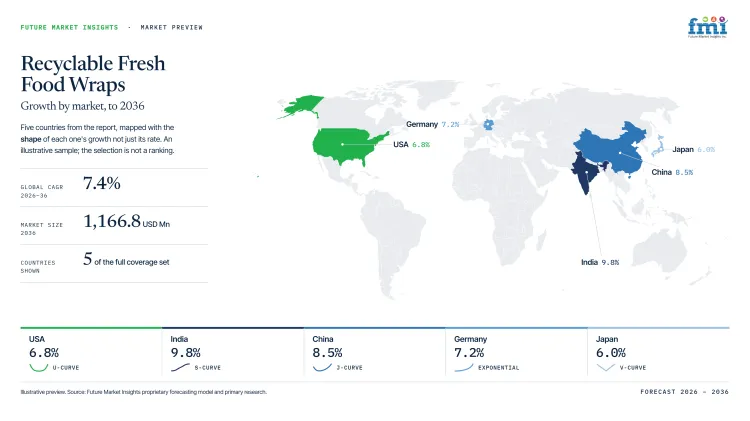
| Country | CAGR |
|---|---|
| United States | 6.8% |
| Germany | 7.2% |
| Japan | 6.0% |
| United Kingdom | 7.3% |
| Brazil | 7.8% |
How do country-level CAGRs compare in the Recyclable Fresh Food Wraps Market?
The countries span a 1.8 percentage-point range between Japan at 6.0% and Brazil at 7.8%. These forecasts measure substitution pace and do not establish current market size or existing shipment volume.
- Brazil's outlook is supported by expanding foodservice demand and increasing scrutiny of packaging recovery across major urban markets.
- In the UK, workplace waste-separation requirements are raising demand for wraps that fit established paper and food-waste handling streams.
- Germany places greater emphasis on recyclability verification, particularly for fiber-rich structures with minimal non-paper content.
- The USA market is shaped by a patchwork of state packaging policies and differing local recovery capabilities across foodservice networks.
- Japan's adoption path remains closely tied to packaging reduction goals, while maintaining strict standards for product presentation and protection.
Comparable CAGRs can represent different commercial burdens as food-contact records and line trials vary across national purchasing systems. The full report evaluates market scale and qualification cost plus collection acceptance across more than thirty countries.
Country-wise Analysis
- National restaurant chains and grocery groups qualify fresh-food wraps across many states and favor common paper structures supported by shared food-contact records plus repeatable line settings for high-volume regional programs. Recyclable fresh food wrap demand in the United States is forecast to rise at 6.8% CAGR over the forecast period owing to centralized national purchasing and expanding state-level producer responsibility requirements. Oregon launched the first statewide packaging and paper extended producer responsibility program in July 2025 with producer-funded collection upgrades but uneven acceptance elsewhere requires state-specific disposal claims plus converter trials before rollout.
- German grocery and foodservice companies operate within mature paper collection systems that reward documented fiber recovery and give approved wraps a clear disposal route across national grocery purchasing programs and retail contracts. Germany's recyclable fresh food wraps sector is projected to record 7.2% CAGR during the assessment period supported by established recycling infrastructure and rigorous design-for-recycling reviews. The German Environment Agency reported in January 2026 that dual systems recycled about 5.5 million tonnes of packaging during 2024 and coating-related rejects remain a friction that requires recognized testing plus traceable EPR records.
- Japanese food companies favor stable appearance and extended qualification cycles for direct-contact packaging which supports careful development with established converters plus detailed shelf-life checks during commercial approval and launch planning. Adoption of recyclable fresh food wraps in Japan is estimated to expand at 6.0% CAGR through 2036 reinforced by coordinated food-packaging resource-circulation work and dependable domestic conversion expertise. The Ministry of Agriculture convened nine task-force meetings from October 2025 to June 2026 and conservative change control remains a friction that requires consistent barrier data plus Japanese disposal guidance for each approved structure.
- Workplace caterers and foodservice groups now operate under clearer separation duties which support consistent paper collection across contracted sites and strengthen the case for wraps carrying simple printed disposal instructions during routine contract reviews. Recyclable fresh food wrap sales in the United Kingdom are forecast to expand at 7.3% CAGR by 2036 aided by national collection rules and concentrated institutional catering networks. England required workplaces with at least ten employees to separate paper and card from March 2025, yet food residue can divert wraps from recycling and raises the value of clean-release structures plus clear staff-ready labels.
- Brazilian foodservice and grocery companies rely on regional converters for printed wraps and short delivery cycles which support local application work plus faster specification adjustments across large urban markets and wider regional launches. Brazil is estimated to post 7.8% CAGR over the forecast period shaped by plastic reverse-logistics obligations and expanding packaged-food channels despite uneven municipal collection performance beyond major cities. Decree 12,688 established a packaging return system in October 2025 but excludes mixed structures containing paper or paperboard from that system which requires clear material declarations plus cost-controlled barriers with local recovery support.
Who are the notable companies in the Recyclable Fresh Food Wraps Market?
Mondi, Ahlstrom, UPM Specialty Papers, Sappi, Koehler Paper, Seaman Paper, Royal Vaassen and Walki are notable companies serving this market.
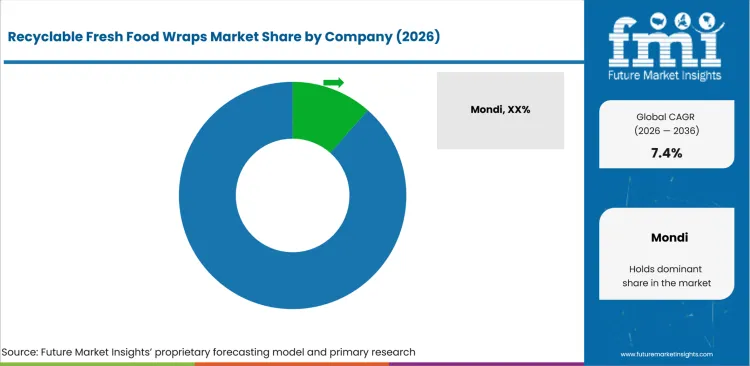
The competitive field remains fragmented across integrated paper groups and specialist barrier producers serving different qualification stages. Commercial entry requires food-contact records and recycling evidence plus repeatable line performance in the intended food application. Integrated producers cover food packaging substrates while converted-format specialists compete on printing and line-ready supply for daily foodservice operations.
- Mondi, Sappi and Koehler Paper compete on high-barrier structures for demanding food uses across paper platforms.
- Seaman Paper and Walki compete with line-ready formats plus printed or cold-seal structures for recurring foodservice packing.
- UPM Specialty Papers, Royal Vaassen and Ahlstrom combine base-paper supply with coating or lamination expertise for food-contact structures.
Competitive Benchmarking: Recyclable Fresh Food Wraps Market
| Company | Food-Wrap Substrate Depth | Barrier and Seal Functionality | Converted Format Access | Geographic Reach |
|---|---|---|---|---|
| Mondi | High | High | Medium | Europe and international markets |
| Ahlstrom | High | High | Medium | Europe, Americas and Asia |
| UPM Specialty Papers | High | High | Medium | Europe, Asia and United States |
| Sappi | High | High | Medium | Europe, Americas and global channels |
| Koehler Paper | Medium | High | Medium | Europe and international distribution |
| Seaman Paper | Medium | Medium | High | United States, Europe and Asia |
| Royal Vaassen | Medium | High | Medium | Europe and international customers |
| Walki | Medium | High | High | Europe and international food-packaging programs |
Key Developments in the Recyclable Fresh Food Wraps Market
- In September 2025, Seaman Paper launched FSC-certified heat-sealable sheets and tubes for form-fill-seal and horizontal flow-wrapper equipment.
- In March 2025, UPM Specialty Papers confirmed CEPI and Western Michigan University recyclability certifications for selected barrier papers.
- In March 2025, Ahlstrom launched recyclable LamiBak Flex wood-pulp base paper for pouches and flow packs requiring further barrier conversion.
Key Players in the Recyclable Fresh Food Wraps Market
Integrated Paper and Barrier Platforms
- Mondi
- Sappi
- Ahlstrom
- UPM Specialty Papers
- Koehler Paper
Converted and Printed Food-Wrap Suppliers
- Seaman Paper
- Walki
Specialty Coating and Lamination Providers
- Royal Vaassen
Recyclable Fresh Food Wraps Market - Report Scope
| Coverage field | Report scope |
|---|---|
| Market breakdown | By product type, material, barrier, application, end use, sales channel and region. |
| Quantitative Units | Revenue in USD million and CAGR in %. |
| Market Definition | Paper- and fiber-dominant flexible wraps sold for direct contact or primary wrapping of fresh and prepared foods. Revenue includes rolls and converted sheets. It excludes downstream food sales and plastic- or foil-only wraps. |
| Regions Covered | North America, Latin America, Western Europe, Eastern Europe, East Asia, South Asia and Pacific and Middle East and Africa. |
| Countries Covered | United States, Germany, Japan, United Kingdom, Brazil, and 20+ countries included in the full report. |
| Key Companies Profiled | Mondi, Ahlstrom, UPM Specialty Papers, Sappi, Koehler Paper, Seaman Paper, Royal Vaassen and Walki. |
| Forecast Period | 2026 to 2036. |
| Approach | Primary and secondary research with market triangulation. |
Recyclable Fresh Food Wraps Market - Research Methodology
| Method | Approach |
|---|---|
| Primary Research | FMI analysts gathered input from manufacturers, service providers, technology developers, distributors, end users, procurement teams, and subject-matter experts. Interviews examined purchasing decisions, product or service evaluation, adoption barriers, approval requirements, pricing considerations, and expectations for technical or commercial support. Respondents were also asked what evidence is required before a trial, pilot, or initial order develops into regular purchasing. |
| Desk Research | Desk research covered government statistics, regulatory publications, trade data, industry associations, technical literature, standards, company filings, product information, and official corporate announcements. Sources were reviewed for relevance, publication date, geographic coverage, and consistency with the defined market scope. Claims relating to performance, applications, approvals, capacity, investment, and commercial activity were retained only when supported by credible public evidence. |
| Market Sizing and Forecasting | The market model combined the baseline value with historical performance, segment structure, pricing and volume indicators, adoption levels, company participation, and country-level demand conditions. Forecast assumptions considered economic activity, investment trends, regulatory developments, technology adoption, purchasing cycles, supply availability, and barriers to wider market use. Segment and regional estimates were reconciled before the final market total was calculated. |
| Data Validation | Estimates were checked against multiple independent indicators, including public data, company activity, trade patterns, industry developments, and findings from primary interviews. Validation also tested whether products, services, applications, and company revenues fell within the defined market boundaries. Adjacent categories, unsupported claims, overlapping revenues, and activities without direct market relevance were excluded to reduce double counting and maintain consistency across segments and countries. |
Recyclable Fresh Food Wraps Market by Segments
Recyclable Fresh Food Wraps Market segmented by Product Type:
- Uncoated Recyclable Wraps
- Dispersion-Coated Recyclable Wraps
- Repulpable Barrier Wraps
- Mono-Paper Laminate Wraps
- Others
Recyclable Fresh Food Wraps Market segmented by Material:
- Virgin Fiber
- Recycled Fiber
- Bagasse - Agri-Fiber
- Others
Recyclable Fresh Food Wraps Market segmented by Barrier:
- Grease Barrier
- Moisture Barrier
- Dual Barrier
- No Barrier
Recyclable Fresh Food Wraps Market segmented by Application:
- QSR & Sandwiches
- Meat & Seafood
- Bakery
- Fresh Produce
- Others
Recyclable Fresh Food Wraps Market segmented by End Use:
- Foodservice
- Grocery Retail
- Food Processing
- Others
Recyclable Fresh Food Wraps Market segmented by Sales Channel:
- Direct - OEM Supply
- Packaging Distributors
- Online - E-commerce
- Others
Recyclable Fresh Food Wraps Market by Region:
- North America
- United States
- Canada
- Latin America
- Brazil
- Mexico
- Chile
- Rest of Latin America
- Western Europe
- Germany
- United Kingdom
- Italy
- Spain
- France
- Nordics
- Benelux
- Rest of Western Europe
- Eastern Europe
- Russia
- Poland
- Hungary
- Balkan and Baltic States
- Rest of Eastern Europe
- East Asia
- China
- Japan
- South Korea
- South Asia and Pacific
- India
- ASEAN
- Australia and New Zealand
- Rest of South Asia and Pacific
- Middle East and Africa
- Kingdom of Saudi Arabia
- Other GCC Countries
- Türkiye
- South Africa
- Other African Union Countries
- Rest of Middle East and Africa
Research Sources and Bibliography
- European Commission. (2025, February 11). New rules enter into force for a more sustainable and competitive packaging economy.
- USA Environmental Protection Agency. Identifying Sustainable Food Service and Food Service Ware. (n.d.). [date should be confirmed directly against epa.gov before republishing]
- UPM Specialty Papers. (2025, March 6). UPM and Orkla Suomi introduce paper packaging for Panda Milk chocolate.
- CalRecycle. (2026, May 1). California approves new plastic and packaging rules that put consumers first.
- Confederation of European Paper Industries. (2025, March 3). Cepi Recyclability Test Method Version 3.
- Oregon Department of Environmental Quality. (2025, July 1). Oregon leads the nation in implementing the Plastic Pollution and Recycling Modernization Act.
- German Environment Agency and Central Agency Packaging Register. (2026, January 27). Facts against myths: Packaging waste recycling in Germany is working.
- Ministry of Agriculture, Forestry and Fisheries. (2025, October 16). 食品分野におけるプラスチック容器包装資源循環タスクフォース.
- Department for Environment, Food & Rural Affairs and Environment Agency. (2025, March 31). New rules simplifying recycling for workplaces in England come into force.
- Presidency of the Republic of Brazil. (2025, October 21). Decreto No. 12.688, de 21 de outubro de 2025.
- Mondi. (2025, August 14). Mondi ramps up FunctionalBarrier Paper Ultimate to meet growing demand for sustainable high-barrier paper-based packaging.
- Sappi. (2025, July 14). Sappi celebrates future-proof paper packaging at FACHPACK 2025.
- Koehler Paper. (2025, February 20). pack&satt Organic Ready-to-Eat Meals Packed in Koehler Paper Material.
- Walki. (2025, April 16). Fibre-based wrapping for a beloved chocolate bar.
- UPM Specialty Papers. (2025, September 4). UPM and Royal Vaassen have developed a fibre-based alternative to plastic and aluminum packaging solutions.
- Seaman Paper. (2025, September 18). Seaman Paper Launches Heat-Sealable Paper Packaging: A Scalable, Recyclable Alternative to Single-Use Plastics.
- UPM Specialty Papers. (2025, March 18). UPM packaging papers achieve recyclability certifications in Europe and the USA.
- Ahlstrom. (2025, March 17). Ahlstrom expands LamiBak portfolio with a new base paper for flexible food packaging.
- Mondi. (2026, February 18). How Prymat improved spice preservation with Mondi's recyclable ultra-high barrier paper solution.
- Koehler Group. (2026, April 10). PFAS-Free and Recyclable Fast Food Packaging Paper by Koehler Paper: Grease-Resistant for Demanding Applications.
- Sappi North America. (2026, April 13). Sappi North America Introduces LusterFSB OGR, a Grease Resistant Food Service Board Designed for Compostability.
- Ahlstrom. (2025, April 7). Ahlstrom receives home compostable certification in Australia and New Zealand for Sulpack Flexible packaging.
This bibliography is provided for reader reference and is not exhaustive. The full report contains the complete reference list and detailed citations.
This Report Answers
- How large is the Recyclable Fresh Food Wraps Market in 2026 and 2036?
- Which packaging and recovery conditions are changing fresh-food wrap specifications?
- Why do uncoated recyclable wraps account for 30.0% of demand in 2026?
- How does virgin fiber reduce food-contact and converting variation during qualification?
- Why does grease barrier hold a 34.0% share across fresh-food applications?
- How do country growth conditions differ across the five profiled national markets?
- Which companies combine barrier-paper expertise with converted food-wrap access?
- How do coating weight and food residue limit practical paper recovery?
- What evidence should food companies review before approving a recyclable fresh-food wrap?
Frequently Asked Questions
How big is the recyclable fresh food wraps market in 2026?
The recyclable fresh food wraps market is estimated at USD 571.4 million in 2026. Growth is driven by increasing adoption of fiber-based food wraps that support recyclability while maintaining moisture and grease resistance.
What is the CAGR of the recyclable fresh food wraps market from 2026 to 2036?
The recyclable fresh food wraps market is projected to grow at a CAGR of 7.4% between 2026 and 2036. Expansion is supported by sustainability regulations and rising demand for recyclable packaging solutions across foodservice and retail sectors.
Which product type is projected to account for 30.0% of the recyclable fresh food wraps market?
Uncoated recyclable wraps are projected to account for 30.0% of the market in 2026. Their leading share is supported by simple fiber-based construction and suitability for dry and short-shelf-life food applications.
What absolute dollar opportunity is projected for the recyclable fresh food wraps market from 2026 to 2036?
The recyclable fresh food wraps market is expected to create an absolute dollar opportunity of USD 595.4 million between 2026 and 2036. Growth reflects increasing approval and adoption of recyclable fiber-based wraps across commercial food packaging applications.
Which companies are active in the recyclable fresh food wraps market?
Key companies operating in the market include Mondi, Ahlstrom, UPM Specialty Papers, Sappi, Koehler Paper, Seaman Paper, Royal Vaassen, and Walki. These companies provide barrier paper solutions and recyclable food-wrap products for foodservice and retail packaging applications.
Preview the report firsthand - request a free sample
Get SampleGet the brochure for pricing and purchase details.
Get PDFTable of Content
- Key Takeaways
- Market Size and CAGR
- Top Growth Driver
- Fastest Growing Segment
- Leading Region
- Key Companies
- Emerging Opportunities
- Executive Summary
- Global Market Outlook
- Demand-side Trends
- Supply-side Trends
- Technology Roadmap Analysis
- Analysis and Recommendations
- Analyst Perspective (What is happening? Why now? What should investors know?)
- Key Questions Answered
- How large is the market?
- What is the CAGR?
- What are key trends?
- Which region dominates?
- Who are the leaders?
- Market Overview
- Market Coverage / Taxonomy
- Market Definition / Scope / Limitations
- Research Methodology
- Chapter Orientation
- Analytical Lens and Working Hypotheses
- Market Structure, Signals, and Trend Drivers
- Benchmarking and Cross-market Comparability
- Market Sizing, Forecasting, and Opportunity Mapping
- Research Design and Evidence Framework
- Desk Research Programme (Secondary Evidence)
- Expert Input and Fieldwork (Primary Evidence)
- Tooling, Models, and Reference Databases
- Data Engineering and Model Build
- Quality Assurance and Audit Trail
- Market Background
- Market Dynamics (Drivers, Restraints, Opportunity, Trends)
- Scenario Forecast (Optimistic, Likely, Conservative)
- Impact Analysis
- AI Impact
- Sustainability Impact
- Regulatory Impact
- Technology Impact
- Consumer / Buyer Analysis
- Purchase Drivers
- Adoption Barriers
- Buyer Journey
- Opportunity Map Analysis
- Product Life Cycle Analysis
- Supply Chain Analysis
- Investment Feasibility Matrix
- Value Chain Analysis
- PESTLE and Porter's Analysis
- Regulatory Landscape
- Regional Parent Market Outlook
- Production and Consumption Statistics
- Import and Export Statistics
- Global Market Analysis and Forecast, 2021 to 2036
- Historical Market Size Value (USD Million) Analysis, 2021 to 2025
- Current and Future Market Size Value (USD Million) Projections, 2026 to 2036
- Y-o-Y Growth Trend Analysis
- Absolute $ Opportunity Analysis
- Global Market Pricing Analysis, 2021 to 2036
- Global Market Analysis and Forecast, By Product Type, 2021 to 2036
- Introduction / Key Findings
- Historical Market Size Value (USD Million) Analysis By Product Type, 2021 to 2025
- Current and Future Market Size Value (USD Million) Analysis and Forecast By Product Type, 2026 to 2036
- Uncoated Recyclable Wraps
- Dispersion-Coated Recyclable Wraps
- Repulpable Barrier Wraps
- Mono-Paper Laminate Wraps
- Others
- Uncoated Recyclable Wraps
- Y-o-Y Growth Trend Analysis By Product Type, 2021 to 2025
- Absolute $ Opportunity Analysis By Product Type, 2026 to 2036
- Global Market Analysis and Forecast, By Material, 2021 to 2036
- Introduction / Key Findings
- Historical Market Size Value (USD Million) Analysis By Material, 2021 to 2025
- Current and Future Market Size Value (USD Million) Analysis and Forecast By Material, 2026 to 2036
- Virgin Fiber
- Recycled Fiber
- Bagasse - Agri-Fiber
- Others
- Virgin Fiber
- Y-o-Y Growth Trend Analysis By Material, 2021 to 2025
- Absolute $ Opportunity Analysis By Material, 2026 to 2036
- Global Market Analysis and Forecast, By Barrier, 2021 to 2036
- Introduction / Key Findings
- Historical Market Size Value (USD Million) Analysis By Barrier, 2021 to 2025
- Current and Future Market Size Value (USD Million) Analysis and Forecast By Barrier, 2026 to 2036
- Grease Barrier
- Moisture Barrier
- Dual Barrier
- No Barrier
- Grease Barrier
- Y-o-Y Growth Trend Analysis By Barrier, 2021 to 2025
- Absolute $ Opportunity Analysis By Barrier, 2026 to 2036
- Global Market Analysis and Forecast, By Application, 2021 to 2036
- Introduction / Key Findings
- Historical Market Size Value (USD Million) Analysis By Application, 2021 to 2025
- Current and Future Market Size Value (USD Million) Analysis and Forecast By Application, 2026 to 2036
- QSR & Sandwiches
- Meat & Seafood
- Bakery
- Fresh Produce
- Others
- QSR & Sandwiches
- Y-o-Y Growth Trend Analysis By Application, 2021 to 2025
- Absolute $ Opportunity Analysis By Application, 2026 to 2036
- Global Market Analysis and Forecast, By End Use, 2021 to 2036
- Introduction / Key Findings
- Historical Market Size Value (USD Million) Analysis By End Use, 2021 to 2025
- Current and Future Market Size Value (USD Million) Analysis and Forecast By End Use, 2026 to 2036
- Foodservice
- Grocery Retail
- Food Processing
- Others
- Foodservice
- Y-o-Y Growth Trend Analysis By End Use, 2021 to 2025
- Absolute $ Opportunity Analysis By End Use, 2026 to 2036
- Global Market Analysis and Forecast, By Sales Channel
- Introduction / Key Findings
- Historical Market Size Value (USD Million) Analysis By Sales Channel, 2021 to 2025
- Current and Future Market Size Value (USD Million) Analysis and Forecast By Sales Channel, 2026 to 2036
- Direct - OEM Supply
- Packaging Distributors
- Online - E-commerce
- Others
- Direct - OEM Supply
- Y-o-Y Growth Trend Analysis By Sales Channel, 2021 to 2025
- Absolute $ Opportunity Analysis By Sales Channel, 2026 to 2036
- Global Market Analysis and Forecast, By Region, 2021 to 2036
- Introduction
- Historical Market Size Value (USD Million) Analysis By Region, 2021 to 2025
- Current Market Size Value (USD Million) Analysis and Forecast By Region, 2026 to 2036
- North America
- Latin America
- Western Europe
- Eastern Europe
- East Asia
- South Asia and Pacific
- Middle East & Africa
- Market Attractiveness Analysis By Region
- North America Market Analysis and Forecast, By Country, 2021 to 2036
- Historical Market Size Value (USD Million) Trend Analysis By Market Taxonomy, 2021 to 2025
- Market Size Value (USD Million) Forecast By Market Taxonomy, 2026 to 2036
- By Country
- USA
- Canada
- By Product Type
- By Material
- By Barrier
- By Application
- By End Use
- By Sales Channel
- By Country
- Market Attractiveness Analysis
- By Country
- By Product Type
- By Material
- By Barrier
- By Application
- By End Use
- By Sales Channel
- Key Takeaways
- Latin America Market Analysis and Forecast, By Country
- Historical Market Size Value (USD Million) Trend Analysis By Market Taxonomy, 2021 to 2025
- Market Size Value (USD Million) Forecast By Market Taxonomy, 2026 to 2036
- By Country
- Brazil
- Mexico
- Chile
- Rest of Latin America
- By Product Type
- By Material
- By Barrier
- By Application
- By End Use
- By Sales Channel
- By Country
- Market Attractiveness Analysis
- By Country
- By Product Type
- By Material
- By Barrier
- By Application
- By End Use
- By Sales Channel
- Key Takeaways
- Western Europe Market Analysis and Forecast, By Country
- Historical Market Size Value (USD Million) Trend Analysis By Market Taxonomy, 2021 to 2025
- Market Size Value (USD Million) Forecast By Market Taxonomy, 2026 to 2036
- By Country
- Germany
- UK
- Italy
- Spain
- France
- Nordic
- BENELUX
- Rest of Western Europe
- By Product Type
- By Material
- By Barrier
- By Application
- By End Use
- By Sales Channel
- By Country
- Market Attractiveness Analysis
- By Country
- By Product Type
- By Material
- By Barrier
- By Application
- By End Use
- By Sales Channel
- Key Takeaways
- Eastern Europe Market Analysis and Forecast, By Country
- Historical Market Size Value (USD Million) Trend Analysis By Market Taxonomy, 2021 to 2025
- Market Size Value (USD Million) Forecast By Market Taxonomy, 2026 to 2036
- By Country
- Russia
- Poland
- Hungary
- Balkan & Baltic
- Rest of Eastern Europe
- By Product Type
- By Material
- By Barrier
- By Application
- By End Use
- By Sales Channel
- By Country
- Market Attractiveness Analysis
- By Country
- By Product Type
- By Material
- By Barrier
- By Application
- By End Use
- By Sales Channel
- Key Takeaways
- East Asia Market Analysis and Forecast, By Country
- Historical Market Size Value (USD Million) Trend Analysis By Market Taxonomy, 2021 to 2025
- Market Size Value (USD Million) Forecast By Market Taxonomy, 2026 to 2036
- By Country
- China
- Japan
- South Korea
- By Product Type
- By Material
- By Barrier
- By Application
- By End Use
- By Sales Channel
- By Country
- Market Attractiveness Analysis
- By Country
- By Product Type
- By Material
- By Barrier
- By Application
- By End Use
- By Sales Channel
- Key Takeaways
- South Asia and Pacific Market Analysis and Forecast, By Country
- Historical Market Size Value (USD Million) Trend Analysis By Market Taxonomy, 2021 to 2025
- Market Size Value (USD Million) Forecast By Market Taxonomy, 2026 to 2036
- By Country
- India
- ASEAN
- Australia & New Zealand
- Rest of South Asia and Pacific
- By Product Type
- By Material
- By Barrier
- By Application
- By End Use
- By Sales Channel
- By Country
- Market Attractiveness Analysis
- By Country
- By Product Type
- By Material
- By Barrier
- By Application
- By End Use
- By Sales Channel
- Key Takeaways
- Middle East & Africa Market Analysis and Forecast, By Country
- Historical Market Size Value (USD Million) Trend Analysis By Market Taxonomy, 2021 to 2025
- Market Size Value (USD Million) Forecast By Market Taxonomy, 2026 to 2036
- By Country
- Kingdom of Saudi Arabia
- Other GCC Countries
- Türkiye
- South Africa
- Other African Union
- Rest of Middle East & Africa
- By Product Type
- By Material
- By Barrier
- By Application
- By End Use
- By Sales Channel
- By Country
- Market Attractiveness Analysis
- By Country
- By Product Type
- By Material
- By Barrier
- By Application
- By End Use
- By Sales Channel
- Key Takeaways
- Key Countries Market Analysis
- USA
- Pricing Analysis
- Market Share Analysis, 2025
- By Product Type
- By Material
- By Barrier
- By Application
- By End Use
- By Sales Channel
- Canada
- Pricing Analysis
- Market Share Analysis, 2025
- By Product Type
- By Material
- By Barrier
- By Application
- By End Use
- By Sales Channel
- Mexico
- Pricing Analysis
- Market Share Analysis, 2025
- By Product Type
- By Material
- By Barrier
- By Application
- By End Use
- By Sales Channel
- Brazil
- Pricing Analysis
- Market Share Analysis, 2025
- By Product Type
- By Material
- By Barrier
- By Application
- By End Use
- By Sales Channel
- Chile
- Pricing Analysis
- Market Share Analysis, 2025
- By Product Type
- By Material
- By Barrier
- By Application
- By End Use
- By Sales Channel
- Germany
- Pricing Analysis
- Market Share Analysis, 2025
- By Product Type
- By Material
- By Barrier
- By Application
- By End Use
- By Sales Channel
- UK
- Pricing Analysis
- Market Share Analysis, 2025
- By Product Type
- By Material
- By Barrier
- By Application
- By End Use
- By Sales Channel
- Italy
- Pricing Analysis
- Market Share Analysis, 2025
- By Product Type
- By Material
- By Barrier
- By Application
- By End Use
- By Sales Channel
- Spain
- Pricing Analysis
- Market Share Analysis, 2025
- By Product Type
- By Material
- By Barrier
- By Application
- By End Use
- By Sales Channel
- France
- Pricing Analysis
- Market Share Analysis, 2025
- By Product Type
- By Material
- By Barrier
- By Application
- By End Use
- By Sales Channel
- India
- Pricing Analysis
- Market Share Analysis, 2025
- By Product Type
- By Material
- By Barrier
- By Application
- By End Use
- By Sales Channel
- ASEAN
- Pricing Analysis
- Market Share Analysis, 2025
- By Product Type
- By Material
- By Barrier
- By Application
- By End Use
- By Sales Channel
- Australia & New Zealand
- Pricing Analysis
- Market Share Analysis, 2025
- By Product Type
- By Material
- By Barrier
- By Application
- By End Use
- By Sales Channel
- China
- Pricing Analysis
- Market Share Analysis, 2025
- By Product Type
- By Material
- By Barrier
- By Application
- By End Use
- By Sales Channel
- Japan
- Pricing Analysis
- Market Share Analysis, 2025
- By Product Type
- By Material
- By Barrier
- By Application
- By End Use
- By Sales Channel
- South Korea
- Pricing Analysis
- Market Share Analysis, 2025
- By Product Type
- By Material
- By Barrier
- By Application
- By End Use
- By Sales Channel
- Russia
- Pricing Analysis
- Market Share Analysis, 2025
- By Product Type
- By Material
- By Barrier
- By Application
- By End Use
- By Sales Channel
- Poland
- Pricing Analysis
- Market Share Analysis, 2025
- By Product Type
- By Material
- By Barrier
- By Application
- By End Use
- By Sales Channel
- Hungary
- Pricing Analysis
- Market Share Analysis, 2025
- By Product Type
- By Material
- By Barrier
- By Application
- By End Use
- By Sales Channel
- Kingdom of Saudi Arabia
- Pricing Analysis
- Market Share Analysis, 2025
- By Product Type
- By Material
- By Barrier
- By Application
- By End Use
- By Sales Channel
- Türkiye
- Pricing Analysis
- Market Share Analysis, 2025
- By Product Type
- By Material
- By Barrier
- By Application
- By End Use
- By Sales Channel
- South Africa
- Pricing Analysis
- Market Share Analysis, 2025
- By Product Type
- By Material
- By Barrier
- By Application
- By End Use
- By Sales Channel
- USA
- Market Structure Analysis
- Competition Dashboard
- Competition Benchmarking
- Market Share Analysis of Top Players
- By Regional
- By Product Type
- By Material
- By Barrier
- By Application
- By End Use
- By Sales Channel
- Emerging Startups
- Innovation Benchmarking
- Competition Analysis
- Competition Deep Dive
- Mondi
- Overview
- Product Portfolio
- Profitability by Market Segments
- Sales Footprint
- Strategy Overview
- Marketing Strategy
- Product Strategy
- Channel Strategy
- Sappi
- Ahlstrom
- Novolex
- McNairn Packaging
- Georgia-Pacific
- Koehler Paper
- UPM Specialty Papers
- Seaman Paper
- Handy Wacks
- Mondi
- Case Studies
- Success Stories
- Recent Developments
- Competition Deep Dive
- Assumptions & Acronyms Used


