

- Industry Size (2026)
- 281.0 USD Mn
- Forecast (2036)
- 975.0 USD Mn
- CAGR (2026 to 2036)
- 13.3%
Bio-Based Food-Contact Compostable Adhesives Market Size, Market Forecast and Outlook By FMI
In 2025, the bio-based food-contact compostable adhesives market crossed a valuation of USD 255.0 million and is projected to reach USD 281.0 million in 2026 and USD 975.0 million by 2036, reflecting a CAGR of 13.3%, with momentum tied to regulatory phase-outs targeting fossil-derived binders. Raised compliance thresholds reset minimum capability standards across global manufacturing hubs. Value scales rapidly as procurement concentrates in pre-qualified vendor pools possessing verified degradation certifications.
Absolute dollar growth of USD 694.0 million over the decade signals a critical transition toward bio-based chemistry, as stringent environmental mandates compel converters to abandon conventional bonding agents. Procurement teams shift specifications toward verified compostable adhesives to avoid impending single-use plastic taxation. Total global bioeconomy value reaches USD 4-5 trillion currently, driving massive capital allocation into renewable feedstock synthesis [1]. Qualification processes accelerate for formulas matching degradation rates of primary wrappers.
Summary of Bio-Based Food-Contact Compostable Adhesives Market
- Bio-Based Food-Contact Compostable Adhesives Market Definition
- Industrial biological bonding agents designed for consumable packaging applications requiring certified end-of-life degradation.
- Demand Drivers in Market
- Mandatory municipal organic waste diversion targets force substrate redesigns.
- Corporate sustainability pledges accelerate fossil-derived chemical phase-outs.
- Advancements in biopolymer thermal stability improve machine runnability speeds.
- Key Segments Analyzed in FMI Report
- Raw Material Source: Polylactic Acid (PLA)-based adhesives (38%) versus starch-based, protein-derived, and cellulosic/biopolymer blends.
- Application Sector: Compostable food packaging tapes (31% of total volume) versus laminated films, labels & graphics, and folding cartons.
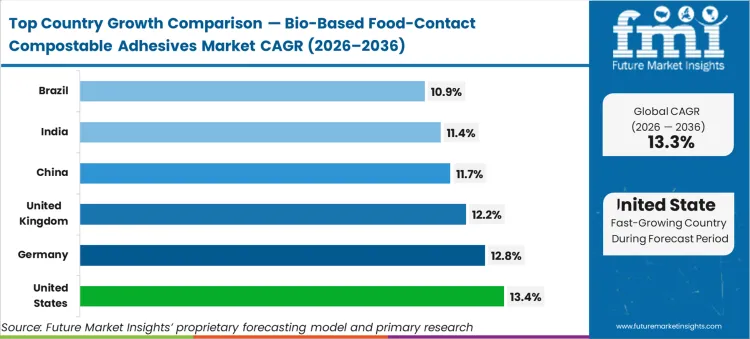
- Geography: High-growth North America and Europe (United States 13.4%, Germany 12.8%, United Kingdom 12.2%) versus scaling Asia-Pacific and Latin America (China 11.7%, India 11.4%, Brazil 10.9%).
- Analyst Opinion at FMI
- Ismail Sutaria, Principal Consultant for Packaging at Future Market Insights, opines, “In our latest Bio-Based Food-Contact Compostable Adhesives Market evaluation, my team and I have identified end-of-life integrity as the true competitive benchmark. It is not enough for an adhesive to be bio-based; it must disintegrate at the same rate as the substrate without leaving micro-residues that compromise compost quality. Adhesive formulation must align with fiber recovery, compost facility conditions, and food-contact migration thresholds simultaneously. Companies that design adhesives as part of a complete compostable packaging ecosystem, rather than as standalone bonding agents, will shape the next phase of sustainable food packaging innovation.”
- Strategic Implications/Executive Takeaways
- Secure bio-feedstock supply chains to insulate margins from agricultural volatility.
- Prioritize drop-in formulations requiring zero capital equipment modifications.
- Pursue home-compostable certifications to outpace basic industrial degradation standards.
- Methodology
- Validated through first-hand corporate production and capacity data.
- Zero reliance on speculative third-party market research reports.
- Based on verifiable industrial benchmarks and verified sources.
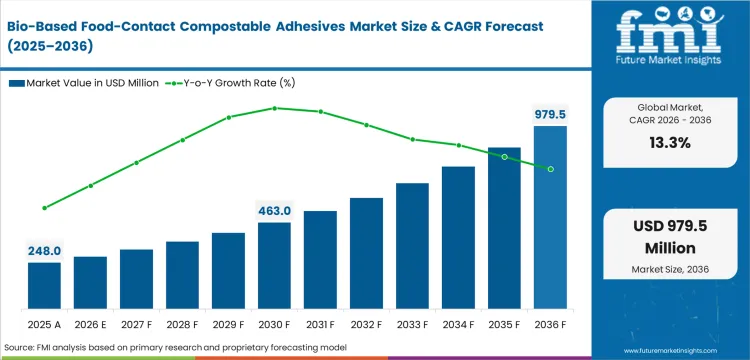
Bio-Based Food-Contact Compostable Adhesives Market Key Takeaways
| Metric | Details |
|---|---|
| Industry Size (2026) | USD 281.0 Million |
| Industry Value (2036) | USD 975.0 Million |
| CAGR (2026-2036) | 13.3% |
As stated by Steven Gaik, Technical Account Manager at BASF, "Compostability and recyclability are complementary approaches to a sustainable economy. They are not intended to replace each other but rather to augment where recycling may not be feasible, such as in small-format food wrapping or packaging with food residues." [2].
Across North America, Europe, and Asia Pacific, adoption concentrates where local infrastructure supports organic waste processing. Dispersion mirrors compliance exposure, forcing multinational conglomerates to formulate highly specific biodegradable food packaging resins. Converters clear technical reviews faster when presenting independently audited decomposition credentials. Compostable materials constituted roughly 0.4% by weight of materials entering United States waste facilities in 2025, highlighting early-stage infrastructure runways [3].
Bio-Based Food-Contact Compostable Adhesives Market Definition
Bio-Based Food-Contact Compostable Adhesives encompass industrial bonding agents formulated from renewable biological resources, engineered specifically to degrade completely within commercial or home composting environments. Manufacturers deploy these compounds primarily to secure flexible and rigid containers intended for direct or indirect consumable goods contact. Product formulations comply with regional food safety regulations while maintaining structural integrity during strict shelf-life periods.
Bio-Based Food-Contact Compostable Adhesives Market Inclusions
Coverage includes starch-derived, polylactic acid, cellulosic, and protein-based formulations utilized as tapes, labels, or laminating layers in consumable goods wrapping. Valuations capture direct sales of liquid and solid bonding materials supplied to converters and direct equipment manufacturers. Revenue from compostable plastic packaging binders engineered for quick-service restaurants and retail grocery applications forms core market data.
Bio-Based Food-Contact Compostable Adhesives Market Exclusions
Assessments exclude non-degradable synthetic hot melts, solvent-based polyurethane, and standard acrylic pressure-sensitive tapes lacking certified biodegradation profiles. Post-consumer recycled bonding agents derived from petrochemical sources fall outside defined boundaries. Valuations omit downstream finished retail goods or machinery required to apply bonding agents onto substrates.
Bio-Based Food-Contact Compostable Adhesives Market Research Methodology
- Primary Research: Analysts conducted structured interviews with chemical engineers, sustainability officers, and packaging converters to validate adoption rates.
- Desk Research: Evaluators reviewed technical specifications from industry associations and corporate sustainability disclosures to benchmark formulation trends.
- Market-Sizing and Forecasting: Teams applied bottom-up volume tracking correlated against regional legislative timelines banning single-use plastics to generate demand models.
- Data Validation and Update Cycle: Quantitative inputs undergo cross-verification against reported biopolymer production capacities and chemical distributor shipment records before final publication.
Segmental Analysis
Bio-Based Food-Contact Compostable Adhesives Market Analysis by Raw Material Source
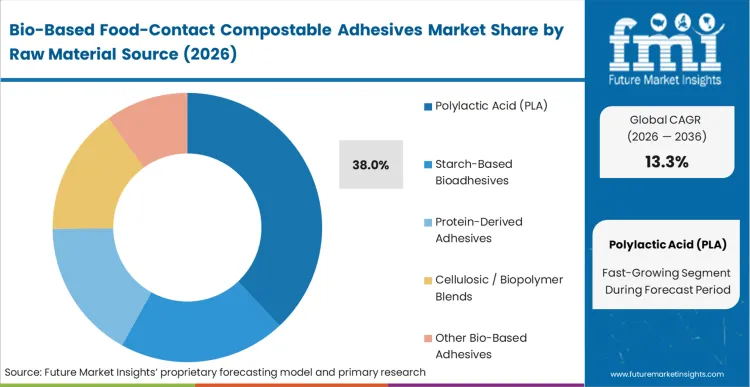
Polylactic Acid (PLA)-Based Adhesives hold a 38% share in 2026, driven by superior optical clarity and structural compatibility with rigid bioplastics. As per FMI's projection, formulation advancements elevate thermal resistance profiles, unlocking hot-fill food applications previously restricted to fossil-based polymers. European Bioplastics reported global bio-based plastics production capacity at 2.31 million tons in 2025, validating feedstock availability for expanding bio based laminate packaging materials [4]. Converters transition toward PLA derivatives to maintain line speeds without sacrificing end-of-life certification requirements. Scale economies gradually compress price premiums, making PLA formats increasingly viable for high-volume quick-service restaurant consumables.
- Procurement shift: Converters replace legacy hot melts with PLA variants to meet strict degradation mandates, securing vital eco-labels for consumer brands. Dow Inc. launched new bio-based laminating adhesives for degradable films in 2025, accelerating broad commercial adoption [5].
- Cost optimization: High initial polymer costs force buyers to blend PLA with starch derivatives for non-critical structural layers, reducing dependency on expensive pure-grade imports. BioBond Adhesives announced USDA BioPreferred solutions in February 2025, optimizing formulation economics for regional converters [6].
- Performance upgrade: Extended shelf-life requirements prompt investments in advanced protein-derived crosslinking agents, offering robust barrier protection. Arkema expanded Bostik Fast Glue Ultra+ production in 2025, deploying high-performance composites for demanding laminate structures [7].
Bio-Based Food-Contact Compostable Adhesives Market Analysis by Application Sector
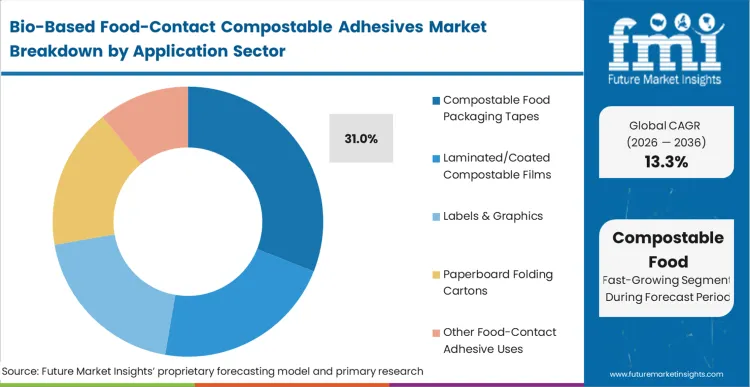
Compostable food packaging tapes are becoming essential components in fully certified secondary packaging systems, ensuring that all elements meet biodegradation standards. Pressure-sensitive bio-based coatings help reduce contamination issues during municipal composting, addressing ongoing sorting challenges. In September 2025, the Washington State Department of Ecology reported that compliant produce stickers cost $4.80 per 1,000 units, adding incremental expense for growers [8]. Despite higher upfront costs, brands are willing to invest to ensure packaging structures pass strict composability tests. Demand is also rising for labels and graphics that can withstand high-moisture refrigeration environments, positioning compostable food packaging tapes to capture 31% volume share in 2026.
- Certification gate: Contamination limits force brands to utilize certified bonding agents for all structural seams across automated carton lines. Kiilto launched Biomelt in 2025, delivering an industrial hot-melt solution specifically engineered for high-speed folding machinery [9].
- Infrastructure alignment: Waste processors reject containers featuring synthetic label backing, driving demand for compliant recyclability certified labels and adhesives. TIPA partnered with Bio4Life in 2025 to distribute fully degradable pressure-sensitive backing formulations [10].
- Speed to market: Drop-in liquid applications accelerate adoption among legacy paperboard converters, deploying sustainable barriers without requiring costly machinery retrofits. Graphic Packaging formed a joint venture with Henkel in 2025, scaling compliant barrier sealants across existing manufacturing lines [11].
Bio-Based Food-Contact Compostable Adhesives Market Drivers, Restraints, and Opportunities
Macroeconomic transition toward circular material economies fundamentally accelerates biological bonding agent adoption across global fast-moving consumer goods sectors. According to FMI's estimates, stringent regulatory frameworks targeting end-of-life plastic pollution force brands to replace legacy synthetic resins with verifiable compostable alternatives. Total United States sustainable packaging spending hit $49.18 billion in 2024, reflecting massive capital deployment into green supply chains [12]. Packaging engineers specify natural polymers to ensure entire container structures pass rigorous municipal facility degradation tests. Procurement teams issue long-term contracts for certified formulations to secure supply ahead of impending single-use plastic tax implementations.
High formulation costs and performance gaps in high-moisture environments remain primary barriers slowing universal adoption across liquid and frozen goods segments. FMI analysts opine that biological polymers often lack essential thermal stability required for rapid hot-fill manufacturing lines, forcing operators to reduce machine speeds. Biodegradable & Bioplastics Industries Association projected a modest 5 to 8% bioplastic substitution potential by 2030, highlighting technical limitations curbing total market takeover [13]. Converters mitigate margin impacts by blending expensive primary biopolymers with cheaper starch derivatives for less demanding secondary enclosure applications. Chemical suppliers invest heavily in crosslinking research to narrow performance deficits against entrenched petrochemical equivalents.
- Feedstock Diversification: Suppliers capture margin stability by substituting volatile agricultural crops with advanced cellulosic waste derivatives, reducing reliance on conventional fossil-derived solvents.
- Foodservice Expansion: Quick-service restaurants present massive volume potential for biological bonding agents used in disposable cups and wrappers. Sika AG expanded dedicated bio-based manufacturing operations in 2025, enabling localized supply security for bulk food-contact applications [14].
- Legislative Harmonization: Unified testing standards across regional borders allow chemical manufacturers to scale single formulations globally. Power Adhesives launched tecbond 214B in 2025, targeting zero-waste initiatives inside global fast-food franchise operations with standardized compliance metrics [15].
Regional Analysis
Based on the regional analysis, the Bio-Based Food-Contact Compostable Adhesives market is segmented into North America, Latin America, Europe, East Asia, South Asia, Oceania and Middle East & Africa across 40+ countries. The full report also offers market attractiveness analysis based on regional trends.
| Country | CAGR (2026 to 2036) |
|---|---|
| United States | 13.4% |
| Germany | 12.8% |
| United Kingdom | 12.2% |
| China | 11.7% |
| India | 11.4% |
| Brazil | 10.9% |
Source: Future Market Insights (FMI) analysis, based on proprietary forecasting model and primary research
.webp "Top Country Growth Comparison Bio Based Food Contact Compostable Adhesives Market Cagr (2026 2036)")
North America Bio-Based Food-Contact Compostable Adhesives Analysis
North America exhibits rapid demand acceleration driven by municipal organic waste infrastructure expansion and rising corporate zero-waste pledges. Converters face increasing pressure from massive retail chains to provide fully compliant solutions to avoid localized landfill penalties. Chemical giants deploy substantial capital into domestic global bio plastics capacity to insulate supply chains from turbulent trans-Pacific shipping routes.
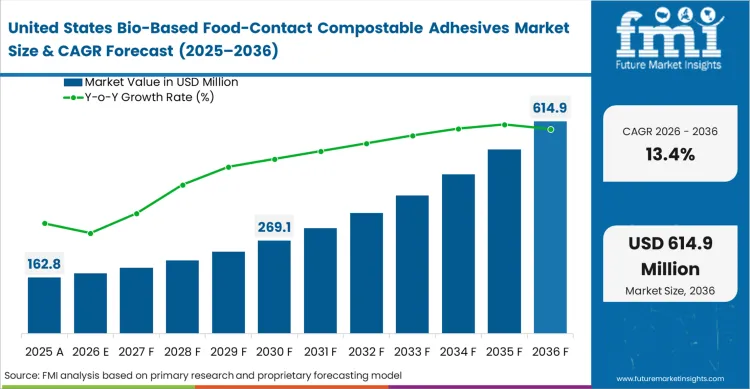
- United States: Demand for Bio-Based Food-Contact Compostable Adhesives in United States is set to grow at 13.4% CAGR through 2036, supported by expanding municipal organic diversion mandates before procurement cycles translate into higher deployment volumes. Sustainable Packaging Coalition reported US composting access for food waste reached 18.1% of sampled populations in October 2025, helping suppliers align positioning with local brand owners [16].
FMI's report includes detailed growth analysis and country-wise assessment across North America. Canada and Mexico present strong opportunistic pathways as regional free-trade agreements harmonize cross-border food safety testing protocols. Procurement teams monitor evolving state-level extended producer responsibility laws dictating specific end-of-life material certifications.
Europe Bio-Based Food-Contact Compostable Adhesives Analysis
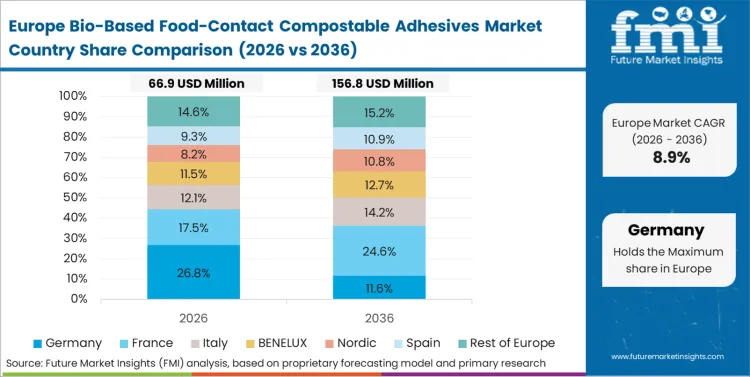
Europe remains a critical regulatory laboratory where aggressive Green Deal directives force comprehensive material science innovation across all packaging tiers. Manufacturers pivot heavily toward home-compostable certifications to bypass inconsistent industrial composting facility access across member states. Converters leverage advanced industrial adhesives to unlock premium pricing structures within highly environmentally conscious consumer demographics.
- Germany: Bio-Based Food-Contact Compostable Adhesives sales in Germany are projected to rise at 12.8% CAGR from 2026 to 2036 as aggressive national plastic taxes take effect, creating a clearer pathway from policy intent to purchase orders. Packsize and Henkel collaborated in 2025 to introduce Eco-Pax, a bio-based hot-melt solution designed for right-sized grocery logistics penetrating German supermarkets [17].
- United Kingdom: United Kingdom is expected to rise 12.2% CAGR in Bio-Based Food-Contact Compostable Adhesives demand over 2026 to 2036 as extended producer responsibility fees penalize synthetic polymers. European Union adhesive demand hit EUR 16.5 billion entering 2026, tightening links between operational constraints and adoption-led investment across neighboring trade zones [18].
FMI's report includes comprehensive analysis covering evolving dynamics inside European borders. France and Italy show immediate promise due to strict national decrees banning non-degradable produce stickers and single-use service items. Buyers face rising pressure to secure high-performance biological formulations before impending continental supply crunches materialize.
Asia Pacific Bio-Based Food-Contact Compostable Adhesives Analysis
Asia Pacific serves as an emerging production powerhouse leveraging immense raw agricultural feedstocks to manufacture cost-competitive starch and PLA derivatives. Regional converters rapidly upgrade material profiles to satisfy stringent export requirements mandated by Western retail clients. Domestic consumption simultaneously rises as urbanization drives demand for single-serve packaged consumables requiring secure biological bonding.
- China: Demand for Bio-Based Food-Contact Compostable Adhesives in China is forecast to expand at 11.7% CAGR through 2036, as sweeping national bans on non-degradable agricultural films prompt market participants to respond with scaled deployment plans. Tex Year activated Asia's first dedicated compostable hot-melt production line in 2025, enabling export-oriented converters to utilize localized capacity [19].
- India: Over 2026 to 2036, Bio-Based Food-Contact Compostable Adhesives in India is projected to grow at 11.4% CAGR, reflecting state-level single-use plastic bans that steadily raise adoption intensity in core end users. Domestic suppliers focus on high-temperature stability formulations suited for local climate extremes to capture premium packaging contracts.
FMI's report includes deep assessments of evolving manufacturing capabilities across Eastern geographies. Japan and South Korea represent advanced innovation centers prioritizing high-barrier biological films for premium snack categories. Chemical distributors track aggressive capacity scaling across regional starch processing facilities aiming to dominate global feedstock exports.
Latin America Bio-Based Food-Contact Compostable Adhesives Analysis
Latin America leverages vast agricultural resources to establish a formidable footprint in biological polymer synthesis, targeting sugar-derived chemistries. Converters utilize locally sourced biological binders to produce export-compliant fresh produce enclosures destined for European markets. Regional brands slowly adopt sustainable wrappers to differentiate premium coffee and snack exports.
- Brazil: In Brazil, demand is strengthening as abundant sugarcane feedstock supports bio-based material production and encourages modernization across regional chemical facilities. This resource advantage is accelerating upgrade and replacement cycles within processing plants. At the same time, local converters are adopting advanced polymer solutions to secure higher-value agricultural export contracts, supporting growth at a 10.9% CAGR through 2036.
FMI's report includes granular data covering South American expansion vectors. Chile and Mexico provide strategic processing hubs linking raw material extraction directly to North American supply chains. Stakeholders monitor regional investments in large-scale biopolymer fermentation facilities designed to reduce dependency on imported synthetic resins.
Competitive Aligners for Market Players
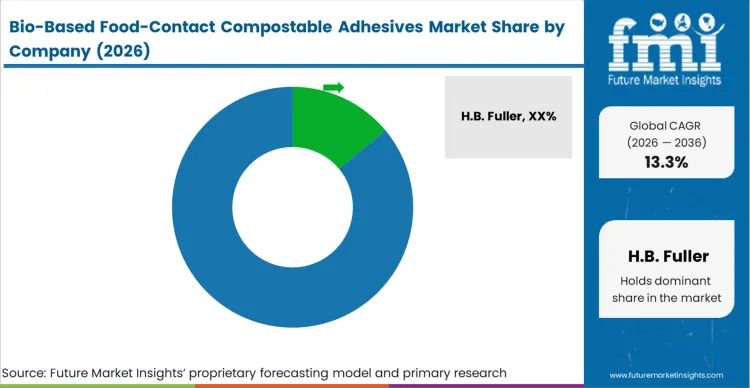
Formulation IP and certified supply chains dictate competitive hierarchies, forcing legacy chemical manufacturers to aggressively acquire niche biological startups. Procurement specifications mandate verifiable degradation profiles, rendering conventional synthetic hot melts obsolete for premium sustainable packaging contracts. Players securing certified product lines capture early market share.
Margin survivability hinges on decoupling raw material costs from volatile agricultural commodity pricing through advanced cellulosic waste integration. Suppliers lacking captive biological feedstocks face severe margin compression during starch or PLA supply shortages. Vertical integration ensures price stability.
Regulatory compliance testing creates massive barriers to entry, concentrating market power among firms possessing robust laboratory infrastructure. Brands require exhaustive migration and degradation documentation before authorizing new adhesive combinations for direct consumable contact. Joint ventures streamline compliance workflows.
Recent Developments
The report includes full coverage of key trends from competitive benchmarking. Some of the recent developments covered in the reports:
- In February 2026, Henkel partnered with Sekab to secure bio-based ethyl acetate drop-in replacements for food packaging enclosures. [20]
- In November 2025, Amcor launched the Lift-Off Winter 2025/26 Challenge, inviting global start-ups to develop breakthrough sustainable packaging solutions and accelerate circular innovation initiatives. [21]
Key Players in Bio-Based Food-Contact Compostable Adhesives Market
- H.B. Fuller
- Henkel
- Arkema
- Jowat SE
- Avery Dennison
- Dow Inc.
- Cosmo Speciality Chemicals
Scope of the Report
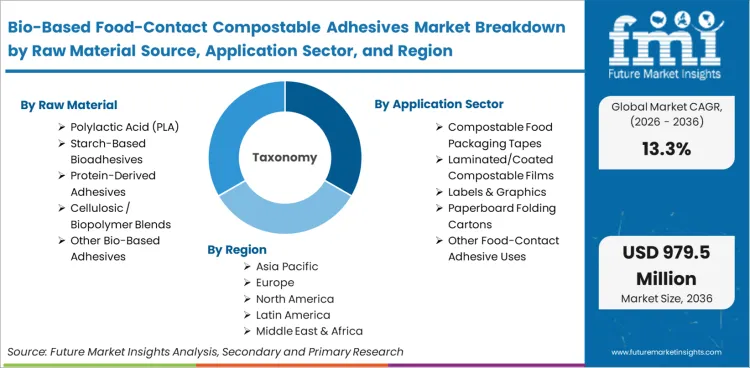
| Metric | Value |
|---|---|
| Quantitative Units | 281.0 USD Million (2026) to 975.0 USD Million (2036), at a CAGR of 13.3% |
| Market Definition | Bio-Based Food-Contact Compostable Adhesives encompass industrial bonding agents formulated from renewable biological resources, engineered specifically to degrade completely within commercial or home composting environments. |
| Raw Material Source Segmentation | Polylactic Acid (PLA)-Based Adhesives, Starch-Based Bioadhesives, Protein-Derived Adhesives, Cellulosic / Biopolymer Blends, Other Bio-Based Adhesives |
| Application Sector Segmentation | Compostable Food Packaging Tapes, Laminated/Coated Compostable Films, Labels & Graphics, Paperboard Folding Cartons, Other Food-Contact Adhesive Uses |
| Regions Covered | North America, Latin America, Europe, East Asia, South Asia, Oceania, Middle East and Africa |
| Countries Covered | United States, Canada, Mexico, Brazil, Argentina, Germany, France, United Kingdom, Italy, Spain, China, India, Japan, South Korea, Indonesia, Australia and 40 plus countries |
| Key Companies Profiled | H.B. Fuller, Henkel, Arkema, Jowat SE, Avery Dennison, Dow Inc., Cosmo Speciality Chemicals |
| Forecast Period | 2026 to 2036 |
| Approach | Hybrid top-down and bottom-up modeling for the Bio-Based Food-Contact Compostable Adhesives Market was validated through primary interviews with bio-resin producers, adhesive formulators, and packaging converters, supported by trade data benchmarking and plant-level production capacity verification |
Bio-Based Food-Contact Compostable Adhesives Market Analysis by Segments
Raw Material Source
- Polylactic Acid (PLA)-Based Adhesives
- Starch-Based Bioadhesives
- Protein-Derived Adhesives
- Cellulosic / Biopolymer Blends
- Other Bio-Based Adhesives
Application Sector
- Compostable Food Packaging Tapes
- Laminated/Coated Compostable Films
- Labels & Graphics
- Paperboard Folding Cartons
- Other Food-Contact Adhesive Uses
Region
- Asia Pacific
- India
- China
- Japan
- South Korea
- Indonesia
- Australia & New Zealand
- ASEAN
- Rest of Asia Pacific
- Europe
- Germany
- Italy
- France
- United Kingdom
- Spain
- Benelux
- Nordics
- Central & Eastern Europe
- Rest of Europe
- North America
- United States
- Canada
- Mexico
- Latin America
- Brazil
- Argentina
- Chile
- Rest of Latin America
- Middle East & Africa
- Kingdom of Saudi Arabia
- United Arab Emirates
- South Africa
- Turkey
- Rest of Middle East & Africa
Bibliography
- [1] UNEP (2025). Climate technology progress report covering bioeconomy value projections.
- [2] BASF (2025). Technical perspective on revolutionizing compostable adhesives.
- [3] USDA AMS (2025). Compostable materials in US packaging waste stream technical report.
- [4] European Bioplastics (2025). Global bio-based plastics production capacity data.
- [5] Dow Inc. (2025). Launch of bio-based laminating adhesives for compostable films.
- [6] BioBond Adhesives (2025). BioAdhere line launch and USDA BioPreferred certification.
- [7] Bostik (2025). Fast Glue Ultra+ launch and US plant expansion details.
- [8] Washington State Dept. of Ecology (2025). Compostable produce stickers cost analysis.
- [9] Kiilto (2025). Biomelt compostable hot-melt adhesive commercial launch.
- [10] TIPA & Bio4Life (2025). Partnership announcement for compostable pressure-sensitive adhesives.
- [11] Graphic Packaging (2025). Partnership with Henkel for sustainable barrier adhesives.
- [12] Two Sides North America (2025). US sustainable packaging market size and outlook.
- [13] Biodegradable & Bioplastics Industries Association (2025). Compostable packaging report and substitution potential.
- [14] Sika AG (2025). New bio-based adhesive manufacturing facility expansion.
- [15] Power Adhesives (2025). Tecbond biodegradable adhesive launch.
- [16] Sustainable Packaging Coalition (2025). US composting access for food waste and compostable packaging.
- [17] Packsize & Henkel (2025). Eco-Pax bio-based hot-melt adhesive product launch.
- [18] EU Green Deal / PMC (2025). European Union adhesive market forecast updates.
- [19] Tex Year (2025). Inauguration of compostable hot-melt adhesive production line in Asia.
- [20] Henkel & Sekab (2026). Partnership announcement for bio-based ethyl acetate.
- [21] Amcor. (2025). Amcor Lift-Off to accelerate more sustainable packaging innovation with Winter 2025/26 Challenge. PR Newswire.
This bibliography is provided for reader reference and is not exhaustive. The full report contains the complete reference list and detailed citations.
This Report Addresses
- Market intelligence to enable structured strategic decision making across mature and emerging biopolymer economies
- Market size estimation and 10 year revenue forecasts from 2026 to 2036, supported by validated capacity and trade benchmarks
- Growth opportunity mapping across PLA, starch, and protein formulations with emphasis on food-contact grade transitions
- Segment and regional revenue forecasts covering tapes, films, labels, and folding cartons for consumer goods
- Competition strategy assessment including feedstock integration models and degradation certification capability benchmarking
- Product reformulation and compostability compliance tracking including USDA BioPreferred and European bioplastics aligned grades
- Regulatory impact analysis covering single-use plastic mandates, municipal organic waste processing thresholds, and export driven specification upgrades
- Market report delivery in PDF, Excel, PPT, and interactive dashboard formats for executive and operational use
Frequently Asked Questions
How large is the demand for Bio-Based Food-Contact Compostable Adhesives in the global market in 2026?
Demand registers at 281.0 USD Million in 2026.
What will be the market size of Bio-Based Food-Contact Compostable Adhesives in the global market by 2036?
Total valuations are projected to reach 975.0 USD Million by 2036.
What is the expected demand growth for Bio-Based Food-Contact Compostable Adhesives in the global market between 2026 and 2036?
The sector expands at a 13.3% CAGR over the forecast period.
Which Raw Material Source is poised to lead global sales by 2026?
Polylactic Acid (PLA)-Based Adhesives hold a 38% share driven by superior optical clarity for rigid formats.
How significant is the role of Compostable Food Packaging Tapes in driving Bio-Based Food-Contact Compostable Adhesives adoption in 2026?
Compostable Food Packaging Tapes capture 31% share as brands secure fully degradable secondary enclosures.
What is driving demand in United States?
Municipal organic waste diversion targets and single-use plastic penalties accelerate adoption.
What compliance standards or regulations are referenced for United States?
USDA BioPreferred guidelines and local composting infrastructure access metrics guide formulation decisions.
What is the United States growth outlook in this report?
United States expands at a 13.4% CAGR.
Why is Europe described as a priority region in this report?
Aggressive Green Deal mandates force rapid phase-outs of fossil-derived bonding agents.
What type of demand dominates in Europe?
Compliance-led replacement demand for certified home-compostable formulations drives purchasing.
What is Germany growth outlook in this report?
Germany is projected to grow at a 12.8% CAGR.
Does the report cover United Kingdom in its regional analysis?
Yes, United Kingdom is included within European regional analysis.
What are the sources referred to for analyzing United Kingdom?
European Union adhesive demand metrics and BBIA substitution forecasts inform regional modeling.
What is the main demand theme linked to United Kingdom in its region coverage?
Extended producer responsibility fees force converters toward compliant biopolymers.
Does the report cover China in its regional analysis?
Yes, China is included within Asia Pacific regional analysis.
What is the main China related demand theme in its region coverage?
Export-led capacity scaling ensures compliance with strict Western retail packaging mandates.
Which product formats or configurations are strategically important for North America supply chains?
Compostable Food Packaging Tapes remain vital for securing fully degradable secondary enclosures.
What is Bio-Based Food-Contact Compostable Adhesives and what is it mainly used for?
Biological industrial adhesives engineered to degrade in composting facilities, used for food wrapping and sealing.
What does Bio-Based Food-Contact Compostable Adhesives mean in this report?
It covers liquid and solid bio-based bonding agents supplied to packaging converters.
What is included in the scope of this Bio-Based Food-Contact Compostable Adhesives report?
PLA, starch, and protein adhesives used in tapes, labels, and laminates.
What is excluded from the scope of this report?
Non-degradable synthetic hot melts, post-consumer recycled fossil plastics, and retail finished goods.
What does market forecast mean on this page?
A model-based projection built on verifiable regulatory timelines and capacity benchmarks.
How does FMI build and validate the Bio-Based Food-Contact Compostable Adhesives forecast?
Through hybrid top-down and bottom-up modeling validated by plant capacities and primary interviews.
What does zero reliance on speculative third party market research mean here?
Forecasts depend strictly on verifiable primary sources, government data, and chemical industry disclosures.
Preview the report firsthand - request a free sample
Get SampleGet the brochure for pricing and purchase details.
Get PDFTable of Content
- Executive Summary
- Global Market Outlook
- Demand-side Trends
- Supply-side Trends
- Technology Roadmap Analysis
- Analysis and Recommendations
- Market Overview
- Market Coverage / Taxonomy
- Market Definition / Scope / Limitations
- Research Methodology
- Chapter Orientation
- Analytical Lens and Working Hypotheses
- Market Structure, Signals, and Trend Drivers
- Benchmarking and Cross-market Comparability
- Market Sizing, Forecasting, and Opportunity Mapping
- Research Design and Evidence Framework
- Desk Research Programme (Secondary Evidence)
- Company Annual and Sustainability Reports
- Peer-reviewed Journals and Academic Literature
- Corporate Websites, Product Literature, and Technical Notes
- Earnings Decks and Investor Briefings
- Government Statistics Portals and Public Data Releases
- Press Releases and Reputable Media Coverage
- Specialist Newsletters and Curated Briefings
- Sector Databases and Reference Repositories
- FMI Internal Proprietary Databases and Historical Market Datasets
- Subscription Datasets and Paid Sources
- Social Channels, Communities, and Digital Listening Inputs
- Additional Desk Sources
- Expert Input and Fieldwork (Primary Evidence)
- Primary Modes
- Qualitative Interviews and Expert Elicitation
- Quantitative Surveys and Structured Data Capture
- Blended Approach
- Why Primary Evidence is Used
- Field Techniques
- Interviews
- Surveys
- Focus Groups
- Observational and In-context Research
- Social and Community Interactions
- Stakeholder Universe Engaged
- C-suite Leaders
- Board Members
- Presidents and Vice Presidents
- R&D and Innovation Heads
- Technical Specialists
- Domain Subject-matter Experts
- Scientists
- Physicians and Other Healthcare Professionals
- Governance, Ethics, and Data Stewardship
- Research Ethics
- Data Integrity and Handling
- Primary Modes
- Tooling, Models, and Reference Databases
- Desk Research Programme (Secondary Evidence)
- Data Engineering and Model Build
- Data Acquisition and Ingestion
- Cleaning, Normalisation, and Verification
- Synthesis, Triangulation, and Analysis
- Quality Assurance and Audit Trail
- Market Background
- Market Dynamics
- Drivers
- Restraints
- Opportunity
- Trends
- Scenario Forecast
- Demand in Optimistic Scenario
- Demand in Likely Scenario
- Demand in Conservative Scenario
- Opportunity Map Analysis
- Product Life Cycle Analysis
- Supply Chain Analysis
- Investment Feasibility Matrix
- Value Chain Analysis
- PESTLE and Porter’s Analysis
- Regulatory Landscape
- Regional Parent Market Outlook
- Production and Consumption Statistics
- Import and Export Statistics
- Market Dynamics
- Global Market Analysis 2021 to 2025 and Forecast, 2026 to 2036
- Historical Market Size Value (USD Million) Analysis, 2021 to 2025
- Current and Future Market Size Value (USD Million) Projections, 2026 to 2036
- Y-o-Y Growth Trend Analysis
- Absolute $ Opportunity Analysis
- Global Market Pricing Analysis 2021 to 2025 and Forecast 2026 to 2036
- Global Market Analysis 2021 to 2025 and Forecast 2026 to 2036, By Raw Material Source
- Introduction / Key Findings
- Historical Market Size Value (USD Million) Analysis By Raw Material Source , 2021 to 2025
- Current and Future Market Size Value (USD Million) Analysis and Forecast By Raw Material Source , 2026 to 2036
- Polylactic Acid (PLA)
- Starch-Based Bioadhesives
- Protein-Derived Adhesives
- Cellulosic / Biopolymer Blends
- Other Bio-Based Adhesives
- Polylactic Acid (PLA)
- Y-o-Y Growth Trend Analysis By Raw Material Source , 2021 to 2025
- Absolute $ Opportunity Analysis By Raw Material Source , 2026 to 2036
- Global Market Analysis 2021 to 2025 and Forecast 2026 to 2036, By Application Sector
- Introduction / Key Findings
- Historical Market Size Value (USD Million) Analysis By Application Sector, 2021 to 2025
- Current and Future Market Size Value (USD Million) Analysis and Forecast By Application Sector, 2026 to 2036
- Compostable Food Packaging Tapes
- Laminated/Coated Compostable Films
- Labels & Graphics
- Paperboard Folding Cartons
- Other Food-Contact Adhesive Uses
- Compostable Food Packaging Tapes
- Y-o-Y Growth Trend Analysis By Application Sector, 2021 to 2025
- Absolute $ Opportunity Analysis By Application Sector, 2026 to 2036
- Global Market Analysis 2021 to 2025 and Forecast 2026 to 2036, By Region
- Introduction
- Historical Market Size Value (USD Million) Analysis By Region, 2021 to 2025
- Current Market Size Value (USD Million) Analysis and Forecast By Region, 2026 to 2036
- North America
- Latin America
- Western Europe
- Eastern Europe
- East Asia
- South Asia and Pacific
- Middle East & Africa
- Market Attractiveness Analysis By Region
- North America Market Analysis 2021 to 2025 and Forecast 2026 to 2036, By Country
- Historical Market Size Value (USD Million) Trend Analysis By Market Taxonomy, 2021 to 2025
- Market Size Value (USD Million) Forecast By Market Taxonomy, 2026 to 2036
- By Country
- USA
- Canada
- Mexico
- By Raw Material Source
- By Application Sector
- By Country
- Market Attractiveness Analysis
- By Country
- By Raw Material Source
- By Application Sector
- Key Takeaways
- Latin America Market Analysis 2021 to 2025 and Forecast 2026 to 2036, By Country
- Historical Market Size Value (USD Million) Trend Analysis By Market Taxonomy, 2021 to 2025
- Market Size Value (USD Million) Forecast By Market Taxonomy, 2026 to 2036
- By Country
- Brazil
- Chile
- Rest of Latin America
- By Raw Material Source
- By Application Sector
- By Country
- Market Attractiveness Analysis
- By Country
- By Raw Material Source
- By Application Sector
- Key Takeaways
- Western Europe Market Analysis 2021 to 2025 and Forecast 2026 to 2036, By Country
- Historical Market Size Value (USD Million) Trend Analysis By Market Taxonomy, 2021 to 2025
- Market Size Value (USD Million) Forecast By Market Taxonomy, 2026 to 2036
- By Country
- Germany
- UK
- Italy
- Spain
- France
- Nordic
- BENELUX
- Rest of Western Europe
- By Raw Material Source
- By Application Sector
- By Country
- Market Attractiveness Analysis
- By Country
- By Raw Material Source
- By Application Sector
- Key Takeaways
- Eastern Europe Market Analysis 2021 to 2025 and Forecast 2026 to 2036, By Country
- Historical Market Size Value (USD Million) Trend Analysis By Market Taxonomy, 2021 to 2025
- Market Size Value (USD Million) Forecast By Market Taxonomy, 2026 to 2036
- By Country
- Russia
- Poland
- Hungary
- Balkan & Baltic
- Rest of Eastern Europe
- By Raw Material Source
- By Application Sector
- By Country
- Market Attractiveness Analysis
- By Country
- By Raw Material Source
- By Application Sector
- Key Takeaways
- East Asia Market Analysis 2021 to 2025 and Forecast 2026 to 2036, By Country
- Historical Market Size Value (USD Million) Trend Analysis By Market Taxonomy, 2021 to 2025
- Market Size Value (USD Million) Forecast By Market Taxonomy, 2026 to 2036
- By Country
- China
- Japan
- South Korea
- By Raw Material Source
- By Application Sector
- By Country
- Market Attractiveness Analysis
- By Country
- By Raw Material Source
- By Application Sector
- Key Takeaways
- South Asia and Pacific Market Analysis 2021 to 2025 and Forecast 2026 to 2036, By Country
- Historical Market Size Value (USD Million) Trend Analysis By Market Taxonomy, 2021 to 2025
- Market Size Value (USD Million) Forecast By Market Taxonomy, 2026 to 2036
- By Country
- India
- ASEAN
- Australia & New Zealand
- Rest of South Asia and Pacific
- By Raw Material Source
- By Application Sector
- By Country
- Market Attractiveness Analysis
- By Country
- By Raw Material Source
- By Application Sector
- Key Takeaways
- Middle East & Africa Market Analysis 2021 to 2025 and Forecast 2026 to 2036, By Country
- Historical Market Size Value (USD Million) Trend Analysis By Market Taxonomy, 2021 to 2025
- Market Size Value (USD Million) Forecast By Market Taxonomy, 2026 to 2036
- By Country
- Kingdom of Saudi Arabia
- Other GCC Countries
- Turkiye
- South Africa
- Other African Union
- Rest of Middle East & Africa
- By Raw Material Source
- By Application Sector
- By Country
- Market Attractiveness Analysis
- By Country
- By Raw Material Source
- By Application Sector
- Key Takeaways
- Key Countries Market Analysis
- USA
- Pricing Analysis
- Market Share Analysis, 2025
- By Raw Material Source
- By Application Sector
- Canada
- Pricing Analysis
- Market Share Analysis, 2025
- By Raw Material Source
- By Application Sector
- Mexico
- Pricing Analysis
- Market Share Analysis, 2025
- By Raw Material Source
- By Application Sector
- Brazil
- Pricing Analysis
- Market Share Analysis, 2025
- By Raw Material Source
- By Application Sector
- Chile
- Pricing Analysis
- Market Share Analysis, 2025
- By Raw Material Source
- By Application Sector
- Germany
- Pricing Analysis
- Market Share Analysis, 2025
- By Raw Material Source
- By Application Sector
- UK
- Pricing Analysis
- Market Share Analysis, 2025
- By Raw Material Source
- By Application Sector
- Italy
- Pricing Analysis
- Market Share Analysis, 2025
- By Raw Material Source
- By Application Sector
- Spain
- Pricing Analysis
- Market Share Analysis, 2025
- By Raw Material Source
- By Application Sector
- France
- Pricing Analysis
- Market Share Analysis, 2025
- By Raw Material Source
- By Application Sector
- India
- Pricing Analysis
- Market Share Analysis, 2025
- By Raw Material Source
- By Application Sector
- ASEAN
- Pricing Analysis
- Market Share Analysis, 2025
- By Raw Material Source
- By Application Sector
- Australia & New Zealand
- Pricing Analysis
- Market Share Analysis, 2025
- By Raw Material Source
- By Application Sector
- China
- Pricing Analysis
- Market Share Analysis, 2025
- By Raw Material Source
- By Application Sector
- Japan
- Pricing Analysis
- Market Share Analysis, 2025
- By Raw Material Source
- By Application Sector
- South Korea
- Pricing Analysis
- Market Share Analysis, 2025
- By Raw Material Source
- By Application Sector
- Russia
- Pricing Analysis
- Market Share Analysis, 2025
- By Raw Material Source
- By Application Sector
- Poland
- Pricing Analysis
- Market Share Analysis, 2025
- By Raw Material Source
- By Application Sector
- Hungary
- Pricing Analysis
- Market Share Analysis, 2025
- By Raw Material Source
- By Application Sector
- Kingdom of Saudi Arabia
- Pricing Analysis
- Market Share Analysis, 2025
- By Raw Material Source
- By Application Sector
- Turkiye
- Pricing Analysis
- Market Share Analysis, 2025
- By Raw Material Source
- By Application Sector
- South Africa
- Pricing Analysis
- Market Share Analysis, 2025
- By Raw Material Source
- By Application Sector
- USA
- Market Structure Analysis
- Competition Dashboard
- Competition Benchmarking
- Market Share Analysis of Top Players
- By Regional
- By Raw Material Source
- By Application Sector
- Competition Analysis
- Competition Deep Dive
- H.B. Fuller
- Overview
- Product Portfolio
- Profitability by Market Segments (Product/Age /Sales Channel/Region)
- Sales Footprint
- Strategy Overview
- Marketing Strategy
- Product Strategy
- Channel Strategy
- Henkel
- Arkema
- Jowat SE
- Avery Dennison
- Dow Inc.
- Cosmo Speciality Chemicals
- H.B. Fuller
- Competition Deep Dive
- Assumptions & Acronyms Used


