

- Industry Size (2026)
- USD 1.0 Bn
- Forecast (2036)
- USD 2.2 Bn
- CAGR (2026 to 2036)
- 8.2%
Non-Fluorinated Barrier Technology Market Size, Market Forecast and Outlook By FMI
The non-fluorinated barrier coatings market stood at a baseline of USD 0.9 billion in 2025, further fueling the industry to cross USD 1.0 billion in 2026 at a CAGR of 8.2% during the forecast period. Continuous capital buildup leads the total market valuation to USD 2.2 billion through 2036 as major retail and foodservice brands systemically de-risk their packaging portfolios ahead of compounding chemical restrictions.
Major brands and their sourcing departments are actively redesigning their material networks to completely remove legacy per- and polyfluoroalkyl substances within the non-fluorinated barrier technology market. Packaging manufacturers now face a clear choice, invest in upgrading their equipment to handle aqueous barrier coatings for paper packaging, or risk being dropped by major buyers. Facilities that delay this transition risk losing valuable fluorine free barrier coatings market contracts, as major consumer brands now demand complete chemical transparency. To successfully scale these new materials, converters need paper barrier coating alternatives to PFAS that can run at traditional production speeds without causing energy costs to spike.
Summary of Non-Fluorinated Barrier Technology Market
- Non-Fluorinated Barrier Technology Market Definition:
- The sector comprises alternative chemical and physical treatments providing resistance to grease, water, and gases on packaging substrates. It serves as the structural response to global mandates eliminating per- and polyfluoroalkyl substances from fiber-based supply chains.
- Demand Drivers in the Market:
- Aggressive EU PPWR PFAS food packaging barrier coatings frameworks require brand owners to eliminate non-repulpable components from their consumer-facing portfolios.
- Sourcing mandates from major quick-service restaurant chains compel independent packaging converters to validate completely fluorine-free material streams.
- Expanding municipal composting infrastructure pushes waste management operators to strictly reject paper products treated with persistent synthetic chemicals.
- Key Segments Analyzed in the FMI Report:
- Aqueous Dispersion Coatings: 41% share in 2026. These formulations integrate directly into existing paper machine size presses, allowing mills to bypass costly application hardware overhauls entirely.
- Paper & Board: 44% share in 2026. The structural necessity of sustaining a robust fiber matrix under physical stress makes this the default substrate for heavy-duty retail packaging.
- Oil & Grease Barrier: 34% share in 2026. High-heat lipid resistance represents the most immediate functional gap left by the phase-out of legacy fluorinated treatments.
- Food & Beverage Package: 46% share in 2026. It represents the most heavily regulated end-use category facing immediate substitution pressure.
- Direct Supply To Converters: 53% share in 2026. This conversion reflects upon the decentralized nature of specialized packaging manufacturing.
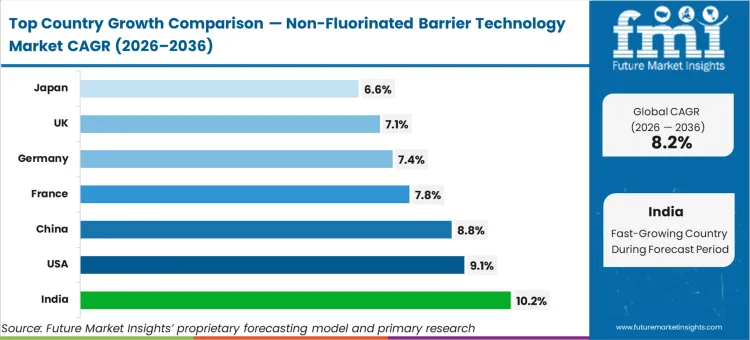
- India: 10.2% CAGR, reflecting rapid modernization of domestic packaging infrastructure alongside deep integration into global export supply chains.
- Analyst Opinion at FMI:
- Ismail Sutaria, Principal Analyst, Packaging, at FMI, states, "A compliance development of PFAS-free chemistry in the lab is the easy part. The hard part is curing that high-solids dispersion on the converter floor without throttling line speeds to accommodate the heavier water load. Formulators delivering high-solids aqueous dispersions that cure at lower temperatures capture long-term contracts because they protect paper mills from throttling machine speeds to accommodate the new chemistry."
- Strategic Implications / Executive Takeaways:
- PFAS-free barrier coating manufacturers must optimize their product solids content to minimize the thermal drying burden on converter infrastructure prior to 2030.
- Packaging converters need long-term supply agreements with specialized dispersion formulators to avoid raw material bottlenecks as global demand spikes.
- Fast-moving consumer goods brands face a shrinking window to complete their shelf-life validation testing before regulatory enforcement restricts their current inventory.
- Methodology:
- Primary Research: Direct interviews with supply chain directors, formulation scientists, and regulatory compliance officers across the packaging value chain.
- Desk Research: Analysis of patent filings for novel bio-based barrier structures and review of material conformity declarations.
- Market-Sizing and Forecasting: Volumetric analysis of converted functional paper tonnage overlaid with average premium pricing for non-fluorinated formulations.
- Data Validation and Update Cycle: Continuous cross-referencing against quarterly earnings reports from tier-1 specialty chemical and paper producers.
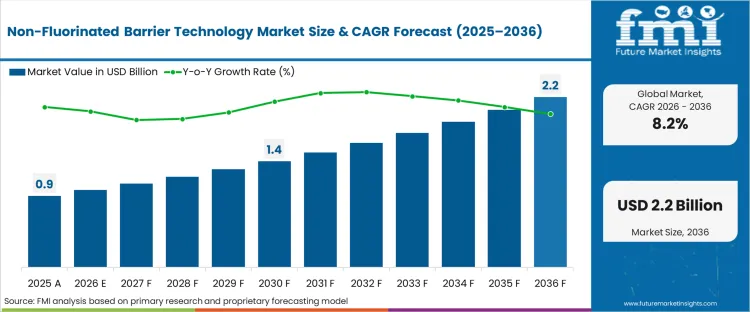
The biggest hurdle in this transition is the drying process on the factory floor. Once water-based barrier coatings for paper provide the same oil and grease resistance as legacy chemicals, without slowing down the machines, widespread adoption will quickly follow. Formulators who successfully develop efficient PFAS-free food packaging coatings market solutions will allow independent paper mills to transition their entire production lines without sacrificing daily output.
India and the United States lead adoption with CAGR of 10.2% and 9.1%, respectively, as major buyers aggressively overhaul localized supply chains. Export-heavy manufacturing hubs follow closely, with China expanding at 8.8%, while stringent repulpability mandates drive steady transition across France at 7.8%, Germany at 7.4%, and the UK at 7.1%. Japan anchors the group with a deliberate 6.6% trajectory tied to exhaustive, multi-year validation cycles.
Non-Fluorinated Barrier Technology Market Definition
The non-fluorinated barrier technology market encompasses chemical formulations and physical structures applied to substrates to prevent the transmission of liquids and gases without utilizing per- and polyfluoroalkyl substances. Alternative mechanisms, such as cross-linked polymers, natural waxes, and engineered minerals, define this category structurally by achieving repulpable and compostable functional packaging. High-performance fluorine free grease barrier coatings act as the primary functional replacement in this domain.
Non-Fluorinated Barrier Technology Market Inclusions
This scope includes aqueous barrier coatings for paper packaging, bio-based polymer blends, and metallized paper solutions specifically engineered as paper barrier coating alternatives to PFAS. It covers treatments applied at the size press during paper manufacturing or downstream at independent converter facilities. Revenue calculations capture barrier coated papers explicitly designed to maintain structural integrity under end-use stress.
Non-Fluorinated Barrier Technology Market Exclusions
Standard polyethylene extrusion coatings and legacy fluorinated finishes fall strictly outside this analysis. Polyethylene layers fundamentally compromise the repulpability of the underlying fiber substrate. This persistence places them outside the scope of sustainable functional material transitions currently demanded by the regulatory environment.
Non-Fluorinated Barrier Technology Market Research Methodology
- Primary Research: Procurement directors at global consumer packaged goods brands, technical directors at tier-1 coating formulators, and operations managers at independent paper converters.
- Desk Research: Aggregation of material safety data sheets, repulpability certification registries, and packaging compliance filings submitted to European and North American regulatory authorities.
- Market-Sizing and Forecasting: Baseline valuation anchored to the volumetric output of functional paperboard production lines explicitly transitioning away from fluorinated chemistries.
- Data Validation and Update Cycle: Forecasts triangulated against capital expenditure announcements from major pulp and paper operators upgrading their application and drying infrastructure.
Segmental Analysis
Non-Fluorinated Barrier Technology Market Analysis by Technology Platform
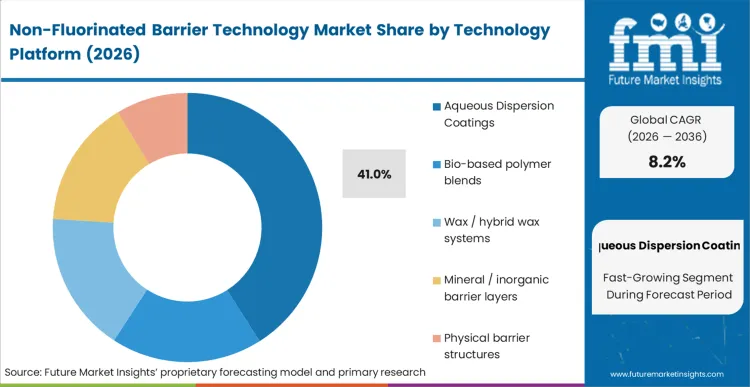
Converters actively evaluate barrier coated paper shares to benchmark their transition costs against competitors. The decision to adopt these coatings is validated during pilot runs testing runnability and curing speeds. If the dispersion requires excessive thermal energy to drive off the water content, the operational economics fail, pushing the converter back into development cycles and delaying their compliance roadmap. This structural dominance of aqueous dispersion coatings, capturing a 41% share in 2026, stems from their fundamental compatibility with existing capital equipment. These liquid formulations integrate directly via standard size presses or off-line coaters. FMI's analysis indicates that this drop-in interoperability is the decisive factor allowing manufacturers to pivot production without suffering massive operational downtime or financing new lamination hardware.
- Initial Qualification: Drop-in application compatibility dictates the first phase of vendor selection for paper mills looking to avoid heavy capital expenditures.
- Operational Validation: Curing speed and thermal energy requirements determine whether the coating maintains standard factory throughput without bottlenecking the line.
- Long-Term Adoption: Consistent film formation without pinholing across varying paper grades ensures the converter will expand the formulation across their broader product portfolio.
Non-Fluorinated Barrier Technology Market Analysis by Substrate
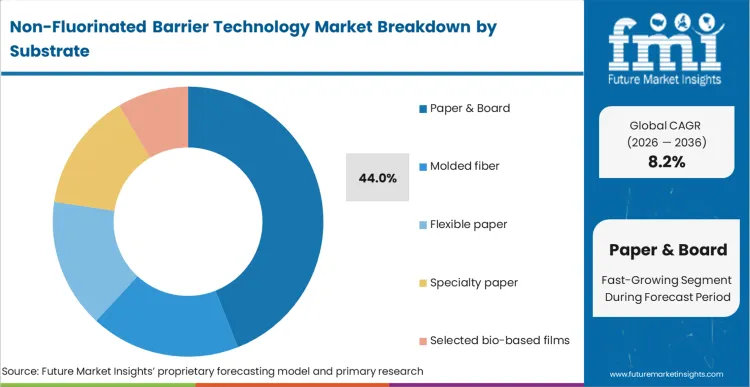
Stringent end-of-life recovery mandates force major brand owners toward paper & board, which commands a 44% share in 2026. This substrate offers a direct pathway to repulpability certifications, provided the applied packaging barrier coatings maintain fiber recovery integrity during recycling. The structural necessity of sustaining a robust fiber matrix under stress makes this the default choice for heavy-duty applications. Paper producers dominating this space leverage massive economies of scale to buffer the cost premiums associated with novel chemical treatments. Supply constraints emerge around the availability of high-quality coating capacity rather than the base fiber. The landscape heading toward 2036 heavily favors integrated mills controlling both substrate quality and barrier application internally.
- Base Production: Tier-1 paper operators utilize their existing tonnage capacity to absorb the initial volatility of transitioning to non-fluorinated chemical supplies.
- Supply Bottlenecks: Off-line converter capacity limits the rapid scaling of highly specialized applications, requiring brands to plan procurement cycles quarters in advance.
- End-State Integration: Direct inline coating at the paper mill level will eventually commoditize standard barrier grades, shifting margin pressure back toward the chemical formulators.
Non-Fluorinated Barrier Technology Market Analysis by Barrier Function
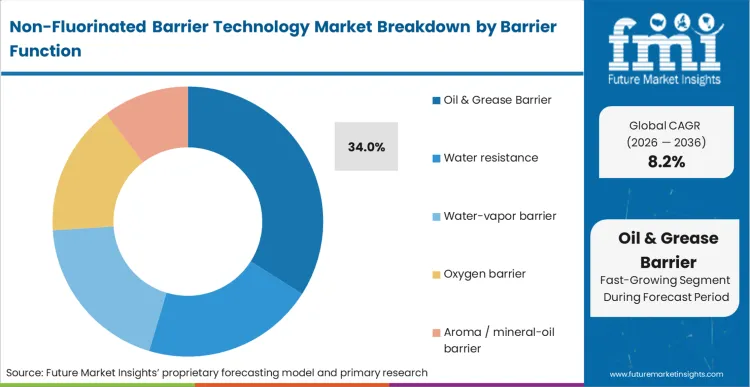
Legacy fluorochemicals previously monopolized the oil & grease barrier segment, making this specific functionality the primary arena for technological displacement. However, formulations exceeding baseline expectations in high-heat environments capture immediate commercial traction leading to securing a 34% share in 2026, with this functional requirement dictating the engineering of entirely new cross-linked polymer networks capable of holding out aggressive fast-food and bakery lipids. Performance gaps frequently appear under edge conditions, such as prolonged exposure to hot, acidic greases, compromising US barrier packaging formats. The absolute determinant of market acceptability therefore rests on passing stringent, standardized kit tests using compliant repulpable barrier coatings for paper packaging.
- Baseline Efficacy: Achieving a standard kit rating of 7 or higher without fluorochemicals represents the minimum technical threshold for market entry.
- Edge-Case Vulnerability: High-temperature lipid exposure combined with mechanical creasing exposes the brittleness of early-generation alternative films.
- Qualification Standards: Procurement teams rely entirely on certified third-party testing protocols to validate performance before authorizing a packaging redesign.
Non-Fluorinated Barrier Technology Market Analysis by End Use
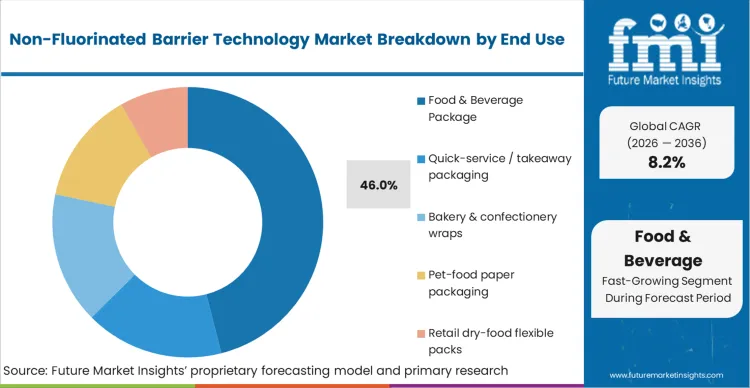
The persistent tension between extending shelf life and ensuring end-of-life repulpability defines the food & beverage packaging segment, which holds a 46% share in 2026. Fast-moving consumer goods companies navigate uncompromising retail sustainability mandates alongside the absolute necessity of preventing package degradation. As per FMI's projection, this dynamic forces a rigorous re-evaluation of how European barrier paper structures are deployed across different product categories. The primary failure mode these solutions prevent is the catastrophic aesthetic and structural collapse of the package on the retail shelf. Residual risks remain regarding flavor scalping or unintended chemical migration. Brand owners need highly engineered foodservice packaging barrier coatings. They also need to recalibrate their secondary packaging and logistics to support the slightly altered physical properties of non-fluorinated materials.
- Primary Prevention: Robust barrier application stops immediate grease penetration, protecting the brand's aesthetic presentation in competitive retail environments.
- Residual Migration: Subtle interactions between novel bio-polymers and sensitive food products require extended shelf-life validation to prevent off-flavor profiles.
- Logistical Adjustment: Supply chain managers must carefully manage humidity and temperature controls during transport to protect alternative barrier integrity.
Non-Fluorinated Barrier Technology Market Analysis by Go-to-Market / Supply Route
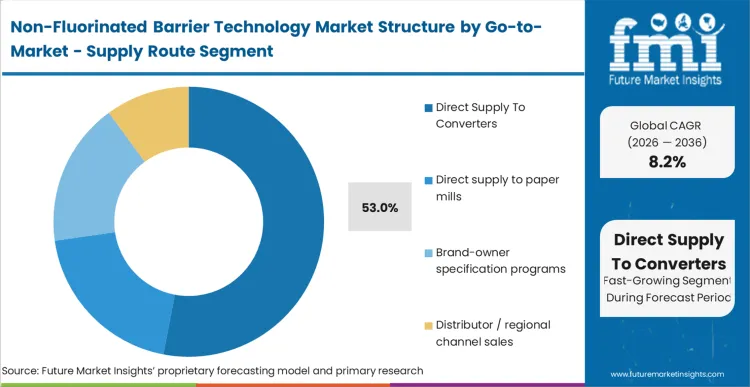
In FMI's view, independent converters act as the critical testing ground for Europe barrier shares, absorbing the operational risk of qualifying new chemical batches. They adopt these formulations first to satisfy brand-owner clients demanding immediate prototyping and small-run validations from trusted non-fluorinated barrier coating suppliers. Integrated paper mills follow closely, observing which chemistries prove robust enough for continuous, high-speed application. Brands attempting to bypass this sequence and run unproven formulations directly onto massive production schedules frequently face severe yield losses, leading the direct supply to converters dominating this channel, capturing 53% share in 2026. Over the next three years, the structural shift toward decentralized, highly responsive application facilities will, as a result, accelerate as regional packaging demands fragment.
- Early Adopters: Agile, independent converters test novel formulations on specialized, short-run equipment to validate performance for demanding brand clients.
- Secondary Integration: Large-scale paper mills implement successful chemistries onto continuous web lines once the formulation demonstrates acceptable runnability and cure times.
- Late-Stage Commoditization: Mass-market distributors eventually catalog standardized barrier products once the technology curve flattens and performance specifications become universal.
Non-Fluorinated Barrier Technology Market Drivers, Restraints, and Opportunities
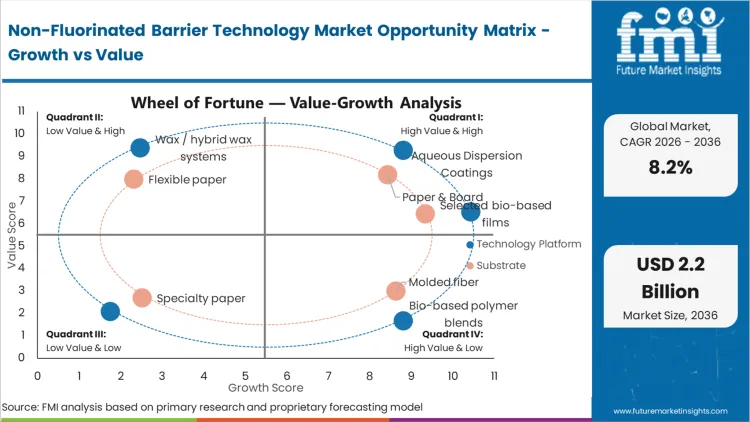
Extended producer responsibility legislation and new PFAS-free barrier coating regulations fundamentally compel packaging procurement directors to strip non-repulpable layers from their high-volume portfolios. Mounting end-of-life taxation on legacy paper coating materials transforms this structural pressure into a hard commercial calculation. Brands failing to transition their folding cartons and flexible wraps to cleanly recoverable formats face immediate margin erosion from municipal recovery fees. These dynamics forces packaging specifiers to prioritize aqueous dispersions and bio-based blends regardless of the initial material premium.
The thermal drying bottleneck inherent in converter infrastructure acts as the single biggest operational friction slowing immediate transition. Modern high-solids dispersions introduce significantly more water to the paper web than legacy fluorinated treatments. Independent converters must dramatically increase their oven temperatures or slow down their line speeds to achieve a proper cure. While functional additives packaging formulators actively develop lower-temperature catalyst systems, many older coating lines physically lack the evaporative capacity to run these new chemistries efficiently.
Opportunities in the Non-Fluorinated Barrier Technology Market
- Thermal Optimization: Converter infrastructure constraints create a massive opening for formulators engineering high-solids dispersions requiring lower evaporative energy. Chemical suppliers delivering this operational efficiency capture long-term contracts by protecting the converter's throughput margins.
- Molded Fiber Integration: The rapid expansion of three-dimensional packaging formats demands specialized spray-on barrier applications within the broader PFAS-free barrier technology market. Coating manufacturers penetrating complex geometries without pooling or pinholing secure dominant positions in the paper packaging market.
- Recyclable Paper Cups: Ambiguity in municipal recycling standards allows tier-1 material suppliers to differentiate by offering the best barrier coating for recyclable paper cups. Integrated paper mills guaranteeing the downstream recovery of their substrates command a distinct pricing premium from risk-averse consumer brands.
Regional Analysis
Global adoption of sustainable packaging hinges heavily on localized regulatory frameworks and export-driven material upgrades, mapping a distinct trajectory for chemical substitution across key geographies. Each major region balances domestic compliance pressures with international trade demands, directly shaping how quickly converters deploy novel barrier systems resulting with the market being segmented into North America, Europe, and Asia Pacific across 40 plus countries.
.webp "Top Country Growth Comparison Non Fluorinated Barrier Technology Market Cagr (2026 2036)")
| Country | CAGR (2026 to 2036) |
|---|---|
| United States | 9.1% |
| Germany | 7.4% |
| France | 7.8% |
| United Kingdom | 7.1% |
| China | 8.8% |
| India | 10.2% |
| Japan | 6.6% |
Source: Future Market Insights (FMI) analysis, based on proprietary forecasting model and primary research
North America Non-Fluorinated Barrier Technology Market Analysis
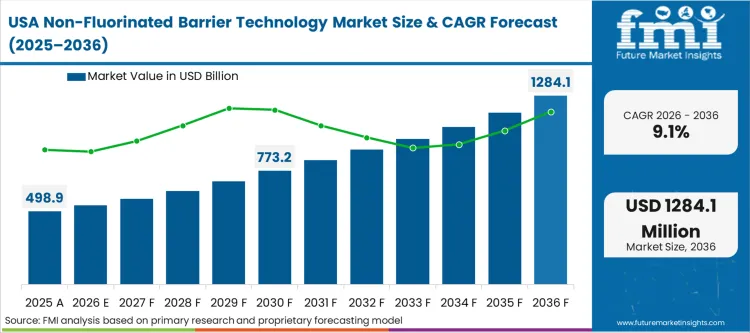
Brand owners currently define their own testing protocols, which are frequently more stringent than any unified baseline due to the absence of a single overarching regulatory standard. Massive retail and quick-service restaurant chains utilize their colossal purchasing influence to execute a swift elimination of legacy chemical treatments across their paper and paperboard packaging. This aggressive, buyer-directed shift engineers an intensely competitive arena, compelling converters to actively deliver proven material substitutes just to keep their standing on approved vendor rosters. The strict vendor qualification rules and decentralized procurement habits, in the end, are the primary forces governing the North American landscape.
- United States: Fragmented state-level chemical bans force national brand owners to adopt the most rigorous standard universally, rather than managing split, multi-jurisdictional supply chains. Procurement teams prioritize universal solutions that guarantee FDA PFAS-free food packaging coating compliance while aligning with both coastal mandates and inland logistical networks. Registering a projected 9.1% CAGR, the United States non-fluorinated barrier coatings market rewards material formulators who can solve this multi-jurisdictional puzzle with massive corporate contracts that effectively block out regional rivals.
FMI's report includes extensive modeling of emerging hubs across North America. Converters operating near agricultural centers frequently leapfrog legacy extrusion technologies, installing modern dispersion-capable equipment as their baseline infrastructure to capture regional produce contracts.
Europe Non-Fluorinated Barrier Technology Market Analysis
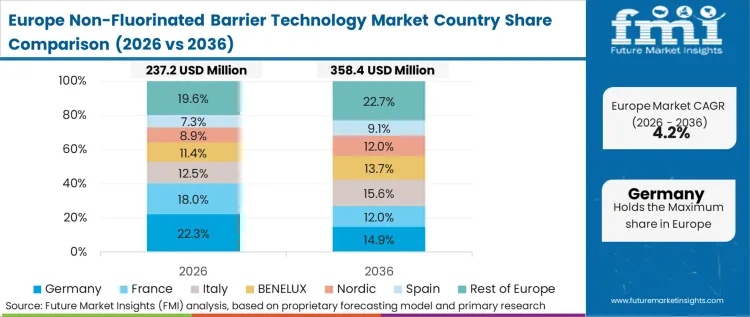
Steep taxation and the threat of product recalls mean that non-compliance penalties strike directly at corporate profitability. Operating within the Europe PFAS-free paper barrier market, brand owners view recyclable barrier packaging not as an optional upgrade but as the basic price of admission to the retail shelf. This strict, policy-driven climate fast-tracks the commercial rollout of sophisticated aqueous dispersions and new bio-polymer formats. An unyielding architecture of chemical registration protocols and extended producer responsibility as a result dictates buyer strategies across the continent.
- Germany: Germany's highly developed recycling infrastructure and exacting repulpability limits establish the structural baseline for continental packaging standards. To align with these rigid circular economy principles, operations managers must source treatments that both withstand active functional stress and separate flawlessly during downstream waste processing. Being allowed to expand at a steady 7.4% CAGR, this pursuit of purely monomaterial paper structures firmly guides the regional trajectory.
- France: Expanding at an anticipated 7.8% CAGR over the forecast period, the French landscape demands rapid agility from manufacturers. Packaging converters supplying the massive domestic bakery and food sectors must execute an immediate operational pivot due to aggressively enforced chemical and single-use plastic bans. By swiftly validating new mineral blends and wax hybrids, proactive buyers carve out a formidable competitive edge over rivals who remain tied to heavily scrutinized imported alternatives.
- United Kingdom: By establishing dual-compliant protective treatments, domestic packaging sites successfully eliminate inventory friction and streamline their complex material handling pipelines. Poised to register a 7.1% CAGR, the UK market for this technology reflects a unique transitional phase. Converters based in the United Kingdom are compelled to carefully balance new localized chemical registries against stringent European export criteria within a challenging post-Brexit environment.
FMI's report includes tracking of shifting compliance frameworks across Eastern Europe. Rapid harmonization with central European directives pushes legacy packaging lines to urgently incorporate secondary coating stations to remain viable.
Asia Pacific Non-Fluorinated Barrier Technology Market Analysis
A fundamentally pragmatic, trade-focused transition defines the material upgrades occurring across these manufacturing hubs. Regional paper mills meticulously weigh the high capital costs of retrofitting their application lines against the superior margins extracted from advanced formats like metallized paper packaging. Although localized consumption contributes to volume, the absolute necessity of retaining entry to strictly regulated Western retail networks stands as the dominant structural catalyst. The export margin realities, capital access, and baseline cost models, in the end, govern the regional adoption curve.
- China: Navigating viciously competitive international bidding wars, manufacturers endure severe margin compression as they attempt to swallow the elevated costs of new chemical alternatives. Within the China PFAS-free packaging coatings market, export-driven converters are under tremendous strain to deliver perfectly compliant formats to Western brands while desperately defending their historical low-cost positioning. China’s market growth is as a result is being pushed at a 8.8% CAGR by the sheer volume of global transition mandates, despite these immense profitability challenges.
- India: A booming quick-service restaurant sector combined with a swiftly maturing domestic supply chain mandates a sweeping overhaul of regional packaging capabilities within the India fluorine free barrier technology market influences it to grow at a 10.2% of CAGR. Independent converters that effectively commercialize coated paper box formats are unlocking lucrative contracts with international foodservice brands aggressively scaling their footprints in the country.
- Japan: Forecasting a deeply integrated future, this hyper-technical and cautious methodology eventually yields ultra-high-performance functional papers that redefine global quality standards. Advancing at a steady 6.6% CAGR, the Japanese landscape moves deliberately compared to adjacent hubs. The country's advanced yet historically conservative packaging ecosystem insists upon exhaustive, multi-year testing regimes before sanctioning any deviation from entrenched material baselines.
FMI's report includes assessment of the accelerating material transitions occurring across Southeast Asia. Formulators deploying molded fiber packaging solutions here tap into a massive localized demand for alternatives to rigid single-use plastics.
Competitive Aligners for Market Players
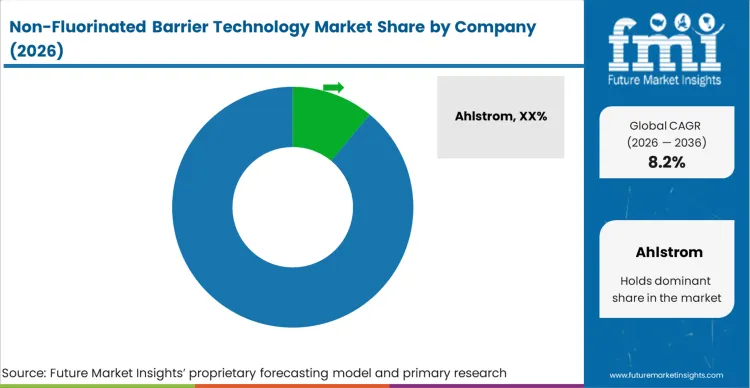
Ahlstrom captures a significant share by treating application engineering as its core product, an approach mirrored by heavyweights like BASF and Michelman. Theoretical barrier performance fails commercially if the chemistry cannot run efficiently on legacy manufacturing equipment. These tier-1 operators embed their technical teams directly onto independent converter floors to troubleshoot high-solids dispersion runnability live on the size press. Procurement directors actively filter their vendor lists based on this specific deployment capability. Formulations causing web breaks or thermal bottlenecks during pilot runs face immediate disqualification, regardless of their laboratory kit test ratings.
An alternative barrier upon development forces massive capital allocation toward regulatory validation. Formulators such as Solenis and Archroma leverage deep, proprietary libraries of cross-linking agents that already carry essential food-contact and repulpability certifications. Replicating this compliance architecture demands that challengers fund multi-year testing cycles across divergent global jurisdictions. The agile innovators like Melodea, at the same time, secure high-margin contracts by engineering highly specialized cellulosic nano-crystals to solve specific oxygen transmission failures. The absolute capacity to guarantee a new coating maintains secondary fiber recovery networks serves as the ultimate commercial moat.
Major consumer brands aggressively construct procurement frameworks that pit different chemical platforms against each other to maintain pricing leverage and prevent supplier lock-in. This purchasing behavior collides directly with the strategy of integrated manufacturers like Mondi. By controlling both the base fiber production and the advanced coating application, these integrated mills dictate the pricing floor for standard grease-resistant grades. Moving toward 2036, the landscape fundamentally fractures. Complex, highly engineered barrier applications will consolidate under specialized chemical formulators. The standard protective treatments, on the other hand, will transition into tightly controlled commodities managed by the massive paper producers.
Key Players in Non-Fluorinated Barrier Technology Market
- Ahlstrom
- Michelman
- Solenis
- Archroma
- BASF
- Mondi
- Melodea
Scope of the Report
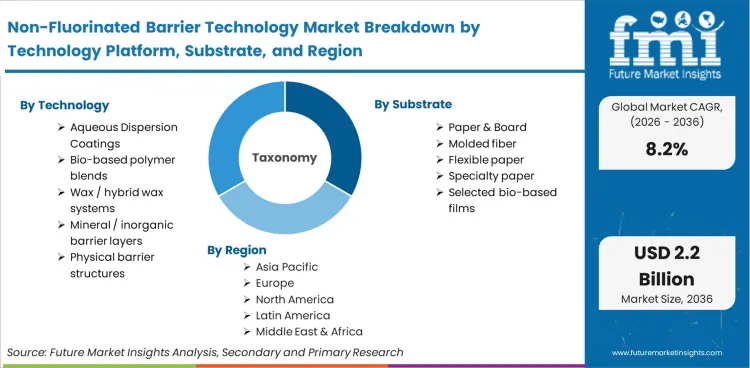
| Metric | Value |
|---|---|
| Quantitative Units | USD 1.0 billion to USD 2.2 billion, at a CAGR of 8.2% |
| Market Definition | The sector comprises alternative chemical and physical treatments providing resistance to grease, water, and gases on packaging substrates. It serves as the structural response to global mandates eliminating persistent synthetic chemicals from fiber-based supply chains. |
| Technology Platform Segmentation | Aqueous dispersion coatings, Bio-based polymer blends, Wax / hybrid wax systems, Mineral / inorganic barrier layers, Physical barrier structures |
| Substrate Segmentation | Paper & board, Molded fiber, Flexible paper, Specialty paper, Selected bio-based films |
| Barrier Function Segmentation | Oil & grease barrier, Water resistance, Water-vapor barrier, Oxygen barrier, Aroma / mineral-oil barrier |
| End Use Segmentation | Food & beverage packaging, Quick-service / takeaway packaging, Bakery & confectionery wraps, Pet-food paper packaging, Retail dry-food flexible packs |
| Go-to-Market / Supply Route Segmentation | Direct supply to converters, Direct supply to paper mills, Brand-owner specification programs, Distributor / regional channel sales |
| Regions Covered | North America, Europe, Asia Pacific |
| Countries Covered | United States, Germany, France, United Kingdom, China, India, Japan, and 40 plus countries |
| Key Companies Profiled | Ahlstrom, Michelman, Solenis, Archroma, BASF, Mondi, Melodea |
| Forecast Period | 2026 to 2036 |
| Approach | Primary interviews were conducted with operations managers, procurement directors, and technical formulation scientists across the packaging value chain. Baseline data is anchored to the volumetric output of functional paperboard lines transitioning to novel chemistries. Forecasts are cross-validated against the capital expenditure cycles of major pulp and paper operators upgrading their application infrastructure. |
Source: Future Market Insights (FMI) analysis, based on proprietary forecasting model and primary research
Segments
Technology Platform:
- Aqueous dispersion coatings
- Bio-based polymer blends
- Wax / hybrid wax systems
- Mineral / inorganic barrier layers
- Physical barrier structures
Substrate:
- Paper & board
- Molded fiber
- Flexible paper
- Specialty paper
- Selected bio-based films
Barrier Function:
- Oil & grease barrier
- Water resistance
- Water-vapor barrier
- Oxygen barrier
- Aroma / mineral-oil barrier
End Use:
- Food & beverage packaging
- Quick-service / takeaway packaging
- Bakery & confectionery wraps
- Pet-food paper packaging
- Retail dry-food flexible packs
Go-to-Market / Supply Route:
- Direct supply to converters
- Direct supply to paper mills
- Brand-owner specification programs
- Distributor / regional channel sales
Regions:
- North America
- United States
- Asia Pacific
- China
- India
- Singapore
- Europe
- Germany
- United Kingdom
Bibliography
- European Commission. (2025, January). Regulation (EU) 2025/40 of the European parliament and of the council of 19th December, 2024 on packaging and packaging waste. Packaging Waste.
- Food and Drug Administration. (2024, February). FDA announces PFAS used in grease-proofing agents for food packaging no longer being sold in the U.S.
- United States Environmental Protection Agency. (2024, May). Instructions for reporting PFAS under TSCA Section 8(a)(7).
- Lacourt C., Mukherjee K., Garthoff J., O’Sullivan A., Meunier L., Fattori V. (2024, January). Recent and emerging food packaging alternatives: Chemical, physical, and safety considerations. Comprehensive Reviews in Food Science and Food Safety.
- Lendewig, M., et al. (2025, January). Moving toward fiber-based products free of PFAS. Resources, Conservation and Recycling.
- Sharbafian, F., et al. (2024, September). Investigation and comparison of alternative oxygen barrier coatings for paper packaging substrates. Coatings.
- Vatansever, E. (2025, January). Development of water-based high barrier coatings for paper packaging applications. Polytechnique Montréal.
- Vinitskaia, N., et al. (2025, January). Environmental sustainability, food quality and safety implications of barrier coatings for paper packaging. Packaging Technology and Science.
This bibliography is provided for reader reference. The full FMI report contains the complete reference list with primary source documentation.
This Report Addresses
- Market intelligence to support strategic decision making across aqueous dispersion coatings and bio-based polymer blends within the PFAS-free food packaging coatings market
- Market size estimation and 10-year revenue forecasts from 2026 to 2036, supported by volumetric analysis of converted functional paper tonnage
- Growth opportunity mapping across molded fiber applications with emphasis on solving the thermal drying bottleneck at the converter level
- Segment and regional revenue forecasts covering retail dry-food flexible packs across stringent extended producer responsibility environments
- Competition strategy assessment including on-site technical deployment capabilities and proprietary cross-linking agent libraries
- Capability development tracking including high-solids dispersions, alternative wax hybrids, and repulpability certification standards
- Market access analysis covering fast-food vendor qualification protocols and European municipal waste recovery thresholds
- Market report delivery in multiple digital formats. These outputs support executive strategy, global packaging procurement planning, and operational benchmarking.
Frequently Asked Questions
How large is the non-fluorinated barrier technology market size in 2026?
The sector is valued at USD 1.0 billion in 2026, representing the immediate capital deployed by tier-1 brands refusing to risk supply chain disruptions from pending chemical bans.
What is the non-fluorinated barrier technology forecast by 2036?
The valuation reaches USD 2.2 billion by 2036, reflecting the systemic replacement of legacy extrusion formats across the entire global foodservice footprint.
What CAGR is projected?
A CAGR of 8.2% is projected as independent converters successfully upgrade their thermal drying infrastructure to handle high-water-content chemistries.
Which Technology Platform segment leads?
Aqueous dispersion coatings capture a 41% share by integrating directly into existing paper machine size presses to bypass massive capital expenditure for new lamination hardware.
Which Substrate segment leads?
Paper & board leads with a 44% share because the fundamental requirement to maintain structural integrity under heavy-duty stress makes this dense fiber matrix the default choice for major takeaway applications.
Which Barrier Function segment leads?
The oil & grease barrier function holds a 34% share because engineering entirely new cross-linked polymer networks to hold out aggressive lipids represents the most urgent technical gap left by exiting fluorochemicals.
What drives rapid growth?
Aggressive extended producer responsibility frameworks force the transition, compelling procurement directors to adopt repulpable alternatives to avoid severe municipal recovery taxation that directly erodes product margins.
What is the primary restraint?
Thermal drying capacity on existing converter lines heavily bottlenecks production, as operators must either slow web speeds or increase oven temperatures to cure modern high-solids dispersions.
Which country grows fastest?
India grows at 10.2%, significantly outpacing mature markets due to the simultaneous modernization of domestic packaging infrastructure and deep integration into global quick-service restaurant supply chains.
How do European recycling directives alter vendor selection?
Brands operating in Germany and France must exclusively secure certified bio-polymer coatings that guarantee complete separation during waste recovery to avoid immediate exclusion from major retail shelves.
Why is molded fiber gaining traction within this landscape?
The expansion of three-dimensional takeaway formats requires barrier applications capable of penetrating complex geometries, allowing formulators who engineer spray-on systems that avoid pooling to unlock new high-margin contract opportunities.
What separates tier-1 coating formulators from regional blenders?
The defining competitive advantage is the ability to deploy technical engineering teams directly to the converter floor to troubleshoot application issues in real-time, which is essential for verifying a novel chemistry's commercial viability.
How do North American procurement standards differ from European mandates?
Lacking a unified federal directive, North American buyers leverage the immense purchasing power of quick-service networks to force chemical phase-outs, requiring converters to meet the strictest state-level standards simply to remain on corporate approved-vendor lists.
What risk do brands face if they delay evaluating new dispersions?
Companies delaying their transition risk losing access to specialized converter capacity, as the limited pool of independent packaging facilities capable of running advanced aqueous coatings will be entirely booked by early movers before regulatory deadlines hit.
How does the industry evaluate PFAS-free coatings vs PE extrusion coating?
Brands are moving away from PE extrusions entirely because polyethylene layers fundamentally compromise the repulpability of the underlying fiber substrate, placing them outside the scope of sustainable functional material transitions.
How do Japanese operations managers approach novel barrier qualification?
The Japanese sector requires exhaustive, multi-year validation cycles to verify alternative barriers do not compromise established flavor profiles or structural integrity, which delays initial adoption but guarantees long-term stability once approved.
What role do independent paper converters play in technology adoption?
Agile independent facilities act as the primary testing ground for unproven chemistries, assuming the operational risk of running small-batch validations before large-scale integrated mills commit to continuous web production.
How does the shift to non-fluorinated barriers impact secondary logistics?
Because substituting legacy chemicals for bio-based alternatives slightly alters the physical properties of the final package, supply chain managers must tightly control humidity and temperature during transport to prevent premature degradation of the novel barrier films.
What dictates the adoption of wax and hybrid systems?
Operations managers select hybrid wax formulations for short shelf-life bakery and confectionery applications where absolute gas resistance is unnecessary, offering a cost-effective compliance route for products consumed within days of packaging.
Why is the 2036 end-state heavily focused on inline mill integration?
Direct inline coating at the paper mill level will eventually commoditize standard barrier grades, allowing massive operators to dictate the pricing floor and shift margin pressure back toward specialty chemical formulators.
How does the baseline valuation methodology account for transition volumes?
The analysis anchors to the actual volumetric output of functional paperboard lines explicitly verified to be transitioning away from fluorinated chemistries, overlaid with established pricing premiums for novel alternative formulations.
What forces Chinese export converters to absorb higher chemical costs?
To maintain access to highly regulated Western markets, Chinese converters must integrate compliant, non-fluorinated barriers to win North American contracts, frequently compressing their own margins to compete in cutthroat international tenders.
Preview the report firsthand - request a free sample
Get SampleGet the brochure for pricing and purchase details.
Get PDFTable of Content
- Executive Summary
- Global Market Outlook
- Demand-side Trends
- Supply-side Trends
- Technology Roadmap Analysis
- Analysis and Recommendations
- Market Overview
- Market Coverage / Taxonomy
- Market Definition / Scope / Limitations
- Research Methodology
- Chapter Orientation
- Analytical Lens and Working Hypotheses
- Market Structure, Signals, and Trend Drivers
- Benchmarking and Cross-market Comparability
- Market Sizing, Forecasting, and Opportunity Mapping
- Research Design and Evidence Framework
- Desk Research Programme (Secondary Evidence)
- Company Annual and Sustainability Reports
- Peer-reviewed Journals and Academic Literature
- Corporate Websites, Product Literature, and Technical Notes
- Earnings Decks and Investor Briefings
- Statutory Filings and Regulatory Disclosures
- Technical White Papers and Standards Notes
- Trade Journals, Industry Magazines, and Analyst Briefs
- Conference Proceedings, Webinars, and Seminar Materials
- Government Statistics Portals and Public Data Releases
- Press Releases and Reputable Media Coverage
- Specialist Newsletters and Curated Briefings
- Sector Databases and Reference Repositories
- FMI Internal Proprietary Databases and Historical Market Datasets
- Subscription Datasets and Paid Sources
- Social Channels, Communities, and Digital Listening Inputs
- Additional Desk Sources
- Expert Input and Fieldwork (Primary Evidence)
- Primary Modes
- Qualitative Interviews and Expert Elicitation
- Quantitative Surveys and Structured Data Capture
- Blended Approach
- Why Primary Evidence is Used
- Field Techniques
- Interviews
- Surveys
- Focus Groups
- Observational and In-context Research
- Social and Community Interactions
- Stakeholder Universe Engaged
- C-suite Leaders
- Board Members
- Presidents and Vice Presidents
- R&D and Innovation Heads
- Technical Specialists
- Domain Subject-matter Experts
- Scientists
- Physicians and Other Healthcare Professionals
- Governance, Ethics, and Data Stewardship
- Research Ethics
- Data Integrity and Handling
- Primary Modes
- Tooling, Models, and Reference Databases
- Desk Research Programme (Secondary Evidence)
- Data Engineering and Model Build
- Data Acquisition and Ingestion
- Cleaning, Normalisation, and Verification
- Synthesis, Triangulation, and Analysis
- Quality Assurance and Audit Trail
- Market Background
- Market Dynamics
- Drivers
- Restraints
- Opportunity
- Trends
- Scenario Forecast
- Demand in Optimistic Scenario
- Demand in Likely Scenario
- Demand in Conservative Scenario
- Opportunity Map Analysis
- Product Life Cycle Analysis
- Supply Chain Analysis
- Investment Feasibility Matrix
- Value Chain Analysis
- PESTLE and Porter’s Analysis
- Regulatory Landscape
- Regional Parent Market Outlook
- Production and Consumption Statistics
- Import and Export Statistics
- Market Dynamics
- Global Market Analysis 2021 to 2025 and Forecast, 2026 to 2036
- Historical Market Size Value (USD Million) Analysis, 2021 to 2025
- Current and Future Market Size Value (USD Million) Projections, 2026 to 2036
- Y-o-Y Growth Trend Analysis
- Absolute $ Opportunity Analysis
- Global Market Pricing Analysis 2021 to 2025 and Forecast 2026 to 2036
- Global Market Analysis 2021 to 2025 and Forecast 2026 to 2036, By Technology Platform
- Introduction / Key Findings
- Historical Market Size Value (USD Million) Analysis By Technology Platform , 2021 to 2025
- Current and Future Market Size Value (USD Million) Analysis and Forecast By Technology Platform , 2026 to 2036
- Aqueous Dispersion Coatings
- Bio-based polymer blends
- Wax / hybrid wax systems
- Mineral / inorganic barrier layers
- Physical barrier structures
- Aqueous Dispersion Coatings
- Y-o-Y Growth Trend Analysis By Technology Platform , 2021 to 2025
- Absolute $ Opportunity Analysis By Technology Platform , 2026 to 2036
- Global Market Analysis 2021 to 2025 and Forecast 2026 to 2036, By Substrate
- Introduction / Key Findings
- Historical Market Size Value (USD Million) Analysis By Substrate, 2021 to 2025
- Current and Future Market Size Value (USD Million) Analysis and Forecast By Substrate, 2026 to 2036
- Paper & Board
- Molded fiber
- Flexible paper
- Specialty paper
- Selected bio-based films
- Paper & Board
- Y-o-Y Growth Trend Analysis By Substrate, 2021 to 2025
- Absolute $ Opportunity Analysis By Substrate, 2026 to 2036
- Global Market Analysis 2021 to 2025 and Forecast 2026 to 2036, By Barrier Function
- Introduction / Key Findings
- Historical Market Size Value (USD Million) Analysis By Barrier Function, 2021 to 2025
- Current and Future Market Size Value (USD Million) Analysis and Forecast By Barrier Function, 2026 to 2036
- Oil & Grease Barrier
- Water resistance
- Water-vapor barrier
- Oxygen barrier
- Aroma / mineral-oil barrier
- Oil & Grease Barrier
- Y-o-Y Growth Trend Analysis By Barrier Function, 2021 to 2025
- Absolute $ Opportunity Analysis By Barrier Function, 2026 to 2036
- Global Market Analysis 2021 to 2025 and Forecast 2026 to 2036, By End Use
- Introduction / Key Findings
- Historical Market Size Value (USD Million) Analysis By End Use, 2021 to 2025
- Current and Future Market Size Value (USD Million) Analysis and Forecast By End Use, 2026 to 2036
- Food & Beverage Package
- Quick-service / takeaway packaging
- Bakery & confectionery wraps
- Pet-food paper packaging
- Retail dry-food flexible packs
- Food & Beverage Package
- Y-o-Y Growth Trend Analysis By End Use, 2021 to 2025
- Absolute $ Opportunity Analysis By End Use, 2026 to 2036
- Global Market Analysis 2021 to 2025 and Forecast 2026 to 2036, By Go-to-Market / Supply Route
- Introduction / Key Findings
- Historical Market Size Value (USD Million) Analysis By Go-to-Market / Supply Route, 2021 to 2025
- Current and Future Market Size Value (USD Million) Analysis and Forecast By Go-to-Market / Supply Route, 2026 to 2036
- Direct Supply To Converters
- Direct supply to paper mills
- Brand-owner specification programs
- Distributor / regional channel sales
- Direct Supply To Converters
- Y-o-Y Growth Trend Analysis By Go-to-Market / Supply Route, 2021 to 2025
- Absolute $ Opportunity Analysis By Go-to-Market / Supply Route, 2026 to 2036
- Global Market Analysis 2021 to 2025 and Forecast 2026 to 2036, By Region
- Introduction
- Historical Market Size Value (USD Million) Analysis By Region, 2021 to 2025
- Current Market Size Value (USD Million) Analysis and Forecast By Region, 2026 to 2036
- North America
- Latin America
- Western Europe
- Eastern Europe
- East Asia
- South Asia and Pacific
- Middle East & Africa
- Market Attractiveness Analysis By Region
- North America Market Analysis 2021 to 2025 and Forecast 2026 to 2036, By Country
- Historical Market Size Value (USD Million) Trend Analysis By Market Taxonomy, 2021 to 2025
- Market Size Value (USD Million) Forecast By Market Taxonomy, 2026 to 2036
- By Country
- USA
- Canada
- Mexico
- By Technology Platform
- By Substrate
- By Barrier Function
- By End Use
- By Go-to-Market / Supply Route
- By Country
- Market Attractiveness Analysis
- By Country
- By Technology Platform
- By Substrate
- By Barrier Function
- By End Use
- By Go-to-Market / Supply Route
- Key Takeaways
- Latin America Market Analysis 2021 to 2025 and Forecast 2026 to 2036, By Country
- Historical Market Size Value (USD Million) Trend Analysis By Market Taxonomy, 2021 to 2025
- Market Size Value (USD Million) Forecast By Market Taxonomy, 2026 to 2036
- By Country
- Brazil
- Chile
- Rest of Latin America
- By Technology Platform
- By Substrate
- By Barrier Function
- By End Use
- By Go-to-Market / Supply Route
- By Country
- Market Attractiveness Analysis
- By Country
- By Technology Platform
- By Substrate
- By Barrier Function
- By End Use
- By Go-to-Market / Supply Route
- Key Takeaways
- Western Europe Market Analysis 2021 to 2025 and Forecast 2026 to 2036, By Country
- Historical Market Size Value (USD Million) Trend Analysis By Market Taxonomy, 2021 to 2025
- Market Size Value (USD Million) Forecast By Market Taxonomy, 2026 to 2036
- By Country
- Germany
- UK
- Italy
- Spain
- France
- Nordic
- BENELUX
- Rest of Western Europe
- By Technology Platform
- By Substrate
- By Barrier Function
- By End Use
- By Go-to-Market / Supply Route
- By Country
- Market Attractiveness Analysis
- By Country
- By Technology Platform
- By Substrate
- By Barrier Function
- By End Use
- By Go-to-Market / Supply Route
- Key Takeaways
- Eastern Europe Market Analysis 2021 to 2025 and Forecast 2026 to 2036, By Country
- Historical Market Size Value (USD Million) Trend Analysis By Market Taxonomy, 2021 to 2025
- Market Size Value (USD Million) Forecast By Market Taxonomy, 2026 to 2036
- By Country
- Russia
- Poland
- Hungary
- Balkan & Baltic
- Rest of Eastern Europe
- By Technology Platform
- By Substrate
- By Barrier Function
- By End Use
- By Go-to-Market / Supply Route
- By Country
- Market Attractiveness Analysis
- By Country
- By Technology Platform
- By Substrate
- By Barrier Function
- By End Use
- By Go-to-Market / Supply Route
- Key Takeaways
- East Asia Market Analysis 2021 to 2025 and Forecast 2026 to 2036, By Country
- Historical Market Size Value (USD Million) Trend Analysis By Market Taxonomy, 2021 to 2025
- Market Size Value (USD Million) Forecast By Market Taxonomy, 2026 to 2036
- By Country
- China
- Japan
- South Korea
- By Technology Platform
- By Substrate
- By Barrier Function
- By End Use
- By Go-to-Market / Supply Route
- By Country
- Market Attractiveness Analysis
- By Country
- By Technology Platform
- By Substrate
- By Barrier Function
- By End Use
- By Go-to-Market / Supply Route
- Key Takeaways
- South Asia and Pacific Market Analysis 2021 to 2025 and Forecast 2026 to 2036, By Country
- Historical Market Size Value (USD Million) Trend Analysis By Market Taxonomy, 2021 to 2025
- Market Size Value (USD Million) Forecast By Market Taxonomy, 2026 to 2036
- By Country
- India
- ASEAN
- Australia & New Zealand
- Rest of South Asia and Pacific
- By Technology Platform
- By Substrate
- By Barrier Function
- By End Use
- By Go-to-Market / Supply Route
- By Country
- Market Attractiveness Analysis
- By Country
- By Technology Platform
- By Substrate
- By Barrier Function
- By End Use
- By Go-to-Market / Supply Route
- Key Takeaways
- Middle East & Africa Market Analysis 2021 to 2025 and Forecast 2026 to 2036, By Country
- Historical Market Size Value (USD Million) Trend Analysis By Market Taxonomy, 2021 to 2025
- Market Size Value (USD Million) Forecast By Market Taxonomy, 2026 to 2036
- By Country
- Kingdom of Saudi Arabia
- Other GCC Countries
- Turkiye
- South Africa
- Other African Union
- Rest of Middle East & Africa
- By Technology Platform
- By Substrate
- By Barrier Function
- By End Use
- By Go-to-Market / Supply Route
- By Country
- Market Attractiveness Analysis
- By Country
- By Technology Platform
- By Substrate
- By Barrier Function
- By End Use
- By Go-to-Market / Supply Route
- Key Takeaways
- Key Countries Market Analysis
- USA
- Pricing Analysis
- Market Share Analysis, 2025
- By Technology Platform
- By Substrate
- By Barrier Function
- By End Use
- By Go-to-Market / Supply Route
- Canada
- Pricing Analysis
- Market Share Analysis, 2025
- By Technology Platform
- By Substrate
- By Barrier Function
- By End Use
- By Go-to-Market / Supply Route
- Mexico
- Pricing Analysis
- Market Share Analysis, 2025
- By Technology Platform
- By Substrate
- By Barrier Function
- By End Use
- By Go-to-Market / Supply Route
- Brazil
- Pricing Analysis
- Market Share Analysis, 2025
- By Technology Platform
- By Substrate
- By Barrier Function
- By End Use
- By Go-to-Market / Supply Route
- Chile
- Pricing Analysis
- Market Share Analysis, 2025
- By Technology Platform
- By Substrate
- By Barrier Function
- By End Use
- By Go-to-Market / Supply Route
- Germany
- Pricing Analysis
- Market Share Analysis, 2025
- By Technology Platform
- By Substrate
- By Barrier Function
- By End Use
- By Go-to-Market / Supply Route
- UK
- Pricing Analysis
- Market Share Analysis, 2025
- By Technology Platform
- By Substrate
- By Barrier Function
- By End Use
- By Go-to-Market / Supply Route
- Italy
- Pricing Analysis
- Market Share Analysis, 2025
- By Technology Platform
- By Substrate
- By Barrier Function
- By End Use
- By Go-to-Market / Supply Route
- Spain
- Pricing Analysis
- Market Share Analysis, 2025
- By Technology Platform
- By Substrate
- By Barrier Function
- By End Use
- By Go-to-Market / Supply Route
- France
- Pricing Analysis
- Market Share Analysis, 2025
- By Technology Platform
- By Substrate
- By Barrier Function
- By End Use
- By Go-to-Market / Supply Route
- India
- Pricing Analysis
- Market Share Analysis, 2025
- By Technology Platform
- By Substrate
- By Barrier Function
- By End Use
- By Go-to-Market / Supply Route
- ASEAN
- Pricing Analysis
- Market Share Analysis, 2025
- By Technology Platform
- By Substrate
- By Barrier Function
- By End Use
- By Go-to-Market / Supply Route
- Australia & New Zealand
- Pricing Analysis
- Market Share Analysis, 2025
- By Technology Platform
- By Substrate
- By Barrier Function
- By End Use
- By Go-to-Market / Supply Route
- China
- Pricing Analysis
- Market Share Analysis, 2025
- By Technology Platform
- By Substrate
- By Barrier Function
- By End Use
- By Go-to-Market / Supply Route
- Japan
- Pricing Analysis
- Market Share Analysis, 2025
- By Technology Platform
- By Substrate
- By Barrier Function
- By End Use
- By Go-to-Market / Supply Route
- South Korea
- Pricing Analysis
- Market Share Analysis, 2025
- By Technology Platform
- By Substrate
- By Barrier Function
- By End Use
- By Go-to-Market / Supply Route
- Russia
- Pricing Analysis
- Market Share Analysis, 2025
- By Technology Platform
- By Substrate
- By Barrier Function
- By End Use
- By Go-to-Market / Supply Route
- Poland
- Pricing Analysis
- Market Share Analysis, 2025
- By Technology Platform
- By Substrate
- By Barrier Function
- By End Use
- By Go-to-Market / Supply Route
- Hungary
- Pricing Analysis
- Market Share Analysis, 2025
- By Technology Platform
- By Substrate
- By Barrier Function
- By End Use
- By Go-to-Market / Supply Route
- Kingdom of Saudi Arabia
- Pricing Analysis
- Market Share Analysis, 2025
- By Technology Platform
- By Substrate
- By Barrier Function
- By End Use
- By Go-to-Market / Supply Route
- Turkiye
- Pricing Analysis
- Market Share Analysis, 2025
- By Technology Platform
- By Substrate
- By Barrier Function
- By End Use
- By Go-to-Market / Supply Route
- South Africa
- Pricing Analysis
- Market Share Analysis, 2025
- By Technology Platform
- By Substrate
- By Barrier Function
- By End Use
- By Go-to-Market / Supply Route
- USA
- Market Structure Analysis
- Competition Dashboard
- Competition Benchmarking
- Market Share Analysis of Top Players
- By Regional
- By Technology Platform
- By Substrate
- By Barrier Function
- By End Use
- By Go-to-Market / Supply Route
- Competition Analysis
- Competition Deep Dive
- Ahlstrom
- Overview
- Product Portfolio
- Profitability by Market Segments (Product/Age /Sales Channel/Region)
- Sales Footprint
- Strategy Overview
- Marketing Strategy
- Product Strategy
- Channel Strategy
- Michelman
- Solenis
- Archroma
- BASF
- Mondi
- Melodea
- Ahlstrom
- Competition Deep Dive
- Assumptions & Acronyms Used


