

- Market Size (2026)
- USD 1.6 Bn
- Forecast (2036)
- USD 4.7 Bn
- CAGR (2026 to 2036)
- 11.4%
How big is Bio-Inspired And Nano-Engineered Surfaces Market in 2026?
USD 1.6 billion in 2026 and USD 4.7 billion by 2036 at an 11.4% CAGR.
Sales of bio-inspired and nano-engineered surfaces are estimated to rise at 11.4% CAGR through 2036, increasing valuation from USD 1.6 billion in 2026 to USD 4.7 billion by 2036. Revenue includes microstructured textures and nanoscale coatings that alter wetting and adhesion while controlling friction or optical and biological interactions at the component surface. These surface changes can improve performance without replacing the underlying material or redesigning the complete component. DEFRA granted a surface-treatment authorization in February 2025 for engineering components used mainly across aerospace and defense programs. The decision confirms that regulated programs require chemical authorization and operating evidence before a nano-coating process reaches production. Commercial demand becomes credible when retained function reduces maintenance cost or contamination risk inside a defined operating workflow.
Medical-device programs prioritize biocompatibility and sterilization evidence across controlled production environments that cannot tolerate unexplained surface variation. Aerospace programs place greater weight on erosion resistance and repair accountability during longer service intervals. Automotive applications add another route because optical clarity and easy-clean performance influence windshield maintenance and replacement. In February 2025, FedDev Ontario supported Alchemy to commercialize longer-lasting nanotechnology-based windshield protection products for vehicle applications. The funding links a defined surface function with manufacturing scale and a specific maintenance problem. Comparable antimicrobial nanocoatings need equally direct evidence that performance survives cleaning and repeated exposure across the intended product life. Coating developers therefore need application-specific testing and repeatable process control before laboratory performance becomes recurring revenue.
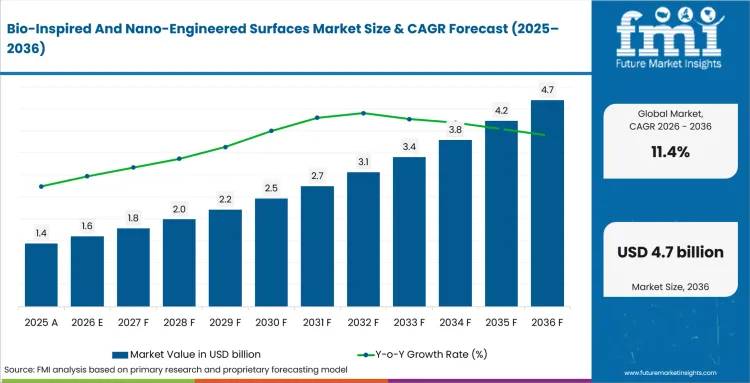
Key Takeaways of Bio-Inspired And Nano-Engineered Surfaces Market
- Demand expands through surface functions that reduce fouling or cleaning while preserving the established component and production system.
- Bio-inspired surfaces are expected to represent 35.0% of product type in 2026, supported by recognizable mechanisms across several application classes.
- Healthcare and medical devices are projected to account for 22.0% share in 2026, reflecting strict validation needs across implants and diagnostic components.
- Healthcare and pharmaceuticals are anticipated to capture 21.0% of end-user demand in 2026, shaped by biocompatibility and contamination-control requirements.
- Scale-up consistency and abrasion durabilityremain principal limits alongside claim substantiation and nano-safety documentation during commercial qualification.
- MDS Coating Technologies Corporation and P2i Ltd. support industrial qualification routes while Surfix B.V. and Bio-Gate AG address biomedical surface applications. NEI Corporation and Integran Technologies Inc. add protective coating depth across industrial surfaces with demanding wear and corrosion requirements. HeiQ Materials AG and Nfinite Nanotechnology Inc. extend commercial access through licensing and packaging scale-up.
Analyst Perspective
"The commercial test is not whether an engineered surface produces an impressive laboratory image without dependable operating evidence. The test is whether its wetting and adhesion functions remain stable alongside barrier or biological performance during the customer’s real cleaning and exposure cycle. Companies that connect retained performance with lower maintenance cost can justify scale-up investment, while programs without repair rules or repeatable deposition data should remain limited to controlled trials."
- Nikhil Kaitwade, Principal Analyst, Future Market Insights
How is the Bio-Inspired And Nano-Engineered Surfaces Market segmented?
The bio-inspired and nano-engineered surfaces industry is segmented by Product Type, Application, End User, Distribution Channel, Surface Function, and Region.
The market is assessed by product type, application, end user, distribution channel, surface function and region. Product type separates bio-inspired textures from nano-engineered coatings and films with distinct requirements for commercial manufacturing. Application identifies the operating problem across healthcare, transportation, electronics, construction, aerospace, energy and consumer products. End user distinguishes the organizations responsible for qualification and purchasing alongside maintenance across every treated component. Distribution channel separates direct technical engagement from distributors and research partnerships used for commercialization and technical support. Surface function classifies the measurable result through self-cleaning, water repellency, anti-fouling, antimicrobial protection, ice resistance, corrosion control or drag reduction. Regional analysis compares testing capacity and regulatory treatment while medical programs apply these categories through specific medical coating requirements that connect surface behavior with sterilization and process control.
What supports the position of bio-inspired surfaces within the product type category?
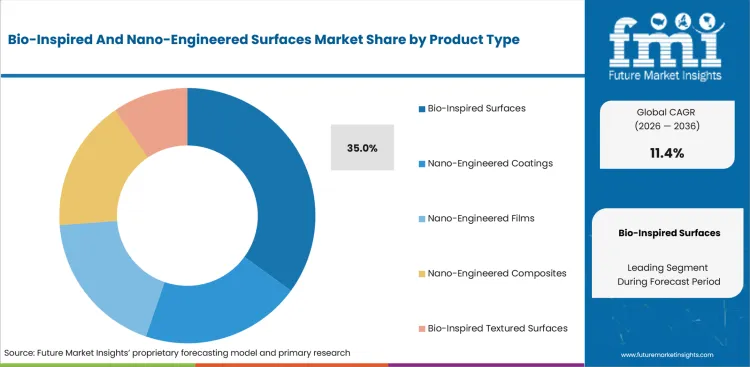
Bio-inspired designs copy useful structures from leaves and insect surfaces or animal skin through controlled micro- or nanoscale patterns. The Government of Japan described a mosquito-repellent textile in March 2025 that uses nanoscale pores to retain an active ingredient. The example shows why hydrophobic surface treatments need architecture-specific testing rather than one contact-angle result. Commercial qualification must confirm that the pattern survives production variation and repeated use throughout the intended service period.
- Bio-inspired surfaces are projected to hold 35.0% share in 2026 owing to their ability to deliver several measurable functions without changing the base component. The segment retains its position through reproducible patterning and durability evidence rather than visual similarity to a biological reference. Commercial renewal improves as tests connect surface architecture with a repeatable result across several operating cycles.
- Manufacturers first use these surfaces on components that experience costly fouling or frequent cleaning during normal operation. Broader adoption requires abrasion testing and geometry-specific process control across curved parts and larger production batches. Qualified programs define cleaning limits and inspection intervals so each customer understands how long the surface function should remain effective.
Why do healthcare and medical devices lead the application category?
Healthcare and medical devices use engineered surfaces to control protein attachment and fluid movement across regulated workflows. A February 2025 United States SBIR award supported a nano-biological coating intended to reduce infection around implantable medical devices. The award establishes an active development route without presenting external evidence as proof of the approved segment share. Commercial programs must connect hydrophilic device coatings with assembly and sterilization controls because surface performance can change across production lots and storage conditions.
- By application, healthcare and medical devices are estimated to hold 22.0% in 2026 owing to the high cost of fouling and contamination across clinical products. The position reflects demanding validation requirements across implantable products and diagnostic systems used within controlled clinical workflows. Revenue becomes defensible through qualified coating steps that fit established assembly and sterilization processes without disrupting device performance.
- Device developers expand adoption through controlled studies that connect coating behavior with the intended clinical workflow and patient-contact conditions. Qualification slows if sterilization changes adhesion or surface chemistry across several production lots and validated storage periods. Acceptance limits must separate coating failure from substrate and packaging variation across several manufacturing sites and validated product generations.
How do healthcare and pharmaceuticals shape demand in the end-user category?
Healthcare and pharmaceutical manufacturers need engineered surfaces that remain reliable through sterilization and biological exposure across storage and repeated handling. Bio-Gate reported in June 2026 that the full multicenter clinical study had started for HyProtect-coated hip revision implants. The study covers ten clinical centers across Germany and Poland as well as Spain within a controlled multinational validation program. The program provides a direct validation route for antimicrobial implant surfaces and requires comparable coating evidence across production sites.
- Healthcare and pharmaceuticals are set to lead the end-user category with 21.0% share in 2026 due to strict contamination-control and biocompatibility requirements. This reflects repeated validation across medical products and controlled processing environments with strict cleanliness and documentation requirements. Long-term purchasing depends on documentation that remains consistent across manufacturing sites and future qualification reviews.
- Pharmaceutical facilities prioritize surfaces that simplify cleaning without adding unacceptable extractables or residues inside controlled operations. Adoption weakens if application methods cannot preserve uniformity across complex equipment and disposable component geometries. Commercial programs need defined extractables testing and maintenance responsibility for every treated surface class during routine quality audits and compliance reviews.
What keeps direct sales ahead within distribution channel?
Direct sales allow surface developers to review substrates and select suitable formulations during the earliest stages of commercial qualification. P2i reported in December 2025 that its production-ready liquid barrier coatings use customer qualification plans and CAD files to guide the first formulation choice. The launch explains why smart coating programs depend on direct engineering dialogue during initial qualification. Distributors become more useful once technical packages define compatible substrates and repeatable deposition conditions for routine orders.
- By distribution channel, direct sales are forecast to represent 31.0% in 2026 driven by the technical dialogue required during substrate qualification. The route supports faster correction of application settings and assigns clear responsibility for performance evidence. Direct engagement also protects technical feedback that can disappear across several distribution handoffs and later escalations.
- Industrial manufacturers favor direct engagement for custom surfaces and regulated applications with costly failure consequences. Wider distributor coverage becomes practical as technical packages define compatible substrates and repeatable curing or deposition windows. Channel expansion should follow standardized sample preparation and clear escalation procedures for performance complaints across customer sites and service teams.
Which buying mechanism supports self-cleaning surfaces in the surface function category?
Self-cleaning surfaces limit residue attachment through controlled wetting and photocatalytic action across components exposed to recurring contamination and cleaning. NEI Corporation identified a PFAS-free easy-clean coating in June 2026 for applications requiring repellency and simpler residue removal. The portfolio update gives anti-soiling functions a current commercial route beyond laboratory contact-angle demonstrations and isolated performance claims. Customers must compare cleaning reduction with renewal expense and possible surface damage across the intended service period before approving broader use.
- Based on surface function, self-cleaning surfaces are projected to account for 24.0% in 2026 due to measurable maintenance benefits across exposed components. The position spans building materials and industrial equipment alongside medical products with recurring cleaning requirements. Commercial strength depends on performance that remains visible in maintenance records across customer facilities and scheduled inspection cycles.
- Facilities prioritize self-cleaning functions on surfaces with frequent residue buildup or expensive access requirements during routine maintenance. Wider adoption depends on retained repellency and clear renewal rules across abrasion and chemical exposure. Customers need repair procedures that restore function without replacing the underlying component or stopping production during planned maintenance periods.
What are the drivers, restraints, and opportunities in the Bio-Inspired And Nano-Engineered Surfaces Market?
Passive functions that reduce fouling and cleaning create demand across maintenance-intensive applications. Manufacturing variation and weak durability evidence can delay qualification, while standardized tests and repairable coating routes offer the clearest path to repeat purchasing.
- Driver: Passive surface functions reduce cleaning frequency and contamination exposure without adding another mechanical system to the component.
- Restraint: Manufacturing variation changes nanoscale geometry and can weaken retained performance across full-size component shapes and production batches.
- Opportunity: Standardized tests and repairable coating routes can convert narrow technical gains into repeat purchasing across qualified applications.
Passive surface functions support demand by reducing fouling or erosion across assets that require frequent maintenance. In March 2025, Canada announced support for MDS Coating Technologies Corporation to expand production of aerospace nanocoatings designed to improve engine-component durability. Comparable marine nanocoating applications require the same link between retained function and documented maintenance savings. Revenue converts more quickly as operators measure lower downtime or reduced contaminant attachment within an established service workflow.
Manufacturing variation creates a material restraint because nanoscale behavior changes with deposition thickness and substrate preparation. Britain’s Office for Product Safety and Standards reported in February 2025 that advanced materials include surface coatings with commercialization and safety-by-design challenges. Anti-corrosion coating systems therefore need lifecycle evidence that connects formulation data with abrasion and exposure performance. Qualification becomes longer if developers cannot relate surface measurements to component durability across repeat production batches.
Standardized performance routes create a credible opportunity for surfaces that solve one defined problem with repeatable evidence. The United States SBIR program recorded a June 2025 award for self-cleaning ceramic nanocoatings designed to protect military solar panels. The award connects exact exposure conditions with a defined maintenance objective during formal customer qualification. Developers gain a stronger pricing case through verified function and repair instructions for every approved substrate and maintenance setting.
Which country CAGRs are profiled in the Bio-Inspired And Nano-Engineered Surfaces Market?
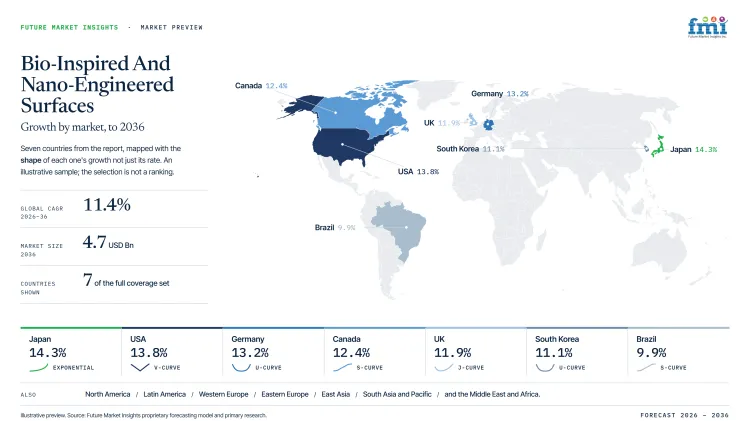
| Country | CAGR |
|---|---|
| Japan | 14.3% |
| USA | 13.8% |
| Germany | 13.2% |
| Canada | 12.4% |
| UK | 11.9% |
| South Korea | 11.1% |
| Brazil | 9.9% |
How do country-level CAGRs compare in the Bio-Inspired And Nano-Engineered Surfaces Market?
The country forecasts span 4.4 percentage points and form a gradual progression rather than one separated growth tier. Japan and the USA combine extensive research capacity with specialized manufacturing or defense qualification routes. Germany and Canada rely more heavily on formal characterization and pilot-scale industrial support programs for regulated applications. The UK emphasizes coordinated surface-technology partnerships while South Korea links public technology transfer with dense electronics manufacturing. Brazil follows a developing conformity route that strengthens claim control but leaves wider service coverage as a constraint.
- Japan combines advanced materials research with specialized textile and medical manufacturing programs that transfer surface architectures into controlled production.
- The USA links defense requirements with SBIR-backed optical and biomedical projects that define measurable performance targets ahead of commercial scale-up.
- Germany combines complementary surface characterization with formal risk assessment across regulated applications that demand detailed evidence before approval.
- Canada connects federal scale-up support with aerospace coating capacity and gives specialist developers a practical route into customer qualification programs.
- The UK uses coordinated surface-technology partnerships and safety guidance while recurring orders depend on manufacturer-led application programs.
- South Korea combines dense electronics manufacturing with public technology transfer routes that test protective coatings against measurable production requirements.
- Brazil is developing a clearer conformity route through CertificaNANO but specialist service coverage remains concentrated around major industrial centers.
Differences in qualification intensity and service coverage can change deployment timing even when two countries have similar CAGRs. Commercial planning should match local evidence requirements and service capacity rather than follow the displayed forecast order. The full report provides country-level CAGR analysis across North America, Latin America, Europe, East Asia, South Asia, Oceania and the Middle East and Africa.
Country-wise Analysis
- Japanese manufacturers expect precise process control and local technical support across specialized medical and industrial components. Adoption of bio-inspired and nano-engineered surfaces in Japan is estimated to expand at 14.3% CAGR through 2036, supported by advanced materials research and precise manufacturing controls. AIST reported in February 2025 that its rapid nano-coating process retained antiviral performance on treated fibers and sheets for two months. The result gives medical-textile developers a local route for repeatable deposition and controlled protective performance. Japan’s research institutes provide a direct adoption enabler through advanced characterization and pilot manufacturing for specialist coating developers. Demanding qualification cycles remain the main friction because complex production geometries can expose coating variation during scale-up.
- United States programs connect defense requirements with small-business development routes for optical and biomedical surface technologies. The USA’s bio-inspired and nano-engineered surfaces outlook is anticipated to advance at 13.8% CAGR over the assessment period, enabled by defense qualification routes and specialist coating developers. The United States SBIR program recorded a June 2025 award for optical windows with hydrophobic and anti-biofouling nanostructures. The project joins scalable nano-imprinting with harsh-environment performance requirements for Navy optical platforms and related defense equipment. Strong research infrastructure and demanding customers provide a direct adoption enabler for developers with specialized validation capacity. Long qualification cycles and liability requirements remain material commercial frictions that delay recurring orders and raise development costs.
- German customers require formal characterization and risk assessment for nano-engineered surfaces entering regulated industrial applications. Bio-inspired and nano-engineered surface sales in Germany are forecast to expand at 13.2% CAGR by 2036, shaped by detailed evidence requirements and established materials institutes. BAM reported in December 2025 that dependable nanomaterial surface assessment requires several complementary analytical methods. The finding supports qualification routes that compare surface chemistry with morphology before application performance is accepted. German laboratories provide a direct adoption enabler through advanced measurement and detailed failure analysis for specialist coating programs. Extensive evidence requirements can delay approval whenever formulation or process changes alter the validated surface characteristics.
- Canadian aerospace developers operating across regulated programs can access public scale-up support alongside specialized coating and nanomaterial facilities. The Canadian bio-inspired and nano-engineered surfaces sector is projected to record 12.4% CAGR during the assessment period, aided by aerospace commercialization support and specialized coating facilities. Canada announced in May 2026 that MDS Coating Technologies Corporation would expand its facility and enhance manufacturing for next-generation aerospace coatings. The project gives local developers a commercial route for nanocoatings designed to improve aircraft engine durability and operating performance. Industrial research support and advanced characterization provide a direct adoption enabler for specialized coating developers and manufacturing partners. Geographic distance and a concentrated specialist base can raise service costs outside major manufacturing corridors.
- United Kingdom commercialization depends on application-specific funding and safety guidance across demanding industrial programs and specialized manufacturing routes. Bio-inspired and nano-engineered surface demand in the UK is forecast to rise at 11.9% CAGR over the forecast period, influenced by coordinated research partnerships and strict qualification requirements. UK Research and Innovation opened a Materials Innovation Partnerships opportunity in March 2026 with an advanced surface technologies theme. The program requires business and academic partners to develop surface treatments for demanding environments and regulated industrial workflows. Universities and testing organizations provide a direct partnership route for tribology studies and specialized surface-treatment development. The transition from funded research into recurring manufacturing orders remains lengthy across smaller programs with limited production volumes.
- South Korean electronics manufacturers combine high-volume production with strict yield expectations and rapid technical response requirements. In South Korea protective nano-engineered surface demand is predicted to advance at 11.1% CAGR through 2036, reinforced by dense manufacturing networks and public technology-transfer routes. KIMM listed an ultra-thin nanomaterial-based waterproof coating on its enterprise collaboration platform in January 2026. The listing provides a current transfer route for protective surfaces used across automotive and mobility applications. Dense manufacturing networks provide a direct adoption enabler through measurable production tests across electronics and mobility components. Price pressure and expectations for fast local engineering support remain material frictions during qualification and production ramp-up.
- Brazilian market entry depends on conformity assessment and dependable service coverage across geographically dispersed industrial customers. Brazil’s bio-inspired and nano-engineered surfaces market is estimated to post 9.9% CAGR over the forecast period, linked to public efforts that improve nanotechnology traceability and claim control. Inmetro and MCTI advanced the CertificaNANO project in July 2025 to develop conformity assessment programs for nanotechnology products. The initiative gives manufacturers a clearer route for verified performance claims and consistent quality documentation. Public metrology capability provides a direct adoption enabler for developers that can document composition and operating exposure. Import costs and limited application support outside major research centers remain material frictions for wider commercial coverage.
Who are the notable companies in the Bio-Inspired And Nano-Engineered Surfaces Market?
MDS Coating Technologies Corporation, NEI Corporation, Integran Technologies Inc., P2i Ltd., Surfix B.V., Bio-Gate AG, HeiQ Materials AG, and Nfinite Nanotechnology Inc. are notable companies shaping this market.
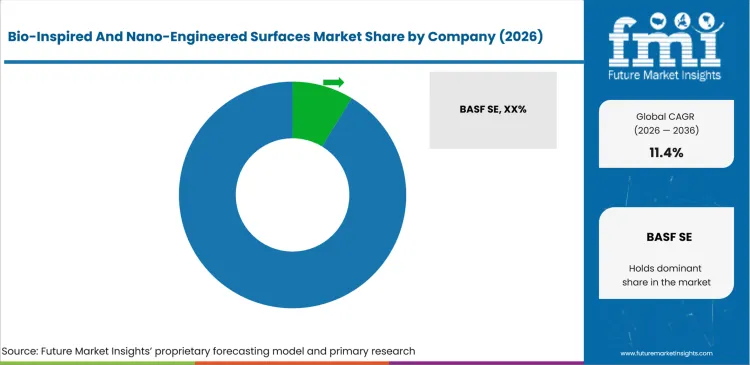
The competitive set combines protective coating platforms with medical and packaging specialists that solve different interfacial problems. MDS Coating Technologies Corporation and Integran Technologies Inc. provide nanostructured protection for aerospace and industrial components. Surfix B.V. and Bio-Gate AG focus on diagnostic or implant pathways that require biological validation. P2i Ltd. and NEI Corporation support diverse substrates through plasma and liquid coating systems with documented industrial application routes. HeiQ Materials AG scales functional chemistry through licensing across printed and polymer surfaces for several commercial applications. Nfinite Nanotechnology Inc. applies ultra-thin deposition to barrier coatings for packaging across commercial converting lines. Selection depends on substrate evidence and retained performance alongside service reach rather than corporate size.
- MDS Coating Technologies Corporation and Integran Technologies Inc. focus on nanostructured protection for aerospace and industrial components. NEI Corporation and P2i Ltd. provide broader functional coating routes through liquid or plasma application systems. Their commercial test is retained performance across customer-specific substrates through repeated operating and maintenance cycles.
- Surfix B.V. and Bio-Gate AG apply engineered surfaces within diagnostic and implant pathways that require biological validation. HeiQ Materials AG extends functional coating chemistry through licensed manufacturing routes across printed and polymer surface applications. Biomedical specialists must align biological performance with production controls and regulatory documentation across every approved application.
- Nfinite Nanotechnology Inc. scales ultra-thin barrier deposition for paper packaging through commercial partnerships and pilot production. Its route depends on continuous coating quality and compatibility with established converting equipment across high-speed commercial packaging lines. Focused platforms can compete by solving one measurable problem without funding a broad coating portfolio or global application network.
Competitive Benchmarking: Bio-Inspired And Nano-Engineered Surfaces Market
| Company | Surface Architecture Depth | Application Engineering | Commercial Scale and Support | Geographic Reach |
|---|---|---|---|---|
| MDS Coating Technologies Corporation | High | High | High | Global aerospace programs |
| NEI Corporation | High | High | Medium | North America and international customers |
| Integran Technologies Inc. | High | High | Medium | North America and licensed programs |
| P2i Ltd. | High | High | High | Global electronics and medical programs |
| Surfix B.V. | Medium | High | Low | Europe and diagnostic partnerships |
| Bio-Gate AG | Medium | High | Medium | Europe and North America |
| HeiQ Materials AG | Medium | High | High | Global licensing network |
| Nfinite Nanotechnology Inc. | Medium | Medium | Low | Canada and global packaging partners |
Key Developments in the Bio-Inspired And Nano-Engineered Surfaces Market
- In July 2025, Surfix B.V. started a project with the Netherlands Cancer Institute and Wageningen University to improve monitoring for immunotherapy patients. The partners combined photonic sensing with clinical and academic expertise to support earlier detection of cortisol deficiency during treatment. The project places an engineered interface inside a defined diagnostic pathway that requires reliable sensing and scalable cartridge manufacturing. Clinical collaboration provides a direct validation route beyond laboratory biosensor development and isolated technical testing.
- In January 2025, HeiQ Materials AG unveiled the transparent heat-reflecting HeiQ Xpectra coating at BAU 2025. The company stated that one application can reduce the wall U-value by up to 25% while preserving the building’s appearance. The launch moves a functional surface from collaborative development into a named commercial route for building retrofits. Distribution partners and standard spray application provide a practical deployment route across existing buildings without major construction changes.
- In December 2025, Nfinite Nanotechnology Inc. secured support to scale its open-air roll-to-roll process for ultra-thin barrier coatings on paper. The company planned a Waterloo pilot plant and commercial work with Amcor as well as PepsiCo and Unilever. The program connects nanoscale deposition with established packaging lines and measurable shelf-life requirements across commercial products. Industrial scale-up gives the surface platform a defined route from laboratory coating performance into recurring packaging production.
- In October 2025, P2i Ltd. entered Jolt Capital’s portfolio through a controlling investment intended to support future growth. Jolt described P2i as a global provider of liquid-repellent nanocoating processes used across more than one billion electronic devices. The transaction adds financial support for production equipment and international service delivery across several customer manufacturing programs. Ownership backing gives manufacturers a clearer route from qualification into repeat deployment across electronics and medical programs.
Key Players in the Bio-Inspired And Nano-Engineered Surfaces Market
Scaled Protective Coating Platforms
- MDS Coating Technologies Corporation
- NEI Corporation
- P2i Ltd.
Nano-Engineered and Biomedical Specialists
- Integran Technologies Inc.
- Surfix B.V.
- Bio-Gate AG
Licensed and Application-Focused Surface Platforms
- HeiQ Materials AG
- Nfinite Nanotechnology Inc.
Bio-Inspired And Nano-Engineered Surfaces Market - Report Scope
| Coverage field | Report scope |
|---|---|
| Market breakdown | Product Type, Application, End User, Distribution Channel, Surface Function, and Region. |
| Market Definition | Micro- and nanoscale textures, coatings, films, and treatments that change surface behavior through biological inspiration or engineered architecture. |
| Regions Covered | North America, Latin America, Western Europe, Eastern Europe, East Asia, South Asia and Pacific, and the Middle East and Africa. |
| Countries Covered | Japan, USA, Germany, Canada, UK, South Korea, and Brazil. |
| Key Companies Profiled | MDS Coating Technologies Corporation, NEI Corporation, Integran Technologies Inc., P2i Ltd., Surfix B.V., Bio-Gate AG, HeiQ Materials AG, Nfinite Nanotechnology Inc. |
| Forecast Period | 2026 to 2036. |
| Approach | Hybrid bottom-up and top-down market sizing supported by category share analysis, country-level growth assessment, company participation mapping, and application-level market validation. |
Bio-Inspired And Nano-Engineered Surfaces Market - Research Methodology
| Method | Approach |
|---|---|
| Primary Research | FMI analysts gathered input from manufacturers, service providers, technology developers, distributors, end users, procurement teams, and subject-matter experts. Interviews examined purchasing decisions, product or service evaluation, adoption barriers, approval requirements, pricing considerations, and expectations for technical or commercial support. Respondents were also asked what evidence is required before a trial, pilot, or initial order develops into regular purchasing. |
| Desk Research | Desk research covered government statistics, regulatory publications, trade data, industry associations, technical literature, standards, company filings, product information, and official corporate announcements. Sources were reviewed for relevance, publication date, geographic coverage, and consistency with the defined market scope. Claims relating to performance, applications, approvals, capacity, investment, and commercial activity were retained only when supported by credible public evidence. |
| Market Sizing and Forecasting | The market model combined the baseline value with historical performance, segment structure, pricing and volume indicators, adoption levels, company participation, and country-level demand conditions. Forecast assumptions considered economic activity, investment trends, regulatory developments, technology adoption, purchasing cycles, supply availability, and barriers to wider market use. Segment and regional estimates were reconciled before the final market total was calculated. |
| Data Validation | Estimates were checked against multiple independent indicators, including public data, company activity, trade patterns, industry developments, and findings from primary interviews. Validation also tested whether products, services, applications, and company revenues fell within the defined market boundaries. Adjacent categories, unsupported claims, overlapping revenues, and activities without direct market relevance were excluded to reduce double counting and maintain consistency across segments and countries. |
Bio-Inspired And Nano-Engineered Surfaces Market by Segments
Bio-Inspired And Nano-Engineered Surfaces Market segmented by Product Type:
- Bio-Inspired Surfaces
- Lotus Leaf-Inspired Self-Cleaning Surfaces
- Shark Skin-Inspired Drag-Reducing Surfaces
- Nano-Engineered Coatings
- Nano-Structured Protective Coatings
- Nano-Engineered Functional Coatings
- Nano-Engineered Films
- Nanostructured Thin Films
- Nano-Barrier Films
- Nano-Engineered Composites
- Polymer-Based Nanocomposites
- Metal and Ceramic Nanocomposites
- Bio-Inspired Textured Surfaces
- Superhydrophobic Textured Surfaces
- Biomimetic Micro- and Nano-Patterned Surfaces
Bio-Inspired And Nano-Engineered Surfaces Market segmented by Application:
- Healthcare and Medical Devices
- Implant and Prosthetic Surfaces
- Antimicrobial Medical Surfaces
- Automotive and Transportation
- Drag-Reducing Vehicle Surfaces
- Self-Cleaning Automotive Surfaces
- Electronics and Semiconductors
- Anti-Reflective Electronic Surfaces
- Protective and Functional Nano-Surfaces
- Construction and Infrastructure
- Self-Cleaning Building Surfaces
- Anti-Corrosion Infrastructure Surfaces
- Aerospace and Defense
- Anti-Icing Aerospace Surfaces
- Drag-Reducing Aircraft Surfaces
- Energy and Power
- Anti-Fouling Energy Surfaces
- Enhanced Solar and Energy Device Surfaces
- Consumer Goods and Other Applications
- Self-Cleaning Consumer Products
- Functional Packaging and Household Surfaces
Bio-Inspired And Nano-Engineered Surfaces Market segmented by End User:
- Healthcare and Pharmaceuticals
- Medical Device Manufacturers
- Pharmaceutical and Biotechnology Companies
- Automotive and Transportation
- Automotive OEMs
- Aerospace and Transportation Manufacturers
- Electronics and Electricals
- Semiconductor Manufacturers
- Electronics and Component Manufacturers
- Industrial Manufacturing
- Industrial Equipment Manufacturers
- Chemical and Process Industries
- Construction and Infrastructure
- Building Material Manufacturers
- Infrastructure Developers
- Consumer Goods and Textiles
- Consumer Product Manufacturers
- Textile and Apparel Companies
- Energy and Environmental Industries
- Energy Equipment Manufacturers
- Water Treatment and Environmental Technology Providers
Bio-Inspired And Nano-Engineered Surfaces Market segmented by Distribution Channel:
- Direct Sales
- Direct Manufacturer Sales
- Long-Term Industrial Contracts
- Specialty Chemical Distributors
- Regional Specialty Chemical Distributors
- Nanotechnology Material Distributors
- OEM and Technology Partnerships
- Automotive and Electronics OEM Partnerships
- Industrial Technology Partnerships
- Research and Development Collaborations
- University and Research Institute Collaborations
- Corporate R&D Partnerships
- Online and B2B Procurement Channels
- Industrial E-Commerce Platforms
- B2B Procurement Portals
- Specialized Surface Technology Providers
- Custom Surface Engineering Suppliers
- Specialized Coating Service Providers
Bio-Inspired And Nano-Engineered Surfaces Market segmented by Surface Function:
- Self-Cleaning Surfaces
- Lotus Leaf-Inspired Surfaces
- Photocatalytic Self-Cleaning Surfaces
- Superhydrophobic and Water-Repellent Surfaces
- Nano-Textured Superhydrophobic Surfaces
- Biomimetic Water-Repellent Surfaces
- Anti-Fouling and Anti-Biofouling Surfaces
- Marine Anti-Fouling Surfaces
- Biofouling-Resistant Medical Surfaces
- Antimicrobial and Antibacterial Surfaces
- Antimicrobial Nano-Coatings
- Bio-Inspired Antibacterial Surfaces
- Anti-Icing and Ice-Phobic Surfaces
- Superhydrophobic Anti-Icing Surfaces
- Nano-Engineered Ice-Phobic Coatings
- Anti-Corrosion and Wear-Resistant Surfaces
- Nano-Barrier Anti-Corrosion Surfaces
- Wear-Resistant Nano-Coatings
- Drag-Reducing and Friction-Reducing Surfaces
- Shark Skin-Inspired Surfaces
- Nano-Textured Low-Friction Surfaces
Bio-Inspired And Nano-Engineered Surfaces Market by Region:
- North America
- USA
- Canada
- Latin America
- Brazil
- Mexico
- Argentina
- Chile
- Western Europe
- Germany
- France
- UK
- Italy
- Spain
- Benelux
- Nordics
- Eastern Europe
- Poland
- Czech Republic
- Romania
- Hungary
- East Asia
- China
- Japan
- South Korea
- South Asia and Pacific
- India
- ASEAN
- Australia and New Zealand
- Middle East and Africa
- GCC Countries
- South Africa
- Türkiye
- Israel
Research Sources and Bibliography
- Department for Environment, Food & Rural Affairs. (2025, March 24).
- Federal Economic Development Agency for Southern Ontario. (2025, February 12).
- Government of Japan. (2025, March 21).
- U.S. Small Business Innovation Research. (2025, February 26).
- Bio-Gate AG. (2026, June 2).
- P2i Ltd. (2025, December 16).
- NEI Corporation. (2026, June 4).
- Innovation, Science and Economic Development Canada. (2025, March 21).
- Office for Product Safety and Standards. (2025, February 6).
- U.S. Small Business Innovation Research. (2025, June 16).
- National Institute of Advanced Industrial Science and Technology. (2025, February 17).
- U.S. Small Business Innovation Research. (2025, June 30).
- Federal Institute for Materials Research and Testing. (2025, December 17).
- Innovation, Science and Economic Development Canada. (2026, May 13).
- UK Research and Innovation. (2026, March 4).
- Korea Institute of Machinery & Materials. (2026, January 2).
- Instituto Nacional de Metrologia, Qualidade e Tecnologia. (2025, July 8).
- Surfix B.V. (2025, July 9).
- HeiQ Materials AG. (2025, January 9).
- Nfinite Nanotechnology Inc. (2025, December 16).
- Perez, P. (2025, October 2).
This bibliography is provided for reader reference and is not exhaustive. The full report contains the complete reference list and detailed citations.
This Report Answers
- How large is the bio-inspired and nano-engineered surfaces market in 2026 and 2036?
- Which surface functions convert laboratory performance into repeatable commercial value?
- Why do bio-inspired surfaces account for 35.0% of product type during 2026?
- How do medical-device requirements influence application growth and surface qualification?
- Why does direct sales remain the principal distribution route for engineered surfaces?
- How do approved country growth rates differ across Japan, North America, Europe, South Korea, and Brazil?
- Which companies provide scalable nanostructured coatings or specialized interfacial technologies?
- What limits retained performance across abrasion, sterilization, ultraviolet exposure, and manufacturing variation?
- How can standardized tests and repair routes improve commercial adoption across narrow applications?
Frequently Asked Questions
How big is the Bio-Inspired and Nano-Engineered Surfaces Market in 2026?
The bio-inspired and nano-engineered surfaces market is valued at USD 1.6 billion in 2026 and is forecast to reach USD 4.7 billion by 2036, reflecting growing demand for microstructured textures and nanoscale coatings that reduce fouling and cleaning frequency across healthcare, aerospace, and industrial applications.
What is the CAGR of the Bio-Inspired and Nano-Engineered Surfaces Market from 2026 to 2036?
The bio-inspired and nano-engineered surfaces market is projected to grow at a CAGR of 11.4% between 2026 and 2036, supported by passive surface functions that reduce contamination exposure and maintenance cost without replacing the underlying component or redesigning the production system.
Which surface function leads the Bio-Inspired and Nano-Engineered Surfaces Market?
Self-cleaning surfaces account for 24.0% of the bio-inspired and nano-engineered surfaces market by surface function in 2026, driven by measurable maintenance benefits across exposed components in building materials, industrial equipment, and medical products with recurring cleaning and contamination-control requirements.
Which country is growing fastest in the Bio-Inspired and Nano-Engineered Surfaces Market?
The bio-inspired and nano-engineered surfaces market in Japan is projected to expand at a CAGR of 14.3% through 2036, ahead of the USA at 13.8%, Germany at 13.2%, Canada at 12.4%, the UK at 11.9%, South Korea at 11.1%, and Brazil at 9.9%, reflecting advanced materials research capacity and precise manufacturing controls across medical and industrial surface applications.
Who are the leading companies in the Bio-Inspired and Nano-Engineered Surfaces Market?
Leading companies in the bio-inspired and nano-engineered surfaces market include MDS Coating Technologies Corporation, NEI Corporation, Integran Technologies Inc., P2i Ltd., Surfix B.V., Bio-Gate AG, HeiQ Materials AG, and Nfinite Nanotechnology Inc., spanning scaled protective coating platforms, nano-engineered biomedical specialists, and licensed functional surface systems across global industrial and medical programs.
Preview the report firsthand - request a free sample
Get SampleGet the brochure for pricing and purchase details.
Get PDFTable of Content
- Key Takeaways
- Market Size and CAGR
- Top Growth Driver
- Fastest Growing Segment
- Leading Region
- Key Companies
- Emerging Opportunities
- Executive Summary
- Global Market Outlook
- Demand-side Trends
- Supply-side Trends
- Technology Roadmap Analysis
- Analysis and Recommendations
- Analyst Perspective (What is happening? Why now? What should investors know?)
- Key Questions Answered
- How large is the market?
- What is the CAGR?
- What are key trends?
- Which region dominates?
- Who are the leaders?
- Market Overview
- Market Coverage / Taxonomy
- Market Definition / Scope / Limitations
- Research Methodology
- Chapter Orientation
- Analytical Lens and Working Hypotheses
- Market Structure, Signals, and Trend Drivers
- Benchmarking and Cross-market Comparability
- Market Sizing, Forecasting, and Opportunity Mapping
- Research Design and Evidence Framework
- Desk Research Programme (Secondary Evidence)
- Expert Input and Fieldwork (Primary Evidence)
- Tooling, Models, and Reference Databases
- Data Engineering and Model Build
- Quality Assurance and Audit Trail
- Market Background
- Market Dynamics (Drivers, Restraints, Opportunity, Trends)
- Scenario Forecast (Optimistic, Likely, Conservative)
- Impact Analysis
- AI Impact
- Sustainability Impact
- Regulatory Impact
- Technology Impact
- Consumer / Buyer Analysis
- Purchase Drivers
- Adoption Barriers
- Buyer Journey
- Opportunity Map Analysis
- Product Life Cycle Analysis
- Supply Chain Analysis
- Investment Feasibility Matrix
- Value Chain Analysis
- PESTLE and Porter's Analysis
- Regulatory Landscape
- Regional Parent Market Outlook
- Production and Consumption Statistics
- Import and Export Statistics
- Global Market Analysis and Forecast, 2021 to 2036
- Historical Market Size Value (USD billion) Analysis, 2021 to 2025
- Current and Future Market Size Value (USD billion) Projections, 2026 to 2036
- Y-o-Y Growth Trend Analysis
- Absolute $ Opportunity Analysis
- Global Market Pricing Analysis, 2021 to 2036
- Global Market Analysis and Forecast, By Product Type, 2021 to 2036
- Introduction / Key Findings
- Historical Market Size Value (USD billion) Analysis By Product Type, 2021 to 2025
- Current and Future Market Size Value (USD billion) Analysis and Forecast By Product Type, 2026 to 2036
- Bio-Inspired Surfaces
- Lotus Leaf-Inspired Self-Cleaning Surfaces
- Shark Skin-Inspired Drag-Reducing Surfaces
- Nano-Engineered Coatings
- Nano-Structured Protective Coatings
- Nano-Engineered Functional Coatings
- Nano-Engineered Films
- Nanostructured Thin Films
- Nano-Barrier Films
- Nano-Engineered Composites
- Polymer-Based Nanocomposites
- Metal and Ceramic Nanocomposites
- Bio-Inspired Textured Surfaces
- Superhydrophobic Textured Surfaces
- Biomimetic Micro- and Nano-Patterned Surfaces
- Bio-Inspired Surfaces
- Y-o-Y Growth Trend Analysis By Product Type, 2021 to 2025
- Absolute $ Opportunity Analysis By Product Type, 2026 to 2036
- Global Market Analysis and Forecast, By Application, 2021 to 2036
- Introduction / Key Findings
- Historical Market Size Value (USD billion) Analysis By Application, 2021 to 2025
- Current and Future Market Size Value (USD billion) Analysis and Forecast By Application, 2026 to 2036
- Healthcare and Medical Devices
- Implant and Prosthetic Surfaces
- Antimicrobial Medical Surfaces
- Automotive and Transportation
- Drag-Reducing Vehicle Surfaces
- Self-Cleaning Automotive Surfaces
- Electronics and Semiconductors
- Anti-Reflective Electronic Surfaces
- Protective and Functional Nano-Surfaces
- Construction and Infrastructure
- Self-Cleaning Building Surfaces
- Anti-Corrosion Infrastructure Surfaces
- Aerospace and Defense
- Anti-Icing Aerospace Surfaces
- Drag-Reducing Aircraft Surfaces
- Energy and Power
- Anti-Fouling Energy Surfaces
- Enhanced Solar and Energy Device Surfaces
- Consumer Goods and Other Applications
- Self-Cleaning Consumer Products
- Functional Packaging and Household Surfaces
- Healthcare and Medical Devices
- Y-o-Y Growth Trend Analysis By Application, 2021 to 2025
- Absolute $ Opportunity Analysis By Application, 2026 to 2036
- Global Market Analysis and Forecast, By End User, 2021 to 2036
- Introduction / Key Findings
- Historical Market Size Value (USD billion) Analysis By End User, 2021 to 2025
- Current and Future Market Size Value (USD billion) Analysis and Forecast By End User, 2026 to 2036
- Healthcare and Pharmaceuticals
- Medical Device Manufacturers
- Pharmaceutical and Biotechnology Companies
- Automotive and Transportation
- Automotive OEMs
- Aerospace and Transportation Manufacturers
- Electronics and Electricals
- Semiconductor Manufacturers
- Electronics and Component Manufacturers
- Industrial Manufacturing
- Industrial Equipment Manufacturers
- Chemical and Process Industries
- Construction and Infrastructure
- Building Material Manufacturers
- Infrastructure Developers
- Consumer Goods and Textiles
- Consumer Product Manufacturers
- Textile and Apparel Companies
- Energy and Environmental Industries
- Energy Equipment Manufacturers
- Water Treatment and Environmental Technology Providers
- Healthcare and Pharmaceuticals
- Y-o-Y Growth Trend Analysis By End User, 2021 to 2025
- Absolute $ Opportunity Analysis By End User, 2026 to 2036
- Global Market Analysis and Forecast, By Distribution Channel, 2021 to 2036
- Introduction / Key Findings
- Historical Market Size Value (USD billion) Analysis By Distribution Channel, 2021 to 2025
- Current and Future Market Size Value (USD billion) Analysis and Forecast By Distribution Channel, 2026 to 2036
- Direct Sales
- Direct Manufacturer Sales
- Long-Term Industrial Contracts
- Specialty Chemical Distributors
- Regional Specialty Chemical Distributors
- Nanotechnology Material Distributors
- OEM and Technology Partnerships
- Automotive and Electronics OEM Partnerships
- Industrial Technology Partnerships
- Research and Development Collaborations
- University and Research Institute Collaborations
- Corporate R&D Partnerships
- Online and B2B Procurement Channels
- Industrial E-Commerce Platforms
- B2B Procurement Portals
- Specialized Surface Technology Providers
- Custom Surface Engineering Suppliers
- Specialized Coating Service Providers
- Direct Sales
- Y-o-Y Growth Trend Analysis By Distribution Channel, 2021 to 2025
- Absolute $ Opportunity Analysis By Distribution Channel, 2026 to 2036
- Global Market Analysis and Forecast, By Surface Function, 2021 to 2036
- Introduction / Key Findings
- Historical Market Size Value (USD billion) Analysis By Surface Function, 2021 to 2025
- Current and Future Market Size Value (USD billion) Analysis and Forecast By Surface Function, 2026 to 2036
- Self-Cleaning Surfaces
- Lotus Leaf-Inspired Surfaces
- Photocatalytic Self-Cleaning Surfaces
- Superhydrophobic and Water-Repellent Surfaces
- Nano-Textured Superhydrophobic Surfaces
- Biomimetic Water-Repellent Surfaces
- Anti-Fouling and Anti-Biofouling Surfaces
- Marine Anti-Fouling Surfaces
- Biofouling-Resistant Medical Surfaces
- Antimicrobial and Antibacterial Surfaces
- Antimicrobial Nano-Coatings
- Bio-Inspired Antibacterial Surfaces
- Anti-Icing and Ice-Phobic Surfaces
- Superhydrophobic Anti-Icing Surfaces
- Nano-Engineered Ice-Phobic Coatings
- Anti-Corrosion and Wear-Resistant Surfaces
- Nano-Barrier Anti-Corrosion Surfaces
- Wear-Resistant Nano-Coatings
- Drag-Reducing and Friction-Reducing Surfaces
- Shark Skin-Inspired Surfaces
- Nano-Textured Low-Friction Surfaces
- Self-Cleaning Surfaces
- Y-o-Y Growth Trend Analysis By Surface Function, 2021 to 2025
- Absolute $ Opportunity Analysis By Surface Function, 2026 to 2036
- Global Market Analysis and Forecast, By Region, 2021 to 2036
- Introduction
- Historical Market Size Value (USD billion) Analysis By Region, 2021 to 2025
- Current Market Size Value (USD billion) Analysis and Forecast By Region, 2026 to 2036
- North America
- Latin America
- Western Europe
- Eastern Europe
- East Asia
- South Asia and Pacific
- Middle East & Africa
- Market Attractiveness Analysis By Region
- North America Market Analysis and Forecast, By Country, 2021 to 2036
- Historical Market Size Value (USD billion) Trend Analysis By Market Taxonomy, 2021 to 2025
- Market Size Value (USD billion) Forecast By Market Taxonomy, 2026 to 2036
- By Country
- USA
- Canada
- By Product Type
- By Application
- By End User
- By Distribution Channel
- By Surface Function
- By Country
- Market Attractiveness Analysis
- By Country
- By Product Type
- By Application
- By End User
- By Distribution Channel
- By Surface Function
- Key Takeaways
- Latin America Market Analysis and Forecast, By Country
- Historical Market Size Value (USD billion) Trend Analysis By Market Taxonomy, 2021 to 2025
- Market Size Value (USD billion) Forecast By Market Taxonomy, 2026 to 2036
- By Country
- Brazil
- Mexico
- Chile
- Rest of Latin America
- By Product Type
- By Application
- By End User
- By Distribution Channel
- By Surface Function
- By Country
- Market Attractiveness Analysis
- By Country
- By Product Type
- By Application
- By End User
- By Distribution Channel
- By Surface Function
- Key Takeaways
- Western Europe Market Analysis and Forecast, By Country
- Historical Market Size Value (USD billion) Trend Analysis By Market Taxonomy, 2021 to 2025
- Market Size Value (USD billion) Forecast By Market Taxonomy, 2026 to 2036
- By Country
- Germany
- UK
- Italy
- Spain
- France
- Nordic
- BENELUX
- Rest of Western Europe
- By Product Type
- By Application
- By End User
- By Distribution Channel
- By Surface Function
- By Country
- Market Attractiveness Analysis
- By Country
- By Product Type
- By Application
- By End User
- By Distribution Channel
- By Surface Function
- Key Takeaways
- Eastern Europe Market Analysis and Forecast, By Country
- Historical Market Size Value (USD billion) Trend Analysis By Market Taxonomy, 2021 to 2025
- Market Size Value (USD billion) Forecast By Market Taxonomy, 2026 to 2036
- By Country
- Russia
- Poland
- Hungary
- Balkan & Baltic
- Rest of Eastern Europe
- By Product Type
- By Application
- By End User
- By Distribution Channel
- By Surface Function
- By Country
- Market Attractiveness Analysis
- By Country
- By Product Type
- By Application
- By End User
- By Distribution Channel
- By Surface Function
- Key Takeaways
- East Asia Market Analysis and Forecast, By Country
- Historical Market Size Value (USD billion) Trend Analysis By Market Taxonomy, 2021 to 2025
- Market Size Value (USD billion) Forecast By Market Taxonomy, 2026 to 2036
- By Country
- China
- Japan
- South Korea
- By Product Type
- By Application
- By End User
- By Distribution Channel
- By Surface Function
- By Country
- Market Attractiveness Analysis
- By Country
- By Product Type
- By Application
- By End User
- By Distribution Channel
- By Surface Function
- Key Takeaways
- South Asia and Pacific Market Analysis and Forecast, By Country
- Historical Market Size Value (USD billion) Trend Analysis By Market Taxonomy, 2021 to 2025
- Market Size Value (USD billion) Forecast By Market Taxonomy, 2026 to 2036
- By Country
- India
- ASEAN
- Australia & New Zealand
- Rest of South Asia and Pacific
- By Product Type
- By Application
- By End User
- By Distribution Channel
- By Surface Function
- By Country
- Market Attractiveness Analysis
- By Country
- By Product Type
- By Application
- By End User
- By Distribution Channel
- By Surface Function
- Key Takeaways
- Middle East & Africa Market Analysis and Forecast, By Country
- Historical Market Size Value (USD billion) Trend Analysis By Market Taxonomy, 2021 to 2025
- Market Size Value (USD billion) Forecast By Market Taxonomy, 2026 to 2036
- By Country
- Kingdom of Saudi Arabia
- Other GCC Countries
- Türkiye
- South Africa
- Other African Union
- Rest of Middle East & Africa
- By Product Type
- By Application
- By End User
- By Distribution Channel
- By Surface Function
- By Country
- Market Attractiveness Analysis
- By Country
- By Product Type
- By Application
- By End User
- By Distribution Channel
- By Surface Function
- Key Takeaways
- Key Countries Market Analysis
- USA
- Pricing Analysis
- Market Share Analysis, 2025
- By Product Type
- By Application
- By End User
- By Distribution Channel
- By Surface Function
- Canada
- Pricing Analysis
- Market Share Analysis, 2025
- By Product Type
- By Application
- By End User
- By Distribution Channel
- By Surface Function
- Mexico
- Pricing Analysis
- Market Share Analysis, 2025
- By Product Type
- By Application
- By End User
- By Distribution Channel
- By Surface Function
- Brazil
- Pricing Analysis
- Market Share Analysis, 2025
- By Product Type
- By Application
- By End User
- By Distribution Channel
- By Surface Function
- Chile
- Pricing Analysis
- Market Share Analysis, 2025
- By Product Type
- By Application
- By End User
- By Distribution Channel
- By Surface Function
- Germany
- Pricing Analysis
- Market Share Analysis, 2025
- By Product Type
- By Application
- By End User
- By Distribution Channel
- By Surface Function
- UK
- Pricing Analysis
- Market Share Analysis, 2025
- By Product Type
- By Application
- By End User
- By Distribution Channel
- By Surface Function
- Italy
- Pricing Analysis
- Market Share Analysis, 2025
- By Product Type
- By Application
- By End User
- By Distribution Channel
- By Surface Function
- Spain
- Pricing Analysis
- Market Share Analysis, 2025
- By Product Type
- By Application
- By End User
- By Distribution Channel
- By Surface Function
- France
- Pricing Analysis
- Market Share Analysis, 2025
- By Product Type
- By Application
- By End User
- By Distribution Channel
- By Surface Function
- India
- Pricing Analysis
- Market Share Analysis, 2025
- By Product Type
- By Application
- By End User
- By Distribution Channel
- By Surface Function
- ASEAN
- Pricing Analysis
- Market Share Analysis, 2025
- By Product Type
- By Application
- By End User
- By Distribution Channel
- By Surface Function
- Australia & New Zealand
- Pricing Analysis
- Market Share Analysis, 2025
- By Product Type
- By Application
- By End User
- By Distribution Channel
- By Surface Function
- China
- Pricing Analysis
- Market Share Analysis, 2025
- By Product Type
- By Application
- By End User
- By Distribution Channel
- By Surface Function
- Japan
- Pricing Analysis
- Market Share Analysis, 2025
- By Product Type
- By Application
- By End User
- By Distribution Channel
- By Surface Function
- South Korea
- Pricing Analysis
- Market Share Analysis, 2025
- By Product Type
- By Application
- By End User
- By Distribution Channel
- By Surface Function
- Russia
- Pricing Analysis
- Market Share Analysis, 2025
- By Product Type
- By Application
- By End User
- By Distribution Channel
- By Surface Function
- Poland
- Pricing Analysis
- Market Share Analysis, 2025
- By Product Type
- By Application
- By End User
- By Distribution Channel
- By Surface Function
- Hungary
- Pricing Analysis
- Market Share Analysis, 2025
- By Product Type
- By Application
- By End User
- By Distribution Channel
- By Surface Function
- Kingdom of Saudi Arabia
- Pricing Analysis
- Market Share Analysis, 2025
- By Product Type
- By Application
- By End User
- By Distribution Channel
- By Surface Function
- Türkiye
- Pricing Analysis
- Market Share Analysis, 2025
- By Product Type
- By Application
- By End User
- By Distribution Channel
- By Surface Function
- South Africa
- Pricing Analysis
- Market Share Analysis, 2025
- By Product Type
- By Application
- By End User
- By Distribution Channel
- By Surface Function
- USA
- Market Structure Analysis
- Competition Dashboard
- Competition Benchmarking
- Market Share Analysis of Top Players
- By Regional
- By Product Type
- By Application
- By End User
- By Distribution Channel
- By Surface Function
- Emerging Startups
- Innovation Benchmarking
- Competition Analysis
- Competition Deep Dive
- BASF SE
- Overview
- Product Portfolio
- Profitability by Market Segments
- Sales Footprint
- Strategy Overview
- Marketing Strategy
- Product Strategy
- Channel Strategy
- DuPont de Nemours, Inc.
- 3M Company
- PPG Industries, Inc.
- Akzo Nobel N.V.
- Covestro AG
- NanoTech Coatings, Inc.
- Lotus Leaf Coatings
- Nanopool GmbH
- Rolith, Inc.
- BASF SE
- Case Studies
- Success Stories
- Recent Developments
- Competition Deep Dive
- Assumptions & Acronyms Used


