

- Market Size (2026)
- USD 6.2 Bn
- Forecast (2036)
- USD 15.7 Bn
- CAGR (2026 to 2036)
- 9.7%
How big is the medical coatings market in 2026?
USD 6.2 billion in 2026, reaching USD 15.7 billion by 2036 at a 9.7% CAGR
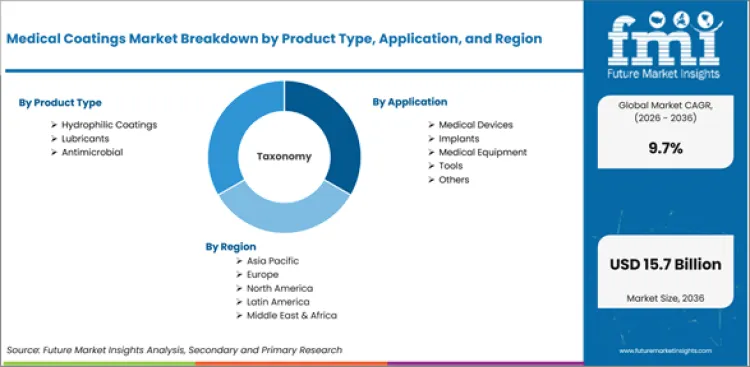
The medical coatings market was valued at USD 5.7 billion in 2025. The market is set to reach USD 6.2 billion by 2026-end and grow at a CAGR of 9.7% between 2026-2036 to reach USD 15.7 billion by 2036. Hydrophilic Coatings will dominate with a 42.8% share, while Medical Devices will lead with a 49.3% share.
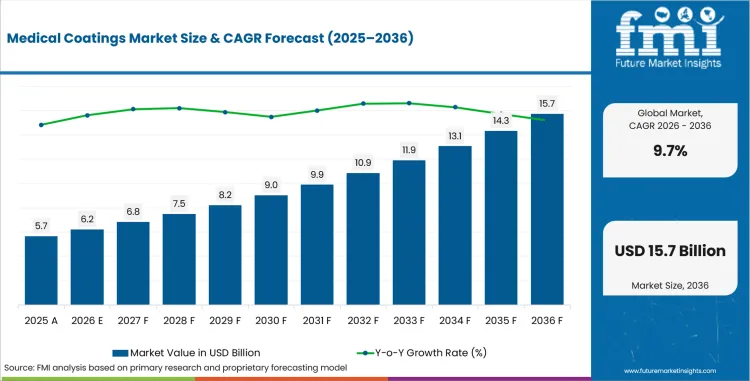
Key Takeaways, Market Size, and Forecast
- Medical Coatings Market Value (2025): USD 5.7 Bn
- Medical Coatings Market Forecast Value (2036): USD 15.7 Bn
- Medical Coatings Market Forecast CAGR (2026 TO 2036): 9.7%
- Medical Coatings Market Leading Product Type Segment: Hydrophilic Coatings (42.8%)
- Medical Coatings Market Key Growth Regions: China, India, South Korea, USA, European Union, UK
- Medical Coatings Market Key Players: DSM Biomedical, Hydromer Inc., Biocoat Inc., Surmodics, Inc., Covalon Technologies Ltd., Harland Medical Systems, AST Products, Inc.
| Parameter | Details |
|---|---|
| Market Size in 2026 (Value) | USD 6.2 Bn |
| Market Forecast in 2036 (Value) | USD 15.7 Bn |
| CAGR (2026 to 2036) | 9.7% |
| Years Considered | 2021 to 2036 |
| Base Year | 2025 |
| Forecast Period | 2026 to 2036 |
| Units Considered | Value (USD Bn) |
| Leading Sub-Region | China |
Summary of the Medical Coatings Market
- Demand and Growth Drivers
- Rising medical device production volumes and expanding surgical procedure rates are increasing demand for specialized coatings that improve device performance, biocompatibility, and patient safety.
- Regulatory requirements for device surface properties including lubricity, antimicrobial activity, and hemocompatibility are driving adoption of advanced coating technologies across medical device categories.
- Growth in minimally invasive surgical procedures is increasing demand for hydrophilic coatings on catheters, guidewires, and endoscopic instruments that require low-friction surface properties.
- Product and Segment View
- Hydrophilic coatings are used on 42.8 % of the product type share and are widely used on catheters, guidewires, and minimally invasive surgical instruments where surface lubricity improves clinical performance.
- The share of medical device applications is 49.3% as device manufacturers add coating steps to the manufacturing processes of catheters, stents, orthopedic implants, and surgical instruments.
- Polymer-based materials account for 43.9% of the material type share, with versatile coating chemistry for hydrophilic, antimicrobial and drug-eluting applications across device categories.
- Geography and Competitive Outlook
- China leads the pack with a CAGR of 13.1% due to an increase in medical device manufacturing, hospital equipment procurement, and domestic development of coating technology.
- North America holds the largest market, anchored by established medical device manufacturing, regulatory requirements for device surface properties, and clinical adoption of coated medical products.
- Companies with validated coating technologies and established medical device manufacturer relationships are positioned to capture growing demand across device categories.
- Analyst Opinion
- Nikhil Kaitwade, Principal Consultant at FMI says, 'Coating providers that can deliver regulatory-validated surface technologies with consistent quality at manufacturing scale are likely to capture growing demand from medical device OEMs expanding coated product portfolios over the forecast period.'
- The medical coatings market is expanding beyond established catheter lubricity applications into broader antimicrobial, drug-eluting, and biocompatibility coating applications across device categories.
- Adoption is increasing due to clinical evidence demonstrating that coated medical devices reduce infection rates, improve procedural outcomes, and enhance patient comfort.
- Demand is supported by medical device manufacturer investment in coating capability development as surface technology becomes a competitive differentiation factor.
- Growth is attributable to expanding minimally invasive procedure volumes that increase consumption of coated catheters, guidewires, and endoscopic instruments.
What are medical coatings and what does the market cover?
Surface-treatment technologies for medical devices, implants and surgical tools to improve performance and biocompatibility
The medical coatings market encompasses surface treatment technologies applied to medical devices, implants, equipment, and surgical tools to improve performance, biocompatibility, and clinical outcomes. Products include hydrophilic coatings, lubricant coatings, antimicrobial coatings, drug-eluting coatings, and hemocompatible coatings applied through physical vapor deposition (PVD), chemical vapor deposition (CVD), dip coating, and related methods using polymer, metal, and ceramic materials.
What is included in the medical coatings market scope?
Hydrophilic, lubricant, antimicrobial, drug-eluting and hemocompatible coatings, 2026 to 2036.
Market scope covers all commercially available medical coating products categorized by product type (hydrophilic coatings, lubricants, antimicrobial), application (medical devices, implants, medical equipment, tools), material type (polymers, metals, ceramics), coating method (physical vapor deposition, chemical vapor deposition, dip coating), and end user (hospitals, medical device manufacturers, research institutes). Revenue is tracked from 2026 to 2036.
What is excluded from the medical coatings market scope?
General industrial coatings, pharmaceutical tablet coatings, and raw coating chemicals without device specifications
The scope does not include general industrial coatings not formulated for medical applications, pharmaceutical tablet coating technologies, or raw coating material chemicals sold without medical device application specification.
How was the medical coatings market research conducted?
Primary interviews, desk research, bottom-up sizing, and quarterly validation
- Primary Research: FMI analysts conducted interviews with medical device coating engineers, device manufacturer R&D directors, hospital procurement specialists, and coating material suppliers across key markets.
- Desk Research: Combined data from medical device manufacturing databases, coating technology patent filings, and manufacturer revenue disclosures.
- Market Sizing and Forecasting: Bottom-up aggregation of coating volumes by product type, device applications and geographic markets with procedure volume growth forecasts.
- Data Validation: Quarterly cross-validation of medical device production data, coating equipment installation tracking and manufacturer sales records.
Why is the medical coatings market growing?
Rising medical device output and surgical volumes driving demand for performance coatings
- Increasing medical device production and surgical procedure volumes are creating demand for specialized coatings to improve device performance, prevent infection and result in better patient safety outcomes.
- Surface lubricity in hydrophilic coatings on catheters and guidewires is driving the growth of minimally invasive surgery, enabling smoother device navigation through vascular and anatomical pathways.
- China is out in front, with a CAGR of 13.1%, driven by growth in medical device manufacturing, hospital purchasing and domestic investment in developing coating technology capabilities.
Surface technologies offer clinical advantages for medical device performance and patient outcomes driving the need for medical coatings. Hydrophilic coatings are expected to hold 42.8% share by product type, with application in catheters, guidewires and endoscopic instruments. Low-friction surface properties of hydrophilic coatings are expected to improve navigability of devices and minimize tissue trauma during minimally invasive procedures. Coatings that are hydrophilic render surfaces exceedingly slippery in the presence of aqueous fluids, thereby facilitating introduction and manipulation in vascular, urological and gastrointestinal applications.
Medical device applications take 49.3% market share as coating processes are incorporated into device manufacturing for catheters, stents, surgical instruments and diagnostic equipment. Applications of implants such as orthopedic joint replacements, cardiovascular stents and dental implants require specialized coatings for biocompatibility and osseointegration. Physical vapor deposition (PVD) has a coating method share of 36.7%, and offers accurate thin film deposition for metallic and ceramic coating applications on implant and surgical instrument surfaces.
Polymer based materials hold a 43.9% share of material type, offering versatile coating chemistry for hydrophilic, antimicrobial and drug-eluting functionality. Metal coatings are used for implant applications where titanium nitride, hydroxyapatite and other bioactive surfaces are used to promote tissue integration. Hospitals’ procurement of coated medical devices is 44.6% of the end user share and medical device manufacturers have significant demand through internal coating operations and contract coating services.
How is the medical coatings market segmented?
By product type, application, material type, coating method and end user
- Hydrophilic coatings held a leading 42.8% share by product type. Hydrophilic coatings are used in catheters, guidewires, and minimally invasive instruments, where surface lubricity improves the clinical performance of devices.
- Coating integration in catheter, stent and surgical instrument manufacturing processes account for 49.3% share in medical device applications.
- 36.7% share is held by the PVD coating method, offering precise thin-film deposition for metallic and ceramic bioactive surface applications on implants and instruments.
Why do hydrophilic coatings lead the medical coatings market?
They hold 42.8% share, led by low-friction lubricious catheter coatings
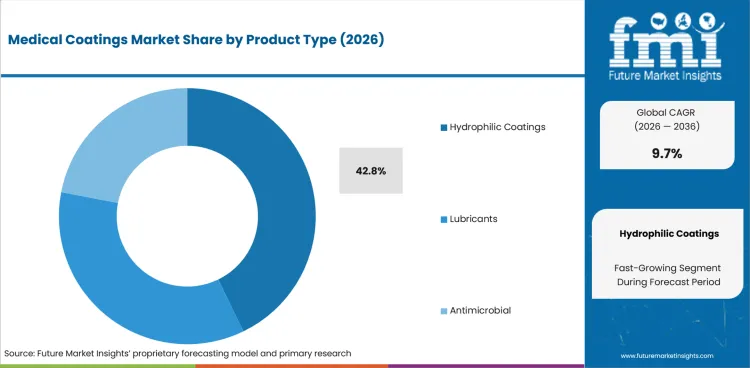
Hydrophilic coatings hold 42.8% of product type in 2026. These water-loving polymer coatings form ultra-low-friction surfaces when hydrated, allowing for smoother catheter insertion and guidewire navigation through vascular and anatomical pathways. Applications include interventional cardiology, urology, gastroenterology and neurovascular device categories.
Critical quality attributes include coating durability and resistance to particulation, as delamination of the coating during use of the device raises patient safety concerns. Increased quality standards and a preference for established coating providers with validated processes are being driven by regulatory requirements for coating integrity testing such as simulated use evaluation and particulate matter assessment.
How big is the medical devices segment in the medical coatings market?
About 49.3% share, led by interventional catheters and drug-eluting stents
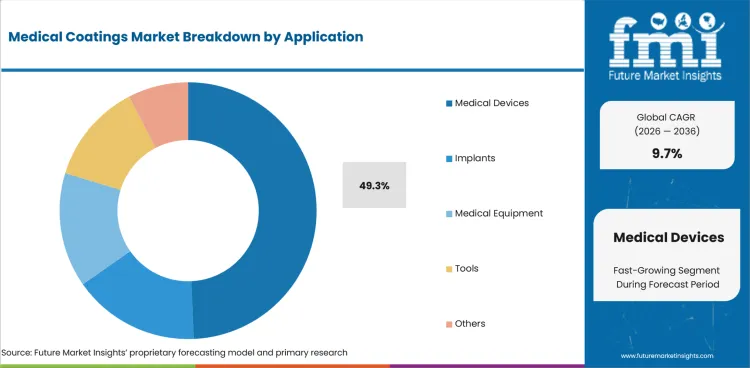
Medical device applications held 49.3% share in 2026. Coatings are needed on device categories such as interventional catheters (hydrophilic to provide lubricity), drug-eluting stents (polymer to control drug release), surgical instruments (anti-reflective, antimicrobial), and diagnostic equipment (anti-fog, hydrophobic to maintain optical clarity).
Medical device manufacturers are growing their own coating capabilities in-house rather than being solely dependent on outside contract coaters. The trend to vertical integration creates a demand for coating equipment, materials and process development services, as well as, procurement of finished coated product.
What drives and restrains the medical coatings market?
Driven by rising device manufacturing and surgical volumes; restrained by quality and regulatory validation barriers
- Rising medical device manufacturing and increased volumes of surgical procedures are driving ongoing demand for coatings that improve device performance and clinical outcomes.
- Coating quality and regulatory validation requirements create market entry barriers favoring established coating providers with documented process capability.
- The largest near-term growth area is the development of antimicrobial and drug-eluting coatings for infection prevention and controlled drug delivery.
Medical Coatings Market to Reach US$ 4.7 Bn by 2030 - Driven by Near Double-Digit Growth, Expansion of Device Production, Growth of Procedure Volume and Advancement of Coating Technology Regulatory complexity and quality standards are the main competitive barriers. Antimicrobial coatings development and device manufacturing for emerging markets are the major growth opportunities.
What drives demand?
Rising minimally invasive procedure volumes in cardiology, urology and neurology
Demand is driven by increasing volumes of minimally invasive procedures in cardiology, urology, gastroenterology and orthopedic surgery. The surface properties of coated catheters, guidewires and instruments directly impact procedural success and patient outcome in each minimally invasive procedure.
What constrains the market?
FDA, EU MDR and national biocompatibility and validation requirements
Adoption is driven by FDA, EU MDR and national regulatory requirements for coating material biocompatibility, durability and particulate integrity. Coating suppliers need validated processes and regulatory documentation to support device submission packages for medical device manufacturers.
What opportunity do antimicrobial coatings offer?
Growing clinical use of antimicrobial coatings to reduce device-related infection
The growth is indicative of the increasing use of antimicrobial coatings in clinical settings that decrease infection rates associated with devices like catheters, implants and surgical instruments. More and more, antibiotic-eluting, surface modified and silver antimicrobial coatings are being adopted in clinical settings as healthcare systems invest in infection prevention.
Where is demand expanding?
Domestic device manufacturing growth in China, India and South Korea
Demand is increasing in China, India and South Korea as domestic medical device manufacturing increases and device companies invest in coating capability to improve product competitiveness. Government medical device industry development programs are promoting the transfer of coating technology and the building of domestic capability.
Analysis of Medical Coatings Market By Key Countries
China 13.1%, India 12.1%, South Korea 10.1%, USA 9.9%, European Union 9.6% through 2036
.webp "Top Country Growth Comparison Medical Coatings Market Cagr (2026 2036)")
| Country | CAGR |
|---|---|
| China | 13.1% |
| India | 12.1% |
| South Korea | 10.1% |
| USA | 9.9% |
| European Union | 9.6% |
| UK | 9.4% |
| Japan | 9.2% |
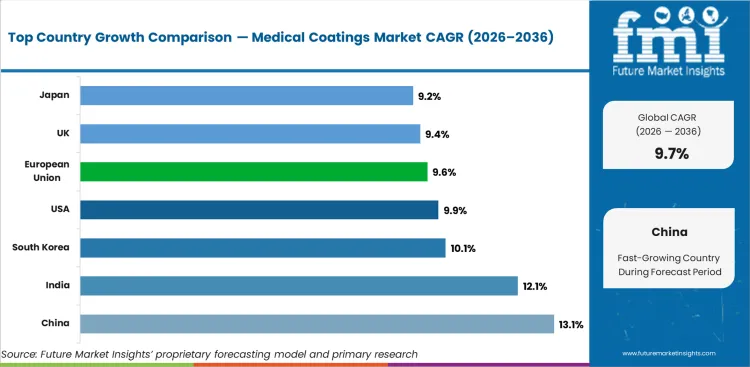
- China leads at 13.1% CAGR, reflecting strong investment driving demand.
- India follows at 12.1%, supported by expanding market penetration.
- South Korea (10.1%) and USA (9.9%) sustain growth through established demand.
The global medical coatings market is estimated to grow at 9.7% CAGR from 2026 to 2036. The study covers more than 30 countries, and the key markets are listed below.
What is the medical coatings market outlook in the United States?
9.9% CAGR, driven by Established medical device manufacturing, FDA regulatory requirements, and clinical
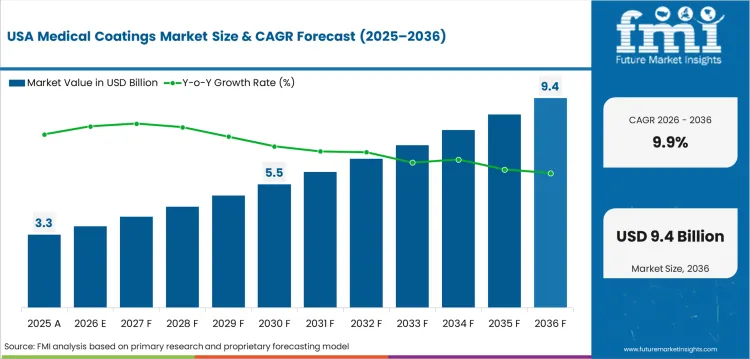
The United States is projected to register 9.9% CAGR through 2036. Established medical device manufacturing, FDA regulatory requirements, and clinical adoption of coated devices sustain market leadership.
- FDA premarket submission requirements include coating material characterization and biocompatibility testing, creating demand for validated coating processes and regulatory documentation.
- Medical device manufacturers in Minnesota, California, and Massachusetts are expanding coating capabilities to support growing coated device portfolios across catheter and implant product lines.
- Hospital infection prevention initiatives are driving procurement preference for antimicrobial-coated devices including central line catheters and urinary catheters.
How fast is the medical coatings market growing in China?
13.1% CAGR through 2036, the fastest country-level market in the study
China leads at 13.1% CAGR through 2036. Medical device manufacturing expansion, hospital equipment procurement, and domestic coating technology investment are accelerating market growth.
- Domestic medical device manufacturers are investing in coating capability development to improve product performance and competitiveness against imported devices.
- Hospital equipment procurement programs include growing specification of coated medical devices that offer improved clinical performance and infection prevention.
- Government medical device industry development policies support coating technology transfer and domestic capability building through R&D investment incentives.
What is driving medical coatings growth in India?
12.1% CAGR, driven by Medical device manufacturing growth under PLI schemes
India is projected to register 12.1% CAGR through 2036. Medical device manufacturing growth under PLI schemes and expanding hospital procurement are creating coating demand.
- PLI scheme support for medical device manufacturing is attracting investment that includes coating capability development at domestic production facilities.
- Hospital procurement expansion for interventional cardiology and minimally invasive surgery is increasing demand for hydrophilic-coated catheters and guidewires.
- Contract coating service providers are emerging to serve domestic device manufacturers who require coating capability without internal investment.
How is the medical coatings market performing in South Korea?
10.1% CAGR, driven by Advanced medical device manufacturing and coating technology development
South Korea is projected to register 10.1% CAGR through 2036. Advanced medical device manufacturing and coating technology development sustain market growth.
- Korean medical device manufacturers are integrating advanced coating technologies to improve product differentiation in both domestic and export markets.
- Samsung Medical Center and other major hospitals drive adoption of coated medical devices through clinical preference and procurement specification.
- Government R&D funding for medical device technology development includes coating innovation programs at research institutes.
What is the medical coatings market forecast for the European Union?
9.6% CAGR, driven by EU MDR requirements, established device manufacturing, and infection prevention initiatives
The European Union is projected to register 9.6% CAGR through 2036. EU MDR requirements, established device manufacturing, and infection prevention initiatives support coating market growth.
- EU Medical Device Regulation compliance requirements include coating material documentation, biocompatibility assessment, and post-market surveillance that support validated coating adoption.
- European medical device manufacturers in Ireland, Germany, and Switzerland maintain advanced coating capabilities for catheter, stent, and implant production.
- Hospital infection prevention mandates across EU member states are increasing specification of antimicrobial-coated devices in procurement decisions.
What is the growth outlook for the medical coatings market in Japan?
9.2% CAGR, driven by Advanced medical device manufacturing and stringent quality standards
Japan is projected to register 9.2% CAGR through 2036. Advanced medical device manufacturing and stringent quality standards sustain coating technology demand.
- Japanese medical device quality standards including PMDA requirements create demand for rigorously validated coating processes with documented performance and safety profiles.
- Terumo, Olympus, and other major Japanese device manufacturers maintain advanced coating capabilities for catheter and endoscope product lines.
- Aging population healthcare demands are increasing surgical procedure volumes that drive consumption of coated medical devices across hospital settings.
Who are the leading companies in the medical coatings market?
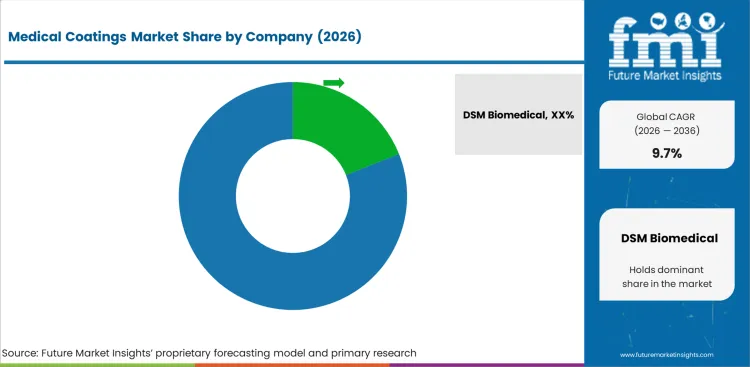
DSM Biomedical, Hydromer Inc., Biocoat Inc., Surmodics, Inc., and Covalon Technologies Ltd.
- DSM Biomedical leads through specialized medical coating polymer portfolio including ComfortCoat hydrophilic technology with established OEM device manufacturer partnerships.
- Surmodics and Biocoat provide hydrophilic and drug-eluting coating solutions with contract coating services for medical device manufacturers.
- Hydromer and Covalon Technologies offer antimicrobial and hydrophilic coating technologies serving catheter, wound care, and surgical device applications.
- Harland Medical Systems and AST Products provide coating equipment and contract coating services that support device manufacturer production operations.
Who are the key players in the medical coatings market?
DSM Biomedical, Hydromer Inc., Biocoat Inc., Surmodics, Inc. and Covalon Technologies Ltd., plus regional players
Key global companies leading the medical coatings market include:
- DSM Biomedical (Netherlands), Hydromer Inc. (USA), Biocoat Inc. (USA), and Surmodics, Inc. (USA) lead global medical coatings markets through specialized coating polymer portfolios, validated coating processes, and established partnerships with major medical device manufacturers.
- Covalon Technologies Ltd. (Canada), Harland Medical Systems (USA), and AST Products, Inc. (USA) hold strong positions through antimicrobial coating technologies, coating equipment manufacturing, and contract coating services serving device manufacturer production operations.
- Precision Coating Co., Inc. (USA), AdvanSource Biomaterials Corp. (USA) are expanding medical coating capabilities through specialized polymer development, thin-film deposition technology, and coating process optimization services.
How do top medical coatings companies compare?
DSM Biomedical and Hydromer Inc. lead globally; Biocoat Inc., Surmodics, Inc. and Covalon Technologies Ltd. are regional specialists
| Company | Coating Technology Portfolio | Medical OEM Relationships | Contract Coating Capability | Geographic Footprint |
|---|---|---|---|---|
| DSM Biomedical | High | High | Strong | Global |
| Surmodics | High | High | Strong | N. America, Global |
| Biocoat | Medium | High | Moderate | N. America |
| Hydromer | Medium | High | Moderate | N. America, Global |
| Covalon Technologies | Medium | High | Moderate | N. America |
| Harland Medical | Medium | Medium | Moderate | N. America |
| AST Products | Medium | Medium | Moderate | N. America |
| Precision Coating | Medium | Medium | Low | N. America |
| AdvanSource | Low | Medium | Low | N. America |
Source: Future Market Insights competitive analysis, 2026.
Key Developments in Medical Coatings Market
- In 2025, DSM Biomedical continued advancing hydrophilic coating and biomaterials technologies for medical devices, supporting improved device performance, biocompatibility, and patient outcomes across catheter and implant applications.
- In 2025, Surmodics continued strengthening its medical device coating portfolio, supporting cardiovascular, neurovascular, and peripheral vascular device manufacturers with drug-delivery and surface-modification coating technologies.
Key Players in the Medical Coatings Market
Major Global Players
- DSM Biomedical
- Hydromer Inc.
- Biocoat Inc.
- Surmodics, Inc.
- Covalon Technologies Ltd.
- Harland Medical Systems
- AST Products, Inc.
- Precision Coating Co., Inc.
Emerging Players/Startups
- AdvanSource Biomaterials Corp.
- Specialty Coating Systems (SCS)
- Biolnteractions Ltd.
- Hemoteq AG
- Medical Surface, Inc.
What does the medical coatings market report cover?
Medical Coatings Market - Research Methodology
| Method | Description |
|---|---|
| Primary Research | FMI analysts conducted interviews with manufacturers, distributors, procurement specialists, and end-use operators across China, India, and South Korea to validate demand patterns and pricing structures for Hydrophilic Coatings, and Lubricants and related product categories. |
| Desk Research | Combined trade statistics, regulatory filings, industry association data, and manufacturer disclosures to establish baseline parameters for Medical Coatings across product, application, material, coating method, and end user segments. |
| Market Sizing & Forecasting | Bottom-up aggregation across Hydrophilic Coatings, Lubricants, and Antimicrobial product categories and Medical Devices, Implants, and Medical Equipment application segments, triangulated with top-down macro indicators and regional adoption curves. |
| Data Validation | Cross-checked quarterly against production statistics, trade flow data, and manufacturer revenue disclosures for Medical Coatings products. |
2016 to 2025 history and 2026 to 2036 forecasts across all segments and 30+ countries
| Parameter | Details |
|---|---|
| Market size by 2036 | USD 15.7 Bn |
| Growth rate | 9.7% CAGR (2026 to 2036) |
| Forecast period | 2026 to 2036 |
| Base year value (2025) | USD 5.7 Bn |
| Key Segment Covered | Product Type, Application, Material Type, Coating Method, End User |
| Regions covered | North America, Latin America, Eastern Europe, Western Europe, East Asia, South Asia and Pacific, Middle East and Africa |
| Countries covered | USA, China, India, South Korea, European Union, UK, Japan, 30 plus countries |
| Key companies profiled | DSM Biomedical, Hydromer Inc., Biocoat Inc., Surmodics, Inc., Covalon Technologies Ltd., Harland Medical Systems, AST Products, Inc., Precision Coating Co., Inc., AdvanSource Biomaterials Corp. |
| Approach | Hybrid bottom-up and top-down methodology starting with verified transaction data, projecting adoption velocity across segments and regions. |
Market Segmentation Analysis
Medical Coatings Market Segmented by Product Type:
- Hydrophilic Coatings
- Water Absorbing Surfaces
- Enhanced Device Compatibility
- Smooth Catheter Navigation
- Polymer Based Hydrophilic Layers
- Reduced Insertion Resistance
- Improved Patient Comfort
- Water Absorbing Surfaces
- Lubricants
- Low Friction Coatings
- Improved Device Insertion
- Reduced Tissue Trauma
- Hydrophobic Lubricant Layers
- Enhanced Surface Glide
- Minimized Wear And Tear
- Low Friction Coatings
- Antimicrobial
- Silver Based Coatings
- Bacterial Growth Inhibition
- Infection Prevention Support
- Antibiotic Embedded Coatings
- Long Term Sterility Maintenance
- Hospital Acquired Infection Control
- Silver Based Coatings
Medical Coatings Market Segmented by Application:
- Medical Devices
- Catheter Devices
- Improved Insertion Efficiency
- Reduced Friction Trauma
- Stents And Guidewires
- Enhanced Blood Compatibility
- Anti Thrombogenic Surface
- Catheter Devices
- Implants
- Orthopedic Implants
- Wear Resistance Improvement
- Biocompatibility Enhancement
- Dental Implants
- Osseointegration Support
- Infection Prevention Layer
- Orthopedic Implants
- Medical Equipment
- Surgical Instruments
- Sterility Maintenance Coatings
- Corrosion Resistance Support
- Diagnostic Equipment
- Surface Protection Enhancement
- Durability Improvement
- Surgical Instruments
- Tools
- Minimally Invasive Tools
- Smooth Operational Performance
- Reduced Tissue Damage
- Laparoscopic Instruments
- Precision Movement Support
- Enhanced Surgical Efficiency
- Minimally Invasive Tools
- Others
Medical Coatings Market Segmented by Material Type:
- Polymers
- Polyethylene Based Coatings
- Flexible Surface Protection
- Biocompatibility Enhancement
- Polyurethane Coatings
- High Durability Layer
- Elastic Performance Improvement
- Polyethylene Based Coatings
- Metals
- Silver Based Coatings
- Strong Antimicrobial Action
- Long Term Infection Control
- Gold Coatings
- Enhanced Biocompatibility
- Corrosion Resistance Support
- Silver Based Coatings
- Ceramics
- Hydroxyapatite Coatings
- Bone Integration Enhancement
- Implant Stability Improvement
- Titanium Oxide Coatings
- Wear Resistance Layer
- Improved Surface Hardness
- Hydroxyapatite Coatings
Medical Coatings Market Segmented by Coating Method:
- Physical Vapor Deposition (PVD)
- Thin Film Deposition
- Uniform Surface Coverage
- High Precision Coating
- Electron Beam Evaporation
- Strong Adhesion Layers
- Advanced Implant Coating
- Thin Film Deposition
- Chemical Vapor Deposition (CVD)
- Gas Phase Coating Process
- High Purity Surface Layers
- Improved Durability Performance
- Plasma Enhanced CVD
- Low Temperature Processing
- Enhanced Material Bonding
- Gas Phase Coating Process
- Dip Coating
- Solution Based Coating Method
- Cost Effective Application
- Uniform Layer Formation
- Spray Coating Techniques
- Scalable Production Process
- Flexible Device Application
- Solution Based Coating Method
Medical Coatings Market Segmented by End User:
- Hospitals
- Surgical Departments
- Coated Instrument Utilization
- Infection Control Support
- Orthopedic Departments
- Implant Coating Usage
- Post Surgery Recovery Support
- Surgical Departments
- Medical Device Manufacturers
- Implant Producers
- Advanced Surface Engineering
- Product Performance Enhancement
- Disposable Device Manufacturers
- Sterile Product Development
- High Volume Production
- Implant Producers
- Research Institutes
- Biomedical Research Centers
- Novel Coating Development
- Material Innovation Studies
- Academic Laboratories
- Surface Science Research
- Clinical Testing Programs
- Biomedical Research Centers
Medical Coatings Market by Region:
- North America
- USA
- Canada
- Mexico
- Latin America
- Brazil
- Chile
- Rest of Latin America
- Western Europe
- Germany
- UK
- Italy
- Spain
- France
- Nordic
- BENELUX
- Rest of Western Europe
- Eastern Europe
- Russia
- Poland
- Hungary
- Balkan & Baltic
- Rest of Eastern Europe
- East Asia
- China
- Japan
- South Korea
- South Asia and Pacific
- India
- ASEAN
- Australia & New Zealand
- Rest of South Asia and Pacific
- Middle East & Africa
- Kingdom of Saudi Arabia
- Other GCC Countries
- Türkiye
- South Africa
- Other African Union
- Rest of Middle East & Africa
Research Sources and Bibliography
- USA Food and Drug Administration. (2025). FDA Guidance on Medical Device Coating Material Characterization. FDA.
- International Organization for Standardization. (2025). ISO 10993 Series: Biological Evaluation of Medical Devices. ISO.
- European Commission. (2025). EU Medical Device Regulation: Material and Coating Requirements. EC.
- Association for the Advancement of Medical Instrumentation. (2025). AAMI Standards for Medical Device Surface Properties. AAMI.
- World Health Organization. (2025). WHO Medical Device Technical Series: Surface Treatment Technologies. WHO.
This bibliography is provided for reader reference.
This Report Answers
- Estimating the size of the medical coatings market and projected revenue from 2026 to 2036.
- Segmentation by product type, application, material type, coating method, end user.
- Insights about more than 30 regional markets.
- Analysis of key market dynamics including demand drivers, restraints, and emerging opportunities.
- Assessment of the competitive landscape and strategic positioning of leading companies.
- Identifying investment opportunities across key product segments and geographic markets.
- Supply chain and distribution channel analysis.
- Delivery of data in PDF and Excel formats.
Frequently Asked Questions
How big is the medical coatings market in 2026?
The global medical coatings market is estimated to be valued at USD 6.2 billion in 2026.
What will be the size of the medical coatings market in 2036?
The market size for the medical coatings market is projected to reach USD 15.7 billion by 2036.
How much will the medical coatings market growth be between 2026 and 2036?
The medical coatings market is expected to grow at a 9.7% CAGR between 2026 and 2036.
What are the key product types in the medical coatings market?
The key product types in the medical coatings market are Hydrophilic Coatings, Lubricants and Antimicrobial.
Which application segment is expected to contribute a significant share in the medical coatings market in 2026?
In terms of application, the medical devices segment is expected to command 49.3% share in the medical coatings market in 2026.
Preview the report firsthand - request a free sample
Get SampleGet the brochure for pricing and purchase details.
Get PDFTable of Content
- Key Takeaways
- Market Size and CAGR
- Top Growth Driver
- Fastest Growing Segment
- Leading Region
- Key Companies
- Emerging Opportunities
- Executive Summary
- Global Market Outlook
- Demand-side Trends
- Supply-side Trends
- Technology Roadmap Analysis
- Analysis and Recommendations
- Analyst Perspective (What is happening? Why now? What should investors know?)
- Key Questions Answered
- How large is the market?
- What is the CAGR?
- What are key trends?
- Which region dominates?
- Who are the leaders?
- Market Overview
- Market Coverage / Taxonomy
- Market Definition / Scope / Limitations
- Research Methodology
- Chapter Orientation
- Analytical Lens and Working Hypotheses
- Market Structure, Signals, and Trend Drivers
- Benchmarking and Cross-market Comparability
- Market Sizing, Forecasting, and Opportunity Mapping
- Research Design and Evidence Framework
- Desk Research Programme (Secondary Evidence)
- Expert Input and Fieldwork (Primary Evidence)
- Tooling, Models, and Reference Databases
- Data Engineering and Model Build
- Quality Assurance and Audit Trail
- Market Background
- Market Dynamics (Drivers, Restraints, Opportunity, Trends)
- Scenario Forecast (Optimistic, Likely, Conservative)
- Impact Analysis
- AI Impact
- Sustainability Impact
- Regulatory Impact
- Technology Impact
- Consumer / Buyer Analysis
- Purchase Drivers
- Adoption Barriers
- Buyer Journey
- Opportunity Map Analysis
- Product Life Cycle Analysis
- Supply Chain Analysis
- Investment Feasibility Matrix
- Value Chain Analysis
- PESTLE and Porter's Analysis
- Regulatory Landscape
- Regional Parent Market Outlook
- Production and Consumption Statistics
- Import and Export Statistics
- Global Market Analysis and Forecast, 2021 to 2036
- Historical Market Size Value (USD Million) Analysis, 2021 to 2025
- Current and Future Market Size Value (USD Million) Projections, 2026 to 2036
- Y-o-Y Growth Trend Analysis
- Absolute $ Opportunity Analysis
- Global Market Pricing Analysis, 2021 to 2036
- Global Market Analysis and Forecast, By Product Type, 2021 to 2036
- Introduction / Key Findings
- Historical Market Size Value (USD Million) Analysis By Product Type, 2021 to 2025
- Current and Future Market Size Value (USD Million) Analysis and Forecast By Product Type, 2026 to 2036
- Hydrophilic Coatings
- Water Absorbing Surfaces
- Polymer Based Hydrophilic Layers
- Lubricants
- Low Friction Coatings
- Hydrophobic Lubricant Layers
- Antimicrobial
- Silver Based Coatings
- Antibiotic Embedded Coatings
- Hydrophilic Coatings
- Y-o-Y Growth Trend Analysis By Product Type, 2021 to 2025
- Absolute $ Opportunity Analysis By Product Type, 2026 to 2036
- Global Market Analysis and Forecast, By Application, 2021 to 2036
- Introduction / Key Findings
- Historical Market Size Value (USD Million) Analysis By Application, 2021 to 2025
- Current and Future Market Size Value (USD Million) Analysis and Forecast By Application, 2026 to 2036
- Medical Devices
- Catheter Devices
- Stents And Guidewires
- Implants
- Orthopedic Implants
- Dental Implants
- Medical Equipment
- Surgical Instruments
- Diagnostic Equipment
- Tools
- Minimally Invasive Tools
- Laparoscopic Instruments
- Others
- Medical Devices
- Y-o-Y Growth Trend Analysis By Application, 2021 to 2025
- Absolute $ Opportunity Analysis By Application, 2026 to 2036
- Global Market Analysis and Forecast, By Material Type, 2021 to 2036
- Introduction / Key Findings
- Historical Market Size Value (USD Million) Analysis By Material Type, 2021 to 2025
- Current and Future Market Size Value (USD Million) Analysis and Forecast By Material Type, 2026 to 2036
- Polymers
- Polyethylene Based Coatings
- Polyurethane Coatings
- Metals
- Silver Based Coatings
- Gold Coatings
- Ceramics
- Hydroxyapatite Coatings
- Titanium Oxide Coatings
- Polymers
- Y-o-Y Growth Trend Analysis By Material Type, 2021 to 2025
- Absolute $ Opportunity Analysis By Material Type, 2026 to 2036
- Global Market Analysis and Forecast, By Coating Method, 2021 to 2036
- Introduction / Key Findings
- Historical Market Size Value (USD Million) Analysis By Coating Method, 2021 to 2025
- Current and Future Market Size Value (USD Million) Analysis and Forecast By Coating Method, 2026 to 2036
- Physical Vapor Deposition (PVD)
- Thin Film Deposition
- Electron Beam Evaporation
- Chemical Vapor Deposition (CVD)
- Gas Phase Coating Process
- Plasma Enhanced CVD
- Dip Coating
- Solution Based Coating Method
- Spray Coating Techniques
- Physical Vapor Deposition (PVD)
- Y-o-Y Growth Trend Analysis By Coating Method, 2021 to 2025
- Absolute $ Opportunity Analysis By Coating Method, 2026 to 2036
- Global Market Analysis and Forecast, By End User, 2021 to 2036
- Introduction / Key Findings
- Historical Market Size Value (USD Million) Analysis By End User, 2021 to 2025
- Current and Future Market Size Value (USD Million) Analysis and Forecast By End User, 2026 to 2036
- Hospitals
- Surgical Departments
- Orthopedic Departments
- Medical Device Manufacturers
- Implant Producers
- Disposable Device Manufacturers
- Research Institutes
- Biomedical Research Centers
- Academic Laboratories
- Hospitals
- Y-o-Y Growth Trend Analysis By End User, 2021 to 2025
- Absolute $ Opportunity Analysis By End User, 2026 to 2036
- Global Market Analysis and Forecast, By Region, 2021 to 2036
- Introduction
- Historical Market Size Value (USD Million) Analysis By Region, 2021 to 2025
- Current Market Size Value (USD Million) Analysis and Forecast By Region, 2026 to 2036
- North America
- Latin America
- Western Europe
- Eastern Europe
- East Asia
- South Asia and Pacific
- Middle East & Africa
- Market Attractiveness Analysis By Region
- North America Market Analysis and Forecast, By Country, 2021 to 2036
- Historical Market Size Value (USD Million) Trend Analysis By Market Taxonomy, 2021 to 2025
- Market Size Value (USD Million) Forecast By Market Taxonomy, 2026 to 2036
- By Country
- USA
- Canada
- Mexico
- By Product Type
- By Application
- By Material Type
- By Coating Method
- By End User
- By Country
- Market Attractiveness Analysis
- By Country
- By Product Type
- By Application
- By Material Type
- By Coating Method
- By End User
- Key Takeaways
- Latin America Market Analysis and Forecast, By Country
- Historical Market Size Value (USD Million) Trend Analysis By Market Taxonomy, 2021 to 2025
- Market Size Value (USD Million) Forecast By Market Taxonomy, 2026 to 2036
- By Country
- Brazil
- Chile
- Rest of Latin America
- By Product Type
- By Application
- By Material Type
- By Coating Method
- By End User
- By Country
- Market Attractiveness Analysis
- By Country
- By Product Type
- By Application
- By Material Type
- By Coating Method
- By End User
- Key Takeaways
- Western Europe Market Analysis and Forecast, By Country
- Historical Market Size Value (USD Million) Trend Analysis By Market Taxonomy, 2021 to 2025
- Market Size Value (USD Million) Forecast By Market Taxonomy, 2026 to 2036
- By Country
- Germany
- UK
- Italy
- Spain
- France
- Nordic
- BENELUX
- Rest of Western Europe
- By Product Type
- By Application
- By Material Type
- By Coating Method
- By End User
- By Country
- Market Attractiveness Analysis
- By Country
- By Product Type
- By Application
- By Material Type
- By Coating Method
- By End User
- Key Takeaways
- Eastern Europe Market Analysis and Forecast, By Country
- Historical Market Size Value (USD Million) Trend Analysis By Market Taxonomy, 2021 to 2025
- Market Size Value (USD Million) Forecast By Market Taxonomy, 2026 to 2036
- By Country
- Russia
- Poland
- Hungary
- Balkan & Baltic
- Rest of Eastern Europe
- By Product Type
- By Application
- By Material Type
- By Coating Method
- By End User
- By Country
- Market Attractiveness Analysis
- By Country
- By Product Type
- By Application
- By Material Type
- By Coating Method
- By End User
- Key Takeaways
- East Asia Market Analysis and Forecast, By Country
- Historical Market Size Value (USD Million) Trend Analysis By Market Taxonomy, 2021 to 2025
- Market Size Value (USD Million) Forecast By Market Taxonomy, 2026 to 2036
- By Country
- China
- Japan
- South Korea
- By Product Type
- By Application
- By Material Type
- By Coating Method
- By End User
- By Country
- Market Attractiveness Analysis
- By Country
- By Product Type
- By Application
- By Material Type
- By Coating Method
- By End User
- Key Takeaways
- South Asia and Pacific Market Analysis and Forecast, By Country
- Historical Market Size Value (USD Million) Trend Analysis By Market Taxonomy, 2021 to 2025
- Market Size Value (USD Million) Forecast By Market Taxonomy, 2026 to 2036
- By Country
- India
- ASEAN
- Australia & New Zealand
- Rest of South Asia and Pacific
- By Product Type
- By Application
- By Material Type
- By Coating Method
- By End User
- By Country
- Market Attractiveness Analysis
- By Country
- By Product Type
- By Application
- By Material Type
- By Coating Method
- By End User
- Key Takeaways
- Middle East & Africa Market Analysis and Forecast, By Country
- Historical Market Size Value (USD Million) Trend Analysis By Market Taxonomy, 2021 to 2025
- Market Size Value (USD Million) Forecast By Market Taxonomy, 2026 to 2036
- By Country
- Kingdom of Saudi Arabia
- Other GCC Countries
- Türkiye
- South Africa
- Other African Union
- Rest of Middle East & Africa
- By Product Type
- By Application
- By Material Type
- By Coating Method
- By End User
- By Country
- Market Attractiveness Analysis
- By Country
- By Product Type
- By Application
- By Material Type
- By Coating Method
- By End User
- Key Takeaways
- Key Countries Market Analysis
- USA
- Pricing Analysis
- Market Share Analysis, 2025
- By Product Type
- By Application
- By Material Type
- By Coating Method
- By End User
- Canada
- Pricing Analysis
- Market Share Analysis, 2025
- By Product Type
- By Application
- By Material Type
- By Coating Method
- By End User
- Mexico
- Pricing Analysis
- Market Share Analysis, 2025
- By Product Type
- By Application
- By Material Type
- By Coating Method
- By End User
- Brazil
- Pricing Analysis
- Market Share Analysis, 2025
- By Product Type
- By Application
- By Material Type
- By Coating Method
- By End User
- Chile
- Pricing Analysis
- Market Share Analysis, 2025
- By Product Type
- By Application
- By Material Type
- By Coating Method
- By End User
- Germany
- Pricing Analysis
- Market Share Analysis, 2025
- By Product Type
- By Application
- By Material Type
- By Coating Method
- By End User
- UK
- Pricing Analysis
- Market Share Analysis, 2025
- By Product Type
- By Application
- By Material Type
- By Coating Method
- By End User
- Italy
- Pricing Analysis
- Market Share Analysis, 2025
- By Product Type
- By Application
- By Material Type
- By Coating Method
- By End User
- Spain
- Pricing Analysis
- Market Share Analysis, 2025
- By Product Type
- By Application
- By Material Type
- By Coating Method
- By End User
- France
- Pricing Analysis
- Market Share Analysis, 2025
- By Product Type
- By Application
- By Material Type
- By Coating Method
- By End User
- India
- Pricing Analysis
- Market Share Analysis, 2025
- By Product Type
- By Application
- By Material Type
- By Coating Method
- By End User
- ASEAN
- Pricing Analysis
- Market Share Analysis, 2025
- By Product Type
- By Application
- By Material Type
- By Coating Method
- By End User
- Australia & New Zealand
- Pricing Analysis
- Market Share Analysis, 2025
- By Product Type
- By Application
- By Material Type
- By Coating Method
- By End User
- China
- Pricing Analysis
- Market Share Analysis, 2025
- By Product Type
- By Application
- By Material Type
- By Coating Method
- By End User
- Japan
- Pricing Analysis
- Market Share Analysis, 2025
- By Product Type
- By Application
- By Material Type
- By Coating Method
- By End User
- South Korea
- Pricing Analysis
- Market Share Analysis, 2025
- By Product Type
- By Application
- By Material Type
- By Coating Method
- By End User
- Russia
- Pricing Analysis
- Market Share Analysis, 2025
- By Product Type
- By Application
- By Material Type
- By Coating Method
- By End User
- Poland
- Pricing Analysis
- Market Share Analysis, 2025
- By Product Type
- By Application
- By Material Type
- By Coating Method
- By End User
- Hungary
- Pricing Analysis
- Market Share Analysis, 2025
- By Product Type
- By Application
- By Material Type
- By Coating Method
- By End User
- Kingdom of Saudi Arabia
- Pricing Analysis
- Market Share Analysis, 2025
- By Product Type
- By Application
- By Material Type
- By Coating Method
- By End User
- Türkiye
- Pricing Analysis
- Market Share Analysis, 2025
- By Product Type
- By Application
- By Material Type
- By Coating Method
- By End User
- South Africa
- Pricing Analysis
- Market Share Analysis, 2025
- By Product Type
- By Application
- By Material Type
- By Coating Method
- By End User
- USA
- Market Structure Analysis
- Competition Dashboard
- Competition Benchmarking
- Market Share Analysis of Top Players
- By Regional
- By Product Type
- By Application
- By Material Type
- By Coating Method
- By End User
- Emerging Startups
- Innovation Benchmarking
- Competition Analysis
- Competition Deep Dive
- DSM Biomedical
- Overview
- Product Portfolio
- Profitability by Market Segments (Product/Region/Sales Channel)
- Sales Footprint
- Strategy Overview
- Marketing Strategy
- Product Strategy
- Channel Strategy
- Hydromer Inc.
- Biocoat Inc.
- Surmodics, Inc.
- Covalon Technologies Ltd.
- Harland Medical Systems
- AST Products, Inc.
- Precision Coating Co., Inc.
- AdvanSource Biomaterials Corp.
- Materion Corporation
- DSM Biomedical
- Case Studies
- Success Stories
- Recent Developments
- Competition Deep Dive
- Assumptions & Acronyms Used


