

- Industry Size (2026)
- USD 2.1 Bn
- Forecast (2036)
- USD 3.9 Bn
- CAGR (2026 to 2036)
- 6.2%
Protective Antimicrobial Coatings for High-Touch Surfaces Market Size, Market Forecast, and Outlook By FMI
The protective antimicrobial coatings for high-touch surfaces market was valued at USD 2.0 billion in 2025. Industry is expected to cross USD 2.1 billion in 2026 at a CAGR of 6.2% during the forecast period. Cumulative sales are projected to hit USD 3.9 billion through 2036 as facility managers transition toward passive architectural contamination controls.
Summary of Protective Antimicrobial Coatings for High-Touch Surfaces Market
- The market is forecast to reach USD 3.9 billion by 2036.
- The market is expected to grow at a CAGR of 6.2% from 2026 to 2036.
- The market was estimated at USD 2.0 billion in 2025.
- The forecast period represents an incremental opportunity of about USD 1.8 billion.
- The market is compliance-sensitive, with purchasing decisions driven by validated efficacy, durability, and compatibility with cleaning protocols.
- Growth is driven by rising hygiene requirements across healthcare, public transport, and commercial high-touch environments.
- Adoption is expanding beyond healthcare into institutional, hospitality, and commercial infrastructure applications.
- India, China, Saudi Arabia, and the UAE are among the fastest-growing markets, with India leading at a 7.4% CAGR through 2036.
- Silver-based coatings dominate the chemistry segment, while waterborne coatings lead due to increasing low-VOC preferences.
- Metal substrates and door hardware applications account for significant demand due to high contact frequency.
- Key players in the market include PPG Industries, Sherwin-Williams, AkzoNobel, Axalta Coating Systems, Nippon Paint Holdings, Microban International, and Sciessent.
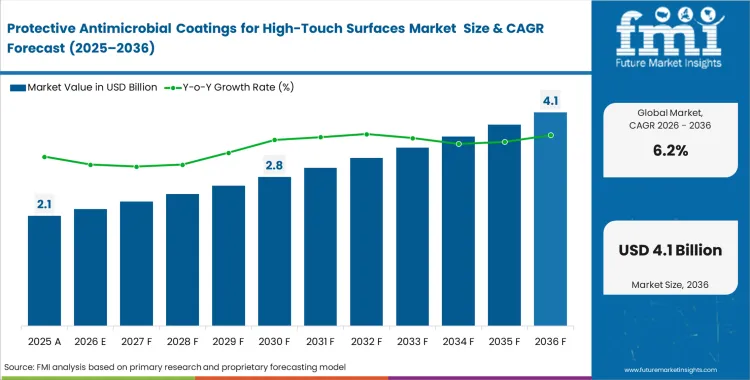
Key Takeaways, Market Size, and Forecast
- 2025 market size: USD 2.0 billion
- 2026 market size: USD 2.1 billion
- 2036 forecast: USD 3.9 billion
- CAGR: 6.2%
- Top chemistry: Silver coatings (34.0%)
- Top technology: Waterborne (42.0%)
- Top substrate: Metal (37.0%)
- Top application: Door hardware (28.0%)
- Top end use: Healthcare (36.0%)
- Top growth market: India (7.4% CAGR)
Continuous pathogen transfer across high-touch clinical surfaces is increasing the commercial case for passive antimicrobial protection. Reliance on periodic manual cleaning leaves temporal vulnerability where bacterial loads recover on hardware before the next scheduled intervention. Integrating active bio-reduction directly into the built environment addresses this persistent exposure window. Evaluating high-touch surface antimicrobial coatings demands long-term infection prevention efficacy alongside standard abrasion resistance. Delayed adoption can reduce relevance in institutional retrofit programs that increasingly prioritize hygiene-linked material performance.
Mainstream specification remains blocked by the lack of harmonized accelerated testing protocols for residual efficacy. Standardized testing frameworks that reflect long-term chemical exposure remain necessary before large-scale specification broadens across institutional assets. Broader adoption depends on clearer long-term performance benchmarks that can validate durability claims under real operating conditions. Establishing this baseline would move antimicrobial surface treatments closer to mainstream institutional specification.
India is expected to hold 7.4% CAGR during the forecast period, driven by greenfield hospital construction and transit infrastructure expansion that create large specification volumes. China is estimated to hold 7.1% CAGR, backed by rapid commercial facility modernization programs. Saudi Arabia is anticipated to capture 6.9% CAGR, leveraging aggressive capital deployment in premium medical city developments. The United Arab Emirates is poised to garner 6.7% CAGR, driven by high‑traffic hospitality upgrades. The United States is set to record 5.8% CAGR, where mature institutional networks require rigorous claims validation before adoption. Germany is expected to hold 5.4% CAGR, operating within strict environmental restrictions that complicate active‑ingredient formulation. Japan is estimated to hold 5.1% CAGR, relying on evidence‑based replacement cycles in eldercare facilities. Geographic divergence reflects emerging economies integrating baseline active protection while mature regulatory environments restrict claims absent extensive clinical utility data.
Segmental Analysis
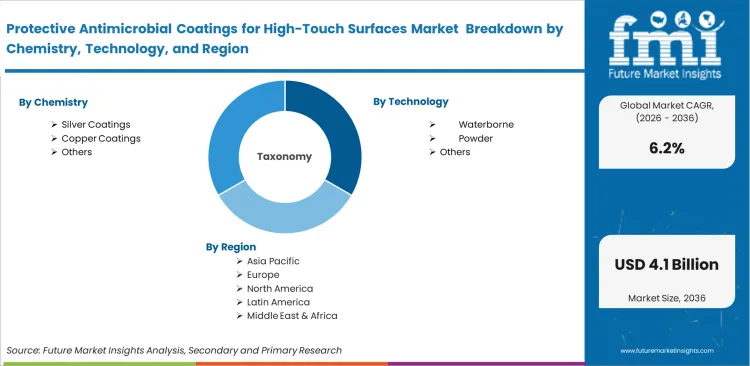
Protective Antimicrobial Coatings for High-Touch Surfaces Market Analysis by Chemistry
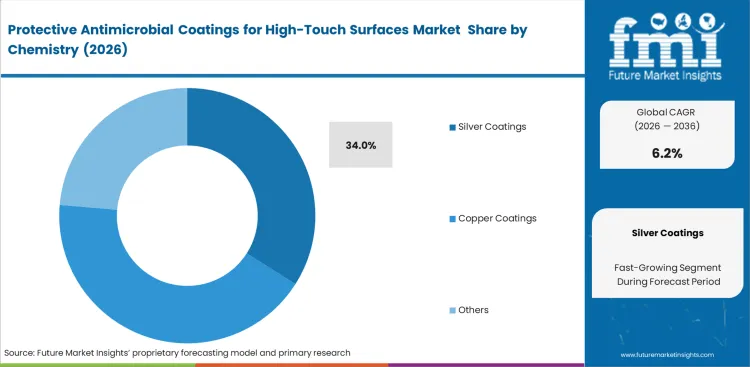
Regulatory familiarity dictates baseline specification across architectural chemistries. Silver antimicrobial coatings retain an advantage in institutional specification because their regulatory pathway is more familiar across commercial and public-use applications. The segment is projected to secure a 34.0% share in 2026. Specifiers demand global antimicrobial additives that carry zero ambiguity regarding tenant safety. Silver and copper systems are often compared on kill-rate performance versus finish stability, with silver generally better suited to clear architectural coatings where visual consistency matters. The primary operational risk emerges in coastal installations, where specific sulfur-heavy environmental conditions trigger unexpected tarnishing. Environmental limitations need to be defined clearly, particularly in sulfur-heavy conditions where tarnishing risk can affect premium fixture appearance.
- Regulatory validation: Selecting silver agents streamlines the arduous registration process, granting facilities faster administrative approval for broad architectural rollout.
- Aesthetic preservation: Integrating silver into clear coats prevents the visual degradation common with heavy copper alternatives, aligning active protection with interior design requirements.
- Sulfur sensitivity: Localized tarnishing can emerge in sulfur-heavy environments, making site-specific suitability an important consideration before application.
Protective Antimicrobial Coatings for High-Touch Surfaces Market Analysis by Technology
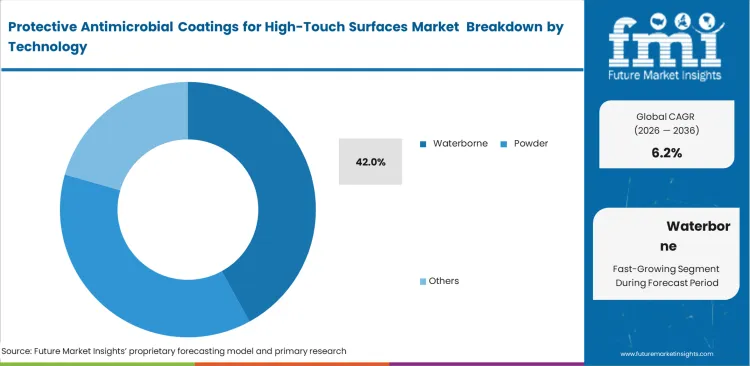
Strict indoor air quality mandates and LEED certification criteria force an operational pivot away from legacy solvent systems. Waterborne antimicrobial coatings are gaining preference where indoor air quality requirements and emission limits are tightening. Executing live-ward retrofits requires low-odor profiles to prevent patient disruption during continuous upgrade cycles. The category is expected to hold a 42.0% share in 2026. Advanced cross-linking techniques have largely resolved historical concerns regarding the mechanical durability of liquid systems. While an antimicrobial powder coating delivers superior abrasion resistance for factory-applied hardware, liquid systems dominate overall volume because they maintain a monopoly on field-applied aftermarket maintenance.
- Emission compliance: Specifying waterborne options satisfies stringent indoor air quality benchmarks without sacrificing functional hygiene or delaying environmental certifications.
- Application flexibility: Liquid systems are better suited to in-situ application in occupied buildings, reducing disruption during retrofit cycles.
- Factory limitation: Powder applications provide maximum mechanical resilience but cannot be deployed outside controlled manufacturing environments, restricting their use to OEM fixture production.
Protective Antimicrobial Coatings for High-Touch Surfaces Market Analysis by Substrate
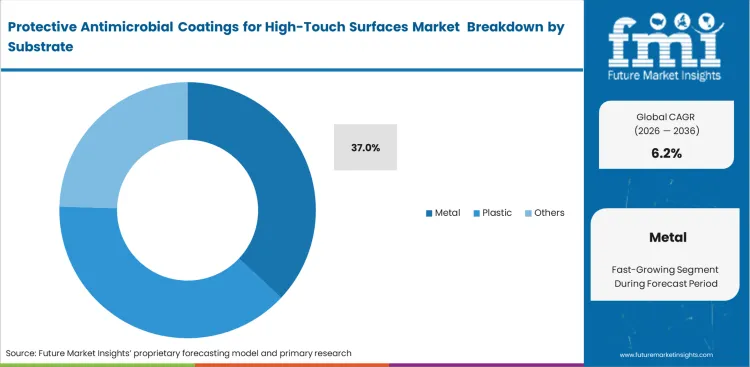
Architectural traffic patterns concentrate physical friction almost entirely on metallic push plates, handles, and grab bars. Concentration of high-frequency contact directly drives demand for protective treatments, with the metal segment anticipated to capture 37.0% of the market in 2026. Investment remains concentrated on global corrosion protective coatings because they combine the highest contact frequency with the strongest need for durable functional protection. Adhesion science dictates this volume concentration. Embedding active metallic ions into metal-compatible epoxy matrices yields significantly longer lifecycle durability than attempting similar functional treatments on porous wood or composites. Adjacent plastic surfaces often require different adhesion systems, which complicates broad multi-substrate coating strategies. A single universal formula is often unsuitable for multi-substrate environments, where adhesion failure risk increases when curing and bonding requirements differ by surface type.
- Traffic concentration: Metallic fixtures account for a disproportionate share of repeated contact, making them the primary focus for antimicrobial surface investment.
- Matrix compatibility: Metal-specific resin systems generally provide stronger active-agent retention and better resistance to aggressive mechanical wear.
- Multi-surface friction: Managing disparate curing requirements across mixed-material environments severely complicates broad facility upgrade execution and inflates maintenance budgets.
Protective Antimicrobial Coatings for High-Touch Surfaces Market Analysis by Application
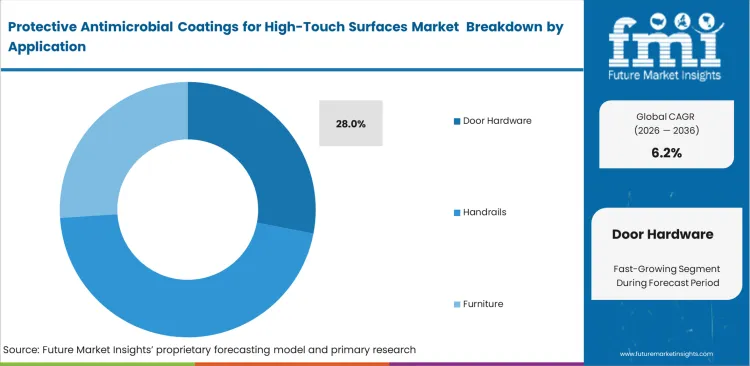
Point-of-entry dynamics establish the fundamental hierarchy of contamination risk within any commercial facility. Relying on specialized surface protection services to deploy antimicrobial coatings for door handles across thousands of existing levers in their real estate portfolios. Handwashing compliance loses all statistical value if the primary exit mechanism immediately recontaminates the user. This critical role of door hardware in contamination control drives sustained demand, with the category poised to account for 28.0% market share in 2026. The definitive performance gap in this application centers on touch duration. Standard laboratory tests evaluate multi-hour contact times, while practical door transit requires less than two seconds of physical interaction. Evaluating the best antimicrobial coating for hospital door handles prioritize rapid pathogen degradation over theoretical 24-hour kill rates.
- Entry vector targeting: Prioritizing door levers intercepts pathogen transfer directly at room boundaries, effectively isolating functional zones to prevent broad facility-wide contamination spread.
- Retrofit scalability: Deploying field-applied solutions across massive existing hardware inventories avoids the prohibitive capital cost of total fixture replacement.
- Contact duration: Technical buyers scrutinize kill-rate velocity against realistic human interaction times, rejecting solutions that require extended contact periods for measurable bio-reduction.
Protective Antimicrobial Coatings for High-Touch Surfaces Market Analysis by End use
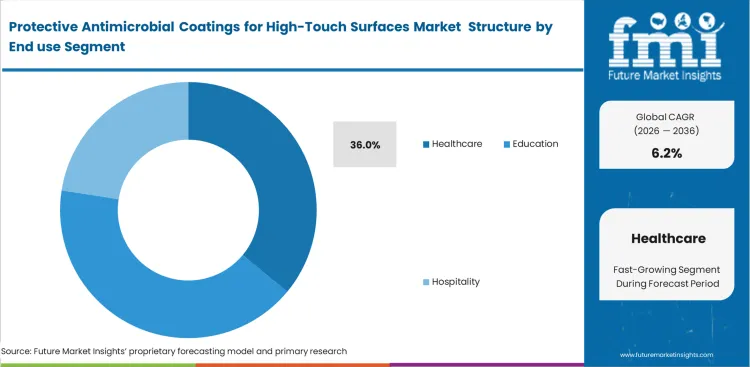
Clinical vulnerability and continuous occupancy make active sanitization a structural necessity rather than an aesthetic upgrade. Specifying hospital high-touch surface coatings treats active surfaces as necessary redundancy for their overburdened cleaning staff. The healthcare segment is estimated to account for 36.0% share in 2026. Healthcare demand remains strong because infection-control performance carries both operational and financial implications for care facilities. A key challenge in healthcare settings is that antimicrobial coatings must perform under the same aggressive disinfectant regimes used for routine sanitation. Formulations optimized using medical devices surface active coatings principles must survive daily exposure to industrial bleach. Evaluating an antimicrobial coating vs disinfectant protocol requires reconciling rapid chemical kills with continuous but slower passive surface protection.
- Redundant protection: Implementing self-sanitizing fixtures specifically to backstop overburdened manual cleaning protocols during peak occupancy periods.
- Financial penalty: Upfront material costs for active architectural hardware represent minor expenditures compared to the severe regulatory financial clawbacks triggered by documented infection outbreaks.
- Chemical degradation: Specifying chemically resilient matrices becomes the absolute determinant of commercial viability, as standard hospital disinfection routines routinely strip inferior active layers.
Protective Antimicrobial Coatings for High-Touch Surfaces Market Drivers, Restraints, and Opportunities
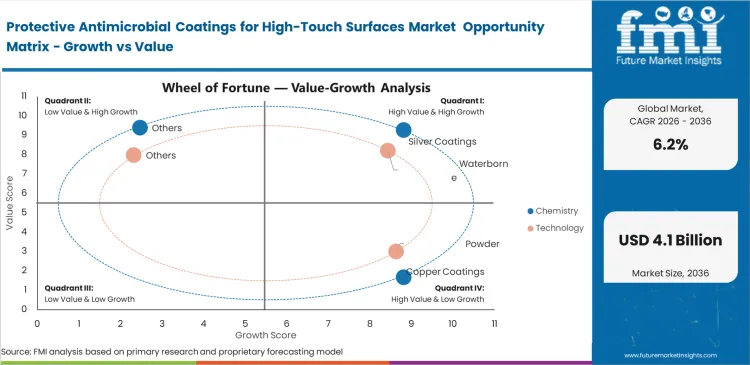
Legal liability regarding traceable facility-acquired infections forces commercial and clinical operators to adopt defensive infrastructure. Manual cleaning alone cannot maintain continuous pathogen reduction across frequently touched hardware surfaces. Passive bio-reduction technologies provide a documented layer of risk mitigation. Antimicrobial coatings are increasingly evaluated as part of broader infection-control strategies in high-contact environments. Delaying this architectural upgrade exposes institutions to severe litigation risks when outbreak tracing identifies specific untreated touchpoints as transmission vectors.
Establishing verifiable real-world efficacy remains the primary operational friction slowing mass deployment. A persistent restraint is the gap between laboratory kill-rates with actual hospital acquired infection control outcomes in dynamic environments. Testing protocols isolate variables that do not reflect the presence of organic soil, constant friction, and aggressive cleaning chemicals. Without stronger real-world efficacy evidence, premium antimicrobial finishes can remain positioned as optional upgrades rather than essential specification items.
Opportunities in the Protective Antimicrobial Coatings for High-Touch Surfaces Market
- Transit network integration: Public transport environments need durable antiviral and antimicrobial surface treatments that can withstand heavy abrasion and repeated contact.
- Commercial real estate upgrades: Hygiene-linked surface enhancement is becoming a differentiation lever in premium office and mixed-use properties.
- Real-time efficacy indicators: Visual wear indicators could strengthen maintenance visibility and improve confidence in coating performance over service life.
Regional Analysis
Based on regional analysis, Protective Antimicrobial Coatings for High-Touch Surfaces is segmented into North America, Latin America, Western Europe, Eastern Europe, Asia Pacific, Middle East and Africa, across 40 plus countries.
.webp "Top Country Growth Comparison Protective Antimicrobial Coatings For High Touch Surfaces Market Cagr (2026 2036)")
| Country | CAGR (2026 to 2036) |
|---|---|
| India | 7.4% |
| China | 7.1% |
| Saudi Arabia | 6.9% |
| United Arab Emirates | 6.7% |
| United States | 5.8% |
| Germany | 5.4% |
| Japan | 5.1% |
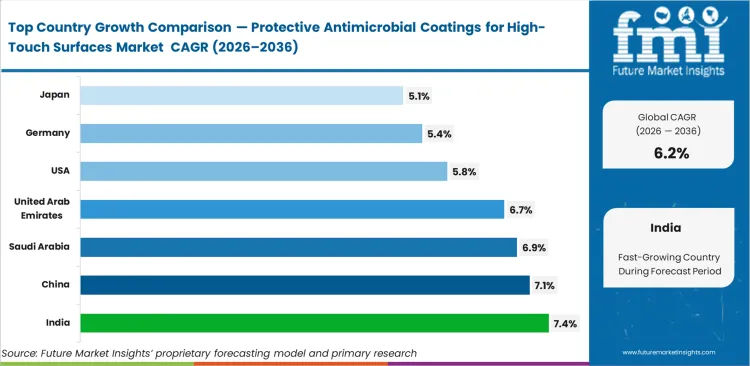
Source: Future Market Insights (FMI) analysis, based on proprietary forecasting model and primary research
Asia Pacific Protective Antimicrobial Coatings for High-Touch Surfaces Market Analysis
Greenfield infrastructure development across emerging Asian economies enables direct architectural specification at scale. Early-stage infrastructure tenders increasingly incorporate active surface requirements, reducing retrofit complexity later in the asset lifecycle. High humidity conditions in these regions require modified resin matrices, pushing local formulators to adapt global chemistries for reliable adhesion. Early specification in large provincial hospital networks secures long-term maintenance contracts for chemical suppliers. High-density transit systems deploy microbicidal surfaces to limit pathogen transmission during peak usage. Prioritizing mechanical durability to withstand continuous high-frequency contact. Performance validation in these metro networks supports durability claims across regional markets. Clinical validation remains important in eldercare environments where replacement decisions are evidence-led and risk-sensitive. National standards define approved active agents, emphasizing safety over rapid bio-reduction. Regional expansion depends on localized biocide supply chains to manage tariffs and maintain cost competitiveness.
- India: Aggressive public health investments are driving the inclusion of self-sanitizing materials in new provincial hospitals from the design stage. Demand within the antimicrobial coatings market in India is anticipated to rise at a 7.4% CAGR through 2036, supported by these large-scale healthcare developments. High humidity conditions across many construction zones require customized resin matrices, pushing local formulators to adapt global chemistries to maintain adhesion performance. Early specification in these projects secures long-term maintenance contracts for suppliers, providing stability against short-term construction fluctuations.
- China: The antimicrobial coatings market in China is likely to advance at a CAGR of 7.1% during the assessment period, driven by transit authorities specifying antimicrobial coatings across public transport systems to control pathogen transmission. Civil engineering teams prioritize mechanical durability to ensure these coatings withstand millions of daily contact cycles across expanding municipal networks. Proven performance in large-scale metro systems provides a validation base for high-friction durability, which material suppliers use to secure additional commercial contracts.
- Japan: Eldercare facility operators require extensive clinical validation before approving premium surface upgrades. National standards strictly define which active agents are permitted for public use, prioritizing safety over rapid bio-reduction performance. Chemical suppliers must demonstrate precise degradation timelines to gain approval in this risk-averse procurement environment. As a result, the architectural finishes sector in Japan is expected to grow at a CAGR of 5.1% through 2036, reflecting slow adoption cycles. This reliance on long-term evidence and multi-year lifecycle data limits new entrants and protects established domestic suppliers from lower-cost regional competition.
FMI's report includes extensive analysis of emerging Southeast Asian hubs demanding similar transit-focused solutions. Thailand is emerging as a critical transit‑oriented market, where rapid expansion of urban mass‑transit projects and airport upgrades is increasing demand for low‑residue, fast‑drying cleaners and dispenser systems optimized for high‑frequency touchpoints.
Middle East and Africa Protective Antimicrobial Coatings for High-Touch Surfaces Market Analysis
Premium hospitality and international transit hubs dominate the specification landscape across the Arabian Peninsula. Aesthetic compatibility remains important in premium hospitality and mixed-use developments where protective coatings cannot compromise finish quality. Harsh local climates accelerate the degradation of standard exterior coatings, forcing specialized regional formulations. Buyers penalize vendors whose clear coats yellow under intense UV exposure, regardless of their underlying microbicidal efficacy.
- Saudi Arabia: Mega-project developers are integrating advanced hygiene solutions into large-scale medical and tourism developments, driving demand for active surface treatments in Saudi Arabia, which is estimated to expand at a 6.9% CAGR by 2036. Project specifiers require formulations that meet strict aesthetic standards, limiting the use of materials such as copper that can degrade visually over time. Intense UV exposure and harsh climatic conditions accelerate the deterioration of standard exterior coatings, increasing scrutiny on product performance. Suppliers whose coatings show discoloration or reduced durability under these conditions face exclusion from project approvals.
- United Arab Emirates: High-traffic commercial towers undergo continuous retrofits as property managers compete for international corporate tenants demanding rigorous wellness standards. Sales of architectural antimicrobial surface treatments in the United Arab Emirates are anticipated to record a 6.7% CAGR during the forecast period, driven by these continuous upgrade cycles. Evaluating commercial building antimicrobial coatings deploy targeted door and elevator treatments to maximize visible compliance without disrupting daily building operations. Supplying fast-curing formulations wins critical overnight maintenance windows in these 24-hour environments.
FMI's report includes analysis of broader Gulf Cooperation Council construction mandates dictating enhanced indoor environmental quality. Developing extreme-temperature stable resins determines long-term viability in this climate. Qatar is emerging as a high‑growth market, where preparations for large‑scale healthcare and sports venue projects are accelerating demand for extreme‑temperature stable resins and validated indoor environmental quality solutions.
North America Protective Antimicrobial Coatings for High-Touch Surfaces Market Analysis
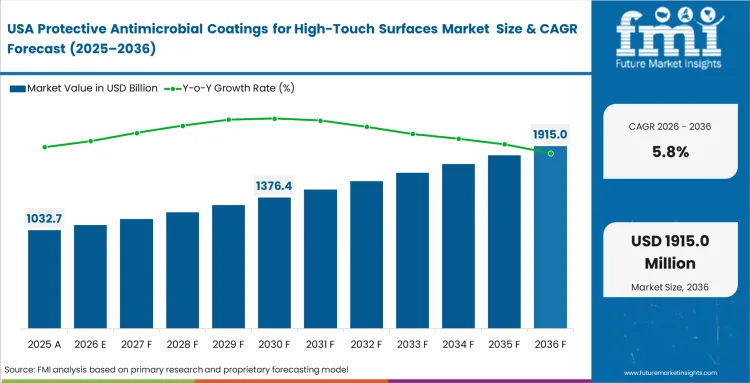
Regulatory frameworks strictly control all commercial claims related to pathogen reduction. Formal registration remains critical for products making public-health-related performance claims in North America. The distinction between “treated articles,” which protect only the coating, and products approved for public health claims leads to very different commercial outcomes. Formulators often spend years navigating regulatory pathways before introducing validated infection-control solutions to institutional buyers.
- United States: Compliance teams refuse to specify any product lacking explicit registration for public health claims, establishing a hard structural barrier against unverified imports. Hospital networks scrutinize medical coatings efficacy data, specifically requiring an EPA MB-40 antimicrobial coating validation, to justify premium capital expenditures and mitigate long-term facility liability. Navigating this exact testing protocol defines commercial survival, driving the antimicrobial coatings market in the United States to an estimated to rise at a 5.8% CAGR by 2036. Mastering this regulatory friction effectively insulates compliant incumbents from low-cost alternative suppliers.
FMI's report includes Canadian provincial healthcare network adoption patterns prioritizing durable cold‑weather formulations. Managing dual regulatory environments defines North American strategic planning. Costa Rica is emerging as a regional medical‑tourism and cold‑chain logistics hub, where investments in refrigerated transport and clinic networks are increasing demand for cold‑weather‑stable formulations.
Western Europe Protective Antimicrobial Coatings for High-Touch Surfaces Market Analysis
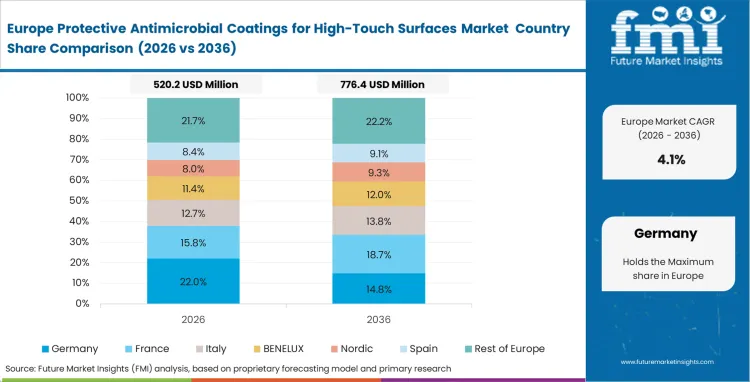
Stringent environmental regulations limit the use of certain heavy metals and chemical biocides. Infection control requirements must be balanced against compliance with frameworks such as the Biocidal Products Regulation. This pressure is accelerating the shift toward non-toxic alternatives, including photocatalytic and mechanical-kill surface technologies. Products with strong antimicrobial performance are still rejected if their environmental impact or end-of-life profile does not meet corporate sustainability standards.
- Germany: Demand for active surface treatments in Germany is forecast to grow at a 5.4% CAGR from 2026 to 2036, as infection-control needs continue to be balanced against strict Biocidal Products Regulation compliance. This regulatory friction elevates the importance of independent antimicrobial coating durability testing, forcing a pivot toward highly stable, environmentally benign mechanisms. Formulators utilizing advanced 2k coatings routinely secure lucrative, highly restricted public sector infrastructure bids by exceeding baseline environmental mandates.
FMI's report includes analysis of localized indoor air quality mandates across the European Union. Reconciling aggressive bio-efficacy with zero-toxicity profiles represents the defining structural challenge. The Netherlands is emerging as a pivotal market, where stringent green‑building standards and ambitious circular‑economy targets are accelerating demand for certified, zero‑toxicity surface treatments and standardized packaging recovery systems.
Competitive Aligners for Market Players
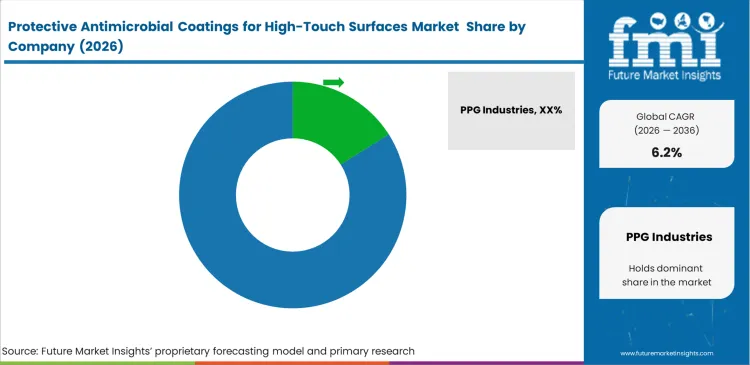
Competition in this market rests on two capabilities: managing regulatory requirements and integrating antimicrobial chemistry into commercially viable coating systems. Large incumbents retain a clear advantage because they combine established distribution strength with the resources needed to generate and maintain the EPA and BPR compliance data required for institutional specification, particularly in hospitals. Smaller innovators may introduce new critical care disinfection chemicals or differentiated surface technologies, but many of them expand only by licensing their intellectual property to larger players that already control regulatory access and buyer relationships.
Broad polymer and resin compatibility across multiple substrates remains a structural advantage in this market. Consistent performance across metal, wood, and composite touch surfaces favors suppliers with multi-substrate formulation depth and broader warranty confidence. Challengers can break into the market only if their additives work across multiple coating systems without disturbing curing behavior or reducing mechanical durability. Abrasion-resistance loss in the base architectural coating remains a major credibility risk for specialist antimicrobial additive systems.
Lifecycle cost visibility often matters more than initial coating price in institutional applications. Durability, maintenance frequency, and reapplication intervals remain core comparison points in supplier evaluation. Coating degradation is tracked over multi-year service cycles, and products that fail early quickly lose favor because premature reapplication raises both maintenance burden and total ownership cost. Competitive strength depends on proven longevity in real use rather than on favorable laboratory data alone. Wear indicators and field-performance support can strengthen market position more effectively than initial laboratory claims alone.
Key Players in Protective Antimicrobial Coatings for High-Touch Surfaces Market
- PPG Industries
- Sherwin-Williams
- AkzoNobel
- Axalta Coating Systems
- Nippon Paint Holdings
- Microban International
- Sciessent
Scope of the Report
| Metric | Value |
|---|---|
| Quantitative Units | USD 2.18 Billion to USD 3.98 Billion, at a CAGR of 6.2% |
| Market Definition | Permanent architectural and hardware surface treatments formulated with active agents to continuously degrade pathogenic organisms between manual cleaning cycles. |
| Segmentation | Chemistry, Technology, Substrate, Application, End use |
| Regions Covered | North America, Latin America, Western Europe, Eastern Europe, Asia Pacific, Middle East and Africa |
| Countries Covered | India, China, Saudi Arabia, United Arab Emirates, United States, Germany, Japan |
| Key Companies Profiled | PPG Industries, Sherwin-Williams, AkzoNobel, Axalta Coating Systems, Nippon Paint Holdings, Microban International, Sciessent |
| Forecast Period | 2026 to 2036 |
| Approach | Installed institutional hardware square footage anchors the baseline volume estimates. |
Source: Future Market Insights (FMI) analysis, based on proprietary forecasting model and primary research
Protective Antimicrobial Coatings for High-Touch Surfaces Market Analysis by Segments
Chemistry
- Silver coatings
- Copper coatings
- QAC coatings
- Photocatalytic coatings
- Hybrid coatings
Technology
- Waterborne
- Powder
- Solventborne
- UV-curable
- Sol-gel
Substrate
- Metal
- Plastic
- Glass
- Wood
- Composite
Application
- Door hardware
- Handrails
- Touch panels
- Countertops
- Furniture
End use
- Healthcare
- Public transport
- Commercial buildings
- Education
- Hospitality
Region
- North America
- United States
- Canada
- Latin America
- Brazil
- Mexico
- Rest of Latin America
- Western Europe
- Germany
- United Kingdom
- France
- Italy
- Spain
- Rest of Western Europe
- Eastern Europe
- Russia
- Poland
- Rest of Eastern Europe
- Asia Pacific
- China
- Japan
- India
- South Korea
- Australia
- Rest of Asia Pacific
- Middle East and Africa
- Saudi Arabia
- United Arab Emirates
- South Africa
- Rest of Middle East and Africa
Bibliography
- Apisarnthanarak, A., Ling, M. L., Thu, L. T. A., Villanueva, V., Pandjaitan, C., & Yusof, M. Y. (2026). APSIC guidelines for environmental hygiene: surface cleaning, air and water quality in hospitals and outpatient settings. Antimicrobial Resistance & Infection Control.
- Nair, S. S., et al. (2025). Real-world testing of the durability claims of a commercially available antimicrobial surface coating. Applied and Environmental Microbiology.
- Pereira-Silva, P., et al. (2025). Recent advances in metal-based antimicrobial coatings. Acta Biomaterialia.
- PPG Industries, Inc. (2026). 2025 annual report. PPG Industries.
- Sherwin-Williams Company. (2026, January 29). The Sherwin-Williams Company reports 2025 year-end and fourth quarter financial results. Sherwin-Williams.
- United States Environmental Protection Agency. (2025, April 2). Antimicrobial testing methods & procedures: MB-40-00. U.S. EPA.
This bibliography is provided for reader reference. The full FMI report contains the complete reference list with primary source documentation.
This Report Addresses
- Regulatory compliance pathways defining EPA and BPR registration for active architectural solutions.
- Matrix durability analysis detailing chemical resilience against aggressive institutional cleaning protocols.
- Formulation compatibility requirements for integrating active metallic ions into clear-coat resins.
- Hardware design strategies utilized by hospital networks to validate antimicrobial coil coating performance claims.
- Lifecycle cost comparisons contrasting continuous active protection against repeated manual disinfection labor.
- Adhesion variability challenges complicating multi-substrate facility retrofit deployments.
- Aesthetic degradation risks associated with sulfur exposure in specific environmental conditions.
- Innovation trajectories targeting non-toxic, environmentally stable microbicidal mechanisms.
Frequently Asked Questions
What are protective antimicrobial coatings for high-touch surfaces?
Active material formulations engineered to continuously reduce pathogenic loads on frequent-contact architectural elements. They rely on specific metallic ions or quaternary ammonium compounds to disrupt cellular function upon contact.
How is the antimicrobial surface coatings size projected for 2036?
The total valuation is expected to reach USD 3.98 billion by 2036. Rising compliance demands across institutional environments push the sector toward this expanded footprint.
What drives the current antimicrobial coatings forecast upward?
The industry will expand at a compound annual growth rate of 6.2% between 2026 and 2036. Infrastructure modernization and healthcare regulations provide the foundational growth baseline.
Which chemistry segment leads commercial specification?
Silver chemistries secure the largest share because their regulatory pathways are universally understood. Product managers select these agents specifically to streamline the arduous EPA registration process.
Why does healthcare account for the largest end-use share?
Clinical vulnerability makes continuous sanitization non-negotiable. Hospital administrators invest in preventive infrastructure to avoid Medicare reimbursement reductions linked directly to facility-acquired infection rates.
How do clinical teams evaluate an antimicrobial coating vs disinfectant protocol?
Clinical administrators recognize that active surfaces act as necessary redundancy rather than replacements. Maintenance supervisors implement self-sanitizing fixtures to backstop manual cleaning protocols between scheduled interventions.
What does EPA MB-40 mean for commercial suppliers?
Securing clearance acts as the ultimate commercial barrier protecting compliant incumbents. Compliance officers refuse to specify any product lacking explicit registration for public health claims.
Which organizations operate as the top antimicrobial coating companies globally?
PPG Industries, Sherwin-Williams, AkzoNobel, and Axalta Coating Systems maintain significant leadership positions. They leverage massive distribution networks and deep regulatory pockets to dominate institutional specification.
Which countries are growing fastest?
India leads at 7.4% as greenfield hospital construction drives massive specification volumes. China follows closely at 7.1% backed by rapid commercial facility modernization and transit network expansion.
What are the main applications for these functional finishes?
Door hardware secures the largest volume because every occupant must interact with these surfaces. Isolating functional zones at entry vectors prevents broad facility-wide contamination spread.
Preview the report firsthand - request a free sample
Get SampleGet the brochure for pricing and purchase details.
Get PDFTable of Content
- Executive Summary
- Global Market Outlook
- Demand-side Trends
- Supply-side Trends
- Technology Roadmap Analysis
- Analysis and Recommendations
- Market Overview
- Market Coverage / Taxonomy
- Market Definition / Scope / Limitations
- Research Methodology
- Chapter Orientation
- Analytical Lens and Working Hypotheses
- Market Structure, Signals, and Trend Drivers
- Benchmarking and Cross-market Comparability
- Market Sizing, Forecasting, and Opportunity Mapping
- Research Design and Evidence Framework
- Desk Research Programme (Secondary Evidence)
- Company Annual and Sustainability Reports
- Peer-reviewed Journals and Academic Literature
- Corporate Websites, Product Literature, and Technical Notes
- Earnings Decks and Investor Briefings
- Statutory Filings and Regulatory Disclosures
- Technical White Papers and Standards Notes
- Trade Journals, Industry Magazines, and Analyst Briefs
- Conference Proceedings, Webinars, and Seminar Materials
- Government Statistics Portals and Public Data Releases
- Press Releases and Reputable Media Coverage
- Specialist Newsletters and Curated Briefings
- Sector Databases and Reference Repositories
- FMI Internal Proprietary Databases and Historical Market Datasets
- Subscription Datasets and Paid Sources
- Social Channels, Communities, and Digital Listening Inputs
- Additional Desk Sources
- Expert Input and Fieldwork (Primary Evidence)
- Primary Modes
- Qualitative Interviews and Expert Elicitation
- Quantitative Surveys and Structured Data Capture
- Blended Approach
- Why Primary Evidence is Used
- Field Techniques
- Interviews
- Surveys
- Focus Groups
- Observational and In-context Research
- Social and Community Interactions
- Stakeholder Universe Engaged
- C-suite Leaders
- Board Members
- Presidents and Vice Presidents
- R&D and Innovation Heads
- Technical Specialists
- Domain Subject-matter Experts
- Scientists
- Physicians and Other Healthcare Professionals
- Governance, Ethics, and Data Stewardship
- Research Ethics
- Data Integrity and Handling
- Primary Modes
- Tooling, Models, and Reference Databases
- Desk Research Programme (Secondary Evidence)
- Data Engineering and Model Build
- Data Acquisition and Ingestion
- Cleaning, Normalisation, and Verification
- Synthesis, Triangulation, and Analysis
- Quality Assurance and Audit Trail
- Market Background
- Market Dynamics
- Drivers
- Restraints
- Opportunity
- Trends
- Scenario Forecast
- Demand in Optimistic Scenario
- Demand in Likely Scenario
- Demand in Conservative Scenario
- Opportunity Map Analysis
- Product Life Cycle Analysis
- Supply Chain Analysis
- Investment Feasibility Matrix
- Value Chain Analysis
- PESTLE and Porter’s Analysis
- Regulatory Landscape
- Regional Parent Market Outlook
- Production and Consumption Statistics
- Import and Export Statistics
- Market Dynamics
- Global Market Analysis 2021 to 2025 and Forecast, 2026 to 2036
- Historical Market Size Value (USD Million) Analysis, 2021 to 2025
- Current and Future Market Size Value (USD Million) Projections, 2026 to 2036
- Y-o-Y Growth Trend Analysis
- Absolute $ Opportunity Analysis
- Global Market Pricing Analysis 2021 to 2025 and Forecast 2026 to 2036
- Global Market Analysis 2021 to 2025 and Forecast 2026 to 2036, By Chemistry
- Introduction / Key Findings
- Historical Market Size Value (USD Million) Analysis By Chemistry , 2021 to 2025
- Current and Future Market Size Value (USD Million) Analysis and Forecast By Chemistry , 2026 to 2036
- Silver Coatings
- Copper Coatings
- Others
- Silver Coatings
- Y-o-Y Growth Trend Analysis By Chemistry , 2021 to 2025
- Absolute $ Opportunity Analysis By Chemistry , 2026 to 2036
- Global Market Analysis 2021 to 2025 and Forecast 2026 to 2036, By Technology
- Introduction / Key Findings
- Historical Market Size Value (USD Million) Analysis By Technology, 2021 to 2025
- Current and Future Market Size Value (USD Million) Analysis and Forecast By Technology, 2026 to 2036
- Waterborne
- Powder
- Others
- Waterborne
- Y-o-Y Growth Trend Analysis By Technology, 2021 to 2025
- Absolute $ Opportunity Analysis By Technology, 2026 to 2036
- Global Market Analysis 2021 to 2025 and Forecast 2026 to 2036, By Substrate
- Introduction / Key Findings
- Historical Market Size Value (USD Million) Analysis By Substrate, 2021 to 2025
- Current and Future Market Size Value (USD Million) Analysis and Forecast By Substrate, 2026 to 2036
- Metal
- Plastic
- Others
- Metal
- Y-o-Y Growth Trend Analysis By Substrate, 2021 to 2025
- Absolute $ Opportunity Analysis By Substrate, 2026 to 2036
- Global Market Analysis 2021 to 2025 and Forecast 2026 to 2036, By Application
- Introduction / Key Findings
- Historical Market Size Value (USD Million) Analysis By Application, 2021 to 2025
- Current and Future Market Size Value (USD Million) Analysis and Forecast By Application, 2026 to 2036
- Door Hardware
- Handrails
- Furniture
- Door Hardware
- Y-o-Y Growth Trend Analysis By Application, 2021 to 2025
- Absolute $ Opportunity Analysis By Application, 2026 to 2036
- Global Market Analysis 2021 to 2025 and Forecast 2026 to 2036, By End use
- Introduction / Key Findings
- Historical Market Size Value (USD Million) Analysis By End use, 2021 to 2025
- Current and Future Market Size Value (USD Million) Analysis and Forecast By End use, 2026 to 2036
- Healthcare
- Education
- Hospitality
- Healthcare
- Y-o-Y Growth Trend Analysis By End use, 2021 to 2025
- Absolute $ Opportunity Analysis By End use, 2026 to 2036
- Global Market Analysis 2021 to 2025 and Forecast 2026 to 2036, By Region
- Introduction
- Historical Market Size Value (USD Million) Analysis By Region, 2021 to 2025
- Current Market Size Value (USD Million) Analysis and Forecast By Region, 2026 to 2036
- North America
- Latin America
- Western Europe
- Eastern Europe
- East Asia
- South Asia and Pacific
- Middle East & Africa
- Market Attractiveness Analysis By Region
- North America Market Analysis 2021 to 2025 and Forecast 2026 to 2036, By Country
- Historical Market Size Value (USD Million) Trend Analysis By Market Taxonomy, 2021 to 2025
- Market Size Value (USD Million) Forecast By Market Taxonomy, 2026 to 2036
- By Country
- USA
- Canada
- Mexico
- By Chemistry
- By Technology
- By Substrate
- By Application
- By End use
- By Country
- Market Attractiveness Analysis
- By Country
- By Chemistry
- By Technology
- By Substrate
- By Application
- By End use
- Key Takeaways
- Latin America Market Analysis 2021 to 2025 and Forecast 2026 to 2036, By Country
- Historical Market Size Value (USD Million) Trend Analysis By Market Taxonomy, 2021 to 2025
- Market Size Value (USD Million) Forecast By Market Taxonomy, 2026 to 2036
- By Country
- Brazil
- Chile
- Rest of Latin America
- By Chemistry
- By Technology
- By Substrate
- By Application
- By End use
- By Country
- Market Attractiveness Analysis
- By Country
- By Chemistry
- By Technology
- By Substrate
- By Application
- By End use
- Key Takeaways
- Western Europe Market Analysis 2021 to 2025 and Forecast 2026 to 2036, By Country
- Historical Market Size Value (USD Million) Trend Analysis By Market Taxonomy, 2021 to 2025
- Market Size Value (USD Million) Forecast By Market Taxonomy, 2026 to 2036
- By Country
- Germany
- UK
- Italy
- Spain
- France
- Nordic
- BENELUX
- Rest of Western Europe
- By Chemistry
- By Technology
- By Substrate
- By Application
- By End use
- By Country
- Market Attractiveness Analysis
- By Country
- By Chemistry
- By Technology
- By Substrate
- By Application
- By End use
- Key Takeaways
- Eastern Europe Market Analysis 2021 to 2025 and Forecast 2026 to 2036, By Country
- Historical Market Size Value (USD Million) Trend Analysis By Market Taxonomy, 2021 to 2025
- Market Size Value (USD Million) Forecast By Market Taxonomy, 2026 to 2036
- By Country
- Russia
- Poland
- Hungary
- Balkan & Baltic
- Rest of Eastern Europe
- By Chemistry
- By Technology
- By Substrate
- By Application
- By End use
- By Country
- Market Attractiveness Analysis
- By Country
- By Chemistry
- By Technology
- By Substrate
- By Application
- By End use
- Key Takeaways
- East Asia Market Analysis 2021 to 2025 and Forecast 2026 to 2036, By Country
- Historical Market Size Value (USD Million) Trend Analysis By Market Taxonomy, 2021 to 2025
- Market Size Value (USD Million) Forecast By Market Taxonomy, 2026 to 2036
- By Country
- China
- Japan
- South Korea
- By Chemistry
- By Technology
- By Substrate
- By Application
- By End use
- By Country
- Market Attractiveness Analysis
- By Country
- By Chemistry
- By Technology
- By Substrate
- By Application
- By End use
- Key Takeaways
- South Asia and Pacific Market Analysis 2021 to 2025 and Forecast 2026 to 2036, By Country
- Historical Market Size Value (USD Million) Trend Analysis By Market Taxonomy, 2021 to 2025
- Market Size Value (USD Million) Forecast By Market Taxonomy, 2026 to 2036
- By Country
- India
- ASEAN
- Australia & New Zealand
- Rest of South Asia and Pacific
- By Chemistry
- By Technology
- By Substrate
- By Application
- By End use
- By Country
- Market Attractiveness Analysis
- By Country
- By Chemistry
- By Technology
- By Substrate
- By Application
- By End use
- Key Takeaways
- Middle East & Africa Market Analysis 2021 to 2025 and Forecast 2026 to 2036, By Country
- Historical Market Size Value (USD Million) Trend Analysis By Market Taxonomy, 2021 to 2025
- Market Size Value (USD Million) Forecast By Market Taxonomy, 2026 to 2036
- By Country
- Kingdom of Saudi Arabia
- Other GCC Countries
- Turkiye
- South Africa
- Other African Union
- Rest of Middle East & Africa
- By Chemistry
- By Technology
- By Substrate
- By Application
- By End use
- By Country
- Market Attractiveness Analysis
- By Country
- By Chemistry
- By Technology
- By Substrate
- By Application
- By End use
- Key Takeaways
- Key Countries Market Analysis
- USA
- Pricing Analysis
- Market Share Analysis, 2025
- By Chemistry
- By Technology
- By Substrate
- By Application
- By End use
- Canada
- Pricing Analysis
- Market Share Analysis, 2025
- By Chemistry
- By Technology
- By Substrate
- By Application
- By End use
- Mexico
- Pricing Analysis
- Market Share Analysis, 2025
- By Chemistry
- By Technology
- By Substrate
- By Application
- By End use
- Brazil
- Pricing Analysis
- Market Share Analysis, 2025
- By Chemistry
- By Technology
- By Substrate
- By Application
- By End use
- Chile
- Pricing Analysis
- Market Share Analysis, 2025
- By Chemistry
- By Technology
- By Substrate
- By Application
- By End use
- Germany
- Pricing Analysis
- Market Share Analysis, 2025
- By Chemistry
- By Technology
- By Substrate
- By Application
- By End use
- UK
- Pricing Analysis
- Market Share Analysis, 2025
- By Chemistry
- By Technology
- By Substrate
- By Application
- By End use
- Italy
- Pricing Analysis
- Market Share Analysis, 2025
- By Chemistry
- By Technology
- By Substrate
- By Application
- By End use
- Spain
- Pricing Analysis
- Market Share Analysis, 2025
- By Chemistry
- By Technology
- By Substrate
- By Application
- By End use
- France
- Pricing Analysis
- Market Share Analysis, 2025
- By Chemistry
- By Technology
- By Substrate
- By Application
- By End use
- India
- Pricing Analysis
- Market Share Analysis, 2025
- By Chemistry
- By Technology
- By Substrate
- By Application
- By End use
- ASEAN
- Pricing Analysis
- Market Share Analysis, 2025
- By Chemistry
- By Technology
- By Substrate
- By Application
- By End use
- Australia & New Zealand
- Pricing Analysis
- Market Share Analysis, 2025
- By Chemistry
- By Technology
- By Substrate
- By Application
- By End use
- China
- Pricing Analysis
- Market Share Analysis, 2025
- By Chemistry
- By Technology
- By Substrate
- By Application
- By End use
- Japan
- Pricing Analysis
- Market Share Analysis, 2025
- By Chemistry
- By Technology
- By Substrate
- By Application
- By End use
- South Korea
- Pricing Analysis
- Market Share Analysis, 2025
- By Chemistry
- By Technology
- By Substrate
- By Application
- By End use
- Russia
- Pricing Analysis
- Market Share Analysis, 2025
- By Chemistry
- By Technology
- By Substrate
- By Application
- By End use
- Poland
- Pricing Analysis
- Market Share Analysis, 2025
- By Chemistry
- By Technology
- By Substrate
- By Application
- By End use
- Hungary
- Pricing Analysis
- Market Share Analysis, 2025
- By Chemistry
- By Technology
- By Substrate
- By Application
- By End use
- Kingdom of Saudi Arabia
- Pricing Analysis
- Market Share Analysis, 2025
- By Chemistry
- By Technology
- By Substrate
- By Application
- By End use
- Turkiye
- Pricing Analysis
- Market Share Analysis, 2025
- By Chemistry
- By Technology
- By Substrate
- By Application
- By End use
- South Africa
- Pricing Analysis
- Market Share Analysis, 2025
- By Chemistry
- By Technology
- By Substrate
- By Application
- By End use
- USA
- Market Structure Analysis
- Competition Dashboard
- Competition Benchmarking
- Market Share Analysis of Top Players
- By Region
- By Chemistry
- By Technology
- By Substrate
- By Application
- By End use
- Competition Analysis
- Competition Deep Dive
- PPG Industries
- Overview
- Product Portfolio
- Profitability by Market Segments (Product/Age /Sales Channel/Region)
- Sales Footprint
- Strategy Overview
- Marketing Strategy
- Product Strategy
- Channel Strategy
- Sherwin-Williams
- AkzoNobel
- Axalta Coating Systems
- Nippon Paint Holdings
- PPG Industries
- Competition Deep Dive
- Assumptions & Acronyms Used


