

- Market Size (2026)
- USD 117.6 Mn
- Forecast (2036)
- USD 416.9 Mn
- CAGR (2026 to 2036)
- 13.5%
Self-Healing Microcapsule Systems for Protective Coatings Market Size, Market Forecast and Outlook By FMI
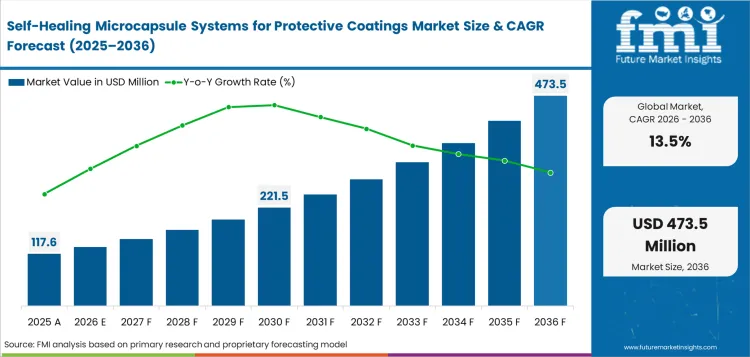
The self-healing microcapsule systems for protective coatings market was valued at USD 103.6 million in 2025. Industry value is anticipated to cross USD 117.6 million in 2026 and reach USD 416.9 million by 2036 at 13.5% CAGR. Crack rupture is projected to account for 52.5% share in 2026. Steel is estimated to represent 48.0% share in 2026.
Summary of the Self-Healing Microcapsule Systems for Protective Coatings Market
- Demand and Growth Drivers
- Marine yards and bridge contractors are raising trial use of microcapsule coatings to reduce early repair work across exposed steel surfaces.
- Capsule dispersion quality is shaping supplier choice as poorly mixed capsules can weaken film finish and scratch response.
- Coatings for aircraft exteriors and industrial assets are moving toward self-healing materials as downtime costs rise.
- Product and Segment View
- Crack rupture is projected to lead damage trigger demand with 52.5% share in 2026 as direct scratch opening starts the repair response.
- Steel is estimated to lead substrate demand with 48.0% share in 2026 due to corrosion exposure across marine and bridge assets.
- Epoxy coatings are anticipated to hold 43.0% share in 2026, led by industrial primers using proven barrier performance.
- Geography and Competitive Outlook
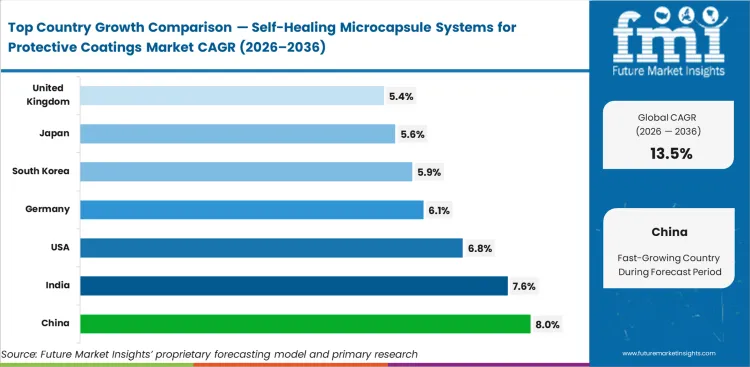
- China is projected to record 8.0% CAGR by 2036, reflected by shipbuilding output and heavy coating adoption supporting early trials.
- India is expected to expand at 7.6% CAGR by 2036 due to highway and port upkeep increasing use cases for durable coatings.
- Autonomic Materials, NEI Corporation and PPG hold the dominance through capsule additives and protective coating portfolios.
- Analyst Opinion
- Nikhil Kaitwade, Principal Analyst for Industrial Automation at FMI, observes, "I view self-healing microcapsule coatings as a maintenance-cost business. Buyers prefer a coating film able to slow corrosion after scratches and small cracks. Cost pressure comes from capsule price and proof of field life. Suppliers gain account strength through stable capsule loading and repair data from steel panels. Clients should watch bridge repair programs with shipyard coating trials and aircraft topcoat systems through 2036."
- Self-Healing Microcapsule Systems for Protective Coatings Market Value Analysis
- The self-healing microcapsule systems for protective coatings market is moving from laboratory-led coating science into a clearer industrial maintenance input segment.
- Adoption is being shaped by asset owners seeking longer coating life across marine structures and industrial equipment exposed to corrosion.
- The market is benefiting from coating systems that release repair agents after scratches or microcracks form on treated surfaces.
- Demand is further supported by the need to reduce repainting cycles and maintenance downtime across infrastructure and heavy-duty protective coating applications.
Key Takeaways, Market Size, and Forecast
- The self-healing microcapsule systems for protective coatings market value stood at USD 103.6 million in 2025.
- Industry revenue is projected to reach USD 416.9 million by 2036 as corrosion repair needs attract coating buyers toward longer-life film systems.
- The sector is expected to expand at 13.5% CAGR from 2026 to 2036 across marine and industrial protective coating uses.
- The sector is projected to create an incremental opportunity of USD 299.3 million between 2026 and 2036.
- Crack rupture is expected to account for 52.5% share in 2026 since direct capsule breakage offers the clearest repair response after coating damage.
- China at 8.0% CAGR and India at 7.6% CAGR are expected to record the fastest country pace through 2036.
Self-healing microcapsule systems for protective coatings are projected to propel the adoption in assets where small scratches lead to corrosion. In December 2025, Ramezanpour et al. reported 97% healing efficiency at 5 wt% loading after 672 h saline immersion. This supports stronger adoption in epoxy coatings for marine and steel protection. Wang et al. added in May 2025 that pH-responsive capsules released benzotriazole faster at pH 11. That improves the case for active corrosion response. Capsule loading is also becoming important because Thakkar and Pandya found 4.35 wt% gave better abrasion and hydrophobicity than 8.70 wt%. Industry is projected to favor coating systems that balance fast healing, corrosion inhibition and surface durability.
Self-Healing Microcapsule Systems for Protective Coatings Market Definition
The sector covers microcapsules added to protective coatings so a coating film can release a repair agent after small cracks or scratches. Included products cover capsule shell systems, healing agents and coating formulas used on steel, aluminum, concrete and composite surfaces. The scope includes additives sold to formulators and finished protective coatings using capsule-based repair. Standalone corrosion inhibitors, normal paints without capsule repair claims and biomedical capsule systems fall outside this study.
Self-Healing Microcapsule Systems for Protective Coatings Market Inclusions
The study includes polyurea capsules, polyurethane capsules, melamine capsules, epoxy precursors, corrosion inhibitors, epoxy coatings, polyurethane coatings, crack rupture systems, steel substrates, marine assets, infrastructure assets, coating formulators, specialty additive suppliers, and global geography.
Self-Healing Microcapsule Systems for Protective Coatings Market Exclusions
The study excludes normal decorative paints, biomedical capsules, fragrance capsules, agricultural capsules, standalone rust converters, corrosion inhibitors sold without capsule systems, and coating resins without self-healing use.
Self-Healing Microcapsule Systems for Protective Coatings Market Research Methodology
- Primary Research: FMI analysts reviewed coating formulators, specialty additive suppliers and asset-maintenance teams using capsule-modified protective coatings. Interviews focused on coating life and repair proof after scratch damage.
- Desk Research: The desk review used public bridge, shipbuilding and coating source checks to define the addressable asset base. Company product pages and technical coating releases were reviewed for capsule use and protective coating direction. Biodegradable microencapsulation technology checks supported shell screening.
- Market Sizing and Forecasting: The forecast combined the FMI self-healing microcapsule base with the protective coatings share and an application-specific uplift. Segment shares were checked against coating chemistry, substrate exposure and buyer approval paths.
- Data Validation: Final values were checked against coating additive use, corrosion protection budgets and country asset-maintenance signals.
Why is the Self-Healing Microcapsule Systems for Protective Coatings Market Growing?
- Steel bridge and marine coatings need longer service life as surface scratches expose metal to corrosion before planned repair.
- Microcapsule additives help coatings form a local repair response after small cracks by releasing film-forming agents into damaged areas.
- Automotive and aviation coating work is moving toward scratch repair and anti-corrosion protection, with suppliers testing systems for coated metal surfaces.
- Coating makers use capsule design to balance healing response with surface finish so protective films remain usable for industrial buyers.
Repair backlogs are urging infrastructure coating buyers to test self-healing additives as maintenance budgets face tighter pressure. U.S. bridge base included 41,677 poor-rated bridges in 2025 and motorists crossed poor-rated structures 163 million times per day. Poor-rated bridge exposure supports protective coatings able to slow early corrosion after scratches or coating breaks. Self-healing capsule systems do not replace bridge repair work. Longer coating life are expected to reduce small-area touch-up requirements between inspections. Suppliers with field panel data gain faster approval from asset owners seeking lower life-cycle cost.
Marine coatings offer another demand path as ships face salt exposure and regular abrasion during service. China completed 48.18 million DWT of shipbuilding in 2024 and accounted for 55.7% of global completions. Large newbuild activity supports trial use of longer-life protective films across shipyards and repair docks. Capsule systems are required to maintain structure during mixing and spray application before matching yard practice. Formulators protecting capsule stability during application can serve newbuild coating and maintenance coating programs.
Market Segmentation Analysis
- Crack rupture leads damage trigger demand with 52.5% share in 2026, led by physical scratches releasing healing agents at the damaged point.
- Steel leads substrate demand with 48.0% share in 2026 since bridges and industrial frames face recurring corrosion exposure.
- Epoxy coatings lead coating chemistry demand with 43.0% share in 2026 as barrier primers already hold a strong position in heavy-duty protection.
- Polyurea leads capsule shell demand with 36.5% share in 2026 due to tough shells influencing storage stability and coating mixing.
- Marine assets are estimated to lead end-use demand with 34.5% share in 2026, reflected by salt exposure creating clear repair-cost pressure.
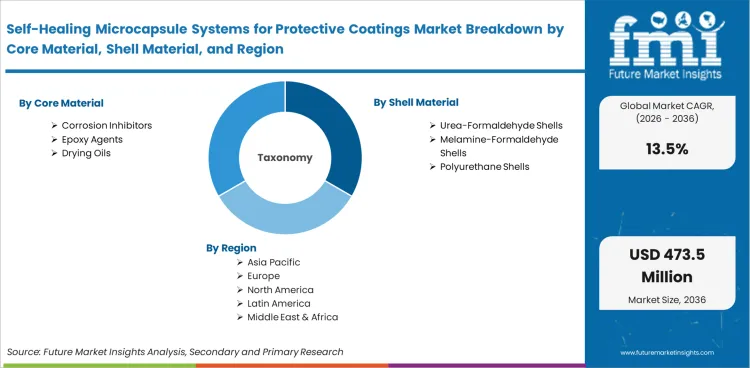
The self-healing microcapsule systems for protective coatings market is segmented by core material, covering corrosion inhibitors and epoxy agents alongside drying oils and silane agents with corrosion inhibitors leading due to stronger use in metal protection after coating scratches. It is further segmented by shell material, covering urea-formaldehyde shells and polyurethane shells alongside silica shells and gelatin shells with urea-formaldehyde shells expected to keep the clearest position. By coating type and application, industry comprises epoxy coatings and polyurethane coatings alongside marine coatings and infrastructure coatings supported by corrosion control needs across ships and exposed steel assets. Industry is segmented by end use and sales channel, spanning marine users and construction users alongside coating formulators and direct supply access.
Self-Healing Microcapsule Systems for Protective Coatings Market Analysis by Core Material
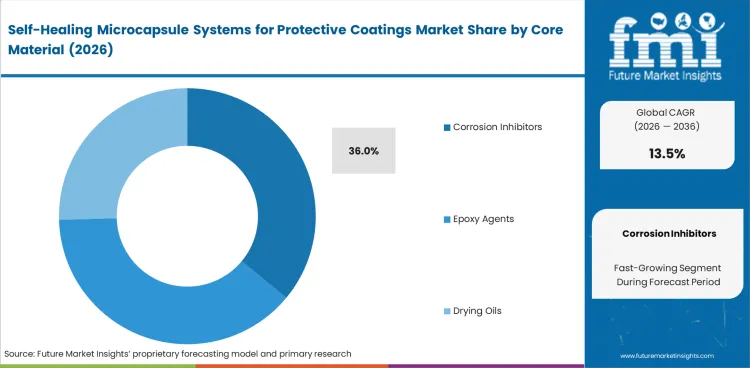
- Corrosion inhibitors are projected to account for 36.0% share in 2026 due to steel assets requiring coating systems able to slow rust after scratches or small film breaks.
- Coating producers select corrosion inhibitor cores for bridge and marine uses since metal exposure creates faster repair urgency compared with cosmetic surface damage.
Insights into Epoxy Agents Segment
- Epoxy agents gain use in protective coatings needing local crack filling after mechanical stress during service.
- Capsule loading must stay controlled led by excess core content weakening film finish and reducing coating acceptance during qualification
Self-Healing Microcapsule Systems for Protective Coatings Market Analysis by Shell Material
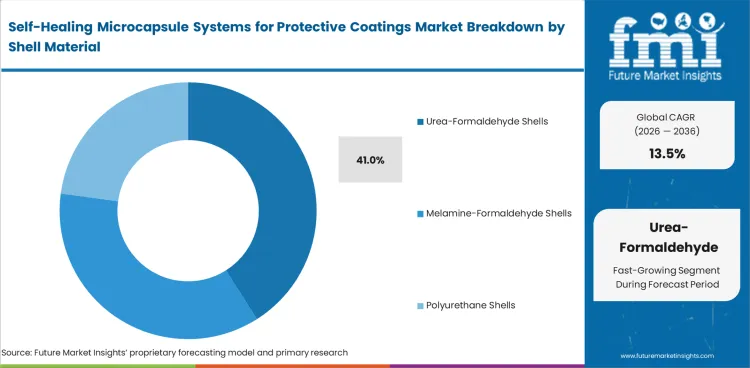
- Urea‑formaldehyde shells are expected to hold a 41.0% share in 2026, favored by formulators for proven capsule strength and cost efficiency in batch coating production.
- Shell wall quality affects storage stability due to weak capsules breaking during mixing before coating reaches asset surface.
Insights into Polyurethane Shells Segment
- Polyurethane shells support flexible coatings used on surfaces facing vibration and bending during service.
- Higher shell flexibility helps protective films retain capsule function after repeated movement in transport and equipment applications.
Self-Healing Microcapsule Systems for Protective Coatings Market Analysis by Coating Type
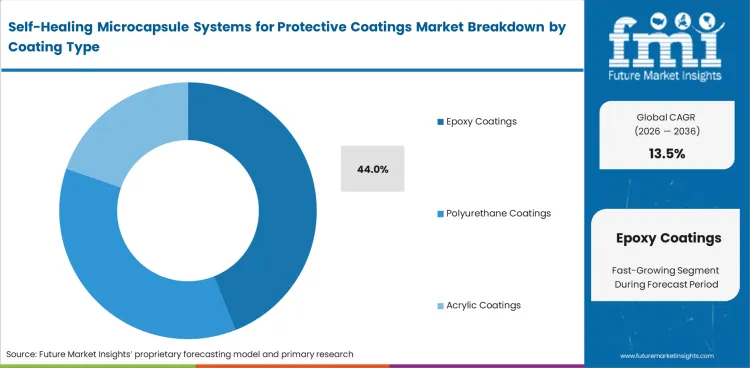
- Proven performance in metal adhesion and corrosion protection influences epoxy coatings to reach an estimated 44.0% share in 2026.
- Epoxy-based systems offer a strong starting base for microcapsules influenced by protective coating buyers already implementing epoxy for bridges and marine equipment.
Insights into Polyurethane Coatings Segment
- Polyurethane coatings gain traction in applications requiring abrasion resistance and surface finish quality together.
- Automotive and aerospace coating users assess polyurethane systems carefully as capsule size affect gloss and final surface appearance.
Self-Healing Microcapsule Systems for Protective Coatings Market Analysis by Application
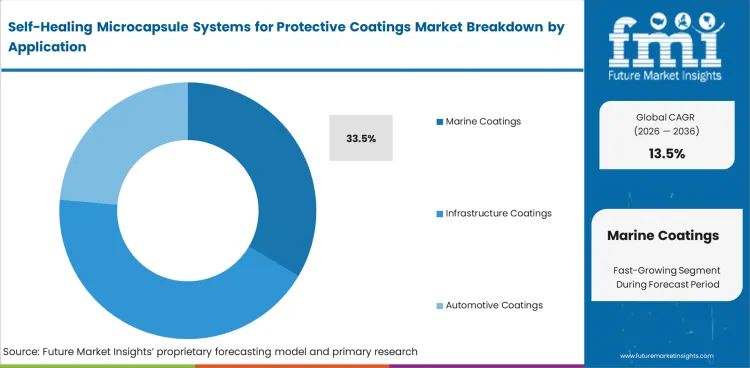
- Marine coatings are projected to secure 33.5% share in 2026, reflected by ship hulls and deck structures facing salt exposure and repeated surface abrasion.
- Shipyards value longer coating life led by repainting schedules affecting dock use and asset availability during maintenance programs.
Insights into Infrastructure Coatings Segment
- Infrastructure coatings gain interest from bridge and rail assets needing longer protection between inspection cycles.
- Asset owners prefer field panel data due to outdoor exposure tests providing clearer proof than laboratory scratch results alone.
Self-Healing Microcapsule Systems for Protective Coatings Market Analysis by End Use Industry
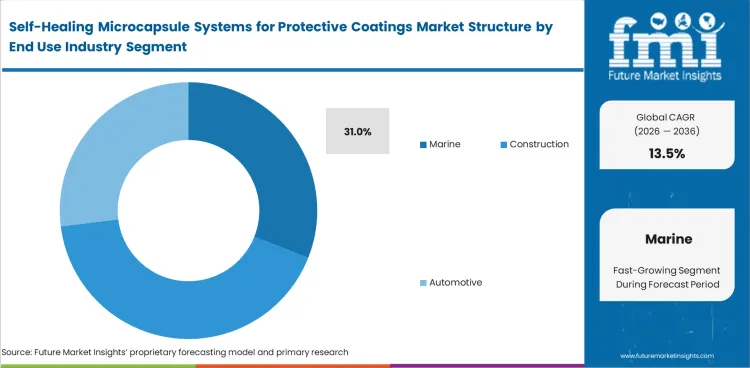
- Marine is estimated to capture 31.0% share in 2026, influenced by shipbuilding and repair programs requiring durable protective films against corrosion.
- Marine users place high weight on salt-spray performance and application stability before accepting capsule-based coating systems.
Insights into Construction Segment
- Construction demand comes from bridges and exposed steel structures needing coating systems with longer service intervals.
- Public infrastructure users adopt slowly driven by specification changes requiring proof of durability across outdoor exposure conditions.
Self-Healing Microcapsule Systems for Protective Coatings Market Analysis by Sales Channel
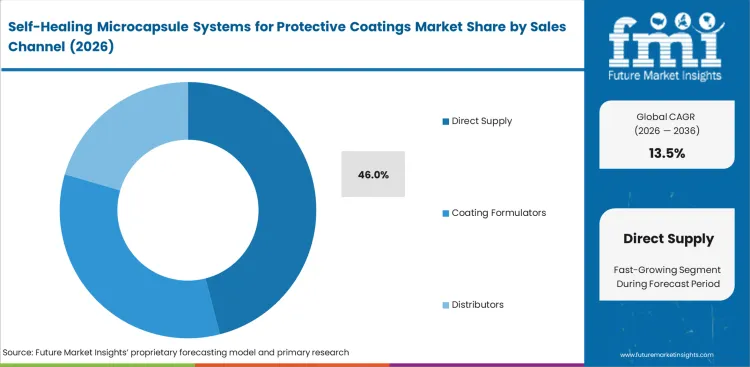
- Pre‑approval recipe testing requirements for microcapsules drive coating formulators at a projected 46.0% share in 2026.
- Formulator-led access helps capsule suppliers enter protective coatings through existing qualification routes and technical service programs.
Insights into Direct Supply Segment
- Direct supply serves large coating producers requiring custom capsule size and core chemistry support.
- Large accounts prefer direct technical support led by capsule dispersion and film finish issues needing quick correction during scale-up.
Self-Healing Microcapsule Systems for Protective Coatings Market Drivers, Restraints, and Opportunities
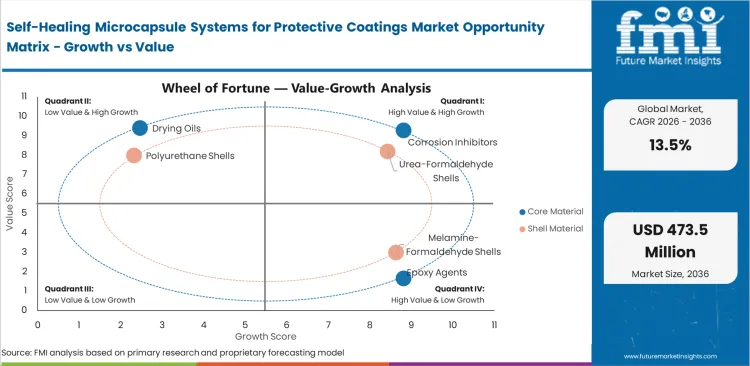
- Bridge and marine steel assets will sustain steady demand for self-healing additives as scratches expose metal before scheduled repair.
- Capsule breakage during mixing and spray use is anticipated to keep qualification cost pressure stable across protective coating producers.
- Shipyards and infrastructure maintenance programs will add more revenue prospects for suppliers able to prove longer coating life in epoxy systems.
By 2036, field validation pressure is likely to limit faster adoption in lower specification protective coating accounts. ARTBA data for 2025 listed 41,677 poor-rated bridges in United States. Same bridge base faced 163 million daily crossings on poor-rated structures. Such exposure supports coating systems able to slow early corrosion after film damage. Capsule suppliers depend on outdoor panel proof and spray stability data before asset owners accept premium self-healing coating systems.
Application-wise Equipment Deployment Analysis
Self-healing microcapsule systems are expected to gain adoption through industrial equipment where scratches and corrosion increase repainting needs. Process industries and utilities are likely to apply said coatings on tanks and pipelines plus pumps and outdoor cabinets. Discrete manufacturing and logistics sites can use them on robotic cells, conveyors and material-handling frames. In September 2025, International Federation of Robotics reported installation of 542,000 industrial robots worldwide in 2024 and Asia accounted for 74% of new deployments. Such equipment base influences forward demand for coatings protecting high-contact assets and extending service life in automated industrial settings.
Buyer Identification and Procurement Structure Analysis
Self-healing microcapsule systems are expected to gain sourcing attention from coating OEMs or EPCs and plant operators managing corrosion-sensitive assets. Buying decisions are likely to center on proven corrosion control and lower maintenance downtime. In April 2025, Sherwin-Williams Protective & Marine received a 2025 MP Corrosion Innovation of the Year Award for Heat-Flex CUI-mitigation coatings, with 10 winners selected from 60 submissions. Such recognition supports a buyer outlook where suppliers with tested asset-protection performance are better positioned in industrial coating specifications.
Regional Analysis
.webp "Top Country Growth Comparison Self Healing Microcapsule Systems For Protective Coatings Market Cagr (2026 2036)")
| Country | CAGR 2026 to 2036 |
|---|---|
| China | 8.0% |
| India | 7.6% |
| United States | 6.8% |
| Germany | 6.1% |
| South Korea | 5.9% |
| Japan | 5.6% |
| United Kingdom | 5.4% |
Source: Future Market Insights analysis based on coating demand signals and public source checks in 2026.
Analysis of Self-Healing Microcapsule Systems for Protective Coatings Market by Key Countries
- China is expected to post fastest pace at 8.0% CAGR by 2036, led by shipbuilding scale and industrial coating output influencing higher use of capsule-based corrosion protection.
- India is projected to follow at 7.6% CAGR by 2036 due to bridge repair activity and marine maintenance work creating stronger need for longer-life protective coatings.
- United States demand is projected at 6.8% CAGR by 2036 as poor-rated bridge exposure and defense maintenance work keep interest steady in coating systems with repair response.
- Germany is expected to record 6.1% CAGR by 2036, influenced by automotive coating research and industrial asset protection needs requiring better film durability.
- South Korea at 5.9% CAGR, Japan at 5.6% CAGR and United Kingdom at 5.4% CAGR expand by 2036, reflected by mature coating systems and steady need for corrosion-control upgrades.
Country growth differs with shipbuilding scale and infrastructure repair pressure. China leads as large shipyard output supports use of longer-life protective films across newbuild and repair activity. India follows as infrastructure and port maintenance create demand from a smaller advanced coating base. United States demand advances through bridge repair needs and industrial asset maintenance. Germany grows through coating engineering depth and automotive testing. South Korea and Japan maintain steadier adoption as mature industrial coating users refine durability rather than add large new coating volume.
Demand Outlook for Self-Healing Microcapsule Systems for Protective Coatings in China
Demand for self-healing microcapsule systems for protective coatings in China is projected to rise at 8.0% CAGR by 2036 as shipyards and heavy industrial coating lines promote larger capsule additive intake. Local coating makers require corrosion inhibitor capsules and epoxy repair agents able to protect steel surfaces after scratches. China leads country outlook for the sector due to shipbuilding depth and large industrial coating consumption.
- Shipbuilding yards support repeat capsule additive adoption due to hulls and deck structures requiring coating systems able to slow corrosion after surface damage.
- Industrial coating makers raise demand for microcapsules able to survive mixing and spray application across high-volume metal coating lines.
- Local suppliers gain more prospects to serve coating formulators depending on stable capsule size and faster support during coating trials.
Demand Outlook for Self-Healing Microcapsule Systems for Protective Coatings in India
Industry in India is expected to expand at 7.6% CAGR by 2036, led by infrastructure repair needs and coastal asset maintenance influencing demand from a smaller base. Domestic coating producers require capsule systems able to improve coating life across bridges and port equipment. India records faster expansion as public works and industrial maintenance activity increase interest in longer service intervals.
- Bridge repair work implement additive since steel structures require coating systems with improved resistance after scratches and film breaks.
- Local coating producers need capsule suppliers able to provide testing support and stable batches for protective coating recipes.
- Port maintenance influences demand for protective coatings able to handle salt exposure and repeated abrasion across equipment surfaces.
Demand Outlook for Self-Healing Microcapsule Systems for Protective Coatings in United States
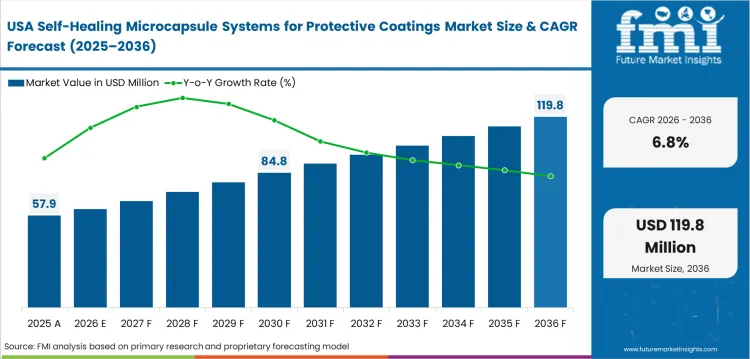
Sales of self-healing microcapsule systems for protective coatings in United States are projected to increase at 6.8% CAGR by 2036, influenced by bridge repair backlogs and industrial maintenance spending. Established coating brands require additive systems able to extend coating life on steel assets. United States growth stays steady led by demand for lower maintenance cost across infrastructure and defense equipment.
- Poor-rated bridge exposure supports demand for capsule-based coatings able to slow early corrosion after small coating damage.
- Defense maintenance channels need protective films with stronger resistance against scratches and outdoor exposure.
- Industrial coating brands require capsule systems compatible with epoxy coatings without lowering adhesion or film finish quality.
Demand Outlook for Self-Healing Microcapsule Systems for Protective Coatings in Germany
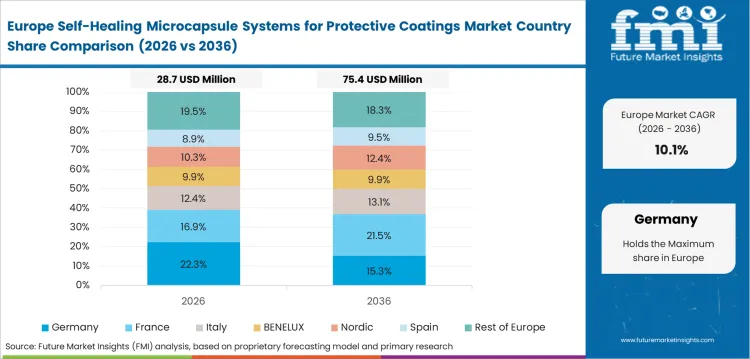
The sector in Germany is projected to record 6.1% CAGR by 2036, driven by automotive coating research and industrial asset protection shape demand for repair-response coating systems. German formulators focus on capsule stability and long-term surface performance. Market progress stays measured as coating approval cycles need proof across abrasion and corrosion testing.
- Industrial users require protective coatings with stable corrosion resistance across machinery and metal structures.
- Local formulators favor capsule suppliers able to provide particle control and test data for finished coating approval.
- Automotive coating labs promote capsule testing for scratch repair and finish protection across exterior coating layers.
Demand Outlook for Self-Healing Microcapsule Systems for Protective Coatings in South Korea
Demand for self-healing microcapsule systems for protective coatings in South Korea is expected to post 5.9% CAGR by 2036 due to shipbuilding strength and electronics-adjacent coating knowledge base supporting selected applications. Coating brands need capsule packages able to protect surfaces exposed to salt and handling damage.
- Industrial coating makers require capsules able to keep structure during mixing without damaging final surface smoothness.
- Shipyard coating programs adopt self-healing additives for hull and deck surfaces facing harsh marine use.
- Product differentiation centers on longer coating life and lower touch-up frequency across marine and machinery uses.
Demand Outlook for Self-Healing Microcapsule Systems for Protective Coatings in Japan
Industry in Japan is expected to grow at 5.6% CAGR by 2036, reflected by mature marine and industrial coating systems sustain steady adoption. Coating makers focus on precise capsule dispersion and high surface quality across protective film systems. Japan expands at a slower pace as established coating performance standards limit fast material shifts.
- Marine maintenance demand maintains steady use of advanced coatings across ships and coastal structures.
- Coating makers in the country prefer capsule systems able to improve scratch response without reducing surface finish.
- Industrial asset owners use longer-life coatings to reduce small-area repair work during scheduled maintenance cycles.
Demand Outlook for Self-Healing Microcapsule Systems for Protective Coatings in United Kingdom
United Kingdom demand is expected to advance at 5.4% CAGR by 2036 since bridge upkeep and marine repair work sustain interest in advanced protective coatings. Coating suppliers need corrosion-control systems with clear evidence from outdoor exposure tests. United Kingdom demand expands steadily influenced by asset owners place more weight on coating life and inspection outcomes.
- Bridge and rail maintenance programs promote interest in protective coatings designed to slow corrosion after coating damage.
- Marine repair yards need durable coating systems for vessels facing salt exposure and dockside abrasion.
- Specialty coating suppliers use field panel evidence to improve buyer confidence before wider capsule-based coating approval.
Competitive Positioning and Strategic Supplier Strength
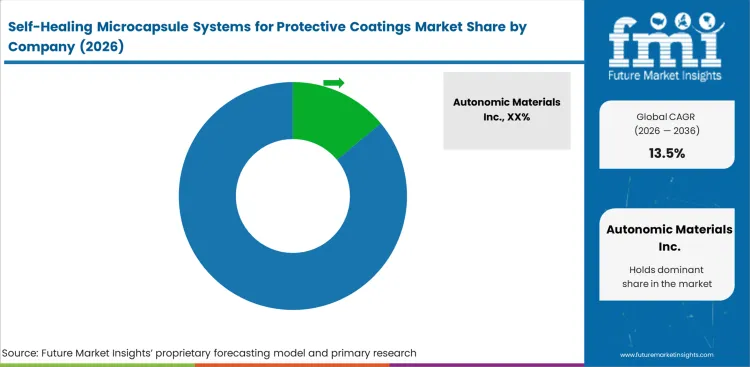
- Competition is centered on specialty capsule developers and protective coating suppliers with proof of scratch repair in coating films.
- Autonomic Materials holds a clear additive position through AMPARMOR microcapsules designed for coating self-healing and longer coating durability.
- NEI Corporation competes through NANOMYTE MEND self-healing coatings with scratch repair claims across polymer coating films.
- Large coating suppliers such as PPG, AkzoNobel and Sherwin-Williams hold access through protective coating accounts and applicator support.
Competition is centered on proof of repair after visible coating damage. Buyers assess healing response and application fit before approving premium additives. Autonomic Materials’ product data supports the use of microcapsules in epoxy and polyurethane coating systems. NEI Corporation markets NANOMYTE MEND systems for scratch or crack repair across coating films. Specialty material suppliers are competing on targeted healing performance, while scale advantage remains with companies that have testing labs and direct links to industrial coating users.
Large coating companies continue to defend accounts through broader product lines and field support. PPG launched ENVIROCRON Extreme Protection Edge Plus in October 2025 with claims around corrosion protection and edge coverage. Sherwin-Williams expanded its Global Core protective and marine coatings in March 2025 with zinc, epoxy, and urethane systems for corrosion protection. These moves show how major suppliers are protecting asset-owner relationships through proven coating platforms before capsule systems see wider use. Capsule developers will need formulation partnerships to enter protective coating channels more effectively.
Key Companies in the Self-Healing Microcapsule Systems for Protective Coatings Market
Competition spans capsule technology developers, protective coating suppliers and coating material companies. Each group competes through repair proof, formulation support and asset-owner access.
- Capsule technology developers: Autonomic Materials and NEI Corporation compete through self-healing additives and smart coating systems.
- Protective coating suppliers: PPG, AkzoNobel and Sherwin-Williams compete through industrial coating lines and account support.
- Material and resin suppliers: BASF, Covestro and Evonik support upstream chemistry used in coatings and capsule systems.
Competitive Benchmarking: Self-Healing Microcapsule Systems for Protective Coatings Market
| Company | Capsule Repair Proof | Coating Compatibility | Asset Coating Access | Footprint |
|---|---|---|---|---|
| Autonomic Materials | High | Large | Moderate | North America |
| NEI Corporation | Large | Moderate | Moderate | North America |
| PPG Industries | Moderate | Large | Large | Global |
| AkzoNobel | Moderate | Large | Large | Global |
| Sherwin-Williams | Moderate | Large | Large | Global |
| BASF | Moderate | Large | Moderate | Global |
| Covestro | Moderate | Large | Moderate | Global |
Source: Future Market Insights competitive analysis based on company product evidence and covered country narratives in 2026.
Key Developments in Self-Healing and Protective Coatings
- In February 2024, AkzoNobel completed a €21 million powder coatings expansion at Como in Italy with four new manufacturing lines.
- In March 2025, Sherwin-Williams expanded Global Core protective and marine coatings with zinc, epoxy, and urethane systems for corrosion protection.
- In October 2025, PPG launched ENVIROCRON Extreme Protection Edge Plus powder coating with improved edge coverage and enhanced corrosion resistance.
Key Players in the Self-Healing Microcapsule Systems for Protective Coatings Market
Specialty Self-Healing Coating Players
- Autonomic Materials Inc.
- NEI Corporation
- Covestro AG
- CompPair Technologies Ltd.
Protective Coating and Material Participants
- PPG Industries Inc.
- AkzoNobel N.V.
- The Sherwin-Williams Company
Report Scope and Coverage
| Item | Value |
|---|---|
| Market value in 2025 | USD 103.6 million |
| Market value in 2026 | USD 117.6 million |
| Market value in 2036 | USD 416.9 million |
| CAGR from 2026 to 2036 | 13.5% |
| Quantitative units | USD million |
| Market definition | Microcapsule systems used in protective coatings to release repair agents after scratches or small cracks |
| By capsule shell | Polyurea, polyurethane, melamine, silica, gelatin, hybrid shells |
| By healing agent | Epoxy precursors, alkyd oils, corrosion inhibitors, isocyanates, siloxanes, drying oils |
| By coating chemistry | Epoxy coatings, polyurethane coatings, acrylic coatings, alkyd coatings, powder coatings, hybrid coatings |
| By damage trigger | Crack rupture, moisture trigger, heat trigger, UV trigger, pH trigger, ion trigger |
| By substrate | Steel, aluminum, concrete, composite, plastic, wood |
| By end use | Marine assets, infrastructure assets, automotive parts, aerospace parts, energy assets, industrial equipment |
| Regions covered | North America, Latin America, Europe, East Asia, South Asia and Pacific, Middle East and Africa |
| Countries covered | United States, Germany, United Kingdom, Japan, China, India, South Korea |
| Key companies profiled | Autonomic Materials, NEI Corporation, PPG, AkzoNobel, Sherwin-Williams, BASF, Covestro |
| Forecast period | 2026 to 2036 |
| Approach | FMI public demand model aligned with coating use, country asset signals and company product checks |
Source: Future Market Insights analysis, 2026.
Self-Healing Microcapsule Systems for Protective Coatings Market Breakdown by Core Material, Shell Material, Coating Type, Application, End Use Industry, Sales Channel, and Region
Self-Healing Microcapsule Systems for Protective Coatings Market Segmented by Core Material
- Corrosion Inhibitors
- Epoxy Agents
- Drying Oils
- Silane Agents
- Polymer Agents
Self-Healing Microcapsule Systems for Protective Coatings Market Segmented by Shell Material
- Urea-Formaldehyde Shells
- Melamine-Formaldehyde Shells
- Polyurethane Shells
- Silica Shells
- Gelatin Shells
Self-Healing Microcapsule Systems for Protective Coatings Market Segmented by Coating Type
- Epoxy Coatings
- Polyurethane Coatings
- Acrylic Coatings
- Alkyd Coatings
- Hybrid Coatings
Self-Healing Microcapsule Systems for Protective Coatings Market Segmented by Application
- Marine Coatings
- Infrastructure Coatings
- Automotive Coatings
- Aerospace Coatings
- Industrial Equipment Coatings
Self-Healing Microcapsule Systems for Protective Coatings Market Segmented by End Use Industry
- Marine
- Construction
- Automotive
- Aerospace
- Oil and Gas
Self-Healing Microcapsule Systems for Protective Coatings Market Segmented by Sales Channel
- Direct Supply
- Coating Formulators
- Distributors
- Specialty Applicators
Self-Healing Microcapsule Systems for Protective Coatings Market by Region
- North America
- United States
- Canada
- Latin America
- Brazil
- Mexico
- Europe
- Germany
- United Kingdom
- France
- Italy
- Spain
- East Asia
- China
- Japan
- South Korea
- South Asia and Pacific
- India
- ASEAN
- Australia and New Zealand
- Middle East and Africa
- Saudi Arabia
- Other GCC Countries
- South Africa
Research Sources and Bibliography
- Sherwin-Williams Protective & Marine. (2025, April 8). Heat-Flex® CUI-Mitigation Coatings Earn 2025 MP Corrosion Innovation of the Year Award. Sherwin-Williams.
- AkzoNobel. (2024, February 13). AkzoNobel completes expansion of its largest powder coatings plant.
- Sherwin-Williams. (2025, March 18). Sherwin-Williams expands Global Core product offering for customers worldwide.
- American Road & Transportation Builders Association. (2025, June 24). 2025 ARTBA bridge report.
- China Petroleum and Chemical Corp., & Sinopec Safety Engineering Research Institute Co. Ltd. (2024, April 16). Self-repairing anti-corrosion coating and preparation method thereof (China Patent No. CN117887325A).
- China South Power Grid International Co. Ltd., & Guizhou Power Grid Co. Ltd. (2024, June 4). A method for preparing modified polyurethane microcapsules and a method for dispersing the microcapsules in composite epoxy resins (China Patent No. CN118122233A).
- Department for Transport. (2026, January 21). Road conditions in England to March 2025. GOV.UK.
- Federal Highway Administration. (2025, June 15). Bridge condition by highway system 2025. U.S. Department of Transportation.
- Office of Rail and Road. (2026, January 15). Annual assessment of National Highways’ performance: End of the second road period April 2020 to March 2025.
- PPG. (2025, October 20). PPG launches PPG ENVIROCRON Extreme Protection Edge Plus powder coating.
- Press Information Bureau. (2025, June 11). Transforming India’s transport infrastructure (2014-2025). Government of India.
- Sherwin-Williams. (2025, March 18). Sherwin-Williams expands Global Core product offering for customers worldwide.
- Shenyang Shengda Huifa Chemical Co. Ltd. (2025, October 28). A kind of curtain coating thick film resin anticorrosive paint and preparation method thereof (China Patent No. CN120842946A).
- Tian, W., Zhao, Y., Qian, H., & Wang, J. (2025). Self-healing anti-corrosion coatings: Challenges and opportunities. Coatings, 15(6), 620.
The bibliography is provided for reader reference and direct source checking.
This Report Answers
- How large the self-healing microcapsule systems for protective coatings sector is in 2026 and how far it can rise by 2036?
- Which capsule shell, healing agent and coating chemistry hold the strongest projected share positions in 2026?
- Why crack rupture and steel hold the clearest leading positions in current protective coating use?
- Why China and India lead the country forecast set through 2036?
- How coating formulators shape access for capsule additives used in epoxy and polyurethane systems?
- Which supplier capabilities help companies defend position in capsule repair proof and coating compatibility?
- What bridge and coating signals support the forecast method used in this study?
Frequently Asked Questions
How large is the self-healing microcapsule systems for protective coatings market in 2026?
The sector is projected at USD 117.6 million in 2026 with corrosion repair pressure supporting specialized coating use.
What will the self-healing microcapsule systems for protective coatings market be worth by 2036?
The sector is forecast to reach USD 416.9 million by 2036 as protective coatings add repair functions.
What CAGR is projected for the self-healing microcapsule systems for protective coatings market from 2026 to 2036?
The sector is expected to expand at 13.5% CAGR from 2026 to 2036 across asset protection uses.
Which damage trigger leads the self-healing microcapsule systems for protective coatings market?
Crack rupture is projected to account for 52.5% share in 2026 as scratches release repair agents directly.
Which country grows fastest in the self-healing microcapsule systems for protective coatings market?
China is projected to record 8.0% CAGR through 2036 due to shipbuilding scale and marine coating trials.
Preview the report firsthand - request a free sample
Get SampleGet the brochure for pricing and purchase details.
Get PDFTable of Content
- Key Takeaways
- Market Size and CAGR
- Top Growth Driver
- Fastest Growing Segment
- Leading Region
- Key Companies
- Emerging Opportunities
- Executive Summary
- Global Market Outlook
- Demand-side Trends
- Supply-side Trends
- Technology Roadmap Analysis
- Analysis and Recommendations
- Analyst Perspective (What is happening? Why now? What should investors know?)
- Key Questions Answered
- How large is the market?
- What is the CAGR?
- What are key trends?
- Which region dominates?
- Who are the leaders?
- Market Overview
- Market Coverage / Taxonomy
- Market Definition / Scope / Limitations
- Research Methodology
- Chapter Orientation
- Analytical Lens and Working Hypotheses
- Market Structure, Signals, and Trend Drivers
- Benchmarking and Cross-market Comparability
- Market Sizing, Forecasting, and Opportunity Mapping
- Research Design and Evidence Framework
- Desk Research Programme (Secondary Evidence)
- Expert Input and Fieldwork (Primary Evidence)
- Tooling, Models, and Reference Databases
- Data Engineering and Model Build
- Quality Assurance and Audit Trail
- Market Background
- Market Dynamics (Drivers, Restraints, Opportunity, Trends)
- Scenario Forecast (Optimistic, Likely, Conservative)
- Impact Analysis
- AI Impact
- Sustainability Impact
- Regulatory Impact
- Technology Impact
- Consumer / Buyer Analysis
- Purchase Drivers
- Adoption Barriers
- Buyer Journey
- Opportunity Map Analysis
- Product Life Cycle Analysis
- Supply Chain Analysis
- Investment Feasibility Matrix
- Value Chain Analysis
- PESTLE and Porter's Analysis
- Regulatory Landscape
- Regional Parent Market Outlook
- Production and Consumption Statistics
- Import and Export Statistics
- Global Market Analysis and Forecast, 2021 to 2036
- Historical Market Size Value (USD Million) Analysis, 2021 to 2025
- Current and Future Market Size Value (USD Million) Projections, 2026 to 2036
- Y-o-Y Growth Trend Analysis
- Absolute $ Opportunity Analysis
- Global Market Pricing Analysis, 2021 to 2036
- Global Market Analysis and Forecast, By Core Material, 2021 to 2036
- Introduction / Key Findings
- Historical Market Size Value (USD Million) Analysis By Core Material, 2021 to 2025
- Current and Future Market Size Value (USD Million) Analysis and Forecast By Core Material, 2026 to 2036
- Corrosion Inhibitors
- Epoxy Agents
- Drying Oils
- Silane Agents
- Polymer Agents
- Corrosion Inhibitors
- Y-o-Y Growth Trend Analysis By Core Material, 2021 to 2025
- Absolute $ Opportunity Analysis By Core Material, 2026 to 2036
- Global Market Analysis and Forecast, By Shell Material, 2021 to 2036
- Introduction / Key Findings
- Historical Market Size Value (USD Million) Analysis By Shell Material, 2021 to 2025
- Current and Future Market Size Value (USD Million) Analysis and Forecast By Shell Material, 2026 to 2036
- Urea-Formaldehyde Shells
- Melamine-Formaldehyde Shells
- Polyurethane Shells
- Silica Shells
- Gelatin Shells
- Urea-Formaldehyde Shells
- Y-o-Y Growth Trend Analysis By Shell Material, 2021 to 2025
- Absolute $ Opportunity Analysis By Shell Material, 2026 to 2036
- Global Market Analysis and Forecast, By Coating Type, 2021 to 2036
- Introduction / Key Findings
- Historical Market Size Value (USD Million) Analysis By Coating Type, 2021 to 2025
- Current and Future Market Size Value (USD Million) Analysis and Forecast By Coating Type, 2026 to 2036
- Epoxy Coatings
- Polyurethane Coatings
- Acrylic Coatings
- Alkyd Coatings
- Hybrid Coatings
- Epoxy Coatings
- Y-o-Y Growth Trend Analysis By Coating Type, 2021 to 2025
- Absolute $ Opportunity Analysis By Coating Type, 2026 to 2036
- Global Market Analysis and Forecast, By Application, 2021 to 2036
- Introduction / Key Findings
- Historical Market Size Value (USD Million) Analysis By Application, 2021 to 2025
- Current and Future Market Size Value (USD Million) Analysis and Forecast By Application, 2026 to 2036
- Marine Coatings
- Infrastructure Coatings
- Automotive Coatings
- Aerospace Coatings
- Industrial Equipment Coatings
- Marine Coatings
- Y-o-Y Growth Trend Analysis By Application, 2021 to 2025
- Absolute $ Opportunity Analysis By Application, 2026 to 2036
- Global Market Analysis and Forecast, By End Use Industry, 2021 to 2036
- Introduction / Key Findings
- Historical Market Size Value (USD Million) Analysis By End Use Industry, 2021 to 2025
- Current and Future Market Size Value (USD Million) Analysis and Forecast By End Use Industry, 2026 to 2036
- Marine
- Construction
- Automotive
- Aerospace
- Oil and Gas
- Marine
- Y-o-Y Growth Trend Analysis By End Use Industry, 2021 to 2025
- Absolute $ Opportunity Analysis By End Use Industry, 2026 to 2036
- Global Market Analysis and Forecast, By Sales Channel
- Introduction / Key Findings
- Historical Market Size Value (USD Million) Analysis By Sales Channel, 2021 to 2025
- Current and Future Market Size Value (USD Million) Analysis and Forecast By Sales Channel, 2026 to 2036
- Direct Supply
- Coating Formulators
- Distributors
- Specialty Applicators
- Direct Supply
- Y-o-Y Growth Trend Analysis By Sales Channel, 2021 to 2025
- Absolute $ Opportunity Analysis By Sales Channel, 2026 to 2036
- Global Market Analysis and Forecast, By Region, 2021 to 2036
- Introduction
- Historical Market Size Value (USD Million) Analysis By Region, 2021 to 2025
- Current Market Size Value (USD Million) Analysis and Forecast By Region, 2026 to 2036
- North America
- Latin America
- Western Europe
- Eastern Europe
- East Asia
- South Asia and Pacific
- Middle East & Africa
- Market Attractiveness Analysis By Region
- North America Market Analysis and Forecast, By Country, 2021 to 2036
- Historical Market Size Value (USD Million) Trend Analysis By Market Taxonomy, 2021 to 2025
- Market Size Value (USD Million) Forecast By Market Taxonomy, 2026 to 2036
- By Country
- USA
- Canada
- By Core Material
- By Shell Material
- By Coating Type
- By Application
- By End Use Industry
- By Sales Channel
- By Country
- Market Attractiveness Analysis
- By Country
- By Core Material
- By Shell Material
- By Coating Type
- By Application
- By End Use Industry
- By Sales Channel
- Key Takeaways
- Latin America Market Analysis and Forecast, By Country
- Historical Market Size Value (USD Million) Trend Analysis By Market Taxonomy, 2021 to 2025
- Market Size Value (USD Million) Forecast By Market Taxonomy, 2026 to 2036
- By Country
- Brazil
- Mexico
- Chile
- Rest of Latin America
- By Core Material
- By Shell Material
- By Coating Type
- By Application
- By End Use Industry
- By Sales Channel
- By Country
- Market Attractiveness Analysis
- By Country
- By Core Material
- By Shell Material
- By Coating Type
- By Application
- By End Use Industry
- By Sales Channel
- Key Takeaways
- Western Europe Market Analysis and Forecast, By Country
- Historical Market Size Value (USD Million) Trend Analysis By Market Taxonomy, 2021 to 2025
- Market Size Value (USD Million) Forecast By Market Taxonomy, 2026 to 2036
- By Country
- Germany
- UK
- Italy
- Spain
- France
- Nordic
- BENELUX
- Rest of Western Europe
- By Core Material
- By Shell Material
- By Coating Type
- By Application
- By End Use Industry
- By Sales Channel
- By Country
- Market Attractiveness Analysis
- By Country
- By Core Material
- By Shell Material
- By Coating Type
- By Application
- By End Use Industry
- By Sales Channel
- Key Takeaways
- Eastern Europe Market Analysis and Forecast, By Country
- Historical Market Size Value (USD Million) Trend Analysis By Market Taxonomy, 2021 to 2025
- Market Size Value (USD Million) Forecast By Market Taxonomy, 2026 to 2036
- By Country
- Russia
- Poland
- Hungary
- Balkan & Baltic
- Rest of Eastern Europe
- By Core Material
- By Shell Material
- By Coating Type
- By Application
- By End Use Industry
- By Sales Channel
- By Country
- Market Attractiveness Analysis
- By Country
- By Core Material
- By Shell Material
- By Coating Type
- By Application
- By End Use Industry
- By Sales Channel
- Key Takeaways
- East Asia Market Analysis and Forecast, By Country
- Historical Market Size Value (USD Million) Trend Analysis By Market Taxonomy, 2021 to 2025
- Market Size Value (USD Million) Forecast By Market Taxonomy, 2026 to 2036
- By Country
- China
- Japan
- South Korea
- By Core Material
- By Shell Material
- By Coating Type
- By Application
- By End Use Industry
- By Sales Channel
- By Country
- Market Attractiveness Analysis
- By Country
- By Core Material
- By Shell Material
- By Coating Type
- By Application
- By End Use Industry
- By Sales Channel
- Key Takeaways
- South Asia and Pacific Market Analysis and Forecast, By Country
- Historical Market Size Value (USD Million) Trend Analysis By Market Taxonomy, 2021 to 2025
- Market Size Value (USD Million) Forecast By Market Taxonomy, 2026 to 2036
- By Country
- India
- ASEAN
- Australia & New Zealand
- Rest of South Asia and Pacific
- By Core Material
- By Shell Material
- By Coating Type
- By Application
- By End Use Industry
- By Sales Channel
- By Country
- Market Attractiveness Analysis
- By Country
- By Core Material
- By Shell Material
- By Coating Type
- By Application
- By End Use Industry
- By Sales Channel
- Key Takeaways
- Middle East & Africa Market Analysis and Forecast, By Country
- Historical Market Size Value (USD Million) Trend Analysis By Market Taxonomy, 2021 to 2025
- Market Size Value (USD Million) Forecast By Market Taxonomy, 2026 to 2036
- By Country
- Kingdom of Saudi Arabia
- Other GCC Countries
- Türkiye
- South Africa
- Other African Union
- Rest of Middle East & Africa
- By Core Material
- By Shell Material
- By Coating Type
- By Application
- By End Use Industry
- By Sales Channel
- By Country
- Market Attractiveness Analysis
- By Country
- By Core Material
- By Shell Material
- By Coating Type
- By Application
- By End Use Industry
- By Sales Channel
- Key Takeaways
- Key Countries Market Analysis
- USA
- Pricing Analysis
- Market Share Analysis, 2025
- By Core Material
- By Shell Material
- By Coating Type
- By Application
- By End Use Industry
- By Sales Channel
- Canada
- Pricing Analysis
- Market Share Analysis, 2025
- By Core Material
- By Shell Material
- By Coating Type
- By Application
- By End Use Industry
- By Sales Channel
- Mexico
- Pricing Analysis
- Market Share Analysis, 2025
- By Core Material
- By Shell Material
- By Coating Type
- By Application
- By End Use Industry
- By Sales Channel
- Brazil
- Pricing Analysis
- Market Share Analysis, 2025
- By Core Material
- By Shell Material
- By Coating Type
- By Application
- By End Use Industry
- By Sales Channel
- Chile
- Pricing Analysis
- Market Share Analysis, 2025
- By Core Material
- By Shell Material
- By Coating Type
- By Application
- By End Use Industry
- By Sales Channel
- Germany
- Pricing Analysis
- Market Share Analysis, 2025
- By Core Material
- By Shell Material
- By Coating Type
- By Application
- By End Use Industry
- By Sales Channel
- UK
- Pricing Analysis
- Market Share Analysis, 2025
- By Core Material
- By Shell Material
- By Coating Type
- By Application
- By End Use Industry
- By Sales Channel
- Italy
- Pricing Analysis
- Market Share Analysis, 2025
- By Core Material
- By Shell Material
- By Coating Type
- By Application
- By End Use Industry
- By Sales Channel
- Spain
- Pricing Analysis
- Market Share Analysis, 2025
- By Core Material
- By Shell Material
- By Coating Type
- By Application
- By End Use Industry
- By Sales Channel
- France
- Pricing Analysis
- Market Share Analysis, 2025
- By Core Material
- By Shell Material
- By Coating Type
- By Application
- By End Use Industry
- By Sales Channel
- India
- Pricing Analysis
- Market Share Analysis, 2025
- By Core Material
- By Shell Material
- By Coating Type
- By Application
- By End Use Industry
- By Sales Channel
- ASEAN
- Pricing Analysis
- Market Share Analysis, 2025
- By Core Material
- By Shell Material
- By Coating Type
- By Application
- By End Use Industry
- By Sales Channel
- Australia & New Zealand
- Pricing Analysis
- Market Share Analysis, 2025
- By Core Material
- By Shell Material
- By Coating Type
- By Application
- By End Use Industry
- By Sales Channel
- China
- Pricing Analysis
- Market Share Analysis, 2025
- By Core Material
- By Shell Material
- By Coating Type
- By Application
- By End Use Industry
- By Sales Channel
- Japan
- Pricing Analysis
- Market Share Analysis, 2025
- By Core Material
- By Shell Material
- By Coating Type
- By Application
- By End Use Industry
- By Sales Channel
- South Korea
- Pricing Analysis
- Market Share Analysis, 2025
- By Core Material
- By Shell Material
- By Coating Type
- By Application
- By End Use Industry
- By Sales Channel
- Russia
- Pricing Analysis
- Market Share Analysis, 2025
- By Core Material
- By Shell Material
- By Coating Type
- By Application
- By End Use Industry
- By Sales Channel
- Poland
- Pricing Analysis
- Market Share Analysis, 2025
- By Core Material
- By Shell Material
- By Coating Type
- By Application
- By End Use Industry
- By Sales Channel
- Hungary
- Pricing Analysis
- Market Share Analysis, 2025
- By Core Material
- By Shell Material
- By Coating Type
- By Application
- By End Use Industry
- By Sales Channel
- Kingdom of Saudi Arabia
- Pricing Analysis
- Market Share Analysis, 2025
- By Core Material
- By Shell Material
- By Coating Type
- By Application
- By End Use Industry
- By Sales Channel
- Türkiye
- Pricing Analysis
- Market Share Analysis, 2025
- By Core Material
- By Shell Material
- By Coating Type
- By Application
- By End Use Industry
- By Sales Channel
- South Africa
- Pricing Analysis
- Market Share Analysis, 2025
- By Core Material
- By Shell Material
- By Coating Type
- By Application
- By End Use Industry
- By Sales Channel
- USA
- Market Structure Analysis
- Competition Dashboard
- Competition Benchmarking
- Market Share Analysis of Top Players
- By Regional
- By Core Material
- By Shell Material
- By Coating Type
- By Application
- By End Use Industry
- By Sales Channel
- Emerging Startups
- Innovation Benchmarking
- Competition Analysis
- Competition Deep Dive
- Autonomic Materials
- Overview
- Product Portfolio
- Profitability by Market Segments
- Sales Footprint
- Strategy Overview
- Marketing Strategy
- Product Strategy
- Channel Strategy
- NEI Corporation
- PPG
- AkzoNobel
- Sherwin-Williams
- BASF
- Covestro
- Autonomic Materials
- Case Studies
- Success Stories
- Recent Developments
- Competition Deep Dive
- Assumptions & Acronyms Used


