

- Industry Size (2026)
- USD 2140 Mn
- Forecast (2036)
- USD 7380 Mn
- CAGR (2026 to 2036)
- 13.2%
Protective Packaging for Glazing Sheets Market Forecast and Outlook By FMI
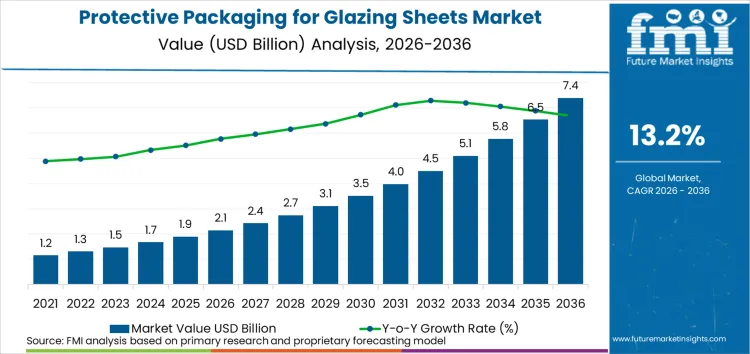
The global protective packaging for glazing sheets market is forecast to total USD 2,140 million in 2026 and is expected to reach USD 7,380 million by 2036, expanding at a CAGR of 13.2% over the forecast period. Growth is structurally driven by the transition of glazing protection from a consumable scratch-prevention layer into an engineered surface-integrity system that preserves optical performance, prevents coating damage, and supports compliance-led procurement across architectural construction, automotive glazing, and specialty optical component supply chains.
This market’s growth logic is anchored in the increasing sensitivity and value density of modern glazing surfaces. Low-emissivity coatings, anti-reflective treatments, hydrophobic/oleophobic topcoats, and self-cleaning photocatalytic layers are increasingly specified across curtain walls, insulated glazing units, panoramic roofs, and high-clarity display panels. In these applications, the tolerance for micro-scratches, haze formation, coating oxidation, and adhesive residue is effectively zero-because minor defects become visible under polarized lighting, directional daylight glare, or inspection regimes used by OEMs and high-end façade contractors. The economic consequence is decisive: when a coating defect is detected late (post-fabrication, post-delivery, or during installation sequencing), replacement cost escalates rapidly versus the incremental cost of engineered protection.
Summary of Protective Packaging for Glazing Sheets Market
- The protective packaging for glazing sheets market comprises engineered surface protection systems used to preserve optical clarity, prevent coating abrasion, and enable damage-free storage, handling, and transportation of rigid glazing substrates, including architectural glass, polycarbonate sheets, acrylic panels, and specialty decorative laminates, across float glass lines, tempering and insulating fabricators, automotive assembly supply chains, and commercial construction project sites.
- These protection systems are specified to prevent four high-cost failure modes: micro-abrasion, coating oxidation exposure damage, dust/particulate imprinting, and residue transfer during removal.
- FMI projects the market to grow at a 13.2% CAGR from 2026 to 2036, expanding from USD 2,140 million in 2026 to USD 7,380 million by 2036. The market is structurally transitioning from commoditized masking and generic interleaving into application-engineered, substrate-validated protection systems as contractors, glazing fabricators, and OEM-linked processors institutionalize residue-free delivery expectations and surface-integrity documentation within supplier quality scorecards.
Sustainability and regulation reinforce the same direction of travel. The file notes that EU packaging policy enforcement within the forecast window is accelerating substitution away from protective materials that are difficult to recycle or are composite/multi-layer structures and toward mono-material polyethylene-based systems and recyclable cushioning formats. In procurement practice, this does not eliminate film-based protection-because the surface-integrity function remains non-negotiable but it pushes suppliers toward recyclability-defensible material hierarchies, downgauging strategies, and standardized mono-material system designs that reduce compliance ambiguity for exporters and multinational OEM supply chains.
Competitive advantage is concentrated among corporations with adhesive formulation expertise, automation-compatible application know-how, and the ability to support recyclability documentation for mono-material protection architectures
Protective Packaging for Glazing Sheets Market Key Takeaways
| Metric | Value |
| Expected Value (2026E) | USD 2,140 million |
| Projected Value (2036F) | USD 7,380 million |
| CAGR (2026-2036) | 13.2% |
Source: Future Market Insights (FMI), proprietary forecasting model and primary research
Why is the Protective Packaging for Glazing Sheets Market Growing?
Growth is primarily driven by the premiumization of glazing surfaces across both architectural and automotive applications. Architectural glass increasingly carries functional coatings that are central to thermal performance and aesthetics, while automotive glazing incorporates advanced multi-layer stacks and topcoats that cannot tolerate handling defects. Protection systems are being specified upstream as part of the “surface integrity pathway,” not as a downstream add-on. In practical terms, protection is being tied to acceptance criteria: glazing must arrive at the next node with intact coating performance and appearance, making packaging functionally comparable to a quality-control input.
A second driver is the economics of damage discovery timing. In glazing supply chains, the cost of defects rises sharply the later they are detected. Damage discovered at the float or tempering stage may be scrapped with limited downstream disruption; damage discovered after insulating assembly, delivery, or partial installation triggers rework, re-sequencing, and often full replacement. This asymmetry makes engineered protection financially rational even when per-unit packaging cost increases, because it reduces high-impact tail risk (low probability, very high cost) linked to coating rejection, jobsite delays, and warranty disputes.
Regulatory and circularity pressures are accelerating material standardization. While protective packaging must remain function-critical, procurement teams increasingly push toward solutions that are easier to document, segregate, and recycle, particularly mono-material polyethylene films and PE foam systems. This pushes the market toward recyclable, automation-ready protection architectures, raising the value-per-sheet of protective packaging as performance and compliance expectations rise in parallel.
How is the Protective Packaging for Glazing Sheets Market Segmented?
The protective packaging for glazing sheets market is segmented by sheet type, protection method, and material, reflecting the reality that damage risk is driven by surface chemistry and geometry (glass vs polymer sheets), while protection choices are driven by residue-free removability, vibration abrasion control, and edge-chip prevention across multi-node handling environments. Since glazing sheets routinely pass through tempering, laminating, insulating, and export staging steps, segmentation is strongly shaped by which failure mode dominates- micro-scratches and haze, coating delamination, particulate imprinting, or edge fracture.
Within this market, segmentation also reflects a widening shift toward systems packaging rather than single-layer protection. Buyers increasingly specify a stack of protection functions because the cost of defects escalates sharply when discovered late at fabrication lines or construction sites. This raises the value density of protective packaging and supports sustained growth for engineered protection combinations.
Why do Architectural Glass Sheets dominate demand for protective packaging?
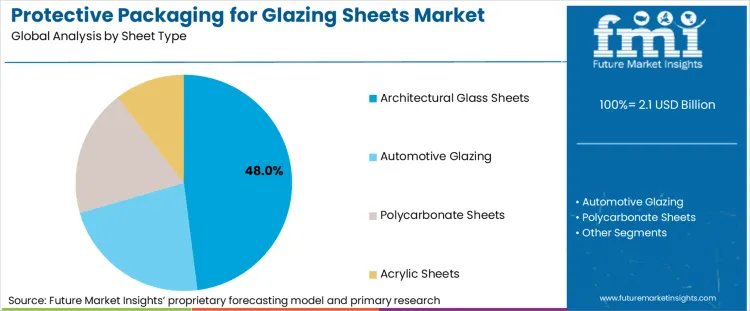
Architectural glass sheets account for 48% of total demand in 2026, driven by the continued premiumization of building envelopes and the increasing adoption of coated glass architectures (low-E, solar control, anti-reflective, and decorative finishes). These coatings elevate scratch sensitivity and residue intolerance: even small surface defects can become visible under daylight glare or polarized inspection, and adhesive residue can degrade appearance uniformity or disrupt downstream sealant performance in insulating glazing assemblies.
In procurement practice, architectural glass packaging is increasingly tied to liability containment. Contractors and façade subcontractors require fabricators to deliver finish-acceptable sheets that are staged on-site without surface degradation, shifting the economic burden of defects upstream. This pushes demand toward protection stacks that combine low-tack films for visible faces with interleaving layers and edge protection that prevent vibration abrasion and handling impacts across long logistics cycles.
How are Low-Tack Protective Films sustaining the leading protection method share?
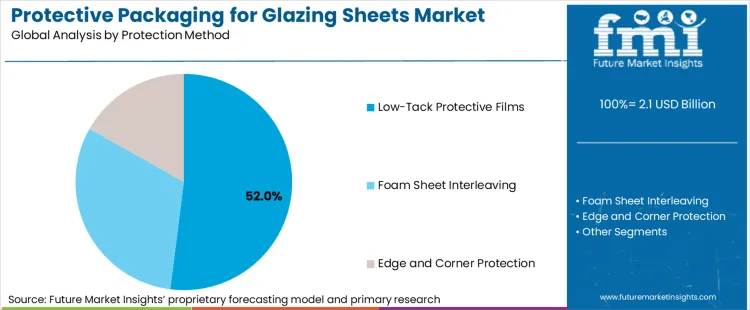
Low-tack protective films hold a 52% share because they uniquely address the market’s most expensive defect mode: visible surface damage or contamination on coated glazing faces. These films are engineered to adhere reliably during handling while remaining removable without residue transfer, and they allow inspection without exposing surfaces to dust or abrasives. As glazing sheet value density rises and acceptance criteria tighten, residue-free film removal becomes a de facto requirement for both architectural and automotive-linked glazing flows.
Beyond surface masking, films increasingly function as a process enabler. They reduce cleaning requirements between nodes, protect coated faces during cutting or handling, and limit particulate imprinting that can create haze or optical distortion. The dominance of films is therefore not a simple material preference- it reflects films’ integration into the way modern glazing is fabricated, staged, and installed, especially where defect discovery at the jobsite carries outsized cost.
Why do LDPE Films remain the dominant material platform?
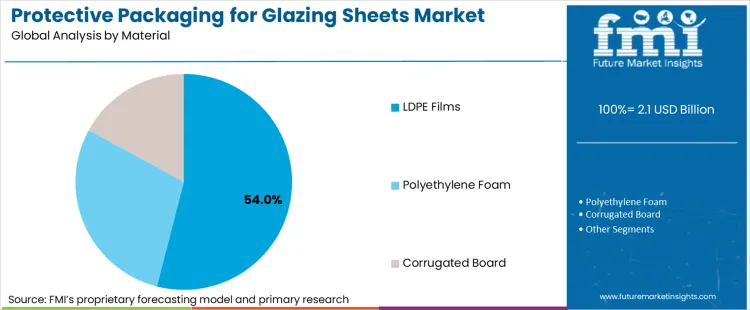
LDPE films account for 54% of total material demand, reflecting their balance of conformability, optical clarity, and processability into controlled-tack protection systems. LDPE can be engineered for stable peel behavior and consistent adhesion across temperature and humidity variation, which is critical because glazing sheets may be transported or staged across mixed climates and durations. In addition, LDPE’s ability to conform to smooth surfaces without air pockets reduces dust intrusion and micro-movement, lowering micro-abrasion risk under vibration.
LDPE’s dominance is reinforced by recyclability defensibility relative to more problematic legacy materials. While protective films are function-critical, procurement teams increasingly prefer materials with clearer end-of-life pathways and established recycling infrastructure, especially for export-facing suppliers. This encourages downgauging and mono-material system design, supporting LDPE’s leadership as the primary platform for protective film solutions in glazing packaging.
What Drivers, Restraints, Opportunities, and Trends Prevail in the Protective Packaging for Glazing Sheets Market?
The market is being propelled by the rapid penetration of functional coatings across architectural and automotive glazing, which sharply raises sensitivity to micro-scratches, haze, and adhesive residue. As coatings become central to energy performance and aesthetics, protection is treated as a quality-critical input because defects compromise not just appearance but also compliance with project specifications and performance warranties. Glazing supply chains amplify the cost of damage when discovered late creating a strong ROI case for integrated protection systems. Even modest improvements in damage avoidance materially reduce replacement, schedule slippage, and dispute risk, making engineered protective packaging financially rational in high-value glazing programs.
Protective films must be matched to coating chemistries and surface energies; poor calibration can cause residue transfer, ghosting, or uneven gloss after prolonged storage or heat exposure. Because these failures are catastrophic for appearance-grade glazing, buyers often require extensive validation trials, which can extend qualification timelines and delay conversion from legacy wraps. Even high-quality protection systems can fail if sheets are staged on dirty racks, exposed to grit, or handled with inconsistent procedures. In markets where construction sites have variable dust control and handling discipline, packaging must be more robust and multi-layered to compensate, raising cost and complexity, and creating resistance among price-sensitive fabricators.
There is clear opportunity for suppliers that can deliver system designs combining films, foam interleaving, and edge protection while maintaining mono-material or recycling-compatible pathways. Export-facing glazing fabricators increasingly seek solutions that preserve surface integrity without adding compliance ambiguity, creating demand for standardized, documented protection architectures. As glazing processors scale, the highest leverage gains come from consistent application tension, repeatable adhesion, and controlled removal procedures. Suppliers that support automated applicators, provide stable tolerances, and standardize removal logic (to prevent residue and recontamination) can capture long-term supply agreements with high-volume fabricators and OEM-linked glazing supply chains.
The market is moving toward thinner films with improved strength and optimized peel profiles, enabling both cost reduction and waste minimization without sacrificing surface protection. This trend is particularly relevant for large-format glazing where film usage scales directly with surface area and cost sensitivity is high. As sheets become larger and thinner, edge vulnerability increases, and chips can propagate into cracks during transport or installation. This is pushing packaging toward protection stacks that explicitly address edge impact and rack abrasion, not only surface masking, raising demand for corrugated spacers, corner guards, and engineered interleaving formats.
Analysis of Protective Packaging for Glazing Sheets Market by Key Countries
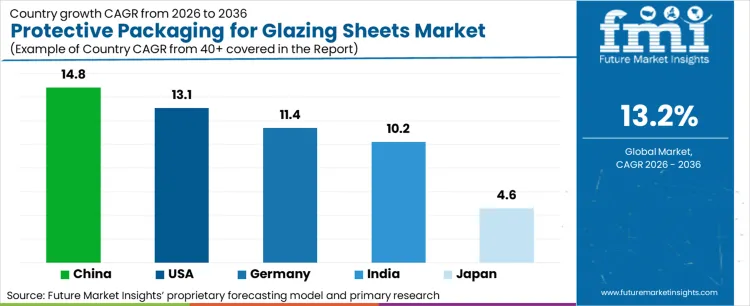
| Country | CAGR (2026-2036) |
| China | 14.80% |
| United States | 13.10% |
| Germany | 11.40% |
| India | 10.20% |
| Japan | 4.60% |
Source: Future Market Insights (FMI), proprietary forecasting model and primary research
Why is China Emerging as the Fastest-Growing Market for Glazing Sheet Protection?
China is projected to grow at a 14.80% CAGR from 2026 to 2036, making it the fastest-expanding national market for protective packaging for glazing sheets. This growth is directly linked to the scale of high-rise construction, infrastructure-led urban redevelopment, and the rapid expansion of domestic architectural glass fabrication capacity. Large-format glazing units with low-E and solar-control coatings are now standard across commercial developments, significantly increasing sensitivity to micro-scratches, haze formation, and coating contamination during handling and transport.
In addition, China’s glazing supply chains are lengthening. Sheets increasingly move from float plants to regional tempering and insulating hubs before final delivery or export, multiplying handling nodes and vibration exposure. As a result, fabricators are shifting away from simple paper or generic film protection toward integrated stacks combining low-tack surface films, foam interleaving, and edge spacers. This structural change, not just volume growth, underpins China’s elevated growth trajectory.
How are Quality Liability and Retrofit Activity Driving USA Market Expansion?
The United States market is expected to expand at a 13.10% CAGR over the forecast period, supported by sustained commercial retrofit activity and stringent quality acceptance norms. In the USA, glazing defects are often discovered late- during façade installation or post-installation inspection- when replacement costs are magnified by labor, access equipment, and schedule disruption. This economic asymmetry strongly favors engineered protective packaging that reduces late-stage defect risk.
Another driver is the growing institutionalization of inbound quality checks by glazing contractors and façade installers. Fabricators are increasingly required to demonstrate residue-free removal and surface integrity upon delivery. This shifts packaging decisions upstream and embeds protective films and interleaving systems into supplier qualification processes, reinforcing steady double-digit growth through 2036.
Why does Germany Show Strong Growth Despite a Mature Construction Market?
Germany is projected to grow at an 11.40% CAGR from 2026 to 2036, reflecting value-led expansion rather than sheer construction volume growth. German glazing markets are characterized by rigorous specification discipline, high adoption of energy-efficient glazing, and strict alignment with recyclability and waste-handling frameworks. These factors collectively raise the performance bar for protective packaging systems.
As regulatory clarity discourages difficult-to-recycle protection materials, glazing processors are upgrading to mono-material polyethylene film systems combined with recyclable interleaving and edge protection. This substitution effect- replacing legacy formats with engineered, compliance-defensible solutions- drives market growth even in a structurally mature construction environment.
What is Supporting India’s Steady Uptake of Glazing Sheet Protection Solutions?
India is forecast to expand at a 10.20% CAGR between 2026 and 2036, driven by rapid growth in commercial construction, airports, metro infrastructure, and high-end residential projects. While cost sensitivity remains high, the share of projects specifying coated architectural glass is rising, particularly in Tier-1 cities and export-oriented fabrication hubs.
As glazing units travel longer distances between fabrication and installation sites, damage risk increases and on-site remediation becomes less viable. This encourages gradual adoption of protective films and interleaving systems, especially among organized fabricators serving institutional and international clients. Growth is therefore incremental but structurally supported by upgrading project requirements.
Why is Japan’s Growth More Moderate Despite High Finish Expectations?
Japan is expected to grow at a 4.60% CAGR through 2036, reflecting a market where high-quality handling practices and protective measures are already widely embedded. Japanese glazing supply chains emphasize precision, cleanliness, and disciplined handling, limiting the scope for rapid volume expansion in protective packaging consumption.
However, modest growth persists as fabricators seek packaging solutions that reduce labor effort, simplify removal, and minimize waste generation. Incremental upgrades- such as improved peel-performance films and standardized interleaving- support continued value growth even as overall market expansion remains comparatively restrained.
What Is the Competition Outlook for the Protective Packaging for Glazing Sheets Market?
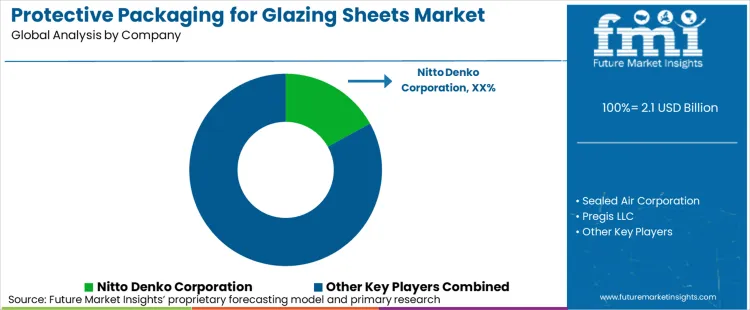
Competition in the protective packaging for glazing sheets market is increasingly shaped by adhesive science depth, surface-compatibility validation, and automation readiness, rather than by material pricing alone. As glazing substrates incorporate multi-layer functional coatings and larger sheet formats, packaging suppliers are being evaluated on their ability to prevent optical defects and residue-related failures across extended handling and storage cycles. This has shifted buyer preference toward suppliers capable of offering substrate-specific protection systems rather than generic masking or interleaving materials.
A key competitive differentiator is adhesive performance predictability. Leading suppliers invest heavily in controlled-tack formulations that maintain adhesion through vibration, humidity, and temperature variation while guaranteeing clean, residue-free removal even after prolonged storage. In architectural and automotive-linked glazing supply chains, failure at the removal stage is unacceptable, as residue or ghosting can permanently impair optical quality. As a result, suppliers that can document peel-force stability and removability across multiple coating chemistries gain preferred-supplier status.
Another axis of competition is system-level packaging capability. Customers increasingly favor vendors that can integrate surface films with foam interleaving, edge spacers, and corner protection into a unified protection architecture. This systems approach reduces variability and simplifies qualification for large fabricators and OEM-linked processors. Suppliers that support automated application and standardized removal procedures further strengthen their position by reducing labor intensity and defect variance- two KPIs that procurement teams increasingly prioritize.
Key Players Profiled in the Protective Packaging for Glazing Sheets Market
- Nitto Denko Corporation
- Sealed Air Corporation
- Pregis LLC
- Toppan Inc.
- Berry Global Group, Inc.
Market Definition
The protective packaging for glazing sheets market comprises engineered packaging solutions designed to preserve surface integrity, optical clarity, and coating performance of rigid glazing substrates throughout storage, handling, transportation, and installation. Glazing sheets within scope include architectural glass, automotive glazing panels, polycarbonate sheets, acrylic panels, and coated specialty laminates used in construction, transportation, and industrial applications.
The market includes low-tack protective films, polyethylene foam interleaving sheets, corrugated edge spacers, corner protectors, and integrated protection stacks engineered to mitigate abrasion, particulate imprinting, coating oxidation, and edge chipping. The scope excludes bulk transport packaging for unprocessed float glass, non-surface-contact dunnage, and downstream installation services.
Scope of the Report
| Attribute | Details |
| Quantitative Units (2026) | USD 2,140 million |
| Sheet Types Covered | Architectural Glass, Automotive Glazing, Polycarbonate Sheets, Acrylic Sheets |
| Protection Methods | Protective Films, Foam Interleaving, Edge & Corner Protection |
| Materials | LDPE Films, Polyethylene Foam, Corrugated Board |
| Regions Covered | North America, Europe, East Asia, South Asia, Japan, Rest of the World |
| Key Countries | United States, China, Germany, India, Japan |
Source: Future Market Insights (FMI), proprietary forecasting model and primary research
Protective Packaging for Glazing Sheets Market Key Segments
By Sheet Type
- Architectural Glass
- Automotive Glazing
- Polycarbonate Sheets
- Acrylic Sheets
By Protection Method
- Low-Tack Protective Films
- Foam Sheet Interleaving
- Edge and Corner Protection
By Material
- LDPE Films
- Polyethylene Foam
- Corrugated Board
By Region
- North America
- Europe
- East Asia
- South Asia
- Japan
- Rest of the World
Bibliography
- International Organization for Standardization. (2025). ISO 18604: Packaging and the environment — Material recycling. ISO.
- European Union. (2024). Regulation on packaging and packaging waste (Packaging and Packaging Waste Regulation). Official Journal of the European Union.
- Glass Association of North America. (2024). Best practices for handling and storage of architectural glazing products. GANA.
- International Energy Agency. (2025). Building envelopes and energy-efficient glazing systems. IEA Publications.
Frequently Asked Questions
What is the growth outlook for the protective packaging for glazing sheets market?
The market is projected to grow at a 13.2% CAGR from 2026 to 2036, driven by increasing adoption of coated glazing and the rising cost of late-stage defect discovery.
How large is the market expected to be by 2036?
FMI estimates the market will reach USD 7,380 million by 2036, up from USD 2,140 million in 2026.
Which glazing segment drives the highest demand for protective packaging?
Architectural glass dominates demand due to its widespread use in commercial construction and its high sensitivity to surface scratches and coating defects.
What protection methods are most commonly specified?
Low-tack protective films lead adoption, often combined with foam interleaving and edge protection to control abrasion, vibration damage, and edge chipping.
Which countries are expected to grow the fastest?
China leads growth with a 14.80% CAGR, followed by the United States at 13.10%, reflecting rapid construction activity and stringent surface-quality expectations.
Preview the report firsthand - request a free sample
Get SampleGet the brochure for pricing and purchase details.
Get PDFTable of Content
- Executive Summary
- Global Market Outlook
- Demand-side Trends
- Supply-side Trends
- Technology Roadmap Analysis
- Analysis and Recommendations
- Market Overview
- Market Coverage / Taxonomy
- Market Definition / Scope / Limitations
- Research Methodology
- Chapter Orientation
- Analytical Lens and Working Hypotheses
- Market Structure, Signals, and Trend Drivers
- Benchmarking and Cross-market Comparability
- Market Sizing, Forecasting, and Opportunity Mapping
- Research Design and Evidence Framework
- Desk Research Programme (Secondary Evidence)
- Company Annual and Sustainability Reports
- Peer-reviewed Journals and Academic Literature
- Corporate Websites, Product Literature, and Technical Notes
- Earnings Decks and Investor Briefings
- Statutory Filings and Regulatory Disclosures
- Technical White Papers and Standards Notes
- Trade Journals, Industry Magazines, and Analyst Briefs
- Conference Proceedings, Webinars, and Seminar Materials
- Government Statistics Portals and Public Data Releases
- Press Releases and Reputable Media Coverage
- Specialist Newsletters and Curated Briefings
- Sector Databases and Reference Repositories
- FMI Internal Proprietary Databases and Historical Market Datasets
- Subscription Datasets and Paid Sources
- Social Channels, Communities, and Digital Listening Inputs
- Additional Desk Sources
- Expert Input and Fieldwork (Primary Evidence)
- Primary Modes
- Qualitative Interviews and Expert Elicitation
- Quantitative Surveys and Structured Data Capture
- Blended Approach
- Why Primary Evidence is Used
- Field Techniques
- Interviews
- Surveys
- Focus Groups
- Observational and In-context Research
- Social and Community Interactions
- Stakeholder Universe Engaged
- C-suite Leaders
- Board Members
- Presidents and Vice Presidents
- R&D and Innovation Heads
- Technical Specialists
- Domain Subject-matter Experts
- Scientists
- Physicians and Other Healthcare Professionals
- Governance, Ethics, and Data Stewardship
- Research Ethics
- Data Integrity and Handling
- Primary Modes
- Tooling, Models, and Reference Databases
- Desk Research Programme (Secondary Evidence)
- Data Engineering and Model Build
- Data Acquisition and Ingestion
- Cleaning, Normalisation, and Verification
- Synthesis, Triangulation, and Analysis
- Quality Assurance and Audit Trail
- Market Background
- Market Dynamics
- Drivers
- Restraints
- Opportunity
- Trends
- Scenario Forecast
- Demand in Optimistic Scenario
- Demand in Likely Scenario
- Demand in Conservative Scenario
- Opportunity Map Analysis
- Product Life Cycle Analysis
- Supply Chain Analysis
- Investment Feasibility Matrix
- Value Chain Analysis
- PESTLE and Porter’s Analysis
- Regulatory Landscape
- Regional Parent Market Outlook
- Production and Consumption Statistics
- Import and Export Statistics
- Market Dynamics
- Global Market Analysis 2021 to 2025 and Forecast, 2026 to 2036
- Historical Market Size Value (USD Million) Analysis, 2021 to 2025
- Current and Future Market Size Value (USD Million) Projections, 2026 to 2036
- Y-o-Y Growth Trend Analysis
- Absolute $ Opportunity Analysis
- Global Market Pricing Analysis 2021 to 2025 and Forecast 2026 to 2036
- Global Market Analysis 2021 to 2025 and Forecast 2026 to 2036, By Sheet Type
- Introduction / Key Findings
- Historical Market Size Value (USD Million) Analysis By Sheet Type , 2021 to 2025
- Current and Future Market Size Value (USD Million) Analysis and Forecast By Sheet Type , 2026 to 2036
- Architectural Glass Sheets
- Automotive Glazing
- Polycarbonate Sheets
- Acrylic Sheets
- Architectural Glass Sheets
- Y-o-Y Growth Trend Analysis By Sheet Type , 2021 to 2025
- Absolute $ Opportunity Analysis By Sheet Type , 2026 to 2036
- Global Market Analysis 2021 to 2025 and Forecast 2026 to 2036, By Protection Method
- Introduction / Key Findings
- Historical Market Size Value (USD Million) Analysis By Protection Method, 2021 to 2025
- Current and Future Market Size Value (USD Million) Analysis and Forecast By Protection Method, 2026 to 2036
- Low-Tack Protective Films
- Foam Sheet Interleaving
- Edge and Corner Protection
- Low-Tack Protective Films
- Y-o-Y Growth Trend Analysis By Protection Method, 2021 to 2025
- Absolute $ Opportunity Analysis By Protection Method, 2026 to 2036
- Global Market Analysis 2021 to 2025 and Forecast 2026 to 2036, By Material
- Introduction / Key Findings
- Historical Market Size Value (USD Million) Analysis By Material, 2021 to 2025
- Current and Future Market Size Value (USD Million) Analysis and Forecast By Material, 2026 to 2036
- LDPE Films
- Polyethylene Foam
- Corrugated Board
- LDPE Films
- Y-o-Y Growth Trend Analysis By Material, 2021 to 2025
- Absolute $ Opportunity Analysis By Material, 2026 to 2036
- Global Market Analysis 2021 to 2025 and Forecast 2026 to 2036, By Region
- Introduction
- Historical Market Size Value (USD Million) Analysis By Region, 2021 to 2025
- Current Market Size Value (USD Million) Analysis and Forecast By Region, 2026 to 2036
- North America
- Latin America
- Western Europe
- Eastern Europe
- East Asia
- South Asia and Pacific
- Middle East & Africa
- Market Attractiveness Analysis By Region
- North America Market Analysis 2021 to 2025 and Forecast 2026 to 2036, By Country
- Historical Market Size Value (USD Million) Trend Analysis By Market Taxonomy, 2021 to 2025
- Market Size Value (USD Million) Forecast By Market Taxonomy, 2026 to 2036
- By Country
- USA
- Canada
- Mexico
- By Sheet Type
- By Protection Method
- By Material
- By Country
- Market Attractiveness Analysis
- By Country
- By Sheet Type
- By Protection Method
- By Material
- Key Takeaways
- Latin America Market Analysis 2021 to 2025 and Forecast 2026 to 2036, By Country
- Historical Market Size Value (USD Million) Trend Analysis By Market Taxonomy, 2021 to 2025
- Market Size Value (USD Million) Forecast By Market Taxonomy, 2026 to 2036
- By Country
- Brazil
- Chile
- Rest of Latin America
- By Sheet Type
- By Protection Method
- By Material
- By Country
- Market Attractiveness Analysis
- By Country
- By Sheet Type
- By Protection Method
- By Material
- Key Takeaways
- Western Europe Market Analysis 2021 to 2025 and Forecast 2026 to 2036, By Country
- Historical Market Size Value (USD Million) Trend Analysis By Market Taxonomy, 2021 to 2025
- Market Size Value (USD Million) Forecast By Market Taxonomy, 2026 to 2036
- By Country
- Germany
- UK
- Italy
- Spain
- France
- Nordic
- BENELUX
- Rest of Western Europe
- By Sheet Type
- By Protection Method
- By Material
- By Country
- Market Attractiveness Analysis
- By Country
- By Sheet Type
- By Protection Method
- By Material
- Key Takeaways
- Eastern Europe Market Analysis 2021 to 2025 and Forecast 2026 to 2036, By Country
- Historical Market Size Value (USD Million) Trend Analysis By Market Taxonomy, 2021 to 2025
- Market Size Value (USD Million) Forecast By Market Taxonomy, 2026 to 2036
- By Country
- Russia
- Poland
- Hungary
- Balkan & Baltic
- Rest of Eastern Europe
- By Sheet Type
- By Protection Method
- By Material
- By Country
- Market Attractiveness Analysis
- By Country
- By Sheet Type
- By Protection Method
- By Material
- Key Takeaways
- East Asia Market Analysis 2021 to 2025 and Forecast 2026 to 2036, By Country
- Historical Market Size Value (USD Million) Trend Analysis By Market Taxonomy, 2021 to 2025
- Market Size Value (USD Million) Forecast By Market Taxonomy, 2026 to 2036
- By Country
- China
- Japan
- South Korea
- By Sheet Type
- By Protection Method
- By Material
- By Country
- Market Attractiveness Analysis
- By Country
- By Sheet Type
- By Protection Method
- By Material
- Key Takeaways
- South Asia and Pacific Market Analysis 2021 to 2025 and Forecast 2026 to 2036, By Country
- Historical Market Size Value (USD Million) Trend Analysis By Market Taxonomy, 2021 to 2025
- Market Size Value (USD Million) Forecast By Market Taxonomy, 2026 to 2036
- By Country
- India
- ASEAN
- Australia & New Zealand
- Rest of South Asia and Pacific
- By Sheet Type
- By Protection Method
- By Material
- By Country
- Market Attractiveness Analysis
- By Country
- By Sheet Type
- By Protection Method
- By Material
- Key Takeaways
- Middle East & Africa Market Analysis 2021 to 2025 and Forecast 2026 to 2036, By Country
- Historical Market Size Value (USD Million) Trend Analysis By Market Taxonomy, 2021 to 2025
- Market Size Value (USD Million) Forecast By Market Taxonomy, 2026 to 2036
- By Country
- Kingdom of Saudi Arabia
- Other GCC Countries
- Turkiye
- South Africa
- Other African Union
- Rest of Middle East & Africa
- By Sheet Type
- By Protection Method
- By Material
- By Country
- Market Attractiveness Analysis
- By Country
- By Sheet Type
- By Protection Method
- By Material
- Key Takeaways
- Key Countries Market Analysis
- USA
- Pricing Analysis
- Market Share Analysis, 2025
- By Sheet Type
- By Protection Method
- By Material
- Canada
- Pricing Analysis
- Market Share Analysis, 2025
- By Sheet Type
- By Protection Method
- By Material
- Mexico
- Pricing Analysis
- Market Share Analysis, 2025
- By Sheet Type
- By Protection Method
- By Material
- Brazil
- Pricing Analysis
- Market Share Analysis, 2025
- By Sheet Type
- By Protection Method
- By Material
- Chile
- Pricing Analysis
- Market Share Analysis, 2025
- By Sheet Type
- By Protection Method
- By Material
- Germany
- Pricing Analysis
- Market Share Analysis, 2025
- By Sheet Type
- By Protection Method
- By Material
- UK
- Pricing Analysis
- Market Share Analysis, 2025
- By Sheet Type
- By Protection Method
- By Material
- Italy
- Pricing Analysis
- Market Share Analysis, 2025
- By Sheet Type
- By Protection Method
- By Material
- Spain
- Pricing Analysis
- Market Share Analysis, 2025
- By Sheet Type
- By Protection Method
- By Material
- France
- Pricing Analysis
- Market Share Analysis, 2025
- By Sheet Type
- By Protection Method
- By Material
- India
- Pricing Analysis
- Market Share Analysis, 2025
- By Sheet Type
- By Protection Method
- By Material
- ASEAN
- Pricing Analysis
- Market Share Analysis, 2025
- By Sheet Type
- By Protection Method
- By Material
- Australia & New Zealand
- Pricing Analysis
- Market Share Analysis, 2025
- By Sheet Type
- By Protection Method
- By Material
- China
- Pricing Analysis
- Market Share Analysis, 2025
- By Sheet Type
- By Protection Method
- By Material
- Japan
- Pricing Analysis
- Market Share Analysis, 2025
- By Sheet Type
- By Protection Method
- By Material
- South Korea
- Pricing Analysis
- Market Share Analysis, 2025
- By Sheet Type
- By Protection Method
- By Material
- Russia
- Pricing Analysis
- Market Share Analysis, 2025
- By Sheet Type
- By Protection Method
- By Material
- Poland
- Pricing Analysis
- Market Share Analysis, 2025
- By Sheet Type
- By Protection Method
- By Material
- Hungary
- Pricing Analysis
- Market Share Analysis, 2025
- By Sheet Type
- By Protection Method
- By Material
- Kingdom of Saudi Arabia
- Pricing Analysis
- Market Share Analysis, 2025
- By Sheet Type
- By Protection Method
- By Material
- Turkiye
- Pricing Analysis
- Market Share Analysis, 2025
- By Sheet Type
- By Protection Method
- By Material
- South Africa
- Pricing Analysis
- Market Share Analysis, 2025
- By Sheet Type
- By Protection Method
- By Material
- USA
- Market Structure Analysis
- Competition Dashboard
- Competition Benchmarking
- Market Share Analysis of Top Players
- By Regional
- By Sheet Type
- By Protection Method
- By Material
- Competition Analysis
- Competition Deep Dive
- Nitto Denko Corporation
- Overview
- Product Portfolio
- Profitability by Market Segments (Product/Age /Sales Channel/Region)
- Sales Footprint
- Strategy Overview
- Marketing Strategy
- Product Strategy
- Channel Strategy
- Sealed Air Corporation
- Pregis LLC
- Toppan Inc.
- Berry Global Group, Inc.
- Nitto Denko Corporation
- Competition Deep Dive
- Assumptions & Acronyms Used


