

- Market Size (2026)
- USD 773.8 Mn
- Forecast (2036)
- USD 1580.0 Mn
- CAGR (2026 to 2036)
- 7.4%
How big is Bio-Based Cold-Chain Insulation Packaging Market in 2026?
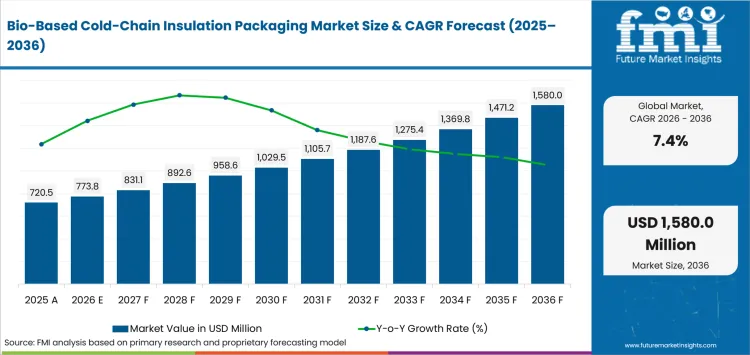
USD 773.8 million in 2026 and USD 1580.0 million by 2036 at a 7.4% CAGR.
Demand for bio-based cold-chain insulation packaging is projected to expand at 7.4% CAGR between 2026 and 2036, increasing valuation from USD 773.8 million in 2026 to USD 1580.0 million by 2036. Food and pharmaceutical shippers increasingly need temperature-controlled packaging systems that protect payloads without leaving rigid foam at the destination. Renewable cold-chain packaging systems now combine fiber or plant-starch insulation with familiar corrugated cases and repeatable pack-out instructions. Visy reported in April 2026 that Visycell produced 41% fewer greenhouse gas emissions than an EPS equivalent across two cold-chain applications. The comparison gives packaging teams a measured replacement case, but route qualification must confirm temperature control across seasonal handling and local disposal conditions.
North America programs often begin with parcel qualification and local recovery claims that vary across municipal collection systems. European programs must meet a common packaging design framework that changes material selection across every disposable component. Regulation (EU) 2025/40 entered into force in February 2025 and generally applies from August 2026 across packaging sold within the European Union. The regulation establishes staged recyclability requirements and tighter controls on substances of concern within food-contact packaging structures. The new requirements directly affect pharmaceutical cold-chain packaging that combines insulation with films, adhesives and coolant components. Packaging teams need one design record that connects performance testing with the disposal route claimed for each target market. Commercial adoption depends on thermal evidence and clear material separation, rather than a broad renewable-content claim applied across every destination.
Key Takeaways of Bio-Based Cold-Chain Insulation Packaging Market
- Food and pharmaceutical shippers are increasing demand for renewable insulation that protects validated temperatures and gives recipients practical disposal steps.
- Paper is projected to account for 38.0% of material demand in 2026, supported by familiar corrugated converting and case-integration capacity.
- Cold chain is estimated to capture 42.0% of end-use demand in 2026, reflecting recurring spending on qualified temperature-control systems.
- North America is anticipated to represent 35.0% of regional demand in 2026, aided by established qualification laboratories and dense parcel networks.
- Moisture exposure and uneven recycling access can weaken the operating case across long routes or poorly controlled delivery conditions.
- Competition spans TemperPack, DS Smith, Veritiv, Visy, Storopack, Woolcool, Cold Chain Technologies, and Ranpak across fiber, wool, plant-starch, distribution, and qualification models.
Analyst Perspective
"Bio-based cold-chain insulation succeeds when a packaging team treats material choice as part of a qualified shipping system. The liner must control temperature across real routes, fit existing pack-out work and separate cleanly at the destination. Companies that connect laboratory evidence with regional production and clear recovery instructions are better placed to turn limited trials into repeat orders."
- Nandini Roy Choudhury, Principal Analyst, Future Market Insights
How is the Bio-Based Cold-Chain Insulation Packaging Market segmented?
The bio-based cold-chain insulation packaging industry is segmented by material, format, barrier or feature, end use, and region.
By material, the market is segmented by paper, molded fiber, recycled pet, mono-material PE, bio-based polymer. Format defines the pack-out geometry across pouches, trays, labels, mailers, and inserts placed around the payload. Barrier or feature records grease resistance, high barrier performance, tamper evidence, traceability, and freshness indication without changing the required temperature profile. End use identifies the operating setting that funds qualification and sets the acceptable handling risk. Region captures recovery access, labeling rules, route length, and service availability that can change material selection across otherwise similar shipping programs.
Why does paper account for the largest material share in the bio-based cold-chain insulation packaging market?
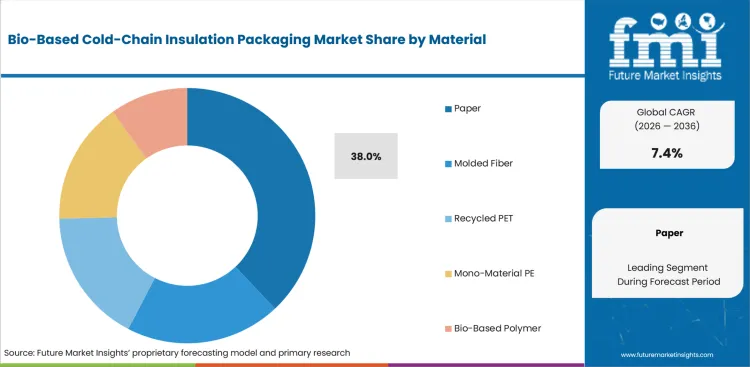
Paper integrates with corrugated cases and familiar cutting operations, which reduces the number of new steps required during pack-out qualification. Visy launched Visycell in April 2025 as a fiber thermal liner made from cardboard waste offcuts for temperature-sensitive food and beverage shipments. Its flat-packed construction supports warehouse storage and existing case assembly, but humid routes require barrier and seal testing across the complete package.
- Paper is set to lead the material category with 38.0% share in 2026 due to established corrugated converting and case-integration capacity. Packaging engineers can test familiar cutting and folding steps without rebuilding the complete packing line. Moisture-heavy routes limit broader substitution, so paper does not replace every molded or foam alternative.
- Food delivery programs favor paper liners that store flat and provide simple disposal instructions at the destination. Pharmaceutical routes require seasonal testing across adhesives and barrier-coated papers as a condition for recurring use. Adoption therefore advances first across short or moderate lanes with controlled handling and replacement stock positioned near pack-out sites.
What keeps pouches relevant within the format category?
Insulated pouches use flexible walls around smaller chilled orders that do not need the protection of a rigid shipper. Their compact form reduces empty-pack storage and lets fulfillment teams adjust pack-outs for changing daily order mixes. Woolcool introduced an insulated paper pouch in August 2025 that reduced plastic use by more than 70% against its plastic pouch. Limited coolant space and compression exposure restrict longer routes that involve repeated parcel handling or fragile payloads.
- Based on format, pouches are projected to account for 23.0% in 2026 due to compact pack-outs for small chilled consignments and direct delivery. Flexible walls fit irregular payloads without occupying substantial storage space across busy fulfillment benches and storage areas. Compression risk and limited coolant volume reduce the segment's suitability for long-duration shipments and fragile payloads.
- Direct-to-consumer food operators use paper pouch formats to simplify packing across small orders and limited storage areas. Pharmacy programs require stronger puncture controls and documented temperature profiles for medicines that cannot tolerate delivery delays. Pouch adoption grows across predictable routes that require moderate coolant volumes and limited handling protection. Rigid formats remain necessary for fragile payloads or deliveries that face longer uncontrolled transit windows.
How does grease resistance shape barrier or feature demand?
Grease resistance protects chilled foods whose oils can weaken paper surfaces, seals and printed presentation during handling. Packaging engineers must balance food-contact performance with printability and fiber recovery across the complete structure. Lecta launched Creaset HGP in April 2025 as a PFAS-free grease-resistant paper for flexible food packaging. The grade supports butter and pet-food formats with established printing methods and documented recyclability assessments.
- The grease-resistant feature is projected to hold 25.0% share in 2026 owing to direct protection needs across chilled and fatty foods. Coated paper must retain seal strength and surface quality through refrigeration and filling operations during commercial production. High-moisture products can require added layers that raise qualification effort and weaken the recovery case for the finished package.
- Manufacturers evaluating sustainable packaging must test coating behavior against refrigeration, heat sealing and line speed on their own equipment. Acceptance depends on the complete structure maintaining food-contact performance and separating cleanly from coolant materials. Adoption remains slower across wet products that require extra barriers or complex laminate structures during repeated distribution.
Why does cold chain account for the largest end-use share?
Cold-chain operators purchase insulation as part of a complete temperature-control system rather than as an isolated material component. Coolant geometry and pack-out instructions determine whether renewable liners protect high-value payloads across seasonal profiles and repeated handling events. Veritiv introduced TempSafe PalletShield in December 2025 with more than five days of validated protection across refrigerated and frozen conditions. The development shows how passive temperature-controlled packaging combines insulation, coolant placement and repeatable assembly instructions.
- The end-use category is forecast to be led by cold chain at 42.0% share in 2026 due to recurring temperature-control responsibility across food and life-science distribution. Cold-chain programs fund insulation as part of a qualified system rather than a disposable accessory. Temperature failure carries direct product-loss or compliance consequences that support consistent spending across recurring shipments.
- Pharmaceutical distributors require documented seasonal profiles and repeatable pack-out instructions across every approved facility and route. Food delivery operators can accept simpler qualification across short shipments with predictable handoffs and lower payload values. Moisture control and recipient disposal guidance remain decisive checks that affect repeat purchasing across recurring parcel routes.
What are the drivers, restraints, and opportunities in the Bio-Based Cold-Chain Insulation Packaging Market?
Bio-based insulation gains from PFAS and foam-reduction pressure, but thermal qualification and uneven recovery systems determine which cold-chain applications convert first.
- Driver: Food-contact and packaging rules are increasing interest in renewable insulation structures with documented performance and clearer material separation.
- Restraint: Humidity exposure and qualification expense limit substitution across long routes that require precise temperatures through several handling environments.
- Opportunity: Validated thermal designs and regional production can reduce rollout friction for recurring food and pharmaceutical shipping programs.
Food-contact rules are one of the factors replacing legacy grease-proofing chemistry within paper-led cold-chain packs. The FDA stated in January 2025 that authorizations for 35 PFAS-related food-contact notifications were no longer effective. The affected notifications covered grease-proofing uses within paper and paperboard food packaging applications across commercial markets. The change supports fluorine-free barriers across chilled food routes and reduces reliance on older coating chemistry. Each finished structure requires separate food-contact and performance review as a condition for recurring commercial approval.
Thermal qualification remains a significant restraint as renewable materials respond differently to humidity and coolant placement. TemperPack launched its Qualified Shipper Program in September 2025 with prevalidated systems and ISTA reports for pharmaceutical users. The service shows the evidence needed to confirm seasonal performance across specialized medicines and recurring shipping lanes. Smaller food shippers often lack comparable testing budgets and may retain familiar foam systems despite disposal concerns. Qualification cost therefore limits conversion despite a material design that fits existing pack-out operations during recurring distribution.
Material-specific waste rules create an opportunity for designs that remove difficult-to-recover components without weakening thermal protection. PackUK confirmed in June 2025 that modulated fees begin in 2026 through red, amber and green recyclability assessments. The framework gives packaging teams a measurable reason to simplify laminates and examine molded fiber inserts alongside paper liners. Providers must explain thermal performance and final material classification as a condition for wider recurring commercial approval.
Which country CAGRs are profiled in the Bio-Based Cold-Chain Insulation Packaging Market?
| Country | CAGR |
|---|---|
| India | 10.0% |
| United States | 9.3% |
| Japan | 8.5% |
| United Kingdom | 7.8% |
| France | 7.0% |
| Germany | 6.3% |
How do country-level CAGRs compare in the Bio-Based Cold-Chain Insulation Packaging Market?
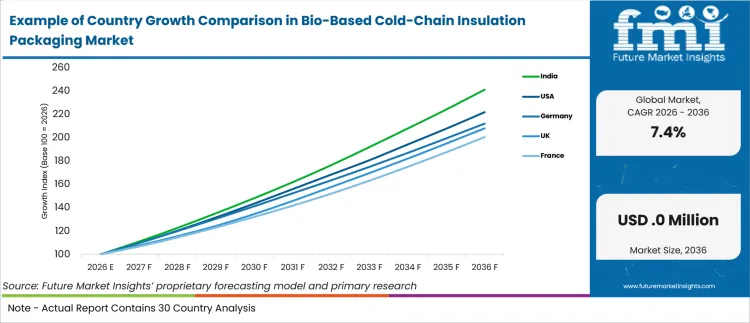
The country forecasts show a clear progression across the bio-based cold-chain insulation packaging market, reflecting varying levels of sustainable packaging adoption within temperature-controlled logistics networks. India and the United States form the upper end of the comparison, supported by expanding pharmaceutical distribution, growing biologics shipments and increasing interest in lower-impact packaging materials. Japan creates a transition between the higher-growth markets and the European countries, where adoption remains steady but more measured. The United Kingdom, France and Germany follow in a gradual sequence rather than forming distinct growth tiers.
- India benefits from rapid growth in healthcare logistics, vaccine distribution networks and temperature-controlled food supply chains, creating strong demand for sustainable insulation packaging alternatives.
- The United States reflects increasing adoption of bio-based cold-chain solutions as pharmaceutical manufacturers and logistics providers pursue packaging sustainability targets without compromising thermal performance.
- Japan supports market growth through its emphasis on packaging quality, product integrity and reliable temperature management for healthcare and specialty food applications.
- The United Kingdom continues to encourage adoption through sustainability initiatives and growing use of insulated packaging solutions across pharmaceutical and e-commerce cold-chain operations.
- France's outlook is influenced by rising demand for recyclable and renewable packaging materials that align with broader environmental objectives across the supply chain.
- Germany maintains steady momentum as cold-chain operators evaluate bio-based insulation materials that can support both thermal efficiency and circular economy goals.
Similar CAGRs do not necessarily translate into identical commercial opportunities. Differences in cold-chain infrastructure, regulatory expectations, sustainability priorities and qualification requirements for temperature-sensitive shipments can significantly influence adoption patterns. As a result, suppliers may encounter distinct commercialization pathways even where growth forecasts appear broadly comparable. The full report provides country-level CAGR analysis across North America, Latin America, Europe, East Asia, South Asia, Oceania and the Middle East and Africa.
Country-wise Analysis
- India's cold-storage base connects production areas with urban distribution centers and creates recurring demand across produce, dairy and processed-food shipments. Official data from the Press Information Bureau placed India's cold-storage network at 8,815 facilities with 40.21 million tonnes of capacity in June 2025. Adoption of bio-based cold-chain insulation packaging in India is estimated to expand at 10.0% CAGR through 2036, supported by refrigerated handling and direct delivery. Local paper manufacturing gives pack-out sites a practical source of liners and corrugated cases near major consumption centers. Long transport distances expose packages to humidity and repeated handling that can reduce liner performance. Packaging teams should validate regional summer profiles and maintain replacement stock near the largest cold-storage clusters.
- Specialty pharmacies in the United States increasingly use parcel networks to deliver refrigerated medicines from regional dispensing facilities. The United States bio-based cold-chain insulation packaging sector is projected to record 9.3% CAGR during the assessment period, underpinned by qualified pharmacy delivery routes. Domestic laboratories provide seasonal qualification and replenishment support across major pharmaceutical shipping corridors and nationwide programs. Cold Chain Technologies reported in May 2025 that UVA Health Pharmacy Services used Rx Naturals for home deliveries serving more than 25,000 patients annually. The deployment shows that renewable insulation can support regulated medicine routes at recurring commercial scale. Municipal recovery rules change between destinations and make one disposal claim unsuitable for every patient delivery.
- Japan's dense urban parcel networks create chilled shipping demand across compact food and pharmacy fulfillment sites. In Japan, bio-based cold-chain insulation packaging demand is predicted to advance at 8.5% CAGR through 2036. Data from METI showed that online sales of food and beverages increased 6.36% during 2024. The increase supports recurring insulated shipments across national meal delivery and specialty grocery route programs. Flexible pouches and flat-packed fiber liners reduce storage pressure across urban fulfillment and pharmacy facilities. Humid summer conditions require careful moisture testing across paper insulation, seals and adhesives used in recurring shipments.
- United Kingdom pharmaceutical distribution combines national parcel coverage with a local base for regulated life-science packaging. The United Kingdom is estimated to post 7.8% CAGR over the forecast period, reinforced by local thermal design and qualification services. Domestic engineering services help distribution teams repeat route tests and maintain replacement inventory across national programs. Wet delivery conditions and mixed material structures complicate recovery claims for paper-led alternatives across national parcel routes. Cold Chain Technologies stated in January 2026 that Tower Cold Chain had been integrated as CCT UK within its global operating network. The integration gives pharmaceutical programs local access to parcel and pallet systems with thermal design support.
- France processes household packaging through established sorting systems that offer a recovery route for clean paper-led structures. ADEME reported in April 2026 that 4.893 million tonnes of household packaging and graphic paper were sorted for recycling during 2024. France's bio-based cold-chain insulation packaging outlook is anticipated to advance at 7.0% CAGR over the assessment period, shaped by food delivery and stricter recyclability expectations. The agency placed household packaging recycling at 69.6% across the national recovery system for the same year. The recovery base supports insulation that separates cleanly from coolant packs and films at the destination. Composite coatings can alter sorting outcomes and weaken recovery claims for the complete package under household collection rules.
- Germany routes household packaging through dual collection systems with material-specific requirements and monitored recycling targets. Bio-based cold-chain insulation packaging demand in Germany is forecast to rise at 6.3% CAGR over the forecast period, influenced by mature collection and strict documentation. The operating base supports paper-led thermal packs with clear separation steps and verified fiber recovery. The German Environment Agency recorded in January 2026 that dual systems recycled about 5.5 million tonnes of packaging waste during 2024. Paper and cardboard met statutory recycling targets within the same monitored collection framework during that year. Coatings and mixed layers can reduce assessed recyclability for the complete shipping package under German rules. Packaging engineers should test the full pack instead of assuming the outer paper case determines the recovery result.
Who are the notable companies in the Bio-Based Cold-Chain Insulation Packaging Market?
TemperPack, DS Smith, an International Paper company, Veritiv, Visy, Storopack, Woolcool, Cold Chain Technologies, and Ranpak form the principal company set assessed for this market.
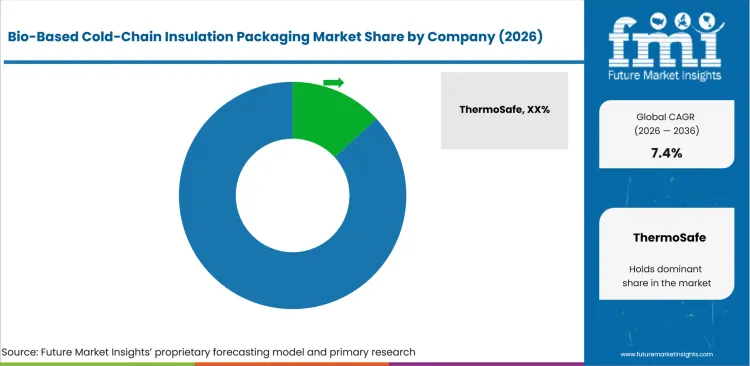
The competitive outlook separates proprietary insulation developers from packaging groups that combine material design with engineering and distribution support. International Paper completed its combination with DS Smith in January 2025, which confirms the current ownership description used in this article. TemperPack and Woolcool focus on plant-based or natural-fiber insulation across recurring food and life-science distribution routes. DS Smith and Visy integrate fiber liners with corrugated system design across established packaging operations. Veritiv and Cold Chain Technologies provide qualified pharmaceutical configurations with engineering support across demanding distribution routes. Storopack and Ranpak add paper or plant-starch formats for food delivery and parcel applications across several regions. Final selection depends on verified temperature performance, pack-out complexity and service coverage across the target routes.
- TemperPack and Cold Chain Technologies support life-science programs through qualified systems and documented pack-out configurations. The commercial test is repeatable seasonal performance across established shipping lanes, including engineering support during site qualification and later replenishment. Programs should compare replacement inventory and laboratory access across every operating region during final approval.
- DS Smith and Visy combine fiber insulation with corrugated design, and Ranpak adds flexible paper liners for parcel shipments across food distribution routes. Packaging teams should compare integration effort and available testing support as part of approval for recurring food or pharmaceutical programs.
- Woolcool and Storopack use wool or plant-starch insulation across food and pharmaceutical routes with different duration needs. Veritiv combines cellulose systems with engineering and distribution reach for programs that require documented recovery guidance and repeatable pack-out control across several facilities.
Competitive Benchmarking: Bio-Based Cold-Chain Insulation Packaging Market
| Company | Bio-Based Insulation Breadth | Qualified Thermal Performance | Design and Integration Support | Geographic Reach |
|---|---|---|---|---|
| TemperPack | High | High | High | North America |
| DS Smith, an International Paper company | Medium | Medium | High | Europe |
| Veritiv | High | High | High | North America |
| Visy | Medium | Medium | Medium | Australia |
| Storopack | Medium | High | High | Global |
| Woolcool | High | High | Medium | United Kingdom and international exports |
| Cold Chain Technologies | High | High | High | Global |
| Ranpak | Medium | Medium | Medium | Global |
Key Developments in the Bio-Based Cold-Chain Insulation Packaging Market
- In January 2025, DS Smith launched TailorTemp at Pharmapack Europe with corrugated insulating inserts and predictive modeling for pharmaceutical cold chains. The system demonstrated cooling for up to 36 hours and supported custom qualification across different product sizes. The launch gave pharmaceutical packaging teams a fiber-based option that reduces reliance on molded foam within validated parcel configurations. Laboratories can model a target pack during early design and then confirm the final configuration through route testing.
- In May 2025, Container Consulting Service published commercial performance details for RecyCoolers following an NBC feature on the paper-fiber platform. The company reported more than 100 hours of thermal protection across pharmaceutical and food distribution uses. The update expanded market visibility for curbside-recyclable shippers that need extended duration without conventional foam insulation across recurring qualified commercial routes and national distribution programs.
- In December 2025, Storopack received the Zero Impact Packaging Award for RENATURE Thermo following commercial use with frozen pet-food shipments in France. Paper panels and plant-starch filling maintained products at -18°C for 48 hours through standard parcel services. The verified deployment connected renewable insulation with quicker packing and simpler disposal across recurring food delivery routes and regional fulfillment facilities at scale.
- In April 2026, Woolcool presented LifeGUARDIAN at LogiPharma as a passive thermal packaging system for pharmaceutical and life-science distribution. The natural wool design provides temperature control for up to 120 hours and uses recyclable outer components. The launch extends natural-fiber insulation into longer routes that have traditionally relied on engineered foam or vacuum-based systems for repeated clinical distribution and healthcare routes.
Bio-Based Cold-Chain Insulation Packaging Market - Report Scope
| Coverage field | Report scope |
|---|---|
| Market breakdown | Material, format, barrier or feature, end use, and region. |
| Quantitative Units | Revenue USD Million, CAGR in %. |
| Market Definition | Commercially tracked demand for insulated cold-chain packaging that uses paper, molded fiber, plant-based polymers, wool, recycled fiber, or related bio-based materials as a primary insulation component. Recycled PET and mono-material PE qualify as supporting barrier components within the same bio-based thermal system. |
| Regions Covered | North America, Latin America, Western Europe, Eastern Europe, East Asia, South Asia and Pacific, and Middle East and Africa. |
| Countries Covered | United States, Germany, United Kingdom, France, Japan, India, and 30+ countries. |
| Key Companies Profiled | TemperPack, DS Smith, an International Paper company, Veritiv, Visy, Storopack, Woolcool, Cold Chain Technologies, and Ranpak. |
| Forecast Period | 2026 to 2036. |
| Approach | Hybrid bottom-up and top-down market sizing supported by primary interviews and official desk research. |
Bio-Based Cold-Chain Insulation Packaging Market - Research Methodology
| Method | Approach |
|---|---|
| Primary Research | FMI analysts gathered input from manufacturers, service providers, technology developers, distributors, end users, procurement teams, and subject-matter experts. Interviews examined purchasing decisions, product or service evaluation, adoption barriers, approval requirements, pricing considerations, and expectations for technical or commercial support. Respondents were also asked what evidence is required before a trial, pilot, or initial order develops into regular purchasing. |
| Desk Research | Desk research covered government statistics, regulatory publications, trade data, industry associations, technical literature, standards, company filings, product information, and official corporate announcements. Sources were reviewed for relevance, publication date, geographic coverage, and consistency with the defined market scope. Claims relating to performance, applications, approvals, capacity, investment, and commercial activity were retained only when supported by credible public evidence. |
| Market Sizing and Forecasting | The market model combined the baseline value with historical performance, segment structure, pricing and volume indicators, adoption levels, company participation, and country-level demand conditions. Forecast assumptions considered economic activity, investment trends, regulatory developments, technology adoption, purchasing cycles, supply availability, and barriers to wider market use. Segment and regional estimates were reconciled before the final market total was calculated. |
| Data Validation | Estimates were checked against multiple independent indicators, including public data, company activity, trade patterns, industry developments, and findings from primary interviews. Validation also tested whether products, services, applications, and company revenues fell within the defined market boundaries. Adjacent categories, unsupported claims, overlapping revenues, and activities without direct market relevance were excluded to reduce double counting and maintain consistency across segments and countries. |
Bio-Based Cold-Chain Insulation Packaging Market by Segments
Bio-Based Cold-Chain Insulation Packaging Market Segmented by Material:
- Paper
- Molded Fiber
- Recycled PET
- Mono-material PE
- Bio-based Polymer
Bio-Based Cold-Chain Insulation Packaging Market Segmented by Format:
- Pouches
- Trays
- Labels
- Mailers
- Inserts
Bio-Based Cold-Chain Insulation Packaging Market Segmented by Barrier or Feature:
- Grease Resistant
- High Barrier
- Tamper Evident
- Traceable
- Freshness Indicating
Bio-Based Cold-Chain Insulation Packaging Market Segmented by End Use:
- Food
- Pharmaceutical
- E-commerce
- Personal Care
- Cold Chain
Bio-Based Cold-Chain Insulation Packaging Market by Region:
- North America
- United States
- Canada
- Mexico
- Latin America
- Brazil
- Chile
- Rest of Latin America
- Western Europe
- Germany
- United Kingdom
- Italy
- Spain
- France
- Nordic Countries
- BENELUX
- Rest of Western Europe
- Eastern Europe
- Russia
- Poland
- Hungary
- Balkan and Baltic Countries
- Rest of Eastern Europe
- East Asia
- China
- Japan
- South Korea
- South Asia and Pacific
- India
- ASEAN
- Australia and New Zealand
- Rest of South Asia and Pacific
- Middle East and Africa
- Kingdom of Saudi Arabia
- Other GCC Countries
- Türkiye
- South Africa
- Other African Union Countries
- Rest of Middle East and Africa
Research Sources and Bibliography
- Visy. (2026, April 23). Visycell cuts the impacts of marine microplastics by up to 91% compared to expanded polystyrene.
- European Parliament and Council of the European Union. (2025, January 22). Regulation (EU) 2025/40 of the European Parliament and of the Council of 19 December 2024 on packaging and packaging waste, amending Regulation (EU) 2019/1020 and Directive (EU) 2019/904, and repealing Directive 94/62/EC (Text with EEA relevance).
- Visy. (2025, April 2). Visy announces new innovative insulation, Visycell, to help Australia ditch problematic polystyrene.
- Woolcool. (2025, August 5). Pioneering insulated paper pouches.
- Lecta. (2025, April 9). Creaset HGP: Lecta's new paper for grease-proof flexible packaging.
- Veritiv Operating Company. (2025, December 10). Veritiv expands its TempSafe portfolio with the industry's first curbside-recyclable pallet shipper for biopharmaceutical cold chain.
- TemperPack. (2025, December 1). TemperPack expands manufacturing capabilities for Green Cell Foam.
- U.S. Food and Drug Administration. (2025, January 3). FDA determines authorization for 35 food contact notifications related to PFAS are no longer effective.
- TemperPack. (2025, September 16). TemperPack launches Qualified Shipper Program.
- Department for Environment, Food & Rural Affairs. (2025, June 27). PackUK: 2025 recyclability assessment requirements.
- Press Information Bureau. (2025, September 28). From harvest to home: Building resilient infrastructure for storage of food grains.
- Cold Chain Technologies. (2025, May 1). Cold Chain Technologies expands its curbside recyclable parcel shipper portfolio.
- Ministry of Economy, Trade and Industry. (2025, August 26). Results of FY2024 E-Commerce Market Survey Compiled.
- Cold Chain Technologies. (2026, January 14). Cold Chain Technologies: going further in 2025.
- ADEME. (2026, April 7). Emballages ménagers et papiers graphiques : données 2024.
- German Environment Agency. (2026, January 27). Facts against myths: Packaging waste recycling in Germany is working.
- International Paper. (2025, January 31). About the IP + DS Smith combination.
- Ranpak Holdings Corp.. (2025, September 4). Ranpak to Debut Complete End-to-End Packaging Solutions for Smarter, Greener Logistics at IMHX 2025.
- DS Smith. (2025, January 21). DS Smith launches TailorTemp.
- Container Consulting Service, Inc.. (2025, May 2). RecyCoolers Featured on NBC: A Sustainable Cold Chain Breakthrough.
- Storopack. (2025, December 9). ZERO IMPACT PACKAGING AWARD 2025.
- Woolcool. (2026, April 20). Woolcool® Showcases Sustainable Innovation and Industry Leadership at LogiPharma 2026.
This bibliography is provided for reader reference and is not exhaustive. The full report contains the complete reference list and detailed citations
This Report Answers
- How large is the bio-based cold-chain insulation packaging market in 2026 and 2036?
- Which material option accounts for the significant share of demand in 2026?
- Why do pouches remain commercially relevant for smaller chilled shipments?
- How do grease-resistant features affect paper-led cold-chain formats?
- Which operating factors support cold chain as the end-use category?
- How do country growth rates differ across the six profiled countries?
- Which local frictions slow adoption across the profiled countries?
- Which companies provide verified bio-based insulation and qualification capabilities?
- How should decision-makers compare thermal performance with design and integration support?
- Which regulatory and recovery conditions most influence material conversion?
Frequently Asked Questions
How big is the Bio-Based Cold-Chain Insulation Packaging Market in 2026?
USD 773.8 million in 2026, the bio-based cold-chain insulation packaging market reaches USD 1580.0 million by 2036. Visy reported in April 2026 that Visycell produced 41% fewer greenhouse gas emissions than an EPS equivalent, giving packaging teams a measured replacement case across food and pharmaceutical cold-chain applications.
What is the CAGR of the Bio-Based Cold-Chain Insulation Packaging Market from 2026 to 2036?
At 7.4% CAGR, the bio-based cold-chain insulation packaging market grows from USD 773.8 million in 2026 to USD 1580.0 million by 2036. Food and pharmaceutical shippers require temperature-controlled systems that protect payloads without leaving rigid foam at the destination, with repeat purchasing depending on thermal evidence and clear material separation across each target market.
Which material type leads the Bio-Based Cold-Chain Insulation Packaging Market?
Paper holds 38.0% share of the bio-based cold-chain insulation packaging market by material in 2026, backed by established corrugated converting and case-integration capacity. Packaging engineers can test familiar cutting and folding steps without rebuilding the complete packing line, though moisture-heavy routes limit broader substitution across longer distribution lanes.
How much will the Bio-Based Cold-Chain Insulation Packaging Market add between 2026 and 2036?
USD 806.2 million will be added to the bio-based cold-chain insulation packaging market between 2026 and 2036, growing from USD 773.8 million to USD 1580.0 million. Validated thermal designs, regional production capacity, and PFAS-reduction pressure across food-contact rules accelerate conversion across recurring food and pharmaceutical shipping programs in six profiled countries.
Who are the leading companies in the Bio-Based Cold-Chain Insulation Packaging Market?
Nine companies shape the bio-based cold-chain insulation packaging market, including TemperPack, DS Smith, Veritiv, Visy, Storopack, Woolcool, Cold Chain Technologies, and Ranpak. Competition centers on proprietary renewable insulation breadth, qualified thermal performance, and design integration support across North American, European, Australian, and global food and life-science distribution programs.
Preview the report firsthand - request a free sample
Get SampleGet the brochure for pricing and purchase details.
Get PDFTable of Content
- Key Takeaways
- Market Size and CAGR
- Top Growth Driver
- Fastest Growing Segment
- Leading Region
- Key Companies
- Emerging Opportunities
- Executive Summary
- Global Market Outlook
- Demand-side Trends
- Supply-side Trends
- Technology Roadmap Analysis
- Analysis and Recommendations
- Analyst Perspective (What is happening? Why now? What should investors know?)
- Key Questions Answered
- How large is the market?
- What is the CAGR?
- What are key trends?
- Which region dominates?
- Who are the leaders?
- Market Overview
- Market Coverage / Taxonomy
- Market Definition / Scope / Limitations
- Research Methodology
- Chapter Orientation
- Analytical Lens and Working Hypotheses
- Market Structure, Signals, and Trend Drivers
- Benchmarking and Cross-market Comparability
- Market Sizing, Forecasting, and Opportunity Mapping
- Research Design and Evidence Framework
- Desk Research Programme (Secondary Evidence)
- Expert Input and Fieldwork (Primary Evidence)
- Tooling, Models, and Reference Databases
- Data Engineering and Model Build
- Quality Assurance and Audit Trail
- Market Background
- Market Dynamics (Drivers, Restraints, Opportunity, Trends)
- Scenario Forecast (Optimistic, Likely, Conservative)
- Impact Analysis
- AI Impact
- Sustainability Impact
- Regulatory Impact
- Technology Impact
- Consumer / Buyer Analysis
- Purchase Drivers
- Adoption Barriers
- Buyer Journey
- Opportunity Map Analysis
- Product Life Cycle Analysis
- Supply Chain Analysis
- Investment Feasibility Matrix
- Value Chain Analysis
- PESTLE and Porter's Analysis
- Regulatory Landscape
- Regional Parent Market Outlook
- Production and Consumption Statistics
- Import and Export Statistics
- Global Market Analysis and Forecast, 2021 to 2036
- Historical Market Size Value (USD Million) Analysis, 2021 to 2025
- Current and Future Market Size Value (USD Million) Projections, 2026 to 2036
- Y-o-Y Growth Trend Analysis
- Absolute $ Opportunity Analysis
- Global Market Pricing Analysis, 2021 to 2036
- Global Market Analysis and Forecast, By Material, 2021 to 2036
- Introduction / Key Findings
- Historical Market Size Value (USD Million) Analysis By Material, 2021 to 2025
- Current and Future Market Size Value (USD Million) Analysis and Forecast By Material, 2026 to 2036
- Paper
- Molded Fiber
- Recycled PET
- Mono-Material PE
- Bio-Based Polymer
- Paper
- Y-o-Y Growth Trend Analysis By Material, 2021 to 2025
- Absolute $ Opportunity Analysis By Material, 2026 to 2036
- Global Market Analysis and Forecast, By Format, 2021 to 2036
- Introduction / Key Findings
- Historical Market Size Value (USD Million) Analysis By Format, 2021 to 2025
- Current and Future Market Size Value (USD Million) Analysis and Forecast By Format, 2026 to 2036
- Pouches
- Trays
- Labels
- Mailers
- Inserts
- Pouches
- Y-o-Y Growth Trend Analysis By Format, 2021 to 2025
- Absolute $ Opportunity Analysis By Format, 2026 to 2036
- Global Market Analysis and Forecast, By Barrier or Feature, 2021 to 2036
- Introduction / Key Findings
- Historical Market Size Value (USD Million) Analysis By Barrier or Feature, 2021 to 2025
- Current and Future Market Size Value (USD Million) Analysis and Forecast By Barrier or Feature, 2026 to 2036
- Grease Resistant
- High Barrier
- Tamper Evident
- Traceable
- Freshness Indicating
- Grease Resistant
- Y-o-Y Growth Trend Analysis By Barrier or Feature, 2021 to 2025
- Absolute $ Opportunity Analysis By Barrier or Feature, 2026 to 2036
- Global Market Analysis and Forecast, By End Use, 2021 to 2036
- Introduction / Key Findings
- Historical Market Size Value (USD Million) Analysis By End Use, 2021 to 2025
- Current and Future Market Size Value (USD Million) Analysis and Forecast By End Use, 2026 to 2036
- Food
- Pharmaceutical
- E-Commerce
- Personal Care
- Cold Chain
- Food
- Y-o-Y Growth Trend Analysis By End Use, 2021 to 2025
- Absolute $ Opportunity Analysis By End Use, 2026 to 2036
- Global Market Analysis and Forecast, By Region, 2021 to 2036
- Introduction
- Historical Market Size Value (USD Million) Analysis By Region, 2021 to 2025
- Current Market Size Value (USD Million) Analysis and Forecast By Region, 2026 to 2036
- North America
- Latin America
- Western Europe
- Eastern Europe
- East Asia
- South Asia and Pacific
- Middle East & Africa
- Market Attractiveness Analysis By Region
- North America Market Analysis and Forecast, By Country, 2021 to 2036
- Historical Market Size Value (USD Million) Trend Analysis By Market Taxonomy, 2021 to 2025
- Market Size Value (USD Million) Forecast By Market Taxonomy, 2026 to 2036
- By Country
- USA
- Canada
- By Material
- By Format
- By Barrier or Feature
- By End Use
- By Country
- Market Attractiveness Analysis
- By Country
- By Material
- By Format
- By Barrier or Feature
- By End Use
- Key Takeaways
- Latin America Market Analysis and Forecast, By Country
- Historical Market Size Value (USD Million) Trend Analysis By Market Taxonomy, 2021 to 2025
- Market Size Value (USD Million) Forecast By Market Taxonomy, 2026 to 2036
- By Country
- Brazil
- Mexico
- Chile
- Rest of Latin America
- By Material
- By Format
- By Barrier or Feature
- By End Use
- By Country
- Market Attractiveness Analysis
- By Country
- By Material
- By Format
- By Barrier or Feature
- By End Use
- Key Takeaways
- Western Europe Market Analysis and Forecast, By Country
- Historical Market Size Value (USD Million) Trend Analysis By Market Taxonomy, 2021 to 2025
- Market Size Value (USD Million) Forecast By Market Taxonomy, 2026 to 2036
- By Country
- Germany
- UK
- Italy
- Spain
- France
- Nordic
- BENELUX
- Rest of Western Europe
- By Material
- By Format
- By Barrier or Feature
- By End Use
- By Country
- Market Attractiveness Analysis
- By Country
- By Material
- By Format
- By Barrier or Feature
- By End Use
- Key Takeaways
- Eastern Europe Market Analysis and Forecast, By Country
- Historical Market Size Value (USD Million) Trend Analysis By Market Taxonomy, 2021 to 2025
- Market Size Value (USD Million) Forecast By Market Taxonomy, 2026 to 2036
- By Country
- Russia
- Poland
- Hungary
- Balkan & Baltic
- Rest of Eastern Europe
- By Material
- By Format
- By Barrier or Feature
- By End Use
- By Country
- Market Attractiveness Analysis
- By Country
- By Material
- By Format
- By Barrier or Feature
- By End Use
- Key Takeaways
- East Asia Market Analysis and Forecast, By Country
- Historical Market Size Value (USD Million) Trend Analysis By Market Taxonomy, 2021 to 2025
- Market Size Value (USD Million) Forecast By Market Taxonomy, 2026 to 2036
- By Country
- China
- Japan
- South Korea
- By Material
- By Format
- By Barrier or Feature
- By End Use
- By Country
- Market Attractiveness Analysis
- By Country
- By Material
- By Format
- By Barrier or Feature
- By End Use
- Key Takeaways
- South Asia and Pacific Market Analysis and Forecast, By Country
- Historical Market Size Value (USD Million) Trend Analysis By Market Taxonomy, 2021 to 2025
- Market Size Value (USD Million) Forecast By Market Taxonomy, 2026 to 2036
- By Country
- India
- ASEAN
- Australia & New Zealand
- Rest of South Asia and Pacific
- By Material
- By Format
- By Barrier or Feature
- By End Use
- By Country
- Market Attractiveness Analysis
- By Country
- By Material
- By Format
- By Barrier or Feature
- By End Use
- Key Takeaways
- Middle East & Africa Market Analysis and Forecast, By Country
- Historical Market Size Value (USD Million) Trend Analysis By Market Taxonomy, 2021 to 2025
- Market Size Value (USD Million) Forecast By Market Taxonomy, 2026 to 2036
- By Country
- Kingdom of Saudi Arabia
- Other GCC Countries
- Türkiye
- South Africa
- Other African Union
- Rest of Middle East & Africa
- By Material
- By Format
- By Barrier or Feature
- By End Use
- By Country
- Market Attractiveness Analysis
- By Country
- By Material
- By Format
- By Barrier or Feature
- By End Use
- Key Takeaways
- Key Countries Market Analysis
- USA
- Pricing Analysis
- Market Share Analysis, 2025
- By Material
- By Format
- By Barrier or Feature
- By End Use
- Canada
- Pricing Analysis
- Market Share Analysis, 2025
- By Material
- By Format
- By Barrier or Feature
- By End Use
- Mexico
- Pricing Analysis
- Market Share Analysis, 2025
- By Material
- By Format
- By Barrier or Feature
- By End Use
- Brazil
- Pricing Analysis
- Market Share Analysis, 2025
- By Material
- By Format
- By Barrier or Feature
- By End Use
- Chile
- Pricing Analysis
- Market Share Analysis, 2025
- By Material
- By Format
- By Barrier or Feature
- By End Use
- Germany
- Pricing Analysis
- Market Share Analysis, 2025
- By Material
- By Format
- By Barrier or Feature
- By End Use
- UK
- Pricing Analysis
- Market Share Analysis, 2025
- By Material
- By Format
- By Barrier or Feature
- By End Use
- Italy
- Pricing Analysis
- Market Share Analysis, 2025
- By Material
- By Format
- By Barrier or Feature
- By End Use
- Spain
- Pricing Analysis
- Market Share Analysis, 2025
- By Material
- By Format
- By Barrier or Feature
- By End Use
- France
- Pricing Analysis
- Market Share Analysis, 2025
- By Material
- By Format
- By Barrier or Feature
- By End Use
- India
- Pricing Analysis
- Market Share Analysis, 2025
- By Material
- By Format
- By Barrier or Feature
- By End Use
- ASEAN
- Pricing Analysis
- Market Share Analysis, 2025
- By Material
- By Format
- By Barrier or Feature
- By End Use
- Australia & New Zealand
- Pricing Analysis
- Market Share Analysis, 2025
- By Material
- By Format
- By Barrier or Feature
- By End Use
- China
- Pricing Analysis
- Market Share Analysis, 2025
- By Material
- By Format
- By Barrier or Feature
- By End Use
- Japan
- Pricing Analysis
- Market Share Analysis, 2025
- By Material
- By Format
- By Barrier or Feature
- By End Use
- South Korea
- Pricing Analysis
- Market Share Analysis, 2025
- By Material
- By Format
- By Barrier or Feature
- By End Use
- Russia
- Pricing Analysis
- Market Share Analysis, 2025
- By Material
- By Format
- By Barrier or Feature
- By End Use
- Poland
- Pricing Analysis
- Market Share Analysis, 2025
- By Material
- By Format
- By Barrier or Feature
- By End Use
- Hungary
- Pricing Analysis
- Market Share Analysis, 2025
- By Material
- By Format
- By Barrier or Feature
- By End Use
- Kingdom of Saudi Arabia
- Pricing Analysis
- Market Share Analysis, 2025
- By Material
- By Format
- By Barrier or Feature
- By End Use
- Türkiye
- Pricing Analysis
- Market Share Analysis, 2025
- By Material
- By Format
- By Barrier or Feature
- By End Use
- South Africa
- Pricing Analysis
- Market Share Analysis, 2025
- By Material
- By Format
- By Barrier or Feature
- By End Use
- USA
- Market Structure Analysis
- Competition Dashboard
- Competition Benchmarking
- Market Share Analysis of Top Players
- By Regional
- By Material
- By Format
- By Barrier or Feature
- By End Use
- Emerging Startups
- Innovation Benchmarking
- Competition Analysis
- Competition Deep Dive
- ThermoSafe
- Overview
- Product Portfolio
- Profitability by Market Segments
- Sales Footprint
- Strategy Overview
- Marketing Strategy
- Product Strategy
- Channel Strategy
- Ranpak
- TemperPack
- Cold Chain Technologies
- International Paper (DS Smith)
- ProAmpac
- Woolcool
- Visy
- ThermoSafe
- Case Studies
- Success Stories
- Recent Developments
- Competition Deep Dive
- Assumptions & Acronyms Used


