

- Market Size (2026)
- USD 240.0 Mn
- Forecast (2036)
- USD 628.2 Mn
- CAGR (2026 to 2036)
- 10.1%
How big is Bio-Based Absorbent Pads Market in 2026?
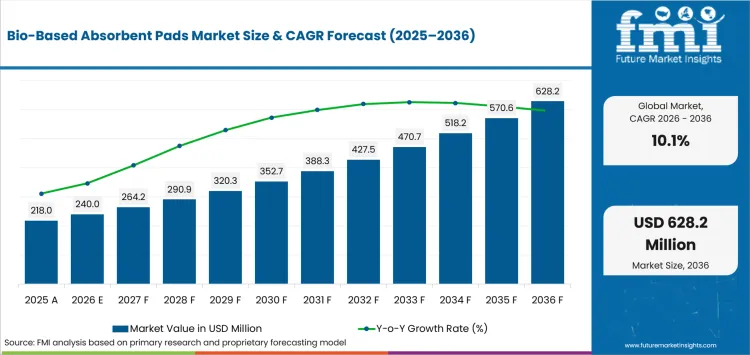
USD 240.0 million in 2026 and USD 628.2 million by 2036 at a 10.1% CAGR.
Demand for bio-based absorbent pads is projected to rise at a 10.1% CAGR between 2026 and 2036. Revenue is forecast to increase from USD 240.0 million to USD 628.2 million as fresh food packaging teams replace fossil-heavy pad structures without weakening fluid retention. The FDA made FCN 2396 effective in December 2024 for crosslinked sodium polyacrylate used with meat and poultry plus seafood and produce. The notification establishes a formal food-contact route for one defined absorbent chemistry used across several fresh-food categories. Cellulose alternatives must satisfy equivalent use and temperature conditions during processor qualification for any commercial tray specification change.
Country conversion depends on packaging costs and recovery rules that determine the commercial value of material claims. The United Kingdom raised Plastic Packaging Tax to GBP 228.82 per tonne from April 2026 for components containing less than 30% recycled plastic. Germany applies stricter evidence to paper-stream claims and Japan links packaging design to municipal separation systems. These conditions shape trials for compostable packaging across each destination market and influence processor verification of recovery claims. Commercial orders depend on purge testing and food-contact records, supported by disposal instructions written for the destination market.
Key Takeaways of Bio-Based Absorbent Pads Market
- Fresh-food processors specify bio-based pads to contain purge and reduce fossil-derived components across high-volume retail tray programmes.
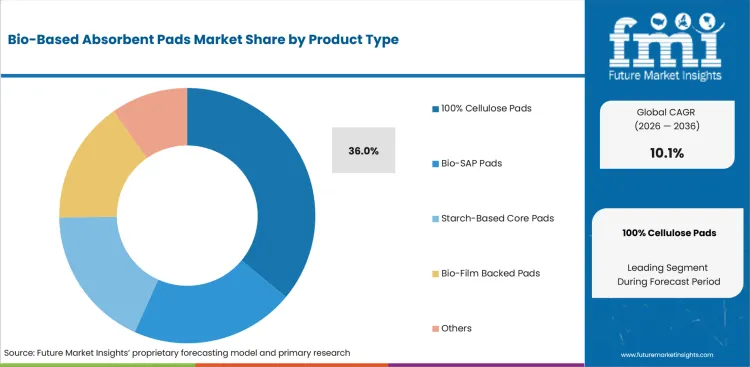
- In 2026, 100% cellulose pads are projected to account for 36.0% of product type demand owing to familiar renewable construction.
- Airlaid cellulose is estimated to capture 36.0% of material demand in 2026 supported by tunable loft and controlled fluid distribution.
- Fully bio-based content is anticipated to represent 46.0% in 2026 as packaging teams seek measurable substitution across the complete pad.
- Conversion remains restrained by retention testing, food-contact approval and disposal claims that differ across customer markets.
- Cellcomb AB and McAirlaid’s Vliesstoffe GmbH work alongside Sirane Ltd. and Elliott Absorbent Products Ltd. with MAGIC S.p.A. and Gelok International Corporation plus Futamura Group and ZymoChem.
Analyst Perspective
"Bio-based absorbent pads earn repeat orders when renewable content survives protein purge, compression and commercial tray speeds. Suppliers should qualify each pad against the food chemistry and disposal route that governs the processor contract."
- Nandini Roy Choudhury, Principal Consultant, Future Market Insights
How is the Bio-Based Absorbent Pads Market segmented?
The bio-based absorbent pads market is segmented by product type, material, bio-based content, application, end use, sales channel and region.
Product type classifies cellulose, Bio-SAP, starch-core and bio-film-backed architectures, and material identifies airlaid cellulose, fluff pulp, bio-based SAP and starch polymer. Bio-based content records material proportion across the finished pad, and application separates meat and poultry, produce, seafood and other foods by fluid profile. End use identifies processors, grocery retailers and foodservice operators, and sales channel distinguishes direct OEM supply, distributors, e-commerce and other commercial routes.
Why do 100% cellulose pads lead the product type category?
Cellulose-only pad architectures reduce fossil content without changing tray geometry or automated placement equipment used by food processors. Cellcomb reported in May 2024 that Biedronka introduced Cellsorb Circular, linking an estimated 55-tonne annual plastic reduction with recurring national retail orders.
- Based on product type, 100% cellulose pads are projected to account for 36.0% in 2026 due to familiar converting methods and clear renewable content.
- Processors favor sealed cellulose structures for moderate purge loads because one material family simplifies composition records and end-of-life instructions for national retail programmes at scale.
Why does airlaid cellulose lead the material category?
Airlaid cellulose forms an open web that distributes fluid while maintaining controlled thickness on automated tray lines. Converters adjust basis weight and layer density for protein, produce or seafood applications without changing pad placement equipment.
- By material, airlaid cellulose is estimated to hold 36.0% in 2026 owing to tunable loft and dependable die-cut conversion.
- Commercial approval requires retention data from stacking pressure and chilled transport across intended distribution routes. McAirlaid’s reported in March 2024 that a tailored pad doubled white tiger prawn shelf life, linking fluid control with a longer retail selling window during processor qualification.
How does 100% bio-based content shape the bio-based content category?
Fully bio-based construction gives packaging teams a direct material-accounting result across the complete pad component. Regulation (EU) 2025/40 entered into force in February 2025 and increased the value of complete composition records across retailer programmes.
- The 100% bio-based segment is likely to capture 46.0% share in 2026 attributable to measurable fossil-content reduction across the finished component.
- Food processors require wet-strength and sealing records because renewable content does not remove food-contact or recovery obligations. Trials also confirm that cover films preserve retention under pressure and remain compatible with tray sealing.
What supports meat & poultry as the leading application?
Meat and poultry packs release recurring purge during chilled storage and high-volume retail distribution programmes. Absorbent pads must retain liquid under compression to prevent tray leakage, rework and rejected packs.
- By application, meat and poultry is forecast to represent 36.0% in 2026 owing to recurring purge-control needs.
- Processors set pad capacity against cut type and pack weight during each commercial food-specific trial. USDA reported in July 2025 that commercial beef production reached 27.0 billion pounds during 2024. That operating scale sustains recurring absorbency requirements across rigid food packaging during chilled distribution and shelf display.
What are the drivers, restraints and opportunities in the Bio-Based Absorbent Pads Market?
Purge control and material reduction support demand, yet qualification work limits conversion and gives application-tuned cellulose structures the clearest revenue route.
- Driver: Processors need pads that protect pack appearance and reduce food loss without slowing tray filling or sealing.
- Restraint: Renewable structures must prove food-contact suitability, retention under pressure and an end-of-life route accepted in the destination market.
- Opportunity: Finished-pad specialists can tailor cellulose cores and covers for specific foods, absorption loads and commercial line settings.
Fresh-food processors absorb leakage costs, tray rework and rejected packs across repeated national retail volumes. Renewable pad trials advance once the new structure matches established retention and placement performance on commercial lines. Recurring orders follow when one component reduces fossil content without slowing tray filling or increasing food loss.
Cellulose retention can weaken under protein purge and compression if density or cover design is unsuitable. Food-contact approval also covers the complete pad architecture and every substance that can migrate into fresh food. Processors require food-specific trials plus finished-pack records before replacing an approved pad in recurring commercial contracts.
Application-specific development gives finished-pad manufacturers a commercial revenue route across protein, seafood and produce programmes. Each programme balances fluid uptake and retention against cushioning plus the cover chemistry required for commercial use. Direct OEM contracts combine test records with line settings and disposal instructions for each destination market.
Which country CAGRs are profiled in the Bio-Based Absorbent Pads Market?
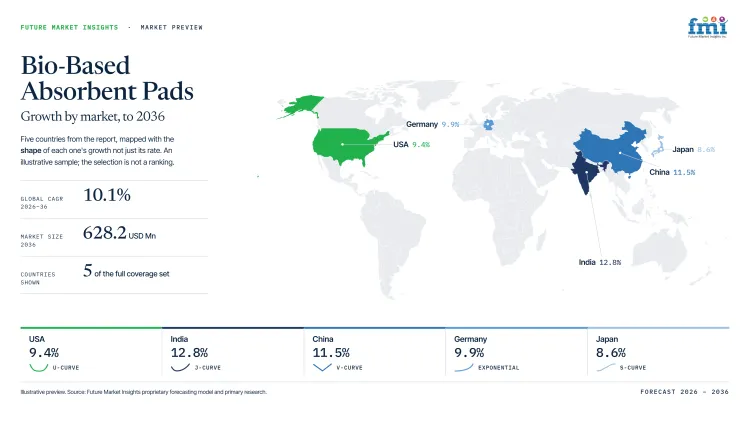
| Country | CAGR |
|---|---|
| Brazil | 10.6% |
| United Kingdom | 10.2% |
| Germany | 9.9% |
| United States | 9.4% |
| Japan | 8.6% |
How do country-level CAGRs compare in the Bio-Based Absorbent Pads Market?
The five profiled country forecasts span 2.0 percentage points between Brazil and Japan, indicating a close growth band across different packaging environments. Commercial priority depends on processor concentration and qualification effort, not a slightly higher CAGR that does not prove a larger national market.
- Brazil's outlook is supported by large protein-processing volumes, where purge management remains important despite uneven organics collection infrastructure.
- In the UK, plastic-related taxes and producer responsibility fees are increasing attention on the material composition of every packaging component.
- Germany places greater emphasis on demonstrating that food-soiled cellulose materials can move through established packaging recovery streams.
- The USA market benefits from extensive meat processing networks that prioritize regulatory compliance, reliable supply and technical support.
- Japan applies stringent approval standards, with packaging evaluations placing considerable focus on dimensional consistency and retail presentation quality.
CAGR does not establish current country size or contract value, and it excludes processor concentration plus average pad specifications and approval costs. The full report compares forecast pace with food-processing structure and packaging rules, alongside disposal access and technical service across 30+ countries.
Country-wise Analysis
- Brazil: Brazilian protein processors use absorbent pads across chilled domestic and export trays, and regional conversion support becomes essential because long service distances complicate commercial trials and recurring deliveries outside major national processing clusters. Bio-based absorbent pad sales in Brazil are forecast to expand at 10.6% CAGR by 2036, supported by recurring purge-control requirements across meat and seafood programmes serving national retailers and export channels. IBGE reported in November 2024 that 31.9% of municipalities still used dumps during 2023, so pad manufacturers need competitive cellulose formats plus Brazilian food-contact records without relying on composting claims outside controlled collection systems.
- United Kingdom: United Kingdom retailers price packaging material choices through plastic taxation and producer-responsibility fees, which makes annual material accounting part of national fresh-food contracts and detailed formal specification reviews. The United Kingdom bio-based absorbent pads outlook is anticipated to advance at 10.2% CAGR over the assessment period, reinforced by retailer requirements for lower fossil content without weaker purge retention across high-volume commercial trays. PackUK set 2025 base fees at GBP 423 per tonne for plastic and GBP 196 for paper and card, so food-soiled pads need defensible classification plus recovery evidence before manufacturers gain access to recurring national retailer programmes.
- Germany: German grocery programmes apply detailed recyclability checks to every tray component, and revised absorbent-pad specifications require evidence that food-soiled structures fit established recovery instructions used across large national retail delivery networks. Adoption of bio-based absorbent pads in Germany is estimated to expand at 9.9% CAGR through 2036, shaped by disciplined material documentation and commercial recovery systems that guide routine commercial retailer qualification. Germany recycled 69.4% of 17.9 million tonnes of packaging waste generated during 2023 according to the German Environment Agency in March 2026, yet contamination and barrier layers still require formal third-party tests before paper-stream acceptance.
- United States: United States protein processors qualify absorbent pads through formal food-contact reviews, and repeatable production trials determine whether one specification can serve several high-volume retail programmes across multiple regional processing sites. In the United States, bio-based absorbent pad demand is predicted to advance at 9.4% CAGR through 2036 owing to concentrated processing capacity and established technical-service networks serving large national accounts. USDA NASS reported in November 2025 that livestock slaughter data covered about 800 federally inspected plants and 1900 state-inspected plants, so pad manufacturers need stable production lots plus retention data reflecting protein chemistry and compression during chilled distribution.
- Japan: Japanese processors place unusually high weight on exact pad dimensions and consistent retail appearance, and imported components require local technical support during qualification for national fresh-food programmes and automated packing lines. The Japan bio-based absorbent pads sector is projected to record 8.6% CAGR during the assessment period, influenced by strict presentation standards and established municipal separation systems across varied prefectures. Japan's Ministry of the Environment reported in March 2026 that 82.4% of municipalities planned plastic-packaging collection but 51.9% planned paper-packaging collection, so pad manufacturers need precise local material declarations without changing purge retention or finished-pack appearance nationwide.
Who are the notable companies in the Bio-Based Absorbent Pads Market?
Cellcomb AB and McAirlaid’s Vliesstoffe GmbH work alongside Sirane Ltd. and Elliott Absorbent Products Ltd. with MAGIC S.p.A. and Gelok International Corporation plus Futamura Group and ZymoChem in this market.
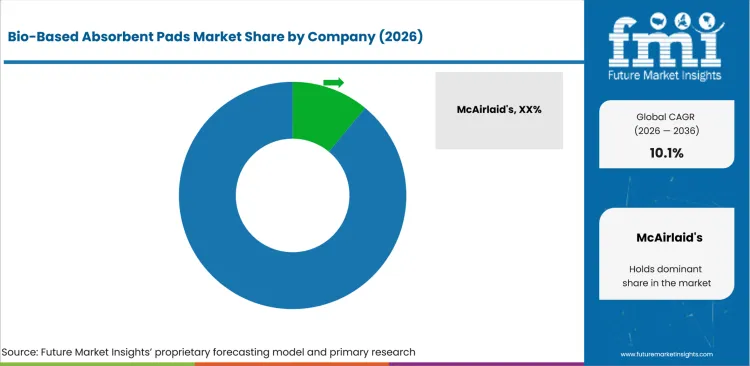
The field is moderately fragmented across finished-pad manufacturers, absorbent-core producers and renewable-input developers with different production assets. Recurring processor contracts favor companies that combine food-contact records with retention data plus dependable commercial lots across several fresh-food applications. Finished-pad specialists qualify sealed construction, core producers compete on fluid distribution and input developers require conversion partners before materials reach completed pads.
- Cellcomb, McAirlaid’s and Sirane compete with Elliott and MAGIC on sealed pad construction plus food-specific qualification.
- Gelok supplies absorbent cores for protein and produce packs whose converters control the final pad architecture.
- Futamura and ZymoChem provide renewable film or BioSAP inputs that depend on commercial pad-development partnerships.
Competitive Benchmarking: Bio-Based Absorbent Pads Market
| Company | Finished Pad Scope | Renewable Input Depth | Commercial Qualification Support | Geographic Reach |
|---|---|---|---|---|
| Cellcomb AB | High | High | High | Europe and exports |
| McAirlaid’s Vliesstoffe GmbH | High | Medium | High | Europe and North America |
| Sirane Ltd. | High | Medium | High | Europe and Americas |
| Elliott Absorbent Products Ltd. | High | High | High | United Kingdom and international sales |
| MAGIC S.p.A. | High | High | High | Europe and international sales |
| Gelok International Corporation | Medium | Medium | High | North America and exports |
| Futamura Group | Low | High | Medium | Europe, Americas and Asia-Pacific |
| ZymoChem | Low | High | Medium | North America with development partners |
Key Developments in the Bio-Based Absorbent Pads Market
- In July 2026, MAGIC commissioned ANDRITZ to supply a food-pad line with integrated airlaid technology and first-quarter 2027 startup. The project adds controlled forming capacity for meat, poultry and fruit pads across repeat processor specifications.
- In October 2025, Cellcomb renamed Cellsorb ECO as Cellsorb CORE to distinguish its standard cellulose-core range from Cellsorb Circular. The change clarifies pad architecture during commercial absorbency and disposal comparisons conducted by food-packaging teams.
- In October 2024, Elliott Absorbent Products launched Echo fruit pads made from crop-residue cellulose for recycling or composting. The launch added plastic-free cushioning and moisture control for berry packs during chilled retail distribution.
Key Players in the Bio-Based Absorbent Pads Market
Finished Bio-Based Pad Specialists
- Cellcomb AB
- McAirlaid’s Vliesstoffe GmbH
- Sirane Ltd.
- Elliott Absorbent Products Ltd.
- MAGIC S.p.A.
Absorbent-Core Provider
- Gelok International Corporation
Renewable Film and BioSAP Enablers
- Futamura Group
- ZymoChem
Bio-Based Absorbent Pads Market - Report Scope
| Coverage field | Report scope |
|---|---|
| Market breakdown | By product type, material, bio-based content, application, end use, sales channel and region. |
| Quantitative Units | Revenue in USD million and CAGR in %. |
| Market Definition | Revenue from bio-based absorbent pads sold for fresh-food packaging within the defined segmentation universe. |
| Regions Covered | North America, Latin America, Western Europe, Eastern Europe, East Asia, South Asia and Pacific and Middle East and Africa. |
| Countries Covered | Brazil, United Kingdom, Germany, United States, Japan and 25+ countries included in the full report. |
| Key Companies Profiled | Cellcomb AB and McAirlaid’s Vliesstoffe GmbH alongside Sirane Ltd. and Elliott Absorbent Products Ltd. with MAGIC S.p.A. and Gelok International Corporation plus Futamura Group and ZymoChem. |
| Forecast Period | 2026 to 2036. |
| Approach | Primary and secondary research with market triangulation. |
Bio-Based Absorbent Pads Market - Research Methodology
| Method | Approach |
|---|---|
| Primary Research | FMI analysts gathered input from manufacturers, service providers, technology developers, distributors, end users, procurement teams, and subject-matter experts. Interviews examined purchasing decisions, product or service evaluation, adoption barriers, approval requirements, pricing considerations, and expectations for technical or commercial support. Respondents were also asked what evidence is required before a trial, pilot, or initial order develops into regular purchasing. |
| Desk Research | Desk research covered government statistics, regulatory publications, trade data, industry associations, technical literature, standards, company filings, product information, and official corporate announcements. Sources were reviewed for relevance, publication date, geographic coverage, and consistency with the defined market scope. Claims relating to performance, applications, approvals, capacity, investment, and commercial activity were retained only when supported by credible public evidence. |
| Market Sizing and Forecasting | The market model combined the baseline value with historical performance, segment structure, pricing and volume indicators, adoption levels, company participation, and country-level demand conditions. Forecast assumptions considered economic activity, investment trends, regulatory developments, technology adoption, purchasing cycles, supply availability, and barriers to wider market use. Segment and regional estimates were reconciled before the final market total was calculated. |
| Data Validation | Estimates were checked against multiple independent indicators, including public data, company activity, trade patterns, industry developments, and findings from primary interviews. Validation also tested whether products, services, applications, and company revenues fell within the defined market boundaries. Adjacent categories, unsupported claims, overlapping revenues, and activities without direct market relevance were excluded to reduce double counting and maintain consistency across segments and countries. |
Bio-Based Absorbent Pads Market by Segments
Bio-Based Absorbent Pads Market segmented by Product Type:
- 100% Cellulose Pads
- Bio-SAP Pads
- Starch-Based Core Pads
- Bio-Film Backed Pads
- Others
Bio-Based Absorbent Pads Market segmented by Material:
- Airlaid Cellulose
- Fluff Pulp
- Bio-Based SAP
- Starch Polymer
- Others
Bio-Based Absorbent Pads Market segmented by Bio-Based Content:
- 100% Bio-Based
- 75-99%
- 50-74%
- Below 50%
Bio-Based Absorbent Pads Market segmented by Application:
- Meat & Poultry
- Fruits & Vegetables
- Seafood
- Others
Bio-Based Absorbent Pads Market segmented by End Use:
- Processors & Packers
- Grocery Retail
- Foodservice
- Others
Bio-Based Absorbent Pads Market segmented by Sales Channel:
- Direct - OEM Supply
- Packaging Distributors
- Online - E-commerce
- Others
Bio-Based Absorbent Pads Market by Region:
- North America
- United States
- Canada
- Latin America
- Brazil
- Mexico
- Chile
- Rest of Latin America
- Western Europe
- Germany
- United Kingdom
- France
- Italy
- Spain
- Nordics
- Benelux
- Rest of Western Europe
- Eastern Europe
- Poland
- Czech Republic
- Romania
- Hungary
- Rest of Eastern Europe
- East Asia
- China
- Japan
- South Korea
- South Asia and Pacific
- India
- ASEAN
- Australia and New Zealand
- Rest of South Asia and Pacific
- Middle East and Africa
- Kingdom of Saudi Arabia
- Other GCC Countries
- Türkiye
- South Africa
- Other African Union Countries
- Rest of Middle East and Africa
Research Sources and Bibliography
- USA Food and Drug Administration. (2024, December 13). Inventory of Effective Food Contact Substance Notifications: FCN No. 2396.
- HM Revenue & Customs. (2026, February 12). Plastic Packaging Tax: steps to take.
- Cellcomb AB. (2024, May 23). Great progress for Cellsorb Circular.
- McAirlaid’s Vliesstoffe GmbH. (2024, March 13). Doubling the shelf life.
- European Parliament and Council of the European Union. (2025, January 22). Regulation (EU) 2025/40 of the European Parliament and of the Council of 19 December 2024 on packaging and packaging waste, amending Regulation (EU) 2019/1020 and Directive (EU) 2019/904, and repealing Directive 94/62/EC.
- USA Department of Agriculture, Economic Research Service. (2025, July 2). Cattle & Beef - Statistics & Information.
- Instituto Brasileiro de Geografia e Estatística. (2024, November 28). MUNIC 2023: 31,9% dos municípios brasileiros ainda despejam resíduos sólidos em lixões.
- Department for Environment, Food & Rural Affairs. (2025, June 30). Extended Producer Responsibility for Packaging: 2025 base fees.
- German Environment Agency. (2026, March 5). Packaging waste.
- USA Department of Agriculture, National Agricultural Statistics Service. (2025, November 20). Livestock Slaughter.
- Ministry of the Environment, Government of Japan. (2026, March 31).
- Cellcomb AB. (2025, October 24). Cellsorb ECO becomes Cellsorb CORE.
- MAGIC S.p.A. (2026, July 15). Magic orders new food pad production line including airlaid technology from Andritz.
- Gelok International Corporation. (2026, January). SAP in food packaging: Enhancing preservation and safety.
- Sirane, trading as Coppice Alupack Ltd. (2024, March 27). ABSORBENT PADS: In-Flex absorbent pad for pre-padding lines still popular after 20 years.
- Elliott Absorbent Products Ltd. (2024, October). Cutting down on waste with Elliott's new compostable fruit pads.
- Futamura Group. (2026, May). Futamura and Biopap advance compostable food service solutions.
- Cellcomb AB. (2025, March 12). Cellsorb Circular - now certified for your home-and garden compost!
This reader bibliography lists the official evidence retained in the article, and the full report contains the complete source record with detailed citations.
This Report Answers
- What is the market size in 2026 and 2036?
- Which operating conditions support fresh-food packaging demand?
- How does airlaid cellulose shape fluid intake and pad conversion?
- Why does fully bio-based content represent 46.0% of demand in 2026?
- How do country growth rates differ across the five profiled markets?
- Which companies supply finished pads, absorbent cores or renewable material inputs?
- What qualification and disposal conditions restrict wider commercial adoption?
- Which processor decisions determine whether a pad trial becomes recurring supply?
Frequently Asked Questions
How big is the Bio-Based Absorbent Pads Market in 2026?
USD 240.0 million is the estimated 2026 value for the Bio-Based Absorbent Pads Market across qualified fresh-food applications. The Bio-Based Absorbent Pads Market is projected to reach USD 628.2 million by 2036 as processors qualify renewable pads for purge retention and commercial lines.
What is the CAGR of the Bio-Based Absorbent Pads Market from 2026 to 2036?
10.1% is the projected CAGR for the Bio-Based Absorbent Pads Market between 2026 and 2036. The Bio-Based Absorbent Pads Market expands as cellulose cores and bio-based covers reduce fossil content without weakening absorption, compression retention or dependable processor line performance.
Which product type segment leads the Bio-Based Absorbent Pads Market?
36.0% is the projected 2026 share for 100% cellulose pads within the Bio-Based Absorbent Pads Market. The Bio-Based Absorbent Pads Market favors this product type as cellulose-only construction offers clear renewable content and supports simpler recycling or composting instructions for fresh-food trays.
How much will the Bio-Based Absorbent Pads Market add between 2026 and 2036?
USD 388.2 million is the incremental opportunity expected in the Bio-Based Absorbent Pads Market between 2026 and 2036. The Bio-Based Absorbent Pads Market gains this value as food processors replace established pad structures after proving purge retention, food-contact compliance and local end-of-life fit.
Which companies are active in the Bio-Based Absorbent Pads Market?
Eight verified companies form the controlled provider set for the Bio-Based Absorbent Pads Market across finished pads and renewable material inputs. The set includes Cellcomb AB and McAirlaid’s Vliesstoffe GmbH with Sirane Ltd. and Elliott Absorbent Products Ltd. plus MAGIC S.p.A. and Gelok International Corporation with Futamura Group and ZymoChem.
Preview the report firsthand - request a free sample
Get SampleGet the brochure for pricing and purchase details.
Get PDFTable of Content
- Key Takeaways
- Market Size and CAGR
- Top Growth Driver
- Fastest Growing Segment
- Leading Region
- Key Companies
- Emerging Opportunities
- Executive Summary
- Global Market Outlook
- Demand-side Trends
- Supply-side Trends
- Technology Roadmap Analysis
- Analysis and Recommendations
- Analyst Perspective (What is happening? Why now? What should investors know?)
- Key Questions Answered
- How large is the market?
- What is the CAGR?
- What are key trends?
- Which region dominates?
- Who are the leaders?
- Market Overview
- Market Coverage / Taxonomy
- Market Definition / Scope / Limitations
- Research Methodology
- Chapter Orientation
- Analytical Lens and Working Hypotheses
- Market Structure, Signals, and Trend Drivers
- Benchmarking and Cross-market Comparability
- Market Sizing, Forecasting, and Opportunity Mapping
- Research Design and Evidence Framework
- Desk Research Programme (Secondary Evidence)
- Expert Input and Fieldwork (Primary Evidence)
- Tooling, Models, and Reference Databases
- Data Engineering and Model Build
- Quality Assurance and Audit Trail
- Market Background
- Market Dynamics (Drivers, Restraints, Opportunity, Trends)
- Scenario Forecast (Optimistic, Likely, Conservative)
- Impact Analysis
- AI Impact
- Sustainability Impact
- Regulatory Impact
- Technology Impact
- Consumer / Buyer Analysis
- Purchase Drivers
- Adoption Barriers
- Buyer Journey
- Opportunity Map Analysis
- Product Life Cycle Analysis
- Supply Chain Analysis
- Investment Feasibility Matrix
- Value Chain Analysis
- PESTLE and Porter's Analysis
- Regulatory Landscape
- Regional Parent Market Outlook
- Production and Consumption Statistics
- Import and Export Statistics
- Global Market Analysis and Forecast, 2021 to 2036
- Historical Market Size Value (USD Million) Analysis, 2021 to 2025
- Current and Future Market Size Value (USD Million) Projections, 2026 to 2036
- Y-o-Y Growth Trend Analysis
- Absolute $ Opportunity Analysis
- Global Market Pricing Analysis, 2021 to 2036
- Global Market Analysis and Forecast, By Product Type, 2021 to 2036
- Introduction / Key Findings
- Historical Market Size Value (USD Million) Analysis By Product Type, 2021 to 2025
- Current and Future Market Size Value (USD Million) Analysis and Forecast By Product Type, 2026 to 2036
- 100% Cellulose Pads
- Bio-SAP Pads
- Starch-Based Core Pads
- Bio-Film Backed Pads
- Others
- 100% Cellulose Pads
- Y-o-Y Growth Trend Analysis By Product Type, 2021 to 2025
- Absolute $ Opportunity Analysis By Product Type, 2026 to 2036
- Global Market Analysis and Forecast, By Material, 2021 to 2036
- Introduction / Key Findings
- Historical Market Size Value (USD Million) Analysis By Material, 2021 to 2025
- Current and Future Market Size Value (USD Million) Analysis and Forecast By Material, 2026 to 2036
- Airlaid Cellulose
- Fluff Pulp
- Bio-Based SAP
- Starch Polymer
- Others
- Airlaid Cellulose
- Y-o-Y Growth Trend Analysis By Material, 2021 to 2025
- Absolute $ Opportunity Analysis By Material, 2026 to 2036
- Global Market Analysis and Forecast, By Bio-Based Content, 2021 to 2036
- Introduction / Key Findings
- Historical Market Size Value (USD Million) Analysis By Bio-Based Content, 2021 to 2025
- Current and Future Market Size Value (USD Million) Analysis and Forecast By Bio-Based Content, 2026 to 2036
- 100% Bio-Based
- 75-99%
- 50-74%
- Below 50%
- 100% Bio-Based
- Y-o-Y Growth Trend Analysis By Bio-Based Content, 2021 to 2025
- Absolute $ Opportunity Analysis By Bio-Based Content, 2026 to 2036
- Global Market Analysis and Forecast, By Application, 2021 to 2036
- Introduction / Key Findings
- Historical Market Size Value (USD Million) Analysis By Application, 2021 to 2025
- Current and Future Market Size Value (USD Million) Analysis and Forecast By Application, 2026 to 2036
- Meat & Poultry
- Fruits & Vegetables
- Seafood
- Others
- Meat & Poultry
- Y-o-Y Growth Trend Analysis By Application, 2021 to 2025
- Absolute $ Opportunity Analysis By Application, 2026 to 2036
- Global Market Analysis and Forecast, By End Use, 2021 to 2036
- Introduction / Key Findings
- Historical Market Size Value (USD Million) Analysis By End Use, 2021 to 2025
- Current and Future Market Size Value (USD Million) Analysis and Forecast By End Use, 2026 to 2036
- Processors & Packers
- Grocery Retail
- Foodservice
- Others
- Processors & Packers
- Y-o-Y Growth Trend Analysis By End Use, 2021 to 2025
- Absolute $ Opportunity Analysis By End Use, 2026 to 2036
- Global Market Analysis and Forecast, By Sales Channel
- Introduction / Key Findings
- Historical Market Size Value (USD Million) Analysis By Sales Channel, 2021 to 2025
- Current and Future Market Size Value (USD Million) Analysis and Forecast By Sales Channel, 2026 to 2036
- Direct - OEM Supply
- Packaging Distributors
- Online - E-commerce
- Others
- Direct - OEM Supply
- Y-o-Y Growth Trend Analysis By Sales Channel, 2021 to 2025
- Absolute $ Opportunity Analysis By Sales Channel, 2026 to 2036
- Global Market Analysis and Forecast, By Region, 2021 to 2036
- Introduction
- Historical Market Size Value (USD Million) Analysis By Region, 2021 to 2025
- Current Market Size Value (USD Million) Analysis and Forecast By Region, 2026 to 2036
- North America
- Latin America
- Western Europe
- Eastern Europe
- East Asia
- South Asia and Pacific
- Middle East & Africa
- Market Attractiveness Analysis By Region
- North America Market Analysis and Forecast, By Country, 2021 to 2036
- Historical Market Size Value (USD Million) Trend Analysis By Market Taxonomy, 2021 to 2025
- Market Size Value (USD Million) Forecast By Market Taxonomy, 2026 to 2036
- By Country
- USA
- Canada
- By Product Type
- By Material
- By Bio-Based Content
- By Application
- By End Use
- By Sales Channel
- By Country
- Market Attractiveness Analysis
- By Country
- By Product Type
- By Material
- By Bio-Based Content
- By Application
- By End Use
- By Sales Channel
- Key Takeaways
- Latin America Market Analysis and Forecast, By Country
- Historical Market Size Value (USD Million) Trend Analysis By Market Taxonomy, 2021 to 2025
- Market Size Value (USD Million) Forecast By Market Taxonomy, 2026 to 2036
- By Country
- Brazil
- Mexico
- Chile
- Rest of Latin America
- By Product Type
- By Material
- By Bio-Based Content
- By Application
- By End Use
- By Sales Channel
- By Country
- Market Attractiveness Analysis
- By Country
- By Product Type
- By Material
- By Bio-Based Content
- By Application
- By End Use
- By Sales Channel
- Key Takeaways
- Western Europe Market Analysis and Forecast, By Country
- Historical Market Size Value (USD Million) Trend Analysis By Market Taxonomy, 2021 to 2025
- Market Size Value (USD Million) Forecast By Market Taxonomy, 2026 to 2036
- By Country
- Germany
- UK
- Italy
- Spain
- France
- Nordic
- BENELUX
- Rest of Western Europe
- By Product Type
- By Material
- By Bio-Based Content
- By Application
- By End Use
- By Sales Channel
- By Country
- Market Attractiveness Analysis
- By Country
- By Product Type
- By Material
- By Bio-Based Content
- By Application
- By End Use
- By Sales Channel
- Key Takeaways
- Eastern Europe Market Analysis and Forecast, By Country
- Historical Market Size Value (USD Million) Trend Analysis By Market Taxonomy, 2021 to 2025
- Market Size Value (USD Million) Forecast By Market Taxonomy, 2026 to 2036
- By Country
- Russia
- Poland
- Hungary
- Balkan & Baltic
- Rest of Eastern Europe
- By Product Type
- By Material
- By Bio-Based Content
- By Application
- By End Use
- By Sales Channel
- By Country
- Market Attractiveness Analysis
- By Country
- By Product Type
- By Material
- By Bio-Based Content
- By Application
- By End Use
- By Sales Channel
- Key Takeaways
- East Asia Market Analysis and Forecast, By Country
- Historical Market Size Value (USD Million) Trend Analysis By Market Taxonomy, 2021 to 2025
- Market Size Value (USD Million) Forecast By Market Taxonomy, 2026 to 2036
- By Country
- China
- Japan
- South Korea
- By Product Type
- By Material
- By Bio-Based Content
- By Application
- By End Use
- By Sales Channel
- By Country
- Market Attractiveness Analysis
- By Country
- By Product Type
- By Material
- By Bio-Based Content
- By Application
- By End Use
- By Sales Channel
- Key Takeaways
- South Asia and Pacific Market Analysis and Forecast, By Country
- Historical Market Size Value (USD Million) Trend Analysis By Market Taxonomy, 2021 to 2025
- Market Size Value (USD Million) Forecast By Market Taxonomy, 2026 to 2036
- By Country
- India
- ASEAN
- Australia & New Zealand
- Rest of South Asia and Pacific
- By Product Type
- By Material
- By Bio-Based Content
- By Application
- By End Use
- By Sales Channel
- By Country
- Market Attractiveness Analysis
- By Country
- By Product Type
- By Material
- By Bio-Based Content
- By Application
- By End Use
- By Sales Channel
- Key Takeaways
- Middle East & Africa Market Analysis and Forecast, By Country
- Historical Market Size Value (USD Million) Trend Analysis By Market Taxonomy, 2021 to 2025
- Market Size Value (USD Million) Forecast By Market Taxonomy, 2026 to 2036
- By Country
- Kingdom of Saudi Arabia
- Other GCC Countries
- Türkiye
- South Africa
- Other African Union
- Rest of Middle East & Africa
- By Product Type
- By Material
- By Bio-Based Content
- By Application
- By End Use
- By Sales Channel
- By Country
- Market Attractiveness Analysis
- By Country
- By Product Type
- By Material
- By Bio-Based Content
- By Application
- By End Use
- By Sales Channel
- Key Takeaways
- Key Countries Market Analysis
- USA
- Pricing Analysis
- Market Share Analysis, 2025
- By Product Type
- By Material
- By Bio-Based Content
- By Application
- By End Use
- By Sales Channel
- Canada
- Pricing Analysis
- Market Share Analysis, 2025
- By Product Type
- By Material
- By Bio-Based Content
- By Application
- By End Use
- By Sales Channel
- Mexico
- Pricing Analysis
- Market Share Analysis, 2025
- By Product Type
- By Material
- By Bio-Based Content
- By Application
- By End Use
- By Sales Channel
- Brazil
- Pricing Analysis
- Market Share Analysis, 2025
- By Product Type
- By Material
- By Bio-Based Content
- By Application
- By End Use
- By Sales Channel
- Chile
- Pricing Analysis
- Market Share Analysis, 2025
- By Product Type
- By Material
- By Bio-Based Content
- By Application
- By End Use
- By Sales Channel
- Germany
- Pricing Analysis
- Market Share Analysis, 2025
- By Product Type
- By Material
- By Bio-Based Content
- By Application
- By End Use
- By Sales Channel
- UK
- Pricing Analysis
- Market Share Analysis, 2025
- By Product Type
- By Material
- By Bio-Based Content
- By Application
- By End Use
- By Sales Channel
- Italy
- Pricing Analysis
- Market Share Analysis, 2025
- By Product Type
- By Material
- By Bio-Based Content
- By Application
- By End Use
- By Sales Channel
- Spain
- Pricing Analysis
- Market Share Analysis, 2025
- By Product Type
- By Material
- By Bio-Based Content
- By Application
- By End Use
- By Sales Channel
- France
- Pricing Analysis
- Market Share Analysis, 2025
- By Product Type
- By Material
- By Bio-Based Content
- By Application
- By End Use
- By Sales Channel
- India
- Pricing Analysis
- Market Share Analysis, 2025
- By Product Type
- By Material
- By Bio-Based Content
- By Application
- By End Use
- By Sales Channel
- ASEAN
- Pricing Analysis
- Market Share Analysis, 2025
- By Product Type
- By Material
- By Bio-Based Content
- By Application
- By End Use
- By Sales Channel
- Australia & New Zealand
- Pricing Analysis
- Market Share Analysis, 2025
- By Product Type
- By Material
- By Bio-Based Content
- By Application
- By End Use
- By Sales Channel
- China
- Pricing Analysis
- Market Share Analysis, 2025
- By Product Type
- By Material
- By Bio-Based Content
- By Application
- By End Use
- By Sales Channel
- Japan
- Pricing Analysis
- Market Share Analysis, 2025
- By Product Type
- By Material
- By Bio-Based Content
- By Application
- By End Use
- By Sales Channel
- South Korea
- Pricing Analysis
- Market Share Analysis, 2025
- By Product Type
- By Material
- By Bio-Based Content
- By Application
- By End Use
- By Sales Channel
- Russia
- Pricing Analysis
- Market Share Analysis, 2025
- By Product Type
- By Material
- By Bio-Based Content
- By Application
- By End Use
- By Sales Channel
- Poland
- Pricing Analysis
- Market Share Analysis, 2025
- By Product Type
- By Material
- By Bio-Based Content
- By Application
- By End Use
- By Sales Channel
- Hungary
- Pricing Analysis
- Market Share Analysis, 2025
- By Product Type
- By Material
- By Bio-Based Content
- By Application
- By End Use
- By Sales Channel
- Kingdom of Saudi Arabia
- Pricing Analysis
- Market Share Analysis, 2025
- By Product Type
- By Material
- By Bio-Based Content
- By Application
- By End Use
- By Sales Channel
- Türkiye
- Pricing Analysis
- Market Share Analysis, 2025
- By Product Type
- By Material
- By Bio-Based Content
- By Application
- By End Use
- By Sales Channel
- South Africa
- Pricing Analysis
- Market Share Analysis, 2025
- By Product Type
- By Material
- By Bio-Based Content
- By Application
- By End Use
- By Sales Channel
- USA
- Market Structure Analysis
- Competition Dashboard
- Competition Benchmarking
- Market Share Analysis of Top Players
- By Regional
- By Product Type
- By Material
- By Bio-Based Content
- By Application
- By End Use
- By Sales Channel
- Emerging Startups
- Innovation Benchmarking
- Competition Analysis
- Competition Deep Dive
- McAirlaid's
- Overview
- Product Portfolio
- Profitability by Market Segments
- Sales Footprint
- Strategy Overview
- Marketing Strategy
- Product Strategy
- Channel Strategy
- Cellcomb
- Sirane
- Novamont
- Futamura
- Novipax
- Gelok International
- Maxwell Chase Technologies
- BioBag
- Sealed Air
- McAirlaid's
- Case Studies
- Success Stories
- Recent Developments
- Competition Deep Dive
- Assumptions & Acronyms Used


