

- Market Size (2026)
- USD 318.5 Mn
- Forecast (2036)
- USD 662.6 Mn
- CAGR (2026 to 2036)
- 7.6%
How big is Recyclable Absorbent Pads Market in 2026?
USD 318.5 million in 2026 and USD 662.6 million by 2036 at a 7.6% CAGR.
Demand for recyclable absorbent pads is projected to expand at 7.6% CAGR between 2026 and 2036, increasing valuation from USD 318.5 million to USD 662.6 million. Fresh-food packers need pads that control purge without weakening the material claim of the complete tray or pouch. The European Commission reported in February 2025 that the Packaging and Packaging Waste Regulation had entered into force. The rule makes packaging design and recycling performance part of a common European compliance timetable. During qualification pad manufacturers therefore receive earlier requests for composition records and food-contact evidence plus production-line trials.
State-level claim rules make the United States qualification route less uniform than the common European timetable. CalRecycle published the SB 343 Final Findings Report in April 2025 to identify material types that routinely become feedstock for new products and packaging. Food packers therefore need evidence that the complete pack follows an operating collection and processing route across the broader recyclable packaging system. Pad manufacturers that pair pressure retention with destination-specific disposal records can shorten the path from line trials to recurring orders.
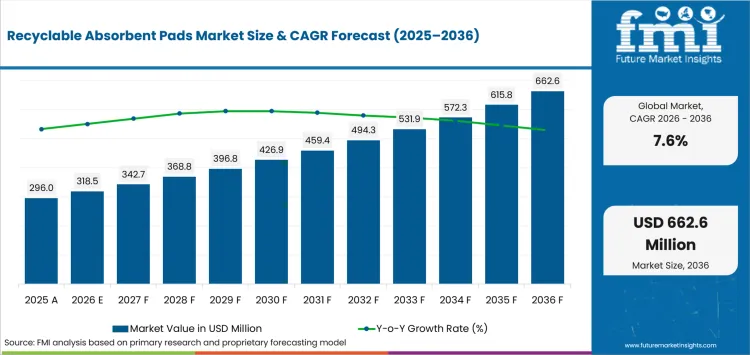
Key Takeaways
- Fresh-food processors are reviewing absorbent pads within the complete packaging specification as recyclability rules become more precise.
- Plastic-free cellulose pads are projected to account for 34.0% of product type revenue in 2026 due to clearer fiber-based disposal routes.
- Airlaid cellulose is estimated to hold 38.0% of core material revenue in 2026 owing to rapid wicking and low-profile converting performance.
- Standard absorbency is anticipated to represent 38.0% of absorbency revenue in 2026 because it covers the widest routine purge range.
- Food contamination and small component size can block practical recovery even when a pad uses a recyclable base material.
- McAirlaid's Vliesstoffe GmbH, Cellcomb AB and Coppice Alupack Ltd T/A Sirane combine food-contact qualification with dedicated absorbent-pad manufacturing.
Analyst Perspective
"Recurring orders depend on complete-pack tests covering fluid retention, seal performance and destination-specific disposal claims on the customer line. Companies gain an advantage by shortening qualification work and documenting local recovery routes without weakening food-contact performance."
- Nandini Roy Choudhury, Principal Consultant, Future Market Insights
How is the recyclable absorbent pads market segmented?
The market is assessed by Product Type, Core Material, Absorbency, Application, End Use and Sales Channel.
Market taxonomy covers product type, core material, absorbency, application, end use, sales channel and region for analysis. Product types include plastic-free cellulose, repulpable paper, mono-material and SAP-free fiber pads. Core materials cover airlaid cellulose, fluff pulp, recycled fiber and mono-PE nonwoven. Applications span meat and poultry, seafood, fruits and vegetables and other foods. End use identifies processors, grocery retailers and foodservice operators. Sales channels include direct OEM supply, packaging distributors and online ordering.
Why do plastic-free cellulose pads lead the product type category?
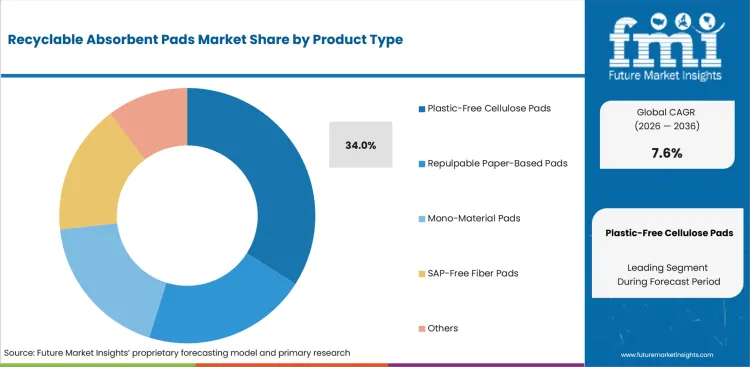
Plastic-free cellulose pads reduce fossil-based layers inside fresh-food packs without changing the absorbent component into a separate rigid format. Four-side sealing and controlled fiber density remain necessary because loose pulp or weak edges can release liquid during distribution.
- Based on product type, plastic-free cellulose pads are projected to account for 34.0% in 2026 due to clearer fiber-based qualification routes.
- Pack engineers compare absorption under the actual protein or produce load with the disposal route claimed for the complete package. Validated cellulose constructions can enter fresh food packaging trials without requiring new tray-loading equipment at every participating site.
Why does airlaid cellulose lead the core material category?
Airlaid cellulose spreads liquid across a thin web and supports controlled basis weights across roll or cut-pad formats. That balance protects pack appearance and reduces interference with seals on high-speed fresh-food tray lines.
- By core material, airlaid cellulose is estimated to hold 38.0% in 2026 owing to fast wicking and flexible converting performance.
- Food-packaging engineers adjust density and pad dimensions around purge volume instead of adding unnecessary thickness. The same manufacturing route connects airlaid textiles with stable slit rolls and repeat specifications for automated lines serving several pack sizes across regional processor networks.
What supports meat and poultry leadership in the application category?
Meat and poultry packs release visible purge during chilling, transport and extended retail display periods. The pad must absorb quickly and retain liquid under pack pressure because leakage triggers rework, presentation loss and handling concerns.
- By application, meat and poultry is forecast to represent 40.0% in 2026 driven by recurring purge-control requirements across protein packs.
- Case-ready formats require consistent performance across varied cuts, pack weights and modified-atmosphere production conditions during distribution. Absorbent pads therefore remain part of the broader meat and seafood packaging specification and support repeat orders across processor and retail production programs with demanding chilled distribution conditions.
Why does direct OEM supply lead the sales channel category?
Direct OEM supply aligns pad dimensions, absorption levels and documentation with one processor's defined packaging program. Manufacturers also receive line-speed and sealing constraints early enough to correct the specification before a commercial run.
- In 2026, direct OEM supply is expected to lead the sales channel category with 46.0% share because qualification requires accountable technical support.
- Direct engagement gives pad manufacturers access to trial quantities and dependable repeat schedules across production sites with different operating constraints. Distributors remain useful for standard replenishment, but complex food-grade packaging programs need one technical contact during approval and specification changes.
What are the drivers, restraints and opportunities in the Recyclable Absorbent Pads Market?
Packaging rules increase qualification pressure, contamination limits many recovery claims and validated fiber formats support broader line conversion.
- Driver: Packaging producers now evaluate absorbent pads within formal recyclability and fee assessments for the complete fresh-food pack.
- Restraint: Food contact and small component size can prevent a technically recyclable pad from entering a practical recovery stream.
- Opportunity: Fiber-based and mono-material pads can replace mixed constructions when testing confirms seal compatibility and fluid retention.
Recyclability Assessments Place Pads inside Formal Design Reviews
Formal reporting now places the absorbent pad inside the commercial review of the complete household pack. PackUK stated in June 2025 that liable producers must assess packaging recyclability and could face red-rated treatment for missing information. Food brands therefore request composition records before approving routine food packaging programs.
Food Contamination Limits Claims after Pack Opening
Practical recovery depends on collection and processing conditions after food contact within the completed fresh-food package. Collection systems may reject a contaminated pad even when its base fiber has favorable laboratory recovery properties. Processors therefore budget added testing before applying one recycling message across several retail destinations with different operating systems.
Drop-In Fiber Formats Reduce Conversion Work
Drop-in fiber pads give processors a route to reduce mixed layers without replacing tray-loading equipment. Commercial approval depends on absorption under actual food loads and stable seals during chilled distribution. Manufacturers with pilot converting can align fiber-based packaging choices with local disposal instructions and repeat production schedules.
Which country CAGRs are profiled in the Recyclable Absorbent Pads Market?
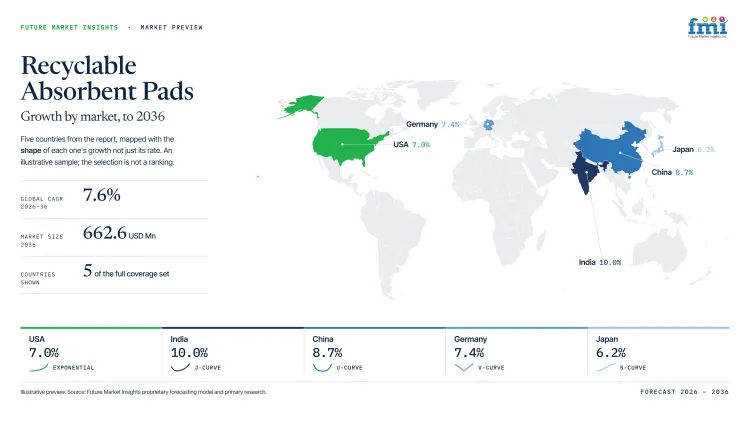
| Country | CAGR |
|---|---|
| Brazil | 8.0% |
| United Kingdom | 7.5% |
| Germany | 7.4% |
| United States | 7.0% |
| Japan | 6.2% |
How do country-level CAGRs compare in the Recyclable Absorbent Pads Market?
The five profiled forecasts span 1.8 percentage points from Brazil at 8.0% to Japan at 6.2%.
The spacing reflects different recovery systems and qualification routes instead of current revenue or installed pad volumes.
- Brazil’s 8.0% pace reflects national recovery targets and regional distribution across a geographically broad protein-processing base.
- The United Kingdom’s 7.5% pace reflects fee modulation that changes the cost of red-rated household packaging structures.
- Germany’s 7.4% pace reflects detailed sorting criteria and documentation work before a packaging change reaches routine use.
- The United States’ 7.0% pace reflects state-level claim rules that complicate one national specification across retail markets.
- Japan’s 6.2% pace reflects measured approval cycles and close control of pack appearance plus sealing performance.
Comparable CAGRs can produce different market entry conditions. The full report provides country-level CAGR analysis across North America, Latin America, Europe, East Asia, South Asia and Pacific, and the Middle East and Africa.
Country-wise Analysis
- Brazilian protein processors serve broad domestic and export corridors that require regional packaging stocks near major meat and poultry plants nationwide. The October 2025 reverse-logistics decree set a 32% national recovery target for plastic packaging during 2026, so mono-PE pad programs and plastic tray systems require clearer mass records across obligated companies. Recyclable absorbent pad sales in Brazil are forecast to expand at 8.0% CAGR by 2036 supported by formal recovery planning although cellulose formats still need local disposal instructions and customer-line trials because collection capacity varies across regions and food contamination can narrow practical recovery routes.
- United Kingdom grocery groups increasingly assess absorbent pads within the recyclability rating assigned to each complete household food pack. PackUK confirmed in June 2025 that red-rated packaging would receive a 1.2 fee factor during the 2026 to 2027 financial year and the United Kingdom's recyclable absorbent pads outlook is anticipated to advance at 7.5% CAGR over the assessment period owing to fee modulation. Fiber pads gain a clearer cost assessment route but processors must confirm classification and seal performance before changing qualified specifications across national retail accounts with different tray and lidding structures plus distribution conditions.
- German food packers evaluate recyclability against practical sorting and recovery systems during commercial qualification for retail tray programs serving national grocery and protein accounts. The Central Agency Packaging Register published its 2025 minimum standard in August 2025 and adoption of recyclable absorbent pads in Germany is estimated to expand at 7.4% CAGR through 2036 supported by detailed assessment rules. Material declarations help processors prepare approval records and retailer submissions but contaminated or composite pads carry a higher proof burden that can extend testing before recurring supply begins across national programs and regional collection systems.
- United States food packers often approve absorbent pads by plant as national brands manage different state rules across sales regions and large retail programs with distinct packaging specifications. CalRecycle approved regulations in May 2026 requiring a 25% reduction in plastic packaging and the United States recyclable absorbent pads sector is projected to record 7.0% CAGR during the assessment period influenced by state compliance routes. State-specific evidence can delay national rollouts and increase documentation work so manufacturers need complete-pack records and customer-line trials that preserve production speed plus accurate disposal language across retail markets with different collection systems.
- Japanese processors favor controlled material changes that preserve pack appearance and stable sealing performance across repeated production runs for national retailers and convenience-store chains serving dense urban markets. The Environment Ministry selected eight plastic resource circulation implementation projects in August 2025 and Japan is estimated to post 6.2% CAGR over the forecast period aided by public implementation support for material circulation. Demonstration programs improve technical confidence and recovery knowledge but pad manufacturers must provide low-variation products plus detailed food-contact records before wider produce packaging adoption across processor sites with measured approval schedules nationwide.
Who are the notable companies in the Recyclable Absorbent Pads Market?
McAirlaid's Vliesstoffe GmbH, Cellcomb AB, Coppice Alupack Ltd T/A Sirane, Novipax, AptarGroup, Inc., Gelok International Corporation, Thermasorb Pty Ltd and Magic S.p.A. are the notable companies serving this market.
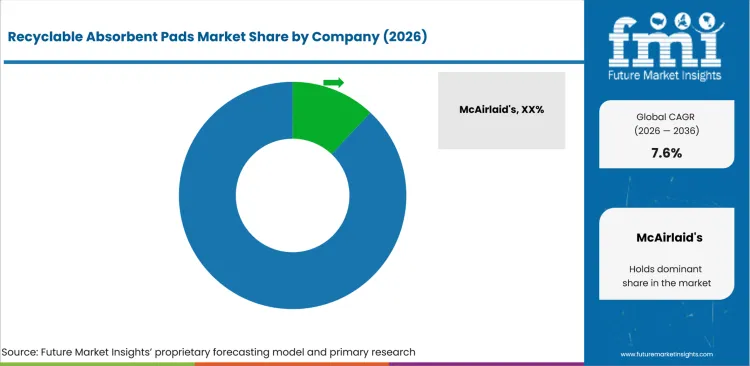
The field remains fragmented across dedicated food-pad manufacturers and protein-absorbent specialists with different converting assets. Active-material developers and regional custom producers offer narrower alternatives for processors with specialized line or distribution needs. Entry remains practical for focused manufacturers with proven food-contact systems, but national accounts require repeatable converting and dependable supply across qualified sites. Competition therefore turns on application records and complete-pack testing instead of corporate scale or broad packaging revenue alone.
- McAirlaid's Vliesstoffe GmbH, Cellcomb AB and Coppice Alupack Ltd T/A Sirane combine finished-pad manufacturing with food-contact documentation and custom converting.
- Novipax and Thermasorb Pty Ltd focus on protein, seafood and foodservice formats that require controlled absorption under routine handling pressure.
- AptarGroup, Inc., Gelok International Corporation and Magic S.p.A. compete with active systems, absorbent-core engineering and dedicated airlaid processing.
Competitive Benchmarking: Recyclable Absorbent Pads Market
| Company | Food-Contact Qualification Depth | Absorbent Format Breadth | Application and Converting Support | Geographic Reach |
|---|---|---|---|---|
| McAirlaid's Vliesstoffe GmbH | High | High | High | Europe, North America and international sales |
| Cellcomb AB | High | High | High | Europe and international sales |
| Coppice Alupack Ltd T/A Sirane | High | High | High | Europe, North America and export markets |
| Novipax | High | High | High | North America |
| AptarGroup, Inc. | High | Medium | High | Global |
| Gelok International Corporation | Medium | Medium | High | North America and international sales |
| Thermasorb Pty Ltd | High | Medium | High | Australia and New Zealand |
| Magic S.p.A. | High | High | High | Europe and 36 export countries |
Scoring basis: High qualification depth requires current food-packaging certification plus documented food-contact use, while Medium requires one verified route and Low identifies one limited record. High absorbent-format breadth requires at least three verified pad or core formats, while Medium requires two and Low identifies one. High application support requires custom converting plus three food applications, while Medium requires one support route and Low identifies one documented application.
Key Developments in the Recyclable Absorbent Pads Market
- In November 2025, McAirlaid's Vliesstoffe GmbH received BRCGS Packaging Materials certification for its Berlingerode site. The certified scope covers cellulose-based pads for direct food contact and gives fresh-food packers a current site-level qualification record.
- In June 2025, Cellcomb AB completed its acquisition of Finnish fiber-products company Fatex and combined approximately 90 employees across Sweden and Finland. The transaction broadened Cellcomb's fiber-based product range and strengthened regional production coverage for food and healthcare customers.
- In March 2025, Cellcomb AB announced home and garden compost certification for its four-side-sealed Cellsorb Circular cellulose food pad. The approval added a documented disposal route for processors comparing plastic-free formats with conventional absorbent pads.
Key Players in the Recyclable Absorbent Pads Market
Fiber-Based and Compostable Pad Specialists
- McAirlaid's Vliesstoffe GmbH
- Cellcomb AB
- Coppice Alupack Ltd T/A Sirane
- Magic S.p.A.
Protein and Foodservice Absorbent Specialists
- Novipax
- Thermasorb Pty Ltd
Absorbent-Core and Active-System Suppliers
- AptarGroup, Inc.
- Gelok International Corporation
Recyclable Absorbent Pads Market - Report Scope
| Coverage field | Report scope |
|---|---|
| Market breakdown | By product type, core material, absorbency, application, end use, sales channel and region. |
| Quantitative Units | USD million. |
| Market Definition | Commercial recyclable absorbent pads sold for fresh-food packaging and related fluid-control applications. Downstream food revenue and adjacent packaging without an absorbent-pad function are excluded. |
| Regions Covered | North America, Latin America, Europe, East Asia, South Asia and Pacific, and Middle East and Africa. |
| Countries Covered | United States, Germany, Japan, United Kingdom, Brazil, and 20+ countries included in the full report. |
| Key Companies Profiled | McAirlaid's Vliesstoffe GmbH, Cellcomb AB, Coppice Alupack Ltd T/A Sirane, Novipax, AptarGroup, Inc., Gelok International Corporation, Thermasorb Pty Ltd, Magic S.p.A. |
| Forecast Period | 2026 to 2036. |
| Approach | Primary and secondary research with market triangulation. |
Recyclable Absorbent Pads Market - Research Methodology
| Method | Approach |
|---|---|
| Primary Research | FMI analysts gathered input from manufacturers, service providers, technology developers, distributors, end users, procurement teams, and subject-matter experts. Interviews examined purchasing decisions, product or service evaluation, adoption barriers, approval requirements, pricing considerations, and expectations for technical or commercial support. Respondents were also asked what evidence is required before a trial, pilot, or initial order develops into regular purchasing. |
| Desk Research | Desk research covered government statistics, regulatory publications, trade data, industry associations, technical literature, standards, company filings, product information, and official corporate announcements. Sources were reviewed for relevance, publication date, geographic coverage, and consistency with the defined market scope. Claims relating to performance, applications, approvals, capacity, investment, and commercial activity were retained only when supported by credible public evidence. |
| Market Sizing and Forecasting | The market model combined the baseline value with historical performance, segment structure, pricing and volume indicators, adoption levels, company participation, and country-level demand conditions. Forecast assumptions considered economic activity, investment trends, regulatory developments, technology adoption, purchasing cycles, supply availability, and barriers to wider market use. Segment and regional estimates were reconciled before the final market total was calculated. |
| Data Validation | Estimates were checked against multiple independent indicators, including public data, company activity, trade patterns, industry developments, and findings from primary interviews. Validation also tested whether products, services, applications, and company revenues fell within the defined market boundaries. Adjacent categories, unsupported claims, overlapping revenues, and activities without direct market relevance were excluded to reduce double counting and maintain consistency across segments and countries. |
Recyclable Absorbent Pads Market by Segments
Recyclable Absorbent Pads Market segmented by Product Type:
- Plastic-Free Cellulose Pads
- Repulpable Paper-Based Pads
- Mono-Material Pads
- SAP-Free Fiber Pads
- Others
Recyclable Absorbent Pads Market segmented by Core Material:
- Airlaid Cellulose
- Fluff Pulp
- Recycled Fiber
- Mono PE Nonwoven
- Others
Recyclable Absorbent Pads Market segmented by Absorbency:
- Standard
- Medium
- High
Recyclable Absorbent Pads Market segmented by Application:
- Meat & Poultry
- Seafood
- Fruits & Vegetables
- Others
Recyclable Absorbent Pads Market segmented by End Use:
- Processors & Packers
- Grocery Retail
- Foodservice
- Others
Recyclable Absorbent Pads Market segmented by Sales Channel:
- Direct - OEM Supply
- Packaging Distributors
- Online - E-commerce
- Others
Recyclable Absorbent Pads Market by Region
- North America
- United States
- Canada
- Latin America
- Brazil
- Mexico
- Argentina
- Rest of Latin America
- Western Europe
- Germany
- United Kingdom
- France
- Italy
- Spain
- BENELUX
- Nordics
- Rest of Western Europe
- Eastern Europe
- East Asia
- China
- Japan
- South Korea
- South Asia and Pacific
- India
- ASEAN
- Australia and New Zealand
- Rest of South Asia and Pacific
- Middle East and Africa
- GCC Countries
- Turkey
- South Africa
- Northern Africa
- Rest of Middle East and Africa
Research Sources and Bibliography
- European Commission. (2025, February 11). New rules enter into force for a more sustainable and competitive packaging economy.
- California Department of Resources Recycling and Recovery. (2025, April 4). SB 343 Final Findings Report (DRRR-2025-1750).
- PackUK. (2025, June 27). PackUK: 2025 recyclability assessment requirements.
- Presidency of the Federative Republic of Brazil. (2025, October 21). Decree No. 12,688 of October 21, 2025.
- PackUK. (2025, June 28). PackUK extended producer responsibility for packaging: producer disposal fees modulation statement.
- Central Agency Packaging Register. (2025, August 28). Minimum standard for determining the recyclability of packaging design: Edition 2025.
- California Department of Resources Recycling and Recovery. (2026, May 1). California approves new plastic and packaging rules that put consumers first.
- Ministry of the Environment, Japan. (2025, August 19). Selection results for plastic resource circulation implementation projects.
- McAirlaid's Vliesstoffe GmbH. (2025, November 26). BRCGS certificate for packaging materials: Berlingerode.
- Cellcomb AB. (2025, June 4). Cellcomb acquires Fatex.
- Cellcomb AB. (2025, March 12). Cellsorb Circular - now certified for your home-and garden compost!.
- Magic S.p.A. (2026, July 15). Magic orders new food pad production line including airlaid technology from Andritz.
- Cellcomb AB. (2025, October 24). Cellsorb® ECO becomes Cellsorb® CORE.
- Coppice Alupack Ltd T/A Sirane. (2024, April 15). GROUP NEWS: Chilean manufacturer becomes Sirane distributor.
This Report Answers
- What is the Recyclable Absorbent Pads Market size in 2026 and 2036?
- How fast is the Recyclable Absorbent Pads Market projected to expand between 2026 and 2036?
- Why do plastic-free cellulose pads hold the leading product type position?
- How does airlaid cellulose affect wicking and line compatibility?
- Why do meat and poultry applications support recurring absorbent-pad orders?
- How do recovery rules change qualification across Brazil, the United Kingdom, Germany, the United States and Japan?
- Which companies provide fiber pads, protein absorbents, active systems or custom airlaid processing?
- How do contamination and small component size restrain recyclable absorbent pad claims?
- What should processors evaluate before replacing a qualified conventional pad?
Frequently Asked Questions
What is the Recyclable Absorbent Pads Market size in 2026?
The recyclable absorbent pads market is estimated at USD 318.5 million in 2026 and USD 662.6 million by 2036. Fresh-food processors support this value by specifying reliable fluid retention alongside package-level material records and disposal requirements across retail destinations.
What is the CAGR of the Recyclable Absorbent Pads Market from 2026 to 2036?
The recyclable absorbent pads market is projected to expand at 7.6% CAGR from 2026 to 2036. Regulation affects this forecast because processors must qualify pad composition and practical recovery claims without weakening seal performance or absorption during routine chilled distribution.
Which product type segment is projected to account for 34.0% of the Recyclable Absorbent Pads Market?
Plastic-free cellulose pads are projected to account for 34.0% of the recyclable absorbent pads market in 2026. Their position reflects a clearer fiber-based material route plus compatibility with established pad dimensions and tray-loading equipment across fresh-food processing lines and multiple pack sizes.
What incremental opportunity is projected for the Recyclable Absorbent Pads Market by 2036?
The recyclable absorbent pads market is projected to add USD 344.1 million between 2026 and 2036. Revenue conversion depends on products that pass food-load trials and support accurate disposal instructions across every destination market served by the processor and its retail customers.
Which companies are active in the Recyclable Absorbent Pads Market?
McAirlaid's Vliesstoffe GmbH, Cellcomb AB and Coppice Alupack Ltd T/A Sirane are active in the recyclable absorbent pads market. Novipax, AptarGroup, Gelok International Corporation, Thermasorb Pty Ltd and Magic add protein-absorbent or regional manufacturing capabilities across food-packaging programs and customer qualification.
Preview the report firsthand - request a free sample
Get SampleGet the brochure for pricing and purchase details.
Get PDFTable of Content
- Key Takeaways
- Market Size and CAGR
- Top Growth Driver
- Fastest Growing Segment
- Leading Region
- Key Companies
- Emerging Opportunities
- Executive Summary
- Global Market Outlook
- Demand-side Trends
- Supply-side Trends
- Technology Roadmap Analysis
- Analysis and Recommendations
- Analyst Perspective (What is happening? Why now? What should investors know?)
- Key Questions Answered
- How large is the market?
- What is the CAGR?
- What are key trends?
- Which region dominates?
- Who are the leaders?
- Market Overview
- Market Coverage / Taxonomy
- Market Definition / Scope / Limitations
- Research Methodology
- Chapter Orientation
- Analytical Lens and Working Hypotheses
- Market Structure, Signals, and Trend Drivers
- Benchmarking and Cross-market Comparability
- Market Sizing, Forecasting, and Opportunity Mapping
- Research Design and Evidence Framework
- Desk Research Programme (Secondary Evidence)
- Expert Input and Fieldwork (Primary Evidence)
- Tooling, Models, and Reference Databases
- Data Engineering and Model Build
- Quality Assurance and Audit Trail
- Market Background
- Market Dynamics (Drivers, Restraints, Opportunity, Trends)
- Scenario Forecast (Optimistic, Likely, Conservative)
- Impact Analysis
- AI Impact
- Sustainability Impact
- Regulatory Impact
- Technology Impact
- Consumer / Buyer Analysis
- Purchase Drivers
- Adoption Barriers
- Buyer Journey
- Opportunity Map Analysis
- Product Life Cycle Analysis
- Supply Chain Analysis
- Investment Feasibility Matrix
- Value Chain Analysis
- PESTLE and Porter's Analysis
- Regulatory Landscape
- Regional Parent Market Outlook
- Production and Consumption Statistics
- Import and Export Statistics
- Global Market Analysis and Forecast, 2021 to 2036
- Historical Market Size Value (USD Million) Analysis, 2021 to 2025
- Current and Future Market Size Value (USD Million) Projections, 2026 to 2036
- Y-o-Y Growth Trend Analysis
- Absolute $ Opportunity Analysis
- Global Market Pricing Analysis, 2021 to 2036
- Global Market Analysis and Forecast, By Product Type, 2021 to 2036
- Introduction / Key Findings
- Historical Market Size Value (USD Million) Analysis By Product Type, 2021 to 2025
- Current and Future Market Size Value (USD Million) Analysis and Forecast By Product Type, 2026 to 2036
- Plastic-Free Cellulose Pads
- Repulpable Paper-Based Pads
- Mono-Material Pads
- SAP-Free Fiber Pads
- Others
- Plastic-Free Cellulose Pads
- Y-o-Y Growth Trend Analysis By Product Type, 2021 to 2025
- Absolute $ Opportunity Analysis By Product Type, 2026 to 2036
- Global Market Analysis and Forecast, By Core Material, 2021 to 2036
- Introduction / Key Findings
- Historical Market Size Value (USD Million) Analysis By Core Material, 2021 to 2025
- Current and Future Market Size Value (USD Million) Analysis and Forecast By Core Material, 2026 to 2036
- Airlaid Cellulose
- Fluff Pulp
- Recycled Fiber
- Mono PE Nonwoven
- Others
- Airlaid Cellulose
- Y-o-Y Growth Trend Analysis By Core Material, 2021 to 2025
- Absolute $ Opportunity Analysis By Core Material, 2026 to 2036
- Global Market Analysis and Forecast, By Absorbency, 2021 to 2036
- Introduction / Key Findings
- Historical Market Size Value (USD Million) Analysis By Absorbency, 2021 to 2025
- Current and Future Market Size Value (USD Million) Analysis and Forecast By Absorbency, 2026 to 2036
- Standard
- Medium
- High
- Standard
- Y-o-Y Growth Trend Analysis By Absorbency, 2021 to 2025
- Absolute $ Opportunity Analysis By Absorbency, 2026 to 2036
- Global Market Analysis and Forecast, By Application, 2021 to 2036
- Introduction / Key Findings
- Historical Market Size Value (USD Million) Analysis By Application, 2021 to 2025
- Current and Future Market Size Value (USD Million) Analysis and Forecast By Application, 2026 to 2036
- Meat & Poultry
- Seafood
- Fruits & Vegetables
- Others
- Meat & Poultry
- Y-o-Y Growth Trend Analysis By Application, 2021 to 2025
- Absolute $ Opportunity Analysis By Application, 2026 to 2036
- Global Market Analysis and Forecast, By End Use, 2021 to 2036
- Introduction / Key Findings
- Historical Market Size Value (USD Million) Analysis By End Use, 2021 to 2025
- Current and Future Market Size Value (USD Million) Analysis and Forecast By End Use, 2026 to 2036
- Processors & Packers
- Grocery Retail
- Foodservice
- Others
- Processors & Packers
- Y-o-Y Growth Trend Analysis By End Use, 2021 to 2025
- Absolute $ Opportunity Analysis By End Use, 2026 to 2036
- Global Market Analysis and Forecast, By Sales Channel
- Introduction / Key Findings
- Historical Market Size Value (USD Million) Analysis By Sales Channel, 2021 to 2025
- Current and Future Market Size Value (USD Million) Analysis and Forecast By Sales Channel, 2026 to 2036
- Direct - OEM Supply
- Packaging Distributors
- Online - E-commerce
- Others
- Direct - OEM Supply
- Y-o-Y Growth Trend Analysis By Sales Channel, 2021 to 2025
- Absolute $ Opportunity Analysis By Sales Channel, 2026 to 2036
- Global Market Analysis and Forecast, By Region, 2021 to 2036
- Introduction
- Historical Market Size Value (USD Million) Analysis By Region, 2021 to 2025
- Current Market Size Value (USD Million) Analysis and Forecast By Region, 2026 to 2036
- North America
- Latin America
- Western Europe
- Eastern Europe
- East Asia
- South Asia and Pacific
- Middle East & Africa
- Market Attractiveness Analysis By Region
- North America Market Analysis and Forecast, By Country, 2021 to 2036
- Historical Market Size Value (USD Million) Trend Analysis By Market Taxonomy, 2021 to 2025
- Market Size Value (USD Million) Forecast By Market Taxonomy, 2026 to 2036
- By Country
- USA
- Canada
- By Product Type
- By Core Material
- By Absorbency
- By Application
- By End Use
- By Sales Channel
- By Country
- Market Attractiveness Analysis
- By Country
- By Product Type
- By Core Material
- By Absorbency
- By Application
- By End Use
- By Sales Channel
- Key Takeaways
- Latin America Market Analysis and Forecast, By Country
- Historical Market Size Value (USD Million) Trend Analysis By Market Taxonomy, 2021 to 2025
- Market Size Value (USD Million) Forecast By Market Taxonomy, 2026 to 2036
- By Country
- Brazil
- Mexico
- Chile
- Rest of Latin America
- By Product Type
- By Core Material
- By Absorbency
- By Application
- By End Use
- By Sales Channel
- By Country
- Market Attractiveness Analysis
- By Country
- By Product Type
- By Core Material
- By Absorbency
- By Application
- By End Use
- By Sales Channel
- Key Takeaways
- Western Europe Market Analysis and Forecast, By Country
- Historical Market Size Value (USD Million) Trend Analysis By Market Taxonomy, 2021 to 2025
- Market Size Value (USD Million) Forecast By Market Taxonomy, 2026 to 2036
- By Country
- Germany
- UK
- Italy
- Spain
- France
- Nordic
- BENELUX
- Rest of Western Europe
- By Product Type
- By Core Material
- By Absorbency
- By Application
- By End Use
- By Sales Channel
- By Country
- Market Attractiveness Analysis
- By Country
- By Product Type
- By Core Material
- By Absorbency
- By Application
- By End Use
- By Sales Channel
- Key Takeaways
- Eastern Europe Market Analysis and Forecast, By Country
- Historical Market Size Value (USD Million) Trend Analysis By Market Taxonomy, 2021 to 2025
- Market Size Value (USD Million) Forecast By Market Taxonomy, 2026 to 2036
- By Country
- Russia
- Poland
- Hungary
- Balkan & Baltic
- Rest of Eastern Europe
- By Product Type
- By Core Material
- By Absorbency
- By Application
- By End Use
- By Sales Channel
- By Country
- Market Attractiveness Analysis
- By Country
- By Product Type
- By Core Material
- By Absorbency
- By Application
- By End Use
- By Sales Channel
- Key Takeaways
- East Asia Market Analysis and Forecast, By Country
- Historical Market Size Value (USD Million) Trend Analysis By Market Taxonomy, 2021 to 2025
- Market Size Value (USD Million) Forecast By Market Taxonomy, 2026 to 2036
- By Country
- China
- Japan
- South Korea
- By Product Type
- By Core Material
- By Absorbency
- By Application
- By End Use
- By Sales Channel
- By Country
- Market Attractiveness Analysis
- By Country
- By Product Type
- By Core Material
- By Absorbency
- By Application
- By End Use
- By Sales Channel
- Key Takeaways
- South Asia and Pacific Market Analysis and Forecast, By Country
- Historical Market Size Value (USD Million) Trend Analysis By Market Taxonomy, 2021 to 2025
- Market Size Value (USD Million) Forecast By Market Taxonomy, 2026 to 2036
- By Country
- India
- ASEAN
- Australia & New Zealand
- Rest of South Asia and Pacific
- By Product Type
- By Core Material
- By Absorbency
- By Application
- By End Use
- By Sales Channel
- By Country
- Market Attractiveness Analysis
- By Country
- By Product Type
- By Core Material
- By Absorbency
- By Application
- By End Use
- By Sales Channel
- Key Takeaways
- Middle East & Africa Market Analysis and Forecast, By Country
- Historical Market Size Value (USD Million) Trend Analysis By Market Taxonomy, 2021 to 2025
- Market Size Value (USD Million) Forecast By Market Taxonomy, 2026 to 2036
- By Country
- Kingdom of Saudi Arabia
- Other GCC Countries
- Türkiye
- South Africa
- Other African Union
- Rest of Middle East & Africa
- By Product Type
- By Core Material
- By Absorbency
- By Application
- By End Use
- By Sales Channel
- By Country
- Market Attractiveness Analysis
- By Country
- By Product Type
- By Core Material
- By Absorbency
- By Application
- By End Use
- By Sales Channel
- Key Takeaways
- Key Countries Market Analysis
- USA
- Pricing Analysis
- Market Share Analysis, 2025
- By Product Type
- By Core Material
- By Absorbency
- By Application
- By End Use
- By Sales Channel
- Canada
- Pricing Analysis
- Market Share Analysis, 2025
- By Product Type
- By Core Material
- By Absorbency
- By Application
- By End Use
- By Sales Channel
- Mexico
- Pricing Analysis
- Market Share Analysis, 2025
- By Product Type
- By Core Material
- By Absorbency
- By Application
- By End Use
- By Sales Channel
- Brazil
- Pricing Analysis
- Market Share Analysis, 2025
- By Product Type
- By Core Material
- By Absorbency
- By Application
- By End Use
- By Sales Channel
- Chile
- Pricing Analysis
- Market Share Analysis, 2025
- By Product Type
- By Core Material
- By Absorbency
- By Application
- By End Use
- By Sales Channel
- Germany
- Pricing Analysis
- Market Share Analysis, 2025
- By Product Type
- By Core Material
- By Absorbency
- By Application
- By End Use
- By Sales Channel
- UK
- Pricing Analysis
- Market Share Analysis, 2025
- By Product Type
- By Core Material
- By Absorbency
- By Application
- By End Use
- By Sales Channel
- Italy
- Pricing Analysis
- Market Share Analysis, 2025
- By Product Type
- By Core Material
- By Absorbency
- By Application
- By End Use
- By Sales Channel
- Spain
- Pricing Analysis
- Market Share Analysis, 2025
- By Product Type
- By Core Material
- By Absorbency
- By Application
- By End Use
- By Sales Channel
- France
- Pricing Analysis
- Market Share Analysis, 2025
- By Product Type
- By Core Material
- By Absorbency
- By Application
- By End Use
- By Sales Channel
- India
- Pricing Analysis
- Market Share Analysis, 2025
- By Product Type
- By Core Material
- By Absorbency
- By Application
- By End Use
- By Sales Channel
- ASEAN
- Pricing Analysis
- Market Share Analysis, 2025
- By Product Type
- By Core Material
- By Absorbency
- By Application
- By End Use
- By Sales Channel
- Australia & New Zealand
- Pricing Analysis
- Market Share Analysis, 2025
- By Product Type
- By Core Material
- By Absorbency
- By Application
- By End Use
- By Sales Channel
- China
- Pricing Analysis
- Market Share Analysis, 2025
- By Product Type
- By Core Material
- By Absorbency
- By Application
- By End Use
- By Sales Channel
- Japan
- Pricing Analysis
- Market Share Analysis, 2025
- By Product Type
- By Core Material
- By Absorbency
- By Application
- By End Use
- By Sales Channel
- South Korea
- Pricing Analysis
- Market Share Analysis, 2025
- By Product Type
- By Core Material
- By Absorbency
- By Application
- By End Use
- By Sales Channel
- Russia
- Pricing Analysis
- Market Share Analysis, 2025
- By Product Type
- By Core Material
- By Absorbency
- By Application
- By End Use
- By Sales Channel
- Poland
- Pricing Analysis
- Market Share Analysis, 2025
- By Product Type
- By Core Material
- By Absorbency
- By Application
- By End Use
- By Sales Channel
- Hungary
- Pricing Analysis
- Market Share Analysis, 2025
- By Product Type
- By Core Material
- By Absorbency
- By Application
- By End Use
- By Sales Channel
- Kingdom of Saudi Arabia
- Pricing Analysis
- Market Share Analysis, 2025
- By Product Type
- By Core Material
- By Absorbency
- By Application
- By End Use
- By Sales Channel
- Türkiye
- Pricing Analysis
- Market Share Analysis, 2025
- By Product Type
- By Core Material
- By Absorbency
- By Application
- By End Use
- By Sales Channel
- South Africa
- Pricing Analysis
- Market Share Analysis, 2025
- By Product Type
- By Core Material
- By Absorbency
- By Application
- By End Use
- By Sales Channel
- USA
- Market Structure Analysis
- Competition Dashboard
- Competition Benchmarking
- Market Share Analysis of Top Players
- By Regional
- By Product Type
- By Core Material
- By Absorbency
- By Application
- By End Use
- By Sales Channel
- Emerging Startups
- Innovation Benchmarking
- Competition Analysis
- Competition Deep Dive
- McAirlaid's
- Overview
- Product Portfolio
- Profitability by Market Segments
- Sales Footprint
- Strategy Overview
- Marketing Strategy
- Product Strategy
- Channel Strategy
- Cellcomb
- Sirane
- Novipax
- Sealed Air
- Gelok International
- Maxwell Chase Technologies
- Cascades
- Aptar CSP Technologies
- Mondi
- McAirlaid's
- Case Studies
- Success Stories
- Recent Developments
- Competition Deep Dive
- Assumptions & Acronyms Used


