

- Market Size (2026)
- USD 1.2 Bn
- Forecast (2036)
- USD 2.2 Bn
- CAGR (2026 to 2036)
- 5.9%
How big is Absorbent Food Pads Market in 2026?
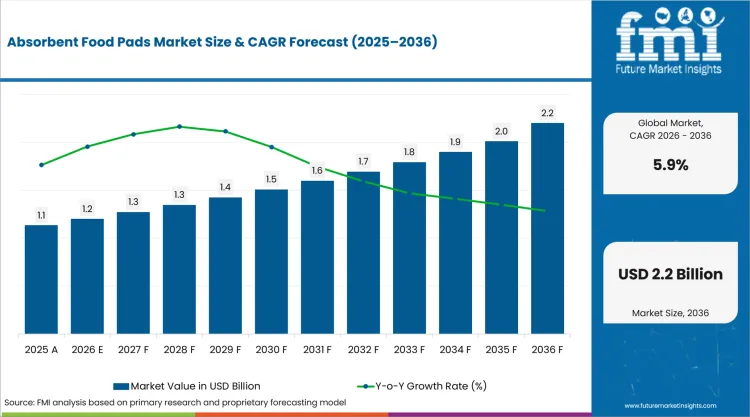
USD 1.2 billion in 2026 and USD 2.2 billion by 2036 at a 5.9% CAGR.
Absorbent food pad demand is forecast to rise at 5.9% CAGR between 2026 and 2036, pushing the industry value from USD 1.2 billion in 2026 to USD 2.2 billion by 2036. Fresh food suppliers continue to focus on extending product presentation and reducing losses throughout distribution and retail channels. The United Nations Environment Programme reported in March 2024 that food waste occurs across retail and foodservice plus households, placing shrink reduction on fresh food packaging and meat packaging agendas. Processors retain specifications once tests confirm leakage control without disrupting denesting, placement or sealing across expected storage periods.
Commercial conditions differ across the five profiled countries even though every processor needs dependable purge control in chilled trays. IBGE reported in March 2026 that Brazil processed 42.94 million cattle during 2025, which favors high-capacity pads across longer export routes. USA plants emphasize food-grade packaging documentation while Germany and the UK review material composition under retailer programs. Japan requires detailed traceability, so these differences change trial length and acceptable unit cost across disposable food containers and protein tray programs.
Key Takeaways of Absorbent Food Pads Market
- Packaged fresh protein and produce create repeat pad demand as every finished tray consumes one moisture-control component.
- Meat & Poultry Pads are projected to account for 38.0% of Product Type demand in 2026 owing to recurring purge across chilled protein packs.
- Fluff Pulp + SAP is estimated to represent 40.0% of Core Material demand in 2026 due to its established capacity-to-thickness balance.
- Medium absorbency is forecast to capture 38.0% of Absorbency demand in 2026 due to its fit across common retail portions without excessive bulk.
- Food-contact review and padless purge-control systems can extend conversion timelines for new core materials and alternative tray specifications.
- Novipax, McAirlaid's Vliesstoffe GmbH, Sirane, Cellcomb AB, POMONA Company Ltd., Gelok International, Sealed Air and Celtex represent the key players in the industry.
Analyst Perspective
"Absorbent food pad contracts depend on tested retention at the actual purge load as a low-cost insert can disrupt a complete tray program. Manufacturers defend repeat business by aligning core composition and sealed-edge design with food-contact records plus uninterrupted replenishment for each approved format."
- Nandini Roy Choudhury, Principal Consultant, Future Market Insights
How is the Absorbent Food Pads Market segmented?
The absorbent food pads market is segmented by Product Type, Core Material, Absorbency, Application, End Use, Sales Channel and Region.
The market taxonomy covers product type, core material, absorbency, application, end use, sales channel and region. Product type includes Meat & Poultry Pads, Seafood Pads, Produce Pads, Universal - Tray Pads and Other pads. Core material covers Fluff Pulp + SAP, Airlaid Cellulose, Nonwoven Synthetic, Cellulose-Only constructions and Other materials. Remaining axes classify absorbency levels, food applications, purchasing organizations and direct or intermediary sales routes.
Why do meat & poultry pads lead the product type category?
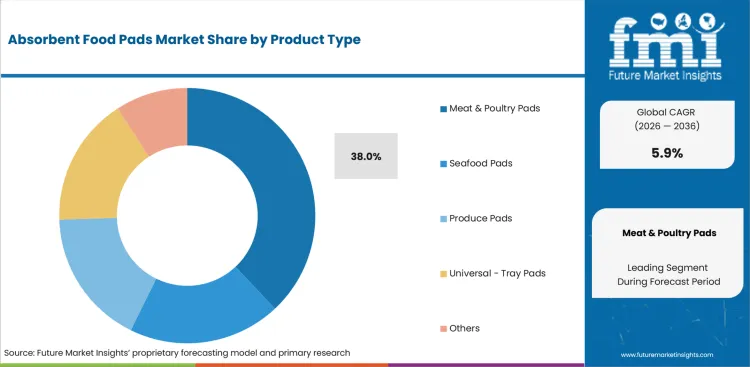
Fresh meat and poultry release measurable purge throughout refrigerated storage and regional distribution across retail supply chains. Protein processors use fitted pads to limit liquid movement while preserving product visibility across meat, poultry and seafood packaging lines during retail display.
- In 2026, meat & poultry pads are expected to lead product type with 38.0% share because chilled protein trays generate recurring purge.
- Processors test pad capacity against portion weight and tray angle during storage periods at commercial scale. Repeat orders follow packed volume as every completed tray consumes one pad, while customized sizes protect seal areas across different cuts and production lines for customer programs.
Why does fluff pulp + SAP lead the core material category?
Fluff pulp distributes incoming liquid across the core while superabsorbent polymer retains part of the load. The combined structure provides high capacity without thickness that disrupts automated tray handling or common sealing clearances within food tray programs during regular production shifts.
- By core material, fluff pulp + SAP is estimated to hold 40.0% in 2026 owing to its established capacity-to-thickness balance.
- Converters adjust pulp weight and polymer content for different food loads while preserving sealed edges and surface integrity. Cellulose-led alternatives need equivalent retention and line-performance evidence to replace an established construction across commercial storage programs on several automated tray lines.
How does medium absorbency anchor the absorbency category?
Medium absorbency covers the fluid range produced by many standard retail protein and produce portions. The class limits excess bulk from high-capacity pads while providing more protection than lower-load formats during refrigerated distribution and normal shelf display nationwide.
- Medium absorbency is projected to hold 38.0% share in 2026 owing to its fit across common tray weights and chilled storage periods.
- Plants standardize this class across several stock-keeping units to simplify inventory and reduce changeovers on high-volume lines. Final approval depends on actual drip volume and tray geometry plus storage orientation within active packaging formats across several retailer pack programs.
What supports fresh red meat within the application category?
Fresh red meat needs consistent liquid control as visible purge can weaken shelf presentation ahead of any quality failure. Case-ready distribution extends the period that each pad must retain fluid across retailer networks and regional transfer points nationwide.
- By application, fresh red meat is forecast to represent 32.0% in 2026 driven by visible leakage risk in higher-value retail packs.
- Packers compare retention across cut size and storage duration before standardizing a pad for regional distribution. These trials protect seal areas and reduce cleanup during transport vibration across PET packaging trays, while seafood applications usually require higher-capacity constructions during extended chilled distribution periods.
What are the drivers, restraints and opportunities in the Absorbent Food Pads Market?
Packaged fresh-food output supports repeat pad use, though food-contact review and padless tray systems slow material changes. Qualified fibre designs provide the clearest route for lower-impact specifications.
- Driver: Higher packaged-protein and produce output raises recurring demand for purge-control components across every completed tray.
- Restraint: Food-contact approval and whole-pack revalidation extend conversion timelines for new cores or padless tray systems.
- Opportunity: Cellulose-only and SAP-free pads can secure specifications once retention performance and credible disposal routes are proven together.
Fresh-Food Throughput Sustains Repeat Pad Orders
Protein and produce lines consume one pad with every finished tray, so production volume converts directly into replacement orders. Plants expand specifications once validated pads reduce cleanup and visible leakage under routine chilled handling. Higher-value active and modified atmosphere packaging programs also require controlled liquid movement around seal areas during retail distribution.
Food-Contact Review and Padless Systems Slow Conversion
Nominal capacity does not secure approval for a material that contacts food or comes in validated tray system. FDA guidance classifies packaging components as food-contact substances that remain subject to authorization for their intended use. Plants therefore review core composition and migration records plus placement performance during commercial authorization trials on production equipment.
Qualified Fibre Pads Expand the Addressable Specification
Cellulose-led pads reduce polymer content without changing the established placement step on automated tray lines. Processors require equivalent fluid retention and sealed-edge integrity plus disposal claims that match the destination market. Manufacturers serving compostable foodservice packaging programs can convert trials into recurring orders once those conditions remain stable at commercial speed.
Which country CAGRs are profiled in the Absorbent Food Pads Market?
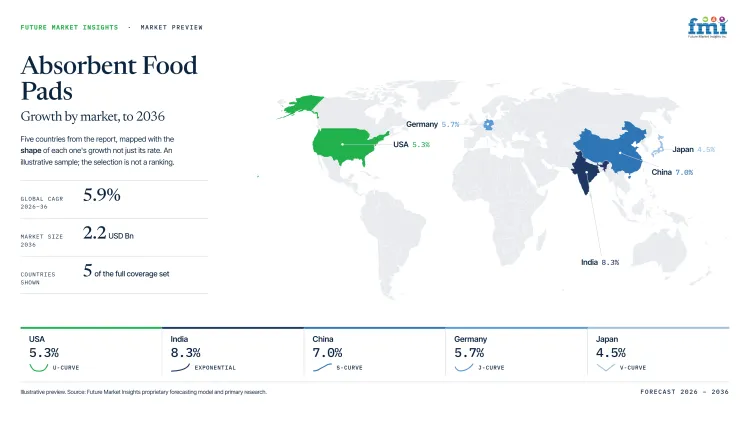
| Country | CAGR |
|---|---|
| USA | 5.3% |
| Germany | 5.7% |
| Japan | 4.5% |
| UK | 5.8% |
| Brazil | 6.3% |
How do country-level CAGRs compare in the Absorbent Food Pads Market?
The five country forecasts span 1.8 percentage points between Brazil at 6.3% and Japan at 4.5%. The UK, Germany and USA form a narrow middle band, although their processor structures and approval routes differ.
- Brazil's 0.5-point margin over the UK reflects export-oriented protein packing and longer distribution routes that require higher-capacity formats.
- The UK and Germany differ by 0.1 point, yet UK fees emphasize recyclability while German programs emphasize material declarations and line testing.
- Germany's 0.4-point margin over the USA reflects forecast pace instead of current market size or recurring order volume.
- The USA maintains broad direct-supply potential since centralized case-ready plants create larger approved accounts despite a slower forecast rate.
- Japan's 4.5% forecast reflects detailed positive-list review and smaller production runs that extend material qualification.
Country CAGR cannot identify the strongest commercial target without considering current order scale and qualification cost. The full report compares processor concentration and route-to-market conditions alongside each forecast rate during commercial prioritization.
Country-wise Analysis
- USA: Large case-ready protein plants use centralized tray specifications and direct supply agreements across national grocery and foodservice programs, concentrating recurring pad orders within major approved accounts that need regional inventory and technical support. The USA is estimated to post 5.3% CAGR over the forecast period, supported by recurring output from meat and poultry lines that consume one pad with every finished tray across major facilities. The USDA Economic Research Service reported in April 2026 that livestock availability continued to shape domestic beef and poultry production; for suppliers, the practical route to approval is to pair food-contact records with change-control evidence from live line trials.
- Germany: German meat processors use retailer-controlled tray specifications that place pack appearance and material documentation inside every format review across large national grocery programs plus regional case-ready facilities and export-oriented customer accounts throughout Germany. Absorbent food pad demand in Germany is forecast to rise at 5.7% CAGR over the forecast period, shaped by stable protein output and established qualification capacity across processing clusters and retail programs. The Federal Statistical Office reported in February 2025 that German meat production reached about 6.9 million tonnes during 2024, making documented composition and comparative retention data central to retailer-led approval discussions.
- Japan: Japanese processors require exact material records and consistent pad quality across smaller seafood and prepared-food production runs serving domestic retailers and import channels with specialized pack formats across several regional ports throughout Japan. Adoption of absorbent food pads in Japan is estimated to expand at 4.5% CAGR through 2036, reinforced by established import controls and qualification of imported food-contact components across tray and film formats. The Ministry of Health Labour and Welfare stated in March 2025 that positive-list implementation would begin on June 1 2025, so suppliers must plan for longer qualification windows and stable lot documentation before seasonal programs scale.
- UK: UK grocery chains use centralized specifications that connect leakage control with pack weight and recyclability reviews across chilled meat and seafood programs supplied by case-ready plants and processor groups plus premium retailer brands nationwide. Absorbent food pad sales in the UK are forecast to expand at 5.8% CAGR by 2036, aided by recurring tray volume across national retailers and major foodservice distribution programs plus regional grocery programs. PackUK updated 2025 base fees in June 2025 and confirmed modulated packaging fees from 2026, shifting supplier differentiation toward simpler structures that can defend disposal claims without adding failure risk across tray sizes.
- Brazil: Brazilian meat processors use high-capacity pads across export programs that face long distribution routes and variable handling conditions beyond major production clusters and established port corridors during seasonal production peaks plus national programs. Absorbent food pad sales in Brazil are forecast to expand at 6.3% CAGR by 2036, supported by large protein output and recurring export packaging across long chilled shipments and regular monthly schedules. Anvisa clarified food and packaging regularization routes in September 2024 under RDC 843/2024 and IN 281/2024, leaving regional inventory depth and Portuguese technical records as the service factors that can shorten conversion for export packers.
Who are the notable companies in the Absorbent Food Pads Market?
Novipax, McAirlaid's Vliesstoffe GmbH, Sirane, Cellcomb AB, POMONA Company Ltd., Gelok International, Sealed Air and Celtex are the notable companies serving this market.
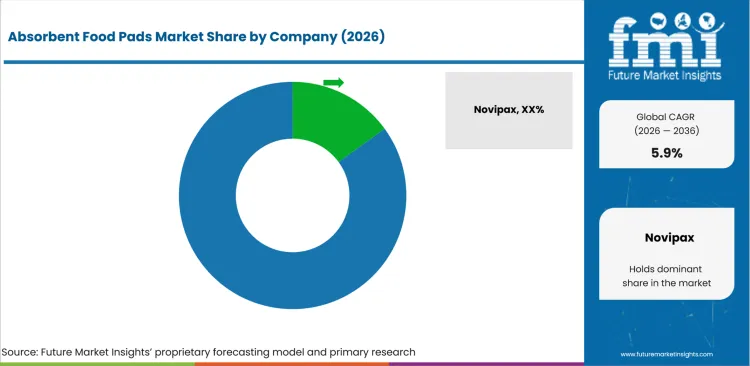
Dedicated pad manufacturers compete beside airlaid specialists and integrated packaging groups serving different risks across finished tray programs. Finished-pad specialists differentiate on absorbency range and sealed-edge construction, whereas material companies compete on core thickness and pressure retention. Integrated groups connect liquid control with trays or equipment, and regional manufacturers shorten lead times for local dimensions and technical support. Each new construction must pass line trials and secure stable replenishment across approved formats before commercial approval.
- Application-specific pad specialists: Novipax, McAirlaid's Vliesstoffe GmbH, Sirane, Cellcomb AB and POMONA Company Ltd. compete across protein, seafood, produce and fibre-based formats.
- Engineered absorbent materials: Gelok International supplies customizable laminates and airlaid cores for food tray pads plus related converted products.
- Integrated and regional pack platforms: Sealed Air (now privately held under CD&R ownership as of April 2026) and Celtex compete with tray-system knowledge, local conversion capacity and processor-facing technical service.
Competitive Benchmarking: Absorbent Food Pads Market
| Company | Application-Specific Pad Depth | Core Construction Breadth | Integrated Pack-Line Support | Geographic Reach |
|---|---|---|---|---|
| Novipax | High | High | Medium | United States with national manufacturing coverage |
| McAirlaid's Vliesstoffe GmbH | High | Medium | Medium | Europe and United States with international pad supply |
| Sirane | High | High | High | Europe with North American and Latin American operations |
| Cellcomb AB | High | High | Medium | Europe with international food-pad sales |
| POMONA Company Ltd. | High | High | Medium | Poland with European fresh-food customers |
| Gelok International | Medium | Medium | Medium | United States with global laminate and converter customers |
| Sealed Air | Medium | Medium | High | Global food-packaging sales and technical service |
| Celtex | High | High | Medium | Chile with regional protein-pad supply |
Key Developments in the Absorbent Food Pads Market
- In November 2025, McAirlaid's Vliesstoffe GmbH received Grade A BRCGS Packaging Materials certification for its Berlingerode site. The scope covers cellulose nonwovens with or without superabsorbers for pads used in direct food-contact packaging. Site-level certification reduces qualification work for European processors, although each finished format requires application testing.
- In September 2025, Sealed Air installed the 4,000th CRYOVAC rotary vacuum chamber system at Cargill's Dodge City facility. The installation strengthens service around automated protein lines and raises the integration standard that absorbent-pad manufacturers must match, although it does not independently establish pad demand.
- In June 2025, Cellcomb completed the acquisition of Finnish healthcare fibre-product maker Fatex to expand its fibre-based product platform. The added manufacturing base broadens northern European capacity, although each food-pad construction requires retention testing and food-contact qualification before recurring orders begin.
Key Players in the Absorbent Food Pads Market
Application-Specific Food Pad Specialists
- Novipax
- McAirlaid's Vliesstoffe GmbH
- Sirane
- Cellcomb AB
- POMONA Company Ltd.
Engineered Absorbent Materials
- Gelok International
Integrated and Regional Packaging Platforms
- Sealed Air
- Celtex
Absorbent Food Pads Market - Report Scope
| Coverage field | Report scope |
|---|---|
| Market breakdown | By product type, core material, absorbency, application, end use, sales channel and region. |
| Quantitative Units | Revenue in USD billion and CAGR in %. |
| Market Definition | Commercial revenue from finished absorbent food pads and inserts supplied for meat, poultry, seafood, produce and related food-pack applications. |
| Regions Covered | North America, Latin America, Europe, East Asia, South Asia and Pacific, and Middle East and Africa. |
| Countries Covered | USA, Germany, Japan, UK, Brazil, and 20+ countries included in the full report. |
| Key Companies Profiled | Novipax, McAirlaid's Vliesstoffe GmbH, Sirane, Cellcomb AB, POMONA Company Ltd., Gelok International, Sealed Air and Celtex. |
| Forecast Period | 2026 to 2036. |
| Approach | Primary and secondary research with market triangulation. |
Absorbent Food Pads Market - Research Methodology
| Method | Approach |
|---|---|
| Primary Research | FMI analysts gathered input from manufacturers, service providers, technology developers, distributors, end users, procurement teams, and subject-matter experts. Interviews examined purchasing decisions, product or service evaluation, adoption barriers, approval requirements, pricing considerations, and expectations for technical or commercial support. Respondents were also asked what evidence is required before a trial, pilot, or initial order develops into regular purchasing. |
| Desk Research | Desk research covered government statistics, regulatory publications, trade data, industry associations, technical literature, standards, company filings, product information, and official corporate announcements. Sources were reviewed for relevance, publication date, geographic coverage, and consistency with the defined market scope. Claims relating to performance, applications, approvals, capacity, investment, and commercial activity were retained only when supported by credible public evidence. |
| Market Sizing and Forecasting | The market model combined the baseline value with historical performance, segment structure, pricing and volume indicators, adoption levels, company participation, and country-level demand conditions. Forecast assumptions considered economic activity, investment trends, regulatory developments, technology adoption, purchasing cycles, supply availability, and barriers to wider market use. Segment and regional estimates were reconciled before the final market total was calculated. |
| Data Validation | Estimates were checked against multiple independent indicators, including public data, company activity, trade patterns, industry developments, and findings from primary interviews. Validation also tested whether products, services, applications, and company revenues fell within the defined market boundaries. Adjacent categories, unsupported claims, overlapping revenues, and activities without direct market relevance were excluded to reduce double counting and maintain consistency across segments and countries. |
Absorbent Food Pads Market by Segments
Absorbent Food Pads Market segmented by Product Type:
- Meat & Poultry Pads
- Seafood Pads
- Produce Pads
- Universal - Tray Pads
- Others
Absorbent Food Pads Market segmented by Core Material:
- Fluff Pulp + SAP
- Airlaid Cellulose
- Nonwoven Synthetic
- Cellulose-Only (SAP-Free)
- Others
Absorbent Food Pads Market segmented by Absorbency:
- Medium (50-100 g)
- Standard (Below 50 g)
- High (Above 100 g)
Absorbent Food Pads Market segmented by Application:
- Fresh Red Meat
- Poultry
- Seafood
- Fruits & Vegetables
- Others
Absorbent Food Pads Market segmented by End Use:
- Meat & Seafood Processors
- Grocery Retail
- Foodservice
- Others
Absorbent Food Pads Market segmented by Sales Channel:
- Direct - OEM Supply
- Packaging Distributors
- Others
- Online - E-commerce
Absorbent Food Pads Market by Region:
- North America
- United States
- Canada
- Latin America
- Brazil
- Mexico
- Chile
- Rest of Latin America
- Western Europe
- Germany
- United Kingdom
- Italy
- Spain
- France
- Nordics
- Benelux
- Rest of Western Europe
- Eastern Europe
- Russia
- Poland
- Hungary
- Balkan and Baltic States
- Rest of Eastern Europe
- East Asia
- China
- Japan
- South Korea
- South Asia and Pacific
- India
- ASEAN
- Australia and New Zealand
- Rest of South Asia and Pacific
- Middle East and Africa
- Kingdom of Saudi Arabia
- Other GCC Countries
- Türkiye
- South Africa
- Other African Union Countries
- Rest of Middle East and Africa
Research Sources and Bibliography
- United Nations Environment Programme. (2024, March 27). Food Waste Index Report 2024.
- Brazilian Institute of Geography and Statistics. (2026, March 18). In 2025, Brazil registers the highest production of milk, leather and eggs in history; cattle, chicken and pig slaughter also reach records.
- USA Food and Drug Administration. (2024, July 24). Food Packaging & Other Substances that Come in Contact with Food - Information for Consumers.
- USA Department of Agriculture Economic Research Service. (2026, April 15). Livestock, Dairy, and Poultry Outlook: April 2026.
- Federal Statistical Office of Germany. (2025, February 7). Fleischproduktion im Jahr 2024 um 1,4 % gestiegen.
- Ministry of Health, Labour and Welfare of Japan. (2025, March 28). Imported Foods Monitoring Plan for FY 2025.
- Department for Environment, Food & Rural Affairs and PackUK. (2025, June 30). Extended Producer Responsibility for Packaging: 2025 base fees.
- Brazilian Health Regulatory Agency. (2024, September 4). Regularização de Alimentos e Embalagens.
- Novipax. (2026). Company. Retrieved August 7, 2026.
- McAirlaid's Vliesstoffe GmbH. (2026). Certifications. Retrieved August 7, 2026.
- Cellcomb AB. (2026). Cellcomb - solutions for health care, hygiene and food industry. Retrieved August 7, 2026.
- POMONA Company Ltd. (2026). About us. Retrieved August 7, 2026.
- Gelok International Corporation. (2026). About Gelok International: Our Founder's Story. Retrieved August 7, 2026.
- Celtex S.A. (2026). About us. Retrieved August 7, 2026.
- McAirlaid's Vliesstoffe GmbH. (2025, November 26). CERTIFICATE.
- Sealed Air Corporation. (2025, September 9). CRYOVAC Brand Food Packaging Installs 4,000th Rotary Vacuum Packaging System.
- Cellcomb AB. (2025, June 4). Cellcomb acquires Fatex.
- Sealed Air Corporation. (2026, April 9). Sealed Air Announces Completion of Acquisition by CD&R.
- Cellcomb AB. (2025, October 24). Cellsorb® ECO becomes Cellsorb® CORE.
- Cellcomb AB. (2025, June 17). Installation of new sprinkler system.
This bibliography is provided for reader reference and is not exhaustive. The full report contains the complete reference list and detailed citations
This Report Answers
- How large is the Absorbent Food Pads Market in 2026 and what value is forecast for 2036?
- Which fresh-food operating conditions support recurring absorbent food pad demand?
- Why do Meat & Poultry Pads account for 38.0% of Product Type demand in 2026?
- How does Fluff Pulp + SAP balance retention capacity with automated tray handling?
- Why does Medium absorbency fit common retail protein and produce packs?
- How do country growth rates differ across the USA, Germany, Japan, UK and Brazil?
- Which supplier types compete across finished pads, engineered absorbents and integrated food-pack systems?
- How do food-contact review and padless trays affect conversion timelines?
- Which commercial tests should processors complete before approving a new pad construction?
Frequently Asked Questions
How big is the absorbent food pads market in 2026?
The absorbent food pads market is estimated at USD 1.2 billion in 2026 and is projected to reach USD 2.2 billion by 2036. Growth is driven by increasing use of absorbent pads in meat, poultry, seafood, and fresh produce packaging.
What is the CAGR of the absorbent food pads market from 2026 to 2036?
The absorbent food pads market is projected to grow at a CAGR of 5.9% between 2026 and 2036. Rising fresh-food packaging volumes and demand for effective moisture management solutions continue to support market expansion.
Which product type is projected to account for 38.0% of the absorbent food pads market?
Meat & poultry pads are projected to account for 38.0% of the market in 2026. Their leading share is supported by widespread use in protein packaging to absorb excess fluid and maintain product presentation.
Which different exhaustive segment offers the clearest expansion route through 2036?
Cellulose-only (SAP-free) is expected to offer the strongest growth opportunity within the core material segment through 2036. Adoption is supported by increasing interest in sustainable materials and improved disposal characteristics.
Which companies are active in the absorbent food pads market?
Key companies operating in the market include Novipax, McAirlaid's Vliesstoffe GmbH, Sirane, Cellcomb AB, POMONA Company Ltd., Gelok International, Sealed Air, and Celtex. These companies provide absorbent food pads, core materials, and packaging support solutions for food processors and retailers.
Preview the report firsthand - request a free sample
Get SampleGet the brochure for pricing and purchase details.
Get PDFTable of Content
- Key Takeaways
- Market Size and CAGR
- Top Growth Driver
- Fastest Growing Segment
- Leading Region
- Key Companies
- Emerging Opportunities
- Executive Summary
- Global Market Outlook
- Demand-side Trends
- Supply-side Trends
- Technology Roadmap Analysis
- Analysis and Recommendations
- Analyst Perspective (What is happening? Why now? What should investors know?)
- Key Questions Answered
- How large is the market?
- What is the CAGR?
- What are key trends?
- Which region dominates?
- Who are the leaders?
- Market Overview
- Market Coverage / Taxonomy
- Market Definition / Scope / Limitations
- Research Methodology
- Chapter Orientation
- Analytical Lens and Working Hypotheses
- Market Structure, Signals, and Trend Drivers
- Benchmarking and Cross-market Comparability
- Market Sizing, Forecasting, and Opportunity Mapping
- Research Design and Evidence Framework
- Desk Research Programme (Secondary Evidence)
- Expert Input and Fieldwork (Primary Evidence)
- Tooling, Models, and Reference Databases
- Data Engineering and Model Build
- Quality Assurance and Audit Trail
- Market Background
- Market Dynamics (Drivers, Restraints, Opportunity, Trends)
- Scenario Forecast (Optimistic, Likely, Conservative)
- Impact Analysis
- AI Impact
- Sustainability Impact
- Regulatory Impact
- Technology Impact
- Consumer / Buyer Analysis
- Purchase Drivers
- Adoption Barriers
- Buyer Journey
- Opportunity Map Analysis
- Product Life Cycle Analysis
- Supply Chain Analysis
- Investment Feasibility Matrix
- Value Chain Analysis
- PESTLE and Porter's Analysis
- Regulatory Landscape
- Regional Parent Market Outlook
- Production and Consumption Statistics
- Import and Export Statistics
- Global Market Analysis and Forecast, 2021 to 2036
- Historical Market Size Value (USD Million) Analysis, 2021 to 2025
- Current and Future Market Size Value (USD Million) Projections, 2026 to 2036
- Y-o-Y Growth Trend Analysis
- Absolute $ Opportunity Analysis
- Global Market Pricing Analysis, 2021 to 2036
- Global Market Analysis and Forecast, By Product Type, 2021 to 2036
- Introduction / Key Findings
- Historical Market Size Value (USD Million) Analysis By Product Type, 2021 to 2025
- Current and Future Market Size Value (USD Million) Analysis and Forecast By Product Type, 2026 to 2036
- Meat & Poultry Pads
- Seafood Pads
- Produce Pads
- Universal - Tray Pads
- Others
- Meat & Poultry Pads
- Y-o-Y Growth Trend Analysis By Product Type, 2021 to 2025
- Absolute $ Opportunity Analysis By Product Type, 2026 to 2036
- Global Market Analysis and Forecast, By Core Material, 2021 to 2036
- Introduction / Key Findings
- Historical Market Size Value (USD Million) Analysis By Core Material, 2021 to 2025
- Current and Future Market Size Value (USD Million) Analysis and Forecast By Core Material, 2026 to 2036
- Fluff Pulp + SAP
- Airlaid Cellulose
- Nonwoven Synthetic
- Cellulose-Only (SAP-Free)
- Others
- Fluff Pulp + SAP
- Y-o-Y Growth Trend Analysis By Core Material, 2021 to 2025
- Absolute $ Opportunity Analysis By Core Material, 2026 to 2036
- Global Market Analysis and Forecast, By Absorbency, 2021 to 2036
- Introduction / Key Findings
- Historical Market Size Value (USD Million) Analysis By Absorbency, 2021 to 2025
- Current and Future Market Size Value (USD Million) Analysis and Forecast By Absorbency, 2026 to 2036
- Medium (50-100 g)
- Standard (Below 50 g)
- High (Above 100 g)
- Medium (50-100 g)
- Y-o-Y Growth Trend Analysis By Absorbency, 2021 to 2025
- Absolute $ Opportunity Analysis By Absorbency, 2026 to 2036
- Global Market Analysis and Forecast, By Application, 2021 to 2036
- Introduction / Key Findings
- Historical Market Size Value (USD Million) Analysis By Application, 2021 to 2025
- Current and Future Market Size Value (USD Million) Analysis and Forecast By Application, 2026 to 2036
- Fresh Red Meat
- Poultry
- Seafood
- Fruits & Vegetables
- Others
- Fresh Red Meat
- Y-o-Y Growth Trend Analysis By Application, 2021 to 2025
- Absolute $ Opportunity Analysis By Application, 2026 to 2036
- Global Market Analysis and Forecast, By End Use, 2021 to 2036
- Introduction / Key Findings
- Historical Market Size Value (USD Million) Analysis By End Use, 2021 to 2025
- Current and Future Market Size Value (USD Million) Analysis and Forecast By End Use, 2026 to 2036
- Meat & Seafood Processors
- Grocery Retail
- Foodservice
- Others
- Meat & Seafood Processors
- Y-o-Y Growth Trend Analysis By End Use, 2021 to 2025
- Absolute $ Opportunity Analysis By End Use, 2026 to 2036
- Global Market Analysis and Forecast, By Sales Channel
- Introduction / Key Findings
- Historical Market Size Value (USD Million) Analysis By Sales Channel, 2021 to 2025
- Current and Future Market Size Value (USD Million) Analysis and Forecast By Sales Channel, 2026 to 2036
- Direct - OEM Supply
- Packaging Distributors
- Others
- Online - E-commerce
- Direct - OEM Supply
- Y-o-Y Growth Trend Analysis By Sales Channel, 2021 to 2025
- Absolute $ Opportunity Analysis By Sales Channel, 2026 to 2036
- Global Market Analysis and Forecast, By Region, 2021 to 2036
- Introduction
- Historical Market Size Value (USD Million) Analysis By Region, 2021 to 2025
- Current Market Size Value (USD Million) Analysis and Forecast By Region, 2026 to 2036
- North America
- Latin America
- Western Europe
- Eastern Europe
- East Asia
- South Asia and Pacific
- Middle East & Africa
- Market Attractiveness Analysis By Region
- North America Market Analysis and Forecast, By Country, 2021 to 2036
- Historical Market Size Value (USD Million) Trend Analysis By Market Taxonomy, 2021 to 2025
- Market Size Value (USD Million) Forecast By Market Taxonomy, 2026 to 2036
- By Country
- USA
- Canada
- By Product Type
- By Core Material
- By Absorbency
- By Application
- By End Use
- By Sales Channel
- By Country
- Market Attractiveness Analysis
- By Country
- By Product Type
- By Core Material
- By Absorbency
- By Application
- By End Use
- By Sales Channel
- Key Takeaways
- Latin America Market Analysis and Forecast, By Country
- Historical Market Size Value (USD Million) Trend Analysis By Market Taxonomy, 2021 to 2025
- Market Size Value (USD Million) Forecast By Market Taxonomy, 2026 to 2036
- By Country
- Brazil
- Mexico
- Chile
- Rest of Latin America
- By Product Type
- By Core Material
- By Absorbency
- By Application
- By End Use
- By Sales Channel
- By Country
- Market Attractiveness Analysis
- By Country
- By Product Type
- By Core Material
- By Absorbency
- By Application
- By End Use
- By Sales Channel
- Key Takeaways
- Western Europe Market Analysis and Forecast, By Country
- Historical Market Size Value (USD Million) Trend Analysis By Market Taxonomy, 2021 to 2025
- Market Size Value (USD Million) Forecast By Market Taxonomy, 2026 to 2036
- By Country
- Germany
- UK
- Italy
- Spain
- France
- Nordic
- BENELUX
- Rest of Western Europe
- By Product Type
- By Core Material
- By Absorbency
- By Application
- By End Use
- By Sales Channel
- By Country
- Market Attractiveness Analysis
- By Country
- By Product Type
- By Core Material
- By Absorbency
- By Application
- By End Use
- By Sales Channel
- Key Takeaways
- Eastern Europe Market Analysis and Forecast, By Country
- Historical Market Size Value (USD Million) Trend Analysis By Market Taxonomy, 2021 to 2025
- Market Size Value (USD Million) Forecast By Market Taxonomy, 2026 to 2036
- By Country
- Russia
- Poland
- Hungary
- Balkan & Baltic
- Rest of Eastern Europe
- By Product Type
- By Core Material
- By Absorbency
- By Application
- By End Use
- By Sales Channel
- By Country
- Market Attractiveness Analysis
- By Country
- By Product Type
- By Core Material
- By Absorbency
- By Application
- By End Use
- By Sales Channel
- Key Takeaways
- East Asia Market Analysis and Forecast, By Country
- Historical Market Size Value (USD Million) Trend Analysis By Market Taxonomy, 2021 to 2025
- Market Size Value (USD Million) Forecast By Market Taxonomy, 2026 to 2036
- By Country
- China
- Japan
- South Korea
- By Product Type
- By Core Material
- By Absorbency
- By Application
- By End Use
- By Sales Channel
- By Country
- Market Attractiveness Analysis
- By Country
- By Product Type
- By Core Material
- By Absorbency
- By Application
- By End Use
- By Sales Channel
- Key Takeaways
- South Asia and Pacific Market Analysis and Forecast, By Country
- Historical Market Size Value (USD Million) Trend Analysis By Market Taxonomy, 2021 to 2025
- Market Size Value (USD Million) Forecast By Market Taxonomy, 2026 to 2036
- By Country
- India
- ASEAN
- Australia & New Zealand
- Rest of South Asia and Pacific
- By Product Type
- By Core Material
- By Absorbency
- By Application
- By End Use
- By Sales Channel
- By Country
- Market Attractiveness Analysis
- By Country
- By Product Type
- By Core Material
- By Absorbency
- By Application
- By End Use
- By Sales Channel
- Key Takeaways
- Middle East & Africa Market Analysis and Forecast, By Country
- Historical Market Size Value (USD Million) Trend Analysis By Market Taxonomy, 2021 to 2025
- Market Size Value (USD Million) Forecast By Market Taxonomy, 2026 to 2036
- By Country
- Kingdom of Saudi Arabia
- Other GCC Countries
- Türkiye
- South Africa
- Other African Union
- Rest of Middle East & Africa
- By Product Type
- By Core Material
- By Absorbency
- By Application
- By End Use
- By Sales Channel
- By Country
- Market Attractiveness Analysis
- By Country
- By Product Type
- By Core Material
- By Absorbency
- By Application
- By End Use
- By Sales Channel
- Key Takeaways
- Key Countries Market Analysis
- USA
- Pricing Analysis
- Market Share Analysis, 2025
- By Product Type
- By Core Material
- By Absorbency
- By Application
- By End Use
- By Sales Channel
- Canada
- Pricing Analysis
- Market Share Analysis, 2025
- By Product Type
- By Core Material
- By Absorbency
- By Application
- By End Use
- By Sales Channel
- Mexico
- Pricing Analysis
- Market Share Analysis, 2025
- By Product Type
- By Core Material
- By Absorbency
- By Application
- By End Use
- By Sales Channel
- Brazil
- Pricing Analysis
- Market Share Analysis, 2025
- By Product Type
- By Core Material
- By Absorbency
- By Application
- By End Use
- By Sales Channel
- Chile
- Pricing Analysis
- Market Share Analysis, 2025
- By Product Type
- By Core Material
- By Absorbency
- By Application
- By End Use
- By Sales Channel
- Germany
- Pricing Analysis
- Market Share Analysis, 2025
- By Product Type
- By Core Material
- By Absorbency
- By Application
- By End Use
- By Sales Channel
- UK
- Pricing Analysis
- Market Share Analysis, 2025
- By Product Type
- By Core Material
- By Absorbency
- By Application
- By End Use
- By Sales Channel
- Italy
- Pricing Analysis
- Market Share Analysis, 2025
- By Product Type
- By Core Material
- By Absorbency
- By Application
- By End Use
- By Sales Channel
- Spain
- Pricing Analysis
- Market Share Analysis, 2025
- By Product Type
- By Core Material
- By Absorbency
- By Application
- By End Use
- By Sales Channel
- France
- Pricing Analysis
- Market Share Analysis, 2025
- By Product Type
- By Core Material
- By Absorbency
- By Application
- By End Use
- By Sales Channel
- India
- Pricing Analysis
- Market Share Analysis, 2025
- By Product Type
- By Core Material
- By Absorbency
- By Application
- By End Use
- By Sales Channel
- ASEAN
- Pricing Analysis
- Market Share Analysis, 2025
- By Product Type
- By Core Material
- By Absorbency
- By Application
- By End Use
- By Sales Channel
- Australia & New Zealand
- Pricing Analysis
- Market Share Analysis, 2025
- By Product Type
- By Core Material
- By Absorbency
- By Application
- By End Use
- By Sales Channel
- China
- Pricing Analysis
- Market Share Analysis, 2025
- By Product Type
- By Core Material
- By Absorbency
- By Application
- By End Use
- By Sales Channel
- Japan
- Pricing Analysis
- Market Share Analysis, 2025
- By Product Type
- By Core Material
- By Absorbency
- By Application
- By End Use
- By Sales Channel
- South Korea
- Pricing Analysis
- Market Share Analysis, 2025
- By Product Type
- By Core Material
- By Absorbency
- By Application
- By End Use
- By Sales Channel
- Russia
- Pricing Analysis
- Market Share Analysis, 2025
- By Product Type
- By Core Material
- By Absorbency
- By Application
- By End Use
- By Sales Channel
- Poland
- Pricing Analysis
- Market Share Analysis, 2025
- By Product Type
- By Core Material
- By Absorbency
- By Application
- By End Use
- By Sales Channel
- Hungary
- Pricing Analysis
- Market Share Analysis, 2025
- By Product Type
- By Core Material
- By Absorbency
- By Application
- By End Use
- By Sales Channel
- Kingdom of Saudi Arabia
- Pricing Analysis
- Market Share Analysis, 2025
- By Product Type
- By Core Material
- By Absorbency
- By Application
- By End Use
- By Sales Channel
- Türkiye
- Pricing Analysis
- Market Share Analysis, 2025
- By Product Type
- By Core Material
- By Absorbency
- By Application
- By End Use
- By Sales Channel
- South Africa
- Pricing Analysis
- Market Share Analysis, 2025
- By Product Type
- By Core Material
- By Absorbency
- By Application
- By End Use
- By Sales Channel
- USA
- Market Structure Analysis
- Competition Dashboard
- Competition Benchmarking
- Market Share Analysis of Top Players
- By Regional
- By Product Type
- By Core Material
- By Absorbency
- By Application
- By End Use
- By Sales Channel
- Emerging Startups
- Innovation Benchmarking
- Competition Analysis
- Competition Deep Dive
- Novipax
- Overview
- Product Portfolio
- Profitability by Market Segments
- Sales Footprint
- Strategy Overview
- Marketing Strategy
- Product Strategy
- Channel Strategy
- Sealed Air
- McAirlaid's
- Sirane
- Cellcomb
- Maxwell Chase Technologies
- Gelok International
- Aptar CSP Technologies
- Cascades
- UFP Technologies
- Novipax
- Case Studies
- Success Stories
- Recent Developments
- Competition Deep Dive
- Assumptions & Acronyms Used


