

- Market Size (2026)
- USD 257.1 Mn
- Forecast (2036)
- USD 717.0 Mn
- CAGR (2026 to 2036)
- 10.8%
How big is Bio-Based Produce Films Market in 2026?
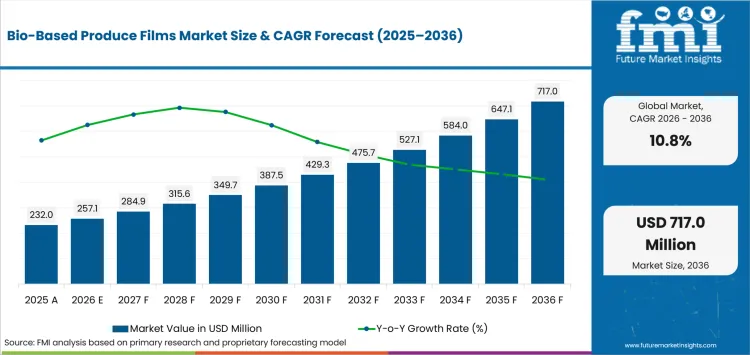
USD 257.1 million in 2026 and USD 717.0 million by 2036 at a 10.8% CAGR.
Demand for bio-based produce films is projected to expand at 10.8% CAGR between 2026 and 2036. Market value rises from USD 257.1 million to USD 717.0 million as packers test renewable films beside fresh food packaging systems that regulate moisture and respiration. FAO reported in September 2025 that fruit and vegetables recorded a 25.4% global loss rate. That operating exposure gives packers a direct reason to test gas exchange and seal performance without sacrificing line speed or shelf visibility.
Material policy does not establish one common disposal route across major packaging markets with different collection systems. European produce programs compare bioplastics with national recycling rules and collection access, whereas American programs often emphasize documented renewable content. Eurostat reported in October 2025 that the EU recycled 42.1% of plastic packaging waste generated during 2023. That measured recovery system raises the design threshold for new films and increases the value of region-specific disposal guidance.
Key Takeaways of Bio-Based Produce Films Market
- Crop-specific permeability and reliable operation on existing equipment convert bio-based film trials into recurring produce-packaging orders.
- PLA films are projected to account for 30.0% share in 2026 owing to established extrusion routes and clear retail presentation.
- Corn-sugarcane starch is estimated to hold 34.0% share in 2026 due to established fermentation and bio-ethanol supply routes.
- Fully bio-based films are anticipated to represent 44.0% share in 2026 owing to their direct renewable-carbon specification.
- Price premiums and inconsistent composting or recycling access lengthen technical qualification across regional produce programs.
- NatureWorks LLC, Futamura Group, Taghleef Industries, TIPA Corp., Novamont S.p.A., Innovia Films and Amcor plc cover renewable polymers, compostable films and produce-specific conversion.
Analyst Perspective
"Bio-based produce films earn repeat volume by controlling respiration and seals across seasonal crop changes. Material origin strengthens the offer, but packers approve a grade once shelf-life evidence and local disposal guidance support the same specification."
- Nandini Roy Choudhury, Principal Consultant, Future Market Insights
How is the Bio-Based Produce Films Market segmented?
The bio-based produce films market is segmented by product type, feedstock, bio-based content, produce type, end use, sales channel and region.
The bio-based produce films market covers PLA films, cellulose films, bio-PE films, starch-blend films and other product types across corn-sugarcane starch, wood cellulose, bio-ethanol, agri-residue and other feedstocks. Bio-based content spans 100%, 75-99%, 50-74% and below 50%, while produce types cover fruits, fresh-cut and salads, whole vegetables, herbs and others. End uses include grocery retail, packers and processors, foodservice and others, supported by direct OEM supply, packaging distributors, online e-commerce and other channels.
What makes PLA films central to the product type category?
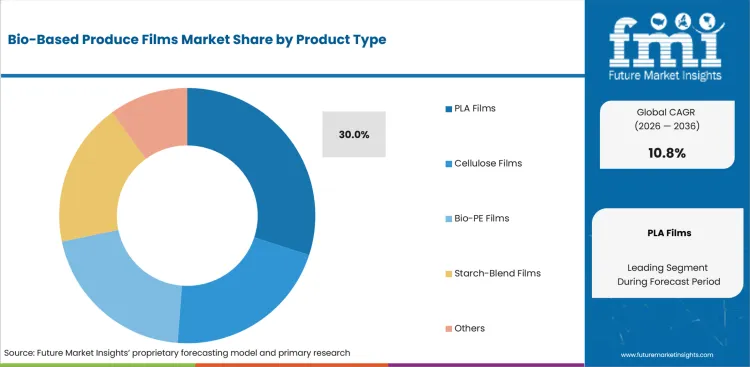
Polylactic acid films give produce packs clear presentation and sufficient stiffness for flow-wrap bags or overwrap formats with strong shelf visibility. Their commercial limit is respiration control as each crop needs a different oxygen and moisture exchange profile during storage and transport.
- Based on product type, PLA films are projected to account for 30.0% in 2026 due to established extrusion knowledge and broad print compatibility.
- Packing teams test seal range and puncture resistance beside modified atmosphere packaging settings on the intended line. Perforation or blending can adjust airflow without forcing a wholesale equipment change across seasonal produce programs at each facility.
How does corn-sugarcane starch influence feedstock selection?
Corn starch and sugarcane support established carbohydrate routes for lactic acid and bio-ethanol production at commercial scale. Their industrial processing base gives resin makers repeatable inputs across North American and tropical supply regions for large starch-based bioplastics programs.
- By feedstock, corn-sugarcane starch is estimated to hold 34.0% in 2026 owing to mature fermentation routes and repeatable commercial resin quality.
- Film converters assess molecular weight and agricultural traceability across production lots during approval of large programs. Multiple crop origins can reduce dependence on one regional harvest but do not remove the need for stable gauge and sealing behavior during routine conversion.
What role does fully bio-based content play within the bio-based content category?
Fully bio-based films give brand owners a direct renewable-carbon specification across biopolymers used for packaging and labeling. That claim remains separate from compostability or recyclability and requires clear measurement plus local disposal guidance in each market.
- In 2026, fully bio-based films are expected to lead bio-based content with 44.0% share owing to specifications that avoid blended-content ambiguity.
- Retail packaging teams verify content inside formal qualification programs and then compare line performance with recovery options. A high renewable percentage earns repeat use provided the film protects produce and matches the collection route available in the selling market.
How do produce packers evaluate direct OEM supply?
Direct OEM supply connects film formulation with packing-line trials and ongoing specification control across flexible plastic packaging programs. The channel suits produce programs that change crops or machinery settings across seasons and regional facilities with centralized specification control.
- By sales channel, direct OEM supply is forecast to represent 40.0% in 2026 driven by application trials and controlled technical adjustments.
- Large produce packers require traceability records and rapid engineering support across multiple facilities during changeovers. A direct relationship gives one technical team responsibility for gauge and seal settings whereas distributors remain better suited to standard bags or small orders during peak seasons.
What are the drivers, restraints and opportunities in the Bio-Based Produce Films Market?
Food-loss economics support demand as performance gaps delay approval and crop-specific permeability directs the clearest commercial route.
- Driver: Produce packers fund renewable film trials that protect shelf life and preserve normal operating speed across existing packaging equipment.
- Restraint: Material premiums and uncertain recovery routes lengthen approval for retail programs that operate across several waste systems.
- Opportunity: Film developers can pair verified renewable content with crop-specific gas transmission and recovery guidance suited to each selling market.
Produce packers fund renewable film trials that reduce dehydration or respiration damage without lowering throughput. Retailers can extend one qualified structure across several packing partners under common specifications once shelf-life results and line performance justify the material premium.
Technical approval slows as bio-based content does not establish compostability or recyclability in the selling market. The European Commission stated in February 2025 that PPWR entered into force and governs packaging composition plus recoverability. Multicountry produce programs require verified performance records and disposal instructions for every collection system in each selling territory.
Film developers can shorten approval by matching each crop grade to one documented recovery route. Compostable plastic packaging fits markets with accepted organic treatment capacity for food-contact formats and accompanying produce waste. Bio-sourced recyclable films fit collection-led sustainable packaging programs that require permeability data and recovery evidence before commercial approval.
Which country CAGRs are profiled in the Bio-Based Produce Films Market?
| Country | CAGR |
|---|---|
| Brazil | 11.3% |
| United Kingdom | 10.9% |
| Germany | 10.6% |
| United States | 10.1% |
| Japan | 9.3% |
How do country-level CAGRs compare in the Bio-Based Produce Films Market?
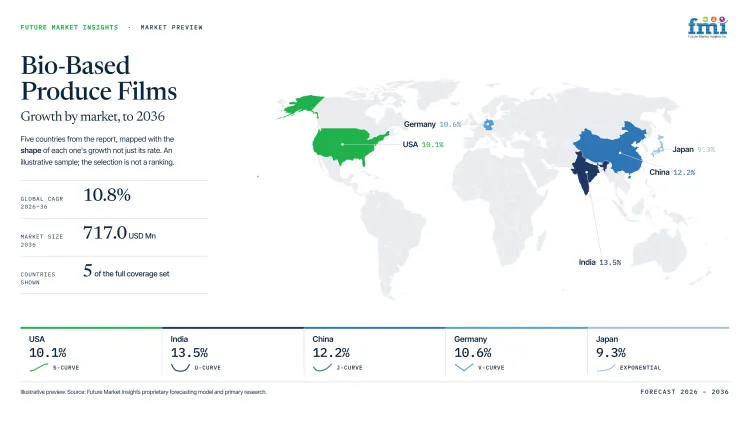
The five-country range spans 2.0 percentage points from Brazil at 11.3% to Japan at 9.3%. The spacing reflects different feedstock access and approval routes instead of current national market size or installed conversion volume.
- Brazil benefits from abundant sugarcane-derived feedstock and policy support for renewable packaging materials.
- In the UK, retailer specifications and packaging tax considerations increasingly shape film selection decisions.
- Germany places greater emphasis on recyclability performance, alongside renewable-content credentials and recovery outcomes.
- The USA market balances large-scale produce packaging trials with differing recovery conditions across states and municipalities.
- Japan's conversion timelines are often extended by detailed quality reviews and careful consumer-facing disposal requirements.
Comparable CAGRs can produce different market entry conditions. The full report provides country-level CAGR analysis across North America, Latin America, Europe, East Asia, South Asia and Pacific, and the Middle East and Africa.
Country-wise Analysis
- Brazilian produce exporters can pair sugarcane-based resin with regional film conversion across domestic and export packing programs under Decree 12,688 which established a 32% national plastic-packaging recovery target for 2026 in October 2025. Bio-based produce film sales in Brazil are forecast to expand at 11.3% CAGR by 2036, supported by local feedstock access and recovery duties that encourage documented material choices across retailer and packhouse programs. Food-contact approval and uneven municipal collection remain material frictions that require traceable resin plus retailer-specific disposal instructions before large export packhouses place recurring orders across every intended selling region throughout each export season.
- United Kingdom produce packers compare renewable feedstock claims with tax records across centralized grocery programs and major regional packhouses, and HM Revenue and Customs reported in May 2026 that 51% of nontaxable plastic-packaging tonnage claimed the recycled-content exemption during 2024-2025. The United Kingdom’s bio-based produce films outlook is anticipated to advance at 10.9% CAGR over the assessment period, aided by established film conversion and national retailer specifications. Tax evidence and equipment trials remain commercial frictions that require each renewable film to preserve sealing performance and meet account-specific material records before packers approve recurring national volumes across multiple crop seasons.
- German grocery groups assess renewable films within established sorting systems across large private-label programs, and the German Environment Agency reported in January 2026 that material recycling covered more than 70% of plastic packaging during 2024. Adoption of bio-based produce films in Germany is estimated to expand at 10.6% CAGR through 2036, reinforced by mature collection infrastructure and food-contact testing capacity within regional converter networks. Recyclability evidence and crop-specific permeability remain material approval conditions that require each film structure to match accepted collection routes before private-label produce programs authorize recurring commercial use across national grocery accounts and export packhouses nationwide.
- United States produce packers use commercial equipment trials across several states to qualify one film specification for national retail programs and seasonal crop changes within regional distribution networks and centralized purchasing systems. The Environmental Protection Agency reported in September 2025 that more than one-third of all food goes uneaten nationally, giving shelf-life trials a measurable operating basis across broad grocery distribution systems and regional produce hubs. The United States bio-based produce films sector is projected to record 10.1% CAGR during the assessment period, supported by retailer testing despite fragmented recovery rules that require state-specific guidance before recurring orders across all selling states.
- Japanese retailers favor controlled material substitutions as the Ministry of the Environment selected eight plastic-circularity demonstration projects in June 2026 covering recycling models and wider biomass-plastic adoption across national programs with companies and municipalities. Bio-based produce film demand in Japan is forecast to rise at 9.3% CAGR over the forecast period, influenced by implementation capacity and retailer preference for thin gauges with stable seasonal appearance and careful waste communication. Lengthy qualification and precise sorting expectations remain commercial frictions that require local film conversion support plus consistent inventory properties before national programs approve routine purchasing across varied crops and presentation formats.
Who are the notable companies in the Bio-Based Produce Films Market?
NatureWorks LLC, Futamura Group, Taghleef Industries, TIPA Corp., Novamont S.p.A., Innovia Films, and Amcor plc are the notable companies serving this market.
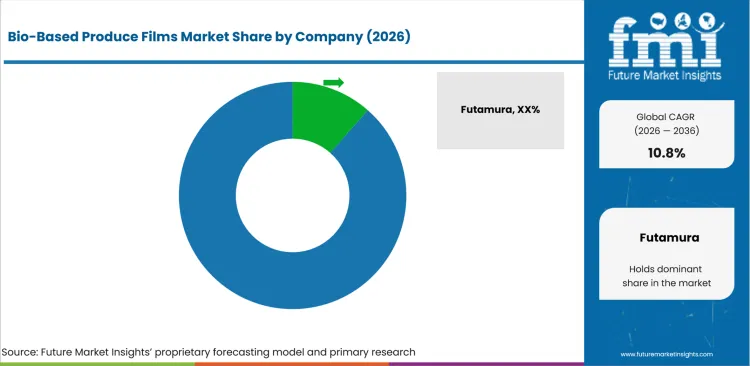
Competition separates upstream polymer ownership from finished-film application expertise across produce programs requiring documented recovery routes. Entry barriers arise from crop-specific gas transmission, food-contact documentation and the ability to support repeated trials across biodegradable films and adjacent recyclable formats.
- NatureWorks LLC and Novamont S.p.A. compete from renewable resin or compostable material platforms.
- Futamura Group and Taghleef Industries provide cellulose or PLA film formats, while TIPA Corp. concentrates on compostable packaging with documented recovery claims.
- Innovia Films and Amcor plc bring produce-film conversion and global qualification reach, although parts of their portfolios sit outside strict bio-based scope.
Competitive Benchmarking: Bio-Based Produce Films Market
| Company | Renewable Material Depth | Produce Functionality | Qualification Support | Geographic Reach |
|---|---|---|---|---|
| NatureWorks LLC | High | Medium | Medium | Americas, Europe and Asia-Pacific |
| Futamura Group | High | High | High | Europe, Americas and Asia-Pacific |
| Taghleef Industries | High | Medium | Medium | Europe, Americas, Middle East and Asia-Pacific |
| TIPA Corp. | High | High | High | Europe, North America and selected global markets |
| Novamont S.p.A. | High | Medium | Medium | Europe and selected international markets |
| Innovia Films | Medium | High | High | Europe, Americas and Asia-Pacific |
| Amcor plc | Medium | High | High | Global |
Key Developments in the Bio-Based Produce Films Market
- In April 2026, NatureWorks LLC opened its fully integrated Ingeo facility at Nakhon Sawan in Thailand. The site has approximately 75,000 metric tons of annual capacity and can produce the full Ingeo grade portfolio from locally sourced sugarcane. Regional film converters gain a closer PLA source and broader grade availability for produce-packaging trials across Asian accounts.
- In November 2025, Taghleef Industries presented its expanded five-family NATIVIA film portfolio during Ecomondo in Italy. The families cover PLA and other bio-based formulations with industrial-compostable or home-compostable options plus high-barrier grades. The wider performance range helps film manufacturers match renewable-content claims with the barrier and recovery conditions required by different produce formats.
- In September 2025, TIPA Corp. and Coveris entered an exclusive agreement for home-compostable fresh-produce labels in the United Kingdom. The agreement combines TIPA material development with Coveris label production and established access across British produce programs. Produce packers can align the label with compostable film or food-waste routes instead of weakening a complete package claim.
Key Players in the Bio-Based Produce Films Market
Renewable Polymer and Resin Platforms
- NatureWorks LLC
- Novamont S.p.A.
Specialty Film and Compostable Packaging Providers
- Futamura Group
- Taghleef Industries
- TIPA Corp.
Large-Scale Produce Film Converters
- Innovia Films
- Amcor plc
Bio-Based Produce Films Market - Report Scope
| Coverage field | Report scope |
|---|---|
| Market breakdown | By product type, feedstock, bio-based content, produce type, end use, sales channel and region. |
| Quantitative Units | Revenue USD million and CAGR in %. |
| Market Definition | Flexible films containing renewable carbon and used to protect fresh fruits, vegetables, salads or herbs during packing, distribution and retail. |
| Regions Covered | North America, Latin America, Europe, East Asia, South Asia and Pacific, and Middle East and Africa. |
| Countries Covered | Brazil, United Kingdom, Germany, United States, Japan, and 20+ countries included in the full report. |
| Key Companies Profiled | NatureWorks LLC, Futamura Group, Taghleef Industries, TIPA Corp., Novamont S.p.A., Innovia Films, Amcor plc. |
| Forecast Period | 2026 to 2036. |
| Approach | Primary and secondary research with market triangulation. |
Bio-Based Produce Films Market - Research Methodology
| Method | Approach |
|---|---|
| Primary Research | FMI analysts gathered input from manufacturers, service providers, technology developers, distributors, end users, procurement teams, and subject-matter experts. Interviews examined purchasing decisions, product or service evaluation, adoption barriers, approval requirements, pricing considerations, and expectations for technical or commercial support. Respondents were also asked what evidence is required before a trial, pilot, or initial order develops into regular purchasing. |
| Desk Research | Desk research covered government statistics, regulatory publications, trade data, industry associations, technical literature, standards, company filings, product information, and official corporate announcements. Sources were reviewed for relevance, publication date, geographic coverage, and consistency with the defined market scope. Claims relating to performance, applications, approvals, capacity, investment, and commercial activity were retained only when supported by credible public evidence. |
| Market Sizing and Forecasting | The market model combined the baseline value with historical performance, segment structure, pricing and volume indicators, adoption levels, company participation, and country-level demand conditions. Forecast assumptions considered economic activity, investment trends, regulatory developments, technology adoption, purchasing cycles, supply availability, and barriers to wider market use. Segment and regional estimates were reconciled before the final market total was calculated. |
| Data Validation | Estimates were checked against multiple independent indicators, including public data, company activity, trade patterns, industry developments, and findings from primary interviews. Validation also tested whether products, services, applications, and company revenues fell within the defined market boundaries. Adjacent categories, unsupported claims, overlapping revenues, and activities without direct market relevance were excluded to reduce double counting and maintain consistency across segments and countries. |
Bio-Based Produce Films Market by Segments
Bio-Based Produce Films Market segmented by Product Type:
- PLA Films
- Cellulose Films
- Bio-PE Films
- Starch-Blend Films
- Others
Bio-Based Produce Films Market segmented by Feedstock:
- Corn - Sugarcane Starch
- Wood Cellulose
- Bio-Ethanol (Bio-PE)
- Agri-Residue
- Others
Bio-Based Produce Films Market segmented by Bio-Based Content:
- 100% Bio-Based
- 75-99%
- 50-74%
- Below 50%
Bio-Based Produce Films Market segmented by Produce Type:
- Fruits
- Fresh-Cut & Salads
- Whole Vegetables
- Herbs
- Others
Bio-Based Produce Films Market segmented by End Use:
- Grocery Retail
- Packers & Processors
- Foodservice
- Others
Bio-Based Produce Films Market segmented by Sales Channel:
- Direct - OEM Supply
- Packaging Distributors
- Online - E-commerce
- Others
Bio-Based Produce Films Market by Region:
- North America
- United States
- Canada
- Latin America
- Brazil
- Mexico
- Chile
- Rest of Latin America
- Western Europe
- Germany
- United Kingdom
- Italy
- Spain
- France
- Nordics
- Benelux
- Rest of Western Europe
- Eastern Europe
- Russia
- Poland
- Hungary
- Balkan and Baltic States
- Rest of Eastern Europe
- East Asia
- China
- Japan
- South Korea
- South Asia and Pacific
- India
- ASEAN
- Australia and New Zealand
- Rest of South Asia and Pacific
- Middle East and Africa
- Kingdom of Saudi Arabia
- Other GCC Countries
- Türkiye
- South Africa
- Other African Union Countries
- Rest of Middle East and Africa
Research Sources and Bibliography
- Food and Agriculture Organization of the United Nations. (2025, September 29). On the International Day of Awareness of Food Loss and Waste, learn how FAO is leveraging data to save food and advance the 2030 Agenda.
- Eurostat. (2025, October 22). Plastic packaging waste in the EU: 35.3 kg per person.
- European Commission. (2025, February 11). New rules enter into force for a more sustainable and competitive packaging economy.
- Presidency of the Republic of Brazil. (2025, October 21). Decreto nº 12.688, de 21 de outubro de 2025.
- HM Revenue & Customs. (2026, May 18). Plastic Packaging Tax: potential certification for mechanically recycled plastic packaging.
- German Environment Agency. (2026, January 27). Facts against myths: Packaging waste recycling in Germany is working.
- USA Environmental Protection Agency. (2025, September 5). EPA launches 'Feed It Onward' initiative.
- Ministry of the Environment, Japan. (2026, June 25).
- NatureWorks LLC. (2026, April 29). NatureWorks Announces Grand Opening of Fully Integrated Ingeo™ Biopolymer Manufacturing Facility in Thailand.
- Futamura Group. (2025, July 2). £15 million investment announcement at Futamura.
- Taghleef Industries. (2025, November 4). At Ecomondo, Taghleef Industries Reveals the New Era of NATIVIA® for Biobased and Biodegradable Films.
- Biodegradable Products Institute. (2026). BioBag Americas Inc. Retrieved August 7, 2026.
- TIPA Corp. (2025, September 4). TIPA® Compostable Packaging Launches Home Compostable Label for Fresh Produce.
- TIPA Corp. (2025, September 17). Coveris and TIPA Enter Exclusive Agreement to Deliver Home Compostable Produce Labels.
- Innovia Films. (2026, March 4). Innovia Films Launches P2G: High-Performance, Recyclable Film for Fresh Produce Packaging.
- Amcor plc. (2025, March 17). Fresh Thinking for Fruits and Vegetables - Extend the Shelf Life up to 4 Times.
This bibliography is provided for reader reference and is not exhaustive. The full report contains the complete reference list and detailed citations
This Report Answers
- How large is the bio-based produce films market in 2026 and 2036?
- Which operating conditions convert renewable-film trials into recurring produce-packaging orders?
- Why do PLA films account for 30.0% of product type demand in 2026?
- How does feedstock selection affect resin availability and film qualification?
- Why do fully bio-based structures account for 44.0% of bio-based content demand?
- How do country growth rates differ across the five profiled markets?
- Which companies provide renewable polymers, compostable films and produce-focused conversion support?
- What limits broader adoption across price, film performance and end-of-life acceptance?
Frequently Asked Questions
How big is the Bio-Based Produce Films Market in 2026?
The bio-based produce films market is estimated at USD 257.1 million in 2026. Growth is driven by increasing adoption of renewable packaging films that help maintain produce freshness while supporting sustainability goals.
What is the CAGR of the Bio-Based Produce Films Market from 2026 to 2036?
The bio-based produce films market is projected to grow at a CAGR of 10.8% between 2026 and 2036. Expansion is supported by rising demand for sustainable packaging solutions and continued development of bio-based film technologies.
Which product type segment is projected to account for 30.0% of the Bio-Based Produce Films Market?
PLA films are projected to account for 30.0% of the market in 2026. Their leading share is supported by strong clarity, established processing capabilities, and growing use in fresh produce packaging applications.
How much will the Bio-Based Produce Films Market add between 2026 and 2036?
The bio-based produce films market is expected to add USD 459.9 million in value between 2026 and 2036. Growth reflects broader commercialization of renewable films that balance produce protection with sustainability requirements.
Which companies are active in the Bio-Based Produce Films Market?
Key companies operating in the market include NatureWorks LLC, Futamura Group, Taghleef Industries, TIPA Corp., Novamont S.p.A., BioBag International AS, Innovia Films, and Amcor plc. These companies provide renewable polymers, compostable films, and produce-packaging solutions across global markets.
Preview the report firsthand - request a free sample
Get SampleGet the brochure for pricing and purchase details.
Get PDFTable of Content
- Key Takeaways
- Market Size and CAGR
- Top Growth Driver
- Fastest Growing Segment
- Leading Region
- Key Companies
- Emerging Opportunities
- Executive Summary
- Global Market Outlook
- Demand-side Trends
- Supply-side Trends
- Technology Roadmap Analysis
- Analysis and Recommendations
- Analyst Perspective (What is happening? Why now? What should investors know?)
- Key Questions Answered
- How large is the market?
- What is the CAGR?
- What are key trends?
- Which region dominates?
- Who are the leaders?
- Market Overview
- Market Coverage / Taxonomy
- Market Definition / Scope / Limitations
- Research Methodology
- Chapter Orientation
- Analytical Lens and Working Hypotheses
- Market Structure, Signals, and Trend Drivers
- Benchmarking and Cross-market Comparability
- Market Sizing, Forecasting, and Opportunity Mapping
- Research Design and Evidence Framework
- Desk Research Programme (Secondary Evidence)
- Expert Input and Fieldwork (Primary Evidence)
- Tooling, Models, and Reference Databases
- Data Engineering and Model Build
- Quality Assurance and Audit Trail
- Market Background
- Market Dynamics (Drivers, Restraints, Opportunity, Trends)
- Scenario Forecast (Optimistic, Likely, Conservative)
- Impact Analysis
- AI Impact
- Sustainability Impact
- Regulatory Impact
- Technology Impact
- Consumer / Buyer Analysis
- Purchase Drivers
- Adoption Barriers
- Buyer Journey
- Opportunity Map Analysis
- Product Life Cycle Analysis
- Supply Chain Analysis
- Investment Feasibility Matrix
- Value Chain Analysis
- PESTLE and Porter's Analysis
- Regulatory Landscape
- Regional Parent Market Outlook
- Production and Consumption Statistics
- Import and Export Statistics
- Global Market Analysis and Forecast, 2021 to 2036
- Historical Market Size Value (USD Million) Analysis, 2021 to 2025
- Current and Future Market Size Value (USD Million) Projections, 2026 to 2036
- Y-o-Y Growth Trend Analysis
- Absolute $ Opportunity Analysis
- Global Market Pricing Analysis, 2021 to 2036
- Global Market Analysis and Forecast, By Product Type, 2021 to 2036
- Introduction / Key Findings
- Historical Market Size Value (USD Million) Analysis By Product Type, 2021 to 2025
- Current and Future Market Size Value (USD Million) Analysis and Forecast By Product Type, 2026 to 2036
- PLA Films
- Cellulose Films
- Bio-PE Films
- Starch-Blend Films
- Others
- PLA Films
- Y-o-Y Growth Trend Analysis By Product Type, 2021 to 2025
- Absolute $ Opportunity Analysis By Product Type, 2026 to 2036
- Global Market Analysis and Forecast, By Feedstock, 2021 to 2036
- Introduction / Key Findings
- Historical Market Size Value (USD Million) Analysis By Feedstock, 2021 to 2025
- Current and Future Market Size Value (USD Million) Analysis and Forecast By Feedstock, 2026 to 2036
- Corn - Sugarcane Starch
- Wood Cellulose
- Bio-Ethanol (Bio-PE)
- Agri-Residue
- Others
- Corn - Sugarcane Starch
- Y-o-Y Growth Trend Analysis By Feedstock, 2021 to 2025
- Absolute $ Opportunity Analysis By Feedstock, 2026 to 2036
- Global Market Analysis and Forecast, By Bio-Based Content, 2021 to 2036
- Introduction / Key Findings
- Historical Market Size Value (USD Million) Analysis By Bio-Based Content, 2021 to 2025
- Current and Future Market Size Value (USD Million) Analysis and Forecast By Bio-Based Content, 2026 to 2036
- 100% Bio-Based
- 75-99%
- 50-74%
- Below 50%
- 100% Bio-Based
- Y-o-Y Growth Trend Analysis By Bio-Based Content, 2021 to 2025
- Absolute $ Opportunity Analysis By Bio-Based Content, 2026 to 2036
- Global Market Analysis and Forecast, By Produce Type, 2021 to 2036
- Introduction / Key Findings
- Historical Market Size Value (USD Million) Analysis By Produce Type, 2021 to 2025
- Current and Future Market Size Value (USD Million) Analysis and Forecast By Produce Type, 2026 to 2036
- Fruits
- Fresh-Cut & Salads
- Whole Vegetables
- Others
- Herbs
- Fruits
- Y-o-Y Growth Trend Analysis By Produce Type, 2021 to 2025
- Absolute $ Opportunity Analysis By Produce Type, 2026 to 2036
- Global Market Analysis and Forecast, By End Use, 2021 to 2036
- Introduction / Key Findings
- Historical Market Size Value (USD Million) Analysis By End Use, 2021 to 2025
- Current and Future Market Size Value (USD Million) Analysis and Forecast By End Use, 2026 to 2036
- Grocery Retail
- Packers & Processors
- Foodservice
- Others
- Grocery Retail
- Y-o-Y Growth Trend Analysis By End Use, 2021 to 2025
- Absolute $ Opportunity Analysis By End Use, 2026 to 2036
- Global Market Analysis and Forecast, By Sales Channel
- Introduction / Key Findings
- Historical Market Size Value (USD Million) Analysis By Sales Channel, 2021 to 2025
- Current and Future Market Size Value (USD Million) Analysis and Forecast By Sales Channel, 2026 to 2036
- Direct - OEM Supply
- Packaging Distributors
- Online - E-commerce
- Others
- Direct - OEM Supply
- Y-o-Y Growth Trend Analysis By Sales Channel, 2021 to 2025
- Absolute $ Opportunity Analysis By Sales Channel, 2026 to 2036
- Global Market Analysis and Forecast, By Region, 2021 to 2036
- Introduction
- Historical Market Size Value (USD Million) Analysis By Region, 2021 to 2025
- Current Market Size Value (USD Million) Analysis and Forecast By Region, 2026 to 2036
- North America
- Latin America
- Western Europe
- Eastern Europe
- East Asia
- South Asia and Pacific
- Middle East & Africa
- Market Attractiveness Analysis By Region
- North America Market Analysis and Forecast, By Country, 2021 to 2036
- Historical Market Size Value (USD Million) Trend Analysis By Market Taxonomy, 2021 to 2025
- Market Size Value (USD Million) Forecast By Market Taxonomy, 2026 to 2036
- By Country
- USA
- Canada
- By Product Type
- By Feedstock
- By Bio-Based Content
- By Produce Type
- By End Use
- By Sales Channel
- By Country
- Market Attractiveness Analysis
- By Country
- By Product Type
- By Feedstock
- By Bio-Based Content
- By Produce Type
- By End Use
- By Sales Channel
- Key Takeaways
- Latin America Market Analysis and Forecast, By Country
- Historical Market Size Value (USD Million) Trend Analysis By Market Taxonomy, 2021 to 2025
- Market Size Value (USD Million) Forecast By Market Taxonomy, 2026 to 2036
- By Country
- Brazil
- Mexico
- Chile
- Rest of Latin America
- By Product Type
- By Feedstock
- By Bio-Based Content
- By Produce Type
- By End Use
- By Sales Channel
- By Country
- Market Attractiveness Analysis
- By Country
- By Product Type
- By Feedstock
- By Bio-Based Content
- By Produce Type
- By End Use
- By Sales Channel
- Key Takeaways
- Western Europe Market Analysis and Forecast, By Country
- Historical Market Size Value (USD Million) Trend Analysis By Market Taxonomy, 2021 to 2025
- Market Size Value (USD Million) Forecast By Market Taxonomy, 2026 to 2036
- By Country
- Germany
- UK
- Italy
- Spain
- France
- Nordic
- BENELUX
- Rest of Western Europe
- By Product Type
- By Feedstock
- By Bio-Based Content
- By Produce Type
- By End Use
- By Sales Channel
- By Country
- Market Attractiveness Analysis
- By Country
- By Product Type
- By Feedstock
- By Bio-Based Content
- By Produce Type
- By End Use
- By Sales Channel
- Key Takeaways
- Eastern Europe Market Analysis and Forecast, By Country
- Historical Market Size Value (USD Million) Trend Analysis By Market Taxonomy, 2021 to 2025
- Market Size Value (USD Million) Forecast By Market Taxonomy, 2026 to 2036
- By Country
- Russia
- Poland
- Hungary
- Balkan & Baltic
- Rest of Eastern Europe
- By Product Type
- By Feedstock
- By Bio-Based Content
- By Produce Type
- By End Use
- By Sales Channel
- By Country
- Market Attractiveness Analysis
- By Country
- By Product Type
- By Feedstock
- By Bio-Based Content
- By Produce Type
- By End Use
- By Sales Channel
- Key Takeaways
- East Asia Market Analysis and Forecast, By Country
- Historical Market Size Value (USD Million) Trend Analysis By Market Taxonomy, 2021 to 2025
- Market Size Value (USD Million) Forecast By Market Taxonomy, 2026 to 2036
- By Country
- China
- Japan
- South Korea
- By Product Type
- By Feedstock
- By Bio-Based Content
- By Produce Type
- By End Use
- By Sales Channel
- By Country
- Market Attractiveness Analysis
- By Country
- By Product Type
- By Feedstock
- By Bio-Based Content
- By Produce Type
- By End Use
- By Sales Channel
- Key Takeaways
- South Asia and Pacific Market Analysis and Forecast, By Country
- Historical Market Size Value (USD Million) Trend Analysis By Market Taxonomy, 2021 to 2025
- Market Size Value (USD Million) Forecast By Market Taxonomy, 2026 to 2036
- By Country
- India
- ASEAN
- Australia & New Zealand
- Rest of South Asia and Pacific
- By Product Type
- By Feedstock
- By Bio-Based Content
- By Produce Type
- By End Use
- By Sales Channel
- By Country
- Market Attractiveness Analysis
- By Country
- By Product Type
- By Feedstock
- By Bio-Based Content
- By Produce Type
- By End Use
- By Sales Channel
- Key Takeaways
- Middle East & Africa Market Analysis and Forecast, By Country
- Historical Market Size Value (USD Million) Trend Analysis By Market Taxonomy, 2021 to 2025
- Market Size Value (USD Million) Forecast By Market Taxonomy, 2026 to 2036
- By Country
- Kingdom of Saudi Arabia
- Other GCC Countries
- Türkiye
- South Africa
- Other African Union
- Rest of Middle East & Africa
- By Product Type
- By Feedstock
- By Bio-Based Content
- By Produce Type
- By End Use
- By Sales Channel
- By Country
- Market Attractiveness Analysis
- By Country
- By Product Type
- By Feedstock
- By Bio-Based Content
- By Produce Type
- By End Use
- By Sales Channel
- Key Takeaways
- Key Countries Market Analysis
- USA
- Pricing Analysis
- Market Share Analysis, 2025
- By Product Type
- By Feedstock
- By Bio-Based Content
- By Produce Type
- By End Use
- By Sales Channel
- Canada
- Pricing Analysis
- Market Share Analysis, 2025
- By Product Type
- By Feedstock
- By Bio-Based Content
- By Produce Type
- By End Use
- By Sales Channel
- Mexico
- Pricing Analysis
- Market Share Analysis, 2025
- By Product Type
- By Feedstock
- By Bio-Based Content
- By Produce Type
- By End Use
- By Sales Channel
- Brazil
- Pricing Analysis
- Market Share Analysis, 2025
- By Product Type
- By Feedstock
- By Bio-Based Content
- By Produce Type
- By End Use
- By Sales Channel
- Chile
- Pricing Analysis
- Market Share Analysis, 2025
- By Product Type
- By Feedstock
- By Bio-Based Content
- By Produce Type
- By End Use
- By Sales Channel
- Germany
- Pricing Analysis
- Market Share Analysis, 2025
- By Product Type
- By Feedstock
- By Bio-Based Content
- By Produce Type
- By End Use
- By Sales Channel
- UK
- Pricing Analysis
- Market Share Analysis, 2025
- By Product Type
- By Feedstock
- By Bio-Based Content
- By Produce Type
- By End Use
- By Sales Channel
- Italy
- Pricing Analysis
- Market Share Analysis, 2025
- By Product Type
- By Feedstock
- By Bio-Based Content
- By Produce Type
- By End Use
- By Sales Channel
- Spain
- Pricing Analysis
- Market Share Analysis, 2025
- By Product Type
- By Feedstock
- By Bio-Based Content
- By Produce Type
- By End Use
- By Sales Channel
- France
- Pricing Analysis
- Market Share Analysis, 2025
- By Product Type
- By Feedstock
- By Bio-Based Content
- By Produce Type
- By End Use
- By Sales Channel
- India
- Pricing Analysis
- Market Share Analysis, 2025
- By Product Type
- By Feedstock
- By Bio-Based Content
- By Produce Type
- By End Use
- By Sales Channel
- ASEAN
- Pricing Analysis
- Market Share Analysis, 2025
- By Product Type
- By Feedstock
- By Bio-Based Content
- By Produce Type
- By End Use
- By Sales Channel
- Australia & New Zealand
- Pricing Analysis
- Market Share Analysis, 2025
- By Product Type
- By Feedstock
- By Bio-Based Content
- By Produce Type
- By End Use
- By Sales Channel
- China
- Pricing Analysis
- Market Share Analysis, 2025
- By Product Type
- By Feedstock
- By Bio-Based Content
- By Produce Type
- By End Use
- By Sales Channel
- Japan
- Pricing Analysis
- Market Share Analysis, 2025
- By Product Type
- By Feedstock
- By Bio-Based Content
- By Produce Type
- By End Use
- By Sales Channel
- South Korea
- Pricing Analysis
- Market Share Analysis, 2025
- By Product Type
- By Feedstock
- By Bio-Based Content
- By Produce Type
- By End Use
- By Sales Channel
- Russia
- Pricing Analysis
- Market Share Analysis, 2025
- By Product Type
- By Feedstock
- By Bio-Based Content
- By Produce Type
- By End Use
- By Sales Channel
- Poland
- Pricing Analysis
- Market Share Analysis, 2025
- By Product Type
- By Feedstock
- By Bio-Based Content
- By Produce Type
- By End Use
- By Sales Channel
- Hungary
- Pricing Analysis
- Market Share Analysis, 2025
- By Product Type
- By Feedstock
- By Bio-Based Content
- By Produce Type
- By End Use
- By Sales Channel
- Kingdom of Saudi Arabia
- Pricing Analysis
- Market Share Analysis, 2025
- By Product Type
- By Feedstock
- By Bio-Based Content
- By Produce Type
- By End Use
- By Sales Channel
- Türkiye
- Pricing Analysis
- Market Share Analysis, 2025
- By Product Type
- By Feedstock
- By Bio-Based Content
- By Produce Type
- By End Use
- By Sales Channel
- South Africa
- Pricing Analysis
- Market Share Analysis, 2025
- By Product Type
- By Feedstock
- By Bio-Based Content
- By Produce Type
- By End Use
- By Sales Channel
- USA
- Market Structure Analysis
- Competition Dashboard
- Competition Benchmarking
- Market Share Analysis of Top Players
- By Regional
- By Product Type
- By Feedstock
- By Bio-Based Content
- By Produce Type
- By End Use
- By Sales Channel
- Emerging Startups
- Innovation Benchmarking
- Competition Analysis
- Competition Deep Dive
- Futamura
- Overview
- Product Portfolio
- Profitability by Market Segments
- Sales Footprint
- Strategy Overview
- Marketing Strategy
- Product Strategy
- Channel Strategy
- TIPA
- Taghleef Industries
- Innovia Films
- NatureWorks
- Novamont
- BioBag
- Amcor
- Berry Global
- Mondi
- Futamura
- Case Studies
- Success Stories
- Recent Developments
- Competition Deep Dive
- Assumptions & Acronyms Used


