

- Market Size (2026)
- USD 101.2 Bn
- Forecast (2036)
- USD 202.8 Bn
- CAGR (2026 to 2036)
- 7.2%
How big is Actuator Market in 2026?
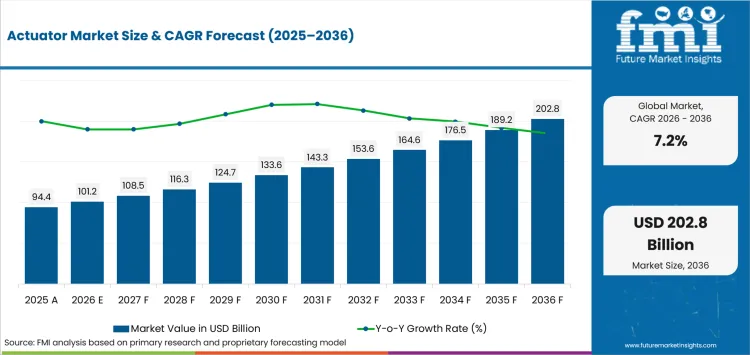
USD 101.2 billion in 2026 and USD 202.8 billion by 2036 at a 7.2% CAGR.
Demand for actuators is projected to expand at 7.2% CAGR between 2026 and 2036, increasing valuation from USD 101.2 billion to USD 202.8 billion. Industrial automation remains a major source of demand because robots, automated machinery, and process equipment rely on actuators to convert control commands into physical motion. A3 reported 9,055 robot orders in North America during the first quarter of 2026. Each new automation project adds motion-control components at installation while also creating a future base for maintenance and replacement demand throughout the equipment lifecycle.
Automation maturity influences how actuators are purchased across manufacturing economies. Japan is forecast to expand at an 8.4% CAGR compared with 4.3% for the United States. IFR reported in April 2026 that Japan operated 446 robots per 10,000 manufacturing workers, while the United States recorded 307. The higher automation density creates more opportunities for precision actuators in production upgrades, equipment optimization, and retrofit projects. In the United States, actuator demand remains more closely tied to new automation investments, production-expansion programs and approved-component requirements within capital projects.
Key Takeaways
- Factory automation increases actuator demand as machine builders add controlled motion to handling equipment, valves, fixtures, and production axes.
- Based on movement type, linear movement is projected to account for 56.0% in 2026 due to frequent push, pull, clamp, lift, and positioning duties.
- By power source, electrical actuator is estimated to hold 57.0% in 2026 owing to programmable positioning and feedback on software-controlled equipment.
- In 2026, light-duty capacity is expected to lead workload capacity with 58.0% share because compact machines contain many lower-force motion points per system.
- Qualification work can slow component switching if mounting geometry, load behavior, environmental ratings, and controls must be revalidated on installed equipment.
- Some of the key players in this market include Emerson Electric Co., Rotork plc, AUMA Riester GmbH & Co. KG, Bosch Rexroth AG, Thomson Industries, Inc., Tolomatic, Inc., LINAK A/S, and SMC Corporation.
Analyst Perspective
"Actuator selection should start with load behavior and duty cycle before engineering teams compare connectivity or purchase price. A device earns its place when it shortens commissioning and preserves service access without forcing a redesign of the surrounding machine."
- Nikhil Kaitwade, Principal Consultant, Future Market Insights
How is the actuator market segmented?
The actuator market is segmented by movement type, power source, workload capacity, actuator style, application, and region.
Movement type includes linear and rotary movement. Power source covers electrical, pneumatic, and hydraulic actuators. Workload capacity comprises light, medium, and heavy duty. Actuator style separates double acting from single acting. Applications include automotive systems, consumer electronics, heavy machinery and appliances, robotics, automation controls, and other equipment.
What drives automotive systems within the application category?
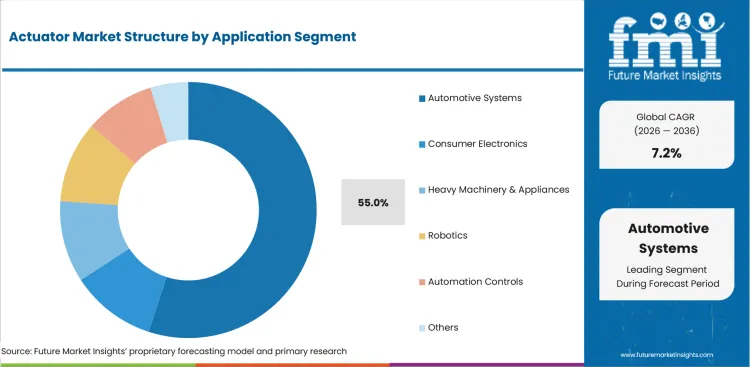
Automotive plants repeatedly specify actuators around welding fixtures, body handling, paint equipment, conveyors, presses, testing systems, and final assembly. A3 recorded 17,635 North American industrial robot orders during first-half 2025, while automotive OEM orders increased 34% from the prior year. That investment supports new specifications for automotive actuators around standardized production cells and vehicle assembly functions.
- By application, automotive systems are forecast to represent 55.0% in 2026 driven by repeated use of validated motion devices in high-volume production lines.
- Once a platform is approved, qualification records and service become hard to displace. Plants avoid an actuator if replacement requires controls or tooling rework.
What makes linear movement central to the movement type category?
Linear actuators suit machines that repeat straight-line clamping, lifting, feeding, and positioning without converting rotary motion at each axis. Thomson expanded position-based synchronization for Electrak HD actuators in June 2025, allowing as many as eight units to coordinate on one CAN network. The control option matters for automated material handling and moving structures that must share load without mechanical cross-shafts.
- Linear movement is projected to hold 56.0% share in 2026 owing to frequent translational duties in machine handling and positioning.
- Standardized strokes and mounts also simplify resizing a linear-actuator platform without rebuilding its complete motion architecture.
Why does electrical actuator lead the power source category?
Electrical actuators fit production equipment that must change position, speed, or force through software while returning feedback to the controller. Bosch Rexroth signed a January 2026 joint venture agreement with Xi’an IF Intelligent Equipment to develop electromechanical actuators for off-highway vehicles. The investment extends electric actuation into higher-load duties once served mainly by hydraulic cylinders.
- By power source, electrical actuator is estimated to hold 57.0% in 2026 owing to software-adjustable motion that reduces mechanical changeover on flexible equipment.
- Pneumatic actuators suit simple high-cycle tasks, while electric architectures gain value from integrated feedback that reduces setup work and supports diagnostics.
How does light-duty capacity shape workload capacity demand?
Automated equipment contains compact axes for stops and small valves, giving light-duty actuators a unit-volume advantage. SMC received a FOOMA 2025 award in June 2025 for its IP69K HF2A-LEY linear electric actuator, which addresses washdown exposure in food-production machinery. The use case places environmental sealing around lower-force motion without pushing the design into heavy-load construction.
- In 2026, light-duty capacity is expected to lead workload capacity with 58.0% share because compact machines use many lower-force motion points per system.
- Machine builders distribute several smaller actuators around one platform, raising unit demand even though medium-duty and heavy-duty products carry higher individual values.
What are the drivers, restraints and opportunities in the Actuator Market?
Higher automation density increases controlled motion demand, while integration work slows component switching and simpler commissioning shortens approval for connected electric-actuator retrofits.
- Driver: New automated cells increase the number of linear and rotary motion points that machine builders must specify, install, and maintain.
- Restraint: Mounting, controls, safety behavior, and commissioning requirements can extend qualification cycles even when an alternative actuator meets the basic load requirement.
- Opportunity: Configuration tools and interoperable controls reduce engineering effort and improve the commercial case for connected electric actuation on new and retrofit equipment.
Automation Projects Multiply Physical Motion Points
Automation investment raises actuator demand by placing a mechanical device behind each control decision that moves a load or final element. AUMA installed 241 Profinet electric actuators during a January 2025 retrofit at Stockholm’s largest combined heat and power plant. The 241-unit retrofit demonstrates that process-control upgrades can produce actuator orders well after the original equipment build.
Integration Work Protects Existing Specifications
A technically suitable actuator can lose a retrofit if engineers must rebuild controls or requalify field interfaces around the replacement. Rotork joined Rockwell Automation’s Technology Partner Program in June 2025 so IQ3 Pro EtherNet/IP actuators could appear in Rockwell catalogues and design tools. That route reduces specification friction around machine control systems but also raises the value of proven interoperability.
Commissioning Support Converts Electrical Adoption
Engineering tools reduce controls work by matching motors, drives, cables, and feedback devices before commissioning. Tolomatic introduced its Drive Integration Tool in January 2025 to reduce servo linear actuator selection and commissioning steps. Faster matching strengthens the case for motion control software in projects with compressed schedules and little room for extended controls engineering.
Which country CAGRs are profiled in the Actuator Market?
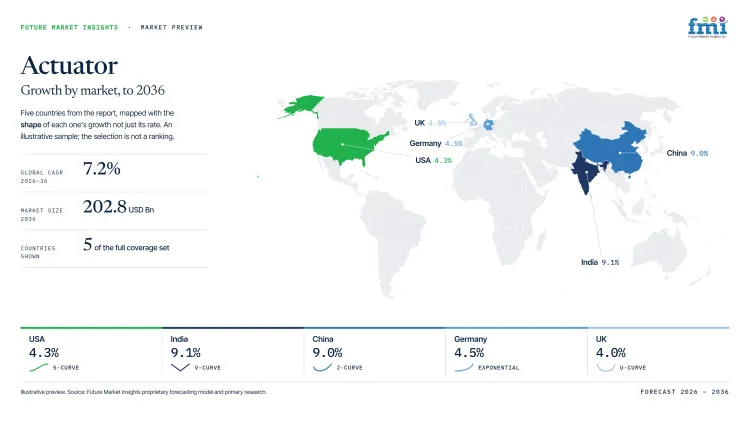
| Country | CAGR |
|---|---|
| Japan | 8.4% |
| Brazil | 6.1% |
| Germany | 4.5% |
| United States | 4.3% |
| United Kingdom | 4.0% |
How do country-level CAGRs compare in the Actuator Market?
The displayed country range spans 4.4 percentage points from Japan to the United Kingdom. Japan and Brazil form the faster pair, while Germany, the United States, and the United Kingdom cluster within half a percentage point. The spacing reflects different automation investment cycles and installed-machine profiles rather than current actuator revenue.
- Japan’s robotics base makes precision and lifecycle reliability central to actuator qualification.
- Brazil’s modernization pipeline broadens demand, while financing and service reach constrain conversions.
- Germany relies on retrofit work within documented machine architectures and installed equipment.
- United States standards preserve incumbents if replacements require mounting or control changes.
- United Kingdom integrators support adoption, although factories remain sensitive to project economics.
Comparable CAGRs mask different qualification costs and service requirements for actuator companies. The full report provides country-level CAGR analysis across North America, Latin America, Europe, East Asia, South Asia, Oceania and the Middle East and Africa.
Country-wise Analysis
- In Japan’s dense automation base, machine builders favor compact motion products with long field histories on serial production platforms, while exacting documentation slows unfamiliar brands during qualification. Actuator demand in Japan is forecast to rise at 8.4% CAGR through 2036 supported by domestic engineering depth, while JARA’s January 2026 release recorded 51,821 robot shipments for October-December 2025 and a 22.7% year-over-year increase. Local application support therefore becomes the practical entry route for companies seeking platform approval without extending validation schedules or increasing changeover risk during automotive and electronics model transitions over long equipment service lives in both industries.
- Imported component exposure and thin service coverage shape actuator purchasing outside Brazil’s largest industrial centers, making commissioning support and local spare stock part of the equipment decision. A May 2025 MDIC-EMBRAPII agreement set targets to support 420 smaller companies through 370 digital-transformation or energy-efficiency projects, giving regional integrators a larger pipeline of plant-modernization work. Brazil is projected to record 6.1% CAGR through 2036 tied to that project base, but financing conditions are likely to keep adoption uneven between major industrial corridors and secondary manufacturing regions with fewer application engineers and slower access to replacement components during commissioning and routine maintenance.
- Once a German OEM freezes a machine platform, approved control architectures and energy requirements make actuator changes costly during serial production and scheduled plant maintenance in automotive and packaging factories. The German actuator market is projected to record 4.5% CAGR through 2036 reflecting replacement and modernization activity, which places more weight on interchangeability and field service than on wholesale redesign of installed equipment. In February 2026, VDMA Robotics + Automation stated that German robotics and automation revenue had fallen 7% in 2025, underscoring a weak capital cycle that limits new-build volume and favors devices that fit documented machine architectures during short shutdown windows.
- Replacing an actuator on a mature USA production line usually starts with the plant’s approved-component list, which favors familiar mounting geometry and service routes in automotive and general manufacturing equipment. A3’s August 2026 data show North American companies ordered 8,940 robots in the second quarter and unit orders rose 4.3% year over year, giving machine builders a fresh factory automation project base. Actuator demand in the United States is forecast to advance at 4.3% CAGR through 2036 because equipment investment and stable replacement logistics persist, but manufacturers gain little from a specification win if commissioning changes disturb validated mounting or control interfaces.
- Large manufacturers and specialist integrators in the United Kingdom judge actuator purchases against project-level automation economics, available controls skills, and the service burden after commissioning. Actuator demand in the United Kingdom is forecast to expand at 4.0% CAGR through 2036 aided by domestic automation capacity and an established network of firms able to integrate electric and pneumatic motion. The February 2025 Smart Machines Strategy counted 2,204 robotics and automation companies headquartered in the country, but capital limits and skills gaps at smaller factories mean further uptake depends on simpler configuration and dependable integrator support during initial installation and later maintenance.
Who are the notable companies in the Actuator Market?
Emerson Electric Co., Rotork plc, AUMA Riester GmbH & Co. KG, Bosch Rexroth AG, Thomson Industries, Inc., Tolomatic, Inc., LINAK A/S, and SMC Corporation are the notable companies profiled in this market.
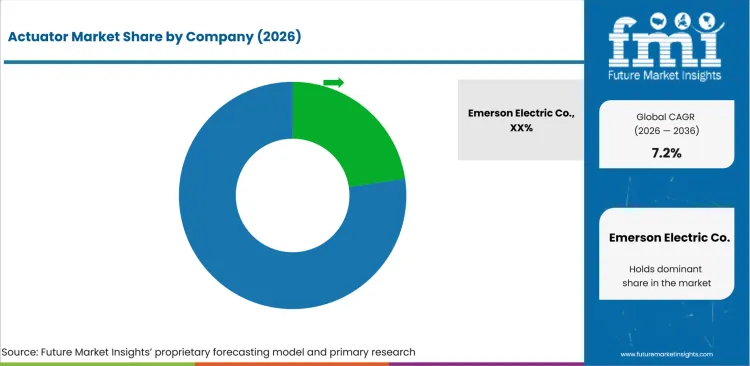
Competitive positions depend on the motion duty and the control environment rather than corporate scale. Emerson, Rotork, and AUMA concentrate strongly on industrial valves and process actuation. Bosch Rexroth, Thomson, Tolomatic, LINAK, and SMC compete more directly in machine motion and industrial automation. Entry barriers rise when customers require qualification history, interoperable controls, and local support for installed equipment.
- Process valve actuation: Emerson Electric Co., Rotork plc, and AUMA Riester GmbH & Co. KG compete on final-control duties, diagnostics, and demanding operating environments.
- Electromechanical machine motion: Bosch Rexroth AG, Thomson Industries, Inc., Tolomatic, Inc., and LINAK A/S focus on programmable linear motion and application integration.
- Factory pneumatic and electric motion: SMC Corporation spans compact cylinders, electric actuators, controls, and high-volume factory automation requirements.
Competitive Benchmarking: Actuator Market
| Company | Actuator Portfolio Breadth | Integrated Control Depth | Application Qualification Evidence | Geographic Reach |
|---|---|---|---|---|
| Emerson Electric Co. | Medium | Medium | High | Global, process industries |
| Rotork plc | High | High | High | Global, process flow-control markets |
| AUMA Riester GmbH & Co. KG | Medium | High | High | Global, energy, water, and process markets |
| Bosch Rexroth AG | High | High | High | Global, industrial and mobile automation |
| Thomson Industries, Inc. | High | High | High | Global, industrial and mobile equipment |
| Tolomatic, Inc. | High | High | High | North America with international channels |
| LINAK A/S | Medium | High | Medium | Global, industrial and off-highway equipment |
| SMC Corporation | High | High | High | Global, factory automation markets |
Scoring basis: High portfolio breadth requires documented actuator families covering at least three distinct motion or power architectures. Medium requires two verified families and Low identifies one narrow route. High control depth requires networked feedback or configuration functions for several actuator families, while Medium documents narrower integration and Low documents basic control only. High qualification evidence requires several documented industrial environments or approvals. Medium covers two application groups and Low one group. Ratings were checked against official company sources listed in the bibliography and do not rank company size.
Key Developments in the Actuator Market
- In November 2025, AUMA Riester GmbH & Co. KG presented the TIGRON SIL explosion-proof electric actuator series for safety-related applications up to SIL 3.
- In August 2025, Thomson Industries, Inc. collaborated with ABB Robotics to certify the Movotrak CTU as a seventh-axis technology for ABB GoFa cobots.
- In May 2025, Emerson Electric Co. introduced the Fisher GX Bolted Bonnet globe valve and actuator system for critical process-fluid applications.
Key Players in the Actuator Market
Process Valve Actuation
- Emerson Electric Co.
- Rotork plc
- AUMA Riester GmbH & Co. KG
Electromechanical and Machine Motion
- Bosch Rexroth AG
- Thomson Industries, Inc.
- Tolomatic, Inc.
- LINAK A/S
Factory Pneumatic and Electric Motion
- SMC Corporation
Actuator Market - Report Scope
| Coverage field | Report scope |
|---|---|
| Market breakdown | By movement type, power source, workload capacity, actuator style, application and region. |
| Quantitative Units | USD billion. |
| Market Definition | Revenue includes actuator products and actuator assemblies that convert electrical, pneumatic, or hydraulic energy into controlled linear or rotary motion. |
| Regions Covered | North America, Latin America, Europe, East Asia, South Asia and Pacific and Middle East and Africa. |
| Countries Covered | Japan, Brazil, Germany, United States, United Kingdom, and 20+ countries included in the full report. |
| Key Companies Profiled | Emerson Electric Co., Rotork plc, AUMA Riester GmbH & Co. KG, Bosch Rexroth AG, Thomson Industries, Inc., Tolomatic, Inc., LINAK A/S, SMC Corporation. |
| Forecast Period | 2026 to 2036. |
| Approach | Primary and secondary research with market triangulation. |
Actuator Market - Research Methodology
| Method | Approach |
|---|---|
| Primary Research | FMI analysts gathered input from manufacturers, service providers, technology developers, distributors, end users, procurement teams, and subject-matter experts. Interviews examined purchasing decisions, product or service evaluation, adoption barriers, approval requirements, pricing considerations, and expectations for technical or commercial support. Respondents were also asked what evidence is required before a trial, pilot, or initial order develops into regular purchasing. |
| Desk Research | Desk research covered government statistics, regulatory publications, trade data, industry associations, technical literature, standards, company filings, product information, and official corporate announcements. Sources were reviewed for relevance, publication date, geographic coverage, and consistency with the defined market scope. Claims relating to performance, applications, approvals, capacity, investment, and commercial activity were retained only when supported by credible public evidence. |
| Market Sizing and Forecasting | The market model combined the baseline value with historical performance, segment structure, pricing and volume indicators, adoption levels, company participation, and country-level demand conditions. Forecast assumptions considered economic activity, investment trends, regulatory developments, technology adoption, purchasing cycles, supply availability, and barriers to wider market use. Segment and regional estimates were reconciled before the final market total was calculated. |
| Data Validation | Estimates were checked against multiple independent indicators, including public data, company activity, trade patterns, industry developments, and findings from primary interviews. Validation also tested whether products, services, applications, and company revenues fell within the defined market boundaries. Adjacent categories, unsupported claims, overlapping revenues, and activities without direct market relevance were excluded to reduce double counting and maintain consistency across segments and countries. |
Actuator Market by Segments
Actuator Market segmented by Movement Type:
- Linear Movement
- Rotary Movement
Actuator Market segmented by Power Source:
- Electrical Actuator
- Pneumatic Actuator
- Hydraulic Actuator
Actuator Market segmented by Workload Capacity:
- Light Duty Capacity
- Medium Duty Capacity
- Heavy Duty Capacity
Actuator Market segmented by Actuator Style:
- Double Acting
- Single Acting
Actuator Market segmented by Application:
- Automotive Systems
- Consumer Electronics
- Heavy Machinery & Appliances
- Robotics
- Automation Controls
- Others
Actuator Market by Region:
- North America
- United States
- Canada
- Latin America
- Brazil
- Mexico
- Argentina
- Chile
- Western Europe
- Germany
- France
- United Kingdom
- Italy
- Spain
- Benelux
- Nordics
- Eastern Europe
- Poland
- Czech Republic
- Romania
- Hungary
- East Asia
- China
- Japan
- South Korea
- South Asia and Pacific
- India
- ASEAN
- Australia and New Zealand
- Middle East and Africa
- GCC Countries
- South Africa
- Türkiye
- Israel
Research Sources and Bibliography
- Association for Advancing Automation. (2026, May 13). Robot orders hold steady in Q1 2026 as demand broadens across non-automotive industries.
- International Federation of Robotics. (2026, April 8). Robot density surges in Europe, Asia, and Americas.
- Thomson Industries, Inc. (2025, June 18). Thomson announces enhanced, position-based synchronization control option for select actuators.
- Bosch Rexroth. (2026, January 27). Bosch Rexroth signs joint venture agreement with Xi’an IF Intelligent Equipment in China to develop and sell electromechanical actuators for off-highway vehicles.
- SMC Corporation. (2025, June 23). SMC Corporation proudly receives the prestigious 4th FOOMA 2025 Award.
- Association for Advancing Automation. (2025, August 12). New A3 report signals steady automation investment in first half of 2025.
- AUMA Riester GmbH & Co. KG. (2025, January 16). AUMA Profinet actuator retrofit increases plant sustainability.
- Rotork plc. (2025, June 3). Rotork joins Rockwell Automation Technology Partner Program.
- Tolomatic, Inc. (2025, January 7). Tolomatic introduces Drive Integration Tool to streamline servo linear actuator commissioning.
- Japan Robot Association. (2026, January 23). Quarterly Results (October-December 2025).
- Ministry of Development, Industry, Trade and Services. (2025, May 26). Cooperation Agreement No. 04/2025 - EMBRAPII.
- VDMA Robotics + Automation. (2026, February 24). Robotics and Automation Industry Remains Under Pressure.
- Association for Advancing Automation. (2026, August 11). Robot Orders Increase in Q2 as Automation Demand Broadens Across Industries.
- Department for Science, Innovation and Technology. (2025, February 11). Smart Machines Strategy 2035.
- AUMA Riester GmbH & Co. KG. (2025, November 4). TIGRON SIL for the highest safety requirements.
- Thomson Industries, Inc. (2025, August 5). Regal Rexnord and ABB Robotics collaborate for seamless integration of cobot 7th axes.
- Emerson Electric Co. (2025, May 29). Emerson’s new bolted bonnet valve improves maintenance for critical fluid applications.
- LINAK A/S. (2025, November 17). When space is tight - and demands are high.
- Bosch Rexroth. (2025, May 4). eSEA Spin launches: Bosch Rexroth and WITTENSTEIN unveil multiturn subsea actuator at OTC 2025 in Houston.
- Thomson Industries, Inc. (2025, July 23). Thomson expands H-Track actuator capabilities with marine-grade corrosion resistance and underwater functionality.
- Rotork plc. (2026, June 22). Rotork and Parameter collaborate to showcase leak detection and fluid isolation for AI-driven, liquid-cooled data centres.
- AUMA Riester GmbH & Co. KG. (2026, January 19). Power in the pocket.
- Tolomatic, Inc. (2026, March 23). Tolomatic doubles force capacity of RSX linear actuators with new RSX50.
- Schaeffler AG. (2026, April 21). The future is electric: New EMA-series of electromechanical linear actuators.
- ABB Ltd. (2026, July 16). ABB expands automation offering with acquisition of Rotork.
- Parker-Hannifin Corporation. (2025, September 18). Parker completes Curtis Instruments acquisition.
This bibliography is provided for reader reference and is not exhaustive. The full report contains the complete reference list and detailed citations.
This Report Answers
- How large is the actuator market in 2026 and what value is forecast for 2036?
- Which automation conditions support actuator demand between 2026 and 2036?
- Why does linear movement account for 56.0% of 2026 revenue?
- Why do electrical actuators hold 57.0% of the power source category in 2026?
- How does light-duty capacity reach 58.0% of workload capacity revenue in 2026?
- How do actuator growth rates differ among Japan, Brazil, Germany, the United States, and the United Kingdom?
- Which engineering and controls issues slow actuator supplier switching?
- Which companies compete in process actuation and programmable machine motion?
- What should engineering teams evaluate before selecting an actuator platform?
Frequently Asked Questions
How big is the actuator market in 2026?
The actuator market is valued at USD 101.2 billion in 2026 and is projected to reach USD 202.8 billion by 2036. Rising automation density increases controlled motion points while installed equipment also requires actuator replacement during normal plant modernization cycles.
What is the CAGR of the actuator market from 2026 to 2036?
The actuator market is projected to grow at a CAGR of 7.2% between 2026 and 2036. Expansion follows new machine automation plus retrofit demand for programmable motion and compatible final-control devices in industrial equipment.
Which movement type leads the actuator market?
The linear movement segment is expected to hold 56.0% of the actuator market in 2026, driven by repeated straight-line duties in machine handling and positioning. Standardized strokes and mounting formats also reduce redesign effort when OEMs resize a production platform.
Which power source leads the actuator market?
The electrical actuator segment is expected to hold 57.0% of the actuator market in 2026, supported by software-adjustable positioning and integrated feedback. These functions reduce mechanical changeover work and simplify control changes on flexible production equipment.
How much value will the actuator market add between 2026 and 2036?
The actuator market is expected to add USD 101.6 billion in value between 2026 and 2036. Added revenue follows automation investment plus installed-base replacement and wider use of programmable electric motion in machinery and process systems.
Which countries are projected to record the highest growth in the actuator market?
Japan is projected to grow at 8.4% CAGR followed by Brazil at 6.1% and Germany at 4.5% through 2036. Different automation densities and modernization programs impose distinct qualification and service requirements in these three markets.
Which companies are active in the actuator market?
Key companies operating in the actuator market include Emerson Electric Co., Rotork plc, AUMA Riester GmbH & Co. KG, Bosch Rexroth AG, Thomson Industries, Inc., Tolomatic, Inc., LINAK A/S, and SMC Corporation. They compete through application depth and control integration.
Preview the report firsthand - request a free sample
Get SampleGet the brochure for pricing and purchase details.
Get PDFTable of Content
- Key Takeaways
- Market Size and CAGR
- Top Growth Driver
- Fastest Growing Segment
- Leading Region
- Key Companies
- Emerging Opportunities
- Executive Summary
- Global Market Outlook
- Demand-side Trends
- Supply-side Trends
- Technology Roadmap Analysis
- Analysis and Recommendations
- Analyst Perspective (What is happening? Why now? What should investors know?)
- Key Questions Answered
- How large is the market?
- What is the CAGR?
- What are key trends?
- Which region dominates?
- Who are the leaders?
- Market Overview
- Market Coverage / Taxonomy
- Market Definition / Scope / Limitations
- Research Methodology
- Chapter Orientation
- Analytical Lens and Working Hypotheses
- Market Structure, Signals, and Trend Drivers
- Benchmarking and Cross-market Comparability
- Market Sizing, Forecasting, and Opportunity Mapping
- Research Design and Evidence Framework
- Desk Research Programme (Secondary Evidence)
- Expert Input and Fieldwork (Primary Evidence)
- Tooling, Models, and Reference Databases
- Data Engineering and Model Build
- Quality Assurance and Audit Trail
- Market Background
- Market Dynamics (Drivers, Restraints, Opportunity, Trends)
- Scenario Forecast (Optimistic, Likely, Conservative)
- Impact Analysis
- AI Impact
- Sustainability Impact
- Regulatory Impact
- Technology Impact
- Consumer / Buyer Analysis
- Purchase Drivers
- Adoption Barriers
- Buyer Journey
- Opportunity Map Analysis
- Product Life Cycle Analysis
- Supply Chain Analysis
- Investment Feasibility Matrix
- Value Chain Analysis
- PESTLE and Porter's Analysis
- Regulatory Landscape
- Regional Parent Market Outlook
- Production and Consumption Statistics
- Import and Export Statistics
- Global Market Analysis and Forecast, 2021 to 2036
- Historical Market Size Value (USD Billion) Analysis, 2021 to 2025
- Current and Future Market Size Value (USD Billion) Projections, 2026 to 2036
- Y-o-Y Growth Trend Analysis
- Absolute $ Opportunity Analysis
- Global Market Pricing Analysis, 2021 to 2036
- Global Market Analysis and Forecast, By Movement Type, 2021 to 2036
- Introduction / Key Findings
- Historical Market Size Value (USD Billion) Analysis By Movement Type, 2021 to 2025
- Current and Future Market Size Value (USD Billion) Analysis and Forecast By Movement Type, 2026 to 2036
- Linear Movement
- Rotary Movement
- Linear Movement
- Y-o-Y Growth Trend Analysis By Movement Type, 2021 to 2025
- Absolute $ Opportunity Analysis By Movement Type, 2026 to 2036
- Global Market Analysis and Forecast, By Power Source, 2021 to 2036
- Introduction / Key Findings
- Historical Market Size Value (USD Billion) Analysis By Power Source, 2021 to 2025
- Current and Future Market Size Value (USD Billion) Analysis and Forecast By Power Source, 2026 to 2036
- Electrical Actuator
- Pneumatic Actuator
- Hydraulic Actuator
- Electrical Actuator
- Y-o-Y Growth Trend Analysis By Power Source, 2021 to 2025
- Absolute $ Opportunity Analysis By Power Source, 2026 to 2036
- Global Market Analysis and Forecast, By Workload Capacity, 2021 to 2036
- Introduction / Key Findings
- Historical Market Size Value (USD Billion) Analysis By Workload Capacity, 2021 to 2025
- Current and Future Market Size Value (USD Billion) Analysis and Forecast By Workload Capacity, 2026 to 2036
- Light Duty Capacity
- Medium Duty Capacity
- Heavy Duty Capacity
- Light Duty Capacity
- Y-o-Y Growth Trend Analysis By Workload Capacity, 2021 to 2025
- Absolute $ Opportunity Analysis By Workload Capacity, 2026 to 2036
- Global Market Analysis and Forecast, By Actuator Style, 2021 to 2036
- Introduction / Key Findings
- Historical Market Size Value (USD Billion) Analysis By Actuator Style, 2021 to 2025
- Current and Future Market Size Value (USD Billion) Analysis and Forecast By Actuator Style, 2026 to 2036
- Double Acting
- Single Acting
- Double Acting
- Y-o-Y Growth Trend Analysis By Actuator Style, 2021 to 2025
- Absolute $ Opportunity Analysis By Actuator Style, 2026 to 2036
- Global Market Analysis and Forecast, By Application, 2021 to 2036
- Introduction / Key Findings
- Historical Market Size Value (USD Billion) Analysis By Application, 2021 to 2025
- Current and Future Market Size Value (USD Billion) Analysis and Forecast By Application, 2026 to 2036
- Automotive Systems
- Consumer Electronics
- Heavy Machinery & Appliances
- Robotics
- Automation Controls
- Others
- Automotive Systems
- Y-o-Y Growth Trend Analysis By Application, 2021 to 2025
- Absolute $ Opportunity Analysis By Application, 2026 to 2036
- Global Market Analysis and Forecast, By Region, 2021 to 2036
- Introduction
- Historical Market Size Value (USD Billion) Analysis By Region, 2021 to 2025
- Current Market Size Value (USD Billion) Analysis and Forecast By Region, 2026 to 2036
- North America
- Latin America
- Western Europe
- Eastern Europe
- East Asia
- South Asia and Pacific
- Middle East & Africa
- Market Attractiveness Analysis By Region
- North America Market Analysis and Forecast, By Country, 2021 to 2036
- Historical Market Size Value (USD Billion) Trend Analysis By Market Taxonomy, 2021 to 2025
- Market Size Value (USD Billion) Forecast By Market Taxonomy, 2026 to 2036
- By Country
- USA
- Canada
- By Movement Type
- By Power Source
- By Workload Capacity
- By Actuator Style
- By Application
- By Country
- Market Attractiveness Analysis
- By Country
- By Movement Type
- By Power Source
- By Workload Capacity
- By Actuator Style
- By Application
- Key Takeaways
- Latin America Market Analysis and Forecast, By Country
- Historical Market Size Value (USD Billion) Trend Analysis By Market Taxonomy, 2021 to 2025
- Market Size Value (USD Billion) Forecast By Market Taxonomy, 2026 to 2036
- By Country
- Brazil
- Mexico
- Chile
- Rest of Latin America
- By Movement Type
- By Power Source
- By Workload Capacity
- By Actuator Style
- By Application
- By Country
- Market Attractiveness Analysis
- By Country
- By Movement Type
- By Power Source
- By Workload Capacity
- By Actuator Style
- By Application
- Key Takeaways
- Western Europe Market Analysis and Forecast, By Country
- Historical Market Size Value (USD Billion) Trend Analysis By Market Taxonomy, 2021 to 2025
- Market Size Value (USD Billion) Forecast By Market Taxonomy, 2026 to 2036
- By Country
- Germany
- UK
- Italy
- Spain
- France
- Nordic
- BENELUX
- Rest of Western Europe
- By Movement Type
- By Power Source
- By Workload Capacity
- By Actuator Style
- By Application
- By Country
- Market Attractiveness Analysis
- By Country
- By Movement Type
- By Power Source
- By Workload Capacity
- By Actuator Style
- By Application
- Key Takeaways
- Eastern Europe Market Analysis and Forecast, By Country
- Historical Market Size Value (USD Billion) Trend Analysis By Market Taxonomy, 2021 to 2025
- Market Size Value (USD Billion) Forecast By Market Taxonomy, 2026 to 2036
- By Country
- Russia
- Poland
- Hungary
- Balkan & Baltic
- Rest of Eastern Europe
- By Movement Type
- By Power Source
- By Workload Capacity
- By Actuator Style
- By Application
- By Country
- Market Attractiveness Analysis
- By Country
- By Movement Type
- By Power Source
- By Workload Capacity
- By Actuator Style
- By Application
- Key Takeaways
- East Asia Market Analysis and Forecast, By Country
- Historical Market Size Value (USD Billion) Trend Analysis By Market Taxonomy, 2021 to 2025
- Market Size Value (USD Billion) Forecast By Market Taxonomy, 2026 to 2036
- By Country
- China
- Japan
- South Korea
- By Movement Type
- By Power Source
- By Workload Capacity
- By Actuator Style
- By Application
- By Country
- Market Attractiveness Analysis
- By Country
- By Movement Type
- By Power Source
- By Workload Capacity
- By Actuator Style
- By Application
- Key Takeaways
- South Asia and Pacific Market Analysis and Forecast, By Country
- Historical Market Size Value (USD Billion) Trend Analysis By Market Taxonomy, 2021 to 2025
- Market Size Value (USD Billion) Forecast By Market Taxonomy, 2026 to 2036
- By Country
- India
- ASEAN
- Australia & New Zealand
- Rest of South Asia and Pacific
- By Movement Type
- By Power Source
- By Workload Capacity
- By Actuator Style
- By Application
- By Country
- Market Attractiveness Analysis
- By Country
- By Movement Type
- By Power Source
- By Workload Capacity
- By Actuator Style
- By Application
- Key Takeaways
- Middle East & Africa Market Analysis and Forecast, By Country
- Historical Market Size Value (USD Billion) Trend Analysis By Market Taxonomy, 2021 to 2025
- Market Size Value (USD Billion) Forecast By Market Taxonomy, 2026 to 2036
- By Country
- Kingdom of Saudi Arabia
- Other GCC Countries
- Türkiye
- South Africa
- Other African Union
- Rest of Middle East & Africa
- By Movement Type
- By Power Source
- By Workload Capacity
- By Actuator Style
- By Application
- By Country
- Market Attractiveness Analysis
- By Country
- By Movement Type
- By Power Source
- By Workload Capacity
- By Actuator Style
- By Application
- Key Takeaways
- Key Countries Market Analysis
- USA
- Pricing Analysis
- Market Share Analysis, 2025
- By Movement Type
- By Power Source
- By Workload Capacity
- By Actuator Style
- By Application
- Canada
- Pricing Analysis
- Market Share Analysis, 2025
- By Movement Type
- By Power Source
- By Workload Capacity
- By Actuator Style
- By Application
- Mexico
- Pricing Analysis
- Market Share Analysis, 2025
- By Movement Type
- By Power Source
- By Workload Capacity
- By Actuator Style
- By Application
- Brazil
- Pricing Analysis
- Market Share Analysis, 2025
- By Movement Type
- By Power Source
- By Workload Capacity
- By Actuator Style
- By Application
- Chile
- Pricing Analysis
- Market Share Analysis, 2025
- By Movement Type
- By Power Source
- By Workload Capacity
- By Actuator Style
- By Application
- Germany
- Pricing Analysis
- Market Share Analysis, 2025
- By Movement Type
- By Power Source
- By Workload Capacity
- By Actuator Style
- By Application
- UK
- Pricing Analysis
- Market Share Analysis, 2025
- By Movement Type
- By Power Source
- By Workload Capacity
- By Actuator Style
- By Application
- Italy
- Pricing Analysis
- Market Share Analysis, 2025
- By Movement Type
- By Power Source
- By Workload Capacity
- By Actuator Style
- By Application
- Spain
- Pricing Analysis
- Market Share Analysis, 2025
- By Movement Type
- By Power Source
- By Workload Capacity
- By Actuator Style
- By Application
- France
- Pricing Analysis
- Market Share Analysis, 2025
- By Movement Type
- By Power Source
- By Workload Capacity
- By Actuator Style
- By Application
- India
- Pricing Analysis
- Market Share Analysis, 2025
- By Movement Type
- By Power Source
- By Workload Capacity
- By Actuator Style
- By Application
- ASEAN
- Pricing Analysis
- Market Share Analysis, 2025
- By Movement Type
- By Power Source
- By Workload Capacity
- By Actuator Style
- By Application
- Australia & New Zealand
- Pricing Analysis
- Market Share Analysis, 2025
- By Movement Type
- By Power Source
- By Workload Capacity
- By Actuator Style
- By Application
- China
- Pricing Analysis
- Market Share Analysis, 2025
- By Movement Type
- By Power Source
- By Workload Capacity
- By Actuator Style
- By Application
- Japan
- Pricing Analysis
- Market Share Analysis, 2025
- By Movement Type
- By Power Source
- By Workload Capacity
- By Actuator Style
- By Application
- South Korea
- Pricing Analysis
- Market Share Analysis, 2025
- By Movement Type
- By Power Source
- By Workload Capacity
- By Actuator Style
- By Application
- Russia
- Pricing Analysis
- Market Share Analysis, 2025
- By Movement Type
- By Power Source
- By Workload Capacity
- By Actuator Style
- By Application
- Poland
- Pricing Analysis
- Market Share Analysis, 2025
- By Movement Type
- By Power Source
- By Workload Capacity
- By Actuator Style
- By Application
- Hungary
- Pricing Analysis
- Market Share Analysis, 2025
- By Movement Type
- By Power Source
- By Workload Capacity
- By Actuator Style
- By Application
- Kingdom of Saudi Arabia
- Pricing Analysis
- Market Share Analysis, 2025
- By Movement Type
- By Power Source
- By Workload Capacity
- By Actuator Style
- By Application
- Türkiye
- Pricing Analysis
- Market Share Analysis, 2025
- By Movement Type
- By Power Source
- By Workload Capacity
- By Actuator Style
- By Application
- South Africa
- Pricing Analysis
- Market Share Analysis, 2025
- By Movement Type
- By Power Source
- By Workload Capacity
- By Actuator Style
- By Application
- USA
- Market Structure Analysis
- Competition Dashboard
- Competition Benchmarking
- Market Share Analysis of Top Players
- By Regional
- By Movement Type
- By Power Source
- By Workload Capacity
- By Actuator Style
- By Application
- Emerging Startups
- Innovation Benchmarking
- Competition Analysis
- Competition Deep Dive
- Emerson Electric Co.
- Overview
- Product Portfolio
- Profitability by Market Segments
- Sales Footprint
- Strategy Overview
- Marketing Strategy
- Product Strategy
- Channel Strategy
- Siemens AG
- ABB Ltd.
- Rockwell Automation, Inc.
- SMC Corporation
- Festo SE & Co. KG
- Rotork plc
- Parker-Hannifin Corporation
- Honeywell International Inc.
- AUMA Riester GmbH & Co. KG
- Emerson Electric Co.
- Case Studies
- Success Stories
- Recent Developments
- Competition Deep Dive
- Assumptions & Acronyms Used


