

- Market Size (2026)
- USD 2.52 Bn
- Forecast (2036)
- USD 4.39 Bn
- CAGR (2026 to 2036)
- 5.7%
Agricultural Tractor Fuel Injection System Platforms Market Size, Forecast and Outlook By FMI
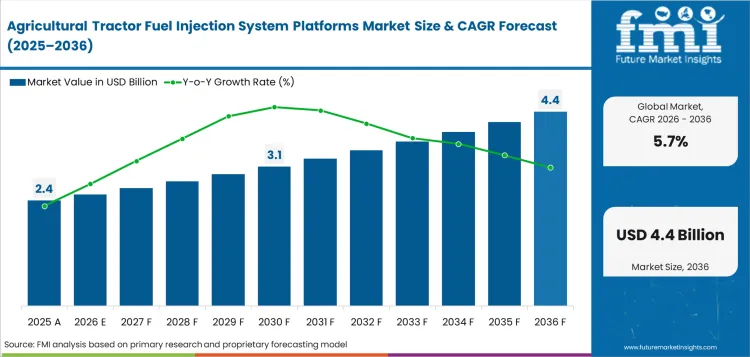
Agricultural tractor fuel injection system platforms were valued at USD 2.38 billion in 2025 and are projected to reach USD 2.52 billion in 2026. The industry is projected to reach USD 4.39 billion by 2036 at 5.7% CAGR. High-pressure common rail platforms are projected to lead platform type demand with 58.0% share in 2026. OEM fitment is expected to hold 72.0% share in 2026.
Tractor makers need fuel systems that meet emission rules and still work under farm-duty loads. In May 2026, eCFR stated that 40 CFR Part 1039 applies to new compression-ignition nonroad engines. That keeps injection platform design tied to certification and engine-family approval. Small tractor engines are now part of the upgrade path. In September 2024, PHINIA launched CR350 for Kohler small off-highway diesel engines below 19 kW.
The system runs up to 350 bar and supports up to 7% fuel-efficiency improvement. That helps compact tractor platforms move toward electronic control without excessive system complexity. OEM fitment proof is also important. In July 2024, Deere listed the 5075GL with a 73 hp 3.4 L engine, DOC and DPF aftertreatment and common rail electronic fuel injection. Suppliers with compliant common rail systems and tractor-ready integration support are expected to be better placed for future platform awards.
Summary of the Agricultural Tractor Fuel Injection System Platforms Market
- Demand and Growth Drivers
- Demand for tractor injection platforms is rising as emission rules push higher fuel pressure and cleaner combustion in diesel farm engines.
- Farm operators are replacing older tractors more selectively, which keeps aftermarket fuel pumps and injectors relevant across large fleets.
- High horsepower tractors need fuel systems that support longer work cycles and steady torque under field load.
- Export tractor programs are moving from mechanical pumps toward electronically controlled common rail systems.
- Product and Segment View
- High-pressure common rail platforms are projected to account for 58.0% share in 2026 as tractor makers need injection timing control.
- Injectors are expected to hold 34.0% share of component demand in 2026 primarily because replacement frequency is higher than rail replacement.
- The 41 to 100 HP band is forecast to account for 46.0% share in 2026 as this range fits the core utility tractor pool.
- The market connects with off-highway vehicle engines and diesel power engines because injection platforms are specified at engine design stage.
- Geography and Competitive Outlook
- India is projected to record 7.0% CAGR through 2036 as tractor production and rural mechanization keep diesel platforms active.
- China is expected to expand at 6.5% CAGR through 2036 as CN Stage IV moves larger tractors toward cleaner fuel systems.
- Robert Bosch GmbH, DENSO Corporation, PHINIA Inc. and Stanadyne LLC shape competition in common rail and diesel injectors.
- Cummins Inc. and AGCO Power influence system design through engine platform work for heavy off-highway duty cycles.
- Analyst Opinion
- Nikhil Kaitwade, Principal Consultant for Automotive at FMI, says, “The tractor injection opportunity is more than an engine part story. Farmers care about fuel use and uptime and tractor makers care about emission compliance and platform repeatability. Suppliers that can match pumps, injectors and controls to regional tractor power bands will hold better ground than suppliers that only sell stand-alone parts.”
- Agricultural Tractor Fuel Injection System Platforms Market Value Analysis
- Market value rises as high-pressure pumps and injectors carry higher content value than older mechanical fuel systems.
- Engine emission rules are shifting platform design toward common rail systems that control injection timing for each cylinder.
- Replacement demand is linked to older tractor fleets that need pumps, nozzles and calibration support after heavy seasonal use.
- Export tractors need fuel platforms that match local fuel quality and emission rules in destination countries.
The value pool is concentrated in OEM fitment because fuel system design is decided before engine and tractor validation close.
Key Takeaways, Market Size, and Forecast
- The agricultural tractor fuel injection system platforms market was valued at USD 2.38 billion in 2025.
- By 2036, the agricultural tractor fuel injection system platforms market is projected to reach USD 4.39 billion.
- From 2026 to 2036, the market is projected to expand at 5.7% CAGR.
- The market is projected to create an incremental opportunity of USD 1.87 billion between 2026 and 2036.
- High-pressure common rail platforms are projected to account for 58.0% share of platform type demand in 2026.
- OEM fitment is expected to account for 72.0% share of sales channel demand in 2026.
- India at 7.0% CAGR and China at 6.5% CAGR are expected to show stable country demand outlooks.
Agricultural Tractor Fuel Injection System Platforms Market Definition
The agricultural tractor fuel injection system platforms market covers pumps, injectors, rails, sensors and control units used to deliver diesel or alternative liquid fuel into tractor engines. The scope includes factory fitted systems and replacement parts sold for farm tractors. It excludes passenger vehicle injectors, marine engines and construction engines unless the same platform is sold into a tractor program.
Agricultural Tractor Fuel Injection System Platforms Market Inclusions
Market scope covers agricultural tractor fuel injection system platforms categorized by system type, including common rail systems and mechanical injection pumps. It also includes electronic unit systems, diesel injectors and fuel rails. Component scope includes high pressure pumps, control units and sensors when supplied as part of tractor fuel delivery platforms. Sales scope includes factory fitment and replacement sales across farm tractor platforms.
The scope also covers systems used in diesel powered tractors where fuel delivery, injection timing and engine control operate as part of one powertrain process. Revenue scope covers 2026 to 2036. The key stakeholders include tractor manufacturers, fuel injection system suppliers, diesel injector producers and high pressure pump manufacturers. It also includes electronic control unit suppliers, aftermarket distributors, farm equipment dealers, repair workshops and agricultural machinery service providers.
Agricultural Tractor Fuel Injection System Platforms Market Exclusions
Scope does not include gasoline passenger injectors, marine-only fuel systems, hydraulic pumps, aftertreatment systems or complete diesel engines sold without a separately identified injection platform.
Agricultural Tractor Fuel Injection System Platforms Market Research Methodology
- Primary Research: FMI analysts reviewed tractor maker specifications, fuel system supplier portfolios and aftermarket repair patterns across major tractor countries. Interviews focused on engine matching, fuel pressure needs and replacement buying routes.
- Desk Research: The study used public data from official trade bodies, government ministries and supplier technical releases. FMI compared tractor fuel systems with medium duty engines and heavy duty engines to avoid overstating tractor-only demand.
- Market sizing and forecasting: Market size was estimated with a hybrid bottom-up and top-down model. Tractor production and registrations were paired with injection system content per engine and replacement rate assumptions.
- Data validation: Forecast checks compared tractor sales by power band, emission rule timing, supplier product fitment and aftermarket replacement cycles. Country CAGRs were adjusted against tractor fleet size and regulatory pressure.
Why is the Agricultural Tractor Fuel Injection System Platforms Market Growing?
- Emission rules are raising demand for electronically controlled injection on tractors above key horsepower thresholds.
- High-hour field operation increases injector wear and creates repeat replacement demand in service channels.
- Export tractor makers need platforms that can be tuned for local fuel quality and regional emission limits.
- Power dense tractors use higher fuel pressure to keep torque stable under tillage and transport loads.
Tractor engines are moving toward tighter fuel control because farm machinery must cut particulate output without losing field torque. The Association of Equipment Manufacturers reported 53,790 United States farm tractor retail sales for January to April 2026. That figure was 9.4% lower than the same period in 2025, but the replacement pool still creates service demand. Lower new sales shift attention toward installed tractors that need pumps and injectors to keep seasonal uptime. This supports suppliers with repair programs and fast parts availability.
Regulation is another factor fuel injection platforms are changing. The Association of Equipment Manufacturers stated in April 2025 that China began CN Stage IV implementation in 2024 for non-road machinery. Engines above 37 kW require diesel particulate filter use under that route. That pushes tractor makers toward better injection timing and rail pressure control. Suppliers that can provide calibration support with pumps and injectors will gain specification access before production starts.
Market Segmentation Analysis
- High-pressure common rail platforms are projected to reach 58.0% share in 2026 as electronic timing control becomes standard in mid-horsepower and high-horsepower tractors.
- With an estimated 34.0% share in 2026, injectors are expected to lead component demand as wear and replacement frequency keep service demand active.
- The 41 to 100 HP range is forecast to account for 46.0% share in 2026 as it matches the core utility tractor pool.
- OEM fitment is projected to capture 72.0% share in 2026 as injection platforms are validated with engines before tractor launch.
- Low sulfur diesel systems are projected to hold 64.0% share in 2026 as most tractors run on regulated diesel.
- Row crop tractors are expected to account for 42.0% share in 2026 as long field hours raise fuel control needs.
The market is divided into six primary segment groups based on platform type, component, power output, sales channel, fuel type and application. Application analysis uses adjacent tractor contexts such as orchard tractors, ride-on mower platforms and utility terrain vehicles only where engine duty cycles overlap.
Insights into the High-Pressure Common Rail Platform Type Segment
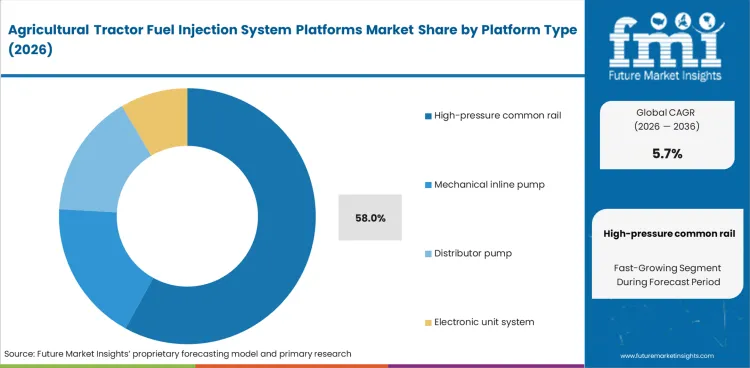
- High-pressure common rail platforms are projected to account for 58.0% share in 2026. Tractor makers use these systems to control injection timing and fuel quantity across changing field loads.
- Mechanical and distributor pumps retain value in lower-cost tractors. Common rail platforms gain share where emission rules and export programs require finer fuel control.
Insights into the Injectors Component Segment
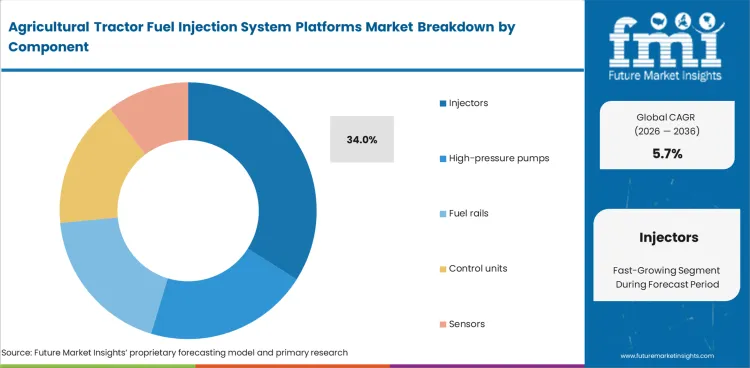
- Injectors are expected to represent 34.0% share of component demand in 2026. Wear, fuel quality variation and service replacement keep injector demand steadier than one-time rail installation.
- High-pressure pumps remain the second value pool as pump durability decides rail stability. Sensors and control units gain value as tractors add electronic diagnostics.
Insights into the 41 to 100 HP Power Output Segment
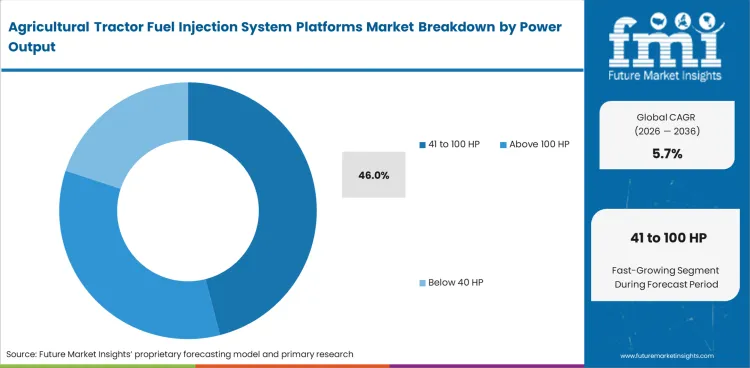
- The 41 to 100 HP band is forecast to account for 46.0% share in 2026. This power range fits utility tractors used for tillage and haulage. Mixed farm work adds another route.
- Above 100 HP tractors carry higher system value per unit. Smaller tractors need low-cost platforms and slower migration from mechanical fuel systems.
Insights into the OEM Fitment Sales Channel Segment
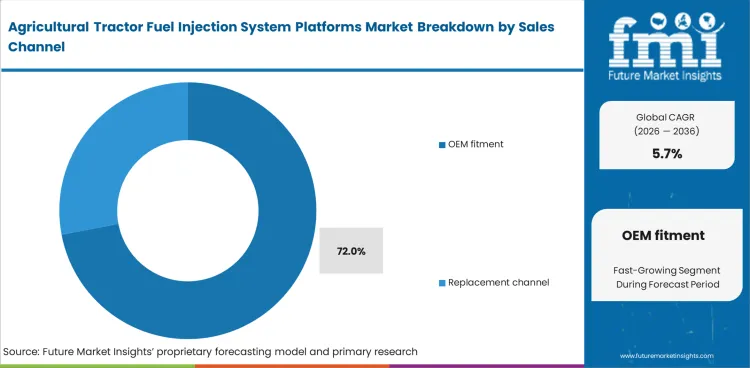
- OEM fitment is projected to hold 72.0% share of sales channel demand in 2026. Fuel systems must be matched to the engine map and emission route before tractor validation.
- Replacement channels stay important where pumps and injectors fail after long service hours. Remanufactured parts help reduce repair cost in price-sensitive farming regions.
Insights into the Low Sulfur Diesel Fuel Type Segment
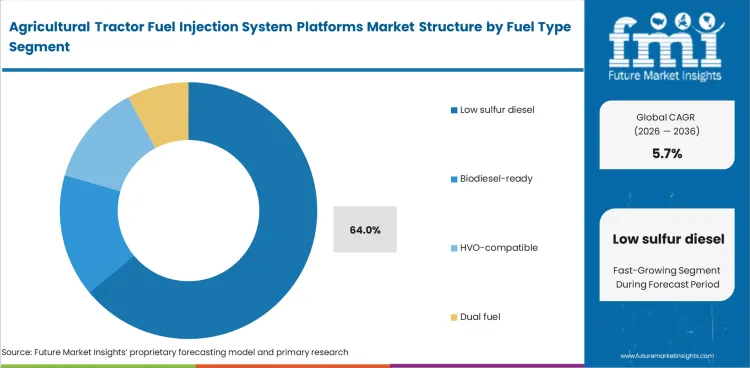
- Low sulfur diesel platforms are projected to hold 64.0% share in 2026. Most tractor fleets continue to rely on diesel as refueling access and torque needs favor liquid fuel.
- Biodiesel-ready and HVO-compatible platforms are rising from a lower base. Their progress depends on fuel supply and elastomer compatibility.
Insights into the Row Crop Tractor Application Segment
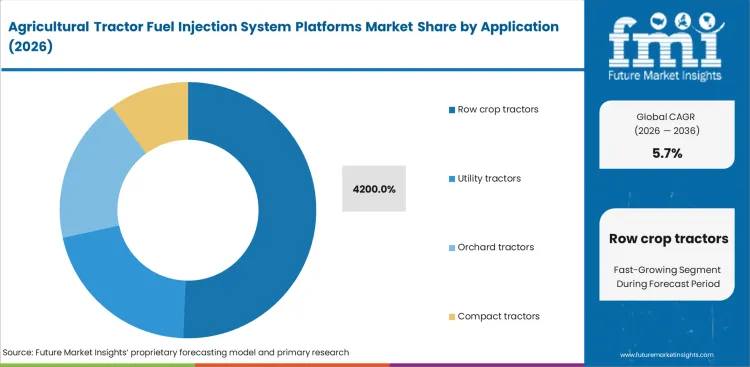
- Row crop tractors are expected to account for 42.0% share of application demand in 2026. Long field hours make fuel efficiency and injector life more visible to farm operators.
- Utility tractors remain close as they dominate mixed farm tasks. Compact and orchard tractors use smaller systems with lower content value per machine.
Agricultural Tractor Fuel Injection System Platforms Market Drivers, Restraints, and Opportunities
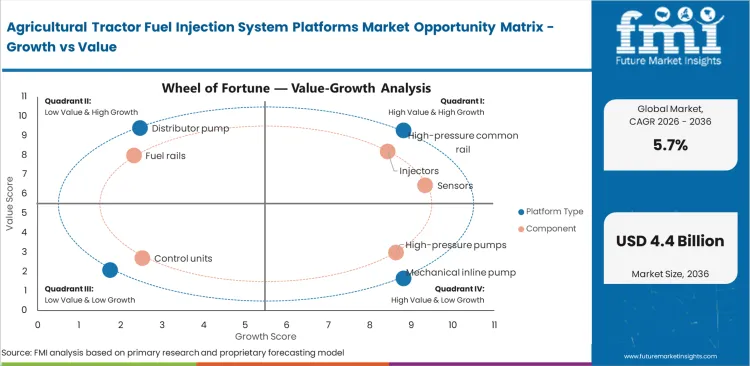
- Fuel pressure control is raising common rail demand in tractors that must meet regional emission limits.
- System cost slows upgrades in low horsepower tractors as farm operators compare repair value against tractor age.
- Serviceable pumps and injectors create opportunity where older fleets need repair without full tractor replacement.
Emission compliance is the high driver for market growth. For instance, Europe had 144,400 agricultural tractor registrations in 2024, according to CEMA aisbl. Larger machines gained share even as total registrations fell. Those tractors usually carry higher value fuel systems as horsepower and exhaust limits require better combustion control.
Fuel System Cost Slows Low-HP Upgrades
The main restraint is the cost added by electronic control, pumps and sensors. Smaller tractors often sell on upfront price. That makes mechanical systems harder to replace in markets when emission enforcement is slower. Suppliers need modular designs that fit small engines without forcing full redesigns. Price pressure is strongest in regions when tractors serve both farm and transport use.
Repair Channels Create Aftermarket Value
Replacement parts create a second path for suppliers after tractor sale. Injectors and pumps face wear from fuel contamination and high seasonal use. Service channels need parts that fit older tractors and newer common rail platforms. This gives fuel system makers a way to earn repeat revenue while OEM programs move through slower product cycles.
Analysis of Agricultural Tractor Fuel Injection System Platforms Market by Key Countries
.webp "Top Country Growth Comparison Agricultural Tractor Fuel Injection System Platforms Market Cagr (2026 2036)")
| Country | CAGR |
|---|---|
| India | 7.0% CAGR |
| China | 6.5% CAGR |
| Brazil | 5.8% CAGR |
| United States | 5.2% CAGR |
| Germany | 4.9% CAGR |
| France | 4.7% CAGR |
| Japan | 4.3% CAGR |
Source: Future Market Insights, 2026.
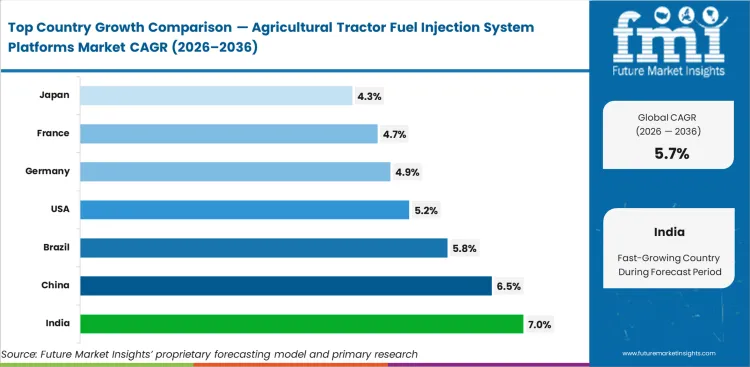
Agricultural Tractor Fuel Injection System Platforms Market CAGR Analysis by Country
- India is expected to post 7.0% CAGR by 2036, supported by sustained domestic manufacturing volumes that encourage localized fuel system development.
- China is projected to record 6.5% CAGR by 2036, driven by stricter emission norms that require more advanced fuel control across higher horsepower segments.
- Brazil is forecast at 5.8% CAGR by 2036, owing to ongoing replacement demand from large-scale farming operations reliant on diesel tractors.
- The United States is expected to advance at 5.2% CAGR by 2036, with growth underpinned by steady aftermarket demand for maintenance and service components.
- Germany, France and Japan grow below the global pace as tractor registrations are steadier and emission systems are already well established.
Demand for agricultural tractor fuel injection system platforms is forecast to rise at 5.7% CAGR from 2026 to 2036. Country-level demand is tied to tractor production, emission enforcement, repair networks and the mix of high horsepower machines.
Demand Outlook for Agricultural Tractor Fuel Injection System Platforms in India
India is projected to record a 7.0% CAGR through 2036 as tractor production scale keeps local fuel system sourcing active. The Press Information Bureau of India reported 9,85,968 tractors produced in 2023 and 96,223 exported. That large production base supports common rail and mechanical platform demand at the same time. Local tractor makers are expected to need supplier support for TREM timing and cost control.
- Punjab and Haryana keep high-utilization tractors active across tillage and haulage tasks.
- Maharashtra and Gujarat create repair demand through mixed farm and transport use.
- Export programs need fuel platforms that match destination fuel quality and service access.
Sales Analysis of Agricultural Tractor Fuel Injection System Platforms in China
China’s tractor platform demand starts with regulation and scale. China is expected to expand at 6.5% CAGR through 2036 as CN Stage IV raises fuel control needs for larger engines. The Association of Equipment Manufacturers stated that CN Stage IV began in 2024 for non-road machinery and adds a particle number route for engines above 37 kW. That makes injector timing and aftertreatment matching more important for tractor makers.
- Large state farms create demand for high horsepower tractor fuel systems.
- Regional tractor makers need cost-controlled common rail platforms for export models.
- Service networks must handle diesel particulate filter and injector fault diagnosis.
Opportunity Analysis of Agricultural Tractor Fuel Injection System Platforms in Brazil
Brazil’s tractor market is linked to large acreage farming and long machine hours. The country is forecast at 5.8% CAGR through 2036 as replacement activity continues despite weaker machinery sales. Associação Nacional dos Fabricantes de Veículos Automotores reported agricultural machinery sales near 49.8 thousand units in 2025. Fuel system suppliers can use repair channels to reach fleets that delay new tractor purchases.
- Mato Grosso farms need durable fuel systems for long field cycles.
- Paraná and Rio Grande do Sul support mixed crop tractor replacement.
- Local service centers create demand for pumps and injectors before full tractor renewal.
Demand Outlook for Agricultural Tractor Fuel Injection System Platforms in the United States
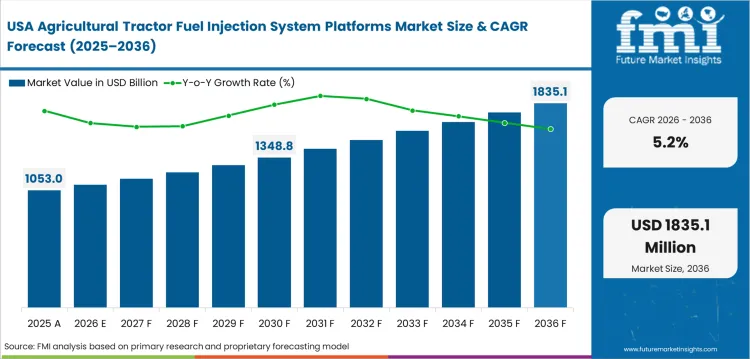
The United States market is service-heavy as tractor owners are stretching replacement cycles. Association of Equipment Manufacturers data showed 53,790 farm tractor retail sales from January to April 2026. The United States is projected to record 5.2% CAGR through 2036 as lower new sales shift spending toward reliable repair parts. Suppliers with fast injector and pump availability can protect seasonal uptime.
- Midwest row crop farms need steady fuel delivery during planting and harvest windows.
- Dealer workshops require diagnostics that identify injector faults before engine damage spreads.
- High horsepower tractor fleets create a higher content opportunity per machine.
Opportunity Analysis of Agricultural Tractor Fuel Injection System Platforms in Germany
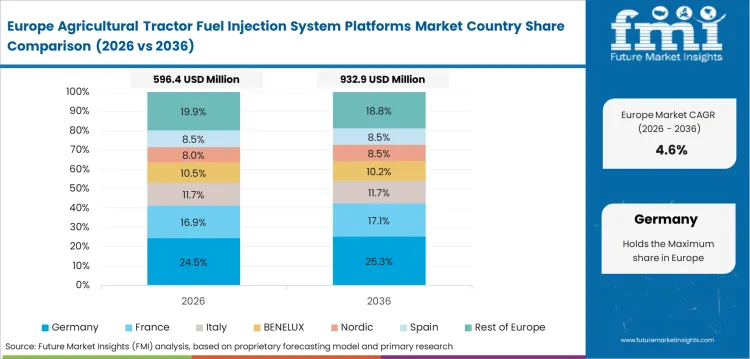
Germany is a high-specification market with a large base of Stage V tractors. Germany is expected to advance at 4.9% CAGR through 2036 as large tractor use supports common rail replacement value. CEMA aisbl reported that German tractor registrations fell 4% in 2024, but larger power classes from 110 kW upward rose slightly. This supports premium platform demand even when total units soften.
- Bavaria and Lower Saxony support service demand through livestock and arable farms.
- Larger power classes need high-pressure pumps with stable rail control under load.
- Suppliers must prove compatibility with Stage V aftertreatment and diagnostic systems.
Future Outlook for Agricultural Tractor Fuel Injection System Platforms in France
France has a broad tractor base and a clear shift toward higher average power. CEMA aisbl reported just over 34,000 tractors first registered in France during 2024. Standard tractor registrations reached 23,976 units and average power reached 169 HP. France is forecast to grow at 4.7% CAGR through 2036 because higher average horsepower raises fuel system value per unit.
- Grain regions need injection systems that support field work and road transport cycles.
- Vineyard tractors require smaller systems with tight packaging and stable service support.
- Dealer groups influence replacement part choice because downtime windows are short.
Future Outlook for Agricultural Tractor Fuel Injection System Platforms in Japan
Japan’s tractor market is compact and quality-sensitive. Japan is forecast at 4.3% CAGR through 2036 as domestic farms use smaller tractors and export platforms need precise emission compliance. The Japan Agricultural Machinery Manufacturers Association’s 2024 country report showed tractor shipment activity split across horsepower bands. Suppliers here need compact fuel systems that support clean combustion without raising service burden.
- Hokkaido farms need higher power tractors for larger fields and export-aligned engines.
- Smaller farms need compact systems with simple service access.
- Japanese OEM exports support demand for globally accepted injector and pump designs.
Competitive Landscape and Strategic Positioning
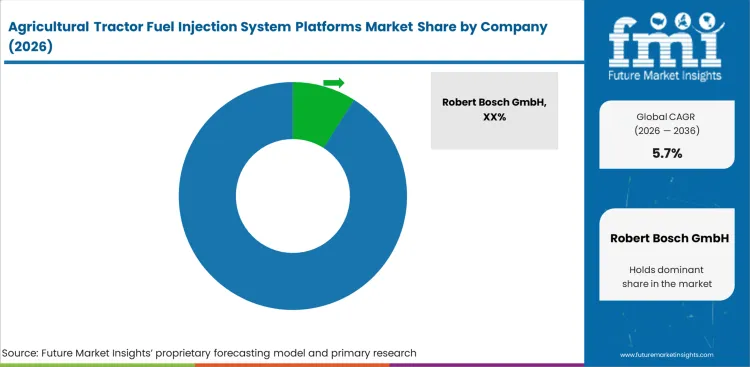
- Competition is concentrated around pressure control, injector durability and calibration support for tractor engine programs.
- Established fuel system suppliers win when they can match pumps, injectors and control units to emission rules.
- Engine makers influence platform choice because injection systems are validated with the full tractor powertrain.
- Entry barriers include clean manufacturing, pressure testing, fuel compatibility work and service network reach.
Pressure and durability define the competitive outlook. Cummins launched a new off-highway fuel system in July 2025 with rail pressure up to 2,200 bar and built-in protection up to 2,600 bar. That level of pressure shows why tractor makers evaluate full system capability rather than a single pump. FMI compared supplier moves with compact construction equipment because many off-highway engines share similar duty demands.
PHINIA is building value in smaller off-highway engines. In September 2024, PHINIA launched the CR350 low pressure common rail system with Kohler Engines for small diesel engines below 19 kW. The company stated that the system can deliver up to 7% fuel efficiency improvement. This is relevant for compact tractors where cost and packaging decide fitment. The same direction links with ruggedized switch systems and cybersecure fuel control units as tractors add electronic control.
Specialist fuel suppliers also matter in service and compact pump design. Stanadyne’s 2P DCR fuel pump received a 2024 PACE Award in April 2024 after the company highlighted low-lubricity fuel compatibility and compact modular design. Those traits fit farm regions where fuel quality varies and repair networks need fewer part variants. This is why suppliers with aftermarket support can defend share against larger engine platform owners.
Key Companies in the Agricultural Tractor Fuel Injection System Platforms Market
Competition is best read by role because fuel system suppliers and engine platform owners influence different stages of tractor design.
- Fuel System Platform Suppliers: Robert Bosch GmbH, DENSO Corporation, PHINIA Inc., Stanadyne LLC and Woodward Inc. supply pumps, injectors, rails and control systems for diesel and alternative fuel engines.
- Engine Platform Integrators: Cummins Inc., AGCO Power and FPT Industrial shape system demand through off-highway engine programs.
- Captive and Regional Tractor Engine Users: John Deere Power Systems, Kubota Corporation and Yanmar Holdings rely on injection platforms that match their tractor portfolios.
Competitive Benchmarking: Agricultural Tractor Fuel Injection System Platforms Market
| Company | Fuel Pressure Depth | Calibration Support | Tractor Fitment Proof | Geographic Footprint |
|---|---|---|---|---|
| Robert Bosch GmbH | High | Strong | Strong | Global with Germany and India depth |
| DENSO Corporation | High | Strong | Medium | Japan centered with global OEM reach |
| PHINIA Inc. | High | Strong | Strong | United States centered with global fuel systems reach |
| Stanadyne LLC | Medium | Strong | Strong | United States centered with off-highway depth |
| Cummins Inc. | High | Strong | Strong | Global with United States, India and China work |
| AGCO Power | Medium | Strong | Strong | Finland centered with Fendt and Massey Ferguson links |
| FPT Industrial | Medium | Strong | Medium | Europe centered with tractor OEM supply |
| Woodward Inc. | Medium | Strong | Medium | United States centered with control systems depth |
| John Deere Power Systems | Medium | Medium | Strong | North America centered with captive tractor fitment |
| Kubota Corporation | Medium | Medium | Strong | Japan centered with compact tractor reach |
Source: Future Market Insights competitive analysis, 2026. Ratings reflect relative positioning based on fuel pressure depth, calibration support and tractor fitment proof.
Key Developments in Agricultural Tractor Fuel Injection System Platforms Market
- In September 2024, PHINIA launched the CR350 common rail system for Kohler small off-highway diesel engines. The system targets compact engines below 19 kW.
- In April 2024, Stanadyne’s 2P DCR fuel pump won a PACE Award. The pump was described as compact, modular and compatible with low-lubricity fuels.
- In July 2025, Cummins launched a fuel system for off-highway applications. The system offers rail pressure up to 2,200 bar for demanding equipment.
- In February 2026, AGCO Power’s CORE80 engine received Diesel Engine of the Year 2026 recognition. The CORE family supports tractors and other off-highway machines.
Key Players in the Agricultural Tractor Fuel Injection System Platforms Market
Fuel System Platform Suppliers
- Robert Bosch GmbH
- DENSO Corporation
- PHINIA Inc.
- Stanadyne LLC
- Woodward Inc.
Engine Platform Integrators
- Cummins Inc.
- AGCO Power
- FPT Industrial
Captive and Regional Tractor Engine Users
- John Deere Power Systems
- Kubota Corporation
- Yanmar Holdings
Report Scope and Coverage
| Parameter | Details |
|---|---|
| Quantitative Units | USD 2.52 billion to USD 4.39 billion, at a CAGR of 5.7% |
| Market Definition | Fuel injection pumps, injectors, rails, sensors and controls used in agricultural tractor engines |
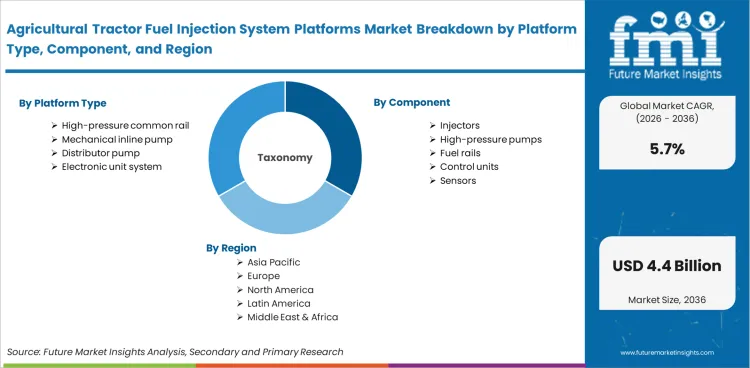
| Platform Type | High-pressure common rail, Mechanical inline pump, Distributor pump, Electronic unit system |
| Component | Injectors, High-pressure pumps, Fuel rails, Control units, Sensors |
| Power Output | Below 40 HP, 41 to 100 HP, Above 100 HP |
| Sales Channel | OEM fitment, Replacement channel |
| Fuel Type | Low sulfur diesel, Biodiesel-ready, HVO-compatible, Dual fuel |
| Application | Row crop tractors, Utility tractors, Orchard tractors, Compact tractors |
| Regions Covered | North America, Latin America, Europe, East Asia, South Asia and Pacific, Middle East and Africa |
| Countries Covered | India, China, Brazil, United States, Germany, France, Japan, 30+ countries |
| Key Companies Profiled | Robert Bosch GmbH, DENSO Corporation, PHINIA Inc., Stanadyne LLC, Cummins Inc., AGCO Power, FPT Industrial |
| Forecast Period | 2026 to 2036 |
| Approach | Hybrid bottom-up and top-down methodology |
Agricultural Tractor Fuel Injection System Platforms Market by Segments
Agricultural Tractor Fuel Injection System Platforms Market Segmented by Platform Type:
- High-pressure common rail
- Mechanical inline pump
- Distributor pump
- Electronic unit system
Agricultural Tractor Fuel Injection System Platforms Market Segmented by Component:
- Injectors
- High-pressure pumps
- Fuel rails
- Control units
- Sensors
Agricultural Tractor Fuel Injection System Platforms Market Segmented by Power Output:
- Below 40 HP
- 41 to 100 HP
- Above 100 HP
Agricultural Tractor Fuel Injection System Platforms Market Segmented by Sales Channel:
- OEM fitment
- Replacement channel
Agricultural Tractor Fuel Injection System Platforms Market Segmented by Fuel Type:
- Low sulfur diesel
- Biodiesel-ready
- HVO-compatible
- Dual fuel
Agricultural Tractor Fuel Injection System Platforms Market Segmented by Application:
- Row crop tractors
- Utility tractors
- Orchard tractors
- Compact tractors
Agricultural Tractor Fuel Injection System Platforms Market Segmented by Region:
- North America
- United States
- Canada
- Mexico
- Latin America
- Brazil
- Chile
- Rest of Latin America
- Western Europe
- Germany
- United Kingdom
- Italy
- Spain
- France
- Nordic
- BENELUX
- Rest of Western Europe
- Eastern Europe
- Russia
- Poland
- Hungary
- Balkan and Baltic
- Rest of Eastern Europe
- East Asia
- China
- Japan
- South Korea
- South Asia and Pacific
- India
- ASEAN
- Australia and New Zealand
- Rest of South Asia and Pacific
- Middle East and Africa
- Kingdom of Saudi Arabia
- Other GCC Countries
- Turkiye
- South Africa
- Other African Union
- Rest of Middle East and Africa
Research Sources and Bibliography
- Association of Equipment Manufacturers. (2026). AEM United States Ag Tractor and Combine Report: April 2026.
- CEMA aisbl. (2025). European tractor registrations at 10-year low in 2024.
- Press Information Bureau, Ministry of Heavy Industries, Government of India. (2024). Production of tractors.
- Associação Nacional dos Fabricantes de Veículos Automotores. (2025). Brazilian Automotive Industry Yearbook 2025.
- Japan Agricultural Machinery Manufacturers Association. (2024). Japan spring 2024 agriculture market report.
- Association of Equipment Manufacturers. (2025). Navigating the global emissions regulations for non-road engines and powertrains.
- PHINIA Inc. (2024). PHINIA launches first-to-market technology designed to reduce emissions and enhance fuel efficiency for Kohler small off-highway diesel engines.
- Stanadyne LLC. (2024). Stanadyne’s 2P DCR fuel pump wins a 2024 Automotive News PACE Award.
- Cummins Inc. (2025). Cummins launches new fuel system for off-highway applications.
- AGCO Power. (2026). AGCO Power’s CORE80 engine named Diesel Engine of the Year 2026.
All sources used for statistical and development checks are government, regulatory, official company or official trade body publications from 2024 onward where a current publication date was available.
This Report Answers
- What is the projected 2026 value of the agricultural tractor fuel injection system platforms market?
- How much market value could be created between 2026 and 2036?
- Which fuel injection platform is expected to account for the leading share in 2026?
- Why do high-pressure common rail platforms gain more specification value in farm tractors?
- Which component group creates the most visible service and replacement demand?
- How do emission rules in India and China change tractor fuel system selection?
- Which countries are forecast to record the faster demand outlook through 2036?
- How are Bosch, PHINIA, Stanadyne and Cummins positioned in this market?
- What is excluded from the agricultural tractor fuel injection system platforms market scope?
- Which data sources and sizing checks support the forecast model used in the report?
Frequently Asked Questions
What is the global agricultural tractor fuel injection system platforms market demand in 2026?
In 2026, the global agricultural tractor fuel injection system platforms market is expected to be worth USD 2.52 billion as OEM fitment leads demand.
What is the forecast value of the agricultural tractor fuel injection system platforms market by 2036?
By 2036, the agricultural tractor fuel injection system platforms market is projected to reach USD 4.39 billion as common rail systems gain share.
What CAGR is expected for the agricultural tractor fuel injection system platforms market?
The agricultural tractor fuel injection system platforms market is projected to expand at 5.7% CAGR from 2026 to 2036.
Which platform type leads the agricultural tractor fuel injection system platforms market?
High-pressure common rail platforms are projected to account for 58.0% share in 2026 due to fuel timing and emission needs.
Which sales channel leads the agricultural tractor fuel injection system platforms market?
OEM fitment is expected to hold 72.0% share in 2026 because fuel systems are validated during tractor engine development.
Why is India the faster growing country in the agricultural tractor fuel injection system platforms market?
India is projected at 7.0% CAGR through 2036 as high tractor production and emission preparation raise local platform demand.
What does the agricultural tractor fuel injection system platforms market include?
The market includes injectors, pumps, rails, sensors and controls used to meter fuel in agricultural tractor engines.
How was the agricultural tractor fuel injection system platforms market forecast built?
The forecast used tractor production, registration data, emission timing, supplier evidence and replacement assumptions under a hybrid sizing model.
Which fuel injection system is best for mid-range farm tractors?
High-pressure common rail is usually best for mid-range tractors that need cleaner combustion and better torque control. Mechanical pumps remain useful where repair cost is the main concern.
Preview the report firsthand - request a free sample
Get SampleGet the brochure for pricing and purchase details.
Get PDFTable of Content
- Executive Summary
- Global Market Outlook
- Demand-side Trends
- Supply-side Trends
- Technology Roadmap Analysis
- Analysis and Recommendations
- Market Overview
- Market Coverage / Taxonomy
- Market Definition / Scope / Limitations
- Research Methodology
- Chapter Orientation
- Analytical Lens and Working Hypotheses
- Market Structure, Signals, and Trend Drivers
- Benchmarking and Cross-market Comparability
- Market Sizing, Forecasting, and Opportunity Mapping
- Research Design and Evidence Framework
- Desk Research Programme (Secondary Evidence)
- Company Annual and Sustainability Reports
- Peer-reviewed Journals and Academic Literature
- Corporate Websites, Product Literature, and Technical Notes
- Earnings Decks and Investor Briefings
- Statutory Filings and Regulatory Disclosures
- Technical White Papers and Standards Notes
- Trade Journals, Industry Magazines, and Analyst Briefs
- Conference Proceedings, Webinars, and Seminar Materials
- Government Statistics Portals and Public Data Releases
- Press Releases and Reputable Media Coverage
- Specialist Newsletters and Curated Briefings
- Sector Databases and Reference Repositories
- FMI Internal Proprietary Databases and Historical Market Datasets
- Subscription Datasets and Paid Sources
- Social Channels, Communities, and Digital Listening Inputs
- Additional Desk Sources
- Expert Input and Fieldwork (Primary Evidence)
- Primary Modes
- Qualitative Interviews and Expert Elicitation
- Quantitative Surveys and Structured Data Capture
- Blended Approach
- Why Primary Evidence is Used
- Field Techniques
- Interviews
- Surveys
- Focus Groups
- Observational and In-context Research
- Social and Community Interactions
- Stakeholder Universe Engaged
- C-suite Leaders
- Board Members
- Presidents and Vice Presidents
- R&D and Innovation Heads
- Technical Specialists
- Domain Subject-matter Experts
- Scientists
- Physicians and Other Healthcare Professionals
- Governance, Ethics, and Data Stewardship
- Research Ethics
- Data Integrity and Handling
- Primary Modes
- Tooling, Models, and Reference Databases
- Desk Research Programme (Secondary Evidence)
- Data Engineering and Model Build
- Data Acquisition and Ingestion
- Cleaning, Normalisation, and Verification
- Synthesis, Triangulation, and Analysis
- Quality Assurance and Audit Trail
- Market Background
- Market Dynamics
- Drivers
- Restraints
- Opportunity
- Trends
- Scenario Forecast
- Demand in Optimistic Scenario
- Demand in Likely Scenario
- Demand in Conservative Scenario
- Opportunity Map Analysis
- Product Life Cycle Analysis
- Supply Chain Analysis
- Investment Feasibility Matrix
- Value Chain Analysis
- PESTLE and Porter’s Analysis
- Regulatory Landscape
- Regional Parent Market Outlook
- Production and Consumption Statistics
- Import and Export Statistics
- Market Dynamics
- Global Market Analysis 2021 to 2025 and Forecast, 2026 to 2036
- Historical Market Size Value (USD Million) Analysis, 2021 to 2025
- Current and Future Market Size Value (USD Million) Projections, 2026 to 2036
- Y-o-Y Growth Trend Analysis
- Absolute $ Opportunity Analysis
- Global Market Pricing Analysis 2021 to 2025 and Forecast 2026 to 2036
- Global Market Analysis 2021 to 2025 and Forecast 2026 to 2036, By Platform Type
- Introduction / Key Findings
- Historical Market Size Value (USD Million) Analysis By Platform Type , 2021 to 2025
- Current and Future Market Size Value (USD Million) Analysis and Forecast By Platform Type , 2026 to 2036
- High-pressure common rail
- Mechanical inline pump
- Distributor pump
- Electronic unit system
- High-pressure common rail
- Y-o-Y Growth Trend Analysis By Platform Type , 2021 to 2025
- Absolute $ Opportunity Analysis By Platform Type , 2026 to 2036
- Global Market Analysis 2021 to 2025 and Forecast 2026 to 2036, By Component
- Introduction / Key Findings
- Historical Market Size Value (USD Million) Analysis By Component, 2021 to 2025
- Current and Future Market Size Value (USD Million) Analysis and Forecast By Component, 2026 to 2036
- Injectors
- High-pressure pumps
- Fuel rails
- Control units
- Sensors
- Injectors
- Y-o-Y Growth Trend Analysis By Component, 2021 to 2025
- Absolute $ Opportunity Analysis By Component, 2026 to 2036
- Global Market Analysis 2021 to 2025 and Forecast 2026 to 2036, By Power Output
- Introduction / Key Findings
- Historical Market Size Value (USD Million) Analysis By Power Output, 2021 to 2025
- Current and Future Market Size Value (USD Million) Analysis and Forecast By Power Output, 2026 to 2036
- 41 to 100 HP
- Above 100 HP
- Below 40 HP
- 41 to 100 HP
- Y-o-Y Growth Trend Analysis By Power Output, 2021 to 2025
- Absolute $ Opportunity Analysis By Power Output, 2026 to 2036
- Global Market Analysis 2021 to 2025 and Forecast 2026 to 2036, By Sales Channel
- Introduction / Key Findings
- Historical Market Size Value (USD Million) Analysis By Sales Channel, 2021 to 2025
- Current and Future Market Size Value (USD Million) Analysis and Forecast By Sales Channel, 2026 to 2036
- OEM fitment
- Replacement channel
- OEM fitment
- Y-o-Y Growth Trend Analysis By Sales Channel, 2021 to 2025
- Absolute $ Opportunity Analysis By Sales Channel, 2026 to 2036
- Global Market Analysis 2021 to 2025 and Forecast 2026 to 2036, By Fuel Type
- Introduction / Key Findings
- Historical Market Size Value (USD Million) Analysis By Fuel Type, 2021 to 2025
- Current and Future Market Size Value (USD Million) Analysis and Forecast By Fuel Type, 2026 to 2036
- Low sulfur diesel
- Biodiesel-ready
- HVO-compatible
- Dual fuel
- Low sulfur diesel
- Y-o-Y Growth Trend Analysis By Fuel Type, 2021 to 2025
- Absolute $ Opportunity Analysis By Fuel Type, 2026 to 2036
- Global Market Analysis 2021 to 2025 and Forecast 2026 to 2036, By Application
- Introduction / Key Findings
- Historical Market Size Value (USD Million) Analysis By Application, 2021 to 2025
- Current and Future Market Size Value (USD Million) Analysis and Forecast By Application, 2026 to 2036
- Row crop tractors
- Utility tractors
- Orchard tractors
- Compact tractors
- Row crop tractors
- Y-o-Y Growth Trend Analysis By Application, 2021 to 2025
- Absolute $ Opportunity Analysis By Application, 2026 to 2036
- Global Market Analysis 2021 to 2025 and Forecast 2026 to 2036, By Region
- Introduction
- Historical Market Size Value (USD Million) Analysis By Region, 2021 to 2025
- Current Market Size Value (USD Million) Analysis and Forecast By Region, 2026 to 2036
- North America
- Latin America
- Western Europe
- Eastern Europe
- East Asia
- South Asia and Pacific
- Middle East & Africa
- Market Attractiveness Analysis By Region
- North America Market Analysis 2021 to 2025 and Forecast 2026 to 2036, By Country
- Historical Market Size Value (USD Million) Trend Analysis By Market Taxonomy, 2021 to 2025
- Market Size Value (USD Million) Forecast By Market Taxonomy, 2026 to 2036
- By Country
- USA
- Canada
- Mexico
- By Platform Type
- By Component
- By Power Output
- By Sales Channel
- By Fuel Type
- By Application
- By Country
- Market Attractiveness Analysis
- By Country
- By Platform Type
- By Component
- By Power Output
- By Sales Channel
- By Fuel Type
- By Application
- Key Takeaways
- Latin America Market Analysis 2021 to 2025 and Forecast 2026 to 2036, By Country
- Historical Market Size Value (USD Million) Trend Analysis By Market Taxonomy, 2021 to 2025
- Market Size Value (USD Million) Forecast By Market Taxonomy, 2026 to 2036
- By Country
- Brazil
- Chile
- Rest of Latin America
- By Platform Type
- By Component
- By Power Output
- By Sales Channel
- By Fuel Type
- By Application
- By Country
- Market Attractiveness Analysis
- By Country
- By Platform Type
- By Component
- By Power Output
- By Sales Channel
- By Fuel Type
- By Application
- Key Takeaways
- Western Europe Market Analysis 2021 to 2025 and Forecast 2026 to 2036, By Country
- Historical Market Size Value (USD Million) Trend Analysis By Market Taxonomy, 2021 to 2025
- Market Size Value (USD Million) Forecast By Market Taxonomy, 2026 to 2036
- By Country
- Germany
- UK
- Italy
- Spain
- France
- Nordic
- BENELUX
- Rest of Western Europe
- By Platform Type
- By Component
- By Power Output
- By Sales Channel
- By Fuel Type
- By Application
- By Country
- Market Attractiveness Analysis
- By Country
- By Platform Type
- By Component
- By Power Output
- By Sales Channel
- By Fuel Type
- By Application
- Key Takeaways
- Eastern Europe Market Analysis 2021 to 2025 and Forecast 2026 to 2036, By Country
- Historical Market Size Value (USD Million) Trend Analysis By Market Taxonomy, 2021 to 2025
- Market Size Value (USD Million) Forecast By Market Taxonomy, 2026 to 2036
- By Country
- Russia
- Poland
- Hungary
- Balkan & Baltic
- Rest of Eastern Europe
- By Platform Type
- By Component
- By Power Output
- By Sales Channel
- By Fuel Type
- By Application
- By Country
- Market Attractiveness Analysis
- By Country
- By Platform Type
- By Component
- By Power Output
- By Sales Channel
- By Fuel Type
- By Application
- Key Takeaways
- East Asia Market Analysis 2021 to 2025 and Forecast 2026 to 2036, By Country
- Historical Market Size Value (USD Million) Trend Analysis By Market Taxonomy, 2021 to 2025
- Market Size Value (USD Million) Forecast By Market Taxonomy, 2026 to 2036
- By Country
- China
- Japan
- South Korea
- By Platform Type
- By Component
- By Power Output
- By Sales Channel
- By Fuel Type
- By Application
- By Country
- Market Attractiveness Analysis
- By Country
- By Platform Type
- By Component
- By Power Output
- By Sales Channel
- By Fuel Type
- By Application
- Key Takeaways
- South Asia and Pacific Market Analysis 2021 to 2025 and Forecast 2026 to 2036, By Country
- Historical Market Size Value (USD Million) Trend Analysis By Market Taxonomy, 2021 to 2025
- Market Size Value (USD Million) Forecast By Market Taxonomy, 2026 to 2036
- By Country
- India
- ASEAN
- Australia & New Zealand
- Rest of South Asia and Pacific
- By Platform Type
- By Component
- By Power Output
- By Sales Channel
- By Fuel Type
- By Application
- By Country
- Market Attractiveness Analysis
- By Country
- By Platform Type
- By Component
- By Power Output
- By Sales Channel
- By Fuel Type
- By Application
- Key Takeaways
- Middle East & Africa Market Analysis 2021 to 2025 and Forecast 2026 to 2036, By Country
- Historical Market Size Value (USD Million) Trend Analysis By Market Taxonomy, 2021 to 2025
- Market Size Value (USD Million) Forecast By Market Taxonomy, 2026 to 2036
- By Country
- Kingdom of Saudi Arabia
- Other GCC Countries
- Turkiye
- South Africa
- Other African Union
- Rest of Middle East & Africa
- By Platform Type
- By Component
- By Power Output
- By Sales Channel
- By Fuel Type
- By Application
- By Country
- Market Attractiveness Analysis
- By Country
- By Platform Type
- By Component
- By Power Output
- By Sales Channel
- By Fuel Type
- By Application
- Key Takeaways
- Key Countries Market Analysis
- USA
- Pricing Analysis
- Market Share Analysis, 2025
- By Platform Type
- By Component
- By Power Output
- By Sales Channel
- By Fuel Type
- By Application
- Canada
- Pricing Analysis
- Market Share Analysis, 2025
- By Platform Type
- By Component
- By Power Output
- By Sales Channel
- By Fuel Type
- By Application
- Mexico
- Pricing Analysis
- Market Share Analysis, 2025
- By Platform Type
- By Component
- By Power Output
- By Sales Channel
- By Fuel Type
- By Application
- Brazil
- Pricing Analysis
- Market Share Analysis, 2025
- By Platform Type
- By Component
- By Power Output
- By Sales Channel
- By Fuel Type
- By Application
- Chile
- Pricing Analysis
- Market Share Analysis, 2025
- By Platform Type
- By Component
- By Power Output
- By Sales Channel
- By Fuel Type
- By Application
- Germany
- Pricing Analysis
- Market Share Analysis, 2025
- By Platform Type
- By Component
- By Power Output
- By Sales Channel
- By Fuel Type
- By Application
- UK
- Pricing Analysis
- Market Share Analysis, 2025
- By Platform Type
- By Component
- By Power Output
- By Sales Channel
- By Fuel Type
- By Application
- Italy
- Pricing Analysis
- Market Share Analysis, 2025
- By Platform Type
- By Component
- By Power Output
- By Sales Channel
- By Fuel Type
- By Application
- Spain
- Pricing Analysis
- Market Share Analysis, 2025
- By Platform Type
- By Component
- By Power Output
- By Sales Channel
- By Fuel Type
- By Application
- France
- Pricing Analysis
- Market Share Analysis, 2025
- By Platform Type
- By Component
- By Power Output
- By Sales Channel
- By Fuel Type
- By Application
- India
- Pricing Analysis
- Market Share Analysis, 2025
- By Platform Type
- By Component
- By Power Output
- By Sales Channel
- By Fuel Type
- By Application
- ASEAN
- Pricing Analysis
- Market Share Analysis, 2025
- By Platform Type
- By Component
- By Power Output
- By Sales Channel
- By Fuel Type
- By Application
- Australia & New Zealand
- Pricing Analysis
- Market Share Analysis, 2025
- By Platform Type
- By Component
- By Power Output
- By Sales Channel
- By Fuel Type
- By Application
- China
- Pricing Analysis
- Market Share Analysis, 2025
- By Platform Type
- By Component
- By Power Output
- By Sales Channel
- By Fuel Type
- By Application
- Japan
- Pricing Analysis
- Market Share Analysis, 2025
- By Platform Type
- By Component
- By Power Output
- By Sales Channel
- By Fuel Type
- By Application
- South Korea
- Pricing Analysis
- Market Share Analysis, 2025
- By Platform Type
- By Component
- By Power Output
- By Sales Channel
- By Fuel Type
- By Application
- Russia
- Pricing Analysis
- Market Share Analysis, 2025
- By Platform Type
- By Component
- By Power Output
- By Sales Channel
- By Fuel Type
- By Application
- Poland
- Pricing Analysis
- Market Share Analysis, 2025
- By Platform Type
- By Component
- By Power Output
- By Sales Channel
- By Fuel Type
- By Application
- Hungary
- Pricing Analysis
- Market Share Analysis, 2025
- By Platform Type
- By Component
- By Power Output
- By Sales Channel
- By Fuel Type
- By Application
- Kingdom of Saudi Arabia
- Pricing Analysis
- Market Share Analysis, 2025
- By Platform Type
- By Component
- By Power Output
- By Sales Channel
- By Fuel Type
- By Application
- Turkiye
- Pricing Analysis
- Market Share Analysis, 2025
- By Platform Type
- By Component
- By Power Output
- By Sales Channel
- By Fuel Type
- By Application
- South Africa
- Pricing Analysis
- Market Share Analysis, 2025
- By Platform Type
- By Component
- By Power Output
- By Sales Channel
- By Fuel Type
- By Application
- USA
- Market Structure Analysis
- Competition Dashboard
- Competition Benchmarking
- Market Share Analysis of Top Players
- By Regional
- By Platform Type
- By Component
- By Power Output
- By Sales Channel
- By Fuel Type
- By Application
- Competition Analysis
- Competition Deep Dive
- Robert Bosch GmbH
- Overview
- Product Portfolio
- Profitability by Market Segments (Product/Age /Sales Channel/Region)
- Sales Footprint
- Strategy Overview
- Marketing Strategy
- Product Strategy
- Channel Strategy
- DENSO Corporation
- PHINIA Inc.
- Stanadyne LLC
- Cummins Inc.
- AGCO Power
- FPT Industrial
- Woodward Inc.
- John Deere Power Systems
- Kubota Corporation
- Robert Bosch GmbH
- Competition Deep Dive
- Assumptions & Acronyms Used


