

- Industry Size (2026)
- Forecast (2036)
- CAGR
- (2026 to 2036)
AI-Assisted Channel Emulation and Propagation Modeling Test Systems Market Forecast and Outlook 2026 to 2036
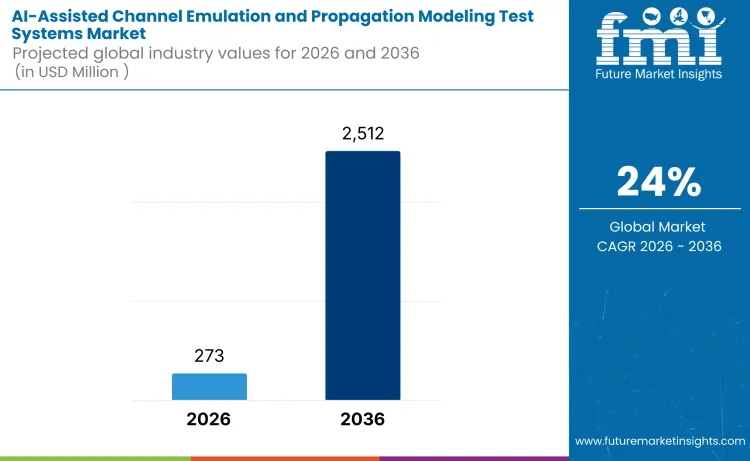
Global AI-assisted channel emulation and propagation modeling test systems market, valued at USD 273 million in 2026, is projected to grow to USD 2,512 million by 2036, with a CAGR of 24%. Demand for AI-assisted channel emulation and propagation modeling test systems is driven by the growing need for advanced testing solutions for developing next-generation wireless networks, including 6G technologies, which require precise channel emulation and propagation modeling.
AI-assisted channel emulators, which account for 30% of the system type market share, are preferred for their ability to simulate complex wireless environments with high accuracy. Machine learning enhanced modeling, representing 28% of the technology type segment, is increasingly used for its ability to optimize and enhance modeling processes, improving testing efficiency and precision. Growth is further supported by the growing adoption of AI and machine learning in wireless network design and testing.
Quick Stats for AI-Assisted Channel Emulation and Propagation Modeling Test Systems Market
- AI-Assisted Channel Emulation and Propagation Modeling Test Systems Market Value (2026): USD 273 million
- AI-Assisted Channel Emulation and Propagation Modeling Test Systems Market Forecast Value (2036): USD 2,512 million
- AI-Assisted Channel Emulation and Propagation Modeling Test Systems Market Global Forecast CAGR: 24%
- Leading System Type in AI-Assisted Channel Emulation and Propagation Modeling Test Systems Market: AI-assisted channel emulators (30%)
- Key Growth Regions in AI-Assisted Channel Emulation and Propagation Modeling Test Systems Market: China, USA, India, UK, Japan
- Top Players in AI-Assisted Channel Emulation and Propagation Modeling Test Systems Market: Keysight Technologies, Rohde & Schwarz, Anritsu Corporation, VIAVI Solutions Inc., Spirent Communications, National Instruments (NI), EXFO, Tektronix, NVIDIA Corporation, Qualcomm Incorporated, Samsung Electronics Co Ltd, Nokia Corporation, Ericsson, Huawei Technologies Co Ltd, ZTE Corporation
AI-Assisted Channel Emulation and Propagation Modeling Test Systems Market Key Takeaways
| Metric | Value |
|---|---|
| Industry Sales Value (2026) | USD 273 million |
| Industry Forecast Value (2036) | USD 2,512 million |
| Industry Forecast CAGR (2026 to 2036) | 24% |
What Is Driving the Demand for AI-Assisted Channel Emulation and Propagation Modeling Test Systems Globally?
Demand for AI-assisted channel emulation and propagation modeling test systems is driven by the complexity of modern wireless networks and the need to simulate real-world conditions to develop and validate communication devices accurately. As 5G evolves and 6G research advances, network environments become more dynamic, with varied frequency bands, multiple antenna systems, and complex propagation scenarios. Traditional modeling and testing approaches are often limited in their ability to capture these conditions. AI-assisted systems use machine learning and data-driven methods to improve the accuracy of channel emulation and propagation predictions, enabling engineers to assess performance under diverse conditions without costly field tests. Telecom equipment vendors, handset makers, and chipset developers increasingly rely on these tools to reduce time to market and improve reliability of wireless products.
Future demand for AI-assisted channel emulation and propagation modeling test systems is expected to grow as next-generation wireless standards progress toward implementation. With more devices and use cases requiring robust connectivity, accurate modeling will be critical for evaluating performance in urban, indoor, rural, and high mobility scenarios. Advances in AI and computing power will enhance the capability of test systems to emulate complex channels and predict propagation behaviours. Collaboration among network operators, equipment manufacturers, and research institutions will support wider adoption, especially as validation needs increase for advanced applications such as autonomous systems and industrial IoT.
What Are the Key Segments in AI-Assisted Channel Emulation and Propagation Modeling Test Systems Market?
The AI-assisted channel emulation and propagation modeling test systems market is growing as the demand for advanced testing tools in wireless communication systems increases. AI-assisted channel emulators represent 30% of the market share, offering high-precision simulations of real-world communication channels. Machine-learning-enhanced modeling accounts for 28%, enabling more accurate predictions of channel behavior. These test systems are crucial for validating the performance of next-generation communication technologies, including 5G and 6G.
Which System Type Drives AI-Assisted Channel Emulation and Propagation Modeling Test Systems Demand Globally?
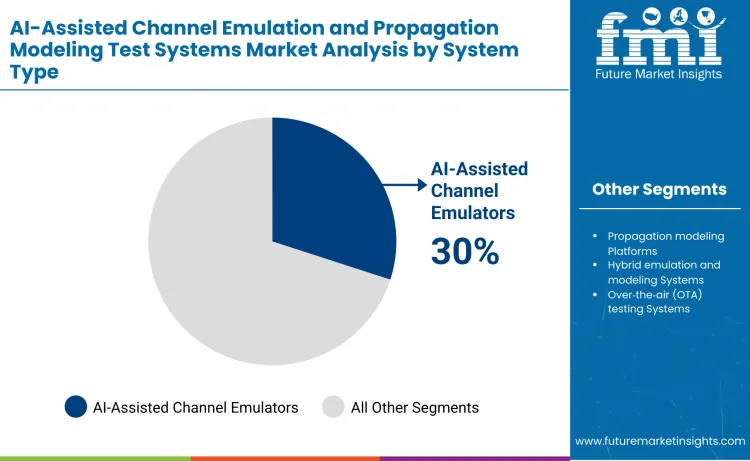
AI-assisted channel emulators account for 30% of the market share in the AI-assisted channel emulation and propagation modeling test systems market. These systems use artificial intelligence to simulate complex communication channels, enhancing the accuracy of channel modeling by predicting real-world radio frequency (RF) conditions, interference, and multipath effects. AI algorithms improve the emulators' ability to simulate diverse environments, such as urban, rural, and indoor settings, which are essential for testing modern communication systems like 5G and 6G. AI-assisted emulators are faster, more accurate, and adaptable compared to traditional channel emulators, enabling engineers to conduct more comprehensive testing with less time and cost. The adoption of AI in this segment allows for real-time optimization of parameters and improved reliability in testing advanced beamforming, massive MIMO, and other cutting-edge technologies. As wireless networks become more complex and diverse, the demand for AI-assisted channel emulators is increasing, particularly in the development of new communication protocols and network architectures.
Which Technology Type Drives AI-Assisted Channel Emulation and Propagation Modeling Test Systems Demand Globally?
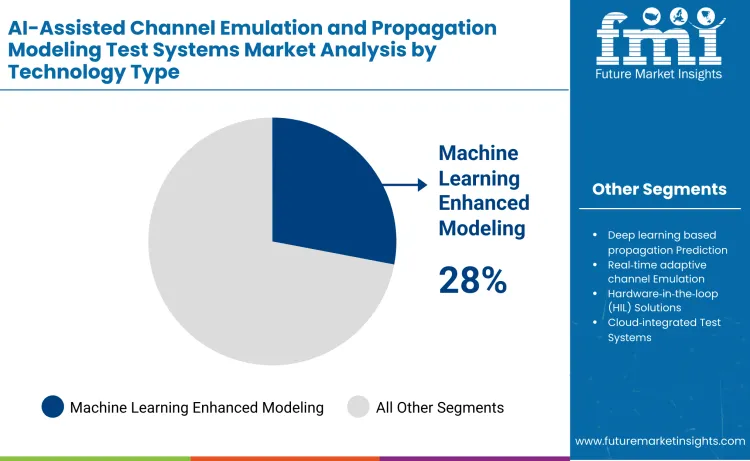
Machine learning enhanced modeling is a key technology type in the market, representing 28% of the share. Machine learning (ML) enhances propagation modeling by analyzing large datasets and identifying patterns that may not be immediately apparent using traditional methods. This technology improves the accuracy of models used for predicting signal behavior in various environments, such as urban canyons, rural areas, and dense indoor spaces. ML algorithms are particularly effective at handling the complexity and variability of real-world environments, enabling more precise predictions of coverage, interference, and signal degradation. The integration of ML with channel emulation systems ensures that models can adapt and learn from new data, continuously improving their performance as more scenarios are tested. This makes ML-enhanced modeling an invaluable tool for the wireless communication industry, particularly as the demand for high-speed, low-latency networks increases with the rollout of 5G and future 6G technologies.
What are the Key Trends in the Global AI-Assisted Channel Emulation and Propagation Modeling Test Systems Market?
Global AI-assisted channel emulation and propagation modeling test systems market is expanding as wireless communication systems become more complex with 5G evolution and future 6G development. AI-assisted systems combine artificial intelligence with advanced emulation and modeling to simulate real-world radio-frequency environments, multipath effects, and propagation behavior. These test systems help network equipment manufacturers, chipset designers, research institutions, and telecom operators validate performance, reliability, and coverage in realistic scenarios before deployment. Growth is driven by increasing demand for accurate performance prediction, fewer test cycles, and improved system optimization.
What are the Key Drivers for the Global AI-Assisted Channel Emulation and Propagation Modeling Test Systems Market?
One main driver is increasing investment in advanced wireless technologies including 5G, 5GAdvanced, and exploratory 6G research, which require more sophisticated testing of channel behaviors across diverse environments. Network operators and developers seek high-fidelity emulation to evaluate system performance under dynamic conditions such as urban, indoor, high mobility, and high-frequency bands. AI integration enhances modeling accuracy, accelerates test execution, and supports predictive analysis for network planning and optimization. Demand is also driven by growth of applications that depend on reliable connectivity, such as autonomous systems, industrial automation, and augmented reality, which require extensive pre-deployment validation of propagation characteristics.
What are the Restraints for the Global AI-Assisted Channel Emulation and Propagation Modeling Test Systems Market?
Building high-fidelity models demands vast data sets, computational resources, and advanced algorithms, which increases development costs. Standardization for next-generation networks is still evolving, creating uncertainty about exact requirements and slowing broad adoption until performance criteria are stabilized. The high cost of sophisticated test systems can be a barrier for smaller labs or organizations with limited budgets. Integration challenges with existing test infrastructures and legacy measurement tools may also slow uptake in some segments.
What is the Global Demand Outlook for AI-Assisted Channel Emulation and Propagation Modeling Test Systems?
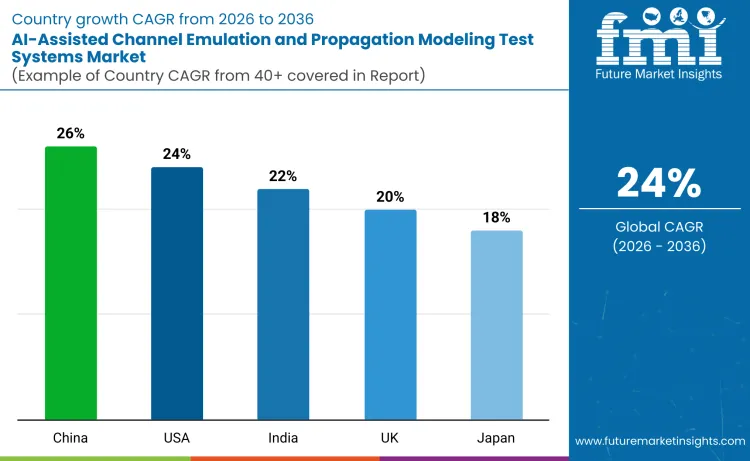
Demand for AI-assisted channel emulation and propagation modeling test systems is expected to grow significantly across various countries, with China leading the market at a projected CAGR of 26%. The USA follows with a growth rate of 24%, while India is expected to grow at 22%. The UK is projected to grow at 20%, and Japan at 18%. As the global telecommunications sector shifts towards advanced wireless technologies like 5G and 6G, the need for AI-powered testing and simulation solutions to model real-world propagation conditions and optimize channel performance is increasing. These test systems are essential for enhancing the accuracy and efficiency of network planning and deployment.
| Country | CAGR (%) |
|---|---|
| China | 26% |
| USA | 24% |
| India | 22% |
| UK | 20% |
| Japan | 18% |
What is Driving the Growth of AI-Assisted Channel Emulation and Propagation Modeling Test Systems in China?
China is projected to experience the highest growth in the AI-assisted channel emulation and propagation modeling test systems market, with a projected CAGR of 26%. As a global leader in telecommunications and technology, China is making substantial investments in advanced wireless networks, including 5G and the upcoming 6G networks. The country’s growing demand for network optimization, coupled with its ambitious goals to lead in the development and deployment of new communication technologies, is driving the adoption of AI-powered test systems. These systems are essential for accurately modeling propagation conditions in complex environments and enhancing the overall performance of wireless networks. China’s increasing focus on AI, machine learning, and telecommunications R&D further fuels the demand for these advanced test systems.
Why is the AI-Assisted Channel Emulation and Propagation Modeling Test Systems Market Expanding in the USA?
In the USA, the AI-assisted channel emulation and propagation modeling test systems market is projected to grow at a CAGR of 24%. The USA has been a leader in the development and deployment of wireless communication technologies, and as the demand for 5G and 6G systems grows, so does the need for accurate channel modeling and testing solutions. AI-assisted test systems are crucial for simulating real-world conditions, optimizing signal propagation, and ensuring the performance and reliability of networks. As the USA focuses on improving the efficiency of its communication infrastructure and developing new wireless technologies, the adoption of these testing solutions will continue to rise. Additionally, the USA’s ongoing investments in AI and machine learning for telecommunications applications are further driving market growth.
How is the AI-Assisted Channel Emulation and Propagation Modeling Test Systems Market Growing in India?
In India, the AI-assisted channel emulation and propagation modeling test systems market is projected to grow at a CAGR of 22%. As India continues to expand its telecommunications infrastructure and move towards 5G and beyond, there is an increasing need for advanced testing solutions to ensure network reliability and efficiency. AI-assisted test systems are vital for accurately modeling and emulating channel conditions in diverse environments, which is critical for the country’s vast and varied geography. The demand for these solutions is also being driven by India’s push to become a leader in digital technologies and its strong focus on innovation. With the government's Digital India initiative and growing investments in telecommunications, the market for channel emulation and propagation modeling test systems in India is expected to see significant growth.
What is Contributing to the Growth of AI-Assisted Channel Emulation and Propagation Modeling Test Systems in the UK?
In the UK, the demand for AI-assisted channel emulation and propagation modeling test systems is projected to grow at a CAGR of 20%. The UK is actively investing in next-generation wireless technologies such as 5G and 6G, and the adoption of AI-powered testing solutions is crucial for ensuring the performance of these networks. These test systems help simulate real-world propagation conditions, optimize signal strength, and improve network planning accuracy. With the UK’s strong focus on digital innovation, smart cities, and IoT, the need for efficient and reliable wireless communication systems is driving the demand for advanced modeling and emulation solutions. As the UK works towards building a more connected and sustainable future, the market for these test systems will continue to expand.
What is Influencing the Growth of AI-Assisted Channel Emulation and Propagation Modeling Test Systems in Japan?
In Japan, the demand for AI-assisted channel emulation and propagation modeling test systems is projected to grow at a CAGR of 18%. Japan has long been a leader in telecommunications and technology, and as the country moves toward the adoption of 5G and 6G technologies, the need for advanced testing solutions to optimize wireless communication is increasing. AI-assisted channel emulation and propagation modeling solutions play a critical role in ensuring the efficiency and reliability of next-generation networks, particularly in urban environments and complex terrains. Japan’s focus on innovation, sustainability, and advanced technology development is driving the adoption of these test systems. With the government’s support for 5G infrastructure and digital transformation, Japan is well-positioned for continued growth in the AI-assisted test systems market.
What is the Competitive Landscape for the AI-Assisted Channel Emulation and Propagation Modeling Test Systems Market?
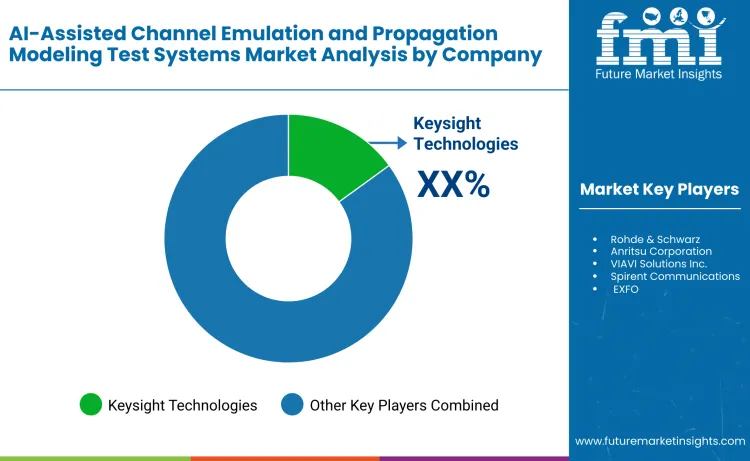
Global demand for AI-assisted channel emulation and propagation modeling test systems is rising as wireless networks evolve toward 6G, ultrareliable low-latency communications, and dense heterogeneous deployments. Next-generation networks require realistic emulation of complex propagation environments including multipath, interference, mobility and dynamic spectrum usage. AI integration enhances predictive modeling, accelerates scenario generation, and improves accuracy in emulating real-world channels for base stations, user equipment and IoT devices.
As research labs, chipset developers, telecom operators and network equipment makers invest in advanced validation tools, the market for intelligent test systems that combine channel emulation with machine learning grows. Rising global activity in 6G research, spectrum exploration and pilot deployments across North America, Europe and Asia Pacific further fuels uptake of sophisticated test solutions that can handle increasingly complex wireless scenarios and reduce time to market.
On the supply side, a broad set of test-equipment, semiconductor and wireless technology companies compete to serve this emerging market. Keysight Technologies is widely recognised as a leading supplier with deep expertise in wireless test solutions and integrated channel emulation platforms. Other important competitors include Rohde & Schwarz, Anritsu Corporation, VIAVI Solutions Inc., Spirent Communications, National Instruments (NI), EXFO and Tektronix, which offer hardware and software for advanced channel modelling, emulation and validation.
In addition, technology firms such as NVIDIA Corporation, Qualcomm Incorporated, Samsung Electronics Co Ltd, Nokia Corporation, Ericsson, Huawei Technologies Co Ltd and ZTE Corporation provide ecosystem support, integrated test solutions or co-validated frameworks that align with their device and network portfolios. Competition among these suppliers focuses on the accuracy of propagation models, scalability for multiantenna and high-frequency scenarios, AI capability for automated scenario generation, ease of integration into development workflows and global service support. Vendors that combine robust AI-assisted emulation platforms, flexible architectures and strong technical support are best positioned to capture growth as wireless systems become more complex and demanding worldwide.
Key Players
- Keysight Technologies
- Rohde & Schwarz
- Anritsu Corporation
- VIAVI Solutions Inc.
- Spirent Communications
- National Instruments (NI)
- EXFO
- Tektronix
- NVIDIA Corporation
- Qualcomm Incorporated
- Samsung Electronics Co Ltd
- Nokia Corporation
- Ericsson
- Huawei Technologies Co Ltd
- ZTE Corporation
Scope of the Report
| Items | Values |
|---|---|
| Quantitative Units (2026) | USD Million |
| System Type | AI-assisted channel emulators, Propagation modeling platforms, Hybrid emulation and modeling systems, Over-the-air (OTA) testing systems, Software-defined test frameworks |
| Technology Type | Machine learning enhanced modeling, Deep learning based propagation prediction, Real-time adaptive channel emulation, Hardware-in-the-loop (HIL) solutions, Cloud-integrated test systems |
| Application | Device performance validation, Network planning and optimization testing, Beamforming and MIMO testing, Mobility and handover simulation, Interference and coexistence analysis |
| End-User | Telecom equipment manufacturers, Network operators, Test and measurement service providers, Research and academic institutions, Defense and aerospace |
| Companies | Keysight Technologies, Rohde & Schwarz, Anritsu Corporation, VIAVI Solutions Inc., Spirent Communications, National Instruments (NI), EXFO, Tektronix, NVIDIA Corporation, Qualcomm Incorporated, Samsung Electronics Co Ltd, Nokia Corporation, Ericsson, Huawei Technologies Co Ltd, ZTE Corporation |
| Regions Covered | North America, Latin America, Western Europe, Eastern Europe, South Asia and Pacific, East Asia, Middle East & Africa |
| Countries Covered | United States, Canada, Mexico, Brazil, Argentina, Germany, France, United Kingdom, Italy, Spain, Netherlands, China, India, Japan, South Korea, ANZ, GCC Countries, South Africa |
| Additional Attributes | Dollar by sales by system type, technology type, application, end-user, and region. Includes market trends in AI-enhanced channel emulation and propagation modeling, performance validation in 5G/6G testing, machine learning and deep learning adoption, cost-effectiveness, sustainability practices, regulatory compliance, market share and competitive positioning of key companies, and the role of AI-assisted test systems in enabling efficient deployment and performance analysis of advanced networks across telecom, research, defense, and academic sectors. |
Key Segments in the AI-Assisted Channel Emulation and Propagation Modeling Test Systems Market
System Type
- AI-assisted channel emulators
- Propagation modeling platforms
- Hybrid emulation and modeling systems
- Over-the-air (OTA) testing systems
- Software-defined test frameworks
Technology Type
- Machine learning enhanced modeling
- Deep learning based propagation prediction
- Realtime adaptive channel emulation
- Hardware-in-the-loop (HIL) solutions
- Cloud-integrated test systems
Application
- Device performance validation
- Network planning and optimization testing
- Beamforming and MIMO testing
- Mobility and handover simulation
- Interference and coexistence analysis
End User
- Telecom equipment manufacturers
- Network operators
- Test and measurement service providers
- Research and academic institutions
- Defense and aerospace
Region
- Asia Pacific
- China
- India
- Japan
- South Korea
- ASEAN
- Rest of Asia Pacific
- Europe
- Germany
- United Kingdom
- France
- Italy
- Spain
- Nordic
- BENELUX
- Rest of Europe
- North America
- United States
- Canada
- Mexico
- Latin America
- Brazil
- Chile
- Rest of Latin America
- Middle East & Africa
- Kingdom of Saudi Arabia
- Other GCC Countries
- Turkey
- South Africa
- Other African Union
- Rest of Middle East & Africa
Frequently Asked Questions
How big is the AI-Assisted Channel Emulation and Propagation Modeling Test Systems market?
The market is valued at USD 273 million in 2026 and is expected to grow at a CAGR of 24%, reaching USD 2.512 billion by 2036.
What is the growth outlook for the AI-Assisted Channel Emulation and Propagation Modeling Test Systems market?
The market is projected to grow at a CAGR of 24% from 2026 to 2036.
Which region is expected to experience the fastest growth in the AI-Assisted Channel Emulation and Propagation Modeling Test Systems market?
China is expected to lead with a growth rate of 26%, driven by advancements in AI technologies and increased demand for accurate channel emulation and propagation modeling for next-generation communication systems.
What are the key applications of AI-Assisted Channel Emulation and Propagation Modeling Test Systems?
These systems are primarily used in simulating and modeling communication channels to optimize and test propagation models for advanced wireless networks.
Who is the major player in the AI-Assisted Channel Emulation and Propagation Modeling Test Systems market?
The leading player in the market is Keysight Technologies.
Preview the report firsthand - request a free sample
Get SampleGet the brochure for pricing and purchase details.
Get PDFTable of Content
- Executive Summary
- Market Overview
- Global Market Value, 2020-2026
- Global Market Forecast, 2026-2036
- Market Dynamics
- Drivers
- Restraints
- Opportunities
- Regulatory & Standards Landscape
- Technology & Innovation Outlook
- Market Segmentation Analysis
- By System Type
- AI-Assisted Channel Emulators
- Propagation Modeling Platforms
- Hybrid Emulation & Modeling Systems
- Over-the-Air (OTA) Testing Systems
- Software-Defined Test Frameworks
- By Technology Type
- Machine Learning Enhanced Modeling
- Deep Learning Based Propagation Prediction
- Real-Time Adaptive Channel Emulation
- Hardware-in-the-Loop (HIL) Solutions
- Cloud-Integrated Test Systems
- By Application
- Device Performance Validation
- Network Planning & Optimization Testing
- Beamforming & MIMO Testing
- Mobility & Handover Simulation
- Interference & Coexistence Analysis
- By End-User
- Telecom Equipment Manufacturers
- Network Operators
- Test & Measurement Service Providers
- Research & Academic Institutions
- Defense & Aerospace
- By System Type
- Regional Outlook
- North America
- Latin America
- Western Europe
- Eastern Europe
- South Asia & Pacific
- East Asia
- Middle East & Africa
- Country-Level Outlook
- United States
- Canada
- Mexico
- Brazil
- Argentina
- Germany
- France
- United Kingdom
- Italy
- Spain
- Netherlands
- China
- India
- Japan
- South Korea
- ANZ
- GCC Countries
- South Africa
- Competitive Landscape
- Market Structure Overview
- Company Positioning
- Strategic Initiatives
- Key Player Profiles
- Scope of the Report
- Research Methodology
- Assumptions & Acronyms


