

- Market Size (2026)
- USD 183.4 Mn
- Forecast (2036)
- USD 600.9 Mn
- CAGR (2026 to 2036)
- 12.6%
How big is AI Cluster Optical Fault Localization Platforms Market in 2026?
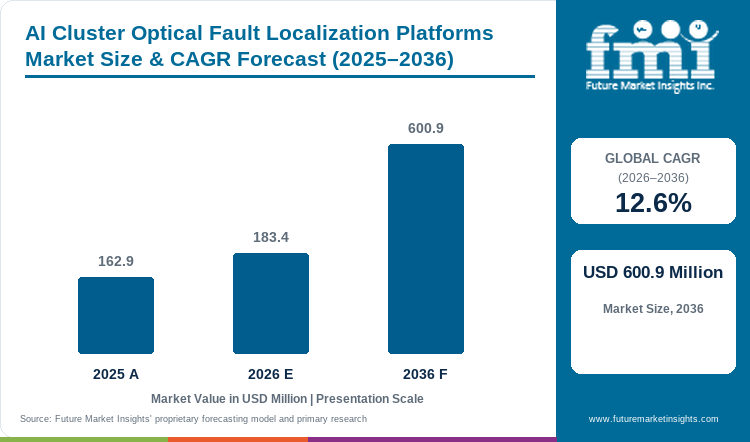
USD 183.4 Million in 2026 and USD 600.9 Million by 2036 at a 12.6% CAGR.
AI Cluster Optical Fault Localization Platforms Market rises from USD 162.9 Million in 2025 to USD 183.4 Million in 2026 and is forecast to reach USD 600.9 Million by 2036 at a 12.6% CAGR. Operators are moving fault isolation closer to the physical layer because each speed transition increases the cost of an unresolved optical impairment. IEEE 802.3df-2024 standardized 400G and 800G Ethernet parameters in March 2024. The Ultra Ethernet Consortium then released Specification 1.0 in June 2025 for AI and high-performance computing fabrics. Those milestones give network teams a clearer basis for validating optical links at scale. The commercial shift is from occasional handheld troubleshooting toward repeatable validation and path-aware diagnosis across dense AI fabrics.
A new AI cluster requires thousands of optical connections to be certified before workloads can run reliably. Expansion in the USA, Japan, South Korea and the UAE creates large commissioning projects, while France and Germany combine new capacity with established data-center estates. Operators need diagnostic results that identify the affected fiber path and can be shared with network teams. Compatibility with existing test equipment and topology software determines how much manual tracing remains.
Key Takeaways
- The market is valued at USD 183.4 Million in 2026 and is forecast to reach USD 600.9 Million by 2036 at a 12.6% CAGR.
- 800G holds 38.0% of Link Speed demand in 2026 as deployed AI scale-out fabrics standardize around mature high-speed Ethernet validation workflows.
- Topology & path optimization accounts for 26.0% of Software Function demand in 2026 because raw optical evidence becomes more useful when mapped to affected routes.
- Inter-rack / scale-out represents 36.0% of Deployment Location demand in 2026 as dense east-west fabrics multiply patching points, transceiver interfaces, and fiber paths.
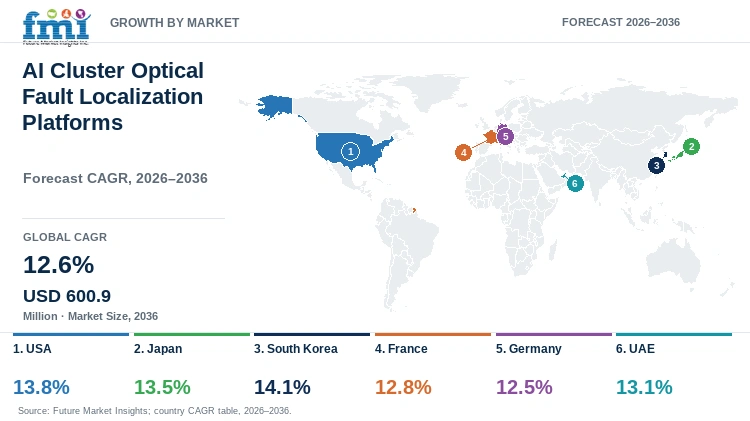
- South Korea records the fastest profiled country CAGR at 14.1% from 2026 to 2036, followed by the USA at 13.8% and Japan at 13.5%.
- Competitive strength depends on multi-rate validation, fault-localization analytics, and workflow integration that can connect physical-layer evidence to remediation.
Analyst Perspective
An optical alarm is useful only if technicians can locate the affected connector, fiber or transceiver and relate it to a network path. At 800G and 1.6T, test automation must carry that context from commissioning into maintenance. Platforms that preserve test records and map impairments to topology can shorten the investigation before a repair begins.
- Nikhil Kaitwade, Future Market Insights
How is the ai cluster optical fault localization platforms market segmented?
The market is assessed by Link Speed, Software Function, Deployment Location, Data Center Type, and Route to Market.
Link Speed sets the transmission rates a platform must test. Software Function covers topology and path analysis, signal margins, fault localization, power budgets and capacity planning. Deployment Location distinguishes faults within racks, across scale-out fabrics and between sites. Data Center Type affects the number of links and the operating team responsible for them. Route to Market determines whether the platform vendor, an integrator or a service provider installs and supports the test workflow.
What makes 800G central to the Link Speed category?
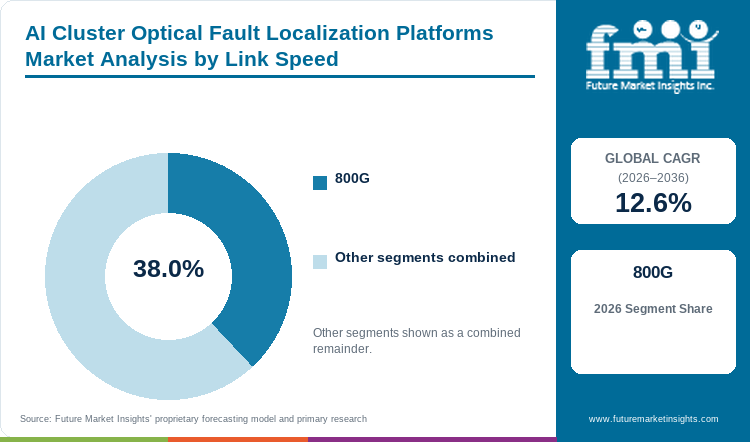
800G sits at the practical center of current AI scale-out deployment because standards and field-test workflows have matured around the rate. Optics and switches are also widely available for current AI builds. IEEE published 802.3df-2024 in March 2024 with 800G Ethernet parameters. VIAVI and EXFO now support 800G validation in data-center workflows while both are extending toward 1.6T. That combination gives 800G a larger installed and commissioning base than newer rates. At the same time, its power levels and high fiber density create enough loss-margin and connector sensitivity to justify automated diagnostics. Buyers can therefore standardize platform procedures now while keeping a migration path to 1.6T.
- 800G accounts for 38.0% of the Link Speed category in 2026 because it combines active AI deployment with a mature validation ecosystem.
- In February 2026, EXFO introduced native 24-fiber data-center testers that combine Tier-1 certification with Tier-2 OTDR troubleshooting for high-density AI builds.
Why does Topology & path optimization lead the Software Function category?
AI fabrics use many parallel links and alternative paths, so the business value of an optical alarm depends on knowing which route and workload it can affect. Topology-aware platforms can convert a raw loss event into a smaller set of suspect links. They can also prioritize remediation when several physical impairments exist at once. The Ultra Ethernet Consortium released Specification 1.0 in June 2025 to improve Ethernet operation for AI and HPC at scale. That broader move toward coordinated fabric behavior increases the value of path context. A platform that links optical evidence with topology can reduce manual correlation between test tools and network operations systems.
- Topology & path optimization accounts for 26.0% of the Software Function category in 2026 because path context turns distributed optical evidence into actionable fault domains.
- In March 2026, VIAVI launched its TestCenter D2 1.6T Appliance with AI workload emulation and multi-vendor validation for hyperscale and cloud environments.
How does Inter-rack / scale-out lead the Deployment Location category?
Scale-out networks connect large numbers of accelerators across racks. That architecture multiplies patching points, transceiver interfaces, and fiber paths compared with a smaller local rack domain. It also creates more ways for an optical impairment to reduce useful cluster capacity even when the rest of the fabric remains healthy. Corning stated in March 2026 that next-generation AI scale-out networks are pushing fiber counts higher as cluster sizes grow. Fault localization platforms are therefore most valuable where operators need to distinguish a local connector issue from a broader path problem. Inter-rack workflows also benefit from centralized evidence because technicians may be tracing faults across many rows and distribution zones.
- Inter-rack / scale-out accounts for 36.0% of the Deployment Location category in 2026 because large east-west fabrics expose more optical paths to commissioning and operational faults.
- In March 2026, Corning expanded its AI data-center connectivity portfolio with PRIZM TMT technology for higher fiber density in scale-up and scale-out environments.
What supports Hyperscale AI data centers in the Data Center Type category?
Hyperscale AI sites combine large accelerator fleets with dense optical cabling. A recurring connector or loss problem can affect many links and consume substantial technician time. Corning stated in January 2025 that AI data centers can require more than ten times the fiber of traditional facilities. This fiber density makes consistent acceptance testing and reusable diagnostic records valuable across successive construction phases and live operations.
- Hyperscale AI data centers account for 48.0% of the Data Center Type category in 2026 because their fiber scale and rollout speed raise the cost of slow fault isolation.
- In February 2026, EXFO said its high fiber count solution was purpose-built for the speed and scale of hyperscale and AI data-center builds.
What drives OEM direct leadership in the Route to Market category?
Direct OEM engagement is important when a diagnostic platform must track fast-changing link rates and interoperate with new optical transceivers. Buyers want access to product roadmaps and calibration support. They also need software updates plus engineering escalation during major fabric transitions. Those needs are harder to separate from the platform vendor at 800G and 1.6T than they are for mature commodity field tools. OEM direct sales also fit lab validation and large hyperscale qualification programs where the buyer may integrate test APIs into its own automation. Integrators and specialists remain important for deployment labor. Managed-service providers can absorb episodic demand, but the OEM often remains responsible for platform capability and lifecycle support.
- OEM direct accounts for 39.0% of the Route to Market category in 2026 because large buyers seek roadmap alignment and direct technical accountability for high-speed platform integration.
- In March 2026, VIAVI positioned its 1.6T TestCenter D2 for cloud providers and hyperscalers. It also targets neoclouds and network equipment manufacturers that validate multi-vendor AI networks.
What are the drivers, restraints, and opportunities in the ai cluster optical fault localization platforms market?
Higher-speed AI fabrics increase optical fault complexity, while integration and ROI thresholds can delay platform standardization and cross-layer observability creates a broader lifecycle opportunity.
- Driver: Migration to 800G and 1.6T increases optical path count and makes automated physical-layer fault isolation more valuable.
- Restraint: Buyers must justify specialized tooling across mixed generations of optics while integrating results with existing operations systems.
- Opportunity: Platforms can combine optical telemetry with topology and workload context to automate diagnosis across scale-out and DCI environments.
High fiber counts make manual fault tracing expensive. Corning reported in March 2026 that AI scale-out growth is increasing optical connections and fiber density inside data centers. EXFO links the same expansion to more connectors and tighter construction schedules. Loss and reflectance measurements help technicians identify defective connections before commissioning; stored results then provide a baseline when a link deteriorates in service.
Integration can delay adoption of an optical diagnostic platform. A platform can produce technically strong measurements yet remain difficult to standardize if it does not fit the operator's topology model, automation stack, or multi-vendor optics. Buyers also face mixed estates where 400G, 800G, and early 1.6T equipment coexist. That can extend validation and training work before a specialized platform is accepted as a common operating tool. VIAVI's March 2026 1.6T launch emphasizes multi-rate operation and multi-vendor environments because those conditions are real buying barriers. Operators may limit deployment to a few workflows until the platform meets these requirements.
Connecting optical measurements to network topology can shorten fault investigations. A technician needs to know both where a loss event occurs and which path it affects. Test platforms can support this workflow through shared records, open APIs and consistent link identifiers. Extending that information into operations software offers a route from acceptance testing to recurring maintenance use as AI fabrics add capacity and faster optics.
Which country CAGRs are profiled in the ai cluster optical fault localization platforms market?
| Country | CAGR |
|---|---|
| USA | 13.8% |
| Japan | 13.5% |
| South Korea | 14.1% |
| France | 12.8% |
| Germany | 12.5% |
| UAE | 13.1% |
How do country-level CAGRs compare in the ai cluster optical fault localization platforms market?
South Korea leads the six profiled markets at 14.1% CAGR from 2026 to 2036. USA follows at 13.8%, Japan at 13.5%, UAE at 13.1%, France at 12.8% and Germany at 12.5%. The 1.6 percentage-point spread accompanies different construction patterns: national compute expansion in South Korea, large operating hyperscale estates in the USA, and greenfield sovereign capacity in the UAE.
- South Korea is 0.3 percentage points above USA. New national compute projects create commissioning work, while the US installed base also requires ongoing optical troubleshooting.
- USA is 0.3 percentage points above Japan. U.S. hyperscale scale favors broad platform automation, while Japan places more weight on dense metro infrastructure and coordinated siting.
- Japan is 0.4 percentage points above UAE. Japan combines existing data-center concentration with redistribution needs, whereas UAE is building large greenfield sovereign AI capacity.
- UAE is 0.3 percentage points above France and 0.6 points above Germany. European suppliers face stronger site, grid, and efficiency integration requirements during project execution.
New facilities need fiber certification before network acceptance. Operating sites need diagnostic tools that can use existing records and identify faults without disrupting healthy paths. The balance between these two workloads affects platform purchasing across the profiled countries.
Country-wise Analysis
- USA: Demand is forecast to rise at 13.8% CAGR from 2026 to 2036. The Department of Energy reported in December 2024 that data centers used about 4.4% of US electricity in 2023 and could reach 6.7% to 12% by 2028. Power availability affects the timing of new clusters. Hyperscale operators can reuse automated test procedures and centralized link records across phased builds and existing facilities.
- Japan: Demand is forecast to rise at 13.5% CAGR from 2026 to 2036. METI's February 2025 work on AI compute capacity was followed by the March 2025 Watt-Bit collaboration council on electricity and telecommunications infrastructure. Coordinated siting increases the importance of reliable connections within and between facilities. Diagnostic platforms must fit compact sites and support local teams tracing faults across data-center interconnects.
- South Korea: Demand is forecast to rise at 14.1% CAGR from 2026 to 2036. In February 2025, the Ministry of Science and ICT announced a target of 18,000 advanced GPUs by the first half of 2026, alongside support for power and site allocation. Phased deployment creates repeated acceptance-testing work across new network domains. Common test procedures and local commissioning support can help maintain consistency across those sites.
- France: Demand is forecast to rise at 12.8% CAGR from 2026 to 2036. The Élysée reported more than EUR 109 billion in infrastructure investment announcements around the February 2025 AI Action Summit. Equipment installation depends on construction and grid-connection schedules. Optical test platforms enter the process when fiber paths are ready for certification and network acceptance.
- Germany: Demand is forecast to rise at 12.5% CAGR from 2026 to 2036. A March 2025 federal data-center assessment reported more than 2,000 facilities and over 2,700 MW of installed IT power. This operating base creates maintenance work alongside new construction. Shared test records can help network teams compare current loss measurements with commissioning results and isolate deteriorating connections.
- UAE: Demand is forecast to rise at 13.1% CAGR from 2026 to 2036. Abu Dhabi Media Office announced Stargate UAE in May 2025 as a 1-gigawatt compute cluster within a planned 5-gigawatt UAE-US AI Campus, with the first 200 MW expected in 2026. Greenfield construction allows fiber identification, test access and acceptance procedures to be specified before installation. The scale of the project makes consistent records across contractors particularly useful.
Who are the notable companies in the ai cluster optical fault localization platforms market?
VIAVI Solutions and EXFO provide diagnostic platforms; Corning supplies related monitoring-ready optical infrastructure.
Competition separates diagnostic platforms from the optical infrastructure they test. VIAVI Solutions and EXFO provide direct test and validation platforms for high-speed networks, covering lab qualification, field certification and troubleshooting. Corning supplies high-density fiber infrastructure and monitoring-ready components. Its role is distinct from test software: it shapes the optical path that must be measured and provides connectivity that affects test access and serviceability. Buyers compare diagnostic depth and workflow automation alongside compatibility with the installed fiber architecture.
- VIAVI Solutions: Multi-rate AI fabric validation, high-speed Ethernet testing and physical-layer troubleshooting.
- EXFO: High-fiber-count optical certification and OTDR-based fault localization for data-center deployment workflows.
- Corning: High-density AI optical infrastructure with monitoring-ready components that support diagnosable fiber paths.
Competitive Benchmarking: AI Cluster Optical Fault Localization Platforms Market
| Company | High-speed Optical Validation | Fault Localization Analytics | Monitoring-ready Workflow Integration | Geographic Reach |
|---|---|---|---|---|
| VIAVI Solutions | High | High | High | Global test and measurement footprint |
| EXFO | High | High | High | Global communications and hyperscaler test footprint |
| Corning | Unscored | Unscored | High | Global optical communications footprint |
Scoring basis: High-speed Optical Validation measures documented ability to validate high-rate optical or Ethernet environments used in AI data centers. Fault Localization Analytics measures documented capability to detect, classify, or locate physical-layer impairments through test or sensing analytics. Monitoring-ready Workflow Integration measures documented support for automated test records and centralized software. It also covers monitoring access or integrated physical-layer workflows. High indicates broad documented capability against the criterion. Medium indicates credible but narrower coverage. Low is reserved for a documented limitation.
Key Developments in the AI Cluster Optical Fault Localization Platforms Market
- In March 2026, VIAVI Solutions launched the TestCenter D2 1.6T Appliance for hyperscale and cloud AI environments. The platform supports multi-rate operation, AI workload emulation, and multi-vendor validation at 1.6T. The release extends optical and fabric qualification beyond the current 800G base. It gives operators a migration path for test automation as AI backend networks add faster links and more diverse interconnects.
- In February 2026, EXFO introduced a high fiber count data-center test solution with native 24-fiber testers. The workflow combines Tier-1 loss and return-loss certification with Tier-2 OTDR troubleshooting and centralized result handling. The launch targets construction schedules where connector density and fiber handling raise error risk. It can reduce the number of separate steps required to move from acceptance testing to localized fault diagnosis.
- In March 2026, Corning announced a collaboration with US Conec and licensed PRIZM TMT optical ferrule technology for its AI data-center portfolio. The technology supports higher fiber counts in tighter spaces and addresses growing optical density in scale-up and scale-out networks. The development matters to fault localization because denser physical architectures increase the value of structured test access and monitoring-ready connectivity during commissioning and maintenance.
Key Players in the AI Cluster Optical Fault Localization Platforms Market
Multi-rate AI Fabric Validation Platforms
- VIAVI Solutions
- EXFO
Monitoring-ready High-density Optical Infrastructure
- Corning
AI Cluster Optical Fault Localization Platforms Market - Report Scope
| Coverage field | Report scope |
|---|---|
| Market breakdown | Link Speed; Software Function; Deployment Location; Data Center Type; Route to Market |
| Quantitative Units | USD Million |
| Market Definition | Revenue includes dedicated hardware, software, licenses, and associated platform services whose primary purpose is optical or physical-layer health assessment, topology and path correlation, link-margin analysis, fault detection or localization, power-budget automation, or capacity planning for fiber-connected AI and HPC clusters. Downstream finished systems, generic DCIM, standalone passive connectivity, unrelated security sensing, and adjacent test categories are excluded when they are not sold for this defined fault-localization use. |
| Regions Covered | North America; Latin America; Western Europe; Eastern Europe; East Asia; South Asia and Pacific; Middle East and Africa |
| Countries Covered | USA, Japan, South Korea, France, Germany, UAE, and more than twenty-five additional countries in the full report |
| Key Companies Profiled | VIAVI Solutions; EXFO; Corning |
| Forecast Period | 2026 to 2036 |
| Approach | FMI applies a hybrid bottom-up and top-down approach that reconciles platform-level revenue logic with deployment, speed, function, data-center type, and route-to-market assumptions. |
AI Cluster Optical Fault Localization Platforms Market - Research Methodology
| Method | Approach |
|---|---|
| Primary Research | FMI uses structured discussions with equipment suppliers, fiber contractors, system integrators, hyperscale infrastructure teams, network operations specialists, procurement stakeholders, and subject-matter experts to test buying criteria, deployment workflows, pricing logic, and replacement or expansion triggers. |
| Desk Research | FMI reviews standards, government infrastructure programs, public company material, technical documentation, product releases, and sector publications that can be traced to the market boundary. Adjacent categories are used only to explain operating context and are not booked as market revenue. |
| Market Sizing and Forecasting | FMI applies a hybrid bottom-up and top-down approach that reconciles platform pricing and deployment assumptions with AI data-center build activity, link-speed migration, software-function mix, deployment location, data-center type, and route-to-market conditions across the 2026 to 2036 forecast period. |
| Data Validation | Findings are cross-checked across independent source types and company disclosures. Duplicate revenue, downstream finished-product revenue, generic DCIM, standalone passive connectivity, and unrelated optical test categories are excluded where they do not meet the market definition. |
AI Cluster Optical Fault Localization Platforms Market by Segments
AI Cluster Optical Fault Localization Platforms Market segmented by Link Speed:
- 800G
- 400G
- 1.6T
- 3.2T and above
AI Cluster Optical Fault Localization Platforms Market segmented by Software Function:
- Topology & path optimization
- Link-margin analytics
- Fault localization
- Power-budget automation
- Capacity planning
AI Cluster Optical Fault Localization Platforms Market segmented by Deployment Location:
- Inter-rack / scale-out
- Intra-rack / scale-up
- Spine-leaf fabric
- Campus / DCI
AI Cluster Optical Fault Localization Platforms Market segmented by Data Center Type:
- Hyperscale AI data centers
- Colocation AI facilities
- Enterprise AI/HPC
- Research / sovereign compute
AI Cluster Optical Fault Localization Platforms Market segmented by Route to Market:
- OEM direct
- Network system integrators
- Fiber/cabling specialists
- Test & managed-service providers
AI Cluster Optical Fault Localization Platforms Market by Region:
- North America
- United States
- Canada
- Latin America
- Brazil
- Mexico
- Argentina
- Chile
- Western Europe
- Germany
- France
- United Kingdom
- Italy
- Spain
- Benelux
- Nordics
- Eastern Europe
- Poland
- Czech Republic
- Romania
- Hungary
- East Asia
- China
- Japan
- South Korea
- South Asia and Pacific
- India
- ASEAN
- Australia and New Zealand
- Middle East and Africa
- GCC Countries
- South Africa
- Türkiye
- Israel
Research Sources and Bibliography
- IEEE Standards Association (2024, March 15). IEEE 802.3df-2024: IEEE Standard for Ethernet Amendment 9: Media Access Control Parameters for 800 Gb/s and Physical Layers and Management Parameters for 400 Gb/s and 800 Gb/s Operation.
- Ultra Ethernet Consortium (2025, June 11). Ultra Ethernet Consortium Launches Specification 1.0, Transforming Ethernet for AI and HPC at Scale.
- U.S. Department of Energy (2024, December 20). DOE Releases New Report Evaluating Increase in Electricity Demand from Data Centers.
- Ministry of Economy, Trade and Industry, Japan (2025, February 7). Cabinet Decision on the Bill for the Act for Partially Amending the Act on Facilitation of Information Processing and the Act on Special Accounts.
- Ministry of Economy, Trade and Industry, Japan (2025, March 18). Public-Private Advisory Council on Watt-Bit Collaboration to Launch.
- Ministry of Science and ICT, Republic of Korea (2025, February 20). Korea to Expand AI Computing Infrastructure to Strengthen National AI Capabilities and Achieve Global Leadership.
- Élysée (2025, February 11). Make France an AI powerhouse.
- Federal Ministry for Economic Affairs and Climate Action, Germany (2025, March 31). Status and Development of the German Data Centre Landscape - Executive Summary.
- Abu Dhabi Media Office (2025, May 22). Global tech alliance launches Stargate UAE.
- VIAVI Solutions (2026, March 12). VIAVI Launches TestCenter D2 1.6T Appliance to Accelerate AI Infrastructure Rollouts Across Hyperscale and Cloud Data Center Environments.
- VIAVI Solutions (2026, March 10). VIAVI Launches True-Phase DAS Fiber Sensing Interrogator with AI/ML at the Edge.
- EXFO (2026, February 19). EXFO Introduces High Fiber Count Data Center Test Solution Supporting AI-driven Global Demand.
- Corning Incorporated (2026, March 11). Corning Expands AI Data Center Connectivity Portfolio with PRIZM TMT Technology.
- Corning Optical Communications (2025, January 9). NVIDIA 800G OSFP 2xDR4 Multimode and Single-mode Structured Cabling Guide for AI Data Centers.
This bibliography is provided for reader reference and is not exhaustive. The full report contains the complete reference list and detailed citations.
This Report Answers
- What is the AI Cluster Optical Fault Localization Platforms Market size in 2026 and how large is it forecast to be by 2036?
- Which AI infrastructure and optical-network pressures support demand for fault-localization platforms?
- Why does 800G hold the leading position within Link Speed in 2026?
- How does Topology & path optimization influence the value of downstream fault-isolation workflows?
- Why does Inter-rack / scale-out hold the leading position within Deployment Location?
- How do growth rates differ across USA, Japan, South Korea, France, Germany, and UAE from 2026 to 2036?
- How do VIAVI Solutions, EXFO and Corning differ in their roles around optical diagnostics and monitoring?
- What integration and ROI barriers can slow adoption of specialized optical fault-localization platforms?
- What should AI infrastructure and network engineering leaders evaluate before purchasing or standardizing a platform?
Frequently Asked Questions
What is driving growth in the AI Cluster Optical Fault Localization Platforms Market?
Growth is driven by the move to 800G and 1.6T AI fabrics, which adds optical paths and increases the cost of slow fault isolation. Buyers are responding with automated validation and path-aware diagnostics that can shorten commissioning and troubleshooting.
Who are the key players in the AI Cluster Optical Fault Localization Platforms Market?
VIAVI Solutions and EXFO provide high-speed fabric validation and optical certification platforms. Corning is profiled for its related high-density connectivity and monitoring-ready infrastructure, which affects optical-path testability and serviceability.
What notable restraint affects the AI Cluster Optical Fault Localization Platforms Market?
The main restraint is qualification and integration across mixed-speed and multi-vendor AI environments. A specialized platform can be delayed when its data does not fit topology models or automation tools while existing service workflows add implementation work.
Why should executives track the AI Cluster Optical Fault Localization Platforms Market?
Optical faults can strand expensive compute capacity even when servers and accelerators remain available. Executives should track the market because diagnostic automation affects commissioning speed and recovery while influencing service staffing plus reuse of operating processes across larger AI clusters.
What business problem does the AI Cluster Optical Fault Localization Platforms Market address?
These platforms reduce the time required to identify where an optical or physical-layer impairment is affecting an AI cluster. They connect measurements with paths and operating context so teams can move from broad symptoms to a smaller set of corrective actions.
What should AI infrastructure and network engineering leaders evaluate in the AI Cluster Optical Fault Localization Platforms Market?
Leaders should evaluate supported link rates and localization accuracy together with topology integration and multi-vendor interoperability. They should also test automation interfaces plus field workflow coverage and confirm that the platform can move from pre-deployment validation into repeatable troubleshooting without duplicating tools.
What limits return on investment in the AI Cluster Optical Fault Localization Platforms Market?
ROI weakens when tools are used only for rare incidents or require substantial manual correlation with other systems. Integration and calibration costs can offset faster fault isolation while training plus software maintenance and fragmented data models add further burden.
What supports long-term commercial confidence in the AI Cluster Optical Fault Localization Platforms Market?
Long-term confidence is supported by sustained AI infrastructure buildout and the transition from 800G toward 1.6T and higher rates. Standards activity and product development show that physical-layer validation will remain necessary as optical density and fabric complexity increase.
Preview the report firsthand - request a free sample
Get SampleGet the brochure for pricing and purchase details.
Get PDFTable of Content
- Key Takeaways
- Market Size and CAGR
- Top Growth Driver
- Fastest Growing Segment
- Leading Region
- Key Companies
- Emerging Opportunities
- Executive Summary
- Global Market Outlook
- Demand-side Trends
- Supply-side Trends
- Technology Roadmap Analysis
- Analysis and Recommendations
- Analyst Perspective (What is happening? Why now? What should investors know?)
- Key Questions Answered
- How large is the market?
- What is the CAGR?
- What are key trends?
- Which region dominates?
- Who are the leaders?
- Market Overview
- Market Coverage / Taxonomy
- Market Definition / Scope / Limitations
- Research Methodology
- Chapter Orientation
- Analytical Lens and Working Hypotheses
- Market Structure, Signals, and Trend Drivers
- Benchmarking and Cross-market Comparability
- Market Sizing, Forecasting, and Opportunity Mapping
- Research Design and Evidence Framework
- Desk Research Programme (Secondary Evidence)
- Expert Input and Fieldwork (Primary Evidence)
- Tooling, Models, and Reference Databases
- Data Engineering and Model Build
- Quality Assurance and Audit Trail
- Market Background
- Market Dynamics (Drivers, Restraints, Opportunity, Trends)
- Scenario Forecast (Optimistic, Likely, Conservative)
- Impact Analysis
- AI Impact
- Sustainability Impact
- Regulatory Impact
- Technology Impact
- Consumer / Buyer Analysis
- Purchase Drivers
- Adoption Barriers
- Buyer Journey
- Opportunity Map Analysis
- Product Life Cycle Analysis
- Supply Chain Analysis
- Investment Feasibility Matrix
- Value Chain Analysis
- PESTLE and Porter's Analysis
- Regulatory Landscape
- Regional Parent Market Outlook
- Production and Consumption Statistics
- Import and Export Statistics
- Global Market Analysis and Forecast, 2021 to 2036
- Historical Market Size Value (USD Million) Analysis, 2021 to 2025
- Current and Future Market Size Value (USD Million) Projections, 2026 to 2036
- Y-o-Y Growth Trend Analysis
- Absolute $ Opportunity Analysis
- Global Market Pricing Analysis, 2021 to 2036
- Global Market Analysis and Forecast, By Link Speed, 2021 to 2036
- Introduction / Key Findings
- Historical Market Size Value (USD Million) Analysis By Link Speed, 2021 to 2025
- Current and Future Market Size Value (USD Million) Analysis and Forecast By Link Speed, 2026 to 2036
- 800G
- 400G
- 1.6T
- 3.2T and above
- Y-o-Y Growth Trend Analysis By Link Speed, 2021 to 2025
- Absolute $ Opportunity Analysis By Link Speed, 2026 to 2036
- Global Market Analysis and Forecast, By Software Function, 2021 to 2036
- Introduction / Key Findings
- Historical Market Size Value (USD Million) Analysis By Software Function, 2021 to 2025
- Current and Future Market Size Value (USD Million) Analysis and Forecast By Software Function, 2026 to 2036
- Topology & path optimization
- Link-margin analytics
- Fault localization
- Power-budget automation
- Capacity planning
- Y-o-Y Growth Trend Analysis By Software Function, 2021 to 2025
- Absolute $ Opportunity Analysis By Software Function, 2026 to 2036
- Global Market Analysis and Forecast, By Deployment Location, 2021 to 2036
- Introduction / Key Findings
- Historical Market Size Value (USD Million) Analysis By Deployment Location, 2021 to 2025
- Current and Future Market Size Value (USD Million) Analysis and Forecast By Deployment Location, 2026 to 2036
- Inter-rack / scale-out
- Intra-rack / scale-up
- Spine-leaf fabric
- Campus / DCI
- Y-o-Y Growth Trend Analysis By Deployment Location, 2021 to 2025
- Absolute $ Opportunity Analysis By Deployment Location, 2026 to 2036
- Global Market Analysis and Forecast, By Data Center Type, 2021 to 2036
- Introduction / Key Findings
- Historical Market Size Value (USD Million) Analysis By Data Center Type, 2021 to 2025
- Current and Future Market Size Value (USD Million) Analysis and Forecast By Data Center Type, 2026 to 2036
- Hyperscale AI data centers
- Colocation AI facilities
- Enterprise AI/HPC
- Research / sovereign compute
- Y-o-Y Growth Trend Analysis By Data Center Type, 2021 to 2025
- Absolute $ Opportunity Analysis By Data Center Type, 2026 to 2036
- Global Market Analysis and Forecast, By Route to Market, 2021 to 2036
- Introduction / Key Findings
- Historical Market Size Value (USD Million) Analysis By Route to Market, 2021 to 2025
- Current and Future Market Size Value (USD Million) Analysis and Forecast By Route to Market, 2026 to 2036
- OEM direct
- Network system integrators
- Fiber/cabling specialists
- Test & managed-service providers
- Y-o-Y Growth Trend Analysis By Route to Market, 2021 to 2025
- Absolute $ Opportunity Analysis By Route to Market, 2026 to 2036
- Global Market Analysis and Forecast, By Region, 2021 to 2036
- Introduction
- Historical Market Size Value (USD Million) Analysis By Region, 2021 to 2025
- Current Market Size Value (USD Million) Analysis and Forecast By Region, 2026 to 2036
- North America
- Latin America
- Western Europe
- Eastern Europe
- East Asia
- South Asia and Pacific
- Middle East and Africa
- Market Attractiveness Analysis By Region
- North America Market Analysis and Forecast, By Country, 2021 to 2036
- Historical Market Size Value (USD Million) Trend Analysis By Market Taxonomy, 2021 to 2025
- Market Size Value (USD Million) Forecast By Market Taxonomy, 2026 to 2036
- By Country
- United States
- Canada
- By Link Speed
- By Software Function
- By Deployment Location
- By Data Center Type
- By Route to Market
- By Country
- Market Attractiveness Analysis
- By Country
- By Link Speed
- By Software Function
- By Deployment Location
- By Data Center Type
- By Route to Market
- Key Takeaways
- Latin America Market Analysis and Forecast, By Country
- Historical Market Size Value (USD Million) Trend Analysis By Market Taxonomy, 2021 to 2025
- Market Size Value (USD Million) Forecast By Market Taxonomy, 2026 to 2036
- By Country
- Brazil
- Mexico
- Argentina
- Chile
- By Link Speed
- By Software Function
- By Deployment Location
- By Data Center Type
- By Route to Market
- By Country
- Market Attractiveness Analysis
- By Country
- By Link Speed
- By Software Function
- By Deployment Location
- By Data Center Type
- By Route to Market
- Key Takeaways
- Western Europe Market Analysis and Forecast, By Country
- Historical Market Size Value (USD Million) Trend Analysis By Market Taxonomy, 2021 to 2025
- Market Size Value (USD Million) Forecast By Market Taxonomy, 2026 to 2036
- By Country
- Germany
- France
- United Kingdom
- Italy
- Spain
- Benelux
- Nordics
- By Link Speed
- By Software Function
- By Deployment Location
- By Data Center Type
- By Route to Market
- By Country
- Market Attractiveness Analysis
- By Country
- By Link Speed
- By Software Function
- By Deployment Location
- By Data Center Type
- By Route to Market
- Key Takeaways
- Eastern Europe Market Analysis and Forecast, By Country
- Historical Market Size Value (USD Million) Trend Analysis By Market Taxonomy, 2021 to 2025
- Market Size Value (USD Million) Forecast By Market Taxonomy, 2026 to 2036
- By Country
- Poland
- Czech Republic
- Romania
- Hungary
- By Link Speed
- By Software Function
- By Deployment Location
- By Data Center Type
- By Route to Market
- By Country
- Market Attractiveness Analysis
- By Country
- By Link Speed
- By Software Function
- By Deployment Location
- By Data Center Type
- By Route to Market
- Key Takeaways
- East Asia Market Analysis and Forecast, By Country
- Historical Market Size Value (USD Million) Trend Analysis By Market Taxonomy, 2021 to 2025
- Market Size Value (USD Million) Forecast By Market Taxonomy, 2026 to 2036
- By Country
- China
- Japan
- South Korea
- By Link Speed
- By Software Function
- By Deployment Location
- By Data Center Type
- By Route to Market
- By Country
- Market Attractiveness Analysis
- By Country
- By Link Speed
- By Software Function
- By Deployment Location
- By Data Center Type
- By Route to Market
- Key Takeaways
- South Asia and Pacific Market Analysis and Forecast, By Country
- Historical Market Size Value (USD Million) Trend Analysis By Market Taxonomy, 2021 to 2025
- Market Size Value (USD Million) Forecast By Market Taxonomy, 2026 to 2036
- By Country
- India
- ASEAN
- Australia and New Zealand
- By Link Speed
- By Software Function
- By Deployment Location
- By Data Center Type
- By Route to Market
- By Country
- Market Attractiveness Analysis
- By Country
- By Link Speed
- By Software Function
- By Deployment Location
- By Data Center Type
- By Route to Market
- Key Takeaways
- Middle East and Africa Market Analysis and Forecast, By Country
- Historical Market Size Value (USD Million) Trend Analysis By Market Taxonomy, 2021 to 2025
- Market Size Value (USD Million) Forecast By Market Taxonomy, 2026 to 2036
- By Country
- GCC Countries
- South Africa
- Türkiye
- Israel
- By Link Speed
- By Software Function
- By Deployment Location
- By Data Center Type
- By Route to Market
- By Country
- Market Attractiveness Analysis
- By Country
- By Link Speed
- By Software Function
- By Deployment Location
- By Data Center Type
- By Route to Market
- Key Takeaways
- Key Countries Market Analysis
- USA
- Pricing Analysis
- Market Share Analysis, 2025
- By Link Speed
- By Software Function
- By Deployment Location
- By Data Center Type
- By Route to Market
- Japan
- Pricing Analysis
- Market Share Analysis, 2025
- By Link Speed
- By Software Function
- By Deployment Location
- By Data Center Type
- By Route to Market
- South Korea
- Pricing Analysis
- Market Share Analysis, 2025
- By Link Speed
- By Software Function
- By Deployment Location
- By Data Center Type
- By Route to Market
- France
- Pricing Analysis
- Market Share Analysis, 2025
- By Link Speed
- By Software Function
- By Deployment Location
- By Data Center Type
- By Route to Market
- Germany
- Pricing Analysis
- Market Share Analysis, 2025
- By Link Speed
- By Software Function
- By Deployment Location
- By Data Center Type
- By Route to Market
- UAE
- Pricing Analysis
- Market Share Analysis, 2025
- By Link Speed
- By Software Function
- By Deployment Location
- By Data Center Type
- By Route to Market
- USA
- Market Structure Analysis
- Competition Dashboard
- Competition Benchmarking
- Market Share Analysis of Top Players
- By Regional
- By Link Speed
- By Software Function
- By Deployment Location
- By Data Center Type
- By Route to Market
- Emerging Startups
- Innovation Benchmarking
- Competition Analysis
- Competition Deep Dive
- VIAVI Solutions
- Overview
- Product Portfolio
- Profitability by Market Segments
- Sales Footprint
- Strategy Overview
- Marketing Strategy
- Product Strategy
- Channel Strategy
- EXFO
- Corning
- VIAVI Solutions
- Case Studies
- Success Stories
- Recent Developments
- Competition Deep Dive
- Assumptions & Acronyms Used


