

- Market Size (2026)
- USD 366.0 Mn
- Forecast (2036)
- USD 1298.7 Mn
- CAGR (2026 to 2036)
- 13.5%
How big is AI Liquid Cooling Loop Sanitization Services Market in 2026?
USD 366.0 million in 2026 and USD 1,298.7 million by 2036 at a 13.5% CAGR.
Demand in the AI liquid cooling loop sanitization services market is anticipated to push valuation from USD 366.0 million in 2026 to USD 1,298.7 million by 2036, expanding at a 13.5% CAGR over the forecast period. AI infrastructure growth is increasing deployment of liquid-cooled computing environments that require ongoing fluid management and contamination control. The International Energy Agency estimated 415 TWh of global data-center electricity use in 2024 and about 945 TWh by 2030. Denser accelerated computing puts more liquid-cooling circuits into service, increasing the installed base that needs clean commissioning baselines plus fluid analysis and corrective work.
Operating requirements also diverge as AI data-center liquid cooling enters jurisdictions with different sustainability controls. Spain proposed annual efficiency and sustainability reporting for data centers above 500 kW in August 2026. The reporting threshold raises the value of traceable water-quality records and documented service actions for operators explaining cooling performance to regulators and infrastructure partners.
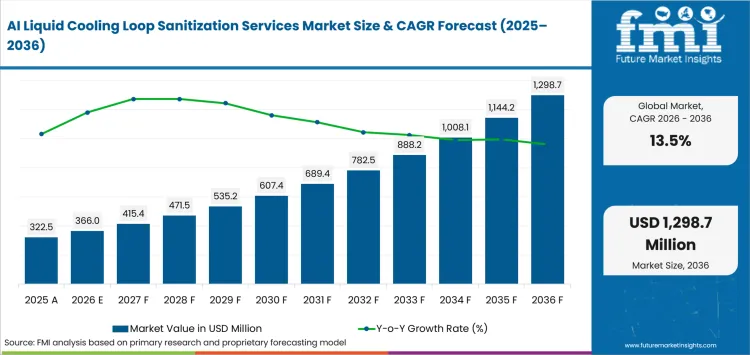
Key Takeaways
- Demand rises as AI data-center operators treat coolant condition as part of uptime control instead of a routine utility check.
- Based on service scope, coolant sampling & analysis is projected to account for 23.0% in 2026 due to testing that determines whether corrective work is warranted.
- By cooling architecture, direct-to-chip loops are estimated to hold 45.0% in 2026 owing to cold-plate deployment in dense AI racks.
- Initial fill / deployment is set to lead the service / replacement cycle category with 33.0% share in 2026 attributable to commissioning records that establish the diagnostic baseline.
- Mixed fluids, metals, elastomers and dilution-water conditions slow approval because one cleaning method cannot be assumed safe for every loop.
- Some of the key players in this market include Ecolab Nalco Water, SK On, and Castrol.
Analyst Perspective
"Loop-care contracts should be compared on diagnostic turnaround, accepted compatibility evidence and the provider’s authority to recommend intervention without disrupting high-value compute. Commercial value is earned by teams that establish the baseline, trace coolant condition and execute remediation inside a planned maintenance window."
- Sudip saha, Principal Consultant, Future Market Insights
How is the AI liquid cooling loop sanitization services market segmented?
The market is analyzed by service scope, cooling architecture, service / replacement cycle, data center type, route to market and region.
Service scope covers coolant sampling & analysis, reconditioning / changeout, water-quality management, compatibility / failure testing and sanitization / flushing. Cooling architecture includes direct-to-chip loops, immersion systems, rear-door heat exchangers and hybrid liquid loops. Service / replacement cycle covers initial fill / deployment, annual maintenance, condition-triggered replacement and emergency remediation. Data center type includes hyperscale AI, colocation AI, enterprise / private AI and HPC & research. Route to market covers fluid manufacturer direct, cooling OEM / integrator, water-treatment service provider and distributor / aftermarket.
What makes coolant sampling & analysis central to the service scope category?
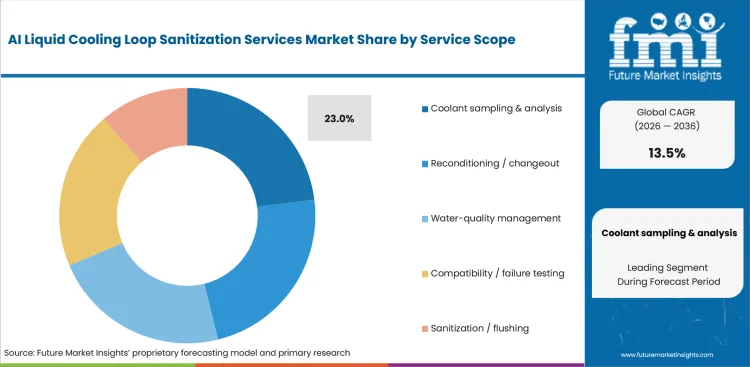
Sampling gives operators a low-disruption way to decide whether a loop needs treatment, reconditioning or a complete fluid change. The 2025 ASHRAE Handbook specifies dilution-water limits below 25 ppm chloride, 25 ppm sulfate and 100 ppm total hardness if purified water is unavailable.
- Based on service scope, coolant sampling & analysis is projected to account for 23.0% in 2026 due to diagnosis preceding higher-cost corrective work.
- Cooling water treatment chemicals expertise becomes commercially relevant after laboratory results identify corrosion, scaling or inhibitor depletion that can be corrected without replacing the entire charge.
Why do direct-to-chip loops lead the cooling architecture category?
Direct-to-chip loops place coolant near processors but retain rack-level service practices familiar to data-center engineering teams. ASHRAE’s September 2025 cold-plate guidance identifies temperature, flow, pressure drop, material compatibility and cleanliness as specific operating requirements.
- In 2026, direct-to-chip loops are expected to lead cooling architecture with 45.0% share because cold-plate deployments fit high-density AI racks and retrofit programs.
- Operators can extend data center liquid cooling without replacing the full facility cooling model during staged retrofits. Each new wetted interface increases the need for controlled filling and chemistry checks.
How does initial fill / deployment set the service / replacement cycle category?
The first fill establishes the chemistry and cleanliness record used to interpret every later sample. In June 2026, ASHRAE, NEMA and PNNL released an AI data-center framework covering design, commissioning, operation and retrofit as linked lifecycle stages.
- By service / replacement cycle, initial fill / deployment is estimated to hold 33.0% in 2026 owing to commissioning records that establish loop cleanliness and later diagnostic baselines.
- A documented fill sequence records dilution water, concentration and trapped debris before production heat loads make later root-cause analysis materially harder during troubleshooting.
What supports hyperscale AI within the data center type category?
Hyperscale facilities apply common coolant specifications to large fleets, so a chemistry error can affect many racks before a local pattern becomes visible. SK Group and AWS stated in June 2025 that their Ulsan AI Zone would use ultra-high-density racks with hybrid air-and-liquid cooling.
- The hyperscale AI segment is likely to capture 46.0% share in 2026 attributable to fleet-scale sampling limits and centralized service records.
- Data center power management planning raises the cost of unplanned maintenance and favors fluid intervention scheduled inside defined redundancy windows.
What drives fluid manufacturer direct in the route to market category?
Fluid manufacturers hold formulation data needed to interpret concentration, inhibitor depletion and wetted-material compatibility against the supplied coolant. The Open Compute Project listed an updated propylene-glycol heat-transfer-fluid guideline in November 2025 covering fluid specification, testing and material compatibility.
- Fluid manufacturer direct is set to lead the route to market category with 34.0% share in 2026 due to formulation ownership and a clearer technical escalation route.
- For immersion cooling systems, dielectric-fluid qualification serves the same decision need even though maintenance methods differ materially from water-glycol cold-plate loops during service.
What are the drivers, restraints and opportunities in the AI Liquid Cooling Loop Sanitization Services Market?
Dense AI computing expands the number of serviceable liquid loops, qualification differences slow interventions and condition-based monitoring gives providers the clearest recurring-service route.
- Driver: More high-density AI capacity puts additional closed cooling loops into operation and increases the need for commissioning evidence plus periodic fluid-health checks.
- Restraint: Loop materials, fluid specifications and water conditions vary by architecture, making one universal sanitization threshold commercially unsafe.
- Opportunity: Condition monitoring linked to laboratory confirmation can replace unnecessary calendar-based changeouts with targeted reconditioning, flushing or replacement.
Higher Compute Density Expands the Serviceable Loop Base
High-density AI racks increase the number of liquid-cooling circuits that facilities must commission and monitor as sustained compute service begins at each hall. USA electricity demand grew about 1.7% annually from 2020 to 2025, with the Energy Information Administration naming data centers as a major contributor. Each additional circuit requires an accepted fluid baseline and a documented response to abnormal chemistry during service.
Qualification Differences Slow Corrective Work
Compatibility review becomes difficult once a facility mixes fluid brands, elastomers, metals and local water sources. The Open Compute Project's August 2025 modular TCS guidance requires teams to agree procedures and materials for hydrotesting and flushing. Service approval depends on accepted test methods and clear responsibility for the intervention, which can delay flushing if stakeholders have not settled the procedure.
Condition-Based Programs Extend Service Revenue
Laboratory confirmation turns online indicators into service decisions by distinguishing treatment from a complete changeout. The Open Compute Project's November 2025 chemistry webinar called for an analytical testing cadence with professional analysis to monitor cooling-system health. A documented testing cadence gives service teams an evidence basis for targeted treatment, flushing or replacement instead of fixed-calendar changeouts during routine maintenance planning.
Which country CAGRs are profiled in the AI Liquid Cooling Loop Sanitization Services Market?
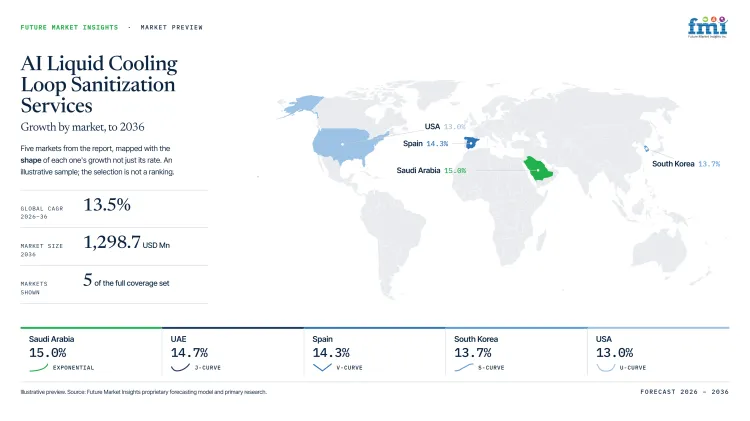
| Country | CAGR |
|---|---|
| Saudi Arabia | 15.0% |
| UAE | 14.7% |
| Spain | 14.3% |
| France | 14.0% |
| South Korea | 13.7% |
| Japan | 13.4% |
| USA | 13.0% |
How do country-level CAGRs compare in the AI Liquid Cooling Loop Sanitization Services Market?
Country forecasts span 2.0 percentage points from Saudi Arabia at 15.0% to the USA at 13.0%. Saudi Arabia and the UAE form the upper band as greenfield campuses enter commissioning. Spain and France follow under tighter infrastructure controls. South Korea, Japan and the USA form a lower group with installed-base service needs.
- Saudi projects favor pre-positioned fluid inventory near campuses.
- UAE campuses standardize startup chemistry across repeated halls.
- Concentrated Aragón projects reduce travel between field-service assignments.
- France's low-carbon power sharpens cooling-efficiency scrutiny.
- South Korea's electronics base shortens access to component engineering.
- Japanese operators formalize third-party access requirements ahead of intervention.
- USA networks separate national procedures from local chemistry limits.
Similar CAGRs produce different service economics as qualification and access costs vary. The full report provides country-level CAGR analysis across North America, Latin America, Western Europe, Eastern Europe, East Asia, South Asia and Pacific, and Middle East and Africa.
Country-wise Analysis
- New AI campuses are opening in large phases, so loop-care crews must be ready ahead of sustained server operation. Saudi Arabia is projected to grow at 15.0% CAGR through 2036 owing to greenfield capacity and hot-climate reliability requirements. In August 2026, the Ministry of Communications and Information Technology said operational data-center capacity exceeded 467 MW in the first quarter after rising from 68 MW in 2021. Regional laboratories can shorten sample turnaround for projects concentrated near major digital-infrastructure clusters. Long travel distances between projects can delay emergency response, making locally positioned technicians and replacement fluid important for repeat service.
- Security controls and fast construction schedules shape site access inside Abu Dhabi’s tightly governed AI campus programs. In May 2025, the UAE Ministry of Foreign Affairs announced a 1 GW AI data center within a planned 5 GW technology cluster. UAE demand is forecast to advance at 14.7% CAGR over the assessment period, tied to large greenfield projects that specify cooling during design. Local engineering teams can define fluid-health procedures ahead of commissioning at each secured campus. High ambient temperatures raise the cost of chemistry errors, and providers without approved onsite teams may struggle to convert startup work into repeat service.
- Aragón has become a data-center planning focus, linking cooling-service demand to grid access and water-accountability requirements. Project engineering can support baseline chemistry programs, but connection timing can shift maintenance mobilization by months. In September 2025, MITECO said planned electricity infrastructure could serve seven times Aragón’s current consumption by 2030 and data-processing centers held most access capacity. Spain is estimated to post 14.3% CAGR over the forecast period because new AI capacity is progressing under tighter infrastructure review. Service firms can improve entry odds by pairing startup records with water-conscious reconditioning plans instead of treating every site as a standard flush job.
- French AI projects can draw on low-carbon electricity and a pipeline of grid-ready sites, although each location faces local connection and permitting work. Demand for AI liquid cooling loop sanitization services in France is forecast to rise at 14.0% CAGR during the forecast period given a larger pipeline of high-density computing sites. The Élysée stated in February 2025 that France had identified 35 sites suitable for data-center projects. Environmental reporting and fluid-disposal rules can lengthen approval work before used coolant leaves each site for treatment. Providers with audit-ready sample records and a documented waste route can manage approval without disrupting maintenance windows.
- South Korean operators often qualify new cooling methods in joint trials involving telecom groups, server vendors and thermal-fluid specialists. In February 2025, the Ministry of Science and ICT announced a plan to secure 18,000 advanced GPUs by the first half of 2026. In South Korea, AI liquid cooling loop sanitization service demand is predicted to advance at 13.7% CAGR through 2036, reflecting higher compute density. Domestic testbeds shorten technical feedback cycles, but operators may require separate acceptance records for direct, immersion and precision methods. Providers need a clear transfer path from trial data to routine maintenance limits so repeat service becomes practical.
- Japanese data-center upgrades often introduce liquid cooling into operating facilities, so intervention plans must preserve legacy services during narrow maintenance windows. Mature engineering practices support controlled retrofits despite compatibility problems caused by older piping and mixed equipment generations. OCCTO’s January 2025 demand assessment counted new and expanded data centers in seven supply areas from Hokkaido to Kyushu. Japan is projected to record 13.4% CAGR over the assessment period attributable to high-density computing additions that must coexist with operating infrastructure. Staged flushing and documented commissioning baselines fit Japanese retrofits better than a uniform site-wide changeout during planned maintenance windows.
- USA service demand spans hyperscale campuses with standardized engineering rules and enterprise facilities that rely more heavily on local contractors. AI liquid cooling loop sanitization service sales in the USA are forecast to expand at 13.0% CAGR by 2036, helped by the broad installed base. In May 2026, the Energy Information Administration estimated that servers accounted for 7% of commercial-sector electricity consumption during 2025. National laboratory coverage can support repeat programs, but water chemistry and OEM combinations differ by site. Providers that standardize chain-of-custody records and preserve site-specific acceptance limits can scale farther without forcing one chemistry rule onto every facility.
Who are the notable companies in the AI Liquid Cooling Loop Sanitization Services Market?
Ecolab Nalco Water, SK On and Castrol are the notable companies serving this market.
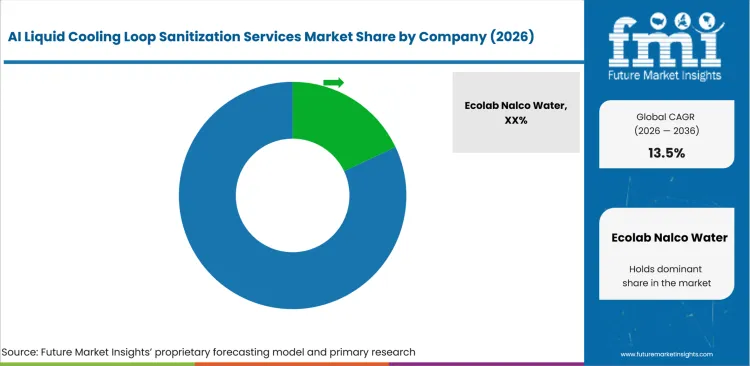
Competition centers on three control points: coolant-health diagnostics, thermal-fluid qualification and execution inside high-value computing environments. Ecolab Nalco Water enters from water chemistry and field service, and SK On holds the former SK Enmove thermal-management business. Castrol brings direct-to-chip and immersion-fluid expertise with thermal engineering support, but accepted test methods and maintenance-window access still govern entry.
- Ecolab Nalco Water competes on real-time coolant monitoring, laboratory analysis and field intervention linked to data-center cooling operations.
- SK On carries forward SK Enmove’s cooling-fluid partnerships for direct, immersion and precision architectures using validation-led programs.
- Castrol competes on coolant formulation, materials review and thermal-engineering support for direct-to-chip and immersion deployments.
Competitive Benchmarking: AI Liquid Cooling Loop Sanitization Services Market
| Company | Coolant Health Analytics | Compatibility and Remediation Support | Architecture Coverage | Geographic Reach |
|---|---|---|---|---|
| Ecolab Nalco Water | High | High | Medium | Global |
| SK On | Medium | Medium | High | South Korea-led with international partner programs |
| Castrol | Medium | High | High | United States, Europe, Middle East, China, Australia and Southeast Asia |
Scoring basis: High coolant-health analytics requires real-time monitoring plus laboratory analysis, whereas Medium covers structured testing and Low identifies one documented testing layer. For compatibility and remediation support, High requires materials evidence plus intervention support. Medium covers one route and Low a narrower documented role in public evidence. High architecture coverage requires at least two documented liquid-cooling architectures in current service evidence. Medium denotes one architecture plus site-loop integration, and Low denotes one narrow architecture. Geographic reach describes verified service or business presence and does not indicate market share.
Key Developments in the AI Liquid Cooling Loop Sanitization Services Market
- In November 2025, Ecolab launched Cooling as a Service with direct-to-chip monitoring, a smart coolant distribution unit and broader facility cooling management.
- In October 2025, Castrol invested in Electronic Cooling Solutions to extend its data-center offer from fluid deployment into thermal design, feasibility work and maintenance.
- In March 2025, SK Enmove signed an MoU with SK Telecom and Giga Computing to develop liquid-cooling methods for AI data centers. SK Enmove, now part of SK On, was assigned fluid development for direct, immersion and precision configurations.
Key Players in the AI Liquid Cooling Loop Sanitization Services Market
Water-Quality and Loop-Health Service
- Ecolab Nalco Water
Thermal-Fluid Validation and Immersion Cooling
- SK On
Multi-Architecture Cooling Fluids and Engineering
- Castrol
AI Liquid Cooling Loop Sanitization Services Market - Report Scope
| Coverage field | Report scope |
|---|---|
| Market breakdown | By service scope, cooling architecture, service / replacement cycle, data center type, route to market and region. |
| Quantitative Units | USD million. |
| Market Definition | Revenue includes commissioning, initial-fill support, coolant sampling and laboratory analysis, water-quality management, reconditioning or changeout, compatibility or failure testing, sanitization or flushing and emergency remediation for AI data-center liquid-cooling loops. Hardware, standalone coolant sales without service, facility HVAC work and downstream compute revenue are excluded. |
| Regions Covered | North America, Latin America, Western Europe, Eastern Europe, East Asia, South Asia and Pacific, and Middle East and Africa. |
| Countries Covered | Saudi Arabia, UAE, Spain, France, South Korea, Japan, USA, and 25+ countries included in the full report. |
| Key Companies Profiled | Ecolab Nalco Water, SK On, Castrol. |
| Forecast Period | 2026 to 2036. |
| Approach | Primary and secondary research with market triangulation. |
AI Liquid Cooling Loop Sanitization Services Market - Research Methodology
| Method | Approach |
|---|---|
| Primary Research | FMI analysts gathered input from manufacturers, service providers, technology developers, distributors, end users, procurement teams, and subject-matter experts. Interviews examined purchasing decisions, product or service evaluation, adoption barriers, approval requirements, pricing considerations, and expectations for technical or commercial support. Respondents were also asked what evidence is required before a trial, pilot, or initial order develops into regular purchasing. |
| Desk Research | Desk research covered government statistics, regulatory publications, trade data, industry associations, technical literature, standards, company filings, product information, and official corporate announcements. Sources were reviewed for relevance, publication date, geographic coverage, and consistency with the defined market scope. Claims relating to performance, applications, approvals, capacity, investment, and commercial activity were retained only when supported by credible public evidence. |
| Market Sizing and Forecasting | The market model combined the baseline value with historical performance, segment structure, pricing and volume indicators, adoption levels, company participation, and country-level demand conditions. Forecast assumptions considered economic activity, investment trends, regulatory developments, technology adoption, purchasing cycles, supply availability, and barriers to wider market use. Segment and regional estimates were reconciled before the final market total was calculated. |
| Data Validation | Estimates were checked against multiple independent indicators, including public data, company activity, trade patterns, industry developments, and findings from primary interviews. Validation also tested whether products, services, applications, and company revenues fell within the defined market boundaries. Adjacent categories, unsupported claims, overlapping revenues, and activities without direct market relevance were excluded to reduce double counting and maintain consistency across segments and countries. |
AI Liquid Cooling Loop Sanitization Services Market by Segments
AI Liquid Cooling Loop Sanitization Services Market segmented by Service Scope:
- Coolant sampling & analysis
- Reconditioning / changeout
- Water-quality management
- Compatibility / failure testing
- Sanitization / flushing
AI Liquid Cooling Loop Sanitization Services Market segmented by Cooling Architecture:
- Direct-to-chip loops
- Immersion systems
- Rear-door heat exchangers
- Hybrid liquid loops
AI Liquid Cooling Loop Sanitization Services Market segmented by Service / Replacement Cycle:
- Initial fill / deployment
- Annual maintenance
- Condition-triggered replacement
- Emergency remediation
AI Liquid Cooling Loop Sanitization Services Market segmented by Data Center Type:
- Hyperscale AI
- Colocation AI
- Enterprise / private AI
- HPC & research
AI Liquid Cooling Loop Sanitization Services Market segmented by Route to Market:
- Fluid manufacturer direct
- Cooling OEM / integrator
- Water-treatment service provider
- Distributor / aftermarket
AI Liquid Cooling Loop Sanitization Services Market by Region:
- North America
- United States
- Canada
- Latin America
- Brazil
- Mexico
- Argentina
- Chile
- Western Europe
- Germany
- France
- United Kingdom
- Italy
- Spain
- Benelux
- Nordics
- Eastern Europe
- Poland
- Czech Republic
- Romania
- Hungary
- East Asia
- China
- Japan
- South Korea
- South Asia and Pacific
- India
- ASEAN
- Australia and New Zealand
- Middle East and Africa
- GCC Countries
- South Africa
- Türkiye
- Israel
Research Sources and Bibliography
- International Energy Agency. (2025, April 10). Energy and AI: Energy demand from AI.
- Ministry for the Ecological Transition and the Demographic Challenge. (2026, August 27). El Gobierno plantea impulsar los centros de datos sostenibles, eficientes y soberanos.
- ASHRAE. (2025). Chapter 31. Physical properties of secondary coolants (brines).
- ASHRAE. (2025, September). Liquid Cooling Cold Plates.
- ASHRAE. (2026, June 10). ASHRAE, NEMA and PNNL Release AI Data Center Energy Performance Framework to Guide Next-Generation Design and Operation.
- SK Telecom. (2025, June 22). SK Group and AWS Team Up to Build Cloud Computing Infrastructure to Support AI Innovation.
- Open Compute Project Foundation. (2025, November). Cooling Environments/Cold Plate.
- USA Energy Information Administration. (2026, March 12). Fossil generation could rise with faster-than-expected growth in data center power demand.
- Open Compute Project Foundation. (2025, August 25). MODULAR TECHNOLOGY COOLING SYSTEM FOR "CLOUD SCALE": DESIGN & DELIVERY OF LIQUID TO RACK DISTRIBUTION SYSTEMS.
- Open Compute Project Foundation. (2025, November 13). OCP Educational Webinar: A Chemical Perspective on Liquid Cooled Data Centers.
- Ministry of Communications and Information Technology, Saudi Arabia. (2026, August 18). Saudi Arabia Reshapes the Future of the Digital Economy Through Advanced Digital Infrastructure, Global Partnerships.
- United Arab Emirates Ministry of Foreign Affairs. (2025, May 16). UAE/US Framework on Advanced Technology Cooperation.
- Ministry for the Ecological Transition and the Demographic Challenge. (2025, September 22). Joan Groizard se reúne con Mª del Mar Vaquero para analizar la propuesta inicial de la Planificación de electricidad con horizonte 2030.
- Presidency of the French Republic. (2025, February 10). Clôture de la première journée du Sommet pour l’action sur l’IA.
- Ministry of Science and ICT, Republic of Korea. (2025, February 20). Korea to Expand AI Computing Infrastructure to Strengthen National AI Capabilities and Achieve Global Leadership.
- Organization for Cross-regional Coordination of Transmission Operators, Japan. (2025, January 22). 2025年度 全国及び供給区域ごとの需要想定について.
- USA Energy Information Administration. (2026, May 19). Data center server energy use grows across the commercial building stock.
- Ecolab. (2025, November 14). Ecolab Strengthens Integrated Cooling Program for Data Centers.
- Castrol. (2025, October 13). Castrol invests in Electronic Cooling Solutions.
- SK Telecom. (2025, March 5). SK Telecom Signs MoU with Giga Computing and SK Enmove on Liquid Cooling Technology.
- Ecolab. (2026, January 14). Catalyzing Growth in the AI Era: The Future of Data Centers Looks Cool.
- SK Innovation. (2025, April 10). [SKinno Tech] Immersion Cooling Technology.
- Castrol. (2025, March 11). Castrol releases Dipping Point industry research report.
- Ecolab. (2026, July 2). Ecolab Closes CoolIT Acquisition and Expands AI Cooling Platform as Global High Tech Business Targets $4 Billion by 2030.
- SK Innovation. (2025, October 31). [SK Innovation’s Q3 2025 Financial Results] Recording revenue of KRW 20.53 trillion and operating profit of KRW 573.5 billion.
- Castrol. (2026, May 5). Castrol ON Advances Liquid Cooling Strategy with OCP Inspired Portfolio.
- SK Innovation. (2025, October 28). SK Enmove Forms Strategic Alliance for Immersion Cooling in AI Data Centers, Targeting Global Market Expansion.
- Ecolab. (2025, May 29). Ecolab Launches New Cooling Management Technology To Revolutionize Performance and Efficiency for Data Centers.
- Castrol. (2026, August 18). Cooling fluids validated by NVIDIA.
- SK Innovation. (2025, June 12). SK Innovation Partners with Singapore’s Bridge Data Centres to Launch First Energy Solutions Initiative for Global AI Data Centers.
This Report Answers
- What are the 2026 and 2036 market values?
- Which operating conditions increase loop-sampling and sanitization demand?
- Why does coolant sampling & analysis lead service scope?
- Why do direct-to-chip loops lead cooling architecture?
- How does initial fill / deployment affect later maintenance?
- How do growth rates differ among profiled countries?
- Which companies provide diagnostics, fluids and thermal support?
- What slows service approval for mixed fluids and wetted materials?
- Which evidence should operators compare before coolant intervention?
Frequently Asked Questions
How big is the AI liquid cooling loop sanitization services market in 2026?
The AI liquid cooling loop sanitization services market is valued at USD 366.0 million in 2026 and projected to reach USD 1,298.7 million by 2036. Higher rack density expands the liquid-loop service base.
What is the CAGR of the AI liquid cooling loop sanitization services market from 2026 to 2036?
The AI liquid cooling loop sanitization services market is projected to grow at a CAGR of 13.5% between 2026 and 2036. Expansion follows liquid-cooling deployment and repeat coolant-health checks.
Which service scope segment leads the AI liquid cooling loop sanitization services market?
The coolant sampling & analysis segment is expected to hold 23.0% of the AI liquid cooling loop sanitization services market in 2026, driven by pre-intervention diagnostic evidence. Laboratory results guide reconditioning or replacement decisions.
Which cooling architecture leads the AI liquid cooling loop sanitization services market?
Direct-to-chip loops are expected to account for 45.0% of cooling architecture in 2026, attributable to high-density cold-plate deployment. Closed loops provide a route for sampling and compatibility checks.
Which countries are projected to record the highest growth in the AI liquid cooling loop sanitization services market?
Saudi Arabia is projected at 15.0% CAGR, followed by the UAE at 14.7% and Spain at 14.3% through 2036. Greenfield campuses and infrastructure investment raise commissioning demand.
Which companies are active in the AI liquid cooling loop sanitization services market?
Key companies operating in the market include Ecolab Nalco Water, SK On and Castrol. Their roles span coolant-health diagnostics, thermal-fluid qualification, direct-to-chip service and immersion validation.
Preview the report firsthand - request a free sample
Get SampleGet the brochure for pricing and purchase details.
Get PDFTable of Content
- Key Takeaways
- Market Size and CAGR
- Top Growth Driver
- Fastest Growing Segment
- Leading Region
- Key Companies
- Emerging Opportunities
- Executive Summary
- Global Market Outlook
- Demand-side Trends
- Supply-side Trends
- Technology Roadmap Analysis
- Analysis and Recommendations
- Analyst Perspective (What is happening? Why now? What should investors know?)
- Key Questions Answered
- How large is the market?
- What is the CAGR?
- What are key trends?
- Which region dominates?
- Who are the leaders?
- Market Overview
- Market Coverage / Taxonomy
- Market Definition / Scope / Limitations
- Research Methodology
- Chapter Orientation
- Analytical Lens and Working Hypotheses
- Market Structure, Signals, and Trend Drivers
- Benchmarking and Cross-market Comparability
- Market Sizing, Forecasting, and Opportunity Mapping
- Research Design and Evidence Framework
- Desk Research Programme (Secondary Evidence)
- Expert Input and Fieldwork (Primary Evidence)
- Tooling, Models, and Reference Databases
- Data Engineering and Model Build
- Quality Assurance and Audit Trail
- Market Background
- Market Dynamics (Drivers, Restraints, Opportunity, Trends)
- Scenario Forecast (Optimistic, Likely, Conservative)
- Impact Analysis
- AI Impact
- Sustainability Impact
- Regulatory Impact
- Technology Impact
- Consumer / Buyer Analysis
- Purchase Drivers
- Adoption Barriers
- Buyer Journey
- Opportunity Map Analysis
- Product Life Cycle Analysis
- Supply Chain Analysis
- Investment Feasibility Matrix
- Value Chain Analysis
- PESTLE and Porter's Analysis
- Regulatory Landscape
- Regional Parent Market Outlook
- Production and Consumption Statistics
- Import and Export Statistics
- Global Market Analysis and Forecast, 2021 to 2036
- Historical Market Size Value (USD Million) Analysis, 2021 to 2025
- Current and Future Market Size Value (USD Million) Projections, 2026 to 2036
- Y-o-Y Growth Trend Analysis
- Absolute $ Opportunity Analysis
- Global Market Pricing Analysis, 2021 to 2036
- Global Market Analysis and Forecast, By Service Scope, 2021 to 2036
- Introduction / Key Findings
- Historical Market Size Value (USD Million) Analysis By Service Scope, 2021 to 2025
- Current and Future Market Size Value (USD Million) Analysis and Forecast By Service Scope, 2026 to 2036
- Coolant sampling & analysis
- Reconditioning / changeout
- Water-quality management
- Compatibility / failure testing
- Sanitization / flushing
- Coolant sampling & analysis
- Y-o-Y Growth Trend Analysis By Service Scope, 2021 to 2025
- Absolute $ Opportunity Analysis By Service Scope, 2026 to 2036
- Global Market Analysis and Forecast, By Cooling Architecture, 2021 to 2036
- Introduction / Key Findings
- Historical Market Size Value (USD Million) Analysis By Cooling Architecture, 2021 to 2025
- Current and Future Market Size Value (USD Million) Analysis and Forecast By Cooling Architecture, 2026 to 2036
- Direct-to-chip loops
- Immersion systems
- Rear-door heat exchangers
- Hybrid liquid loops
- Direct-to-chip loops
- Y-o-Y Growth Trend Analysis By Cooling Architecture, 2021 to 2025
- Absolute $ Opportunity Analysis By Cooling Architecture, 2026 to 2036
- Global Market Analysis and Forecast, By Service / Replacement Cycle, 2021 to 2036
- Introduction / Key Findings
- Historical Market Size Value (USD Million) Analysis By Service / Replacement Cycle, 2021 to 2025
- Current and Future Market Size Value (USD Million) Analysis and Forecast By Service / Replacement Cycle, 2026 to 2036
- Initial fill / deployment
- Annual maintenance
- Condition-triggered replacement
- Emergency remediation
- Initial fill / deployment
- Y-o-Y Growth Trend Analysis By Service / Replacement Cycle, 2021 to 2025
- Absolute $ Opportunity Analysis By Service / Replacement Cycle, 2026 to 2036
- Global Market Analysis and Forecast, By Data Center Type, 2021 to 2036
- Introduction / Key Findings
- Historical Market Size Value (USD Million) Analysis By Data Center Type, 2021 to 2025
- Current and Future Market Size Value (USD Million) Analysis and Forecast By Data Center Type, 2026 to 2036
- Hyperscale AI
- Colocation AI
- Enterprise / private AI
- HPC & research
- Hyperscale AI
- Y-o-Y Growth Trend Analysis By Data Center Type, 2021 to 2025
- Absolute $ Opportunity Analysis By Data Center Type, 2026 to 2036
- Global Market Analysis and Forecast, By Route to Market, 2021 to 2036
- Introduction / Key Findings
- Historical Market Size Value (USD Million) Analysis By Route to Market, 2021 to 2025
- Current and Future Market Size Value (USD Million) Analysis and Forecast By Route to Market, 2026 to 2036
- Fluid manufacturer direct
- Cooling OEM / integrator
- Water-treatment service provider
- Distributor / aftermarket
- Fluid manufacturer direct
- Y-o-Y Growth Trend Analysis By Route to Market, 2021 to 2025
- Absolute $ Opportunity Analysis By Route to Market, 2026 to 2036
- Global Market Analysis and Forecast, By Region, 2021 to 2036
- Introduction
- Historical Market Size Value (USD Million) Analysis By Region, 2021 to 2025
- Current Market Size Value (USD Million) Analysis and Forecast By Region, 2026 to 2036
- North America
- Latin America
- Western Europe
- Eastern Europe
- East Asia
- South Asia and Pacific
- Middle East & Africa
- Market Attractiveness Analysis By Region
- North America Market Analysis and Forecast, By Country, 2021 to 2036
- Historical Market Size Value (USD Million) Trend Analysis By Market Taxonomy, 2021 to 2025
- Market Size Value (USD Million) Forecast By Market Taxonomy, 2026 to 2036
- By Country
- USA
- Canada
- By Service Scope
- By Cooling Architecture
- By Service / Replacement Cycle
- By Data Center Type
- By Route to Market
- By Country
- Market Attractiveness Analysis
- By Country
- By Service Scope
- By Cooling Architecture
- By Service / Replacement Cycle
- By Data Center Type
- By Route to Market
- Key Takeaways
- Latin America Market Analysis and Forecast, By Country
- Historical Market Size Value (USD Million) Trend Analysis By Market Taxonomy, 2021 to 2025
- Market Size Value (USD Million) Forecast By Market Taxonomy, 2026 to 2036
- By Country
- Brazil
- Mexico
- Chile
- Rest of Latin America
- By Service Scope
- By Cooling Architecture
- By Service / Replacement Cycle
- By Data Center Type
- By Route to Market
- By Country
- Market Attractiveness Analysis
- By Country
- By Service Scope
- By Cooling Architecture
- By Service / Replacement Cycle
- By Data Center Type
- By Route to Market
- Key Takeaways
- Western Europe Market Analysis and Forecast, By Country
- Historical Market Size Value (USD Million) Trend Analysis By Market Taxonomy, 2021 to 2025
- Market Size Value (USD Million) Forecast By Market Taxonomy, 2026 to 2036
- By Country
- Germany
- UK
- Italy
- Spain
- France
- Nordic
- BENELUX
- Rest of Western Europe
- By Service Scope
- By Cooling Architecture
- By Service / Replacement Cycle
- By Data Center Type
- By Route to Market
- By Country
- Market Attractiveness Analysis
- By Country
- By Service Scope
- By Cooling Architecture
- By Service / Replacement Cycle
- By Data Center Type
- By Route to Market
- Key Takeaways
- Eastern Europe Market Analysis and Forecast, By Country
- Historical Market Size Value (USD Million) Trend Analysis By Market Taxonomy, 2021 to 2025
- Market Size Value (USD Million) Forecast By Market Taxonomy, 2026 to 2036
- By Country
- Russia
- Poland
- Hungary
- Balkan & Baltic
- Rest of Eastern Europe
- By Service Scope
- By Cooling Architecture
- By Service / Replacement Cycle
- By Data Center Type
- By Route to Market
- By Country
- Market Attractiveness Analysis
- By Country
- By Service Scope
- By Cooling Architecture
- By Service / Replacement Cycle
- By Data Center Type
- By Route to Market
- Key Takeaways
- East Asia Market Analysis and Forecast, By Country
- Historical Market Size Value (USD Million) Trend Analysis By Market Taxonomy, 2021 to 2025
- Market Size Value (USD Million) Forecast By Market Taxonomy, 2026 to 2036
- By Country
- China
- Japan
- South Korea
- By Service Scope
- By Cooling Architecture
- By Service / Replacement Cycle
- By Data Center Type
- By Route to Market
- By Country
- Market Attractiveness Analysis
- By Country
- By Service Scope
- By Cooling Architecture
- By Service / Replacement Cycle
- By Data Center Type
- By Route to Market
- Key Takeaways
- South Asia and Pacific Market Analysis and Forecast, By Country
- Historical Market Size Value (USD Million) Trend Analysis By Market Taxonomy, 2021 to 2025
- Market Size Value (USD Million) Forecast By Market Taxonomy, 2026 to 2036
- By Country
- India
- ASEAN
- Australia & New Zealand
- Rest of South Asia and Pacific
- By Service Scope
- By Cooling Architecture
- By Service / Replacement Cycle
- By Data Center Type
- By Route to Market
- By Country
- Market Attractiveness Analysis
- By Country
- By Service Scope
- By Cooling Architecture
- By Service / Replacement Cycle
- By Data Center Type
- By Route to Market
- Key Takeaways
- Middle East & Africa Market Analysis and Forecast, By Country
- Historical Market Size Value (USD Million) Trend Analysis By Market Taxonomy, 2021 to 2025
- Market Size Value (USD Million) Forecast By Market Taxonomy, 2026 to 2036
- By Country
- Kingdom of Saudi Arabia
- Other GCC Countries
- Türkiye
- South Africa
- Other African Union
- Rest of Middle East & Africa
- By Service Scope
- By Cooling Architecture
- By Service / Replacement Cycle
- By Data Center Type
- By Route to Market
- By Country
- Market Attractiveness Analysis
- By Country
- By Service Scope
- By Cooling Architecture
- By Service / Replacement Cycle
- By Data Center Type
- By Route to Market
- Key Takeaways
- Key Countries Market Analysis
- USA
- Pricing Analysis
- Market Share Analysis, 2025
- By Service Scope
- By Cooling Architecture
- By Service / Replacement Cycle
- By Data Center Type
- By Route to Market
- Canada
- Pricing Analysis
- Market Share Analysis, 2025
- By Service Scope
- By Cooling Architecture
- By Service / Replacement Cycle
- By Data Center Type
- By Route to Market
- Mexico
- Pricing Analysis
- Market Share Analysis, 2025
- By Service Scope
- By Cooling Architecture
- By Service / Replacement Cycle
- By Data Center Type
- By Route to Market
- Brazil
- Pricing Analysis
- Market Share Analysis, 2025
- By Service Scope
- By Cooling Architecture
- By Service / Replacement Cycle
- By Data Center Type
- By Route to Market
- Chile
- Pricing Analysis
- Market Share Analysis, 2025
- By Service Scope
- By Cooling Architecture
- By Service / Replacement Cycle
- By Data Center Type
- By Route to Market
- Germany
- Pricing Analysis
- Market Share Analysis, 2025
- By Service Scope
- By Cooling Architecture
- By Service / Replacement Cycle
- By Data Center Type
- By Route to Market
- UK
- Pricing Analysis
- Market Share Analysis, 2025
- By Service Scope
- By Cooling Architecture
- By Service / Replacement Cycle
- By Data Center Type
- By Route to Market
- Italy
- Pricing Analysis
- Market Share Analysis, 2025
- By Service Scope
- By Cooling Architecture
- By Service / Replacement Cycle
- By Data Center Type
- By Route to Market
- Spain
- Pricing Analysis
- Market Share Analysis, 2025
- By Service Scope
- By Cooling Architecture
- By Service / Replacement Cycle
- By Data Center Type
- By Route to Market
- France
- Pricing Analysis
- Market Share Analysis, 2025
- By Service Scope
- By Cooling Architecture
- By Service / Replacement Cycle
- By Data Center Type
- By Route to Market
- India
- Pricing Analysis
- Market Share Analysis, 2025
- By Service Scope
- By Cooling Architecture
- By Service / Replacement Cycle
- By Data Center Type
- By Route to Market
- ASEAN
- Pricing Analysis
- Market Share Analysis, 2025
- By Service Scope
- By Cooling Architecture
- By Service / Replacement Cycle
- By Data Center Type
- By Route to Market
- Australia & New Zealand
- Pricing Analysis
- Market Share Analysis, 2025
- By Service Scope
- By Cooling Architecture
- By Service / Replacement Cycle
- By Data Center Type
- By Route to Market
- China
- Pricing Analysis
- Market Share Analysis, 2025
- By Service Scope
- By Cooling Architecture
- By Service / Replacement Cycle
- By Data Center Type
- By Route to Market
- Japan
- Pricing Analysis
- Market Share Analysis, 2025
- By Service Scope
- By Cooling Architecture
- By Service / Replacement Cycle
- By Data Center Type
- By Route to Market
- South Korea
- Pricing Analysis
- Market Share Analysis, 2025
- By Service Scope
- By Cooling Architecture
- By Service / Replacement Cycle
- By Data Center Type
- By Route to Market
- Russia
- Pricing Analysis
- Market Share Analysis, 2025
- By Service Scope
- By Cooling Architecture
- By Service / Replacement Cycle
- By Data Center Type
- By Route to Market
- Poland
- Pricing Analysis
- Market Share Analysis, 2025
- By Service Scope
- By Cooling Architecture
- By Service / Replacement Cycle
- By Data Center Type
- By Route to Market
- Hungary
- Pricing Analysis
- Market Share Analysis, 2025
- By Service Scope
- By Cooling Architecture
- By Service / Replacement Cycle
- By Data Center Type
- By Route to Market
- Kingdom of Saudi Arabia
- Pricing Analysis
- Market Share Analysis, 2025
- By Service Scope
- By Cooling Architecture
- By Service / Replacement Cycle
- By Data Center Type
- By Route to Market
- Türkiye
- Pricing Analysis
- Market Share Analysis, 2025
- By Service Scope
- By Cooling Architecture
- By Service / Replacement Cycle
- By Data Center Type
- By Route to Market
- South Africa
- Pricing Analysis
- Market Share Analysis, 2025
- By Service Scope
- By Cooling Architecture
- By Service / Replacement Cycle
- By Data Center Type
- By Route to Market
- USA
- Market Structure Analysis
- Competition Dashboard
- Competition Benchmarking
- Market Share Analysis of Top Players
- By Regional
- By Service Scope
- By Cooling Architecture
- By Service / Replacement Cycle
- By Data Center Type
- By Route to Market
- Emerging Startups
- Innovation Benchmarking
- Competition Analysis
- Competition Deep Dive
- Ecolab Nalco Water
- Overview
- Product Portfolio
- Profitability by Market Segments
- Sales Footprint
- Strategy Overview
- Marketing Strategy
- Product Strategy
- Channel Strategy
- Kurita
- SK Enmove
- Castrol
- Ecolab Nalco Water
- Case Studies
- Success Stories
- Recent Developments
- Competition Deep Dive
- Assumptions & Acronyms Used


