

- Market Size (2026)
- USD 472.0 Mn
- Forecast (2036)
- USD 1414.5 Mn
- CAGR (2026 to 2036)
- 11.6%
How big is Liquid Cooling Loop Flushing Services Market in 2026?
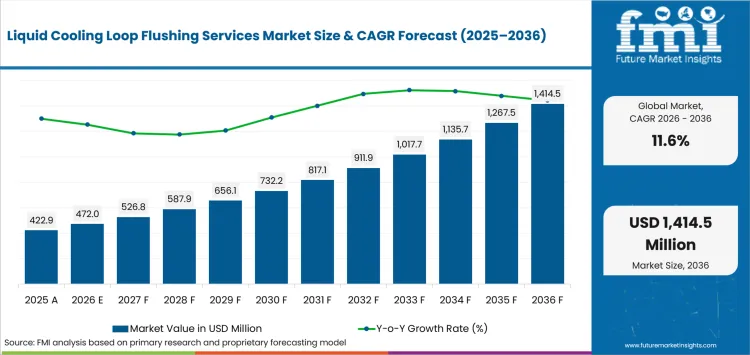
USD 472.0 million in 2026 and USD 1414.5 million by 2036 at an 11.6% CAGR.
Sales in the liquid cooling loop flushing services market are projected to grow at 11.6% CAGR through 2036, driving valuation to USD 1414.5 million by 2036 from USD 472.0 million in 2026 as AI installations make verified flow and fluid cleanliness part of server handover. In February 2025, Vertiv formalized this work through a global liquid cooling services portfolio covering installation, fluid management, and maintenance. Incomplete hydraulic acceptance can delay compute availability, so flushing belongs inside the commissioning budget.
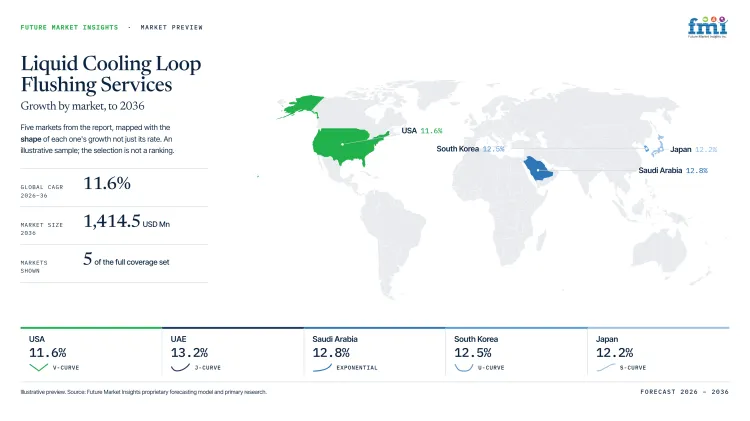
Service conversion differs between countries because power delivery and mechanical completion reach rack handover on different schedules. UAE is forecast at 13.2% CAGR through 2036 compared with 11.6% in USA. Data center power management constraints can stagger site energization even after servers are ordered. In May 2026, the USA Energy Information Administration estimated that servers alone used 7% of commercial-sector electricity in 2025. High server load makes cooling readiness a handover issue, so flushing revenue depends on usable access points and temporary pumping routes.
Key Takeaways
- AI liquid loops turn cleanliness and hydraulic balance into commissioning requirements tied to compute availability and handover timing.
- Commissioning / balancing is projected to hold 26.0% share in 2026 owing to pre-startup cleanliness and hydraulic acceptance at handover.
- In 2026, dry coolers are expected to lead heat rejection / secondary loop with 29.0% share because closed facility-water circuits give flushing teams a defined system for cleaning and hydraulic verification.
- The 251-500 kW band is likely to capture 34.0% share in 2026 attributable to high liquid-cooling dependence and repeatable multi-rack commissioning work.
- Late hydraulic design, limited temporary connection points and coolant compatibility disputes can delay authorization even where liquid-cooling equipment is already ordered.
- Some of the key players in this market include Vertiv, Motivair by Schneider Electric, Munters, Daikin, Johnson Controls, Trane Technologies, Modine, and CoolIT Systems.
Analyst Perspective
"Liquid-cooling flushing becomes a commissioning decision once the design fixes temporary connection points, allowable pressure, and the acceptance flow for each branch. Contractors that preserve filtration results and branch-flow records can compare later configuration changes against a known baseline instead of repeating fault isolation from scratch."
- Sudip saha, Principal Consultant, Future Market Insights
How is the liquid cooling loop flushing services market segmented?
The liquid cooling loop flushing services market is segmented by service scope, heat rejection / secondary loop, rack density, data center type, route to market, and region.
Service scope covers commissioning / balancing, design, reliability, retrofit / conversion, and maintenance. Heat rejection covers dry coolers, chillers, evaporative systems, facility water, and hybrids. Rack density spans below 100 kW to above 500 kW. Types include hyperscale AI, colocation AI, enterprise AI/HPC, and sovereign compute. Routes cover OEM direct, MEP/EPC, server/rack bundle, and service/retrofit.
What supports hyperscale AI leadership within data center type?
During hyperscale AI startup, AI datacenter liquid cooling puts CDUs and rack branches behind a narrow acceptance window. A hydraulic defect can hold back an accelerator block. Phased halls repeat the same acceptance work as mechanical completion reaches server fit-out.
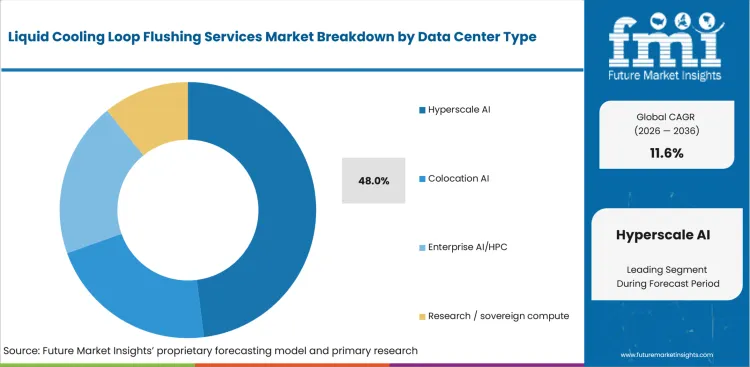
- By data center type, hyperscale AI is forecast to represent 48.0% in 2026 driven by campus-scale deployments that repeat loop acceptance as each hall reaches startup.
- Motivair by Schneider Electric announced a 2.5 MW MCDU-70 in January 2026 and said the design could scale beyond 10 MW for AI-factory coolant distribution.
What makes commissioning / balancing central to the service scope category?
At handover, commissioning / balancing has a clear budget owner because it must prove clean design flow before server energization. The acceptance record gives operations a documented baseline as the MEP contractor hands over the system, and temporary pumps must remove debris without exceeding downstream pressure limits.
- Based on service scope, commissioning / balancing is projected to account for 26.0% in 2026 due to required pre-startup cleanliness and hydraulic acceptance at handover.
- Vertiv completed its PurgeRite acquisition in December 2025 and brought mechanical flushing, purging, and filtration services into its liquid-cooling portfolio for mission-critical facilities.
Why do dry coolers lead the heat rejection / secondary loop category?
Inside closed facility-water circuits, dry coolers and data center chillers can be flushed before full-load operation. In November 2025, Airedale by Modine extended its TurboChill DCS platform with stainless-steel water-loop construction, explicitly targeting cleaner liquid-cooling water circuits.
- By heat rejection / secondary loop, dry coolers are estimated to hold 29.0% in 2026 owing to closed facility-water circuits that require pre-commission cleaning and hydraulic verification.
- Phased campus additions alter flow paths and pump head, so later expansion can require a fresh hydraulic check before the circuit returns to service.
How does 251-500 kW anchor the rack density category?
Several racks share each circuit in High-performance computing at 251-500 kW, so blocked filters or uneven branch resistance can affect more than one rack. Commissioning teams can repeat the same acceptance method from one modular pod to the next provided temporary equipment protects CDU and rack-side pressure limits.
- In 2026, 251-500 kW is expected to lead rack density with 34.0% share because several high-density racks can share one repeatable loop-acceptance procedure.
- Munters introduced its LCX liquid-to-liquid CDU family in March 2025 with a 500 kW entry model and 25-micron technology-fluid filtration for high-density loops.
What drives cooling OEM direct in route to market?
Cooling OEMs set pressure limits, filtration rules, coolant requirements, and startup criteria for their CDUs. Schneider Electric placed CDUs, chillers, technology cooling loops, software, and field service under one Motivair offer for AI deployments in September 2025.
- Cooling OEM direct is set to lead route to market with 36.0% share in 2026 due to OEM ownership of fluid-acceptance criteria and post-startup equipment service.
- The direct route ties infrastructure services to baseline flow records, warranty review and future equipment service calls once operations assume the loop.
What are the drivers, restraints and opportunities in the Liquid Cooling Loop Flushing Services Market?
Higher rack heat raises the cost of poor fluid commissioning, interfaces can delay acceptance, and configuration changes support fluid assurance after startup.
- Driver: Higher heat flux and lower hydraulic margin make debris removal, air purging, and verified branch flow material to compute availability.
- Restraint: Late coordination between rack-side and facility-side cooling can expose pressure losses, incompatible materials, or inadequate temporary flushing access.
- Opportunity: Baseline flow records, coolant sampling, filtration, and rebalancing can turn one commissioning visit into repeat service after configuration changes.
Higher Heat Flux Raises the Cost of Hydraulic Loss
High-density direct liquid cooling has little pump margin for debris, filter loss, or poor branch balance. In February 2026, Johnson Controls signed an agreement to acquire Alloy Enterprises and cited pressure-drop reductions of up to 75% for its heat exchanger approach. Lower component loss leaves more CDU head available at rack branches, so flushing work is judged by branch flow instead of labor hours alone.
Late Interface Decisions Delay Fluid Acceptance
Flushing costs rise if project teams freeze pipe routes and coolant rules without workable temporary connection points. A mismatch between rack-side and facility-side controls can force hydraulic redesign before final flow testing. In July 2026, Daikin and NTT DATA launched a cooling-control proof of concept linking chillers with liquid-cooling systems under one infrastructure management layer. Projects that settle those interfaces late risk idle crews and delayed acceptance.
Configuration Changes Support Repeat Fluid Service
Expansion work changes loop resistance as new racks, valves, or server-side components enter the circuit. Baseline pressure and filtration records give service teams a comparison point for later fault isolation. Repeat revenue follows material configuration changes in a liquid-cooled edge or core hall instead of one commissioning visit. Vertiv acquired Strategic Thermal Labs in April 2026 to extend server-side liquid-cooling and flow-management expertise. The added server-side knowledge can shorten diagnosis provided the original commissioning records remain available.
Which country CAGRs are profiled in the Liquid Cooling Loop Flushing Services Market?
| Country | CAGR |
|---|---|
| UAE | 13.2% |
| Saudi Arabia | 12.8% |
| South Korea | 12.5% |
| Japan | 12.2% |
| France | 11.9% |
| USA | 11.6% |
How do country-level CAGRs compare in the Liquid Cooling Loop Flushing Services Market?
The profiled CAGRs span 1.6 percentage points from UAE at 13.2% to USA at 11.6%. UAE, Saudi Arabia, and South Korea form the faster group as AI programs cluster commissioning work. Japan, France, and USA are closer together, so service scope carries more weight within this group. That shifts attention toward commissioning scope and local delivery capacity.
- UAE campus procurement broadens thermal teams’ startup scope.
- Saudi EPC-led delivery can place flushing-provider selection inside the main mechanical package.
- South Korea’s engineering depth can shorten design-to-field handoffs.
- Japan places more weight on repeat-service depth than geographic expansion.
- France makes service scope a practical differentiator.
- USA demand follows a steadier commissioning cadence than Gulf peers.
Similar growth rates produce different contract timing. The full report provides country-level CAGR analysis across North America, Latin America, Europe, East Asia, South Asia, Oceania and the Middle East and Africa.
Country-wise Analysis
- Large UAE AI campuses can bring several buildings to mechanical completion in the same quarter, letting specialist crews reuse temporary pumps and filtration equipment between nearby blocks without a new mobilization for every building on site. In May 2025, Abu Dhabi Media Office said Stargate UAE's first 200 MW AI cluster was expected online in 2026, which gives service firms a visible sequence of high-density handovers. UAE is estimated to post 13.2% CAGR through 2036 as campus-scale compute keeps expanding although simultaneous handovers can stretch trained crews and force contractors to reserve filtration equipment ahead of each mechanical-completion window.
- With more Saudi facilities entering operation, specialist mechanical contractors can redeploy crews and flushing skids between active sites within the same region instead of rebuilding field capacity for each project. Liquid cooling loop flushing services in Saudi Arabia are forecast to rise at 12.8% CAGR through 2036, aided by domestic compute expansion and larger projects that package cooling work under one construction schedule. MCIT reported in April 2026 that operational data-center capacity exceeded 440 MW in 2025, but parallel construction can compress commissioning windows and leave temporary pumps or trained technicians unavailable at peak workload outside the largest contractor bases.
- Tying accelerator procurement to land and power makes South Korean flushing demand dependent on how quickly approved compute capacity becomes an energized data-center project. South Korea's liquid cooling loop flushing services outlook is anticipated to advance at 12.5% CAGR through 2036 owing to planned compute buildout, though grid and site execution can lag procurement and keep commissioning dates unstable for firms carrying specialized temporary equipment. MSIT stated in February 2025 that Korea aimed to secure 18,000 high-performance GPUs by the first half of 2026, which gives mechanical contractors a clearer view of incoming high-density capacity than chip orders alone.
- Near Tokyo and Osaka, live-site access and retrofit sequencing can matter as much as hydraulic capacity for liquid-loop service planning. Japan's June 2025 Energy White Paper recorded about 90% of national data-center floor area in those two metropolitan regions in 2023, which gives experienced teams several facilities within one service base for repeat visits. Adoption of liquid cooling loop flushing services in Japan is estimated to expand at 12.2% CAGR through 2036 given dense metro demand despite scarce sites and difficult power routing that limit shutdown flexibility and increase the value of planned temporary connection points and documented shutdown sequences.
- French data-center developers gain earlier visibility into land, grid connection potential, and local acceptance at the site-screening stage. Liquid cooling loop flushing services in France are forecast to expand at 11.9% CAGR by 2036, tied to the screened project pipeline, but sponsorship and connection readiness still determine which sites become paid commissioning packages and which contractors can hold crews through schedule changes. The French economy ministry reported in January 2026 that 63 sites had been identified as suitable for data-center development, a wider project funnel that does not imply every location will reach construction or liquid-cooling procurement on schedule.
- For USA operators, a large installed data-center base and dense regional MEP networks give flushing firms retrofit and recommissioning work beyond new campus construction in several major hubs. EIA's March 2026 analysis put national electricity-demand growth at about 1.7% annually from 2020 to 2025, which documents the load pressure regional power planners must absorb. By 2036, USA is projected to grow at 11.6% CAGR as AI loads raise electricity planning pressure despite interconnection delays that separate server delivery from mechanical energization and favor contractors able to shift crews between new builds and live-site changes without national remobilization.
Who are the notable companies in the Liquid Cooling Loop Flushing Services Market?
Vertiv, Motivair by Schneider Electric, Munters, Daikin, Johnson Controls, Trane Technologies, Modine, and CoolIT Systems are notable companies serving this market.
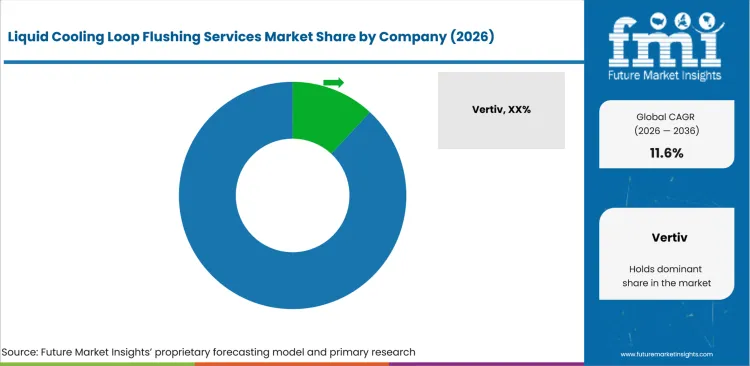
Competition is divided by where companies control the liquid loop, with Vertiv holding the clearest flushing position. Motivair by Schneider Electric, Johnson Controls, and Trane Technologies span CDUs, facility cooling, and data center infrastructure services. Munters, Daikin, and Modine cover heat rejection, whereas CoolIT Systems concentrates near the rack and CDU layer. Data-center operators compare coolant knowledge, flow equipment, acceptance records, and fault-isolation support to assign a commissioning role.
- Dedicated fluid management and OEM service: Vertiv pairs liquid-cooling lifecycle service with mechanical flushing, purging, filtration, and server-side flow expertise.
- Integrated cooling and facility hydronics: Motivair by Schneider Electric, Munters, Daikin, Johnson Controls, Trane Technologies, and Modine span CDUs, facility water, and heat rejection.
- Rack-side liquid-cooling specialist: CoolIT Systems brings cold plates, manifolds, CDUs, and professional services into projects where server-loop behavior shapes commissioning requirements.
Competitive Benchmarking: Liquid Cooling Loop Flushing Services Market
| Company | Loop Fluid Preparation & Cleanliness | TCS / SFN Integration & Commissioning | Heat-Rejection & Lifecycle Service Coverage | Geographic Reach |
|---|---|---|---|---|
| Vertiv | High | High | High | Global |
| Motivair by Schneider Electric | High | High | High | Global |
| Munters | Medium | High | High | Global |
| Daikin | Low | Medium | High | Global |
| Johnson Controls | Medium | High | High | Global |
| Trane Technologies | Medium | High | High | Global |
| Modine | Medium | Medium | High | North America, Europe, and Asia Pacific |
| CoolIT Systems | Medium | High | Medium | Global |
Scoring basis: A High loop-fluid rating requires flushing plus filtration or fluid-management service, whereas Medium requires coolant handling or commissioning support and Low is limited to rack-side cooling. A High TCS / SFN rating requires rack-side cooling, facility hydronics, and startup support, with Medium covering two layers and Low one. High heat-rejection and lifecycle coverage requires facility heat rejection plus post-install service, with Medium covering one layer and Low limited to rack-side support.
Key Developments in the Liquid Cooling Loop Flushing Services Market
- In March 2026, Trane Technologies completed its acquisition of LiquidStack and extended its data-center thermal portfolio into direct-to-chip and immersion liquid cooling.
- In November 2025, Daikin Applied acquired Chilldyne and extended its data-center offer into negative-pressure direct-to-chip liquid cooling for high-performance and AI deployments.
- In April 2025, CoolIT Systems introduced the CHx2000 row-based CDU with 2 MW cooling capacity for high-density AI and high-performance computing installations.
Key Players in the Liquid Cooling Loop Flushing Services Market
Fluid-Management and Integrated Service Leaders
- Vertiv
- Motivair by Schneider Electric
Facility Cooling and Hydronic Platform Providers
- Munters
- Daikin
- Johnson Controls
- Trane Technologies
- Modine
Rack-Side Liquid-Cooling Specialist
- CoolIT Systems
Liquid Cooling Loop Flushing Services Market - Report Scope
| Coverage field | Report scope |
|---|---|
| Market breakdown | By service scope, heat rejection / secondary loop, rack density, data center type, route to market, and region. |
| Quantitative Units | USD million. |
| Market Definition | Professional field and engineering services used to clean, purge, filter, fill, balance, recommission, diagnose, and maintain liquid-cooling loops in data centers. |
| Regions Covered | North America, Latin America, Western Europe, Eastern Europe, East Asia, South Asia and Pacific, and Middle East and Africa. |
| Countries Covered | UAE, Saudi Arabia, South Korea, Japan, France, USA, and 20+ countries included in the full report. |
| Key Companies Profiled | Vertiv, Motivair by Schneider Electric, Munters, Daikin, Johnson Controls, Trane Technologies, Modine, and CoolIT Systems. |
| Forecast Period | 2026 to 2036. |
| Approach | Primary and secondary research with market triangulation. |
Liquid Cooling Loop Flushing Services Market - Research Methodology
| Method | Approach |
|---|---|
| Primary Research | FMI analysts gathered input from manufacturers, service providers, technology developers, distributors, end users, procurement teams, and subject-matter experts. Interviews examined purchasing decisions, product or service evaluation, adoption barriers, approval requirements, pricing considerations, and expectations for technical or commercial support. Respondents were also asked what evidence is required before a trial, pilot, or initial order develops into regular purchasing. |
| Desk Research | Desk research covered government statistics, regulatory publications, trade data, industry associations, technical literature, standards, company filings, product information, and official corporate announcements. Sources were reviewed for relevance, publication date, geographic coverage, and consistency with the defined market scope. Claims relating to performance, applications, approvals, capacity, investment, and commercial activity were retained only when supported by credible public evidence. |
| Market Sizing and Forecasting | The market model combined the baseline value with historical performance, segment structure, pricing and volume indicators, adoption levels, company participation, and country-level demand conditions. Forecast assumptions considered economic activity, investment trends, regulatory developments, technology adoption, purchasing cycles, supply availability, and barriers to wider market use. Segment and regional estimates were reconciled before the final market total was calculated. |
| Data Validation | Estimates were checked against multiple independent indicators, including public data, company activity, trade patterns, industry developments, and findings from primary interviews. Validation also tested whether products, services, applications, and company revenues fell within the defined market boundaries. Adjacent categories, unsupported claims, overlapping revenues, and activities without direct market relevance were excluded to reduce double counting and maintain consistency across segments and countries. |
Liquid Cooling Loop Flushing Services Market by Segments
Liquid Cooling Loop Flushing Services Market segmented by Service Scope:
- Commissioning / balancing
- Design & simulation
- Reliability & failure analysis
- Retrofit / conversion
- Managed maintenance
Liquid Cooling Loop Flushing Services Market segmented by Heat Rejection / Secondary Loop:
- Dry coolers
- Chillers
- Cooling towers / evaporative
- Facility water loop / district interface
- Hybrid systems
Liquid Cooling Loop Flushing Services Market segmented by Rack Density:
- 251-500 kW
- 100-250 kW
- Below 100 kW
- Above 500 kW
Liquid Cooling Loop Flushing Services Market segmented by Data Center Type:
- Hyperscale AI
- Colocation AI
- Enterprise AI/HPC
- Research / sovereign compute
Liquid Cooling Loop Flushing Services Market segmented by Route to Market:
- Cooling OEM direct
- MEP / EPC integrator
- Server / rack OEM bundle
- Service / retrofit channel
Liquid Cooling Loop Flushing Services Market by Region:
- North America
- United States
- Canada
- Latin America
- Brazil
- Mexico
- Chile
- Rest of Latin America
- Western Europe
- Germany
- United Kingdom
- Italy
- Spain
- France
- Nordics
- Benelux
- Rest of Western Europe
- Eastern Europe
- Russia
- Poland
- Hungary
- Balkan and Baltic States
- Rest of Eastern Europe
- East Asia
- China
- Japan
- South Korea
- South Asia and Pacific
- India
- ASEAN
- Australia and New Zealand
- Rest of South Asia and Pacific
- Middle East and Africa
- Kingdom of Saudi Arabia
- Other GCC Countries
- Türkiye
- South Africa
- Other African Union Countries
- Rest of Middle East and Africa
Research Sources and Bibliography
- Vertiv. (2025, February 11). Vertiv announces global launch of liquid cooling services portfolio to support systems for AI and high-density compute applications.
- USA Energy Information Administration. (2026, May 19). Data center server energy use grows across the commercial building stock.
- Vertiv. (2025, December 4). Vertiv completes acquisition of PurgeRite, expanding leadership in liquid cooling services.
- Airedale by Modine. (2025, November 18). Airedale by Modine Announces Stainless Steel Extension of TurboChill™ DCS Chiller for Liquid Cooling Data Centers.
- Munters. (2025, March 6). Munters advances data center cooling portfolio with LCX liquid-to-liquid Coolant Distribution Units.
- Schneider Electric. (2026, January 21). Motivair by Schneider Electric announces new CDU with capability to scale to 10MW and beyond for next-gen AI Factories.
- Schneider Electric. (2025, September 29). Schneider Electric Unveils Liquid Cooling Portfolio with Motivair Featuring Dedicated Solutions and Services for HPC and AI Workloads.
- Johnson Controls. (2026, February 18). Johnson Controls signs agreement to acquire Alloy Enterprises strengthening data center thermal management leadership.
- Daikin Industries. (2026, July 6). Daikin and NTT DATA Launch Joint Proof of Concept for AI-Driven Data Center Cooling Optimization.
- Vertiv. (2026, April 27). Vertiv strengthens liquid-cooling system capability with acquisition of Strategic Thermal Labs.
- Abu Dhabi Media Office. (2025, May 22). Global tech alliance launches 'Stargate UAE'.
- Ministry of Communications and Information Technology, Saudi Arabia. (2026, April 28). Saudi Arabia Strengthens Its Global Position in Artificial Intelligence Through Data Center Growth and Accelerated Smart Manufacturing.
- Ministry of Science and ICT, Republic of Korea. (2025, February 20). Korea to Expand AI Computing Infrastructure to Strengthen National AI Capabilities and Achieve Global Leadership.
- Agency for Natural Resources and Energy, Ministry of Economy, Trade and Industry, Japan. (2025, June 13).
- Ministère de l'Économie, des Finances et de la Souveraineté industrielle, énergétique et numérique. (2026, January 30). Rencontres des centres de données : la dynamique des projets d’infrastructures numériques se confirme.
- USA Energy Information Administration. (2026, March 12). Fossil generation could rise with faster-than-expected growth in data center power demand.
- Trane Technologies. (2026, March 3). Trane Technologies Completes Acquisition of LiquidStack.
- Daikin Industries. (2025, November 5). Daikin Applied Expands Data Center Offering with Acquisition of Chilldyne.
- CoolIT Systems. (2025, April 15). CoolIT Systems Announces Further Breakthroughs in Row-Based Coolant Distribution Unit Performance.
- Vertiv. (2025, March 18). Vertiv unveils new systems to solve speed of deployment, management, and rack power and cooling challenges for AI applications.
- Johnson Controls. (2025, September 8). Johnson Controls expands thermal management offering with scalable liquid cooling solution to meet the increasing demand of high-density data centers.
- Schneider Electric. (2025, December 15). Motivair by Schneider Electric Announces New Range of CDUs to Meet the Rising Demands of HPC and AI Workloads.
- Munters. (2025, December 31). Munters wins record orders for data center equipment with a total value of 2.1 BSEK.
- Trane Technologies. (2026, February 18). Trane Technologies Completes Acquisition of Stellar Energy.
- Vertiv. (2025, June 3). Vertiv Expands Liquid Cooling Portfolio with Scalable Solutions for AI And HPC Applications.
- Schneider Electric India. (2026, February 18). Schneider Electric launches Motivair liquid cooling solutions factory, to accelerate India’s high-density AI infrastructure.
- Munters. (2025, July 11). Munters breaks ground on Data Center Technologies expansion in Virginia.
- Daikin Industries. (2026, May 11). Daikin Holdings Singapore and Delta Electronics Sign MOU to Advance Next Generation Data Centre Cooling Solutions in Asia-Oceania Market.
- Johnson Controls. (2025, October 6). Johnson Controls Announces Investment in Data Centre Liquid Cooling Company Accelsius.
- Trane. (2025, June 10). Trane Strengthens its Comprehensive Thermal Management System Capabilities Through Expansion of Liquid Cooling Portfolio.
- Airedale by Modine. (2025, March 5). Airedale by Modine™ Unveils Expanded Capacities for Coolant Distribution Unit.
- CoolIT Systems. (2025, March 13). CoolIT’s 4000W Coldplate Establishes Single-Phase Direct Liquid Cooling Technology Leadership.
This bibliography is provided for reader reference and is not exhaustive. The full report contains the complete reference list and detailed citations.
This Report Answers
- What is the liquid cooling loop flushing services market size in 2026 and 2036?
- What operating conditions turn loop cleaning into a commissioning purchase?
- Why does commissioning / balancing lead the service scope category?
- Why do dry coolers lead heat rejection / secondary loop?
- Why does the 251-500 kW band lead rack density?
- How do country growth rates differ among the six profiled markets?
- Which companies cover liquid-cooling equipment, heat rejection, and field service?
- Which factors should owners compare in a flushing and balancing provider?
Frequently Asked Questions
How big is the Liquid Cooling Loop Flushing Services Market in 2026?
The liquid cooling loop flushing services market is valued at USD 472.0 million in 2026 and is projected to reach USD 1,414.5 million by 2036. AI projects require verified design flow and clean fluid before high-density racks are energized.
What is the CAGR of the Liquid Cooling Loop Flushing Services Market from 2026 to 2036?
The liquid cooling loop flushing services market is projected to grow at a CAGR of 11.6% between 2026 and 2036. Higher rack heat loads increase commissioning work, and later configuration changes bring contractors back for rebalancing or fluid service.
Which service scope leads the Liquid Cooling Loop Flushing Services Market?
The commissioning / balancing segment is expected to hold 26.0% of the liquid cooling loop flushing services market in 2026, driven by pre-startup cleanliness and hydraulic acceptance. Commissioning budgets are tied to proving design flow before operations assume responsibility.
How much value will the Liquid Cooling Loop Flushing Services Market add between 2026 and 2036?
The market is expected to add USD 942.5 million in value between 2026 and 2036. The increase follows wider liquid-cooling deployment and more commissioning work as high-density halls progress from mechanical completion to server handover.
Which companies are active in the Liquid Cooling Loop Flushing Services Market?
Key companies operating in the market include Vertiv, Motivair by Schneider Electric, Munters, Daikin, Johnson Controls, Trane Technologies, Modine, and CoolIT Systems. Their positions differ by fluid management depth, CDU integration, facility heat rejection, and field-service coverage.
Preview the report firsthand - request a free sample
Get SampleGet the brochure for pricing and purchase details.
Get PDFTable of Content
- Key Takeaways
- Market Size and CAGR
- Top Growth Driver
- Fastest Growing Segment
- Leading Region
- Key Companies
- Emerging Opportunities
- Executive Summary
- Global Market Outlook
- Demand-side Trends
- Supply-side Trends
- Technology Roadmap Analysis
- Analysis and Recommendations
- Analyst Perspective (What is happening? Why now? What should investors know?)
- Key Questions Answered
- How large is the market?
- What is the CAGR?
- What are key trends?
- Which region dominates?
- Who are the leaders?
- Market Overview
- Market Coverage / Taxonomy
- Market Definition / Scope / Limitations
- Research Methodology
- Chapter Orientation
- Analytical Lens and Working Hypotheses
- Market Structure, Signals, and Trend Drivers
- Benchmarking and Cross-market Comparability
- Market Sizing, Forecasting, and Opportunity Mapping
- Research Design and Evidence Framework
- Desk Research Programme (Secondary Evidence)
- Expert Input and Fieldwork (Primary Evidence)
- Tooling, Models, and Reference Databases
- Data Engineering and Model Build
- Quality Assurance and Audit Trail
- Market Background
- Market Dynamics (Drivers, Restraints, Opportunity, Trends)
- Scenario Forecast (Optimistic, Likely, Conservative)
- Impact Analysis
- AI Impact
- Sustainability Impact
- Regulatory Impact
- Technology Impact
- Consumer / Buyer Analysis
- Purchase Drivers
- Adoption Barriers
- Buyer Journey
- Opportunity Map Analysis
- Product Life Cycle Analysis
- Supply Chain Analysis
- Investment Feasibility Matrix
- Value Chain Analysis
- PESTLE and Porter's Analysis
- Regulatory Landscape
- Regional Parent Market Outlook
- Production and Consumption Statistics
- Import and Export Statistics
- Global Market Analysis and Forecast, 2021 to 2036
- Historical Market Size Value (USD Million) Analysis, 2021 to 2025
- Current and Future Market Size Value (USD Million) Projections, 2026 to 2036
- Y-o-Y Growth Trend Analysis
- Absolute $ Opportunity Analysis
- Global Market Pricing Analysis, 2021 to 2036
- Global Market Analysis and Forecast, By Service Scope, 2021 to 2036
- Introduction / Key Findings
- Historical Market Size Value (USD Million) Analysis By Service Scope, 2021 to 2025
- Current and Future Market Size Value (USD Million) Analysis and Forecast By Service Scope, 2026 to 2036
- Commissioning / balancing
- Design & simulation
- Reliability & failure analysis
- Retrofit / conversion
- Managed maintenance
- Commissioning / balancing
- Y-o-Y Growth Trend Analysis By Service Scope, 2021 to 2025
- Absolute $ Opportunity Analysis By Service Scope, 2026 to 2036
- Global Market Analysis and Forecast, By Heat Rejection / Secondary Loop, 2021 to 2036
- Introduction / Key Findings
- Historical Market Size Value (USD Million) Analysis By Heat Rejection / Secondary Loop, 2021 to 2025
- Current and Future Market Size Value (USD Million) Analysis and Forecast By Heat Rejection / Secondary Loop, 2026 to 2036
- Dry coolers
- Chillers
- Cooling towers / evaporative
- Facility water loop / district interface
- Hybrid systems
- Dry coolers
- Y-o-Y Growth Trend Analysis By Heat Rejection / Secondary Loop, 2021 to 2025
- Absolute $ Opportunity Analysis By Heat Rejection / Secondary Loop, 2026 to 2036
- Global Market Analysis and Forecast, By Rack Density, 2021 to 2036
- Introduction / Key Findings
- Historical Market Size Value (USD Million) Analysis By Rack Density, 2021 to 2025
- Current and Future Market Size Value (USD Million) Analysis and Forecast By Rack Density, 2026 to 2036
- 251–500 kW
- 100–250 kW
- Below 100 kW
- Above 500 kW
- 251–500 kW
- Y-o-Y Growth Trend Analysis By Rack Density, 2021 to 2025
- Absolute $ Opportunity Analysis By Rack Density, 2026 to 2036
- Global Market Analysis and Forecast, By Data Center Type, 2021 to 2036
- Introduction / Key Findings
- Historical Market Size Value (USD Million) Analysis By Data Center Type, 2021 to 2025
- Current and Future Market Size Value (USD Million) Analysis and Forecast By Data Center Type, 2026 to 2036
- Hyperscale AI
- Colocation AI
- Enterprise AI/HPC
- Research / sovereign compute
- Hyperscale AI
- Y-o-Y Growth Trend Analysis By Data Center Type, 2021 to 2025
- Absolute $ Opportunity Analysis By Data Center Type, 2026 to 2036
- Global Market Analysis and Forecast, By Route to Market, 2021 to 2036
- Introduction / Key Findings
- Historical Market Size Value (USD Million) Analysis By Route to Market, 2021 to 2025
- Current and Future Market Size Value (USD Million) Analysis and Forecast By Route to Market, 2026 to 2036
- Cooling OEM direct
- MEP / EPC integrator
- Server / rack OEM bundle
- Service & retrofit channel
- Cooling OEM direct
- Y-o-Y Growth Trend Analysis By Route to Market, 2021 to 2025
- Absolute $ Opportunity Analysis By Route to Market, 2026 to 2036
- Global Market Analysis and Forecast, By Region, 2021 to 2036
- Introduction
- Historical Market Size Value (USD Million) Analysis By Region, 2021 to 2025
- Current Market Size Value (USD Million) Analysis and Forecast By Region, 2026 to 2036
- North America
- Latin America
- Western Europe
- Eastern Europe
- East Asia
- South Asia and Pacific
- Middle East & Africa
- Market Attractiveness Analysis By Region
- North America Market Analysis and Forecast, By Country, 2021 to 2036
- Historical Market Size Value (USD Million) Trend Analysis By Market Taxonomy, 2021 to 2025
- Market Size Value (USD Million) Forecast By Market Taxonomy, 2026 to 2036
- By Country
- USA
- Canada
- By Service Scope
- By Heat Rejection / Secondary Loop
- By Rack Density
- By Data Center Type
- By Route to Market
- By Country
- Market Attractiveness Analysis
- By Country
- By Service Scope
- By Heat Rejection / Secondary Loop
- By Rack Density
- By Data Center Type
- By Route to Market
- Key Takeaways
- Latin America Market Analysis and Forecast, By Country
- Historical Market Size Value (USD Million) Trend Analysis By Market Taxonomy, 2021 to 2025
- Market Size Value (USD Million) Forecast By Market Taxonomy, 2026 to 2036
- By Country
- Brazil
- Mexico
- Chile
- Rest of Latin America
- By Service Scope
- By Heat Rejection / Secondary Loop
- By Rack Density
- By Data Center Type
- By Route to Market
- By Country
- Market Attractiveness Analysis
- By Country
- By Service Scope
- By Heat Rejection / Secondary Loop
- By Rack Density
- By Data Center Type
- By Route to Market
- Key Takeaways
- Western Europe Market Analysis and Forecast, By Country
- Historical Market Size Value (USD Million) Trend Analysis By Market Taxonomy, 2021 to 2025
- Market Size Value (USD Million) Forecast By Market Taxonomy, 2026 to 2036
- By Country
- Germany
- UK
- Italy
- Spain
- France
- Nordic
- BENELUX
- Rest of Western Europe
- By Service Scope
- By Heat Rejection / Secondary Loop
- By Rack Density
- By Data Center Type
- By Route to Market
- By Country
- Market Attractiveness Analysis
- By Country
- By Service Scope
- By Heat Rejection / Secondary Loop
- By Rack Density
- By Data Center Type
- By Route to Market
- Key Takeaways
- Eastern Europe Market Analysis and Forecast, By Country
- Historical Market Size Value (USD Million) Trend Analysis By Market Taxonomy, 2021 to 2025
- Market Size Value (USD Million) Forecast By Market Taxonomy, 2026 to 2036
- By Country
- Russia
- Poland
- Hungary
- Balkan & Baltic
- Rest of Eastern Europe
- By Service Scope
- By Heat Rejection / Secondary Loop
- By Rack Density
- By Data Center Type
- By Route to Market
- By Country
- Market Attractiveness Analysis
- By Country
- By Service Scope
- By Heat Rejection / Secondary Loop
- By Rack Density
- By Data Center Type
- By Route to Market
- Key Takeaways
- East Asia Market Analysis and Forecast, By Country
- Historical Market Size Value (USD Million) Trend Analysis By Market Taxonomy, 2021 to 2025
- Market Size Value (USD Million) Forecast By Market Taxonomy, 2026 to 2036
- By Country
- China
- Japan
- South Korea
- By Service Scope
- By Heat Rejection / Secondary Loop
- By Rack Density
- By Data Center Type
- By Route to Market
- By Country
- Market Attractiveness Analysis
- By Country
- By Service Scope
- By Heat Rejection / Secondary Loop
- By Rack Density
- By Data Center Type
- By Route to Market
- Key Takeaways
- South Asia and Pacific Market Analysis and Forecast, By Country
- Historical Market Size Value (USD Million) Trend Analysis By Market Taxonomy, 2021 to 2025
- Market Size Value (USD Million) Forecast By Market Taxonomy, 2026 to 2036
- By Country
- India
- ASEAN
- Australia & New Zealand
- Rest of South Asia and Pacific
- By Service Scope
- By Heat Rejection / Secondary Loop
- By Rack Density
- By Data Center Type
- By Route to Market
- By Country
- Market Attractiveness Analysis
- By Country
- By Service Scope
- By Heat Rejection / Secondary Loop
- By Rack Density
- By Data Center Type
- By Route to Market
- Key Takeaways
- Middle East & Africa Market Analysis and Forecast, By Country
- Historical Market Size Value (USD Million) Trend Analysis By Market Taxonomy, 2021 to 2025
- Market Size Value (USD Million) Forecast By Market Taxonomy, 2026 to 2036
- By Country
- Kingdom of Saudi Arabia
- Other GCC Countries
- Türkiye
- South Africa
- Other African Union
- Rest of Middle East & Africa
- By Service Scope
- By Heat Rejection / Secondary Loop
- By Rack Density
- By Data Center Type
- By Route to Market
- By Country
- Market Attractiveness Analysis
- By Country
- By Service Scope
- By Heat Rejection / Secondary Loop
- By Rack Density
- By Data Center Type
- By Route to Market
- Key Takeaways
- Key Countries Market Analysis
- USA
- Pricing Analysis
- Market Share Analysis, 2025
- By Service Scope
- By Heat Rejection / Secondary Loop
- By Rack Density
- By Data Center Type
- By Route to Market
- Canada
- Pricing Analysis
- Market Share Analysis, 2025
- By Service Scope
- By Heat Rejection / Secondary Loop
- By Rack Density
- By Data Center Type
- By Route to Market
- Mexico
- Pricing Analysis
- Market Share Analysis, 2025
- By Service Scope
- By Heat Rejection / Secondary Loop
- By Rack Density
- By Data Center Type
- By Route to Market
- Brazil
- Pricing Analysis
- Market Share Analysis, 2025
- By Service Scope
- By Heat Rejection / Secondary Loop
- By Rack Density
- By Data Center Type
- By Route to Market
- Chile
- Pricing Analysis
- Market Share Analysis, 2025
- By Service Scope
- By Heat Rejection / Secondary Loop
- By Rack Density
- By Data Center Type
- By Route to Market
- Germany
- Pricing Analysis
- Market Share Analysis, 2025
- By Service Scope
- By Heat Rejection / Secondary Loop
- By Rack Density
- By Data Center Type
- By Route to Market
- UK
- Pricing Analysis
- Market Share Analysis, 2025
- By Service Scope
- By Heat Rejection / Secondary Loop
- By Rack Density
- By Data Center Type
- By Route to Market
- Italy
- Pricing Analysis
- Market Share Analysis, 2025
- By Service Scope
- By Heat Rejection / Secondary Loop
- By Rack Density
- By Data Center Type
- By Route to Market
- Spain
- Pricing Analysis
- Market Share Analysis, 2025
- By Service Scope
- By Heat Rejection / Secondary Loop
- By Rack Density
- By Data Center Type
- By Route to Market
- France
- Pricing Analysis
- Market Share Analysis, 2025
- By Service Scope
- By Heat Rejection / Secondary Loop
- By Rack Density
- By Data Center Type
- By Route to Market
- India
- Pricing Analysis
- Market Share Analysis, 2025
- By Service Scope
- By Heat Rejection / Secondary Loop
- By Rack Density
- By Data Center Type
- By Route to Market
- ASEAN
- Pricing Analysis
- Market Share Analysis, 2025
- By Service Scope
- By Heat Rejection / Secondary Loop
- By Rack Density
- By Data Center Type
- By Route to Market
- Australia & New Zealand
- Pricing Analysis
- Market Share Analysis, 2025
- By Service Scope
- By Heat Rejection / Secondary Loop
- By Rack Density
- By Data Center Type
- By Route to Market
- China
- Pricing Analysis
- Market Share Analysis, 2025
- By Service Scope
- By Heat Rejection / Secondary Loop
- By Rack Density
- By Data Center Type
- By Route to Market
- Japan
- Pricing Analysis
- Market Share Analysis, 2025
- By Service Scope
- By Heat Rejection / Secondary Loop
- By Rack Density
- By Data Center Type
- By Route to Market
- South Korea
- Pricing Analysis
- Market Share Analysis, 2025
- By Service Scope
- By Heat Rejection / Secondary Loop
- By Rack Density
- By Data Center Type
- By Route to Market
- Russia
- Pricing Analysis
- Market Share Analysis, 2025
- By Service Scope
- By Heat Rejection / Secondary Loop
- By Rack Density
- By Data Center Type
- By Route to Market
- Poland
- Pricing Analysis
- Market Share Analysis, 2025
- By Service Scope
- By Heat Rejection / Secondary Loop
- By Rack Density
- By Data Center Type
- By Route to Market
- Hungary
- Pricing Analysis
- Market Share Analysis, 2025
- By Service Scope
- By Heat Rejection / Secondary Loop
- By Rack Density
- By Data Center Type
- By Route to Market
- Kingdom of Saudi Arabia
- Pricing Analysis
- Market Share Analysis, 2025
- By Service Scope
- By Heat Rejection / Secondary Loop
- By Rack Density
- By Data Center Type
- By Route to Market
- Türkiye
- Pricing Analysis
- Market Share Analysis, 2025
- By Service Scope
- By Heat Rejection / Secondary Loop
- By Rack Density
- By Data Center Type
- By Route to Market
- South Africa
- Pricing Analysis
- Market Share Analysis, 2025
- By Service Scope
- By Heat Rejection / Secondary Loop
- By Rack Density
- By Data Center Type
- By Route to Market
- USA
- Market Structure Analysis
- Competition Dashboard
- Competition Benchmarking
- Market Share Analysis of Top Players
- By Regional
- By Service Scope
- By Heat Rejection / Secondary Loop
- By Rack Density
- By Data Center Type
- By Route to Market
- Emerging Startups
- Innovation Benchmarking
- Competition Analysis
- Competition Deep Dive
- Vertiv
- Overview
- Product Portfolio
- Profitability by Market Segments
- Sales Footprint
- Strategy Overview
- Marketing Strategy
- Product Strategy
- Channel Strategy
- Munters
- Motivair by Schneider Electric
- Daikin
- Vertiv
- Case Studies
- Success Stories
- Recent Developments
- Competition Deep Dive
- Assumptions & Acronyms Used


