

- Market Size (2026)
- USD 257.0 Mn
- Forecast (2036)
- USD 749.7 Mn
- CAGR (2026 to 2036)
- 11.3%
How big is Liquid-Cooled Rack Hose Health Monitoring Systems Market in 2026?
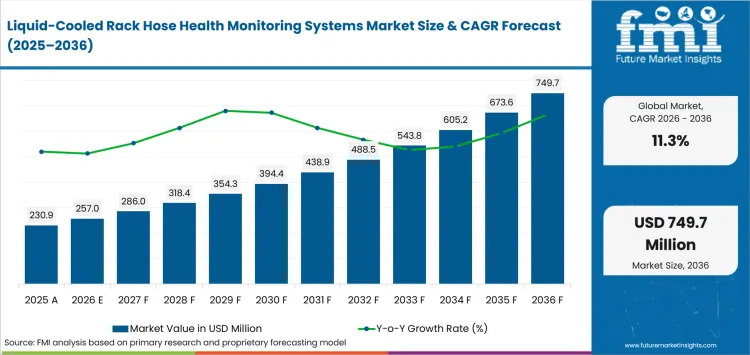
USD 257.0 million in 2026 and USD 749.7 million by 2036 at an 11.3% CAGR.
Demand for liquid-cooled rack hose health monitoring systems is projected to rise at an 11.3% CAGR by 2036, driving industry valuation from USD 257.0 million in 2026 to USD 749.7 million during the forecast period. AI liquid cooling places more detachable hoses and couplings inside rack-side thermal paths. DMTF's April 2026 Redfish schema bundle defines coolant-connector telemetry for flow, supply temperature, return temperature, differential pressure, and leak detection. Those standardized points let monitoring vendors feed actionable rack signals into data center power management and thermal controls.
Country adoption diverges between new AI campuses and brownfield facilities because new sites can specify hose monitoring with direct-to-chip liquid cooling before commissioning. Saudi Press Agency documented the 480 MW Tier IV Hexagon government data center in Riyadh in January 2026. A greenfield project of that scale can set telemetry requirements alongside CDU and manifold specifications. Mature markets have more legacy controls, so separate hose-health layers may need longer integration and approval work.
Key Takeaways
- High-density AI racks place more serviceable hose and connector interfaces between CDUs, manifolds, and cold plates, raising demand for connection-level fault isolation.
- Direct-to-chip liquid cooling is projected to hold 44.0% share in 2026, owing to the number of detachable rack-side coolant interfaces.
- Dry coolers are likely to capture 29.0% share in 2026, attributable to closed-loop heat rejection with limited evaporative water use.
- The rack density category is forecast to be led by the 251-500 kW range at 34.0% share in 2026, due to repeatable liquid-cooling blocks with material thermal risk.
- Qualification slows adoption if sensor thresholds and alarm protocols do not match the selected CDU, connector set, and facility-control environment.
- Some of the key players in this market include nVent, LG Electronics, Parker Hannifin, STULZ, Schneider Electric, Vertiv, Eaton (Boyd Thermal), and CoolIT Systems.
Analyst Perspective
"Hose-health monitoring earns budget when an alarm identifies the affected liquid path and gives maintenance teams a specific service action. Commercial differentiation comes from mapping connection-level signals into CDU telemetry without forcing operators to commission a second control workflow."
- Sudip saha, Principal Consultant, Future Market Insights
How is the liquid-cooled rack hose health monitoring systems market segmented?
The market is segmented by cooling architecture, heat rejection / secondary loop, rack density, data center type, route to market, and region.
The market is segmented by cooling architecture (direct-to-chip liquid cooling, rear-door heat exchangers, immersion cooling, hybrid air-liquid systems), heat rejection / secondary loop (dry coolers, chillers, cooling towers / evaporative, facility water loop / district interface, hybrid systems), rack density (below 100 kW, 100-250 kW, 251-500 kW, above 500 kW), data center type (hyperscale AI, colocation AI, enterprise AI/HPC, research / sovereign compute), route to market (cooling OEM direct, MEP / EPC integrator, server / rack OEM bundle, service & retrofit channel), and region according to the taxonomy below.
What makes direct-to-chip liquid cooling central to the cooling architecture category?
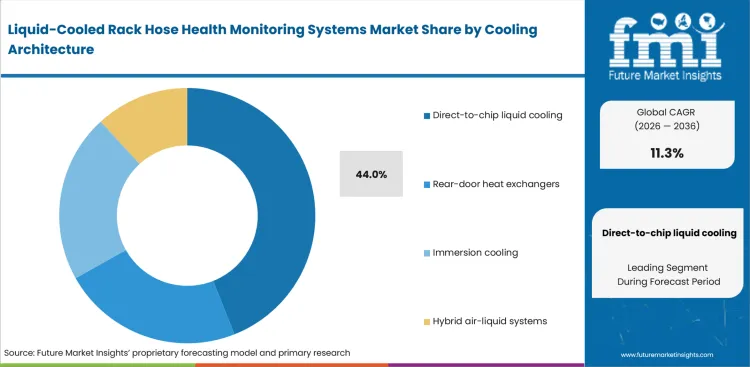
Direct-to-chip systems carry coolant from a CDU through rack cooling manifolds and hoses to cold plates. Schneider Electric's September 2025 liquid-cooling portfolio paired CDUs, cold plates, TCS loops, and controls for high-density data centers.
- Based on cooling architecture, direct-to-chip liquid cooling is projected to account for 44.0% in 2026, due to multiple detachable rack-side coolant interfaces that can be instrumented.
- During site acceptance, technicians need leak, flow, and pressure alarms that identify one rack path and map into the CDU controller. That mapping should remain usable during planned hose replacement cycles without forcing technicians into a second service workflow for the same rack.
How does dry-cooler heat rejection influence selection within the heat rejection / secondary loop category?
Dry coolers reject heat without continuous evaporative water use, unlike data center chillers that require compressor operation for heat rejection. Stable facility-side conditions make it easier for hose monitoring to separate a rack connection fault from a secondary-loop change.
- By heat rejection / secondary loop, dry coolers are estimated to hold 29.0% in 2026, attributable to closed-loop operation and compatibility with warmer technology-water designs.
- Johnson Controls' February 2026 one-gigawatt AI factory design specifies a fully water-free heat-rejection process using dry coolers. The design requires rack-side monitoring to read secondary-loop conditions correctly before assigning an alarm to a hose or coupling.
How does the 251-500 kW range shape demand within the rack density category?
Racks in the 251-500 kW band carry enough thermal load for a local flow loss to become expensive. Johnson Controls launched its Silent-Aire CDU platform in September 2025 with capacities from 500 kW to more than 10 MW for high-performance computing and AI deployments.
- In 2026, the 251-500 kW range is expected to lead rack density with 34.0% share, driven by modular liquid-cooling blocks that make connection monitoring economically repeatable.
- The 500 kW platform boundary gives technicians a defined point for pressure, temperature, and flow diagnostics before cooling capacity is distributed through rack manifolds.
What supports demand for hyperscale AI within the data center type category?
Hyperscale AI campuses repeat rack and manifold designs over compute blocks, so one fault-detection method can be deployed many times. Data center liquid cooling raises the value of remote diagnosis because maintenance teams cannot inspect every liquid connection manually.
- By data center type, hyperscale AI is forecast to represent 48.0% in 2026, owing to repeated high-density rack designs that require consistent telemetry and service procedures.
- CoolIT Systems stated in February 2026 that it manufactures hundreds of CDUs and thousands of rack manifolds each month. That production volume increases the value of monitoring methods technicians can commission consistently on replicated liquid loops.
What are the drivers, restraints and opportunities in the Liquid-Cooled Rack Hose Health Monitoring Systems Market?
Higher AI rack density raises the cost of undetected liquid-loop faults, multi-vendor qualification can slow approval, and retrofit monitoring gives service teams a route into installed rack loops.
- Driver: High-density AI racks increase the cost of undetected liquid-loop faults during commissioning and fault isolation.
- Restraint: Multi-vendor liquid loops require agreed connector specifications, alarm thresholds, and telemetry ownership before a separate monitoring layer can be accepted.
- Opportunity: Retrofit sensor gateways and fluid-management services can extend hose-health visibility without replacing the primary CDU or facility heat-rejection equipment.
Higher Rack Density Raises Fault-Isolation Value
AI compute loads raise the cost of a local liquid-cooling fault because a restricted hose can remove cooling capacity from a dense rack before room-level conditions identify the source. The IEA's 2025 Energy and AI analysis projects electricity use by accelerated servers to grow 30% annually from 2024 to 2030. The projected increase expands the high-power equipment exposed to rack-side liquid paths, giving leak, flow, pressure, and temperature monitoring a direct role in fault isolation.
Qualification Spans More Than the Hose Interface
Multi-vendor qualification slows adoption because hose-health alarms must align with the connector, CDU, technology cooling loop, and facility controls at each site. In October 2025, the Open Compute Project Foundation and ASHRAE formed an alliance covering liquid-cooling standards and facility readiness from facility water systems to direct-to-chip equipment. The alignment work makes threshold ownership and protocol mapping part of approval before a separate sensing layer enters data center infrastructure management software.
Retrofit Service Reduces Entry Disruption
Retrofit revenue is strongest in installed liquid loops where service teams can improve fault visibility without replacing the main cooling plant. Vertiv introduced PurgeRite NearZero in June 2026 with continuous monitoring for closed-loop hydronic commissioning in North America. The commissioning service route gives hose-health vendors a practical entry point during thermal management work, provided that sensor alarms map cleanly to existing CDU controls.
Which country CAGRs are profiled in the Liquid-Cooled Rack Hose Health Monitoring Systems Market?
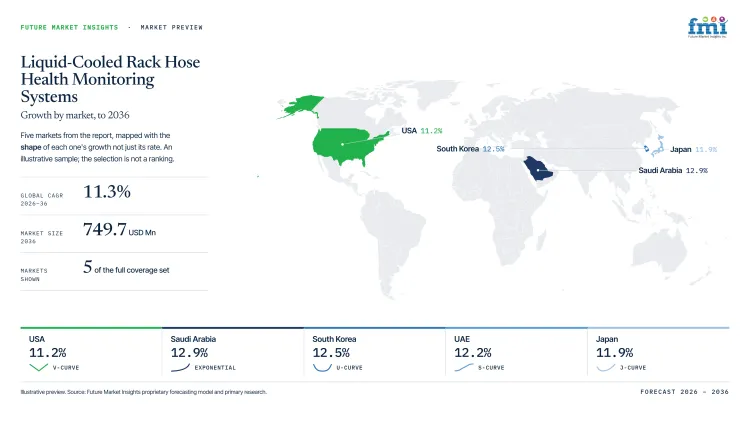
| Country | CAGR |
|---|---|
| Saudi Arabia | 12.9% |
| South Korea | 12.5% |
| UAE | 12.2% |
| Japan | 11.8% |
| France | 11.5% |
| USA | 11.2% |
How do country-level CAGRs compare in the Liquid-Cooled Rack Hose Health Monitoring Systems Market?
The six CAGRs form two compact groups within a 1.7-point range. Saudi Arabia, South Korea, and the UAE occupy the upper band at 12.2%-12.9%. Japan, France, and the USA form a second band between 11.2% and 11.8%. The spread points to different project timing and installed-base maturity instead of market size.
- Saudi campus programs reward early OEM engagement on rack standards.
- South Korea rewards interfaces that shorten server-to-cooling qualification.
- UAE projects value regional spares during phased commissioning.
- Japan gives retrofit-compatible gateways more weight in operating facilities.
- France combines new AI projects with mature colocation channels.
- USA field-service depth supports upgrades across the installed base.
Site design and service ownership still change order patterns. The full report provides country-level CAGR analysis across North America, Latin America, Europe, East Asia, South Asia, Oceania and the Middle East and Africa.
Country-wise Analysis
- Saudi projects are commissioning large AI facilities under hot-climate constraints, and Saudi Press Agency said in April 2026 that operational data-center capacity rose from 68 MW in 2021 to more than 440 MW in 2025. Liquid-cooled rack hose health monitoring system sales in Saudi Arabia are forecast to expand at 12.9% CAGR by 2036, because greenfield capacity lets project teams specify instrumentation before rack loops are commissioned. High ambient temperatures increase heat-rejection pressure, so Eaton, nVent, and cooling integrators need service coverage that separates rack-side connection faults from plant-side changes during staged activation of large new hot-weather campuses nationwide.
- South Korean AI projects link data-center siting to power-system review, so grid coordination and facility design become material parts of liquid-loop commissioning and equipment approval. The Ministry of Science and ICT stated in February 2025 that Korea aimed to secure 18,000 advanced GPUs by the first half of 2026 and improve rules for facility locations and power supply. South Korea is estimated to post 12.5% CAGR over the forecast period, owing to concentrated compute additions that favor compact monitoring hardware and local commissioning support, with power approval setting the pace at which cooling packages move from design into orders.
- Abu Dhabi is building AI capacity in large campus blocks, and Abu Dhabi Media Office documented Stargate UAE in May 2025 as a 1 GW compute cluster inside a 5 GW campus. Adoption of liquid-cooled rack hose health monitoring systems in the UAE is estimated to expand at 12.2% CAGR through 2036, attributable to greenfield projects that can set rack telemetry requirements early in design and procurement. High ambient conditions narrow heat-rejection choices, and the strongest offers will preserve one alarm model from rack hoses to central operations without requiring a separate service route for connection faults during campus ramp-up.
- Japanese operators often introduce denser rack server systems inside operating facilities, so limited plant-room space and planned maintenance windows constrain how much new monitoring hardware can be accepted during retrofit work. AIST's June 2025 benchmark results show ABCI 3.0 used 3,328 GPUs for its TOP500 run and ranked 15th globally, evidence of substantial accelerator density in a national compute platform. In Japan, liquid-cooled rack hose health monitoring system demand is predicted to advance at 11.8% CAGR through 2036, tied to compact gateways and diagnostics that fit scheduled service windows without forcing broad changes to existing building controls and maintenance routines.
- French data-center programs are planning larger AI sites within a mature European operating environment, and the Élysée said in June 2026 that SoftBank committed to develop at least 3 GW and up to 5 GW of AI-dedicated capacity nationwide. France's liquid-cooled rack hose health monitoring systems outlook is anticipated to advance at 11.5% CAGR over the assessment period, supported by greenfield projects that can specify liquid-loop telemetry with cooling infrastructure. Permitting and grid timing can slow individual sites, so Schneider Electric and service partners gain an advantage where monitoring is documented clearly enough to move from commissioning into routine maintenance.
- USA operators manage new AI campuses beside a large brownfield base, so hose-health systems must fit repeatable hyperscale blocks without breaking older building-control practices or current maintenance procedures. Lawrence Berkeley National Laboratory's June 2026 update estimates that data centers could account for 11.8% of USA electricity by 2030, a scale that increases pressure on power and cooling planning. Liquid-cooled rack hose health monitoring systems demand in the USA is forecast to rise at 11.2% CAGR over the forecast period, given a broad installed base that favors retrofit monitoring, with grid and control-integration constraints extending some deployment schedules further.
Who are the notable companies in the Liquid-Cooled Rack Hose Health Monitoring Systems Market?
nVent, LG Electronics, Parker Hannifin, STULZ, Schneider Electric, Vertiv, Eaton (Boyd Thermal), and CoolIT Systems are the notable companies serving this market.
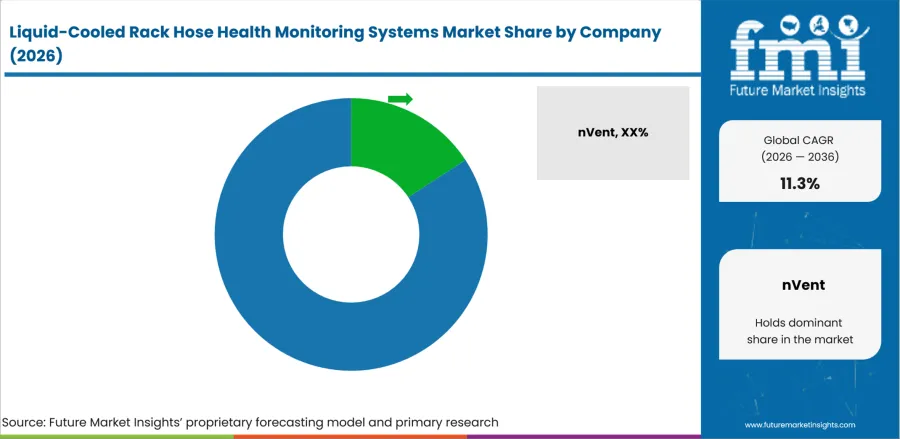
Competition centers on rack sensing, connection engineering, and CDU integration during commissioning and service handoff. A monitoring-only entrant must prove connector compatibility and map alarms into the site service workflow before a separate sensing layer gains approval.
- nVent, LG Electronics, STULZ, and CoolIT Systems pair liquid-cooling equipment with rack or loop controls.
- Schneider Electric, Vertiv, and Eaton (Boyd Thermal) span rack cooling and broader data-center infrastructure integration.
- Parker Hannifin specializes in fluid conveyance and quick-disconnect interfaces used in liquid-cooled equipment.
Competitive Benchmarking: Liquid-Cooled Rack Hose Health Monitoring Systems Market
| Company | Coolant-Loop Monitoring Depth | Hose / Connection Engineering | Cooling-System Integration | Geographic Reach |
|---|---|---|---|---|
| nVent | High | High | High | Global |
| LG Electronics | High | Medium | High | Global |
| Parker Hannifin | Low | High | Low | Global |
| STULZ | High | Medium | High | Europe, North America, Asia-Pacific |
| Schneider Electric | High | Medium | High | Global |
| Vertiv | High | Medium | High | Global |
| Eaton (Boyd Thermal) | Medium | High | High | Global |
| CoolIT Systems | High | High | High | North America, Europe, Asia |
Ratings reflect documented capability inside the market boundary and never infer a score from company size or reputation. High monitoring depth requires loop telemetry plus remote diagnostics, whereas Medium denotes equipment-level sensing and Low denotes mainly mechanical hardware. High connection engineering requires evidence spanning hoses, manifolds, and couplings, with Medium covering one or two interface classes. High system integration requires rack-to-facility controls, Medium marks a defined platform, and Low identifies a documented component limitation backed by public evidence.
Key Developments in the Liquid-Cooled Rack Hose Health Monitoring Systems Market
- In April 2026, Vertiv acquired Strategic Thermal Labs to extend cold-plate engineering, server-side liquid cooling, and high-density thermal validation within its liquid-cooling system work.
- In November 2025, nVent unveiled modular row and rack CDUs, technology cooling system manifolds, and a new services program for next-generation AI liquid-cooling deployments at SC25.
- In February 2025, Schneider Electric completed its acquisition of an initial 75% controlling interest in Motivair, bringing specialist liquid-cooling and advanced thermal-management expertise into its Energy Management business.
Key Players in the Liquid-Cooled Rack Hose Health Monitoring Systems Market
Rack and Thermal Cooling Platforms
- nVent
- LG Electronics
Connection and Cooling Specialists
- Parker Hannifin
- STULZ
Integrated Data Center Infrastructure
- Schneider Electric
- Vertiv
Grid-to-Chip and Direct Liquid Cooling
- Eaton (Boyd Thermal)
- CoolIT Systems
Liquid-Cooled Rack Hose Health Monitoring Systems Market - Report Scope
| Coverage field | Report scope |
|---|---|
| Market breakdown | By cooling architecture, heat rejection / secondary loop, rack density, data center type, route to market, and region. |
| Quantitative Units | USD million. |
| Market Definition | Hardware, sensing, telemetry gateways, and software functions used to identify hose, coupling, flow, pressure, temperature, or leak conditions in rack-level liquid-cooling loops. |
| Regions Covered | North America, Latin America, Western Europe, Eastern Europe, East Asia, South Asia and Pacific, Middle East and Africa. |
| Countries Covered | Saudi Arabia, South Korea, UAE, Japan, France, USA, and 20+ countries included in the full report. |
| Key Companies Profiled | nVent, LG Electronics, Parker Hannifin, STULZ, Schneider Electric, Vertiv, Eaton (Boyd Thermal), and CoolIT Systems. |
| Forecast Period | 2026 to 2036. |
| Approach | Primary and desk research with market sizing, segmentation, country-growth comparison, and competitive benchmarking. |
Liquid-Cooled Rack Hose Health Monitoring Systems Market - Research Methodology
| Method | Approach |
|---|---|
| Primary Research | FMI analysts gathered input from manufacturers, service providers, technology developers, distributors, end users, procurement teams, and subject-matter experts. Interviews examined purchasing decisions, product or service evaluation, adoption barriers, approval requirements, pricing considerations, and expectations for technical or commercial support. Respondents were also asked what evidence is required before a trial, pilot, or initial order develops into regular purchasing. |
| Desk Research | Desk research covered government statistics, regulatory publications, trade data, industry associations, technical literature, standards, company filings, product information, and official corporate announcements. Sources were reviewed for relevance, publication date, geographic coverage, and consistency with the defined market scope. Claims relating to performance, applications, approvals, capacity, investment, and commercial activity were retained only when supported by credible public evidence. |
| Market Sizing and Forecasting | The market model combined the baseline value with historical performance, segment structure, pricing and volume indicators, adoption levels, company participation, and country-level demand conditions. Forecast assumptions considered economic activity, investment trends, regulatory developments, technology adoption, purchasing cycles, supply availability, and barriers to wider market use. Segment and regional estimates were reconciled before the final market total was calculated. |
| Data Validation | Estimates were checked against multiple independent indicators, including public data, company activity, trade patterns, industry developments, and findings from primary interviews. Validation also tested whether products, services, applications, and company revenues fell within the defined market boundaries. Adjacent categories, unsupported claims, overlapping revenues, and activities without direct market relevance were excluded to reduce double counting and maintain consistency across segments and countries. |
Liquid-Cooled Rack Hose Health Monitoring Systems Market by Segments
Liquid-Cooled Rack Hose Health Monitoring Systems Market segmented by Cooling Architecture:
- Direct-to-chip liquid cooling
- Rear-door heat exchangers
- Immersion cooling
- Hybrid air-liquid systems
Liquid-Cooled Rack Hose Health Monitoring Systems Market segmented by Heat Rejection / Secondary Loop:
- Dry coolers
- Chillers
- Cooling towers / evaporative
- Facility water loop / district interface
- Hybrid systems
Liquid-Cooled Rack Hose Health Monitoring Systems Market segmented by Rack Density:
- 251-500 kW
- 100-250 kW
- Below 100 kW
- Above 500 kW
Liquid-Cooled Rack Hose Health Monitoring Systems Market segmented by Data Center Type:
- Hyperscale AI
- Colocation AI
- Enterprise AI/HPC
- Research / sovereign compute
Liquid-Cooled Rack Hose Health Monitoring Systems Market segmented by Route to Market:
- Cooling OEM direct
- MEP / EPC integrator
- Server / rack OEM bundle
- Service & retrofit channel
Liquid-Cooled Rack Hose Health Monitoring Systems Market by Region:
- North America
- United States
- Canada
- Latin America
- Brazil
- Mexico
- Argentina
- Chile
- Western Europe
- Germany
- France
- United Kingdom
- Italy
- Spain
- Benelux
- Nordics
- Eastern Europe
- Poland
- Czech Republic
- Romania
- Hungary
- East Asia
- China
- Japan
- South Korea
- South Asia and Pacific
- India
- ASEAN
- Australia and New Zealand
- Middle East and Africa
- GCC Countries
- South Africa
- Türkiye
- Israel
Research Sources and Bibliography
- DMTF. (2026, April 2). Redfish Schema Bundle Readme.
- Saudi Press Agency. (2026, January 1). Foundation Stone Laid for World’s Largest Government Data Center in Riyadh.
- Saudi Press Agency. (2026, April 27). Saudi Arabia Strengthens Its Global Position in Artificial Intelligence Through Data Center Growth and Accelerated Smart Manufacturing.
- Ministry of Science and ICT, Republic of Korea. (2025, February 20). Korea to expand AI computing infrastructure to strengthen national AI capabilities and achieve global leadership.
- Abu Dhabi Media Office. (2025, May 22). Global Tech Alliance Launches Stargate UAE.
- National Institute of Advanced Industrial Science and Technology. (2025, June 10).
- Élysée. (2026, June 1). Meeting with Masayoshi Son, CEO of SoftBank.
- Lawrence Berkeley National Laboratory. (2026, June). United States Data Center Energy Usage Report: 2025 Update.
- International Energy Agency. (2025, April 10). Energy and AI.
- Open Compute Project Foundation. (2025, October 13). Open Compute Project Foundation and ASHRAE Form New Alliance.
- Vertiv. (2026, June 3). Vertiv launches Vertiv™ PurgeRite™ NearZero™ service.
- Schneider Electric. (2025, September 29). Schneider Electric unveils liquid cooling portfolio with Motivair, featuring dedicated solutions and services for HPC and AI workloads.
- Johnson Controls. (2026, February 2). Johnson Controls launches series of thermal management reference design guides for gigawatt-scale AI data centers.
- Johnson Controls. (2025, September 8). Johnson Controls expands thermal management offering with scalable liquid cooling solution to meet the increasing demand of high-density data centers.
- CoolIT Systems. (2026, February 25). CoolIT Systems Continues Rapid Growth as it Celebrates 25 Years.
- Vertiv. (2026, April 27). Vertiv Strengthens Liquid-Cooling System Capability with Acquisition of Strategic Thermal Labs.
- nVent Electric plc. (2025, November 17). nVent Unveils New Liquid Cooling and Power Portfolio at SC25.
- Schneider Electric. (2025, February 28). Schneider Electric completes acquisition of Motivair Corporation.
- Eaton. (2026, March 12). Eaton completes acquisition of leading liquid-cooling solutions provider Boyd Thermal, creating an industry-leading grid-to-chip solution for data centers.
- Ecolab. (2026, July 2). Ecolab Closes CoolIT Acquisition and Expands AI Cooling Platform as Global High Tech Business Targets $4 Billion by 2030.
- nVent Electric plc. (2025, September 3). nVent Expands Data Center Solutions Manufacturing with New USA Production Facility.
- Vertiv. (2025, June 3). Vertiv Expands Liquid Cooling Portfolio with Scalable Solutions for AI and HPC Applications.
- Schneider Electric. (2025, December 15). Motivair by Schneider Electric Announces New Range of CDUs to Meet the Rising Demands of HPC and AI Workloads.
- Open Compute Project Foundation. (n.d.). Delta 2MW Deschutes 5 CDU.
- Open Compute Project Foundation. (n.d.). CEJN Universal Quick Disconnect (UQD).
- Open Compute Project Foundation. (n.d.). Parker UQD Series Universal Quick Disconnect Couplings.
- Open Compute Project Foundation. (n.d.). Stäubli Universal Quick Disconnect (UQD).
- Open Compute Project Foundation. (n.d.). STULZ Deschutes CDU - CyberCool Liquid Cooling Distribution Unit.
- Open Compute Project Foundation. (n.d.). Eaton ROL4000-48U65 Deschutes CDU.
- nVent Electric plc. (2026, July 31). nVent Expands Data Center Liquid Cooling Capacity.
- LG Electronics. (2026, July 27). LG Electronics Earns NVIDIA Infrastructure Validation for Its 600kW Coolant Distribution Unit.
- Parker Hannifin. (2025, September 18). Parker Introduces Innovative Universal Quick Disconnect Couplings for Liquid Cooling Applications.
- STULZ. (2025, July 24). STULZ produziert CyberCool CMU im Headquarter in Hamburg.
- Schneider Electric. (2026, January 21). Motivair by Schneider Electric Announces New CDU with Capability to Scale to 10MW and Beyond for Next-Gen AI Factories.
- Vertiv. (2025, March 11). Vertiv Introduces New Flexible, High-Density Heat Rejection System to Support Hybrid Liquid and Air Cooling for AI Applications.
- Boyd. (2025, October 29). Boyd Unveils a new 2 Megawatt High-Capacity Coolant Distribution Unit for Liquid Cooled AI Data Centers.
- CoolIT Systems. (2025, April 15). CoolIT Systems Announces Further Breakthroughs in Row-Based Coolant Distribution Unit Performance.
This bibliography is provided for reader reference and is not exhaustive. The full report contains the complete reference list and detailed citations
This Report Answers
- How large is the liquid-cooled rack hose health monitoring systems market in 2026 and 2036?
- What operating conditions make rack hose-health monitoring valuable in high-density AI racks?
- Why does direct-to-chip liquid cooling hold 44.0% of cooling architecture in 2026?
- Why do dry coolers account for 29.0% of heat rejection / secondary loop demand in 2026?
- Why does the 251-500 kW rack-density band account for 34.0% in 2026?
- How does hyperscale AI change hose-health monitoring economics?
- Which profiled countries record the highest CAGRs through 2036?
- Which companies cover cooling controls, fluid connections, and commissioning support?
Frequently Asked Questions
How big is the liquid-cooled rack hose health monitoring systems market in 2026?
The liquid-cooled rack hose health monitoring systems market is valued at USD 257.0 million in 2026 and is projected to reach USD 749.7 million by 2036. Growth follows higher rack densities and more serviceable liquid connections.
What is the CAGR of the liquid-cooled rack hose health monitoring systems market from 2026 to 2036?
The liquid-cooled rack hose health monitoring systems market is projected to grow at a CAGR of 11.3% between 2026 and 2036. Expansion follows wider direct liquid cooling and hyperscale AI deployment, which place more hose interfaces near high-value compute.
Which cooling architecture leads the liquid-cooled rack hose health monitoring systems market?
The direct-to-chip liquid cooling segment is expected to hold 44.0% of the liquid-cooled rack hose health monitoring systems market in 2026, driven by its concentration of rack-side coolant interfaces. Hoses and manifolds give operators defined points for leak, flow, and pressure monitoring.
Which heat rejection / secondary loop option leads the liquid-cooled rack hose health monitoring systems market?
The dry coolers segment is estimated to hold 29.0% of the liquid-cooled rack hose health monitoring systems market in 2026, attributable to closed-loop heat rejection with limited evaporative water use. Stable secondary-loop conditions also improve fault separation at rack connections.
Which companies are active in the liquid-cooled rack hose health monitoring systems market?
Key companies in the liquid-cooled rack hose health monitoring systems market include nVent, LG Electronics, Parker Hannifin, STULZ, Schneider Electric, Vertiv, Eaton (Boyd Thermal), and CoolIT Systems. Their positions span cooling platforms, fluid connections, rack telemetry, and field service.
Preview the report firsthand - request a free sample
Get SampleGet the brochure for pricing and purchase details.
Get PDFTable of Content
- Key Takeaways
- Market Size and CAGR
- Top Growth Driver
- Fastest Growing Segment
- Leading Region
- Key Companies
- Emerging Opportunities
- Executive Summary
- Global Market Outlook
- Demand-side Trends
- Supply-side Trends
- Technology Roadmap Analysis
- Analysis and Recommendations
- Analyst Perspective (What is happening? Why now? What should investors know?)
- Key Questions Answered
- How large is the market?
- What is the CAGR?
- What are key trends?
- Which region dominates?
- Who are the leaders?
- Market Overview
- Market Coverage / Taxonomy
- Market Definition / Scope / Limitations
- Research Methodology
- Chapter Orientation
- Analytical Lens and Working Hypotheses
- Market Structure, Signals, and Trend Drivers
- Benchmarking and Cross-market Comparability
- Market Sizing, Forecasting, and Opportunity Mapping
- Research Design and Evidence Framework
- Desk Research Programme (Secondary Evidence)
- Expert Input and Fieldwork (Primary Evidence)
- Tooling, Models, and Reference Databases
- Data Engineering and Model Build
- Quality Assurance and Audit Trail
- Market Background
- Market Dynamics (Drivers, Restraints, Opportunity, Trends)
- Scenario Forecast (Optimistic, Likely, Conservative)
- Impact Analysis
- AI Impact
- Sustainability Impact
- Regulatory Impact
- Technology Impact
- Consumer / Buyer Analysis
- Purchase Drivers
- Adoption Barriers
- Buyer Journey
- Opportunity Map Analysis
- Product Life Cycle Analysis
- Supply Chain Analysis
- Investment Feasibility Matrix
- Value Chain Analysis
- PESTLE and Porter's Analysis
- Regulatory Landscape
- Regional Parent Market Outlook
- Production and Consumption Statistics
- Import and Export Statistics
- Global Market Analysis and Forecast, 2021 to 2036
- Historical Market Size Value (USD Million) Analysis, 2021 to 2025
- Current and Future Market Size Value (USD Million) Projections, 2026 to 2036
- Y-o-Y Growth Trend Analysis
- Absolute $ Opportunity Analysis
- Global Market Pricing Analysis, 2021 to 2036
- Global Market Analysis and Forecast, By Cooling Architecture, 2021 to 2036
- Introduction / Key Findings
- Historical Market Size Value (USD Million) Analysis By Cooling Architecture, 2021 to 2025
- Current and Future Market Size Value (USD Million) Analysis and Forecast By Cooling Architecture, 2026 to 2036
- Direct-to-chip liquid cooling
- Rear-door heat exchangers
- Immersion cooling
- Hybrid air-liquid systems
- Direct-to-chip liquid cooling
- Y-o-Y Growth Trend Analysis By Cooling Architecture, 2021 to 2025
- Absolute $ Opportunity Analysis By Cooling Architecture, 2026 to 2036
- Global Market Analysis and Forecast, By Heat Rejection / Secondary Loop, 2021 to 2036
- Introduction / Key Findings
- Historical Market Size Value (USD Million) Analysis By Heat Rejection / Secondary Loop, 2021 to 2025
- Current and Future Market Size Value (USD Million) Analysis and Forecast By Heat Rejection / Secondary Loop, 2026 to 2036
- Dry coolers
- Chillers
- Cooling towers / evaporative
- Facility water loop / district interface
- Hybrid systems
- Dry coolers
- Y-o-Y Growth Trend Analysis By Heat Rejection / Secondary Loop, 2021 to 2025
- Absolute $ Opportunity Analysis By Heat Rejection / Secondary Loop, 2026 to 2036
- Global Market Analysis and Forecast, By Rack Density, 2021 to 2036
- Introduction / Key Findings
- Historical Market Size Value (USD Million) Analysis By Rack Density, 2021 to 2025
- Current and Future Market Size Value (USD Million) Analysis and Forecast By Rack Density, 2026 to 2036
- 251–500 kW
- 100–250 kW
- Below 100 kW
- Above 500 kW
- 251–500 kW
- Y-o-Y Growth Trend Analysis By Rack Density, 2021 to 2025
- Absolute $ Opportunity Analysis By Rack Density, 2026 to 2036
- Global Market Analysis and Forecast, By Data Center Type, 2021 to 2036
- Introduction / Key Findings
- Historical Market Size Value (USD Million) Analysis By Data Center Type, 2021 to 2025
- Current and Future Market Size Value (USD Million) Analysis and Forecast By Data Center Type, 2026 to 2036
- Hyperscale AI
- Colocation AI
- Enterprise AI/HPC
- Research / sovereign compute
- Hyperscale AI
- Y-o-Y Growth Trend Analysis By Data Center Type, 2021 to 2025
- Absolute $ Opportunity Analysis By Data Center Type, 2026 to 2036
- Global Market Analysis and Forecast, By Route to Market, 2021 to 2036
- Introduction / Key Findings
- Historical Market Size Value (USD Million) Analysis By Route to Market, 2021 to 2025
- Current and Future Market Size Value (USD Million) Analysis and Forecast By Route to Market, 2026 to 2036
- Cooling OEM direct
- MEP / EPC integrator
- Server / rack OEM bundle
- Service & retrofit channel
- Cooling OEM direct
- Y-o-Y Growth Trend Analysis By Route to Market, 2021 to 2025
- Absolute $ Opportunity Analysis By Route to Market, 2026 to 2036
- Global Market Analysis and Forecast, By Region, 2021 to 2036
- Introduction
- Historical Market Size Value (USD Million) Analysis By Region, 2021 to 2025
- Current Market Size Value (USD Million) Analysis and Forecast By Region, 2026 to 2036
- North America
- Latin America
- Western Europe
- Eastern Europe
- East Asia
- South Asia and Pacific
- Middle East & Africa
- Market Attractiveness Analysis By Region
- North America Market Analysis and Forecast, By Country, 2021 to 2036
- Historical Market Size Value (USD Million) Trend Analysis By Market Taxonomy, 2021 to 2025
- Market Size Value (USD Million) Forecast By Market Taxonomy, 2026 to 2036
- By Country
- USA
- Canada
- By Cooling Architecture
- By Heat Rejection / Secondary Loop
- By Rack Density
- By Data Center Type
- By Route to Market
- By Country
- Market Attractiveness Analysis
- By Country
- By Cooling Architecture
- By Heat Rejection / Secondary Loop
- By Rack Density
- By Data Center Type
- By Route to Market
- Key Takeaways
- Latin America Market Analysis and Forecast, By Country
- Historical Market Size Value (USD Million) Trend Analysis By Market Taxonomy, 2021 to 2025
- Market Size Value (USD Million) Forecast By Market Taxonomy, 2026 to 2036
- By Country
- Brazil
- Mexico
- Chile
- Rest of Latin America
- By Cooling Architecture
- By Heat Rejection / Secondary Loop
- By Rack Density
- By Data Center Type
- By Route to Market
- By Country
- Market Attractiveness Analysis
- By Country
- By Cooling Architecture
- By Heat Rejection / Secondary Loop
- By Rack Density
- By Data Center Type
- By Route to Market
- Key Takeaways
- Western Europe Market Analysis and Forecast, By Country
- Historical Market Size Value (USD Million) Trend Analysis By Market Taxonomy, 2021 to 2025
- Market Size Value (USD Million) Forecast By Market Taxonomy, 2026 to 2036
- By Country
- Germany
- UK
- Italy
- Spain
- France
- Nordic
- BENELUX
- Rest of Western Europe
- By Cooling Architecture
- By Heat Rejection / Secondary Loop
- By Rack Density
- By Data Center Type
- By Route to Market
- By Country
- Market Attractiveness Analysis
- By Country
- By Cooling Architecture
- By Heat Rejection / Secondary Loop
- By Rack Density
- By Data Center Type
- By Route to Market
- Key Takeaways
- Eastern Europe Market Analysis and Forecast, By Country
- Historical Market Size Value (USD Million) Trend Analysis By Market Taxonomy, 2021 to 2025
- Market Size Value (USD Million) Forecast By Market Taxonomy, 2026 to 2036
- By Country
- Russia
- Poland
- Hungary
- Balkan & Baltic
- Rest of Eastern Europe
- By Cooling Architecture
- By Heat Rejection / Secondary Loop
- By Rack Density
- By Data Center Type
- By Route to Market
- By Country
- Market Attractiveness Analysis
- By Country
- By Cooling Architecture
- By Heat Rejection / Secondary Loop
- By Rack Density
- By Data Center Type
- By Route to Market
- Key Takeaways
- East Asia Market Analysis and Forecast, By Country
- Historical Market Size Value (USD Million) Trend Analysis By Market Taxonomy, 2021 to 2025
- Market Size Value (USD Million) Forecast By Market Taxonomy, 2026 to 2036
- By Country
- China
- Japan
- South Korea
- By Cooling Architecture
- By Heat Rejection / Secondary Loop
- By Rack Density
- By Data Center Type
- By Route to Market
- By Country
- Market Attractiveness Analysis
- By Country
- By Cooling Architecture
- By Heat Rejection / Secondary Loop
- By Rack Density
- By Data Center Type
- By Route to Market
- Key Takeaways
- South Asia and Pacific Market Analysis and Forecast, By Country
- Historical Market Size Value (USD Million) Trend Analysis By Market Taxonomy, 2021 to 2025
- Market Size Value (USD Million) Forecast By Market Taxonomy, 2026 to 2036
- By Country
- India
- ASEAN
- Australia & New Zealand
- Rest of South Asia and Pacific
- By Cooling Architecture
- By Heat Rejection / Secondary Loop
- By Rack Density
- By Data Center Type
- By Route to Market
- By Country
- Market Attractiveness Analysis
- By Country
- By Cooling Architecture
- By Heat Rejection / Secondary Loop
- By Rack Density
- By Data Center Type
- By Route to Market
- Key Takeaways
- Middle East & Africa Market Analysis and Forecast, By Country
- Historical Market Size Value (USD Million) Trend Analysis By Market Taxonomy, 2021 to 2025
- Market Size Value (USD Million) Forecast By Market Taxonomy, 2026 to 2036
- By Country
- Kingdom of Saudi Arabia
- Other GCC Countries
- Türkiye
- South Africa
- Other African Union
- Rest of Middle East & Africa
- By Cooling Architecture
- By Heat Rejection / Secondary Loop
- By Rack Density
- By Data Center Type
- By Route to Market
- By Country
- Market Attractiveness Analysis
- By Country
- By Cooling Architecture
- By Heat Rejection / Secondary Loop
- By Rack Density
- By Data Center Type
- By Route to Market
- Key Takeaways
- Key Countries Market Analysis
- USA
- Pricing Analysis
- Market Share Analysis, 2025
- By Cooling Architecture
- By Heat Rejection / Secondary Loop
- By Rack Density
- By Data Center Type
- By Route to Market
- Canada
- Pricing Analysis
- Market Share Analysis, 2025
- By Cooling Architecture
- By Heat Rejection / Secondary Loop
- By Rack Density
- By Data Center Type
- By Route to Market
- Mexico
- Pricing Analysis
- Market Share Analysis, 2025
- By Cooling Architecture
- By Heat Rejection / Secondary Loop
- By Rack Density
- By Data Center Type
- By Route to Market
- Brazil
- Pricing Analysis
- Market Share Analysis, 2025
- By Cooling Architecture
- By Heat Rejection / Secondary Loop
- By Rack Density
- By Data Center Type
- By Route to Market
- Chile
- Pricing Analysis
- Market Share Analysis, 2025
- By Cooling Architecture
- By Heat Rejection / Secondary Loop
- By Rack Density
- By Data Center Type
- By Route to Market
- Germany
- Pricing Analysis
- Market Share Analysis, 2025
- By Cooling Architecture
- By Heat Rejection / Secondary Loop
- By Rack Density
- By Data Center Type
- By Route to Market
- UK
- Pricing Analysis
- Market Share Analysis, 2025
- By Cooling Architecture
- By Heat Rejection / Secondary Loop
- By Rack Density
- By Data Center Type
- By Route to Market
- Italy
- Pricing Analysis
- Market Share Analysis, 2025
- By Cooling Architecture
- By Heat Rejection / Secondary Loop
- By Rack Density
- By Data Center Type
- By Route to Market
- Spain
- Pricing Analysis
- Market Share Analysis, 2025
- By Cooling Architecture
- By Heat Rejection / Secondary Loop
- By Rack Density
- By Data Center Type
- By Route to Market
- France
- Pricing Analysis
- Market Share Analysis, 2025
- By Cooling Architecture
- By Heat Rejection / Secondary Loop
- By Rack Density
- By Data Center Type
- By Route to Market
- India
- Pricing Analysis
- Market Share Analysis, 2025
- By Cooling Architecture
- By Heat Rejection / Secondary Loop
- By Rack Density
- By Data Center Type
- By Route to Market
- ASEAN
- Pricing Analysis
- Market Share Analysis, 2025
- By Cooling Architecture
- By Heat Rejection / Secondary Loop
- By Rack Density
- By Data Center Type
- By Route to Market
- Australia & New Zealand
- Pricing Analysis
- Market Share Analysis, 2025
- By Cooling Architecture
- By Heat Rejection / Secondary Loop
- By Rack Density
- By Data Center Type
- By Route to Market
- China
- Pricing Analysis
- Market Share Analysis, 2025
- By Cooling Architecture
- By Heat Rejection / Secondary Loop
- By Rack Density
- By Data Center Type
- By Route to Market
- Japan
- Pricing Analysis
- Market Share Analysis, 2025
- By Cooling Architecture
- By Heat Rejection / Secondary Loop
- By Rack Density
- By Data Center Type
- By Route to Market
- South Korea
- Pricing Analysis
- Market Share Analysis, 2025
- By Cooling Architecture
- By Heat Rejection / Secondary Loop
- By Rack Density
- By Data Center Type
- By Route to Market
- Russia
- Pricing Analysis
- Market Share Analysis, 2025
- By Cooling Architecture
- By Heat Rejection / Secondary Loop
- By Rack Density
- By Data Center Type
- By Route to Market
- Poland
- Pricing Analysis
- Market Share Analysis, 2025
- By Cooling Architecture
- By Heat Rejection / Secondary Loop
- By Rack Density
- By Data Center Type
- By Route to Market
- Hungary
- Pricing Analysis
- Market Share Analysis, 2025
- By Cooling Architecture
- By Heat Rejection / Secondary Loop
- By Rack Density
- By Data Center Type
- By Route to Market
- Kingdom of Saudi Arabia
- Pricing Analysis
- Market Share Analysis, 2025
- By Cooling Architecture
- By Heat Rejection / Secondary Loop
- By Rack Density
- By Data Center Type
- By Route to Market
- Türkiye
- Pricing Analysis
- Market Share Analysis, 2025
- By Cooling Architecture
- By Heat Rejection / Secondary Loop
- By Rack Density
- By Data Center Type
- By Route to Market
- South Africa
- Pricing Analysis
- Market Share Analysis, 2025
- By Cooling Architecture
- By Heat Rejection / Secondary Loop
- By Rack Density
- By Data Center Type
- By Route to Market
- USA
- Market Structure Analysis
- Competition Dashboard
- Competition Benchmarking
- Market Share Analysis of Top Players
- By Regional
- By Cooling Architecture
- By Heat Rejection / Secondary Loop
- By Rack Density
- By Data Center Type
- By Route to Market
- Emerging Startups
- Innovation Benchmarking
- Competition Analysis
- Competition Deep Dive
- nVent
- Overview
- Product Portfolio
- Profitability by Market Segments
- Sales Footprint
- Strategy Overview
- Marketing Strategy
- Product Strategy
- Channel Strategy
- LG Electronics
- Parker Hannifin
- STULZ
- nVent
- Case Studies
- Success Stories
- Recent Developments
- Competition Deep Dive
- Assumptions & Acronyms Used


