
- Market Size (2026)
- USD 310.0 Mn
- Forecast (2036)
- USD 720.5 Mn
- CAGR (2026 to 2036)
- 8.8%
How Big Is the Anastomotic Leak Detection Devices Market in 2026?
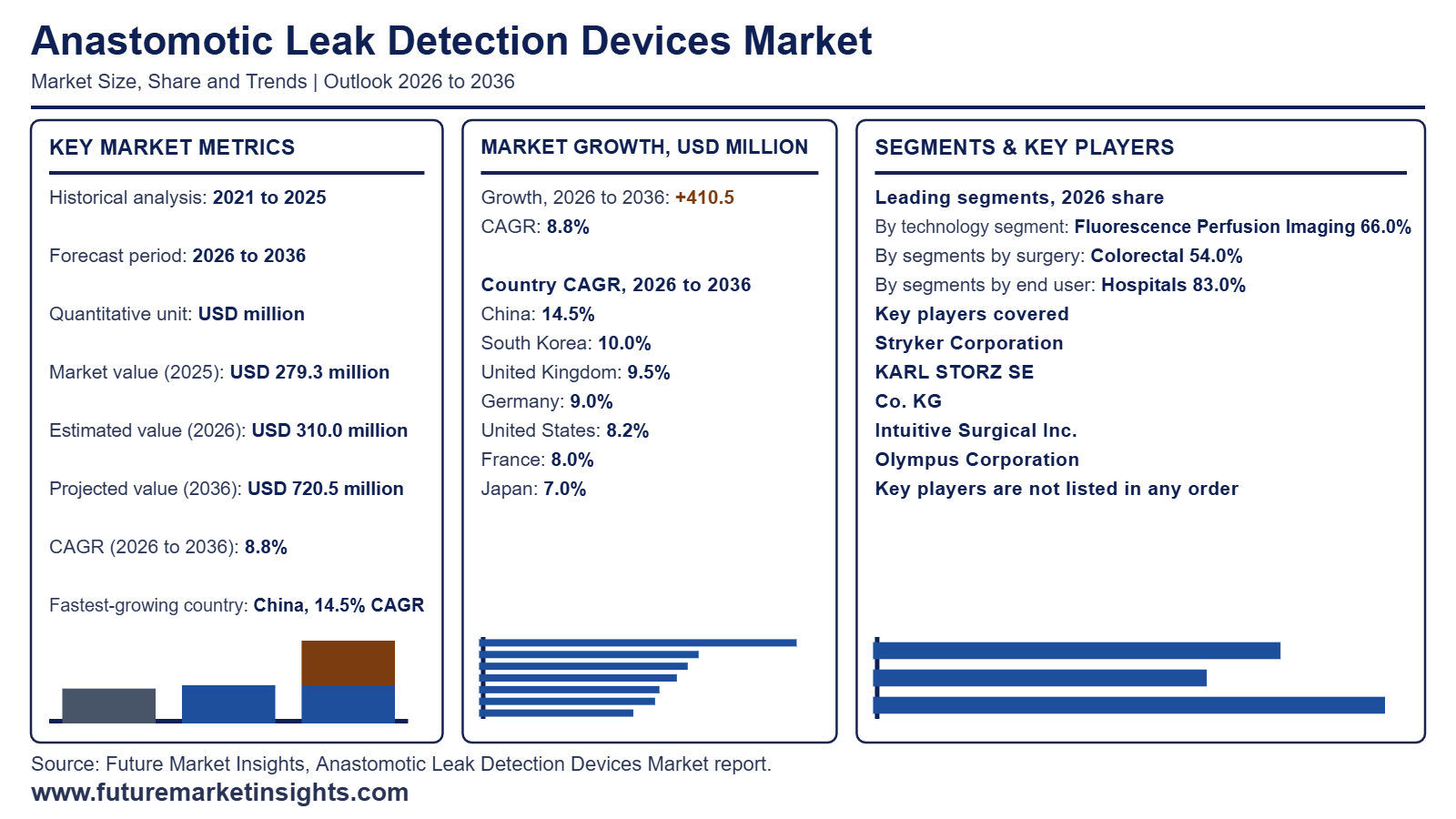
The global anastomotic leak detection devices market is valued at USD 310.0 million in 2026, up from USD 279.3 million in 2025, and is projected by Future Market Insights (FMI) to reach USD 720.5 million by 2036, expanding at an 8.8% CAGR from 2026 to 2036 and generating USD 410.5 million in incremental revenue over the 10-year forecast period.
| Market Metric | Valuation / Share / Forecast Benchmark |
|---|---|
| 2025 Market Size (Historical) | USD 279.3 million |
| 2026 Market Size (Estimated) | USD 310.0 million |
| 2036 Market Size (Projected) | USD 720.5 million |
| Compound Annual Growth Rate (2026 to 2036) | 8.8% CAGR |
| Incremental Dollar Opportunity (2026 to 2036) | USD 410.5 million |
| Dominant Technology Segment (2026 to 2036 Share) | Fluorescence Perfusion Imaging (66.0% in 2026, easing to 62.0% by 2036) |
| Leading & Fastest-Growing Segments by Surgery | Colorectal (54.0% share in 2026, 9.1% CAGR, the fastest growth in this group) |
| Leading & Fastest-Growing Segments by End User | Hospitals (83.0% share in 2026, 8.5% CAGR) │ Ambulatory Surgery Centers (10.3% CAGR) |
| Largest Country Markets (2026 Global Share) | United States (44.0%), Japan (9.0%), Germany (6.8%) |
| Fastest-Growing Country Markets (2026 to 2036) | China (14.5% CAGR), South Korea (10.0% CAGR), United Kingdom (9.5% CAGR) |
| Leading Tier-1 Companies | Stryker Corporation, KARL STORZ SE and Co. KG, Intuitive Surgical Inc., Olympus Corporation |
Source: Future Market Insights analysis of the anastomotic leak detection devices market, 2026.
Executive Market Overview
Preference for anastomotic leak detection devices is primarily driven by routine perfusion checks in colorectal surgery along with early hospital purchases of drain-based sensors. Hospitals make most of these purchases, and the National Bowel Cancer Audit (October 2025) recorded 21,395 major resections among people diagnosed with bowel cancer in England and Wales in 2023. The United States is the largest national buyer, holding 44.0% of 2026 sales in FMI's sizing. Stryker (January 2026), an imaging tower maker covered in this report, reported 2025 Endoscopy net sales of USD 3,807 million, up 12.3% on the prior year.
Colorectal and bariatric surgery departments buy fluorescence imaging modes along with leak-test kits and drain monitors because surgeons want a recorded check of the join during the operation and in the days after. Imaging companies are extending near-infrared modes to open surgery and to surgical robots, and sensor startups are moving through regulatory review in the United States. The Postoperative Drain and Biosensor Monitoring segment is projected to expand at a 12.8% CAGR, the Ambulatory Surgery Centers segment at 10.3% and China at 14.5%, all faster than the 8.8% overall market CAGR. Market sizing covers fluorescence perfusion imaging systems and agents apportioned to checks of bowel and gastric joins as well as intraoperative leak-test devices and postoperative drain or biosensor monitors. Surgical staplers and tissue sealants are excluded, as are imaging towers bought for procedures other than gastrointestinal join checks.
Analyst Perspective
"Operating rooms often own the camera tower already, so value in leak detection rises through software modes and imaging agents, along with single-patient sensors, more than through the volume of towers shipped. The commercial risk I would name first is payers declining separate payment for a postoperative sensor, which leaves the hospital to absorb the price inside the procedure budget."
-Anurag Sharma, Principal Consultant, Future Market Insights (FMI)
Major Market Trends and Insights
Near-infrared imaging is moving beyond the laparoscope: KARL STORZ (June 2026) announced FDA clearance for the Rubina Lens exoscope, which brings near-infrared imaging with indocyanine green to open surgery. The release describes the exoscope as indicated for real-time tissue perfusion assessment. An information sheet from Medtronic (2025) lists fluorescence imaging modes for the Hugo robot that run on the KARL STORZ IMAGE1 S RUBINA system. FMI expects each added viewing route to raise the number of bowel joins that get a perfusion check, which also supports the wider fluorescence guided surgery systems market.
Drain-based sensors are reaching regulators: BetaKit (September 2025) reported that the FDA cleared the Origin drain monitor from FluidAI Medical in August 2025 as a Class 2 device. Exero Medical (September 2025) said enrollment was complete in the main United States study of the xBar system, covering 222 patients at 12 medical centers in the United States and Israel. Results of that study were later submitted to the FDA within a De Novo application, according to Exero Medical (May 2026). In FMI's assessment, these regulatory steps mark the start of a postoperative product category that hospitals buy per patient.
Dye-free and robot-mounted perfusion imaging: KARL STORZ (April 2025) acquired the intellectual property of Diaspective Vision, a German maker of hyperspectral cameras. The same release described the TIVITA Mini as approved at that date for contact-free, dye-free assessment of tissue perfusion. MicroPort MedBot (November 2025) said the DFVision 3D fluorescence endoscope of the Toumai surgical robot received CE certification. FMI reads both moves as signs that perfusion imaging is becoming a standard feature of new camera platforms.
What Are the Main Drivers, Restraints, and Opportunities?
Routine perfusion checks lift demand in bowel surgery even as mixed trial evidence slows some purchases, with postoperative sensors opening a second product line.
Driver: Camera-based bowel surgery is now the norm in audited hospitals
The National Bowel Cancer Audit (October 2025) found that 75% of the major bowel cancer resections recorded for 2023 in England and Wales were minimally invasive. Robotic cases made up 15% of those resections, according to the National Bowel Cancer Audit (October 2025). Intuitive (January 2026) reported a da Vinci installed base of 11,106 systems at the end of 2025, up 12% from a year earlier. FMI's view is that every camera-based case gives the surgeon a screen on which a fluorescence mode can be switched on, so the installed base of towers and robots sets the ceiling for perfusion checks.
Restraint: Trial evidence on perfusion imaging is still being weighed
The IntAct trial, whose published paper is held at White Rose Research Online (July 2025), randomized 766 patients at 28 rectal cancer centers in eight European countries. The published abstract states that the difference in leak rates between the two trial arms did not reach statistical significance. FMI expects purchasing committees in budget-limited health systems to ask for further evidence before funding fluorescence modes for every bowel case.
Opportunity: Postoperative monitoring as an add-on for equipped hospitals
BetaKit (September 2025) reported that FluidAI Medical had worked with more than 35 medical centers. The same article said Origin was on sale in Canada and the Middle East. Qaelon Medical (June 2026) of Strasbourg said the Qaelon intraoperative leak detection platform was still in development, without FDA clearance or CE marking. In FMI's view, hospitals that already buy from the surgical drains market can add a sensor to the drain without changing the operation, which lowers the barrier to a first purchase.
How Is the Anastomotic Leak Detection Devices Market Segmented?
The global anastomotic leak detection devices market is segmented by technology and surgery, along with end user and region.
| Segmentation Axis | Sub-Segments Covered | 2026 Leading Segment & Share | Main Growth Benchmark (2026 to 2036) |
|---|---|---|---|
| Technology | Fluorescence Perfusion Imaging, Intraoperative Leak Test Devices, Postoperative Drain and Biosensor Monitoring | Fluorescence Perfusion Imaging (66.0% share) | Postoperative Drain and Biosensor Monitoring leads growth at 12.8% CAGR, against 8.1% for Fluorescence Perfusion Imaging |
| Surgery | Colorectal, Bariatric and Upper GI, Others | Colorectal (54.0% share) | Colorectal share rises to 55.5% by 2036 |
| End User | Hospitals, Ambulatory Surgery Centers | Hospitals (83.0% share) | Ambulatory Surgery Centers leads growth at 10.3% CAGR, against 8.5% for Hospitals |
| Region | North America, Latin America, Western Europe, Eastern Europe, East Asia, South Asia and Pacific, Middle East and Africa | United States (44.0% global share) | China leads national growth at 14.5% CAGR |
Source: Future Market Insights analysis of the anastomotic leak detection devices market, 2026.
Why Does the Fluorescence Perfusion Imaging Segment Lead by Technology?

Fluorescence Perfusion Imaging holds 66.0% of 2026 sales. FMI attributes the lead to camera towers that are already in the operating room, so the perfusion check is done within the same procedure. Olympus (March 2026) launched the VISERA ELITE III platform in the United States with infrared imaging for indocyanine green and said the platform was available in all global regions. FMI projects the segment share to ease to 62.0% by 2036 as towers reach most operating rooms. Postoperative Drain and Biosensor Monitoring grows at 12.8% from a small base once the first cleared sensors are sold in volume.
Why Does the Colorectal Segment Lead by Surgery?
Colorectal procedures account for 54.0% of 2026 sales, the highest share among surgery types. The National Bowel Cancer Audit (October 2025) recorded 37,730 bowel cancer diagnoses in England and Wales for 2023, a measure of the colorectal caseload in those two nations. Exero Medical (September 2025) built the xBar registration study around leaks after colorectal surgery. FMI projects the Colorectal share at 55.5% in 2036, a CAGR of 9.1%, with bariatric and upper gastrointestinal cases growing slightly below the market.
Why Does the Hospitals Segment Lead by End User?
Hospitals take 83.0% of 2026 sales. In FMI's view, hospitals lead because bowel resections and revisional bariatric cases are inpatient procedures. KARL STORZ (June 2026) said the Rubina Lens works with existing IMAGE1 S Rubina platforms, so a hospital can add fluorescence for open surgery without a new capital purchase. FMI projects the Hospitals share at 80.5% in 2036. FMI expects Ambulatory Surgery Centers to grow at 10.3% as more primary bariatric cases are done as same-day surgery, a shift that also benefits the laparoscopic devices market.
Anastomotic Leak Detection Devices Market by Region and Country (2026 to 2036)

North America is the largest region, and the United States alone holds 44.0% of 2026 sales. China grows fastest among the countries covered at 14.5%, ahead of South Korea at 10.0% and the United Kingdom at 9.5%. The United States and France, along with Japan, grow below the global rate of 8.8% because fluorescence imaging towers are already common in large hospitals there, in FMI's assessment.
| Country | 2026 Revenue | 2036 Revenue | 10-Year Addition | 2026 to 2036 CAGR | Global Share (2026 → 2036) |
|---|---|---|---|---|---|
| China | USD 19.8 million | USD 76.8 million | +USD 57.0 million | 14.5% | 6.4% → 10.7% |
| South Korea | USD 9.3 million | USD 24.1 million | +USD 14.8 million | 10.0% | 3.0% → 3.3% |
| United Kingdom | USD 14.3 million | USD 35.3 million | +USD 21.0 million | 9.5% | 4.6% → 4.9% |
| Germany | USD 21.1 million | USD 49.9 million | +USD 28.8 million | 9.0% | 6.8% → 6.9% |
| United States | USD 136.4 million | USD 300.0 million | +USD 163.6 million | 8.2% | 44.0% → 41.6% |
| France | USD 12.7 million | USD 27.4 million | +USD 14.7 million | 8.0% | 4.1% → 3.8% |
| Japan | USD 27.9 million | USD 54.9 million | +USD 27.0 million | 7.0% | 9.0% → 7.6% |
Source: Future Market Insights analysis of the anastomotic leak detection devices market, 2026.
United States
The United States accounts for USD 136.4 million in 2026, and FMI projects USD 300.0 million by 2036 at a CAGR of 8.2%. KARL STORZ (June 2026) announced FDA clearance of the Rubina Lens exoscope for open surgery in a release issued from El Segundo, California. The FDA (August 2025) cleared the Origin drain monitor on 21 August 2025, and BetaKit (September 2025) reported that the maker, FluidAI Medical, plans a United States office. FMI expects the country to remain the main launch market for new sensors because sensor makers run registration studies in American hospitals.
Japan
Japan starts the forecast at USD 27.9 million in 2026 and ends at USD 54.9 million in 2036, a CAGR of 7.0%. Olympus (November 2025) set out a corporate strategy in Tokyo built around endoscopy with artificial intelligence and robotics, alongside a net reduction of roughly 2,000 positions in the global workforce. FMI's view is that Japanese hospitals adopted fluorescence imaging early, so new growth is led by replacement towers and by sensors.
Germany
Germany's sales are forecast at USD 21.1 million for 2026 and USD 49.9 million for 2036, which implies a CAGR of 9.0%. KARL STORZ (April 2025), based in Tuttlingen, acquired assets of Diaspective Vision and said four employees of the hyperspectral camera maker would join the buyer. FMI expects German university hospitals to be early European buyers of dye-free perfusion cameras once these systems are sold on standard towers.
China
China records the highest growth among the seven countries, rising from USD 19.8 million in 2026 to USD 76.8 million in 2036 at a CAGR of 14.5%. MicroPort MedBot (November 2025), based in Shanghai, said the DFVision fluorescence endoscope of the Toumai robot received CE certification and that Toumai has market access in more than 60 countries and regions. FMI's assessment is that Chinese-made fluorescence laparoscopes are lowering the entry price for provincial hospitals.
United Kingdom
In the United Kingdom, FMI sizes sales at USD 14.3 million in 2026 and USD 35.3 million in 2036, a CAGR of 9.5%. The National Bowel Cancer Audit (October 2025) classed 60% of the 2023 major resections in English and Welsh hospitals as laparoscopic. The IntAct trial record at White Rose Research Online (July 2025) names the National Institute for Health Research as funder. FMI expects national audit data and publicly funded trials to guide how quickly hospital trusts add perfusion imaging.
France
France is expected to reach USD 27.4 million by 2036 from USD 12.7 million in 2026, a CAGR of 8.0%. Qaelon Medical (June 2026), a Strasbourg company developing an intraoperative leak detection platform, announced a data partnership with Scialytics, which is also headquartered in Strasbourg. FMI's view is that French demand in the forecast period is led by fluorescence imaging in public hospitals, with locally developed leak-test devices arriving later.
South Korea
South Korea has the smallest 2026 total among the seven countries at USD 9.3 million, and FMI projects USD 24.1 million by 2036 at a CAGR of 10.0%. The Asia Business Daily (July 2026) reported that the Korea Research Institute of Chemical Technology had developed a polymer form of indocyanine green named KR-NIR-P, with further preclinical studies planned. FMI expects Korean demand to be led by large Seoul hospitals with high volumes of laparoscopic and robotic gastrointestinal surgery.
Competitive Environment and Notable Companies
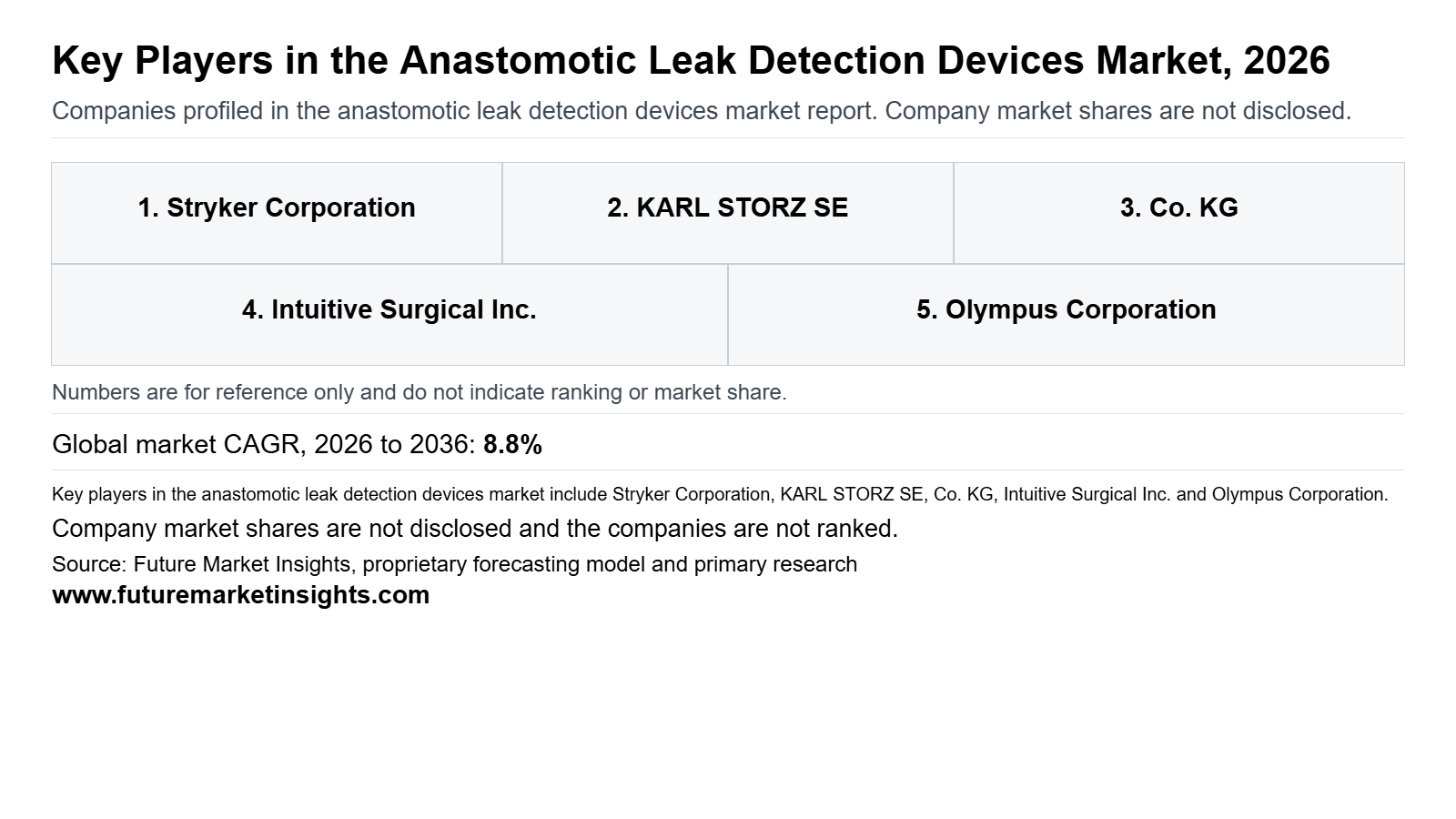
Sales are concentrated among makers of surgical imaging towers and robots. Stryker Corporation holds the largest share in FMI's sizing, ahead of KARL STORZ SE and Co. KG, Intuitive Surgical Inc., Olympus Corporation and Medtronic plc. FluidAI Medical and Exero Medical Ltd. are early-stage sensor makers with small shares in 2026.
How Are Companies Positioned in the Anastomotic Leak Detection Devices Market?
Imaging companies sell fluorescence as a mode on a camera platform that hospitals buy for many procedures. Stryker (January 2026) reported 2025 net sales of USD 25.1 billion for the whole group, which sells many product lines beyond imaging. A product page from Stryker (2026) lists SPY fluorescence modes on the 1788 Platform together with a handheld imager for open surgery. Sensor makers sell a single-patient device together with monitoring software, in FMI's assessment.
What Matters When a Buyer Selects an Anastomotic Leak Detection Devices Supplier?
FMI finds that hospital purchasing teams look first at whether a device works with the tower or robot already installed. Regulatory status is the second filter. Exero Medical (May 2026) said xBar was not yet approved for sale in the United States and was limited to investigational work. Per-case cost of the imaging agent or sensor is the third point in most evaluations, in FMI's assessment.
Which Capabilities Distinguish Product Offers?
Offers differ in how many viewing routes the fluorescence mode covers. The da Vinci product page of Intuitive (May 2026) names Firefly fluorescence imaging among the features of the da Vinci Xi system. In results for the same company, Intuitive (January 2026) reported placing 303 da Vinci 5 systems in the fourth quarter of 2025. Medtronic (December 2025) announced FDA clearance of the Hugo robot for urologic procedures. A further FDA clearance covering general surgery procedures on Hugo was announced by Medtronic (November 2026). FMI's view is that robot makers with general surgery clearance will sell perfusion imaging into the same accounts that buy from the surgical staplers market.
How Does Geographic Reach Affect Competition?
Large imaging companies sell in every region, in FMI's assessment. Olympus (March 2026) said the VISERA ELITE III platform is available in all global regions. Startups begin with a few countries, as BetaKit (September 2025) described for FluidAI Medical in Canada and the Middle East.
| Verified Company Evidence (2026) | Commercial Effect | Buyer Action |
|---|---|---|
| 11 March 2026: Olympus launched the VISERA ELITE III surgical imaging platform in the United States (Olympus, March 2026). | A further tower with an infrared mode for indocyanine green is on sale to American hospitals. | Compare fluorescence modes and scope compatibility when a tower replacement is due. |
| 11 May 2026: Exero Medical said results of the 222-patient xBar study had been submitted to the FDA within a De Novo application (Exero Medical, May 2026). | A second postoperative leak sensor has reached the United States regulator for review. | Hospitals interested in sensors can plan evaluation pilots for the period after a regulatory decision. |
| 10 June 2026: KARL STORZ announced FDA clearance of the Rubina Lens exoscope for near-infrared imaging in open surgery (KARL STORZ, June 2026). | Perfusion assessment with indocyanine green becomes available in open cases on installed KARL STORZ towers. | Check which open bowel procedures can use the existing tower before budgeting for a separate imaging device. |
Source: Verified corporate disclosures and Future Market Insights analysis, 2026.
| Company | Core Positioning | Verified Activity & Source Attribution |
|---|---|---|
| Stryker Corporation | Largest share in FMI's sizing through fluorescence imaging on surgical camera platforms. | Reported 2025 Endoscopy net sales of USD 3,807 million, up 12.3% (Stryker, January 2026). |
| KARL STORZ SE and Co. KG | Family-owned endoscopy maker with near-infrared imaging on the Rubina platform. | Acquired the intellectual property of hyperspectral camera maker Diaspective Vision (KARL STORZ, April 2025). |
| Intuitive Surgical Inc. | Robot maker with Firefly fluorescence imaging on da Vinci systems. | Placed 303 da Vinci 5 systems in the fourth quarter of 2025 out of 532 da Vinci placements (Intuitive, January 2026). |
| Olympus Corporation | Endoscopy company with infrared imaging on the VISERA ELITE III surgical platform. | Launched VISERA ELITE III in the United States on 11 March 2026 (Olympus, March 2026). |
| Medtronic plc | Surgical device group offering fluorescence imaging modes on the Hugo robot. | Lists indocyanine green fluorescence imaging modes for the Hugo robot on the KARL STORZ IMAGE1 S RUBINA system (Medtronic, 2025). |
| FluidAI Medical | Canadian maker of the Origin postoperative drain monitor. | Received FDA clearance for Origin on 21 August 2025 (FDA, August 2025). |
| Exero Medical Ltd. | Israeli developer of the xBar sensor system for leaks after colorectal surgery. | Submitted results of the 222-patient xBar study to the FDA within a De Novo application (Exero Medical, May 2026). |
Source: Verified corporate disclosures and Future Market Insights analysis, 2026.
Anastomotic Leak Detection Devices Market Report Scope and Research Methodology
FMI measures sales of leak detection devices at manufacturer selling prices in the year a hospital or surgery center takes delivery. Imaging systems and agents that serve many procedures are included only for the portion linked to checks of bowel and gastric joins. Units sold and average selling prices are built up country by country and then added to regional and global totals. Segment values by technology and by surgery type, as well as by end user, each add to the same global total. Company disclosures and regulator records, together with hospital audit publications, were reviewed to check the direction of the figures.
| Coverage Field | Report Scope |
|---|---|
| Market definition | Devices and imaging agents bought to check gastrointestinal surgical joins for perfusion or leakage during and after an operation. |
| Technology | Fluorescence Perfusion Imaging, Intraoperative Leak Test Devices, Postoperative Drain and Biosensor Monitoring |
| Surgery | Colorectal, Bariatric and Upper GI, Others |
| End User | Hospitals, Ambulatory Surgery Centers |
| End users | Hospitals and ambulatory surgery centers performing colorectal and bariatric surgery, along with upper gastrointestinal surgery. |
| Inclusions | Fluorescence perfusion imaging systems and agents apportioned to join checks, intraoperative leak-test devices, postoperative drain and biosensor monitors. |
| Exclusions | Surgical staplers, tissue sealants, general imaging towers bought for other procedures, radiology imaging. |
| Quantitative units | USD million for value. |
| Value basis | Manufacturer selling prices in US dollars, 2026 to 2036. |
| Base year and history | 2025 base year, with history from 2021 to 2025. |
| Forecast period | 2026 to 2036. |
| Regions covered | North America, Latin America, Western Europe, Eastern Europe, East Asia, South Asia and Pacific, Middle East and Africa. |
| National coverage | United States, Japan, Germany, China, United Kingdom, France, South Korea. |
| Companies covered | Stryker Corporation, KARL STORZ SE and Co. KG, Intuitive Surgical Inc., Olympus Corporation, Medtronic plc, FluidAI Medical, Exero Medical Ltd. |
Source: Future Market Insights analysis of the anastomotic leak detection devices market, 2026.
Research Sources and Bibliography
- BetaKit. (2025, September 24). FluidAI lands FDA clearance to sell post-surgery monitor in the US.
- Exero Medical. (2025, September 16). Exero Medical Completes Enrollment of 222-Patient U.S. Pivotal Study for Early Detection of Post-Operative Gastrointestinal Surgery Complications.
- Exero Medical. (2026, May 11). Exero Medical Announces Pivotal Study Results Demonstrating Early Detection of Colorectal Surgery Complications Using the xBar Monitoring System.
- Intuitive. (2026, January 22). Intuitive Announces Fourth Quarter Earnings.
- Intuitive. (2026, May). Da Vinci Robotic Surgical Systems | Intuitive.
- KARL STORZ. (2025, April 25). KARL STORZ Acquires IP and Talent from Diaspective Vision. https://www.karlstorz.com/co/en/karl-storz-acquires-ip-and-talent-from-diaspective-vision.htm
- KARL STORZ. (2026, June 10). KARL STORZ Announces FDA Clearance for RUBINA Lens for Open Surgery. https://www.karlstorz.com/us/en/karl-storz-announces-fda-Clearance-for-rubina-lens-for-open-surgery.htm
- Medtronic. (2025, accessed November 20, 2026). Bring the benefits of the Hugo RAS system to more complex procedures (ICG for Hugo information sheet). https://www.medtronic.com/content/dam/medtronic-wide/public/western-europe/products/surgical-robotics/icg-for-hugo-infosheet.pdf
- Medtronic. (2025, December 3). Medtronic announces FDA clearance of Hugo robotic-assisted surgery system for urologic surgical procedures. https://news.medtronic.com/2025-12-03-Medtronic-announces-FDA-clearance-of-Hugo-TM-robotic-assisted-surgery-system-for-urologic-surgical-procedures
- Medtronic. (2026, November 17). Medtronic announces FDA clearance of general surgery procedures for the Hugo robotic-assisted surgery (RAS) system. https://news.medtronic.com/2026-11-17-Medtronic-announces-FDA-clearance-of-general-surgery-procedures-for-the-Hugo-TM-robotic-assisted-surgery-RAS-system
- MicroPort MedBot. (2025, November 15). Toumai Surgical Robot Fluorescence Imaging System DFVision Receives CE Mark. https://microport.com/news/toumai-surgical-robot-fluorescence-imaging-system-dfvision-receives-ce-mark
- National Bowel Cancer Audit. (2025, October). National Bowel Cancer Audit (NBOCA) State of the Nation Report. https://www.natcan.org.uk/wp-content/uploads/2025/10/NBOCA-State-of-the-Nation-Report-2025.pdf
- Olympus. (2025, November 7). Olympus Unveils Corporate Strategy. https://www.acnnewswire.com/press-release/english/103583/olympus-unveils-corporate-strategy
- Olympus. (2026, March 11). Olympus Launches Next-Generation Surgical Imaging Platform in U.S. https://www.biospace.com/press-releases/olympus-launches-next-generation-surgical-imaging-platform-in-u-s
- Qaelon Medical. (2026, June 3). Qaelon Medical and Scialytics Announce Data Strategy Partnership to Advance AI-Driven Surgical Intelligence in Colorectal Surgery. https://www.biospace.com/press-releases/qaelon-medical-and-scialytics-announce-data-strategy-partnership-to-advance-ai-driven-surgical-intelligence-in-colorectal-surgery
- Stryker. (2026, accessed November 20, 2026). 1788 Platform. https://www.stryker.com/us/en/endoscopy/products/1788-platform.html
- Stryker. (2026, January 29). Stryker reports 2025 operating results and 2026 outlook. https://www.biospace.com/stryker-reports-2025-operating-results-and-2026-outlook
- The Asia Business Daily. (2026, July 19). Fluorescence Lasts Four Times Longer During Surgery... KRICT Develops Next-Generation Near-Infrared Fluorescent Dye. https://view.asiae.co.kr/en/article/2026071614205122580
- U.S. Food and Drug Administration. (2025, August 21). 510(k) Premarket Notification K243965: Origin. https://www.accessdata.fda.gov/scripts/cdrh/cfdocs/cfPMN/pmn.cfm?ID=K243965
- White Rose Research Online. (2025, July 18). Intraoperative fluorescence angiography with indocyanine green to prevent anastomotic leak in rectal cancer surgery (IntAct): an unblinded randomised controlled trial. https://eprints.whiterose.ac.uk/230347
Table of Content
- Key Takeaways
- Market Size and CAGR
- Top Growth Driver
- Fastest Growing Segment
- Leading Region
- Key Companies
- Emerging Opportunities
- Executive Summary
- Global Market Outlook
- Demand-side Trends
- Supply-side Trends
- Technology Roadmap Analysis
- Analysis and Recommendations
- Analyst Perspective (What is happening? Why now? What should investors know?)
Read More...
- Key Questions Answered
- How large is the market?
- What is the CAGR?
- What are key trends?
- Which region dominates?
- Who are the leaders?
- Market Overview
- Market Coverage / Taxonomy
- Market Definition / Scope / Limitations
- Research Methodology
- Chapter Orientation
- Analytical Lens and Working Hypotheses
- Market Structure, Signals, and Trend Drivers
- Benchmarking and Cross-market Comparability
- Market Sizing, Forecasting, and Opportunity Mapping
- Research Design and Evidence Framework
- Desk Research Program (Secondary Evidence)
- Expert Input and Fieldwork (Primary Evidence)
- Tooling, Models, and Reference Databases
- Data Engineering and Model Build
- Quality Assurance and Audit Trail
- Market Background
- Market Dynamics (Drivers, Restraints, Opportunity, Trends)
- Scenario Forecast (Optimistic, Likely, Conservative)
- Impact Analysis
- AI Impact
- Sustainability Impact
- Regulatory Impact
- Technology Impact
- Consumer / Buyer Analysis
- Purchase Drivers
- Adoption Barriers
- Buyer Journey
- Opportunity Map Analysis
- Product Life Cycle Analysis
- Supply Chain Analysis
- Investment Feasibility Matrix
- Value Chain Analysis
- PESTLE and Porter's Analysis
- Regulatory Landscape
- Regional Parent Market Outlook
- Production and Consumption Statistics
- Import and Export Statistics
- Global Market Analysis and Forecast, 2021 to 2036
- Historical Market Size Value (USD Million) Analysis, 2021 to 2025
- Current and Future Market Size Value (USD Million) Projections, 2026 to 2036
- Y-o-Y Growth Trend Analysis
- Absolute $ Opportunity Analysis
- Global Market Pricing Analysis, 2021 to 2036
- Global Market Analysis and Forecast, By Technology, 2021 to 2036
- Introduction / Key Findings
- Historical Market Size Value (USD Million) Analysis By Technology, 2021 to 2025
- Current and Future Market Size Value (USD Million) Analysis and Forecast By Technology, 2026 to 2036
- Fluorescence Perfusion Imaging
- Intraoperative Leak Test Devices
- Postoperative Drain and Biosensor Monitoring
- Y-o-Y Growth Trend Analysis By Technology, 2021 to 2025
- Absolute $ Opportunity Analysis By Technology, 2026 to 2036
- Global Market Analysis and Forecast, By Surgery, 2021 to 2036
- Introduction / Key Findings
- Historical Market Size Value (USD Million) Analysis By Surgery, 2021 to 2025
- Current and Future Market Size Value (USD Million) Analysis and Forecast By Surgery, 2026 to 2036
- Colorectal
- Bariatric and Upper GI
- Others
- Y-o-Y Growth Trend Analysis By Surgery, 2021 to 2025
- Absolute $ Opportunity Analysis By Surgery, 2026 to 2036
- Global Market Analysis and Forecast, By End User, 2021 to 2036
- Introduction / Key Findings
- Historical Market Size Value (USD Million) Analysis By End User, 2021 to 2025
- Current and Future Market Size Value (USD Million) Analysis and Forecast By End User, 2026 to 2036
- Hospitals
- Ambulatory Surgery Centers
- Y-o-Y Growth Trend Analysis By End User, 2021 to 2025
- Absolute $ Opportunity Analysis By End User, 2026 to 2036
- Global Market Analysis and Forecast, By Region, 2021 to 2036
- Introduction
- Historical Market Size Value (USD Million) Analysis By Region, 2021 to 2025
- Current Market Size Value (USD Million) Analysis and Forecast By Region, 2026 to 2036
- North America
- Western Europe
- East Asia
- Market Attractiveness Analysis By Region
- North America Market Analysis and Forecast, By Country, 2021 to 2036
- Historical Market Size Value (USD Million) Trend Analysis By Market Taxonomy, 2021 to 2025
- Market Size Value (USD Million) Forecast By Market Taxonomy, 2026 to 2036
- By Country
- United States
- Rest of North America
- By Technology
- By Surgery
- By End User
- By Country
- Market Attractiveness Analysis
- By Country
- By Technology
- By Surgery
- By End User
- Key Takeaways
- Western Europe Market Analysis and Forecast, By Country, 2021 to 2036
- Historical Market Size Value (USD Million) Trend Analysis By Market Taxonomy, 2021 to 2025
- Market Size Value (USD Million) Forecast By Market Taxonomy, 2026 to 2036
- By Country
- Germany
- United Kingdom
- France
- Rest of Western Europe
- By Technology
- By Surgery
- By End User
- By Country
- Market Attractiveness Analysis
- By Country
- By Technology
- By Surgery
- By End User
- Key Takeaways
- East Asia Market Analysis and Forecast, By Country, 2021 to 2036
- Historical Market Size Value (USD Million) Trend Analysis By Market Taxonomy, 2021 to 2025
- Market Size Value (USD Million) Forecast By Market Taxonomy, 2026 to 2036
- By Country
- Japan
- China
- South Korea
- Rest of East Asia
- By Technology
- By Surgery
- By End User
- By Country
- Market Attractiveness Analysis
- By Country
- By Technology
- By Surgery
- By End User
- Key Takeaways
- Key Countries Market Analysis
- United States
- Pricing Analysis
- Market Share Analysis, 2025
- By Technology
- By Surgery
- By End User
- Japan
- Pricing Analysis
- Market Share Analysis, 2025
- By Technology
- By Surgery
- By End User
- Germany
- Pricing Analysis
- Market Share Analysis, 2025
- By Technology
- By Surgery
- By End User
- China
- Pricing Analysis
- Market Share Analysis, 2025
- By Technology
- By Surgery
- By End User
- United Kingdom
- Pricing Analysis
- Market Share Analysis, 2025
- By Technology
- By Surgery
- By End User
- France
- Pricing Analysis
- Market Share Analysis, 2025
- By Technology
- By Surgery
- By End User
- South Korea
- Pricing Analysis
- Market Share Analysis, 2025
- By Technology
- By Surgery
- By End User
- United States
- Market Structure Analysis
- Competition Dashboard
- Competition Benchmarking
- Market Share Analysis of Top Players
- By Regional
- By Technology
- By Surgery
- By End User
- Emerging Startups
- Innovation Benchmarking
- Competition Analysis
- Competition Deep Dive
- Stryker Corporation
- Overview
- Product Portfolio
- Profitability by Market Segments
- Sales Footprint
- Strategy Overview
- Marketing Strategy
- Product Strategy
- Channel Strategy
- KARL STORZ SE and Co. KG
- Intuitive Surgical Inc.
- Olympus Corporation
- Medtronic plc
- FluidAI Medical
- Exero Medical Ltd.
- Stryker Corporation
- Competition Deep Dive
- Case Studies
- Success Stories
- Recent Developments
- Assumptions & Acronyms Used
List of Tables
- Table 1: Global Market Value (USD Million) Forecast by Region, 2021 to 2036
- Table 2: Global Market Value (USD Million) Forecast by Technology, 2021 to 2036
- Table 3: Global Market Value (USD Million) Forecast by Surgery, 2021 to 2036
- Table 4: Global Market Value (USD Million) Forecast by End User, 2021 to 2036
- Table 5: North America Market Value (USD Million) Forecast by Country, 2021 to 2036
- Table 6: North America Market Value (USD Million) Forecast by Technology, 2021 to 2036
- Table 7: North America Market Value (USD Million) Forecast by Surgery, 2021 to 2036
- Table 8: North America Market Value (USD Million) Forecast by End User, 2021 to 2036
- Table 9: Western Europe Market Value (USD Million) Forecast by Country, 2021 to 2036
- Table 10: Western Europe Market Value (USD Million) Forecast by Technology, 2021 to 2036
- Table 11: Western Europe Market Value (USD Million) Forecast by Surgery, 2021 to 2036
- Table 12: Western Europe Market Value (USD Million) Forecast by End User, 2021 to 2036
- Table 13: East Asia Market Value (USD Million) Forecast by Country, 2021 to 2036
- Table 14: East Asia Market Value (USD Million) Forecast by Technology, 2021 to 2036
- Table 15: East Asia Market Value (USD Million) Forecast by Surgery, 2021 to 2036
- Table 16: East Asia Market Value (USD Million) Forecast by End User, 2021 to 2036
List of Figures
- Figure 1: Global Market Pricing Analysis
- Figure 2: Global Market Value (USD Million) Forecast 2021-2036
- Figure 3: Global Market Value Share and BPS Analysis by Technology, 2026 and 2036
- Figure 4: Global Market Y-o-Y Growth Comparison by Technology, 2026-2036
- Figure 5: Global Market Attractiveness Analysis by Technology
- Figure 6: Global Market Value Share and BPS Analysis by Surgery, 2026 and 2036
- Figure 7: Global Market Y-o-Y Growth Comparison by Surgery, 2026-2036
- Figure 8: Global Market Attractiveness Analysis by Surgery
- Figure 9: Global Market Value Share and BPS Analysis by End User, 2026 and 2036
- Figure 10: Global Market Y-o-Y Growth Comparison by End User, 2026-2036
- Figure 11: Global Market Attractiveness Analysis by End User
- Figure 12: Global Market Value (USD Million) Share and BPS Analysis by Region, 2026 and 2036
- Figure 13: Global Market Y-o-Y Growth Comparison by Region, 2026-2036
- Figure 14: Global Market Attractiveness Analysis by Region
- Figure 15: North America Market Incremental Dollar Opportunity, 2026-2036
- Figure 16: Western Europe Market Incremental Dollar Opportunity, 2026-2036
- Figure 17: East Asia Market Incremental Dollar Opportunity, 2026-2036
- Figure 18: North America Market Value Share and BPS Analysis by Country, 2026 and 2036
- Figure 19: North America Market Value Share and BPS Analysis by Technology, 2026 and 2036
- Figure 20: North America Market Y-o-Y Growth Comparison by Technology, 2026-2036
- Figure 21: North America Market Attractiveness Analysis by Technology
- Figure 22: North America Market Value Share and BPS Analysis by Surgery, 2026 and 2036
- Figure 23: North America Market Y-o-Y Growth Comparison by Surgery, 2026-2036
- Figure 24: North America Market Attractiveness Analysis by Surgery
- Figure 25: North America Market Value Share and BPS Analysis by End User, 2026 and 2036
- Figure 26: North America Market Y-o-Y Growth Comparison by End User, 2026-2036
- Figure 27: North America Market Attractiveness Analysis by End User
- Figure 28: Western Europe Market Value Share and BPS Analysis by Country, 2026 and 2036
- Figure 29: Western Europe Market Value Share and BPS Analysis by Technology, 2026 and 2036
- Figure 30: Western Europe Market Y-o-Y Growth Comparison by Technology, 2026-2036
- Figure 31: Western Europe Market Attractiveness Analysis by Technology
- Figure 32: Western Europe Market Value Share and BPS Analysis by Surgery, 2026 and 2036
- Figure 33: Western Europe Market Y-o-Y Growth Comparison by Surgery, 2026-2036
- Figure 34: Western Europe Market Attractiveness Analysis by Surgery
- Figure 35: Western Europe Market Value Share and BPS Analysis by End User, 2026 and 2036
- Figure 36: Western Europe Market Y-o-Y Growth Comparison by End User, 2026-2036
- Figure 37: Western Europe Market Attractiveness Analysis by End User
- Figure 38: East Asia Market Value Share and BPS Analysis by Country, 2026 and 2036
- Figure 39: East Asia Market Value Share and BPS Analysis by Technology, 2026 and 2036
- Figure 40: East Asia Market Y-o-Y Growth Comparison by Technology, 2026-2036
- Figure 41: East Asia Market Attractiveness Analysis by Technology
- Figure 42: East Asia Market Value Share and BPS Analysis by Surgery, 2026 and 2036
- Figure 43: East Asia Market Y-o-Y Growth Comparison by Surgery, 2026-2036
- Figure 44: East Asia Market Attractiveness Analysis by Surgery
- Figure 45: East Asia Market Value Share and BPS Analysis by End User, 2026 and 2036
- Figure 46: East Asia Market Y-o-Y Growth Comparison by End User, 2026-2036
- Figure 47: East Asia Market Attractiveness Analysis by End User
- Figure 48: Global Market - Tier Structure Analysis
- Figure 49: Global Market - Company Share Analysis
Frequently Asked Questions
How big is the anastomotic leak detection devices market in 2026?
Future Market Insights estimates the global anastomotic leak detection devices market at USD 310.0 million in 2026, up from USD 279.3 million in 2025.
How fast is the anastomotic leak detection devices market expected to grow through 2036?
FMI projects an 8.8% CAGR from 2026 to 2036, taking the global anastomotic leak detection devices market to USD 720.5 million by 2036 and generating USD 410.5 million in incremental revenue.
Which technology leads the anastomotic leak detection devices market?
The Fluorescence Perfusion Imaging segment leads the anastomotic leak detection devices market by technology with 66.0% of 2026 revenue, and the Postoperative Drain and Biosensor Monitoring segment is projected to grow fastest at a 12.8% CAGR from 2026 to 2036.
Which surgery leads the anastomotic leak detection devices market?
The Colorectal segment leads the anastomotic leak detection devices market by surgery with 54.0% of 2026 revenue, and the segment share is projected to reach 55.5% by 2036.
Which end user leads the anastomotic leak detection devices market?
The Hospitals segment leads the anastomotic leak detection devices market by end user with 83.0% of 2026 revenue, and the Ambulatory Surgery Centers segment is projected to grow fastest at a 10.3% CAGR from 2026 to 2036.
Which country is the largest anastomotic leak detection devices market?
Among the countries covered, the United States is the largest anastomotic leak detection devices market with 44.0% of global revenue in 2026 (USD 136.4 million), followed by Japan at 9.0% (USD 27.9 million) and Germany at 6.8% (USD 21.1 million).
Which countries are expected to grow fastest in the anastomotic leak detection devices market?
China is projected to grow fastest in the anastomotic leak detection devices market among the countries covered, at a 14.5% CAGR from 2026 to 2036, followed by South Korea at 10.0% and the United Kingdom at 9.5%.
What drives demand for anastomotic leak detection devices?
Demand for anastomotic leak detection devices comes from colorectal and upper gastrointestinal surgery teams that want a documented check of the join during the operation and in the days after. FMI also sees hospitals adding drain-based sensors after regulatory clearance.
Preview the report firsthand - request a free sample
Get SampleGet the brochure for pricing and purchase details.
Get PDF
