
- Market Size (2026)
- USD 871.9 Mn
- Forecast (2036)
- USD 1300.0 Mn
- CAGR (2026 to 2036)
- 3.8%
How big is the Anticoagulant Rodenticides Market in 2026?
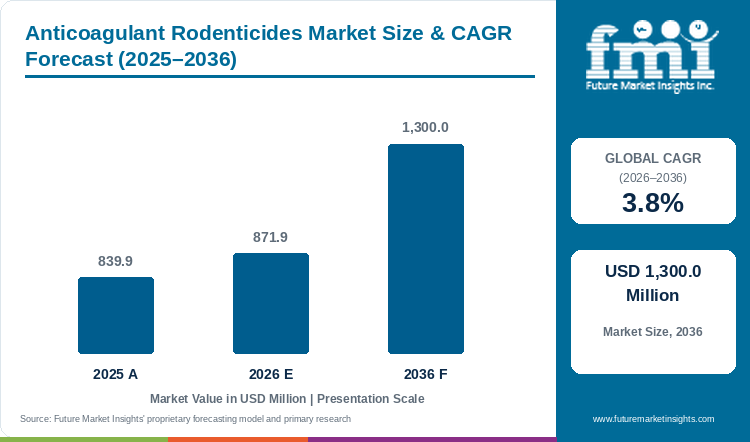
The market is projected to reach USD 1.3 billion by 2036, growing at a 3.8% CAGR from 2026 to 2036. The market is estimated at USD 871.9 million in 2026. The market was valued at USD 839.9 million in 2025. Access rules now decide who can buy. Since 1 January 2026, professional products in Great Britain go only to buyers with CRRU UK-approved training or CPD membership [2]. Germany's authorisation for preventive baiting without a confirmed infestation ends from 1 July 2026, with sell-off and use-up periods totalling one year before use is restricted to confirmed infestations [6].
Rules, not raw-material cost, now set the pace. Anticoagulant actives meet biocides exclusion criteria but stay on the market as essential, so each renewal faces a comparative assessment [4][8]. The Commission concluded in Implementing Decision (EU) 2024/816 that chemical alternatives cover only some uses and are not available in every Member State [5]. In the United States, second-generation products are limited to commercial and structural pest control [11].
Key Market Trends & Insights
- On 25 April 2025 the UK Health and Safety Executive announced that 41 second-generation anticoagulant rodenticide products had been amended. They cannot be used in open areas or around waste dumps. Purchase for those uses ended on 4 July 2024, and use became illegal on 1 January 2025 [2]. A November 2026 review by the Government Oversight Group found that the total quantity of second-generation products sold in the UK fell by almost half between 2016 and 2023 [3].
- On 5 March 2024 the European Commission adopted Implementing Decision (EU) 2024/816 on the second comparative assessment of anticoagulant rodenticide biocidal products [5]. Germany's environment agency states that preventive baiting is no longer authorised there from 1 July 2026 [6].
- On 22 November 2024 the US Environmental Protection Agency released its final biological evaluation of 11 rodenticide active ingredients [12]. On 19 May 2025 Syngenta and Neogen announced a licence giving Neogen exclusive US and Canadian rights to the Talon-G and Talon Weatherblok XT brodifacoum baits [14].
Regional Highlights
- Europe: preventive and open-area uses are being removed while professional baiting is kept. Great Britain closes open-area use of second-generation products from 1 January 2025 [2]. Germany ends authorisation of preventive baiting from 1 July 2026 [6].
- North America: EPA rules since 2008 keep consumer products to bait stations without second-generation actives. California extended its wildlife-habitat restrictions to the first-generation compound diphacinone through Chapter 836 of the 2023 statutes [11][13].
- Asia: Japan approves a single second-generation active as a pest-control quasi-drug. India recommends bromadiolone baits alongside zinc phosphide for field rodent management [9][10]. China runs a nationwide enforcement campaign on restricted pesticides from July 2026 to the end of March 2027 [25].
Anticoagulant Rodenticides Market Size and Forecast
Table 1: Anticoagulant Rodenticides Market Size and Forecast
| Market size and forecast | Value |
|---|---|
| Market size in 2025 | USD 839.9 million |
| Estimated market size in 2026 | USD 871.9 million |
| Projected market size by 2036 | USD 1.3 billion |
| CAGR from 2026 to 2036 | 3.8% |
Source: Future Market Insights analysis of the anticoagulant rodenticides market, 2026.
Analyst Perspective
“Anticoagulant baits remain the workhorse of rodent control because chemical baiting is still the most practical option for farms, stores and large sites. Growth over the decade depends less on new active substances than on who is allowed to sell and use the existing ones. Buyers should expect more certification checks at the counter, fewer open-area uses and more mixed programmes that combine bait stations with traps and monitoring. Suppliers with documented training, clear labels and reliable access to technical material will hold share as licensing tightens.”
- Nikhil Kaitwade, Principal Consultant, FMI
How is the Anticoagulant Rodenticides Market segmented?
- By product type: 1st Gen and 2nd Gen
- By form: Pellets, Blocks and Powder/Spray
- By application: Agriculture, Pest Control Companies, Warehouses, Urban Centers, Household and Others
- By region: North America, Europe and Asia Pacific
Why does 1st Gen lead by Product Type in the Anticoagulant Rodenticides Market in 2026?
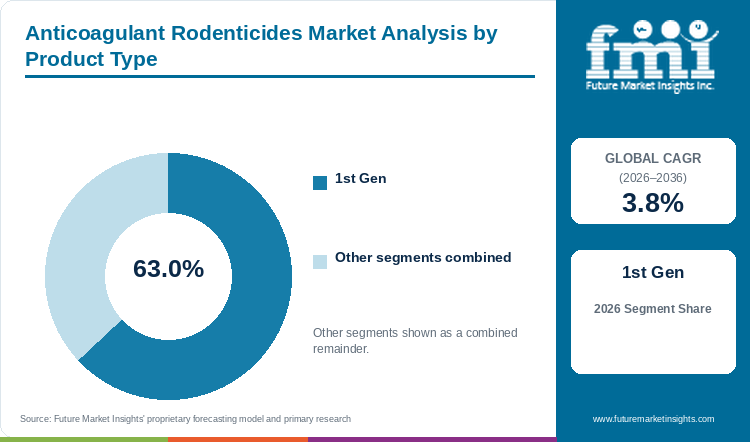
1st Gen is estimated to account for 63.0% of the Anticoagulant Rodenticides Market by product type in 2026. Access is the main reason. EPA rules mean consumer products no longer contain brodifacoum, bromadiolone, difenacoum or difethialone. The consumer bait-station actives named by the agency are bromethalin, chlorophacinone and diphacinone [11]. Retail and farm channels include many first-generation products. Neogen's Ramik line, which uses diphacinone, is sold in pellets, place packs, bars and mini-bars for uses from livestock and poultry production to residential mouse control [15]. Regulation outside the United States points the same way for general users. In Japan, warfarin and coumatetralyl are among the main first-generation ingredients in pest-control quasi-drugs. Difethialone is the single second-generation active approved in that category [9]. The lead is not secure. Roof rats resistant to first-generation compounds were confirmed in Japan in 1981, and brown rats in 2005 [9]. Resistance has spread through large cities such as Tokyo [9]. California's Chapter 836 of the 2023 statutes added diphacinone to the wildlife-habitat prohibition that already covered second-generation products [13]. Neogen limits Ramik diphacinone sales in California to licensed pest control dealers from 1 January 2024 [15]. Where resistance or wildlife rules bite, buyers move to second-generation or non-anticoagulant options. Consumer-facing baits also sit within the wider home and garden pesticides category.
Table 2: Product Type, 2026 Share
| Leading Share | 2026 market share |
|---|---|
| 1st Gen | 63.0% |
| All Other Segments Combined Share | 37.0% |
Source: Future Market Insights analysis of the anticoagulant rodenticides market, 2026.
Why do Pellets lead by Form in the Anticoagulant Rodenticides Market in 2026?
Pellets are estimated to account for 49.0% of the Anticoagulant Rodenticides Market by form in 2026. Pellets suit bulk professional and agricultural work, where applicators fill stations or burrows from a pail. Bell Laboratories describes Contrac Rodenticide as a highly compressed pelleted bromadiolone bait. It resists mold and moisture and is packed in bulk in a pail, suited to burrow baiting [17]. Rules also shape the split. EPA allows professional products to use block, paste or pelleted bait. Consumer products may not be pelleted and must be sold with bait stations [11]. That keeps pellets in the professional and farm channel, where volumes per order are larger. Neogen lists pellets among the forms of its Ramik line for livestock and poultry production [15]. Blocks are the main alternative. Bell Laboratories makes Contrac All-Weather Blox with a hole for bait-securing rods. BASF supplies Storm Ultra Secure as 25 g blocks. Syngenta's Talon Weatherblok XT is a brodifacoum block now marketed in the United States and Canada by Neogen [14][16][18]. In Europe, the Commission notes that direct application of ready-to-use bait into burrows is allowed only where authorised [5]. That limits loose pellet use outdoors. Bulk pails and refill packs for these baits link the segment to pesticides packaging demand.
Table 3: Form, 2026 Share
| Leading Share | 2026 market share |
|---|---|
| Pellets | 49.0% |
| All Other Segments Combined Share | 51.0% |
Source: Future Market Insights analysis of the anticoagulant rodenticides market, 2026.
Why does Agriculture lead by Application in the Anticoagulant Rodenticides Market in 2026?
Agriculture is estimated to account for 34.0% of the Anticoagulant Rodenticides Market by application in 2026. Rodents cause 2 to 15% losses to crops before harvest and up to 5% in storage, according to scientists at India's Central Arid Zone Research Institute. They describe chemical control as the cheapest and most feasible option [10]. That loss rate gives farms and grain stores a direct financial reason to bait. Product labelling follows the same pattern. Neogen lists livestock and poultry production among the applications of its Ramik range and names Norway rats, roof rats, house mice and meadow voles as targets [15]. Kalyani Industries recommends its bromadiolone 0.005 percent bait for poultry farms, sugarcane, wheat, gram, paddy, coconut or bamboo and groundnut [21]. Rules also restrict farm use. In Great Britain, use of any second-generation anticoagulant in open areas and around waste dumps has been illegal since 1 January 2025 [2].
Table 4: Application, 2026 Share
| Leading Share | 2026 market share |
|---|---|
| Agriculture | 34.0% |
| All Other Segments Combined Share | 66.0% |
Source: Future Market Insights analysis of the anticoagulant rodenticides market, 2026.
What are the key drivers, restraints and opportunities?
Driver
Crop and stored-grain losses. Rodents cause 2 to 15% losses to crops at the pre-harvest stage and up to 5% in storage. A paper from India's Central Arid Zone Research Institute gives these figures [10]. It recommends 2 to 2.5% zinc phosphide bait in fields, followed by bromadiolone at 0.005 percent for surviving rodents, and bromadiolone alone for indoor use [10]. Producers of cakes and concentrates, such as Heranba and Kalyani, sell into this follow-up use [20][21]. For another stored-grain pest tool, see agricultural fumigants.
Professional-only supply. Regulators are not removing anticoagulants but concentrating them with trained users. Germany allows second-generation products only for trained professional users and excludes the public [7]. In Great Britain, CRRU UK membership has been mandatory since 1 April 2016 for companies supplying professional anticoagulant products [1]. Proof of training or CPD membership has been required at the counter since 1 January 2026 [2].
Restraint
Wildlife exposure. The US Environmental Protection Agency's final biological evaluation was released on 22 November 2024. It found no effect on 88% of species and 95% of critical habitats from labelled uses of 11 rodenticide active ingredients [12]. It estimated that 1 to 8% of protected species and 4% of critical habitats are likely to be adversely affected [12]. In Great Britain, the Government Oversight Group's November 2026 review found that exposure levels in sentinel species have stayed static, not falling as expected [3]. It also found that predatory bird monitoring has not been updated since 2022 because of avian influenza [3]. Evidence of this kind leads regulators to narrow uses.
Preventive baiting and non-chemical substitution. Germany's environment agency states that preventive baiting is no longer authorised from 1 July 2026 [6]. It recommends integrated pest management with digital monitoring and traps instead [6]. The European Commission concluded that mechanical traps meeting the NoCheRo criteria present a significantly lower overall risk for mice inside buildings [5]. On 20 October 2026 Rentokil launched Eliminair, a rodenticide-free multi-catch rat control system, in the UK [22].
Opportunity
Resistance-breaking and lower-dose products. BASF lists Storm Ultra Secure at 0.0025 percent flocoumafen, reduced from 50 to 25 parts per million [18]. BASF says it is effective against anticoagulant-resistant rats and mice [18]. A September 2023 article reports that only one second-generation active is approved as a pest-control quasi-drug in Japan, and that professional operators lack stronger products [9]. Formulators with a documented dose and resistance case have room to place premium baits.
Licensed distribution. As supply narrows to certified users, control of the channel matters more. Syngenta and Neogen announced on 19 May 2025 a licence giving Neogen exclusive rights to market and sell Talon-G and Talon Weatherblok XT in the United States and Canada [14]. Neogen sells its diphacinone line in California only through licensed pest control dealers [15]. For the wider category, see rodent control pesticides.
Anticoagulant Rodenticides Market by Country (2026 to 2036)
Table 5: Anticoagulant Rodenticides Market Country Growth Forecast
| Country | CAGR, 2026 to 2036 |
|---|---|
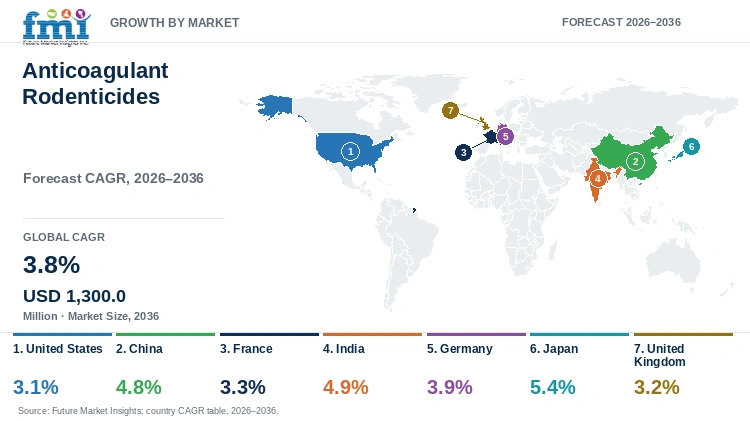
| United States | 3.1% |
| China | 4.8% |
| France | 3.3% |
| India | 4.9% |
| Germany | 3.9% |
| Japan | 5.4% |
| United Kingdom | 3.2% |
Source: Future Market Insights analysis of the anticoagulant rodenticides market, 2026.
United States
The EPA's 2008 risk mitigation decision still defines the market [11]. Consumer rodenticides must be sold with bait stations and contain block or paste bait, and loose forms are not permitted [11]. Brodifacoum, bromadiolone, difenacoum and difethialone can no longer be sold in consumer products, although professionals may use them [11]. Professional products may be block, paste or pelleted [11]. Tamper-resistant stations are required where children, pets or wildlife may reach the bait, and for all above-ground outdoor use [11].
Wildlife review is the next layer. On 22 November 2024 the EPA released its final biological evaluation for 11 active ingredients, including brodifacoum, bromadiolone, difenacoum, difethialone, chlorophacinone and diphacinone [12]. The agency said the strategy itself imposes no requirements. Mitigation will be chosen as each rodenticide goes through registration review [12]. California has gone further. Chapter 836 of the 2023 statutes, approved on 13 October 2023, extended the second-generation wildlife-habitat prohibition to diphacinone [13]. AB 2552 then prohibited most uses of chlorophacinone and warfarin from 1 January 2025 [27].
Supply is consolidating around licensed channels. Syngenta and Neogen announced on 19 May 2025 that Neogen would hold exclusive US and Canadian rights to Talon-G and Talon Weatherblok XT [14]. Bell Laboratories supplies Contrac in pellets and blocks to pest professionals [16][17]. Consumer anticoagulant products in the United States use first-generation bait stations [11], and bromethalin, a non-anticoagulant, is also a consumer option [11]. The United States has the lowest forecast growth of the seven profiled countries, at 3.1%.
China
China is both a producer and a tightly controlled market. Siyang Rodenticide Factory is a state-designated maker of technical brodifacoum and bromadiolone [23]. It says China's original five technical rodenticide producers were reduced to two after policy changes between 2005 and 2008 [23]. It also says bromadiolone and brodifacoum are on the 2015 list of hypertoxic chemicals [23].
Enforcement has tightened in 2026. The Ministry of Agriculture and Rural Affairs issued a notice dated 19 March 2026. It concerns concentrated action against illegal production, sale and use of prohibited and restricted pesticides [24]. On 10 July 2026 seven ministries launched a campaign covering production, trading, online sales and use [25]. It runs from July 2026 to the end of March 2027 [25]. It requires restricted pesticides to be sold through dedicated counters [25]. The ministries also issued the national pesticide industry plan for the 15th Five-Year period on 23 October 2026 [26].
Siyang says it has suspended business operations from July 2026 to the end of March 2027 under the campaign [23]. It will restart enquiries in April 2027 or later [23]. Importers and formulators that rely on Chinese technical material should plan for constrained supply until at least April 2027.
France
France applies the EU framework with its own conditions on use. A ministerial reply published on 25 February 2020 recorded eight anticoagulant active substances that meet exclusion criteria of the European biocides rules [8]. They are bromadiolone, difenacoum, brodifacoum, chlorophacinone, coumatetralyl, difethialone, flocoumafen and warfarin [8]. They were re-approved in 2017 because of their wide use against pest rodents [8].
The reply also set out the position on permanent baiting. Bromadiolone and difenacoum may be used for permanent baiting under the EU approval conditions [8]. ANSES had not extended that use to products, and it wrote the non-authorisation into renewed marketing authorisations [8]. Germany's environment agency lists France among EU states where preventive baiting has been prohibited, in part for many years [6].
French rodenticide authorisations therefore depend on derogation from the exclusion criteria. They also depend on the outcome of the EU-level comparative assessment set out in Implementing Decision (EU) 2024/816 of 5 March 2024 [5][8]. Suppliers should plan for renewals that stay conditional on that assessment. Buyers that favour curative baiting over permanent stations also matter here.
India
Rodent control in India is led by farm and grain-store use. A paper in Indian Farming, from the Central Arid Zone Research Institute, describes rodent losses. Rodents cause 2 to 15% losses to crops before harvest and up to 5% in storage [10]. It recommends 2 to 2.5% zinc phosphide in cereal bait in fields, followed by bromadiolone at 0.005 percent for surviving rodents [10]. Indoors, it recommends only bromadiolone at 0.005 percent [10].
Domestic manufacturers sell into that recommendation. Heranba lists Rat Kill, a bromadiolone 0.005 percent cake described as a single-dose anticoagulant rodenticide, in 25 g and 100 g pouches [20]. Kalyani Industries lists Kalrat RB, a 40 g bromadiolone 0.005 percent cake [21]. It also lists a 0.25 percent bromadiolone powder concentrate, alongside zinc phosphide 80% [21].
The mix shows how anticoagulants are used in India: as the second step after an acute treatment, or as a single-dose bait in houses, poultry farms and stores. Local makers that sell both small consumer packs and bulk concentrates can serve both channels.
Germany
Germany restricts anticoagulants by user. The Federal Environment Agency states that second-generation rodenticides may be used only by trained professional users [7]. The general public is excluded, and professionals without proof of competence may not use them [7]. Use without a prior infestation has been generally prohibited since 2014 [6]. A narrow exception applies to preventive baiting at hygiene-critical sites such as food plants [6].
That exception ends. The agency states that rodenticides are no longer authorised for preventive baiting from 1 July 2026 [6]. After sell-off and use-up periods totalling one year, they may be placed only after an infestation has been confirmed [6]. Weekly checks of bait points apply [6]. The agency names difenacoum and bromadiolone as the active substances used for the exception [6]. It cites toxicity to all vertebrates, persistence and resistance as reasons [6].
The agency points operators to integrated pest management, remote monitoring and traps. It notes that food-industry standards such as AIB International argue against rodenticide use in food plants [6]. Demand in German food premises should shift toward monitoring contracts with infestation-triggered baiting.
Japan
Japan regulates rodenticides through separate ministries and laws. A September 2023 article by Satoru Nagaoka of Daimaru Gosei Yakuhin, in the journal Life and Environment, explains the framework [9]. Pest-control quasi-drugs fall under the Pharmaceuticals and Medical Devices Act through the Ministry of Health, Labour and Welfare [9]. Animal quasi-drugs fall under the same Act through the Ministry of Agriculture, Forestry and Fisheries [9]. Agrochemicals fall under the Agricultural Chemicals Regulation Act [9].
The active ingredient list is short. Warfarin and coumatetralyl are first-generation actives used as pest-control quasi-drugs [9]. Diphacinone is used as an agrochemical [9]. Difethialone is the single second-generation active approved as a pest-control quasi-drug [9]. Bromadiolone is approved as an animal quasi-drug [9]. The author notes there is no restricted-use category, so consumers and professional pest controllers use the same products [9]. Professionals also lack high-concentration products for difficult sites [9].
Resistance adds pressure. Resistance to first-generation compounds was confirmed in roof rats in 1981 and in brown rats in 2005, and it has spread in large cities [9]. The domestic shipment value of pest-control quasi-drug rodenticides has fallen year after year [9]. Japan has the highest forecast rate of the seven countries, at 5.4%. The author's proposed professional category is one route to higher-value baits.
United Kingdom
Great Britain runs one of the most established stewardship schemes in the market. HSE states that CRRU UK membership became mandatory on 1 April 2016 for companies supplying professional anticoagulant rodenticides [1]. It states that the scheme was extended to cholecalciferol products in September 2020 [1]. The Government Oversight Group's November 2026 review concluded that CRRU UK has met its assessment criteria [3]. It found that the total quantity of second-generation products sold in the UK fell by almost half between 2016 and 2023 [3].
Rules have narrowed use since 2024. HSE amended 41 second-generation products so they cannot be used in open areas or around waste dumps [2]. Purchase for those uses ended on 4 July 2024, and use became illegal on 1 January 2025 [2]. Since 1 January 2026, professional products are supplied only to buyers who show CRRU UK-approved training or approved CPD membership [2].
The wildlife problem is not solved. The review states that exposure levels in sentinel species have stayed static, not falling [3]. It also states that brodifacoum sales were broadly similar between 2016 and 2023, while some barn owl residue measures rose [3]. HSE is also assessing renewals of anticoagulant rodenticide products against alternatives under the GB Biocidal Products Regulation [4]. With a narrower buyer base, suppliers should check certification before accepting orders.
Who are the notable companies in the Anticoagulant Rodenticides Market?
Notable companies in the Anticoagulant Rodenticides Market include BASF, Syngenta, PelGar International, Rentokil Initial plc, Bell Laboratories, Kalyani Industries Limited, Heranba Industries Ltd. and NEOGEN Corporation.
The sharpest line between competitors is who is allowed to reach the buyer, since that now depends more on regulation than on price. Branded professional baits come from BASF, Syngenta and Bell Laboratories, which sell through trained-user channels. Neogen holds exclusive rights to Talon-G and Talon Weatherblok XT in the United States and Canada [14]. The rights come from a licence announced with Syngenta on 19 May 2025 [14]. Neogen also sells its own diphacinone line [15]. PelGar International sells rodenticide concentrates and finished baits under brands including Roban, Rodex, Vertox and Brigand [19]. It says availability varies by country with local registration [19].
Active substance choice separates the offers. BASF markets flocoumafen in Storm Ultra Secure at 0.0025 percent, reduced from 50 to 25 parts per million [18]. Syngenta's Talon products are brodifacoum baits [14]. Bell Laboratories sells bromadiolone as Contrac pellets and Blox [16][17], and PelGar lists difenacoum, bromadiolone and brodifacoum [19]. Neogen's Ramik line uses diphacinone, a first-generation active [15]. In Great Britain, the review notes that brodifacoum sales stayed broadly level over 2016 to 2023 [3]. Bromadiolone and difenacoum sales fell over the same period [3]. Regional product mix is therefore moving too.
Indian makers compete on pack size and price in a different channel. Heranba sells Rat Kill bromadiolone cake in 25 g and 100 g pouches [20]. Kalyani Industries lists cake, powder concentrate and zinc phosphide products [21]. Service providers shape demand from the other side. On 20 October 2026 Rentokil, which describes itself as a global leader in pest control, launched Eliminair, a rodenticide-free system, in the UK [22]. A global launch is planned for 2027 [22]. The launch shows service providers investing in alternatives to bait.
Key Developments in the Anticoagulant Rodenticides Market
- Syngenta and Neogen Corporation announced a licensing and supply agreement on 19 May 2025. It gives Neogen exclusive rights to market and sell Talon-G and Talon Weatherblok XT brodifacoum rodenticides in the United States and Canada [14].
- From 1 January 2024, Neogen limited sales of its Ramik diphacinone products in California to licensed pest control dealers. This is in line with California's AB 1322 [15].
- On 20 October 2026, Rentokil Initial plc launched Eliminair in the UK [22]. The multi-catch rodent control system uses no rodenticide, and a global launch is planned for 2027 [22].
- On 1 January 2026, new UK rules took effect. Professional rodenticide products are supplied only to buyers who show CRRU UK-approved training or approved CPD scheme membership [2]. The rule affects every supplier of professional products in Great Britain [2].
Key Players in the Anticoagulant Rodenticides Market
- BASF
- Syngenta
- PelGar International
- Rentokil Initial plc
- Bell Laboratories
- Kalyani Industries Limited
- Heranba Industries Ltd.
- NEOGEN Corporation
Anticoagulant Rodenticides Market Report Scope
Table 6: Anticoagulant Rodenticides Market Report Scope
| Coverage field | Report scope |
|---|---|
| Market definition | Anticoagulant rodenticides (first- and second-generation baits and concentrates) for rats and mice, measured by value of sales to end-use applications |
| Product Type | 1st Gen and 2nd Gen |
| Form | Pellets, Blocks and Powder/Spray |
| Application | Agriculture, Pest Control Companies, Warehouses, Urban Centers, Household and Others |
| Regions and profiled countries | North America, Europe and Asia Pacific (United States, China, France, India, Germany, Japan and United Kingdom) |
| Companies covered | BASF, Syngenta, PelGar International, Rentokil Initial plc, Bell Laboratories, Kalyani Industries Limited, Heranba Industries Ltd. and NEOGEN Corporation |
| Forecast period | 2026 to 2036, with 2025 as the historical base year |
| Quantitative Units | USD million |
Source: Future Market Insights analysis of the anticoagulant rodenticides market, 2026.
Anticoagulant Rodenticides Market by Segments
Anticoagulant Rodenticides Market segmented by Product Type:
- 1st Gen
- 2nd Gen
Anticoagulant Rodenticides Market segmented by Form:
- Pellets
- Blocks
- Powder/Spray
Anticoagulant Rodenticides Market segmented by Application:
- Agriculture
- Pest Control Companies
- Warehouses
- Urban Centers
- Household
- Others
Anticoagulant Rodenticides Market by Region
- North America
- Europe
- Asia Pacific
- United States
- China
- France
- India
- Germany
- Japan
- United Kingdom
Research Sources and Bibliography
- [1] Health and Safety Executive. (2026, November 2). How rodenticide stewardship helps reduce risk. https://www.hse.gov.uk/biocides/using/rodenticides-stewardship.htm
- [2] Health and Safety Executive. (2025, April 25). Biocides: Changes to authorised anticoagulant rodenticide uses (HSE Biocides ebulletin). https://content.govdelivery.com/accounts/UKHSE/bulletins/3dd4365
- [3] Government Oversight Group for Rodenticide Stewardship. (2026, November). Review and recommendations for strengthening the CRRU UK regime. https://www.hse.gov.uk/biocides/assets/docs/government-oversight-group-review-and-recommendations.pdf
- [4] Health and Safety Executive. (n.d.). GB Biocidal Products Regulation (GB BPR): Anticoagulant rodenticide product renewals, assessment of alternatives (public consultation). https://consultations.hse.gov.uk/crd-biocides/gb-bpr-anticoagulant-rodenticides/
- [5] European Commission. (2024, March 5). Commission Implementing Decision (EU) 2024/816 addressing questions regarding the second comparative assessment of anticoagulant rodenticide biocidal products. https://eur-lex.europa.eu/eli/dec_impl/2024/816/oj
- [6] Umweltbundesamt. (2026, October 2). Was ist eine befallsunabhaengige Dauerbekoederung und warum wird sie in Deutschland nicht mehr zugelassen? https://www.umweltbundesamt.de/service/uba-fragen/was-ist-eine-befallsunabhaengige-dauerbekoederung
- [7] Umweltbundesamt. (2026, October 2). Welche Risikominderungsmassnahmen gelten fuer Antikoagulanzien der 2. Generation? https://www.umweltbundesamt.de/service/uba-fragen/welche-risikominderungsmassnahmen-gelten-fuer-0
- [8] Assemblee nationale. (2020, February 25). Reponse a la question ecrite n. 21468, Situation des entreprises de deratisation. https://questions.assemblee-nationale.fr/dyn/15/questions/QANR5L15QE21468.pdf
- [9] Nagaoka, S. (2023, September). Kaigai to hikaku shita Nihon ni okeru sasso-zai no genjo (The state of rodenticides in Japan compared with overseas). Life and Environment, 68(5), Japan Environmental Sanitation Center. https://www.jesc.or.jp/Portals/0/center/library/seikatsu%20to%20kankyo/202309_Nagaoka.pdf
- [10] Tripathi, R. S., & Chaudhary, V. (2018, October 29). Rodent management in arid regions. Indian Farming, 68(9). https://epubs.icar.org.in/index.php/IndFarm/article/view/84425
- [11] U.S. Environmental Protection Agency. (2026, September 8). Restrictions on Rodenticide Products. https://www.epa.gov/rodenticides/restrictions-rodenticide-products
- [12] U.S. Environmental Protection Agency. (2024, November 22). EPA releases rodenticide strategy including final biological evaluation of effects on 11 rodenticides. https://epa.gov/pesticides/epa-releases-rodenticide-strategy-including-final-biological-evaluation-effects-11
- [13] California Legislature. (2023, October 13). AB 1322, Pesticides: second-generation anticoagulant rodenticide: diphacinone (Chapter 836, Statutes of 2023). https://calmatters.digitaldemocracy.org/bills/ca_202320240ab1322
- [14] Syngenta Professional Pest Management. (2025, May 19). Syngenta and Neogen announce strategic licensing and supply agreement for Talon-G and Talon Weatherblok XT rodenticides. https://www.syngentapmp.com/articles/newsarticle.aspx?paid=229842
- [15] Neogen Corporation. (n.d.). Ramik Green rodenticide bait. https://www.neogen.com/en/categories/rodent-control/ramik-green/
- [16] Bell Laboratories, Inc. (2023, September 19). CONTRAC All-Weather BLOX. https://www.belllabs.com/products/us/pest-control/contrac-all-weather-blox/
- [17] Bell Laboratories, Inc. (2023, September 19). CONTRAC Rodenticide. https://www.belllabs.com/products/us/pest-control/contrac-rodenticide/
- [18] BASF Professional and Specialty Solutions. (n.d.). Storm Ultra Secure (Great Britain). https://pest-control.basf.com/gb/en/products/rodenticides/storm-ultra-secure
- [19] PelGar International. (n.d.). Rodent control. https://www.pelgar.co.uk/49/420/rodent-control
- [20] Heranba Industries Limited. (n.d.). Rat Kill (Bromadiolone 0.005 percent cake), Public Health, Rodenticide. https://www.heranba.com/public-health?category=RODENTICIDE
- [21] Kalyani Industries Limited. (n.d.). Rodenticide: Bromadiolone 0.005 percent RB, Bromadiolone 0.25 percent CB and Zinc Phosphide. https://www.kalyanicare.in/rodenticide.html
- [22] Rentokil Initial plc. (2026, October 20). Rentokil revolutionises rodent control with launch of Eliminair. https://www.rentokil-initial.com/media/news-releases/2026/eliminair.aspx
- [23] Siyang Rodenticide Factory. (2026, November 4). Contact and regulatory notes. https://www.rodenticide.com.cn/contact
- [24] Ministry of Agriculture and Rural Affairs of China. (2026, March 19). Notice of the General Office on concentrated action against illegal production, sale and use of prohibited and restricted pesticides. https://www.moa.gov.cn/ztzl/2026ncgjxs/gzbs_30197/202604/t20260401_6482858.htm
- [25] Xinhua. (2026, July 10). Seven ministries launch campaign to further regulate production, sale and use of pesticides and veterinary drugs. https://www.news.cn/20260710/9f68825bd7014fdfabcda507eb0f8c72/c.html
- [26] Ministry of Agriculture and Rural Affairs of China. (2026, October 23). Notice on issuing the National Pesticide Industry Development Plan for the 15th Five-Year Plan period. https://www.moa.gov.cn/govpublic/ZZYGLS/202611/t20261103_6489156.htm
- [27] California Department of Pesticide Regulation. (n.d.). Chlorophacinone and warfarin: restricted material status, prohibitions, allowed uses, and questions and answers. https://www.cdpr.ca.gov/cac-letter/chlorophacinone-and-warfarin-restricted-material-status-prohibitions-allowed-uses-and-questions-and-answers/
Table of Content
Table of Content
- Key Takeaways
- Market Size and CAGR
- Top Growth Driver
- Fastest Growing Segment
- Leading Region
- Key Companies
- Emerging Opportunities
- Executive Summary
- Global Market Outlook
- Demand-side Trends
- Supply-side Trends
- Technology Roadmap Analysis
- Analysis and Recommendations
- Analyst Perspective (What is happening? Why now? What should investors know?)
- Key Questions Answered
- How large is the market?
- What is the CAGR?
- What are key trends?
- Which region dominates?
- Who are the leaders?
Read More...
- Market Overview
- Market Coverage / Taxonomy
- Market Definition / Scope / Limitations
- Research Methodology
- Chapter Orientation
- Analytical Lens and Working Hypotheses
- Market Structure, Signals, and Trend Drivers
- Benchmarking and Cross-market Comparability
- Market Sizing, Forecasting, and Opportunity Mapping
- Research Design and Evidence Framework
- Desk Research Programme (Secondary Evidence)
- Expert Input and Fieldwork (Primary Evidence)
- Tooling, Models, and Reference Databases
- Data Engineering and Model Build
- Quality Assurance and Audit Trail
- Market Background
- Market Dynamics (Drivers, Restraints, Opportunity, Trends)
- Scenario Forecast (Optimistic, Likely, Conservative)
- Impact Analysis
- AI Impact
- Sustainability Impact
- Regulatory Impact
- Technology Impact
- Consumer / Buyer Analysis
- Purchase Drivers
- Adoption Barriers
- Buyer Journey
- Opportunity Map Analysis
- Product Life Cycle Analysis
- Supply Chain Analysis
- Investment Feasibility Matrix
- Value Chain Analysis
- PESTLE and Porter's Analysis
- Regulatory Landscape
- Regional Parent Market Outlook
- Production and Consumption Statistics
- Import and Export Statistics
- Global Market Analysis and Forecast, 2021 to 2036
- Historical Market Size Value (USD Million) Analysis, 2021 to 2025
- Current and Future Market Size Value (USD Million) Projections, 2026 to 2036
- Y-o-Y Growth Trend Analysis
- Absolute $ Opportunity Analysis
- Global Market Pricing Analysis, 2021 to 2036
- Global Market Analysis and Forecast, By Product Type, 2021 to 2036
- Introduction / Key Findings
- Historical Market Size Value (USD Million) Analysis By Product Type, 2021 to 2025
- Current and Future Market Size Value (USD Million) Analysis and Forecast By Product Type, 2026 to 2036
- 1st Gen
- 2nd Gen
- Y-o-Y Growth Trend Analysis By Product Type, 2021 to 2025
- Absolute $ Opportunity Analysis By Product Type, 2026 to 2036
- Global Market Analysis and Forecast, By Form, 2021 to 2036
- Introduction / Key Findings
- Historical Market Size Value (USD Million) Analysis By Form, 2021 to 2025
- Current and Future Market Size Value (USD Million) Analysis and Forecast By Form, 2026 to 2036
- Pellets
- Blocks
- Powder/Spray
- Y-o-Y Growth Trend Analysis By Form, 2021 to 2025
- Absolute $ Opportunity Analysis By Form, 2026 to 2036
- Global Market Analysis and Forecast, By Application, 2021 to 2036
- Introduction / Key Findings
- Historical Market Size Value (USD Million) Analysis By Application, 2021 to 2025
- Current and Future Market Size Value (USD Million) Analysis and Forecast By Application, 2026 to 2036
- Agriculture
- Pest Control Companies
- Warehouses
- Urban Centers
- Household
- Others
- Y-o-Y Growth Trend Analysis By Application, 2021 to 2025
- Absolute $ Opportunity Analysis By Application, 2026 to 2036
- Global Market Analysis and Forecast, By Region, 2021 to 2036
- Introduction
- Historical Market Size Value (USD Million) Analysis By Region, 2021 to 2025
- Current Market Size Value (USD Million) Analysis and Forecast By Region, 2026 to 2036
- North America
- Europe
- Asia Pacific
- Market Attractiveness Analysis By Region
- North America Market Analysis and Forecast, By Country, 2021 to 2036
- Historical Market Size Value (USD Million) Trend Analysis By Market Taxonomy, 2021 to 2025
- Market Size Value (USD Million) Forecast By Market Taxonomy, 2026 to 2036
- By Country
- By Product Type
- By Form
- By Application
- Market Attractiveness Analysis
- By Country
- By Product Type
- By Form
- By Application
- Key Takeaways
- Europe Market Analysis and Forecast, By Country
- Historical Market Size Value (USD Million) Trend Analysis By Market Taxonomy, 2021 to 2025
- Market Size Value (USD Million) Forecast By Market Taxonomy, 2026 to 2036
- By Country
- By Product Type
- By Form
- By Application
- Market Attractiveness Analysis
- By Country
- By Product Type
- By Form
- By Application
- Key Takeaways
- Asia Pacific Market Analysis and Forecast, By Country
- Historical Market Size Value (USD Million) Trend Analysis By Market Taxonomy, 2021 to 2025
- Market Size Value (USD Million) Forecast By Market Taxonomy, 2026 to 2036
- By Country
- United States
- China
- France
- India
- Germany
- Japan
- United Kingdom
- By Product Type
- By Form
- By Application
- By Country
- Market Attractiveness Analysis
- By Country
- By Product Type
- By Form
- By Application
- Key Takeaways
- Key Countries Market Analysis
- United States
- Pricing Analysis
- Market Share Analysis, 2025
- By Product Type
- By Form
- By Application
- Germany
- Pricing Analysis
- Market Share Analysis, 2025
- By Product Type
- By Form
- By Application
- United Kingdom
- Pricing Analysis
- Market Share Analysis, 2025
- By Product Type
- By Form
- By Application
- France
- Pricing Analysis
- Market Share Analysis, 2025
- By Product Type
- By Form
- By Application
- India
- Pricing Analysis
- Market Share Analysis, 2025
- By Product Type
- By Form
- By Application
- China
- Pricing Analysis
- Market Share Analysis, 2025
- By Product Type
- By Form
- By Application
- Japan
- Pricing Analysis
- Market Share Analysis, 2025
- By Product Type
- By Form
- By Application
- United States
- Market Structure Analysis
- Competition Dashboard
- Competition Benchmarking
- Market Share Analysis of Top Players
- By Regional
- By Product Type
- By Form
- By Application
- Emerging Startups
- Innovation Benchmarking
- Competition Analysis
- Competition Deep Dive
- BASF
- Overview
- Product Portfolio
- Profitability by Market Segments
- Sales Footprint
- Strategy Overview
- Marketing Strategy
- Product Strategy
- Channel Strategy
- Syngenta
- PelGar International
- Rentokil Initial plc
- Bell Laboratories
- Kalyani Industries Limited
- Heranba Industries Ltd.
- NEOGEN Corporation
- BASF
- Case Studies
- Success Stories
- Recent Developments
- Competition Deep Dive
- Assumptions & Acronyms Used
List of Tables
- Table 1: Global Market Value (USD Million) Forecast by Region, 2021 to 2036
- Table 2: Global Market Value (USD Million) Forecast by Product Type, 2021 to 2036
- Table 3: Global Market Value (USD Million) Forecast by Form, 2021 to 2036
- Table 4: Global Market Value (USD Million) Forecast by Application, 2021 to 2036
- Table 5: North America Market Value (USD Million) Forecast by Country, 2021 to 2036
- Table 6: North America Market Value (USD Million) Forecast by Product Type, 2021 to 2036
- Table 7: North America Market Value (USD Million) Forecast by Form, 2021 to 2036
- Table 8: North America Market Value (USD Million) Forecast by Application, 2021 to 2036
- Table 9: Europe Market Value (USD Million) Forecast by Country, 2021 to 2036
- Table 10: Europe Market Value (USD Million) Forecast by Product Type, 2021 to 2036
- Table 11: Europe Market Value (USD Million) Forecast by Form, 2021 to 2036
- Table 12: Europe Market Value (USD Million) Forecast by Application, 2021 to 2036
- Table 13: Asia Pacific Market Value (USD Million) Forecast by Country, 2021 to 2036
- Table 14: Asia Pacific Market Value (USD Million) Forecast by Product Type, 2021 to 2036
- Table 15: Asia Pacific Market Value (USD Million) Forecast by Form, 2021 to 2036
- Table 16: Asia Pacific Market Value (USD Million) Forecast by Application, 2021 to 2036
List of Figures
- Figure 1: Global Market Pricing Analysis
- Figure 2: Global Market Value (USD Million) Forecast 2021-2036
- Figure 3: Global Market Value Share and BPS Analysis by Product Type, 2026 and 2036
- Figure 4: Global Market Y-o-Y Growth Comparison by Product Type, 2026-2036
- Figure 5: Global Market Attractiveness Analysis by Product Type
- Figure 6: Global Market Value Share and BPS Analysis by Form, 2026 and 2036
- Figure 7: Global Market Y-o-Y Growth Comparison by Form, 2026-2036
- Figure 8: Global Market Attractiveness Analysis by Form
- Figure 9: Global Market Value Share and BPS Analysis by Application, 2026 and 2036
- Figure 10: Global Market Y-o-Y Growth Comparison by Application, 2026-2036
- Figure 11: Global Market Attractiveness Analysis by Application
- Figure 12: Global Market Value (USD Million) Share and BPS Analysis by Region, 2026 and 2036
- Figure 13: Global Market Y-o-Y Growth Comparison by Region, 2026-2036
- Figure 14: Global Market Attractiveness Analysis by Region
- Figure 15: North America Market Incremental Dollar Opportunity, 2026-2036
- Figure 16: Europe Market Incremental Dollar Opportunity, 2026-2036
- Figure 17: Asia Pacific Market Incremental Dollar Opportunity, 2026-2036
- Figure 18: North America Market Value Share and BPS Analysis by Country, 2026 and 2036
- Figure 19: North America Market Value Share and BPS Analysis by Product Type, 2026 and 2036
- Figure 20: North America Market Y-o-Y Growth Comparison by Product Type, 2026-2036
- Figure 21: North America Market Attractiveness Analysis by Product Type
- Figure 22: North America Market Value Share and BPS Analysis by Form, 2026 and 2036
- Figure 23: North America Market Y-o-Y Growth Comparison by Form, 2026-2036
- Figure 24: North America Market Attractiveness Analysis by Form
- Figure 25: North America Market Value Share and BPS Analysis by Application, 2026 and 2036
- Figure 26: North America Market Y-o-Y Growth Comparison by Application, 2026-2036
- Figure 27: North America Market Attractiveness Analysis by Application
- Figure 28: Europe Market Value Share and BPS Analysis by Country, 2026 and 2036
- Figure 29: Europe Market Value Share and BPS Analysis by Product Type, 2026 and 2036
- Figure 30: Europe Market Y-o-Y Growth Comparison by Product Type, 2026-2036
- Figure 31: Europe Market Attractiveness Analysis by Product Type
- Figure 32: Europe Market Value Share and BPS Analysis by Form, 2026 and 2036
- Figure 33: Europe Market Y-o-Y Growth Comparison by Form, 2026-2036
- Figure 34: Europe Market Attractiveness Analysis by Form
- Figure 35: Europe Market Value Share and BPS Analysis by Application, 2026 and 2036
- Figure 36: Europe Market Y-o-Y Growth Comparison by Application, 2026-2036
- Figure 37: Europe Market Attractiveness Analysis by Application
- Figure 38: Asia Pacific Market Value Share and BPS Analysis by Country, 2026 and 2036
- Figure 39: Asia Pacific Market Value Share and BPS Analysis by Product Type, 2026 and 2036
- Figure 40: Asia Pacific Market Y-o-Y Growth Comparison by Product Type, 2026-2036
- Figure 41: Asia Pacific Market Attractiveness Analysis by Product Type
- Figure 42: Asia Pacific Market Value Share and BPS Analysis by Form, 2026 and 2036
- Figure 43: Asia Pacific Market Y-o-Y Growth Comparison by Form, 2026-2036
- Figure 44: Asia Pacific Market Attractiveness Analysis by Form
- Figure 45: Asia Pacific Market Value Share and BPS Analysis by Application, 2026 and 2036
- Figure 46: Asia Pacific Market Y-o-Y Growth Comparison by Application, 2026-2036
- Figure 47: Asia Pacific Market Attractiveness Analysis by Application
- Figure 48: Global Market - Tier Structure Analysis
- Figure 49: Global Market - Company Share Analysis
Frequently Asked Questions
How big is the anticoagulant rodenticides market in 2026?
The Anticoagulant Rodenticides Market is estimated at USD 871.9 million in 2026, up from USD 839.9 million in 2025. It is projected to reach USD 1.3 billion by 2036, a 3.8% CAGR from 2026 to 2036.
Which application leads the anticoagulant rodenticides market?
Agriculture leads with 34.0% of the market in 2026. Rodents cause 2 to 15% losses to crops before harvest and up to 5% in storage [10]. Scientists at India's Central Arid Zone Research Institute make that case [10]. Farm-focused labels such as Neogen's Ramik name livestock and poultry production among their uses [15].
Which other product types and forms matter?
By product type, 1st Gen holds 63.0% and 2nd Gen 37.0%. By form, pellets hold 49.0%, blocks 29.0% and powder or spray 22.0%. EPA rules keep second-generation actives out of consumer products and do not allow pelleted bait in them, which explains much of the split [11].
Which profiled country is forecast to grow fastest?
Japan has the highest forecast CAGR of the seven profiled countries, at 5.4% from 2026 to 2036. India follows at 4.9%, China at 4.8%, Germany at 3.9%, France at 3.3%, the United Kingdom at 3.2% and the United States at 3.1%. Japan approves only one second-generation active as a pest-control quasi-drug and has no restricted-use category for professionals [9].
Which rule changes affect supply in 2026?
In Great Britain, professional rodenticides have been supplied only to buyers with CRRU UK-approved training or approved CPD membership since 1 January 2026 [2]. In Germany, preventive baiting is no longer authorised from 1 July 2026, with sell-off and use-up periods totalling one year [6]. In China, a nationwide enforcement campaign on restricted pesticides runs from July 2026 to the end of March 2027 [25].
What should a buyer check before choosing a product?
Check the active substance and generation first, because consumer and professional channels differ by country [7][11]. Then confirm three things. The buyer must hold the required certification. The form (pellet, block or concentrate) must be authorised for the site. The supplier must be the registrant or a licensed distributor. The Neogen and Syngenta arrangement for Talon in the United States and Canada is one example [14].
Preview the report firsthand - request a free sample
Get SampleGet the brochure for pricing and purchase details.
Get PDF
