

- Market Size (2026)
- USD 73.49 Mn
- Forecast (2036)
- USD 132.16 Mn
- CAGR (2026 to 2036)
- 6.04%
How big is the Aprepitant market in 2026?
USD 73.49 million in 2026 and USD 132.16 million by 2036 at a 6.04% CAGR.
The aprepitant market value is anticipated to grow from USD 68.94 million in 2025 and USD 73.49 million in 2026 to USD 132.16 million by 2036, reflecting a 6.04% CAGR from 2026 to 2036, influenced by repeat oncology supportive-care use and regulated finished-dose supply. Chemotherapy-induced nausea and vomiting is forecast to account for 82.5% share in 2026, while powder form is projected to hold 76.0% share in 2026 through routine capsule blending and repeat batch planning.
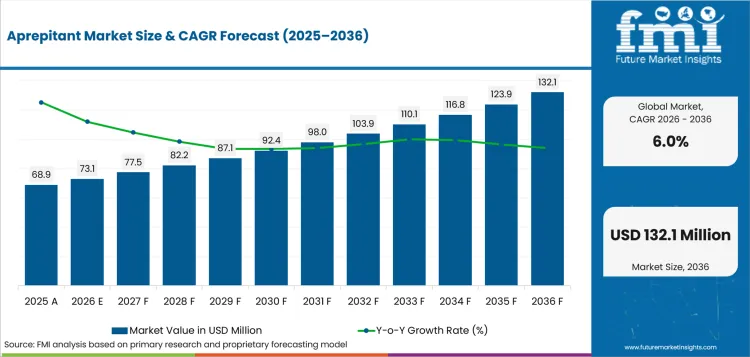
| 2025 Market Size | USD 68.94 million |
|---|---|
| 2026 Market Size | USD 73.49 million |
| 2036 Market Size | USD 132.16 million |
| Forecast CAGR (2026-2036) | 6.04% |
| Leading Application | Chemotherapy-Induced Nausea and Vomiting |
| Chemotherapy-Induced Nausea and Vomiting Share (2026) | 82.5% |
| Leading Form | Powder |
| Powder Share (2026) | 76.0% |
| Fastest-growing Country | India |
| India Forecast CAGR | 7.2% from 2026 to 2036 |
Summary of the Aprepitant Market
- Demand and Growth Drivers
- Oncology supportive-care protocols create repeat active pharmaceutical ingredient demand across chemotherapy schedules. This makes supplier qualification, regulatory documentation, and continuity of supply important for buyers.
- Generic capsule suppliers need stable aprepitant sourcing for regulated-market product maintenance and batch continuity. Procurement teams therefore look for evidence of quality consistency, audit readiness, and reliable batch support.
- Cancer-care access in India and China supports wider generic supportive-care use across hospitals and finished-dose manufacturers.
- Product and Segment View
- Chemotherapy-induced nausea and vomiting is forecast to hold 82.5% share in 2026, supported by repeat chemotherapy-cycle use.
- Powder form is projected to secure 76.0% share in 2026, guided by routine blending and capsule manufacturing needs.
- The >=99.5% purity grade is expected to represent 68.5% share in 2026, supported by impurity control and audit files.
- Geography and Competitive Outlook
- India is projected to record 7.2% CAGR by 2036, backed by synthesis depth and export-oriented active ingredient manufacturing.
- China is expected to expand at 6.9% CAGR by 2036, supported by oncology treatment scale and domestic formulation demand.
- MSN Laboratories, Laurus Labs, Hetero Drugs, Dr. Reddy's Laboratories, and Aurobindo Pharma compete based on synthesis depth and regulated-market documentation.
- Optimus Drugs, Biophore, MetroChem API, Shandong Anxin Pharmaceutical, and Torrent Pharmaceuticals compete depending on particle control and finished-dose customer access.
- Analyst Opinion
- Anurag Sharma, Principal Consultant for Healthcare at FMI, says, “Aprepitant active pharmaceutical ingredient is a narrow but demanding market. Demand is concentrated in oncology protocols, so buyers care less about general nausea claims and more about reliable capsule supply. Supplier approval starts with impurity control and documentation depth. Powder remains the main working grade since capsule routes dominate finished-dose manufacturing. Micronized grades gain value for formulation teams needing tighter dissolution behavior. Suppliers with strong batch history and audit support can protect long-term supply positions.”
Oral oncology-supportive supply planning is shaped by label discipline, generic activity, and active pharmaceutical ingredient documentation. DailyMed revised aprepitant capsule labeling in June 2026, listing 125 mg on Day 1 and 80 mg on Days 2 and 3 for chemotherapy-induced nausea and vomiting. FDA’s generic medicines program recorded 689 approvals and 462 drug master file completeness assessments in fiscal 2025. FDA’s generic-drug office also states that generics account for more than 90% of prescriptions filled in the United States. High-purity powder suppliers with audit-ready drug master file support are positioned to gain stronger buyer preference.
Which factors support expansion in the Aprepitant market?
Finished oral capsule demand and regulated active ingredient sourcing support market value.
- Market value is supported by commercial aprepitant active pharmaceutical ingredient sales before distributor margins and finished-dose pharmacy revenue.
- Supplier pricing reflects assay control and documentation depth before capsule manufacturing costs are added.
- Revenue improves as finished-dose manufacturers qualify reliable sources for oncology supportive-care products across regulated destinations. This makes supplier qualification, regulatory documentation, and continuity of supply important for buyers.
- Buyer trust improves as batch records and change-control packages make supplier comparison easier during audits.
Why is the Aprepitant Market growing?
Oncology supportive-care use is creating steady demand for aprepitant active pharmaceutical ingredient across regulated capsule programs.
Aprepitant demand is linked to repeat chemotherapy-cycle support rather than casual anti-nausea use. American Cancer Society projected 2,041,910 new cancer cases and 618,120 cancer deaths in the United States in 2025, underscoring the treatment system that relies on supportive-care medicines. Finished-dose manufacturers plan aprepitant sourcing around oncology schedules and post-approval product maintenance. High-purity material gains preference as buyers seek cleaner impurity profiles and stronger audit support.
How is the Aprepitant market segmented?
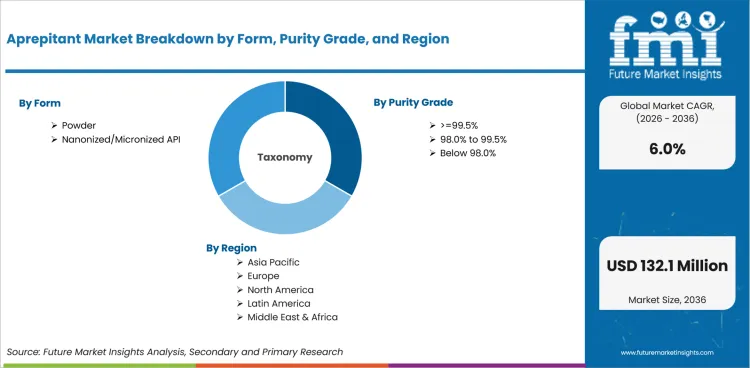
Aprepitant Market is segmented by form, purity grade, application, sales channel, and buyer type.
- Powder is projected to secure 76.0% share in 2026, supported by standard capsule blending and repeat batch planning.
- The >=99.5% purity grade is anticipated to hold 68.5% share in 2026, guided by residual-solvent discipline and regulated-market filing needs.
- Chemotherapy-induced nausea and vomiting is forecast to account for 82.5% share in 2026, supported by oncology protocol use and repeat chemotherapy-cycle demand.
- Direct supply is expected to represent 61.0% share in 2026, shaped by documentation control and supplier accountability.
- Finished-dose manufacturers are projected to hold 57.5% share in 2026, led by capsule dossier ownership and active ingredient qualification authority.
Why does powder API lead form demand?
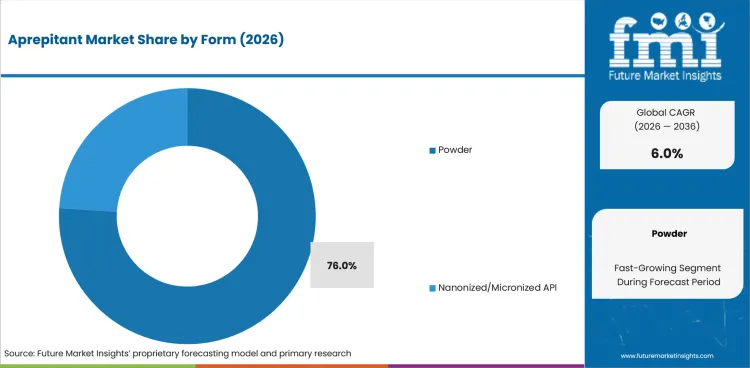
- Powder API is projected to hold 76.0% share in 2026, influenced by routine capsule manufacturing and repeat batch handling.
- Nanonized and micronized API remains a smaller value area for formulation teams that need tighter dissolution behavior in low-solubility oral dosage programs.
What keeps the >=99.5% grade ahead?
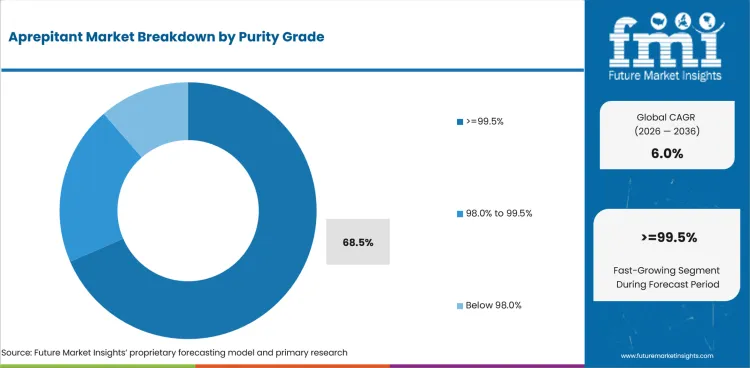
- The >=99.5% purity grade is expected to secure 68.5% share in 2026, supported by impurity control and regulated-market filing needs.
- Lower-purity material may serve early development or price-sensitive supply programs. Commercial dossiers usually favor cleaner impurity profiles and repeat high-purity lots.
Why does chemotherapy-induced nausea and vomiting dominate demand?
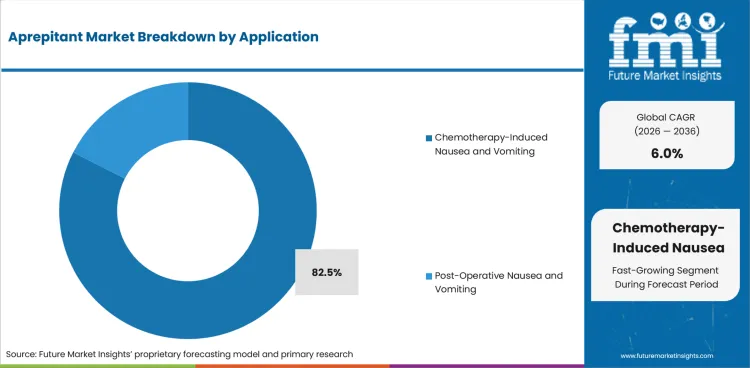
- Chemotherapy-induced nausea and vomiting is forecast to hold 82.5% share in 2026, led by oncology protocols and repeat chemotherapy-cycle use.
- Post-operative nausea and vomiting remains a valid application area. Demand is more procedure-linked and less predictable than oncology-cycle use.
How does direct supply lead sales channels?
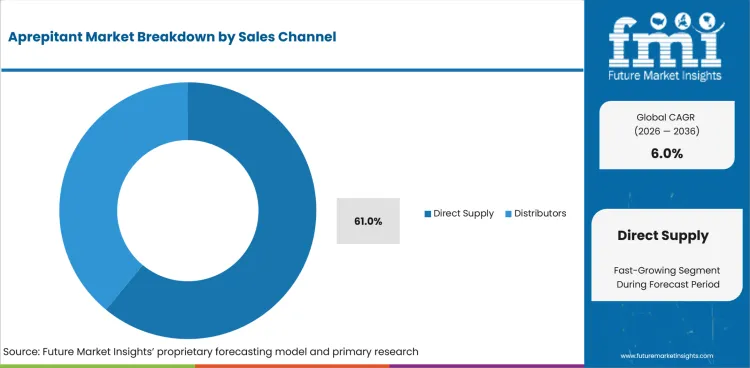
- Direct supply is expected to represent 61.0% share in 2026, supported by audit access and supplier accountability.
- Distributors serve smaller buyers and development programs with commercial regulated-market supply usually favoring accountable source relationships.
Why do finished-dose manufacturers lead buyer type demand?
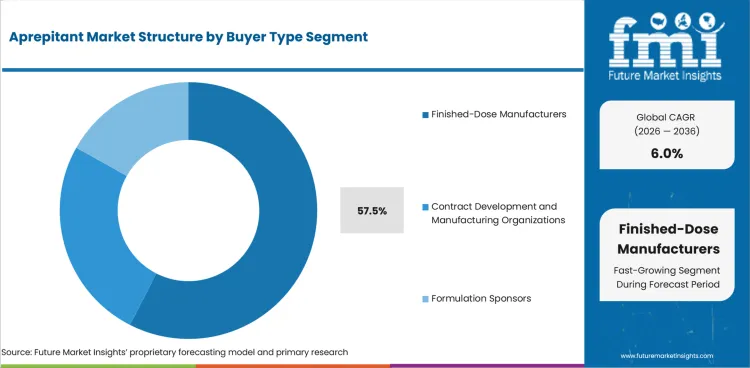
- Finished-dose manufacturers are projected to hold 57.5% share in 2026, led by capsule dossier control and source qualification authority.
- Contract development and manufacturing organizations support additional sourcing activity. Final supplier approval often rests with formulation sponsors and marketing authorization holders.
What are the drivers, restraints, and opportunities in the Aprepitant market?
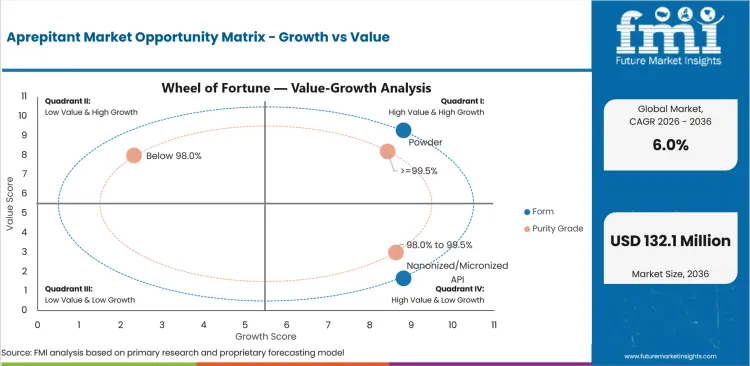
Oncology-supportive demand supports expansion while quality-control pressure limits weak supplier entry.
- Driver: Oncology supportive-care protocols sustain repeat active ingredient demand across chemotherapy treatment cycles. Procurement teams therefore look for evidence of quality consistency, audit readiness, and reliable batch support.
- Restraint: Impurity and residual-solvent expectations restrict suppliers without mature quality systems. The commercial impact is strongest where clinical use, formulation fit, and compliance history affect supplier choice.
- Opportunity: High-purity and micronized grades create stronger value for suppliers that can document performance across regulated filings.
Oncology Supportive-Care Pull
EMA recommended 114 human medicines for marketing authorization in 2024, including 46 new active substances. Oncology medicines formed a major share of review activity, which keeps supportive-care products important across treatment pathways. Active ingredient suppliers with stable lots and rapid technical support can benefit from the continuing need for nausea and vomiting prevention.
Quality-Control Barrier
FDA’s generic medicines program issued 1,281 complete response letters and 5,352 information requests in fiscal 2025, showing the level of documentation pressure faced by generic applicants. Aprepitant suppliers must support impurity data and batch traceability. Weak records can slow buyer approval and keep lower-cost offers outside regulated commercial supply.
High-Purity API Opportunity
India’s Department of Pharmaceuticals placed the national active pharmaceutical ingredient market at USD 14.77 billion in 2025, equal to about INR 1,31,700 crore. Indian active ingredient suppliers can use synthesis depth and regulated-market documentation to serve oncology-supportive products such as aprepitant. High-purity powder and targeted micronized grades can command stronger customer attention if batch consistency remains reliable.
Which countries are growing fastest in the Aprepitant market?
India 7.2% CAGR, China 6.9% CAGR, South Korea 6.4% CAGR, Japan 5.9% CAGR, United States 5.6% CAGR, Germany 5.4% CAGR, France 5.3% CAGR, and United Kingdom 5.2% CAGR through 2036.
.webp "Top Country Growth Comparison Aprepitant Market Cagr (2026 2036)")
| Country | CAGR |
|---|---|
| India | 7.2% |
| China | 6.9% |
| South Korea | 6.4% |
| Japan | 5.9% |
| United States | 5.6% |
| Germany | 5.4% |
| France | 5.3% |
| United Kingdom | 5.2% |
Source: Future Market Insights, 2026.
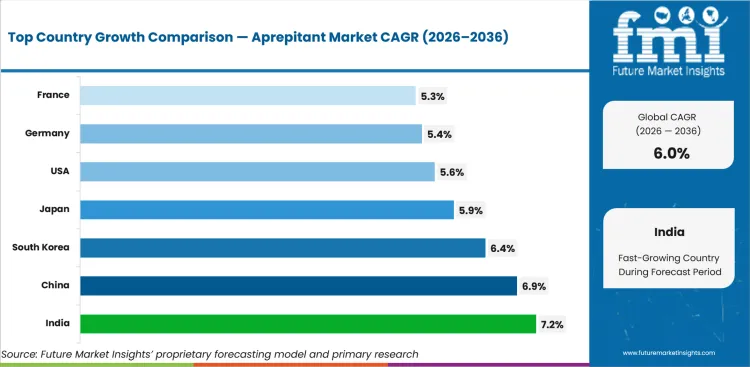
How do country-level CAGRs compare in the Aprepitant market?
India leads country expansion while the United Kingdom records the most cautious outlook among profiled markets.
- India is forecast to record 7.2% CAGR by 2036, reflected by active ingredient synthesis depth influencing export-oriented supply.
- China is expected to expand at a 6.9% CAGR from 2026 to 2036, supported by oncology treatment scale and generic supportive-care demand.
- South Korea is projected to grow at a 6.4% CAGR from 2026 to 2036 as quality-led biopharma and oncology supply programs deepen.
- Japan is estimated to rise at 5.9% CAGR by 2036, led by high-specification buyers favoring stable active ingredient sources.
- United States is expected to advance at 5.6% CAGR through 2036, influenced by generic capsule programs sustaining active ingredient orders.
- Germany is forecast to grow at 5.4% CAGR through 2036, backed by regulated oncology demand supporting selective supplier approvals.
- France is projected to post 5.3% CAGR by 2036, guided by cancer-care access promoting supportive-care medicine use.
- United Kingdom is expected to expand at 5.2% CAGR through 2036, supported by pricing and access controls moderate supplier expansion.
How fast is the Aprepitant market growing in India?
A 7.2% CAGR through 2036 reflects oncology-treatment demand and export-oriented active ingredient supply.
Country Market Snapshot Table
| Parameter | Value |
|---|---|
| Market Size in 2025 (Value) | USD 5.88 million |
| Market Size in 2026 (Value) | USD 6.30 million |
| Market Forecast in 2036 (Value) | USD 12.62 million |
| CAGR (2026 to 2036) | 7.2% |
| Years Considered | 2021 to 2036 |
| Base Year | 2025 |
| Forecast Period | 2026 to 2036 |
| Units Considered | Value (USD million) |
| Leading Sub-Region | Hyderabad and western India API clusters |
India Aprepitant Market Outlook
India Aprepitant demand is supported by active ingredient synthesis strength and oncology supportive-care supply. Domestic manufacturers can serve formulation sponsors and export customers needing qualified active ingredient sources.
Regulated-market buyers are expected to favor suppliers with residual-solvent discipline, and stable change-control support. Manufacturers able to document repeat high-purity batches can gain a stronger role in capsule programs.
Key Growth Drivers
- Oncology-cycle demand gives Indian buyers a steady antiemetic planning base, supported by health-ministry cancer incidence estimated at 15,33,055 cases in 2024.
- Domestic API depth strengthens supplier qualification for aprepitant capsules, reinforced through a national API market valued at USD 14.77 billion in 2025.
- Export-oriented formulation programs strengthen qualification needs for stable high-purity aprepitant supply. This makes supplier qualification, regulatory documentation, and continuity of supply important for buyers.
- Domestic synthesis capability gives Indian suppliers a stronger position in multi-step molecule programs requiring batch discipline.
Key Restraints
- Regulated-market submissions require deep impurity and particle-size records before buyer approval.
- Price-sensitive finished-dose customers can delay premium micronized-grade adoption. Procurement teams therefore look for evidence of quality consistency, audit readiness, and reliable batch support.
- Scale-up risk remains present for smaller producers, evidenced in official pharmaceutical reporting that counted around 500 active pharmaceutical ingredient manufacturers in India.
What makes India unique
India is unique due to deep generic-drug synthesis capability and export-facing active ingredient manufacturing clusters.
Key Companies
- MSN Laboratories
- Laurus Labs
- Hetero Drugs
- Dr. Reddy's Laboratories
- Aurobindo Pharma
- Optimus Drugs
- Biophore
- MetroChem API
Sales & Marketing Channels
- Direct API supply
- Regulated-market distributor networks
- Finished-dose manufacturer qualification routes
- Contract manufacturing supply programs
- Export documentation channels
- Oncology formulation sponsor relationships
Country Segment Breakdown Table
| Segment | Sub-Segments |
|---|---|
| By Form | Powder · Nanonized/Micronized API |
| By Purity Grade | >=99.5% · 98.0% to 99.5% · Below 98.0% |
| By Application | Chemotherapy-Induced Nausea and Vomiting · Post-Operative Nausea and Vomiting |
| By Sales Channel | Direct Supply · Distributors |
| By Buyer Type | Finished-Dose Manufacturers · Contract Development and Manufacturing Organizations · Formulation Sponsors |
| Key Sub-Regions Covered, API Manufacturing Areas | Hyderabad · Ahmedabad · Mumbai · Visakhapatnam · Bengaluru · Pune |
Frequently Asked Questions
How fast is India Aprepitant market growing?
India is projected to expand at 7.2% CAGR from 2026 to 2036, supported by API manufacturing depth.
Who leads India Aprepitant market?
MSN Laboratories, Laurus Labs, Hetero Drugs, Dr. Reddy's Laboratories, and Aurobindo Pharma compete through synthesis scale and regulated-market access.
What is driving adoption in India Aprepitant market?
Oncology supportive-care demand and active ingredient export capability are moving Indian suppliers toward stronger aprepitant API qualification.
How fast is the Aprepitant market growing in China?
A 6.9% CAGR through 2036 reflects oncology treatment scale and domestic finished-dose manufacturing demand.
Country Market Snapshot Table
| Parameter | Value |
|---|---|
| Market Size in 2025 (Value) | USD 10.70 million |
| Market Size in 2026 (Value) | USD 11.44 million |
| Market Forecast in 2036 (Value) | USD 22.31 million |
| CAGR (2026 to 2036) | 6.9% |
| Years Considered | 2021 to 2036 |
| Base Year | 2025 |
| Forecast Period | 2026 to 2036 |
| Units Considered | Value (USD million) |
| Leading Sub-Region | Yangtze River Delta and Shandong API corridors |
China Aprepitant Market Outlook
China Aprepitant demand is supported by large oncology treatment needs and domestic generic formulation scale. Local active ingredient suppliers can support cost-sensitive capsule programs while regulated buyers continue to screen documentation quality.
Finished-dose sponsors are expected to favor reliable high-purity sources that can support filings and commercial batch planning. Powder API remains the main supply base, while micronized material serves selected formulation programs.
Key Growth Drivers
- Oncology-care scale supports repeat antiemetic use, indicated by national estimates of 3,246,625 new cancer cases in 2024.
- Mortality burden sustains supportive-treatment planning, corroborated through 1,699,066 estimated cancer deaths in China during 2024. The commercial impact is strongest where clinical use, formulation fit, and compliance history affect supplier choice.
- Domestic generic manufacturing creates active ingredient opportunities for stable capsule supply. This makes supplier qualification, regulatory documentation, and continuity of supply important for buyers.
- Shandong and eastern China manufacturing clusters support access to experienced intermediate and API production capacity. Procurement teams therefore look for evidence of quality consistency, audit readiness, and reliable batch support.
Key Restraints
- Regulated-market buyers can reject lower-cost sources lacking full impurity histories and audit-ready batch records. The commercial impact is strongest where clinical use, formulation fit, and compliance history affect supplier choice.
- Local price pressure may reduce margin room for high-purity and micronized grades. This makes supplier qualification, regulatory documentation, and continuity of supply important for buyers.
- Oncology drug review expectations can raise dossier pressure, reflected in 46 innovative drug approvals recorded by China’s regulator in 2024.
What makes China unique
China is unique due to large oncology-treatment demand and established active ingredient manufacturing corridors.
Key Companies
- Shandong Anxin Pharmaceutical
- Zhejiang Huahai Pharmaceutical
- Zhejiang Charioteer Pharmaceutical
- Jiangsu Hengrui Pharmaceuticals
- Qilu Pharmaceutical
- CSPC Pharmaceutical Group
- Jiangsu Hansoh Pharmaceutical
Sales & Marketing Channels
- Domestic API direct supply
- Finished-dose manufacturer relationships
- Pharmaceutical distributor networks
- Export-oriented API supply routes
- Provincial medicine distribution channels
- Contract manufacturing partnerships
Country Segment Breakdown Table
| Segment | Sub-Segments |
|---|---|
| By Form | Powder · Nanonized/Micronized API |
| By Purity Grade | >=99.5% · 98.0% to 99.5% · Below 98.0% |
| By Application | Chemotherapy-Induced Nausea and Vomiting · Post-Operative Nausea and Vomiting |
| By Sales Channel | Direct Supply · Distributors |
| By Buyer Type | Finished-Dose Manufacturers · Contract Development and Manufacturing Organizations · Formulation Sponsors |
| Key Sub-Regions Covered, API Manufacturing Areas | Shandong · Jiangsu · Zhejiang · Shanghai · Beijing · Guangdong |
Frequently Asked Questions
How fast is China Aprepitant market growing?
China is expected to grow at 6.9% CAGR from 2026 to 2036, shaped by oncology-treatment scale and domestic formulation demand.
Who leads China Aprepitant market?
Shandong Anxin Pharmaceutical, Zhejiang Huahai Pharmaceutical, Qilu Pharmaceutical, and Jiangsu Hengrui Pharmaceuticals compete through active ingredient and finished-dose links.
What is driving adoption in China Aprepitant market?
Cancer-care scale and generic formulation programs are supporting aprepitant API demand across domestic and export channels.
How fast is the Aprepitant market growing in South Korea?
A 6.4% CAGR through 2036 reflects oncology-treatment demand and quality-led pharmaceutical manufacturing.
Country Market Snapshot Table
| Parameter | Value |
|---|---|
| Market Size in 2025 (Value) | USD 3.68 million |
| Market Size in 2026 (Value) | USD 3.91 million |
| Market Forecast in 2036 (Value) | USD 7.27 million |
| CAGR (2026 to 2036) | 6.4% |
| Years Considered | 2021 to 2036 |
| Base Year | 2025 |
| Forecast Period | 2026 to 2036 |
| Units Considered | Value (USD million) |
| Leading Sub-Region | Seoul Capital Area and Incheon biopharma corridor |
South Korea Aprepitant Market Outlook
South Korea Aprepitant demand is shaped by quality-led medicine production and oncology-supportive treatment use. Domestic formulation sponsors value suppliers that can support strict documentation and stable lot-to-lot performance.
Supplier entry remains selective as buyers assess impurity control and regulatory response speed. Micronized grades can gain use in targeted formulation work, but powder API remains the main commercial route.
Key Growth Drivers
- Oncology-treatment load supports supportive-care medicine use, signaled through 304,754 expected new cancer cases in 2025. Procurement teams therefore look for evidence of quality consistency, audit readiness, and reliable batch support.
- Cancer registry depth keeps demand planning more measurable for antiemetic suppliers, supported by 282,047 newly diagnosed cancer cases reported for 2022 in a 2025 national cancer-statistics publication.
- Domestic biopharma quality systems support selective adoption of well-documented aprepitant sources. The commercial impact is strongest where clinical use, formulation fit, and compliance history affect supplier choice.
- Incheon and Seoul-area pharmaceutical operations strengthen access to formulation and export-support capabilities. This makes supplier qualification, regulatory documentation, and continuity of supply important for buyers.
Key Restraints
- Buyer qualification cycles can slow new API supplier entry across regulated capsule programs. Procurement teams therefore look for evidence of quality consistency, audit readiness, and reliable batch support.
- Smaller market scale limits bulk aprepitant purchases compared with India, China, and the United States.
- Approval-file discipline adds review pressure for suppliers, supported by MFDS reporting 1,197 approved and notified drug items in 2024, including 566 approved items and 631 notified items.
What makes South Korea unique
South Korea is unique due to quality-led pharmaceutical manufacturing and concentrated biopharma infrastructure around Seoul and Incheon.
Key Companies
- Celltrion Pharm
- Hanmi Pharmaceutical
- Chong Kun Dang
- Daewoong Pharmaceutical
- Yuhan Corporation
- Dong-A ST
- Samyang Holdings Biopharmaceuticals
Sales & Marketing Channels
- Direct API supply to formulation sponsors
- Hospital-linked finished-dose channels
- CDMO qualification routes
- Domestic pharmaceutical distributor networks
- Export documentation channels
- Oncology medicine supply programs
Country Segment Breakdown Table
| Segment | Sub-Segments |
|---|---|
| By Form | Powder · Nanonized/Micronized API |
| By Purity Grade | >=99.5% · 98.0% to 99.5% · Below 98.0% |
| By Application | Chemotherapy-Induced Nausea and Vomiting · Post-Operative Nausea and Vomiting |
| By Sales Channel | Direct Supply · Distributors |
| By Buyer Type | Finished-Dose Manufacturers · Contract Development and Manufacturing Organizations · Formulation Sponsors |
| Key Sub-Regions Covered, Pharma Manufacturing Areas | Seoul · Incheon · Gyeonggi · Daejeon · Busan · Daegu |
Frequently Asked Questions
How fast is South Korea Aprepitant market growing?
South Korea is projected to grow at 6.4% CAGR from 2026 to 2036, supported by oncology demand and quality-led supply.
Who leads South Korea Aprepitant market?
Hanmi Pharmaceutical, Celltrion Pharm, Chong Kun Dang, Daewoong Pharmaceutical, and Yuhan Corporation compete due to formulation reach and regulated medicine supply.
What is driving adoption in South Korea Aprepitant market?
Quality-led manufacturing and oncology supportive-care use are supporting aprepitant API demand across finished-dose programs.
How fast is the Aprepitant market growing in Japan?
A 5.9% CAGR through 2036 reflects high-specification buyer behavior and stable oncology-supportive care demand.
Country Market Snapshot Table
| Parameter | Value |
|---|---|
| Market Size in 2025 (Value) | USD 7.25 million |
| Market Size in 2026 (Value) | USD 7.68 million |
| Market Forecast in 2036 (Value) | USD 13.63 million |
| CAGR (2026 to 2036) | 5.9% |
| Years Considered | 2021 to 2036 |
| Base Year | 2025 |
| Forecast Period | 2026 to 2036 |
| Units Considered | Value (USD million) |
| Leading Sub-Region | Kanto and Kansai oncology supply corridors |
Japan Aprepitant Market Outlook
Japan Aprepitant demand is supported by oncology supportive-care use and strong quality expectations in finished-dose supply. Buyers emphasize stable impurity control and repeatable capsule-grade material.
High-purity powder API remains preferred for commercial capsule programs. Micronized and nanonized forms gain attention in projects requiring tighter dissolution behavior, although adoption remains controlled by formulation evidence.
Key Growth Drivers
- Cancer-care load supports antiemetic demand, with projected incidence for all cancers reaching 1,023,100 cases in Japan’s current cancer-statistics release.
- Mortality-linked supportive-care planning remains active, backed by 395,100 projected cancer deaths for 2025 in Japan’s national short-term cancer projection.
- High-specification buyer culture supports premium active ingredient sources with clean audit records. The commercial impact is strongest where clinical use, formulation fit, and compliance history affect supplier choice.
- Kanto and Kansai supply corridors support access to formulation sponsors and oncology medicine distribution. This makes supplier qualification, regulatory documentation, and continuity of supply important for buyers.
Key Restraints
- Conservative supplier approval processes can extend qualification timelines for new aprepitant sources. Procurement teams therefore look for evidence of quality consistency, audit readiness, and reliable batch support.
- High documentation standards increase cost for suppliers offering micronized or development-grade material.
- Quality-file scrutiny can slow formulation changes, supported by PMDA’s FY 2024 GMP/GCTP annual report recording 2,175 GMP inspections for drug manufacturing sites, including 126 on-site inspections and 2,049 document-based inspections.
What makes Japan unique
Japan is unique due to high-specification buyer standards and disciplined oncology medicine supply channels.
Key Companies
- Towa Pharmaceutical
- Nichi-Iko Pharmaceutical
- Sawai Pharmaceutical
- Nipro Pharma
- Nippon Chemiphar
- Kyowa Kirin
- Daiichi Sankyo Espha
Sales & Marketing Channels
- Direct supply to formulation sponsors
- Hospital medicine distribution
- Wholesaler-led pharmaceutical channels
- CDMO qualification programs
- Oncology-supportive care supply routes
- Regulated import documentation channels
Country Segment Breakdown Table
| Segment | Sub-Segments |
|---|---|
| By Form | Powder · Nanonized/Micronized API |
| By Purity Grade | >=99.5% · 98.0% to 99.5% · Below 98.0% |
| By Application | Chemotherapy-Induced Nausea and Vomiting · Post-Operative Nausea and Vomiting |
| By Sales Channel | Direct Supply · Distributors |
| By Buyer Type | Finished-Dose Manufacturers · Contract Development and Manufacturing Organizations · Formulation Sponsors |
| Key Sub-Regions Covered, Oncology Supply Areas | Tokyo · Osaka · Yokohama · Nagoya · Kobe · Fukuoka |
Frequently Asked Questions
How fast is Japan Aprepitant market growing?
Japan is estimated to grow at 5.9% CAGR from 2026 to 2036, supported by high-specification oncology medicine supply.
Who leads Japan Aprepitant market?
Sawai Pharmaceutical, Towa Pharmaceutical, Nichi-Iko Pharmaceutical, Nipro Pharma, and Nippon Chemiphar compete depending on regulated generic medicine access.
What is driving adoption in Japan Aprepitant market?
Oncology supportive-care demand and high-quality finished-dose standards are supporting aprepitant API use across Japanese capsule programs.
How fast is the Aprepitant market growing in the United States?
A 5.6% CAGR through 2036 reflects generic capsule demand and regulated-market documentation needs.
Country Market Snapshot Table
| Parameter | Value |
|---|---|
| Market Size in 2025 (Value) | USD 12.55 million |
| Market Size in 2026 (Value) | USD 13.25 million |
| Market Forecast in 2036 (Value) | USD 22.86 million |
| CAGR (2026 to 2036) | 5.6% |
| Years Considered | 2021 to 2036 |
| Base Year | 2025 |
| Forecast Period | 2026 to 2036 |
| Units Considered | Value (USD million) |
| Leading Sub-Region | Northeast oncology supply and national generic distribution |
United States Aprepitant Market Outlook
United States Aprepitant demand is supported by oncology treatment volume and generic capsule availability. Finished-dose sponsors seek active ingredient suppliers that can support drug master files and change-control expectations.
Commercial supply remains selective as buyers require evidence of impurity control and stable manufacturing. High-purity powder API keeps the main position, while micronized grades serve performance-sensitive formulation needs.
Key Growth Drivers
- Oncology treatment burden supports repeat antiemetic demand, measured by 2,041,910 projected new cancer cases in 2025.
- Generic medicine activity supports active ingredient sourcing, tracked through 689 approvals in FDA’s fiscal 2025 generic program.
- National generic distribution creates steady demand for qualified aprepitant capsule supply. The commercial impact is strongest where clinical use, formulation fit, and compliance history affect supplier choice.
- Finished-dose sponsors favor suppliers that can maintain drug master file access and technical response discipline. This makes supplier qualification, regulatory documentation, and continuity of supply important for buyers.
Key Restraints
- Generic applicants face repeated documentation demands before final approval. Procurement teams therefore look for evidence of quality consistency, audit readiness, and reliable batch support.
- Supplier changes can trigger additional review work for finished-dose sponsors.
- Review transparency may expose data gaps more directly, substantiated through FDA’s September 2025 release of 89 previously unpublished complete response letters tied to pending or withdrawn applications.
What makes the United States unique
United States is unique due to large generic-medicine use and national oncology-supportive capsule distribution.
Key Companies
- Dr. Reddy's Laboratories Inc.
- Aurobindo Pharma USA
- Glenmark Pharmaceuticals Inc.
- Teva Pharmaceuticals USA
- Amneal Pharmaceuticals
- Camber Pharmaceuticals
- Torrent Pharma Inc.
Sales & Marketing Channels
- Direct API supply to finished-dose sponsors
- Drug master file access routes
- National generic distributors
- Hospital medicine channels
- Oncology-supportive care networks
- Contract manufacturing partnerships
Country Segment Breakdown Table
| Segment | Sub-Segments |
|---|---|
| By Form | Powder · Nanonized/Micronized API |
| By Purity Grade | >=99.5% · 98.0% to 99.5% · Below 98.0% |
| By Application | Chemotherapy-Induced Nausea and Vomiting · Post-Operative Nausea and Vomiting |
| By Sales Channel | Direct Supply · Distributors |
| By Buyer Type | Finished-Dose Manufacturers · Contract Development and Manufacturing Organizations · Formulation Sponsors |
| Key Sub-Regions Covered, Generic Supply Areas | Northeast · Midwest · California · New Jersey · Texas · North Carolina |
Frequently Asked Questions
How fast is United States Aprepitant market growing?
United States is expected to advance at 5.6% CAGR from 2026 to 2036, supported by generic capsule demand.
Who leads United States Aprepitant market?
Dr. Reddy's Laboratories, Aurobindo Pharma USA, Glenmark, Teva, Amneal, Camber, and Torrent compete with generic medicine distribution and regulated supply.
What is driving adoption in United States Aprepitant market?
Oncology supportive-care use and generic-drug activity are supporting aprepitant API demand across finished-dose programs.
How fast is the Aprepitant market growing in Germany?
A 5.4% CAGR through 2036 reflects regulated oncology demand and selective supplier approval behavior.
Country Market Snapshot Table
| Parameter | Value |
|---|---|
| Market Size in 2025 (Value) | USD 4.92 million |
| Market Size in 2026 (Value) | USD 5.19 million |
| Market Forecast in 2036 (Value) | USD 8.77 million |
| CAGR (2026 to 2036) | 5.4% |
| Years Considered | 2021 to 2036 |
| Base Year | 2025 |
| Forecast Period | 2026 to 2036 |
| Units Considered | Value (USD million) |
| Leading Sub-Region | North Rhine-Westphalia and Bavaria pharma manufacturing base |
Germany Aprepitant Market Outlook
Germany Aprepitant demand is supported by oncology treatment needs and high documentation standards. Finished-dose buyers prioritize suppliers with complete quality files and reliable change management.
Supplier expansion remains measured as price pressure and regulatory scrutiny affect generic supportive-care products. Powder API remains the main purchase form, while micronized material supports selected formulation requirements.
Key Growth Drivers
- Cancer-care load supports demand for supportive medicines, framed by European cancer data placing new cases across member states at 2.7 million in 2024.
- Future oncology needs support antiemetic planning, stated in Germany’s country cancer profile through a 15% projected cancer-case rise between 2022 and 2040.
- High-quality finished-dose manufacturing supports demand for well-documented active ingredient sources. The commercial impact is strongest where clinical use, formulation fit, and compliance history affect supplier choice.
- Hospital oncology pathways maintain recurring need for nausea and vomiting prevention products. This makes supplier qualification, regulatory documentation, and continuity of supply important for buyers.
Key Restraints
- Price controls can limit room for premium active ingredient pricing.
- Supplier switching remains slow due to audit and authorization-update requirements. Procurement teams therefore look for evidence of quality consistency, audit readiness, and reliable batch support.
- Oncology review activity can raise quality expectations, noted in EMA’s 2024 human medicines review covering 114 marketing-authorization recommendations.
What makes Germany unique
Germany is unique due to strict medicine quality expectations and organized pharmaceutical manufacturing demand.
Key Companies
- Stada Arzneimittel
- Hexal AG
- Ratiopharm
- Bayer AG
- Boehringer Ingelheim
- Merck KGaA
- Aenova Group
Sales & Marketing Channels
- Direct supply to formulation sponsors
- Pharmaceutical wholesaler networks
- Hospital medicine channels
- Contract manufacturing routes
- Import documentation channels
- Oncology medicine distribution programs
Country Segment Breakdown Table
| Segment | Sub-Segments |
|---|---|
| By Form | Powder · Nanonized/Micronized API |
| By Purity Grade | >=99.5% · 98.0% to 99.5% · Below 98.0% |
| By Application | Chemotherapy-Induced Nausea and Vomiting · Post-Operative Nausea and Vomiting |
| By Sales Channel | Direct Supply · Distributors |
| By Buyer Type | Finished-Dose Manufacturers · Contract Development and Manufacturing Organizations · Formulation Sponsors |
| Key Sub-Regions Covered, Pharma Manufacturing Areas | North Rhine-Westphalia · Bavaria · Baden-Württemberg · Hesse · Berlin · Hamburg |
Frequently Asked Questions
How fast is Germany Aprepitant market growing?
Germany is forecast to grow at 5.4% CAGR from 2026 to 2036, supported by regulated oncology demand.
Who leads Germany Aprepitant market?
Stada, Hexal, Ratiopharm, Bayer, Boehringer Ingelheim, Merck KGaA, and Aenova compete led by pharmaceutical manufacturing and regulated medicine supply.
What is driving adoption in Germany Aprepitant market?
Oncology supportive-care demand and high-quality finished-dose standards are supporting selective aprepitant API sourcing.
How fast is the Aprepitant market growing in France?
A 5.3% CAGR through 2036 reflects supportive-care demand and controlled generic sourcing.
Country Market Snapshot Table
| Parameter | Value |
|---|---|
| Market Size in 2025 (Value) | USD 4.10 million |
| Market Size in 2026 (Value) | USD 4.32 million |
| Market Forecast in 2036 (Value) | USD 7.25 million |
| CAGR (2026 to 2036) | 5.3% |
| Years Considered | 2021 to 2036 |
| Base Year | 2025 |
| Forecast Period | 2026 to 2036 |
| Units Considered | Value (USD million) |
| Leading Sub-Region | Île-de-France and Auvergne-Rhône-Alpes oncology supply corridors |
France Aprepitant Market Outlook
France Aprepitant demand is supported by oncology supportive-care needs and structured medicine access. Finished-dose sponsors value active ingredient suppliers that can support quality files and stable technical communication.
Expansion remains controlled as buyers balance generic medicine cost pressure with regulatory quality expectations. High-purity powder API remains central to commercial capsule programs serving oncology care.
Key Growth Drivers
- Cancer prevalence supports supportive-care medicine planning, recorded in France’s country profile at 2,025 five-year cases per 100,000 people in 2022.
- Future treatment needs remain meaningful, illustrated by a 19% projected rise in cancer cases from 2022 to 2040.
- Domestic hospital oncology systems sustain demand for antiemetic medicines linked to chemotherapy. The commercial impact is strongest where clinical use, formulation fit, and compliance history affect supplier choice.
- Finished-dose sponsors prioritize API partners able to support regulated dossier maintenance. This makes supplier qualification, regulatory documentation, and continuity of supply important for buyers.
Key Restraints
- Generic pricing pressure can reduce willingness to pay for premium particle-control grades. Procurement teams therefore look for evidence of quality consistency, audit readiness, and reliable batch support.
- New supplier entry can slow as sponsors verify impurity and residual-solvent histories.
- European review standards remain demanding, recorded through 46 new active substances among EMA’s 2024 human medicine recommendations.
What makes France unique
France is unique due to structured oncology medicine access and controlled generic supply channels.
Key Companies
- Sanofi
- Servier
- Biogaran
- EuroAPI
- Seqens
- Pierre Fabre
- Delpharm
Sales & Marketing Channels
- Direct API supply
- Hospital medicine procurement channels
- Pharmaceutical wholesaler networks
- Contract manufacturing routes
- Generic formulation sponsor relationships
- Oncology pharmacy distribution
Country Segment Breakdown Table
| Segment | Sub-Segments |
|---|---|
| By Form | Powder · Nanonized/Micronized API |
| By Purity Grade | >=99.5% · 98.0% to 99.5% · Below 98.0% |
| By Application | Chemotherapy-Induced Nausea and Vomiting · Post-Operative Nausea and Vomiting |
| By Sales Channel | Direct Supply · Distributors |
| By Buyer Type | Finished-Dose Manufacturers · Contract Development and Manufacturing Organizations · Formulation Sponsors |
| Key Sub-Regions Covered, Oncology Supply Areas | Île-de-France · Lyon · Marseille · Toulouse · Lille · Nantes |
Frequently Asked Questions
How fast is France Aprepitant market growing?
France is projected to post 5.3% CAGR from 2026 to 2036, supported by cancer-care access and generic sourcing discipline.
Who leads France Aprepitant market?
Sanofi, Servier, Biogaran, EuroAPI, Seqens, Pierre Fabre, and Delpharm compete led by pharmaceutical manufacturing and oncology medicine access.
What is driving adoption in France Aprepitant market?
Cancer supportive-care needs and controlled finished-dose supply are supporting aprepitant API demand in France.
How fast is the Aprepitant market growing in the United Kingdom?
A 5.2% CAGR through 2036 reflects regulated oncology access and cautious generic sourcing behavior.
Country Market Snapshot Table
| Parameter | Value |
|---|---|
| Market Size in 2025 (Value) | USD 3.24 million |
| Market Size in 2026 (Value) | USD 3.41 million |
| Market Forecast in 2036 (Value) | USD 5.66 million |
| CAGR (2026 to 2036) | 5.2% |
| Years Considered | 2021 to 2036 |
| Base Year | 2025 |
| Forecast Period | 2026 to 2036 |
| Units Considered | Value (USD million) |
| Leading Sub-Region | England hospital oncology and formulation supply corridors |
United Kingdom Aprepitant Market Outlook
United Kingdom Aprepitant demand is supported by oncology treatment needs and generic medicine use. Finished-dose buyers seek active ingredient suppliers with stable documentation and reliable communication during product changes.
Market expansion remains cautious as treatment access pressures and pricing controls affect generic supportive-care products. Powder API retains the main commercial role, while micronized grades serve selected formulation programs.
Key Growth Drivers
- Cancer incidence supports antiemetic demand, reported through projections of more than 505,000 new cancer cases yearly by 2038 to 2040.
- National treatment access remains active, backed by 68.4% of patients starting first treatment within 62 days in England’s January 2026 cancer waiting report.
- Generic medicine use supports ongoing active ingredient sourcing for supportive-care capsules. The commercial impact is strongest where clinical use, formulation fit, and compliance history affect supplier choice.
- England-based hospital oncology pathways sustain demand for nausea and vomiting prevention medicines. This makes supplier qualification, regulatory documentation, and continuity of supply important for buyers.
Key Restraints
- Pricing control can restrict supplier margins for high-purity and micronized material.
- Treatment access pressure can create uneven finished-dose demand planning for smaller products. Procurement teams therefore look for evidence of quality consistency, audit readiness, and reliable batch support.
- Cancer service standards leave operating pressure on oncology pathways, measured by the 85% target for treatment within 62 days after urgent referral.
What makes the United Kingdom unique
United Kingdom is unique due to national cancer-service performance targets and controlled generic medicine purchasing.
Key Companies
- Accord Healthcare
- Teva UK
- Sandoz UK
- Viatris UK
- Thornton & Ross
- Almac Pharma Services
- Oxford Pharmaceuticals
Sales & Marketing Channels
- Direct supply to formulation sponsors
- Hospital pharmacy channels
- NHS-linked medicine supply routes
- Pharmaceutical wholesaler networks
- Contract manufacturing routes
- Oncology supportive-care distribution
Country Segment Breakdown Table
| Segment | Sub-Segments |
|---|---|
| By Form | Powder · Nanonized/Micronized API |
| By Purity Grade | >=99.5% · 98.0% to 99.5% · Below 98.0% |
| By Application | Chemotherapy-Induced Nausea and Vomiting · Post-Operative Nausea and Vomiting |
| By Sales Channel | Direct Supply · Distributors |
| By Buyer Type | Finished-Dose Manufacturers · Contract Development and Manufacturing Organizations · Formulation Sponsors |
| Key Sub-Regions Covered, Oncology Supply Areas | London · Manchester · Birmingham · Leeds · Glasgow · Cambridge |
Frequently Asked Questions
How fast is United Kingdom Aprepitant market growing?
United Kingdom is expected to expand at 5.2% CAGR from 2026 to 2036, supported by regulated oncology access.
Who leads United Kingdom Aprepitant market?
Accord Healthcare, Teva UK, Sandoz UK, Viatris UK, Almac Pharma Services, and Oxford Pharmaceuticals compete through generic medicine supply and formulation support.
What is driving adoption in United Kingdom Aprepitant market?
Cancer treatment pathways and generic capsule supply needs are supporting aprepitant API sourcing in the United Kingdom.
Who are the leading companies in the Aprepitant market?
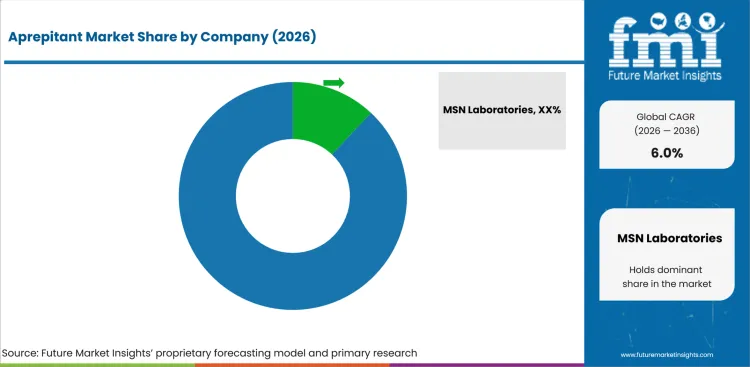
MSN Laboratories, Laurus Labs, Hetero Drugs, Dr. Reddy's Laboratories, and Aurobindo Pharma lead the competitive field, with Biophore, Optimus Drugs, MetroChem API, Shandong Anxin Pharmaceutical, and Torrent Pharmaceuticals also active.
- Established Indian API companies hold an advantage through export documentation and finished-dose customer access.
- Specialized API suppliers gain buyer attention through particle-size consistency and responsive technical files.
- Finished-dose integrated companies benefit from closer links between active ingredient qualification and commercial capsule programs. The commercial impact is strongest where clinical use, formulation fit, and compliance history affect supplier choice.
- China-based suppliers compete through intermediate access and cost-sensitive manufacturing depth.
Aprepitant competition is built on quality-file strength rather than molecule novelty. Buyers serving regulated markets assess impurity profiles and batch reproducibility before approving a source. Powder API remains the core commercial grade, although micronized and nanonized material can support formulation teams that need tighter dissolution control.
Indian suppliers are strongest in export-oriented sourcing since they combine chemistry depth with regulated-market dossier support. Chinese suppliers remain important for intermediate availability and domestic formulation supply. Smaller specialized firms can win selective positions if particle control and technical response timelines meet buyer expectations.
Commercial expansion requires repeat supply performance. Active ingredient producers that support drug master file access and regulatory questions can gain long-term buyer positions. Suppliers relying only on lower pricing are exposed to rejection if impurity data or change-control packages are weak.
How do top Aprepitant companies compare?
MSN Laboratories and Laurus Labs score strongest on synthesis depth while Hetero and Dr. Reddy's Laboratories lead integrated generic medicine reach.
| Company | Relevance to Market Title | API Documentation Depth | Formulation Link | Quality-Control Strength | Channel Reach | Geographic Footprint |
|---|---|---|---|---|---|---|
| MSN Laboratories | Very High | Very Strong | Strong | Very Strong | Strong | Global |
| Laurus Labs | Very High | Very Strong | Moderate | Very Strong | Strong | Global |
| Hetero Drugs | Very High | Strong | Very Strong | Strong | Very Strong | Global |
| Dr. Reddy's Laboratories | High | Strong | Very Strong | Very Strong | Very Strong | Global |
| Aurobindo Pharma | High | Strong | Very Strong | Strong | Very Strong | Global |
| Optimus Drugs | Moderate to High | Strong | Moderate | Strong | Moderate | India and Export Markets |
| Biophore | High | Strong | Moderate | Very Strong | Moderate | Global |
| MetroChem API | High | Strong | Moderate | Strong | Moderate | Global |
| Shandong Anxin Pharmaceutical | Moderate to High | Moderate | Moderate | Moderate | Strong | China and Export Markets |
| Torrent Pharmaceuticals | High | Strong | Very Strong | Strong | Very Strong | Global |
Source: Future Market Insights competitive analysis, 2026.
Who are the leading companies in the Aprepitant market?
MSN Laboratories, Laurus Labs, Hetero Drugs, Dr. Reddy's Laboratories, and Aurobindo Pharma are listed with Optimus Drugs, Biophore, MetroChem API, Shandong Anxin Pharmaceutical, and Torrent Pharmaceuticals among other suppliers.
Leading global companies in the Aprepitant market include:
- MSN Laboratories
- Laurus Labs
- Hetero Drugs
- Dr. Reddy's Laboratories
- Aurobindo Pharma
- Optimus Drugs
- Biophore
- MetroChem API
- Shandong Anxin Pharmaceutical
- Torrent Pharmaceuticals
Key Developments in Aprepitant Market
- In June 2026, DailyMed updated Torrent Pharmaceuticals’ aprepitant capsule and kit label, listing 40 mg, 80 mg, and 125 mg capsule strengths along with multiple national drug codes.
- In March 2026, FDA’s Orange Book cumulative supplement listed an aprepitant emulsion product under abbreviated application activity, adding molecule-linked antiemetic reference activity for regulated supply planning.
- In September 2025, FDA began real-time release of complete response letters and posted 89 previously unpublished letters tied to pending or withdrawn applications, increasing transparency around review deficiencies for drug applicants.
Leading Companies in the Aprepitant Market
Large Indian API and Generic Groups
- MSN Laboratories
- Laurus Labs
- Hetero Drugs
- Dr. Reddy's Laboratories
- Aurobindo Pharma
Specialized API Suppliers
- Optimus Drugs
- Biophore
- MetroChem API
- Shandong Anxin Pharmaceutical
Finished-Dose and Regional Supply Companies
- Torrent Pharmaceuticals
- Teva Pharmaceuticals
- Glenmark Pharmaceuticals
- Accord Healthcare
- Sawai Pharmaceutical
Aprepitant Market - Report Scope
| Parameter | Details |
|---|---|
| Forecast period | 2026 to 2036 |
| Historical period | 2021 to 2025 |
| Quantitative unit | Revenue in USD million |
| By form | Powder, nanonized/micronized API |
| By purity grade | >=99.5%, 98.0% to 99.5%, below 98.0% |
| By application | Chemotherapy-induced nausea and vomiting, post-operative nausea and vomiting |
| By sales channel | Direct supply, distributors |
| By buyer type | Finished-dose manufacturers, contract development and manufacturing organizations, formulation sponsors |
| Regions covered | North America, Latin America, Europe, East Asia, South Asia and Pacific, Middle East and Africa |
| Countries covered | India, China, South Korea, Japan, United States, Germany, France, United Kingdom |
| Companies profiled | MSN Laboratories, Laurus Labs, Hetero Drugs, Dr. Reddy's Laboratories, Aurobindo Pharma, Optimus Drugs, Biophore, MetroChem API, Shandong Anxin Pharmaceutical, Torrent Pharmaceuticals |
| Approach | Bottom-up product-boundary approach using eligible API revenue, active ingredient grade, buyer qualification, country oncology demand, and channel presence |
Source: Future Market Insights, 2026.
Aprepitant Market - Scope & Definition
| Attribute | Detail |
|---|---|
| Market Definition | Commercially traded aprepitant active pharmaceutical ingredient used in finished medicines for chemotherapy-induced nausea and vomiting and post-operative nausea and vomiting |
| Functions Covered | NK1 receptor antagonist API supply, oncology supportive-care formulation support, antiemetic capsule input, and formulation-grade active ingredient supply |
| Applications Covered | Chemotherapy-induced nausea and vomiting and post-operative nausea and vomiting |
| End-Use Industries | Pharmaceutical manufacturing, oncology supportive-care medicine supply, generic finished-dose manufacturing, and contract development and manufacturing |
| Grades Covered | Powder API, nanonized/micronized API, high-purity API, development-grade material, and lower-purity material for limited applications |
| Inclusions | Aprepitant API by form, purity grade, application, sales channel, buyer type, and regional demand across commercial active ingredient markets |
| Exclusions | Finished branded capsules, finished generic prescription revenue, fosaprepitant prodrug API, netupitant API, ondansetron API, dopamine antagonist APIs, hospital antiemetic services, and oncology spending that does not create direct aprepitant API demand |
Aprepitant Market - Research Methodology
| Method | Description |
|---|---|
| Primary Research | FMI analyst interviews with API suppliers, finished-dose manufacturers, oncology sourcing managers, hospital pharmacy stakeholders, and distributors handling regulated pharmaceutical ingredients |
| Desk Research | Review of DailyMed labeling, FDA generic activity, drug master file activity, cancer statistics, official medicine records, and company product information related to aprepitant API and oncology supportive care |
| Market Sizing & Forecasting | Bottom-up product-boundary approach using eligible API revenue, purity-grade premiums, dosage-form assumptions, buyer qualification behavior, country cancer-care demand, and direct versus distributor routing |
| Data Validation | Cross-verification using label indications, oncology demand signals, API supplier evidence, finished-dose manufacturer presence, regulatory context, and country-level medicine access conditions |
Aprepitant Market Breakdown by Form, Purity Grade, Application, Sales Channel, Buyer Type, and Region
Aprepitant Market Segmented by Form:
- Powder
- Nanonized/Micronized API
Aprepitant Market Segmented by Purity Grade:
- >=99.5%
- 98.0% to 99.5%
- Below 98.0%
Aprepitant Market Segmented by Application:
- Chemotherapy-Induced Nausea and Vomiting
- Post-Operative Nausea and Vomiting
Aprepitant Market Segmented by Sales Channel:
- Direct Supply
- Distributors
Aprepitant Market Segmented by Buyer Type:
- Finished-Dose Manufacturers
- Contract Development and Manufacturing Organizations
- Formulation Sponsors
Aprepitant Market by Region:
- North America
- Latin America
- Europe
- East Asia
- South Asia and Pacific
- Middle East and Africa
Research Sources and Bibliography
- American Cancer Society. (2025). Cancer facts & figures 2025. American Cancer Society.
- Cancer Research UK. (2025). Cancer incidence statistics. Cancer Research UK.
- DailyMed. (2026, June). Aprepitant capsule and aprepitant kit prescribing information. National Library of Medicine.
- Department of Pharmaceuticals. (2025). Annual report 2025-26. Ministry of Chemicals and Fertilizers, Government of India.
- European Commission Joint Research Centre. (2025). Latest EU cancer data. European Commission.
- European Medicines Agency. (2025, January 16). Human medicines in 2024. European Medicines Agency.
- Food and Drug Administration. (2025). Generic Drugs Program Activities Report - FY 2025 Monthly Performance. U.S. Food and Drug Administration.
- Food and Drug Administration. (2025, September 4). FDA announces real-time release of complete response letters, posts previously unpublished batch of 89. U.S. Food and Drug Administration.
- Food and Drug Administration. (2026, March). Approved drug products with therapeutic equivalence evaluations cumulative supplement. U.S. Food and Drug Administration.
- Health Ministry of India. (2025, August 8). Cancer cases in the country. Lok Sabha, Government of India.
- Japan National Cancer Center. (2025, May 9). Cancer statistics in Japan 2025. National Cancer Center Japan.
- Japan National Cancer Center. (2026). Projected cancer statistics. National Cancer Center Japan.
- Jung, K. W., Won, Y. J., Kang, M. J., Kong, H. J., & Im, J. S. (2025). Prediction of cancer incidence and mortality in Korea, 2025. Cancer Research and Treatment.
- Ministry of Food and Drug Safety. (2025, July 1). 2024 Drug Approval Report. Ministry of Food and Drug Safety.
- National Medical Products Administration. (2025). Drug approval and review activity updates. National Medical Products Administration of China.
- NHS England. (2026, March). Cancer waiting times, January 2026. NHS England.
- Organisation for Economic Co-operation and Development and European Commission. (2025). EU country cancer profile: France 2025. OECD Publishing.
- Organisation for Economic Co-operation and Development and European Commission. (2025). EU country cancer profile: Germany 2025. OECD Publishing.
- Park, E. H., Jung, K. W., & Kong, H. J. (2025). Cancer statistics in Korea: Incidence, mortality, survival, and prevalence in 2022. Cancer Research and Treatment.
- Pharmaceuticals and Medical Devices Agency. (2025, July 7). GMP/GCTP Annual Report FY 2024. Office of Manufacturing Quality for Drugs.
- Press Information Bureau. (2026, March). India’s pharmaceutical sector and API manufacturing base. Government of India.
- Wu, Y., Zheng, R., Han, B., et al. (2024). Comparative analysis of cancer statistics in China and the United States in 2024. Chinese Medical Journal.
This bibliography is provided for reader reference and is not exhaustive. The full report contains the complete reference list and detailed citations.
This Report Answers
- Market size estimates for 2026 and forecasts through 2036 for the Aprepitant market.
- Insights across more than 30 regional and country-level markets.
- Analysis of demand drivers, oncology supportive-care use, supplier qualification, and purchasing behavior.
- Evaluation of leading applications and buyer groups, including finished-dose manufacturers and formulation sponsors.
- Assessment of impurity control, residual-solvent expectations, and documentation requirements affecting supplier approval.
- Identification of opportunities across powder API, micronized grades, high-purity supply, and direct supply channels.
- Evaluation of supply chain dynamics, active ingredient sourcing, and quality-file expectations.
- Country-level growth analysis covering India, China, South Korea, Japan, the United States, Germany, France, and the United Kingdom.
- Assessment of competitive structure, including leading API suppliers and formulation-linked companies.
- Analysis of buyer preferences, regulatory quality expectations, and supplier qualification behavior.
- Regional outlooks across North America, Europe, East Asia, South Asia and Pacific, Latin America, and Middle East and Africa.
- Delivery of market data, forecasts, and supporting analysis in PDF and Excel formats.
Frequently Asked Questions
What is the growth prospect for Aprepitant?
Demand for Aprepitant is expected to rise at a considerable pace as oncology supportive-care protocols sustain repeat active ingredient use.
Which companies are expected to shape the Aprepitant market?
MSN Laboratories, Laurus Labs, Hetero Drugs, Dr. Reddy's Laboratories, Aurobindo Pharma, Optimus Drugs, Biophore, MetroChem API, Shandong Anxin Pharmaceutical, and Torrent Pharmaceuticals are expected to shape market competition through active ingredient supply and regulated documentation.
Why are leading pharmaceutical companies investing in Aprepitant API?
Leading pharmaceutical companies are investing in Aprepitant API to support oncology supportive-care capsules and regulated finished-dose maintenance.
Why are direct supply channels important in the Aprepitant market?
Direct supply channels support audit access and technical response discipline.
Which product formats are gaining attention in Aprepitant?
Powder API remains dominant, while nanonized and micronized forms gain attention in formulation programs needing tighter dissolution behavior.
How do regulations influence Aprepitant API supply?
Regulations influence API supply through impurity limits and post-approval change control.
Why is high purity important for Aprepitant API?
High purity is important since regulated finished-dose buyers need cleaner impurity profiles, stronger audit support, and more predictable batch release.
What role does oncology demand play in Aprepitant adoption?
Oncology demand supports adoption as aprepitant is used in defined antiemetic schedules for chemotherapy-induced nausea and vomiting.
How do distributors support Aprepitant in some countries?
Distributors support smaller formulation buyers and development-stage programs, although regulated commercial supply often favors direct qualified supplier relationships.
Preview the report firsthand - request a free sample
Get SampleGet the brochure for pricing and purchase details.
Get PDFTable of Content
- Key Takeaways
- Market Size and CAGR
- Top Growth Driver
- Fastest Growing Segment
- Leading Region
- Key Companies
- Emerging Opportunities
- Executive Summary
- Global Market Outlook
- Demand-side Trends
- Supply-side Trends
- Technology Roadmap Analysis
- Analysis and Recommendations
- Analyst Perspective (What is happening? Why now? What should investors know?)
- Key Questions Answered
- How large is the market?
- What is the CAGR?
- What are key trends?
- Which region dominates?
- Who are the leaders?
- Market Overview
- Market Coverage / Taxonomy
- Market Definition / Scope / Limitations
- Research Methodology
- Chapter Orientation
- Analytical Lens and Working Hypotheses
- Market Structure, Signals, and Trend Drivers
- Benchmarking and Cross-market Comparability
- Market Sizing, Forecasting, and Opportunity Mapping
- Research Design and Evidence Framework
- Desk Research Programme (Secondary Evidence)
- Expert Input and Fieldwork (Primary Evidence)
- Tooling, Models, and Reference Databases
- Data Engineering and Model Build
- Quality Assurance and Audit Trail
- Market Background
- Market Dynamics (Drivers, Restraints, Opportunity, Trends)
- Scenario Forecast (Optimistic, Likely, Conservative)
- Impact Analysis
- AI Impact
- Sustainability Impact
- Regulatory Impact
- Technology Impact
- Consumer / Buyer Analysis
- Purchase Drivers
- Adoption Barriers
- Buyer Journey
- Opportunity Map Analysis
- Product Life Cycle Analysis
- Supply Chain Analysis
- Investment Feasibility Matrix
- Value Chain Analysis
- PESTLE and Porter's Analysis
- Regulatory Landscape
- Regional Parent Market Outlook
- Production and Consumption Statistics
- Import and Export Statistics
- Global Market Analysis and Forecast, 2021 to 2036
- Historical Market Size Value (USD Million) Analysis, 2021 to 2025
- Current and Future Market Size Value (USD Million) Projections, 2026 to 2036
- Y-o-Y Growth Trend Analysis
- Absolute $ Opportunity Analysis
- Global Market Pricing Analysis, 2021 to 2036
- Global Market Analysis and Forecast, By Form, 2021 to 2036
- Introduction / Key Findings
- Historical Market Size Value (USD Million) Analysis By Form, 2021 to 2025
- Current and Future Market Size Value (USD Million) Analysis and Forecast By Form, 2026 to 2036
- Powder
- Nanonized/Micronized API
- Powder
- Y-o-Y Growth Trend Analysis By Form, 2021 to 2025
- Absolute $ Opportunity Analysis By Form, 2026 to 2036
- Global Market Analysis and Forecast, By Purity Grade, 2021 to 2036
- Introduction / Key Findings
- Historical Market Size Value (USD Million) Analysis By Purity Grade, 2021 to 2025
- Current and Future Market Size Value (USD Million) Analysis and Forecast By Purity Grade, 2026 to 2036
- >=99.5%
- 98.0% to 99.5%
- Below 98.0%
- >=99.5%
- Y-o-Y Growth Trend Analysis By Purity Grade, 2021 to 2025
- Absolute $ Opportunity Analysis By Purity Grade, 2026 to 2036
- Global Market Analysis and Forecast, By Application, 2021 to 2036
- Introduction / Key Findings
- Historical Market Size Value (USD Million) Analysis By Application, 2021 to 2025
- Current and Future Market Size Value (USD Million) Analysis and Forecast By Application, 2026 to 2036
- Chemotherapy-Induced Nausea and Vomiting
- Post-Operative Nausea and Vomiting
- Chemotherapy-Induced Nausea and Vomiting
- Y-o-Y Growth Trend Analysis By Application, 2021 to 2025
- Absolute $ Opportunity Analysis By Application, 2026 to 2036
- Global Market Analysis and Forecast, By Sales Channel, 2021 to 2036
- Introduction / Key Findings
- Historical Market Size Value (USD Million) Analysis By Sales Channel, 2021 to 2025
- Current and Future Market Size Value (USD Million) Analysis and Forecast By Sales Channel, 2026 to 2036
- Direct Supply
- Distributors
- Direct Supply
- Y-o-Y Growth Trend Analysis By Sales Channel, 2021 to 2025
- Absolute $ Opportunity Analysis By Sales Channel, 2026 to 2036
- Global Market Analysis and Forecast, By Buyer Type, 2021 to 2036
- Introduction / Key Findings
- Historical Market Size Value (USD Million) Analysis By Buyer Type, 2021 to 2025
- Current and Future Market Size Value (USD Million) Analysis and Forecast By Buyer Type, 2026 to 2036
- Finished-Dose Manufacturers
- Contract Development and Manufacturing Organizations
- Formulation Sponsors
- Finished-Dose Manufacturers
- Y-o-Y Growth Trend Analysis By Buyer Type, 2021 to 2025
- Absolute $ Opportunity Analysis By Buyer Type, 2026 to 2036
- Global Market Analysis and Forecast, By Region, 2021 to 2036
- Introduction
- Historical Market Size Value (USD Million) Analysis By Region, 2021 to 2025
- Current Market Size Value (USD Million) Analysis and Forecast By Region, 2026 to 2036
- North America
- Latin America
- Western Europe
- Eastern Europe
- East Asia
- South Asia and Pacific
- Middle East & Africa
- Market Attractiveness Analysis By Region
- North America Market Analysis and Forecast, By Country, 2021 to 2036
- Historical Market Size Value (USD Million) Trend Analysis By Market Taxonomy, 2021 to 2025
- Market Size Value (USD Million) Forecast By Market Taxonomy, 2026 to 2036
- By Country
- USA
- Canada
- Mexico
- By Form
- By Purity Grade
- By Application
- By Sales Channel
- By Buyer Type
- By Country
- Market Attractiveness Analysis
- By Country
- By Form
- By Purity Grade
- By Application
- By Sales Channel
- By Buyer Type
- Key Takeaways
- Latin America Market Analysis and Forecast, By Country
- Historical Market Size Value (USD Million) Trend Analysis By Market Taxonomy, 2021 to 2025
- Market Size Value (USD Million) Forecast By Market Taxonomy, 2026 to 2036
- By Country
- Brazil
- Chile
- Rest of Latin America
- By Form
- By Purity Grade
- By Application
- By Sales Channel
- By Buyer Type
- By Country
- Market Attractiveness Analysis
- By Country
- By Form
- By Purity Grade
- By Application
- By Sales Channel
- By Buyer Type
- Key Takeaways
- Western Europe Market Analysis and Forecast, By Country
- Historical Market Size Value (USD Million) Trend Analysis By Market Taxonomy, 2021 to 2025
- Market Size Value (USD Million) Forecast By Market Taxonomy, 2026 to 2036
- By Country
- Germany
- UK
- Italy
- Spain
- France
- Nordic
- BENELUX
- Rest of Western Europe
- By Form
- By Purity Grade
- By Application
- By Sales Channel
- By Buyer Type
- By Country
- Market Attractiveness Analysis
- By Country
- By Form
- By Purity Grade
- By Application
- By Sales Channel
- By Buyer Type
- Key Takeaways
- Eastern Europe Market Analysis and Forecast, By Country
- Historical Market Size Value (USD Million) Trend Analysis By Market Taxonomy, 2021 to 2025
- Market Size Value (USD Million) Forecast By Market Taxonomy, 2026 to 2036
- By Country
- Russia
- Poland
- Hungary
- Balkan & Baltic
- Rest of Eastern Europe
- By Form
- By Purity Grade
- By Application
- By Sales Channel
- By Buyer Type
- By Country
- Market Attractiveness Analysis
- By Country
- By Form
- By Purity Grade
- By Application
- By Sales Channel
- By Buyer Type
- Key Takeaways
- East Asia Market Analysis and Forecast, By Country
- Historical Market Size Value (USD Million) Trend Analysis By Market Taxonomy, 2021 to 2025
- Market Size Value (USD Million) Forecast By Market Taxonomy, 2026 to 2036
- By Country
- China
- Japan
- South Korea
- By Form
- By Purity Grade
- By Application
- By Sales Channel
- By Buyer Type
- By Country
- Market Attractiveness Analysis
- By Country
- By Form
- By Purity Grade
- By Application
- By Sales Channel
- By Buyer Type
- Key Takeaways
- South Asia and Pacific Market Analysis and Forecast, By Country
- Historical Market Size Value (USD Million) Trend Analysis By Market Taxonomy, 2021 to 2025
- Market Size Value (USD Million) Forecast By Market Taxonomy, 2026 to 2036
- By Country
- India
- ASEAN
- Australia & New Zealand
- Rest of South Asia and Pacific
- By Form
- By Purity Grade
- By Application
- By Sales Channel
- By Buyer Type
- By Country
- Market Attractiveness Analysis
- By Country
- By Form
- By Purity Grade
- By Application
- By Sales Channel
- By Buyer Type
- Key Takeaways
- Middle East & Africa Market Analysis and Forecast, By Country
- Historical Market Size Value (USD Million) Trend Analysis By Market Taxonomy, 2021 to 2025
- Market Size Value (USD Million) Forecast By Market Taxonomy, 2026 to 2036
- By Country
- Kingdom of Saudi Arabia
- Other GCC Countries
- Türkiye
- South Africa
- Other African Union
- Rest of Middle East & Africa
- By Form
- By Purity Grade
- By Application
- By Sales Channel
- By Buyer Type
- By Country
- Market Attractiveness Analysis
- By Country
- By Form
- By Purity Grade
- By Application
- By Sales Channel
- By Buyer Type
- Key Takeaways
- Key Countries Market Analysis
- USA
- Pricing Analysis
- Market Share Analysis, 2025
- By Form
- By Purity Grade
- By Application
- By Sales Channel
- By Buyer Type
- Canada
- Pricing Analysis
- Market Share Analysis, 2025
- By Form
- By Purity Grade
- By Application
- By Sales Channel
- By Buyer Type
- Mexico
- Pricing Analysis
- Market Share Analysis, 2025
- By Form
- By Purity Grade
- By Application
- By Sales Channel
- By Buyer Type
- Brazil
- Pricing Analysis
- Market Share Analysis, 2025
- By Form
- By Purity Grade
- By Application
- By Sales Channel
- By Buyer Type
- Chile
- Pricing Analysis
- Market Share Analysis, 2025
- By Form
- By Purity Grade
- By Application
- By Sales Channel
- By Buyer Type
- Germany
- Pricing Analysis
- Market Share Analysis, 2025
- By Form
- By Purity Grade
- By Application
- By Sales Channel
- By Buyer Type
- UK
- Pricing Analysis
- Market Share Analysis, 2025
- By Form
- By Purity Grade
- By Application
- By Sales Channel
- By Buyer Type
- Italy
- Pricing Analysis
- Market Share Analysis, 2025
- By Form
- By Purity Grade
- By Application
- By Sales Channel
- By Buyer Type
- Spain
- Pricing Analysis
- Market Share Analysis, 2025
- By Form
- By Purity Grade
- By Application
- By Sales Channel
- By Buyer Type
- France
- Pricing Analysis
- Market Share Analysis, 2025
- By Form
- By Purity Grade
- By Application
- By Sales Channel
- By Buyer Type
- India
- Pricing Analysis
- Market Share Analysis, 2025
- By Form
- By Purity Grade
- By Application
- By Sales Channel
- By Buyer Type
- ASEAN
- Pricing Analysis
- Market Share Analysis, 2025
- By Form
- By Purity Grade
- By Application
- By Sales Channel
- By Buyer Type
- Australia & New Zealand
- Pricing Analysis
- Market Share Analysis, 2025
- By Form
- By Purity Grade
- By Application
- By Sales Channel
- By Buyer Type
- China
- Pricing Analysis
- Market Share Analysis, 2025
- By Form
- By Purity Grade
- By Application
- By Sales Channel
- By Buyer Type
- Japan
- Pricing Analysis
- Market Share Analysis, 2025
- By Form
- By Purity Grade
- By Application
- By Sales Channel
- By Buyer Type
- South Korea
- Pricing Analysis
- Market Share Analysis, 2025
- By Form
- By Purity Grade
- By Application
- By Sales Channel
- By Buyer Type
- Russia
- Pricing Analysis
- Market Share Analysis, 2025
- By Form
- By Purity Grade
- By Application
- By Sales Channel
- By Buyer Type
- Poland
- Pricing Analysis
- Market Share Analysis, 2025
- By Form
- By Purity Grade
- By Application
- By Sales Channel
- By Buyer Type
- Hungary
- Pricing Analysis
- Market Share Analysis, 2025
- By Form
- By Purity Grade
- By Application
- By Sales Channel
- By Buyer Type
- Kingdom of Saudi Arabia
- Pricing Analysis
- Market Share Analysis, 2025
- By Form
- By Purity Grade
- By Application
- By Sales Channel
- By Buyer Type
- Türkiye
- Pricing Analysis
- Market Share Analysis, 2025
- By Form
- By Purity Grade
- By Application
- By Sales Channel
- By Buyer Type
- South Africa
- Pricing Analysis
- Market Share Analysis, 2025
- By Form
- By Purity Grade
- By Application
- By Sales Channel
- By Buyer Type
- USA
- Market Structure Analysis
- Competition Dashboard
- Competition Benchmarking
- Market Share Analysis of Top Players
- By Regional
- By Form
- By Purity Grade
- By Application
- By Sales Channel
- By Buyer Type
- Emerging Startups
- Innovation Benchmarking
- Competition Analysis
- Competition Deep Dive
- MSN Laboratories
- Overview
- Product Portfolio
- Profitability by Market Segments (Product/Region/Sales Channel)
- Sales Footprint
- Strategy Overview
- Marketing Strategy
- Product Strategy
- Channel Strategy
- Laurus Labs
- Hetero Drugs
- Dr. Reddy's Laboratories
- Aurobindo Pharma
- Optimus Drugs
- Biophore
- MetroChem API
- MSN Laboratories
- Case Studies
- Success Stories
- Recent Developments
- Competition Deep Dive
- Assumptions & Acronyms Used


