

- Market Size (2026)
- USD 176.0 Mn
- Forecast (2036)
- USD 883.0 Mn
- CAGR (2026 to 2036)
- 17.5%
How big is the Assistive Robots For Disability Market in 2026?
USD 176.0 million in 2026 and USD 883.0 million by 2036 at a 17.5% CAGR.
Sales of assistive robots for disability are estimated to rise at 17.5% CAGR through 2036, increasing valuation from USD 176.0 million in 2026 to USD 883.0 million by 2036.
Japan continues advancing robotic assistance through rehabilitation research and ageing support programs. The United States places greater emphasis on home-based assistive technologies that improve everyday independence for people living with physical disabilities. European healthcare organizations examine clinical evidence before introducing robotic assistance into routine care pathways. Regional priorities therefore differ according to healthcare delivery models and rehabilitation practices. Fourier Intelligence introduced the GR-2 humanoid robot, incorporating enhanced dexterity, whole-body motion capability, and an upgraded software development kit. The platform supports ongoing research into human assistance and rehabilitation robotics.
Daily independence is becoming a primary measure of product value across disability support. Healthcare professionals increasingly recommend technologies that help users complete routine activities with reduced caregiver involvement. Device selection also reflects ease of operation and long-term reliability instead of mechanical capability alone.
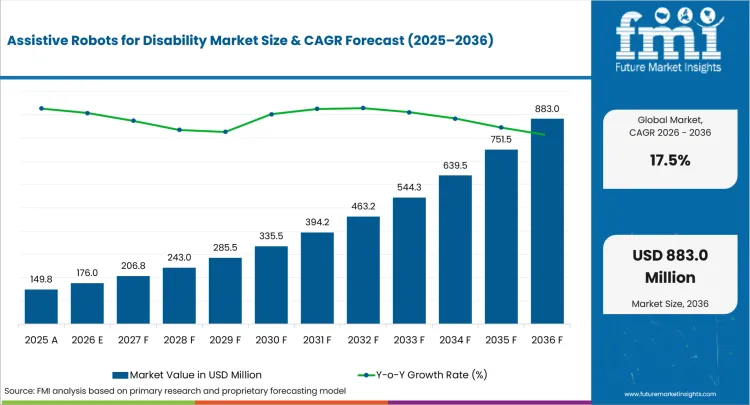
Key Takeaways of Assistive Robots for Disability Market
- Demand for assistive robots is driven by independent living goals, with healthcare providers and families increasingly evaluating robotic assistance based on practical improvements in mobility, self-care, and user autonomy rather than technology features alone.
- By component, hardware is expected to lead with 62.0% share in 2026, accounting for the largest investment within complete robotic systems.
- Home & personal use is the dominant application segment, projected to hold 52.0% share in 2026, remaining the preferred setting for disability support across everyday living environments.
- Wheelchair-mounted robotic arms are estimated to lead the product category with 46.0% share in 2026, driven by their role in improving independence during routine daily activities.
- Rehabilitation providers are incorporating robotic support into functional recovery programs, while user-friendly control systems continue improving accessibility across different mobility conditions.
- Regional demand reflects healthcare funding priorities, rehabilitation capacity, and disability policies, with North America, Europe, and East Asia remaining key centres for adoption, growing at a projected 17.5% CAGR through 2036.
- Competition centers on Kinova, Obi, Neater Solutions, Focal Meditech, ReWalk Robotics, Ekso Bionics Holdings, Cyberdyne, and Fourier Intelligence, with vendors differentiating through everyday usability, adaptive control systems, and clinical collaborations.
Analyst Perspective
"The assistive robots for disability market is advancing as end users and care providers place greater emphasis on technologies that deliver meaningful improvements in everyday independence. Adoption is increasingly influenced by intuitive operation, dependable long-term performance, and evidence demonstrating real-world functional benefits. Suppliers that combine user-centered design with clinical validation, responsive service, and ongoing technical support are likely to build stronger trust across home care, rehabilitation, and long-term assistive programs."
- Anurag Sharma, Principal Consultant at FMI
How is the Assistive Robots For Disability Market segmented?
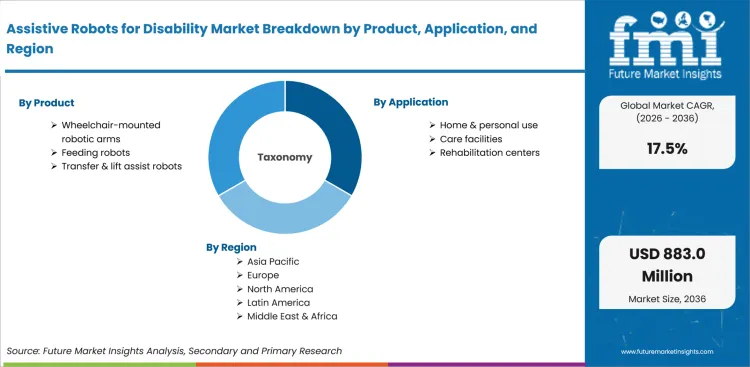
The assistive robots for disability market is segmented by product, application, component, end user, funding source, and region.
Product segmentation includes wheelchair-mounted robotic arms, feeding robots, and transfer & lift assist robots. Application coverage comprises home & personal use, care facilities, and rehabilitation centers. Component analysis includes hardware, software & controls, and services. End-user assessment covers individuals with disabilities, long-term care providers, and hospitals & rehabilitation centers. Funding source analysis includes insurance & public funding, out-of-pocket payments, and institutional sourcing. Regional evaluation spans North America, Latin America, Europe, East Asia, South Asia & Pacific, Oceania, and the Middle East & Africa.
Why do wheelchair-mounted robotic arms account for the leading product share?
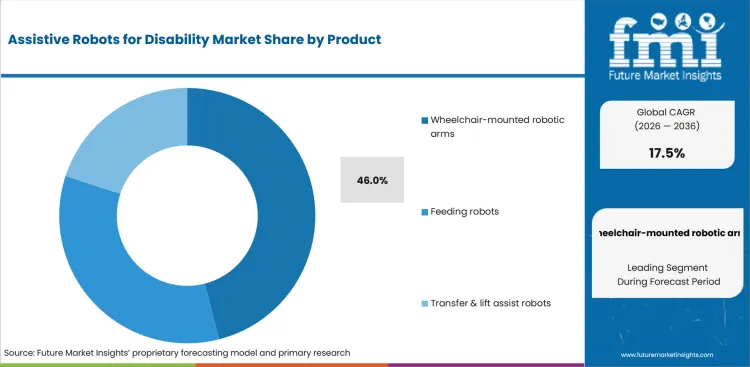
Wheelchair-mounted robotic arms address everyday activities that often require another person's assistance. Users rely on these systems to reach objects, open doors, prepare simple meals, or complete personal routines without leaving their wheelchair. Practical daily value has therefore positioned this product ahead of more task-specific assistive robots.
- In 2026, wheelchair-mounted robotic arms are estimated to account for 46.0% of product demand. Daily independence remains the primary purchasing objective as users seek greater control over routine household activities with minimal caregiver involvement. Kinova continued expanding its assistive robotics portfolio by advancing robotic manipulation technologies for users with upper-limb disabilities through its JACO and Gen3 assistive platforms. The company's product strategy remains focused on improving independent daily living through robotic assistance.
- Product developers continue refining compact arm designs, intuitive joystick controls, and adaptive gripping technology to improve accessibility across different physical abilities. Greater compatibility with powered wheelchairs is also encouraging wider acceptance among rehabilitation specialists and home care providers.
Why does home & personal use generate the highest application demand?
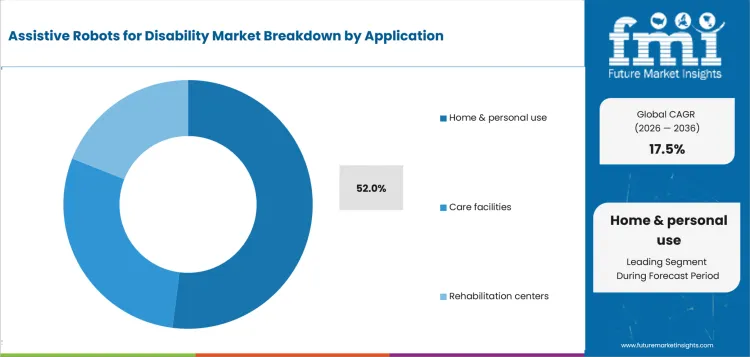
Most assistive robots spend considerably more time inside the home than in clinical environments. Daily routines create frequent opportunities for robotic assistance, making home settings the primary destination for product adoption across disability support.
- Home & personal use is projected to represent 52.0% of application segment in 2026. Individuals increasingly seek technologies that support eating, dressing, object handling, and communication within familiar surroundings while reducing reliance on continuous caregiver assistance.
- Rehabilitation centres continue introducing assistive robots during therapy sessions before recommending long-term use at home. Familiarity gained during rehabilitation often improves confidence before independent everyday use begins.
Why does hardware remain the largest component segment?
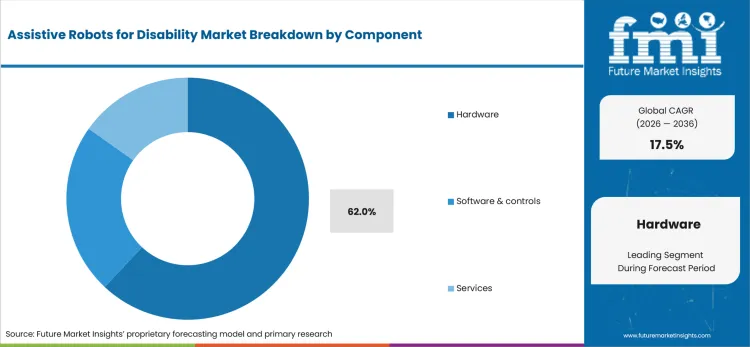
Mechanical systems continue representing the greatest share of overall product cost across assistive robotics. Robotic arms, actuators, sensors, batteries, mounting assemblies, and safety mechanisms determine physical performance during everyday operation.
- Hardware is expected to capture 62.0% of component revenue in 2026. Physical components continue representing the largest investment as manufacturers prioritize durability, precision movement, and dependable operation throughout repeated daily use.
- Software & controls improve user interaction through simplified interfaces and customizable operating modes. Service activities including installation, maintenance, and user training continue supporting long-term product performance after deployment.
What are the drivers, restraints, and opportunities in the Assistive Robots For Disability Market?
Growing interest in independent living is encouraging wider adoption of assistive robotics across disability support. Product cost and application-specific customization continue slowing purchasing decisions.
- Driver: Greater emphasis on independent daily living is encouraging healthcare providers and families to adopt robotic assistance across disability care.
- Restraint: Product customization and high acquisition costs continue limiting adoption across many healthcare organizations and individual users.
- Opportunity: Home healthcare services and community-based rehabilitation programs are creating additional demand for assistive robotic technologies.
Many purchasing decisions begin with a practical challenge instead of a technology comparison. People living with limited upper-body mobility often seek assistance with reaching objects, preparing meals, or completing personal care activities. Assistive robots address those daily requirements through robotic manipulation, adaptive controls, and programmable movement that support greater independence. Clinical teams also recognize that consistent daily use encourages confidence beyond structured rehabilitation sessions. ReWalk Robotics continued commercial expansion of its personal exoskeleton portfolio following broader reimbursement support for wearable robotic mobility devices, strengthening accessibility for individuals living with spinal cord injuries and related mobility conditions.
Cost remains an important consideration across disability support services. Assistive robots frequently require individualized configuration, wheelchair integration, and user-specific adjustments before regular operation begins. Rehabilitation providers also evaluate maintenance requirements, staff training, and long-term technical support before recommending a device for routine use. Those factors extend purchasing timelines across both institutional and personal settings.
Future opportunities increasingly extend into home healthcare and community care rather than hospital environments. Population ageing, caregiver shortages, and wider acceptance of assistive technologies are encouraging greater investment in solutions that support independent living. Manufacturers capable of combining accessible design with adaptable functionality and dependable after-sales support are expected to strengthen acceptance across long-term disability care.
Which country CAGRs are profiled in the Assistive Robots For Disability Market?
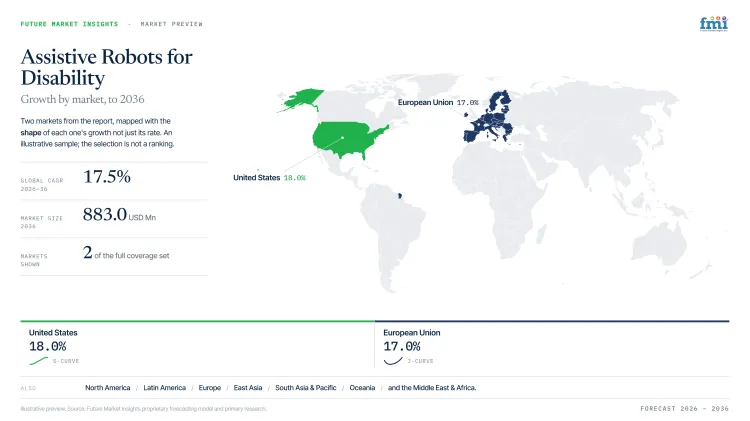
| Country | CAGR |
|---|---|
| United States | 18.0% |
| European Union | 17.0% |
Source: FMI proprietary forecasting model and primary research.
How do country-level CAGRs compare in the Assistive Robots For Disability Market?
The country comparison spans 1.0 percentage point, indicating a highly concentrated growth outlook across the Assistive Robots for Disability Market. The United States and the European Union remain closely aligned, reflecting strong momentum in regions with established healthcare infrastructure, advanced rehabilitation services and increasing investment in assistive technologies. Differences in healthcare funding models, reimbursement frameworks and disability support programs continue to shape adoption patterns across the two markets.
- The United States leads the comparison at 18.0% CAGR as expanding demand for independent living technologies, home-based care solutions and robotic systems that assist with daily activities continues to support market growth. Growing investment in rehabilitation services and increasing acceptance of assistive robotics in long-term care further strengthen adoption.
- The European Union remains 1.0 percentage point below the United States and reflects a market where rehabilitation-focused healthcare systems, accessibility initiatives and continued investment in assistive technology programs support steady adoption. Demand is reinforced by emphasis on improving functional independence, long-term rehabilitation outcomes and accessibility for people with disabilities.
Comparable CAGRs can still produce different market entry conditions. Differences in healthcare reimbursement, rehabilitation practices, accessibility policies and availability of disability support services influence deployment timelines and long-term adoption of assistive robotic technologies. The full report provides country-level CAGR analysis across North America, Latin America, Europe, East Asia, South Asia, Oceania and the Middle East and Africa.
Country-wise Analysis
- Growth across the European Union is projected at 17.0% CAGR from 2026 to 2036 owing to continued investment in rehabilitation services and assistive technology programs. The European Commission adopted the European Accessibility Act across Member States during June 2025, encouraging wider availability of accessible products and services that improve participation for people with disabilities. Rehabilitation centres continue evaluating robotic assistance as part of multidisciplinary care pathways.
- The United States is anticipated to record 18.0% CAGR through 2036 supported by expanding demand for technologies that improve independence outside institutional care. The Centers for Medicare & Medicaid Services reported that national health expenditure increased by 7.5% during 2023 to USD 4.9 trillion, with updated reporting released in December 2024, reflecting continued healthcare investment that supports adoption of advanced assistive technologies across rehabilitation and home care services. Developers continue introducing systems designed for everyday activities that reduce caregiver dependence and improve user autonomy.
Who are the notable companies in the Assistive Robots For Disability Market?
Kinova, Obi, Neater Solutions, Focal Meditech, ReWalk Robotics, Ekso Bionics, Cyberdyne Inc., and Fourier Intelligence are among the companies active in the assistive robots for disability market.
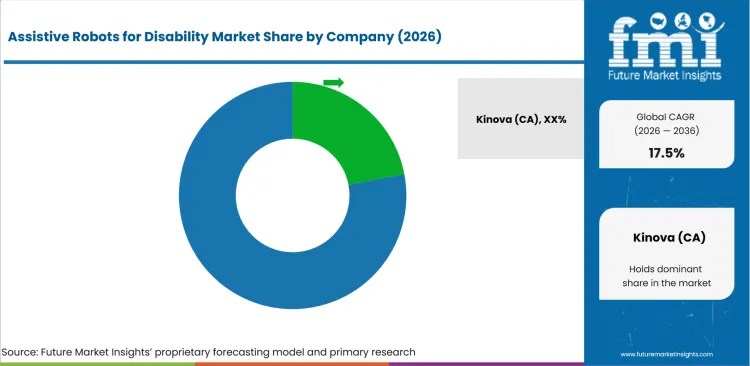
Competition reflects the ability to improve independence across everyday activities instead of adding complex robotic functions. Developers continue refining human-machine interaction, adaptive assistance, and ergonomic design to improve usability across different disability conditions. Clinical evidence, rehabilitation partnerships, and long-term product support also influence purchasing decisions among healthcare providers and individual users.
- Kinova and Obi concentrate on robotic assistance that enables users to perform everyday activities such as eating, reaching, and object manipulation with greater independence. Product development emphasizes intuitive control methods together with adaptable hardware suitable for home and rehabilitation environments.
- Neater Solutions and Focal Meditech focus on assistive technologies that simplify routine living for people with limited upper-limb mobility. Product portfolios continue evolving through improved accessibility, user comfort, and compatibility with different assistive equipment used across disability care.
- ReWalk Robotics, Ekso Bionics, Cyberdyne Inc., and Fourier Intelligence contribute advanced rehabilitation robotics that support mobility recovery and physical assistance. Continuing investment in wearable robotics, intelligent motion control, and rehabilitation technologies is expanding the role of assistive robotics across hospitals, rehabilitation centres, and community healthcare services.
Competitive Benchmarking: Assistive Robots for Disability Market
| Company | Product Portfolio | Rehabilitation Capability | Technology Innovation | Geographic Presence |
|---|---|---|---|---|
| Kinova | High | High | High | Global |
| Obi | Medium | Medium | High | North America |
| Neater Solutions | Medium | Medium | Medium | Europe |
| Focal Meditech | Medium | High | Medium | Europe |
| ReWalk Robotics | High | High | High | Global |
| Ekso Bionics | High | High | High | Global |
| Cyberdyne Inc. | High | High | High | Asia and Europe |
| Fourier Intelligence | High | High | High | Global |
Scoring basis: High reflects established commercial products, rehabilitation expertise, and international deployment. Medium represents demonstrated capability across selected assistive robotics applications and regional healthcare markets.
Source: FMI proprietary competitive assessment based on company portfolios, clinical activities, and primary research.
Key Developments in the Assistive Robots for Disability Market
- In March 2025, ReWalk Robotics received additional regulatory clearance for ReStore Exo-Suit applications, expanding rehabilitation options for people recovering from neurological conditions. The development strengthened the company's position across mobility assistance and rehabilitation robotics.
Key Players in the Assistive Robots for Disability Market
- Kinova
- Obi
- Neater Solutions
- Focal Meditech
- ReWalk Robotics Ltd.
- Ekso Bionics Holdings, Inc.
- Cyberdyne Inc.
- Fourier Intelligence
Assistive Robots for Disability Market Report Scope
| Coverage field | Report scope |
|---|---|
| Market breakdown | Product, application, component, end user, funding source, country, and regional analysis. |
| Market Definition | Assistive robots for disability are robotic systems developed to support people with physical disabilities by improving mobility, object handling, communication, feeding, rehabilitation, and other activities of daily living through intelligent mechanical assistance. |
| Regions Covered | North America, Latin America, Europe, East Asia, South Asia & Pacific, Oceania, and the Middle East & Africa. |
| Countries Covered | United States, Germany, United Kingdom, France, Japan, China, South Korea, Canada, and more than 30 additional countries. |
| Key Companies Profiled | Kinova, Obi, Neater Solutions, Focal Meditech, ReWalk Robotics Ltd., Ekso Bionics Holdings, Inc., Cyberdyne Inc., and Fourier Intelligence. |
| Forecast Period | 2026 to 2036, with 2025 used as the historical market-size reference. |
| Approach | Hybrid bottom-up and top-down market estimation supported by manufacturer analysis, rehabilitation adoption trends, healthcare utilization patterns, and country-level disability support assessment. |
Source: FMI proprietary research and primary interviews.
Assistive Robots for Disability Market Research Methodology
| Method | Approach |
|---|---|
| Primary Research | FMI analysts gathered input from manufacturers, service providers, technology developers, distributors, end users, sourcing teams, and subject-matter experts. Interviews examined purchasing decisions, product or service evaluation, adoption barriers, approval requirements, pricing considerations, and expectations for technical or commercial support. Respondents were also asked what evidence is required before a trial, pilot, or initial order develops into regular purchasing. |
| Secondary Research | Desk research covered government statistics, regulatory publications, trade data, industry associations, technical literature, standards, company filings, product information, and official corporate announcements. Sources were reviewed for relevance, publication date, geographic coverage, and consistency with the defined market scope. Claims relating to performance, applications, approvals, capacity, investment, and commercial activity were retained only when supported by credible public evidence. |
| Market Estimation | The market model combined the baseline value with historical performance, segment structure, pricing and volume indicators, adoption levels, company participation, and country-level demand conditions. Forecast assumptions considered economic activity, investment trends, regulatory developments, technology adoption, purchasing cycles, supply availability, and barriers to wider market use. Segment and regional estimates were reconciled before the final market total was calculated. |
| Forecast Validation | Estimates were checked against multiple independent indicators, including public data, company activity, trade patterns, industry developments, and findings from primary interviews. Validation also tested whether products, services, applications, and company revenues fell within the defined market boundaries. Adjacent categories, unsupported claims, overlapping revenues, and activities without direct market relevance were excluded to reduce double counting and maintain consistency across segments and countries. |
Assistive Robots for Disability Market by Segments
By Product
- Wheelchair-mounted robotic arms
- Feeding robots
- Transfer & lift assist robots
By Application
- Home & personal use
- Care facilities
- Rehabilitation centers
By Component
- Hardware
- Software & controls
- Services
By End User
- Individuals with disabilities
- Long-term care providers
- Hospitals & rehabilitation centers
By Funding Source
- Insurance & public funding
- Out-of-pocket payments
- Institutional procurement
By Region
- North America
- United States
- Canada
- Latin America
- Brazil
- Mexico
- Argentina
- Europe
- Germany
- United Kingdom
- France
- Italy
- Spain
- Rest of Europe
- East Asia
- Japan
- China
- South Korea
- South Asia & Pacific
- India
- ASEAN
- Australia & New Zealand
- Rest of South Asia & Pacific
- Oceania
- Australia
- New Zealand
- Middle East & Africa
- GCC Countries
- South Africa
- Türkiye
Bibliography
- Centers for Medicare & Medicaid Services. (2024, December). National health expenditure data. Centers for Medicare & Medicaid Services.
- European Commission. (2025). European Accessibility Act. European Commission.
- Fourier Intelligence. (2025). GR-2 humanoid robot advances embodied intelligence and rehabilitation robotics. Fourier Intelligence.
- Fourier Intelligence. (2025). NewInTech newsroom announcement. Fourier Intelligence.
- Kinova Inc. (2025). Assistive robotics solutions and robotic arms. Kinova Inc.
- ReWalk Robotics Ltd. (2025). Investor relations and corporate announcements. ReWalk Robotics Ltd. (Use only if you cite an actual official ReWalk announcement.)
- World Health Organization. (2025). World report on disability and rehabilitation initiatives. World Health Organization. (Use only if referenced in the report.)
This Report Answers
- What is the estimated value of the assistive robots for disability market in 2026 and 2036?
- What CAGR is projected for the assistive robots for disability market between 2026 and 2036?
- Which product, application, and component account for the leading market shares?
- What factors are encouraging adoption of assistive robots for disability?
- How do country growth rates compare across major markets?
- Which companies are influencing competition in assistive robots for disability?
- How does Future Market Insights estimate market size and validate forecast assumptions?
- Which factors influence purchasing decisions among healthcare providers and home users?
- How are rehabilitation technologies reshaping assistive robotics for disability support?
Frequently Asked Questions
What is supporting demand for assistive robots for disability?
Growing emphasis on independent living, rehabilitation services, and home-based care is encouraging wider adoption of robotic technologies that assist people with physical disabilities.
Who are the leading companies in the assistive robots for disability market?
Leading participants include Kinova, Obi, Neater Solutions, Focal Meditech, ReWalk Robotics, Ekso Bionics, Cyberdyne Inc., and Fourier Intelligence.
What is limiting wider adoption?
High acquisition costs, product customization requirements, and reimbursement limitations continue delaying purchasing decisions across several healthcare settings.
Why is the market attracting greater attention?
Healthcare providers increasingly recognize assistive robotics as an effective approach for improving functional independence and reducing long-term caregiver burden.
What challenge do assistive robots address?
Assistive robots support daily activities including reaching, feeding, mobility assistance, and object handling for individuals living with physical disabilities.
What should buyers evaluate before selecting an assistive robot?
Decision makers should assess functional suitability, ease of operation, rehabilitation compatibility, technical support, maintenance requirements, and long-term usability.
Which end users are creating new opportunities?
Home healthcare providers, rehabilitation centres, long-term care organizations, and individuals with disabilities continue expanding demand for assistive robotic technologies.
Preview the report firsthand - request a free sample
Get SampleGet the brochure for pricing and purchase details.
Get PDFTable of Content
- Key Takeaways
- Market Size and CAGR
- Top Growth Driver
- Fastest Growing Segment
- Leading Region
- Key Companies
- Emerging Opportunities
- Executive Summary
- Global Market Outlook
- Demand-side Trends
- Supply-side Trends
- Technology Roadmap Analysis
- Analysis and Recommendations
- Analyst Perspective (What is happening? Why now? What should investors know?)
- Key Questions Answered
- How large is the market?
- What is the CAGR?
- What are key trends?
- Which region dominates?
- Who are the leaders?
- Market Overview
- Market Coverage / Taxonomy
- Market Definition / Scope / Limitations
- Research Methodology
- Chapter Orientation
- Analytical Lens and Working Hypotheses
- Market Structure, Signals, and Trend Drivers
- Benchmarking and Cross-market Comparability
- Market Sizing, Forecasting, and Opportunity Mapping
- Research Design and Evidence Framework
- Desk Research Programme (Secondary Evidence)
- Expert Input and Fieldwork (Primary Evidence)
- Tooling, Models, and Reference Databases
- Data Engineering and Model Build
- Quality Assurance and Audit Trail
- Market Background
- Market Dynamics (Drivers, Restraints, Opportunity, Trends)
- Scenario Forecast (Optimistic, Likely, Conservative)
- Impact Analysis
- AI Impact
- Sustainability Impact
- Regulatory Impact
- Technology Impact
- Consumer / Buyer Analysis
- Purchase Drivers
- Adoption Barriers
- Buyer Journey
- Opportunity Map Analysis
- Product Life Cycle Analysis
- Supply Chain Analysis
- Investment Feasibility Matrix
- Value Chain Analysis
- PESTLE and Porter's Analysis
- Regulatory Landscape
- Regional Parent Market Outlook
- Production and Consumption Statistics
- Import and Export Statistics
- Global Market Analysis and Forecast, 2021 to 2036
- Historical Market Size Value (USD Million) Analysis, 2021 to 2025
- Current and Future Market Size Value (USD Million) Projections, 2026 to 2036
- Y-o-Y Growth Trend Analysis
- Absolute $ Opportunity Analysis
- Global Market Pricing Analysis, 2021 to 2036
- Global Market Analysis and Forecast, By Product, 2021 to 2036
- Introduction / Key Findings
- Historical Market Size Value (USD Million) Analysis By Product, 2021 to 2025
- Current and Future Market Size Value (USD Million) Analysis and Forecast By Product, 2026 to 2036
- Wheelchair-mounted robotic arms
- Feeding robots
- Transfer & lift assist robots
- Wheelchair-mounted robotic arms
- Y-o-Y Growth Trend Analysis By Product, 2021 to 2025
- Absolute $ Opportunity Analysis By Product, 2026 to 2036
- Global Market Analysis and Forecast, By Application, 2021 to 2036
- Introduction / Key Findings
- Historical Market Size Value (USD Million) Analysis By Application, 2021 to 2025
- Current and Future Market Size Value (USD Million) Analysis and Forecast By Application, 2026 to 2036
- Home & personal use
- Care facilities
- Rehabilitation centers
- Home & personal use
- Y-o-Y Growth Trend Analysis By Application, 2021 to 2025
- Absolute $ Opportunity Analysis By Application, 2026 to 2036
- Global Market Analysis and Forecast, By Component, 2021 to 2036
- Introduction / Key Findings
- Historical Market Size Value (USD Million) Analysis By Component, 2021 to 2025
- Current and Future Market Size Value (USD Million) Analysis and Forecast By Component, 2026 to 2036
- Hardware
- Software & controls
- Services
- Hardware
- Y-o-Y Growth Trend Analysis By Component, 2021 to 2025
- Absolute $ Opportunity Analysis By Component, 2026 to 2036
- Global Market Analysis and Forecast, By End User, 2021 to 2036
- Introduction / Key Findings
- Historical Market Size Value (USD Million) Analysis By End User, 2021 to 2025
- Current and Future Market Size Value (USD Million) Analysis and Forecast By End User, 2026 to 2036
- Individuals with disabilities
- Long-term care providers
- Hospitals & rehab
- Individuals with disabilities
- Y-o-Y Growth Trend Analysis By End User, 2021 to 2025
- Absolute $ Opportunity Analysis By End User, 2026 to 2036
- Global Market Analysis and Forecast, By Funding Source, 2021 to 2036
- Introduction / Key Findings
- Historical Market Size Value (USD Million) Analysis By Funding Source, 2021 to 2025
- Current and Future Market Size Value (USD Million) Analysis and Forecast By Funding Source, 2026 to 2036
- Insurance & public funding
- Out-of-pocket
- Institutional procurement
- Insurance & public funding
- Y-o-Y Growth Trend Analysis By Funding Source, 2021 to 2025
- Absolute $ Opportunity Analysis By Funding Source, 2026 to 2036
- Global Market Analysis and Forecast, By Region, 2021 to 2036
- Introduction
- Historical Market Size Value (USD Million) Analysis By Region, 2021 to 2025
- Current Market Size Value (USD Million) Analysis and Forecast By Region, 2026 to 2036
- North America
- Latin America
- Western Europe
- Eastern Europe
- East Asia
- South Asia and Pacific
- Middle East & Africa
- Market Attractiveness Analysis By Region
- North America Market Analysis and Forecast, By Country, 2021 to 2036
- Historical Market Size Value (USD Million) Trend Analysis By Market Taxonomy, 2021 to 2025
- Market Size Value (USD Million) Forecast By Market Taxonomy, 2026 to 2036
- By Country
- USA
- Canada
- By Product
- By Application
- By Component
- By End User
- By Funding Source
- By Country
- Market Attractiveness Analysis
- By Country
- By Product
- By Application
- By Component
- By End User
- By Funding Source
- Key Takeaways
- Latin America Market Analysis and Forecast, By Country
- Historical Market Size Value (USD Million) Trend Analysis By Market Taxonomy, 2021 to 2025
- Market Size Value (USD Million) Forecast By Market Taxonomy, 2026 to 2036
- By Country
- Brazil
- Mexico
- Chile
- Rest of Latin America
- By Product
- By Application
- By Component
- By End User
- By Funding Source
- By Country
- Market Attractiveness Analysis
- By Country
- By Product
- By Application
- By Component
- By End User
- By Funding Source
- Key Takeaways
- Western Europe Market Analysis and Forecast, By Country
- Historical Market Size Value (USD Million) Trend Analysis By Market Taxonomy, 2021 to 2025
- Market Size Value (USD Million) Forecast By Market Taxonomy, 2026 to 2036
- By Country
- Germany
- UK
- Italy
- Spain
- France
- Nordic
- BENELUX
- Rest of Western Europe
- By Product
- By Application
- By Component
- By End User
- By Funding Source
- By Country
- Market Attractiveness Analysis
- By Country
- By Product
- By Application
- By Component
- By End User
- By Funding Source
- Key Takeaways
- Eastern Europe Market Analysis and Forecast, By Country
- Historical Market Size Value (USD Million) Trend Analysis By Market Taxonomy, 2021 to 2025
- Market Size Value (USD Million) Forecast By Market Taxonomy, 2026 to 2036
- By Country
- Russia
- Poland
- Hungary
- Balkan & Baltic
- Rest of Eastern Europe
- By Product
- By Application
- By Component
- By End User
- By Funding Source
- By Country
- Market Attractiveness Analysis
- By Country
- By Product
- By Application
- By Component
- By End User
- By Funding Source
- Key Takeaways
- East Asia Market Analysis and Forecast, By Country
- Historical Market Size Value (USD Million) Trend Analysis By Market Taxonomy, 2021 to 2025
- Market Size Value (USD Million) Forecast By Market Taxonomy, 2026 to 2036
- By Country
- China
- Japan
- South Korea
- By Product
- By Application
- By Component
- By End User
- By Funding Source
- By Country
- Market Attractiveness Analysis
- By Country
- By Product
- By Application
- By Component
- By End User
- By Funding Source
- Key Takeaways
- South Asia and Pacific Market Analysis and Forecast, By Country
- Historical Market Size Value (USD Million) Trend Analysis By Market Taxonomy, 2021 to 2025
- Market Size Value (USD Million) Forecast By Market Taxonomy, 2026 to 2036
- By Country
- India
- ASEAN
- Australia & New Zealand
- Rest of South Asia and Pacific
- By Product
- By Application
- By Component
- By End User
- By Funding Source
- By Country
- Market Attractiveness Analysis
- By Country
- By Product
- By Application
- By Component
- By End User
- By Funding Source
- Key Takeaways
- Middle East & Africa Market Analysis and Forecast, By Country
- Historical Market Size Value (USD Million) Trend Analysis By Market Taxonomy, 2021 to 2025
- Market Size Value (USD Million) Forecast By Market Taxonomy, 2026 to 2036
- By Country
- Kingdom of Saudi Arabia
- Other GCC Countries
- Türkiye
- South Africa
- Other African Union
- Rest of Middle East & Africa
- By Product
- By Application
- By Component
- By End User
- By Funding Source
- By Country
- Market Attractiveness Analysis
- By Country
- By Product
- By Application
- By Component
- By End User
- By Funding Source
- Key Takeaways
- Key Countries Market Analysis
- USA
- Pricing Analysis
- Market Share Analysis, 2025
- By Product
- By Application
- By Component
- By End User
- By Funding Source
- Canada
- Pricing Analysis
- Market Share Analysis, 2025
- By Product
- By Application
- By Component
- By End User
- By Funding Source
- Mexico
- Pricing Analysis
- Market Share Analysis, 2025
- By Product
- By Application
- By Component
- By End User
- By Funding Source
- Brazil
- Pricing Analysis
- Market Share Analysis, 2025
- By Product
- By Application
- By Component
- By End User
- By Funding Source
- Chile
- Pricing Analysis
- Market Share Analysis, 2025
- By Product
- By Application
- By Component
- By End User
- By Funding Source
- Germany
- Pricing Analysis
- Market Share Analysis, 2025
- By Product
- By Application
- By Component
- By End User
- By Funding Source
- UK
- Pricing Analysis
- Market Share Analysis, 2025
- By Product
- By Application
- By Component
- By End User
- By Funding Source
- Italy
- Pricing Analysis
- Market Share Analysis, 2025
- By Product
- By Application
- By Component
- By End User
- By Funding Source
- Spain
- Pricing Analysis
- Market Share Analysis, 2025
- By Product
- By Application
- By Component
- By End User
- By Funding Source
- France
- Pricing Analysis
- Market Share Analysis, 2025
- By Product
- By Application
- By Component
- By End User
- By Funding Source
- India
- Pricing Analysis
- Market Share Analysis, 2025
- By Product
- By Application
- By Component
- By End User
- By Funding Source
- ASEAN
- Pricing Analysis
- Market Share Analysis, 2025
- By Product
- By Application
- By Component
- By End User
- By Funding Source
- Australia & New Zealand
- Pricing Analysis
- Market Share Analysis, 2025
- By Product
- By Application
- By Component
- By End User
- By Funding Source
- China
- Pricing Analysis
- Market Share Analysis, 2025
- By Product
- By Application
- By Component
- By End User
- By Funding Source
- Japan
- Pricing Analysis
- Market Share Analysis, 2025
- By Product
- By Application
- By Component
- By End User
- By Funding Source
- South Korea
- Pricing Analysis
- Market Share Analysis, 2025
- By Product
- By Application
- By Component
- By End User
- By Funding Source
- Russia
- Pricing Analysis
- Market Share Analysis, 2025
- By Product
- By Application
- By Component
- By End User
- By Funding Source
- Poland
- Pricing Analysis
- Market Share Analysis, 2025
- By Product
- By Application
- By Component
- By End User
- By Funding Source
- Hungary
- Pricing Analysis
- Market Share Analysis, 2025
- By Product
- By Application
- By Component
- By End User
- By Funding Source
- Kingdom of Saudi Arabia
- Pricing Analysis
- Market Share Analysis, 2025
- By Product
- By Application
- By Component
- By End User
- By Funding Source
- Türkiye
- Pricing Analysis
- Market Share Analysis, 2025
- By Product
- By Application
- By Component
- By End User
- By Funding Source
- South Africa
- Pricing Analysis
- Market Share Analysis, 2025
- By Product
- By Application
- By Component
- By End User
- By Funding Source
- USA
- Market Structure Analysis
- Competition Dashboard
- Competition Benchmarking
- Market Share Analysis of Top Players
- By Regional
- By Product
- By Application
- By Component
- By End User
- By Funding Source
- Emerging Startups
- Innovation Benchmarking
- Competition Analysis
- Competition Deep Dive
- Kinova (CA)
- Overview
- Product Portfolio
- Profitability by Market Segments
- Sales Footprint
- Strategy Overview
- Marketing Strategy
- Product Strategy
- Channel Strategy
- Obi (US)
- Neater Solutions (UK)
- Focal Meditech (NL)
- Kinova (CA)
- Case Studies
- Success Stories
- Recent Developments
- Competition Deep Dive
- Assumptions & Acronyms Used


