

- Industry Size (2026):
- USD 1.9 Bn
- Forecast (2036)
- USD 3.4Bn
- CAGR (2026 to 2036)
- 5.90%
Automotive Deep Groove Ball Bearings Market Forecast and Outlook 2026 to 2036
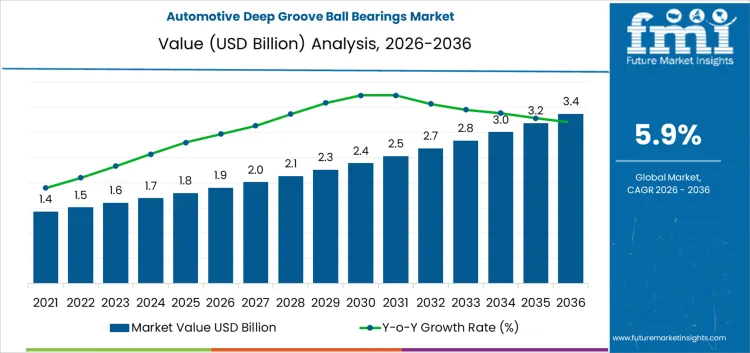
The automotive deep groove ball bearings market is projected to grow from USD 1.9 billion in 2026 to USD 3.4 billion by 2036, with a compound annual growth rate (CAGR) of 5.90%. This growth is driven by the increasing demand for efficient, reliable, and durable components in the automotive sector. These bearings are essential for reducing friction and ensuring smooth operation in critical automotive parts, including wheels, transmissions, and engines.
The market is also benefiting from the rise in electric vehicles (EVs) and hybrid vehicles, which require specialized bearings to handle unique operational conditions. Sealed deep groove ball bearings dominate the market due to their ability to prevent contaminants and retain lubrication, improving performance and lifespan. The wheel end application holds a significant share, emphasizing the need for high-quality bearings in demanding environments. As technological advancements continue, the market is expected to expand steadily through 2036, supported by ongoing automotive production and performance requirements.
Quick Stats for Automotive Deep Groove Ball Bearings Market
- Automotive Deep Groove Ball Bearings Market Value (2026): USD 1.9 Billion
- Automotive Deep Groove Ball Bearings Market Forecast Value (2036): USD 3.4 Billion
- Automotive Deep Groove Ball Bearings Market Forecast CAGR 2026 to 2036: 5.90%
- Leading Product Type in Automotive Deep Groove Ball Bearings Market: Sealed Deep Groove Ball Bearings
- Leading Application in Automotive Deep Groove Ball Bearings Market: Wheel End • Key Growth Regions in Automotive Deep Groove Ball Bearings Market: China, India, North America, Japan
- Top Key Players in Automotive Deep Groove Ball Bearings Market: SKF Group, NSK Ltd., NTN Corporation, Schaeffler AG, JTEKT Corporation, The Timken Company, MinebeaMitsumi Inc.
Metric
| Metric | Value |
|---|---|
| Automotive Deep Groove Ball Bearings Market Value (2026) | USD 1.9 Billion |
| Automotive Deep Groove Ball Bearings Market Forecast Value (2036) | USD 3.4 Billion |
| Automotive Deep Groove Ball Bearings Market Forecast CAGR 2026 to 2036 | 5.90% |
Why is the Automotive Deep Groove Ball Bearings Market Growing?
The automotive deep groove ball bearings market is experiencing steady growth, primarily driven by the automotive industry’s demand for reliable, durable, and efficient components. These ball bearings are integral to reducing friction and supporting smooth rotational motion in critical automotive parts, such as wheels, transmissions, and engines. As vehicle manufacturers continuously work to improve performance, fuel efficiency, and reduce overall vehicle weight, the demand for high-quality bearings has risen. The rise in global automotive production, particularly in emerging markets, is further contributing to the market’s expansion.
Another key factor driving growth is the increasing adoption of electric vehicles (EVs) and hybrid vehicles. These vehicles require specialized bearings to handle unique operating conditions, such as higher speeds, enhanced energy efficiency, and lower emissions. With the growing adoption of electric mobility and the focus on reducing carbon footprints, automotive deep groove ball bearings are being integrated into a broader range of applications. Manufacturers are designing bearings to handle higher torque loads and longer operational lifespans to meet the needs of these advanced technologies.
Technological advancements also play a vital role in the market's growth. Innovations in bearing materials and manufacturing processes have improved the performance and durability of ball bearings. Additionally, advancements in lubrication techniques and sealing technologies contribute to extending the lifespan of these bearings and reducing maintenance requirements. As vehicle production continues to evolve with innovations in automotive design and materials, the automotive deep groove ball bearings market is poised for continued growth, supported by the increasing focus on performance, efficiency.
What Does The Segment Overview Indicate About The Automotive Deep Groove Ball Bearings Market?
The automotive deep groove ball bearings market is segmented by type and application, reflecting the varying use cases and specifications for different automotive components. Sealed deep groove ball bearings lead the product type segment with a 58% share, favored for their ability to prevent contaminants from entering and to retain lubrication, making them ideal for demanding applications. Open deep groove ball bearings, although smaller in share, are used where greater flexibility and ease of maintenance are required. Shielded deep groove ball bearings offer protection against dirt and debris while being more economical. On the application side, wheel end applications dominate with a 36% share, as these bearings are critical in supporting the wheel and ensuring smooth rotation.
Why Do Sealed Deep Groove Ball Bearings Hold the Leading Product Share in the Automotive Deep Groove Ball Bearings Market?
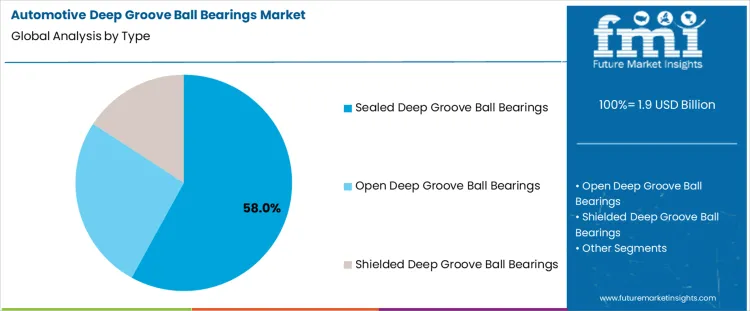
Sealed deep groove ball bearings hold the largest 58% share in the automotive deep groove ball bearings market due to their superior ability to protect against contaminants and retain lubricant, thus improving the lifespan and performance of critical automotive components. These bearings are particularly valuable in applications that experience harsh environmental conditions, such as wheel ends, where exposure to dirt, moisture, and extreme temperatures is common. Their ability to provide reliable, long-term performance with minimal maintenance makes them the preferred choice for automotive manufacturers. Sealed bearings' efficiency in reducing friction, improving energy consumption, and increasing the overall reliability of vehicle systems is driving their dominance in the market.
How Does the Wheel End Application Drive Demand in the Automotive Deep Groove Ball Bearings Market?
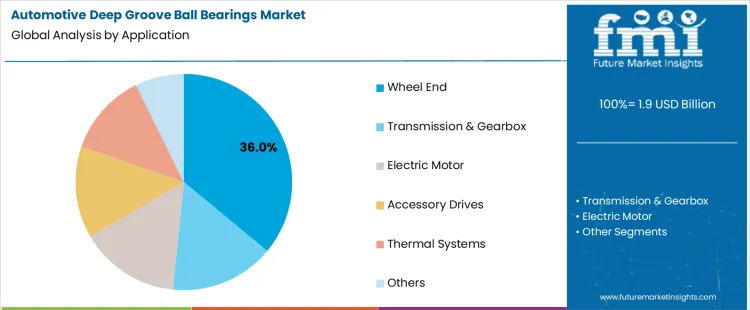
The wheel end application leads the automotive deep groove ball bearings market with a 36% share, reflecting the critical role of bearings in supporting the vehicle’s wheel and ensuring smooth and efficient rotation. The wheel end is one of the most demanding environments for bearings, as it experiences continuous motion, high stress, and exposure to harsh conditions like dirt, water, and extreme temperatures. Sealed and shielded deep groove ball bearings are particularly favored in wheel end applications due to their ability to prevent contaminants and retain lubrication. As automotive manufacturers continue to focus on vehicle performance, safety, and durability, the demand for high-quality bearings in wheel end applications remains a key driver of market growth.
What Are the Key Dynamics for the Automotive Deep Groove Ball Bearings Market?
The automotive deep groove ball bearings market is driven by the increasing demand for high-performance, durable, and efficient components in the automotive industry. As vehicle manufacturers focus on improving fuel efficiency, reducing vehicle weight, and enhancing overall performance, deep groove ball bearings are essential due to their low friction, high load capacity, and ability to function in harsh environments. Additionally, the rise of electric vehicles (EVs) and hybrid vehicles, which require specialized components, is further boosting the demand for these bearings.
Technological advancements, such as the development of higher precision bearings and improved materials, are also supporting market growth. However, challenges such as increasing material costs, the impact of raw material price fluctuations, and the need for continuous innovation to meet specific requirements in emerging automotive technologies remain.
What Are the Key Challenges in the Automotive Deep Groove Ball Bearings Market?
The automotive deep groove ball bearings market faces several challenges, including rising material costs and supply chain disruptions. As demand for high-performance bearings grows, the cost of raw materials such as steel and specialized alloys is fluctuating, impacting manufacturers' ability to maintain cost-effectiveness. Moreover, the development of new technologies, such as electric and autonomous vehicles, introduces complexity to bearing designs, requiring advanced materials and precision manufacturing processes. The market is also faced with intense competition, as numerous suppliers offer similar products, making it difficult for companies to differentiate themselves. The increasing pressure to meet sustainability goals requires manufacturers to invest in eco-friendly production processes, which can lead to higher operational costs.
How Are Technological Innovations Shaping the Automotive Deep Groove Ball Bearings Market?
Technological innovations are playing a pivotal role in shaping the automotive deep groove ball bearings market by enhancing performance, durability, and manufacturing efficiency. Developments in materials science, such as the introduction of ceramic and hybrid bearings, are enabling the creation of more robust, lightweight components that can handle higher speeds and greater loads. Advancements in lubrication technology and sealing systems are improving the lifespan and reliability of ball bearings, reducing maintenance costs and downtime for automotive applications. The integration of sensors and smart technologies is also gaining traction, as manufacturers explore the potential of smart bearings that can monitor wear and predict failure, further enhancing vehicle safety and efficiency.
What Is the Country-Wise Growth Outlook for the Automotive Deep Groove Ball Bearings Market?
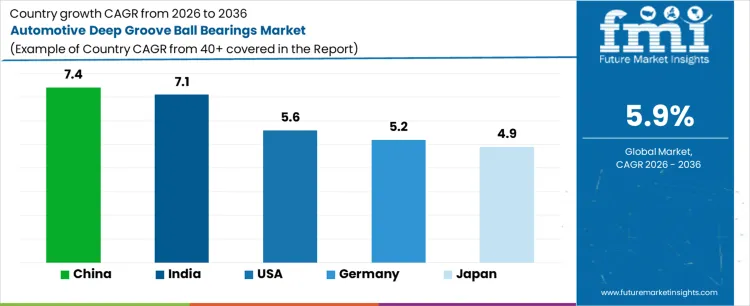
The automotive deep groove ball bearings market is experiencing varied growth across different regions. China leads with a CAGR of 7.4%, driven by the rapid growth in the automotive sector and increasing demand for high-performance components. India follows closely with a CAGR of 7.1%, supported by the expansion of the automotive manufacturing industry and rising vehicle production. The USA shows a steady growth at a CAGR of 5.6%, with demand driven by a well-established automotive market and a focus on enhancing vehicle efficiency and performance. Germany records a CAGR of 5.2%, with a mature automotive industry and an increasing push for advanced bearing solutions. Japan experiences a slightly lower CAGR of 4.9%, driven by its high-tech automotive market and emphasis on reliability and performance in vehicle components.
| Country | CAGR (%) |
|---|---|
| China | 7.4% |
| India | 7.1% |
| USA | 5.6% |
| Germany | 5.2% |
| Japan | 4.9% |
Why Is China Leading in the Automotive Deep Groove Ball Bearings Market?
China is leading the automotive deep groove ball bearings market with a CAGR of 7.4%, driven by its rapid automotive industry expansion. As the world’s largest producer and consumer of vehicles, China has a significant demand for automotive components, including bearings, to ensure vehicle performance, longevity, and fuel efficiency. The automotive sector is evolving to meet environmental regulations and growing consumer demands for advanced, energy-efficient vehicles
. As China increasingly focuses on the production of electric vehicles (EVs), the need for specialized, high-performance bearings that can handle the requirements of new vehicle technologies, such as higher torque and speed, is rising. China’s continued urbanization and industrialization boost vehicle ownership, further driving the need for automotive parts. The country’s investments in improving manufacturing capabilities and the rise of home-grown automotive brands also contribute to the market’s expansion, making China the key player in the global automotive deep groove ball bearings market.
What Is Driving Growth in India’s Automotive Deep Groove Ball Bearings Market?
India is seeing substantial growth in the automotive deep groove ball bearings market, with a CAGR of 7.1%. This is largely attributed to the rapid expansion of the automotive manufacturing sector, driven by increasing domestic demand for vehicles and rising middle-class income. India’s burgeoning automotive industry, combined with a focus on manufacturing fuel-efficient vehicles, is escalating the need for high-quality bearings in the production process.
The growing number of vehicle owners in the country is also spurring the demand for automotive components that enhance safety and performance. India’s strategic push to become a global automotive manufacturing hub has led to increased investments in both local production and exports, further driving the demand for bearings. As India continues to develop its infrastructure and automotive sector, deep groove ball bearings will remain a crucial component in improving vehicle performance, and their demand will continue to grow, supported by both internal production and global market expansion.
Why Is the Automotive Deep Groove Ball Bearings Market Growing in the USA?
The automotive deep groove ball bearings market in the USA is growing at a CAGR of 5.6%, supported by the country’s focus on high-performance, reliable vehicle components. The USA is home to a well-established automotive industry, where there is a constant push for efficiency, innovation, and quality in vehicle manufacturing. With the rise of electric and hybrid vehicles, the demand for specialized bearings that can withstand the higher speeds, greater torque, and unique operating conditions of these vehicles is also increasing.
As manufacturers strive to enhance vehicle performance, safety, and energy efficiency, the need for precise and durable ball bearings becomes even more critical. The USA’s focus on reducing vehicle emissions, improving fuel efficiency, and meeting stricter environmental standards contributes to the demand for deep groove ball bearings. The continued adoption of advanced technologies in the automotive sector ensures that these bearings remain integral to meeting new industry standards and consumer expectations.
What Is Contributing to the Growth of the Automotive Deep Groove Ball Bearings Market in Germany?
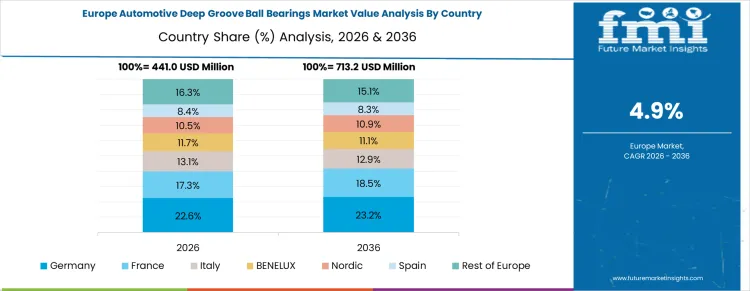
Germany’s automotive deep groove ball bearings market is growing at a CAGR of 5.2%, driven by its robust automotive industry, which is a major global player. Known for its engineering excellence and focus on innovation, Germany requires high-performance, reliable bearings for a wide range of applications, including premium vehicles, electric cars, and hybrids. As the automotive industry pushes toward sustainability and energy efficiency, bearings that support these goals are in high demand.
Germany’s strong presence in both the traditional internal combustion engine (ICE) and emerging electric vehicle (EV) sectors leads to the requirement for highly durable, precision-engineered ball bearings that can meet modern vehicle performance standards. The country's focus on manufacturing vehicles with low environmental impact is further encouraging the adoption of energy-efficient bearings. Germany’s well-established automotive supply chain and research infrastructure foster continuous improvements in bearing technology, ensuring steady growth for the automotive deep groove ball bearings market.
What Is Supporting Growth in Japan’s Automotive Deep Groove Ball Bearings Market?
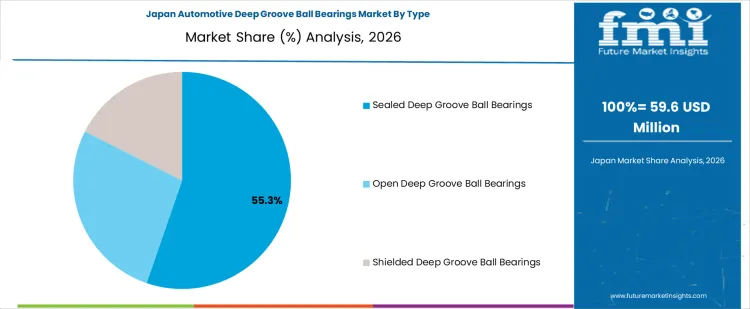
Japan’s automotive deep groove ball bearings market is growing at a CAGR of 4.9%, driven by a combination of technological advancements and a strong automotive manufacturing sector. Known for its innovation and precision engineering, Japan’s automotive industry places a high emphasis on producing high-performance, durable vehicles. As the demand for fuel-efficient and environmentally friendly vehicles rises, so does the need for advanced bearings capable of supporting complex automotive systems, such as electric and hybrid vehicles.
Japanese manufacturers are at the forefront of adopting cutting-edge bearing technologies, including hybrid materials and designs that provide improved load resistance, reduced friction, and greater durability. Japan’s established automotive market and its focus on safety, reliability, and cutting-edge vehicle technologies contribute to the steady demand for deep groove ball bearings. As the country continues to innovate in vehicle technologies and adopt newer systems like autonomous vehicles, the need for advanced bearing solutions will continue to drive market growth.
Competition and Strategies in the Automotive Deep Groove Ball Bearings Market
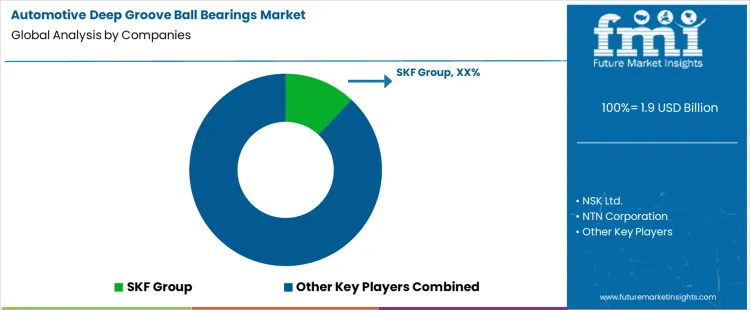
The competition in the automotive deep groove ball bearings market is intense, with leading players continuously innovating to meet automotive industry demands. SKF Group and NSK Ltd. lead with their focus on performance and reliability. SKF has leveraged decades of expertise to produce bearings that reduce friction and increase fuel efficiency. Their products are designed to meet stringent automotive requirements, delivering high reliability even under extreme conditions. NSK emphasizes precision engineering, enhancing product lifespan and minimizing maintenance. Both companies invest heavily in research and development, ensuring their products remain at the forefront of the industry.
NTN Corporation and Schaeffler AG adopt similar strategies, prioritizing durability and sustainability. NTN specializes in bearings that support high load capacity, critical for automotive applications where performance consistency is essential. Schaeffler's products are engineered to improve safety and fuel efficiency, with deep groove ball bearings integrated into a wide range of vehicle types. Both companies are expanding their portfolios, focusing on smart technologies like sensors and high-performance materials. Their product brochures highlight precision, efficiency, and reduced environmental impact, all essential for the evolving automotive market.
JTEKT Corporation, The Timken Company, and MinebeaMitsumi Inc. complement this competitive landscape with their own unique approaches. JTEKT focuses on reliability and noise reduction, enhancing passenger comfort. Timken, known for its superior motion and control products, ensures that its bearings operate under demanding conditions. MinebeaMitsumi targets high-precision applications, offering products that provide superior operational stability. Each company’s product brochure underscores a commitment to quality, precision, and innovation, with clear messaging about their bearings’ ability to perform in challenging environments. These companies are all working to stay ahead by focusing on quality, innovation, and sustainability in their product offerings.
Key Players in Automotive Deep Groove Ball Bearings Market
- SKF Group
- NSK Ltd.
- NTN Corporation
- Schaeffler AG
- JTEKT Corporation
- The Timken Company
- MinebeaMitsumi Inc.
Scope of Report
| Attribute | Description |
|---|---|
| Quantitative Unit | USD Billion |
| Product | Sealed Deep Groove Ball Bearings, Open Deep Groove Ball Bearings, Shielded Deep Groove Ball Bearings |
| Application | Wheel End, Transmission & Gearbox, Electric Motor, Accessory Drives, Thermal Systems, Others |
| Regions Covered | Asia Pacific, Europe, North America, Latin America, Middle East & Africa |
| Countries Covered | China, Japan, South Korea, India, Australia & New Zealand, ASEAN, Rest of Asia Pacific, Germany, United Kingdom, France, Italy, Spain, Nordic, BENELUX, United States, Canada, Mexico, Brazil, Chile, Rest of Latin America, Kingdom of Saudi Arabia, Other GCC Countries, Turkey, South Africa, Other African Union, Rest of Middle East & Africa |
| Key Companies Profiled | SKF Group, NSK Ltd., NTN Corporation, Schaeffler AG, JTEKT Corporation, The Timken Company, MinebeaMitsumi Inc. |
| Additional Attributes | Market revenue by product and application; regional adoption trends for different types of ball bearings; growth projections for 2026-2036; technological advancements in automotive deep groove ball bearings systems; competitive analysis and market share of key players. |
Automotive Deep Groove Ball Bearings Market by Key Segments
Type:
- Sealed Deep Groove Ball Bearings
- Open Deep Groove Ball Bearings
- Shielded Deep Groove Ball Bearings
Application:
- Wheel End
- Transmission & Gearbox
- Electric Motor
- Accessory Drives
- Thermal Systems
- Others
Region:
- Asia Pacific
- China
- Japan
- South Korea
- India
- Australia & New Zealand
- ASEAN
- Rest of Asia Pacific
- Europe
- Germany
- United Kingdom
- France
- Italy
- Spain
- Nordic
- BENELUX
- Rest of Europe
- North America
- United States
- Canada
- Mexico
- Latin America
- Brazil
- Chile
- Rest of Latin America
- Middle East & Africa
- Kingdom of Saudi Arabia
- Other GCC Countries
- Turkey
- South Africa
- Other African Union
- Rest of Middle East & Africa
Bibilography
- International Organization of Motor Vehicle Manufacturers (OICA). (2024).
- USA Department of Energy. (2024).
- International Energy Agency (IEA). (2024).
- National Institute of Standards and Technology (NIST). (2023).
- European Commission. (2024).
Frequently Asked Questions
How big is the automotive deep groove ball bearings market in 2026?
The global automotive deep groove ball bearings market is estimated to be valued at USD 1.9 billion in 2026.
What will be the size of automotive deep groove ball bearings market in 2036?
The market size for the automotive deep groove ball bearings market is projected to reach USD 3.4 billion by 2036.
How much will be the automotive deep groove ball bearings market growth between 2026 and 2036?
The automotive deep groove ball bearings market is expected to grow at a 5.9% CAGR between 2026 and 2036.
What are the key product types in the automotive deep groove ball bearings market?
The key product types in automotive deep groove ball bearings market are sealed deep groove ball bearings, open deep groove ball bearings and shielded deep groove ball bearings.
Which application segment to contribute significant share in the automotive deep groove ball bearings market in 2026?
In terms of application, wheel end segment to command 36.0% share in the automotive deep groove ball bearings market in 2026.
Preview the report firsthand - request a free sample
Get SampleGet the brochure for pricing and purchase details.
Get PDFTable of Content
- Executive Summary
- Global Market Outlook
- Demand-side Trends
- Supply-side Trends
- Technology Roadmap Analysis
- Analysis and Recommendations
- Market Overview
- Market Coverage / Taxonomy
- Market Definition / Scope / Limitations
- Market Background
- Market Dynamics
- Drivers
- Restraints
- Opportunity
- Trends
- Scenario Forecast
- Demand in Optimistic Scenario
- Demand in Likely Scenario
- Demand in Conservative Scenario
- Opportunity Map Analysis
- Product Life Cycle Analysis
- Supply Chain Analysis
- Investment Feasibility Matrix
- Value Chain Analysis
- PESTLE and Porter’s Analysis
- Regulatory Landscape
- Regional Parent Market Outlook
- Production and Consumption Statistics
- Import and Export Statistics
- Market Dynamics
- Global Market Analysis 2021 to 2025 and Forecast, 2026 to 2036
- Historical Market Size Value (USD Million) Analysis, 2021 to 2025
- Current and Future Market Size Value (USD Million) Projections, 2026 to 2036
- Y-o-Y Growth Trend Analysis
- Absolute $ Opportunity Analysis
- Global Market Pricing Analysis 2021 to 2025 and Forecast 2026 to 2036
- Global Market Analysis 2021 to 2025 and Forecast 2026 to 2036, By Type
- Introduction / Key Findings
- Historical Market Size Value (USD Million) Analysis By Type, 2021 to 2025
- Current and Future Market Size Value (USD Million) Analysis and Forecast By Type, 2026 to 2036
- Sealed Deep Groove Ball Bearings
- Open Deep Groove Ball Bearings
- Shielded Deep Groove Ball Bearings
- Sealed Deep Groove Ball Bearings
- Y-o-Y Growth Trend Analysis By Type, 2021 to 2025
- Absolute $ Opportunity Analysis By Type, 2026 to 2036
- Global Market Analysis 2021 to 2025 and Forecast 2026 to 2036, By Application
- Introduction / Key Findings
- Historical Market Size Value (USD Million) Analysis By Application, 2021 to 2025
- Current and Future Market Size Value (USD Million) Analysis and Forecast By Application, 2026 to 2036
- Wheel End
- Transmission & Gearbox
- Electric Motor
- Accessory Drives
- Thermal Systems
- Others
- Wheel End
- Y-o-Y Growth Trend Analysis By Application, 2021 to 2025
- Absolute $ Opportunity Analysis By Application, 2026 to 2036
- Global Market Analysis 2021 to 2025 and Forecast 2026 to 2036, By Region
- Introduction
- Historical Market Size Value (USD Million) Analysis By Region, 2021 to 2025
- Current Market Size Value (USD Million) Analysis and Forecast By Region, 2026 to 2036
- North America
- Latin America
- Western Europe
- Eastern Europe
- East Asia
- South Asia and Pacific
- Middle East & Africa
- Market Attractiveness Analysis By Region
- North America Market Analysis 2021 to 2025 and Forecast 2026 to 2036, By Country
- Historical Market Size Value (USD Million) Trend Analysis By Market Taxonomy, 2021 to 2025
- Market Size Value (USD Million) Forecast By Market Taxonomy, 2026 to 2036
- By Country
- USA
- Canada
- Mexico
- By Type
- By Application
- By Country
- Market Attractiveness Analysis
- By Country
- By Type
- By Application
- Key Takeaways
- Latin America Market Analysis 2021 to 2025 and Forecast 2026 to 2036, By Country
- Historical Market Size Value (USD Million) Trend Analysis By Market Taxonomy, 2021 to 2025
- Market Size Value (USD Million) Forecast By Market Taxonomy, 2026 to 2036
- By Country
- Brazil
- Chile
- Rest of Latin America
- By Type
- By Application
- By Country
- Market Attractiveness Analysis
- By Country
- By Type
- By Application
- Key Takeaways
- Western Europe Market Analysis 2021 to 2025 and Forecast 2026 to 2036, By Country
- Historical Market Size Value (USD Million) Trend Analysis By Market Taxonomy, 2021 to 2025
- Market Size Value (USD Million) Forecast By Market Taxonomy, 2026 to 2036
- By Country
- Germany
- UK
- Italy
- Spain
- France
- Nordic
- BENELUX
- Rest of Western Europe
- By Type
- By Application
- By Country
- Market Attractiveness Analysis
- By Country
- By Type
- By Application
- Key Takeaways
- Eastern Europe Market Analysis 2021 to 2025 and Forecast 2026 to 2036, By Country
- Historical Market Size Value (USD Million) Trend Analysis By Market Taxonomy, 2021 to 2025
- Market Size Value (USD Million) Forecast By Market Taxonomy, 2026 to 2036
- By Country
- Russia
- Poland
- Hungary
- Balkan & Baltic
- Rest of Eastern Europe
- By Type
- By Application
- By Country
- Market Attractiveness Analysis
- By Country
- By Type
- By Application
- Key Takeaways
- East Asia Market Analysis 2021 to 2025 and Forecast 2026 to 2036, By Country
- Historical Market Size Value (USD Million) Trend Analysis By Market Taxonomy, 2021 to 2025
- Market Size Value (USD Million) Forecast By Market Taxonomy, 2026 to 2036
- By Country
- China
- Japan
- South Korea
- By Type
- By Application
- By Country
- Market Attractiveness Analysis
- By Country
- By Type
- By Application
- Key Takeaways
- South Asia and Pacific Market Analysis 2021 to 2025 and Forecast 2026 to 2036, By Country
- Historical Market Size Value (USD Million) Trend Analysis By Market Taxonomy, 2021 to 2025
- Market Size Value (USD Million) Forecast By Market Taxonomy, 2026 to 2036
- By Country
- India
- ASEAN
- Australia & New Zealand
- Rest of South Asia and Pacific
- By Type
- By Application
- By Country
- Market Attractiveness Analysis
- By Country
- By Type
- By Application
- Key Takeaways
- Middle East & Africa Market Analysis 2021 to 2025 and Forecast 2026 to 2036, By Country
- Historical Market Size Value (USD Million) Trend Analysis By Market Taxonomy, 2021 to 2025
- Market Size Value (USD Million) Forecast By Market Taxonomy, 2026 to 2036
- By Country
- Kingdom of Saudi Arabia
- Other GCC Countries
- Turkiye
- South Africa
- Other African Union
- Rest of Middle East & Africa
- By Type
- By Application
- By Country
- Market Attractiveness Analysis
- By Country
- By Type
- By Application
- Key Takeaways
- Key Countries Market Analysis
- USA
- Pricing Analysis
- Market Share Analysis, 2025
- By Type
- By Application
- Canada
- Pricing Analysis
- Market Share Analysis, 2025
- By Type
- By Application
- Mexico
- Pricing Analysis
- Market Share Analysis, 2025
- By Type
- By Application
- Brazil
- Pricing Analysis
- Market Share Analysis, 2025
- By Type
- By Application
- Chile
- Pricing Analysis
- Market Share Analysis, 2025
- By Type
- By Application
- Germany
- Pricing Analysis
- Market Share Analysis, 2025
- By Type
- By Application
- UK
- Pricing Analysis
- Market Share Analysis, 2025
- By Type
- By Application
- Italy
- Pricing Analysis
- Market Share Analysis, 2025
- By Type
- By Application
- Spain
- Pricing Analysis
- Market Share Analysis, 2025
- By Type
- By Application
- France
- Pricing Analysis
- Market Share Analysis, 2025
- By Type
- By Application
- India
- Pricing Analysis
- Market Share Analysis, 2025
- By Type
- By Application
- ASEAN
- Pricing Analysis
- Market Share Analysis, 2025
- By Type
- By Application
- Australia & New Zealand
- Pricing Analysis
- Market Share Analysis, 2025
- By Type
- By Application
- China
- Pricing Analysis
- Market Share Analysis, 2025
- By Type
- By Application
- Japan
- Pricing Analysis
- Market Share Analysis, 2025
- By Type
- By Application
- South Korea
- Pricing Analysis
- Market Share Analysis, 2025
- By Type
- By Application
- Russia
- Pricing Analysis
- Market Share Analysis, 2025
- By Type
- By Application
- Poland
- Pricing Analysis
- Market Share Analysis, 2025
- By Type
- By Application
- Hungary
- Pricing Analysis
- Market Share Analysis, 2025
- By Type
- By Application
- Kingdom of Saudi Arabia
- Pricing Analysis
- Market Share Analysis, 2025
- By Type
- By Application
- Turkiye
- Pricing Analysis
- Market Share Analysis, 2025
- By Type
- By Application
- South Africa
- Pricing Analysis
- Market Share Analysis, 2025
- By Type
- By Application
- USA
- Market Structure Analysis
- Competition Dashboard
- Competition Benchmarking
- Market Share Analysis of Top Players
- By Regional
- By Type
- By Application
- Competition Analysis
- Competition Deep Dive
- SKF Group
- Overview
- Product Portfolio
- Profitability by Market Segments (Product/Age /Sales Channel/Region)
- Sales Footprint
- Strategy Overview
- Marketing Strategy
- Product Strategy
- Channel Strategy
- NSK Ltd.
- NTN Corporation
- Schaeffler AG
- JTEKT Corporation
- The Timken Company
- MinebeaMitsumi Inc.
- SKF Group
- Competition Deep Dive
- Assumptions & Acronyms Used
- Research Methodology


