

- Market Size (2026)
- USD 362.0 Mn
- Forecast (2036)
- USD 432.0 Mn
- CAGR (2026 to 2036)
- 1.8%
How big is Automotive Hood Prop Rods Market in 2026?
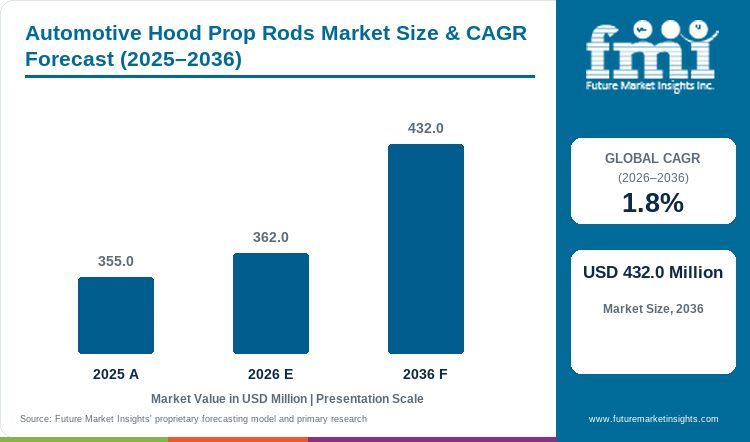
USD 362.0 million in 2026 and USD 432.0 million by 2036 at a 1.8% CAGR.
The market was valued at USD 355.0 million in 2025. Demand is estimated at USD 362.0 million in 2026 and is projected to reach USD 432.0 million by 2036 at 1.8% CAGR. The estimate covers rigid and telescopic rods that manually support an automotive hood or front access panel in the open position, together with integrated tips, clips and retainers sold as part of the assembly. Gas springs, hood hinges and powered actuators are excluded.
Demand sits beside the bonnet lock plate and latch market, because both components are specified around the hood opening system. Prop-rod revenue follows vehicle production, manual-support fitment and replacement of bent, missing or corroded assemblies.
Key Takeaways
- The market is valued at USD 362.0 million in 2026 and is projected to create USD 70.0 million in additional value by 2036.
- Passenger cars is projected to hold 72.0% of Vehicle Type demand in 2026 because passenger-car production provides the broadest fitment base.
- Coated steel is projected to hold 74.0% of Rod Material demand in 2026 because formed steel provides economical stiffness and familiar coating processes.
- Bent hook is projected to hold 49.0% of Rod Design and End demand in 2026 because the formed end combines engagement and load transfer with few parts.
- Gas springs, spring-assist hinges and powered hood mechanisms reduce conventional prop-rod fitment on higher-content vehicles.
- Some of the key players in this market include GM Genuine Parts, Ford Service Parts, Mopar, Nissan Genuine Parts, Dorman Products, NAPA, Stabilus, SUSPA, Lesjöfors, Edscha.
Analyst Perspective
"The hood prop rod survives because it solves a safety-critical holding task with one formed part. Its weakness is convenience, which is exactly where gas springs and powered systems compete."
- Nikhil Kaitwade, Principal Consultant, Future Market Insights
How is the automotive hood prop rods market segmented?
The automotive hood prop rods market is segmented by vehicle type, rod material, rod design and end, hood material, sales channel and region.
Vehicle type sets the production pool. Rod material and end design determine stiffness, corrosion behavior and engagement. Hood material affects local load limits, while sales channel separates vehicle assembly from replacement hardware.
Why do passenger cars lead vehicle-type demand?
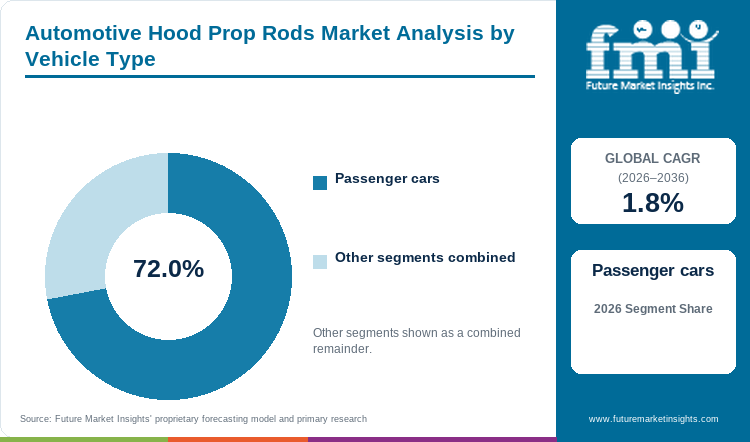
Passenger cars create the broadest fitment base for hood prop rods because many entry and mid-range models still use a simple manual support rather than gas struts or powered hood systems. The part is low cost, requires little package space and can remain in service for the life of the vehicle. Its geometry still has to match the hood opening angle, stowage point and under-hood layout, which keeps the component tied closely to individual vehicle programs.
- Passenger cars are estimated to account for 72.0% of vehicle-type demand in 2026.
- OICA reported 96.4 million motor vehicles produced globally in 2025, with passenger-car production providing a substantial fitment base for manual hood-support hardware.
Why does coated steel lead rod-material demand?
The rod has to carry hood weight without excessive flex while remaining easy to form into hooks, pivots and storage bends. Low-carbon steel suits this combination of stiffness and manufacturability. Protective coatings address corrosion exposure in the engine bay and around the front body structure, while the base material remains compatible with high-volume bending and simple welded or formed attachments.
- Coated steel is estimated to account for 74.0% of rod-material demand in 2026.
- Current OE service parts continue to use conventional rigid prop-rod architectures, including GM Genuine Parts hood prop rods designed and validated for specific vehicle applications.
Why do bent-hook designs lead rod-design demand?
A bent hook combines retention and load transfer in the rod itself. The user lifts the rod from its storage clip and places the formed end into a hole or slot in the hood inner panel, avoiding a separate latch or powered support mechanism. Toyota's hood-prop patent describes this familiar arrangement directly, with one end pivoted to the vehicle body and the other engaging an aperture or slot in the hood.
- Bent-hook designs are estimated to account for 49.0% of rod-design demand in 2026.
- US11447989B2 describes conventional hood prop rods using an elongated member with a hook or molded end that engages the hood inner panel to hold it open.
Why do steel-hood applications lead demand?
Steel hoods remain well suited to prop-rod support because the inner panel can incorporate a reinforced hole or bracket for the rod without adding a separate support assembly. Once hood mass and opening angle are fixed, the rod length and engagement point can be engineered around a predictable load path. Lighter hood materials can change that balance and may lead OEMs toward different reinforcement or assistance strategies, but manual rods remain practical where cost and simplicity dominate.
- Steel-hood applications are estimated to account for 58.0% of demand in 2026.
- Conventional prop-rod designs rely on a defined engagement point in the hood inner panel, so hood construction and local reinforcement remain part of the support-system design.
Why does OEM supply lead the sales channel?
A hood prop rod is inexpensive but highly vehicle-specific. Rod length, pivot position, storage clip, bend geometry and hood engagement point are established during front-end and hood development. That places most unit volume in original vehicle assembly. The service channel remains active for damaged or missing rods, but replacements are still matched to specific vehicle applications rather than sold as universal supports.
- OEM supply is estimated to account for 77.0% of sales-channel demand in 2026.
- GM identifies its hood prop rods as OE parts installed during production or validated for specific Chevrolet, Buick, GMC and Cadillac vehicles, while separate service parts are retained for replacement.
What are the drivers, restraints and opportunities in the Automotive Hood Prop Rods Market?
Low cost preserves fitment, assisted support systems reduce penetration, and value-focused vehicle growth keeps global revenue positive.
- Driver: A single formed rod provides reliable hood support with low mass, low part count and minimal assembly cost.
- Restraint: Gas struts and assisted hinges offer easier opening and remove the need to place the rod manually.
- Opportunity: Corrosion-resistant coatings, molded contact tips and complete service kits can raise value without changing the basic architecture.
The automotive door latch and hinges market reflects the wider hood hardware installed on every vehicle. A prop rod captures only part of that demand because assisted hinges and struts can perform the support function.
Substitution is based on user experience and package economics rather than powertrain. Gas springs enable one-hand opening and keep the support out of the service path, but they add seals, force tolerance and aging behavior. Powered systems add still more cost. The rigid rod remains defensible where durable simplicity has higher priority.
The compression gas spring market is the direct substitute category. Prop-rod suppliers can respond with lighter sections, quieter molded tips and positive-retention features that narrow the convenience gap without adopting a pressurized cylinder.
Which country CAGRs are profiled in the Automotive Hood Prop Rods Market?
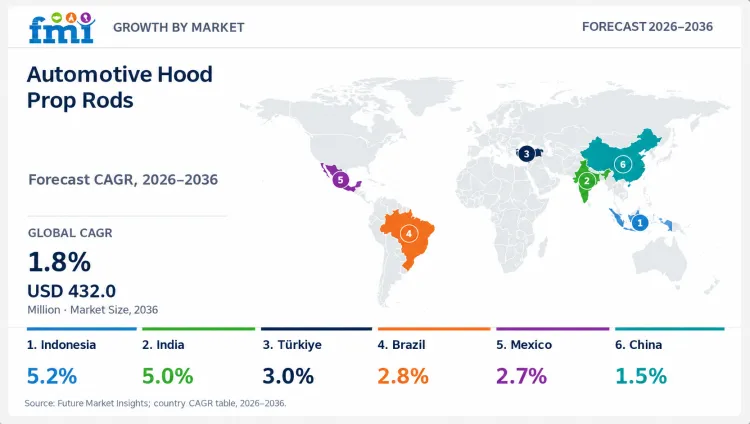
| Country | CAGR |
|---|---|
| Indonesia | 5.2% |
| India | 5.0% |
| Türkiye | 3.0% |
| Brazil | 2.8% |
| Mexico | 2.7% |
| China | 1.5% |
How do country-level CAGRs compare in the Automotive Hood Prop Rods Market?
Hood prop rod demand is shaped less by vehicle output alone and more by the type of platforms being assembled. Entry and mid-range vehicles still favor simple manual supports, while higher-content models are more likely to adopt gas springs or integrated assistance. India and Indonesia retain a wide base of cost-sensitive vehicle programs. Türkiye, Brazil and Mexico benefit from local assembly and export production. China still offers scale, but richer vehicle specifications gradually reduce manual-rod penetration. Germany faces the clearest substitution pressure as electrified and higher-content passenger cars take a larger share of domestic production. Germany produced 4.15 million passenger cars in 2025, with electric models accounting for 40% of output.
- Indonesia: Manual prop rods remain well suited to value-focused passenger vehicles, where low part count and simple serviceability matter more than assisted opening.
- India: High-volume small-car and light-commercial programs preserve a broad fitment base for rigid steel rods, particularly where local sourcing and low component cost remain important.
- Türkiye: Domestic assembly continues to support OEM demand even as the vehicle mix becomes more sophisticated. Türkiye produced about 1.42 million vehicles in 2025, including 872,538 passenger cars.
- Brazil: Local production and a large in-use vehicle base support both original fitment and replacement demand. Vehicle production reached 2.64 million units in 2025, up 3.5% from the previous year.
- Mexico: Export-oriented assembly keeps model-specific hood hardware tied closely to North American vehicle programs. The choice between a prop rod and an assisted support therefore depends heavily on the platform mix allocated to local plants.
- China: Large vehicle output continues to support substantial unit demand, but higher equipment content across newer models reduces the share of vehicles using conventional manual support rods.
- Germany: Prop rods face stronger substitution from gas springs and other assisted systems. The shift is reinforced by the changing production mix, with 1.67 million electric passenger cars manufactured domestically in 2025.
Across the key countries in this market, these rates measure revenue within the defined product boundary and do not represent growth of the wider automotive components industry.
Country-wise Analysis
- Indonesia: 5.2% CAGR through 2036. Vehicle ownership growth and continued use of cost-sensitive platforms preserve demand for rigid steel prop rods. The product also suits localized stamping, bending and coating operations, which keeps sourcing relatively straightforward for regional suppliers.
- India: 5.0% CAGR through 2036. Small cars, utility vehicles and light-commercial platforms provide a wide application base for simple hood supports. High local content requirements favor parts that can be formed and coated domestically without complex mechanisms or imported subassemblies.
- Türkiye: 3.0% CAGR through 2036. OEM production provides the main volume base, while exports expose component suppliers to several vehicle specifications. Total automotive output reached about 1.42 million units in 2025, keeping model-specific rods, clips and brackets relevant even as assisted supports gain ground on higher-content vehicles.
- Brazil: 2.8% CAGR through 2036. A 2.64 million-unit production base in 2025 supports original fitment, while the existing vehicle parc creates a separate replacement channel for damaged rods and retaining clips. Growth remains measured as assisted hood supports gradually move into better-equipped models.
- Mexico: 2.7% CAGR through 2036. Demand depends heavily on which passenger and light-truck programs are assigned to local plants. Manual rods remain viable on cost-controlled platforms, while gas supports take a larger role as vehicle content rises. Suppliers therefore need close alignment with individual OEM programs rather than broad catalog coverage.
- China: 1.5% CAGR through 2036. Production scale keeps absolute demand meaningful, but the product mix is moving away from simple manual support on many newer vehicles. Higher-content combustion models and new-energy vehicles increasingly adopt assisted or integrated hood-opening systems, limiting the share captured by conventional rods.
Who are the notable companies in the Automotive Hood Prop Rods Market?
GM Genuine Parts, Ford Service Parts, Mopar, Nissan Genuine Parts, Dorman Products, NAPA, Stabilus, SUSPA, Lesjöfors, Edscha are the notable companies profiled in this market.
Public direct evidence is strongest in OEM service catalogs and aftermarket hardware listings. Gas-spring, hinge and powered-opening suppliers are benchmarked as substitutes and remain Unscored where no current rigid prop rod is confirmed.
- OEM Prop-Rod Service Channels: GM Genuine Parts, Ford Service Parts, Mopar, Nissan Genuine Parts.
- Aftermarket Rod and Retainer Channels: Dorman Products, NAPA.
- Alternative Hood-Support Platforms: Stabilus, SUSPA, Lesjöfors, Edscha.
Competitive Benchmarking: Automotive Hood Prop Rods Market
| Company | Direct Rod Evidence | Support-System Breadth | OEM or Service Reach | Geographic Reach |
|---|---|---|---|---|
| GM Genuine Parts | High | Medium | High | Global dealer network |
| Ford Service Parts | High | Medium | High | Global dealer network |
| Mopar | High | Medium | High | Global dealer network |
| Nissan Genuine Parts | High | Medium | High | Global dealer network |
| Dorman Products | Medium | High | High | North America, export |
| NAPA | Medium | Medium | High | North America |
| Stabilus | Unscored | High | High | Global |
| SUSPA | Unscored | High | High | Global |
| Lesjöfors | Unscored | High | High | Europe, global aftermarket |
| Edscha | Unscored | High | High | Global |
High direct evidence requires a current complete prop-rod listing. Medium reflects rod kits or retention hardware. Unscored identifies an alternative hood-support platform without sufficient public evidence for a rigid prop rod.
Key Developments in the Automotive Hood Prop Rods Market
- In 2026, Mopar continued a conventional hood prop rod on the Jeep Gladiator parts program, confirming ongoing fitment in a current utility vehicle.
- In February 2025, Ford Performance instructed users of a carbon-fiber hood to retain the original prop rod rather than reinstall gas struts, highlighting material-specific load concerns.
- In 2026, OICA reported 96.4 million motor vehicles produced in 2025, providing the current global production anchor for new hood-support demand.
Key Players in the Automotive Hood Prop Rods Market
OEM Prop-Rod Service Channels
- GM Genuine Parts
- Ford Service Parts
- Mopar
- Nissan Genuine Parts
Aftermarket Rod and Retainer Channels
- Dorman Products
- NAPA
Alternative Hood-Support Platforms
- Stabilus
- SUSPA
- Lesjöfors
- Edscha
Automotive Hood Prop Rods Market - Report Scope
| Coverage field | Report scope |
|---|---|
| Market Size | USD 362.0 million in 2026 and USD 432.0 million by 2036 at 1.8% CAGR. |
| Market Definition | Rigid, folding or telescopic rods that manually hold an automotive hood or front access panel in the open position, including integral tips and retainers sold with the rod. |
| Segmentation | Vehicle type, rod material, rod design and end, hood material, sales channel and region. |
| Regional Coverage | North America, Latin America, Western Europe, Eastern Europe, East Asia, South Asia and Pacific, and Middle East and Africa. |
| Countries Covered | Indonesia, India, Türkiye, Brazil, Mexico, China, Germany and more than 20 countries included in the full report. |
| Key Companies Profiled | GM Genuine Parts, Ford Service Parts, Mopar, Nissan Genuine Parts, Dorman Products, NAPA, Stabilus, SUSPA, Lesjöfors, Edscha. |
| Forecast Period | 2026 to 2036. |
| Approach | Bottom-up model using vehicle production, manual prop-rod fitment, OEM rod value, installed vehicle parc, replacement incidence and service-part pricing. |
Automotive Hood Prop Rods Market - Research Methodology
| Method | Approach |
|---|---|
| Primary Research | Direct-source research reviewed official vehicle-production statistics, patent records, OEM parts catalogs, supplier product pages and technical installation instructions. Each item was checked for an explicit hood hold-open or prop-rod function. |
| Desk Research | Desk research covered government statistics, standards, industry associations, technical literature, patents, official product information and corporate announcements. Evidence was screened for scope, date and direct relevance. |
| Market Sizing and Forecasting | Bottom-up model using vehicle production, manual prop-rod fitment, OEM rod value, installed vehicle parc, replacement incidence and service-part pricing. |
| Data Validation | Estimates were checked against parent-market activity, installed-base indicators, product specifications and supplier participation. Adjacent products without the defined function were excluded. |
Automotive Hood Prop Rods Market by Segments
Automotive Hood Prop Rods Market segmented by Vehicle Type:
- Passenger cars
- Light commercial vehicles
- Medium and heavy commercial vehicles
- Buses and coaches
Automotive Hood Prop Rods Market segmented by Rod Material:
- Coated steel
- Stainless steel
- Aluminum
- Composite
- Other materials
Automotive Hood Prop Rods Market segmented by Rod Design and End:
- Bent hook
- Molded tip
- Locking retainer
- Telescopic and folding
- Other designs
Automotive Hood Prop Rods Market segmented by Hood Material:
- Steel-hood applications
- Aluminum-hood applications
- Composite-hood applications
Automotive Hood Prop Rods Market segmented by Sales Channel:
- OEM supply
- Aftermarket
Automotive Hood Prop Rods Market by Region:
- North America
- United States
- Canada
- Latin America
- Brazil
- Mexico
- Argentina
- Chile
- Western Europe
- Germany
- France
- United Kingdom
- Italy
- Spain
- Benelux
- Nordics
- Eastern Europe
- Poland
- Czech Republic
- Romania
- Hungary
- East Asia
- China
- Japan
- South Korea
- South Asia and Pacific
- India
- ASEAN
- Australia and New Zealand
- Middle East and Africa
- GCC Countries
- South Africa
- Türkiye
- Israel
Research Sources and Bibliography
- International Organization of Motor Vehicle Manufacturers. (2026). Global motor-vehicle production reached 96.4 million units in 2025.
- German Association of the Automotive Industry. (2026). International automobile production tables.
- European Patent Office. (2011). EP1813749B1, vehicle hood support device.
- United States Patent and Trademark Office. (2022). US11447989B2, vehicle hood prop rod.
- European Automobile Manufacturers' Association. (2026). Vehicles on European Roads 2026.
- European Environment Agency. (2026). Evolution of average passenger-car age in the European Union.
- GM Genuine Parts. (n.d.; accessed September 24, 2026). Hood Hold Open Rod listings.
- Ford Service Parts. (n.d.; accessed September 24, 2026). Hood and Trunk Prop Rod Stay listings.
- Mopar. (2026). Jeep Gladiator hood and hood-release parts catalog.
- Nissan Genuine Parts. (2025). Hood and components catalogs.
- Dorman Products. (n.d.; accessed September 24, 2026). Hood Prop Rod retainers and clips.
- Future Market Insights. (2026). Bonnet Lock Plate and Latch Market.
This bibliography is provided for reader reference and is not exhaustive. The full report contains the complete reference list and detailed citations.
This Report Answers
- How large is the automotive hood prop rods market in 2026 and 2036?
- Which product specification leads demand in 2026?
- What operating condition converts technical need into a purchase?
- Which constraint can delay qualification or replacement?
- How do country growth rates compare across the profiled markets?
- Which companies provide direct or adjacent market capability?
Frequently Asked Questions
How big is the automotive hood prop rods market in 2026?
The automotive hood prop rods market is valued at USD 362.0 million in 2026 and is projected to reach USD 432.0 million by 2036. The estimate covers revenue within the stated market definition and excludes adjacent equipment or chemicals sold without the required function.
What is the CAGR of the automotive hood prop rods market from 2026 to 2036?
The market is projected to grow at 1.8% CAGR between 2026 and 2036. Expansion depends on end-market output together with the rate at which plants adopt higher-specification products.
Which vehicle type leads the automotive hood prop rods market?
Passenger cars is expected to hold 72.0% share in 2026 because passenger-car production provides the broadest fitment base. Commercial vehicles use durable supports but remain smaller in annual unit volume.
Which countries are projected to record higher growth?
Indonesia is projected at 5.2% CAGR, followed by India at 5.0% and Türkiye at 3.0% through 2036. The comparison reflects local production investment and the timing of replacement or qualification cycles.
Which companies are active in the automotive hood prop rods market?
The profiled group includes GM Genuine Parts, Ford Service Parts, Mopar, Nissan Genuine Parts, Dorman Products, NAPA, Stabilus, SUSPA, Lesjöfors, Edscha. Capability differs by product range and application evidence.
Preview the report firsthand - request a free sample
Get SampleGet the brochure for pricing and purchase details.
Get PDFTable of Content
- Key Takeaways
- Market Size and CAGR
- Top Growth Driver
- Fastest Growing Segment
- Leading Region
- Key Companies
- Emerging Opportunities
- Executive Summary
- Global Market Outlook
- Demand-side Trends
- Supply-side Trends
- Technology Roadmap Analysis
- Analysis and Recommendations
- Analyst Perspective (What is happening? Why now? What should investors know?)
- Key Questions Answered
- How large is the market?
- What is the CAGR?
- What are key trends?
- Which region dominates?
- Who are the leaders?
- Market Overview
- Market Coverage / Taxonomy
- Market Definition / Scope / Limitations
- Research Methodology
- Chapter Orientation
- Analytical Lens and Working Hypotheses
- Market Structure, Signals, and Trend Drivers
- Benchmarking and Cross-market Comparability
- Market Sizing, Forecasting, and Opportunity Mapping
- Research Design and Evidence Framework
- Desk Research Programme (Secondary Evidence)
- Expert Input and Fieldwork (Primary Evidence)
- Tooling, Models, and Reference Databases
- Data Engineering and Model Build
- Quality Assurance and Audit Trail
- Market Background
- Market Dynamics (Drivers, Restraints, Opportunity, Trends)
- Scenario Forecast (Optimistic, Likely, Conservative)
- Impact Analysis
- AI Impact
- Sustainability Impact
- Regulatory Impact
- Technology Impact
- Consumer / Buyer Analysis
- Purchase Drivers
- Adoption Barriers
- Buyer Journey
- Opportunity Map Analysis
- Product Life Cycle Analysis
- Supply Chain Analysis
- Investment Feasibility Matrix
- Value Chain Analysis
- PESTLE and Porter's Analysis
- Regulatory Landscape
- Regional Parent Market Outlook
- Production and Consumption Statistics
- Import and Export Statistics
- Global Market Analysis and Forecast, 2021 to 2036
- Historical Market Size Value (USD Million) Analysis, 2021 to 2025
- Current and Future Market Size Value (USD Million) Projections, 2026 to 2036
- Y-o-Y Growth Trend Analysis
- Absolute $ Opportunity Analysis
- Global Market Pricing Analysis, 2021 to 2036
- Global Market Analysis and Forecast, By Vehicle Type, 2021 to 2036
- Introduction / Key Findings
- Historical Market Size Value (USD Million) Analysis By Vehicle Type, 2021 to 2025
- Current and Future Market Size Value (USD Million) Analysis and Forecast By Vehicle Type, 2026 to 2036
- Passenger cars
- Light commercial vehicles
- Medium and heavy commercial vehicles
- Buses and coaches
- Y-o-Y Growth Trend Analysis By Vehicle Type, 2021 to 2025
- Absolute $ Opportunity Analysis By Vehicle Type, 2026 to 2036
- Global Market Analysis and Forecast, By Rod Material, 2021 to 2036
- Introduction / Key Findings
- Historical Market Size Value (USD Million) Analysis By Rod Material, 2021 to 2025
- Current and Future Market Size Value (USD Million) Analysis and Forecast By Rod Material, 2026 to 2036
- Coated steel
- Stainless steel
- Aluminum
- Composite
- Other materials
- Y-o-Y Growth Trend Analysis By Rod Material, 2021 to 2025
- Absolute $ Opportunity Analysis By Rod Material, 2026 to 2036
- Global Market Analysis and Forecast, By Rod Design and End, 2021 to 2036
- Introduction / Key Findings
- Historical Market Size Value (USD Million) Analysis By Rod Design and End, 2021 to 2025
- Current and Future Market Size Value (USD Million) Analysis and Forecast By Rod Design and End, 2026 to 2036
- Bent hook
- Molded tip
- Locking retainer
- Telescopic and folding
- Other designs
- Y-o-Y Growth Trend Analysis By Rod Design and End, 2021 to 2025
- Absolute $ Opportunity Analysis By Rod Design and End, 2026 to 2036
- Global Market Analysis and Forecast, By Hood Material, 2021 to 2036
- Introduction / Key Findings
- Historical Market Size Value (USD Million) Analysis By Hood Material, 2021 to 2025
- Current and Future Market Size Value (USD Million) Analysis and Forecast By Hood Material, 2026 to 2036
- Steel-hood applications
- Aluminum-hood applications
- Composite-hood applications
- Y-o-Y Growth Trend Analysis By Hood Material, 2021 to 2025
- Absolute $ Opportunity Analysis By Hood Material, 2026 to 2036
- Global Market Analysis and Forecast, By Sales Channel, 2021 to 2036
- Introduction / Key Findings
- Historical Market Size Value (USD Million) Analysis By Sales Channel, 2021 to 2025
- Current and Future Market Size Value (USD Million) Analysis and Forecast By Sales Channel, 2026 to 2036
- OEM supply
- Aftermarket
- Y-o-Y Growth Trend Analysis By Sales Channel, 2021 to 2025
- Absolute $ Opportunity Analysis By Sales Channel, 2026 to 2036
- Global Market Analysis and Forecast, By Region, 2021 to 2036
- Introduction
- Historical Market Size Value (USD Million) Analysis By Region, 2021 to 2025
- Current Market Size Value (USD Million) Analysis and Forecast By Region, 2026 to 2036
- North America
- Latin America
- Western Europe
- Eastern Europe
- East Asia
- South Asia and Pacific
- Middle East and Africa
- Market Attractiveness Analysis By Region
- North America Market Analysis and Forecast, By Country, 2021 to 2036
- Historical Market Size Value (USD Million) Trend Analysis By Market Taxonomy, 2021 to 2025
- Market Size Value (USD Million) Forecast By Market Taxonomy, 2026 to 2036
- By Country
- United States
- Canada
- By Vehicle Type
- By Rod Material
- By Rod Design and End
- By Hood Material
- By Sales Channel
- By Country
- Market Attractiveness Analysis
- By Country
- By Vehicle Type
- By Rod Material
- By Rod Design and End
- By Hood Material
- By Sales Channel
- Key Takeaways
- Latin America Market Analysis and Forecast, By Country
- Historical Market Size Value (USD Million) Trend Analysis By Market Taxonomy, 2021 to 2025
- Market Size Value (USD Million) Forecast By Market Taxonomy, 2026 to 2036
- By Country
- Brazil
- Mexico
- Argentina
- Chile
- By Vehicle Type
- By Rod Material
- By Rod Design and End
- By Hood Material
- By Sales Channel
- By Country
- Market Attractiveness Analysis
- By Country
- By Vehicle Type
- By Rod Material
- By Rod Design and End
- By Hood Material
- By Sales Channel
- Key Takeaways
- Western Europe Market Analysis and Forecast, By Country
- Historical Market Size Value (USD Million) Trend Analysis By Market Taxonomy, 2021 to 2025
- Market Size Value (USD Million) Forecast By Market Taxonomy, 2026 to 2036
- By Country
- Germany
- France
- United Kingdom
- Italy
- Spain
- Benelux
- Nordics
- By Vehicle Type
- By Rod Material
- By Rod Design and End
- By Hood Material
- By Sales Channel
- By Country
- Market Attractiveness Analysis
- By Country
- By Vehicle Type
- By Rod Material
- By Rod Design and End
- By Hood Material
- By Sales Channel
- Key Takeaways
- Eastern Europe Market Analysis and Forecast, By Country
- Historical Market Size Value (USD Million) Trend Analysis By Market Taxonomy, 2021 to 2025
- Market Size Value (USD Million) Forecast By Market Taxonomy, 2026 to 2036
- By Country
- Poland
- Czech Republic
- Romania
- Hungary
- By Vehicle Type
- By Rod Material
- By Rod Design and End
- By Hood Material
- By Sales Channel
- By Country
- Market Attractiveness Analysis
- By Country
- By Vehicle Type
- By Rod Material
- By Rod Design and End
- By Hood Material
- By Sales Channel
- Key Takeaways
- East Asia Market Analysis and Forecast, By Country
- Historical Market Size Value (USD Million) Trend Analysis By Market Taxonomy, 2021 to 2025
- Market Size Value (USD Million) Forecast By Market Taxonomy, 2026 to 2036
- By Country
- China
- Japan
- South Korea
- By Vehicle Type
- By Rod Material
- By Rod Design and End
- By Hood Material
- By Sales Channel
- By Country
- Market Attractiveness Analysis
- By Country
- By Vehicle Type
- By Rod Material
- By Rod Design and End
- By Hood Material
- By Sales Channel
- Key Takeaways
- South Asia and Pacific Market Analysis and Forecast, By Country
- Historical Market Size Value (USD Million) Trend Analysis By Market Taxonomy, 2021 to 2025
- Market Size Value (USD Million) Forecast By Market Taxonomy, 2026 to 2036
- By Country
- India
- ASEAN
- Australia and New Zealand
- By Vehicle Type
- By Rod Material
- By Rod Design and End
- By Hood Material
- By Sales Channel
- By Country
- Market Attractiveness Analysis
- By Country
- By Vehicle Type
- By Rod Material
- By Rod Design and End
- By Hood Material
- By Sales Channel
- Key Takeaways
- Middle East and Africa Market Analysis and Forecast, By Country
- Historical Market Size Value (USD Million) Trend Analysis By Market Taxonomy, 2021 to 2025
- Market Size Value (USD Million) Forecast By Market Taxonomy, 2026 to 2036
- By Country
- GCC Countries
- South Africa
- Türkiye
- Israel
- By Vehicle Type
- By Rod Material
- By Rod Design and End
- By Hood Material
- By Sales Channel
- By Country
- Market Attractiveness Analysis
- By Country
- By Vehicle Type
- By Rod Material
- By Rod Design and End
- By Hood Material
- By Sales Channel
- Key Takeaways
- Key Countries Market Analysis
- United States
- Pricing Analysis
- Market Share Analysis, 2025
- By Vehicle Type
- By Rod Material
- By Rod Design and End
- By Hood Material
- By Sales Channel
- Canada
- Pricing Analysis
- Market Share Analysis, 2025
- By Vehicle Type
- By Rod Material
- By Rod Design and End
- By Hood Material
- By Sales Channel
- Mexico
- Pricing Analysis
- Market Share Analysis, 2025
- By Vehicle Type
- By Rod Material
- By Rod Design and End
- By Hood Material
- By Sales Channel
- Brazil
- Pricing Analysis
- Market Share Analysis, 2025
- By Vehicle Type
- By Rod Material
- By Rod Design and End
- By Hood Material
- By Sales Channel
- Chile
- Pricing Analysis
- Market Share Analysis, 2025
- By Vehicle Type
- By Rod Material
- By Rod Design and End
- By Hood Material
- By Sales Channel
- Germany
- Pricing Analysis
- Market Share Analysis, 2025
- By Vehicle Type
- By Rod Material
- By Rod Design and End
- By Hood Material
- By Sales Channel
- United Kingdom
- Pricing Analysis
- Market Share Analysis, 2025
- By Vehicle Type
- By Rod Material
- By Rod Design and End
- By Hood Material
- By Sales Channel
- Italy
- Pricing Analysis
- Market Share Analysis, 2025
- By Vehicle Type
- By Rod Material
- By Rod Design and End
- By Hood Material
- By Sales Channel
- Spain
- Pricing Analysis
- Market Share Analysis, 2025
- By Vehicle Type
- By Rod Material
- By Rod Design and End
- By Hood Material
- By Sales Channel
- France
- Pricing Analysis
- Market Share Analysis, 2025
- By Vehicle Type
- By Rod Material
- By Rod Design and End
- By Hood Material
- By Sales Channel
- India
- Pricing Analysis
- Market Share Analysis, 2025
- By Vehicle Type
- By Rod Material
- By Rod Design and End
- By Hood Material
- By Sales Channel
- ASEAN
- Pricing Analysis
- Market Share Analysis, 2025
- By Vehicle Type
- By Rod Material
- By Rod Design and End
- By Hood Material
- By Sales Channel
- Australia and New Zealand
- Pricing Analysis
- Market Share Analysis, 2025
- By Vehicle Type
- By Rod Material
- By Rod Design and End
- By Hood Material
- By Sales Channel
- China
- Pricing Analysis
- Market Share Analysis, 2025
- By Vehicle Type
- By Rod Material
- By Rod Design and End
- By Hood Material
- By Sales Channel
- Japan
- Pricing Analysis
- Market Share Analysis, 2025
- By Vehicle Type
- By Rod Material
- By Rod Design and End
- By Hood Material
- By Sales Channel
- South Korea
- Pricing Analysis
- Market Share Analysis, 2025
- By Vehicle Type
- By Rod Material
- By Rod Design and End
- By Hood Material
- By Sales Channel
- Poland
- Pricing Analysis
- Market Share Analysis, 2025
- By Vehicle Type
- By Rod Material
- By Rod Design and End
- By Hood Material
- By Sales Channel
- Hungary
- Pricing Analysis
- Market Share Analysis, 2025
- By Vehicle Type
- By Rod Material
- By Rod Design and End
- By Hood Material
- By Sales Channel
- Türkiye
- Pricing Analysis
- Market Share Analysis, 2025
- By Vehicle Type
- By Rod Material
- By Rod Design and End
- By Hood Material
- By Sales Channel
- South Africa
- Pricing Analysis
- Market Share Analysis, 2025
- By Vehicle Type
- By Rod Material
- By Rod Design and End
- By Hood Material
- By Sales Channel
- Indonesia
- Pricing Analysis
- Market Share Analysis, 2025
- By Vehicle Type
- By Rod Material
- By Rod Design and End
- By Hood Material
- By Sales Channel
- United States
- Market Structure Analysis
- Competition Dashboard
- Competition Benchmarking
- Market Share Analysis of Top Players
- By Regional
- By Vehicle Type
- By Rod Material
- By Rod Design and End
- By Hood Material
- By Sales Channel
- Emerging Startups
- Innovation Benchmarking
- Competition Analysis
- Competition Deep Dive
- GM Genuine Parts
- Overview
- Product Portfolio
- Profitability by Market Segments
- Sales Footprint
- Strategy Overview
- Marketing Strategy
- Product Strategy
- Channel Strategy
- Ford Service Parts
- Mopar
- Nissan Genuine Parts
- Dorman Products
- NAPA
- Stabilus
- SUSPA
- Lesjöfors
- Edscha
- GM Genuine Parts
- Case Studies
- Success Stories
- Recent Developments
- Competition Deep Dive
- Assumptions & Acronyms Used


