

- Market Size (2026)
- USD 3.6 Bn
- Forecast (2036)
- USD 5.9 Bn
- CAGR (2026 to 2036)
- 5.1%
How big is Automotive Jounce Bumpers Market in 2026?
USD 3.6 Billion in 2026 and USD 5.9 Billion by 2036 at a 5.1% CAGR.
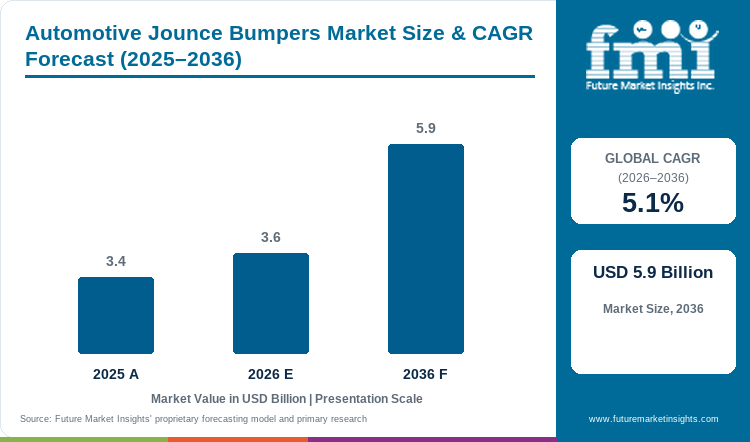
The Automotive Jounce Bumpers market stood at USD 3.4 Billion in 2025, is estimated at USD 3.6 Billion in 2026, and is forecast to reach USD 5.9 Billion by 2036 at a 5.1% CAGR from 2026 to 2036.
The market advances as vehicle programs demand a controlled secondary spring before the suspension reaches hard mechanical contact. Global vehicle production rose 3.9% to 96.4 million units in 2025, according to naamsa's May 2026 trade manual. The same publication recorded 20.7 million electric-vehicle sales.
Heavier battery packs and utility-oriented platforms increase the energy that end-stop components must manage. Vibracoustic reported in April 2025 that a premium electric pickup used jounce bumpers with air springs and hydro bushings. The package addressed vehicle mass and uneven-road inputs.
It also addressed a 10,000-pound towing requirement. This does not turn every vehicle into a premium application. It does raise the engineering value of progressive force-displacement behavior, compact packaging and durability under repeated compression.
OEM chassis teams therefore move jounce selection into platform tuning and validation rather than treating the part as an interchangeable rubber stop.
Conversion differs by production system. Brazil and Mexico offer expanding vehicle assembly bases, so local content and plant-side logistics can accelerate nomination when suppliers support tooling near launch sites. The USA combines high pickup and SUV exposure with strict platform validation.
This favors suppliers that sustain serial quality close to OEM plants. Germany and Japan apply mature engineering processes and tight packaging targets, so a material change needs clear performance evidence before it displaces a proven design.
Canada and South Africa add replacement demand from large or varied vehicle parcs. Model-specific fitment and imported-part economics shape the accessible aftermarket. Across these markets, interest becomes an order only after the force-displacement curve and temperature endurance are validated.
Assembly method and lifetime cost must also fit the vehicle architecture.
Key Takeaways
- The market is estimated at USD 3.6 Billion in 2026 and is forecast to reach USD 5.9 Billion by 2036 at a 5.1% CAGR.
- Microcellular polyurethane bumpers lead the Bumper Type category in 2026. Passenger cars lead the Vehicle Type category in 2026.
- Strut-mounted designs lead the Mounting category in 2026. Bottom-out protection leads the Function category in 2026. OEM direct leads the Sales Channel category in 2026.
- Driver: Higher vehicle output and tougher end-stop load cases increase the value of tuned energy absorption.
- Restraint: Vehicle-specific tooling and durability validation make late supplier changes expensive.
- Opportunity: Integrated, recyclable and EV-specific bumper modules can reduce interfaces and localize value. Brazil has the highest profiled country CAGR at 5.9%, compared with Japan at 3.8%.
Analyst Perspective
Revenue capture depends on arriving before design freeze with evidence that lowers platform risk. A supplier must match the required force-displacement curve across temperature, aging, and repeated compression.
- Nikhil Kaitwade, Principal Consultant, Future Market Insights
How is the Automotive Jounce Bumpers Market segmented?
The market is analyzed by Bumper Type, Vehicle Type, Mounting, Function, Sales Channel, and Region.
Bumper Type separates the materials and mechanisms that create the end-stop force curve. Vehicle Type separates platform volume and curb mass from axle load and duty cycle. Mounting identifies where the component engages within the suspension package.
Function separates mandatory bottom-out protection from comfort tuning, load management, and durability objectives. Sales Channel shows whether the part is nominated through an OEM program or supplied through a suspension Tier-1. It also separates service replacement from performance accessories.
These axes interact, but each answers a different purchase question.
What makes Microcellular polyurethane bumpers central to the Bumper Type category?
Microcellular polyurethane combines a progressive response with high energy absorption in a small package. Density, cell structure, and geometry can be tuned so the component begins softly then stiffens as travel closes.
That behavior reduces the peak load transmitted when a wheel encounters a pothole or when a loaded vehicle approaches full compression. It also limits lateral expansion around a damper rod, which matters in compact strut envelopes. Rubber remains relevant where cost and established tooling dominate.
Hydraulic and other progressive designs serve specialized load cases. The MCU format leads because it gives chassis engineers a wider tuning window without adding a separate mechanical system.
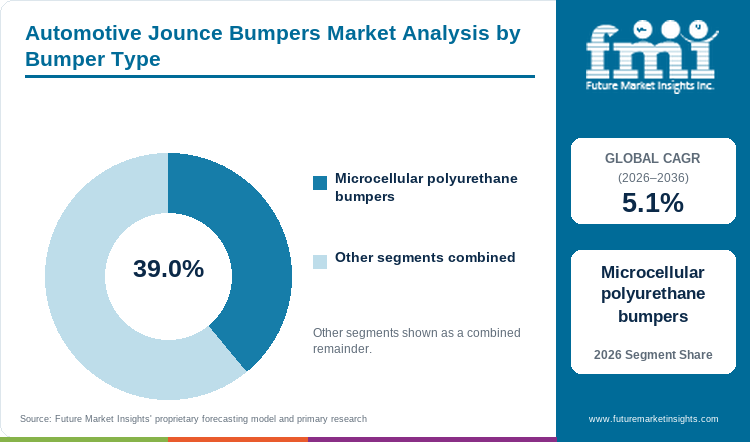
- Microcellular polyurethane bumpers account for 39.0% of the Bumper Type category in 2026 because their nonlinear response supports compact packaging and vehicle-specific tuning.
- BASF announced in February 2025 that a new Cellasto microcellular polyurethane mold line in India would support customized automotive components, including jounce-bumper applications.
Why does Passenger cars lead the Vehicle Type category?
Passenger-car platforms generate the broadest recurring nomination base for jounce bumpers. They also rely heavily on compact suspension packaging and ride-comfort targets that make a predictable secondary spring useful. One platform can support several trims, axle loads, and wheel packages.
Engineers can tune bumper geometry or density without redesigning the primary suspension. SUVs and crossovers are gaining importance because of higher mass and travel demands. Pickups and off-road vehicles create higher-energy events. Their unit base is narrower, however, and they use more varied mounting strategies.
Passenger cars therefore retain the largest aggregate volume even as utility segments set the pace for higher-specification designs.
- Passenger cars hold 34.0% of the Vehicle Type category in 2026 because their production scale creates the broadest repeat fitment across front and rear suspension architectures.
- VDA reported in February 2026 that Germany produced 4.15 million passenger cars in 2025, including 1.94 million SUV and off-road models, illustrating how high-volume passenger architectures and utility derivatives coexist.
How does Strut-mounted architecture support the Mounting category?
Strut-mounted bumpers sit on or around the damper rod, usually beneath a dust cover. This position lets the bumper manage the last portion of wheel travel while using the existing strut axis and package. Adjacent suspension bushings must meet the same durability and ride-quality targets.
The part can be integrated with a top-mount or protective module. This reduces assembly interfaces and can control abrasion or noise. Axle-mounted and frame-mounted designs remain important for pickups and commercial vehicles as well as off-road platforms. Shock-integrated solutions serve packaged modules.
Strut mounting leads because MacPherson-type front suspensions are widespread in passenger vehicles and because the bumper can be tuned without adding a new chassis attachment.
- Strut-mounted designs represent 38.0% of the Mounting category in 2026 because they align the jounce element with the damper path and support compact module integration.
- Trelleborg stated in January 2024 that its blow-molded jounce bumper used snap-fit assembly and integrated dust protection while avoiding contact with the strut.
What supports Bottom-out protection as the leading Function?
Bottom-out protection is the non-negotiable task that anchors jounce-bumper demand. As suspension travel closes, the bumper absorbs energy and raises spring force before metal components contact. This protects dampers and body structures. It also shields tires and nearby hardware during pothole strikes or curb events.
Protection remains important during payload shifts and hard maneuvering. Ride-comfort tuning and load management build on the same response curve. Durability benefits follow when peak loads are controlled.
The protective role leads because every vehicle program must define a safe end-of-travel condition, while comfort or load features vary by positioning. Suppliers that shape the transition from soft engagement to high resistance gain the broadest nomination relevance.
- Bottom-out protection accounts for 39.0% of the Function category in 2026 because it protects the suspension and body structure during the most severe end-of-travel events.
- Vibracoustic reported in April 2025 that jounce bumpers on a premium electric pickup absorbed energy from irregular road events while supporting a vehicle configured for 10,000 pounds of towing.
What drives OEM direct leadership in the Sales Channel category?
OEM direct supply dominates because each jounce bumper is engineered around a vehicle. Chassis teams specify the force-displacement curve and available travel. They also define side-load behavior and temperature range as well as fluid resistance and assembly method.
Tier-1 integrators may place the component inside a complete strut or air-spring module, but the vehicle maker still controls platform validation and change approval. Aftermarket replacement and performance accessories matter once vehicles enter service.
Those channels face a fragmented fitment map and variable willingness to pay. Direct nominations lead because tooling, validation, and serial-quality evidence are committed before launch and then remain stable through much of the platform life.
- OEM direct accounts for 55.0% of the Sales Channel category in 2026 because customer-specific tuning and launch validation are approved before serial production begins.
- Sumitomo Riko reported in August 2026 that a North American pickup program triggered new Ohio production equipment and a planned 15% capacity increase, illustrating vehicle-specific nomination and local serial supply.
What are the drivers, restraints, and opportunities in the Automotive Jounce Bumpers Market?
Higher vehicle mass and more demanding suspension duty support demand, while platform-specific validation slows switching and integrated recyclable designs create a higher-value opportunity.
- Driver: Higher vehicle output and tougher end-stop load cases increase the value of tuned energy absorption.
- Restraint: Vehicle-specific tooling and durability validation make late supplier changes expensive.
- Opportunity: Integrated, recyclable, and EV-specific bumper modules can reduce interfaces and localize value.
Vehicle producers are asking the jounce element to handle more energy without consuming more travel. naamsa reported in May 2026 that global production reached 96.4 million vehicles in 2025 and electric-vehicle sales reached 20.7 million. The volume effect expands fitted units.
The architecture effect is more valuable because battery mass and large wheels change the end-stop load case. Towing packages and utility use add further demand. Vibracoustic's April 2025 electric-pickup program linked jounce bumpers to uneven-road energy and a 10,000-pound towing duty.
Suppliers gain when they translate those loads into a stable progressive response that protects the suspension without a harsh transition.
Qualification is the main brake on supplier switching. A candidate bumper must fit the envelope and reproduce the approved force curve across temperature and aging. It must also withstand contamination and repeated compression. A small unit-price saving can be outweighed by new tooling and rig tests.
Vehicle trials, line approval, and warranty exposure add further cost. Trelleborg noted in January 2024 that OEM adoption of a new recyclable design remained challenging because the industry is conservative about new technology. The friction delays material substitution rather than eliminating demand.
Suppliers must enter before design freeze or demonstrate a clear integration benefit that justifies reopening validation.
Functional integration creates an opening beyond a conventional foam stop. Trelleborg's January 2024 design combined as many as four parts into one recyclable thermoplastic solution with integrated dust protection.
BASF's February 2025 investment added a new microcellular polyurethane mold line for tailored automotive components. These moves point to two capture routes: integrate protection and assembly features, or localize custom molding near vehicle programs.
EV and utility platforms provide the best starting points because packaging and load cases are already being reworked. Winning designs need measurable weight or assembly benefits. They can also justify adoption through durability or recyclability rather than a material-only proposition.
Which country CAGRs are profiled in the Automotive Jounce Bumpers Market?
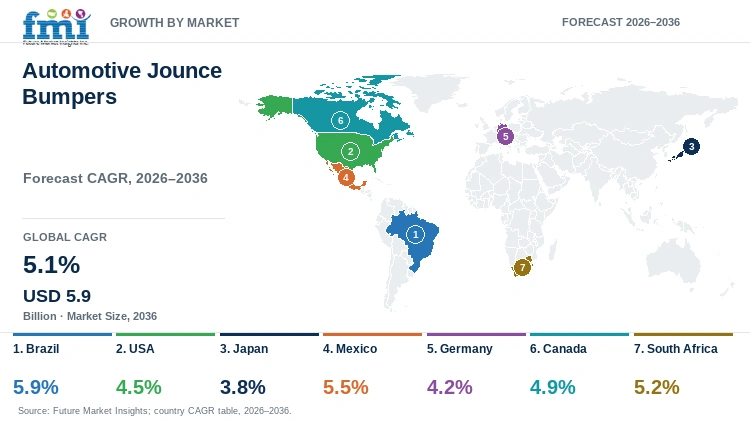
| Country | CAGR |
|---|---|
| Brazil | 5.9% |
| USA | 4.5% |
| Japan | 3.8% |
| Mexico | 5.5% |
| Germany | 4.2% |
| Canada | 4.9% |
| South Africa | 5.2% |
How do country-level CAGRs compare in the Automotive Jounce Bumpers Market?
The seven forecasts span 2.1 percentage points, from Brazil at 5.9% to Japan at 3.8%. Brazil and Mexico form the fastest band, while South Africa and Canada occupy an upper-middle range. The USA and Germany sit in a steadier established-market band. Japan advances at a more measured rate.
These differences reflect vehicle-production pace and utility-vehicle exposure. Localization and replacement activity also matter. They do not indicate absolute market size. A large existing vehicle base can support substantial revenue even when its growth rate trails a smaller manufacturing market.
- Brazil leads Mexico by 0.4 percentage points. That gap favors early local-capacity decisions, but both markets require plant-side engineering and fitment support.
- Mexico leads South Africa by 0.3 percentage points, while South Africa leads Canada by another 0.3 points. The narrow spacing supports staged regional investment rather than a single-country allocation.
- Canada leads the USA by 0.4 percentage points. The faster rate does not offset the USA's larger platform and vehicle-parc base, so suppliers need different channel expectations.
- The USA leads Germany by 0.3 percentage points, and Germany leads Japan by 0.4 points. Mature qualification systems in all three markets reward early engineering access more than headline growth alone.
CAGR should be read with platform volume and local vehicle production. Import exposure, replacement demand and validation cost shape the commercial result. The broader report covers additional countries and regional conditions, so the fastest forecast does not automatically represent the largest revenue pool or the easiest entry point.
In South Africa, naamsa also reported 597,338 new vehicle sales in 2025.
Country-wise Analysis
- Brazil: Brazilian OEMs and Tier-1s buy around locally assembled platforms, while imported electrified models widen the application mix. Demand for automotive jounce bumpers in Brazil is forecast to expand at 5.9% CAGR from 2026 to 2036. ANFAVEA reported in January 2026 that 2.644 million vehicles were produced in 2025, up 3.5% and projected 2.741 million for 2026. High interest rates and a growing import mix can pressure program timing and local-content economics. Suppliers need local molding and flexible validation support. They also need coverage for both domestic platforms and imported fitments.
- USA: USA procurement is concentrated in OEM platform nominations for pickups and SUVs. Locally engineered suspension modules are especially important. Demand for automotive jounce bumpers in the USA is forecast to rise at 4.5% CAGR from 2026 to 2036. In August 2026, Sumitomo Riko announced a USD 4.6 million investment in Ohio and a planned 15% capacity increase for anti-vibration rubber tied to a North American pickup program. Long validation cycles and warranty exposure make mid-cycle switching difficult. Suppliers need program-side engineering and reliable regional production rather than export-only coverage.
- Japan: Japanese programs emphasize precise tuning, compact packaging and long qualification records. Demand for automotive jounce bumpers in Japan is forecast to expand at 3.8% CAGR from 2026 to 2036. JAMA's 2025 industry report placed automotive research and development expenditure at 4.3 trillion yen in 2023 and equipment investment at 1.6 trillion yen in fiscal 2024. That engineering intensity raises the evidence threshold for new materials even when weight or recyclability improves. Suppliers should enter early with simulation data, fatigue testing and proven serial control.
- Mexico: Mexico's suppliers operate inside a deeply integrated North American production system so plant location and origin rules shape component sourcing. Demand for automotive jounce bumpers in Mexico is forecast to expand at 5.5% CAGR from 2026 to 2036. INEGI reported in July 2026 that Mexico produced 354,221 light vehicles in June and exported 301,009. Export dependence exposes nominations to trade policy and model-allocation shifts. Suppliers need multi-plant logistics and documentation that supports regional-content claims.
- Germany: German OEMs and chassis suppliers use detailed vehicle-dynamics validation and increasingly large SUV or electrified portfolios. Demand for automotive jounce bumpers in Germany is forecast to rise at 4.2% CAGR from 2026 to 2036. VDA reported in February 2026 that domestic passenger-car production reached 4.15 million in 2025. SUV and off-road output rose 8.2% to 1.94 million. Mature supplier relationships and strict change control slow late material substitutions. Success depends on quantified weight, durability, and integration gains backed by local engineering.
- Canada: Canadian demand combines a large light-duty vehicle parc with close integration into USA production and aftermarket channels. Demand for automotive jounce bumpers in Canada is forecast to expand at 4.9% CAGR from 2026 to 2036. Statistics Canada reported 26.8 million registered road vehicles in 2024, with light-duty vehicles at 91.6% and electric vehicles at 5.2% of light-duty registrations. A dispersed vehicle parc and winter exposure increase fitment and material-performance requirements. Suppliers need model-specific coverage, cold-temperature validation and distribution that reaches repair networks.
- South Africa: South African buyers balance locally built export models with a replacement market that also serves many imported vehicles. Demand for automotive jounce bumpers in South Africa is forecast to expand at 5.2% CAGR from 2026 to 2036. naamsa reported in May 2026 that vehicle production reached 618,077 units in 2025. Exports reached 414,271. Imported light vehicles represented 69.1% of light-vehicle sales. This makes aftermarket fitment more fragmented. Suppliers need coverage for domestic assembly programs and imported-model replacement parts. Local stock and fitment data are essential.
Who are the notable companies in the Automotive Jounce Bumpers Market?
BASF and Sumitomo Riko are profiled. Vibracoustic and Trelleborg are also covered. Continental and Hutchinson are also covered. Cooper Standard and Mubea are also covered. Freudenberg and SumiRiko AVS complete the notable-company set.
Competition is divided between material-led jounce specialists, NVH integrators, and broader chassis suppliers. BASF and Trelleborg compete through elastomer platforms and molded-part design.
Freudenberg represents group-level automotive materials and NVH access, while Vibracoustic is the operating specialist with MCU components. Sumitomo Riko, Hutchinson and SumiRiko AVS emphasize vehicle-specific vibration control and validation. Continental documents bump stops within a wider suspension portfolio.
Mubea provides adjacent chassis engineering and lightweight-component access. Cooper Standard remains a diversified component comparator, but public evidence of a dedicated jounce-bumper offer is limited.
The practical dividing line is the ability to tune the force curve, validate it with the vehicle, and supply consistent parts near the nominated assembly plant.
- Material and elastomer platforms: BASF, Trelleborg and Freudenberg compete through chemistry, molded geometry and energy-absorption design.
- Vehicle NVH integration: Sumitomo Riko and Vibracoustic compete alongside Hutchinson and SumiRiko AVS. They combine system tuning with simulation and validation for customer-specific development.
- Broader chassis access: Continental, Mubea and Cooper Standard connect the market to suspension modules, adjacent chassis hardware or diversified automotive component programs.
Competitive Benchmarking: Automotive Jounce Bumpers Market
| Company | Progressive Energy-Absorption Materials | Vehicle-Specific Suspension Integration | OEM Localization and Serial Supply | Geographic Reach |
|---|---|---|---|---|
| BASF | High | High | High | North America and South America are covered. Coverage extends to Europe and Asia. |
| Sumitomo Riko | High | High | High | Japan and the Americas are covered. Coverage extends to Europe and Africa and Asia. |
| Vibracoustic | High | High | High | Europe, the Americas, and Asia |
| Trelleborg | High | Medium | Medium | Europe with global automotive customer programs |
| Continental | Medium | High | High | Europe, the Americas, and Asia |
| Hutchinson | Medium | High | High | Europe, the Americas, and Asia |
| Cooper Standard | Low | Low | Low | Public evidence not scored for this market |
| Mubea | Medium | High | High | Europe and the Americas are covered. Coverage extends to Asia and Africa. |
| Freudenberg | High | Medium | High | Global through group automotive operations |
| SumiRiko AVS | Medium | High | High | Europe with Sumitomo Riko network support |
Scoring basis: Progressive Energy-Absorption Materials measures documented control of elastomer chemistry, density, or molded geometry for end-stop behavior. Vehicle-Specific Suspension Integration measures evidence of chassis engineering and simulation. Validation and module integration also count.
OEM Localization and Serial Supply measures documented regional production, customer-specific program support and automotive quality infrastructure. High indicates broad direct evidence, while Medium indicates credible but narrower capability. Low is reserved for a documented limitation.
Unavailable public information is shown as Low rather than Low.
Key Developments in the Automotive Jounce Bumpers Market
- In January 2024, Trelleborg and Celanese introduced a recyclable blow-molded Hytrel jounce bumper that can combine as many as four parts. The design removes the separate base cup or ring and adds dust protection with snap-fit assembly. Its commercial significance is a lower-interface architecture that gives OEMs a measurable circularity and assembly proposition, although vehicle adoption still requires validation.
- In April 2025, Vibracoustic reported a premium electric pickup application with air springs and jounce bumpers. The package also included hydro bushings. The jounce elements were integrated to absorb irregular-road energy under high vehicle mass and a 10,000-pound towing requirement. The program shows how electrified utility vehicles can pull jounce design into load management and comfort tuning rather than a minimum-protection specification.
- During February 2025 BASF broke ground on a new Cellasto microcellular polyurethane plant and mold line at Dahej, India. The facility was scheduled to become operational in the second half of 2026 and was designed to support customized automotive components. The investment adds localized MCU capacity and shortens the distance between material formulation, molded-part development and OEM demand in a growing production region.
Key Players in the Automotive Jounce Bumpers Market
Microcellular and Elastomer Material Platforms
- BASF
- Trelleborg
- Freudenberg
Vehicle NVH and Suspension Integration Specialists
- Sumitomo Riko
- Vibracoustic
- Hutchinson
- SumiRiko AVS
Chassis and Diversified Automotive Component Integrators
- Continental
- Cooper Standard
- Mubea
Automotive Jounce Bumpers Market - Report Scope
| Coverage field | Report scope |
|---|---|
| Market breakdown | Bumper Type, Vehicle Type, Mounting, Function, Sales Channel, and Region |
| Quantitative Units | USD Billion |
| Market Definition | Revenue from automotive jounce bumpers and attributable jounce-bumper modules sold within the named vehicle, mounting, function, and channel segments. Complete vehicles, finished struts, shock absorbers, air springs, coil springs, body bumpers, industrial end stops, and substitute products are excluded. |
| Regions Covered | North America, Latin America, Western Europe, Eastern Europe, East Asia, South Asia and Pacific, and Middle East and Africa |
| Countries Covered | Brazil, USA, Japan, Mexico, Germany, Canada, South Africa, and more than twenty-five additional countries in the full report |
| Key Companies Profiled | BASF, Sumitomo Riko, Vibracoustic, Trelleborg, Continental, Hutchinson, Cooper Standard, Mubea, Freudenberg, and SumiRiko AVS |
| Forecast Period | 2026 to 2036 |
| Approach | Hybrid bottom-up and top-down sizing that reconciles component revenue, vehicle fitment, production, replacement demand, and channel evidence without counting complete suspension-system revenue. |
Automotive Jounce Bumpers Market - Research Methodology
| Method | Approach |
|---|---|
| Primary Research | FMI consults jounce-bumper makers and suspension suppliers. OEM teams and repair specialists explain fitment and replacement behavior. The research tests purchase criteria and adoption barriers. |
| Desk Research | FMI reviews vehicle-production and registration data. Company disclosures and engineering literature support the component boundary. Sources are retained when they support the defined market boundary. |
| Market Sizing and Forecasting | FMI reconciles component revenue with vehicle output and likely fitment. Forecasts reflect utility-vehicle exposure and supplier localization. Country conditions and channel structure are checked against the revenue boundary. |
| Data Validation | Findings are checked against independent evidence. The estimate excludes complete struts and downstream vehicle revenue. Duplicate OEM and Tier-1 value is removed. |
Automotive Jounce Bumpers Market by Segments
Automotive Jounce Bumpers Market segmented by Bumper Type:
- Microcellular polyurethane bumpers
- Rubber jounce bumpers
- Hydraulic jounce bumpers
- Progressive rate bumpers
- EV suspension bumpers
Automotive Jounce Bumpers Market segmented by Vehicle Type:
- Passenger cars
- SUVs/crossovers
- Pickup trucks
- Light commercial vehicles
- Off-road vehicles
Automotive Jounce Bumpers Market segmented by Mounting:
- Strut-mounted
- Axle-mounted
- Frame-mounted
- Shock-integrated
Automotive Jounce Bumpers Market segmented by Function:
- Bottom-out protection
- Ride comfort tuning
- Load management
- Suspension durability
Automotive Jounce Bumpers Market segmented by Sales Channel:
- OEM direct
- Suspension Tier-1s
- Aftermarket replacement
- Performance accessory channel
Automotive Jounce Bumpers Market by Region:
- North America
- United States
- Canada
- Latin America
- Brazil
- Mexico
- Argentina
- Chile
- Western Europe
- Germany
- France
- United Kingdom
- Italy
- Spain
- Benelux
- Nordics
- Eastern Europe
- Poland
- Czech Republic
- Romania
- Hungary
- East Asia
- China
- Japan
- South Korea
- South Asia and Pacific
- India
- ASEAN
- Australia and New Zealand
- Middle East and Africa
- GCC Countries
- South Africa
- Türkiye
- Israel
Research Sources and Bibliography
- BASF (2025, February 24). Cellasto strengthens its position in India by taking steps for capacity enhancement.
- Vibracoustic (2025, April 10). Vibracoustic air springs for enhanced driving comfort and performance of a premium electric pickup truck.
- Trelleborg Group (2024, January 15). Keep me in suspense.
- Sumitomo Riko (2026, August 5). Strengthening U.S. plant to establish a stable supply system for the North American market.
- SumiRiko AVS Germany (n.d.; accessed September 1, 2026). State-of-the-Art Anti-Vibration Systems for Modern Mobility.
- Freudenberg Group (n.d.; accessed September 1, 2026). Vibracoustic.
- Continental (n.d.; accessed September 1, 2026). Air Springs and Suspension Solutions.
- Hutchinson (n.d.; accessed September 1, 2026). NVH Solutions for Automotive.
- Mubea (n.d.; accessed September 1, 2026). Suspension Components.
- Japan Automobile Manufacturers Association (2025). The Motor Industry of Japan 2025.
- ANFAVEA (2026, January 15). Vehicle production and sales grow in 2025 and ANFAVEA projects another increase in 2026.
- INEGI (2026, July 7). 354,221 light vehicles were produced in Mexico and 301,009 were exported in June 2026.
- VDA (2026, February 16). Automobile Production.
- Statistics Canada (n.d.; accessed September 1, 2026). Automotive Statistics.
- naamsa | The Automotive Business Council (2026, May 15). naamsa Releases the 2026 Automotive Trade Manual.
This bibliography is provided for reader reference and is not exhaustive. The full report contains the complete reference list and detailed citations.
This Report Answers
- What are the Automotive Jounce Bumpers Market values in 2026 and 2036?
- Which vehicle-production and suspension pressures support demand from 2026 to 2036?
- Why do Microcellular polyurethane bumpers hold the leading Bumper Type position?
- How does the Passenger cars segment influence recurring fitment demand?
- Why does Strut-mounted architecture hold the leading Mounting position?
- How do the profiled country growth rates compare for the Automotive Jounce Bumpers market?
- Which approved companies compete through materials, NVH integration, or broader chassis access?
- How do platform qualification and supplier-switching costs restrain adoption?
Frequently Asked Questions
What is driving growth in the Automotive Jounce Bumpers Market?
Growth comes from higher vehicle output and more demanding end-stop loads on SUVs, pickups and electrified platforms. OEMs need compact components that absorb peak energy while preserving ride quality, which supports higher-value tuning and recurring platform nominations.
Who are the key players in the Automotive Jounce Bumpers Market?
BASF, Sumitomo Riko and Vibracoustic are among the profiled companies. Others listed under Key Players compete through elastomer technology and suspension integration. The report does not state a company-share ranking.
What is a notable restraint in the Automotive Jounce Bumpers Market?
Vehicle-specific force curves and durability requirements make supplier changes expensive after a platform is validated. New tooling and rig testing add cost before a switch; vehicle trials and line approval add more; warranty risk can outweigh a modest unit-price saving.
Why should executives track the Automotive Jounce Bumpers Market?
Jounce bumpers are low-cost parts with direct influence on ride, durability, and severe-event protection. Their sourcing decisions reveal where OEMs are redesigning suspension packages for higher mass and utility use as electrification and local-content requirements create further change.
What business problem does the Automotive Jounce Bumpers Market address?
The market addresses the need to control the final portion of suspension travel before metal components contact. A tuned bumper protects hardware and occupants while helping engineers manage comfort and payload; it also preserves package space and controls repeated impact energy.
What should OEM chassis and procurement teams evaluate in the Automotive Jounce Bumpers Market?
Teams should compare the force curve and package fit across the full suspension travel. They should also evaluate temperature endurance; aging; contamination resistance; side-load behavior; assembly method; serial consistency; local engineering support; and manufacturing capacity before nomination.
What limits return on investment in the Automotive Jounce Bumpers Market?
Return can be diluted when tooling and validation are repeated for small program volumes or fragmented aftermarket fitments. Acquisition cost should be assessed with assembly interfaces and warranty exposure; logistics, failure avoidance, and any weight or integration benefit also shape return.
What supports long-term commercial confidence in the Automotive Jounce Bumpers Market?
Every vehicle suspension needs a defined end-of-travel strategy, which creates a durable functional base. Confidence improves when suppliers combine material control with local serial supply and designs that address heavier vehicles; compact packaging; recyclability; or module integration.
Preview the report firsthand - request a free sample
Get SampleGet the brochure for pricing and purchase details.
Get PDFTable of Content
- Key Takeaways
- Market Size and CAGR
- Top Growth Driver
- Fastest Growing Segment
- Leading Region
- Key Companies
- Emerging Opportunities
- Executive Summary
- Global Market Outlook
- Demand-side Trends
- Supply-side Trends
- Technology Roadmap Analysis
- Analysis and Recommendations
- Analyst Perspective (What is happening? Why now? What should investors know?)
- Key Questions Answered
- How large is the market?
- What is the CAGR?
- What are key trends?
- Which region dominates?
- Who are the leaders?
- Market Overview
- Market Coverage / Taxonomy
- Market Definition / Scope / Limitations
- Research Methodology
- Chapter Orientation
- Analytical Lens and Working Hypotheses
- Market Structure, Signals, and Trend Drivers
- Benchmarking and Cross-market Comparability
- Market Sizing, Forecasting, and Opportunity Mapping
- Research Design and Evidence Framework
- Desk Research Programme (Secondary Evidence)
- Expert Input and Fieldwork (Primary Evidence)
- Tooling, Models, and Reference Databases
- Data Engineering and Model Build
- Quality Assurance and Audit Trail
- Market Background
- Market Dynamics (Drivers, Restraints, Opportunity, Trends)
- Scenario Forecast (Optimistic, Likely, Conservative)
- Impact Analysis
- AI Impact
- Sustainability Impact
- Regulatory Impact
- Technology Impact
- Consumer / Buyer Analysis
- Purchase Drivers
- Adoption Barriers
- Buyer Journey
- Opportunity Map Analysis
- Product Life Cycle Analysis
- Supply Chain Analysis
- Investment Feasibility Matrix
- Value Chain Analysis
- PESTLE and Porter's Analysis
- Regulatory Landscape
- Regional Parent Market Outlook
- Production and Consumption Statistics
- Import and Export Statistics
- Global Market Analysis and Forecast, 2021 to 2036
- Historical Market Size Value (USD Billion) Analysis, 2021 to 2025
- Current and Future Market Size Value (USD Billion) Projections, 2026 to 2036
- Y-o-Y Growth Trend Analysis
- Absolute $ Opportunity Analysis
- Global Market Pricing Analysis, 2021 to 2036
- Global Market Analysis and Forecast, By Bumper Type, 2021 to 2036
- Introduction / Key Findings
- Historical Market Size Value (USD Billion) Analysis By Bumper Type, 2021 to 2025
- Current and Future Market Size Value (USD Billion) Analysis and Forecast By Bumper Type, 2026 to 2036
- Microcellular polyurethane bumpers
- Rubber jounce bumpers
- Hydraulic jounce bumpers
- Progressive rate bumpers
- EV suspension bumpers
- Y-o-Y Growth Trend Analysis By Bumper Type, 2021 to 2025
- Absolute $ Opportunity Analysis By Bumper Type, 2026 to 2036
- Global Market Analysis and Forecast, By Vehicle Type, 2021 to 2036
- Introduction / Key Findings
- Historical Market Size Value (USD Billion) Analysis By Vehicle Type, 2021 to 2025
- Current and Future Market Size Value (USD Billion) Analysis and Forecast By Vehicle Type, 2026 to 2036
- Passenger cars
- SUVs/crossovers
- Pickup trucks
- Light commercial vehicles
- Off-road vehicles
- Y-o-Y Growth Trend Analysis By Vehicle Type, 2021 to 2025
- Absolute $ Opportunity Analysis By Vehicle Type, 2026 to 2036
- Global Market Analysis and Forecast, By Mounting, 2021 to 2036
- Introduction / Key Findings
- Historical Market Size Value (USD Billion) Analysis By Mounting, 2021 to 2025
- Current and Future Market Size Value (USD Billion) Analysis and Forecast By Mounting, 2026 to 2036
- Strut-mounted
- Axle-mounted
- Frame-mounted
- Shock-integrated
- Y-o-Y Growth Trend Analysis By Mounting, 2021 to 2025
- Absolute $ Opportunity Analysis By Mounting, 2026 to 2036
- Global Market Analysis and Forecast, By Function, 2021 to 2036
- Introduction / Key Findings
- Historical Market Size Value (USD Billion) Analysis By Function, 2021 to 2025
- Current and Future Market Size Value (USD Billion) Analysis and Forecast By Function, 2026 to 2036
- Bottom-out protection
- Ride comfort tuning
- Load management
- Suspension durability
- Y-o-Y Growth Trend Analysis By Function, 2021 to 2025
- Absolute $ Opportunity Analysis By Function, 2026 to 2036
- Global Market Analysis and Forecast, By Sales Channel, 2021 to 2036
- Introduction / Key Findings
- Historical Market Size Value (USD Billion) Analysis By Sales Channel, 2021 to 2025
- Current and Future Market Size Value (USD Billion) Analysis and Forecast By Sales Channel, 2026 to 2036
- OEM direct
- Suspension Tier-1s
- Aftermarket replacement
- Performance accessory channel
- Y-o-Y Growth Trend Analysis By Sales Channel, 2021 to 2025
- Absolute $ Opportunity Analysis By Sales Channel, 2026 to 2036
- Global Market Analysis and Forecast, By Region, 2021 to 2036
- Introduction
- Historical Market Size Value (USD Billion) Analysis By Region, 2021 to 2025
- Current Market Size Value (USD Billion) Analysis and Forecast By Region, 2026 to 2036
- North America
- Latin America
- Western Europe
- Eastern Europe
- East Asia
- South Asia and Pacific
- Middle East and Africa
- Market Attractiveness Analysis By Region
- North America Market Analysis and Forecast, By Country, 2021 to 2036
- Historical Market Size Value (USD Billion) Trend Analysis By Market Taxonomy, 2021 to 2025
- Market Size Value (USD Billion) Forecast By Market Taxonomy, 2026 to 2036
- By Country
- United States
- Canada
- By Bumper Type
- By Vehicle Type
- By Mounting
- By Function
- By Sales Channel
- By Country
- Market Attractiveness Analysis
- By Country
- By Bumper Type
- By Vehicle Type
- By Mounting
- By Function
- By Sales Channel
- Key Takeaways
- Latin America Market Analysis and Forecast, By Country
- Historical Market Size Value (USD Billion) Trend Analysis By Market Taxonomy, 2021 to 2025
- Market Size Value (USD Billion) Forecast By Market Taxonomy, 2026 to 2036
- By Country
- Brazil
- Mexico
- Argentina
- Chile
- By Bumper Type
- By Vehicle Type
- By Mounting
- By Function
- By Sales Channel
- By Country
- Market Attractiveness Analysis
- By Country
- By Bumper Type
- By Vehicle Type
- By Mounting
- By Function
- By Sales Channel
- Key Takeaways
- Western Europe Market Analysis and Forecast, By Country
- Historical Market Size Value (USD Billion) Trend Analysis By Market Taxonomy, 2021 to 2025
- Market Size Value (USD Billion) Forecast By Market Taxonomy, 2026 to 2036
- By Country
- Germany
- France
- United Kingdom
- Italy
- Spain
- Benelux
- Nordics
- By Bumper Type
- By Vehicle Type
- By Mounting
- By Function
- By Sales Channel
- By Country
- Market Attractiveness Analysis
- By Country
- By Bumper Type
- By Vehicle Type
- By Mounting
- By Function
- By Sales Channel
- Key Takeaways
- Eastern Europe Market Analysis and Forecast, By Country
- Historical Market Size Value (USD Billion) Trend Analysis By Market Taxonomy, 2021 to 2025
- Market Size Value (USD Billion) Forecast By Market Taxonomy, 2026 to 2036
- By Country
- Poland
- Czech Republic
- Romania
- Hungary
- By Bumper Type
- By Vehicle Type
- By Mounting
- By Function
- By Sales Channel
- By Country
- Market Attractiveness Analysis
- By Country
- By Bumper Type
- By Vehicle Type
- By Mounting
- By Function
- By Sales Channel
- Key Takeaways
- East Asia Market Analysis and Forecast, By Country
- Historical Market Size Value (USD Billion) Trend Analysis By Market Taxonomy, 2021 to 2025
- Market Size Value (USD Billion) Forecast By Market Taxonomy, 2026 to 2036
- By Country
- China
- Japan
- South Korea
- By Bumper Type
- By Vehicle Type
- By Mounting
- By Function
- By Sales Channel
- By Country
- Market Attractiveness Analysis
- By Country
- By Bumper Type
- By Vehicle Type
- By Mounting
- By Function
- By Sales Channel
- Key Takeaways
- South Asia and Pacific Market Analysis and Forecast, By Country
- Historical Market Size Value (USD Billion) Trend Analysis By Market Taxonomy, 2021 to 2025
- Market Size Value (USD Billion) Forecast By Market Taxonomy, 2026 to 2036
- By Country
- India
- ASEAN
- Australia and New Zealand
- By Bumper Type
- By Vehicle Type
- By Mounting
- By Function
- By Sales Channel
- By Country
- Market Attractiveness Analysis
- By Country
- By Bumper Type
- By Vehicle Type
- By Mounting
- By Function
- By Sales Channel
- Key Takeaways
- Middle East and Africa Market Analysis and Forecast, By Country
- Historical Market Size Value (USD Billion) Trend Analysis By Market Taxonomy, 2021 to 2025
- Market Size Value (USD Billion) Forecast By Market Taxonomy, 2026 to 2036
- By Country
- GCC Countries
- South Africa
- Türkiye
- Israel
- By Bumper Type
- By Vehicle Type
- By Mounting
- By Function
- By Sales Channel
- By Country
- Market Attractiveness Analysis
- By Country
- By Bumper Type
- By Vehicle Type
- By Mounting
- By Function
- By Sales Channel
- Key Takeaways
- Key Countries Market Analysis
- United States
- Pricing Analysis
- Market Share Analysis, 2025
- By Bumper Type
- By Vehicle Type
- By Mounting
- By Function
- By Sales Channel
- Canada
- Pricing Analysis
- Market Share Analysis, 2025
- By Bumper Type
- By Vehicle Type
- By Mounting
- By Function
- By Sales Channel
- Mexico
- Pricing Analysis
- Market Share Analysis, 2025
- By Bumper Type
- By Vehicle Type
- By Mounting
- By Function
- By Sales Channel
- Brazil
- Pricing Analysis
- Market Share Analysis, 2025
- By Bumper Type
- By Vehicle Type
- By Mounting
- By Function
- By Sales Channel
- Chile
- Pricing Analysis
- Market Share Analysis, 2025
- By Bumper Type
- By Vehicle Type
- By Mounting
- By Function
- By Sales Channel
- Germany
- Pricing Analysis
- Market Share Analysis, 2025
- By Bumper Type
- By Vehicle Type
- By Mounting
- By Function
- By Sales Channel
- United Kingdom
- Pricing Analysis
- Market Share Analysis, 2025
- By Bumper Type
- By Vehicle Type
- By Mounting
- By Function
- By Sales Channel
- Italy
- Pricing Analysis
- Market Share Analysis, 2025
- By Bumper Type
- By Vehicle Type
- By Mounting
- By Function
- By Sales Channel
- Spain
- Pricing Analysis
- Market Share Analysis, 2025
- By Bumper Type
- By Vehicle Type
- By Mounting
- By Function
- By Sales Channel
- France
- Pricing Analysis
- Market Share Analysis, 2025
- By Bumper Type
- By Vehicle Type
- By Mounting
- By Function
- By Sales Channel
- India
- Pricing Analysis
- Market Share Analysis, 2025
- By Bumper Type
- By Vehicle Type
- By Mounting
- By Function
- By Sales Channel
- ASEAN
- Pricing Analysis
- Market Share Analysis, 2025
- By Bumper Type
- By Vehicle Type
- By Mounting
- By Function
- By Sales Channel
- Australia and New Zealand
- Pricing Analysis
- Market Share Analysis, 2025
- By Bumper Type
- By Vehicle Type
- By Mounting
- By Function
- By Sales Channel
- China
- Pricing Analysis
- Market Share Analysis, 2025
- By Bumper Type
- By Vehicle Type
- By Mounting
- By Function
- By Sales Channel
- Japan
- Pricing Analysis
- Market Share Analysis, 2025
- By Bumper Type
- By Vehicle Type
- By Mounting
- By Function
- By Sales Channel
- South Korea
- Pricing Analysis
- Market Share Analysis, 2025
- By Bumper Type
- By Vehicle Type
- By Mounting
- By Function
- By Sales Channel
- Poland
- Pricing Analysis
- Market Share Analysis, 2025
- By Bumper Type
- By Vehicle Type
- By Mounting
- By Function
- By Sales Channel
- Hungary
- Pricing Analysis
- Market Share Analysis, 2025
- By Bumper Type
- By Vehicle Type
- By Mounting
- By Function
- By Sales Channel
- Türkiye
- Pricing Analysis
- Market Share Analysis, 2025
- By Bumper Type
- By Vehicle Type
- By Mounting
- By Function
- By Sales Channel
- South Africa
- Pricing Analysis
- Market Share Analysis, 2025
- By Bumper Type
- By Vehicle Type
- By Mounting
- By Function
- By Sales Channel
- United States
- Market Structure Analysis
- Competition Dashboard
- Competition Benchmarking
- Market Share Analysis of Top Players
- By Regional
- By Bumper Type
- By Vehicle Type
- By Mounting
- By Function
- By Sales Channel
- Emerging Startups
- Innovation Benchmarking
- Competition Analysis
- Competition Deep Dive
- BASF
- Overview
- Product Portfolio
- Profitability by Market Segments
- Sales Footprint
- Strategy Overview
- Marketing Strategy
- Product Strategy
- Channel Strategy
- Sumitomo Riko
- Vibracoustic
- Trelleborg
- Continental
- Hutchinson
- Cooper Standard
- Mubea
- Freudenberg
- SumiRiko AVS
- BASF
- Case Studies
- Success Stories
- Recent Developments
- Competition Deep Dive
- Assumptions & Acronyms Used


