

- Market Size (2026)
- USD 964.2 Mn
- Forecast (2036)
- USD 1518.3 Mn
- CAGR (2026 to 2036)
- 4.6%
How big is Automotive Radiator Fan Shrouds Market in 2026?
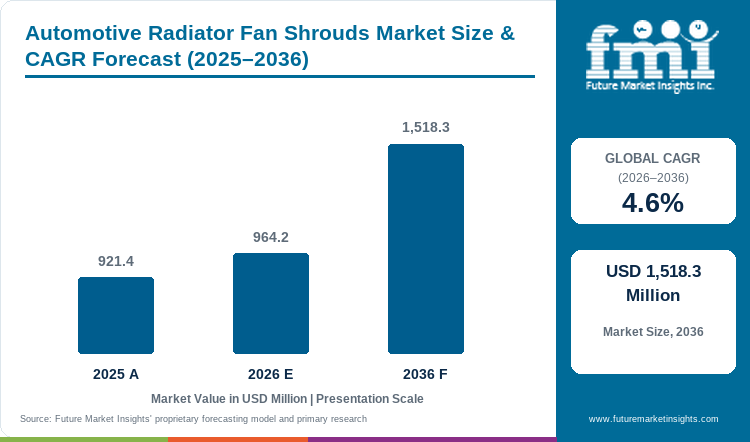
USD 964.2 million in 2026 and USD 1,518.3 million by 2036 at a 4.6% CAGR.
Sales of automotive radiator fan shrouds are estimated to rise at 4.6% CAGR through 2036, increasing valuation from USD 921.4 million in 2025 to USD 964.2 million in 2026, and reaching USD 1,518.3 million by 2036. Vehicle engineers use the shroud to guide air through smaller cooling spaces. MAHLE said in April 2026 that thermal management is now a core business field. The company had completed its thermal business integration. This puts more value on tested fan shapes and stable radiator mounts. Vehicle programs now treat the shroud as part of the cooling assembly, not as a simple plastic cover.
Country growth differs because each vehicle mix changes the need for new cooling tools. VDA said in February 2026 that Germany made 1.67 million electric passenger cars in 2025. Electric models made up 40% of passenger-car output. This mix keeps combustion models active and adds new cooling layouts for EVs. Hungary and Mexico grow faster in the model because new plants create more vehicle changes. Japan grows more slowly because its mature fleet creates more service work and longer approval cycles.
Key Takeaways
- Smaller front-end spaces are raising demand for shrouds that guide air and keep cooling noise under control.
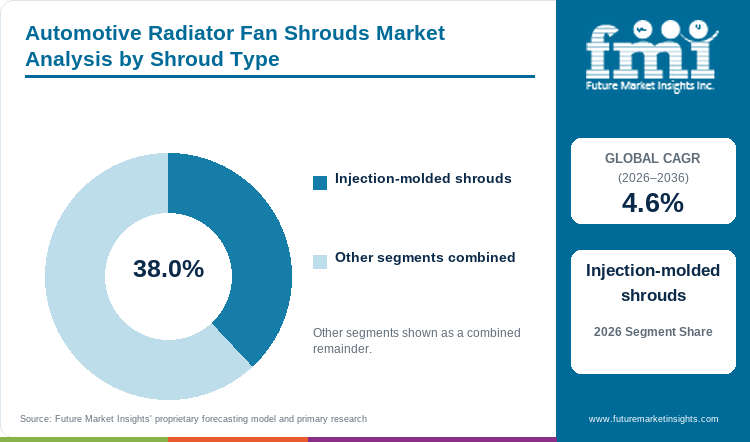
- By shroud type, injection-molded shrouds are projected to account for 38.0% in 2026, supported by repeatable molded shapes.
- Within material, PA66 glass-filled is anticipated to take 39.0% share in 2026, influenced by stiffness and heat resistance.
- Passenger cars are expected to represent 35.0% of vehicle type demand in 2026, attributed to large production runs and replacement needs.
- Vehicle-specific tools and fit checks slow switching because each shroud must keep the fan aligned with the radiator.
- Some of the key players in this market include MAHLE, DENSO, Valeo, Hanon Systems, Marelli, Modine Manufacturing Company, T.RAD Co., Ltd., Flex-A-Lite, TYC Americas, and Spectra Premium Mobility Solutions.
Analyst Perspective
"Engineers get more value from a fan shroud when airflow and mounting can be tested together. Suppliers that pair part-fit data with cooling results can serve vehicle programs and replacement channels without treating the shroud as a basic part."
- Nikhil Kaitwade, Principal Consultant, Future Market Insights
How is the automotive radiator fan shrouds market segmented?
Automotive Radiator Fan Shrouds Market is segmented by Shroud Type, Material, Vehicle Type, Sales Channel, Function and Region.
The market is divided by shroud type, material, vehicle type, sales channel, function, and region. Shroud type includes injection-molded, integrated fan-shroud, ring, truck radiator, and EV thermal shrouds. Material includes PA66 glass-filled, PP, ABS, aluminum, and composite. Vehicle type includes passenger cars, SUVs/crossovers, light commercial vehicles, heavy trucks, and EVs/hybrids. Sales channel includes OEM direct, thermal system Tier-1s, aftermarket replacement, and service kits. Function includes airflow management, fan efficiency, NVH reduction, and cooling module integration.
What supports injection-molded shrouds within the shroud type category?
Injection molding lets engineers make the fan ring and ribs with the mounts as one part. It also lets them control wall thickness near points that carry more load. A June 2026 technical case described long-glass-fiber plastic as a current route for molded cooling shrouds. The method supports large production runs and keeps key shapes the same from part to part.
- Based on shroud type, injection-molded shrouds are projected to account for 38.0% in 2026, supported by repeatable high-volume shapes.
- Approved tooling helps vehicle plants keep fan clearance and ribs with mounting points consistent from one production batch to the next.
How does PA66 glass-filled support the material category?
Fan shrouds must keep their shape near heat and vibration beside a spinning fan. Glass-filled PA66 is stiffer than plain resin and still works well in complex molded parts. BASF expanded its heat-stable automotive polyamide range in January 2026. The new grades target durable parts that face long periods of under-hood heat.
- Within material, PA66 glass-filled is anticipated to take 39.0% share in 2026, influenced by its stiffness and heat resistance.
- Vehicle programs still test the material against real heat and moisture because glass fiber does not stop every aging effect.
How do passenger cars shape demand within the vehicle type category?
Passenger-car programs create large production runs and a deep base of vehicles that later need replacement parts. Their cooling packages also face noise and space limits, so the shroud must keep its shape. VDA reported 4.15 million passenger cars made in Germany during 2025. Electric models accounted for 1.67 million of that output. The mix keeps old and new cooling designs in use at the same time.
- For vehicle type, passenger cars are predicted to reach 35.0% share in 2026, supported by large production runs and repair demand.
- SUVs and heavy vehicles use different package sizes, while passenger cars give suppliers steady volume in many approved cooling layouts.
What supports OEM direct within the sales channel category?
Vehicle programs test shrouds for fan clearance and radiator sealing before full production. They also check each mounting point during the same approval work. This work needs close coordination with the automaker or its thermal module team. Hanon Systems started production of a combined cooling unit for the BMW iX3 in March 2026. The launch shows that more cooling parts are moving into smaller approved units. Shroud suppliers must match those fixed package limits before volume production starts.
- By sales channel, OEM direct is forecast to represent 51.0% in 2026, tied to vehicle-specific parts and production approval.
- Service demand grows with failures or crashes, but full vehicle programs carry larger approval and delivery duties.
What makes airflow management central within the function category?
The shroud guides fan-induced air toward the heat exchanger. Poor guidance lets some air bypass the cooling surface and makes the fan work harder. MAHLE kept thermal management as a core business field in 2026. Its current EV cooling work also puts more focus on fan efficiency. Airflow control stays the first design job because noise and energy use depend on how well air reaches the cooling surface.
- Airflow management is likely to capture 37.0% of function demand in 2026, driven by the need to guide air through the cooling surface.
- Noise control and fan efficiency add value once airflow stays stable in tight electric and hybrid front ends.
What are the drivers, restraints and opportunities in the Automotive Radiator Fan Shrouds Market?
Higher cooling loads support engineered airflow, platform qualification slows interchangeability and integrated EV modules widen the design opportunity.
- Driver: Smaller thermal packages raise the need for shrouds that guide air and keep fan work under control.
- Restraint: Vehicle-specific mounts and material tests raise tool costs and slow the reuse of one design on another vehicle.
- Opportunity: EV cooling modules need lighter shrouds that support the fan and guide air through smaller spaces.
Cooling systems must remove more heat from front ends with sensors and EV hardware. Battery cooling adds another load to the same space. Valeo showed compact thermal and power systems at Auto China 2026. Several products were entering production at that time. Smaller parts make shroud design more important because air still has to pass through the heat exchanger. Better guidance can reduce fan work for the same cooling result. It can lower noise at slow vehicle speeds. Suppliers win vehicle programs by testing the fan and shroud with their mounts as one unit. They also need stable parts that keep the same shape during full production. This gives automakers a clear way to judge cooling performance before final approval.
Fan shrouds do not move easily from one vehicle program to another because openings and mounts are vehicle-specific. A small radiator change can move the fan center or sealing edge. Material changes also need tests for heat aging and slow shape change. Celanese outlined nylon supply and plant changes in May 2026 as it adjusted its engineered-materials network. Resin supply alone does not set shroud demand. A supply change can still interrupt an approved material route. Replacement brands face another fit problem because catalog parts must match the original mounting pattern. New tools and tests can delay a switch even if another resin costs less. This keeps approval work high for both OEM and service parts.
EVs use new front-end layouts because batteries and power electronics need cooling. Cabin airflow also uses space near the front cooling stack. T.RAD published its T.RAD-2026 plan in April 2026 and kept radiator and thermal-system work in scope. Combined cooling parts give shroud makers a chance to join module design earlier. Lighter structures can cut weight without weakening fan support. Engineers can also test airflow with noise and shape stability in the same program. The same work gives fan-shroud modules a clear role in tighter EV spaces. Service demand needs a different approach from new vehicle programs. Brands still need accurate part-fit data for replacement parts sold once a vehicle reaches the road.
Which country CAGRs are profiled in the Automotive Radiator Fan Shrouds Market?
| Country | CAGR |
|---|---|
| Hungary | 5.9% |
| Mexico | 5.5% |
| Brazil | 5.2% |
| USA | 4.9% |
| France | 4.5% |
| Germany | 4.2% |
| Japan | 3.8% |
How do country-level CAGRs compare in the Automotive Radiator Fan Shrouds Market?
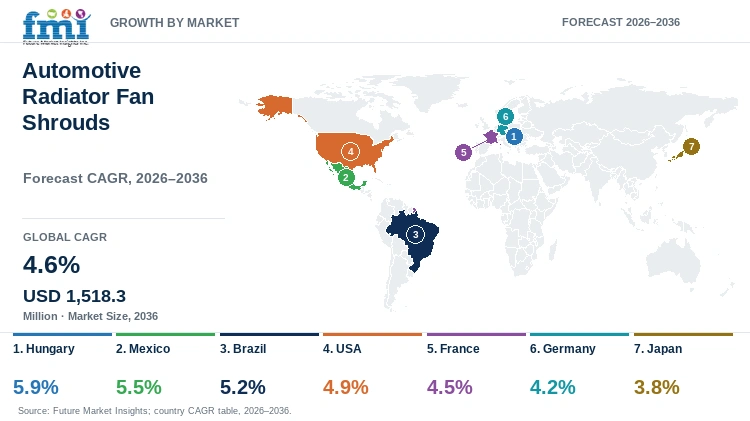
The seven modeled countries span 2.1 percentage points, from Hungary at 5.9% to Japan at 3.8%. Hungary is in the faster group with Mexico and Brazil because new vehicle output adds cooling work. The USA falls near the middle of the modeled range. France and Germany show steady demand from mixed fleets. Japan has the lowest rate, but it still has a large vehicle base.
- Hungary is adding vehicle capacity and registrations, so more cooling packages enter new approval and tooling cycles.
- Mexico combines high light-vehicle output with truck-heavy production, which requires many shroud sizes and strong mounts.
- Brazil has a large combustion fleet and rising EV registrations, so suppliers must support two cooling designs.
- US production remains truck-heavy, which expands shroud sizes and keeps accurate replacement fit data important.
- France combines an older vehicle fleet with EV growth, supporting both service parts and newer cooling designs.
- Germany adds electric-car output while combustion models remain active, so suppliers must support many approved cooling layouts.
- Japan has a mature vehicle base and long supplier ties, so growth depends more on model changes than fleet growth.
Similar CAGRs can still lead to different order patterns because vehicle mix and approval timing vary by country. Fleet size also changes replacement demand even when forecast growth is slower.
The full report provides country-level CAGR analysis in North America, Latin America, Western Europe, Eastern Europe, East Asia, South Asia and Pacific, and the Middle East and Africa.
Country-wise Analysis
- US vehicle programs cover passenger cars and SUVs with different cooling needs. Pickups add another set of cooling needs for the same suppliers. Fan shroud demand in the USA is forecast to expand at 4.9% CAGR through 2036, influenced by the truck-heavy vehicle mix. EPA said trucks made up 66% of model-year 2024 new vehicles under NHTSA rules. Larger front ends need more shroud sizes and more part numbers. OEM programs need tested airflow and firm mounting points. Service brands also need clear part-fit data for crash or fan repairs. A single shroud design cannot cover this range. Suppliers therefore need broad vehicle coverage and accurate fit data to win repeat OEM and service orders.
- Germany keeps a large combustion-vehicle base while electric-car output rises. Germany is projected to record 4.2% CAGR through 2036, supported by continued changes in passenger-car cooling packages. VDA said Germany made 1.67 million electric passenger cars in 2025. Total passenger-car output reached 4.15 million, and EVs made up 40% of the total. Suppliers must support compact and quiet EV cooling without dropping proven combustion designs. Vehicle programs also need close engineering control during model changes. Local support can shorten approval work as fan shapes or radiator packages change. This mix favors suppliers that can serve both older designs and new EV programs with stable parts.
- Japan has a mature car ownership base and slower fleet growth than newer production hubs. Fan shroud demand in Japan is forecast to expand at 3.8% CAGR through 2036, tied to model changes and service needs. JAMA said household passenger-car ownership was 71.9% in its 2025 survey. JAMA also found that multi-car ownership reached 30.5%. This large installed base supports repair demand even when new sales grow slowly. Suppliers still face long approval cycles and strict shape checks. Stable molded parts and clear part-fit data help keep repeat business. Brands that support both domestic and export models can serve this mature base without relying on rapid fleet growth.
- Brazil has a large combustion fleet while EV registrations keep rising. Fan shroud demand in Brazil is projected to expand at 5.2% CAGR through 2036, shaped by the mixed powertrain shift. Brazil's Ministry of Mines and Energy said EV registrations rose from 1.9 thousand in 2020 to more than 215 thousand in 2024. Combustion models will still need repair parts during this shift. Suppliers need low-cost service coverage for older vehicles. Newer EVs also need quieter and more compact cooling parts. Heat resistance remains important for vehicles used in hot conditions. The sales route covers old vehicle fit as well as new cooling layouts. Suppliers that can serve both needs have a wider order base.
- France has a large car fleet that keeps service demand important during the EV shift. Fan shroud sales in France are forecast to expand at 4.5% CAGR through 2036, influenced by fleet age and new powertrains. SDES counted 40.0 million passenger cars in use on January 1 2026. The average passenger car was 11.8 years old. Electric cars made up 3.5% of the fleet, and plug-in hybrids held 2.0%. Older vehicles still need replacement cooling parts during normal service. New EVs need smaller and quieter cooling designs. Service catalogs must keep part-fit data current as the fleet changes slowly. Suppliers therefore need broad replacement coverage and newer parts for electrified models.
- Hungary is adding new vehicles to the road as its production base moves toward EV programs. Fan shroud demand in Hungary is expected to grow at 5.9% CAGR through 2036, supported by faster model turnover. Hungary recorded 72,349 passenger cars first placed on the market in the first quarter of 2026. The second quarter added another 78,118 passenger cars. More new vehicles expand the future service base as fresh models reach drivers. OEM suppliers still need program approval and ready tools before volume starts. Nearby engineering teams can make model changes faster during launch. Combined fan-shroud modules gain value as local EV programs use smaller cooling spaces and tighter part layouts.
- Mexico is a large North American vehicle production base with a high share of trucks. Mexico is estimated to post 5.5% CAGR through 2036, tied to full-scale production and export model changes. INEGI said Mexico made 3.95 million light vehicles during 2025. Trucks represented more than three quarters of output in the official series. This mix needs many shroud sizes and strong mounting designs. Export programs also require tools and tests that match several destination rules. Local output builds a large future base for service parts as these vehicles enter use. Suppliers that support factory programs and later repairs can spread tooling work over more orders.
Who are the notable companies in the Automotive Radiator Fan Shrouds Market?
MAHLE, DENSO, Valeo, Hanon Systems, Marelli, Modine Manufacturing Company, T.RAD Co., Ltd., Flex-A-Lite, TYC Americas, and Spectra Premium Mobility Solutions
Competition comes from large thermal suppliers and radiator specialists. Replacement cooling brands make up a third competitor group. A shroud is hard to reuse between vehicles because airflow shape and mounting points change by program. Material behavior can also change the approval work. OEM programs value engineering support and tested module work. Replacement channels value clear part-fit data and wide vehicle coverage. Company ownership also matters because a merger can change who makes or sells a part.
- MAHLE, DENSO, Valeo, Hanon Systems and Marelli compete from broader thermal-system positions with direct vehicle-program engineering access.
- Modine Manufacturing Company and T.RAD Co., Ltd. bring radiator and heat-exchanger experience that supports cooling-module integration work.
- Flex-A-Lite, TYC Americas and Spectra Premium Mobility Solutions focus more heavily on replacement cooling coverage and service-channel fitment.
Competitive Benchmarking: Automotive Radiator Fan Shrouds Market
| Company | Fan-Shroud Assembly Evidence | Thermal-System Integration | Replacement-Channel Evidence | Geographic Reach |
|---|---|---|---|---|
| MAHLE | High | High | Medium | Global |
| DENSO | High | High | Medium | Global |
| Valeo | High | High | Medium | Global |
| Hanon Systems | High | High | Medium | Global |
| Marelli | Medium | High | Medium | Global |
| Modine Manufacturing Company | Medium | Medium | Low | North America, Europe and Asia |
| T.RAD Co., Ltd. | Medium | Medium | Low | Asia, Europe and North America |
| Flex-A-Lite | High | Low | High | North America with export distribution |
| TYC Americas | High | Low | High | North America with global TYC supply |
| Spectra Premium Mobility Solutions | Medium | Medium | High | North America and export channels |
Scoring basis: High means current proof of a direct capability in the named area. Medium means the proof is narrower or shows partial integration. Low means current proof is limited for that area. Geographic reach only describes the regions served and does not receive a score.
Key Developments in the Automotive Radiator Fan Shrouds Market
- In July 2026, MAHLE began series production of EV battery cooling plates at its Montblanc plant in Spain.
- In March 2026, Hanon Systems began production of its highly integrated cooling entity for the BMW iX3.
- In January 2026, DENSO announced the planned acquisition of SYSTEX Products Corporation to strengthen engine-cooling manufacturing in Michigan.
Key Players in the Automotive Radiator Fan Shrouds Market
Integrated thermal-system suppliers
- MAHLE
- DENSO
- Valeo
- Hanon Systems
- Marelli
Radiator and heat-exchanger specialists
- Modine Manufacturing Company
- T.RAD Co., Ltd.
Replacement cooling specialists
- Flex-A-Lite
- TYC Americas
- Spectra Premium Mobility Solutions
Automotive Radiator Fan Shrouds Market - Report Scope
| Coverage field | Report scope |
|---|---|
| Market breakdown | By shroud type, material, vehicle type, sales channel, function and region. |
| Quantitative Units | USD million. |
| Market Definition | Commercial radiator fan shrouds and integrated fan-shroud assemblies used to guide cooling airflow and support the fan are included. |
| Regions Covered | North America, Latin America, Western Europe, Eastern Europe, East Asia, South Asia and Pacific, and Middle East and Africa. |
| Countries Covered | Hungary, Mexico, Brazil, USA, France, Germany, Japan, and 20+ countries included in the full report. |
| Key Companies Profiled | MAHLE, DENSO, Valeo, Hanon Systems, Marelli, Modine Manufacturing Company, T.RAD Co., Ltd., Flex-A-Lite, TYC Americas, and Spectra Premium Mobility Solutions. |
| Forecast Period | 2026 to 2036. |
| Approach | Primary and secondary research with market triangulation. |
Automotive Radiator Fan Shrouds Market - Research Methodology
| Method | Approach |
|---|---|
| Primary Research | FMI analysts gathered input from manufacturers, service providers, technology developers, distributors, end users, procurement teams, and subject-matter experts. Interviews examined purchasing decisions, product or service evaluation, adoption barriers, approval requirements, pricing considerations, and expectations for technical or commercial support. Respondents were also asked what evidence is required before a trial, pilot, or initial order develops into regular purchasing. |
| Desk Research | Desk research covered government statistics, regulatory publications, trade data, industry associations, technical literature, standards, company filings, product information, and official corporate announcements. Sources were reviewed for relevance, publication date, geographic coverage, and consistency with the defined market scope. Claims relating to performance, applications, approvals, capacity, investment, and commercial activity were retained only when supported by credible public evidence. |
| Market Sizing and Forecasting | The market model combined the baseline value with historical performance, segment structure, pricing and volume indicators, adoption levels, company participation, and country-level demand conditions. Forecast assumptions considered economic activity, investment trends, regulatory developments, technology adoption, purchasing cycles, supply availability, and barriers to wider market use. Segment and regional estimates were reconciled before the final market total was calculated. |
| Data Validation | Estimates were checked against multiple independent indicators, including public data, company activity, trade patterns, industry developments, and findings from primary interviews. Validation also tested whether products, services, applications, and company revenues fell within the defined market boundaries. Adjacent categories, unsupported claims, overlapping revenues, and activities without direct market relevance were excluded to reduce double counting and maintain consistency across segments and countries. |
Automotive Radiator Fan Shrouds Market by Segments
Automotive Radiator Fan Shrouds Market segmented by Shroud Type:
- Injection-molded shrouds
- Integrated fan-shroud modules
- Ring shrouds
- Truck radiator shrouds
- EV thermal shrouds
Automotive Radiator Fan Shrouds Market segmented by Material:
- PA66 glass-filled
- PP
- ABS
- Aluminum
- Composite
Automotive Radiator Fan Shrouds Market segmented by Vehicle Type:
- Passenger cars
- SUVs/crossovers
- Light commercial vehicles
- Heavy trucks
- EVs/hybrids
Automotive Radiator Fan Shrouds Market segmented by Sales Channel:
- OEM direct
- Thermal system Tier-1s
- Aftermarket replacement
- Service kits
Automotive Radiator Fan Shrouds Market segmented by Function:
- Airflow management
- Fan efficiency
- NVH reduction
- Cooling module integration
Automotive Radiator Fan Shrouds Market by Region:
- North America
- United States
- Canada
- Latin America
- Brazil
- Mexico
- Argentina
- Chile
- Western Europe
- Germany
- France
- United Kingdom
- Italy
- Spain
- Benelux
- Nordics
- Eastern Europe
- Poland
- Czech Republic
- Romania
- Hungary
- East Asia
- China
- Japan
- South Korea
- South Asia and Pacific
- India
- ASEAN
- Australia and New Zealand
- Middle East and Africa
- GCC Countries
- South Africa
- Türkiye
- Israel
Research Sources and Bibliography
- MAHLE. (2026, April 15). MAHLE achieves turnaround in 2025.
- German Association of the Automotive Industry (VDA). (2026, February 3). Production and market in January 2026.
- LONG-GLASS-FIBER-REINFORCED THERMOPLASTICS. (2026, June 30). PP-LGF30 Replace PA6-GF30 Cooling Shroud Case.
- BASF. (2026, January 12). BASF expands Ultramid portfolio for durable automotive plastic parts with higher thermal stability.
- Hanon Systems. (2026, March 31). Hanon Systems Begins Production of Highly Integrated Cooling Entity for BMW iX3.
- Valeo. (2026, April 24). Valeo at Auto China 2026.
- Celanese Corporation. (2026, May 5). Celanese outlines strategic nylon uplift initiatives for global engineered materials business.
- T.RAD Co., Ltd.. (2026, April 27). Notice of Medium-Term Management Plan (T.RAD-2026).
- U.S. Environmental Protection Agency. (2026, February 19). 2025 Automotive Trends Report and highlights.
- Japan Automobile Manufacturers Association. (2026, April 14). 2025
- Brazil Ministry of Mines and Energy. (2025, October 10). Aumento de carros elétricos nas ruas faz crescer o consumo de energia no Brasil.
- Service des données et études statistiques (SDES). (2026, July 10). 40 millions de voitures en circulation en France au 1er janvier 2026.
- Hungarian Central Statistical Office. (2026, August 28). 24.2.1.22. Number of passenger cars placed on the market in Hungary for the first time by make, quarterly.
- INEGI. (2026, January 9). Registro administrativo de la industria automotriz de vehículos ligeros. Diciembre de 2025.
- Marelli. (2026, April 20). Marelli to showcase propulsion and thermal innovations supporting powertrain evolution at Auto China 2026.
- DENSO. (2026, January 21). DENSO Manufacturing Michigan to Acquire SYSTEX Products Corporation, Merge Operations.
- Hanon Systems. (2026, September 4). Hanon Systems Strengthens Global Aftermarket Business.
- Modine Manufacturing Company. (2026, January 29). Gentherm and Modine's Performance Technologies Business to Combine, Establishing a Scaled Leader in Thermal Management Solutions.
- DENSO. (2026, April 1). DENSO Hosted “DENSO DIALOG DAY 2026”, Delivers Mid-Term Management Plan “CORE 2030”.
- Hanon Systems. (2026, August 7). Hanon Systems Secures CAD 10 Million Government Support to Accelerate North American Electrification Strategy.
- MAHLE. (2026, July 29). MAHLE Starts Series Production of Battery Cooling Plates at the Montblanc Plant, Tarragona.
- Valeo. (2026, June 9). Valeo and Calyos advance passive two-phase thermal management for mobility electronics.
- TYC Brother Industrial Co., Ltd.. (2026, July). Monthly New Product Announcement - July 2026.
- MAHLE. (2026, August 27). MAHLE Starts E-Compressor Production in India.
This bibliography is provided for reader reference and is not exhaustive. The full report contains the complete reference list and detailed citations.
This Report Answers
- What is the automotive radiator fan shrouds market size in 2026 and what value is forecast for 2036?
- Which thermal and packaging conditions support demand for automotive radiator fan shrouds?
- Why do injection-molded shrouds hold the largest modeled share within shroud type?
- How does PA66 glass-filled support shape stability within the material category?
- Why do passenger cars account for 35.0% of modeled vehicle type demand in 2026?
- How do country CAGRs differ among Hungary, Mexico, Brazil, USA, France, Germany and Japan?
- Which approval and fitment requirements limit switching between fan-shroud designs?
- How do integrated thermal suppliers differ from replacement-focused cooling brands?
- Which companies are active in the automotive radiator fan shrouds market?
Frequently Asked Questions
How big is the automotive radiator fan shrouds market in 2026?
The automotive radiator fan shrouds market is worth USD 964.2 million in 2026 and projected to reach USD 1,518.3 million by 2036. Smaller cooling spaces keep airflow control and strong fan mounting important in vehicle programs.
What is the CAGR of the automotive radiator fan shrouds market from 2026 to 2036?
The automotive radiator fan shrouds market is projected to grow at a 4.6% CAGR between 2026 and 2036. New cooling layouts and vehicle model changes support demand, while repair work adds steady replacement orders.
Which shroud type leads the automotive radiator fan shrouds market?
The injection-molded shrouds segment is projected to account for 38.0% of the shroud type category in 2026. Molding lets suppliers make complex airflow shapes and repeat the same mounting features in large production runs.
Which material holds the largest modeled share in the automotive radiator fan shrouds market?
The PA66 glass-filled segment is estimated to hold 39.0% of the material category in 2026. Glass fiber adds stiffness and helps the part keep its shape near hot fan and radiator areas.
Which sales channel holds the largest modeled share in the automotive radiator fan shrouds market?
OEM direct is forecast to represent 51.0% of the sales channel category in 2026. Vehicle-specific parts need close program approval, so direct work with vehicle makers remains important before full production.
Which countries are projected to record the highest growth in the automotive radiator fan shrouds market?
Hungary is projected to grow at 5.9% CAGR through 2036, followed by Mexico at 5.5% and Brazil at 5.2%. New vehicle plants and faster model changes create more cooling-package approval work in these countries.
Which companies are active in the automotive radiator fan shrouds market?
Key companies operating in the market include MAHLE, DENSO, Valeo, Hanon Systems, Marelli, Modine Manufacturing Company, T.RAD Co., Ltd., Flex-A-Lite, TYC Americas, and Spectra Premium Mobility Solutions. These companies cover OEM thermal systems and replacement cooling parts.
Preview the report firsthand - request a free sample
Get SampleGet the brochure for pricing and purchase details.
Get PDFTable of Content
- Key Takeaways
- Market Size and CAGR
- Top Growth Driver
- Fastest Growing Segment
- Leading Region
- Key Companies
- Emerging Opportunities
- Executive Summary
- Global Market Outlook
- Demand-side Trends
- Supply-side Trends
- Technology Roadmap Analysis
- Analysis and Recommendations
- Analyst Perspective (What is happening? Why now? What should investors know?)
- Key Questions Answered
- How large is the market?
- What is the CAGR?
- What are key trends?
- Which region dominates?
- Who are the leaders?
- Market Overview
- Market Coverage / Taxonomy
- Market Definition / Scope / Limitations
- Research Methodology
- Chapter Orientation
- Analytical Lens and Working Hypotheses
- Market Structure, Signals, and Trend Drivers
- Benchmarking and Cross-market Comparability
- Market Sizing, Forecasting, and Opportunity Mapping
- Research Design and Evidence Framework
- Desk Research Programme (Secondary Evidence)
- Expert Input and Fieldwork (Primary Evidence)
- Tooling, Models, and Reference Databases
- Data Engineering and Model Build
- Quality Assurance and Audit Trail
- Market Background
- Market Dynamics (Drivers, Restraints, Opportunity, Trends)
- Scenario Forecast (Optimistic, Likely, Conservative)
- Impact Analysis
- AI Impact
- Sustainability Impact
- Regulatory Impact
- Technology Impact
- Consumer / Buyer Analysis
- Purchase Drivers
- Adoption Barriers
- Buyer Journey
- Opportunity Map Analysis
- Product Life Cycle Analysis
- Supply Chain Analysis
- Investment Feasibility Matrix
- Value Chain Analysis
- PESTLE and Porter's Analysis
- Regulatory Landscape
- Regional Parent Market Outlook
- Production and Consumption Statistics
- Import and Export Statistics
- Global Market Analysis and Forecast, 2021 to 2036
- Historical Market Size Value (USD Million) Analysis, 2021 to 2025
- Current and Future Market Size Value (USD Million) Projections, 2026 to 2036
- Y-o-Y Growth Trend Analysis
- Absolute $ Opportunity Analysis
- Global Market Pricing Analysis, 2021 to 2036
- Global Market Analysis and Forecast, By Shroud Type, 2021 to 2036
- Introduction / Key Findings
- Historical Market Size Value (USD Million) Analysis By Shroud Type, 2021 to 2025
- Current and Future Market Size Value (USD Million) Analysis and Forecast By Shroud Type, 2026 to 2036
- Injection-molded shrouds
- Integrated fan-shroud modules
- Ring shrouds
- Truck radiator shrouds
- EV thermal shrouds
- Y-o-Y Growth Trend Analysis By Shroud Type, 2021 to 2025
- Absolute $ Opportunity Analysis By Shroud Type, 2026 to 2036
- Global Market Analysis and Forecast, By Material, 2021 to 2036
- Introduction / Key Findings
- Historical Market Size Value (USD Million) Analysis By Material, 2021 to 2025
- Current and Future Market Size Value (USD Million) Analysis and Forecast By Material, 2026 to 2036
- PA66 glass-filled
- PP
- ABS
- Aluminum
- Composite
- Y-o-Y Growth Trend Analysis By Material, 2021 to 2025
- Absolute $ Opportunity Analysis By Material, 2026 to 2036
- Global Market Analysis and Forecast, By Vehicle Type, 2021 to 2036
- Introduction / Key Findings
- Historical Market Size Value (USD Million) Analysis By Vehicle Type, 2021 to 2025
- Current and Future Market Size Value (USD Million) Analysis and Forecast By Vehicle Type, 2026 to 2036
- Passenger cars
- SUVs/crossovers
- Light commercial vehicles
- Heavy trucks
- EVs/hybrids
- Y-o-Y Growth Trend Analysis By Vehicle Type, 2021 to 2025
- Absolute $ Opportunity Analysis By Vehicle Type, 2026 to 2036
- Global Market Analysis and Forecast, By Sales Channel, 2021 to 2036
- Introduction / Key Findings
- Historical Market Size Value (USD Million) Analysis By Sales Channel, 2021 to 2025
- Current and Future Market Size Value (USD Million) Analysis and Forecast By Sales Channel, 2026 to 2036
- OEM direct
- Thermal system Tier-1s
- Aftermarket replacement
- Service kits
- Y-o-Y Growth Trend Analysis By Sales Channel, 2021 to 2025
- Absolute $ Opportunity Analysis By Sales Channel, 2026 to 2036
- Global Market Analysis and Forecast, By Function, 2021 to 2036
- Introduction / Key Findings
- Historical Market Size Value (USD Million) Analysis By Function, 2021 to 2025
- Current and Future Market Size Value (USD Million) Analysis and Forecast By Function, 2026 to 2036
- Airflow management
- Fan efficiency
- NVH reduction
- Cooling module integration
- Y-o-Y Growth Trend Analysis By Function, 2021 to 2025
- Absolute $ Opportunity Analysis By Function, 2026 to 2036
- Global Market Analysis and Forecast, By Region, 2021 to 2036
- Introduction
- Historical Market Size Value (USD Million) Analysis By Region, 2021 to 2025
- Current Market Size Value (USD Million) Analysis and Forecast By Region, 2026 to 2036
- North America
- Latin America
- Western Europe
- Eastern Europe
- East Asia
- South Asia and Pacific
- Middle East and Africa
- Market Attractiveness Analysis By Region
- North America Market Analysis and Forecast, By Country, 2021 to 2036
- Historical Market Size Value (USD Million) Trend Analysis By Market Taxonomy, 2021 to 2025
- Market Size Value (USD Million) Forecast By Market Taxonomy, 2026 to 2036
- By Country
- United States
- Canada
- By Shroud Type
- By Material
- By Vehicle Type
- By Sales Channel
- By Function
- By Country
- Market Attractiveness Analysis
- By Country
- By Shroud Type
- By Material
- By Vehicle Type
- By Sales Channel
- By Function
- Key Takeaways
- Latin America Market Analysis and Forecast, By Country
- Historical Market Size Value (USD Million) Trend Analysis By Market Taxonomy, 2021 to 2025
- Market Size Value (USD Million) Forecast By Market Taxonomy, 2026 to 2036
- By Country
- Brazil
- Mexico
- Argentina
- Chile
- By Shroud Type
- By Material
- By Vehicle Type
- By Sales Channel
- By Function
- By Country
- Market Attractiveness Analysis
- By Country
- By Shroud Type
- By Material
- By Vehicle Type
- By Sales Channel
- By Function
- Key Takeaways
- Western Europe Market Analysis and Forecast, By Country
- Historical Market Size Value (USD Million) Trend Analysis By Market Taxonomy, 2021 to 2025
- Market Size Value (USD Million) Forecast By Market Taxonomy, 2026 to 2036
- By Country
- Germany
- France
- United Kingdom
- Italy
- Spain
- Benelux
- Nordics
- By Shroud Type
- By Material
- By Vehicle Type
- By Sales Channel
- By Function
- By Country
- Market Attractiveness Analysis
- By Country
- By Shroud Type
- By Material
- By Vehicle Type
- By Sales Channel
- By Function
- Key Takeaways
- Eastern Europe Market Analysis and Forecast, By Country
- Historical Market Size Value (USD Million) Trend Analysis By Market Taxonomy, 2021 to 2025
- Market Size Value (USD Million) Forecast By Market Taxonomy, 2026 to 2036
- By Country
- Poland
- Czech Republic
- Romania
- Hungary
- By Shroud Type
- By Material
- By Vehicle Type
- By Sales Channel
- By Function
- By Country
- Market Attractiveness Analysis
- By Country
- By Shroud Type
- By Material
- By Vehicle Type
- By Sales Channel
- By Function
- Key Takeaways
- East Asia Market Analysis and Forecast, By Country
- Historical Market Size Value (USD Million) Trend Analysis By Market Taxonomy, 2021 to 2025
- Market Size Value (USD Million) Forecast By Market Taxonomy, 2026 to 2036
- By Country
- China
- Japan
- South Korea
- By Shroud Type
- By Material
- By Vehicle Type
- By Sales Channel
- By Function
- By Country
- Market Attractiveness Analysis
- By Country
- By Shroud Type
- By Material
- By Vehicle Type
- By Sales Channel
- By Function
- Key Takeaways
- South Asia and Pacific Market Analysis and Forecast, By Country
- Historical Market Size Value (USD Million) Trend Analysis By Market Taxonomy, 2021 to 2025
- Market Size Value (USD Million) Forecast By Market Taxonomy, 2026 to 2036
- By Country
- India
- ASEAN
- Australia and New Zealand
- By Shroud Type
- By Material
- By Vehicle Type
- By Sales Channel
- By Function
- By Country
- Market Attractiveness Analysis
- By Country
- By Shroud Type
- By Material
- By Vehicle Type
- By Sales Channel
- By Function
- Key Takeaways
- Middle East and Africa Market Analysis and Forecast, By Country
- Historical Market Size Value (USD Million) Trend Analysis By Market Taxonomy, 2021 to 2025
- Market Size Value (USD Million) Forecast By Market Taxonomy, 2026 to 2036
- By Country
- GCC Countries
- South Africa
- Türkiye
- Israel
- By Shroud Type
- By Material
- By Vehicle Type
- By Sales Channel
- By Function
- By Country
- Market Attractiveness Analysis
- By Country
- By Shroud Type
- By Material
- By Vehicle Type
- By Sales Channel
- By Function
- Key Takeaways
- Key Countries Market Analysis
- United States
- Pricing Analysis
- Market Share Analysis, 2025
- By Shroud Type
- By Material
- By Vehicle Type
- By Sales Channel
- By Function
- Canada
- Pricing Analysis
- Market Share Analysis, 2025
- By Shroud Type
- By Material
- By Vehicle Type
- By Sales Channel
- By Function
- Mexico
- Pricing Analysis
- Market Share Analysis, 2025
- By Shroud Type
- By Material
- By Vehicle Type
- By Sales Channel
- By Function
- Brazil
- Pricing Analysis
- Market Share Analysis, 2025
- By Shroud Type
- By Material
- By Vehicle Type
- By Sales Channel
- By Function
- Chile
- Pricing Analysis
- Market Share Analysis, 2025
- By Shroud Type
- By Material
- By Vehicle Type
- By Sales Channel
- By Function
- Germany
- Pricing Analysis
- Market Share Analysis, 2025
- By Shroud Type
- By Material
- By Vehicle Type
- By Sales Channel
- By Function
- United Kingdom
- Pricing Analysis
- Market Share Analysis, 2025
- By Shroud Type
- By Material
- By Vehicle Type
- By Sales Channel
- By Function
- Italy
- Pricing Analysis
- Market Share Analysis, 2025
- By Shroud Type
- By Material
- By Vehicle Type
- By Sales Channel
- By Function
- Spain
- Pricing Analysis
- Market Share Analysis, 2025
- By Shroud Type
- By Material
- By Vehicle Type
- By Sales Channel
- By Function
- France
- Pricing Analysis
- Market Share Analysis, 2025
- By Shroud Type
- By Material
- By Vehicle Type
- By Sales Channel
- By Function
- India
- Pricing Analysis
- Market Share Analysis, 2025
- By Shroud Type
- By Material
- By Vehicle Type
- By Sales Channel
- By Function
- ASEAN
- Pricing Analysis
- Market Share Analysis, 2025
- By Shroud Type
- By Material
- By Vehicle Type
- By Sales Channel
- By Function
- Australia and New Zealand
- Pricing Analysis
- Market Share Analysis, 2025
- By Shroud Type
- By Material
- By Vehicle Type
- By Sales Channel
- By Function
- China
- Pricing Analysis
- Market Share Analysis, 2025
- By Shroud Type
- By Material
- By Vehicle Type
- By Sales Channel
- By Function
- Japan
- Pricing Analysis
- Market Share Analysis, 2025
- By Shroud Type
- By Material
- By Vehicle Type
- By Sales Channel
- By Function
- South Korea
- Pricing Analysis
- Market Share Analysis, 2025
- By Shroud Type
- By Material
- By Vehicle Type
- By Sales Channel
- By Function
- Poland
- Pricing Analysis
- Market Share Analysis, 2025
- By Shroud Type
- By Material
- By Vehicle Type
- By Sales Channel
- By Function
- Hungary
- Pricing Analysis
- Market Share Analysis, 2025
- By Shroud Type
- By Material
- By Vehicle Type
- By Sales Channel
- By Function
- Türkiye
- Pricing Analysis
- Market Share Analysis, 2025
- By Shroud Type
- By Material
- By Vehicle Type
- By Sales Channel
- By Function
- South Africa
- Pricing Analysis
- Market Share Analysis, 2025
- By Shroud Type
- By Material
- By Vehicle Type
- By Sales Channel
- By Function
- United States
- Market Structure Analysis
- Competition Dashboard
- Competition Benchmarking
- Market Share Analysis of Top Players
- By Regional
- By Shroud Type
- By Material
- By Vehicle Type
- By Sales Channel
- By Function
- Emerging Startups
- Innovation Benchmarking
- Competition Analysis
- Competition Deep Dive
- MAHLE
- Overview
- Product Portfolio
- Profitability by Market Segments
- Sales Footprint
- Strategy Overview
- Marketing Strategy
- Product Strategy
- Channel Strategy
- DENSO
- Valeo
- Hanon Systems
- Marelli
- Modine Manufacturing Company
- T.RAD Co., Ltd.
- Flex-A-Lite
- TYC Americas
- Spectra Premium Mobility Solutions
- MAHLE
- Case Studies
- Success Stories
- Recent Developments
- Competition Deep Dive
- Assumptions & Acronyms Used


