

- Market Size (2026)
- USD 950.0 Mn
- Forecast (2036)
- USD 1510.6 Mn
- CAGR (2026 to 2036)
- 4.7%
How big is Automotive Cavity Waxes Market in 2026?
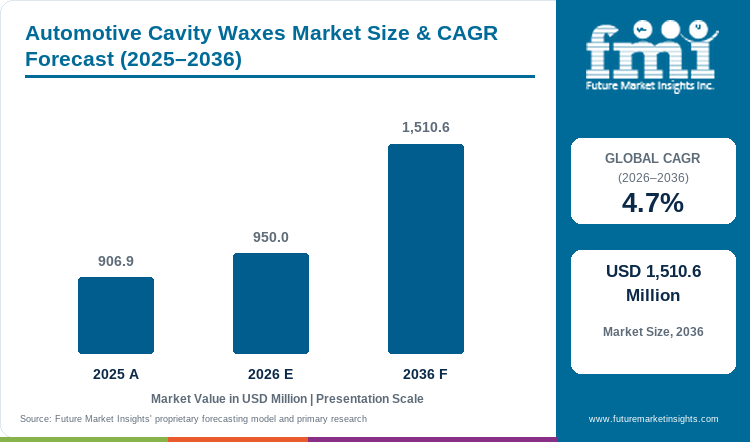
USD 950.0 million in 2026 and USD 1,510.6 million by 2036, expanding at 4.7% CAGR.
Sales of automotive cavity waxes are estimated to rise at 4.7% CAGR through 2036. Valuation rises from USD 906.9 million in 2025 to USD 950.0 million in 2026 and reaches USD 1,510.6 million by 2036. In June 2025, I-CAR documented Ford and Lincoln repair rules. Those rules use cavity wax to restore rust protection after body repairs. The same repair work also uses automotive refinish coatings. Cavity wax is tied to structural body repairs and not optional detailing.
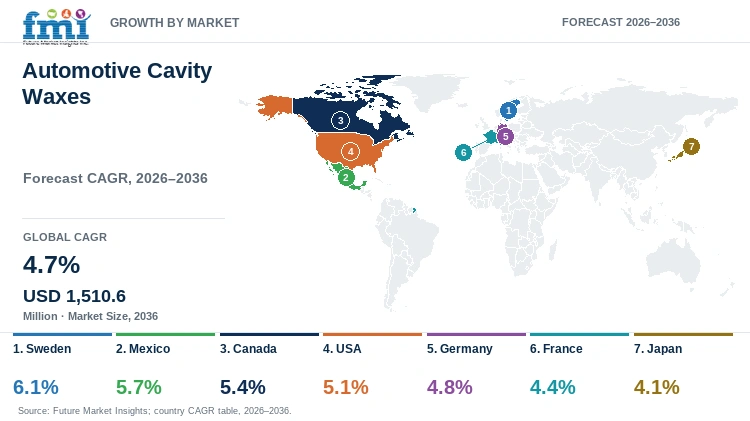
Mexico is projected to grow at 5.7% CAGR through 2036. Japan is projected at 4.1% CAGR during the same period. INEGI reported in September 2025 that Mexico made 349,856 light vehicles in August 2025. Export-focused plants need bulk wax supply nearby. Japanese programs use longer supplier checks, so the two countries use different approval and service steps for automotive body structures.
Key Takeaways
- Factory corrosion steps and post-repair restoration create repeat cavity-wax purchases at assembly plants and collision centers.
- By wax type, solvent-based cavity waxes are estimated to hold 33.0% share in 2026, supported by familiar spray methods and reliable seam wetting.
- In 2026, door cavities are expected to lead application with 28.0% share, attributable to enclosed hems and frequent repair work.
- Automotive OEMs are projected to hold 42.0% of sales channel demand in 2026, supported by planned dosing and vehicle-platform specifications.
- Hidden coverage slows supplier changes because technicians cannot inspect the final wax film once the body is assembled.
- Some of the key players in this market include Henkel, 3M, Sika, PPG, Axalta, DINOL GmbH, Bilt Hamber Laboratories, Würth Group and Daubert Chemical Company.
Analyst Perspective
"Cavity wax works best when a plant or repair shop can prove that it reaches hidden seams without slowing work. Lower-emission products will gain use if they keep good seam creep, film retention and steady dosing inside real body cavities."
- Nikhil Kaitwade, Principal Consultant, Future Market Insights
How is the automotive cavity waxes market segmented?
The automotive cavity waxes market is segmented by Wax Type, Application, Vehicle Type, Sales Channel, Function and Region.
Wax type has five groups. They are solvent-based cavity waxes, water-based cavity waxes, wax-oil blends, aerosol cavity waxes and OEM-applied wax systems. Application also has five groups. They are door cavities, rocker panels, chassis cavities, hood - trunk seams and underbody cavities. Vehicle type covers passenger cars, SUVs - crossovers, light commercial vehicles, commercial vehicles and classic - restoration vehicles. Sales channel covers automotive OEMs, aftermarket repair, body shop distributors and industrial distributors. Function covers corrosion protection, moisture displacement, seam penetration and long-term film retention. Region follows the FMI hierarchy.
What supports solvent-based cavity waxes within the wax type category?
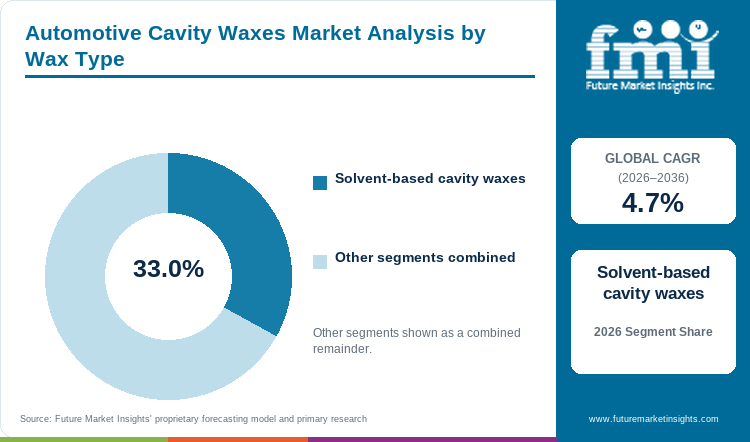
Solvent-based waxes remain common because their low viscosity helps them flow through seams before the solvent flashes off. Existing spray guns and wands also reduce the need for retraining. Lower-emission programs are increasing interest in waterborne coatings. New cavity-wax chemistry must still match seam creep and no-drip behavior inside the same body shape.
- By wax type, solvent-based cavity waxes are estimated to hold 33.0% in 2026, supported by predictable seam wetting and familiar spray methods.
- Repair teams keep these formats when flash time, wand use and surface compatibility pass internal checks.
Why do door cavities lead the application category?
Door cavities contain hem flanges, drains and hardware. These parts limit access once the trim is installed. In June 2025, I-CAR documented Ford and Lincoln repair guidance that uses cavity wax after body work. Door repair links corrosion restoration with routine repair and maintenance services. Applicators must reach the lower seam without blocking drains or window hardware.
- In 2026, door cavities are expected to lead application with 28.0% share, attributable to enclosed hem geometry and frequent repair work.
- Applicators need controlled creep that reaches folded metal without blocking drains or window hardware.
How do passenger cars shape demand within the vehicle type category?
Passenger cars create a large repair base because doors, pillars and rails contain hidden metal sections. France’s SDES reported in February 2026 that 5.534 million used passenger cars were sold in 2025. Those sales keep repair shops busy even after factory warranties end. Repair shops use cavity wax with automotive paints and coatings when damaged panels need visible paint work and hidden rust protection.
- Passenger cars are projected to hold 35.0% of vehicle type demand in 2026, influenced by a large vehicle base and recurring body repair.
- Suppliers need formats that work with different body shapes without changing the corrosion process for every model.
What supports automotive OEMs within the sales channel category?
Automotive OEMs use cavity wax on planned production schedules once the process is approved. VDA reported in July 2025 that German plants produced almost 2.2 million passenger cars in the first half of 2025. High output supports bulk delivery and on-site plant support. The same body line uses automotive adhesives and sealants. Any wax change must work within existing application windows.
- By sales channel, automotive OEMs are estimated to hold 42.0% in 2026, supported by vehicle-platform specifications and planned production dosing.
- OEM approval can turn one material qualification into repeat volume. An unapproved substitute can interrupt production.
What drives corrosion protection within the function category?
Rust protection needs wax that can enter seams, push out moisture and stay on the metal. Technicians cannot see these closed areas after assembly. Current repair steps use protective films with approved corrosion inhibitors and application tools. Suppliers must prove that the wax reaches the metal and stays there. Broad rust-prevention claims are not enough.
- Corrosion protection is forecast to represent 40.0% of function demand in 2026, driven by the need to protect enclosed metal after assembly or repair.
- The need is significant when technicians restore protection without reopening welded or trimmed body sections.
What are the drivers, restraints and opportunities in the Automotive Cavity Waxes Market?
Factory application and repair reinstatement support demand, hidden-film qualification slows switching and lower-emission cavity systems create a practical formulation opening.
- Driver: Factory production and structural repair create repeat application points for corrosion protection inside closed body sections.
- Restraint: Hidden coverage makes substrate compatibility and application quality harder to verify before long-term corrosion becomes visible.
- Opportunity: Water-based and 100%-solids cavity waxes can replace higher-emission systems when they preserve seam penetration and film retention.
Factory and repair procedures create repeat dosing
Car plants use cavity wax as a standard body-protection step. Collision shops restore the wax after structural repairs. Federal Reserve data available in September 2026 put August 2025 US motor vehicle assemblies at an annual rate of 11.1 million units. High output means many factory wax applications. A plant buys wax when its approved work steps require it. Repairs create the need again after welding or panel replacement. The materials must also work with automotive sealants without disrupting approved body-shop steps.
Hidden coverage slows supplier qualification
Engineers cannot see the wax film once the body is closed. They must check that the wax works with the surface, reaches the full cavity and sprays the same way each time. Repair rules also limit the materials and tools a shop may use. A new formula may need fresh test data before approval. Suppliers working with corrosion protection coatings need data from real cavities. Poor records can delay a supplier change even when the wax works well.
Lower-emission chemistry has a practical replacement route
Lower-emission wax can enter programs that still need deep seam reach and long-lasting protection. In December 2025, Daubert Chemical documented 100%-solids cavity wax used by a Japanese OEM and other OEMs replacing solvent-based systems. The new wax must work as well as the old process. Environmental claims alone are not enough. Suppliers also need dosing equipment and local technical support to control waste. Repair shops use automotive appearance chemicals in other parts of the job. Cavity wax remains a rust-control product, not a cosmetic one.
Which country CAGRs are profiled in the Automotive Cavity Waxes Market?
| Country | CAGR |
|---|---|
| Sweden | 6.1% |
| Mexico | 5.7% |
| Canada | 5.4% |
| USA | 5.1% |
| Germany | 4.8% |
| France | 4.4% |
| Japan | 4.1% |
How do country-level CAGRs compare in the Automotive Cavity Waxes Market?
Sweden and Mexico form the upper growth group. Canada and the USA also remain above 5.0% CAGR. Germany and France occupy the middle of the range. Japan closes the profiled range at 4.1%. The countries differ in repair exposure, vehicle production and supplier approval. The 2.0-point CAGR range does not show current revenue size.
- Sweden’s 6.1% outlook is linked to winter corrosion repair and preservation work.
- Mexico reaches 5.7% as export-focused assembly supports bulk cavity-wax programs.
- Canada records 5.4% as winter exposure keeps repair and preservation demand active.
- The USA reaches 5.1%, supported by factory assembly and collision repair.
- Germany’s 4.8% outlook is shaped by long vehicle-platform approval cycles.
- France reaches 4.4% as used-car turnover keeps repair work active.
- Japan reaches 4.1%, with careful supplier validation slowing product substitution.
Production and approval rules make similar CAGRs lead to different business conditions. The full report provides country-level CAGR analysis across North America, Latin America, Western Europe, Eastern Europe, East Asia, South Asia and Pacific and the Middle East and Africa.
Country-wise Analysis
- Swedish repair shops deal with rust during long winter road-treatment periods. Sweden is projected to grow at 6.1% CAGR through 2036, linked to work that protects exposed body cavities. In February 2026, the Swedish Transport Agency reported 257,778 type-approved passenger-car registrations during 2025. Those new cars join a fleet that also needs long-term rust care. Cold-weather use remains a practical limit. Wax must still flow into seams without becoming too thick. Clear low-temperature work steps can help repair shops avoid rework during winter jobs.
- Mexican assembly plants buy wax to meet export schedules and global car-program rules. Automotive cavity wax sales in Mexico are forecast to expand at 5.7% CAGR through 2036, supported by high light-vehicle output and local plant service. INEGI reported in September 2025 that Mexico produced 349,856 light vehicles during August 2025. Global program approval still controls any material change. Local stock alone cannot win a program. Suppliers need bulk stock and plant support that can respond without stopping production. One wax approved for several plants can lower supply risk and cut the cost of local stocking.
- Canadian repair demand comes from many vehicles and winter salt exposure at seams and closed body areas. Adoption of automotive cavity waxes in Canada is estimated to expand at 5.4% CAGR through 2036, influenced by repeat repair and rust-care work. Statistics Canada reported in March 2026 that 1,866,714 new motor vehicles were registered during 2025. Those registrations add more cars and trucks to the fleet. Wax still needs good cold flow and a flexible film. Repair centers benefit from nearby stock. Technicians also need to check coverage in rails, pillars and door hems.
- US demand comes from large assembly plants and a large collision-repair channel. The USA is estimated to post 5.1% CAGR over the forecast period, tied to factory dosing and coating repair after body work. Federal Reserve data available in September 2026 show August 2025 motor vehicle assemblies at an annual rate of 11.1 million units. Plants need metered bulk systems. Repair shops use smaller packs and extension wands. Vehicle-program rules can slow supplier changes because the new wax must prove coverage and material match. National distribution and training can help one approved wax serve several plants or repair sites.
- German car makers need steady wax use on production lines and often use long approval cycles. Cavity wax demand in Germany is forecast to rise at 4.8% CAGR over the forecast period, supported by high passenger-car output. VDA reported in July 2025 that German plants made almost 2.2 million passenger cars in the first half of 2025. Suppliers need engineers at plants and steady supply from Europe. Approval can take longer when one wax is used on several car designs. Lower-emission waxes gain interest if they keep good seam flow, dry-film behavior and steady dosing in existing line windows.
- French cavity-wax demand is closely tied to car repair and continued use of older cars. Demand in France is forecast to rise at 4.4% CAGR over the forecast period, influenced by used-car sales and collision work. France’s SDES reported in February 2026 that 5.534 million used passenger cars were sold during 2025. Those sales keep repairable cars moving between owners and workshops. Shops also compare the cost of a separate cavity-wax step with total repair time. Suppliers can make use easier with compact packs, clear access guides and low-waste spray methods.
- Japanese car makers want clear proof that a new wax works with existing materials. They also value a supplier’s past results. Cavity wax sales in Japan are forecast to expand at 4.1% CAGR by 2036, constrained by careful local approval. The Japan Automobile Dealers Association reported in October 2025. It recorded 2,203,910 new registered vehicles from January through September 2025. A new wax must work with compact body shapes and local repair steps before repeat use. Local-language guides and steady small-batch supply can shorten technical review without weakening approval rules.
Who are the notable companies in the Automotive Cavity Waxes Market?
Henkel, 3M, Sika, PPG, Axalta, DINOL GmbH, Bilt Hamber Laboratories, Würth Group, Daubert Chemical Company are active within the defined automotive cavity-wax and adjacent body-protection supply boundary.
Competition includes large automotive-chemistry groups, repair-system suppliers and cavity-protection specialists. Entry is hard because the chemistry must work with each program’s application tools and body shape. OEMs prefer bulk dosing and local technical help. Repair shops need aerosols, pressure systems and extension wands. TEROSON, DINITROL and Tectyl remain brands owned by their current parent companies, so they are not counted twice.
- Henkel, Sika, PPG and Axalta bring broad automotive chemistry and OEM process experience to body-protection work.
- 3M and Würth Group support repair work with application tools and workshop distribution.
- DINOL GmbH, Bilt Hamber Laboratories and Daubert Chemical Company focus more directly on corrosion protection and cavity preservation.
Competitive Benchmarking: Automotive Cavity Waxes Market
| Company | Cavity-Specific Public Evidence | OEM or Repair Process Integration | Lower-Emission Cavity Route | Geographic Reach |
|---|---|---|---|---|
| Henkel | High | High | Medium | Global |
| 3M | High | High | Low | Global |
| Sika | Medium | High | Medium | Global |
| PPG | Low | High | High | Global |
| Axalta | Low | High | High | Global |
| DINOL GmbH | High | Medium | High | Europe with export channels |
| Bilt Hamber Laboratories | High | Low | Medium | United Kingdom with exports |
| Würth Group | Medium | High | Low | Global professional trade |
| Daubert Chemical Company | High | High | High | North America with international OEM routes |
Scoring basis: High means recent public proof of cavity-wax work on cars. Medium means current rust-protection work with less direct proof for cavities. Low means coating or repair work without the same cavity proof. High process integration means documented use by a car maker or professional repair shop. Lower-emission ratings use proof for water-based, solvent-free, or similar products. Geographic reach only lists the places served and is not scored.
Key Developments in the Automotive Cavity Waxes Market
- In December 2025, Daubert Chemical Company documented Nox-Rust 7320 water-emulsion cavity wax. A European car maker used the product in a North American program. Daubert made the wax on dedicated equipment. The program also included bulk delivery.
- In September 2025, PPG announced a partnership with Toyota Motor Europe for its European body shop network. The deal strengthened PPG’s role in repair shops that also restore cavity protection after body repairs.
- In April 2025, Axalta launched its next-generation FCLE refinish system. The system serves collision-repair customers. The launch placed a new repair product in shops that also handle hidden rust protection.
Key Players in the Automotive Cavity Waxes Market
Integrated automotive chemistry and coatings groups
- Henkel
- Sika
- PPG
- Axalta
Professional repair-system suppliers
- 3M
- Würth Group
Cavity and corrosion-protection specialists
- DINOL GmbH
- Bilt Hamber Laboratories
- Daubert Chemical Company
Automotive Cavity Waxes Market - Report Scope
| Coverage field | Report scope |
|---|---|
| Market breakdown | By wax type, application, vehicle type, sales channel, function and region. |
| Quantitative Units | USD million. |
| Market Definition | Commercial cavity waxes used to protect enclosed or semi-enclosed vehicle body sections during OEM production, collision repair, restoration, or corrosion-preservation work. E-coats, primers, seam sealers, underbody-only coatings and repair labor are excluded. |
| Regions Covered | North America, Latin America, Western Europe, Eastern Europe, East Asia, South Asia and Pacific and Middle East and Africa. |
| Countries Covered | Sweden, Mexico, Canada, USA, Germany, France, Japan and 20+ countries included in the full report. |
| Key Companies Profiled | Henkel, 3M, Sika, PPG, Axalta, DINOL GmbH, Bilt Hamber Laboratories, Würth Group, Daubert Chemical Company. |
| Forecast Period | 2026 to 2036. |
| Approach | Primary and secondary research with market triangulation. |
Automotive Cavity Waxes Market - Research Methodology
| Method | Approach |
|---|---|
| Primary Research | FMI analysts gathered input from manufacturers, service providers, technology developers, distributors, end users, procurement teams and subject-matter experts. Interviews examined purchasing decisions, product or service evaluation, adoption barriers, approval requirements, pricing considerations and expectations for technical or commercial support. Respondents were also asked what evidence is required before a trial, pilot, or initial order develops into regular purchasing. |
| Desk Research | Desk research covered government statistics, regulatory publications, trade data, industry associations, technical literature, standards, company filings, product information and official corporate announcements. Sources were reviewed for relevance, publication date, geographic coverage and consistency with the defined market scope. Claims relating to performance, applications, approvals, capacity, investment and commercial activity were retained only when supported by credible public evidence. |
| Market Sizing and Forecasting | The market model combined the baseline value with historical performance, segment structure, pricing and volume indicators, adoption levels, company participation and country-level demand conditions. Forecast assumptions considered economic activity, investment trends, regulatory developments, technology adoption, purchasing cycles, supply availability and barriers to wider market use. Segment and regional estimates were reconciled before the final market total was calculated. |
| Data Validation | Estimates were checked against multiple independent indicators, including public data, company activity, trade patterns, industry developments and findings from primary interviews. Validation also tested whether products, services, applications and company revenues fell within the defined market boundaries. Adjacent categories, unsupported claims, overlapping revenues and activities without direct market relevance were excluded to reduce double counting and maintain consistency across segments and countries. |
Automotive Cavity Waxes Market by Segments
Automotive Cavity Waxes Market segmented by Wax Type:
- Solvent-based cavity waxes
- Water-based cavity waxes
- Wax-oil blends
- Aerosol cavity waxes
- OEM-applied wax systems
Automotive Cavity Waxes Market segmented by Application:
- Door cavities
- Rocker panels
- Chassis cavities
- Hood - trunk seams
- Underbody cavities
Automotive Cavity Waxes Market segmented by Vehicle Type:
- Passenger cars
- SUVs - crossovers
- Light commercial vehicles
- Commercial vehicles
- Classic - restoration vehicles
Automotive Cavity Waxes Market segmented by Sales Channel:
- Automotive OEMs
- Aftermarket repair
- Body shop distributors
- Industrial distributors
Automotive Cavity Waxes Market segmented by Function:
- Corrosion protection
- Moisture displacement
- Seam penetration
- Long-term film retention
Automotive Cavity Waxes Market by Region:
- North America
- United States
- Canada
- Latin America
- Brazil
- Mexico
- Chile
- Rest of Latin America
- Western Europe
- Germany
- United Kingdom
- Italy
- Spain
- France
- Nordics
- Benelux
- Rest of Western Europe
- Eastern Europe
- Russia
- Poland
- Hungary
- Balkan and Baltic States
- Rest of Eastern Europe
- East Asia
- China
- Japan
- South Korea
- South Asia and Pacific
- India
- ASEAN
- Australia and New Zealand
- Rest of South Asia and Pacific
- Middle East and Africa
- Kingdom of Saudi Arabia
- Other GCC Countries
- Türkiye
- South Africa
- Other African Union Countries
- Rest of Middle East and Africa
Research Sources and Bibliography
- I-CAR. (2025, June 10). Ford/Lincoln corrosion protection update: Cavity wax and approved repair materials.
- National Institute of Statistics and Geography (INEGI). (2025, September 9). Administrative Record of the Light Vehicle Automotive Industry (RAIAVL): August 2025 results. Mexico.
- Statistical Data and Studies Service (SDES), France. (2026, February 11). 2025 vehicle registration data. France.
- German Association of the Automotive Industry (VDA). (2025, July 2). Car production grows in June. Germany.
- Federal Reserve Bank of St. Louis. (2026, September). Motor vehicle assemblies: Monthly, seasonally adjusted annual rate. United States.
- Swedish Transport Agency. (2026, February 12). Emissions from the new passenger car fleet continue to decrease. Sweden.
- Statistics Canada. (2026, March 12). New motor vehicle registrations, fourth quarter 2025. Canada.
- Japan Automobile Dealers Association. (2025, October 1). September 2025 new vehicle registrations by vehicle type. Japan.
- Daubert Chemical Company. (2025, December 8). Daubert develops Nox-Rust 100% solids cavity wax technology.
- Daubert Chemical Company. (2025, December 15). Nox-Rust 7320 water emulsion wax technology.
- PPG. (2025, September 2). PPG announces strategic partnership with Toyota Motor Europe to support its European body shop network.
- Axalta Coating Systems. (2025, April 22). Axalta launches next-generation FCLE refinish system.
- PPG. (2025, August 14). PPG celebrates 3,000th installation of PPG MOONWALK paint mixing system at a U.S. collision center.
- Axalta Coating Systems. (2025, February 18). Axalta expands its direct distribution footprint through three distributor acquisitions.
- Henkel. (2026, May 12). New Henkel automotive adhesive: One product, twice the power.
- Sika. (2025, June 18). Sika strengthens global presence with investments across all regions.
- PPG. (2026, May 12). PPG introduces SEM products for body shops in Mexico.
- Axalta Coating Systems. (2026, April 17). Axalta earns three 2026 Edison Awards for automotive customization, EV safety and AI-powered color technology.
- UK Intellectual Property Office. (2026, March 6). Trade Marks Journal 2026/010: Scionax application by Bilt Hamber Laboratories Ltd.
- CAREPROFF ApS. (2025, September 5). The two most recognized rust-protection brands have the same owner. Denmark.
- Würth Group. (2026, January 26). Würth becomes official tool supplier of Red Bull KTM Factory Racing in the MotoGP series.
- 3M. (2025, September 1). Performance Spray Gun 2 technical data sheet for automotive aftermarket applications.
This bibliography is provided for reader reference and is not exhaustive. The full report contains the complete reference list and detailed citations.
This Report Answers
- How large is the automotive cavity waxes market in 2026 and 2036?
- Why do factory corrosion procedures and structural repair create recurring cavity-wax demand?
- Which wax type accounts for 33.0% of demand in the 2026 base year?
- Which application accounts for 28.0% of demand during the 2026 base year?
- Why do automotive OEMs account for 42.0% of sales channel demand in 2026?
- How does hidden-film qualification slow supplier switching?
- Which profiled countries have CAGRs above 5.0% through 2036?
- Which companies operate within the defined automotive cavity-wax and body-protection supply boundary?
Frequently Asked Questions
How big is the automotive cavity waxes market in 2026?
The automotive cavity waxes market is valued at USD 950.0 million in 2026. By 2036, it is projected to reach USD 1,510.6 million as factory rust-protection steps and body repair work create repeat wax use.
What is the CAGR of the automotive cavity waxes market from 2026 to 2036?
The automotive cavity waxes market is projected to grow at 4.7% CAGR from 2026 to 2036. Repeat wax dosing at OEM plants and repair shops restoring hidden rust protection support the forecast.
Which sales channel leads the automotive cavity waxes market in 2026?
Automotive OEMs are projected to hold 42.0% of sales channel demand in 2026. In the automotive cavity waxes market, car-program rules and planned dosing create repeat bulk orders once a wax is approved.
Which application leads the automotive cavity waxes market in 2026?
Door cavities are expected to make up 28.0% of application demand in 2026. In the automotive cavity waxes market, enclosed hems and repair work make good seam reach important when buyers choose a product.
Which companies are active in the automotive cavity waxes market?
Key companies in the automotive cavity waxes market include Henkel, 3M, Sika, PPG, Axalta, DINOL GmbH, Bilt Hamber Laboratories, Würth Group and Daubert Chemical Company. They differ in OEM support, repair tools and rust-control products for body cavities.
Preview the report firsthand - request a free sample
Get SampleGet the brochure for pricing and purchase details.
Get PDFTable of Content
- Key Takeaways
- Market Size and CAGR
- Top Growth Driver
- Fastest Growing Segment
- Leading Region
- Key Companies
- Emerging Opportunities
- Executive Summary
- Global Market Outlook
- Demand-side Trends
- Supply-side Trends
- Technology Roadmap Analysis
- Analysis and Recommendations
- Analyst Perspective (What is happening? Why now? What should investors know?)
- Key Questions Answered
- How large is the market?
- What is the CAGR?
- What are key trends?
- Which region dominates?
- Who are the leaders?
- Market Overview
- Market Coverage / Taxonomy
- Market Definition / Scope / Limitations
- Research Methodology
- Chapter Orientation
- Analytical Lens and Working Hypotheses
- Market Structure, Signals, and Trend Drivers
- Benchmarking and Cross-market Comparability
- Market Sizing, Forecasting, and Opportunity Mapping
- Research Design and Evidence Framework
- Desk Research Programme (Secondary Evidence)
- Expert Input and Fieldwork (Primary Evidence)
- Tooling, Models, and Reference Databases
- Data Engineering and Model Build
- Quality Assurance and Audit Trail
- Market Background
- Market Dynamics (Drivers, Restraints, Opportunity, Trends)
- Scenario Forecast (Optimistic, Likely, Conservative)
- Impact Analysis
- AI Impact
- Sustainability Impact
- Regulatory Impact
- Technology Impact
- Consumer / Buyer Analysis
- Purchase Drivers
- Adoption Barriers
- Buyer Journey
- Opportunity Map Analysis
- Product Life Cycle Analysis
- Supply Chain Analysis
- Investment Feasibility Matrix
- Value Chain Analysis
- PESTLE and Porter's Analysis
- Regulatory Landscape
- Regional Parent Market Outlook
- Production and Consumption Statistics
- Import and Export Statistics
- Global Market Analysis and Forecast, 2021 to 2036
- Historical Market Size Value (USD Million) Analysis, 2021 to 2025
- Current and Future Market Size Value (USD Million) Projections, 2026 to 2036
- Y-o-Y Growth Trend Analysis
- Absolute $ Opportunity Analysis
- Global Market Pricing Analysis, 2021 to 2036
- Global Market Analysis and Forecast, By Wax Type, 2021 to 2036
- Introduction / Key Findings
- Historical Market Size Value (USD Million) Analysis By Wax Type, 2021 to 2025
- Current and Future Market Size Value (USD Million) Analysis and Forecast By Wax Type, 2026 to 2036
- Solvent-based cavity waxes
- Water-based cavity waxes
- Wax-oil blends
- Aerosol cavity waxes
- OEM-applied wax systems
- Y-o-Y Growth Trend Analysis By Wax Type, 2021 to 2025
- Absolute $ Opportunity Analysis By Wax Type, 2026 to 2036
- Global Market Analysis and Forecast, By Application, 2021 to 2036
- Introduction / Key Findings
- Historical Market Size Value (USD Million) Analysis By Application, 2021 to 2025
- Current and Future Market Size Value (USD Million) Analysis and Forecast By Application, 2026 to 2036
- Door cavities
- Rocker panels
- Chassis cavities
- Hood - trunk seams
- Underbody cavities
- Y-o-Y Growth Trend Analysis By Application, 2021 to 2025
- Absolute $ Opportunity Analysis By Application, 2026 to 2036
- Global Market Analysis and Forecast, By Vehicle Type, 2021 to 2036
- Introduction / Key Findings
- Historical Market Size Value (USD Million) Analysis By Vehicle Type, 2021 to 2025
- Current and Future Market Size Value (USD Million) Analysis and Forecast By Vehicle Type, 2026 to 2036
- Passenger cars
- SUVs - crossovers
- Light commercial vehicles
- Commercial vehicles
- Classic - restoration vehicles
- Y-o-Y Growth Trend Analysis By Vehicle Type, 2021 to 2025
- Absolute $ Opportunity Analysis By Vehicle Type, 2026 to 2036
- Global Market Analysis and Forecast, By Sales Channel, 2021 to 2036
- Introduction / Key Findings
- Historical Market Size Value (USD Million) Analysis By Sales Channel, 2021 to 2025
- Current and Future Market Size Value (USD Million) Analysis and Forecast By Sales Channel, 2026 to 2036
- Automotive OEMs
- Aftermarket repair
- Body shop distributors
- Industrial distributors
- Y-o-Y Growth Trend Analysis By Sales Channel, 2021 to 2025
- Absolute $ Opportunity Analysis By Sales Channel, 2026 to 2036
- Global Market Analysis and Forecast, By Function, 2021 to 2036
- Introduction / Key Findings
- Historical Market Size Value (USD Million) Analysis By Function, 2021 to 2025
- Current and Future Market Size Value (USD Million) Analysis and Forecast By Function, 2026 to 2036
- Corrosion protection
- Moisture displacement
- Seam penetration
- Long-term film retention
- Y-o-Y Growth Trend Analysis By Function, 2021 to 2025
- Absolute $ Opportunity Analysis By Function, 2026 to 2036
- Global Market Analysis and Forecast, By Region, 2021 to 2036
- Introduction
- Historical Market Size Value (USD Million) Analysis By Region, 2021 to 2025
- Current Market Size Value (USD Million) Analysis and Forecast By Region, 2026 to 2036
- North America
- Latin America
- Western Europe
- Eastern Europe
- East Asia
- South Asia and Pacific
- Middle East and Africa
- Market Attractiveness Analysis By Region
- North America Market Analysis and Forecast, By Country, 2021 to 2036
- Historical Market Size Value (USD Million) Trend Analysis By Market Taxonomy, 2021 to 2025
- Market Size Value (USD Million) Forecast By Market Taxonomy, 2026 to 2036
- By Country
- United States
- Canada
- By Wax Type
- By Application
- By Vehicle Type
- By Sales Channel
- By Function
- By Country
- Market Attractiveness Analysis
- By Country
- By Wax Type
- By Application
- By Vehicle Type
- By Sales Channel
- By Function
- Key Takeaways
- Latin America Market Analysis and Forecast, By Country
- Historical Market Size Value (USD Million) Trend Analysis By Market Taxonomy, 2021 to 2025
- Market Size Value (USD Million) Forecast By Market Taxonomy, 2026 to 2036
- By Country
- Brazil
- Mexico
- Chile
- Rest of Latin America
- By Wax Type
- By Application
- By Vehicle Type
- By Sales Channel
- By Function
- By Country
- Market Attractiveness Analysis
- By Country
- By Wax Type
- By Application
- By Vehicle Type
- By Sales Channel
- By Function
- Key Takeaways
- Western Europe Market Analysis and Forecast, By Country
- Historical Market Size Value (USD Million) Trend Analysis By Market Taxonomy, 2021 to 2025
- Market Size Value (USD Million) Forecast By Market Taxonomy, 2026 to 2036
- By Country
- Germany
- United Kingdom
- Italy
- Spain
- France
- Nordics
- Benelux
- Rest of Western Europe
- By Wax Type
- By Application
- By Vehicle Type
- By Sales Channel
- By Function
- By Country
- Market Attractiveness Analysis
- By Country
- By Wax Type
- By Application
- By Vehicle Type
- By Sales Channel
- By Function
- Key Takeaways
- Eastern Europe Market Analysis and Forecast, By Country
- Historical Market Size Value (USD Million) Trend Analysis By Market Taxonomy, 2021 to 2025
- Market Size Value (USD Million) Forecast By Market Taxonomy, 2026 to 2036
- By Country
- Russia
- Poland
- Hungary
- Balkan and Baltic States
- Rest of Eastern Europe
- By Wax Type
- By Application
- By Vehicle Type
- By Sales Channel
- By Function
- By Country
- Market Attractiveness Analysis
- By Country
- By Wax Type
- By Application
- By Vehicle Type
- By Sales Channel
- By Function
- Key Takeaways
- East Asia Market Analysis and Forecast, By Country
- Historical Market Size Value (USD Million) Trend Analysis By Market Taxonomy, 2021 to 2025
- Market Size Value (USD Million) Forecast By Market Taxonomy, 2026 to 2036
- By Country
- China
- Japan
- South Korea
- By Wax Type
- By Application
- By Vehicle Type
- By Sales Channel
- By Function
- By Country
- Market Attractiveness Analysis
- By Country
- By Wax Type
- By Application
- By Vehicle Type
- By Sales Channel
- By Function
- Key Takeaways
- South Asia and Pacific Market Analysis and Forecast, By Country
- Historical Market Size Value (USD Million) Trend Analysis By Market Taxonomy, 2021 to 2025
- Market Size Value (USD Million) Forecast By Market Taxonomy, 2026 to 2036
- By Country
- India
- ASEAN
- Australia and New Zealand
- Rest of South Asia and Pacific
- By Wax Type
- By Application
- By Vehicle Type
- By Sales Channel
- By Function
- By Country
- Market Attractiveness Analysis
- By Country
- By Wax Type
- By Application
- By Vehicle Type
- By Sales Channel
- By Function
- Key Takeaways
- Middle East and Africa Market Analysis and Forecast, By Country
- Historical Market Size Value (USD Million) Trend Analysis By Market Taxonomy, 2021 to 2025
- Market Size Value (USD Million) Forecast By Market Taxonomy, 2026 to 2036
- By Country
- Kingdom of Saudi Arabia
- Other GCC Countries
- Türkiye
- South Africa
- Other African Union Countries
- Rest of Middle East and Africa
- By Wax Type
- By Application
- By Vehicle Type
- By Sales Channel
- By Function
- By Country
- Market Attractiveness Analysis
- By Country
- By Wax Type
- By Application
- By Vehicle Type
- By Sales Channel
- By Function
- Key Takeaways
- Key Countries Market Analysis
- United States
- Pricing Analysis
- Market Share Analysis, 2025
- By Wax Type
- By Application
- By Vehicle Type
- By Sales Channel
- By Function
- Canada
- Pricing Analysis
- Market Share Analysis, 2025
- By Wax Type
- By Application
- By Vehicle Type
- By Sales Channel
- By Function
- Mexico
- Pricing Analysis
- Market Share Analysis, 2025
- By Wax Type
- By Application
- By Vehicle Type
- By Sales Channel
- By Function
- Brazil
- Pricing Analysis
- Market Share Analysis, 2025
- By Wax Type
- By Application
- By Vehicle Type
- By Sales Channel
- By Function
- Chile
- Pricing Analysis
- Market Share Analysis, 2025
- By Wax Type
- By Application
- By Vehicle Type
- By Sales Channel
- By Function
- Germany
- Pricing Analysis
- Market Share Analysis, 2025
- By Wax Type
- By Application
- By Vehicle Type
- By Sales Channel
- By Function
- United Kingdom
- Pricing Analysis
- Market Share Analysis, 2025
- By Wax Type
- By Application
- By Vehicle Type
- By Sales Channel
- By Function
- Italy
- Pricing Analysis
- Market Share Analysis, 2025
- By Wax Type
- By Application
- By Vehicle Type
- By Sales Channel
- By Function
- Spain
- Pricing Analysis
- Market Share Analysis, 2025
- By Wax Type
- By Application
- By Vehicle Type
- By Sales Channel
- By Function
- France
- Pricing Analysis
- Market Share Analysis, 2025
- By Wax Type
- By Application
- By Vehicle Type
- By Sales Channel
- By Function
- India
- Pricing Analysis
- Market Share Analysis, 2025
- By Wax Type
- By Application
- By Vehicle Type
- By Sales Channel
- By Function
- ASEAN
- Pricing Analysis
- Market Share Analysis, 2025
- By Wax Type
- By Application
- By Vehicle Type
- By Sales Channel
- By Function
- Australia and New Zealand
- Pricing Analysis
- Market Share Analysis, 2025
- By Wax Type
- By Application
- By Vehicle Type
- By Sales Channel
- By Function
- China
- Pricing Analysis
- Market Share Analysis, 2025
- By Wax Type
- By Application
- By Vehicle Type
- By Sales Channel
- By Function
- Japan
- Pricing Analysis
- Market Share Analysis, 2025
- By Wax Type
- By Application
- By Vehicle Type
- By Sales Channel
- By Function
- South Korea
- Pricing Analysis
- Market Share Analysis, 2025
- By Wax Type
- By Application
- By Vehicle Type
- By Sales Channel
- By Function
- Russia
- Pricing Analysis
- Market Share Analysis, 2025
- By Wax Type
- By Application
- By Vehicle Type
- By Sales Channel
- By Function
- Poland
- Pricing Analysis
- Market Share Analysis, 2025
- By Wax Type
- By Application
- By Vehicle Type
- By Sales Channel
- By Function
- Hungary
- Pricing Analysis
- Market Share Analysis, 2025
- By Wax Type
- By Application
- By Vehicle Type
- By Sales Channel
- By Function
- Kingdom of Saudi Arabia
- Pricing Analysis
- Market Share Analysis, 2025
- By Wax Type
- By Application
- By Vehicle Type
- By Sales Channel
- By Function
- Türkiye
- Pricing Analysis
- Market Share Analysis, 2025
- By Wax Type
- By Application
- By Vehicle Type
- By Sales Channel
- By Function
- South Africa
- Pricing Analysis
- Market Share Analysis, 2025
- By Wax Type
- By Application
- By Vehicle Type
- By Sales Channel
- By Function
- Sweden
- Pricing Analysis
- Market Share Analysis, 2025
- By Wax Type
- By Application
- By Vehicle Type
- By Sales Channel
- By Function
- United States
- Market Structure Analysis
- Competition Dashboard
- Competition Benchmarking
- Market Share Analysis of Top Players
- By Regional
- By Wax Type
- By Application
- By Vehicle Type
- By Sales Channel
- By Function
- Emerging Startups
- Innovation Benchmarking
- Competition Analysis
- Competition Deep Dive
- Henkel
- Overview
- Product Portfolio
- Profitability by Market Segments
- Sales Footprint
- Strategy Overview
- Marketing Strategy
- Product Strategy
- Channel Strategy
- 3M
- Sika
- PPG
- Axalta
- DINOL GmbH
- Bilt Hamber Laboratories
- Würth Group
- Daubert Chemical Company
- Henkel
- Case Studies
- Success Stories
- Recent Developments
- Competition Deep Dive
- Assumptions & Acronyms Used


