

- Market Size (2026)
- USD 1016.3 Mn
- Forecast (2036)
- USD 1675.7 Mn
- CAGR (2026 to 2036)
- 5.1%
How big is Automotive Piston Cooling Nozzles Market in 2026?
USD 1,016.3 million in 2026 and USD 1,675.7 million by 2036 at a 5.1% CAGR.
Demand for automotive piston cooling nozzles is projected to expand at a 5.1% CAGR between 2026 and 2036. Market value is expected to increase from USD 966.7 million in 2025 to USD 1,016.3 million in 2026 before reaching USD 1,675.7 million by 2036. Engine manufacturers are seeking thermal-management components that can respond to changing operating conditions without adding unnecessary control-system complexity. Weichai Power received a patent grant in November 2025 for a piston cooling nozzle whose output flow varies with engine-oil pressure. The design addresses changing piston-cooling requirements without requiring electronic control hardware inside the nozzle.
Germany and Japan follow different qualification paths despite similarly mature automotive engineering bases and established supplier networks. VDA reported that electric cars represented 40% of Germany’s domestic passenger-car production during 2025. Germany’s hybrid and combustion programs therefore concentrate nozzle opportunities in selective engine families instead of broad volume expansion. Japan’s mature gasoline and hybrid programs place more weight on oil-flow efficiency and switching cost. The difference supports Germany’s 4.7% projected CAGR against Japan’s 4.0% CAGR through 2036 without implying a larger current nozzle market.
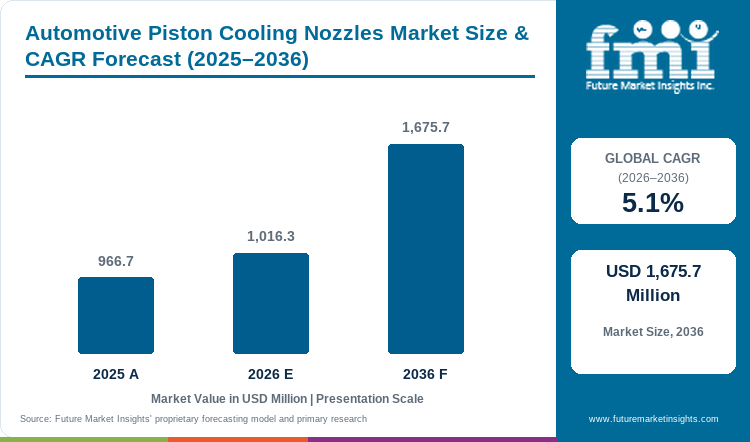
Key Takeaways
- Higher piston heat load and tighter oil-management targets increase demand for repeatable spray direction inside validated engine lubrication systems.
- Fixed oil jets are projected to hold 30.0% share within the nozzle type category in 2026, supported by simple geometry that reduces mechanical complexity.
- The engine type category is forecast to be led by diesel engines at 35.0% share in 2026, driven by sustained high-load duty that preserves piston-cooling requirements.
- Steel is set to lead the material category with 42.0% share in 2026, attributable to strength that protects outlet geometry during thermal cycling.
- Engine-specific spray targeting and oil-flow validation slow switching because nozzle changes can disturb pump demand and lubrication balance during release testing.
- Key players in the automotive piston cooling nozzles market include Bontaz Group, Cummins Inc., Micro Supreme Auto Industries (India) Private Limited, Devendra Autocom Private Limited, MAHLE International GmbH, Astemo, Ltd., Weichai Power Co., Ltd., Dongfeng Cummins Engine Co., Ltd., Pierburg GmbH, and Toyota Motor Corporation.
Analyst Perspective
“Piston cooling nozzles earn approval once spray position and oil consumption pass joint validation. Suppliers gain negotiating room by protecting piston temperature with repeatable flow that avoids unnecessary oil-pump demand.”
- Nikhil Kaitwade, Principal Consultant, Future Market Insights
How is the automotive piston cooling nozzles market segmented?
By Nozzle Type, Engine Type, Material, Vehicle Type, Sales Channel and Region.
The automotive piston cooling nozzles market is segmented by nozzle type, engine type, material, vehicle type, sales channel and region. Nozzle types cover fixed oil jets, spring-loaded nozzles, check-valve nozzles, integrated gallery nozzles and high-pressure precision nozzles. Engine types include diesel engines, gasoline engines, hybrid ICE engines, performance engines and commercial vehicle engines. Material choices include steel, brass, stainless steel, powder metal and specialty alloys for defined engine application requirements. Vehicle types cover passenger cars, light commercial vehicles, heavy trucks, performance vehicles and hybrid vehicles. Sales channels include engine OEMs, Tier-1 powertrain suppliers, aftermarket - service providers and machining suppliers serving production programs.
Why do fixed oil jets suit engines with predictable cooling demand?
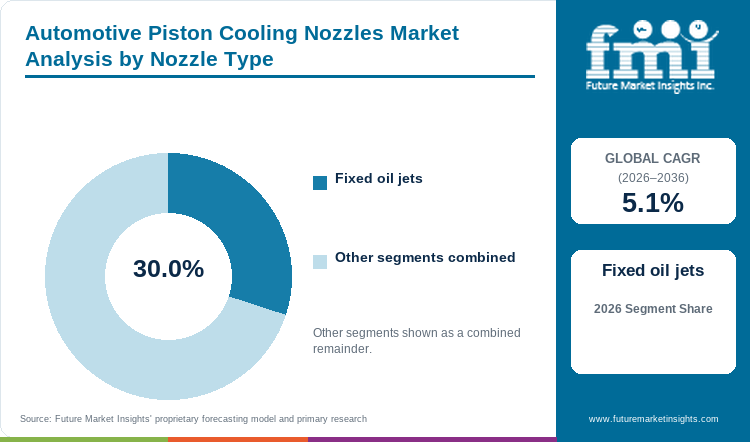
Fixed oil jets direct pressurized oil toward the piston underside without an electronic actuator. Their simple architecture suits engines with oil-pressure ranges and cooling requirements that remain inside a defined calibration window. Caterpillar identifies part 276-5605 as an OEM direct-replacement piston cooling nozzle that directs oil to the piston underside. Fixed hardware remains common in automotive piston systems with established engine-specific pressure and targeting requirements. Fixed jets keep moving parts out of a hot oil environment and simplify repeat production. Continuous flow remains their main limitation during operating periods that require less piston cooling.
- Fixed oil jets are likely to capture 30.0% of nozzle type demand in 2026, enabled by simple geometry that limits moving parts and manufacturing complexity.
- Caterpillar identifies 276-5605 as an OEM direct-replacement piston cooling nozzle for multiple engine applications with oil directed to the piston underside.
Why do diesel duty cycles keep piston oil delivery under close control?
Diesel duty exposes pistons to sustained combustion pressure and long high-load periods that leave little margin for weak oil targeting. Cooling oil removes heat beneath the crown and feeds internal galleries in engines that need more heat removal than direct impingement provides. Cummins documents twin piston-cooling nozzles on its CFP23E engine platform for sustained high-load industrial operation. Engine calibration also coordinates piston cooling with fuel injection systems because combustion timing and fueling shape piston heat release. Nozzle suppliers therefore need stable opening behavior and repeatable spray direction under extended duty.
- Diesel engines are projected to hold 35.0% of engine type demand in 2026, reinforced by high-load operation that preserves piston-cooling requirements.
- Cummins documents twin piston-cooling nozzles on its CFP23E engine platform for sustained high-load operation that requires controlled cooling-oil delivery.
How does steel preserve nozzle geometry under repeated pressure and heat?
Oil pressure and thermal cycling stress small nozzle passages, so steel hardware helps preserve outlet geometry inside the engine. Caterpillar specifies carbon steel for its 495-9860 piston cooling oil-jet tube assembly and describes precision machining for accurate targeting. Material stiffness matters because a small outlet error can move the jet away from the piston underside. Steel also suits established forming and joining processes used for automotive valves and other lubricated engine hardware. Corrosion protection or alternative alloys remain application-specific for engines exposed to different oil chemistries or temperatures.
- Steel is likely to capture 42.0% of material demand in 2026, tied to strength that protects outlet geometry during thermal cycling.
- Caterpillar specifies carbon steel for the 495-9860 piston cooling oil-jet tube assembly and identifies accurate targeting as a design requirement.
Why do passenger-car programs retain piston cooling during hybrid transition?
Passenger-car programs still combine gasoline engines and hybrid combustion systems that need piston protection during transient high-load operation. Hybridization changes engine duty on vehicle platforms that still retain an internal-combustion engine for propulsion support. Bontaz lists piston head cooling nozzles for light petrol and diesel vehicles plus solenoid valves for nozzle control. Piston cooling therefore remains part of thermal management systems that balance warm-up against high-load protection. Nozzle suppliers compete on controlled oil use as well as reliable cooling capacity during repeated load changes. Each design must protect the piston without delaying warm-up or adding unnecessary pump work.
- Passenger cars are set to lead the vehicle type category with 34.0% share in 2026, influenced by hybrid and combustion platforms that retain piston-cooling requirements.
- Bontaz lists piston head cooling nozzles for light petrol and diesel vehicles plus solenoid valves that control nozzle operation.
Why do engine OEMs retain authority over nozzle geometry and release?
Engine OEMs define gallery pressure and piston geometry as part of the nozzle release process. They also control durability validation that proves the spray reaches its intended surface over the operating map. Cummins’ January 2025 engine parts catalog lists exact piston cooling nozzle part numbers inside engine service documentation. Engine designers coordinate nozzle flow with automotive pumps and other lubrication hardware supplied by the same oil circuit. A nozzle change can alter pump demand and competing oil priorities inside the engine.
- The sales channel category is forecast to be led by engine OEMs at 52.0% share in 2026, shaped by their authority over engine-family qualification and release.
- Cummins’ January 2025 engine parts catalog lists exact piston cooling nozzle part numbers inside engine-specific service documentation.
What are the drivers, restraints and opportunities in the Automotive Piston Cooling Nozzles Market?
Higher piston heat load expands the cooling requirement, engine-level oil validation slows redesigns and demand-controlled flow raises the value of precise nozzle control.
- Driver: Power-dense combustion and hybrid engines require stable piston temperature control during high-load operation without sacrificing engine durability.
- Restraint: Nozzle aim and flow interact with the complete lubrication circuit, increasing validation cost each time a supplier or geometry changes.
- Opportunity: Pressure-responsive or electronically controlled cooling can reduce unnecessary oil flow during operating periods that do not require piston cooling.
Driver: Higher Piston Heat Load Tightens Cooling Requirements
Higher combustion pressure or specific power increases local piston heat inside smaller engine packages. Oil jets protect the crown through stable spray position and flow at peak thermal load. SAE International reported in November 2025 that changing the cooling-oil injection point altered maximum piston temperature in high-performance engine simulations. Engine developers therefore validate nozzle geometry alongside variable oil pumps and other controls that influence available lubrication flow. Suppliers that maintain targeting accuracy under tolerance and temperature variation have a stronger case during engine redesigns. The requirement remains relevant for combustion and hybrid engines exposed to repeated high-load piston temperature events.
Restraint: Oil-Flow Tradeoffs Raise Engine Validation Cost
Piston cooling consumes oil that the same pump must deliver to bearings and other engine functions. A bent or obstructed nozzle can remove cooling from the piston even with a healthy remaining lubrication circuit. MAHLE’s February 2026 Technical Messenger links damaged cooling oil nozzles during crank-mechanism repair with piston seizures and overheating. The service evidence explains why nozzle geometry and cleanliness remain validation items during substitution approval. Engine oil filters protect the nozzle’s small passages from debris that can change flow or spray direction. Repair procedures also require technicians to check nozzle deformation during reassembly and renewed engine operation. Suppliers therefore need verified flow curves and durability evidence to qualify a nozzle substitution for series production.
Opportunity: Demand-Controlled Cooling Raises Component Value
Demand-controlled piston cooling can reduce unnecessary oil use without giving up protection during high-load operation. Hitachi Astemo, Ltd. published a March 2025 automotive control application that changes piston oil-jet cooling by hydraulic pressure or a valve mechanism. The architecture links cooling amount to operating conditions instead of leaving the nozzle continuously active. Controlled cooling gives nozzle suppliers a higher-value role in automotive oil management and engine calibration. Hardware still needs stable opening behavior and repeatable targeting because electronic control cannot compensate for a poor jet path. Controlled delivery raises component value by reducing pump demand without weakening piston temperature protection.
Which country CAGRs are profiled in the Automotive Piston Cooling Nozzles Market?
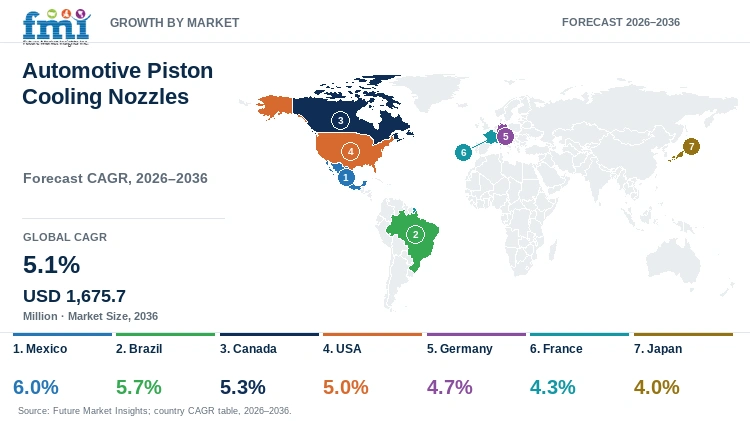
| Country | CAGR |
|---|---|
| Mexico | 6.0% |
| Brazil | 5.7% |
| Canada | 5.3% |
| USA | 5.0% |
| Germany | 4.7% |
| France | 4.3% |
| Japan | 4.0% |
How do country-level CAGRs compare in the Automotive Piston Cooling Nozzles Market?
The country profiles span 2.0 percentage points from Mexico at 6.0% to Japan at 4.0% during 2026-2036. The spread reflects differences in engine-program timing and supplier qualification cycles instead of current revenue size.
- Mexico’s export-oriented engine programs reward localized precision machining and responsive production support as suppliers resolve qualification issues during high-volume vehicle launches.
- Brazil’s continuing combustion programs keep thermal-control components inside engine qualification work and require suppliers to balance local manufacturing costs with emissions compliance.
- Canada benefits from North American platform integration because one engine approval can support production and service requirements in connected continental supplier networks.
- US light-truck and commercial-engine programs sustain piston durability requirements under load and keep nozzle validation commercially relevant over long production cycles.
- Germany places strong emphasis on engine engineering and selective nozzle qualification as electrified production expands and pure-combustion launch volumes narrow.
- France preserves hybrid engine applications that maintain demand for piston thermal-control components even as new pure-combustion passenger programs become narrower.
- Japan’s mature gasoline and hybrid engine platforms prioritize lubrication efficiency and favor nozzle changes that improve control without disturbing established calibration.
The full report provides country-level CAGR analysis across North America, Latin America, Western Europe, Eastern Europe, East Asia, South Asia and Pacific, and the Middle East and Africa.
Country-wise Analysis
- Mexico’s export-oriented heavy-vehicle plants qualify piston cooling nozzles within commercial-vehicle thermal systems that must meet OEM release targets. Mexico’s automotive piston cooling nozzles outlook is anticipated to advance at 6.0% CAGR over the assessment period, driven by export engine programs that create repeated supplier approval windows. INEGI reported 14.7 thousand heavy vehicles produced and 13.1 thousand exported in July 2026. Local machining shortens corrective-action cycles for spray-direction or cleanliness failures found during production approval. Program cyclicality and global OEM release rules can still delay a new supplier nomination. Suppliers need repeatable jet targeting and documented process control to retain series business during engine-program changes. Local engineering support reduces response time during launch corrections and renewed component validation for successive engine programs.
- Brazilian engine programs place emissions compliance beside local cost control during component qualification and localization. Automotive piston cooling nozzle demand in Brazil is forecast to rise at 5.7% CAGR over the forecast period, supported by combustion and hybrid programs that require piston thermal control. Ibama reported in August 2026 that its 2025 Proconve L8 assessment homologated more than 18 million emissions credits for light passenger and commercial vehicles. Local production shortens tooling-correction cycles for nozzles that fail flow or aim validation during release testing. Price sensitivity remains the main constraint for suppliers that also need documented material and cleanliness control. Repeat business depends on preserving engine-family lubrication targets without losing local manufacturing economics on successive programs.
- Canadian piston cooling nozzle demand follows North American engine platforms and shared component approvals. Adoption of automotive piston cooling nozzles in Canada is estimated to expand at 5.3% CAGR through 2036, influenced by continental engine programs that extend component approvals into Canadian production and service. Environment and Climate Change Canada reported an average of about 42,600 heavy-duty engines per model year in its March 2026 Phase 2 compliance review. Canada’s smaller domestic engine-program base limits independent sourcing windows available to new piston cooling nozzle suppliers. Cold-start behavior also makes oil-flow calibration important during component validation under Canadian operating conditions. Suppliers need regional approval coverage and dependable technical support to serve related North American engine families with one nozzle specification.
- US engine programs retain a large light-truck base that keeps piston durability and lubrication efficiency relevant under load. The USA automotive piston cooling nozzles sector is projected to record 5.0% CAGR during the assessment period, shaped by combustion and hybrid programs that continue to require thermal validation. Alliance for Automotive Innovation reported that electric vehicles represented 6.3% of new US light-duty sales in the first quarter of 2026. Engine launch schedules coordinate piston cooling nozzles with automotive fuel injectors and other combustion hardware under the same production milestones. Platform uncertainty remains the main constraint as electrification changes individual engine lifecycles and sourcing windows. Nozzle suppliers need flexible capacity and repeatable flow control to protect qualification timing from platform changes.
- Germany combines intensive engine engineering with a shift toward electrified passenger-vehicle production and registrations. Automotive piston cooling nozzle demand in Germany is predicted to advance at 4.7% CAGR through 2036, reinforced by hybrid programs that preserve selected cooling requirements. VDA reported 4.15 million passenger cars produced domestically in 2025 and 856,600 electric registrations during the year. Suppliers still face demanding validation work as the pool of new pure-combustion launches narrows. Piston and nozzle geometry must remain aligned as oil galleries or pump strategies change between engine generations. The commercial opportunity concentrates in programs with measurable system-efficiency gains that justify a new component release. Local engineering support can shorten spray-targeting and oil-demand validation during series approval for revised engine programs.
- France retains piston cooling nozzle demand as hybrid powertrains keep combustion engines inside an increasingly electrified vehicle fleet. France is estimated to post 4.3% CAGR over the forecast period, linked to hybrid and combustion applications that retain thermal-control requirements under transient load. France’s SDES reported 40.0 million passenger cars in operation at the start of 2026 and found 86.1% used gasoline or diesel powertrains. The addressable program base is narrower than in markets with heavier commercial-engine activity and longer platform cycles. Suppliers must justify redesigns with an oil-flow or durability benefit that survives complete engine validation. Local qualification economics favor parts that migrate between related engine families with limited tooling change.
- Japanese engine programs prioritize fuel economy and package efficiency because unnecessary lubrication flow raises parasitic losses. Automotive piston cooling nozzle sales in Japan are forecast to expand at 4.0% CAGR by 2036, constrained by mature engine families that limit new qualification events. JAMA’s April 2026 national survey found passenger-car household ownership at 71.9% and hybrid or other engine types at nearly three-tenths of vehicles held. Engineers have little tolerance for a nozzle change that increases pump work or disrupts warm-up behavior. Flow control and jet targeting therefore need complete lubrication-system evidence during formal engine-release validation.
Who are the notable companies in the Automotive Piston Cooling Nozzles Market?
Bontaz Group, Cummins Inc., Micro Supreme Auto Industries (India) Private Limited, Devendra Autocom Private Limited, MAHLE International GmbH, Astemo, Ltd., Weichai Power Co., Ltd., Dongfeng Cummins Engine Co., Ltd., Pierburg GmbH, and Toyota Motor Corporation
Competition separates current piston cooling nozzle suppliers from engine developers that control oil-jet flow or targeting inside proprietary lubrication systems. Bontaz Group, Cummins Inc., Micro Supreme Auto Industries (India) Private Limited and Devendra Autocom Private Limited publish current piston cooling nozzle product records. MAHLE International GmbH and Astemo, Ltd. document piston-interface or oil-jet control engineering that defines nozzle performance requirements. Weichai Power Co., Ltd. and Dongfeng Cummins Engine Co., Ltd. hold active piston cooling nozzle records for heavy-vehicle engines. Pierburg GmbH controls piston-cooling oil flow and Toyota Motor Corporation documents direct automotive oil-jet control.
- Commercial piston cooling nozzle suppliers include Bontaz Group and Cummins Inc. plus Micro Supreme Auto Industries (India) Private Limited and Devendra Autocom Private Limited.
- Direct piston-cooling engineering records cover MAHLE International GmbH and Astemo, Ltd. plus Weichai Power Co., Ltd. and Dongfeng Cummins Engine Co., Ltd.
- Piston-cooling control developers include Pierburg GmbH and Toyota Motor Corporation based on direct oil-flow and oil-jet engineering records.
Competitive Benchmarking: Automotive Piston Cooling Nozzles Market
| Company | Current PCN Commercial Supply | Flow or Targeting Engineering | Automotive Application Breadth | Geographic Reach |
|---|---|---|---|---|
| Bontaz Group | High | High | High | Global |
| Cummins Inc. | High | High | High | Global |
| Micro Supreme Auto Industries (India) Private Limited | High | Medium | High | India and export markets |
| Devendra Autocom Private Limited | Medium | Medium | High | India and export markets |
| MAHLE International GmbH | Low | High | Medium | Global |
| Astemo, Ltd. | Low | High | Medium | Global |
| Weichai Power Co., Ltd. | Low | High | Medium | China |
| Dongfeng Cummins Engine Co., Ltd. | Low | High | Medium | China |
| Pierburg GmbH | Low | High | Medium | Global |
| Toyota Motor Corporation | Low | High | Medium | Global |
Scoring basis: High commercial supply requires multiple piston cooling nozzle products or documented programs. Medium commercial supply requires one current supply route and Low identifies direct engineering evidence without public standalone supply. High flow or targeting engineering requires direct control or documented multi-target nozzle evidence for current engine applications. Medium flow or targeting engineering requires documented fixed-jet geometry evidence without active flow-control functionality. Application breadth uses the number of documented automotive engine or vehicle groups supported by current public product or engineering records. Geographic reach remains descriptive because regional presence does not establish piston cooling nozzle capability by itself.
Key Developments in the Automotive Piston Cooling Nozzles Market
- In March 2026, MAHLE International GmbH’s DE102024124577A1 was published for a piston cooling-oil inlet and capture groove that guides an offset oil jet into the cooling channel.
- In January 2026, Weichai Power Co., Ltd.’s CN223814094U was published for a piston cooling nozzle that directs engine oil to the piston underside or internal cooling oil duct.
- In September 2025, Dongfeng Cummins Engine Co., Ltd.’s CN223305830U was published for an engine piston cooling nozzle with separate spray paths for piston cooling and thrust-shoe lubrication.
Key Players in the Automotive Piston Cooling Nozzles Market
Commercial Piston Cooling Nozzle Suppliers
- Bontaz Group
- Cummins Inc.
- Micro Supreme Auto Industries (India) Private Limited
- Devendra Autocom Private Limited
Piston Cooling Engineering and Control Developers
- MAHLE International GmbH
- Astemo, Ltd.
- Weichai Power Co., Ltd.
- Dongfeng Cummins Engine Co., Ltd.
- Pierburg GmbH
- Toyota Motor Corporation
Automotive Piston Cooling Nozzles Market - Report Scope
| Coverage field | Report scope |
|---|---|
| Market breakdown | By nozzle type, engine type, material, vehicle type, sales channel and region. |
| Quantitative Units | USD million. |
| Market Definition | Automotive piston cooling nozzles and oil-jet nozzle assemblies whose primary function is to meter or direct engine oil to the piston underside or piston cooling gallery. |
| Regions Covered | North America, Latin America, Western Europe, Eastern Europe, East Asia, South Asia and Pacific, and Middle East and Africa. |
| Countries Covered | Mexico, Brazil, Canada, USA, Germany, France, Japan, and 20+ countries included in the full report. |
| Key Companies Profiled | Bontaz Group, Cummins Inc., Micro Supreme Auto Industries (India) Private Limited, Devendra Autocom Private Limited, MAHLE International GmbH, Astemo, Ltd., Weichai Power Co., Ltd., Dongfeng Cummins Engine Co., Ltd., Pierburg GmbH, and Toyota Motor Corporation |
| Forecast Period | 2026 to 2036. |
| Approach | Primary and secondary research with market triangulation. |
Automotive Piston Cooling Nozzles Market - Research Methodology
| Method | Approach |
|---|---|
| Primary Research | FMI’s primary-research framework uses structured interviews with manufacturers, engine OEMs, component suppliers, distributors and technical specialists to test buying criteria and qualification requirements. Interview evidence is retained once the research record documents it and reconciliation confirms the defined market boundary. |
| Desk Research | Desk research reviews government publications, patent records, standards, company filings, current product documentation and official corporate announcements. Evidence is retained for records that match the piston cooling nozzle boundary or a documented immediate-family function with the same specification and purchase route. |
| Market Sizing and Forecasting | The market model combines the supplied baseline with segment structure, pricing and volume indicators, company participation and country-level demand assumptions. Forecasting tests program timing, powertrain mix, thermal-management requirements, replacement activity and barriers that affect qualification or switching. |
| Data Validation | Estimates are checked against independent technical records, company disclosures, patent evidence and public market indicators. Validation excludes downstream vehicle value, unsupported company roles, unrelated cooling products, double-counted component revenue and evidence that does not match the defined market scope. |
Automotive Piston Cooling Nozzles Market by Segments
Automotive Piston Cooling Nozzles Market segmented by Nozzle Type:
- Fixed oil jets
- Spring-loaded nozzles
- Check-valve nozzles
- Integrated gallery nozzles
- High-pressure precision nozzles
Automotive Piston Cooling Nozzles Market segmented by Engine Type:
- Diesel engines
- Gasoline engines
- Hybrid ICE engines
- Performance engines
- Commercial vehicle engines
Automotive Piston Cooling Nozzles Market segmented by Material:
- Steel
- Brass
- Stainless steel
- Powder metal
- Specialty alloys
Automotive Piston Cooling Nozzles Market segmented by Vehicle Type:
- Passenger cars
- Light commercial vehicles
- Heavy trucks
- Performance vehicles
- Hybrid vehicles
Automotive Piston Cooling Nozzles Market segmented by Sales Channel:
- Engine OEMs
- Tier-1 powertrain suppliers
- Aftermarket - service
- Machining suppliers
Automotive Piston Cooling Nozzles Market by Region:
- North America
- United States
- Canada
- Latin America
- Brazil
- Mexico
- Argentina
- Chile
- Rest of Latin America
- Western Europe
- Germany
- United Kingdom
- Italy
- Spain
- France
- Nordics
- Benelux
- Rest of Western Europe
- Eastern Europe
- Russia
- Poland
- Hungary
- Balkan and Baltic States
- Rest of Eastern Europe
- East Asia
- China
- Japan
- South Korea
- South Asia and Pacific
- India
- ASEAN
- Australia and New Zealand
- Rest of South Asia and Pacific
- Middle East and Africa
- Kingdom of Saudi Arabia
- Other GCC Countries
- Türkiye
- South Africa
- Other African Union Countries
- Rest of Middle East and Africa
Research Sources and Bibliography
- Weichai Power Co., Ltd. (2025, November 18). CN119825534B: A piston cooling nozzle and an engine.
- Verband der Automobilindustrie. (2026, February 3). New record: 40% electric share of passenger car production in 2025.
- Caterpillar Inc. (n.d.). 276-5605: Piston Cooling Nozzle. Retrieved September 17, 2026.
- Cummins Inc. (n.d.). CFP23E. Retrieved September 17, 2026.
- Caterpillar Inc. (n.d.). 495-9860: Piston Cooling Oil Jet Lines Tube Assembly. Retrieved September 17, 2026.
- Bontaz Group. (n.d.). I.C.E. Retrieved September 17, 2026.
- Cummins Inc. (2025, January). Engine Parts Catalog.
- SAE International. (2025, November 3). Advanced Multi-Fidelity Simulation of Piston Oil Jet Cooling in High-Performance Engines.
- MAHLE. (2026). Technical Messenger, Issue no. 02/2026: Damaged Cooling Oil Nozzle.
- Hitachi Astemo, Ltd. (2025, March 27). US20250101928A1: In-vehicle control device and method for controlling internal combustion engine.
- Instituto Nacional de Estadística y Geografía. (2026, August 11). Venta, producción y exportación de vehículos pesados.
- Instituto Brasileiro do Meio Ambiente e dos Recursos Naturais Renováveis. (2026, August 18). Ibama divulga Balanço Geral de Emissões Corporativas - Proconve L8, ano-base 2025.
- Environment and Climate Change Canada. (2026, March). Greenhouse Gas Emissions Performance for 2021 to 2023 (Phase 2) Heavy-duty Vehicles and Engines.
- Alliance for Automotive Innovation. (2026, July 1). Alliance for Automotive Innovation Reports New USA Electric Vehicle Data.
- Verband der Automobilindustrie. (2026, January 5). Passenger car production in 2025 slightly above previous year’s level.
- Service des données et études statistiques. (2026, July 10). 40 millions de voitures en circulation en France au 1er janvier 2026.
- Japan Automobile Manufacturers Association. (2026, April 14). 2025年度乗用車市場動向調査について.
- MAHLE International GmbH. (2026, March 5). DE102024124577A1: Kolben für einen Verbrennungsmotor, Verbrennungsmotor mit zumindest einem solchen Kolben.
- Weichai Power Co., Ltd. (2026, January 20). CN223814094U: A piston cooling nozzle and an engine.
- Dongfeng Cummins Engine Co., Ltd. (2025, September 5). CN223305830U: Engine piston cooling nozzles.
- Micro Supreme Auto Industries (India) Private Limited. (n.d.). Automotive and Precision Engineering Division. Retrieved September 17, 2026.
- Devendra Autocom Private Limited. (n.d.). Piston Cooling Nozzle. Retrieved September 17, 2026.
- Pierburg GmbH. (n.d.). Oil valves: Valves for shutting off piston cooling functions. Retrieved September 17, 2026.
- Astemo, Ltd. (2025, November 19). JP7773659B2: Internal combustion engine control device and internal combustion engine control method.
- Cummins Inc. (2025, May 1). US20250137398A1: System, method, and apparatus for controlling fluid flow from piston cooling nozzles.
- Toyota Motor Corporation. (2025, January 17). JP2025006550A: Controller of internal combustion engine.
- Bontaz Group. (n.d.). Rapport de développement durable 2023. Retrieved September 17, 2026.
- Micro Supreme Auto Industries (India) Private Limited. (n.d.). Technology. Retrieved September 17, 2026.
- Devendra Autocom Private Limited. (n.d.). About Us. Retrieved September 17, 2026.
- MAHLE Motorsports. (2026). Application Guide.
- Weichai Power Co., Ltd. (2025, May 20). CN115653737B: Piston cooling nozzle, engine and vehicle.
This bibliography is provided for reader reference and is not exhaustive. The full report contains the complete reference list and detailed citations
This Report Answers
- How large is the automotive piston cooling nozzles market through 2036?
- Which engine conditions keep piston cooling nozzles commercially relevant during redesigns?
- Which nozzle type accounts for 30.0% of estimated 2026 demand?
- How do oil-flow tradeoffs raise validation cost during nozzle switching?
- Why do profiled country CAGRs differ despite common thermal requirements?
- Which supplier capabilities matter during engine-program qualification and production release?
- How does demand-controlled cooling change the value of piston nozzle hardware?
- Which companies provide direct nozzle supply or piston-cooling engineering evidence?
Frequently Asked Questions
How big is the Automotive Piston Cooling Nozzles Market in 2026?
The automotive piston cooling nozzles market is valued at USD 1,016.3 million in 2026 and is projected to reach USD 1,675.7 million by 2036. Continued engine thermal-validation work supports qualified nozzle demand over the 2026-2036 forecast period for retained combustion and hybrid programs.
What is the CAGR of the Automotive Piston Cooling Nozzles Market?
The automotive piston cooling nozzles market is projected to grow at 5.1% CAGR between 2026 and 2036. Continuing combustion and hybrid engine programs preserve piston thermal-validation requirements during the full assessment period.
Which nozzle type holds the largest estimated share in 2026?
Fixed oil jets are estimated to hold 30.0% of nozzle type demand in 2026. Simple geometry supports durable operation without increasing mechanical complexity inside a validated engine lubrication system. Controlled designs gain relevance in engine programs that need cooling flow to change with specific operating conditions.
Which profiled countries record the highest growth rates through 2036?
Mexico is projected to grow at 6.0% CAGR through 2036 followed by Brazil at 5.7% and Canada at 5.3%. Their growth paths differ because engine-program timing and supplier qualification cycles vary materially by country.
Which companies are active in the Automotive Piston Cooling Nozzles Market?
Active companies include Bontaz Group and Cummins Inc. plus Micro Supreme Auto Industries (India) Private Limited and Devendra Autocom Private Limited. The remaining company set comprises MAHLE International GmbH, Astemo, Ltd., Weichai Power Co., Ltd., Dongfeng Cummins Engine Co., Ltd., Pierburg GmbH and Toyota Motor Corporation.
Preview the report firsthand - request a free sample
Get SampleGet the brochure for pricing and purchase details.
Get PDFTable of Content
- Key Takeaways
- Market Size and CAGR
- Top Growth Driver
- Fastest Growing Segment
- Leading Region
- Key Companies
- Emerging Opportunities
- Executive Summary
- Global Market Outlook
- Demand-side Trends
- Supply-side Trends
- Technology Roadmap Analysis
- Analysis and Recommendations
- Analyst Perspective (What is happening? Why now? What should investors know?)
- Key Questions Answered
- How large is the market?
- What is the CAGR?
- What are key trends?
- Which region dominates?
- Who are the leaders?
- Market Overview
- Market Coverage / Taxonomy
- Market Definition / Scope / Limitations
- Research Methodology
- Chapter Orientation
- Analytical Lens and Working Hypotheses
- Market Structure, Signals, and Trend Drivers
- Benchmarking and Cross-market Comparability
- Market Sizing, Forecasting, and Opportunity Mapping
- Research Design and Evidence Framework
- Desk Research Programme (Secondary Evidence)
- Expert Input and Fieldwork (Primary Evidence)
- Tooling, Models, and Reference Databases
- Data Engineering and Model Build
- Quality Assurance and Audit Trail
- Market Background
- Market Dynamics (Drivers, Restraints, Opportunity, Trends)
- Scenario Forecast (Optimistic, Likely, Conservative)
- Impact Analysis
- AI Impact
- Sustainability Impact
- Regulatory Impact
- Technology Impact
- Consumer / Buyer Analysis
- Purchase Drivers
- Adoption Barriers
- Buyer Journey
- Opportunity Map Analysis
- Product Life Cycle Analysis
- Supply Chain Analysis
- Investment Feasibility Matrix
- Value Chain Analysis
- PESTLE and Porter's Analysis
- Regulatory Landscape
- Regional Parent Market Outlook
- Production and Consumption Statistics
- Import and Export Statistics
- Global Market Analysis and Forecast, 2021 to 2036
- Historical Market Size Value (USD Million) Analysis, 2021 to 2025
- Current and Future Market Size Value (USD Million) Projections, 2026 to 2036
- Y-o-Y Growth Trend Analysis
- Absolute $ Opportunity Analysis
- Global Market Pricing Analysis, 2021 to 2036
- Global Market Analysis and Forecast, By Nozzle Type, 2021 to 2036
- Introduction / Key Findings
- Historical Market Size Value (USD Million) Analysis By Nozzle Type, 2021 to 2025
- Current and Future Market Size Value (USD Million) Analysis and Forecast By Nozzle Type, 2026 to 2036
- Fixed oil jets
- Spring-loaded nozzles
- Check-valve nozzles
- Integrated gallery nozzles
- High-pressure precision nozzles
- Y-o-Y Growth Trend Analysis By Nozzle Type, 2021 to 2025
- Absolute $ Opportunity Analysis By Nozzle Type, 2026 to 2036
- Global Market Analysis and Forecast, By Engine Type, 2021 to 2036
- Introduction / Key Findings
- Historical Market Size Value (USD Million) Analysis By Engine Type, 2021 to 2025
- Current and Future Market Size Value (USD Million) Analysis and Forecast By Engine Type, 2026 to 2036
- Diesel engines
- Gasoline engines
- Hybrid ICE engines
- Performance engines
- Commercial vehicle engines
- Y-o-Y Growth Trend Analysis By Engine Type, 2021 to 2025
- Absolute $ Opportunity Analysis By Engine Type, 2026 to 2036
- Global Market Analysis and Forecast, By Material, 2021 to 2036
- Introduction / Key Findings
- Historical Market Size Value (USD Million) Analysis By Material, 2021 to 2025
- Current and Future Market Size Value (USD Million) Analysis and Forecast By Material, 2026 to 2036
- Steel
- Brass
- Stainless steel
- Powder metal
- Specialty alloys
- Y-o-Y Growth Trend Analysis By Material, 2021 to 2025
- Absolute $ Opportunity Analysis By Material, 2026 to 2036
- Global Market Analysis and Forecast, By Vehicle Type, 2021 to 2036
- Introduction / Key Findings
- Historical Market Size Value (USD Million) Analysis By Vehicle Type, 2021 to 2025
- Current and Future Market Size Value (USD Million) Analysis and Forecast By Vehicle Type, 2026 to 2036
- Passenger cars
- Light commercial vehicles
- Heavy trucks
- Performance vehicles
- Hybrid vehicles
- Y-o-Y Growth Trend Analysis By Vehicle Type, 2021 to 2025
- Absolute $ Opportunity Analysis By Vehicle Type, 2026 to 2036
- Global Market Analysis and Forecast, By Sales Channel, 2021 to 2036
- Introduction / Key Findings
- Historical Market Size Value (USD Million) Analysis By Sales Channel, 2021 to 2025
- Current and Future Market Size Value (USD Million) Analysis and Forecast By Sales Channel, 2026 to 2036
- Engine OEMs
- Tier-1 powertrain suppliers
- Aftermarket - service
- Machining suppliers
- Y-o-Y Growth Trend Analysis By Sales Channel, 2021 to 2025
- Absolute $ Opportunity Analysis By Sales Channel, 2026 to 2036
- Global Market Analysis and Forecast, By Region, 2021 to 2036
- Introduction
- Historical Market Size Value (USD Million) Analysis By Region, 2021 to 2025
- Current Market Size Value (USD Million) Analysis and Forecast By Region, 2026 to 2036
- North America
- Latin America
- Western Europe
- Eastern Europe
- East Asia
- South Asia and Pacific
- Middle East and Africa
- Market Attractiveness Analysis By Region
- North America Market Analysis and Forecast, By Country, 2021 to 2036
- Historical Market Size Value (USD Million) Trend Analysis By Market Taxonomy, 2021 to 2025
- Market Size Value (USD Million) Forecast By Market Taxonomy, 2026 to 2036
- By Country
- United States
- Canada
- By Nozzle Type
- By Engine Type
- By Material
- By Vehicle Type
- By Sales Channel
- By Country
- Market Attractiveness Analysis
- By Country
- By Nozzle Type
- By Engine Type
- By Material
- By Vehicle Type
- By Sales Channel
- Key Takeaways
- Latin America Market Analysis and Forecast, By Country
- Historical Market Size Value (USD Million) Trend Analysis By Market Taxonomy, 2021 to 2025
- Market Size Value (USD Million) Forecast By Market Taxonomy, 2026 to 2036
- By Country
- Brazil
- Mexico
- Argentina
- Chile
- Rest of Latin America
- By Nozzle Type
- By Engine Type
- By Material
- By Vehicle Type
- By Sales Channel
- By Country
- Market Attractiveness Analysis
- By Country
- By Nozzle Type
- By Engine Type
- By Material
- By Vehicle Type
- By Sales Channel
- Key Takeaways
- Western Europe Market Analysis and Forecast, By Country
- Historical Market Size Value (USD Million) Trend Analysis By Market Taxonomy, 2021 to 2025
- Market Size Value (USD Million) Forecast By Market Taxonomy, 2026 to 2036
- By Country
- Germany
- United Kingdom
- Italy
- Spain
- France
- Nordics
- Benelux
- Rest of Western Europe
- By Nozzle Type
- By Engine Type
- By Material
- By Vehicle Type
- By Sales Channel
- By Country
- Market Attractiveness Analysis
- By Country
- By Nozzle Type
- By Engine Type
- By Material
- By Vehicle Type
- By Sales Channel
- Key Takeaways
- Eastern Europe Market Analysis and Forecast, By Country
- Historical Market Size Value (USD Million) Trend Analysis By Market Taxonomy, 2021 to 2025
- Market Size Value (USD Million) Forecast By Market Taxonomy, 2026 to 2036
- By Country
- Russia
- Poland
- Hungary
- Balkan and Baltic States
- Rest of Eastern Europe
- By Nozzle Type
- By Engine Type
- By Material
- By Vehicle Type
- By Sales Channel
- By Country
- Market Attractiveness Analysis
- By Country
- By Nozzle Type
- By Engine Type
- By Material
- By Vehicle Type
- By Sales Channel
- Key Takeaways
- East Asia Market Analysis and Forecast, By Country
- Historical Market Size Value (USD Million) Trend Analysis By Market Taxonomy, 2021 to 2025
- Market Size Value (USD Million) Forecast By Market Taxonomy, 2026 to 2036
- By Country
- China
- Japan
- South Korea
- By Nozzle Type
- By Engine Type
- By Material
- By Vehicle Type
- By Sales Channel
- By Country
- Market Attractiveness Analysis
- By Country
- By Nozzle Type
- By Engine Type
- By Material
- By Vehicle Type
- By Sales Channel
- Key Takeaways
- South Asia and Pacific Market Analysis and Forecast, By Country
- Historical Market Size Value (USD Million) Trend Analysis By Market Taxonomy, 2021 to 2025
- Market Size Value (USD Million) Forecast By Market Taxonomy, 2026 to 2036
- By Country
- India
- ASEAN
- Australia and New Zealand
- Rest of South Asia and Pacific
- By Nozzle Type
- By Engine Type
- By Material
- By Vehicle Type
- By Sales Channel
- By Country
- Market Attractiveness Analysis
- By Country
- By Nozzle Type
- By Engine Type
- By Material
- By Vehicle Type
- By Sales Channel
- Key Takeaways
- Middle East and Africa Market Analysis and Forecast, By Country
- Historical Market Size Value (USD Million) Trend Analysis By Market Taxonomy, 2021 to 2025
- Market Size Value (USD Million) Forecast By Market Taxonomy, 2026 to 2036
- By Country
- Kingdom of Saudi Arabia
- Other GCC Countries
- Türkiye
- South Africa
- Other African Union Countries
- Rest of Middle East and Africa
- By Nozzle Type
- By Engine Type
- By Material
- By Vehicle Type
- By Sales Channel
- By Country
- Market Attractiveness Analysis
- By Country
- By Nozzle Type
- By Engine Type
- By Material
- By Vehicle Type
- By Sales Channel
- Key Takeaways
- Key Countries Market Analysis
- United States
- Pricing Analysis
- Market Share Analysis, 2025
- By Nozzle Type
- By Engine Type
- By Material
- By Vehicle Type
- By Sales Channel
- Canada
- Pricing Analysis
- Market Share Analysis, 2025
- By Nozzle Type
- By Engine Type
- By Material
- By Vehicle Type
- By Sales Channel
- Mexico
- Pricing Analysis
- Market Share Analysis, 2025
- By Nozzle Type
- By Engine Type
- By Material
- By Vehicle Type
- By Sales Channel
- Brazil
- Pricing Analysis
- Market Share Analysis, 2025
- By Nozzle Type
- By Engine Type
- By Material
- By Vehicle Type
- By Sales Channel
- Chile
- Pricing Analysis
- Market Share Analysis, 2025
- By Nozzle Type
- By Engine Type
- By Material
- By Vehicle Type
- By Sales Channel
- Germany
- Pricing Analysis
- Market Share Analysis, 2025
- By Nozzle Type
- By Engine Type
- By Material
- By Vehicle Type
- By Sales Channel
- United Kingdom
- Pricing Analysis
- Market Share Analysis, 2025
- By Nozzle Type
- By Engine Type
- By Material
- By Vehicle Type
- By Sales Channel
- Italy
- Pricing Analysis
- Market Share Analysis, 2025
- By Nozzle Type
- By Engine Type
- By Material
- By Vehicle Type
- By Sales Channel
- Spain
- Pricing Analysis
- Market Share Analysis, 2025
- By Nozzle Type
- By Engine Type
- By Material
- By Vehicle Type
- By Sales Channel
- France
- Pricing Analysis
- Market Share Analysis, 2025
- By Nozzle Type
- By Engine Type
- By Material
- By Vehicle Type
- By Sales Channel
- India
- Pricing Analysis
- Market Share Analysis, 2025
- By Nozzle Type
- By Engine Type
- By Material
- By Vehicle Type
- By Sales Channel
- ASEAN
- Pricing Analysis
- Market Share Analysis, 2025
- By Nozzle Type
- By Engine Type
- By Material
- By Vehicle Type
- By Sales Channel
- Australia and New Zealand
- Pricing Analysis
- Market Share Analysis, 2025
- By Nozzle Type
- By Engine Type
- By Material
- By Vehicle Type
- By Sales Channel
- China
- Pricing Analysis
- Market Share Analysis, 2025
- By Nozzle Type
- By Engine Type
- By Material
- By Vehicle Type
- By Sales Channel
- Japan
- Pricing Analysis
- Market Share Analysis, 2025
- By Nozzle Type
- By Engine Type
- By Material
- By Vehicle Type
- By Sales Channel
- South Korea
- Pricing Analysis
- Market Share Analysis, 2025
- By Nozzle Type
- By Engine Type
- By Material
- By Vehicle Type
- By Sales Channel
- Russia
- Pricing Analysis
- Market Share Analysis, 2025
- By Nozzle Type
- By Engine Type
- By Material
- By Vehicle Type
- By Sales Channel
- Poland
- Pricing Analysis
- Market Share Analysis, 2025
- By Nozzle Type
- By Engine Type
- By Material
- By Vehicle Type
- By Sales Channel
- Hungary
- Pricing Analysis
- Market Share Analysis, 2025
- By Nozzle Type
- By Engine Type
- By Material
- By Vehicle Type
- By Sales Channel
- Kingdom of Saudi Arabia
- Pricing Analysis
- Market Share Analysis, 2025
- By Nozzle Type
- By Engine Type
- By Material
- By Vehicle Type
- By Sales Channel
- Türkiye
- Pricing Analysis
- Market Share Analysis, 2025
- By Nozzle Type
- By Engine Type
- By Material
- By Vehicle Type
- By Sales Channel
- South Africa
- Pricing Analysis
- Market Share Analysis, 2025
- By Nozzle Type
- By Engine Type
- By Material
- By Vehicle Type
- By Sales Channel
- United States
- Market Structure Analysis
- Competition Dashboard
- Competition Benchmarking
- Market Share Analysis of Top Players
- By Regional
- By Nozzle Type
- By Engine Type
- By Material
- By Vehicle Type
- By Sales Channel
- Emerging Startups
- Innovation Benchmarking
- Competition Analysis
- Competition Deep Dive
- Bontaz Group
- Overview
- Product Portfolio
- Profitability by Market Segments
- Sales Footprint
- Strategy Overview
- Marketing Strategy
- Product Strategy
- Channel Strategy
- Cummins Inc.
- Micro Supreme Auto Industries (India) Private Limited
- Devendra Autocom Private Limited
- MAHLE International GmbH
- Astemo, Ltd.
- Weichai Power Co., Ltd.
- Dongfeng Cummins Engine Co., Ltd.
- Pierburg GmbH
- Toyota Motor Corporation
- Bontaz Group
- Case Studies
- Success Stories
- Recent Developments
- Competition Deep Dive
- Assumptions & Acronyms Used


