

- Market Size (2026)
- USD 5.3 Bn
- Forecast (2036)
- USD 9.5 Bn
- CAGR (2026 to 2036)
- 6.0%
How big is Automotive Driveline Disconnects Market in 2026?
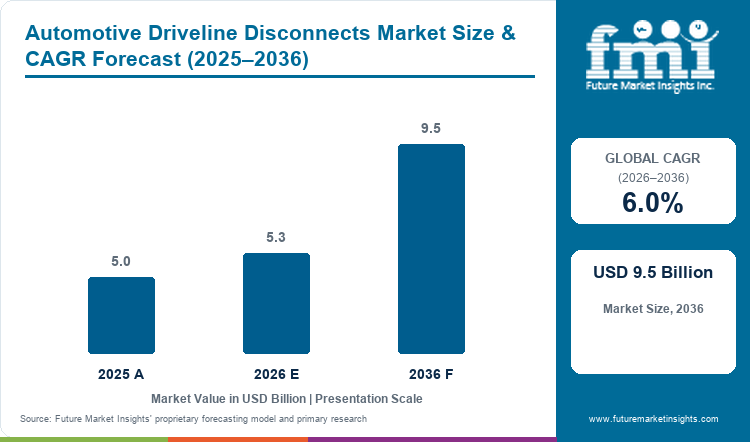
USD 5.3 billion in 2026 and USD 9.5 billion by 2036 at a 6.0% CAGR.
Demand for automotive driveline disconnects is projected to expand at 6.0% CAGR through 2036, lifting valuation from USD 5.3 billion in 2026 to USD 9.5 billion. OEMs specify these modules to stop unused shafts, gears and bearings during steady cruising without removing AWD availability. The European Commission applies a 93.6 g CO2/km passenger-car fleet target for 2025-2029, keeping driveline-loss reduction inside platform-level compliance decisions.
Electrification broadens the same engineering problem since a secondary axle can stay mechanically coupled even at zero commanded torque. Compact electric drive units leave less room for a separate disconnect and actuator package inside the propulsion module. ACEA recorded 1,880,370 battery-electric registrations in the EU during 2025, equal to 17.4% of new-car registrations. Higher BEV volume shifts value toward compact couplings that isolate the unused axle without disturbing traction response.
Key Takeaways
- Demand for automotive driveline disconnects rises as OEMs cut unloaded driveline losses without giving up AWD or 4WD response.
- Based on disconnect type, axle disconnects are projected to account for 31.0% in 2026 as their location removes rotation near the driven axle.
- By actuation, the electric actuator segment is estimated to hold 43.0% in 2026 owing to controller-commanded engagement and direct position feedback.
- SUVs/crossovers are set to lead the vehicle type category with 32.0% share in 2026 due to high AWD fitment and frequent two-wheel-drive cruising.
- Platform release can slow if reconnect quality, NVH, durability or fail-safe behavior requires added calibration and component-level validation.
- Some of the key players in this market include Magna International, BorgWarner, Dana, Dauch Corporation, JTEKT, and ZF Friedrichshafen.
Analyst Perspective
"Disconnect value is notable when a vehicle can stop enough rotating mass to recover measurable range or fuel economy without a reconnect event the driver notices. OEM sourcing therefore turns on complete-axle proof because a low-cost coupling can lose its advantage if calibration and validation work expand late in the program."
- Nikhil Kaitwade, Principal Consultant, Future Market Insights
How is the automotive driveline disconnects market segmented?
The market is segmented by disconnect type, actuation, vehicle type, drivetrain and sales channel.
Disconnect type includes axle disconnects, differential disconnects, transfer case disconnects, e-axle disconnects and propshaft disconnects. Actuation covers electric, vacuum, hydraulic and electromechanical formats. Vehicle types span SUVs/crossovers, pickup trucks, off-road vehicles, hybrid AWD vehicles and electric AWD vehicles. Drivetrain covers part-time 4WD, AWD, hybrid AWD and e-axle AWD. Sales channels include OEM direct, Tier-1 driveline systems, aftermarket replacement and service parts.
What makes axle disconnects central to the disconnect type category?
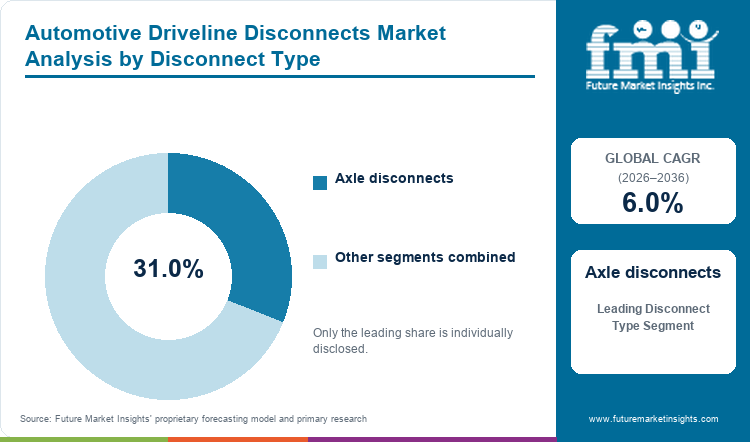
Axle disconnects interrupt torque near the driven axle, removing rotation from a large part of the unloaded secondary path. Automotive axle engineering therefore weighs drag reduction against half-shaft behavior, reconnect speed and packaging inside the axle assembly.
- By disconnect type, axle disconnects are estimated to hold 31.0% in 2026 owing to their ability to isolate rotating hardware near the wheel-end torque path.
- In May 2025, GKN Automotive used CTI Symposium USA to present driveline disconnect architectures and changing BEV requirements. The program linked axle-level disconnection with both torque transfer and electric-vehicle efficiency.
Why does electric actuator lead the actuation category?
Electric actuation suits disconnects that must respond to vehicle software instead of a local hydraulic or vacuum condition. Position feedback lets the controller confirm commanded state before torque returns, aligning disconnect timing with EV transmission control.
- In 2026, the electric actuator segment is expected to lead actuation with 43.0% share, with electronic control coordinating engagement timing with traction and e-drive commands.
- BorgWarner's 2025 Arctic Drive presentation documented serial-production electric torque-vectoring disconnect systems and an axle disconnect module with electromechanical actuation. The evidence ties electric actuation to controller software, state management and production-ready disconnect hardware.
How do SUVs/crossovers shape the vehicle type category?
SUVs and crossovers carry a large AWD fitment base even though normal cruising rarely needs continuous torque at both axles. Disconnects preserve the traction feature that sells the vehicle and remove drag during routine two-wheel-drive operation.
- Based on vehicle type, SUVs/crossovers are projected to account for 32.0% in 2026 given broad AWD fitment and frequent two-wheel-drive cruising.
- The US EPA reported in February 2026 that truck SUVs alone represented half of model-year 2024 new production. High-volume SUV production keeps transparent reconnect behavior central to qualification on platforms that must preserve expected AWD response.
What supports part-time 4WD in the drivetrain category?
Part-time 4WD already separates low-drag road operation from higher-traction modes, so a disconnect fits the drivetrain logic without changing its purpose. All-wheel-drive systems require controlled shift quality and torque synchronization as vehicle speed and axle demand change.
- Part-time 4WD is set to lead the drivetrain category with 35.0% share in 2026 due to operating logic that already separates road and traction modes.
- BorgWarner secured Chery contracts in October 2025 for a torque-on-demand transfer case that supports 2H and locked 4WD modes. BorgWarner's award links selectable traction directly with fuel-efficiency requirements inside a current Chery 4WD program.
What are the drivers, restraints and opportunities in the Automotive Driveline Disconnects Market?
Selective torque-path control lowers unloaded driveline losses, with reconnect validation limiting release speed and electrified secondary axles shifting value toward integrated modules.
- Driver: OEMs can recover efficiency by stopping unnecessary rotation without removing AWD or 4WD capability required for traction events.
- Restraint: Couplings, actuators and controls must re-engage without torque interruption, unacceptable noise or a loss of requested AWD function.
- Opportunity: Secondary e-axles give driveline specialists a new integration point for disconnect hardware inside electrified propulsion modules.
Unloaded Driveline Losses Strengthen the Efficiency Case
Disconnects have the clearest efficiency case on vehicles that cruise for long periods with little need for a secondary axle. GKN Automotive's July 2025 Dritev program included a technical presentation on disconnect systems in battery-electric vehicles, placing drag reduction inside an active BEV driveline problem. OEMs must recover enough energy during those low-load periods to justify the coupling, actuator and control costs.
Reconnect Reliability Raises the Qualification Burden
Reconnect behavior can delay release if front- or rear-axle torque does not return predictably under changing speed and load. A May 2025 service action filed with NHTSA addressed transfer-case clutch and AWD-lock performance on several Land Rover models. Program teams therefore treat state confirmation, actuator durability and fault handling as sourcing gates so one calibration can carry into several vehicle derivatives.
Electrified Axles Shift Value Toward Integrated Modules
Secondary electric axles give disconnect hardware a defined integration point beside the motor, gearing and controls. Dana identified a disconnecting AWD rear drive unit for the Ford Maverick Lobo in its January 2026 investor filing, confirming a current vehicle program built on selective rear-axle torque. Early packaging and control decisions reduce expensive changes during late vehicle validation for related automotive differential programs.
Which country CAGRs are profiled in the Automotive Driveline Disconnects Market?
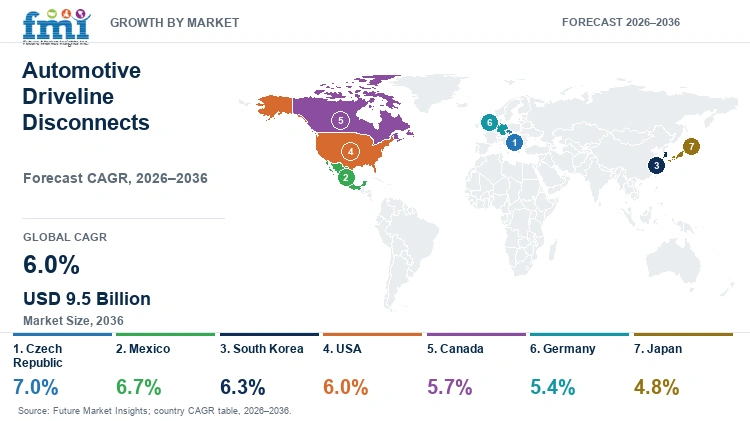
| Country | CAGR |
|---|---|
| Czech Republic | 7.0% |
| Mexico | 6.7% |
| South Korea | 6.3% |
| USA | 6.0% |
| Canada | 5.7% |
| Germany | 5.4% |
| Japan | 4.8% |
How do country-level CAGRs compare in the Automotive Driveline Disconnects Market?
The country forecasts form two upper clusters ahead of a slower mature-market group. Czech Republic and Mexico lead at 7.0% and 6.7%, followed by South Korea and the USA at 6.3% and 6.0%. Canada, Germany and Japan range from 5.7% to 4.8%. The lower rates arise from different program cycles and do not rank current market size.
- Czech component clusters shorten engineering handoffs.
- Mexico proximity to US OEMs speeds program handoffs.
- Korean automakers centralize powertrain engineering decisions.
- US warranty exposure raises reconnect refinement stakes.
- Canadian plants support mixed-powertrain assembly programs.
- German test infrastructure shortens prototype iteration.
- Japanese sourcing emphasizes low actuator energy use.
Comparable CAGRs can hide different qualification, service and launch burdens for driveline manufacturers. The full report provides country-level CAGR analysis across North America, Latin America, Western Europe, Eastern Europe, East Asia, South Asia and Pacific, and the Middle East and Africa.
Country-wise Analysis
- Czech assembly plants release axle content against European export specifications, and AutoSAP's January 2026 data put 92.5% of 2025 passenger-car output into foreign markets. The Czech Republic is projected to expand at 7.0% CAGR through 2036 because qualified disconnect hardware can carry into later derivatives built on the same axle family. Local engineering teams can shorten launch corrections by keeping calibration and durability support close to the vehicle plant during program release. One failed reconnect or durability test can block the same part number in several destination programs, so Czech export work requires portable validation records and local fault-response capacity.
- Mexican driveline sourcing clusters near export assembly plants that build pickups and utility vehicles with high axle loads and compressed launch schedules. Mexico is forecast to grow at 6.7% CAGR over the assessment period, owing to a production mix that keeps selectable 4WD hardware relevant to high-volume programs. INEGI reported in January 2026 that light trucks represented 77.2% of 2025 light-vehicle production and total output reached 3,953,494 units for domestic and export programs. Local tooling and launch support can protect timing, but aggressive program pricing and trade uncertainty leave little room for redesigns once export validation has started.
- South Korean OEM programs move quickly from domestic launches into export derivatives, which raises the value of validation records that can travel with the same driveline design. MOTIR stated in January 2026 that eco-friendly vehicles reached 48% of domestic new sales in 2025 and battery-electric sales totaled 216,000 units. Adoption of automotive driveline disconnects in South Korea is anticipated to advance at 6.3% CAGR by 2036, tied to faster turnover in hybrid and electric AWD programs. Local engineering capacity is a direct advantage, though overseas localization requirements can force another qualification cycle for the same module at an export plant.
- USA driveline programs place disconnects in pickups and utility vehicles whose owners expect immediate traction response alongside measurable fuel or range gains. Sales in the USA are forecast to rise at 6.0% CAGR during the forecast period, given large AWD program volumes and demanding towing duty. Alliance for Automotive Innovation reported in March 2026 that light trucks represented 82% of the 2025 US electric-vehicle market, widening the platform base for reusable axle controls. High loads make reconnect calibration harder, so proven state detection and common service procedures let one axle architecture serve more vehicle families in series production.
- Canadian sourcing is tied to North American vehicle architectures, so disconnect hardware must remain useful as one platform shifts between combustion, hybrid and electric derivatives. In February 2026, Innovation, Science and Economic Development Canada said model-year 2027-2032 standards would place the country on a path toward 75% electric-vehicle sales by 2035. Canada is on track to deliver 5.7% CAGR between 2026 and 2036, aided by shared engineering that lets propulsion-flexible disconnect modules move between related vehicle programs. Cross-border trade exposure can upset volume planning, leaving manufacturers with the best position when one mechanical concept can survive propulsion changes without a new validation program.
- German e-drive programs increasingly measure losses at axle level, and ZSW documented in April 2026 that electric-car registrations rose 50% in 2025 to 856,500 units. Germany is set to post 5.4% CAGR over the forecast period, reflecting a larger electrified vehicle base and more secondary-axle programs to target directly. Vehicle cost targets remain a hard constraint since every coupling, actuator and control function must justify its effect on usable range during production-representative testing. Engineering teams that quantify recovered energy ahead of packaging freeze can enter sourcing discussions earlier than driveline groups offering an efficiency claim without full-vehicle proof.
- Hybrid hardware already competes for limited underbody space, so Japanese vehicle programs give compact packaging and low control-power demand unusual weight. The Agency for Natural Resources and Energy reported in June 2025 that electrified vehicles represented 57% of 2024 new passenger sales and purchase price remained an adoption barrier. Automotive driveline disconnect demand in Japan is positioned to record 4.8% CAGR by 2036, attributable to continuing hybrid and electric platform turnover. Quiet engagement is the local qualification test, and designs that recover too little energy for their added cost will struggle to displace simpler multi-energy drivetrains in series production.
Who are the notable companies in the Automotive Driveline Disconnects Market?
Magna International, BorgWarner, Dana, Dauch Corporation, Schaeffler, JTEKT, and ZF Friedrichshafen are notable companies serving this market.
Competition is concentrated among driveline groups that can validate mechanical couplings with actuation, controls and axle packaging. Adjacent propeller shaft couplings face similar vibration and torque-transfer scrutiny during vehicle-level OEM qualification. Disconnect entry barriers depend on OEM program awards, durability records and engineering support near launch plants rather than corporate scale alone.
- Magna International, BorgWarner, Dana and Dauch Corporation cover broad AWD torque management, axle systems and disconnect architectures.
- Schaeffler, JTEKT and ZF Friedrichshafen focus on driveline modules, couplings, e-drive integration and program-specific engineering.
Competitive Benchmarking: Automotive Driveline Disconnects Market
| Company | Disconnect Architecture Breadth | Actuation & Control Integration | Electrified AWD / E-Axle Readiness | Geographic Reach |
|---|---|---|---|---|
| Magna International | High | High | High | North America, Europe and Asia |
| BorgWarner | High | High | High | North America, Europe and Asia |
| Dana | High | Medium | Medium | North America, Europe and Asia |
| Dauch Corporation | High | High | High | North America, Europe and Asia |
| Schaeffler | Medium | High | High | Europe, North America and Asia |
| JTEKT | Medium | High | Medium | Asia, North America and Europe |
| ZF Friedrichshafen | Medium | High | High | Europe, North America and Asia |
Scoring basis: High architecture breadth requires at least three documented disconnect routes, Medium requires two and Low identifies one. High control integration requires electromechanical actuation with controller coordination, Medium reflects a narrower integrated route and Low covers mechanical-only evidence. High electrified readiness requires current BEV, PHEV or e-axle program evidence, Medium identifies a narrower electrified program and Low indicates conventional AWD evidence only.
Key Developments in the Automotive Driveline Disconnects Market
- In July 2026, BorgWarner secured a torque-on-demand transfer-case program for a newly developed full-size SUV in China, extending selective 4WD content into another OEM application.
- In September 2025, GKN Automotive received ISO/SAE 21434 cybersecurity engineering certification from SGS TUV, adding current qualification evidence for software-controlled driveline programs.
- In February 2025, Magna International expanded its long-term Mercedes-Benz partnership for the eDS Duo electric drive, which uses decoupling technology in a production electric off-roader.
Key Players in the Automotive Driveline Disconnects Market
Integrated AWD and Disconnect System Providers
- Magna International
- BorgWarner
- Dana
- Dauch Corporation
Driveline, Coupling and E-Drive Integration Providers
- Schaeffler
- JTEKT
- ZF Friedrichshafen
Automotive Driveline Disconnects Market - Report Scope
| Coverage field | Report scope |
|---|---|
| Market breakdown | By disconnect type, actuation, vehicle type, drivetrain, sales channel and region. |
| Quantitative Units | USD billion. |
| Market Definition | Automotive devices and modules that mechanically interrupt torque flow or rotating driveline paths in AWD, 4WD, hybrid and electric vehicle architectures. |
| Regions Covered | North America, Latin America, Western Europe, Eastern Europe, East Asia, South Asia and Pacific and Middle East and Africa. |
| Countries Covered | Czech Republic, Mexico, South Korea, USA, Canada, Germany, Japan, and 30+ countries included in the full report. |
| Key Companies Profiled | Magna International, BorgWarner, Dana, Dauch Corporation, Schaeffler, JTEKT, ZF Friedrichshafen. |
| Forecast Period | 2026 to 2036. |
| Approach | Primary and secondary research with market triangulation. |
Automotive Driveline Disconnects Market - Research Methodology
| Method | Approach |
|---|---|
| Primary Research | FMI analysts gathered input from manufacturers, service providers, technology developers, distributors, end users, procurement teams, and subject-matter experts. Interviews examined purchasing decisions, product or service evaluation, adoption barriers, approval requirements, pricing considerations, and expectations for technical or commercial support. Respondents were also asked what evidence is required before a trial, pilot, or initial order develops into regular purchasing. |
| Desk Research | Desk research covered government statistics, regulatory publications, trade data, industry associations, technical literature, standards, company filings, product information, and official corporate announcements. Sources were reviewed for relevance, publication date, geographic coverage, and consistency with the defined market scope. Claims relating to performance, applications, approvals, capacity, investment, and commercial activity were retained only when supported by credible public evidence. |
| Market Sizing and Forecasting | The market model combined the baseline value with historical performance, segment structure, pricing and volume indicators, adoption levels, company participation, and country-level demand conditions. Forecast assumptions considered economic activity, investment trends, regulatory developments, technology adoption, purchasing cycles, supply availability, and barriers to wider market use. Segment and regional estimates were reconciled before the final market total was calculated. |
| Data Validation | Estimates were checked against multiple independent indicators, including public data, company activity, trade patterns, industry developments, and findings from primary interviews. Validation also tested whether products, services, applications, and company revenues fell within the defined market boundaries. Adjacent categories, unsupported claims, overlapping revenues, and activities without direct market relevance were excluded to reduce double counting and maintain consistency across segments and countries. |
Automotive Driveline Disconnects Market by Segments
Automotive Driveline Disconnects Market segmented by Disconnect Type:
- Axle disconnects
- Differential disconnects
- Transfer case disconnects
- E-axle disconnects
- Propshaft disconnects
Automotive Driveline Disconnects Market segmented by Actuation:
- Electric actuator
- Vacuum actuator
- Hydraulic actuator
- Electromechanical module
Automotive Driveline Disconnects Market segmented by Vehicle Type:
- SUVs/crossovers
- Pickup trucks
- Off-road vehicles
- Hybrid AWD vehicles
- Electric AWD vehicles
Automotive Driveline Disconnects Market segmented by Drivetrain:
- Part-time 4WD
- AWD
- Hybrid AWD
- E-axle AWD
Automotive Driveline Disconnects Market segmented by Sales Channel:
- OEM direct
- Tier-1 driveline systems
- Aftermarket replacement
- Service parts
Automotive Driveline Disconnects Market by Region:
- North America
- United States
- Canada
- Latin America
- Brazil
- Mexico
- Chile
- Rest of Latin America
- Western Europe
- Germany
- United Kingdom
- Italy
- Spain
- France
- Nordics
- Benelux
- Rest of Western Europe
- Eastern Europe
- Russia
- Poland
- Hungary
- Balkan and Baltic States
- Rest of Eastern Europe
- East Asia
- China
- Japan
- South Korea
- South Asia and Pacific
- India
- ASEAN
- Australia and New Zealand
- Rest of South Asia and Pacific
- Middle East and Africa
- Kingdom of Saudi Arabia
- Other GCC Countries
- Türkiye
- South Africa
- Other African Union Countries
- Rest of Middle East and Africa
Research Sources and Bibliography
- European Union. European Commission. (2026). Cars and vans.
- European Union. European Automobile Manufacturers Association. (2026, January 27). New car registrations: +1.8% in 2025; battery-electric 17.4% market share.
- United States. GKN Automotive. (2025, May 16). GKN Automotive at CTI Symposium USA.
- Global. BorgWarner Inc. (2025). 2025 BorgWarner Arctic Drive Presentation.
- United States. USA Environmental Protection Agency. (2026, February). The 2025 EPA Automotive Trends Report: Fuel Economy and Technology since 1975, Executive Summary.
- Global. BorgWarner Inc. (2025, October 30). BorgWarner expands collaboration with Chery to supply advanced AWD products for global growth.
- Germany. GKN Automotive. (2025, July 14). GKN Automotive at Dritev 2025.
- United States. National Highway Traffic Safety Administration. (2025, May 6). Global Service Action D006: Twin Speed Transfer Case Hydraulic Pump.
- Global. Dana Incorporated. (2026, January 21). Dana Incorporated announces strong preliminary 2025 financial results and provides 2026 outlook featuring new business growth and increased margins.
- Czech Republic. Association of the Automotive Industry of the Czech Republic. (2026, January 27). 2025: Second strongest year in passenger car production, record year for bus production.
- Mexico. Instituto Nacional de Estadística y Geografía. (2026, January 9). Registro administrativo de la industria automotriz de vehículos ligeros. Diciembre de 2025.
- South Korea. Ministry of Trade, Industry and Resources. (2026, January 15). Automobile exports hit record high of $72 billion in 2025.
- United States. Alliance for Automotive Innovation. (2026, March 25). Alliance for Automotive Innovation reports new USA electric vehicle data.
- Canada. Innovation, Science and Economic Development Canada. (2026, February 6). Minister Joly highlights the Government of Canada’s new Auto Strategy.
- Germany. Zentrum für Sonnenenergie- und Wasserstoff-Forschung Baden-Württemberg. (2026, April 27). Over 74 million electric cars on the roads worldwide today.
- Japan. Agency for Natural Resources and Energy. (2025, June). Energy Trends: Primary energy trends, advanced energy use.
- Global. Magna International. (2026, March 27). 2025 annual report.
- Global. BorgWarner Inc. (2026, February 11). Form 10-K for the year ended December 31, 2025.
- Global. Dana Incorporated. (2026, February 27). Form 10-K for the year ended December 31, 2025.
- Global. GKN Automotive. (2025, November 12). In conversation: What makes GKN Automotive stand apart from other Tier 1 suppliers?
- Global. Dauch Corporation. (2026, February 13). Form 10-K for the year ended December 31, 2025.
- Japan. JTEKT Corporation. (2025). Technology Development and Outlook for Automotive Driveline System.
- Global. Schaeffler AG. (2026, March). Annual Report 2025.
- Global. ZF Friedrichshafen AG. (2026, March 19). Annual Report 2025.
- China. BorgWarner Inc. (2026, July 27). BorgWarner secures new transfer case business in China, expanding all-wheel drive growth.
- Global. GKN Automotive. (2025, September 8). GKN Automotive achieves ISO 21434 certification.
- Germany. Magna International. (2025, February 11). Magna expands long-term innovation partnership with Mercedes-Benz.
- United States. Dana Incorporated. (2025, June 11). Dana Incorporated announces agreement to sell Off-Highway business for $2.7 billion; $1 billion capital return authorization.
- China. Magna International. (2025, November 19). Magna deepens China footprint to meet growing EV demand.
- China. Magna International. (2026, July 28). Magna secures 800V eDrive program award with Chery.
- Germany. ZF Friedrichshafen AG. (2025, June 3). SELECT platform gives car manufacturers a choice: ZF introduces more flexible concept for e-drives.
- Japan. JTEKT Corporation. (2026, June 12). Development of grease-lubricated ceramic ball bearings for eAxles in high-performance electric vehicles.
- Global. Magna Powertrain. (n.d.). Facts & Figures: Quality Certificates. Retrieved September 4, 2026.
- Germany. Schaeffler Group. (n.d.). Schaeffler Automotive Buehl GmbH & Co. KG - Bühl. Retrieved September 4, 2026.
- China. BorgWarner Inc. (2026, February 11). BorgWarner secures its first 48V electric cross differential program.
- United States. American Axle & Manufacturing. (2025, June 11). AAM secures new business to support Scout Motors’ iconic SUV and truck launch.
- Germany. Schaeffler Group. (2026, January 16). Schaeffler set to head ReDriveS research project for sustainable and circular use of electric axle drives.
This bibliography is provided for reader reference and is not exhaustive. The full report contains the complete reference list and detailed citations
This Report Answers
- How large is the automotive driveline disconnects market in 2026 and what value is projected for 2036?
- Which operating conditions make driveline disconnection commercially useful in AWD, 4WD and electrified vehicles?
- Why do axle disconnects hold the largest supplied share within the disconnect type category?
- Why does electric actuation hold the leading supplied share within the actuation category?
- What engineering risks can slow OEM qualification and serial sourcing?
- How do the profiled country CAGRs differ between export manufacturing centers and mature vehicle markets?
- Which companies compete in integrated disconnect, torque-management and e-drive architectures?
- What recent company actions are changing program access, qualification and regional manufacturing?
Frequently Asked Questions
How big is the automotive driveline disconnects market in 2026?
The automotive driveline disconnects market is valued at USD 5.3 billion in 2026 and is projected to reach USD 9.5 billion by 2036. OEM programs use disconnects to reduce unloaded driveline losses without removing AWD or 4WD capability.
What is the CAGR of the automotive driveline disconnects market from 2026 to 2036?
The automotive driveline disconnects market is projected to grow at a CAGR of 6.0% between 2026 and 2036. Expansion follows wider use of selective torque-path control in conventional AWD and electrified secondary-axle architectures.
Which disconnect type leads the automotive driveline disconnects market?
The axle disconnects segment is expected to hold 31.0% of the automotive driveline disconnects market in 2026, driven by its ability to isolate rotating hardware near the driven axle. Wheel-end disconnection removes more unloaded secondary-path rotation during routine two-wheel-drive cruising on AWD platforms.
Which actuation segment leads the automotive driveline disconnects market?
The electric actuator segment is expected to hold 43.0% of actuation revenue in 2026, supported by software-commanded engagement and direct state feedback. Electronic actuation lets vehicle controls coordinate reconnect timing with traction or e-drive commands.
Which countries are projected to record the highest growth in the automotive driveline disconnects market?
The Czech Republic is projected to grow at 7.0% CAGR, followed by Mexico at 6.7% and South Korea at 6.3% through 2036. Export production, utility-vehicle programs and electrified-platform turnover place these countries in the upper growth group.
Which companies are active in the automotive driveline disconnects market?
Key companies operating in the automotive driveline disconnects market include Magna International, BorgWarner, Dana, GKN Automotive, American Axle & Manufacturing, Schaeffler, JTEKT, and ZF Friedrichshafen. These companies compete on disconnect architecture, control integration, electrified axle readiness and vehicle-program engineering support.
Preview the report firsthand - request a free sample
Get SampleGet the brochure for pricing and purchase details.
Get PDFTable of Content
- Key Takeaways
- Market Size and CAGR
- Top Growth Driver
- Fastest Growing Segment
- Leading Region
- Key Companies
- Emerging Opportunities
- Executive Summary
- Global Market Outlook
- Demand-side Trends
- Supply-side Trends
- Technology Roadmap Analysis
- Analysis and Recommendations
- Analyst Perspective (What is happening? Why now? What should investors know?)
- Key Questions Answered
- How large is the market?
- What is the CAGR?
- What are key trends?
- Which region dominates?
- Who are the leaders?
- Market Overview
- Market Coverage / Taxonomy
- Market Definition / Scope / Limitations
- Research Methodology
- Chapter Orientation
- Analytical Lens and Working Hypotheses
- Market Structure, Signals, and Trend Drivers
- Benchmarking and Cross-market Comparability
- Market Sizing, Forecasting, and Opportunity Mapping
- Research Design and Evidence Framework
- Desk Research Programme (Secondary Evidence)
- Expert Input and Fieldwork (Primary Evidence)
- Tooling, Models, and Reference Databases
- Data Engineering and Model Build
- Quality Assurance and Audit Trail
- Market Background
- Market Dynamics (Drivers, Restraints, Opportunity, Trends)
- Scenario Forecast (Optimistic, Likely, Conservative)
- Impact Analysis
- AI Impact
- Sustainability Impact
- Regulatory Impact
- Technology Impact
- Consumer / Buyer Analysis
- Purchase Drivers
- Adoption Barriers
- Buyer Journey
- Opportunity Map Analysis
- Product Life Cycle Analysis
- Supply Chain Analysis
- Investment Feasibility Matrix
- Value Chain Analysis
- PESTLE and Porter's Analysis
- Regulatory Landscape
- Regional Parent Market Outlook
- Production and Consumption Statistics
- Import and Export Statistics
- Global Market Analysis and Forecast, 2021 to 2036
- Historical Market Size Value (USD Billion) Analysis, 2021 to 2025
- Current and Future Market Size Value (USD Billion) Projections, 2026 to 2036
- Y-o-Y Growth Trend Analysis
- Absolute $ Opportunity Analysis
- Global Market Pricing Analysis, 2021 to 2036
- Global Market Analysis and Forecast, By Disconnect Type, 2021 to 2036
- Introduction / Key Findings
- Historical Market Size Value (USD Billion) Analysis By Disconnect Type, 2021 to 2025
- Current and Future Market Size Value (USD Billion) Analysis and Forecast By Disconnect Type, 2026 to 2036
- Axle disconnects
- Differential disconnects
- Transfer case disconnects
- E-axle disconnects
- Propshaft disconnects
- Y-o-Y Growth Trend Analysis By Disconnect Type, 2021 to 2025
- Absolute $ Opportunity Analysis By Disconnect Type, 2026 to 2036
- Global Market Analysis and Forecast, By Actuation, 2021 to 2036
- Introduction / Key Findings
- Historical Market Size Value (USD Billion) Analysis By Actuation, 2021 to 2025
- Current and Future Market Size Value (USD Billion) Analysis and Forecast By Actuation, 2026 to 2036
- Electric actuator
- Vacuum actuator
- Hydraulic actuator
- Electromechanical module
- Y-o-Y Growth Trend Analysis By Actuation, 2021 to 2025
- Absolute $ Opportunity Analysis By Actuation, 2026 to 2036
- Global Market Analysis and Forecast, By Vehicle Type, 2021 to 2036
- Introduction / Key Findings
- Historical Market Size Value (USD Billion) Analysis By Vehicle Type, 2021 to 2025
- Current and Future Market Size Value (USD Billion) Analysis and Forecast By Vehicle Type, 2026 to 2036
- SUVs/crossovers
- Pickup trucks
- Off-road vehicles
- Hybrid AWD vehicles
- Electric AWD vehicles
- Y-o-Y Growth Trend Analysis By Vehicle Type, 2021 to 2025
- Absolute $ Opportunity Analysis By Vehicle Type, 2026 to 2036
- Global Market Analysis and Forecast, By Drivetrain, 2021 to 2036
- Introduction / Key Findings
- Historical Market Size Value (USD Billion) Analysis By Drivetrain, 2021 to 2025
- Current and Future Market Size Value (USD Billion) Analysis and Forecast By Drivetrain, 2026 to 2036
- Part-time 4WD
- AWD
- Hybrid AWD
- E-axle AWD
- Y-o-Y Growth Trend Analysis By Drivetrain, 2021 to 2025
- Absolute $ Opportunity Analysis By Drivetrain, 2026 to 2036
- Global Market Analysis and Forecast, By Sales Channel, 2021 to 2036
- Introduction / Key Findings
- Historical Market Size Value (USD Billion) Analysis By Sales Channel, 2021 to 2025
- Current and Future Market Size Value (USD Billion) Analysis and Forecast By Sales Channel, 2026 to 2036
- OEM direct
- Tier-1 driveline systems
- Aftermarket replacement
- Service parts
- Y-o-Y Growth Trend Analysis By Sales Channel, 2021 to 2025
- Absolute $ Opportunity Analysis By Sales Channel, 2026 to 2036
- Global Market Analysis and Forecast, By Region, 2021 to 2036
- Introduction
- Historical Market Size Value (USD Billion) Analysis By Region, 2021 to 2025
- Current Market Size Value (USD Billion) Analysis and Forecast By Region, 2026 to 2036
- North America
- Latin America
- Western Europe
- Eastern Europe
- East Asia
- South Asia and Pacific
- Middle East and Africa
- Market Attractiveness Analysis By Region
- North America Market Analysis and Forecast, By Country, 2021 to 2036
- Historical Market Size Value (USD Billion) Trend Analysis By Market Taxonomy, 2021 to 2025
- Market Size Value (USD Billion) Forecast By Market Taxonomy, 2026 to 2036
- By Country
- United States
- Canada
- By Disconnect Type
- By Actuation
- By Vehicle Type
- By Drivetrain
- By Sales Channel
- By Country
- Market Attractiveness Analysis
- By Country
- By Disconnect Type
- By Actuation
- By Vehicle Type
- By Drivetrain
- By Sales Channel
- Key Takeaways
- Latin America Market Analysis and Forecast, By Country
- Historical Market Size Value (USD Billion) Trend Analysis By Market Taxonomy, 2021 to 2025
- Market Size Value (USD Billion) Forecast By Market Taxonomy, 2026 to 2036
- By Country
- Brazil
- Mexico
- Chile
- Rest of Latin America
- By Disconnect Type
- By Actuation
- By Vehicle Type
- By Drivetrain
- By Sales Channel
- By Country
- Market Attractiveness Analysis
- By Country
- By Disconnect Type
- By Actuation
- By Vehicle Type
- By Drivetrain
- By Sales Channel
- Key Takeaways
- Western Europe Market Analysis and Forecast, By Country
- Historical Market Size Value (USD Billion) Trend Analysis By Market Taxonomy, 2021 to 2025
- Market Size Value (USD Billion) Forecast By Market Taxonomy, 2026 to 2036
- By Country
- Germany
- United Kingdom
- Italy
- Spain
- France
- Nordics
- Benelux
- Rest of Western Europe
- By Disconnect Type
- By Actuation
- By Vehicle Type
- By Drivetrain
- By Sales Channel
- By Country
- Market Attractiveness Analysis
- By Country
- By Disconnect Type
- By Actuation
- By Vehicle Type
- By Drivetrain
- By Sales Channel
- Key Takeaways
- Eastern Europe Market Analysis and Forecast, By Country
- Historical Market Size Value (USD Billion) Trend Analysis By Market Taxonomy, 2021 to 2025
- Market Size Value (USD Billion) Forecast By Market Taxonomy, 2026 to 2036
- By Country
- Russia
- Poland
- Hungary
- Balkan and Baltic States
- Rest of Eastern Europe
- By Disconnect Type
- By Actuation
- By Vehicle Type
- By Drivetrain
- By Sales Channel
- By Country
- Market Attractiveness Analysis
- By Country
- By Disconnect Type
- By Actuation
- By Vehicle Type
- By Drivetrain
- By Sales Channel
- Key Takeaways
- East Asia Market Analysis and Forecast, By Country
- Historical Market Size Value (USD Billion) Trend Analysis By Market Taxonomy, 2021 to 2025
- Market Size Value (USD Billion) Forecast By Market Taxonomy, 2026 to 2036
- By Country
- China
- Japan
- South Korea
- By Disconnect Type
- By Actuation
- By Vehicle Type
- By Drivetrain
- By Sales Channel
- By Country
- Market Attractiveness Analysis
- By Country
- By Disconnect Type
- By Actuation
- By Vehicle Type
- By Drivetrain
- By Sales Channel
- Key Takeaways
- South Asia and Pacific Market Analysis and Forecast, By Country
- Historical Market Size Value (USD Billion) Trend Analysis By Market Taxonomy, 2021 to 2025
- Market Size Value (USD Billion) Forecast By Market Taxonomy, 2026 to 2036
- By Country
- India
- ASEAN
- Australia and New Zealand
- Rest of South Asia and Pacific
- By Disconnect Type
- By Actuation
- By Vehicle Type
- By Drivetrain
- By Sales Channel
- By Country
- Market Attractiveness Analysis
- By Country
- By Disconnect Type
- By Actuation
- By Vehicle Type
- By Drivetrain
- By Sales Channel
- Key Takeaways
- Middle East and Africa Market Analysis and Forecast, By Country
- Historical Market Size Value (USD Billion) Trend Analysis By Market Taxonomy, 2021 to 2025
- Market Size Value (USD Billion) Forecast By Market Taxonomy, 2026 to 2036
- By Country
- Kingdom of Saudi Arabia
- Other GCC Countries
- Türkiye
- South Africa
- Other African Union Countries
- Rest of Middle East and Africa
- By Disconnect Type
- By Actuation
- By Vehicle Type
- By Drivetrain
- By Sales Channel
- By Country
- Market Attractiveness Analysis
- By Country
- By Disconnect Type
- By Actuation
- By Vehicle Type
- By Drivetrain
- By Sales Channel
- Key Takeaways
- Key Countries Market Analysis
- United States
- Pricing Analysis
- Market Share Analysis, 2025
- By Disconnect Type
- By Actuation
- By Vehicle Type
- By Drivetrain
- By Sales Channel
- Canada
- Pricing Analysis
- Market Share Analysis, 2025
- By Disconnect Type
- By Actuation
- By Vehicle Type
- By Drivetrain
- By Sales Channel
- Mexico
- Pricing Analysis
- Market Share Analysis, 2025
- By Disconnect Type
- By Actuation
- By Vehicle Type
- By Drivetrain
- By Sales Channel
- Brazil
- Pricing Analysis
- Market Share Analysis, 2025
- By Disconnect Type
- By Actuation
- By Vehicle Type
- By Drivetrain
- By Sales Channel
- Chile
- Pricing Analysis
- Market Share Analysis, 2025
- By Disconnect Type
- By Actuation
- By Vehicle Type
- By Drivetrain
- By Sales Channel
- Germany
- Pricing Analysis
- Market Share Analysis, 2025
- By Disconnect Type
- By Actuation
- By Vehicle Type
- By Drivetrain
- By Sales Channel
- United Kingdom
- Pricing Analysis
- Market Share Analysis, 2025
- By Disconnect Type
- By Actuation
- By Vehicle Type
- By Drivetrain
- By Sales Channel
- Italy
- Pricing Analysis
- Market Share Analysis, 2025
- By Disconnect Type
- By Actuation
- By Vehicle Type
- By Drivetrain
- By Sales Channel
- Spain
- Pricing Analysis
- Market Share Analysis, 2025
- By Disconnect Type
- By Actuation
- By Vehicle Type
- By Drivetrain
- By Sales Channel
- France
- Pricing Analysis
- Market Share Analysis, 2025
- By Disconnect Type
- By Actuation
- By Vehicle Type
- By Drivetrain
- By Sales Channel
- India
- Pricing Analysis
- Market Share Analysis, 2025
- By Disconnect Type
- By Actuation
- By Vehicle Type
- By Drivetrain
- By Sales Channel
- ASEAN
- Pricing Analysis
- Market Share Analysis, 2025
- By Disconnect Type
- By Actuation
- By Vehicle Type
- By Drivetrain
- By Sales Channel
- Australia and New Zealand
- Pricing Analysis
- Market Share Analysis, 2025
- By Disconnect Type
- By Actuation
- By Vehicle Type
- By Drivetrain
- By Sales Channel
- China
- Pricing Analysis
- Market Share Analysis, 2025
- By Disconnect Type
- By Actuation
- By Vehicle Type
- By Drivetrain
- By Sales Channel
- Japan
- Pricing Analysis
- Market Share Analysis, 2025
- By Disconnect Type
- By Actuation
- By Vehicle Type
- By Drivetrain
- By Sales Channel
- South Korea
- Pricing Analysis
- Market Share Analysis, 2025
- By Disconnect Type
- By Actuation
- By Vehicle Type
- By Drivetrain
- By Sales Channel
- Russia
- Pricing Analysis
- Market Share Analysis, 2025
- By Disconnect Type
- By Actuation
- By Vehicle Type
- By Drivetrain
- By Sales Channel
- Poland
- Pricing Analysis
- Market Share Analysis, 2025
- By Disconnect Type
- By Actuation
- By Vehicle Type
- By Drivetrain
- By Sales Channel
- Hungary
- Pricing Analysis
- Market Share Analysis, 2025
- By Disconnect Type
- By Actuation
- By Vehicle Type
- By Drivetrain
- By Sales Channel
- Kingdom of Saudi Arabia
- Pricing Analysis
- Market Share Analysis, 2025
- By Disconnect Type
- By Actuation
- By Vehicle Type
- By Drivetrain
- By Sales Channel
- Türkiye
- Pricing Analysis
- Market Share Analysis, 2025
- By Disconnect Type
- By Actuation
- By Vehicle Type
- By Drivetrain
- By Sales Channel
- South Africa
- Pricing Analysis
- Market Share Analysis, 2025
- By Disconnect Type
- By Actuation
- By Vehicle Type
- By Drivetrain
- By Sales Channel
- Czech Republic
- Pricing Analysis
- Market Share Analysis, 2025
- By Disconnect Type
- By Actuation
- By Vehicle Type
- By Drivetrain
- By Sales Channel
- United States
- Market Structure Analysis
- Competition Dashboard
- Competition Benchmarking
- Market Share Analysis of Top Players
- By Regional
- By Disconnect Type
- By Actuation
- By Vehicle Type
- By Drivetrain
- By Sales Channel
- Emerging Startups
- Innovation Benchmarking
- Competition Analysis
- Competition Deep Dive
- Magna International
- Overview
- Product Portfolio
- Profitability by Market Segments
- Sales Footprint
- Strategy Overview
- Marketing Strategy
- Product Strategy
- Channel Strategy
- BorgWarner
- Dana
- Dauch Corporation
- Schaeffler
- JTEKT
- ZF Friedrichshafen
- Magna International
- Case Studies
- Success Stories
- Recent Developments
- Competition Deep Dive
- Assumptions & Acronyms Used


