

- Market Size (2026)
- USD 4.3 Bn
- Forecast (2036)
- USD 7.2 Bn
- CAGR (2026 to 2036)
- 5.3%
How big is Automotive Hollow Driveshafts Market in 2026?
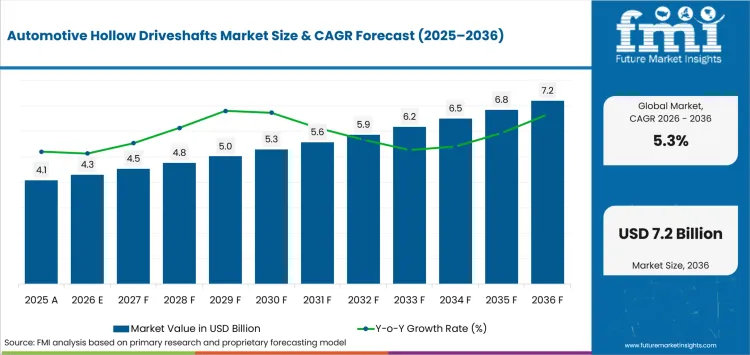
USD 4.3 billion in 2026 and USD 7.2 billion by 2036 at a 5.3% CAGR.
Demand for automotive hollow driveshafts is projected to expand at 5.3% CAGR between 2026 and 2036, increasing valuation from USD 4.3 billion to USD 7.2 billion. Pickup and truck-SUV platforms preserve a large pool of longitudinal driveline layouts. The USA EPA reported in February 2026 that trucks represented 66% of model-year 2024 new vehicles. Hollow-shaft revenue converts at the platform award after torque, critical-speed and NVH targets clear validation.
Country production structure changes the award path even under the same global forecast. ANFAC documented in January 2026 that Spain exported 85.8% of its 2025 vehicle output. Export exposure makes Spanish launch schedules more sensitive to European model-line changes than truck-heavy North American programs. Local tube capacity and engineering response therefore influence where qualified shaft work is placed.
Key Takeaways
- Pickup, SUV and 4WD programs preserve longitudinal torque-transfer volumes because many body-on-frame and utility platforms retain a mechanical shaft.
- Based on shaft type, steel hollow driveshafts are projected to account for 38.0% in 2026 due to high torque capacity and mature tube-processing economics.
- In 2026, pickup trucks are expected to lead vehicle type with 31.0% share because towing loads preserve longitudinal rear-drive layouts.
- 4WD is set to lead the drivetrain category with 31.0% share in 2026 due to front-to-rear torque transfer and articulation requirements.
- Platform-specific fatigue, critical-speed and NVH testing slows supplier switches because a new tube material or joining route can trigger revalidation.
- Some of the key players in this market include Dana, GKN Automotive, American Axle & Manufacturing, Schaeffler, Nexteer Automotive, IFA Group, JTEKT, Meritor, Neapco, and NTN.
Analyst Perspective
"Platform teams compare hollow driveshafts on validated torque margin, critical speed and balance stability before material savings enter the sourcing decision. Lighter shafts earn a premium after the joining route clears fatigue, NVH and field-repair requirements without delaying launch."
- Nikhil Kaitwade, Principal Consultant, Future Market Insights
How is the automotive hollow driveshafts market segmented?
The market is analyzed by shaft type, vehicle type, drivetrain, sales channel and manufacturing.
Shaft type covers steel, aluminum, composite, propeller shaft assemblies and carbon fiber designs. Vehicle type includes pickup trucks, SUVs/crossovers, light commercial vehicles, performance cars and off-road vehicles. Drivetrain covers 4WD, RWD, AWD, hybrid drivetrains and EV auxiliary drive. Sales channel includes OEM direct, driveline Tier-1s, aftermarket replacement and performance aftermarket. Manufacturing covers seam-welded tube, drawn tube, extruded aluminum and composite winding.
How does 4WD shape the drivetrain category?
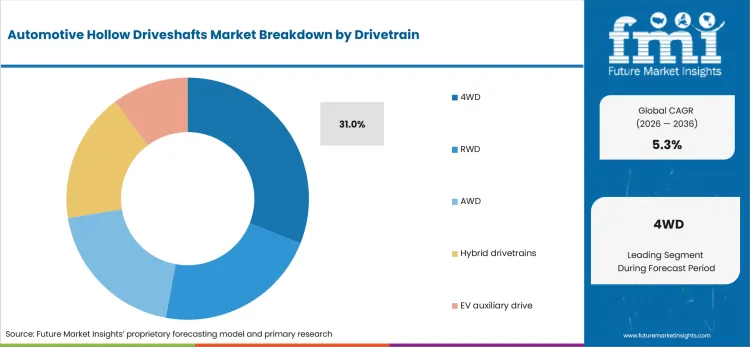
Four-wheel-drive systems expose a propshaft to changing joint angles and transient loads that straight-line torque ratings miss. Stellantis Media stated in July 2025 that the Jeep Wrangler Rubicon uses Dana solid axles and a Rock-Trac 4x4 transfer case with a 4:1 low range. Such hardware makes articulation and low-speed torque part of shaft validation before comparable all-wheel drive systems reach series approval.
- 4WD is set to lead the drivetrain category with 31.0% share in 2026 due to front-to-rear torque transfer and articulation requirements.
- Adoption depends on proving the shaft at the vehicle’s actual joint angles instead of relying on nominal torque capacity alone.
What makes steel hollow driveshafts central to the shaft type category?
Steel remains the practical baseline where high torque and cost targets must survive high-volume launch schedules. AAM's June 2025 Supplier Day recognized Steel Dynamics after it supplied nearly 75,000 tons of SAE-grade steel to AAM facilities. That supply depth does not prove the modeled share, but it explains why familiar steel processing reduces sourcing risk for tubular driveline programs.
- The steel hollow driveshafts segment is projected to hold 38.0% share in 2026 owing to high torque capacity and familiar tube-forming economics.
- Large vehicle programs compare steel designs with automotive axle systems because shared durability targets reward repeatable welding and balance instead of material novelty.
Why do pickup trucks lead the vehicle type category?
Pickup programs place long wheelbases and towing torque on the same longitudinal driveline, making shaft diameter and joint behavior central to platform validation. General Motors reported in January 2026 that Chevrolet Silverado and GMC Sierra recorded their best combined USA sales in 20 years. The volume keeps large platform awards commercially important for full-size pickup trucks and heavy-duty derivatives.
- By vehicle type, pickup trucks are forecast to represent 31.0% in 2026 driven by long-wheelbase towing layouts that retain longitudinal shaft torque transfer.
- Manufacturers gain adoption by validating one tubular architecture for several duty ratings without carrying unnecessary rotating mass.
What supports OEM direct in the sales channel category?
OEM direct sourcing starts before series tooling is frozen because shaft geometry must clear vehicle-level torque, fatigue and NVH targets. Dana’s February 2026 filing shows Ford and Stellantis among its largest light-vehicle customers. The concentration illustrates why driveline qualification carries substantial value inside a limited number of vehicle-program relationships.
- By sales channel, OEM direct is estimated to hold 55.0% in 2026 owing to platform-level qualification before series tooling is frozen.
- Driveline teams also evaluate constant velocity joints and adjacent interfaces during approval, so the commercial advantage lies in resolving fit and validation issues before production timing hardens.
What drives seam-welded tube in the manufacturing category?
Seam-welded tube suits high-volume hollow shafts because manufacturers can control diameter, wall thickness and end-fitting alignment within repeatable production routes. Cummins described in November 2025 how Meritor’s driveline program uses tube shafts and weld yokes, with replacement shafts assembled and balanced to OE standards. The same process discipline supports repeatable dimensions during larger manufacturing runs.
- The manufacturing category is forecast to be led by seam-welded tube at 34.0% share in 2026 due to repeatable high-volume tube processing.
- axle and propeller shafts still require tight runout control following welding, so volume economics weaken if balancing work or rework rises faster than line throughput.
What are the drivers, restraints and opportunities in the automotive hollow driveshafts market?
Truck and 4WD platform volumes support demand, while validation risk limits switching and lighter shaft systems offer the clearest design opportunity.
- Driver: Pickup and SUV architectures preserve longitudinal torque-transfer volume where rear-drive and 4WD layouts remain part of the platform.
- Restraint: Material or source changes can reopen fatigue and NVH validation as revised joints also require critical-speed testing before vehicle approval.
- Opportunity: Aluminum and composite hollow shafts can win selective programs that price rotating-mass reduction above the extra joining and qualification work.
Truck programs convert vehicle volume into hollow-shaft orders wherever RWD or 4WD keeps a mechanical longitudinal path. General Motors reported in July 2026 that it led USA full-size pickup and fleet sales during the first half. Automotive differential systems beside the shaft raise torque demands on the same launch program, so propshaft orders depend on retained mechanical layouts rather than vehicle volume alone.
Platform switching is constrained by physical validation behind a rotating driveline. Nexteer opened 1,900 square meters of driveline validation capacity in Bengaluru in November 2025 for production and design testing. Additional local test capacity reduces iteration time. A revised shaft still needs complete vehicle-level fatigue and balance evidence plus automotive NVH materials validation before an OEM changes the approved source.
Lightweight shafts earn a premium where vehicle-efficiency or recyclability rules make mass visible in the platform business case. Brazil's April 2025 MOVER decree made energy-efficiency and vehicle-recyclability requirements part of new-vehicle commercialization from June 2025. The rule changes documentation and qualification before launch, so aluminum or composite shafts compete best on programs that can repay additional joining and validation cost.
Which country CAGRs are profiled in the automotive hollow driveshafts market?
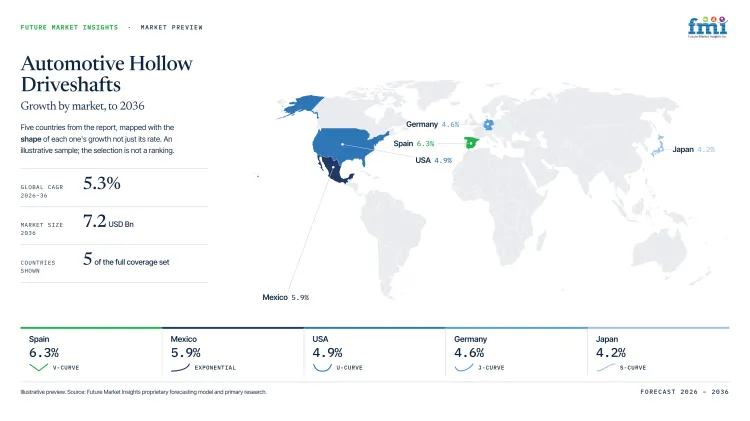
| Country | CAGR |
|---|---|
| Spain | 6.3% |
| Mexico | 5.9% |
| Brazil | 5.6% |
| Canada | 5.3% |
| USA | 4.9% |
| Germany | 4.6% |
| Japan | 4.2% |
How do country-level CAGRs compare in the automotive hollow driveshafts market?
Spain and Mexico form the upper band as export-oriented assembly concentrates shaft awards. Brazil and Canada sit in the middle. USA and Germany follow while Japan has the slowest approved CAGR.
- Spain compresses launch windows through European model turnover.
- Mexico keeps shaft sourcing close to pickup plants.
- Brazil weighs local steel economics against material changes.
- Canada shares replacement fitment across North American platforms.
- USA pickup scale broadens original-equipment sourcing.
- Germany applies deeper NVH qualification to premium vehicles.
- Japan limits demand through compact longitudinal layouts.
Similar rates still convert through different award routes. The full report provides country-level CAGR analysis across North America, Latin America, Western Europe, Eastern Europe, East Asia, South Asia and Pacific, and Middle East and Africa.
Country-wise Analysis
- Spain's export-oriented assembly plants schedule model changes for several European destinations, so hollow-shaft awards depend on launch timing and fast engineering response when an approved balance package moves between vehicle programs. In February 2026 the Spanish government assigned support to 34 electric and connected-vehicle value-chain projects under PERTE VEC IV, and automotive hollow driveshaft demand is forecast to rise at 6.3% CAGR through 2036 because electrified launches keep changing driveline layouts. Export concentration exposes component makers to sudden platform-volume shifts, which favors flexible tube capacity and local engineers who can preserve fatigue and balance approvals without forcing a late material reset.
- Mexico's pickup and SUV plants feed North American export programs at high volume, making nearby shaft engineering and production response important through closely timed tooling changes and launch ramps. INEGI documented in January 2026 that light trucks represented 77.2% of Mexico's 2025 light-vehicle output, giving tubular driveline programs a concentrated vehicle base for repeat OEM awards and locally timed engineering work. Automotive hollow driveshaft demand is projected to grow at 5.9% CAGR through 2036 due to that truck mix, while missed balance or tooling milestones can stop an export launch before series production and weaken the case for a remote source.
- Brazilian pickup and light-commercial programs operate under tight local cost targets, leaving little room for a shaft material change that raises joining expense without a measurable vehicle benefit or manufacturing saving. IBGE recorded an 8.7% monthly decline in motor-vehicle and related body production in December 2025, and automotive hollow driveshaft demand is expected to post 5.6% CAGR over the assessment period tied to a production base that still serves utility vehicles. Volume volatility keeps steel economics influential, so automotive composites win selectively where lower rotating mass repays qualification work without pushing the program beyond its approved cost target or launch schedule.
- Canada's truck-heavy sales mix gives hollow driveshaft companies two linked revenue routes: new-platform supply and replacement work through North American service channels that stock familiar driveline families and repair parts. Automotive hollow driveshaft sales are anticipated to expand at 5.3% CAGR by 2036 aided by this installed base, though cross-border parts flows make accurate fitment and fast inventory response more valuable than uncommon material variants during seasonal fleet peaks. Statistics Canada reported in April 2026 that trucks accounted for 88.0% of new motor-vehicle sales in 2025, confirming why service coverage and North American OE compatibility stay central during fleet repair peaks.
- United States hollow-shaft demand extends beyond new pickup awards because a large truck parc keeps replacement shops and dealer networks active long after the original platform leaves production or changes generation nationwide. Federal Highway Administration data published in February 2026 list 189.8 million registered trucks for 2024, giving replacement programs a deep installed base for exact-fit propshaft assemblies and service stock. Automotive hollow driveshaft demand is predicted to advance at 4.9% CAGR through 2036 given this service depth, but platform-specific torque and critical-speed limits make catalog breadth and correct fitment more commercially useful than one lightweight design applied too widely.
- German driveline programs move through engineering-intensive launches where rapid powertrain change can remove a longitudinal shaft from one model while preserving it in another utility or all-wheel-drive configuration. Automotive hollow driveshaft demand is set to post 4.6% CAGR during the forecast period attributable to retained mechanical layouts, with mixed-platform factories rewarding fast revalidation more than broad material substitution that would restart fatigue and NVH work at each launch. VDA reported in February 2026 that electric cars represented 40% of domestic passenger-car production in 2025, confirming why advanced automotive materials need a vehicle-specific qualification case instead of a blanket substitution plan.
- Japan's vehicle mix keeps several mechanical driveline paths alive because hybrids coexist with conventional and battery-electric platforms, leaving shaft demand concentrated in utility and all-wheel-drive applications instead of the entire passenger-car base. JAMA's April 2026 survey found that hybrid and other engine types represented just under 30% of household passenger-car holdings, giving hybrid vehicles a durable installed base for retained mechanical torque paths. Automotive hollow driveshaft sales are forecast to expand at 4.2% CAGR by 2036 reflecting gradual architecture change, while strict cost control limits material substitution unless a lighter shaft produces a clear efficiency or packaging return during platform validation.
Who are the notable companies in the automotive hollow driveshafts market?
Dana, GKN Automotive, American Axle & Manufacturing, Schaeffler, Nexteer Automotive, IFA Group, JTEKT, Meritor, Neapco and NTN are the notable companies serving this market.
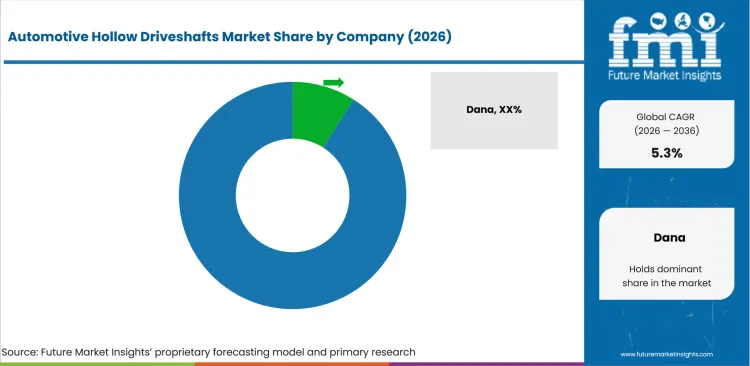
Direct propshaft depth separates Dana and GKN Automotive from broader driveline groups. IFA Group and Neapco hold similar depth. American Axle & Manufacturing and Meritor participate beside axle or commercial-vehicle programs. Nexteer documents driveline validation. Schaeffler, JTEKT and NTN focus more heavily on adjacent shaft interfaces. Entry depends on exact product scope plus vehicle-level qualification support.
- Complete longitudinal propshaft specialists include Dana and GKN Automotive. IFA Group and Neapco also compete directly in this group.
- Broader driveline and commercial-vehicle platforms: American Axle & Manufacturing, Meritor and Nexteer Automotive.
- Adjacent shaft-interface and replacement specialists: Schaeffler, JTEKT and NTN.
Competitive Benchmarking: Automotive Hollow Driveshafts Market
| Company | Complete Propshaft Architecture | Lightweight and Electrified Shaft Engineering | OEM and Replacement Route Coverage | Geographic Reach |
|---|---|---|---|---|
| Dana | High | High | High | Global |
| GKN Automotive | High | High | High | Global |
| American Axle & Manufacturing | Medium | Medium | Medium | North America, Europe and Asia |
| Schaeffler | Low | Medium | High | Global |
| Nexteer Automotive | Low | High | Medium | Americas, Europe and Asia |
| IFA Group | High | High | Medium | Europe, North America and Asia |
| JTEKT | Low | High | Medium | Japan, Americas, Europe and Asia |
| Meritor | High | Medium | High | North America with global commercial-vehicle distribution |
| Neapco | High | Medium | High | North America, Europe and Asia |
| NTN | Medium | High | Medium | Japan, Americas, Europe and Asia |
Scoring uses current evidence within the defined product boundary. High propshaft architecture requires documented tubular-shaft and assembly scope. Medium reflects narrower assembled-shaft evidence and Low marks adjacent interfaces. High lightweight engineering requires a verified action addressing mass or NVH. High route coverage requires OEM and replacement evidence. Medium means one strong route and Low means one narrow route.
Key Developments in the Automotive Hollow Driveshafts Market
- In March 2026 Neapco completed its acquisition of IFA Group and aligned two propeller-shaft and joint-engineering networks across Europe plus North America and Asia.
- In October 2025, NTN invested in its Bawal CVJ operation to raise local sourcing and add design plus durability-testing resources for automotive driveline programs.
- In April 2025 Nexteer Automotive introduced three driveline technologies for EV and mixed-propulsion platforms that prioritize lower mass plus controlled NVH and durability during qualification.
Key Players in the Automotive Hollow Driveshafts Market
Complete Propshaft System Specialists
- Dana
- GKN Automotive
- IFA Group
- Neapco
Integrated Driveline and Commercial-Vehicle Platforms
- American Axle & Manufacturing
- Meritor
- Nexteer Automotive
Adjacent Driveline and Replacement Specialists
- Schaeffler
- JTEKT
- NTN
Automotive Hollow Driveshafts Market - Report Scope
| Coverage field | Report scope |
|---|---|
| Market breakdown | By shaft type, vehicle type, drivetrain, sales channel, manufacturing and region. |
| Quantitative Units | USD billion. |
| Market Definition | Automotive hollow driveshafts that transmit torque through tubular longitudinal or linked driveline members in passenger, utility and commercial vehicles. |
| Regions Covered | North America, Latin America, Western Europe, Eastern Europe, East Asia, South Asia and Pacific and Middle East and Africa. |
| Countries Covered | Spain, Mexico, Brazil, Canada, USA, Germany, Japan, and 25+ countries included in the full report. |
| Key Companies Profiled | Dana, GKN Automotive, American Axle & Manufacturing, Schaeffler, Nexteer Automotive, IFA Group, JTEKT, Meritor, Neapco, NTN. |
| Forecast Period | 2026 to 2036. |
| Approach | Primary and secondary research with market triangulation. |
Automotive Hollow Driveshafts Market - Research Methodology
| Method | Approach |
|---|---|
| Primary Research | FMI analysts gathered input from manufacturers, service providers, technology developers, distributors, end users, procurement teams, and subject-matter experts. Interviews examined purchasing decisions, product or service evaluation, adoption barriers, approval requirements, pricing considerations, and expectations for technical or commercial support. Respondents were also asked what evidence is required before a trial, pilot, or initial order develops into regular purchasing. |
| Desk Research | Desk research covered government statistics, regulatory publications, trade data, industry associations, technical literature, standards, company filings, product information, and official corporate announcements. Sources were reviewed for relevance, publication date, geographic coverage, and consistency with the defined market scope. Claims relating to performance, applications, approvals, capacity, investment, and commercial activity were retained only when supported by credible public evidence. |
| Market Sizing and Forecasting | The market model combined the baseline value with historical performance, segment structure, pricing and volume indicators, adoption levels, company participation, and country-level demand conditions. Forecast assumptions considered economic activity, investment trends, regulatory developments, technology adoption, purchasing cycles, supply availability, and barriers to wider market use. Segment and regional estimates were reconciled before the final market total was calculated. |
| Data Validation | Estimates were checked against multiple independent indicators, including public data, company activity, trade patterns, industry developments, and findings from primary interviews. Validation also tested whether products, services, applications, and company revenues fell within the defined market boundaries. Adjacent categories, unsupported claims, overlapping revenues, and activities without direct market relevance were excluded to reduce double counting and maintain consistency across segments and countries. |
Automotive Hollow Driveshafts Market by Segments
Automotive Hollow Driveshafts Market segmented by Shaft Type:
- Steel hollow driveshafts
- Aluminum hollow driveshafts
- Composite hollow driveshafts
- Propeller shaft assemblies
- Carbon fiber shafts
Automotive Hollow Driveshafts Market segmented by Vehicle Type:
- Pickup trucks
- SUVs/crossovers
- Light commercial vehicles
- Performance cars
- Off-road vehicles
Automotive Hollow Driveshafts Market segmented by Drivetrain:
- 4WD
- RWD
- AWD
- Hybrid drivetrains
- EV auxiliary drive
Automotive Hollow Driveshafts Market segmented by Sales Channel:
- OEM direct
- Driveline Tier-1s
- Aftermarket replacement
- Performance aftermarket
Automotive Hollow Driveshafts Market segmented by Manufacturing:
- Seam-welded tube
- Drawn tube
- Extruded aluminum
- Composite winding
Automotive Hollow Driveshafts Market by Region:
- North America
- United States
- Canada
- Latin America
- Brazil
- Mexico
- Argentina
- Chile
- Western Europe
- Germany
- France
- United Kingdom
- Italy
- Spain
- Benelux
- Nordics
- Eastern Europe
- Poland
- Czech Republic
- Romania
- Hungary
- East Asia
- China
- Japan
- South Korea
- South Asia and Pacific
- India
- ASEAN
- Australia and New Zealand
- Middle East and Africa
- GCC Countries
- South Africa
- Türkiye
- Israel
Research Sources and Bibliography
- USA Environmental Protection Agency. (2026, February 19). Highlights of the Automotive Trends Report.
- Asociación Española de Fabricantes de Automóviles y Camiones. (2026, January 21). La producción de vehículos cae un 4,3% en 2025, con 2.274.026 unidades.
- American Axle & Manufacturing. (2025, June 18). AAM recognizes top suppliers with awards.
- Dana Incorporated. (2026, February 27). Annual report on Form 10-K for the year ended December 31, 2025.
- General Motors. (2026, January 5). GM leads USA industry, 2025 sales up 6%.
- Stellantis Media. (2025, July 16). Iconic Jeep Wrangler MY25 Pricing Released.
- Cummins Inc. (2025, November 13). Maximize vehicle performance with aftermarket driveline solutions.
- General Motors. (2026, July 1). GM #1 in USA Sales for Q2.
- Nexteer Automotive. (2025, November 7). Nexteer Expands India Technical Center to Advance Driveline Validation Capabilities.
- Government of Brazil. (2025, April 15). Decreto nº 12.435, de 15 de abril de 2025.
- Government of Spain. (2026, February 19). Hereu anuncia la adjudicación de 134 millones de euros a 34 proyectos de la línea de cadena de valor del PERTE de Vehículo Eléctrico y Conectado.
- Instituto Nacional de Estadística y Geografía. (2026, January 9). Registro administrativo de la industria automotriz de vehículos ligeros. Diciembre de 2025.
- Instituto Brasileiro de Geografia e Estatística. (2026, February 3). Produção industrial recua 1,2% em dezembro.
- Statistics Canada. (2026, April 30). Springing into a new motor vehicle.
- Federal Highway Administration. (2026, February 23). Table MV-1 - Highway Statistics 2024.
- German Association of the Automotive Industry. (2026, February 3). New record: 40% electric share of passenger car production in 2025.
- Japan Automobile Manufacturers Association. (2026, April 14). 2025
- Neapco Holdings LLC. (2026, March 26). Neapco Holdings LLC Announces the Official Close of IFA Group Acquisition, Creating a Global Leader in Driveline Solutions.
- NTN Corporation. (2025, October 29). NTN Strengthens CVJ Business through Strategic Investment in Indian Market.
- Nexteer Automotive. (2025, April 21). Nexteer Debuts Driveline Innovations, Expands Portfolio.
- Dana Incorporated. (2025, June 11). Dana Incorporated Announces Agreement to Sell Off-Highway Business for $2.7 Billion; $1 Billion Capital Return Authorization.
- American Axle & Manufacturing. (2025, March 13). Recommended cash and share combination of Dowlais Group plc with American Axle & Manufacturing Holdings, Inc..
- GKN Automotive. (2025, September 8). GKN Automotive Achieves ISO 21434 Certification.
- Schaeffler Group. (2025, July 9). Rear-wheel steering: Successful production launch for German OEM and new volume production orders with greater vertical integration.
- NTN Corporation. (2025, May 13). NTN Develops High Performance Ball Type Sliding CVJ for EVs.
- Dana Incorporated. (2026, June 11). Dana Incorporated Announces Agreement to Combine with Eaton's Mobility Business, Strengthens Dana's Position as a Leading Global Powertrain Systems Provider.
- GKN Automotive. (2025, September 10). GKN Automotive India, hosts a Technology Showcase for Mahindra & Mahindra.
- Dauch Corporation. (2026, February 3). Dauch Corporation Completes Acquisition of Dowlais Group plc.
- Schaeffler Group. (2025, April 4). Schaeffler starts production of successful ball screw drive for Chinese EV manufacturer.
- Nexteer Automotive. (2025, January 15). NEXTEER'S FACILITY GRAND OPENING IN CHANGSHU, CHINA EXPANDS ADVANCED STEERING PRODUCTION & VALIDATION Capitalizes on Company's APAC Growth Momentum.
- JTEKT Corporation. (2025, October 1). Steer-by-Wire System and Backup Power Supply (Libuddy®) are installed in LEXUS RZ.
- Cummins Inc. (2026, March 12). Cummins launches new RPL35+, its lightest high-torque driveline for Class 8 trucks, at TMC 2026.
- NTN Corporation. (2026, August 31). NTN Develops CVJ Analysis Technology for Highly Accurate Prediction of Vehicle Vibrations.
This bibliography is provided for reader reference and is not exhaustive. The full report contains the complete reference list and detailed citations.
This Report Answers
- How large is the automotive hollow driveshafts market in 2026 and 2036?
- Why do steel hollow driveshafts hold 38.0% of shaft type demand in 2026?
- Why do pickup trucks represent 31.0% of vehicle type demand in 2026?
- How does 4WD change shaft articulation and durability requirements?
- Why does OEM direct account for 55.0% of sales channel demand?
- How do country growth rates differ among the seven profiled markets?
- Which companies document complete propshaft or adjacent driveline capabilities?
- What limits material substitution in qualified vehicle programs?
Frequently Asked Questions
How big is the automotive hollow driveshafts market in 2026?
The automotive hollow driveshafts market is valued at USD 4.3 billion in 2026 and is projected to reach USD 7.2 billion by 2036. Pickup and 4WD platforms preserve longitudinal torque-transfer applications.
What is the CAGR of the automotive hollow driveshafts market from 2026 to 2036?
The automotive hollow driveshafts market is projected to grow at 5.3% CAGR between 2026 and 2036. Truck-heavy vehicle mixes and platform redesigns preserve mechanical longitudinal shafts in utility applications.
Which shaft type leads the automotive hollow driveshafts market?
The steel hollow driveshafts segment is expected to hold 38.0% of shaft type demand in 2026, driven by mature tube processing and high torque capacity. Familiar joining and balancing routes keep steel economical for large vehicle programs.
Which vehicle type leads the automotive hollow driveshafts market?
The pickup trucks segment is projected to represent 31.0% of vehicle type demand in 2026, supported by towing loads and rear-drive packaging. Long-wheelbase platforms keep hollow longitudinal shafts relevant to large pickup programs.
Which companies are active in the automotive hollow driveshafts market?
Key companies include Dana, GKN Automotive, American Axle & Manufacturing, Schaeffler, Nexteer Automotive, IFA Group, JTEKT, Meritor, Neapco and NTN. Their positions differ by complete propshaft scope, adjacent interface engineering and replacement coverage.
Preview the report firsthand - request a free sample
Get SampleGet the brochure for pricing and purchase details.
Get PDFTable of Content
- Key Takeaways
- Market Size and CAGR
- Top Growth Driver
- Fastest Growing Segment
- Leading Region
- Key Companies
- Emerging Opportunities
- Executive Summary
- Global Market Outlook
- Demand-side Trends
- Supply-side Trends
- Technology Roadmap Analysis
- Analysis and Recommendations
- Analyst Perspective (What is happening? Why now? What should investors know?)
- Key Questions Answered
- How large is the market?
- What is the CAGR?
- What are key trends?
- Which region dominates?
- Who are the leaders?
- Market Overview
- Market Coverage / Taxonomy
- Market Definition / Scope / Limitations
- Research Methodology
- Chapter Orientation
- Analytical Lens and Working Hypotheses
- Market Structure, Signals, and Trend Drivers
- Benchmarking and Cross-market Comparability
- Market Sizing, Forecasting, and Opportunity Mapping
- Research Design and Evidence Framework
- Desk Research Programme (Secondary Evidence)
- Expert Input and Fieldwork (Primary Evidence)
- Tooling, Models, and Reference Databases
- Data Engineering and Model Build
- Quality Assurance and Audit Trail
- Market Background
- Market Dynamics (Drivers, Restraints, Opportunity, Trends)
- Scenario Forecast (Optimistic, Likely, Conservative)
- Impact Analysis
- AI Impact
- Sustainability Impact
- Regulatory Impact
- Technology Impact
- Consumer / Buyer Analysis
- Purchase Drivers
- Adoption Barriers
- Buyer Journey
- Opportunity Map Analysis
- Product Life Cycle Analysis
- Supply Chain Analysis
- Investment Feasibility Matrix
- Value Chain Analysis
- PESTLE and Porter's Analysis
- Regulatory Landscape
- Regional Parent Market Outlook
- Production and Consumption Statistics
- Import and Export Statistics
- Global Market Analysis and Forecast, 2021 to 2036
- Historical Market Size Value (USD Billion) Analysis, 2021 to 2025
- Current and Future Market Size Value (USD Billion) Projections, 2026 to 2036
- Y-o-Y Growth Trend Analysis
- Absolute $ Opportunity Analysis
- Global Market Pricing Analysis, 2021 to 2036
- Global Market Analysis and Forecast, By Shaft Type, 2021 to 2036
- Introduction / Key Findings
- Historical Market Size Value (USD Billion) Analysis By Shaft Type, 2021 to 2025
- Current and Future Market Size Value (USD Billion) Analysis and Forecast By Shaft Type, 2026 to 2036
- Steel hollow driveshafts
- Aluminum hollow driveshafts
- Composite hollow driveshafts
- Propeller shaft assemblies
- Carbon fiber shafts
- Steel hollow driveshafts
- Y-o-Y Growth Trend Analysis By Shaft Type, 2021 to 2025
- Absolute $ Opportunity Analysis By Shaft Type, 2026 to 2036
- Global Market Analysis and Forecast, By Vehicle Type, 2021 to 2036
- Introduction / Key Findings
- Historical Market Size Value (USD Billion) Analysis By Vehicle Type, 2021 to 2025
- Current and Future Market Size Value (USD Billion) Analysis and Forecast By Vehicle Type, 2026 to 2036
- Pickup trucks
- SUVs/crossovers
- Light commercial vehicles
- Performance cars
- Off-road vehicles
- Pickup trucks
- Y-o-Y Growth Trend Analysis By Vehicle Type, 2021 to 2025
- Absolute $ Opportunity Analysis By Vehicle Type, 2026 to 2036
- Global Market Analysis and Forecast, By Drivetrain, 2021 to 2036
- Introduction / Key Findings
- Historical Market Size Value (USD Billion) Analysis By Drivetrain, 2021 to 2025
- Current and Future Market Size Value (USD Billion) Analysis and Forecast By Drivetrain, 2026 to 2036
- 4WD
- RWD
- AWD
- Hybrid drivetrains
- EV auxiliary drive
- 4WD
- Y-o-Y Growth Trend Analysis By Drivetrain, 2021 to 2025
- Absolute $ Opportunity Analysis By Drivetrain, 2026 to 2036
- Global Market Analysis and Forecast, By Sales Channel, 2021 to 2036
- Introduction / Key Findings
- Historical Market Size Value (USD Billion) Analysis By Sales Channel, 2021 to 2025
- Current and Future Market Size Value (USD Billion) Analysis and Forecast By Sales Channel, 2026 to 2036
- OEM direct
- Driveline Tier-1s
- Aftermarket replacement
- Performance aftermarket
- OEM direct
- Y-o-Y Growth Trend Analysis By Sales Channel, 2021 to 2025
- Absolute $ Opportunity Analysis By Sales Channel, 2026 to 2036
- Global Market Analysis and Forecast, By Manufacturing, 2021 to 2036
- Introduction / Key Findings
- Historical Market Size Value (USD Billion) Analysis By Manufacturing, 2021 to 2025
- Current and Future Market Size Value (USD Billion) Analysis and Forecast By Manufacturing, 2026 to 2036
- Seam-welded tube
- Drawn tube
- Extruded aluminum
- Composite winding
- Seam-welded tube
- Y-o-Y Growth Trend Analysis By Manufacturing, 2021 to 2025
- Absolute $ Opportunity Analysis By Manufacturing, 2026 to 2036
- Global Market Analysis and Forecast, By Region, 2021 to 2036
- Introduction
- Historical Market Size Value (USD Billion) Analysis By Region, 2021 to 2025
- Current Market Size Value (USD Billion) Analysis and Forecast By Region, 2026 to 2036
- North America
- Latin America
- Western Europe
- Eastern Europe
- East Asia
- South Asia and Pacific
- Middle East & Africa
- Market Attractiveness Analysis By Region
- North America Market Analysis and Forecast, By Country, 2021 to 2036
- Historical Market Size Value (USD Billion) Trend Analysis By Market Taxonomy, 2021 to 2025
- Market Size Value (USD Billion) Forecast By Market Taxonomy, 2026 to 2036
- By Country
- USA
- Canada
- By Shaft Type
- By Vehicle Type
- By Drivetrain
- By Sales Channel
- By Manufacturing
- By Country
- Market Attractiveness Analysis
- By Country
- By Shaft Type
- By Vehicle Type
- By Drivetrain
- By Sales Channel
- By Manufacturing
- Key Takeaways
- Latin America Market Analysis and Forecast, By Country
- Historical Market Size Value (USD Billion) Trend Analysis By Market Taxonomy, 2021 to 2025
- Market Size Value (USD Billion) Forecast By Market Taxonomy, 2026 to 2036
- By Country
- Brazil
- Mexico
- Chile
- Rest of Latin America
- By Shaft Type
- By Vehicle Type
- By Drivetrain
- By Sales Channel
- By Manufacturing
- By Country
- Market Attractiveness Analysis
- By Country
- By Shaft Type
- By Vehicle Type
- By Drivetrain
- By Sales Channel
- By Manufacturing
- Key Takeaways
- Western Europe Market Analysis and Forecast, By Country
- Historical Market Size Value (USD Billion) Trend Analysis By Market Taxonomy, 2021 to 2025
- Market Size Value (USD Billion) Forecast By Market Taxonomy, 2026 to 2036
- By Country
- Germany
- UK
- Italy
- Spain
- France
- Nordic
- BENELUX
- Rest of Western Europe
- By Shaft Type
- By Vehicle Type
- By Drivetrain
- By Sales Channel
- By Manufacturing
- By Country
- Market Attractiveness Analysis
- By Country
- By Shaft Type
- By Vehicle Type
- By Drivetrain
- By Sales Channel
- By Manufacturing
- Key Takeaways
- Eastern Europe Market Analysis and Forecast, By Country
- Historical Market Size Value (USD Billion) Trend Analysis By Market Taxonomy, 2021 to 2025
- Market Size Value (USD Billion) Forecast By Market Taxonomy, 2026 to 2036
- By Country
- Russia
- Poland
- Hungary
- Balkan & Baltic
- Rest of Eastern Europe
- By Shaft Type
- By Vehicle Type
- By Drivetrain
- By Sales Channel
- By Manufacturing
- By Country
- Market Attractiveness Analysis
- By Country
- By Shaft Type
- By Vehicle Type
- By Drivetrain
- By Sales Channel
- By Manufacturing
- Key Takeaways
- East Asia Market Analysis and Forecast, By Country
- Historical Market Size Value (USD Billion) Trend Analysis By Market Taxonomy, 2021 to 2025
- Market Size Value (USD Billion) Forecast By Market Taxonomy, 2026 to 2036
- By Country
- China
- Japan
- South Korea
- By Shaft Type
- By Vehicle Type
- By Drivetrain
- By Sales Channel
- By Manufacturing
- By Country
- Market Attractiveness Analysis
- By Country
- By Shaft Type
- By Vehicle Type
- By Drivetrain
- By Sales Channel
- By Manufacturing
- Key Takeaways
- South Asia and Pacific Market Analysis and Forecast, By Country
- Historical Market Size Value (USD Billion) Trend Analysis By Market Taxonomy, 2021 to 2025
- Market Size Value (USD Billion) Forecast By Market Taxonomy, 2026 to 2036
- By Country
- India
- ASEAN
- Australia & New Zealand
- Rest of South Asia and Pacific
- By Shaft Type
- By Vehicle Type
- By Drivetrain
- By Sales Channel
- By Manufacturing
- By Country
- Market Attractiveness Analysis
- By Country
- By Shaft Type
- By Vehicle Type
- By Drivetrain
- By Sales Channel
- By Manufacturing
- Key Takeaways
- Middle East & Africa Market Analysis and Forecast, By Country
- Historical Market Size Value (USD Billion) Trend Analysis By Market Taxonomy, 2021 to 2025
- Market Size Value (USD Billion) Forecast By Market Taxonomy, 2026 to 2036
- By Country
- Kingdom of Saudi Arabia
- Other GCC Countries
- Türkiye
- South Africa
- Other African Union
- Rest of Middle East & Africa
- By Shaft Type
- By Vehicle Type
- By Drivetrain
- By Sales Channel
- By Manufacturing
- By Country
- Market Attractiveness Analysis
- By Country
- By Shaft Type
- By Vehicle Type
- By Drivetrain
- By Sales Channel
- By Manufacturing
- Key Takeaways
- Key Countries Market Analysis
- USA
- Pricing Analysis
- Market Share Analysis, 2025
- By Shaft Type
- By Vehicle Type
- By Drivetrain
- By Sales Channel
- By Manufacturing
- Canada
- Pricing Analysis
- Market Share Analysis, 2025
- By Shaft Type
- By Vehicle Type
- By Drivetrain
- By Sales Channel
- By Manufacturing
- Mexico
- Pricing Analysis
- Market Share Analysis, 2025
- By Shaft Type
- By Vehicle Type
- By Drivetrain
- By Sales Channel
- By Manufacturing
- Brazil
- Pricing Analysis
- Market Share Analysis, 2025
- By Shaft Type
- By Vehicle Type
- By Drivetrain
- By Sales Channel
- By Manufacturing
- Chile
- Pricing Analysis
- Market Share Analysis, 2025
- By Shaft Type
- By Vehicle Type
- By Drivetrain
- By Sales Channel
- By Manufacturing
- Germany
- Pricing Analysis
- Market Share Analysis, 2025
- By Shaft Type
- By Vehicle Type
- By Drivetrain
- By Sales Channel
- By Manufacturing
- UK
- Pricing Analysis
- Market Share Analysis, 2025
- By Shaft Type
- By Vehicle Type
- By Drivetrain
- By Sales Channel
- By Manufacturing
- Italy
- Pricing Analysis
- Market Share Analysis, 2025
- By Shaft Type
- By Vehicle Type
- By Drivetrain
- By Sales Channel
- By Manufacturing
- Spain
- Pricing Analysis
- Market Share Analysis, 2025
- By Shaft Type
- By Vehicle Type
- By Drivetrain
- By Sales Channel
- By Manufacturing
- France
- Pricing Analysis
- Market Share Analysis, 2025
- By Shaft Type
- By Vehicle Type
- By Drivetrain
- By Sales Channel
- By Manufacturing
- India
- Pricing Analysis
- Market Share Analysis, 2025
- By Shaft Type
- By Vehicle Type
- By Drivetrain
- By Sales Channel
- By Manufacturing
- ASEAN
- Pricing Analysis
- Market Share Analysis, 2025
- By Shaft Type
- By Vehicle Type
- By Drivetrain
- By Sales Channel
- By Manufacturing
- Australia & New Zealand
- Pricing Analysis
- Market Share Analysis, 2025
- By Shaft Type
- By Vehicle Type
- By Drivetrain
- By Sales Channel
- By Manufacturing
- China
- Pricing Analysis
- Market Share Analysis, 2025
- By Shaft Type
- By Vehicle Type
- By Drivetrain
- By Sales Channel
- By Manufacturing
- Japan
- Pricing Analysis
- Market Share Analysis, 2025
- By Shaft Type
- By Vehicle Type
- By Drivetrain
- By Sales Channel
- By Manufacturing
- South Korea
- Pricing Analysis
- Market Share Analysis, 2025
- By Shaft Type
- By Vehicle Type
- By Drivetrain
- By Sales Channel
- By Manufacturing
- Russia
- Pricing Analysis
- Market Share Analysis, 2025
- By Shaft Type
- By Vehicle Type
- By Drivetrain
- By Sales Channel
- By Manufacturing
- Poland
- Pricing Analysis
- Market Share Analysis, 2025
- By Shaft Type
- By Vehicle Type
- By Drivetrain
- By Sales Channel
- By Manufacturing
- Hungary
- Pricing Analysis
- Market Share Analysis, 2025
- By Shaft Type
- By Vehicle Type
- By Drivetrain
- By Sales Channel
- By Manufacturing
- Kingdom of Saudi Arabia
- Pricing Analysis
- Market Share Analysis, 2025
- By Shaft Type
- By Vehicle Type
- By Drivetrain
- By Sales Channel
- By Manufacturing
- Türkiye
- Pricing Analysis
- Market Share Analysis, 2025
- By Shaft Type
- By Vehicle Type
- By Drivetrain
- By Sales Channel
- By Manufacturing
- South Africa
- Pricing Analysis
- Market Share Analysis, 2025
- By Shaft Type
- By Vehicle Type
- By Drivetrain
- By Sales Channel
- By Manufacturing
- USA
- Market Structure Analysis
- Competition Dashboard
- Competition Benchmarking
- Market Share Analysis of Top Players
- By Regional
- By Shaft Type
- By Vehicle Type
- By Drivetrain
- By Sales Channel
- By Manufacturing
- Emerging Startups
- Innovation Benchmarking
- Competition Analysis
- Competition Deep Dive
- Dana
- Overview
- Product Portfolio
- Profitability by Market Segments
- Sales Footprint
- Strategy Overview
- Marketing Strategy
- Product Strategy
- Channel Strategy
- GKN Automotive
- American Axle & Manufacturing
- Schaeffler
- Nexteer Automotive
- IFA Group
- JTEKT
- Meritor
- Neapco
- NTN
- Dana
- Case Studies
- Success Stories
- Recent Developments
- Competition Deep Dive
- Assumptions & Acronyms Used


