

- Market Size (2026)
- USD 9.4 Bn
- Forecast (2036)
- USD 15.7 Bn
- CAGR (2026 to 2036)
- 5.2%
How big is Automotive Wheel Carriers Market in 2026?
USD 9.4 billion in 2026 and USD 15.7 billion by 2036 at a 5.2% CAGR.
Demand for automotive wheel carriers is projected to rise at 5.2% CAGR from 2026 to 2036, taking market value from USD 9.4 billion in 2026 to USD 15.7 billion by 2036. Vehicle makers revisit carrier geometry whenever platform mass or wheel-end load targets change during suspension redesign. OICA reported in April 2026 that global motor-vehicle production reached 96.4 million units during 2025. That production base keeps new carrier programs active because each platform change requires validated geometry before serial release.
Country demand diverges because the rate of powertrain renewal changes how often chassis engineers revisit wheel-end mass targets. ACEA reported in January 2026 that battery-electric registrations rose 43.2% in Germany versus 12.5% in France during 2025. The wider German change produces more near-term redesign occasions while French programs still require selective component industrialization
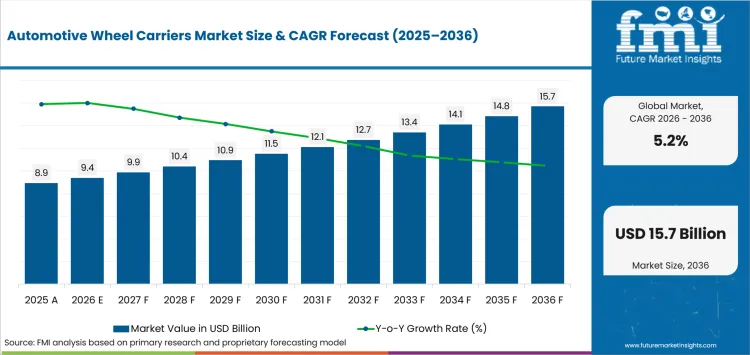
Key Takeaways of Automotive Wheel Carriers Market
- Automotive wheel carrier demand follows vehicle-platform renewal because chassis engineers revisit wheel-end mass and fatigue requirements during major redesign programs.
- By carrier type, front wheel carriers are estimated to hold 29.0% in 2026 due to steering and alignment duties on many front axles.
- Cast iron is projected to hold 32.0% share in 2026 owing to familiar foundry economics within cost-sensitive material programs.
- In 2026, passenger cars are expected to lead vehicle type with 37.0% share as repeated model renewal keeps carrier programs active.
- Safety-critical fatigue validation and tooling approval slow material substitution because redesigned carriers must reproduce established load paths before serial release.
- Key players in the automotive wheel carriers market include Nemak, Linamar, Aisin, Gestamp, Nemak's former GF Casting Solutions automotive business, Astemo, Fawer Automotive, Sodecia, thyssenkrupp, and Donghee Industrial.
Analyst Perspective
"Wheel-carrier offers should be judged on validated geometry and fatigue evidence before unit price enters a platform decision. Commercial value comes from one accountable route that controls material choice, machining accuracy and launch timing through serial approval."
- Nikhil Kaitwade, Principal Consultant, Future Market Insights
How is the Automotive Wheel Carriers Market segmented?
The automotive wheel carriers market is segmented by carrier type, material, vehicle type, manufacturing, and sales channel.
Carrier type includes front wheel carriers, rear wheel carriers, steering knuckles, lightweight forged carriers, and EV-specific wheel carriers. Material covers cast iron, aluminum, forged steel, ductile iron, and composite-reinforced designs used within the defined component boundary. Vehicle type includes passenger cars, SUVs - crossovers, light commercial vehicles, EV platforms, and performance vehicles. Manufacturing covers casting, forging, machining, and hybrid cast-machined routes used before final carrier release. Sales channel includes OEM direct, chassis Tier-1s, aftermarket replacement, and precision foundry supply within the defined revenue scope.
Why do front wheel carriers lead the carrier type category?
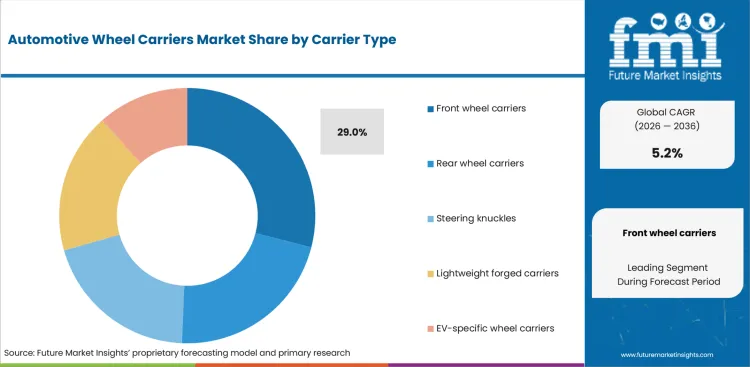
Front wheel carriers locate the hub beside steering geometry and transfer braking plus cornering loads into suspension joints. New steered-axle packaging therefore changes several approval-sensitive wheel-end dimensions.
- By carrier type, front wheel carriers are estimated to hold 29.0% in 2026 owing to steering and alignment duties on many front axles.
- Gestamp unveiled the Ges-Blade tie-blade knuckle in April 2025 using high-strength steel and advanced welding for lower component mass. The design gives chassis engineers a lightweighting route that does not depend on aluminum substitution.
Why does cast iron lead the material category?
Cast iron suits automotive casting routes that require predictable machining and familiar foundry economics for complex load-bearing geometry. GF transferred its Leipzig iron foundry to Linamar in December 2025 and preserved automotive iron-casting capacity inside a chassis manufacturing group.
- Cast iron is projected to hold 32.0% share in 2026 attributable to mature foundry economics and proven fatigue behavior in cost-sensitive carrier programs.
- Material substitution requires a clear mass benefit because lighter alloys can trigger fresh tooling and durability work. Cast iron retains an advantage where machining routes and wheel-end geometry already carry program approval.
Why do passenger cars lead the vehicle type category?
Passenger-car carriers must fit several suspension control-arm layouts and powertrain variants without changing hub position or alignment behavior. High production cadence makes small machining or mass changes commercially visible during model renewal.
- Passenger cars are set to lead the vehicle type category with 37.0% share in 2026 due to platform volume and repeated model renewal.
- Aisin announced in October 2025 that its new eAxle was adopted for Toyota’s bZ4X passenger vehicle. The program shows how electrified passenger platforms can trigger surrounding chassis redesign without changing the carrier’s basic locating function.
Why does casting lead the manufacturing category?
Casting forms ribs and bosses close to final geometry before machining controls bearing seats and mounting interfaces. Linamar completed its Aludyne North America acquisition in November 2025 and gained aluminum casting plus precision machining for knuckles. Metal casting processes remain useful where one route can control raw geometry and final dimensions.
- By manufacturing, casting is forecast to represent 48.0% in 2026 driven by near-net geometry that reduces material removal on complex carrier bodies.
- Carrier castings still need controlled heat treatment and finish machining because bearing bores set wheel-end alignment. Integrated foundry and machining operations reduce handoffs during launch correction and serial quality review.
Why does OEM direct lead the sales channel category?
OEM direct sourcing keeps carrier engineering close to the vehicle program because wheel-end geometry is platform-specific. Direct contact on automotive suspension systems keeps tooling changes visible to the engineering team responsible for vehicle-level validation.
- The sales channel category is forecast to be led by OEM direct at 57.0% share in 2026 due to platform-specific validation responsibility.
- Nemak completed the GF Casting Solutions automotive acquisition in February 2026 and gained nine production facilities plus a Swiss research center. The footprint extends direct OEM access to structure and chassis industrialization during launch and serial production.
What are the drivers, restraints and opportunities in the Automotive Wheel Carriers Market?
Vehicle-efficiency targets keep wheel-end mass under review, qualification slows switching, and integrated forming with machining can capture more program content.
- Driver: Vehicle-efficiency targets keep wheel-end mass under engineering review during new-platform development and material changes.
- Restraint: Fatigue performance and dimensional approval extend switching timelines because tooling and process changes require fresh release evidence.
- Opportunity: Integrated lightweight manufacturing can capture more program content by controlling raw geometry and finish machining under one launch responsibility.
Vehicle-efficiency rules keep wheel-end mass under review because a carrier can lose weight without changing its core locating function. The European Commission’s January 2026 cars-and-vans page lists a 93.6 g CO2/km fleet target for new cars during 2025 to 2029. automotive lightweight materials gain consideration only where lower mass preserves fatigue performance and serial machining economics for the intended platform.
Safety-critical carriers are difficult to switch because replacements must reproduce wheel-end load paths under repeated operation. NHTSA opened Engineering Analysis EA26003 on April 24, 2026 after reports of front steering-knuckle fractures in certain vehicles. The investigation makes durability evidence a practical release condition for new carrier geometry and manufacturing routes before OEM approval can move into serial production.
Manufacturers can capture more program content by keeping structural forming and finish machining under one launch responsibility. Sodecia and AAPICO formed a US joint venture in May 2025 to manufacture chassis frames for a named vehicle maker. Local engineering lets automotive forging routes serve similar high-load programs with fewer handoffs between raw geometry, finish machining and final qualification responsibility.
Which country CAGRs are covered in the Automotive Wheel Carriers Market?
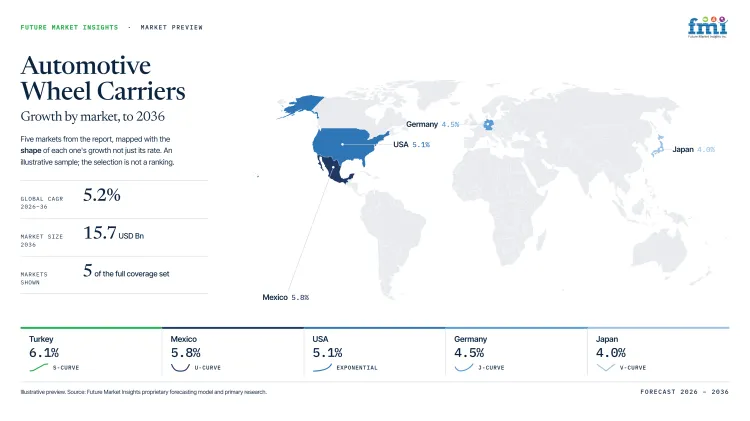
| Country | CAGR |
|---|---|
| Turkey | 6.1% |
| Mexico | 5.8% |
| Brazil | 5.5% |
| USA | 5.1% |
| France | 4.8% |
| Germany | 4.5% |
| Japan | 4.0% |
How do country-level CAGRs compare in the Automotive Wheel Carriers Market?
The 2.1-point spread separates Turkey and Mexico from a slower mature-market group. Brazil and the USA remain near the global forecast because both retain large production programs. France and Germany form a tighter European band with slower renewal. Japan closes the set as mature platforms reduce unnecessary wheel-end requalification.
- Turkey’s export assembly base raises launch workload for local tooling teams during new electric-vehicle program ramps.
- Mexico’s clustered vehicle plants shorten logistics while truck-heavy production raises wheel-end durability requirements during export launches.
- Brazilian vehicle programs review carrier materials earlier because efficiency and recyclability requirements now enter new-vehicle design decisions.
- US long-cycle vehicle platforms favor approved local capacity once a carrier design enters high-volume serial production.
- French component plants can use transition funding to offset portions of domestic retooling and industrial conversion costs.
- German vehicle programs enforce strict release discipline that raises qualification work for unfamiliar material and process routes.
- Japanese automakers increasingly require digital traceability between engineering changes and parts supply before changed chassis components reach production.
Similar CAGRs therefore mask different launch and qualification conditions for wheel-carrier producers. The full report provides country-level CAGR analysis for North America and Latin America plus Western Europe and Eastern Europe. It also covers East Asia and South Asia and Pacific plus Middle East and Africa.
Country-wise Analysis
- Turkey has entered a new electric-vehicle production cycle at Hyundai’s Izmit plant as export-oriented battery-electric production expands local engineering work. Hyundai Motor Türkiye began IONIQ 3 series production in August 2026, producing the IONIQ 3 primarily for European markets as the first electric vehicle built by a foreign OEM at the İzmit plant. Automotive wheel carrier demand in Turkey is forecast to grow at 6.1% CAGR over the assessment period, supported by fresh platform localization. The export program gives local chassis manufacturers a direct volume enabler, but new carrier tooling must still clear durability and geometry approval. Companies with local steering-system engineering can respond to launch changes without another cross-border engineering handoff.
- Mexico’s wheel-end demand is shaped by export plants and a vehicle mix weighted toward light trucks within concentrated automotive clusters. Automotive wheel carrier demand in Mexico is positioned to record 5.8% CAGR during the assessment period, reinforced by high-volume assembly. INEGI’s January 2026 release documented Mexican production of 3,953,494 light vehicles during 2025 with light trucks at 77.2% of the total. The mix supports higher axle-load carriers yet leaves little tolerance for machining drift. Producers near vehicle plants need traceable quality systems for wheel-bearing interfaces so launch corrections do not interrupt serial export schedules.
- Brazilian vehicle programs now place efficiency and recyclability requirements beside local tooling cost during scheduled model renewal. Brazil’s MDIC states that mandatory new-vehicle efficiency and recyclability requirements have applied under MOVER since June 2025. Automotive wheel carrier demand in Brazil is on track to deliver 5.5% CAGR through 2036, attributable to compliance-led redesign and domestic platform renewal. The rules give local foundries a reason to qualify lighter or more recyclable carrier designs, though unfamiliar materials must still fit regional manufacturing economics. Plants with nearby engineering support can test material changes during model renewal without separating design responsibility from serial industrialization.
- US carrier sourcing is tied closely to platform gates because vehicle makers run long programs through established chassis manufacturing networks. EPA’s February 2026 automotive trends data show that trucks represented 66% of model-year 2024 new light-duty vehicles under federal classifications. The US automotive wheel carriers sector is expected to maintain 5.1% CAGR between 2026 and 2036, shaped by efficiency work and a truck-heavy vehicle mix. That mix favors durable wheel-end structures, but retooling established lines can make switching expensive after a program is approved. Local dimensional capability therefore carries more commercial weight than a lower quoted part price during platform changes.
- French component manufacturing is moving through an investment cycle centered on zero-emission vehicles and domestic supplier conversion. Automotive wheel carrier sales in France are set to post 4.8% CAGR by 2036, driven by component industrialization and lower-carbon manufacturing. The Direction générale des Entreprises launched France 2030 calls in July 2025 for investment in future road vehicles and their components. Public support can lower part of the retooling burden, but funding does not remove the need for competitive serial economics. Carrier producers must show that lighter designs can be industrialized at repeatable cost before new capacity becomes durable OEM business in French plants.
- German chassis sourcing pairs demanding vehicle-dynamics targets with strict productivity and material-efficiency requirements inside a mature manufacturing base. Germany’s Federal Ministry for Economic Affairs reported in January 2026 that battery-electric cars represented 19.1% of new passenger-car registrations during 2025. Adoption of automotive wheel carriers in Germany is anticipated to record 4.5% CAGR through 2036, supported by battery-electric platform renewal. More electrified launches give chassis teams reasons to revisit unsprung mass yet unfamiliar material routes face expensive qualification work. Producers need repeatable manufacturing with brake-system interfaces controlled closely enough to protect platform launch timing.
- Japanese vehicle programs place unusual weight on quality continuity and coordinated engineering before new chassis technology reaches serial production. In Japan, automotive wheel carrier demand is predicted to advance at 4.0% CAGR through 2036 owing to digital development and multi-powertrain work. METI and MLIT updated the Mobility DX Strategy in June 2025 to strengthen automotive supply-chain visibility and digitize development processes. Digital engineering gives teams faster design feedback yet mature hybrid and conventional platforms reduce the case for unnecessary requalification. Companies entering Japan need local engineering continuity and documented process discipline so design changes do not fragment responsibility between development and serial manufacturing.
Who are the notable companies in the Automotive Wheel Carriers Market?
Nemak, Linamar, Aisin, Gestamp, Nemak's former GF Casting Solutions automotive business, Astemo, Fawer Automotive, Sodecia, thyssenkrupp, and Donghee Industrial are the notable companies serving this market.
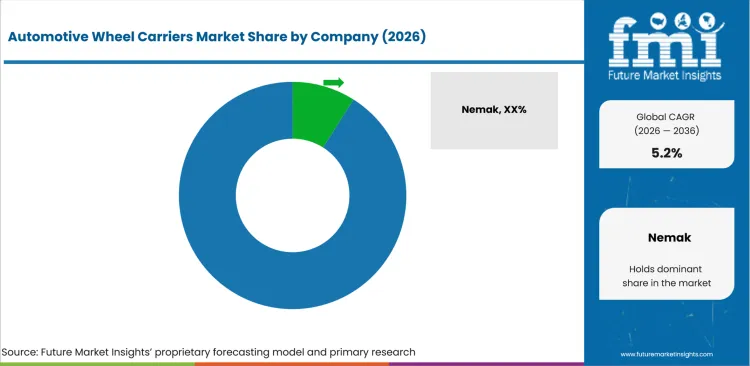
The outlook separates direct knuckle evidence from broader chassis manufacturing. Linamar and Gestamp document knuckle programs while Nemak and Nemak's former GF Casting Solutions automotive business provide structure and chassis casting depth. Aisin and Astemo participate through integrated chassis systems. Fawer Automotive, Sodecia, thyssenkrupp and Donghee Industrial extend the field into suspension, forming and axle production.
- Direct wheel-end and casting specialists: Linamar and Gestamp document knuckle programs while Nemak and Nemak's former GF Casting Solutions automotive business provide chassis casting depth.
- Integrated chassis-system groups: Aisin and Astemo participate through steering or suspension systems while Fawer Automotive provides broader chassis manufacturing.
- Structural manufacturing networks: Sodecia and thyssenkrupp provide chassis forming or axle production while Donghee Industrial contributes suspension technology.
Competitive Benchmarking: Automotive Wheel Carriers Market
| Company | Structural Wheel-End Relevance | Material & Forming Depth | Chassis Engineering & Integration | Geographic Reach |
|---|---|---|---|---|
| Nemak | Medium | High | High | Americas, Europe, and Asia |
| Linamar | High | High | High | North America, South America, Europe, and Asia |
| Aisin | Medium | Medium | High | Japan, Americas, Europe, and Asia |
| Gestamp | High | High | High | Europe, Americas, and Asia |
| Nemak's former GF Casting Solutions automotive business | Medium | High | Medium | Europe, China, and United States |
| Astemo | Medium | Medium | High | Japan, China, Americas, Europe, and Asia |
| Fawer Automotive | Medium | Medium | High | China with selected international programs |
| Sodecia | Medium | High | Medium | Europe, North America, South America, and Asia |
| thyssenkrupp | Medium | High | High | Europe, Americas, and Asia |
| Donghee Industrial | Medium | Medium | High | South Korea, United States, Mexico, Europe, and Turkey |
Key Developments in the Automotive Wheel Carriers Market
- In February 2026, Aisin agreed with Toyota Tsusho and Minth to establish a Canadian joint venture for aluminum body-frame parts. The action expands regional lightweight structural capacity for chassis programs that need coordinated material supply and industrialization.
- In November 2025, Sodecia entered a joint venture with Neel Metal Products for hot-stamping engineering and manufacturing in India. The planned Chakan facility extends localized forming capacity for high-strength structural vehicle programs.
- In June 2025, thyssenkrupp Automotive Technology approved a realignment centered on chassis and selected component activities. The change concentrates investment on operations that pair engineering depth with serial industrial efficiency.
Key Players in the Automotive Wheel Carriers Market
Direct Carrier and Knuckle Manufacturing Specialists
- Nemak
- Linamar
- Gestamp
- Nemak's former GF Casting Solutions automotive business
Integrated Chassis and System Suppliers
- Aisin
- Astemo
- Fawer Automotive
Structural Forming, Forging, and Suspension Networks
- Sodecia
- thyssenkrupp
- Donghee Industrial
Automotive Wheel Carriers Market - Report Scope
| Coverage field | Report scope |
|---|---|
| Market breakdown | By carrier type, material, vehicle type, manufacturing, sales channel and region. |
| Quantitative Units | Revenue in USD billion and CAGR in %. |
| Market Definition | Revenue includes wheel-carrier bodies and carrier or knuckle structures sold as cast, forged, machined, or hybrid cast-machined components. Separately sold hubs, bearings, control arms, brake assemblies, axle modules, chassis frames, and finished vehicles are excluded. |
| Regions Covered | North America, Latin America, Western Europe, Eastern Europe, East Asia, South Asia and Pacific, and Middle East and Africa. |
| Countries Covered | Turkey; Mexico; Brazil; USA; France; Germany; Japan; and 20+ countries included in the full report. |
| Key Companies | Nemak, Linamar, Aisin, Gestamp, Nemak's former GF Casting Solutions automotive business, Astemo, Fawer Automotive, Sodecia, thyssenkrupp, and Donghee Industrial. |
| Forecast Period | 2026 to 2036. |
| Approach | Primary and secondary research with market triangulation. |
Automotive Wheel Carriers Market - Research Methodology
| Method | Approach |
|---|---|
| Primary Research | FMI analysts gathered input from manufacturers, service providers, technology developers, distributors, end users, procurement teams, and subject-matter experts. Interviews examined purchasing decisions, product or service evaluation, adoption barriers, approval requirements, pricing considerations, and expectations for technical or commercial support. Respondents were also asked what evidence is required before a trial, pilot, or initial order develops into regular purchasing. |
| Desk Research | Desk research covered government statistics, regulatory publications, trade data, industry associations, technical literature, standards, company filings, product information, and official corporate announcements. Sources were reviewed for relevance, publication date, geographic coverage, and consistency with the defined market scope. Claims relating to performance, applications, approvals, capacity, investment, and commercial activity were retained only when supported by credible public evidence. |
| Market Sizing and Forecasting | The market model combined the baseline value with historical performance, segment structure, pricing and volume indicators, adoption levels, company participation, and country-level demand conditions. Forecast assumptions considered economic activity, investment trends, regulatory developments, technology adoption, purchasing cycles, supply availability, and barriers to wider market use. Segment and regional estimates were reconciled before the final market total was calculated. |
| Data Validation | Estimates were checked against multiple independent indicators, including public data, company activity, trade patterns, industry developments, and findings from primary interviews. Validation also tested whether products, services, applications, and company revenues fell within the defined market boundaries. Adjacent categories, unsupported claims, overlapping revenues, and activities without direct market relevance were excluded to reduce double counting and maintain consistency across segments and countries. |
Automotive Wheel Carriers Market by Segments
Automotive Wheel Carriers Market segmented by Carrier Type:
- Front wheel carriers
- Rear wheel carriers
- Steering knuckles
- Lightweight forged carriers
- EV-specific wheel carriers
Automotive Wheel Carriers Market segmented by Material:
- Cast iron
- Aluminum
- Forged steel
- Ductile iron
- Composite-reinforced
Automotive Wheel Carriers Market segmented by Vehicle Type:
- Passenger cars
- SUVs - crossovers
- Light commercial vehicles
- EV platforms
- Performance vehicles
Automotive Wheel Carriers Market segmented by Manufacturing:
- Casting
- Forging
- Machining
- Hybrid cast-machined
Automotive Wheel Carriers Market segmented by Sales Channel:
- OEM direct
- Chassis Tier-1s
- Aftermarket replacement
- Precision foundry supply
Automotive Wheel Carriers Market by Region:
- North America
- United States
- Canada
- Latin America
- Brazil
- Mexico
- Argentina
- Chile
- Western Europe
- Germany
- France
- United Kingdom
- Italy
- Spain
- Benelux
- Nordics
- Eastern Europe
- Poland
- Czech Republic
- Romania
- Hungary
- East Asia
- China
- Japan
- South Korea
- South Asia and Pacific
- India
- ASEAN
- Australia and New Zealand
- Middle East and Africa
- GCC Countries
- South Africa
- Türkiye
- Israel
Research Sources and Bibliography
- International Organization of Motor Vehicle Manufacturers. (2026, April 23). Auto industry growth shifted east in 2025 amid global repositioning.
- European Automobile Manufacturers’ Association. (2026, January 27). New car registrations: +1.8% in 2025; battery-electric 17.4% market share.
- Gestamp. (2025, April 23). Gestamp showcases its latest innovations at Auto Shanghai 2025.
- Georg Fischer Ltd. (2025, December 31). GF closes divestment of iron foundry in Leipzig (Germany).
- AISIN Corporation. (2025, October 10). Newly developed eAxle adopted for TOYOTA’s new “bZ4X”.
- Linamar Corporation. (2025, November 14). Linamar Completes Acquisition of Aludyne North America Assets.
- Nemak. (2026, February 12). Nemak completes the acquisition of GF Casting Solutions’ automotive business.
- European Commission. (2026, January 30). Cars and vans.
- National Highway Traffic Safety Administration. (2026, April 24). Engineering Analysis EA26003: Front steering knuckle fractures.
- Sodecia. (2025, May 15). SODECIA and AAPICO announce strategic joint venture in the United States to serve key automotive customer.
- Hyundai Motor Türkiye. (2026, August 14). Hyundai Motor Türkiye, İlk Elektrikli Aracı IONIQ 3’ün Üretimine Başladı.
- Instituto Nacional de Estadística y Geografía. (2026, January 9). Registro administrativo de la industria automotriz de vehículos ligeros. Diciembre de 2025.
- Ministério do Desenvolvimento, Indústria, Comércio e Serviços. (2026, July 6). Programa MOVER.
- USA Environmental Protection Agency. (2026, February 19). Highlights of the Automotive Trends Report.
- Direction générale des Entreprises. (2025, July 11). France 2030: Lancement des appels à projets pour les véhicules routiers de demain et leurs composants.
- Federal Ministry for Economic Affairs and Energy, Germany. (2026, January 27). Good prospects for electric mobility.
- Ministry of Economy, Trade and Industry, Japan. (2025, June 9). Mobility Digital Transformation (DX) Strategy Updated.
- AISIN Corporation. (2026, February 5). AISIN, Toyota Tsusho and Minth Agree to Establish a Joint Venture to Produce Aluminum Body Frame Parts in North America.
- Sodecia. (2025, November 21). Joint Venture Announcement.
- thyssenkrupp AG. (2025, June 24). Realignment decided: thyssenkrupp Automotive Technology focuses on profitable growth and drives forward capital market readiness.
- Gestamp. (2026, June 16). Gestamp strengthens its commitment to Brazil with the opening of its eighth plant in the country.
- Linamar Corporation. (2026, March 27). Linamar Corporation to Acquire WinningBLW’s Remscheid and Penzberg Facilities, Expanding its Forging and Gear Manufacturing.
- Nemak. (2025, December 12). Nemak and Hydro strengthen collaboration to decarbonize the automotive industry.
- Gestamp. (2025, October 9). Gestamp and Hydnum Steel sign agreement to use clean steel produced with green hydrogen.
- Astemo Americas. (2025, June 9). Changes Are Underway at Astemo Americas - A Leading Auto Supplier.
- thyssenkrupp AG. (2026, May 18). thyssenkrupp Automotive Technology segment plans to focus its USA production network.
- Nemak. (2026, May 18). Nemak Mexico Achieves ASI Performance Standard V3.1 and Chain of Custody Certifications.
- Linamar Corporation. (2025, January 28). Linamar Announces Investments in Automotive Technologies Supported by the Canadian Federal and Ontario Provincial Governments.
- AISIN Corporation. (2026, February 4). AISIN to Strengthen Production System to Expand Business in India.
- Gestamp. (2025, May 21). Gestamp showcases its latest innovations for a safer mobility at AEE 2025 in Yokohama.
- Georg Fischer Ltd. (2025, July 24). GF Mid-Year Report 2025.
- Astemo, Ltd. (2025, May 14). Astemo to showcase cross-domain control among SDV tech at Automotive Engineering Expo 2025.
- FAWER Automotive Parts Limited Company. (2026, February 7). Announcement on completion of factory relocation and start of production at Chongqing Yuaan Shock Absorber Co., Ltd..
- Sodecia. (2025, December 2). SODECIA AAPICO JV Announces New $120 Million Manufacturing Facility in Orangeburg, South Carolina.
- thyssenkrupp AG. (2026, February 11). thyssenkrupp Automotive Technology opens new axle assembly plant in Allershausen near Munich.
- Sharda Motor Industries Limited. (2025, October 29). SHARDA MOTOR INDUSTRIES LTD. SIGNS TECHNOLOGY LICENCE AGREEMENT WITH DONGHEE INDUSTRIAL CO. LTD., REPUBLIC OF KOREA, FOR ADVANCED SUSPENSION PORTFOLIO.
This bibliography is provided for reader reference and is not exhaustive. The full report contains the complete reference list and detailed citations.
This Report Answers
- How large is the automotive wheel carriers market in 2026 and how large is it forecast to be by 2036?
- Which vehicle-efficiency and platform-renewal conditions keep wheel carriers on active redesign programs?
- Why do front wheel carriers account for 29.0% of carrier type demand in 2026?
- Why does cast iron retain a 32.0% share within the material category in 2026?
- Why do passenger cars account for 37.0% of vehicle type demand in 2026?
- How do growth rates differ among the seven covered automotive manufacturing countries?
- Which companies provide carrier, chassis-system, casting, forming, or suspension manufacturing capabilities?
- What should OEM chassis engineers compare before selecting a wheel-carrier manufacturing route?
Frequently Asked Questions
How big is the Automotive Wheel Carriers Market in 2026?
The automotive wheel carriers market is valued at USD 9.4 billion in 2026 and is projected to reach USD 15.7 billion by 2036. Platform renewal keeps wheel-end geometry under review as chassis teams pursue lower mass without weakening fatigue performance.
What is the CAGR of the Automotive Wheel Carriers Market from 2026 to 2036?
The automotive wheel carriers market is projected to grow at a CAGR of 5.2% between 2026 and 2036. Expansion follows platform redesign and vehicle-efficiency work that requires validated carrier geometry before serial production begins.
Which carrier type leads the Automotive Wheel Carriers Market?
The front wheel carriers segment is expected to hold 29.0% of the automotive wheel carriers market in 2026, attributable to steering and alignment duties on many front axles. Platform renewal therefore keeps front carrier geometry inside repeated engineering and validation cycles.
How much value will the Automotive Wheel Carriers Market add between 2026 and 2036?
The automotive wheel carriers market is expected to add USD 6.3 billion in value between 2026 and 2036. The increase follows new vehicle programs and chassis lightweighting work that convert into qualified casting and machining assignments.
Which companies are active in the Automotive Wheel Carriers Market?
Key companies operating in the automotive wheel carriers market include Nemak, Linamar, Aisin, Gestamp, Nemak's former GF Casting Solutions automotive business, Astemo, Fawer Automotive, Sodecia, thyssenkrupp, and Donghee Industrial. The company set covers direct knuckle work plus casting, suspension, forming and axle-system capabilities relevant to wheel-end programs.
Preview the report firsthand - request a free sample
Get SampleGet the brochure for pricing and purchase details.
Get PDFTable of Content
- Key Takeaways
- Market Size and CAGR
- Top Growth Driver
- Fastest Growing Segment
- Leading Region
- Key Companies
- Emerging Opportunities
- Executive Summary
- Global Market Outlook
- Demand-side Trends
- Supply-side Trends
- Technology Roadmap Analysis
- Analysis and Recommendations
- Analyst Perspective (What is happening? Why now? What should investors know?)
- Key Questions Answered
- How large is the market?
- What is the CAGR?
- What are key trends?
- Which region dominates?
- Who are the leaders?
- Market Overview
- Market Coverage / Taxonomy
- Market Definition / Scope / Limitations
- Research Methodology
- Chapter Orientation
- Analytical Lens and Working Hypotheses
- Market Structure, Signals, and Trend Drivers
- Benchmarking and Cross-market Comparability
- Market Sizing, Forecasting, and Opportunity Mapping
- Research Design and Evidence Framework
- Desk Research Programme (Secondary Evidence)
- Expert Input and Fieldwork (Primary Evidence)
- Tooling, Models, and Reference Databases
- Data Engineering and Model Build
- Quality Assurance and Audit Trail
- Market Background
- Market Dynamics (Drivers, Restraints, Opportunity, Trends)
- Scenario Forecast (Optimistic, Likely, Conservative)
- Impact Analysis
- AI Impact
- Sustainability Impact
- Regulatory Impact
- Technology Impact
- Consumer / Buyer Analysis
- Purchase Drivers
- Adoption Barriers
- Buyer Journey
- Opportunity Map Analysis
- Product Life Cycle Analysis
- Supply Chain Analysis
- Investment Feasibility Matrix
- Value Chain Analysis
- PESTLE and Porter's Analysis
- Regulatory Landscape
- Regional Parent Market Outlook
- Production and Consumption Statistics
- Import and Export Statistics
- Global Market Analysis and Forecast, 2021 to 2036
- Historical Market Size Value (USD Billion) Analysis, 2021 to 2025
- Current and Future Market Size Value (USD Billion) Projections, 2026 to 2036
- Y-o-Y Growth Trend Analysis
- Absolute $ Opportunity Analysis
- Global Market Pricing Analysis, 2021 to 2036
- Global Market Analysis and Forecast, By Carrier Type, 2021 to 2036
- Introduction / Key Findings
- Historical Market Size Value (USD Billion) Analysis By Carrier Type, 2021 to 2025
- Current and Future Market Size Value (USD Billion) Analysis and Forecast By Carrier Type, 2026 to 2036
- Front wheel carriers
- Rear wheel carriers
- Steering knuckles
- Lightweight forged carriers
- EV-specific wheel carriers
- Front wheel carriers
- Y-o-Y Growth Trend Analysis By Carrier Type, 2021 to 2025
- Absolute $ Opportunity Analysis By Carrier Type, 2026 to 2036
- Global Market Analysis and Forecast, By Material, 2021 to 2036
- Introduction / Key Findings
- Historical Market Size Value (USD Billion) Analysis By Material, 2021 to 2025
- Current and Future Market Size Value (USD Billion) Analysis and Forecast By Material, 2026 to 2036
- Cast iron
- Aluminum
- Forged steel
- Ductile iron
- Composite-reinforced
- Cast iron
- Y-o-Y Growth Trend Analysis By Material, 2021 to 2025
- Absolute $ Opportunity Analysis By Material, 2026 to 2036
- Global Market Analysis and Forecast, By Vehicle Type, 2021 to 2036
- Introduction / Key Findings
- Historical Market Size Value (USD Billion) Analysis By Vehicle Type, 2021 to 2025
- Current and Future Market Size Value (USD Billion) Analysis and Forecast By Vehicle Type, 2026 to 2036
- Passenger cars
- SUVs/crossovers
- Light commercial vehicles
- EV platforms
- Performance vehicles
- Passenger cars
- Y-o-Y Growth Trend Analysis By Vehicle Type, 2021 to 2025
- Absolute $ Opportunity Analysis By Vehicle Type, 2026 to 2036
- Global Market Analysis and Forecast, By Manufacturing, 2021 to 2036
- Introduction / Key Findings
- Historical Market Size Value (USD Billion) Analysis By Manufacturing, 2021 to 2025
- Current and Future Market Size Value (USD Billion) Analysis and Forecast By Manufacturing, 2026 to 2036
- Casting
- Forging
- Machining
- Hybrid cast-machined
- Casting
- Y-o-Y Growth Trend Analysis By Manufacturing, 2021 to 2025
- Absolute $ Opportunity Analysis By Manufacturing, 2026 to 2036
- Global Market Analysis and Forecast, By Sales Channel, 2021 to 2036
- Introduction / Key Findings
- Historical Market Size Value (USD Billion) Analysis By Sales Channel, 2021 to 2025
- Current and Future Market Size Value (USD Billion) Analysis and Forecast By Sales Channel, 2026 to 2036
- OEM direct
- Chassis Tier-1s
- Aftermarket replacement
- Precision foundry supply
- OEM direct
- Y-o-Y Growth Trend Analysis By Sales Channel, 2021 to 2025
- Absolute $ Opportunity Analysis By Sales Channel, 2026 to 2036
- Global Market Analysis and Forecast, By Region, 2021 to 2036
- Introduction
- Historical Market Size Value (USD Billion) Analysis By Region, 2021 to 2025
- Current Market Size Value (USD Billion) Analysis and Forecast By Region, 2026 to 2036
- North America
- Latin America
- Western Europe
- Eastern Europe
- East Asia
- South Asia and Pacific
- Middle East & Africa
- Market Attractiveness Analysis By Region
- North America Market Analysis and Forecast, By Country, 2021 to 2036
- Historical Market Size Value (USD Billion) Trend Analysis By Market Taxonomy, 2021 to 2025
- Market Size Value (USD Billion) Forecast By Market Taxonomy, 2026 to 2036
- By Country
- USA
- Canada
- By Carrier Type
- By Material
- By Vehicle Type
- By Manufacturing
- By Sales Channel
- By Country
- Market Attractiveness Analysis
- By Country
- By Carrier Type
- By Material
- By Vehicle Type
- By Manufacturing
- By Sales Channel
- Key Takeaways
- Latin America Market Analysis and Forecast, By Country
- Historical Market Size Value (USD Billion) Trend Analysis By Market Taxonomy, 2021 to 2025
- Market Size Value (USD Billion) Forecast By Market Taxonomy, 2026 to 2036
- By Country
- Brazil
- Mexico
- Chile
- Rest of Latin America
- By Carrier Type
- By Material
- By Vehicle Type
- By Manufacturing
- By Sales Channel
- By Country
- Market Attractiveness Analysis
- By Country
- By Carrier Type
- By Material
- By Vehicle Type
- By Manufacturing
- By Sales Channel
- Key Takeaways
- Western Europe Market Analysis and Forecast, By Country
- Historical Market Size Value (USD Billion) Trend Analysis By Market Taxonomy, 2021 to 2025
- Market Size Value (USD Billion) Forecast By Market Taxonomy, 2026 to 2036
- By Country
- Germany
- UK
- Italy
- Spain
- France
- Nordic
- BENELUX
- Rest of Western Europe
- By Carrier Type
- By Material
- By Vehicle Type
- By Manufacturing
- By Sales Channel
- By Country
- Market Attractiveness Analysis
- By Country
- By Carrier Type
- By Material
- By Vehicle Type
- By Manufacturing
- By Sales Channel
- Key Takeaways
- Eastern Europe Market Analysis and Forecast, By Country
- Historical Market Size Value (USD Billion) Trend Analysis By Market Taxonomy, 2021 to 2025
- Market Size Value (USD Billion) Forecast By Market Taxonomy, 2026 to 2036
- By Country
- Russia
- Poland
- Hungary
- Balkan & Baltic
- Rest of Eastern Europe
- By Carrier Type
- By Material
- By Vehicle Type
- By Manufacturing
- By Sales Channel
- By Country
- Market Attractiveness Analysis
- By Country
- By Carrier Type
- By Material
- By Vehicle Type
- By Manufacturing
- By Sales Channel
- Key Takeaways
- East Asia Market Analysis and Forecast, By Country
- Historical Market Size Value (USD Billion) Trend Analysis By Market Taxonomy, 2021 to 2025
- Market Size Value (USD Billion) Forecast By Market Taxonomy, 2026 to 2036
- By Country
- China
- Japan
- South Korea
- By Carrier Type
- By Material
- By Vehicle Type
- By Manufacturing
- By Sales Channel
- By Country
- Market Attractiveness Analysis
- By Country
- By Carrier Type
- By Material
- By Vehicle Type
- By Manufacturing
- By Sales Channel
- Key Takeaways
- South Asia and Pacific Market Analysis and Forecast, By Country
- Historical Market Size Value (USD Billion) Trend Analysis By Market Taxonomy, 2021 to 2025
- Market Size Value (USD Billion) Forecast By Market Taxonomy, 2026 to 2036
- By Country
- India
- ASEAN
- Australia & New Zealand
- Rest of South Asia and Pacific
- By Carrier Type
- By Material
- By Vehicle Type
- By Manufacturing
- By Sales Channel
- By Country
- Market Attractiveness Analysis
- By Country
- By Carrier Type
- By Material
- By Vehicle Type
- By Manufacturing
- By Sales Channel
- Key Takeaways
- Middle East & Africa Market Analysis and Forecast, By Country
- Historical Market Size Value (USD Billion) Trend Analysis By Market Taxonomy, 2021 to 2025
- Market Size Value (USD Billion) Forecast By Market Taxonomy, 2026 to 2036
- By Country
- Kingdom of Saudi Arabia
- Other GCC Countries
- Türkiye
- South Africa
- Other African Union
- Rest of Middle East & Africa
- By Carrier Type
- By Material
- By Vehicle Type
- By Manufacturing
- By Sales Channel
- By Country
- Market Attractiveness Analysis
- By Country
- By Carrier Type
- By Material
- By Vehicle Type
- By Manufacturing
- By Sales Channel
- Key Takeaways
- Key Countries Market Analysis
- USA
- Pricing Analysis
- Market Share Analysis, 2025
- By Carrier Type
- By Material
- By Vehicle Type
- By Manufacturing
- By Sales Channel
- Canada
- Pricing Analysis
- Market Share Analysis, 2025
- By Carrier Type
- By Material
- By Vehicle Type
- By Manufacturing
- By Sales Channel
- Mexico
- Pricing Analysis
- Market Share Analysis, 2025
- By Carrier Type
- By Material
- By Vehicle Type
- By Manufacturing
- By Sales Channel
- Brazil
- Pricing Analysis
- Market Share Analysis, 2025
- By Carrier Type
- By Material
- By Vehicle Type
- By Manufacturing
- By Sales Channel
- Chile
- Pricing Analysis
- Market Share Analysis, 2025
- By Carrier Type
- By Material
- By Vehicle Type
- By Manufacturing
- By Sales Channel
- Germany
- Pricing Analysis
- Market Share Analysis, 2025
- By Carrier Type
- By Material
- By Vehicle Type
- By Manufacturing
- By Sales Channel
- UK
- Pricing Analysis
- Market Share Analysis, 2025
- By Carrier Type
- By Material
- By Vehicle Type
- By Manufacturing
- By Sales Channel
- Italy
- Pricing Analysis
- Market Share Analysis, 2025
- By Carrier Type
- By Material
- By Vehicle Type
- By Manufacturing
- By Sales Channel
- Spain
- Pricing Analysis
- Market Share Analysis, 2025
- By Carrier Type
- By Material
- By Vehicle Type
- By Manufacturing
- By Sales Channel
- France
- Pricing Analysis
- Market Share Analysis, 2025
- By Carrier Type
- By Material
- By Vehicle Type
- By Manufacturing
- By Sales Channel
- India
- Pricing Analysis
- Market Share Analysis, 2025
- By Carrier Type
- By Material
- By Vehicle Type
- By Manufacturing
- By Sales Channel
- ASEAN
- Pricing Analysis
- Market Share Analysis, 2025
- By Carrier Type
- By Material
- By Vehicle Type
- By Manufacturing
- By Sales Channel
- Australia & New Zealand
- Pricing Analysis
- Market Share Analysis, 2025
- By Carrier Type
- By Material
- By Vehicle Type
- By Manufacturing
- By Sales Channel
- China
- Pricing Analysis
- Market Share Analysis, 2025
- By Carrier Type
- By Material
- By Vehicle Type
- By Manufacturing
- By Sales Channel
- Japan
- Pricing Analysis
- Market Share Analysis, 2025
- By Carrier Type
- By Material
- By Vehicle Type
- By Manufacturing
- By Sales Channel
- South Korea
- Pricing Analysis
- Market Share Analysis, 2025
- By Carrier Type
- By Material
- By Vehicle Type
- By Manufacturing
- By Sales Channel
- Russia
- Pricing Analysis
- Market Share Analysis, 2025
- By Carrier Type
- By Material
- By Vehicle Type
- By Manufacturing
- By Sales Channel
- Poland
- Pricing Analysis
- Market Share Analysis, 2025
- By Carrier Type
- By Material
- By Vehicle Type
- By Manufacturing
- By Sales Channel
- Hungary
- Pricing Analysis
- Market Share Analysis, 2025
- By Carrier Type
- By Material
- By Vehicle Type
- By Manufacturing
- By Sales Channel
- Kingdom of Saudi Arabia
- Pricing Analysis
- Market Share Analysis, 2025
- By Carrier Type
- By Material
- By Vehicle Type
- By Manufacturing
- By Sales Channel
- Türkiye
- Pricing Analysis
- Market Share Analysis, 2025
- By Carrier Type
- By Material
- By Vehicle Type
- By Manufacturing
- By Sales Channel
- South Africa
- Pricing Analysis
- Market Share Analysis, 2025
- By Carrier Type
- By Material
- By Vehicle Type
- By Manufacturing
- By Sales Channel
- USA
- Market Structure Analysis
- Competition Dashboard
- Competition Benchmarking
- Market Share Analysis of Top Players
- By Regional
- By Carrier Type
- By Material
- By Vehicle Type
- By Manufacturing
- By Sales Channel
- Emerging Startups
- Innovation Benchmarking
- Competition Analysis
- Competition Deep Dive
- Nemak
- Overview
- Product Portfolio
- Profitability by Market Segments
- Sales Footprint
- Strategy Overview
- Marketing Strategy
- Product Strategy
- Channel Strategy
- Linamar
- Aisin
- Gestamp
- GF Casting Solutions
- Hitachi Astemo
- Fawer Automotive
- Sodecia
- thyssenkrupp
- Donghee Industrial
- Nemak
- Case Studies
- Success Stories
- Recent Developments
- Competition Deep Dive
- Assumptions & Acronyms Used


