

- Market Size (2026)
- USD 1.5 Bn
- Forecast (2036)
- USD 2.4 Bn
- CAGR (2026 to 2036)
- 4.8%
How big is Automotive Oil Filter Housings Market in 2026?
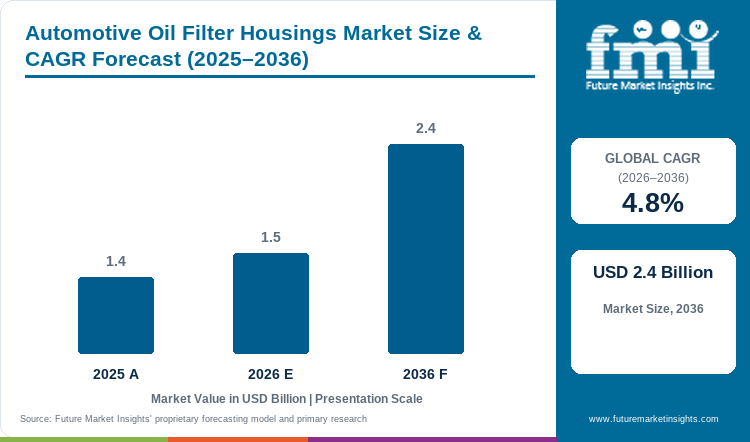
USD 1.5 billion in 2026 and USD 2.4 billion by 2036 at a 4.8% CAGR.
Sales of automotive oil filter housings are estimated to rise at a 4.8% CAGR through 2036. Valuation is projected to increase from USD 1.4 billion in 2025 to USD 1.5 billion in 2026 before reaching USD 2.4 billion by 2036. Engine manufacturers are preferring lubrication modules that combine multiple functions within a single assembly because integrated designs can simplify packaging and component management. MANN+HUMMEL documents passenger-car oil filter modules that use plastic or die-cast aluminum housings with optional oil cooling. Current module designs integrate pressure measurement and oil-cooling functions within the same engine-oil assembly.
Country supply bases are shaping how the forecast converts into original equipment and replacement orders over the assessment period. Mexico’s vehicle-production link with North America and Japan’s large export-oriented automotive industry create different routes for filtration modules and replacement housings. Mexico is forecast to grow at 5.5% CAGR through 2036, supported by regional production and cross-border parts flows. Japan's automotive oil filter housings outlook is anticipated to advance at 3.8% CAGR over the assessment period, while Japan Customs reported that total exports increased 5.9% in fiscal 2024, reinforcing the role of export-oriented manufacturing and established component routes.
Key Takeaways
- Hybrid ICE programs preserve engine-oil filtration demand while integrated cooling and control functions increase housing content per vehicle.
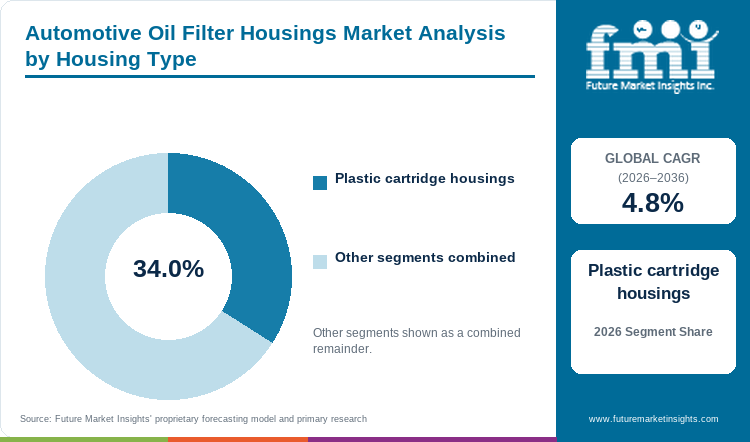
- Plastic cartridge housings are projected to account for 34.0% of the housing type category in 2026, attributable to serviceable elements designed for compact engine packages.
- Glass-filled polymer is estimated to hold 42.0% of the material category in 2026, supported by molded functional integration with lower component mass.
- OEM direct is likely to capture 51.0% of sales channel demand in 2026, influenced by engine-level qualification requirements before serial production.
- Pure battery-electric platforms remove the conventional combustion-engine oil circuit and narrow the addressable housing content on those vehicle programs.
- Some of the key players in this market include MAHLE, MANN+HUMMEL, Hengst, UFI Filters, Standard Motor Products, CRP Automotive, Dorman Products, and Purflux Group.
Analyst Perspective
"Combining filtration and thermal functions in one validated assembly increases the content carried by an oil filter housing. The commercial advantage depends on engine-specific qualification and a credible replacement route once the vehicle enters service."
- Nikhil Kaitwade, Principal Consultant, Future Market Insights
How is the automotive oil filter housings market segmented?
The automotive oil filter housings market is segmented by housing type, material, engine type, vehicle type, sales channel and region.
The automotive oil filter housings market is segmented by housing type, material, engine type, vehicle type, sales channel and region. Housing type covers plastic cartridge housings, aluminum housings, spin-on filter bases, integrated oil cooler housings and modular filtration housings. Material covers glass-filled polymer, aluminum, steel, magnesium alloy and hybrid assemblies while engine type covers gasoline, diesel, hybrid ICE and commercial vehicle engines. Vehicle type includes passenger cars, SUVs - crossovers, light commercial vehicles, heavy trucks and hybrid vehicles while sales channel covers OEM direct, filtration Tier-1s, aftermarket replacement and service kits.
How do plastic cartridge housings reduce service complexity inside compact lubrication assemblies?
Plastic cartridge housings keep the filter element serviceable and leave the permanent body to carry oil passages and sealing interfaces. MAHLE documents oil filter modules that use high-performance plastic or aluminum housings with integrated cooling and control functions. Integrated housings reduce separate components and preserve access to the scheduled filter element during routine engine service. Engineers still require pressure-cycle and thermal validation because cap threads and sealing faces must remain stable over engine life. Scheduled maintenance depends on accessible engine oil filters that technicians can replace without disturbing the permanent housing.
- Plastic cartridge housings are projected to hold 34.0% of the housing type category in 2026, driven by serviceable filter elements designed for compact permanent modules.
- Application-specific housings require accurate cap geometry and stable sealing surfaces before technicians can replace only the filter element during scheduled service.
How does glass-filled polymer support low-mass housings under engine thermal loads?
Glass-filled automotive plastics give housing engineers a molded route to stiff passages and integrated mounts with lower component mass. UFI documented a BMW oil module with a fiberglass-reinforced plastic body that was about 35% lighter than comparable metal. The same module was designed for pressures up to 30 bar and integrated a heat exchanger within the housing. Its pressure rating and integrated heat exchanger support polymer use under combined mechanical and thermal loads. Hot-oil exposure and seal stability still require application-specific validation before a polymer housing enters production.
- Glass-filled polymer is forecast to represent 42.0% of material in 2026, owing to lower component mass and molded functional integration.
- Housing material changes require pressure-cycle and thermal validation because seal compression and cooler performance depend on stable geometry throughout engine service.
How do gasoline engines keep complete housing demand active as hybridization changes the powertrain mix?
Gasoline engines keep complete housing demand active because their lubrication circuits remain present in conventional and hybrid passenger vehicles. Dorman's 926-959 assembly covers Pentastar gasoline applications and replaces the original plastic housing with a complete aluminum repair. The assembly includes an oil cooler and filter with application-specific interfaces for the engine lubrication circuit. A variable oil pump controls engine-oil pressure and flow within the same lubrication circuit that feeds the housing. Housing suppliers need validated pressure limits and fitment coverage for successive gasoline engine model years.
- Gasoline engines are expected to lead engine type with 36.0% share in 2026, reinforced by conventional and hybrid platforms that retain engine lubrication circuits.
- Housing suppliers must support cold-start pressure and sustained hot-oil exposure without increasing restriction inside downsized gasoline-engine lubrication systems during service.
What makes passenger cars a broad fitment base for housing designs and later replacement demand?
Passenger cars create a broad fitment base because model years and engine packages multiply the number of housing interfaces in service. Dorman's 926-528 housing covers Audi and Volkswagen passenger applications from recent model years with an aluminum replacement design. The complete repair kit includes the cooler and filter so technicians can replace a failed assembly without sourcing separate parts. Long-lived passenger cars also sustain a bearing and clutch aftermarket that depends on accurate application data. Housing suppliers need catalog continuity and distributor availability for each engine family beyond the original platform production cycle.
- The vehicle type category is forecast to be led by passenger cars at 35.0% share in 2026, aided by diverse engine fitments that expand original-equipment and replacement coverage.
- Housing failures continue beyond original production and require accurate vehicle application data plus reliable replacement distribution.
Why does OEM direct sourcing remain central when a housing interfaces with the engine and cooler?
Complete housings interface with the engine block before vehicle launch and often share functions with the oil cooler. UFI documented a Fiat Ducato oil module selected for Stellantis engines with a die-cast aluminum body and integrated heat exchanger. Original-equipment integration requires filtration and thermal validation before serial production. Integrated oil coolers make thermal management part of housing design during original-equipment validation. Replacement suppliers must reproduce those service interfaces if a complete housing later fails outside the original vehicle warranty.
- OEM direct is set to lead the sales channel category with 51.0% share in 2026, shaped by platform validation requirements for engine-specific housings before production.
- Aftermarket replacement becomes more important later because leakage or cooler faults can require a complete assembly instead of a routine filter element.
What are the drivers, restraints and opportunities in the Automotive Oil Filter Housings Market?
Hybrid ICE programs sustain engine lubrication content, pure battery-electric adoption removes conventional housings and aging vehicles expand replacement demand for complete assemblies.
- Driver: Hybrid powertrains preserve engine-oil filtration content while integrated modules raise the number of functions inside each housing.
- Restraint: Pure battery-electric vehicle platforms remove the conventional engine-oil circuit and eliminate the housing from those propulsion architectures.
- Opportunity: Older combustion fleets create repair demand for complete housings when leakage or integrated-cooler failures make element-only service insufficient.
Hybrid Powertrains Preserve Engine-Lubrication Content
Hybrid powertrains preserve engine-oil housing demand because the combustion engine still carries a dedicated lubrication circuit. UFI's Volkswagen mild-hybrid program used a compact plastic oil module with integrated valves for oil and coolant control. The module reduced lubrication-system pressure losses and retained a serviceable cartridge within the complete engine assembly. Powertrain engineers coordinate automotive pumps and oil filter modules because both control lubricant flow during platform development. Cooling and control functions can increase housing content once they pass module-level validation. Long service intervals make low restriction commercially relevant because pressure loss continues during normal engine operation.
Battery-Electric Architectures Remove Conventional Engine-Oil Housings
Pure battery-electric platforms remove the combustion engine and eliminate its conventional engine-oil filter housing from the propulsion system. MANN+HUMMEL documents separate oil filter systems for e-axles and hybrid transmissions as products for electrified drivetrains. Those systems manage transmission or e-axle lubricant and do not replace the defined engine-oil housing category. Automotive oil requirements shift as electrified drivetrains move some lubrication duties from engines to e-axles and transmissions. Housing suppliers must protect combustion and hybrid platform positions without counting electric-drive filtration as equivalent engine-housing demand. A full-electric platform removes engine housing demand from the vehicle program and changes long-term capacity planning.
Complete Replacement Assemblies Extend the Aftermarket Revenue Route
Complete replacement assemblies generate aftermarket revenue as heat and chemical exposure damages an original housing or its sealing surfaces. Dorman's 926-959 replaces a failure-prone plastic Pentastar housing with an aluminum assembly that includes the cooler and filter. The complete repair includes seals and hardware that restore the oil circuit instead of replacing only the filter element. Workshop repairs depend on gaskets and seals that maintain oil-circuit integrity at the replacement interface. Suppliers capture this demand by maintaining exact fitment coverage for aging combustion vehicles. Complete kits reduce installation uncertainty because technicians receive the matched housing and required service components together.
Which country CAGRs are profiled in the Automotive Oil Filter Housings Market?
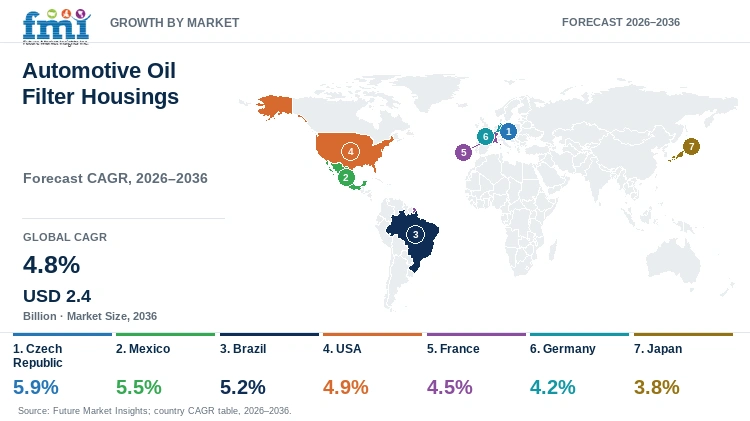
| Country | CAGR |
|---|---|
| Czech Republic | 5.9% |
| Mexico | 5.5% |
| Brazil | 5.2% |
| USA | 4.9% |
| France | 4.5% |
| Germany | 4.2% |
| Japan | 3.8% |
How do country-level CAGRs compare in the Automotive Oil Filter Housings Market?
The country forecasts cover a 2.1 percentage-point range between Czech Republic and Japan over the assessment period. Czech Republic and Mexico occupy the upper end while France and Germany form a more moderate group. The pattern corresponds with different engine-filtration supply bases and service exposure rather than current housing revenue.
- Czech Republic's export-oriented automotive supply base keeps housing suppliers close to European engine programs and rewards reliable technical support for cross-border component sourcing.
- In Mexico, North American vehicle production and cross-border filtration routes strengthen demand for locally supported housings with dependable regional sourcing and service availability.
- Brazil's domestic vehicle base and independent repair network favor complete housing suppliers that maintain application coverage once vehicles leave original-equipment service channels.
- A large national service network in the USA supports original-equipment and replacement demand by keeping engine-specific housing coverage available through long vehicle service lives.
- France continues to balance established engine-filtration supply with faster electrification, which rewards suppliers that protect hybrid applications and maintain replacement coverage for combustion vehicles.
- Germany benefits from an established engine-filtration export base and disciplined platform engineering that place technical qualification and serial-production support at the center of supplier selection.
- For Japan, mature service expectations and substantial filtration exports favor exact fitment plus durable replacement support for engine families that remain in service beyond production.
Comparable CAGRs can still produce different commercial conditions because platform nominations and repair demand convert on different schedules. The full report provides country-level CAGR analysis across North America, Latin America, Western Europe, Eastern Europe, East Asia, South Asia and Pacific, and the Middle East and Africa.
Country-wise Analysis
- US engine-filtration trade connects original-equipment programs with national replacement distribution for combustion vehicles. Automotive oil filter housing demand in the USA is forecast to rise at 4.9% CAGR over the forecast period, supported by established engine-filtration supply and service channels. USA Census Bureau and Bureau of Economic Analysis data show that exports of automotive vehicles, parts and engines increased by USD 1.9 billion in November 2024, including gains of USD 0.8 billion in passenger cars and USD 0.6 billion in trucks, buses and special-purpose vehicles. The monthly increase demonstrates active cross-border movement across the wider automotive supply chain that supports component and filtration distribution. Battery-electric platforms remove conventional housings from new propulsion applications and reduce future engine nominations. Hybrid programs preserve housing demand because their combustion engines retain lubrication circuits. Suppliers need durable assemblies and exact oil and fuel filter service coverage for complete repairs once vehicle warranties expire.
- Germany's engine-filtration export base ties module suppliers to European original-equipment programs and replacement distribution. Germany's automotive oil filter housings outlook is anticipated to advance at 4.2% CAGR over the assessment period, influenced by established engineering qualification and technical-service capacity. Germany’s Federal Statistical Office reported in March 2025 that new-passenger-car export volume increased 2.5% in 2024, while battery-electric cars represented 25.9% of exported new vehicles. The figures demonstrate both the scale of Germany’s export-oriented vehicle manufacturing base and the growing electrification pressure on conventional engine-component demand. Battery-electric adoption reduces future engine-oil content on some new platforms and changes long-term capacity requirements.
- Japan's mature vehicle service network places unusual weight on exact fitment and long product life for engine components. Adoption of automotive oil filter housings in Japan is estimated to expand at 3.8% CAGR through 2036, shaped by mature service expectations and long replacement cycles. Japan Customs reported that total exports increased 5.9% in fiscal 2024 from the preceding fiscal year. The rise supports Japan’s role as an export-oriented manufacturing base with established routes for vehicles and related components. Mature service conditions reduce the value of generic application coverage for long-lived engine families and replacements.
- Independent repair shops in Brazil keep complete engine-filtration repairs commercially relevant once original warranty coverage ends. Brazil's automotive oil filter housings market is projected to record 5.2% CAGR during the assessment period, attributable to the domestic combustion fleet and active repair channels. IBGE reported that Brazil’s GDP grew 2.3% in 2025 after expanding 3.4% in 2024, marking a fifth consecutive year of economic growth. Continued economic expansion supports vehicle use, parts distribution and workshop activity even as the growth rate moderates. Cost sensitivity can limit premium complete-housing replacement because lower-priced repair options remain available to independent workshops. Older combustion vehicles still require accurate fitment data and workshop access to complete replacement assemblies.
- The Czech Republic serves European vehicle programs through an export-oriented component base and short supply routes to major assembly markets. Automotive oil filter housing demand in the Czech Republic is projected to grow at 5.9% CAGR through 2036, driven by export-oriented component production near European assembly plants. The Czech Statistical Office reported that goods exports decreased 3.3% year on year in March 2024, while imports fell 9.0%; seasonally adjusted exports and imports declined 1.1% and 2.2%, respectively, from the prior month. The smaller export decline than import decline supported a positive trade balance and confirms the importance of export-linked manufacturing conditions for Czech component suppliers. Dependence on European platform mix exposes suppliers to battery-electric substitution and changing engine-component volumes. Hybrid and combustion nominations still require fast engineering response near customer plants and regional assembly operations. Export concentration can make one platform change visible through several component suppliers and service programs.
- France combines established engine-filtration supply channels with a new-vehicle mix that is moving quickly toward electrified powertrains. Automotive oil filter housing demand in France is predicted to advance at 4.5% CAGR through 2036, reinforced by continuing hybrid applications and replacement demand from the installed combustion fleet. INSEE states that revisions to its passenger-car registration series alter annual trends by no more than 0.4 percentage points, supporting consistent year-over-year interpretation of the market’s vehicle-registration direction. The stable official series provides a dependable basis for assessing how new platforms enter future service channels without introducing disallowed unit counts. Battery-electric platforms reduce conventional engine-oil housing content in new programs and alter future supplier volumes. Hybrid vehicles and the installed combustion fleet preserve replacement requirements for qualified engine-specific housing assemblies.
- Mexico's engine-component base is closely linked with North American vehicle production and cross-border service channels. Automotive oil filter housing demand in Mexico is estimated to expand at 5.5% CAGR through 2036, aided by regional vehicle production and established cross-border filtration routes. INEGI reports that nearly 90% of Mexico’s avocado export tonnage went to the United States in 2024, providing a quantified indicator of the intensity of the country’s northbound merchandise corridor. The same cross-border logistics infrastructure supports frequent movement of automotive components and replacement parts into North American channels. Platform concentration raises supplier risk as engine programs change or move toward battery-electric architectures. Truck and crossover applications also place heavier thermal demands on sealing systems during long service cycles.
Who are the notable companies in the Automotive Oil Filter Housings Market?
MAHLE, MANN+HUMMEL, Hengst, UFI Filters, Standard Motor Products, CRP Automotive, Dorman Products, and Purflux Group are notable companies serving this market.
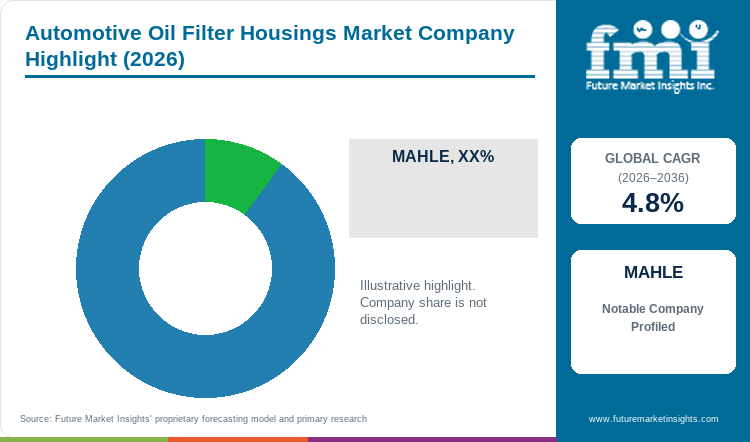
Competition separates original-equipment module engineering from vehicle-specific replacement housing programs that address known failure points in service. MAHLE and MANN+HUMMEL join Hengst and UFI Filters in documenting complete oil-management or oil-filter modules for engine lubrication systems. Standard Motor Products and CRP Automotive join Dorman Products in selling complete replacement housings for defined vehicle applications. Purflux Group operates current original-equipment and aftermarket engine-oil filtration routes under its post-Sogefi corporate identity. Engine interfaces and thermal validation create a higher entry barrier than catalog breadth alone in this exact category. Many of the same replacement distributors carry automotive air filters without changing the qualification requirements for engine-oil housings.
- Original-equipment module specialists include MAHLE and MANN+HUMMEL alongside Hengst and UFI Filters with documented complete module capability.
- Aftermarket housing specialists include Standard Motor Products and CRP Automotive alongside Dorman Products with vehicle-specific complete replacement assemblies.
- Purflux Group serves original-equipment and aftermarket engine-oil filtration routes under the current ownership structure established following the Sogefi transaction.
Competitive Benchmarking: Automotive Oil Filter Housings Market
| Company | Complete Housing / Module Breadth | OE Platform Integration | Replacement Housing Support | Geographic Reach |
|---|---|---|---|---|
| MAHLE | High | High | Medium | Global |
| MANN+HUMMEL | High | High | Medium | Global |
| Hengst | High | Low | High | Europe and international aftermarket |
| UFI Filters | High | High | Medium | Europe with global OE and aftermarket activity |
| Standard Motor Products | High | Low | High | North America |
| CRP Automotive | Medium | Low | High | North America |
| Dorman Products | High | Low | High | North America |
| Purflux Group | Medium | Medium | Low | Europe, North America and international markets |
Scoring basis: High breadth requires multiple documented complete housing or oil-module routes across distinct vehicle applications. Medium breadth requires one current complete route or a narrower documented family that shares the same engine-filtration purchase path. Low breadth identifies limited exact-market coverage that does not establish multiple complete housing or module routes. High OE integration requires direct platform-level supply while Medium reflects documented original-equipment engine-oil system participation without the same module depth. Low OE integration identifies service-catalog evidence that does not establish direct platform-supply documentation for original-equipment programs. High replacement support requires multiple complete-housing or module offers with active application coverage in service channels. Medium replacement support requires a narrower complete service route while Low identifies limited complete-housing support.
Key Developments in the Automotive Oil Filter Housings Market
- In March 2026, UFI Filters disclosed original-equipment supply of complete oil filtration modules with heat exchangers for Renault Trafic and Master vehicles whose production had begun in late 2025.
- In January 2026, CRP Automotive introduced a Rein aluminum oil filter housing for BMW B58 engines that replaces the factory plastic design and includes a pre-installed oil cooler.
- In February 2025, Standard Motor Products expanded its oil filter housing program with application-specific kits that include installed sensors and complete sealing hardware.
Key Players in the Automotive Oil Filter Housings Market
Original-Equipment Oil-Management Module Suppliers
- MAHLE
- MANN+HUMMEL
- Hengst
- UFI Filters
Aftermarket Complete-Housing Specialists
- Standard Motor Products
- CRP Automotive
- Dorman Products
Multi-Channel Filtration Supplier
- Purflux Group
Automotive Oil Filter Housings Market - Report Scope
| Coverage field | Report scope |
|---|---|
| Market breakdown | By housing type, material, engine type, vehicle type, sales channel and region. |
| Quantitative Units | USD billion. |
| Market Definition | Automotive oil filter housings include filter bases and integrated engine-oil filtration modules sold within the stated segmentation boundary. Filter media sold alone and unrelated fluid-management components are excluded. |
| Regions Covered | North America, Latin America, Western Europe, Eastern Europe, East Asia, South Asia and Pacific and Middle East and Africa. |
| Countries Covered | USA, Germany, Japan, Brazil, Czech Republic, France, Mexico, and 20+ countries included in the full report. |
| Key Companies Profiled | MAHLE, MANN+HUMMEL, Hengst, UFI Filters, Standard Motor Products, CRP Automotive, Dorman Products, and Purflux Group. |
| Forecast Period | 2026 to 2036. |
| Approach | Primary and secondary research with market triangulation. |
Automotive Oil Filter Housings Market - Research Methodology
| Method | Approach |
|---|---|
| Primary Research | FMI analysts gathered input from manufacturers, service providers, technology developers, distributors, end users, procurement teams, and subject-matter experts. Interviews examined purchasing decisions, product or service evaluation, adoption barriers, approval requirements, pricing considerations, and expectations for technical or commercial support. Respondents were also asked what evidence is required before a trial, pilot, or initial order develops into regular purchasing. |
| Desk Research | Desk research covered government statistics, regulatory publications, trade data, industry associations, technical literature, standards, company filings, product information, and official corporate announcements. Sources were reviewed for relevance, publication date, geographic coverage, and consistency with the defined market scope. Claims relating to performance, applications, approvals, capacity, investment, and commercial activity were retained only when supported by credible public evidence. |
| Market Sizing and Forecasting | The market model combined the baseline value with historical performance, segment structure, pricing and volume indicators, adoption levels, company participation, and country-level demand conditions. Forecast assumptions considered economic activity, investment trends, regulatory developments, technology adoption, purchasing cycles, supply availability, and barriers to wider market use. Segment and regional estimates were reconciled before the final market total was calculated. |
| Data Validation | Estimates were checked against multiple independent indicators, including public data, company activity, trade patterns, industry developments, and findings from primary interviews. Validation also tested whether products, services, applications, and company revenues fell within the defined market boundaries. Adjacent categories, unsupported claims, overlapping revenues, and activities without direct market relevance were excluded to reduce double counting and maintain consistency across segments and countries. |
Automotive Oil Filter Housings Market by Segments
Automotive Oil Filter Housings Market segmented by Housing Type:
- Plastic cartridge housings
- Aluminum housings
- Spin-on filter bases
- Integrated oil cooler housings
- Modular filtration housings
Automotive Oil Filter Housings Market segmented by Material:
- Glass-filled polymer
- Aluminum
- Steel
- Magnesium alloy
- Hybrid assemblies
Automotive Oil Filter Housings Market segmented by Engine Type:
- Gasoline engines
- Diesel engines
- Hybrid ICE engines
- Commercial vehicle engines
Automotive Oil Filter Housings Market segmented by Vehicle Type:
- Passenger cars
- SUVs - crossovers
- Light commercial vehicles
- Heavy trucks
- Hybrid vehicles
Automotive Oil Filter Housings Market segmented by Sales Channel:
- OEM direct
- Filtration Tier-1s
- Aftermarket replacement
- Service kits
Automotive Oil Filter Housings Market by Region:
- North America
- United States
- Canada
- Latin America
- Brazil
- Mexico
- Argentina
- Chile
- Western Europe
- Germany
- France
- United Kingdom
- Italy
- Spain
- Benelux
- Nordics
- Eastern Europe
- Poland
- Czech Republic
- Romania
- Hungary
- East Asia
- China
- Japan
- South Korea
- South Asia and Pacific
- India
- ASEAN
- Australia and New Zealand
- Middle East and Africa
- GCC Countries
- South Africa
- Türkiye
- Israel
Research Sources and Bibliography
- MANN+HUMMEL. (n.d.). Engine oil filters for passenger cars.
- USA Census Bureau and USA Bureau of Economic Analysis. (2025, January 7). USA International Trade in Goods and Services, November 2024.
- MAHLE Aftermarket. (n.d.). Engine peripherals.
- UFI Filters. (2020, July 23). UFI Filters oil module for BMW second generation 6-cylinder engines.
- Dorman Products. (n.d.). Engine Oil Filter Housing and Cooler Assembly, 926-959.
- Dorman Products. (n.d.). Engine Oil Filter Housing, 926-528.
- UFI Filters. (2021, December 9). UFI Filters oil and diesel modules for the new generation FIAT DUCATO.
- UFI Filters. (2019, October 29). New UFI Filters oil module for the Volkswagen Group's mild hybrid engines.
- MANN+HUMMEL. (n.d.). E-axles and hybrid transmissions.
- German Federal Statistical Office (Destatis). (2025, March 20). New passenger-car exports from Germany in 2024.
- Japan Customs, Ministry of Finance. (2025, April 25). Value of Exports and Imports, Fiscal Year 2024.
- Czech Statistical Office. (2024, May 7). International trade in goods (change of ownership) - March 2024.
- Brazilian Institute of Geography and Statistics (IBGE). (2026). Economic Indicators of Brazil 2025.
- INSEE. (2026). Transport statistics - New passenger cars registrations, raw monthly data series.
- INEGI. (2026). Comercio exterior de mercancías: Mexico merchandise exports, 2015-2025.
- Pacific Avenue Capital Partners. (2024, June 4). Pacific Avenue Capital Partners Completes the Acquisition of the Filtration Business of Sogefi S.p.A., Now Operating as Purflux Group.
- Hengst. (n.d.). H810H.
- UFI Filters. (2026, March 5). UFI supplies original equipment oil filter modules, heat exchangers for Renault commercial vehicles with 2.0-litre Blue dCi engines.
- CRP Automotive. (2026, January 31). CRP Automotive Introduces Rein Upgraded Oil Filter Housing for BMW B58 Engines.
- Standard Motor Products. (2025, February 6). Standard Motor Products Continues to Expand Oil Filter Housing Program.
- Purflux Group. (n.d.). Product Solutions.
- Purflux Group. (2026, September 14). PURFLUX GROUP official statement.
- MANN+HUMMEL. (2026, September 1). MANN+HUMMEL presents its formula for success at IAA TRANSPORTATION 2026.
- MAHLE. (2026, July 21). MAHLE accelerates electrification of road transport sector.
- UFI Filters. (n.d.). Original Equipment Thermal Systems.
- Standard. (n.d.). Oil Filter Housing Kits.
- CRP Automotive. (2024, June 1). Rein Aluminum Oil Filter Housing Now Available for BMW B46 Engines.
- Dorman Products. (n.d.). Engine Oil Filter Housing, 926-453.
This bibliography is provided for reader reference and is not exhaustive. The full report contains the complete reference list and detailed citations
This Report Answers
- How large is the automotive oil filter housings market in 2026?
- Which conditions preserve housing demand as vehicle powertrains shift toward electrification?
- Why do plastic cartridge housings hold a notable housing type share?
- How does glass-filled polymer affect housing weight and integration decisions?
- Why does OEM direct retain a high sales channel share?
- How do profiled country growth rates differ through the forecast period?
- Which suppliers document complete modules and replacement housing capabilities today?
- What limits automotive oil filter housing demand on pure battery-electric vehicle platforms?
Frequently Asked Questions
How big is the Automotive Oil Filter Housings Market in 2026?
The automotive oil filter housings market is valued at USD 1.5 billion in 2026 and is projected to reach USD 2.4 billion by 2036. Hybrid engine programs and integrated lubrication modules preserve demand for engine-specific complete housing assemblies during the forecast period.
What is the CAGR of the Automotive Oil Filter Housings Market from 2026 to 2036?
The automotive oil filter housings market is projected to grow at 4.8% CAGR between 2026 and 2036. Growth depends on hybrid engine programs and replacement demand from combustion vehicles that remain in service for many years.
Which housing type holds 34.0% of its category in 2026?
Plastic cartridge housings are expected to hold 34.0% of the housing type category in 2026. Serviceable filter elements and molded functional integration make this architecture practical for compact engine lubrication assemblies.
Which sales channel accounts for 51.0% of its category in 2026?
OEM direct is projected to account for 51.0% of the sales channel category in 2026. Engine-specific interfaces require platform validation before complete housings enter serial production and later service support.
Which profiled countries exceed 5.0% CAGR through 2036?
The Czech Republic is projected to expand at 5.9% CAGR through 2036 while Mexico is forecast at 5.5% and Brazil at 5.2%. Export production and replacement channels give the three countries distinct commercial paths for housing suppliers and distributors.
Which companies are active in the Automotive Oil Filter Housings Market?
Key companies include MAHLE and MANN+HUMMEL alongside Hengst and UFI Filters plus Standard Motor Products and CRP Automotive. Dorman Products and Purflux Group complete the company set with roles spanning replacement housings and multi-channel engine filtration.
Preview the report firsthand - request a free sample
Get SampleGet the brochure for pricing and purchase details.
Get PDFTable of Content
- Key Takeaways
- Market Size and CAGR
- Top Growth Driver
- Fastest Growing Segment
- Leading Region
- Key Companies
- Emerging Opportunities
- Executive Summary
- Global Market Outlook
- Demand-side Trends
- Supply-side Trends
- Technology Roadmap Analysis
- Analysis and Recommendations
- Analyst Perspective (What is happening? Why now? What should investors know?)
- Key Questions Answered
- How large is the market?
- What is the CAGR?
- What are key trends?
- Which region dominates?
- Who are the leaders?
- Market Overview
- Market Coverage / Taxonomy
- Market Definition / Scope / Limitations
- Research Methodology
- Chapter Orientation
- Analytical Lens and Working Hypotheses
- Market Structure, Signals, and Trend Drivers
- Benchmarking and Cross-market Comparability
- Market Sizing, Forecasting, and Opportunity Mapping
- Research Design and Evidence Framework
- Desk Research Programme (Secondary Evidence)
- Expert Input and Fieldwork (Primary Evidence)
- Tooling, Models, and Reference Databases
- Data Engineering and Model Build
- Quality Assurance and Audit Trail
- Market Background
- Market Dynamics (Drivers, Restraints, Opportunity, Trends)
- Scenario Forecast (Optimistic, Likely, Conservative)
- Impact Analysis
- AI Impact
- Sustainability Impact
- Regulatory Impact
- Technology Impact
- Consumer / Buyer Analysis
- Purchase Drivers
- Adoption Barriers
- Buyer Journey
- Opportunity Map Analysis
- Product Life Cycle Analysis
- Supply Chain Analysis
- Investment Feasibility Matrix
- Value Chain Analysis
- PESTLE and Porter's Analysis
- Regulatory Landscape
- Regional Parent Market Outlook
- Production and Consumption Statistics
- Import and Export Statistics
- Global Market Analysis and Forecast, 2021 to 2036
- Historical Market Size Value (USD Billion) Analysis, 2021 to 2025
- Current and Future Market Size Value (USD Billion) Projections, 2026 to 2036
- Y-o-Y Growth Trend Analysis
- Absolute $ Opportunity Analysis
- Global Market Pricing Analysis, 2021 to 2036
- Global Market Analysis and Forecast, By Housing Type, 2021 to 2036
- Introduction / Key Findings
- Historical Market Size Value (USD Billion) Analysis By Housing Type, 2021 to 2025
- Current and Future Market Size Value (USD Billion) Analysis and Forecast By Housing Type, 2026 to 2036
- Plastic cartridge housings
- Aluminum housings
- Spin-on filter bases
- Integrated oil cooler housings
- Modular filtration housings
- Y-o-Y Growth Trend Analysis By Housing Type, 2021 to 2025
- Absolute $ Opportunity Analysis By Housing Type, 2026 to 2036
- Global Market Analysis and Forecast, By Material, 2021 to 2036
- Introduction / Key Findings
- Historical Market Size Value (USD Billion) Analysis By Material, 2021 to 2025
- Current and Future Market Size Value (USD Billion) Analysis and Forecast By Material, 2026 to 2036
- Glass-filled polymer
- Aluminum
- Steel
- Magnesium alloy
- Hybrid assemblies
- Y-o-Y Growth Trend Analysis By Material, 2021 to 2025
- Absolute $ Opportunity Analysis By Material, 2026 to 2036
- Global Market Analysis and Forecast, By Engine Type, 2021 to 2036
- Introduction / Key Findings
- Historical Market Size Value (USD Billion) Analysis By Engine Type, 2021 to 2025
- Current and Future Market Size Value (USD Billion) Analysis and Forecast By Engine Type, 2026 to 2036
- Gasoline engines
- Diesel engines
- Hybrid ICE engines
- Commercial vehicle engines
- Y-o-Y Growth Trend Analysis By Engine Type, 2021 to 2025
- Absolute $ Opportunity Analysis By Engine Type, 2026 to 2036
- Global Market Analysis and Forecast, By Vehicle Type, 2021 to 2036
- Introduction / Key Findings
- Historical Market Size Value (USD Billion) Analysis By Vehicle Type, 2021 to 2025
- Current and Future Market Size Value (USD Billion) Analysis and Forecast By Vehicle Type, 2026 to 2036
- Passenger cars
- SUVs - crossovers
- Light commercial vehicles
- Heavy trucks
- Hybrid vehicles
- Y-o-Y Growth Trend Analysis By Vehicle Type, 2021 to 2025
- Absolute $ Opportunity Analysis By Vehicle Type, 2026 to 2036
- Global Market Analysis and Forecast, By Sales Channel, 2021 to 2036
- Introduction / Key Findings
- Historical Market Size Value (USD Billion) Analysis By Sales Channel, 2021 to 2025
- Current and Future Market Size Value (USD Billion) Analysis and Forecast By Sales Channel, 2026 to 2036
- OEM direct
- Filtration Tier-1s
- Aftermarket replacement
- Service kits
- Y-o-Y Growth Trend Analysis By Sales Channel, 2021 to 2025
- Absolute $ Opportunity Analysis By Sales Channel, 2026 to 2036
- Global Market Analysis and Forecast, By Region, 2021 to 2036
- Introduction
- Historical Market Size Value (USD Billion) Analysis By Region, 2021 to 2025
- Current Market Size Value (USD Billion) Analysis and Forecast By Region, 2026 to 2036
- North America
- Latin America
- Western Europe
- Eastern Europe
- East Asia
- South Asia and Pacific
- Middle East and Africa
- Market Attractiveness Analysis By Region
- North America Market Analysis and Forecast, By Country, 2021 to 2036
- Historical Market Size Value (USD Billion) Trend Analysis By Market Taxonomy, 2021 to 2025
- Market Size Value (USD Billion) Forecast By Market Taxonomy, 2026 to 2036
- By Country
- United States
- Canada
- By Housing Type
- By Material
- By Engine Type
- By Vehicle Type
- By Sales Channel
- By Country
- Market Attractiveness Analysis
- By Country
- By Housing Type
- By Material
- By Engine Type
- By Vehicle Type
- By Sales Channel
- Key Takeaways
- Latin America Market Analysis and Forecast, By Country
- Historical Market Size Value (USD Billion) Trend Analysis By Market Taxonomy, 2021 to 2025
- Market Size Value (USD Billion) Forecast By Market Taxonomy, 2026 to 2036
- By Country
- Brazil
- Mexico
- Argentina
- Chile
- By Housing Type
- By Material
- By Engine Type
- By Vehicle Type
- By Sales Channel
- By Country
- Market Attractiveness Analysis
- By Country
- By Housing Type
- By Material
- By Engine Type
- By Vehicle Type
- By Sales Channel
- Key Takeaways
- Western Europe Market Analysis and Forecast, By Country
- Historical Market Size Value (USD Billion) Trend Analysis By Market Taxonomy, 2021 to 2025
- Market Size Value (USD Billion) Forecast By Market Taxonomy, 2026 to 2036
- By Country
- Germany
- France
- United Kingdom
- Italy
- Spain
- Benelux
- Nordics
- By Housing Type
- By Material
- By Engine Type
- By Vehicle Type
- By Sales Channel
- By Country
- Market Attractiveness Analysis
- By Country
- By Housing Type
- By Material
- By Engine Type
- By Vehicle Type
- By Sales Channel
- Key Takeaways
- Eastern Europe Market Analysis and Forecast, By Country
- Historical Market Size Value (USD Billion) Trend Analysis By Market Taxonomy, 2021 to 2025
- Market Size Value (USD Billion) Forecast By Market Taxonomy, 2026 to 2036
- By Country
- Poland
- Czech Republic
- Romania
- Hungary
- By Housing Type
- By Material
- By Engine Type
- By Vehicle Type
- By Sales Channel
- By Country
- Market Attractiveness Analysis
- By Country
- By Housing Type
- By Material
- By Engine Type
- By Vehicle Type
- By Sales Channel
- Key Takeaways
- East Asia Market Analysis and Forecast, By Country
- Historical Market Size Value (USD Billion) Trend Analysis By Market Taxonomy, 2021 to 2025
- Market Size Value (USD Billion) Forecast By Market Taxonomy, 2026 to 2036
- By Country
- China
- Japan
- South Korea
- By Housing Type
- By Material
- By Engine Type
- By Vehicle Type
- By Sales Channel
- By Country
- Market Attractiveness Analysis
- By Country
- By Housing Type
- By Material
- By Engine Type
- By Vehicle Type
- By Sales Channel
- Key Takeaways
- South Asia and Pacific Market Analysis and Forecast, By Country
- Historical Market Size Value (USD Billion) Trend Analysis By Market Taxonomy, 2021 to 2025
- Market Size Value (USD Billion) Forecast By Market Taxonomy, 2026 to 2036
- By Country
- India
- ASEAN
- Australia and New Zealand
- By Housing Type
- By Material
- By Engine Type
- By Vehicle Type
- By Sales Channel
- By Country
- Market Attractiveness Analysis
- By Country
- By Housing Type
- By Material
- By Engine Type
- By Vehicle Type
- By Sales Channel
- Key Takeaways
- Middle East and Africa Market Analysis and Forecast, By Country
- Historical Market Size Value (USD Billion) Trend Analysis By Market Taxonomy, 2021 to 2025
- Market Size Value (USD Billion) Forecast By Market Taxonomy, 2026 to 2036
- By Country
- GCC Countries
- South Africa
- Türkiye
- Israel
- By Housing Type
- By Material
- By Engine Type
- By Vehicle Type
- By Sales Channel
- By Country
- Market Attractiveness Analysis
- By Country
- By Housing Type
- By Material
- By Engine Type
- By Vehicle Type
- By Sales Channel
- Key Takeaways
- Key Countries Market Analysis
- United States
- Pricing Analysis
- Market Share Analysis, 2025
- By Housing Type
- By Material
- By Engine Type
- By Vehicle Type
- By Sales Channel
- Canada
- Pricing Analysis
- Market Share Analysis, 2025
- By Housing Type
- By Material
- By Engine Type
- By Vehicle Type
- By Sales Channel
- Mexico
- Pricing Analysis
- Market Share Analysis, 2025
- By Housing Type
- By Material
- By Engine Type
- By Vehicle Type
- By Sales Channel
- Brazil
- Pricing Analysis
- Market Share Analysis, 2025
- By Housing Type
- By Material
- By Engine Type
- By Vehicle Type
- By Sales Channel
- Chile
- Pricing Analysis
- Market Share Analysis, 2025
- By Housing Type
- By Material
- By Engine Type
- By Vehicle Type
- By Sales Channel
- Germany
- Pricing Analysis
- Market Share Analysis, 2025
- By Housing Type
- By Material
- By Engine Type
- By Vehicle Type
- By Sales Channel
- United Kingdom
- Pricing Analysis
- Market Share Analysis, 2025
- By Housing Type
- By Material
- By Engine Type
- By Vehicle Type
- By Sales Channel
- Italy
- Pricing Analysis
- Market Share Analysis, 2025
- By Housing Type
- By Material
- By Engine Type
- By Vehicle Type
- By Sales Channel
- Spain
- Pricing Analysis
- Market Share Analysis, 2025
- By Housing Type
- By Material
- By Engine Type
- By Vehicle Type
- By Sales Channel
- France
- Pricing Analysis
- Market Share Analysis, 2025
- By Housing Type
- By Material
- By Engine Type
- By Vehicle Type
- By Sales Channel
- India
- Pricing Analysis
- Market Share Analysis, 2025
- By Housing Type
- By Material
- By Engine Type
- By Vehicle Type
- By Sales Channel
- ASEAN
- Pricing Analysis
- Market Share Analysis, 2025
- By Housing Type
- By Material
- By Engine Type
- By Vehicle Type
- By Sales Channel
- Australia and New Zealand
- Pricing Analysis
- Market Share Analysis, 2025
- By Housing Type
- By Material
- By Engine Type
- By Vehicle Type
- By Sales Channel
- China
- Pricing Analysis
- Market Share Analysis, 2025
- By Housing Type
- By Material
- By Engine Type
- By Vehicle Type
- By Sales Channel
- Japan
- Pricing Analysis
- Market Share Analysis, 2025
- By Housing Type
- By Material
- By Engine Type
- By Vehicle Type
- By Sales Channel
- South Korea
- Pricing Analysis
- Market Share Analysis, 2025
- By Housing Type
- By Material
- By Engine Type
- By Vehicle Type
- By Sales Channel
- Poland
- Pricing Analysis
- Market Share Analysis, 2025
- By Housing Type
- By Material
- By Engine Type
- By Vehicle Type
- By Sales Channel
- Hungary
- Pricing Analysis
- Market Share Analysis, 2025
- By Housing Type
- By Material
- By Engine Type
- By Vehicle Type
- By Sales Channel
- Türkiye
- Pricing Analysis
- Market Share Analysis, 2025
- By Housing Type
- By Material
- By Engine Type
- By Vehicle Type
- By Sales Channel
- South Africa
- Pricing Analysis
- Market Share Analysis, 2025
- By Housing Type
- By Material
- By Engine Type
- By Vehicle Type
- By Sales Channel
- Czech Republic
- Pricing Analysis
- Market Share Analysis, 2025
- By Housing Type
- By Material
- By Engine Type
- By Vehicle Type
- By Sales Channel
- United States
- Market Structure Analysis
- Competition Dashboard
- Competition Benchmarking
- Market Share Analysis of Top Players
- By Regional
- By Housing Type
- By Material
- By Engine Type
- By Vehicle Type
- By Sales Channel
- Emerging Startups
- Innovation Benchmarking
- Competition Analysis
- Competition Deep Dive
- MAHLE
- Overview
- Product Portfolio
- Profitability by Market Segments
- Sales Footprint
- Strategy Overview
- Marketing Strategy
- Product Strategy
- Channel Strategy
- MANN+HUMMEL
- Hengst
- UFI Filters
- Standard Motor Products
- CRP Automotive
- Dorman Products
- Purflux Group
- MAHLE
- Case Studies
- Success Stories
- Recent Developments
- Competition Deep Dive
- Assumptions & Acronyms Used


