

- Industry Size (2022)
- USD 215.9 Mn
- Forecast (2032)
- USD 657.1 Mn
- CAGR (2022 to 2032)
- 8.4%
Automotive Oil Strainer Market Snapshot (2022-2032)
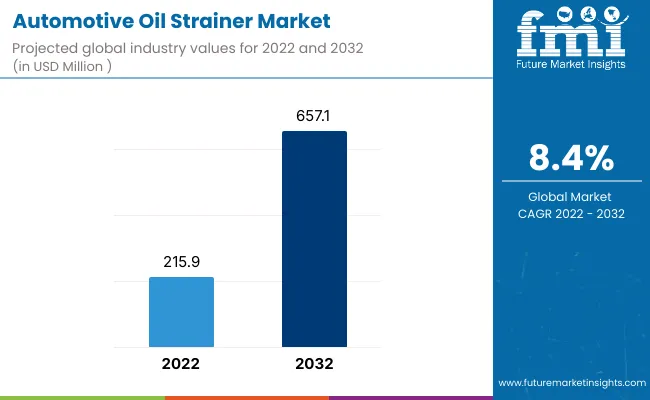
[250 Pages Report] The global automotive oil strainer market size is anticipated to be valued at US$ 657.1 Million in 2032. Rising number of fuel economy regulations and surging stringency of vehicle emission are expected to push sales of automotive oil strainers in the upcoming years.
As per a new report by FMI, the automotive oil strainer market is projected to reach US$ 215.9 Million in 2022 and exhibit steady growth at a CAGR of 8.4% in the forecast period from 2022 to 2032. Rapid expansion of the automotive industry across the globe is set to drive the market.
| Report Attribute | Details |
| Automotive Oil Strainer Market Estimated Base Year Value (2021) | US$ 194.5 Million |
| Automotive Oil Strainer Market Expected Market Value (2022) | US$ 215.9 Million |
| Automotive Oil Strainer Market Anticipated Forecast Value (2032) | US$ 657.1 Million |
| Automotive Oil Strainer Market Projected Growth Rate (2022-2032) | 8.4% CAGR |
Automotive oil strainers are mainly integrated into vehicles to get hold of large-sized contaminants. These large-sized contaminants are impurities that are larger than 40 microns.
The demand for automotive oil strainers is likely to grow at a rapid pace in the forthcoming years stoked by their ability to hold contaminants of sizes surpassing 240-micron level. Today’s innovative oil strainers have a 60 mesh strainer container.
Stringent government regulations in various parts of the globe are expected to compel automobile manufacturers to produce efficient engines, as well as develop technologically advanced engine designs to accelerate oil filtration.
Rising demand for luxury passenger cars, especially in developed countries, such as the U.S., U.K., Germany, and Italy is another crucial factor that is estimated to augment growth.
High Demand for Safe Transportation Services to Push the Automotive Oil Strainer Market Growth
Rising demand for passenger cars backed by the entry of various international automobile manufacturers in untapped areas, as well as rising investments in the development of luxurious and safe transportation systems is expected to boost the automotive oil strainer market growth. Increasing awareness about the importance of maintaining a healthy air cabin quality is another vital factor that is likely to augment the market.
Moreover, the replacement cycle of automotive oil strainers is usually optimized because of technological advancements in filter media types. Urgent need to enhance the oil quality by separating the oil from contaminants to keep it safe and unadulterated is also projected to push the market in the assessment period.
Tough Competition among Leading Players and IAM Companies May Hinder the Automotive Oil Strainer Market Growth
The global market consists of various Original Equipment Suppliers (OES) and Independent Aftermarket (IAM). Several IAM companies present in the field of automotive oil strainers are expected to provide tough competition to the market leaders, especially in India and China.
It is likely to occur as IAM players are capable of matching the requirements of customers by delivering better quality products, compared to Tier 1 companies at a relatively low cost. Spurred by the aforementioned factors, the demand for automotive oil strainers is anticipated to surge at a fast pace in future years.
Concerns about the Environmental Impact of Air Pollutants in North America to Boost the Automotive Oil Strainer Market
According to FMI, North America is expected to remain at the forefront by generating the largest automotive oil strainer market share in the evaluation period. Increasing implementation of stringent regulations owing to the rising awareness about the environmental impact of air pollutants is likely to spur the regional market.
Besides, high average miles driven per year and large vehicle parc in Canada, Mexico, and the U.S. are some of the other major factors that are expected to drive the North America market. As per the U.S. Department of Transportation, in 2020, nearly 105,143,990 new vehicle registrations took place in the country. The number is anticipated to grow at a fast pace, thereby propelling the North America market.
Ongoing Development of Passenger Cars in India to Drive the Asia Pacific Automotive Oil Strainer Market
The presence of a large number of automotive component manufacturers in developing countries, such as China, is anticipated to foster sales of automotive oil strainers in Asia Pacific, finds FMI. Rising demand for synthetic automotive oil strainers owing to their high suitability and efficiency to any type of oil is likely to drive the regional market.
In addition to that, rapid expansion of the automotive industry in India is projected to bode well for the market. According to the India Brand Equity Foundation (IBEF), between April to October 2021, approximately 13 million vehicles were produced in the country. Also, sales of passenger vehicles reached 3.08 million units in CY21. The trend is expected to continue throughout the forthcoming years, thereby accelerating the Asia Pacific market.
Market Competition
Some of the leading players present in the global automotive oil strainer market include Triple R America, Parker Hannifin Corp., TECNECOFILTRATION, Delphi Auto Parts, Champion Laboratories, Inc., DaikyoNishikawa Corporation, VANTECH CO., LTD., ELOFIC INDUSTRIES LIMITED, ALCO Filters Ltd., Lucas Industries Ltd., and Anhui Meiruier Filter Co. Ltd., among others.
The global market is fragmented in nature with the presence of several regional and international companies. The majority of the leading players are resorting to partnerships with small-scale manufacturers, new product launches, constructive collaborations, and product design changes to surge their penetration in highly profitable areas.
Meanwhile, some of the other key players are focusing on combining various growth strategies to propel their geographical reach and increase sales of their in-house automotive oil strainers to compete with rivals.
Report Scope
|
Report Attribute |
Details |
|
Growth Rate |
CAGR of 8.4% from 2022 to 2032 |
|
Base Year for Estimation |
2021 |
|
Historical Data |
2015-2020 |
|
Forecast Period |
2022-2032 |
|
Quantitative Units |
Volume, USD Million, and CAGR from 2022-2032 |
|
Report Coverage |
Revenue Forecast, Volume Forecast, Company Ranking, Competitive Landscape, Growth Factors, Trends and Pricing Analysis |
|
Segments Covered |
|
|
Regions Covered |
|
|
Key Countries Profiled |
|
|
Key Companies Profiled |
|
|
Customization |
Available Upon Request |
Key Segments Profiled in the Automotive Oil Strainer Industry Survey
By Vehicle Type:
- Passenger Cars
- Compact Cars
- Mid-Sized Cars
- Luxury
- SUVs
- Commercial Vehicles
- LCVs (Light Commercial Vehicles)
- HCVs (Heavy Commercial Vehicles)
By Cover Type:
- Floating Type Automotive Oil Strainer
- Fixed Type Automotive Oil Strainer
By Sales Channel:
- OEMs
- Aftermarket
By Region:
- North America
- Latin America
- Western Europe
- Eastern Europe
- APEJ
- Japan
- Middle East and Africa
Frequently Asked Questions
What is the projected size of the global automotive oil strainer market by 2032?
The global automotive oil strainer market is projected to surpass US$ 657.1 Million in 2032.
Which region is set to lead the automotive oil strainer market?
North America is set to lead the automotive oil strainer market in the forecast period.
Which are some of the renowned companies in the automotive oil strainer market?
Triple R America, Parker Hannifin Corp., TECNECOFILTRATION, Delphi Auto Parts, Champion Laboratories, Inc., and DaikyoNishikawa Corporation are some of the renowned companies in the automotive oil strainer market.
Preview the report firsthand - request a free sample
Get SampleGet the brochure for pricing and purchase details.
Get PDFTable of Content
1. Executive Summary
1.1. Global Market Outlook
1.2. Demand-side Trends
1.3. Supply-side Trends
1.4. Technology Roadmap Analysis
1.5. Analysis and Recommendations
2. Market Overview
2.1. Market Coverage / Taxonomy
2.2. Market Definition / Scope / Limitations
3. Market Background
3.1. Market Dynamics
3.1.1. Drivers
3.1.2. Restraints
3.1.3. Opportunity
3.1.4. Trends
3.2. Scenario Forecast
3.2.1. Demand in Optimistic Scenario
3.2.2. Demand in Likely Scenario
3.2.3. Demand in Conservative Scenario
3.3. Opportunity Map Analysis
3.4. Product Life Cycle Analysis
3.5. Supply Chain Analysis
3.5.1. Supply Side Participants and their Roles
3.5.1.1. Producers
3.5.1.2. Mid-Level Participants (Traders/ Agents/ Brokers)
3.5.1.3. Wholesalers and Distributors
3.5.2. Value Added and Value Created at Node in the Supply Chain
3.5.3. List of Raw Material Suppliers
3.5.4. List of Existing and Potential Buyer’s
3.6. Investment Feasibility Matrix
3.7. Value Chain Analysis
3.7.1. Profit Margin Analysis
3.7.2. Wholesalers and Distributors
3.7.3. Retailers
3.8. PESTLE and Porter’s Analysis
3.9. Regulatory Landscape
3.9.1. By Key Regions
3.9.2. By Key Countries
3.10. Regional Parent Market Outlook
3.11. Production and Consumption Statistics
3.12. Import and Export Statistics
4. Global Automotive Oil Strainer Market Analysis 2017-2021 and Forecast, 2022-2032
4.1. Historical Market Size Value (US$ Mn) & Volume (Units) Analysis, 2017-2021
4.2. Current and Future Market Size Value (US$ Mn) & Volume (Units) Projections, 2022-2032
4.2.1. Y-o-Y Growth Trend Analysis
4.2.2. Absolute $ Opportunity Analysis
5. Global Automotive Oil Strainer Market Analysis 2017-2021 and Forecast 2022-2032, By Product
5.1. Introduction / Key Findings
5.2. Historical Market Size Value (US$ Mn) & Volume (Units) Analysis By Product, 2017-2021
5.3. Current and Future Market Size Value (US$ Mn) & Volume (Units) Analysis and Forecast By Product, 2022-2032
5.3.1. Floating Type
5.3.2. Fixed Type
5.4. Y-o-Y Growth Trend Analysis By Product, 2017-2021
5.5. Absolute $ Opportunity Analysis By Product, 2022-2032
6. Global Automotive Oil Strainer Market Analysis 2017-2021 and Forecast 2022-2032, By Application
6.1. Introduction / Key Findings
6.2. Historical Market Size Value (US$ Mn) & Volume (Units) Analysis By Application, 2017-2021
6.3. Current and Future Market Size Value (US$ Mn) & Volume (Units) Analysis and Forecast By Application, 2022-2032
6.3.1. Passenger Cars
6.3.2. Commercial Vehicles
6.4. Y-o-Y Growth Trend Analysis By Application, 2017-2021
6.5. Absolute $ Opportunity Analysis By Application, 2022-2032
7. Global Automotive Oil Strainer Market Analysis 2017-2021 and Forecast 2022-2032, By Region
7.1. Introduction
7.2. Historical Market Size Value (US$ Mn) & Volume (Units) Analysis By Region, 2017-2021
7.3. Current Market Size Value (US$ Mn) & Volume (Units) Analysis and Forecast By Region, 2022-2032
7.3.1. North America
7.3.2. Latin America
7.3.3. Europe
7.3.4. Asia Pacific
7.3.5. MEA
7.4. Market Attractiveness Analysis By Region
8. North America Automotive Oil Strainer Market Analysis 2017-2021 and Forecast 2022-2032, By Country
8.1. Historical Market Size Value (US$ Mn) & Volume (Units) Trend Analysis By Market Taxonomy, 2017-2021
8.2. Market Size Value (US$ Mn) & Volume (Units) Forecast By Market Taxonomy, 2022-2032
8.2.1. By Country
8.2.1.1. U.S.
8.2.1.2. Canada
8.2.2. By Product
8.2.3. By Application
8.3. Market Attractiveness Analysis
8.3.1. By Country
8.3.2. By Product
8.3.3. By Application
8.4. Key Takeaways
9. Latin America Automotive Oil Strainer Market Analysis 2017-2021 and Forecast 2022-2032, By Country
9.1. Historical Market Size Value (US$ Mn) & Volume (Units) Trend Analysis By Market Taxonomy, 2017-2021
9.2. Market Size Value (US$ Mn) & Volume (Units) Forecast By Market Taxonomy, 2022-2032
9.2.1. By Country
9.2.1.1. Brazil
9.2.1.2. Mexico
9.2.1.3. Rest of Latin America
9.2.2. By Product
9.2.3. By Application
9.3. Market Attractiveness Analysis
9.3.1. By Country
9.3.2. By Product
9.3.3. By Application
9.4. Key Takeaways
10. Europe Automotive Oil Strainer Market Analysis 2017-2021 and Forecast 2022-2032, By Country
10.1. Historical Market Size Value (US$ Mn) & Volume (Units) Trend Analysis By Market Taxonomy, 2017-2021
10.2. Market Size Value (US$ Mn) & Volume (Units) Forecast By Market Taxonomy, 2022-2032
10.2.1. By Country
10.2.1.1. Germany
10.2.1.2. U.K.
10.2.1.3. France
10.2.1.4. Spain
10.2.1.5. Italy
10.2.1.6. Russia
10.2.1.7. Rest of Europe
10.2.2. By Product
10.2.3. By Application
10.3. Market Attractiveness Analysis
10.3.1. By Country
10.3.2. By Product
10.3.3. By Application
10.4. Key Takeaways
11. Asia Pacific Automotive Oil Strainer Market Analysis 2017-2021 and Forecast 2022-2032, By Country
11.1. Historical Market Size Value (US$ Mn) & Volume (Units) Trend Analysis By Market Taxonomy, 2017-2021
11.2. Market Size Value (US$ Mn) & Volume (Units) Forecast By Market Taxonomy, 2022-2032
11.2.1. By Country
11.2.1.1. China
11.2.1.2. Japan
11.2.1.3. India
11.2.1.4. South Korea
11.2.1.5. Australia
11.2.1.6. Rest of APAC
11.2.2. By Product
11.2.3. By Application
11.3. Market Attractiveness Analysis
11.3.1. By Country
11.3.2. By Product
11.3.3. By Application
11.4. Key Takeaways
12. MEA Automotive Oil Strainer Market Analysis 2017-2021 and Forecast 2022-2032, By Country
12.1. Historical Market Size Value (US$ Mn) & Volume (Units) Trend Analysis By Market Taxonomy, 2017-2021
12.2. Market Size Value (US$ Mn) & Volume (Units) Forecast By Market Taxonomy, 2022-2032
12.2.1. By Country
12.2.1.1. South Africa
12.2.1.2. Saudi Arabia
12.2.1.3. UAE
12.2.1.4. Israel
12.2.1.5. Rest of MEA
12.2.2. By Product
12.2.3. By Application
12.3. Market Attractiveness Analysis
12.3.1. By Country
12.3.2. By Product
12.3.3. By Application
12.4. Key Takeaways
13. Key Countries Automotive Oil Strainer Market Analysis
13.1. U.S.
13.1.1. Pricing Analysis
13.1.2. Market Share Analysis, 2021
13.1.2.1. By Product
13.1.2.2. By Application
13.2. Canada
13.2.1. Pricing Analysis
13.2.2. Market Share Analysis, 2021
13.2.2.1. By Product
13.2.2.2. By Application
13.3. Brazil
13.3.1. Pricing Analysis
13.3.2. Market Share Analysis, 2021
13.3.2.1. By Product
13.3.2.2. By Application
13.4. Mexico
13.4.1. Pricing Analysis
13.4.2. Market Share Analysis, 2021
13.4.2.1. By Product
13.4.2.2. By Application
13.5. Germany
13.5.1. Pricing Analysis
13.5.2. Market Share Analysis, 2021
13.5.2.1. By Product
13.5.2.2. By Application
13.6. U.K.
13.6.1. Pricing Analysis
13.6.2. Market Share Analysis, 2021
13.6.2.1. By Product
13.6.2.2. By Application
13.7. France
13.7.1. Pricing Analysis
13.7.2. Market Share Analysis, 2021
13.7.2.1. By Product
13.7.2.2. By Application
13.8. Spain
13.8.1. Pricing Analysis
13.8.2. Market Share Analysis, 2021
13.8.2.1. By Product
13.8.2.2. By Application
13.9. Italy
13.9.1. Pricing Analysis
13.9.2. Market Share Analysis, 2021
13.9.2.1. By Product
13.9.2.2. By Application
13.10. Russia
13.10.1. Pricing Analysis
13.10.2. Market Share Analysis, 2021
13.10.2.1. By Product
13.10.2.2. By Application
13.11. China
13.11.1. Pricing Analysis
13.11.2. Market Share Analysis, 2021
13.11.2.1. By Product
13.11.2.2. By Application
13.12. Japan
13.12.1. Pricing Analysis
13.12.2. Market Share Analysis, 2021
13.12.2.1. By Product
13.12.2.2. By Application
13.13. India
13.13.1. Pricing Analysis
13.13.2. Market Share Analysis, 2021
13.13.2.1. By Product
13.13.2.2. By Application
13.14. South Korea
13.14.1. Pricing Analysis
13.14.2. Market Share Analysis, 2021
13.14.2.1. By Product
13.14.2.2. By Application
13.15. Australia
13.15.1. Pricing Analysis
13.15.2. Market Share Analysis, 2021
13.15.2.1. By Product
13.15.2.2. By Application
13.16. South Africa
13.16.1. Pricing Analysis
13.16.2. Market Share Analysis, 2021
13.16.2.1. By Product
13.16.2.2. By Application
13.17. Saudi Arabia
13.17.1. Pricing Analysis
13.17.2. Market Share Analysis, 2021
13.17.2.1. By Product
13.17.2.2. By Application
13.18. UAE
13.18.1. Pricing Analysis
13.18.2. Market Share Analysis, 2021
13.18.2.1. By Product
13.18.2.2. By Application
13.19. Israel
13.19.1. Pricing Analysis
13.19.2. Market Share Analysis, 2021
13.19.2.1. By Product
13.19.2.2. By Application
14. Market Structure Analysis
14.1. Competition Dashboard
14.2. Competition Benchmarking
14.3. Market Share Analysis of Top Players
14.3.1. By Regional
14.3.2. By Product
14.3.3. By Application
15. Competition Analysis
15.1. Competition Deep Dive
15.1.1. DaikyoNishikawa
15.1.1.1. Overview
15.1.1.2. Product Portfolio
15.1.1.3. Profitability by Market Segments
15.1.1.4. Sales Footprint
15.1.1.5. Strategy Overview
15.1.1.5.1. Marketing Strategy
15.1.1.5.2. Product Strategy
15.1.1.5.3. Channel Strategy
15.1.2. AL Filter
15.1.2.1. Overview
15.1.2.2. Product Portfolio
15.1.2.3. Profitability by Market Segments
15.1.2.4. Sales Footprint
15.1.2.5. Strategy Overview
15.1.2.5.1. Marketing Strategy
15.1.2.5.2. Product Strategy
15.1.2.5.3. Channel Strategy
15.1.3. Lucas Filters
15.1.3.1. Overview
15.1.3.2. Product Portfolio
15.1.3.3. Profitability by Market Segments
15.1.3.4. Sales Footprint
15.1.3.5. Strategy Overview
15.1.3.5.1. Marketing Strategy
15.1.3.5.2. Product Strategy
15.1.3.5.3. Channel Strategy
15.1.4. Triple R America
15.1.4.1. Overview
15.1.4.2. Product Portfolio
15.1.4.3. Profitability by Market Segments
15.1.4.4. Sales Footprint
15.1.4.5. Strategy Overview
15.1.4.5.1. Marketing Strategy
15.1.4.5.2. Product Strategy
15.1.4.5.3. Channel Strategy
15.1.5. Champ Filteration
15.1.5.1. Overview
15.1.5.2. Product Portfolio
15.1.5.3. Profitability by Market Segments
15.1.5.4. Sales Footprint
15.1.5.5. Strategy Overview
15.1.5.5.1. Marketing Strategy
15.1.5.5.2. Product Strategy
15.1.5.5.3. Channel Strategy
15.1.6. AnHui Meiruier Filter
15.1.6.1. Overview
15.1.6.2. Product Portfolio
15.1.6.3. Profitability by Market Segments
15.1.6.4. Sales Footprint
15.1.6.5. Strategy Overview
15.1.6.5.1. Marketing Strategy
15.1.6.5.2. Product Strategy
15.1.6.5.3. Channel Strategy
15.1.7. TECNECO FILTRATION
15.1.7.1. Overview
15.1.7.2. Product Portfolio
15.1.7.3. Profitability by Market Segments
15.1.7.4. Sales Footprint
15.1.7.5. Strategy Overview
15.1.7.5.1. Marketing Strategy
15.1.7.5.2. Product Strategy
15.1.7.5.3. Channel Strategy
15.1.8. ALCO Filters
15.1.8.1. Overview
15.1.8.2. Product Portfolio
15.1.8.3. Profitability by Market Segments
15.1.8.4. Sales Footprint
15.1.8.5. Strategy Overview
15.1.8.5.1. Marketing Strategy
15.1.8.5.2. Product Strategy
15.1.8.5.3. Channel Strategy
15.1.9. Sanko Gosei
15.1.9.1. Overview
15.1.9.2. Product Portfolio
15.1.9.3. Profitability by Market Segments
15.1.9.4. Sales Footprint
15.1.9.5. Strategy Overview
15.1.9.5.1. Marketing Strategy
15.1.9.5.2. Product Strategy
15.1.9.5.3. Channel Strategy
15.1.10. Showa Rasenkan Seisakusho
15.1.10.1. Overview
15.1.10.2. Product Portfolio
15.1.10.3. Profitability by Market Segments
15.1.10.4. Sales Footprint
15.1.10.5. Strategy Overview
15.1.10.5.1. Marketing Strategy
15.1.10.5.2. Product Strategy
15.1.10.5.3. Channel Strategy
15.1.11. VANTECH
15.1.11.1. Overview
15.1.11.2. Product Portfolio
15.1.11.3. Profitability by Market Segments
15.1.11.4. Sales Footprint
15.1.11.5. Strategy Overview
15.1.11.5.1. Marketing Strategy
15.1.11.5.2. Product Strategy
15.1.11.5.3. Channel Strategy
15.1.12. Watanabe Indusutry
15.1.12.1. Overview
15.1.12.2. Product Portfolio
15.1.12.3. Profitability by Market Segments
15.1.12.4. Sales Footprint
15.1.12.5. Strategy Overview
15.1.12.5.1. Marketing Strategy
15.1.12.5.2. Product Strategy
15.1.12.5.3. Channel Strategy
16. Assumptions & Acronyms Used
17. Research Methodology


