

- Market Size (2026)
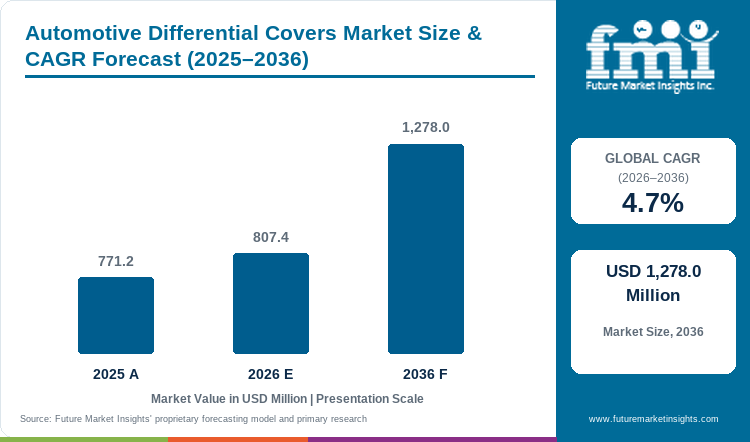
- USD 807.4 Mn
- Forecast (2036)
- USD 1278.0 Mn
- CAGR (2026 to 2036)
- 4.7%
How big is Automotive Differential Covers Market in 2026?
USD 807.4 million in 2026 and USD 1,278.0 million by 2036 at a 4.7% CAGR.
Sales of automotive differential covers are estimated to rise at 4.7% CAGR through 2036, increasing valuation from USD 771.2 million in 2025 to USD 807.4 million in 2026, and reaching USD 1,278.0 million by 2036. New axle programs are creating factory-fit volume because engineers are releasing cover geometry with each differential housing and vehicle package. Replacement demand remains active because corrosion damage or sealing failure makes a serviceable cover unusable during operation.
Mexico is projected to grow at 5.5% CAGR through 2036 compared with 3.8% CAGR for Japan. INEGI recorded 3.95 million light vehicles produced in Mexico during 2025 and light trucks represented 77.2% of output. Japan's tightly qualified platforms are limiting comparable light-truck exposure as automakers are managing component security across multiple propulsion pathways.
Key Takeaways
- Factory-fit axle programs and repair of serviceable differential housings are creating separate demand routes for automotive differential covers.
- Based on cover type, stamped steel covers are projected to account for 36.0% in 2026. Formed construction is supporting repeatable sealing geometry across automotive volumes and high-volume standard replacement programs.
- The axle type category is forecast to be led by light-duty axles at 27.0% share in 2026. The installed light-duty axle population is supporting factory fitment and later replacement coverage across established pickup and utility platforms.
- In 2026, pickup trucks are expected to lead the vehicle type category with 31.0% share. Large axle populations and active service channels are supporting recurring cover demand across factory and replacement channels.
- Axle-specific bolt patterns and clearance requirements are increasing validation work across replacement catalogs and inventory planning.
- Dana and Dauch Corporation are participating in integrated driveline programs tied to vehicle-platform engineering. Magna International and GKN Automotive are supporting platform programs alongside Linamar through current powertrain and driveline engineering. Dorman Products and Yukon Gear & Axle are serving replacement channels alongside Spicer through application-specific axle-service coverage. ARB 4x4 Accessories and RuffStuff Specialties are serving severe-duty off-road applications with reinforced differential-cover products.
Analyst Perspective
"Differential-cover suppliers are earning repeat business by matching each axle family before competing on material or added protection. Electrified driveline integration is changing the opportunity unevenly because many installed pickups and commercial vehicles still retain serviceable housings."
- Nikhil Kaitwade, Principal Consultant, Future Market Insights
How is the automotive differential covers market segmented?
The automotive differential covers market is segmented by Cover Type, Axle Type, Vehicle Type, Sales Channel, Material, and Region.
The automotive differential covers market is segmented by cover type, axle type, vehicle type, sales channel, material, and region. Cover type includes stamped steel, cast aluminum, reinforced, inspection, and performance/off-road and axle type spans light-duty, heavy-duty, pickup/SUV, off-road, and commercial vehicle axles. Vehicle type covers pickups, SUVs/off-road, passenger cars, commercial vehicles, and motorsport vehicles whereas sales channels distinguish OEM direct, driveline Tier-1, aftermarket replacement, and performance/off-road aftermarket. Material separates stamped steel, cast aluminum, ductile iron, and composite/hybrid construction and region follows standard geography.
What keeps stamped steel covers central to the cover type category?
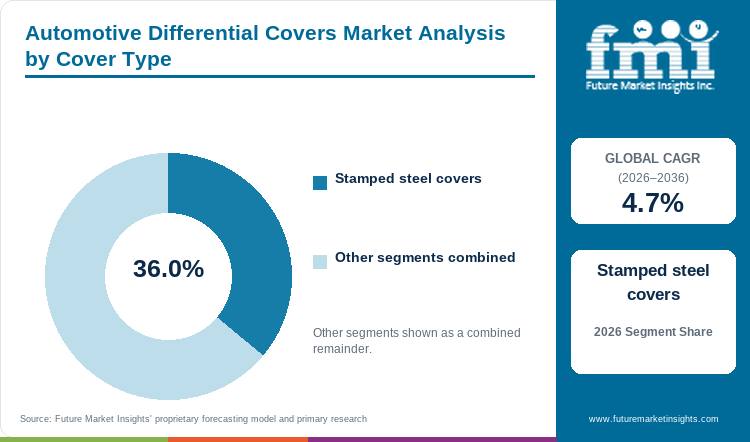
Stamped steel covers are being used in volume programs that require repeatable sealing flanges and controlled unit cost. Formed construction accepts corrosion coatings without the machining burden and extra finishing required by thicker cast designs. Each cover follows housing geometry used in automotive axle systems instead of a universal closure.
- Based on cover type, stamped steel covers are projected to account for 36.0% in 2026. High-volume forming and replacement fitment are supporting its position across standard-volume applications and service programs.
- Spicer is currently specifying nodular iron and ribbed construction for performance differential covers used in severe off-road service.
How do light-duty axles shape demand within the axle type category?
Light-duty axles are supporting large pickup and utility fleets that retain serviceable differential housings across long operating lives. Cover selection follows axle and propeller shafts because sealing clearance and lubricant access are fixed within each package. Heavy-duty and off-road axles are serving smaller populations with higher load requirements and fewer repeat fitments.
- The axle type category is forecast to be led by light-duty axles at 27.0% share in 2026. Installed-base breadth and replacement coverage support their position in recurring factory and service applications.
- Dorman is listing direct-replacement differential covers for Ford Super Duty applications with vehicle-specific bolt counts and material specifications.
What supports pickup-truck demand within the vehicle type category?
Pickup trucks combine high axle exposure with towing and off-road use that increases the value of differential protection. Repair channels are using differential remanufacturing programs to service axles whose damaged covers remain separately replaceable. Passenger cars are increasingly using integrated driveline packaging that removes some conventional bolt-on cover applications from new platforms.
- Pickup trucks are set to lead the vehicle type category with 31.0% share in 2026. Large axle populations and active service channels are reinforcing their position across factory fitment and replacement demand.
- Yukon Gear & Axle is currently offering a Dana M275 cover for Ford Super Duty applications with nodular iron construction and increased fluid capacity.
How does OEM direct sourcing shape the sales channel category?
OEM direct sourcing begins during platform development because engineers are validating cover geometry with the axle program. The interface follows axle housing and carrier assemblies because housing geometry defines the sealing boundary. Replacement channels are gaining importance once vehicles enter service and factory program control no longer governs every purchase.
- The sales channel category is forecast to be led by OEM direct at 41.0% share in 2026. Platform-level fitment validation before production supports its position in new vehicle manufacturing programs worldwide.
- Magna received General Motors Supplier of the Year recognition for transfer cases in May 2026. Electric vehicle e-axles require platform-level validation because drive and differential functions are integrated before production release.
Why does stamped steel remain important within the material category?
Stamped steel balances forming speed and cost with adequate stiffness for standard cover duty. Material selection follows differential housing components because the cover must maintain sealing under housing movement and local impact. Cast aluminum and ductile iron are serving narrower applications that require lower mass or greater severe-duty stiffness.
- Stamped steel is set to lead the material category with 46.0% share in 2026, reinforced by established forming routes and standard-duty suitability.
- Spicer is specifying nodular iron and ribbed construction for performance differential covers that protect axle components during severe off-road use.
What are the drivers, restraints and opportunities in the Automotive Differential Covers Market?
New axle programs and service replacement support baseline demand, fitment fragmentation raises catalog costs, and severe-duty users create higher-value cover opportunities.
- Driver: Vehicle production and service of installed axles are supporting repeat orders because differential covers remain tied to platform fitment and repair needs.
- Restraint: Axle-specific geometry is raising engineering and inventory costs as distributors are carrying many low-volume fitments without universal substitution.
- Opportunity: Severe-duty covers are expected to capture higher-value demand because documented impact and service needs favor added rigidity and easier maintenance access.
Vehicle production and installed-axle service are creating separate purchasing cycles for factory and replacement differential covers. Linamar completed its WinningBLW facility acquisition in April 2026 and added forging plus gear-manufacturing capacity. The added capacity is supporting axle programs whose housing interfaces define automotive differential systems during platform engineering. Repairers are creating the second route by replacing damaged covers without changing a serviceable axle assembly.
Fitment fragmentation remains the main restraint because one cover geometry cannot serve every housing family. Bolt patterns and carrier clearances require separate application validation for each housing family and axle package. Magna introduced its DHD REX hybrid drive in March 2026 with a compact integrated architecture. Packaging pressure is rising as automotive driveline disconnects and integrated eDrive modules are placing more functions inside compact assemblies.
Severe-duty applications are supporting higher-value sales because exposed axles face rock strikes and repeated service under towing or off-road loads. RuffStuff identified differential covers among priority protection upgrades for trail-driven Jeep XJ applications in May 2026. Off-road builders are also evaluating differential lock systems as part of the same axle-protection and traction decision. Added fluid capacity and housing rigidity justify premium pricing when they address documented heat or impact problems. Standard replacement buyers are showing less willingness to pay for these features without severe-use requirements.
Which country CAGRs are profiled in the Automotive Differential Covers Market?
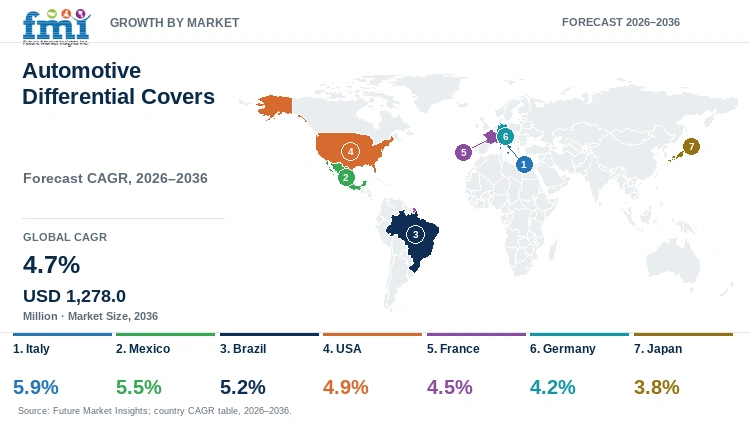
| Country | CAGR |
|---|---|
| Italy | 5.9% |
| Mexico | 5.5% |
| Brazil | 5.2% |
| USA | 4.9% |
| France | 4.5% |
| Germany | 4.2% |
| Japan | 3.8% |
How do country-level CAGRs compare in the Automotive Differential Covers Market?
The country rates range from 3.8% to 5.9% as vehicle age and light-truck exposure shape demand conditions. Italy and Mexico are projected to occupy the upper end because their local mechanisms support faster forecast expansion. Brazil and the USA are projected to remain in the middle through different production and replacement conditions. France, Germany and Japan are projected to post lower rates as mature replacement patterns and changing driveline architecture limit expansion.
- Italy's older vehicle base is keeping standard replacement covers relevant beyond national new-vehicle production cycles.
- Mexico's light-truck production is creating program exposure because Tier-1 timing and axle-family concentration are shaping supplier access.
- Brazil retained substantial light-vehicle production in 2025 while financing pressure weighed on truck demand and premium severe-duty upgrades.
- US pickup and SUV density is sustaining aftermarket fitment as electric drivetrains are changing future axle architecture.
- French used-vehicle activity is keeping replacement coverage relevant for older axle families in independent repair channels.
- German OEM engineering is favoring suppliers that support validated axle interfaces as powertrain layouts are changing.
- Japanese platform discipline is raising fitment requirements as integrated eDrive packaging is reducing conventional cover opportunities.
Similar CAGRs produce different entry conditions because fleet age and channel access convert growth differently. The country analysis spans North America, Latin America and Western Europe across the profiled demand comparison. The remaining analysis covers Eastern Europe and East Asia alongside South Asia and Pacific plus the Middle East and Africa.
Country-wise Analysis
- US repair channels are serving a large light-duty vehicle population that still includes many serviceable pickup and SUV axles. Automotive differential covers demand in the USA is forecast to rise at 4.9% CAGR through 2036, influenced by continued operation of conventional and hybrid drivetrains. Alliance for Automotive Innovation reported that EVs represented 9.6% of new light-duty sales in 2025 but only 2.5% of light-duty vehicles in operation. Replacement suppliers are managing pickup fitment and separating standard replacement from severe-duty upgrades because catalog errors raise return costs across older axle families. Catalog discipline remains a purchase requirement for replacement channels that are serving long-lived light-duty platforms.
- German demand is being shaped by OEM axle engineering as manufacturers are moving more driveline functions into electrified packages. The German automotive differential covers sector is projected to record 4.2% CAGR during the assessment period, constrained by faster architecture change than replacement-led markets. VDA reported 4.15 million passenger cars produced in Germany during 2025 alongside 856,600 electric registrations. Program economics are weakening as new eDrive modules are integrating differential functions without separately serviceable housing covers. Suppliers serving automotive differential housing programs are balancing legacy all-wheel-drive service demand against newer platforms that retain discrete cover interfaces. Validated interface data remains essential for suppliers supporting both legacy and electrified German platforms.
- Japanese sourcing is emphasizing tightly engineered vehicle platforms and long supplier qualification cycles for driveline components. Automotive differential covers demand in Japan is forecast to rise at 3.8% CAGR over the forecast period, shaped by component-security requirements and multi-pathway propulsion planning. JAMA identified stable procurement of critical resources and components as a fiscal 2026 priority for domestic automakers. Compact packaging is narrowing conventional cover opportunities as integrated drive systems leave fewer housings with separately serviceable closures. Suppliers are concentrating qualification resources on exact platform fitment instead of interchangeable axle catalogs. Suppliers are focusing current replacement coverage on applications that retain discrete serviceable differential closures in Japan.
- Brazil is combining domestic light-vehicle production with replacement demand from commercial and utility applications that retain serviceable axle assemblies. The Brazil automotive differential covers market is estimated to post 5.2% CAGR over the forecast period, supported by continuing vehicle production and service activity. ANFAVEA reported 2.644 million vehicles produced in 2025 and expected production to increase again during 2026. High borrowing costs weighed on truck demand during 2025 and made premium upgrades harder to justify before replacement became unavoidable. Standard replacement coverage remains important because slower fleet renewal keeps serviceable axle assemblies in operation longer. Price-sensitive channels are favoring proven fitment over severe-duty features that raise replacement cost without a required performance benefit.
- French repair channels are serving a used-vehicle population that keeps replacement fitment relevant beyond new-car production cycles. Automotive differential covers sales in France are forecast to expand at 4.5% CAGR by 2036, linked to older vehicles remaining active in transaction and service channels. SDES reported that used vehicles represented 77% of passenger-car purchases in 2025 and averaged 11.1 years of age. Suppliers are managing application data and standard-cover pricing because reinforced designs need clear operating benefits for lower-value vehicles. Independent repair networks are favoring broad application coverage for common axle families that remain active in the national fleet. Premium designs require clear durability gains before owners accept higher replacement costs across lower-value used vehicles.
- Italy's older passenger-car fleet is extending service life for conventional driveline components and repairable axle assemblies. The Italy automotive differential covers outlook is anticipated to advance at 5.9% CAGR over the assessment period, reinforced by replacement exposure from the aging installed base. ACI reported a median passenger-car age of 13 years for 2024 within the national fleet. Price sensitivity and fragmented repair routes are limiting premium conversion before standard replacement availability is secured for common axle families. Replacement suppliers are prioritizing common legacy axle families before expanding into premium reinforced designs. Long vehicle retention is making availability and price discipline central to conversion across independent repair channels.
- Mexico is combining export-oriented vehicle manufacturing with unusually high light-truck exposure inside national production volumes. Automotive differential covers sales in Mexico are forecast to expand at 5.5% CAGR by 2036, attributable to pickup and utility platform concentration. INEGI recorded 3.953 million light vehicles produced in 2025 and reported that light trucks represented 77.2% of that output. Model-specific export cycles are shifting cover demand between axle families and production programs as vehicle schedules change. Program proximity remains important because concentrated export schedules leave limited room for late fitment changes following platform validation.
Who are the notable companies in the Automotive Differential Covers Market?
Dana, Dauch Corporation, Magna International, GKN Automotive, Linamar, Dorman Products, Yukon Gear & Axle, ARB 4x4 Accessories, RuffStuff Specialties, and Spicer.
Competition is separating integrated driveline groups from replacement and severe-duty cover suppliers that are serving different purchase routes. Dauch Corporation replaced American Axle & Manufacturing Holdings as the listed corporate identity in January 2026. It completed the Dowlais acquisition in February 2026 and brought GKN Automotive under the Dauch corporate structure. Spicer is operating as Dana's aftermarket brand for axle-service components and performance differential-cover applications in off-road service.
- Dana and Dauch Corporation are participating in vehicle programs through axle engineering and broader driveline integration responsibilities. Magna International, GKN Automotive and Linamar are also supporting integrated driveline programs tied to vehicle-platform engineering.
- Dorman Products and Yukon Gear & Axle are competing through application-specific replacement coverage for serviceable differential housings. Spicer is also serving axle-service channels with differential-cover products designed for replacement and severe-duty applications.
- ARB 4x4 Accessories and RuffStuff Specialties are concentrating on reinforced differential protection for off-road and severe-use applications.
Competitive Benchmarking: Automotive Differential Covers Market
| Company | Axle-System Integration | Differential-Cover Depth | Severe-Duty Engineering | Geographic Reach |
|---|---|---|---|---|
| Dana | High | High | High | Global automotive and off-highway markets |
| Dauch Corporation | High | Low | Medium | North America, Europe, Asia and global OEM programs |
| Magna International | High | Low | Medium | North America, Europe and Asia |
| GKN Automotive | High | Low | Medium | Europe, Asia and the Americas within Dauch |
| Linamar | High | Low | Medium | North America, Europe and Asia |
| Dorman Products | Low | High | Medium | Primarily North American aftermarket |
| Yukon Gear & Axle | Medium | High | High | North American performance aftermarket |
| ARB 4x4 Accessories | Medium | High | High | Australia, North America and global 4x4 channels |
| RuffStuff Specialties | Low | High | High | United States direct and off-road aftermarket |
| Spicer | High | High | High | Global OEM and replacement-parts networks |
Scoring basis: High axle-system integration requires complete-axle evidence while Medium records narrower eDrive or vehicle-program responsibility. High differential-cover depth requires a documented cover range and Medium records narrower direct product coverage. Low records no public direct-cover line and High severe-duty ratings require reinforced or off-road proof. Medium severe-duty evidence is narrower and geographic reach remains descriptive without contributing to ratings.
Key Developments in the Automotive Differential Covers Market
- In July 2026, Magna International secured an 800V two-speed eDrive program award with Chery for production in Wuhu and platform-level drive integration.
- In April 2026, Dana announced a RAM Dakota award with Stellantis covering front drive units and rear axles that establish downstream housing interfaces.
- In February 2026, Dauch Corporation completed its Dowlais acquisition and brought GKN Automotive under the current Dauch corporate structure.
Key Players in the Automotive Differential Covers Market
Integrated axle and driveline platforms
- Dana
- Dauch Corporation
- Magna International
- GKN Automotive
- Linamar
Replacement and axle-service cover specialists
- Dorman Products
- Yukon Gear & Axle
- Spicer
Performance and off-road protection specialists
- ARB 4x4 Accessories
- RuffStuff Specialties
Automotive Differential Covers Market - Report Scope
| Coverage field | Report scope |
|---|---|
| Market breakdown | By cover type, axle type, vehicle type, sales channel, material and region. |
| Quantitative Units | USD million. |
| Market Definition | Revenue includes automotive differential covers sold as discrete components or identifiable cover subassemblies across OEM, driveline Tier-1, replacement and performance channels. Complete axle assemblies, differential gears, housings, separately sold gaskets and downstream vehicle revenue are excluded. |
| Regions Covered | North America, Latin America, Western Europe, Eastern Europe, East Asia, South Asia and Pacific, and Middle East and Africa. |
| Countries Covered | USA, Germany, Japan, Brazil, France, Italy, Mexico, and 20+ countries included in the full report. |
| Key Companies Profiled | Dana, Dauch Corporation, Magna International, GKN Automotive, Linamar, Dorman Products, Yukon Gear & Axle, ARB 4x4 Accessories, RuffStuff Specialties, and Spicer. |
| Forecast Period | 2026 to 2036. |
| Approach | Primary and secondary research with market triangulation. |
Automotive Differential Covers Market - Research Methodology
| Method | Approach |
|---|---|
| Primary Research | FMI analysts gathered input from manufacturers, service providers, technology developers, distributors, end users, procurement teams, and subject-matter experts. Interviews examined purchasing decisions, product or service evaluation, adoption barriers, approval requirements, pricing considerations, and expectations for technical or commercial support. Respondents were also asked what evidence is required before a trial, pilot, or initial order develops into regular purchasing. |
| Desk Research | Desk research covered government statistics, regulatory publications, trade data, industry associations, technical literature, standards, company filings, product information, and official corporate announcements. Sources were reviewed for relevance, publication date, geographic coverage, and consistency with the defined market scope. Claims relating to performance, applications, approvals, capacity, investment, and commercial activity were retained only when supported by credible public evidence. |
| Market Sizing and Forecasting | The market model combined the baseline value with historical performance, segment structure, pricing and volume indicators, adoption levels, company participation, and country-level demand conditions. Forecast assumptions considered economic activity, investment trends, regulatory developments, technology adoption, purchasing cycles, supply availability, and barriers to wider market use. Segment and regional estimates were reconciled before the final market total was calculated. |
| Data Validation | Estimates were checked against multiple independent indicators, including public data, company activity, trade patterns, industry developments, and findings from primary interviews. Validation also tested whether products, services, applications, and company revenues fell within the defined market boundaries. Adjacent categories, unsupported claims, overlapping revenues, and activities without direct market relevance were excluded to reduce double counting and maintain consistency across segments and countries. |
Automotive Differential Covers Market by Segments
Automotive Differential Covers Market segmented by Cover Type:
- Stamped steel covers
- Cast aluminum covers
- Reinforced covers
- Inspection covers
- Performance/off-road covers
Automotive Differential Covers Market segmented by Axle Type:
- Light-duty axles
- Heavy-duty axles
- Pickup/SUV axles
- Off-road axles
- Commercial vehicle axles
Automotive Differential Covers Market segmented by Vehicle Type:
- Pickup trucks
- SUVs/off-road
- Passenger cars
- Commercial vehicles
- Motorsport vehicles
Automotive Differential Covers Market segmented by Sales Channel:
- OEM direct
- Driveline Tier-1s
- Aftermarket replacement
- Performance/off-road aftermarket
Automotive Differential Covers Market segmented by Material:
- Stamped steel
- Cast aluminum
- Ductile iron
- Composite/hybrid
Automotive Differential Covers Market by Region:
- North America
- United States
- Canada
- Latin America
- Brazil
- Mexico
- Chile
- Rest of Latin America
- Western Europe
- Germany
- United Kingdom
- Italy
- Spain
- France
- Nordics
- Benelux
- Rest of Western Europe
- Eastern Europe
- Russia
- Poland
- Hungary
- Balkan and Baltic States
- Rest of Eastern Europe
- East Asia
- China
- Japan
- South Korea
- South Asia and Pacific
- India
- ASEAN
- Australia and New Zealand
- Rest of South Asia and Pacific
- Middle East and Africa
- Kingdom of Saudi Arabia
- Other GCC Countries
- Türkiye
- South Africa
- Other African Union Countries
- Rest of Middle East and Africa
Research Sources and Bibliography
- Instituto Nacional de Estadística y Geografía. (2026, January 9). Registro administrativo de la industria automotriz de vehículos ligeros. Diciembre de 2025.
- Japan Automobile Manufacturers Association. (2025, December 18). Executive Decisions on Priority Matters for JAMA for the Upcoming Fiscal Year and Next Organizational Leadership.
- Spicer Parts. (n.d.). Spicer Nodular Iron Performance Diff Covers. Retrieved September 18, 2026.
- Yukon Gear & Axle. (n.d.). Yukon Nodular Iron Differential Cover, 2017+ Ford Super Duty w/M275 Rear. Retrieved September 18, 2026.
- Magna International. (2026, July 28). Magna Secures 800V eDrive Program Award with Chery.
- Dana Incorporated. (2026, April 29). Dana Incorporated Reports Strong First-Quarter Results; Maintains Full-Year Guidance; Announces New Business Win.
- RuffStuff Specialties. (2026, May 14). The Best Off-Road Parts for a Jeep XJ: A Practical Upgrade Guide for Real Trail Use.
- Alliance for Automotive Innovation. (2026, March 25). Alliance for Automotive Innovation Reports New U.S. Electric Vehicle Data.
- German Association of the Automotive Industry (VDA). (2026, January 5). Passenger car production in 2025 slightly above previous year's level.
- ANFAVEA. (2026, January 15). Produção e venda de autoveículos crescem em 2025 e Anfavea projeta nova alta em 2026.
- Service des données et études statistiques. (2026, February 11). Immatriculations de voitures en 2025 : le marché du neuf baisse, celui de l’occasion résiste.
- Automobile Club d’Italia. (2025). Annuario Statistico 2025: tutti i numeri delle auto in Italia.
- Dauch Corporation. (2026, January 26). American Axle & Manufacturing Holdings, Inc. to Become “Dauch Corporation” and Trade on NYSE Under New Ticker Symbol “DCH”.
- Dauch Corporation. (2026, February 3). Dauch Corporation Completes Acquisition of Dowlais Group plc.
- GKN Automotive. (2026, January 30). The circular economy is key to reaching net zero.
- Linamar Corporation. (2026, April 30). Linamar Corporation Completes Previously Announced Acquisition of WinningBLW’s Remscheid and Penzberg Facilities.
- Magna International. (2026, March 24). Magna Unveils DHD REX Hybrid Drive for Enhanced EV Range.
- Magna International Inc.. (2026, May 21). Magna Earns Five 2025 General Motors Supplier of the Year Awards.
- ARB Corporation Limited. (2026, February 24). Appendix 4D, Chairman’s Statement and Financial Report for the Half Year Ended 31 December 2025.
- Dorman Products. (n.d.). Differential Cover 697-741: Differential Cover Assembly. Retrieved September 18, 2026.
- ARB 4x4 Accessories. (n.d.). Diff Covers. Retrieved September 18, 2026.
This bibliography is provided for reader reference and is not exhaustive. The full report contains the complete reference list and detailed citations.
This Report Answers
- How large is the automotive differential covers market in 2026 and what value is forecast by 2036?
- Which production and replacement conditions support recurring differential-cover demand?
- Which cover type holds 36.0% of its parent category in the 2026 base year?
- How do light-duty axle and pickup-truck shares affect product and catalog planning?
- Why does axle-specific fitment create a material restraint for aftermarket suppliers?
- How do the seven profiled countries differ in forecast growth?
- Which companies compete across driveline integration and replacement or off-road protection?
- Which protection and service features support higher-value severe-duty differential covers?
Frequently Asked Questions
How big is the automotive differential covers market in 2026?
The automotive differential covers market is valued at USD 807.4 million in 2026 and is projected to reach USD 1,278.0 million by 2036. Factory axle programs and replacement of damaged service covers are creating separate purchasing cycles for suppliers.
What is the CAGR of the automotive differential covers market from 2026 to 2036?
The automotive differential covers market is projected to grow at 4.7% CAGR between 2026 and 2036. New-platform fitment and serviceable-axle replacement are keeping demand tied to both factory and repair channels.
Which cover type leads the automotive differential covers market in 2026?
Stamped steel covers are projected to account for 36.0% of cover type revenue in 2026. Formed construction is supporting repeatable sealing geometry and cost-efficient production volumes for standard automotive applications.
Which axle type accounts for 27.0% of its category in the automotive differential covers market?
Light-duty axles are estimated to hold 27.0% of axle type demand during the 2026 base year. Their installed population is supporting original-equipment fitment and later replacement coverage on established pickup and utility platforms.
Which companies are active in the automotive differential covers market?
Dana and Dauch Corporation are participating in axle and driveline programs tied directly to vehicle-platform engineering. Magna International, GKN Automotive and Linamar are supporting integrated vehicle platforms through current powertrain and driveline programs. Dorman Products and Yukon Gear & Axle are focusing on replacement coverage for serviceable differential housings and axle applications. ARB 4x4 Accessories, RuffStuff Specialties and Spicer are serving severe-duty or axle-service channels with documented differential-cover products.
Preview the report firsthand - request a free sample
Get SampleGet the brochure for pricing and purchase details.
Get PDFTable of Content
- Key Takeaways
- Market Size and CAGR
- Top Growth Driver
- Fastest Growing Segment
- Leading Region
- Key Companies
- Emerging Opportunities
- Executive Summary
- Global Market Outlook
- Demand-side Trends
- Supply-side Trends
- Technology Roadmap Analysis
- Analysis and Recommendations
- Analyst Perspective (What is happening? Why now? What should investors know?)
- Key Questions Answered
- How large is the market?
- What is the CAGR?
- What are key trends?
- Which region dominates?
- Who are the leaders?
- Market Overview
- Market Coverage / Taxonomy
- Market Definition / Scope / Limitations
- Research Methodology
- Chapter Orientation
- Analytical Lens and Working Hypotheses
- Market Structure, Signals, and Trend Drivers
- Benchmarking and Cross-market Comparability
- Market Sizing, Forecasting, and Opportunity Mapping
- Research Design and Evidence Framework
- Desk Research Programme (Secondary Evidence)
- Expert Input and Fieldwork (Primary Evidence)
- Tooling, Models, and Reference Databases
- Data Engineering and Model Build
- Quality Assurance and Audit Trail
- Market Background
- Market Dynamics (Drivers, Restraints, Opportunity, Trends)
- Scenario Forecast (Optimistic, Likely, Conservative)
- Impact Analysis
- AI Impact
- Sustainability Impact
- Regulatory Impact
- Technology Impact
- Consumer / Buyer Analysis
- Purchase Drivers
- Adoption Barriers
- Buyer Journey
- Opportunity Map Analysis
- Product Life Cycle Analysis
- Supply Chain Analysis
- Investment Feasibility Matrix
- Value Chain Analysis
- PESTLE and Porter's Analysis
- Regulatory Landscape
- Regional Parent Market Outlook
- Production and Consumption Statistics
- Import and Export Statistics
- Global Market Analysis and Forecast, 2021 to 2036
- Historical Market Size Value (USD Million) Analysis, 2021 to 2025
- Current and Future Market Size Value (USD Million) Projections, 2026 to 2036
- Y-o-Y Growth Trend Analysis
- Absolute $ Opportunity Analysis
- Global Market Pricing Analysis, 2021 to 2036
- Global Market Analysis and Forecast, By Cover Type, 2021 to 2036
- Introduction / Key Findings
- Historical Market Size Value (USD Million) Analysis By Cover Type, 2021 to 2025
- Current and Future Market Size Value (USD Million) Analysis and Forecast By Cover Type, 2026 to 2036
- Stamped steel covers
- Cast aluminum covers
- Reinforced covers
- Inspection covers
- Performance/off-road covers
- Y-o-Y Growth Trend Analysis By Cover Type, 2021 to 2025
- Absolute $ Opportunity Analysis By Cover Type, 2026 to 2036
- Global Market Analysis and Forecast, By Axle Type, 2021 to 2036
- Introduction / Key Findings
- Historical Market Size Value (USD Million) Analysis By Axle Type, 2021 to 2025
- Current and Future Market Size Value (USD Million) Analysis and Forecast By Axle Type, 2026 to 2036
- Light-duty axles
- Heavy-duty axles
- Pickup/SUV axles
- Off-road axles
- Commercial vehicle axles
- Y-o-Y Growth Trend Analysis By Axle Type, 2021 to 2025
- Absolute $ Opportunity Analysis By Axle Type, 2026 to 2036
- Global Market Analysis and Forecast, By Vehicle Type, 2021 to 2036
- Introduction / Key Findings
- Historical Market Size Value (USD Million) Analysis By Vehicle Type, 2021 to 2025
- Current and Future Market Size Value (USD Million) Analysis and Forecast By Vehicle Type, 2026 to 2036
- Pickup trucks
- SUVs/off-road
- Passenger cars
- Commercial vehicles
- Motorsport vehicles
- Y-o-Y Growth Trend Analysis By Vehicle Type, 2021 to 2025
- Absolute $ Opportunity Analysis By Vehicle Type, 2026 to 2036
- Global Market Analysis and Forecast, By Sales Channel, 2021 to 2036
- Introduction / Key Findings
- Historical Market Size Value (USD Million) Analysis By Sales Channel, 2021 to 2025
- Current and Future Market Size Value (USD Million) Analysis and Forecast By Sales Channel, 2026 to 2036
- OEM direct
- Driveline Tier-1s
- Aftermarket replacement
- Performance/off-road aftermarket
- Y-o-Y Growth Trend Analysis By Sales Channel, 2021 to 2025
- Absolute $ Opportunity Analysis By Sales Channel, 2026 to 2036
- Global Market Analysis and Forecast, By Material, 2021 to 2036
- Introduction / Key Findings
- Historical Market Size Value (USD Million) Analysis By Material, 2021 to 2025
- Current and Future Market Size Value (USD Million) Analysis and Forecast By Material, 2026 to 2036
- Stamped steel
- Cast aluminum
- Ductile iron
- Composite/hybrid
- Y-o-Y Growth Trend Analysis By Material, 2021 to 2025
- Absolute $ Opportunity Analysis By Material, 2026 to 2036
- Global Market Analysis and Forecast, By Region, 2021 to 2036
- Introduction
- Historical Market Size Value (USD Million) Analysis By Region, 2021 to 2025
- Current Market Size Value (USD Million) Analysis and Forecast By Region, 2026 to 2036
- North America
- Latin America
- Western Europe
- Eastern Europe
- East Asia
- South Asia and Pacific
- Middle East and Africa
- Market Attractiveness Analysis By Region
- North America Market Analysis and Forecast, By Country, 2021 to 2036
- Historical Market Size Value (USD Million) Trend Analysis By Market Taxonomy, 2021 to 2025
- Market Size Value (USD Million) Forecast By Market Taxonomy, 2026 to 2036
- By Country
- United States
- Canada
- By Cover Type
- By Axle Type
- By Vehicle Type
- By Sales Channel
- By Material
- By Country
- Market Attractiveness Analysis
- By Country
- By Cover Type
- By Axle Type
- By Vehicle Type
- By Sales Channel
- By Material
- Key Takeaways
- Latin America Market Analysis and Forecast, By Country
- Historical Market Size Value (USD Million) Trend Analysis By Market Taxonomy, 2021 to 2025
- Market Size Value (USD Million) Forecast By Market Taxonomy, 2026 to 2036
- By Country
- Brazil
- Mexico
- Chile
- Rest of Latin America
- By Cover Type
- By Axle Type
- By Vehicle Type
- By Sales Channel
- By Material
- By Country
- Market Attractiveness Analysis
- By Country
- By Cover Type
- By Axle Type
- By Vehicle Type
- By Sales Channel
- By Material
- Key Takeaways
- Western Europe Market Analysis and Forecast, By Country
- Historical Market Size Value (USD Million) Trend Analysis By Market Taxonomy, 2021 to 2025
- Market Size Value (USD Million) Forecast By Market Taxonomy, 2026 to 2036
- By Country
- Germany
- United Kingdom
- Italy
- Spain
- France
- Nordics
- Benelux
- Rest of Western Europe
- By Cover Type
- By Axle Type
- By Vehicle Type
- By Sales Channel
- By Material
- By Country
- Market Attractiveness Analysis
- By Country
- By Cover Type
- By Axle Type
- By Vehicle Type
- By Sales Channel
- By Material
- Key Takeaways
- Eastern Europe Market Analysis and Forecast, By Country
- Historical Market Size Value (USD Million) Trend Analysis By Market Taxonomy, 2021 to 2025
- Market Size Value (USD Million) Forecast By Market Taxonomy, 2026 to 2036
- By Country
- Russia
- Poland
- Hungary
- Balkan and Baltic States
- Rest of Eastern Europe
- By Cover Type
- By Axle Type
- By Vehicle Type
- By Sales Channel
- By Material
- By Country
- Market Attractiveness Analysis
- By Country
- By Cover Type
- By Axle Type
- By Vehicle Type
- By Sales Channel
- By Material
- Key Takeaways
- East Asia Market Analysis and Forecast, By Country
- Historical Market Size Value (USD Million) Trend Analysis By Market Taxonomy, 2021 to 2025
- Market Size Value (USD Million) Forecast By Market Taxonomy, 2026 to 2036
- By Country
- China
- Japan
- South Korea
- By Cover Type
- By Axle Type
- By Vehicle Type
- By Sales Channel
- By Material
- By Country
- Market Attractiveness Analysis
- By Country
- By Cover Type
- By Axle Type
- By Vehicle Type
- By Sales Channel
- By Material
- Key Takeaways
- South Asia and Pacific Market Analysis and Forecast, By Country
- Historical Market Size Value (USD Million) Trend Analysis By Market Taxonomy, 2021 to 2025
- Market Size Value (USD Million) Forecast By Market Taxonomy, 2026 to 2036
- By Country
- India
- ASEAN
- Australia and New Zealand
- Rest of South Asia and Pacific
- By Cover Type
- By Axle Type
- By Vehicle Type
- By Sales Channel
- By Material
- By Country
- Market Attractiveness Analysis
- By Country
- By Cover Type
- By Axle Type
- By Vehicle Type
- By Sales Channel
- By Material
- Key Takeaways
- Middle East and Africa Market Analysis and Forecast, By Country
- Historical Market Size Value (USD Million) Trend Analysis By Market Taxonomy, 2021 to 2025
- Market Size Value (USD Million) Forecast By Market Taxonomy, 2026 to 2036
- By Country
- Kingdom of Saudi Arabia
- Other GCC Countries
- Türkiye
- South Africa
- Other African Union Countries
- Rest of Middle East and Africa
- By Cover Type
- By Axle Type
- By Vehicle Type
- By Sales Channel
- By Material
- By Country
- Market Attractiveness Analysis
- By Country
- By Cover Type
- By Axle Type
- By Vehicle Type
- By Sales Channel
- By Material
- Key Takeaways
- Key Countries Market Analysis
- United States
- Pricing Analysis
- Market Share Analysis, 2025
- By Cover Type
- By Axle Type
- By Vehicle Type
- By Sales Channel
- By Material
- Canada
- Pricing Analysis
- Market Share Analysis, 2025
- By Cover Type
- By Axle Type
- By Vehicle Type
- By Sales Channel
- By Material
- Mexico
- Pricing Analysis
- Market Share Analysis, 2025
- By Cover Type
- By Axle Type
- By Vehicle Type
- By Sales Channel
- By Material
- Brazil
- Pricing Analysis
- Market Share Analysis, 2025
- By Cover Type
- By Axle Type
- By Vehicle Type
- By Sales Channel
- By Material
- Chile
- Pricing Analysis
- Market Share Analysis, 2025
- By Cover Type
- By Axle Type
- By Vehicle Type
- By Sales Channel
- By Material
- Germany
- Pricing Analysis
- Market Share Analysis, 2025
- By Cover Type
- By Axle Type
- By Vehicle Type
- By Sales Channel
- By Material
- United Kingdom
- Pricing Analysis
- Market Share Analysis, 2025
- By Cover Type
- By Axle Type
- By Vehicle Type
- By Sales Channel
- By Material
- Italy
- Pricing Analysis
- Market Share Analysis, 2025
- By Cover Type
- By Axle Type
- By Vehicle Type
- By Sales Channel
- By Material
- Spain
- Pricing Analysis
- Market Share Analysis, 2025
- By Cover Type
- By Axle Type
- By Vehicle Type
- By Sales Channel
- By Material
- France
- Pricing Analysis
- Market Share Analysis, 2025
- By Cover Type
- By Axle Type
- By Vehicle Type
- By Sales Channel
- By Material
- India
- Pricing Analysis
- Market Share Analysis, 2025
- By Cover Type
- By Axle Type
- By Vehicle Type
- By Sales Channel
- By Material
- ASEAN
- Pricing Analysis
- Market Share Analysis, 2025
- By Cover Type
- By Axle Type
- By Vehicle Type
- By Sales Channel
- By Material
- Australia and New Zealand
- Pricing Analysis
- Market Share Analysis, 2025
- By Cover Type
- By Axle Type
- By Vehicle Type
- By Sales Channel
- By Material
- China
- Pricing Analysis
- Market Share Analysis, 2025
- By Cover Type
- By Axle Type
- By Vehicle Type
- By Sales Channel
- By Material
- Japan
- Pricing Analysis
- Market Share Analysis, 2025
- By Cover Type
- By Axle Type
- By Vehicle Type
- By Sales Channel
- By Material
- South Korea
- Pricing Analysis
- Market Share Analysis, 2025
- By Cover Type
- By Axle Type
- By Vehicle Type
- By Sales Channel
- By Material
- Russia
- Pricing Analysis
- Market Share Analysis, 2025
- By Cover Type
- By Axle Type
- By Vehicle Type
- By Sales Channel
- By Material
- Poland
- Pricing Analysis
- Market Share Analysis, 2025
- By Cover Type
- By Axle Type
- By Vehicle Type
- By Sales Channel
- By Material
- Hungary
- Pricing Analysis
- Market Share Analysis, 2025
- By Cover Type
- By Axle Type
- By Vehicle Type
- By Sales Channel
- By Material
- Kingdom of Saudi Arabia
- Pricing Analysis
- Market Share Analysis, 2025
- By Cover Type
- By Axle Type
- By Vehicle Type
- By Sales Channel
- By Material
- Türkiye
- Pricing Analysis
- Market Share Analysis, 2025
- By Cover Type
- By Axle Type
- By Vehicle Type
- By Sales Channel
- By Material
- South Africa
- Pricing Analysis
- Market Share Analysis, 2025
- By Cover Type
- By Axle Type
- By Vehicle Type
- By Sales Channel
- By Material
- United States
- Market Structure Analysis
- Competition Dashboard
- Competition Benchmarking
- Market Share Analysis of Top Players
- By Regional
- By Cover Type
- By Axle Type
- By Vehicle Type
- By Sales Channel
- By Material
- Emerging Startups
- Innovation Benchmarking
- Competition Analysis
- Competition Deep Dive
- Dana
- Overview
- Product Portfolio
- Profitability by Market Segments
- Sales Footprint
- Strategy Overview
- Marketing Strategy
- Product Strategy
- Channel Strategy
- Dauch Corporation
- Magna International
- GKN Automotive
- Linamar
- Dorman Products
- Yukon Gear & Axle
- ARB 4x4 Accessories
- RuffStuff Specialties
- Spicer
- Dana
- Case Studies
- Success Stories
- Recent Developments
- Competition Deep Dive
- Assumptions & Acronyms Used


