

- Market Size (2026)
- USD 3.6 Bn
- Forecast (2036)
- USD 6.4 Bn
- CAGR (2026 to 2036)
- 5.8%
How big is Automotive Differential Actuators Market in 2026?
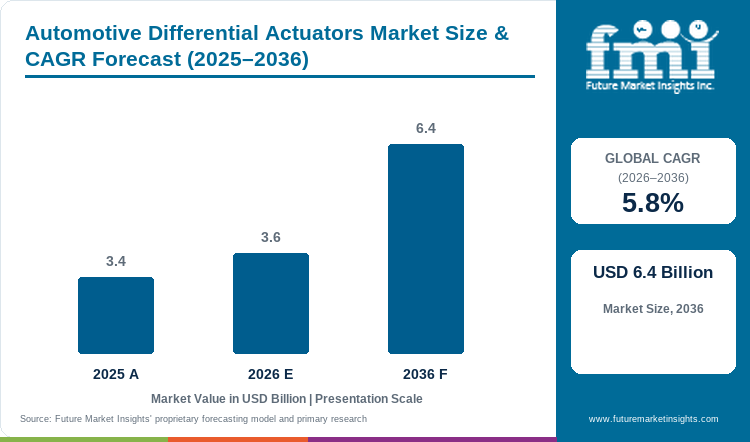
USD 3.6 Billion in 2026 and USD 6.4 Billion by 2036 at a 5.8% CAGR.
Sales of automotive differential actuators are estimated to grow at a 5.8% CAGR from 2026 to 2036, increasing valuation from USD 3.4 billion in 2025 to USD 3.6 billion in 2026 and reaching USD 6.4 billion by 2036. Demand is moving beyond simple differential locking. Vehicle makers increasingly need actuation that can engage an axle, load a clutch pack, command an electronic limited-slip differential, or disconnect unused driveline hardware while confirming that the requested position has actually been reached.
Selective engagement helps all-wheel drive systems provide traction while limiting losses when a secondary drive is not needed. Electrification adds further pressure to reduce drag in unused driveline hardware. Differential actuators must meet the required force and response time while confirming position to the vehicle controller. Sealing, thermal performance and fault detection are tested as part of the driveline before series production.
Key Takeaways
- Demand is increasing as OEMs use differential actuation to preserve traction while disconnecting or modulating driveline hardware when full torque transfer is unnecessary.
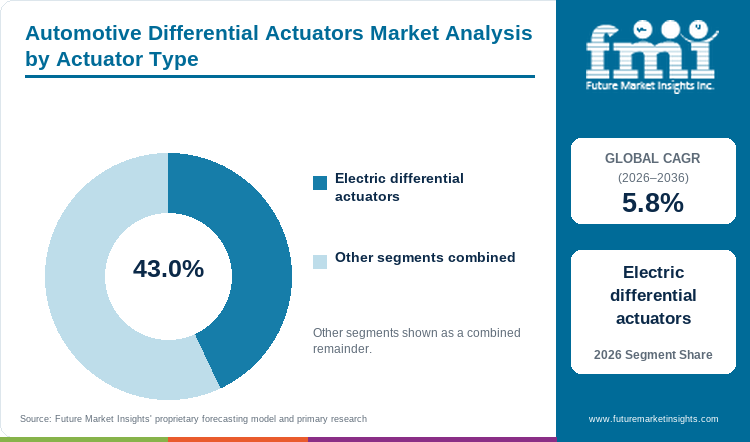
- Electric differential actuators are projected to lead Actuator Type with 43.0% share in 2026 because electronic commands can be combined with sensing, diagnostics, and repeatable position control.
- Locking differential is expected to account for 31.0% of Differential Type demand, while SUVs/crossovers lead Vehicle Type with 32.0% in 2026.
- Platform-specific force, fluid, packaging, environmental, and controller requirements can extend qualification cycles and limit simple actuator substitution.
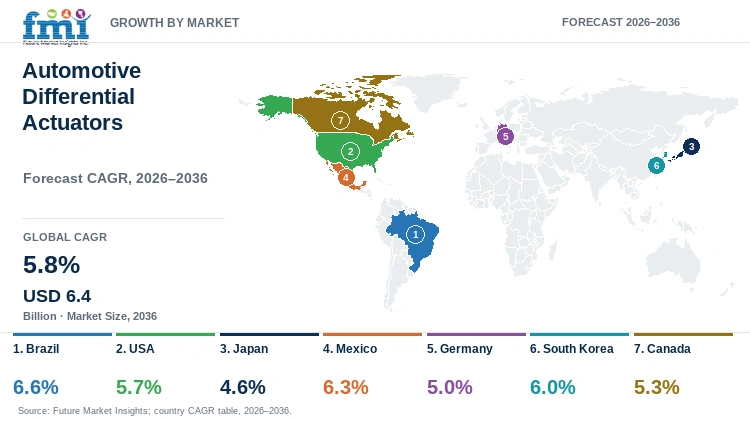
- Brazil leads the profiled countries at 6.6% CAGR through 2036, followed by Mexico at 6.3% and South Korea at 6.0%.
- Notable companies include BorgWarner, Magna International, Dana, GKN Automotive, JTEKT, Dauch Corporation's legacy AAM business, ZF Friedrichshafen, Schaeffler, Eaton, and Nidec Mobility.
Analyst Perspective
Differential actuation must match the vehicle's traction strategy. A lock, coupling or disconnect has a different job, but each needs dependable engagement and position feedback. Reusing qualified hardware across derivatives can reduce validation effort only when the force, stroke, environmental limits and control behavior remain suitable for each application.
- Nikhil Kaitwade, Principal Consultant, Future Market Insights
How is the automotive differential actuators market segmented?
Actuator Type, Differential Type, Vehicle Type, Sales Channel, Function, and Region
The automotive differential actuators market is segmented by Actuator Type, Differential Type, Vehicle Type, Sales Channel, Function, and Region. Actuator Type includes electric differential actuators, vacuum actuators, hydraulic actuators, electro-magnetic actuators, and smart position-sensing actuators. Differential Type covers locking differential, limited-slip differential, e-differential, AWD coupling, and transfer case differential. Vehicle Type comprises SUVs/crossovers, pickup trucks, off-road vehicles, commercial vehicles, and performance vehicles. Sales Channel includes OEM direct, Tier-1 driveline suppliers, aftermarket replacement, and service kits. Function covers axle lock/unlock, torque distribution, AWD engagement, and traction enhancement.
Why do electric differential actuators lead demand within the Actuator Type category?
Electric differential actuators fit the way modern driveline decisions are made. A controller can command a motor or solenoid, monitor movement, and coordinate the result with braking, stability, or torque-management software without depending on a vacuum source or separate hydraulic circuit. That makes electric actuation useful across locking differentials, couplings, disconnect systems, and eLSD functions. The same shift toward electronically commanded motion is widening the role of automotive actuators across the wider vehicle architecture.
- Electric differential actuators are projected to account for 43.0% of Actuator Type revenue in 2026.
- Their advantage comes from controllability and system integration rather than the electric motor alone, particularly where the vehicle must confirm engagement position and diagnose a failed command.
Why does locking differential lead demand within the Differential Type category?
Locking differential applications give the actuator a direct mechanical task: move the differential from normal wheel-speed differentiation into a locked traction state when grip becomes inadequate. Pickups, SUVs, and off-road vehicles value this function because one wheel can otherwise lose usable torque on mud, rock, snow, or uneven terrain. Electronic actuation also gives the vehicle controller more control over when the lock can engage or release. These requirements keep locking systems commercially important within the wider automotive differential market.
- Locking differential is estimated to hold 31.0% of Differential Type revenue in 2026.
- Suppliers must balance engagement speed with mechanical protection because an actuator that moves too slowly can delay traction, while poorly synchronized engagement can create impact loading inside the differential.
Why do SUVs/crossovers lead demand within the Vehicle Type category?
SUVs and crossovers combine scale with a wide range of traction requirements. Mainstream models need quiet operation and limited efficiency penalty in daily driving, while premium and utility variants may add AWD, eLSD, towing, off-road, or selectable terrain functions. This creates room for common actuator families to be used across several derivatives if force ratings, packaging, software interfaces, and calibration can be adjusted without redesigning the complete unit.
- SUVs/crossovers are projected to account for 32.0% of Vehicle Type revenue in 2026.
- Their commercial importance comes from the combination of high-volume road use and repeated demand for electronically controlled AWD, differential locking, and driveline-disconnect functions.
Why does OEM direct lead demand within the Sales Channel category?
OEM direct leads because differential actuation is normally fixed before a vehicle reaches production. The selected unit must fit the differential or coupling, deliver the required force and stroke, connect to the vehicle electrical architecture, and perform correctly under the OEM's control strategy. Once those interfaces are frozen and validated, replacing the actuator with a different design can trigger new engineering work. Tier-1 driveline suppliers remain important system integrators, while aftermarket demand follows the installed vehicle base.
- OEM direct is projected to account for 54.0% of Sales Channel revenue in 2026.
- The channel is strengthened by vehicle-level validation because actuator selection affects calibration, diagnostic logic, launch quality, and warranty exposure before serial production begins.
Why does axle lock/unlock lead demand within the Function category?
Axle lock/unlock covers two commercially valuable outcomes. A locking system closes the torque path when additional traction is required, while a disconnect system opens part of the driveline when secondary-axle torque is unnecessary. Electrified vehicles make the second function more important because an idle secondary drive can create avoidable mechanical losses. This places differential actuator engineering closer to the expanding electric vehicle e-axle market, where compact packaging and selective torque delivery increasingly have to be considered together.
- Axle lock/unlock is projected to hold 36.0% of Function revenue in 2026.
- Position confirmation is commercially important because the controller must know whether the mechanical path has actually opened or closed before torque strategy can change safely.
What are the drivers, restraints and opportunities in the Automotive Differential Actuators Market?
Selective torque control drives demand, platform-specific qualification limits substitution, and electrified AWD creates opportunities for integrated actuation and sensing.
- Driver: OEMs need on-demand torque transfer that preserves AWD and locking capability without keeping every driveline component permanently engaged.
- Restraint: Force, stroke, fluid compatibility, sealing, software, and fault-handling requirements make differential actuator qualification specific to the target vehicle architecture.
- Opportunity: Suppliers can capture more value by combining actuation, position sensing, local electronics, and calibration support for electrified AWD and e-axle disconnect functions.
Selective torque control requires commanded engagement of driveline components. The EPA's latest automotive trends data show four-wheel-drive systems at 63% of model-year 2024 U.S. production and 86% within trucks. That installed architecture gives automakers a strong reason to reduce the energy penalty of carrying extra driven hardware when full traction is not needed. An actuator that can engage a coupling or lock quickly, then release it reliably, helps vehicle engineers retain capability without treating every driving condition as a full-time AWD event.
Vehicle qualification can delay a new differential actuator. Nominal actuator force does not establish suitability for a new program. The module still has to operate across the required temperature range, withstand contamination and vibration, fit the available package, tolerate the specified lubricant environment, and communicate correctly with the vehicle controller. A change in differential geometry or control strategy can therefore create additional validation even when the supplier already has a similar actuator in production.
Reducing losses in unused driveline components can help an electric vehicle conserve energy. Global electric-car sales exceeded 20 million units in 2025, according to the IEA, increasing the number of platforms where manufacturers evaluate losses in motors, gears, bearings, and secondary drive units. Suppliers that connect differential or disconnect actuation with sensing and controller logic can participate in a larger share of the EV powertrain market than suppliers selling an isolated mechanical actuator.
Which country CAGRs are profiled in the Automotive Differential Actuators Market?
| Country | CAGR |
|---|---|
| Brazil | 6.6% |
| USA | 5.7% |
| Japan | 4.6% |
| Mexico | 6.3% |
| Germany | 5.0% |
| South Korea | 6.0% |
| Canada | 5.3% |
How do country-level CAGRs compare in the Automotive Differential Actuators Market?
Brazil leads the country forecasts at 6.6% CAGR from 2026 to 2036, followed by Mexico at 6.3% and South Korea at 6.0%. USA is at 5.7%, Canada at 5.3%, Germany at 5.0% and Japan at 4.6%. Production localization shapes orders in Brazil and Mexico. Vehicle mix, winter operation and the integration of traction controls influence demand in North America and established engineering centers.
- Brazil's faster rate is supported by a manufacturing base where local vehicle and component production can expand actuator content as electronically controlled driveline functions spread.
- Mexico combines large export-oriented light-vehicle output with high light-truck production, making plant proximity and North American platform compatibility commercially important.
- South Korea links actuator opportunities to fast domestic OEM development cycles and a vehicle industry with substantial export exposure.
- The USA carries a large four-wheel-drive vehicle base, particularly among trucks, so durability and towing-related duty cycles influence actuator qualification.
- Canada's truck-heavy sales mix supports AWD and locking demand but places greater emphasis on low-temperature operation and corrosion resistance.
- Germany brings mature premium-vehicle and electrified-platform engineering, where control integration, NVH, and efficiency can outweigh simple component cost.
- Japan combines long validation cycles with a policy push toward software-defined vehicles, increasing the importance of actuator diagnostics and electronic interfaces.
Country-wise Analysis
- Brazil: Automotive differential actuator demand in Brazil is forecast to expand at a 6.6% CAGR from 2026 to 2036. IBGE reported that Brazilian production of motor vehicles, trailers, and bodies increased 4.1% from April to May 2026, while the automotive sector recorded its fifth consecutive monthly expansion. For actuator suppliers, this creates a practical route through local vehicle and component programs rather than import-led replacement alone. Cost control remains important, so designs need to pair electronic control with manufacturing localization and protection against demanding road conditions.
- USA: Demand in the USA is projected to rise at a 5.7% CAGR through 2036. EPA data show four-wheel-drive systems accounted for 63% of model-year 2024 new-vehicle production and 86% within trucks. Pickups and truck-based SUVs subject differential actuators to high axle loads, towing duty, and long warranty expectations, making force margin and environmental durability significant selection criteria. Suppliers also need launch engineering near OEM plants because actuator calibration interacts directly with traction and stability functions.
- Japan: Demand in Japan is forecast to increase at a 4.6% CAGR from 2026 to 2036. METI and MLIT updated the country's Mobility DX Strategy in June 2025 and retained the objective of Japanese companies reaching 30% of global software-defined vehicle unit sales in 2030 and 2035. Differential actuator suppliers therefore face a market where compact hardware has to coexist with increasingly structured software, diagnostic, and control interfaces. The slower CAGR reflects mature platform cycles rather than a lack of technical depth.
- Mexico: Automotive differential actuator demand in Mexico is projected to grow at a 6.3% CAGR through 2036. INEGI recorded 3,953,494 light vehicles produced during 2025, with light trucks accounting for 77.2% of production. This mix supports AWD and differential-control demand while keeping sourcing closely tied to North American vehicle platforms. Plant-proximate inventory and rapid quality response matter because export programs leave little room for a driveline component to interrupt assembly.
- Germany: Demand in Germany is forecast to rise at a 5.0% CAGR from 2026 to 2036. The German Federal Motor Transport Authority reported that SUVs represented 33.3% of 2025 new registrations. The country's actuator opportunity is shaped by premium vehicles, AWD architectures, and electrified drivetrains where low drag, fast control response, and NVH performance receive close engineering attention. Supplier switching can be slow because the actuator becomes part of a calibrated driveline and vehicle-dynamics package.
- South Korea: Demand in South Korea is projected to expand at a 6.0% CAGR through 2036. The Ministry of Trade, Industry and Resources reported that automobile exports reached USD 6.24 billion in July 2026, up 7.0% year on year, with eco-friendly vehicles supporting growth. Suppliers therefore compete inside programs intended for multiple export destinations, which increases the value of scalable electronics, strong high-volume quality systems, and engineering teams able to respond quickly to platform changes.
- Canada: Demand in Canada is forecast to grow at a 5.3% CAGR from 2026 to 2036. Statistics Canada reported that trucks, including SUVs and pickups, represented 88.0% of new motor vehicle sales in 2025, with more than 1.7 million units sold. That vehicle mix supports AWD and selectable traction functions, while winter use raises the importance of low-temperature response, sealing, corrosion resistance, and dependable replacement supply.
Who are the notable companies in the Automotive Differential Actuators Market?
BorgWarner, Magna International, Dana, GKN Automotive, JTEKT, Dauch Corporation's legacy AAM business, ZF Friedrichshafen, Schaeffler, Eaton, and Nidec Mobility are the notable companies profiled in this market.
Competition is split between suppliers that control a wider AWD or torque-management system and companies whose strength lies in the differential, axle, actuator, or control layer. BorgWarner, Magna International, GKN Automotive, and ZF can combine actuation with broader driveline functions. Dana, JTEKT, and Eaton bring differential or axle expertise to engagement and traction applications. Schaeffler and Nidec Mobility add mechatronic and electronic-control capability.
The corporate structure of the field changed in February 2026 when Dauch Corporation, formerly American Axle & Manufacturing, completed its acquisition of Dowlais and its GKN Automotive subsidiary. GKN Automotive continues as an operating business within Dauch, while the legacy AAM business adds axle and driveline integration capability under the same parent group.
Competitive Benchmarking: Automotive Differential Actuators Market
| Company | Actuation Architecture Coverage | Differential/AWD Integration | Closed-Loop Control Support | Geographic Reach |
|---|---|---|---|---|
| BorgWarner | High | High | High | North America, Europe, China, and broader Asia |
| Magna International | Medium | High | High | North America, Europe, and Asia |
| Dana | High | Medium | Medium | North America, Europe, Asia, and Latin America |
| GKN Automotive, a Dauch Corporation company | Medium | High | High | Europe, Asia, North America, and other global markets |
| JTEKT | Medium | High | Medium | Japan, North America, Europe, and Asia |
| Dauch Corporation, legacy AAM business | Medium | High | High | North America with broader global operations |
| ZF Friedrichshafen | High | High | High | Europe, North America, and Asia |
| Schaeffler | High | Medium | High | Europe, the Americas, Greater China, and Asia-Pacific |
| Eaton | Medium | Medium | Medium | North America, Europe, and Asia |
| Nidec Mobility | Medium | Unscored | High | Japan, Asia, Europe, and North America |
Scoring basis: Actuation Architecture Coverage measures documented electric and electromechanical capability across relevant driveline functions. Differential/AWD Integration reflects the ability to place actuation within locking, coupling, eLSD, disconnect, transfer-case, or related torque-management applications. Closed-Loop Control Support reflects sensing, electronics, diagnostics, or software capability around the actuator. High indicates broad capability; Medium indicates narrower coverage.
Key Developments in the Automotive Differential Actuators Market
- In October 2025, BorgWarner secured multiple Chery contracts for its Mlock torque-on-demand transfer case and Gen VI XWD system. The XWD architecture combines a coupling, electronic limited-slip differential, brushless DC motor, modular piston pump, and integrated controller. Mass production is scheduled to begin in 2027, showing how actuator content is increasingly nominated inside a complete AWD control package.
- In November 2025, Magna announced a new Wuhu, China facility for electric drive production, initially supporting Chery and positioned for additional OEM programs. Localized e-drive production increases Magna's ability to combine powertrain hardware with driveline engineering close to Chinese vehicle-development programs.
- In February 2026, Dauch Corporation completed the acquisition of Dowlais Group and its GKN Automotive subsidiary. The transaction combined legacy AAM axle and driveline operations with GKN Automotive's AWD, eDrive, and torque-management capabilities under one global automotive group.
Key Players in the Automotive Differential Actuators Market
Integrated AWD and Torque-Management Systems
- BorgWarner
- Magna International
- GKN Automotive
- ZF Friedrichshafen
Axle and Differential Engagement Specialists
- Dana
- JTEKT
- Eaton
Actuator-Enabled Axle and Mechatronic Platforms
- Dauch Corporation, legacy AAM business
- Schaeffler
- Nidec Mobility
Automotive Differential Actuators Market - Report Scope
| Coverage field | Report scope |
|---|---|
| Market breakdown | Actuator Type; Differential Type; Vehicle Type; Sales Channel; Function |
| Quantitative Units | USD Billion |
| Market Definition | Revenue includes automotive differential actuator modules used for differential locking, limited-slip control, AWD coupling, transfer-case engagement, axle disconnect, and related torque-management functions. Complete differentials, axles, transfer cases, e-axles, vehicles, standalone controllers, and unrelated automotive actuators are outside the market boundary. |
| Regions Covered | North America; Latin America; Western Europe; Eastern Europe; East Asia; South Asia and Pacific; Middle East and Africa |
| Countries Covered | Brazil, USA, Japan, Mexico, Germany, South Korea, Canada, and more than twenty-five additional countries |
| Key Companies Profiled | BorgWarner; Magna International; Dana; GKN Automotive; JTEKT; Dauch Corporation's legacy AAM business; ZF Friedrichshafen; Schaeffler; Eaton; Nidec Mobility |
| Forecast Period | 2026 to 2036 |
| Approach | Hybrid bottom-up and top-down sizing based on actuator-level revenue, vehicle-platform fitment, driveline architecture, channel structure, vehicle production, and country adoption conditions. |
Automotive Differential Actuators Market - Research Methodology
| Method | Approach |
|---|---|
| Primary Research | Industry discussions assess actuator specification, OEM sourcing, qualification requirements, channel structure, replacement demand, vehicle integration, and purchasing conditions across driveline suppliers and vehicle manufacturers. |
| Desk Research | Research covers current government vehicle statistics, industry publications, technical product information, standards, company filings, and official corporate developments relevant to differential and AWD actuation. |
| Market Sizing and Forecasting | Revenue is assessed at actuator-module level using vehicle production, AWD and differential fitment, electrification, replacement demand, product mix, localization, and platform timing. |
| Data Validation | Market assumptions are cross-checked against supplier activity, official vehicle data, product architecture, country operating conditions, and the defined actuator revenue boundary. |
Automotive Differential Actuators Market by Segments
Automotive Differential Actuators Market segmented by Actuator Type:
- Electric differential actuators
- Vacuum actuators
- Hydraulic actuators
- Electro-magnetic actuators
- Smart position-sensing actuators
Automotive Differential Actuators Market segmented by Differential Type:
- Locking differential
- Limited-slip differential
- E-differential
- AWD coupling
- Transfer case differential
Automotive Differential Actuators Market segmented by Vehicle Type:
- SUVs/crossovers
- Pickup trucks
- Off-road vehicles
- Commercial vehicles
- Performance vehicles
Automotive Differential Actuators Market segmented by Sales Channel:
- OEM direct
- Tier-1 driveline suppliers
- Aftermarket replacement
- Service kits
Automotive Differential Actuators Market segmented by Function:
- Axle lock/unlock
- Torque distribution
- AWD engagement
- Traction enhancement
Automotive Differential Actuators Market by Region:
- North America
- United States
- Canada
- Latin America
- Brazil
- Mexico
- Argentina
- Chile
- Western Europe
- Germany
- France
- United Kingdom
- Italy
- Spain
- Benelux
- Nordics
- Eastern Europe
- Poland
- Czech Republic
- Romania
- Hungary
- East Asia
- China
- Japan
- South Korea
- South Asia and Pacific
- India
- ASEAN
- Australia and New Zealand
- Middle East and Africa
- GCC Countries
- South Africa
- Türkiye
- Israel
Research Sources and Bibliography
- International Energy Agency. (2026). Global EV Outlook 2026.
- U.S. Environmental Protection Agency. (2025). Automotive Trends Report.
- Instituto Brasileiro de Geografia e Estatística. (2026, July). Industrial Production, May 2026.
- Instituto Nacional de Estadística y Geografía. (2026, January). Administrative Record of the Light Vehicle Automotive Industry, December 2025.
- Ministry of Economy, Trade and Industry, Japan. (2025, June). Mobility Digital Transformation Strategy Updated.
- German Federal Motor Transport Authority. (2026, January). Vehicle Registrations in December 2025, Annual Balance.
- Ministry of Trade, Industry and Resources, Republic of Korea. (2026, August). Automobile Exports Hit Record High for July.
- Statistics Canada. (2026, April). Springing into a New Motor Vehicle.
- BorgWarner. (2025, October). BorgWarner Expands Collaboration with Chery to Supply Advanced AWD Products for Global Growth.
- Magna International. (2025, November). Magna Deepens China Footprint to Meet Growing EV Demand.
- GKN Automotive. (2025, September). GKN Automotive India Hosts a Technology Showcase for Mahindra & Mahindra.
- JTEKT Corporation. (2025). Technology Development and Outlook for Automotive Driveline System.
- Schaeffler. (2025, September). Shaping the Future of Mobility with Electric Axle Drives, Hybrid Solutions, Steer-by-Wire Technologies, and Software.
- Dauch Corporation. (2026, February). Dauch Corporation and Dowlais Group Combination Complete.
- Nidec Mobility Corporation. (2025, April). New Nidec Mobility Following Merger with Nidec Elesys.
- ZF Friedrichshafen. (2025, June). SELECT Platform Gives Car Manufacturers a Choice: ZF Introduces More Flexible Concept for E-Drives.
- Dana Incorporated. (2025). Light Vehicle Driveline and E-Propulsion Portfolio.
- Eaton. (2025). Differential Application Guide.
This Report Answers
- What is the size of the Automotive Differential Actuators Market in 2026 and what value is forecast by 2036?
- Why do electric differential actuators lead the Actuator Type category?
- Why does locking differential hold the leading position within Differential Type?
- How do SUVs/crossovers influence demand for differential and AWD actuation?
- Why does OEM direct account for the largest Sales Channel share?
- How do Brazil, USA, Japan, Mexico, Germany, South Korea, and Canada differ in forecast growth?
- Which companies compete across AWD systems, differential engagement, axle integration, and mechatronic control?
- What qualification conditions can delay adoption of a new differential actuator?
Frequently Asked Questions
How big is the Automotive Differential Actuators Market in 2026?
The automotive differential actuators market is valued at USD 3.6 billion in 2026 and is forecast to reach USD 6.4 billion by 2036. The market was valued at USD 3.4 billion in 2025.
What is the CAGR of the Automotive Differential Actuators Market from 2026 to 2036?
The market is projected to expand at a 5.8% CAGR from 2026 to 2036 as vehicle makers increase electronically controlled locking, AWD coupling, torque-management, and axle-disconnect functions.
Which Actuator Type leads the Automotive Differential Actuators Market?
Electric differential actuators are projected to account for 43.0% of Actuator Type revenue in 2026 because electronic control supports rapid commands, diagnostic feedback, and repeatable position management.
Which Differential Type leads the market?
Locking differential is projected to hold 31.0% of Differential Type demand in 2026. Selectable locking provides a clear traction benefit for pickups, SUVs, and off-road vehicles operating on low-grip surfaces.
Which countries have the highest profiled growth rates?
Brazil is forecast to grow at 6.6% CAGR from 2026 to 2036, followed by Mexico at 6.3% and South Korea at 6.0%. The USA is projected at 5.7%, Canada at 5.3%, Germany at 5.0%, and Japan at 4.6%.
Who are the key companies in the Automotive Differential Actuators Market?
Notable companies include BorgWarner, Magna International, Dana, GKN Automotive, JTEKT, Dauch Corporation's legacy AAM business, ZF Friedrichshafen, Schaeffler, Eaton, and Nidec Mobility.
Preview the report firsthand - request a free sample
Get SampleGet the brochure for pricing and purchase details.
Get PDFTable of Content
- Key Takeaways
- Market Size and CAGR
- Top Growth Driver
- Fastest Growing Segment
- Leading Region
- Key Companies
- Emerging Opportunities
- Executive Summary
- Global Market Outlook
- Demand-side Trends
- Supply-side Trends
- Technology Roadmap Analysis
- Analysis and Recommendations
- Analyst Perspective (What is happening? Why now? What should investors know?)
- Key Questions Answered
- How large is the market?
- What is the CAGR?
- What are key trends?
- Which region dominates?
- Who are the leaders?
- Market Overview
- Market Coverage / Taxonomy
- Market Definition / Scope / Limitations
- Research Methodology
- Chapter Orientation
- Analytical Lens and Working Hypotheses
- Market Structure, Signals, and Trend Drivers
- Benchmarking and Cross-market Comparability
- Market Sizing, Forecasting, and Opportunity Mapping
- Research Design and Evidence Framework
- Desk Research Programme (Secondary Evidence)
- Expert Input and Fieldwork (Primary Evidence)
- Tooling, Models, and Reference Databases
- Data Engineering and Model Build
- Quality Assurance and Audit Trail
- Market Background
- Market Dynamics (Drivers, Restraints, Opportunity, Trends)
- Scenario Forecast (Optimistic, Likely, Conservative)
- Impact Analysis
- AI Impact
- Sustainability Impact
- Regulatory Impact
- Technology Impact
- Consumer / Buyer Analysis
- Purchase Drivers
- Adoption Barriers
- Buyer Journey
- Opportunity Map Analysis
- Product Life Cycle Analysis
- Supply Chain Analysis
- Investment Feasibility Matrix
- Value Chain Analysis
- PESTLE and Porter's Analysis
- Regulatory Landscape
- Regional Parent Market Outlook
- Production and Consumption Statistics
- Import and Export Statistics
- Global Market Analysis and Forecast, 2021 to 2036
- Historical Market Size Value (USD Billion) Analysis, 2021 to 2025
- Current and Future Market Size Value (USD Billion) Projections, 2026 to 2036
- Y-o-Y Growth Trend Analysis
- Absolute $ Opportunity Analysis
- Global Market Pricing Analysis, 2021 to 2036
- Global Market Analysis and Forecast, By Actuator Type, 2021 to 2036
- Introduction / Key Findings
- Historical Market Size Value (USD Billion) Analysis By Actuator Type, 2021 to 2025
- Current and Future Market Size Value (USD Billion) Analysis and Forecast By Actuator Type, 2026 to 2036
- Electric differential actuators
- Vacuum actuators
- Hydraulic actuators
- Electro-magnetic actuators
- Smart position-sensing actuators
- Y-o-Y Growth Trend Analysis By Actuator Type, 2021 to 2025
- Absolute $ Opportunity Analysis By Actuator Type, 2026 to 2036
- Global Market Analysis and Forecast, By Differential Type, 2021 to 2036
- Introduction / Key Findings
- Historical Market Size Value (USD Billion) Analysis By Differential Type, 2021 to 2025
- Current and Future Market Size Value (USD Billion) Analysis and Forecast By Differential Type, 2026 to 2036
- Locking differential
- Limited-slip differential
- E-differential
- AWD coupling
- Transfer case differential
- Y-o-Y Growth Trend Analysis By Differential Type, 2021 to 2025
- Absolute $ Opportunity Analysis By Differential Type, 2026 to 2036
- Global Market Analysis and Forecast, By Vehicle Type, 2021 to 2036
- Introduction / Key Findings
- Historical Market Size Value (USD Billion) Analysis By Vehicle Type, 2021 to 2025
- Current and Future Market Size Value (USD Billion) Analysis and Forecast By Vehicle Type, 2026 to 2036
- SUVs/crossovers
- Pickup trucks
- Off-road vehicles
- Commercial vehicles
- Performance vehicles
- Y-o-Y Growth Trend Analysis By Vehicle Type, 2021 to 2025
- Absolute $ Opportunity Analysis By Vehicle Type, 2026 to 2036
- Global Market Analysis and Forecast, By Sales Channel, 2021 to 2036
- Introduction / Key Findings
- Historical Market Size Value (USD Billion) Analysis By Sales Channel, 2021 to 2025
- Current and Future Market Size Value (USD Billion) Analysis and Forecast By Sales Channel, 2026 to 2036
- OEM direct
- Tier-1 driveline suppliers
- Aftermarket replacement
- Service kits
- Y-o-Y Growth Trend Analysis By Sales Channel, 2021 to 2025
- Absolute $ Opportunity Analysis By Sales Channel, 2026 to 2036
- Global Market Analysis and Forecast, By Function, 2021 to 2036
- Introduction / Key Findings
- Historical Market Size Value (USD Billion) Analysis By Function, 2021 to 2025
- Current and Future Market Size Value (USD Billion) Analysis and Forecast By Function, 2026 to 2036
- Axle lock/unlock
- Torque distribution
- AWD engagement
- Traction enhancement
- Y-o-Y Growth Trend Analysis By Function, 2021 to 2025
- Absolute $ Opportunity Analysis By Function, 2026 to 2036
- Global Market Analysis and Forecast, By Region, 2021 to 2036
- Introduction
- Historical Market Size Value (USD Billion) Analysis By Region, 2021 to 2025
- Current Market Size Value (USD Billion) Analysis and Forecast By Region, 2026 to 2036
- North America
- Latin America
- Western Europe
- Eastern Europe
- East Asia
- South Asia and Pacific
- Middle East and Africa
- Market Attractiveness Analysis By Region
- North America Market Analysis and Forecast, By Country, 2021 to 2036
- Historical Market Size Value (USD Billion) Trend Analysis By Market Taxonomy, 2021 to 2025
- Market Size Value (USD Billion) Forecast By Market Taxonomy, 2026 to 2036
- By Country
- United States
- Canada
- By Actuator Type
- By Differential Type
- By Vehicle Type
- By Sales Channel
- By Function
- By Country
- Market Attractiveness Analysis
- By Country
- By Actuator Type
- By Differential Type
- By Vehicle Type
- By Sales Channel
- By Function
- Key Takeaways
- Latin America Market Analysis and Forecast, By Country
- Historical Market Size Value (USD Billion) Trend Analysis By Market Taxonomy, 2021 to 2025
- Market Size Value (USD Billion) Forecast By Market Taxonomy, 2026 to 2036
- By Country
- Brazil
- Mexico
- Argentina
- Chile
- By Actuator Type
- By Differential Type
- By Vehicle Type
- By Sales Channel
- By Function
- By Country
- Market Attractiveness Analysis
- By Country
- By Actuator Type
- By Differential Type
- By Vehicle Type
- By Sales Channel
- By Function
- Key Takeaways
- Western Europe Market Analysis and Forecast, By Country
- Historical Market Size Value (USD Billion) Trend Analysis By Market Taxonomy, 2021 to 2025
- Market Size Value (USD Billion) Forecast By Market Taxonomy, 2026 to 2036
- By Country
- Germany
- France
- United Kingdom
- Italy
- Spain
- Benelux
- Nordics
- By Actuator Type
- By Differential Type
- By Vehicle Type
- By Sales Channel
- By Function
- By Country
- Market Attractiveness Analysis
- By Country
- By Actuator Type
- By Differential Type
- By Vehicle Type
- By Sales Channel
- By Function
- Key Takeaways
- Eastern Europe Market Analysis and Forecast, By Country
- Historical Market Size Value (USD Billion) Trend Analysis By Market Taxonomy, 2021 to 2025
- Market Size Value (USD Billion) Forecast By Market Taxonomy, 2026 to 2036
- By Country
- Poland
- Czech Republic
- Romania
- Hungary
- By Actuator Type
- By Differential Type
- By Vehicle Type
- By Sales Channel
- By Function
- By Country
- Market Attractiveness Analysis
- By Country
- By Actuator Type
- By Differential Type
- By Vehicle Type
- By Sales Channel
- By Function
- Key Takeaways
- East Asia Market Analysis and Forecast, By Country
- Historical Market Size Value (USD Billion) Trend Analysis By Market Taxonomy, 2021 to 2025
- Market Size Value (USD Billion) Forecast By Market Taxonomy, 2026 to 2036
- By Country
- China
- Japan
- South Korea
- By Actuator Type
- By Differential Type
- By Vehicle Type
- By Sales Channel
- By Function
- By Country
- Market Attractiveness Analysis
- By Country
- By Actuator Type
- By Differential Type
- By Vehicle Type
- By Sales Channel
- By Function
- Key Takeaways
- South Asia and Pacific Market Analysis and Forecast, By Country
- Historical Market Size Value (USD Billion) Trend Analysis By Market Taxonomy, 2021 to 2025
- Market Size Value (USD Billion) Forecast By Market Taxonomy, 2026 to 2036
- By Country
- India
- ASEAN
- Australia and New Zealand
- By Actuator Type
- By Differential Type
- By Vehicle Type
- By Sales Channel
- By Function
- By Country
- Market Attractiveness Analysis
- By Country
- By Actuator Type
- By Differential Type
- By Vehicle Type
- By Sales Channel
- By Function
- Key Takeaways
- Middle East and Africa Market Analysis and Forecast, By Country
- Historical Market Size Value (USD Billion) Trend Analysis By Market Taxonomy, 2021 to 2025
- Market Size Value (USD Billion) Forecast By Market Taxonomy, 2026 to 2036
- By Country
- GCC Countries
- South Africa
- Türkiye
- Israel
- By Actuator Type
- By Differential Type
- By Vehicle Type
- By Sales Channel
- By Function
- By Country
- Market Attractiveness Analysis
- By Country
- By Actuator Type
- By Differential Type
- By Vehicle Type
- By Sales Channel
- By Function
- Key Takeaways
- Key Countries Market Analysis
- United States
- Pricing Analysis
- Market Share Analysis, 2025
- By Actuator Type
- By Differential Type
- By Vehicle Type
- By Sales Channel
- By Function
- Canada
- Pricing Analysis
- Market Share Analysis, 2025
- By Actuator Type
- By Differential Type
- By Vehicle Type
- By Sales Channel
- By Function
- Mexico
- Pricing Analysis
- Market Share Analysis, 2025
- By Actuator Type
- By Differential Type
- By Vehicle Type
- By Sales Channel
- By Function
- Brazil
- Pricing Analysis
- Market Share Analysis, 2025
- By Actuator Type
- By Differential Type
- By Vehicle Type
- By Sales Channel
- By Function
- Chile
- Pricing Analysis
- Market Share Analysis, 2025
- By Actuator Type
- By Differential Type
- By Vehicle Type
- By Sales Channel
- By Function
- Germany
- Pricing Analysis
- Market Share Analysis, 2025
- By Actuator Type
- By Differential Type
- By Vehicle Type
- By Sales Channel
- By Function
- United Kingdom
- Pricing Analysis
- Market Share Analysis, 2025
- By Actuator Type
- By Differential Type
- By Vehicle Type
- By Sales Channel
- By Function
- Italy
- Pricing Analysis
- Market Share Analysis, 2025
- By Actuator Type
- By Differential Type
- By Vehicle Type
- By Sales Channel
- By Function
- Spain
- Pricing Analysis
- Market Share Analysis, 2025
- By Actuator Type
- By Differential Type
- By Vehicle Type
- By Sales Channel
- By Function
- France
- Pricing Analysis
- Market Share Analysis, 2025
- By Actuator Type
- By Differential Type
- By Vehicle Type
- By Sales Channel
- By Function
- India
- Pricing Analysis
- Market Share Analysis, 2025
- By Actuator Type
- By Differential Type
- By Vehicle Type
- By Sales Channel
- By Function
- ASEAN
- Pricing Analysis
- Market Share Analysis, 2025
- By Actuator Type
- By Differential Type
- By Vehicle Type
- By Sales Channel
- By Function
- Australia and New Zealand
- Pricing Analysis
- Market Share Analysis, 2025
- By Actuator Type
- By Differential Type
- By Vehicle Type
- By Sales Channel
- By Function
- China
- Pricing Analysis
- Market Share Analysis, 2025
- By Actuator Type
- By Differential Type
- By Vehicle Type
- By Sales Channel
- By Function
- Japan
- Pricing Analysis
- Market Share Analysis, 2025
- By Actuator Type
- By Differential Type
- By Vehicle Type
- By Sales Channel
- By Function
- South Korea
- Pricing Analysis
- Market Share Analysis, 2025
- By Actuator Type
- By Differential Type
- By Vehicle Type
- By Sales Channel
- By Function
- Poland
- Pricing Analysis
- Market Share Analysis, 2025
- By Actuator Type
- By Differential Type
- By Vehicle Type
- By Sales Channel
- By Function
- Hungary
- Pricing Analysis
- Market Share Analysis, 2025
- By Actuator Type
- By Differential Type
- By Vehicle Type
- By Sales Channel
- By Function
- Türkiye
- Pricing Analysis
- Market Share Analysis, 2025
- By Actuator Type
- By Differential Type
- By Vehicle Type
- By Sales Channel
- By Function
- South Africa
- Pricing Analysis
- Market Share Analysis, 2025
- By Actuator Type
- By Differential Type
- By Vehicle Type
- By Sales Channel
- By Function
- United States
- Market Structure Analysis
- Competition Dashboard
- Competition Benchmarking
- Market Share Analysis of Top Players
- By Regional
- By Actuator Type
- By Differential Type
- By Vehicle Type
- By Sales Channel
- By Function
- Emerging Startups
- Innovation Benchmarking
- Competition Analysis
- Competition Deep Dive
- BorgWarner
- Overview
- Product Portfolio
- Profitability by Market Segments
- Sales Footprint
- Strategy Overview
- Marketing Strategy
- Product Strategy
- Channel Strategy
- Magna International
- Dana
- GKN Automotive, a Dauch Corporation company
- JTEKT
- Dauch Corporation, legacy AAM business
- ZF Friedrichshafen
- Schaeffler
- Eaton
- Nidec Mobility
- GKN Automotive
- BorgWarner
- Case Studies
- Success Stories
- Recent Developments
- Competition Deep Dive
- Assumptions & Acronyms Used


