

- Market Size (2026)
- USD 803.8 Mn
- Forecast (2036)
- USD 1248.2 Mn
- CAGR (2026 to 2036)
- 4.5%
How big is Dock Bumpers Market in 2026?
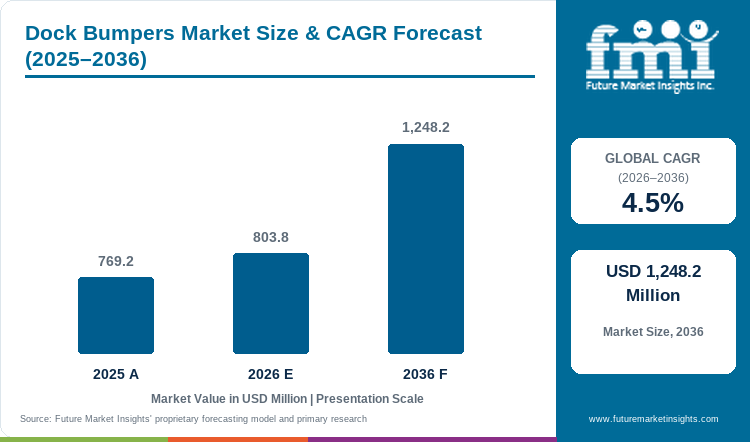
USD 803.8 million in 2026 and USD 1,248.2 million by 2036, expanding at 4.5% CAGR.
Demand for dock bumpers is projected to expand at 4.5% CAGR between 2026 and 2036, growing from USD 769.2 million in 2025 to USD 803.8 million in 2026, and escalating to USD 1,248.2 million by 2036. Kelley dock-planning standards state that dock bumpers can reduce backing-truck impact by 90% to 95% while protecting the dock face from repeated contact. Repeated contact is therefore a maintenance condition and not a one-time installation issue. Facilities are checking wear and projection because excessive compression can expose the dock face.
The USA is projected to expand at 4.9% CAGR compared with 3.9% for Japan because replacement timing differs with dock utilization and operating priorities. Japan’s transport ministry reported in July 2026 that waiting and cargo-handling time averaged two hours and two minutes per truck run during the surveyed 2025 period. Logistics programs are reducing non-driving work at freight stops and are placing more attention on reliable dock interfaces. U.S. facilities face a different replacement condition because frequent trailer cycles can make one damaged position a material-flow constraint. Both markets reward accurate bumper fit, but the operating reason for replacement is not identical.
Key Takeaways
- Repeated trailer contact supports recurring dock bumper replacement because wear can reduce protection before the surrounding dock equipment requires renewal.
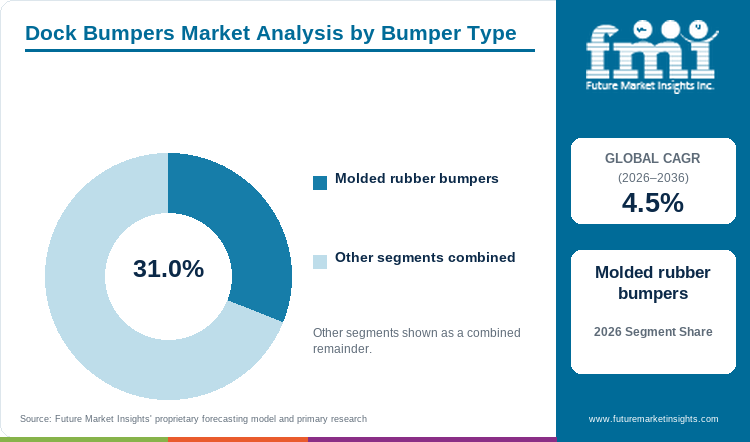
- Molded rubber bumpers are projected to account for 31.0% of Bumper Type demand in 2026 with standardized dimensions supporting routine replacement.
- Rubber is estimated to hold 44.0% of Material demand in 2026 with impact recovery supporting repeated trailer contact.
- Warehouses are expected to lead End Use with 32.0% share in 2026 because frequent trailer cycles make bumper condition a regular maintenance concern.
- Incorrect projection or mounting can delay replacement approval because a poorly fitted bumper may interfere with levelers or leave the dock face exposed.
- Some of the key players in this market include Rite-Hite, Kelley Dock Solutions, Blue Giant, Pentalift Equipment Corporation, Vestil Manufacturing, Dura-Ramp Inc., TMI as a Senneca brand, Beacon Industries, Inc., Loading Systems, and Nova Technology International, LLC.
Analyst Perspective
"Dock bumper replacement earns attention when maintenance teams can connect visible wear with a specific risk to the dock face or surrounding equipment. Suppliers gain an advantage when they verify projection and mounting before quoting a replacement because fit errors can erase the value of a more durable design."
- Nikhil Kaitwade, Principal Consultant, Future Market Insights
How is the dock bumpers market segmented?
The dock bumpers market is segmented by bumper type, material, end use, mounting, sales channel and region.
The dock bumpers market is segmented by bumper type, material, end use, mounting, sales channel and region. Bumper type covers molded rubber, laminated, steel-faced, spring and heavy-duty impact bumpers. Material includes rubber, recycled rubber, steel-faced rubber, polyurethane and composite. End use covers warehouses, distribution centers, manufacturing plants, cold storage and retail loading docks. Mounting covers bolt-on, weld-on, embedded mount and adjustable - replaceable designs. Sales channel covers dock equipment suppliers, industrial distributors, contractor installation and aftermarket - MRO routes.
How do molded rubber bumpers fit routine bumper replacement decisions?
Molded rubber bumpers suit facilities that need predictable dimensions and straightforward replacement without moving wear surfaces. Blue Giant’s dock-planning guidance identifies bumper thickness, trailer traffic and mounting method as application factors for loading-dock protection. One-piece construction keeps selection centered on projection and contact duty rather than a moving steel assembly. Standard dimensions also simplify fit checks against an existing dock face before a worn unit is removed. Consistent rubber molding supports repeatable bumper geometry across scheduled replacement orders. Severe vertical abrasion can still justify steel-faced or moving designs at busier positions.
- By Bumper Type, molded rubber bumpers are estimated to hold 31.0% in 2026, supported by standardized dimensions that suit routine replacement.
- Routine replacement is easier when maintenance teams can compare standard molded dimensions with the installed projection before removing the worn unit.
Why does rubber remain the primary material choice for dock bumpers?
Rubber absorbs contact energy while tolerating repeated compression at active loading positions. Rite-Hite documents molded, laminated and steel-faced bumper formats that use rubber as the impact body across different contact duties. The material remains practical because it can recover from routine trailer contact without requiring a rigid all-steel impact block. Steel wear faces become more relevant when vertical trailer movement raises abrasion at the contact surface. The same need for resilience and stable dimensions applies to industrial rubber products used under repeated mechanical load. Buyers therefore compare traffic frequency and wear pattern before choosing plain rubber or a steel-faced configuration.
- By Material, rubber is estimated to hold 44.0% in 2026, influenced by impact recovery and established specifications for repeated trailer contact.
- Rubber remains practical for facilities that need a replaceable impact body that recovers from routine trailer contact and can be paired with a harder wear face.
What keeps warehouses at the center of dock bumper end use?
Warehouses concentrate trailer frequency across fixed dock positions and make bumper wear a recurring maintenance task. Blue Giant’s dock-planning guidance treats truck volume per shift as a direct input to bumper selection for light, moderate or heavy traffic. High-cycle doors can justify thicker or more abrasion-resistant protection before the surrounding dock equipment reaches its own replacement point. Warehouse racking and dock equipment share the same operating need for predictable material flow around busy shipping positions. A damaged bumper can take one door out of routine service if fit or projection is not restored quickly. Stocked replacement sizes reduce that risk for facilities with repeated trailer turns.
- In 2026, warehouses are expected to lead End Use with 32.0% share, supported by frequent trailer cycles that make bumper wear a regular maintenance concern.
- High-cycle warehouse doors reward suppliers that can match existing dock geometry and restore a worn position without extending loading downtime.
How does bolt-on mounting reduce friction during bumper replacement?
Bolt-on mounting lets maintenance crews remove worn bumpers without cutting permanent welds from the dock face. Vestil documents laminated dock bumpers that can be bolted or welded and offers concrete anchor hardware for installation. The removable route is most useful when existing concrete remains sound and the anchor pattern supports the required projection. It gives maintenance teams a clearer replacement path when a standard bumper is changed without rebuilding the surrounding dock face. Components made from industrial rubber still need secure attachment under repeated impact because movement at the mounting point can shorten service life.
- By Mounting, bolt-on systems are forecast to represent 38.0% in 2026, supported by removable anchors that simplify retrofit replacement.
- Bolt-on replacement works best when the existing concrete and anchor pattern remain suitable for the required bumper projection and expected contact duty.
How do dock equipment suppliers convert site surveys into bumper orders?
Dock equipment suppliers assess bumpers beside levelers and restraints instead of treating protection as an isolated rubber part. Rite-Hite states that local representatives can survey dock approach, height and trailer conditions before recommending a bumper design. That service route matters when projection must preserve leveler reach and restraint clearance at an existing position. Automated material handling equipment increases the cost of avoidable dock downtime because loading positions feed planned material-flow schedules. A site survey can resolve geometry before a supplier confirms size and mounting. Industrial distributors remain practical for known replacement dimensions that do not require application engineering.
- By Sales Channel, dock equipment suppliers are forecast to represent 34.0% in 2026, shaped by site surveys that connect bumper fit with surrounding dock equipment.
- Supplier-led channels add value when a replacement requires site measurements or interface checks before the final bumper size and mounting route are approved.
What are the drivers, restraints and opportunities in the Dock Bumpers Market?
Repeated trailer impact supports replacement demand, installation geometry constrains quick substitution and service-led upgrades create room for higher-value bumper solutions.
- Driver: Frequent trailer contact increases cumulative compression and abrasion at active loading positions until the installed bumper needs replacement.
- Restraint: Projection and mounting errors can delay approval because a replacement must preserve leveler clearance and trailer contact geometry.
- Opportunity: Suppliers can pair bumper inspection with dock surveys and control upgrades that bring replacement into a planned service visit.
Trailer Impact Converts Dock Use into Replacement Demand
Repeated trailer contact raises replacement demand because dock bumpers absorb impact before the building structure does. OSHA recorded a January 2025 fatal incident in which a reversing tractor-trailer pinned a worker against a loading dock. The event does not measure bumper demand, but it confirms the severity of vehicle movement at active dock faces. High-cycle facilities also expose bumpers to compression and vertical abrasion during loading. The same material-flow system often includes heavy-duty pallet racking, so one damaged dock position can disrupt planned movement through the facility. Maintenance teams are replacing visibly worn protection before reduced stand-off distance exposes the dock face or interferes with surrounding equipment.
Dock Geometry Can Delay an Otherwise Straightforward Replacement
A replacement bumper must preserve trailer stand-off distance and clearance for the dock equipment behind the face. Blue Giant’s dock-planning guidance warns that excessive bumper projection can reduce a dock leveler’s lip projection onto the trailer bed. The geometry problem becomes material when a thicker replacement changes the interface between bumper contact and leveler reach. Workplace safety systems at the dock also depend on predictable positioning between the trailer and fixed equipment. Suppliers are checking anchor condition and projection before quotation because a dimensionally correct bumper can still fail the application if the mounting surface is unsuitable. Installation approval therefore depends on verified geometry rather than on bumper size alone.
Service-Led Upgrades Can Raise the Value of a Bumper Replacement
Bumper replacement gives service providers a practical reason to inspect the complete dock position during the same visit. Rite-Hite launched Dok-Commander Pro in April 2026 with real-time equipment visibility and diagnostic tools intended to support maintenance planning. The dated launch concerns connected dock controls rather than bumpers alone, so its relevance is the service route around installed loading equipment. Service teams can identify worn protection while reviewing levelers, restraints and controls at the same position. Portable loading ramps can enter the inspection plan when a facility uses mixed loading arrangements. Coordinating these checks can convert an emergency parts order into planned replacement with verified dimensions.
Which country CAGRs are profiled in the Dock Bumpers Market?
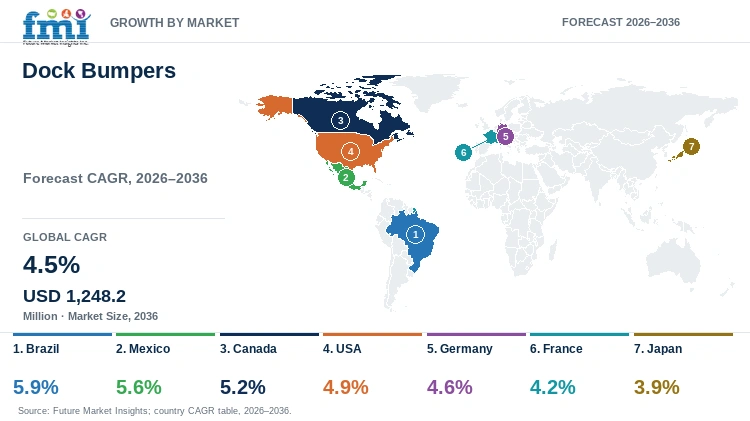
| Country | CAGR |
|---|---|
| Brazil | 5.9% |
| Mexico | 5.6% |
| Canada | 5.2% |
| USA | 4.9% |
| Germany | 4.6% |
| France | 4.2% |
| Japan | 3.9% |
How do country-level CAGRs compare in the Dock Bumpers Market?
The seven selected countries span a 2.0 percentage-point CAGR range from Brazil at 5.9% to Japan at 3.9%. Brazil and Mexico occupy the upper end while Canada and the USA remain nearer the global rate and Germany plus France show mature replacement conditions.
- Brazil’s road-dependent freight network increases the value of rugged standard bumpers and service coverage that reaches industrial sites beyond major logistics hubs.
- Mexico’s manufacturing corridors encourage local stocking of replacement sizes that accommodate mixed trailer fleets and uneven dock specifications.
- Canada’s long service distances favor local stocking of common bumper sizes because established warehouse networks cannot rely on lengthy replacement lead times.
- Across the USA, high warehouse utilization rewards suppliers that can provide rapid aftermarket replacement before one damaged dock position disrupts material flow.
- Germany places strong emphasis on dimensional documentation because mature industrial sites replace bumpers within established dock geometries and existing equipment interfaces.
- For France, maintenance budgeting prioritizes replacement designs that can justify longer service intervals at active distribution sites with recurring trailer contact.
- Japan’s logistics-efficiency programs strengthen demand for predictable dock integration as operators reduce waiting time and non-driving work at freight stops.
Comparable CAGRs can produce different commercial conditions because installed-dock age and service coverage change the timing of replacement orders. A mature country can grow more slowly while still supporting a substantial installed base that requires regular maintenance. The full report provides country-level CAGR analysis across North America, Latin America, Western Europe, Eastern Europe, East Asia, South Asia and Pacific, and the Middle East and Africa.
Country-wise Analysis
- Brazilian facilities manage dock protection inside a national material-handling safety framework that remains under formal regulatory review. By 2036, Brazil is projected to grow at 5.9% CAGR. National material-handling rules support the outlook by keeping equipment condition inside routine facility oversight. Brazil’s Ministry of Labor and Employment updated its NR-11 page in June 2025 as the CTPP continued the revision process. The rule covers material transport plus movement and storage activities that shape equipment condition in industrial facilities. Local service coverage remains important because a worn bumper must match the existing dock face before the position returns to regular service.
- Mexican loading operations now work under NOM-006-STPS-2023 for machinery-based material handling in industrial facilities nationwide. Mexico’s dock bumpers outlook is anticipated to advance at 5.6% CAGR over the assessment period, influenced by national machinery-handling requirements. The Secretaría del Trabajo y Previsión Social confirmed in April 2025 that NOM-006-STPS-2023 entered into force on September 3 2024. Mixed trailer geometry can complicate replacement at older sites with nonstandard equipment interfaces. Material handling equipment service routes can improve replacement execution by pairing local stock with site measurements before worn bumpers alter stand-off distance. That verification reduces rework at facilities with mixed trailer heights and older dock faces.
- Canadian loading docks operate under federal requirements that directly address docks and ramps as well as dock plates. Dock bumper demand in Canada is forecast to rise at 5.2% CAGR over the forecast period, influenced by federal rules that formalize loading-area condition. Canada’s Occupational Health and Safety Regulations were current to June 2026 and last amended in March 2025. Section 2.11 requires loading docks and ramps to support expected loads without surface conditions that interfere with mobile equipment. Cold-chain warehouse automation raises the operational cost of a damaged dock position because scheduled loading depends on reliable interfaces. Replacement planning therefore favors predictable dimensions and local availability at temperature-controlled facilities.
- U.S. loading-dock maintenance carries a direct safety requirement because trailer positioning can expose workers to severe impact hazards. Adoption of dock bumpers in the USA is estimated to expand at 4.9% CAGR through 2036, shaped by safety exposure at active loading positions. OSHA recorded a January 2025 fatality in which a reversing tractor-trailer pinned a worker against a loading dock. Uncontrolled vehicle movement can damage equipment as well as trap workers at the contact point. Replacement teams are checking projection and availability before worn protection compromises surrounding dock equipment. That check matters at high-cycle doors that cannot remain unavailable during scheduled shipping windows.
- German facilities replace dock protection inside an established workplace-safety system that formalizes equipment condition and safe access. The Germany dock bumpers sector is projected to record 4.6% CAGR during the assessment period, reinforced by workplace rules applied to facility operations. BAuA reported in January 2026 that its updated workplace-rules compendium carried a November 2025 status date. The national framework requires employers to limit avoidable hazards when workplaces are set up and operated. Suppliers reduce installation rework by documenting bumper projection and mounting compatibility before the existing unit is removed. Documented geometry also helps mature sites preserve compatibility with levelers that remain in service.
- French distribution sites place loading-area protection inside formal risk-prevention routines that connect vehicle movement with dock access. In France, dock bumper demand is predicted to advance at 4.2% CAGR through 2036. National prevention practices support the outlook by covering yard and loading-dock operations. INRS published its updated road-freight TutoPrév guide in June 2026 with scenarios covering company yards and loading-unloading docks. The guidance keeps loading-dock conditions inside routine prevention work before worn protective components are replaced. Premium replacement can still be deferred when abrasion and fit are not documented clearly enough for maintenance approval. Clear wear records can make that maintenance case easier to approve within planned service budgets.
- Japanese logistics policy is reducing non-driving time at freight stops and placing greater attention on loading efficiency. Dock bumper sales in Japan are forecast to expand at 3.9% CAGR by 2036, tied to programs that place greater scrutiny on loading-position downtime. Japan’s transport ministry reported in July 2026 that waiting and cargo-handling time averaged two hours and two minutes per truck run for the surveyed 2025 period. Facilities protecting shorter dock cycles gain more from predictable integration than from a bumper chosen only on unit price. Suppliers compete by minimizing replacement disruption while preserving the contact geometry required by existing equipment.
Who are the notable companies in the Dock Bumpers Market?
Rite-Hite, Kelley Dock Solutions, Blue Giant, Pentalift Equipment Corporation, Vestil Manufacturing, Dura-Ramp Inc., TMI as a Senneca brand, Beacon Industries, Inc., Loading Systems, and Nova Technology International, LLC are the notable companies serving this market.
Competition separates by bumper architecture breadth and by the ability to verify fit before replacement begins. Integrated dock-equipment suppliers coordinate bumpers with levelers and restraints, while catalog specialists compete on stocked sizes and rapid availability. Site surveys and documented service support raise the qualification bar beyond a simple parts shipment.
- Rite-Hite and Kelley Dock Solutions combine dock-system supply with application guidance during replacement planning. Blue Giant, Pentalift Equipment Corporation and Loading Systems also document dock-bumper selection within integrated loading-dock engineering routes.
- Catalog and replacement specialists include Vestil Manufacturing and Beacon Industries because both provide broad industrial assortments with direct or distributor access.
- Dura-Ramp Inc. and Nova Technology International, LLC supply loading-access systems that incorporate bumper assemblies. TMI participates through Chase TMI dock bumper families within Senneca’s industrial portfolio.
Competitive Benchmarking: Dock Bumpers Market
| Company | Bumper Architecture Breadth | Dock-Fit Engineering | Replacement Support | Geographic Reach |
|---|---|---|---|---|
| Rite-Hite | High | High | High | Global distribution and service network |
| Kelley Dock Solutions | Medium | High | High | North America through 4Front channels |
| Blue Giant | High | High | High | North America with international distribution |
| Pentalift Equipment Corporation | Medium | High | Medium | Canada and USA with dealer support |
| Vestil Manufacturing | High | Medium | High | United States with broad distributor reach |
| Dura-Ramp Inc. | Low | Medium | Medium | North America with custom project delivery |
| TMI as a Senneca brand | High | Medium | Medium | North America through Chase and Senneca |
| Beacon Industries, Inc. | High | Medium | High | United States with direct and distributor reach |
| Loading Systems | High | High | High | Europe with international project coverage |
| Nova Technology International, LLC | Low | High | High | North America through authorized dealers |
Scoring basis: High architecture breadth requires at least three documented bumper families while Medium requires two and Low identifies one direct or integrated bumper route. High dock-fit engineering requires documented geometry guidance while Medium requires product-specific application guidance and Low identifies narrower application detail. High replacement support requires a broad dealer or service network while Medium reflects narrower documented support and Low identifies limited replacement coverage.
Key Developments in the Dock Bumpers Market
- In August 2026, Blue Giant Equipment Corporation’s U.S. patent application was published for a multi-position vehicle restraint designed to secure a vehicle relative to a loading dock.
- In February 2026, Loading Systems published details of an integrated modular control solution that coordinates several loading-bay components through one control architecture.
- In January 2026, Rite-Hite Holding Corporation’s Canadian patent application CA3275462A1 was published for bumpers designed specifically for loading docks.
Key Players in the Dock Bumpers Market
Integrated Dock Systems and Application Engineering
- Rite-Hite
- Kelley Dock Solutions
- Blue Giant
- Pentalift Equipment Corporation
- Loading Systems
Catalog-Based Bumper and Replacement Supply
- Vestil Manufacturing
- Beacon Industries, Inc.
Loading Access and Dock-Environment Platforms
- Dura-Ramp Inc.
- TMI as a Senneca brand
- Nova Technology International, LLC
Dock Bumpers Market - Report Scope
| Coverage field | Report scope |
|---|---|
| Market breakdown | By bumper type, material, end use, mounting, sales channel and region. |
| Quantitative Units | USD million. |
| Market Definition | Commercial sales of dock bumper products and replaceable impact assemblies used at truck and vehicle loading docks. |
| Regions Covered | North America, Latin America, Western Europe, Eastern Europe, East Asia, South Asia and Pacific, and Middle East and Africa. |
| Countries Covered | Brazil, Mexico, Canada, USA, Germany, France, Japan, and 20+ countries included in the full report. |
| Key Companies Profiled | Rite-Hite, Kelley Dock Solutions, Blue Giant, Pentalift Equipment Corporation, Vestil Manufacturing, Dura-Ramp Inc., TMI as a Senneca brand, Beacon Industries, Inc., Loading Systems, and Nova Technology International, LLC. |
| Forecast Period | 2026 to 2036. |
| Approach | Primary and secondary research with market triangulation. |
Dock Bumpers Market - Research Methodology
| Method | Approach |
|---|---|
| Primary Research | FMI analysts gathered input from manufacturers, service providers, technology developers, distributors, end users, procurement teams, and subject-matter experts. Interviews examined purchasing decisions, product or service evaluation, adoption barriers, approval requirements, pricing considerations, and expectations for technical or commercial support. Respondents were also asked what evidence is required before a trial, pilot, or initial order develops into regular purchasing. |
| Desk Research | Desk research covered government statistics, regulatory publications, trade data, industry associations, technical literature, standards, company filings, product information, and official corporate announcements. Sources were reviewed for relevance, publication date, geographic coverage, and consistency with the defined market scope. Claims relating to performance, applications, approvals, capacity, investment, and commercial activity were retained only when supported by credible public evidence. |
| Market Sizing and Forecasting | The market model combined the baseline value with historical performance, segment structure, pricing and volume indicators, adoption levels, company participation, and country-level demand conditions. Forecast assumptions considered economic activity, investment trends, regulatory developments, technology adoption, purchasing cycles, supply availability, and barriers to wider market use. Segment and regional estimates were reconciled before the final market total was calculated. |
| Data Validation | Estimates were checked against multiple independent indicators, including public data, company activity, trade patterns, industry developments, and findings from primary interviews. Validation also tested whether products, services, applications, and company revenues fell within the defined market boundaries. Adjacent categories, unsupported claims, overlapping revenues, and activities without direct market relevance were excluded to reduce double counting and maintain consistency across segments and countries. |
Dock Bumpers Market by Segments
Dock Bumpers Market segmented by Bumper Type:
- Molded rubber bumpers
- Laminated dock bumpers
- Steel-faced bumpers
- Spring dock bumpers
- Heavy-duty impact bumpers
Dock Bumpers Market segmented by Material:
- Rubber
- Recycled rubber
- Steel-faced rubber
- Polyurethane
- Composite
Dock Bumpers Market segmented by End Use:
- Warehouses
- Distribution centers
- Manufacturing plants
- Cold storage
- Retail loading docks
Dock Bumpers Market segmented by Mounting:
- Bolt-on
- Weld-on
- Embedded mount
- Adjustable - replaceable
Dock Bumpers Market segmented by Sales Channel:
- Dock equipment suppliers
- Industrial distributors
- Contractor installation
- Aftermarket - MRO
Dock Bumpers Market by Region:
- North America
- United States
- Canada
- Latin America
- Brazil
- Mexico
- Argentina
- Chile
- Western Europe
- Germany
- France
- United Kingdom
- Italy
- Spain
- Benelux
- Nordics
- Eastern Europe
- Poland
- Czech Republic
- Romania
- Hungary
- East Asia
- China
- Japan
- South Korea
- South Asia and Pacific
- India
- ASEAN
- Australia and New Zealand
- Middle East and Africa
- GCC Countries
- South Africa
- Türkiye
- Israel
Research Sources and Bibliography
- Kelley Dock Solutions. (2026). Dock planning standards.
- Ministry of Land, Infrastructure, Transport and Tourism. (2026, July 10). Truck-driver average duty-time survey results for one operation.
- Kelley Dock Solutions. (2026, January 6). Ease a tight squeeze.
- Occupational Safety and Health Administration. (2025, January 23). Accident report detail: Employee dies of multiple injuries when pinned to dock by semi.
- Rite-Hite. (2026, April 6). Rite-Hite launches Dok-Commander Pro, delivering real-time visibility and connected control at the loading dock.
- Ministério do Trabalho e Emprego. (2025, June 2). Norma Regulamentadora No. 11 (NR-11).
- Secretaría del Trabajo y Previsión Social. (2025, April 7). Entrada en vigor de la NOM-006-STPS-2023.
- Government of Canada. (2026). Canada Occupational Health and Safety Regulations, section 2.11: Docks, ramps and dock plates.
- Federal Institute for Occupational Safety and Health. (2026, January 6). Arbeitsstätten sicher gestalten.
- Institut national de recherche et de sécurité. (2026, June). TutoPrév’ accueil - Transport routier de marchandises.
- Blue Giant Equipment Corporation. (2026, August 20). Vehicle restraint having a plurality of blocking positions for restraining a vehicle relative to a loading dock (U.S. Patent Application Publication No. 20260242164).
- Loading Systems. (2026, February 11). Integrated and modular control for greater efficiency and cost savings.
- Rite-Hite Holding Corporation. (2026, January 19). Bumpers for use at loading docks (CA3275462A1).
- Rite-Hite. (2026, March 26). Rite-Hite acquires Dallas-based Johnson Equipment Company.
- Vestil Manufacturing. (2026). Specialty molded dock bumpers.
- Chase Doors. (2026). Chase TMI dock bumpers.
- Beacon Industries, Inc. (2026). Dock bumpers.
- Nova Technology International, LLC. (2026, July). NMS mechanical dock leveler owner’s manual.
- Blue Giant Equipment Corporation. (2026). Dock bumpers: Planning and design.
- Pentalift Equipment Corporation. (2026). Dock bumpers, loading dock rubber bumpers.
- Dura-Ramp Inc. (2026). Heavy duty ramps: Integrated dock leveler option.
- Loading Systems. (2026). Dock bumpers.
- Rite-Hite. (2026). Loading dock bumpers.
This bibliography is provided for reader reference and is not exhaustive. The full report contains the complete reference list and detailed citations.
This Report Answers
- How large is the dock bumpers market in 2026 and 2036?
- Which operating conditions turn dock bumper wear into replacement demand?
- Why do molded rubber bumpers lead the bumper type category?
- How does rubber maintain its position within the material category?
- Why do warehouses account for 32.0% of end use demand?
- How do country growth rates differ across the selected country forecasts?
- Which companies combine dock bumper supply with application and replacement support?
- Which installation conditions can delay an otherwise suitable dock bumper replacement?
Frequently Asked Questions
How big is the Dock Bumpers Market in 2026?
The dock bumpers market is valued at USD 803.8 million in 2026 and is projected to reach USD 1,248.2 million by 2036. Replacement demand follows repeated trailer contact at active loading positions because worn protection can expose the dock face.
What is the CAGR of the Dock Bumpers Market from 2026 to 2036?
The dock bumpers market is projected to grow at 4.5% CAGR between 2026 and 2036. Recurring replacement at active docks supports the forecast, while higher-abrasion positions increase demand for more durable bumper designs.
Which bumper type leads the Dock Bumpers Market?
Molded rubber bumpers are projected to account for 31.0% of bumper type demand in 2026. Standardized one-piece construction supports routine replacement for facilities that need predictable dimensions and straightforward mounting.
Which material accounts for 44.0% of material demand in the Dock Bumpers Market?
Rubber is estimated to hold 44.0% of material demand in the dock bumpers market during 2026. Impact recovery and established molded or laminated formats keep the material practical for repeated trailer contact at commercial loading docks.
Which country CAGRs are included in the Dock Bumpers Market analysis?
Brazil is projected at 5.9% CAGR and Mexico at 5.6% through 2036. Different national operating conditions shape those forecasts, so the rates describe expected expansion rather than current market-size rankings.
Which companies are active in the Dock Bumpers Market?
Rite-Hite and Kelley Dock Solutions are active alongside Blue Giant and Pentalift Equipment Corporation. Vestil Manufacturing and Beacon Industries also supply dedicated dock-bumper products. Loading Systems documents a broad bumper range. Dura-Ramp Inc. participates through loading systems that include bumper assemblies. TMI as a Senneca brand and Nova Technology International, LLC also document direct or integrated bumper routes.
Preview the report firsthand - request a free sample
Get SampleGet the brochure for pricing and purchase details.
Get PDFTable of Content
- Key Takeaways
- Market Size and CAGR
- Top Growth Driver
- Fastest Growing Segment
- Leading Region
- Key Companies
- Emerging Opportunities
- Executive Summary
- Global Market Outlook
- Demand-side Trends
- Supply-side Trends
- Technology Roadmap Analysis
- Analysis and Recommendations
- Analyst Perspective (What is happening? Why now? What should investors know?)
- Key Questions Answered
- How large is the market?
- What is the CAGR?
- What are key trends?
- Which region dominates?
- Who are the leaders?
- Market Overview
- Market Coverage / Taxonomy
- Market Definition / Scope / Limitations
- Research Methodology
- Chapter Orientation
- Analytical Lens and Working Hypotheses
- Market Structure, Signals, and Trend Drivers
- Benchmarking and Cross-market Comparability
- Market Sizing, Forecasting, and Opportunity Mapping
- Research Design and Evidence Framework
- Desk Research Programme (Secondary Evidence)
- Expert Input and Fieldwork (Primary Evidence)
- Tooling, Models, and Reference Databases
- Data Engineering and Model Build
- Quality Assurance and Audit Trail
- Market Background
- Market Dynamics (Drivers, Restraints, Opportunity, Trends)
- Scenario Forecast (Optimistic, Likely, Conservative)
- Impact Analysis
- AI Impact
- Sustainability Impact
- Regulatory Impact
- Technology Impact
- Consumer / Buyer Analysis
- Purchase Drivers
- Adoption Barriers
- Buyer Journey
- Opportunity Map Analysis
- Product Life Cycle Analysis
- Supply Chain Analysis
- Investment Feasibility Matrix
- Value Chain Analysis
- PESTLE and Porter's Analysis
- Regulatory Landscape
- Regional Parent Market Outlook
- Production and Consumption Statistics
- Import and Export Statistics
- Global Market Analysis and Forecast, 2021 to 2036
- Historical Market Size Value (USD Million) Analysis, 2021 to 2025
- Current and Future Market Size Value (USD Million) Projections, 2026 to 2036
- Y-o-Y Growth Trend Analysis
- Absolute $ Opportunity Analysis
- Global Market Pricing Analysis, 2021 to 2036
- Global Market Analysis and Forecast, By Bumper Type, 2021 to 2036
- Introduction / Key Findings
- Historical Market Size Value (USD Million) Analysis By Bumper Type, 2021 to 2025
- Current and Future Market Size Value (USD Million) Analysis and Forecast By Bumper Type, 2026 to 2036
- Molded rubber bumpers
- Laminated dock bumpers
- Steel-faced bumpers
- Spring dock bumpers
- Heavy-duty impact bumpers
- Y-o-Y Growth Trend Analysis By Bumper Type, 2021 to 2025
- Absolute $ Opportunity Analysis By Bumper Type, 2026 to 2036
- Global Market Analysis and Forecast, By Material, 2021 to 2036
- Introduction / Key Findings
- Historical Market Size Value (USD Million) Analysis By Material, 2021 to 2025
- Current and Future Market Size Value (USD Million) Analysis and Forecast By Material, 2026 to 2036
- Rubber
- Recycled rubber
- Steel-faced rubber
- Polyurethane
- Composite
- Y-o-Y Growth Trend Analysis By Material, 2021 to 2025
- Absolute $ Opportunity Analysis By Material, 2026 to 2036
- Global Market Analysis and Forecast, By End Use, 2021 to 2036
- Introduction / Key Findings
- Historical Market Size Value (USD Million) Analysis By End Use, 2021 to 2025
- Current and Future Market Size Value (USD Million) Analysis and Forecast By End Use, 2026 to 2036
- Warehouses
- Distribution centers
- Manufacturing plants
- Cold storage
- Retail loading docks
- Y-o-Y Growth Trend Analysis By End Use, 2021 to 2025
- Absolute $ Opportunity Analysis By End Use, 2026 to 2036
- Global Market Analysis and Forecast, By Mounting, 2021 to 2036
- Introduction / Key Findings
- Historical Market Size Value (USD Million) Analysis By Mounting, 2021 to 2025
- Current and Future Market Size Value (USD Million) Analysis and Forecast By Mounting, 2026 to 2036
- Bolt-on
- Weld-on
- Embedded mount
- Adjustable - replaceable
- Y-o-Y Growth Trend Analysis By Mounting, 2021 to 2025
- Absolute $ Opportunity Analysis By Mounting, 2026 to 2036
- Global Market Analysis and Forecast, By Sales Channel, 2021 to 2036
- Introduction / Key Findings
- Historical Market Size Value (USD Million) Analysis By Sales Channel, 2021 to 2025
- Current and Future Market Size Value (USD Million) Analysis and Forecast By Sales Channel, 2026 to 2036
- Dock equipment suppliers
- Industrial distributors
- Contractor installation
- Aftermarket - MRO
- Y-o-Y Growth Trend Analysis By Sales Channel, 2021 to 2025
- Absolute $ Opportunity Analysis By Sales Channel, 2026 to 2036
- Global Market Analysis and Forecast, By Region, 2021 to 2036
- Introduction
- Historical Market Size Value (USD Million) Analysis By Region, 2021 to 2025
- Current Market Size Value (USD Million) Analysis and Forecast By Region, 2026 to 2036
- North America
- Latin America
- Western Europe
- Eastern Europe
- East Asia
- South Asia and Pacific
- Middle East and Africa
- Market Attractiveness Analysis By Region
- North America Market Analysis and Forecast, By Country, 2021 to 2036
- Historical Market Size Value (USD Million) Trend Analysis By Market Taxonomy, 2021 to 2025
- Market Size Value (USD Million) Forecast By Market Taxonomy, 2026 to 2036
- By Country
- United States
- Canada
- By Bumper Type
- By Material
- By End Use
- By Mounting
- By Sales Channel
- By Country
- Market Attractiveness Analysis
- By Country
- By Bumper Type
- By Material
- By End Use
- By Mounting
- By Sales Channel
- Key Takeaways
- Latin America Market Analysis and Forecast, By Country
- Historical Market Size Value (USD Million) Trend Analysis By Market Taxonomy, 2021 to 2025
- Market Size Value (USD Million) Forecast By Market Taxonomy, 2026 to 2036
- By Country
- Brazil
- Mexico
- Argentina
- Chile
- By Bumper Type
- By Material
- By End Use
- By Mounting
- By Sales Channel
- By Country
- Market Attractiveness Analysis
- By Country
- By Bumper Type
- By Material
- By End Use
- By Mounting
- By Sales Channel
- Key Takeaways
- Western Europe Market Analysis and Forecast, By Country
- Historical Market Size Value (USD Million) Trend Analysis By Market Taxonomy, 2021 to 2025
- Market Size Value (USD Million) Forecast By Market Taxonomy, 2026 to 2036
- By Country
- Germany
- France
- United Kingdom
- Italy
- Spain
- Benelux
- Nordics
- By Bumper Type
- By Material
- By End Use
- By Mounting
- By Sales Channel
- By Country
- Market Attractiveness Analysis
- By Country
- By Bumper Type
- By Material
- By End Use
- By Mounting
- By Sales Channel
- Key Takeaways
- Eastern Europe Market Analysis and Forecast, By Country
- Historical Market Size Value (USD Million) Trend Analysis By Market Taxonomy, 2021 to 2025
- Market Size Value (USD Million) Forecast By Market Taxonomy, 2026 to 2036
- By Country
- Poland
- Czech Republic
- Romania
- Hungary
- By Bumper Type
- By Material
- By End Use
- By Mounting
- By Sales Channel
- By Country
- Market Attractiveness Analysis
- By Country
- By Bumper Type
- By Material
- By End Use
- By Mounting
- By Sales Channel
- Key Takeaways
- East Asia Market Analysis and Forecast, By Country
- Historical Market Size Value (USD Million) Trend Analysis By Market Taxonomy, 2021 to 2025
- Market Size Value (USD Million) Forecast By Market Taxonomy, 2026 to 2036
- By Country
- China
- Japan
- South Korea
- By Bumper Type
- By Material
- By End Use
- By Mounting
- By Sales Channel
- By Country
- Market Attractiveness Analysis
- By Country
- By Bumper Type
- By Material
- By End Use
- By Mounting
- By Sales Channel
- Key Takeaways
- South Asia and Pacific Market Analysis and Forecast, By Country
- Historical Market Size Value (USD Million) Trend Analysis By Market Taxonomy, 2021 to 2025
- Market Size Value (USD Million) Forecast By Market Taxonomy, 2026 to 2036
- By Country
- India
- ASEAN
- Australia and New Zealand
- By Bumper Type
- By Material
- By End Use
- By Mounting
- By Sales Channel
- By Country
- Market Attractiveness Analysis
- By Country
- By Bumper Type
- By Material
- By End Use
- By Mounting
- By Sales Channel
- Key Takeaways
- Middle East and Africa Market Analysis and Forecast, By Country
- Historical Market Size Value (USD Million) Trend Analysis By Market Taxonomy, 2021 to 2025
- Market Size Value (USD Million) Forecast By Market Taxonomy, 2026 to 2036
- By Country
- GCC Countries
- South Africa
- Türkiye
- Israel
- By Bumper Type
- By Material
- By End Use
- By Mounting
- By Sales Channel
- By Country
- Market Attractiveness Analysis
- By Country
- By Bumper Type
- By Material
- By End Use
- By Mounting
- By Sales Channel
- Key Takeaways
- Key Countries Market Analysis
- United States
- Pricing Analysis
- Market Share Analysis, 2025
- By Bumper Type
- By Material
- By End Use
- By Mounting
- By Sales Channel
- Canada
- Pricing Analysis
- Market Share Analysis, 2025
- By Bumper Type
- By Material
- By End Use
- By Mounting
- By Sales Channel
- Mexico
- Pricing Analysis
- Market Share Analysis, 2025
- By Bumper Type
- By Material
- By End Use
- By Mounting
- By Sales Channel
- Brazil
- Pricing Analysis
- Market Share Analysis, 2025
- By Bumper Type
- By Material
- By End Use
- By Mounting
- By Sales Channel
- Chile
- Pricing Analysis
- Market Share Analysis, 2025
- By Bumper Type
- By Material
- By End Use
- By Mounting
- By Sales Channel
- Germany
- Pricing Analysis
- Market Share Analysis, 2025
- By Bumper Type
- By Material
- By End Use
- By Mounting
- By Sales Channel
- United Kingdom
- Pricing Analysis
- Market Share Analysis, 2025
- By Bumper Type
- By Material
- By End Use
- By Mounting
- By Sales Channel
- Italy
- Pricing Analysis
- Market Share Analysis, 2025
- By Bumper Type
- By Material
- By End Use
- By Mounting
- By Sales Channel
- Spain
- Pricing Analysis
- Market Share Analysis, 2025
- By Bumper Type
- By Material
- By End Use
- By Mounting
- By Sales Channel
- France
- Pricing Analysis
- Market Share Analysis, 2025
- By Bumper Type
- By Material
- By End Use
- By Mounting
- By Sales Channel
- India
- Pricing Analysis
- Market Share Analysis, 2025
- By Bumper Type
- By Material
- By End Use
- By Mounting
- By Sales Channel
- ASEAN
- Pricing Analysis
- Market Share Analysis, 2025
- By Bumper Type
- By Material
- By End Use
- By Mounting
- By Sales Channel
- Australia and New Zealand
- Pricing Analysis
- Market Share Analysis, 2025
- By Bumper Type
- By Material
- By End Use
- By Mounting
- By Sales Channel
- China
- Pricing Analysis
- Market Share Analysis, 2025
- By Bumper Type
- By Material
- By End Use
- By Mounting
- By Sales Channel
- Japan
- Pricing Analysis
- Market Share Analysis, 2025
- By Bumper Type
- By Material
- By End Use
- By Mounting
- By Sales Channel
- South Korea
- Pricing Analysis
- Market Share Analysis, 2025
- By Bumper Type
- By Material
- By End Use
- By Mounting
- By Sales Channel
- Poland
- Pricing Analysis
- Market Share Analysis, 2025
- By Bumper Type
- By Material
- By End Use
- By Mounting
- By Sales Channel
- Hungary
- Pricing Analysis
- Market Share Analysis, 2025
- By Bumper Type
- By Material
- By End Use
- By Mounting
- By Sales Channel
- Türkiye
- Pricing Analysis
- Market Share Analysis, 2025
- By Bumper Type
- By Material
- By End Use
- By Mounting
- By Sales Channel
- South Africa
- Pricing Analysis
- Market Share Analysis, 2025
- By Bumper Type
- By Material
- By End Use
- By Mounting
- By Sales Channel
- United States
- Market Structure Analysis
- Competition Dashboard
- Competition Benchmarking
- Market Share Analysis of Top Players
- By Regional
- By Bumper Type
- By Material
- By End Use
- By Mounting
- By Sales Channel
- Emerging Startups
- Innovation Benchmarking
- Competition Analysis
- Competition Deep Dive
- Rite-Hite
- Overview
- Product Portfolio
- Profitability by Market Segments
- Sales Footprint
- Strategy Overview
- Marketing Strategy
- Product Strategy
- Channel Strategy
- Kelley Dock Solutions
- Blue Giant
- Pentalift Equipment Corporation
- Vestil Manufacturing
- Dura-Ramp Inc.
- TMI as a Senneca brand
- Beacon Industries, Inc.
- Loading Systems
- Nova Technology International, LLC
- Rite-Hite
- Case Studies
- Success Stories
- Recent Developments
- Competition Deep Dive
- Assumptions & Acronyms Used


