

- Market Size (2026)
- USD 1008.8 Mn
- Forecast (2036)
- USD 1604.5 Mn
- CAGR (2026 to 2036)
- 4.7%
How big is Dock Seals Market in 2026?
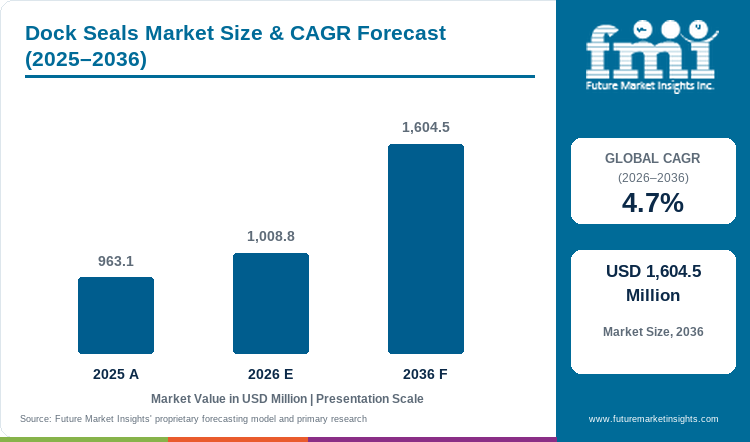
USD 1,008.8 million in 2026 and USD 1,604.5 million by 2036, expanding at 4.7% CAGR.
Sales of dock seals are estimated to rise at 4.7% CAGR through 2036. Valuation moves from USD 963.1 million in 2025 to USD 1,008.8 million in 2026 and reaches USD 1,604.5 million by 2036. Facility operators are controlling air exchange at active loading doors without slowing trailer turnaround. The 2024 International Energy Conservation Code retains a loading-dock weather-seal requirement for direct contact along parked vehicles. U.S. retail e-commerce sales reached USD 326.7 billion in the first quarter of 2026 and increased 9.8% year over year. Higher distribution throughput is increasing door cycles and makes seal fit plus abrasion resistance more important during replacement decisions.
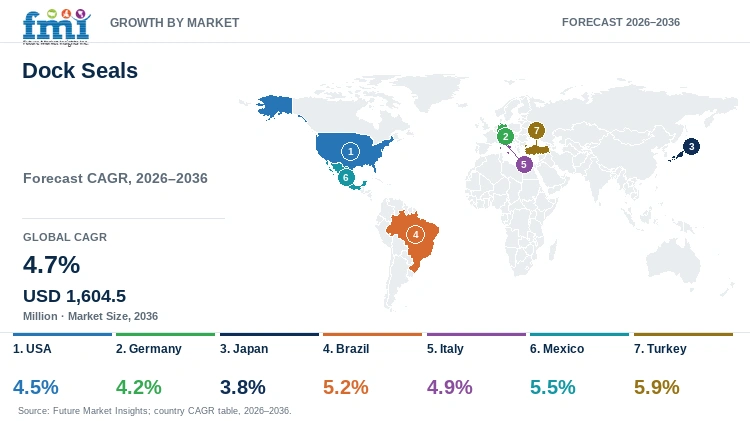
Turkey is projected to grow at 5.9% CAGR through 2036 compared with 3.8% CAGR for Japan. Stable-growth countries are adding distribution capacity and need installation coverage beside product availability. Mature markets are replacing equipment across larger installed dock bases and place more weight on service response. Conversion depends on matching seal architecture with door geometry and the trailer mix at each facility. Suppliers are documenting durability and replacement economics because poor fit can erase expected environmental-control benefits.
Key Takeaways
- Loading-dock operators are replacing worn seals to control uncontrolled airflow and weather exposure during recurring trailer movements.
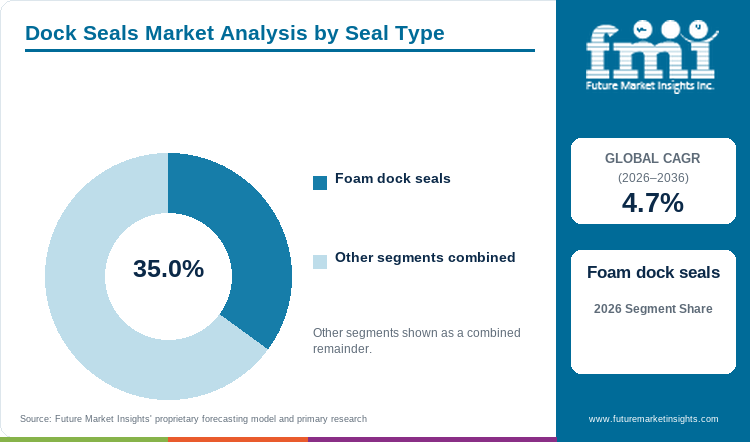
- By seal type, foam dock seals are estimated to hold 35.0% of revenue in 2026, supported by predictable compression performance on consistent trailer fleets.
- By application, standard trailers are projected to represent 32.0% of revenue in 2026, influenced by broad compatibility with established dock geometry.
- By end use, warehouses are anticipated to account for 28.0% of revenue in 2026, supported by repeated loading cycles and visible wear-based replacement.
- By material, vinyl fabric is forecast to hold 38.0% of revenue in 2026, linked to cleanable surfaces and reinforced wear zones across several seal designs.
- Some key participants include Rite-Hite, ASSA ABLOY Entrance Systems, Hormann, Kelley Dock Solutions, Blue Giant, Pentalift, Loading Systems, Stertil Dock Products, Fairborn USA and Chalfant Sewing Fabricators.
Analyst Perspective
"Suppliers are converting replacement demand by documenting trailer fit and expected service life before installation. Facility teams are comparing environmental control with wear exposure because the wrong enclosure can increase maintenance without delivering a reliable seal."
- Nikhil Kaitwade, Principal Analyst at Future Market Insights
How is the dock seals market segmented?
The dock seals market is segmented by Seal Type, Application, End Use, Material, Sales Channel and Region.
The dock seals market is segmented by seal type, application, end use, material, sales channel and region for the 2026 to 2036 assessment period. Seal type separates foam and curtain designs from inflatable or refrigerated configurations. Application identifies the trailer and operating pattern that the enclosure must accommodate. End use captures the facility workflow and environmental-control requirement. Material identifies the exposed surface or compressible structure that manages contact wear. Sales channel separates integrated dock-equipment specification from dealer, contractor and aftermarket replacement routes.
How do foam dock seals support predictable trailer-interface decisions within the seal type category?
Foam dock seals remain a practical configuration for facilities serving trailers with limited variation in body width and height. The trailer compresses foam pads against the wall opening and forms a contact seal without blowers or moving frames. Facility teams are comparing initial cost with reinforcement because compression and trailer motion concentrate wear near corners. Current Blue Giant documentation continues to identify fixed-head-pad seals for consistent trailer heights and standard dock conditions. Buyers are checking head-pad dimensions against the actual fleet before approving replacement specifications.
- Foam dock seals are estimated to lead the seal type category with 35.0% share in 2026, supported by straightforward compression sealing on consistent trailer fleets.
- Selection depends on trailer variation and approach geometry because poor alignment can increase fabric damage despite a simple seal architecture.
How do standard trailers shape specification decisions within the application category?
Standard trailers lead applications because much installed dock infrastructure is dimensioned around common semi-trailer docking patterns. Known bumper projection and dock height allow a supplier to narrow the required seal dimensions before installation. Door size and approach grade are refining the specification during site surveys. Facilities with greater trailer variation are considering shelters or inflatable systems to preserve access and contact. The commercial advantage comes from a large replacement base rather than from a single new-build application.
- Standard trailers are projected to hold 32.0% of application revenue in 2026, influenced by broad compatibility with established dock geometry.
- Site surveys remain necessary because approach angles and vehicle-height differences can weaken contact even at routine loading positions.
How do repeated loading cycles support warehouse demand within the end use category?
Warehouses concentrate loading activity at repeated door positions and expose seals to visible mechanical wear over time. Distribution operations are managing rain and dust beside hot or cold air movement through active trailer openings. First-quarter 2026 U.S. retail e-commerce sales rose 9.8% from the prior year according to the Census Bureau. That throughput measure increases the workload placed on distribution infrastructure without directly measuring dock-seal revenue. Warehouse operators are standardizing suitable seal types and keeping replacement components available for high-use positions.
- Warehouses are anticipated to account for 28.0% of end use revenue in 2026, supported by repeated loading cycles and recurring wear management.
- Distribution throughput strengthens replacement exposure because more trailer movements increase the frequency of contact between vehicles and enclosure materials.
How does vinyl fabric support wear management within the material category?
Vinyl fabric leads because the exposed seal surface must tolerate weather and dirt while protecting the compressible structure underneath. Suppliers are varying fabric weight and reinforcement by wear zone without changing the underlying seal concept. Facility teams are comparing acquisition cost with abrasion resistance and practical cleaning requirements. Vinyl covers also appear across compression seals and accessory curtains which broadens use across several architectures. Buyers are reviewing seam construction and repairability beside low-temperature flexibility for cold facilities.
- Vinyl fabric is forecast to lead the material category with 38.0% share in 2026, linked to cleanable surfaces and adaptable reinforcement across wear zones.
- Material selection remains tied to actual contact frequency because repeated trailer movement can shorten service life at exposed corners and side pads.
How do dock equipment OEMs reduce interface risk within the sales channel category?
Dock equipment OEMs lead when seals are specified with doors and levelers as part of a coordinated loading-bay package. The same project can also include restraints and controls that depend on the final vehicle position. Integrated specification reduces interface risk because the channel can survey openings before matching each component. OEM routes also support standardized requirements across multi-site warehouse programs. Dealers and aftermarket specialists remain important for replacement work at established facilities with known bay geometry.
- Dock equipment OEMs are set to lead the sales channel category with 35.0% share in 2026, enabled by coordinated specification across wider loading-bay systems.
- Aftermarket channels remain commercially important because installed seals require replacement before surrounding dock equipment reaches end of life.
What are the drivers, restraints and opportunities in the Dock Seals Market?
Environmental-control requirements support replacement demand, application mismatch raises lifecycle cost, and controlled-environment docks create higher-value retrofit opportunities.
- Driver: Facility operators are reducing uncontrolled air and weather movement at active dock openings to protect conditioned interior space.
- Restraint: Misapplied seals and repeated trailer contact can increase damage plus replacement frequency before expected energy savings are realized.
- Opportunity: Food, pharmaceutical and cold-chain docks reward better-fitted sealing systems where temperature or contamination losses carry higher operating costs.
Environmental control keeps seal condition tied to recurring replacement decisions
Conditioned facilities are treating the loading opening as part of the building envelope rather than an isolated warehouse accessory. The 2024 International Energy Conservation Code retains loading-dock weather seals within commercial envelope provisions. Facility engineers are checking direct contact around parked vehicles to reduce uncontrolled leakage during routine loading. Food operations add a sanitation requirement because outside air and debris can enter through poorly sealed interfaces. Replacement becomes easier to justify when environmental control has a measurable operating consequence.
Application mismatch raises lifecycle cost before buyers see expected operating savings
Compression seals can deteriorate quickly when trailer heights vary beyond the dimensions assumed during specification. Repeated vehicle movement also concentrates abrasion on face fabric and exposed corners during forklift activity. Facility teams are delaying upgrades when expected savings cannot be separated from installation and maintenance costs. Suppliers are reducing this friction through site surveys and replaceable wear components. Better lifecycle documentation gives procurement teams a clearer comparison between initial price and expected service life.
Controlled-environment docks create a clearer case for higher-performance sealing systems
Cold-chain facilities assign more value to stable temperatures because each loading cycle can expose conditioned space to outside air. Inflatable and refrigerated configurations are adapting to greater vehicle variation without relying on fixed compression geometry alone. Food and pharmaceutical operations are also assessing cleanability and dependable local service during equipment selection. Suppliers with application support can convert retrofit need by proving fit before installation. This route supports higher-value projects without assuming that every warehouse requires the same enclosure architecture.
Which country CAGRs are profiled in the Dock Seals Market?
| Country | CAGR |
|---|---|
| USA | 4.5% |
| Germany | 4.2% |
| Japan | 3.8% |
| Brazil | 5.2% |
| Italy | 4.9% |
| Mexico | 5.5% |
| Turkey | 5.9% |
How do country-level CAGRs compare in the Dock Seals Market?
Turkey forms the upper growth band at 5.9% CAGR followed by Mexico at 5.5% and Brazil at 5.2%. Italy is projected to expand at 4.9% compared with 4.5% for the USA. Germany is anticipated to grow at 4.2% and Japan at 3.8% through 2036. The spread describes forecast speed rather than current revenue size because installed dock bases differ by country. Suppliers therefore combine CAGR with local warehouse investment and replacement intensity before allocating channel resources.
- Turkey and Mexico favor earlier dealer expansion because fast e-commerce growth increases the need for installation capacity beside product availability.
- Brazil combines distribution build-out with cold-chain activity that can support new-bay specification and later replacement demand.
- Italy and the USA place greater weight on retrofit economics because established facilities already contain substantial loading infrastructure.
- Germany and Japan emphasize precise fit plus dependable service because mature logistics networks create recurring replacement rather than first-time adoption.
Comparable growth rates can still produce different buying conditions because facility age and trailer mix vary by country. The full report therefore evaluates installed infrastructure beside freight activity and channel coverage. Cold-chain requirements provide another country-specific filter for higher-performance configurations. Construction cycles and maintenance practices complete the purchasing context across regional markets.
Country-wise Analysis
- Warehouse replacement activity is supporting the USA outlook at 4.5% CAGR through 2036 as operators manage a large installed dock base. The U.S. Census Bureau reported first-quarter 2026 retail e-commerce sales of USD 326.7 billion and 9.8% annual growth. Higher throughput is increasing contact cycles at distribution doors and raises the value of service availability. Suppliers are competing through site surveys and reinforced options for positions with frequent trailer movement.
- Dense freight activity is influencing Germany at 4.2% CAGR through 2036 because mature facilities require durable retrofit performance. Destatis reported roughly 3.34 billion tonnes of road goods transport for 2024 and a similar provisional figure for 2025. Replacement decisions are focusing on energy control and downtime rather than basic product awareness. Suppliers are supporting orders with documented fit and responsive maintenance coverage.
- A mature logistics system is shaping Japan at 3.8% CAGR through 2036 as operators prioritize precise retrofit fit. METI reported a JPY 26.1 trillion B2C e-commerce market and JPY 514.4 trillion B2B market for 2024. Existing equipment can delay replacement until measurable handling or energy benefits become clear. Suppliers are emphasizing compact retrofit solutions and dependable local support.
- New logistics investment is supporting Brazil at 5.2% CAGR through 2036 as distribution hubs add loading-bay capacity. Brazil's Ministry of Ports and Airports reported in May 2026 that e-commerce growth is expanding airport logistics activity and distribution infrastructure. Regional service consistency remains important across a geographically broad network. Suppliers are combining durable configurations with installer coverage for new and replacement projects.
- Selective warehouse modernization is influencing Italy at 4.9% CAGR through 2036 as online selling adds distribution activity to an established base. Istat reported that 20.4% of enterprises with at least ten employees made online sales during 2024. Capital approval can remain difficult for upgrades that are not safety critical. Suppliers are strengthening retrofit cases with energy retention and maintenance savings.
- Digital commerce growth is supporting Mexico at 5.5% CAGR through 2036 as distribution networks add throughput and new facilities. INEGI reported that e-commerce of goods and services represented 6.9% of national GDP in 2024. Installation consistency becomes more important as operators expand across several sites. Suppliers are building scalable dealer coverage and dependable aftermarket replacement capability.
- Rapid e-commerce expansion is supporting Turkey at 5.9% CAGR through 2036 as distribution flows increase across warehouse doors. The Ministry of Trade reported that 2025 e-commerce volume exceeded TRY 4.5 trillion after increasing 52.2% from the prior year. Service networks must expand quickly enough to support new sites and recurring replacement. Suppliers are prioritizing configurable products with regional parts availability.
Who are the notable companies in the Dock Seals Market?
Rite-Hite, ASSA ABLOY Entrance Systems, Hormann, Kelley Dock Solutions, Blue Giant, Pentalift, Loading Systems, Stertil Dock Products, Fairborn USA and Chalfant Sewing Fabricators are active within the defined dock seals supply boundary.
Competition spans integrated loading-bay system vendors and specialist dock-equipment manufacturers beside focused seal fabricators. Integrated suppliers are coordinating seals with doors and levelers during new construction or wider retrofit programs. Dock specialists are competing through several enclosure architectures and service capability for mixed vehicle fleets. Focused fabricators remain relevant for custom dimensions and replacement components at established bays. Local surveying and installation support influence conversion because installed performance depends heavily on actual trailer geometry.
- Rite-Hite, ASSA ABLOY Entrance Systems, Hormann and Kelley Dock Solutions combine sealing products with wider loading-bay equipment portfolios.
- Blue Giant, Pentalift, Loading Systems and Stertil Dock Products provide sealing systems beside levelers or other loading-bay components.
- Fairborn USA and Chalfant Sewing Fabricators serve focused enclosure and replacement requirements through fabric-based or custom seal configurations.
Competitive Benchmarking: Dock Seals Market
| Company | Seal Configuration Breadth | Controlled-Environment Fit | Dock-System Integration | Geographic Reach |
|---|---|---|---|---|
| Rite-Hite | High | High | High | North America, Europe and Asia-Pacific |
| ASSA ABLOY Entrance Systems | High | High | High | Global commercial and service network |
| Hormann | Medium | Medium | High | Europe, North America and international markets |
| Kelley Dock Solutions | High | High | High | United States and Canada |
| Blue Giant | High | High | High | North America and international distribution |
| Pentalift | High | Medium | High | North America |
| Loading Systems | High | High | High | Europe and international markets |
| Stertil Dock Products | High | High | High | Europe and global distributor markets |
| Fairborn USA | Medium | Medium | Unscored | United States |
| Chalfant Sewing Fabricators | Medium | Medium | Unscored | United States |
Scoring basis: High configuration breadth requires documented coverage across multiple seal or shelter architectures. Controlled-environment fit considers evidence for temperature-control or hygiene-sensitive loading applications. Dock-system integration measures coordination with doors and levelers plus related loading-bay equipment. Medium indicates credible but narrower evidence within the stated criterion. Unscored is used when public evidence is insufficient for a defensible rating.
Key Developments in the Dock Seals Market
- June 2026: ASSA ABLOY acquired Sentinel Dock & Door in Canada and added a national commercial dock-and-door service platform to Entrance Systems. The completed acquisition strengthens direct service coverage for loading-bay equipment and supports local measurement plus lifecycle maintenance around enclosure projects.
- May 2026: Stertil Dock Products UK appointed Jon Wickett as General Manager after experience across materials handling and warehouse operations. The appointment supports commercial execution inside a business that supplies shelters and seals beside broader loading-bay equipment.
- April 2026: Rite-Hite launched Dok-Commander Pro for connected dock control and equipment diagnostics. The system does not replace dock seals but supports coordinated operation across the same loading-bay procurement route and strengthens integrated service positioning.
Key Players in the Dock Seals Market
Integrated Loading-Bay System Suppliers
- Rite-Hite
- ASSA ABLOY Entrance Systems
- Hormann
- Kelley Dock Solutions
Broad Dock Equipment Specialists
- Blue Giant
- Pentalift
- Loading Systems
- Stertil Dock Products
Seal and Fabric Specialists
- Fairborn USA
- Chalfant Sewing Fabricators
Dock Seals Market - Report Scope
| Coverage field | Report scope |
|---|---|
| Market breakdown | By seal type, application, end use, material, sales channel and region. |
| Quantitative Units | USD million. |
| Market Definition | Commercial dock sealing products sold within the defined seal type, application, end use, material and sales channel universe are included. Stand-alone dock levelers, doors, vehicle restraints, bumpers and unrelated shelter systems outside the defined seal categories are excluded. |
| Regions Covered | North America, Latin America, Western Europe, Eastern Europe, East Asia, South Asia and Pacific, and Middle East and Africa. |
| Countries Covered | USA, Germany, Japan, Brazil, Italy, Mexico, Turkey and more than twenty-five additional countries in the full report. |
| Key Companies Profiled | Rite-Hite, ASSA ABLOY Entrance Systems, Hormann, Kelley Dock Solutions, Blue Giant, Pentalift, Loading Systems, Stertil Dock Products, Fairborn USA and Chalfant Sewing Fabricators. |
| Forecast Period | 2026 to 2036. |
| Approach | Primary and secondary research with market triangulation. |
Dock Seals Market - Research Methodology
| Method | Approach |
|---|---|
| Primary Research | FMI analysts gathered input from manufacturers, service providers, technology developers, distributors, end users, procurement teams, and subject-matter experts. Interviews examined purchasing decisions, product or service evaluation, adoption barriers, approval requirements, pricing considerations, and expectations for technical or commercial support. Respondents were also asked what evidence is required before a trial, pilot, or initial order develops into regular purchasing. |
| Desk Research | Desk research covered government statistics, regulatory publications, trade data, industry associations, technical literature, standards, company filings, product information, and official corporate announcements. Sources were reviewed for relevance, publication date, geographic coverage, and consistency with the defined market scope. Claims relating to performance, applications, approvals, capacity, investment, and commercial activity were retained only when supported by credible public evidence. |
| Market Sizing and Forecasting | The market model combined the baseline value with historical performance, segment structure, pricing and volume indicators, adoption levels, company participation, and country-level demand conditions. Forecast assumptions considered economic activity, investment trends, regulatory developments, technology adoption, purchasing cycles, supply availability, and barriers to wider market use. Segment and regional estimates were reconciled before the final market total was calculated. |
| Data Validation | Estimates were checked against multiple independent indicators, including public data, company activity, trade patterns, industry developments, and findings from primary interviews. Validation also tested whether products, services, applications, and company revenues fell within the defined market boundaries. Adjacent categories, unsupported claims, overlapping revenues, and activities without direct market relevance were excluded to reduce double counting and maintain consistency across segments and countries. |
Dock Seals Market by Segments
Dock Seals Market segmented by Seal Type:
- Foam dock seals
- Curtain dock seals
- Inflatable seals
- Head curtain seals
- Refrigerated dock seals
Dock Seals Market segmented by Application:
- Standard trailers
- Refrigerated trailers
- Parcel vans
- High-traffic docks
- Food and pharmaceutical docks
Dock Seals Market segmented by End Use:
- Warehouses
- Cold chain logistics
- Food distribution
- Retail distribution
- Manufacturing plants
Dock Seals Market segmented by Material:
- Vinyl fabric
- Foam core
- Rubberized fabric
- Reinforced PVC
Dock Seals Market segmented by Sales Channel:
- Dock equipment OEMs
- Industrial door dealers
- Facility contractors
- Aftermarket replacement
Dock Seals Market by Region:
- North America
- USA
- Canada
- Latin America
- Brazil
- Mexico
- Argentina
- Chile
- Western Europe
- Germany
- France
- United Kingdom
- Italy
- Spain
- Benelux
- Nordics
- Eastern Europe
- Poland
- Czech Republic
- Romania
- Hungary
- East Asia
- China
- Japan
- South Korea
- South Asia and Pacific
- India
- ASEAN
- Australia and New Zealand
- Middle East and Africa
- GCC Countries
- South Africa
- Turkey
- Israel
Research Sources and Bibliography
- International Code Council. (2024). 2024 International Energy Conservation Code: Commercial provisions on loading dock weather seals.
- U.S. Census Bureau. (2026, May 18). Quarterly retail e-commerce sales, first quarter 2026.
- Federal Statistical Office of Germany (Destatis). (2026, April). Goods transport: Transport and performance.
- Ministry of Economy, Trade and Industry, Japan. (2025, August 26). Results of FY2024 e-commerce market survey compiled.
- Ministry of Ports and Airports, Brazil. (2026, May 28). Expansion of e-commerce increases strategic use of airports for logistics operations in Brazil.
- Istat. (2025, January 17). Enterprises and ICT - Year 2024.
- INEGI. (2026, February 18). Gross value added of e-commerce, base 2018.
- Ministry of Trade, Republic of Türkiye. (2026, May 22). Türkiye'de E-Ticaretin Görünümü Raporu 2025 - English version.
- U.S. Food and Drug Administration. (2026). Frequently asked questions on FSMA sanitary transportation requirements.
- ASSA ABLOY. (2026, June 2). ASSA ABLOY acquires Sentinel Dock & Door in Canada.
- Stertil Dock Products. (2026, May 18). Stertil Dock Products UK appoints Jon Wickett as General Manager.
- Rite-Hite. (2026, April 6). Rite-Hite launches Dok-Commander Pro.
- Rite-Hite. (2026, April 6). Rite-Hite introduces PitMaster Vertical to help food and beverage facilities strengthen loading dock compliance.
- Blue Giant Equipment Corporation. (2026, March 4). Seals and shelters installation-manual revisions, document library.
- Kelley Dock Solutions. (2026, June 29). Solving the high-capacity dock dilemma: Why width and seal matter more than ever.
This bibliography is provided for reader reference and is not exhaustive. The full report contains the complete reference list and detailed citations.
This Report Answers
- How large is the dock seals market in 2026 and 2036?
- Which operating conditions support recurring replacement demand for dock seals?
- Which seal type accounts for 35.0% of 2026 revenue?
- How do standard trailers influence dock-seal specification and replacement decisions?
- Which end use accounts for 28.0% of revenue in 2026?
- How do country growth rates differ across the seven profiled markets?
- Which suppliers combine dock seals with broader loading-bay equipment portfolios?
- Which fit and wear conditions can reduce expected lifecycle returns?
- What should facility teams evaluate before approving a replacement seal?
Frequently Asked Questions
How big is the dock seals market in 2026?
The dock seals market is valued at USD 1,008.8 million in 2026 and is projected to reach USD 1,604.5 million by 2036. Replacement demand is supported by recurring wear plus environmental-control requirements at active loading interfaces.
What is the CAGR of the dock seals market from 2026 to 2036?
The dock seals market is projected to grow at 4.7% CAGR between 2026 and 2036. Warehouse throughput and installed-base replacement support the forecast beside new distribution infrastructure in faster-growth countries.
Which seal type leads the dock seals market in 2026?
Foam dock seals are estimated to hold 35.0% of seal type revenue during 2026. Their compression design suits facilities serving trailers with relatively consistent height and width characteristics.
Which application leads the dock seals market in 2026?
Standard trailers are projected to represent 32.0% of application revenue during 2026. Established dock geometry reduces customization and supports a large replacement base for compression and curtain configurations.
Which companies are active in the dock seals market?
Active companies include Rite-Hite, ASSA ABLOY Entrance Systems, Hormann, Kelley Dock Solutions, Blue Giant, Pentalift, Loading Systems, Stertil Dock Products, Fairborn USA and Chalfant Sewing Fabricators. They compete through configuration breadth plus system integration and service coverage.
Preview the report firsthand - request a free sample
Get SampleGet the brochure for pricing and purchase details.
Get PDFTable of Content
- Key Takeaways
- Market Size and CAGR
- Top Growth Driver
- Fastest Growing Segment
- Leading Region
- Key Companies
- Emerging Opportunities
- Executive Summary
- Global Market Outlook
- Demand-side Trends
- Supply-side Trends
- Technology Roadmap Analysis
- Analysis and Recommendations
- Analyst Perspective (What is happening? Why now? What should investors know?)
- Key Questions Answered
- How large is the market?
- What is the CAGR?
- What are key trends?
- Which region dominates?
- Who are the leaders?
- Market Overview
- Market Coverage / Taxonomy
- Market Definition / Scope / Limitations
- Research Methodology
- Chapter Orientation
- Analytical Lens and Working Hypotheses
- Market Structure, Signals, and Trend Drivers
- Benchmarking and Cross-market Comparability
- Market Sizing, Forecasting, and Opportunity Mapping
- Research Design and Evidence Framework
- Desk Research Programme (Secondary Evidence)
- Expert Input and Fieldwork (Primary Evidence)
- Tooling, Models, and Reference Databases
- Data Engineering and Model Build
- Quality Assurance and Audit Trail
- Market Background
- Market Dynamics (Drivers, Restraints, Opportunity, Trends)
- Scenario Forecast (Optimistic, Likely, Conservative)
- Impact Analysis
- AI Impact
- Sustainability Impact
- Regulatory Impact
- Technology Impact
- Consumer / Buyer Analysis
- Purchase Drivers
- Adoption Barriers
- Buyer Journey
- Opportunity Map Analysis
- Product Life Cycle Analysis
- Supply Chain Analysis
- Investment Feasibility Matrix
- Value Chain Analysis
- PESTLE and Porter's Analysis
- Regulatory Landscape
- Regional Parent Market Outlook
- Production and Consumption Statistics
- Import and Export Statistics
- Global Market Analysis and Forecast, 2021 to 2036
- Historical Market Size Value (USD Million) Analysis, 2021 to 2025
- Current and Future Market Size Value (USD Million) Projections, 2026 to 2036
- Y-o-Y Growth Trend Analysis
- Absolute $ Opportunity Analysis
- Global Market Pricing Analysis, 2021 to 2036
- Global Market Analysis and Forecast, By Seal Type, 2021 to 2036
- Introduction / Key Findings
- Historical Market Size Value (USD Million) Analysis By Seal Type, 2021 to 2025
- Current and Future Market Size Value (USD Million) Analysis and Forecast By Seal Type, 2026 to 2036
- Foam dock seals
- Curtain dock seals
- Inflatable seals
- Head curtain seals
- Refrigerated dock seals
- Y-o-Y Growth Trend Analysis By Seal Type, 2021 to 2025
- Absolute $ Opportunity Analysis By Seal Type, 2026 to 2036
- Global Market Analysis and Forecast, By Application, 2021 to 2036
- Introduction / Key Findings
- Historical Market Size Value (USD Million) Analysis By Application, 2021 to 2025
- Current and Future Market Size Value (USD Million) Analysis and Forecast By Application, 2026 to 2036
- Standard trailers
- Refrigerated trailers
- Parcel vans
- High-traffic docks
- Food and pharmaceutical docks
- Y-o-Y Growth Trend Analysis By Application, 2021 to 2025
- Absolute $ Opportunity Analysis By Application, 2026 to 2036
- Global Market Analysis and Forecast, By End Use, 2021 to 2036
- Introduction / Key Findings
- Historical Market Size Value (USD Million) Analysis By End Use, 2021 to 2025
- Current and Future Market Size Value (USD Million) Analysis and Forecast By End Use, 2026 to 2036
- Warehouses
- Cold chain logistics
- Food distribution
- Retail distribution
- Manufacturing plants
- Y-o-Y Growth Trend Analysis By End Use, 2021 to 2025
- Absolute $ Opportunity Analysis By End Use, 2026 to 2036
- Global Market Analysis and Forecast, By Material, 2021 to 2036
- Introduction / Key Findings
- Historical Market Size Value (USD Million) Analysis By Material, 2021 to 2025
- Current and Future Market Size Value (USD Million) Analysis and Forecast By Material, 2026 to 2036
- Vinyl fabric
- Foam core
- Rubberized fabric
- Reinforced PVC
- Y-o-Y Growth Trend Analysis By Material, 2021 to 2025
- Absolute $ Opportunity Analysis By Material, 2026 to 2036
- Global Market Analysis and Forecast, By Sales Channel, 2021 to 2036
- Introduction / Key Findings
- Historical Market Size Value (USD Million) Analysis By Sales Channel, 2021 to 2025
- Current and Future Market Size Value (USD Million) Analysis and Forecast By Sales Channel, 2026 to 2036
- Dock equipment OEMs
- Industrial door dealers
- Facility contractors
- Aftermarket replacement
- Y-o-Y Growth Trend Analysis By Sales Channel, 2021 to 2025
- Absolute $ Opportunity Analysis By Sales Channel, 2026 to 2036
- Global Market Analysis and Forecast, By Region, 2021 to 2036
- Introduction
- Historical Market Size Value (USD Million) Analysis By Region, 2021 to 2025
- Current Market Size Value (USD Million) Analysis and Forecast By Region, 2026 to 2036
- North America
- Latin America
- Western Europe
- Eastern Europe
- East Asia
- South Asia and Pacific
- Middle East and Africa
- Market Attractiveness Analysis By Region
- North America Market Analysis and Forecast, By Country, 2021 to 2036
- Historical Market Size Value (USD Million) Trend Analysis By Market Taxonomy, 2021 to 2025
- Market Size Value (USD Million) Forecast By Market Taxonomy, 2026 to 2036
- By Country
- USA
- Canada
- By Seal Type
- By Application
- By End Use
- By Material
- By Sales Channel
- By Country
- Market Attractiveness Analysis
- By Country
- By Seal Type
- By Application
- By End Use
- By Material
- By Sales Channel
- Key Takeaways
- Latin America Market Analysis and Forecast, By Country
- Historical Market Size Value (USD Million) Trend Analysis By Market Taxonomy, 2021 to 2025
- Market Size Value (USD Million) Forecast By Market Taxonomy, 2026 to 2036
- By Country
- Brazil
- Mexico
- Argentina
- Chile
- By Seal Type
- By Application
- By End Use
- By Material
- By Sales Channel
- By Country
- Market Attractiveness Analysis
- By Country
- By Seal Type
- By Application
- By End Use
- By Material
- By Sales Channel
- Key Takeaways
- Western Europe Market Analysis and Forecast, By Country
- Historical Market Size Value (USD Million) Trend Analysis By Market Taxonomy, 2021 to 2025
- Market Size Value (USD Million) Forecast By Market Taxonomy, 2026 to 2036
- By Country
- Germany
- France
- United Kingdom
- Italy
- Spain
- Benelux
- Nordics
- By Seal Type
- By Application
- By End Use
- By Material
- By Sales Channel
- By Country
- Market Attractiveness Analysis
- By Country
- By Seal Type
- By Application
- By End Use
- By Material
- By Sales Channel
- Key Takeaways
- Eastern Europe Market Analysis and Forecast, By Country
- Historical Market Size Value (USD Million) Trend Analysis By Market Taxonomy, 2021 to 2025
- Market Size Value (USD Million) Forecast By Market Taxonomy, 2026 to 2036
- By Country
- Poland
- Czech Republic
- Romania
- Hungary
- By Seal Type
- By Application
- By End Use
- By Material
- By Sales Channel
- By Country
- Market Attractiveness Analysis
- By Country
- By Seal Type
- By Application
- By End Use
- By Material
- By Sales Channel
- Key Takeaways
- East Asia Market Analysis and Forecast, By Country
- Historical Market Size Value (USD Million) Trend Analysis By Market Taxonomy, 2021 to 2025
- Market Size Value (USD Million) Forecast By Market Taxonomy, 2026 to 2036
- By Country
- China
- Japan
- South Korea
- By Seal Type
- By Application
- By End Use
- By Material
- By Sales Channel
- By Country
- Market Attractiveness Analysis
- By Country
- By Seal Type
- By Application
- By End Use
- By Material
- By Sales Channel
- Key Takeaways
- South Asia and Pacific Market Analysis and Forecast, By Country
- Historical Market Size Value (USD Million) Trend Analysis By Market Taxonomy, 2021 to 2025
- Market Size Value (USD Million) Forecast By Market Taxonomy, 2026 to 2036
- By Country
- India
- ASEAN
- Australia and New Zealand
- By Seal Type
- By Application
- By End Use
- By Material
- By Sales Channel
- By Country
- Market Attractiveness Analysis
- By Country
- By Seal Type
- By Application
- By End Use
- By Material
- By Sales Channel
- Key Takeaways
- Middle East and Africa Market Analysis and Forecast, By Country
- Historical Market Size Value (USD Million) Trend Analysis By Market Taxonomy, 2021 to 2025
- Market Size Value (USD Million) Forecast By Market Taxonomy, 2026 to 2036
- By Country
- GCC Countries
- South Africa
- Turkey
- Israel
- By Seal Type
- By Application
- By End Use
- By Material
- By Sales Channel
- By Country
- Market Attractiveness Analysis
- By Country
- By Seal Type
- By Application
- By End Use
- By Material
- By Sales Channel
- Key Takeaways
- Key Countries Market Analysis
- USA
- Pricing Analysis
- Market Share Analysis, 2025
- By Seal Type
- By Application
- By End Use
- By Material
- By Sales Channel
- Canada
- Pricing Analysis
- Market Share Analysis, 2025
- By Seal Type
- By Application
- By End Use
- By Material
- By Sales Channel
- Mexico
- Pricing Analysis
- Market Share Analysis, 2025
- By Seal Type
- By Application
- By End Use
- By Material
- By Sales Channel
- Brazil
- Pricing Analysis
- Market Share Analysis, 2025
- By Seal Type
- By Application
- By End Use
- By Material
- By Sales Channel
- Chile
- Pricing Analysis
- Market Share Analysis, 2025
- By Seal Type
- By Application
- By End Use
- By Material
- By Sales Channel
- Germany
- Pricing Analysis
- Market Share Analysis, 2025
- By Seal Type
- By Application
- By End Use
- By Material
- By Sales Channel
- United Kingdom
- Pricing Analysis
- Market Share Analysis, 2025
- By Seal Type
- By Application
- By End Use
- By Material
- By Sales Channel
- Italy
- Pricing Analysis
- Market Share Analysis, 2025
- By Seal Type
- By Application
- By End Use
- By Material
- By Sales Channel
- Spain
- Pricing Analysis
- Market Share Analysis, 2025
- By Seal Type
- By Application
- By End Use
- By Material
- By Sales Channel
- France
- Pricing Analysis
- Market Share Analysis, 2025
- By Seal Type
- By Application
- By End Use
- By Material
- By Sales Channel
- India
- Pricing Analysis
- Market Share Analysis, 2025
- By Seal Type
- By Application
- By End Use
- By Material
- By Sales Channel
- ASEAN
- Pricing Analysis
- Market Share Analysis, 2025
- By Seal Type
- By Application
- By End Use
- By Material
- By Sales Channel
- Australia and New Zealand
- Pricing Analysis
- Market Share Analysis, 2025
- By Seal Type
- By Application
- By End Use
- By Material
- By Sales Channel
- China
- Pricing Analysis
- Market Share Analysis, 2025
- By Seal Type
- By Application
- By End Use
- By Material
- By Sales Channel
- Japan
- Pricing Analysis
- Market Share Analysis, 2025
- By Seal Type
- By Application
- By End Use
- By Material
- By Sales Channel
- South Korea
- Pricing Analysis
- Market Share Analysis, 2025
- By Seal Type
- By Application
- By End Use
- By Material
- By Sales Channel
- Poland
- Pricing Analysis
- Market Share Analysis, 2025
- By Seal Type
- By Application
- By End Use
- By Material
- By Sales Channel
- Hungary
- Pricing Analysis
- Market Share Analysis, 2025
- By Seal Type
- By Application
- By End Use
- By Material
- By Sales Channel
- South Africa
- Pricing Analysis
- Market Share Analysis, 2025
- By Seal Type
- By Application
- By End Use
- By Material
- By Sales Channel
- Turkey
- Pricing Analysis
- Market Share Analysis, 2025
- By Seal Type
- By Application
- By End Use
- By Material
- By Sales Channel
- USA
- Market Structure Analysis
- Competition Dashboard
- Competition Benchmarking
- Market Share Analysis of Top Players
- By Regional
- By Seal Type
- By Application
- By End Use
- By Material
- By Sales Channel
- Emerging Startups
- Innovation Benchmarking
- Competition Analysis
- Competition Deep Dive
- Rite-Hite
- Overview
- Product Portfolio
- Profitability by Market Segments
- Sales Footprint
- Strategy Overview
- Marketing Strategy
- Product Strategy
- Channel Strategy
- ASSA ABLOY Entrance Systems
- Hormann
- Kelley Dock Solutions
- Blue Giant
- Pentalift
- Loading Systems
- Stertil Dock Products
- Fairborn USA
- Chalfant Sewing Fabricators
- Rite-Hite
- Case Studies
- Success Stories
- Recent Developments
- Competition Deep Dive
- Assumptions & Acronyms Used


