

- Market Size (2026)
- USD 357.0 Mn
- Forecast (2036)
- USD 581.5 Mn
- CAGR (2026 to 2036)
- 5.0%
How big is Butterfly Seals Market in 2026?
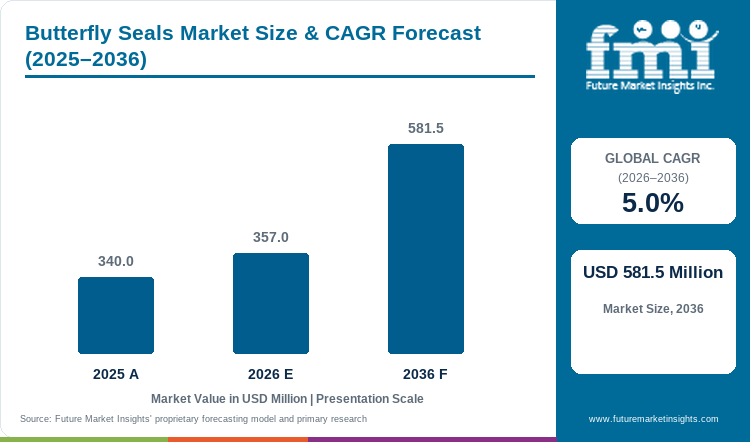
USD 357.0 million in 2026 and USD 581.5 million by 2036 at a 5.0% CAGR.
Sales of butterfly seals are estimated to rise at 5.0% CAGR through 2036, increasing valuation from USD 340.0 million in 2025 to USD 357.0 million in 2026, and reaching USD 581.5 million by 2036. Seat wear is changing torque and shutoff performance, so new assemblies and overhauls both create sealing decisions. Crane ChemPharma reported TA-Luft 2021 certification for XOMOX valves in October 2025 under test protocols aligned with ISO 15848-1. That qualification links industrial valve acceptance to documented emissions performance before an OEM or plant approves the sealing configuration.
Japan’s mature wastewater network makes replacement work more prominent nationally than project-led KSA expansion. Japan’s transport ministry reported in August 2026 that wastewater treatment coverage reached 94.0% nationally. Nationwide coverage shifts equipment decisions toward established-system renewal work instead of greenfield construction planning. KSA differs because network expansion places new seal decisions inside project specifications before equipment commissioning.
Key Takeaways of Butterfly Seals Market
- Installed butterfly valves generate repeat seal demand when seat wear or media changes require replacement before the valve body reaches the end of its service life.
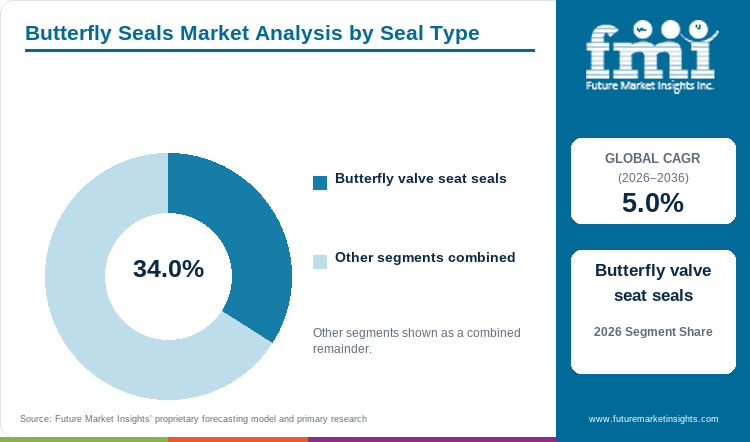
- In 2026, Butterfly Valve Seat Seals lead the product category with a 34.0% share because shutoff performance depends on the seat-disc interface.
- EPDM accounts for 27.0% of material demand in 2026 because qualified water-service applications favor resilient elastomer liners.
- In 2026, 2-6 inch valves lead the Valve Size category with a 38.0% share because common line sizes create recurring replacement volume.
- Valve geometry and chemical exposure influence torque and leakage performance, limiting substitution even when replacement dimensions match.
- Key players include Trelleborg Sealing Solutions, Freudenberg Sealing Technologies, Parker Hannifin, Garlock, James Walker, ERIKS, Flowserve, Crane ChemPharma, KSB, and Emerson Keystone.
Analyst Perspective
"Butterfly seal selection turns on valve geometry and process media because the component can determine shutoff reliability. Suppliers pairing qualified compounds with dependable replacement availability can retain accounts during routine valve maintenance."
- Nikhil Kaitwade, Principal Consultant, Future Market Insights
How is the Butterfly Seals Market segmented?
Seal Type, Material, Valve Size, End Use, Sales Channel and Region
Seal type covers butterfly valve seat seals, disc seals, shaft seals, body liner seals and high-performance elastomer seals, while material covers EPDM, PTFE, NBR, FKM - Viton, silicone and metal-reinforced constructions. Valve size, end use and sales channel retain the exact category labels listed in the final taxonomy below.
How do butterfly valve seat seals shape demand within the seal type category?
Valve designers treat the seat as the controlled sealing boundary because disc travel and compression determine shutoff torque. Crane ChemPharma published ISO 15848-1 and TA-Luft certification for XOMOX lined butterfly valves in October 2025. The qualification directly connects butterfly-valve sealing geometry with emissions performance under defined service limits. Process operators retain original seat dimensions and compatible compounds to avoid requalification when substitutions alter torque or leakage behavior.
- By seal type, butterfly valve seat seals are estimated to hold 34.0% in 2026 because they control disc-to-body shutoff.
- OEMs retain seat specifications because substitutions altering interference, torque or leakage require requalification before plant approval.
What operating condition supports EPDM demand in the material category?
Water-service butterfly valves favor resilient liners that tolerate repeated cycling without forcing premium fluoropolymer specifications. Garlock’s 2025 potable-water case study documents EPDM sealing in a large-diameter butterfly-valve application under limited bolt torque. Material selection must therefore match potable-water approval and the mechanical load available at the flange. Familiar industrial rubber materials can simplify replacement where process media permit EPDM and valve geometry remains unchanged. More aggressive chemicals or higher temperatures still move buyers toward PTFE or FKM, making chemical compatibility the boundary on wider EPDM use during utility maintenance programs.
- EPDM is set to lead the material category with 27.0% share in 2026 because resilient water-service performance fits many installed valves.
- Aggressive media shift selection toward PTFE or FKM when swelling or temperature exposure would shorten normal EPDM liner life.
How does the 2-6 inch class secure its position within the valve size category?
The 2-6 inch class appears frequently in compact process lines and utility branches where isolation points are numerous. WRAS approval 250402026 covers potable-water butterfly valves from DN50 through DN200 with EPDM seats, and July 2026 additions extend the family to DN250 and DN300. The approval directly covers small and midrange sizes represented by this segment in regulated water service. Distributors can stock several common seat dimensions without carrying costly large-bore custom inventory for routine maintenance. Approved size concentration keeps butterfly valve demand tied to repeat replacement availability during utility outages.
- In 2026, the 2-6 inch class is expected to lead valve size with 38.0% share because common line sizes support repeat replacements.
- Distributors can stock common dimensions economically, which shortens routine replacement response compared with large-bore custom seals.
What supports water and wastewater within the end use category?
Utilities install butterfly valves where compact isolation supports treatment plants, distribution mains and pumping stations with many flow-control points. The U.S. Environmental Protection Agency’s May 2025 State Revolving Fund allotments directed federal funding into state drinking-water and clean-water pipelines. That water treatment investment expands equipment that later needs seat, liner and shaft-seal maintenance. Seal companies retain repeat business when approved replacements remain available after commissioning and match valve pressure and media requirements. Long asset lives make local stock and traceable material records central to planned utility maintenance programs.
- By end use, water and wastewater is forecast to represent 29.0% in 2026 because utilities combine new valves with long maintenance cycles.
- Seal suppliers retain repeat work when approved replacement geometry remains locally available for planned utility outages.
Why do valve OEMs remain central to the sales channel category?
Valve OEMs control dimensions setting seat interference and disc clearance before a butterfly valve reaches the field. Flowserve completed its Trillium Flow Technologies’ Valves Division acquisition in June 2026 and added engineered valve brands with a larger service installed base. Original manufacturers retain influence after the first sale because drawings and replacement identifiers stay tied to their platforms. Independent seal specialists gain access only after reproducing controlled dimensions and documented service limits. The same logic applies to oil and gas valves where critical-service operators require verified fit before accepting aftermarket sealing substitutes.
- Based on sales channel, valve OEMs are projected to account for 39.0% in 2026 because geometry is qualified during valve design.
- Aftermarket specialists gain access later when validated dimensions and material records support replacement outside the original channel.
What are the drivers, restraints and opportunities in the Butterfly Seals Market?
Water-system renewal expands the installed valve base, qualification requirements slow material substitution and engineered replacement compounds increase aftermarket value.
- Driver: Water infrastructure spending adds new butterfly valves that become future seat and liner maintenance points.
- Restraint: Geometry and process compatibility can force a replacement seal through valve-level qualification before plant approval.
- Opportunity: Reformulated elastomers can preserve an installed valve when the original compound no longer meets service or regulatory requirements.
Water-system renewal expands the future replacement base because every new isolation valve adds sealing interfaces that will require inspection. In April 2026, the U.S. Environmental Protection Agency issued final FY2026 State Revolving Fund allotments for drinking-water and clean-water programs through national funding tables. Contractors specify valve materials before commissioning, which gives approved seal sources an opportunity to remain attached to the asset during later maintenance. The same lifecycle supports sanitary butterfly valves where service intervals create recurring seat and liner demand. Suppliers gain an advantage when distributor inventory and documented interchangeability keep planned outages from turning into complete valve replacement.
Qualification slows substitution because a butterfly seal functions inside a defined valve assembly instead of acting as an independent elastomer ring. WRAS approval 250402025 covers EPDM-seated butterfly valves with stated size, pressure and temperature boundaries for regulated water use. A replacement compound outside the approved configuration can require fresh technical evidence before a utility or contractor accepts it. Plant engineers compare process media with those mechanical limits before approving a change in sealing material. That review keeps PTFE material selection relevant where chemical duty exceeds standard EPDM conditions. The delay affects conversion timing rather than maintenance need because worn seats still require replacement.
Material redesign offers aftermarket value when hygienic standards or process chemistry change before the valve body reaches end of life. In September 2025, Freudenberg Sealing Technologies introduced beverage-industry sealing updates that included a new HNBR material and a faster shaft-seal replacement design. The announcement addresses the same qualification issue faced by butterfly seals in hygienic lines: a serviceable valve can require new sealing materials as cleaning or compliance conditions change. Sealing companies can pursue fluoroelastomer development where customers need approved compounds for existing valve geometries. Revenue follows when the replacement preserves the installed valve and satisfies current food-contact and maintenance requirements.
Which country CAGRs are profiled in the Butterfly Seals Market?
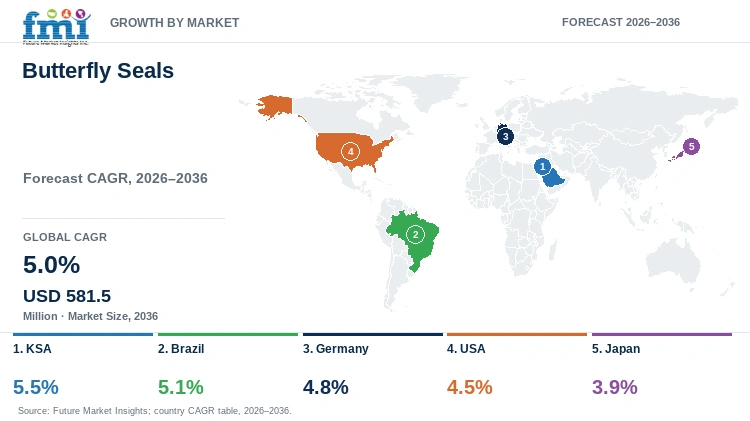
| Country | CAGR |
|---|---|
| KSA | 5.5% |
| Brazil | 5.1% |
| Germany | 4.8% |
| USA | 4.5% |
| Japan | 3.9% |
How do country-level CAGRs compare in the Butterfly Seals Market?
The forecasts span 1.6 percentage points without implying differences in current market size. KSA and Brazil remain project-led markets, whereas Japan relies more heavily on replacement demand.
- KSA combines desalination and wastewater investment, widening material requirements for water-service sealing applications nationwide.
- Brazil’s large service territories make dependable distributor coverage important for planned valve maintenance programs.
- Germany’s process-industry buyers place added weight on documented conformity during severe-service butterfly-valve replacement work.
- USA industrial and municipal accounts create broad aftermarket demand for standardized replacement sizes nationwide.
- Japan’s 94.0% wastewater treatment coverage shifts commercial emphasis toward renewal programs over greenfield expansion.
Comparable CAGRs can produce different order conditions because installed assets and approval routes differ.The full report provides country-level CAGR analysis across North America, Latin America, Western Europe, Eastern Europe, East Asia, South Asia and Pacific, and the Middle East and Africa.
Country-wise Analysis
- KSA water and wastewater expansion keeps engineering contractors and valve OEMs involved before equipment reaches project sites, with butterfly seal demand projected to grow at 5.5% CAGR through 2036. Saudi Arabia’s water ministry reported in June 2026 that water networks covered 88% of the population and sanitation services covered 60%. Desalination and wastewater projects expose sealing materials to service conditions that require application-specific compound selection. Large-project qualification and severe operating conditions increase documentation requirements for sealing components entering major infrastructure projects. EPC approval shapes initial seal specifications and spare-parts lists, so suppliers with regional engineering support can remain available through long maintenance cycles.
- Brazilian water operators increasingly work under national reference rules designed to standardize service conditions among regional regulators. Butterfly seal sales in Brazil are forecast to expand at 5.1% CAGR by 2036, supported by a more consistent regulatory basis for water and sewer services. ANA approved Reference Standard 11 in January 2025 to establish general conditions for public water-supply and sewerage services. Project execution capacity still varies among utilities and concessionaires that follow different local purchasing processes nationwide. Seal companies can reduce replacement friction with Portuguese technical records and stocked common sizes, allowing one specification to support recurring maintenance programs in multiple service territories.
- German process operators require traceable material performance before accepting seal substitutions, with butterfly seal demand forecast to rise at 4.8% CAGR through 2036. The federal environment ministry stated in July 2026 that the Water Action Program contains 78 measures and includes infrastructure for secure water supply. For chemical-service valves, emissions or compatibility evidence becomes part of replacement approval under applicable plant standards. Material changes can alter torque or sealing behavior enough to extend technical review before planned maintenance work. Suppliers with local test support and documented valve records can compete for replacement work without discarding serviceable valve bodies locally.
- USA utility demand is split among state programs and municipal owners that translate federal funding into separate project specifications. Adoption of butterfly seals in the USA is estimated to expand at 4.5% CAGR through 2036 as new infrastructure and installed-base maintenance proceed together. EPA’s 2025 drinking-water infrastructure update estimates about four million lead service lines nationally and applies updated data to federal replacement-fund allocations. Fragmented approval practices can lengthen supplier onboarding among municipal and industrial accounts with different technical requirements. Distributors with documented common seats near maintenance accounts can shorten planned-outage response and preserve repeat business after installation during later maintenance cycles.
- Japanese utilities manage an aging sewer network where renewal planning protects long-lived public assets, with butterfly seal demand estimated to post 3.9% CAGR through 2036. Japan’s transport ministry reported in January 2026 that national sewer pipe totaled about 500,000 km and about 40,000 km exceeded the 50-year standard service life. Conservative qualification favors components with stable service records and verified fit during long public-asset replacement programs. Utilities retain approved materials while available components continue meeting operating requirements, delaying changes until a documented service need appears. Manufacturers need dependable local availability so replacement seats remain obtainable over extended asset lives and repeated maintenance cycles.
Who are the notable companies in the Butterfly Seals Market?
Trelleborg Sealing Solutions, Freudenberg Sealing Technologies, Parker Hannifin, Garlock, James Walker, ERIKS, Flowserve, Crane ChemPharma, KSB and Emerson Keystone serve the defined butterfly seals market.
Competition separates material specialists from distributors and integrated butterfly-valve manufacturers controlling different replacement decisions. Operators require documented chemical-compatibility records and valve-specific geometry evidence before approving new sealing sources. Integrated OEMs retain installed-base advantages because original dimensions and actuator interfaces remain tied to their valve platforms.
- Trelleborg Sealing Solutions, Freudenberg Sealing Technologies and Parker Hannifin provide engineered materials for demanding sealing duties.
- Garlock, James Walker and ERIKS serve specialist sealing or distribution routes where replacement availability influences maintenance decisions.
- Flowserve, Crane ChemPharma, KSB and Emerson Keystone integrate butterfly-valve platforms with replacement access for installed equipment.
Competitive Benchmarking: Butterfly Seals Market
| Company | Butterfly-Specific Sealing | Material / Severe-Service Range | OEM & MRO Access | Geographic Reach |
|---|---|---|---|---|
| Trelleborg Sealing Solutions | Medium | High | High | Global |
| Freudenberg Sealing Technologies | High | High | High | Global |
| Parker Hannifin | Medium | High | Medium | Global |
| Garlock | High | High | High | Multi-region |
| James Walker | Medium | High | Medium | Multi-region |
| ERIKS | Medium | Medium | High | Europe and selected international markets |
| Flowserve | High | High | High | Global |
| Crane ChemPharma | High | High | High | Global process industries |
| KSB | High | Medium | High | Global |
| Emerson Keystone | High | High | High | Global |
Scoring basis: High requires broad direct evidence for a rated criterion, Medium confirms narrower documented capability and Low marks a documented limitation. Butterfly-specific sealing measures seat or liner evidence while material range measures multiple severe-service elastomer or fluoropolymer routes. OEM and MRO access measures valve-platform control or a verified replacement channel while geographic reach remains descriptive.
Key Developments in the Butterfly Seals Market
- In April 2026, Trelleborg Sealing Solutions opened a European service center expanding industrial sealing support and kitting capacity.
- In November 2025, Freudenberg Sealing Technologies introduced bisphenol-AF-free FKM with a butterfly valve seal for food-contact use.
- In August 2025, James Walker reported PFAS-surfactant removal across 98% of its mainstream fluorocarbon elastomers.
Key Players in the Butterfly Seals Market
Engineered Elastomer and Polymer Sealing Platforms
- Trelleborg Sealing Solutions
- Freudenberg Sealing Technologies
- Parker Hannifin
Specialist Valve-Sealing and Distribution Routes
- Garlock
- James Walker
- ERIKS
Integrated Butterfly Valve OEMs
- Flowserve
- Crane ChemPharma
- KSB
- Emerson Keystone
Butterfly Seals Market - Report Scope
| Coverage field | Report scope |
|---|---|
| Market breakdown | By seal type, material, valve size, end use, sales channel and region. |
| Quantitative Units | USD million. |
| Market Definition | Commercial butterfly valve sealing elements including seats, disc seals, shaft seals, body liners and high-performance elastomer sealing components. Full butterfly valve revenue and unrelated sealing products are excluded. |
| Regions Covered | North America, Latin America, Western Europe, Eastern Europe, East Asia, South Asia and Pacific, and Middle East and Africa. |
| Countries Covered | KSA, Brazil, Germany, USA, Japan, and 20+ countries included in the full report. |
| Key Companies Profiled | Trelleborg Sealing Solutions, Freudenberg Sealing Technologies, Parker Hannifin, Garlock, James Walker, ERIKS, Flowserve, Crane ChemPharma, KSB, Emerson Keystone. |
| Forecast Period | 2026 to 2036. |
| Approach | Primary and secondary research with market triangulation. |
Butterfly Seals Market - Research Methodology
| Method | Approach |
|---|---|
| Primary Research | Primary research tests purchasing decisions, product evaluation, adoption barriers, approval requirements, pricing considerations and expectations for technical or commercial support. Inputs are incorporated only when documented in project records and reconciled with the defined market scope before they affect sizing or interpretation. |
| Desk Research | Desk research covered government statistics, regulatory publications, trade data, industry associations, technical literature, standards, company filings, product information, and official corporate announcements. Sources were reviewed for relevance, publication date, geographic coverage, and consistency with the defined market scope. Claims relating to performance, applications, approvals, capacity, investment, and commercial activity were retained only when supported by credible public evidence. |
| Market Sizing and Forecasting | The market model combined the baseline value with historical performance, segment structure, pricing and volume indicators, adoption levels, company participation, and country-level demand conditions. Forecast assumptions considered economic activity, investment trends, regulatory developments, technology adoption, purchasing cycles, supply availability, and barriers to wider market use. Segment and regional estimates were reconciled before the final market total was calculated. |
| Data Validation | Estimates were checked against multiple independent indicators, including public data, company activity, trade patterns and industry developments. Validation also tested whether products, services, applications and company revenues fell within the defined market boundaries. Adjacent categories, unsupported claims, overlapping revenues and activities without direct market relevance were excluded to reduce double counting and maintain consistency across segments and countries. |
Butterfly Seals Market by Segments
Butterfly Seals Market segmented by Seal Type:
- Butterfly valve seat seals
- Disc seals
- Shaft seals
- Body liner seals
- High-performance elastomer seals
Butterfly Seals Market segmented by Material:
- EPDM
- PTFE
- NBR
- FKM - Viton
- Silicone
- Metal-reinforced
Butterfly Seals Market segmented by Valve Size:
- 2-6 inch
- Below 2 inch
- 6-12 inch
- Above 12 inch
Butterfly Seals Market segmented by End Use:
- Water & wastewater
- Chemicals
- Food & beverage
- Oil & gas
- HVAC
Butterfly Seals Market segmented by Sales Channel:
- Valve OEMs
- Seal distributors
- Aftermarket MRO
- Custom seal manufacturers
Butterfly Seals Market by Region:
- North America
- United States
- Canada
- Latin America
- Brazil
- Mexico
- Argentina
- Chile
- Western Europe
- Germany
- France
- United Kingdom
- Italy
- Spain
- Benelux
- Nordics
- Eastern Europe
- Poland
- Czech Republic
- Romania
- Hungary
- East Asia
- China
- Japan
- South Korea
- South Asia and Pacific
- India
- ASEAN
- Australia and New Zealand
- Middle East and Africa
- GCC Countries
- South Africa
- Türkiye
- Israel
Research Sources and Bibliography
- Crane ChemPharma & Energy. (2025, October 24). XOMOX®, WTA®, and KROMBACH® lead in emission control with TA-Luft 2021-certified valves.
- Ministry of Land, Infrastructure, Transport and Tourism, Japan. (2026, August 24).
- Crane ChemPharma & Energy. (2025, October 23). Certificate acc. to TA-LUFT 2021 & ISO 15848-1 - XOMOX lined butterfly valves.
- Garlock. (2025). Case study: Reliable sealing for large-diameter water lines with MULTI-SWELL 3760.
- Water Regulations Approval Scheme Ltd. (2026). Approvals directory (Approval 250402026).
- U.S. Environmental Protection Agency. (2025, May). Annual allotment of federal funds to states, tribes, and territories.
- Flowserve Corporation. (2026, June 30). Flowserve completes acquisition of Trillium Flow Technologies’ Valves Division.
- U.S. Environmental Protection Agency. (2026, April 14). Fiscal year 2026 allotments for the State Revolving Fund provisions of the Infrastructure Investment and Jobs Act and base program funding.
- Water Regulations Approval Scheme Ltd. (2025). Approvals directory (Approval 250402025).
- Freudenberg Sealing Technologies. (2025, September 4). Sustainable and standards-compliant: Seals for the beverage industry.
- Ministry of Environment, Water and Agriculture, Saudi Arabia. (2026, June 23). Saudi water security.
- Agência Nacional de Águas e Saneamento Básico. (2025, January 9). ANA aprova norma de referência sobre as condições gerais para prestação dos serviços públicos de abastecimento de água e esgotamento sanitário.
- Federal Ministry for the Environment, Climate Action, Nature Conservation and Nuclear Safety. (2026, July 14). Was ist das Aktionsprogramm Wasser?
- U.S. Environmental Protection Agency. (2025). EPA’s 7th Drinking Water Infrastructure Needs Survey and Assessment: 2025 update.
- Ministry of Land, Infrastructure, Transport and Tourism, Japan. (2026, January).
- Trelleborg Sealing Solutions. (2026, April 29). Trelleborg Sealing Solutions opens state-of-the-art European service center.
- Freudenberg Sealing Technologies. (2025, November 24). With innovative sealing solutions without bisphenol AF, Freudenberg is setting new standards.
- James Walker. (2025, August 11). Targeting PFAS surfactants-free.
- Trelleborg Group. (2026, January 7). Trelleborg acquires a tooling and automation specialist.
- Freudenberg Sealing Technologies. (2026, April 22). FACT Surface Technology for the Environment: An adhesive bonding process without wet-chemicals.
- Freudenberg Sealing Technologies. (2025, September 17). Large-ring test bench sets new standards in sealing technology.
- Parker-Hannifin Corporation. (2026, August 21). Annual report on Form 10-K for the fiscal year ended June 30, 2026.
- Trelleborg Sealing Solutions. (2025, February 6). Trelleborg strengthens capabilities with CRC Distribution acquisition.
- Trelleborg Sealing Solutions. (2025, October 17). Energy sector sealing expert Masterseals acquired by Trelleborg.
- Freudenberg Sealing Technologies. (2025, September 19). Freudenberg Sealing Technologies dedicates new facility in Hamburg.
- Parker-Hannifin Corporation. (2025, August 22). Annual report on Form 10-K for the fiscal year ended June 30, 2025.
- Garlock GmbH. (2025, December 10). EC declaration of conformity: Lined butterfly valves.
- James Walker. (2025, January 8). Introducing two new technical papers.
- ERIKS. (2025, December 12). ERIKS acquires Séric Technologie.
- Flowserve Corporation. (2026, February 17). Annual report on Form 10-K for the fiscal year ended December 31, 2025.
- Crane Company. (2026, February 26). Annual report on Form 10-K for the fiscal year ended December 31, 2025.
- KSB. (2025, June 20). KSB elevates South China presence with expanded Guangzhou Service Center.
- Emerson Electric Co. (2025, November 10). Annual report on Form 10-K for the fiscal year ended September 30, 2025.
This bibliography is provided for reader reference and is not exhaustive. The full report contains the complete reference list and detailed citations
This Report Answers
- How large is the butterfly seals market in 2026 and 2036?
- Which operating conditions create repeat replacement demand for butterfly sealing components?
- Why do butterfly valve seat seals lead the seal type category?
- Why does EPDM hold a significant share of material revenue?
- How does valve size affect replacement stocking and service response?
- Which national conditions explain the five stated country growth rates?
- How do material qualification requirements limit substitution between seal compounds?
- Which companies combine engineered sealing capabilities with butterfly-valve aftermarket access?
Frequently Asked Questions
How big is the Butterfly Seals Market in 2026?
The butterfly seals market is valued at USD 357.0 million in 2026 and is projected to reach USD 581.5 million by 2036. Installed-valve maintenance sustains repeat demand for qualified seats and liners over long equipment service lives.
What is the CAGR of the Butterfly Seals Market from 2026 to 2036?
The butterfly seals market is projected to grow at a CAGR of 5.0% between 2026 and 2036. Seat wear and changing process media create repeated seal replacement requirements on installed butterfly valves.
Which seal type leads the Butterfly Seals Market?
The butterfly valve seat seals segment is expected to hold 34.0% of seal type revenue in 2026. Seat geometry controls shutoff integrity and operating torque at the principal disc-to-body sealing interface.
Which countries record the higher stated growth rates in the Butterfly Seals Market?
KSA is projected to grow at 5.5% CAGR followed by Brazil at 5.1% and Germany at 4.8% through 2036. Water-system expansion and technical qualification create different national commercial conditions behind those growth rates.
Which companies are active in the Butterfly Seals Market?
Key companies in the butterfly seals market include Trelleborg Sealing Solutions, Freudenberg Sealing Technologies, Parker Hannifin, Garlock, James Walker, ERIKS, Flowserve, Crane ChemPharma, KSB and Emerson Keystone. Their roles cover engineered sealing materials, industrial distribution and integrated butterfly-valve platforms with aftermarket access.
Preview the report firsthand - request a free sample
Get SampleGet the brochure for pricing and purchase details.
Get PDFTable of Content
- Key Takeaways
- Market Size and CAGR
- Top Growth Driver
- Fastest Growing Segment
- Leading Region
- Key Companies
- Emerging Opportunities
- Executive Summary
- Global Market Outlook
- Demand-side Trends
- Supply-side Trends
- Technology Roadmap Analysis
- Analysis and Recommendations
- Analyst Perspective (What is happening? Why now? What should investors know?)
- Key Questions Answered
- How large is the market?
- What is the CAGR?
- What are key trends?
- Which region dominates?
- Who are the leaders?
- Market Overview
- Market Coverage / Taxonomy
- Market Definition / Scope / Limitations
- Research Methodology
- Chapter Orientation
- Analytical Lens and Working Hypotheses
- Market Structure, Signals, and Trend Drivers
- Benchmarking and Cross-market Comparability
- Market Sizing, Forecasting, and Opportunity Mapping
- Research Design and Evidence Framework
- Desk Research Programme (Secondary Evidence)
- Expert Input and Fieldwork (Primary Evidence)
- Tooling, Models, and Reference Databases
- Data Engineering and Model Build
- Quality Assurance and Audit Trail
- Market Background
- Market Dynamics (Drivers, Restraints, Opportunity, Trends)
- Scenario Forecast (Optimistic, Likely, Conservative)
- Impact Analysis
- AI Impact
- Sustainability Impact
- Regulatory Impact
- Technology Impact
- Consumer / Buyer Analysis
- Purchase Drivers
- Adoption Barriers
- Buyer Journey
- Opportunity Map Analysis
- Product Life Cycle Analysis
- Supply Chain Analysis
- Investment Feasibility Matrix
- Value Chain Analysis
- PESTLE and Porter's Analysis
- Regulatory Landscape
- Regional Parent Market Outlook
- Production and Consumption Statistics
- Import and Export Statistics
- Global Market Analysis and Forecast, 2021 to 2036
- Historical Market Size Value (USD Million) Analysis, 2021 to 2025
- Current and Future Market Size Value (USD Million) Projections, 2026 to 2036
- Y-o-Y Growth Trend Analysis
- Absolute $ Opportunity Analysis
- Global Market Pricing Analysis, 2021 to 2036
- Global Market Analysis and Forecast, By Seal Type, 2021 to 2036
- Introduction / Key Findings
- Historical Market Size Value (USD Million) Analysis By Seal Type, 2021 to 2025
- Current and Future Market Size Value (USD Million) Analysis and Forecast By Seal Type, 2026 to 2036
- Butterfly valve seat seals
- Disc seals
- Shaft seals
- Body liner seals
- High-performance elastomer seals
- Y-o-Y Growth Trend Analysis By Seal Type, 2021 to 2025
- Absolute $ Opportunity Analysis By Seal Type, 2026 to 2036
- Global Market Analysis and Forecast, By Material, 2021 to 2036
- Introduction / Key Findings
- Historical Market Size Value (USD Million) Analysis By Material, 2021 to 2025
- Current and Future Market Size Value (USD Million) Analysis and Forecast By Material, 2026 to 2036
- EPDM
- PTFE
- NBR
- FKM - Viton
- Silicone
- Metal-reinforced
- Y-o-Y Growth Trend Analysis By Material, 2021 to 2025
- Absolute $ Opportunity Analysis By Material, 2026 to 2036
- Global Market Analysis and Forecast, By Valve Size, 2021 to 2036
- Introduction / Key Findings
- Historical Market Size Value (USD Million) Analysis By Valve Size, 2021 to 2025
- Current and Future Market Size Value (USD Million) Analysis and Forecast By Valve Size, 2026 to 2036
- 2-6 inch
- Below 2 inch
- 6-12 inch
- Above 12 inch
- Y-o-Y Growth Trend Analysis By Valve Size, 2021 to 2025
- Absolute $ Opportunity Analysis By Valve Size, 2026 to 2036
- Global Market Analysis and Forecast, By End Use, 2021 to 2036
- Introduction / Key Findings
- Historical Market Size Value (USD Million) Analysis By End Use, 2021 to 2025
- Current and Future Market Size Value (USD Million) Analysis and Forecast By End Use, 2026 to 2036
- Water & wastewater
- Chemicals
- Food & beverage
- Oil & gas
- HVAC
- Y-o-Y Growth Trend Analysis By End Use, 2021 to 2025
- Absolute $ Opportunity Analysis By End Use, 2026 to 2036
- Global Market Analysis and Forecast, By Sales Channel, 2021 to 2036
- Introduction / Key Findings
- Historical Market Size Value (USD Million) Analysis By Sales Channel, 2021 to 2025
- Current and Future Market Size Value (USD Million) Analysis and Forecast By Sales Channel, 2026 to 2036
- Valve OEMs
- Seal distributors
- Aftermarket MRO
- Custom seal manufacturers
- Y-o-Y Growth Trend Analysis By Sales Channel, 2021 to 2025
- Absolute $ Opportunity Analysis By Sales Channel, 2026 to 2036
- Global Market Analysis and Forecast, By Region, 2021 to 2036
- Introduction
- Historical Market Size Value (USD Million) Analysis By Region, 2021 to 2025
- Current Market Size Value (USD Million) Analysis and Forecast By Region, 2026 to 2036
- North America
- Latin America
- Western Europe
- Eastern Europe
- East Asia
- South Asia and Pacific
- Middle East and Africa
- Market Attractiveness Analysis By Region
- North America Market Analysis and Forecast, By Country, 2021 to 2036
- Historical Market Size Value (USD Million) Trend Analysis By Market Taxonomy, 2021 to 2025
- Market Size Value (USD Million) Forecast By Market Taxonomy, 2026 to 2036
- By Country
- United States
- Canada
- By Seal Type
- By Material
- By Valve Size
- By End Use
- By Sales Channel
- By Country
- Market Attractiveness Analysis
- By Country
- By Seal Type
- By Material
- By Valve Size
- By End Use
- By Sales Channel
- Key Takeaways
- Latin America Market Analysis and Forecast, By Country
- Historical Market Size Value (USD Million) Trend Analysis By Market Taxonomy, 2021 to 2025
- Market Size Value (USD Million) Forecast By Market Taxonomy, 2026 to 2036
- By Country
- Brazil
- Mexico
- Argentina
- Chile
- By Seal Type
- By Material
- By Valve Size
- By End Use
- By Sales Channel
- By Country
- Market Attractiveness Analysis
- By Country
- By Seal Type
- By Material
- By Valve Size
- By End Use
- By Sales Channel
- Key Takeaways
- Western Europe Market Analysis and Forecast, By Country
- Historical Market Size Value (USD Million) Trend Analysis By Market Taxonomy, 2021 to 2025
- Market Size Value (USD Million) Forecast By Market Taxonomy, 2026 to 2036
- By Country
- Germany
- France
- United Kingdom
- Italy
- Spain
- Benelux
- Nordics
- By Seal Type
- By Material
- By Valve Size
- By End Use
- By Sales Channel
- By Country
- Market Attractiveness Analysis
- By Country
- By Seal Type
- By Material
- By Valve Size
- By End Use
- By Sales Channel
- Key Takeaways
- Eastern Europe Market Analysis and Forecast, By Country
- Historical Market Size Value (USD Million) Trend Analysis By Market Taxonomy, 2021 to 2025
- Market Size Value (USD Million) Forecast By Market Taxonomy, 2026 to 2036
- By Country
- Poland
- Czech Republic
- Romania
- Hungary
- By Seal Type
- By Material
- By Valve Size
- By End Use
- By Sales Channel
- By Country
- Market Attractiveness Analysis
- By Country
- By Seal Type
- By Material
- By Valve Size
- By End Use
- By Sales Channel
- Key Takeaways
- East Asia Market Analysis and Forecast, By Country
- Historical Market Size Value (USD Million) Trend Analysis By Market Taxonomy, 2021 to 2025
- Market Size Value (USD Million) Forecast By Market Taxonomy, 2026 to 2036
- By Country
- China
- Japan
- South Korea
- By Seal Type
- By Material
- By Valve Size
- By End Use
- By Sales Channel
- By Country
- Market Attractiveness Analysis
- By Country
- By Seal Type
- By Material
- By Valve Size
- By End Use
- By Sales Channel
- Key Takeaways
- South Asia and Pacific Market Analysis and Forecast, By Country
- Historical Market Size Value (USD Million) Trend Analysis By Market Taxonomy, 2021 to 2025
- Market Size Value (USD Million) Forecast By Market Taxonomy, 2026 to 2036
- By Country
- India
- ASEAN
- Australia and New Zealand
- By Seal Type
- By Material
- By Valve Size
- By End Use
- By Sales Channel
- By Country
- Market Attractiveness Analysis
- By Country
- By Seal Type
- By Material
- By Valve Size
- By End Use
- By Sales Channel
- Key Takeaways
- Middle East and Africa Market Analysis and Forecast, By Country
- Historical Market Size Value (USD Million) Trend Analysis By Market Taxonomy, 2021 to 2025
- Market Size Value (USD Million) Forecast By Market Taxonomy, 2026 to 2036
- By Country
- GCC Countries
- South Africa
- Türkiye
- Israel
- By Seal Type
- By Material
- By Valve Size
- By End Use
- By Sales Channel
- By Country
- Market Attractiveness Analysis
- By Country
- By Seal Type
- By Material
- By Valve Size
- By End Use
- By Sales Channel
- Key Takeaways
- Key Countries Market Analysis
- United States
- Pricing Analysis
- Market Share Analysis, 2025
- By Seal Type
- By Material
- By Valve Size
- By End Use
- By Sales Channel
- Canada
- Pricing Analysis
- Market Share Analysis, 2025
- By Seal Type
- By Material
- By Valve Size
- By End Use
- By Sales Channel
- Mexico
- Pricing Analysis
- Market Share Analysis, 2025
- By Seal Type
- By Material
- By Valve Size
- By End Use
- By Sales Channel
- Brazil
- Pricing Analysis
- Market Share Analysis, 2025
- By Seal Type
- By Material
- By Valve Size
- By End Use
- By Sales Channel
- Chile
- Pricing Analysis
- Market Share Analysis, 2025
- By Seal Type
- By Material
- By Valve Size
- By End Use
- By Sales Channel
- Germany
- Pricing Analysis
- Market Share Analysis, 2025
- By Seal Type
- By Material
- By Valve Size
- By End Use
- By Sales Channel
- United Kingdom
- Pricing Analysis
- Market Share Analysis, 2025
- By Seal Type
- By Material
- By Valve Size
- By End Use
- By Sales Channel
- Italy
- Pricing Analysis
- Market Share Analysis, 2025
- By Seal Type
- By Material
- By Valve Size
- By End Use
- By Sales Channel
- Spain
- Pricing Analysis
- Market Share Analysis, 2025
- By Seal Type
- By Material
- By Valve Size
- By End Use
- By Sales Channel
- France
- Pricing Analysis
- Market Share Analysis, 2025
- By Seal Type
- By Material
- By Valve Size
- By End Use
- By Sales Channel
- India
- Pricing Analysis
- Market Share Analysis, 2025
- By Seal Type
- By Material
- By Valve Size
- By End Use
- By Sales Channel
- ASEAN
- Pricing Analysis
- Market Share Analysis, 2025
- By Seal Type
- By Material
- By Valve Size
- By End Use
- By Sales Channel
- Australia and New Zealand
- Pricing Analysis
- Market Share Analysis, 2025
- By Seal Type
- By Material
- By Valve Size
- By End Use
- By Sales Channel
- China
- Pricing Analysis
- Market Share Analysis, 2025
- By Seal Type
- By Material
- By Valve Size
- By End Use
- By Sales Channel
- Japan
- Pricing Analysis
- Market Share Analysis, 2025
- By Seal Type
- By Material
- By Valve Size
- By End Use
- By Sales Channel
- South Korea
- Pricing Analysis
- Market Share Analysis, 2025
- By Seal Type
- By Material
- By Valve Size
- By End Use
- By Sales Channel
- Poland
- Pricing Analysis
- Market Share Analysis, 2025
- By Seal Type
- By Material
- By Valve Size
- By End Use
- By Sales Channel
- Hungary
- Pricing Analysis
- Market Share Analysis, 2025
- By Seal Type
- By Material
- By Valve Size
- By End Use
- By Sales Channel
- Türkiye
- Pricing Analysis
- Market Share Analysis, 2025
- By Seal Type
- By Material
- By Valve Size
- By End Use
- By Sales Channel
- South Africa
- Pricing Analysis
- Market Share Analysis, 2025
- By Seal Type
- By Material
- By Valve Size
- By End Use
- By Sales Channel
- KSA
- Pricing Analysis
- Market Share Analysis, 2025
- By Seal Type
- By Material
- By Valve Size
- By End Use
- By Sales Channel
- United States
- Market Structure Analysis
- Competition Dashboard
- Competition Benchmarking
- Market Share Analysis of Top Players
- By Regional
- By Seal Type
- By Material
- By Valve Size
- By End Use
- By Sales Channel
- Emerging Startups
- Innovation Benchmarking
- Competition Analysis
- Competition Deep Dive
- Trelleborg Sealing Solutions
- Overview
- Product Portfolio
- Profitability by Market Segments
- Sales Footprint
- Strategy Overview
- Marketing Strategy
- Product Strategy
- Channel Strategy
- Freudenberg Sealing Technologies
- Parker Hannifin
- Garlock
- James Walker
- ERIKS
- Flowserve
- Crane ChemPharma
- KSB
- Emerson Keystone
- Trelleborg Sealing Solutions
- Case Studies
- Success Stories
- Recent Developments
- Competition Deep Dive
- Assumptions & Acronyms Used


