

- Market Size (2026)
- USD 790.6 Mn
- Forecast (2036)
- USD 1804.1 Mn
- CAGR (2026 to 2036)
- 8.6%
How big is the cryogenic seals market in 2026?
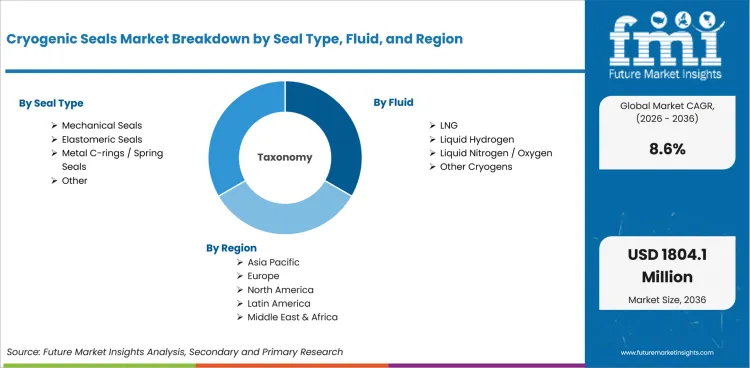
USD 790.6 million in 2026 and USD 1,804.1 million by 2036 at an 8.6% CAGR.
The cryogenic seals industry value is forecast to grow from USD 728.0 million in 2025 to USD 1,804.1 million by 2036 at an 8.6% CAGR as LNG terminals, industrial gas systems, and low-temperature hydrogen projects require validated sealing packages. OEM sales are expected to represent 57.0% share in 2026 because seal selection is increasingly fixed during pump, valve, tank, and compressor engineering. The -100°C to -196°C temperature range is forecast to secure 52.0% share in 2026, led by LNG and liquid nitrogen duties across terminals and industrial gas facilities.
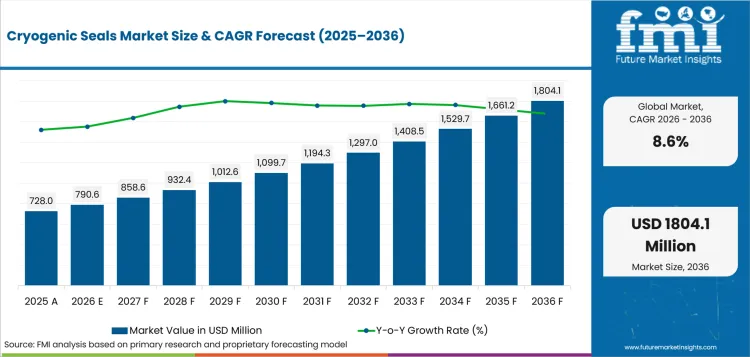
Cryogenic Seals Market Overview: Size and Forecast
- 2025 Market Size: USD 728.0 million
- 2026 Market Size: USD 790.6 million
- 2036 Market Size: USD 1,804.1 million
- Forecast CAGR: 8.6% from 2026 to 2036
- Leading Sales Mix: OEM
- OEM Share in 2026: 57.0%
- Leading Temperature Range: -100°C to -196°C
- -100°C to -196°C Share in 2026: 52.0%
- Fastest-growing Country: India
- India CAGR: 9.6% by 2036
Summary of the Cryogenic Seals Market
- Demand and Growth Drivers
- LNG infrastructure is expected to remain the largest demand pool as terminal pumps, compressors, valves, and loading arms require seals qualified for repeated cool-down cycles.
- Liquid hydrogen projects are increasing interest in metal seals, spring-energized products, and low-permeation polymers designed for very low temperature service.
- Industrial gas plants support recurring aftermarket demand because liquid nitrogen and liquid oxygen equipment need replacement seals during planned maintenance.
- Product and Segment View
- OEM is projected to lead the sales mix with 57.0% share in 2026 since cryogenic seals are specified before equipment commissioning.
- The -100°C to -196°C range is forecast to hold 52.0% share in 2026 as LNG and liquid nitrogen systems form the largest temperature band.
- LNG is expected to lead by fluid with 44.0% share in 2026 as liquefaction, storage, transfer, and regasification equipment use cold-service seals at several points.
- Geography and Competitive Outlook
- India is projected to record 9.6% CAGR by 2036 as LNG terminal capacity and green hydrogen programs create new specification points.
- China is expected to expand at 9.4% CAGR through 2036 as LNG import infrastructure and industrial gas demand support package-level buying.
- EagleBurgmann and John Crane hold strong positions in mechanical and dry gas sealing for LNG and process equipment.
- Trelleborg Sealing Solutions and Parker Hannifin strengthen hydrogen-related sealing depth through validated materials and cryogenic components.
- Analyst Opinion
- Nikhil Kaitwade, Principal Consultant at Future Market Insights for industrial domain, says, "Cryogenic seals are becoming project-risk components rather than routine maintenance parts. Buyers in LNG and hydrogen systems first ask whether a seal can pass cold cycling, oxygen cleaning, helium leak checks, and vibration exposure without losing preload. Suppliers with cryogenic test capacity, material traceability, and local service teams should win earlier in the buying process. The strongest commercial position will belong to companies that support both first-fit equipment and field replacement."
Cryogenic seal adoption is moving toward documented cold-service qualification as LNG and hydrogen systems add higher consequence operating points. The U.S. Department of Energy reported in March 2026 that United States LNG export capacity was more than 19 Bcf/d and over 36 Bcf/d was in operation or construction, creating a wider service pool for pumps, compressors, and loading equipment. The International Energy Agency stated in 2026 that around 345 bcm/yr of new LNG export capacity is set to come online between 2025 and 2030 from projects already under construction at the start of 2025. Hydrogen-related demand is also more visible as the International Energy Agency reported in 2025 that worldwide hydrogen demand reached almost 100 million tonnes in 2024, up 2% from 2023, giving seal suppliers a stronger reason to validate materials for hydrogen storage and transfer equipment.
Which factors support expansion in the cryogenic seals market?
Cryogenic equipment specification, LNG service reliability, and hydrogen leakage control support value across OEM and aftermarket channels.
- Market value is supported by engineered seal revenue before OEM pump and valve packages add specification premiums.
- Supplier pricing reflects material validation, oxygen cleaning, and low-temperature testing before routine aftermarket margins apply.
- Revenue improves as LNG terminal operators move from emergency replacement toward planned seal kits tied to maintenance windows.
- Buyer trust rises when product documentation clearly explains fluid compatibility, temperature limits, and installation cleanliness requirements.
Why is the cryogenic seals market growing?
LNG terminals, liquid hydrogen systems, and industrial gas plants need seals that keep leakage low during thermal cycling and scheduled maintenance.
Market expansion is supported by operators treating seals as reliability components inside larger cold-service systems. The U.S. Energy Information Administration forecast in April 2026 that United States LNG exports would rise 1.9 Bcf/d in 2026 to average 17.0 Bcf/d and increase by another 9% in 2027. Higher LNG movement increases operating hours for pumps, compressors, valves, and loading systems that depend on mechanical seals and static sealing products. Hydrogen adds another specification layer because buyers must control small-molecule leakage while protecting system integrity. The result is a stronger link between LNG utilization, hydrogen project planning, and supplier qualification for cryogenic sealing packages.
How is the cryogenic seals market segmented?
The cryogenic seals industry is segmented by seal type, fluid, end use, temperature range, and sales mix.
- Mechanical Seals are projected to secure 38.5% share in 2026, led by rotating cryogenic pumps and compressors requiring shaft leakage control during speed changes and low-temperature cycling.
- LNG is expected to hold 44.0% share by fluid in 2026 since liquefaction trains, storage systems, loading arms, and regasification equipment need proven cold-service sealing across multiple assets.
- LNG Infrastructure is anticipated to account for 41.0% share by end use in 2026 as large terminals specify seals at package level for pumps, valves, loading systems, and boil-off equipment.
- The -100°C to -196°C band is forecast to represent 52.0% share in 2026 as LNG and liquid nitrogen duties cluster in the largest commercial cryogenic service range.
- OEM sales are projected to represent 57.0% share in 2026 because first-fit selection affects warranty exposure, commissioning acceptance, and long-term equipment reliability.
Why do mechanical seals dominate the cryogenic seals market?
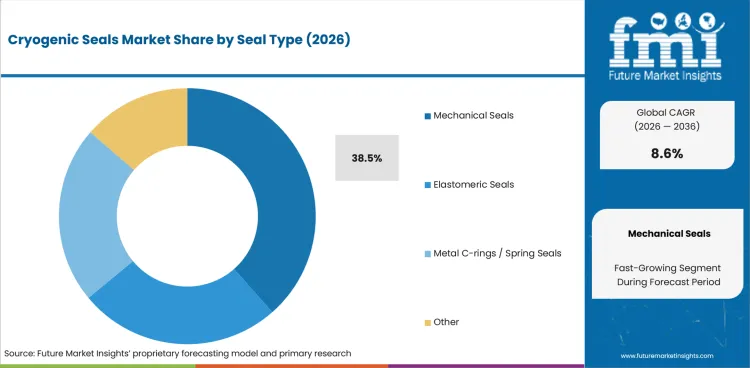
- Mechanical Seals are projected to account for 38.5% share in 2026, influenced by cryogenic pumps and compressors that need controlled shaft sealing during start-up and shutdown.
- Elastomeric seals gain value in static applications when buyers need flexible materials for valve seats, transfer lines, and lower-pressure industrial gas equipment.
Which fluid leads the cryogenic seals market?
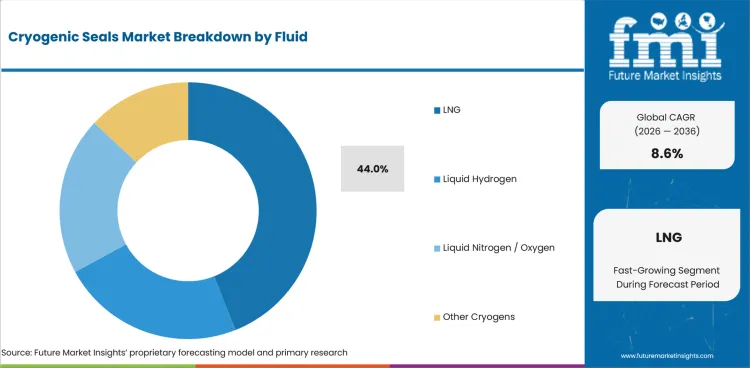
- LNG is expected to represent 44.0% share in 2026, shaped by liquefaction, storage, marine transfer, and regasification equipment using low-temperature seals across several contact points.
- Liquid hydrogen raises premium demand as small-molecule leakage and -253°C operation require tighter material screening than conventional LNG service.
Which end use leads the cryogenic seals market?
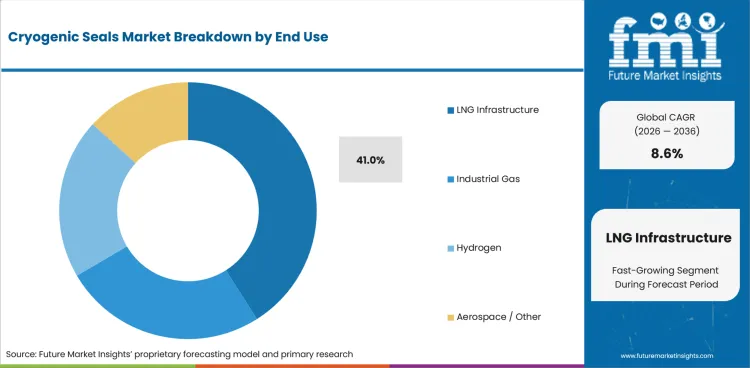
- LNG Infrastructure is anticipated to hold 41.0% share in 2026, supported by terminal equipment that needs seal replacement during commissioning and planned service intervals.
- Industrial gas applications add recurring demand as liquid nitrogen and liquid oxygen systems need seals that tolerate thermal contraction and cleanliness requirements.
Which temperature range leads the cryogenic seals market?
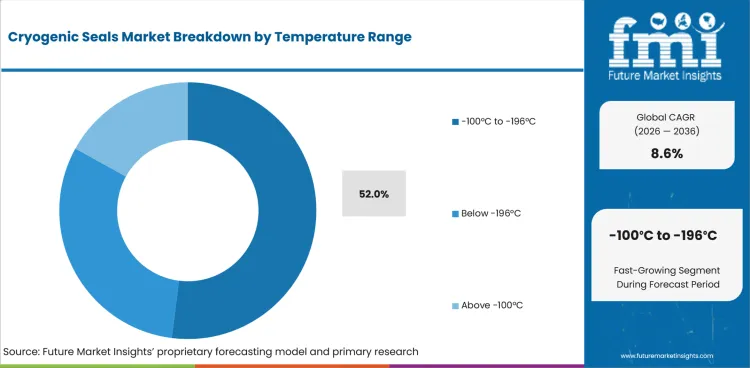
- The -100°C to -196°C range is forecast to secure 52.0% share in 2026, reflected by LNG and liquid nitrogen forming the largest installed equipment base.
- Below -196°C duties gain strategic value as hydrogen storage, aerospace testing, and advanced research systems demand validated low-permeation sealing designs.
Which sales mix leads the cryogenic seals market?
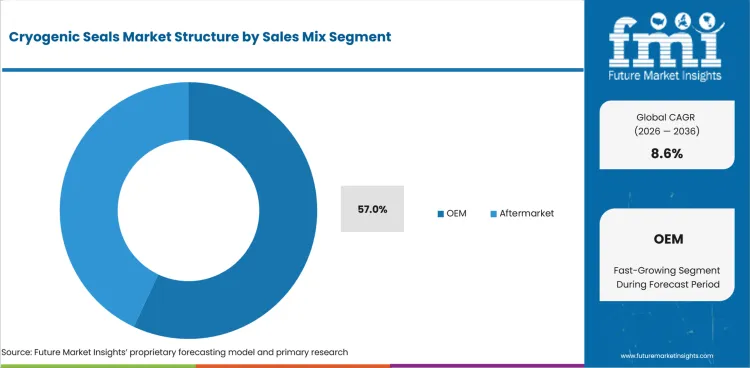
- OEM is expected to represent 57.0% share in 2026, led by equipment makers specifying seals during pump, valve, tank, and compressor package engineering.
- Aftermarket sales remain important as thermal shock, repeated restarts, and scheduled turnarounds create replacement demand across installed LNG and industrial gas assets.
What are the driver, restraints, and opportunities in the cryogenic seals market?
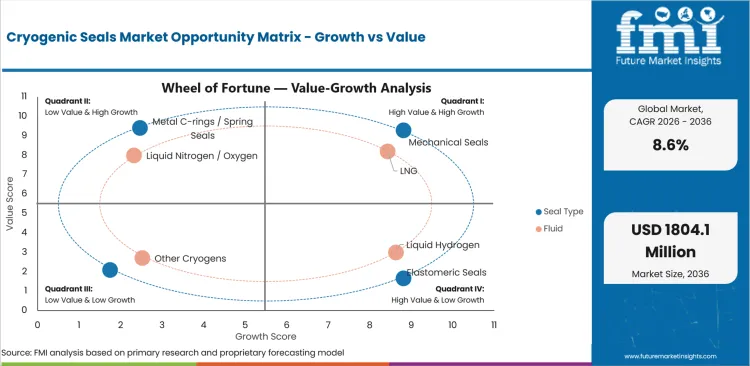
LNG expansion and hydrogen specification support demand while qualification cost and documentation requirements limit smaller suppliers.
- Driver: LNG and industrial gas operators need qualified seals that reduce leakage risk during repeated cool-down and warm-up cycles.
- Restraint: Cryogenic testing, oxygen cleaning, and material traceability can increase lead times for suppliers without advanced validation capability.
- Opportunity: OEM-ready seal packages can create stronger access to LNG, hydrogen, and aerospace projects requiring documented low-temperature performance.
LNG Pump Seal Qualification Outlook
LNG pump seal qualification is becoming more valuable as terminal equipment packages become larger and more complex. The International Energy Agency stated in October 2025 that about 300 bcm/yr of LNG export capacity is set to be added by 2030, primarily supported by capacity additions in the United States and Qatar. That scale means seal demand extends beyond a single pump sale into spares, commissioning kits, and maintenance contracts. Suppliers with cryogenic test rigs can reduce buyer risk before installation and gain stronger access to large LNG projects.
Hydrogen Leakage and Material Qualification Restraint
Hydrogen creates a tighter performance window than most cryogenic fluids because leakage control and material behavior become part of the safety case. The U.S. Energy Information Administration states that hydrogen turns liquid at -253°C, which is far below the operating range of LNG. That temperature narrows the approved material pool and pushes buyers toward metal seals, spring-energized products, and low-permeation polymers. Smaller suppliers face slower approvals when they cannot provide low-temperature evidence, cleanliness records, and installation guidance.
OEM Validation and Service Opportunity
OEM validation creates a clear opportunity for suppliers that can qualify seals before equipment reaches the site. The U.S. Department of Energy approved Corpus Christi LNG exports up to a total of 4.45 Bcf/d in February 2026, showing how larger LNG projects can extend demand for first-fit seals, spare kits, and field support. Suppliers that combine documentation with local service coverage can become preferred partners for pump makers, valve makers, and EPC contractors. This supports premium pricing in critical cryogenic applications where downtime costs are high.
Which countries are growing fastest in the cryogenic seals market?
India 9.6% CAGR, China 9.4% CAGR, Germany 9.2% CAGR, United States 9.0% CAGR, Japan 8.4% CAGR, South Korea 8.3% CAGR, France 7.9% CAGR, and United Kingdom 7.8% CAGR through 2036.
.webp "Top Country Growth Comparison Cryogenic Seals Market Cagr (2026 2036)")
| Country | CAGR |
|---|---|
| India | 9.6% |
| China | 9.4% |
| Germany | 9.2% |
| United States | 9.0% |
| Japan | 8.4% |
| South Korea | 8.3% |
| France | 7.9% |
| United Kingdom | 7.8% |
Source: Future Market Insights, 2026.
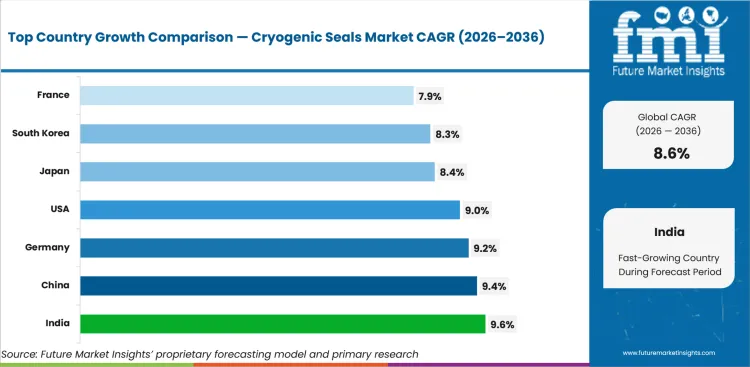
How do country-level CAGRs compare in the cryogenic seals market?
India leads the selected countries while the United Kingdom records the most measured expansion outlook among profiled markets.
- India is forecast to record 9.6% CAGR by 2036 as LNG terminals and green hydrogen manufacturing programs widen demand.
- China is expected to expand at 9.4% CAGR through 2036 as LNG receiving assets and industrial gas systems support higher equipment buying.
- Germany is projected to rise at 9.2% CAGR by 2036 with hydrogen core network planning and industrial gas demand shaping specification work.
- The United States is estimated to advance at 9.0% CAGR through 2036 as Gulf Coast LNG projects and aerospace testing support seal demand.
- Japan is expected to grow at 8.4% CAGR by 2036 as LNG maturity and hydrogen policy create premium sealing requirements.
- South Korea is forecast to expand at 8.3% CAGR through 2036 as LNG, hydrogen, and shipbuilding channels support advanced components.
- France is projected to post 7.9% CAGR by 2036 as LNG maintenance and hydrogen pilots support steady demand.
- The United Kingdom is expected to grow at 7.8% CAGR through 2036 as import terminals and hydrogen allocation projects support qualification-led buying.
What is the cryogenic seals market outlook in the United States?
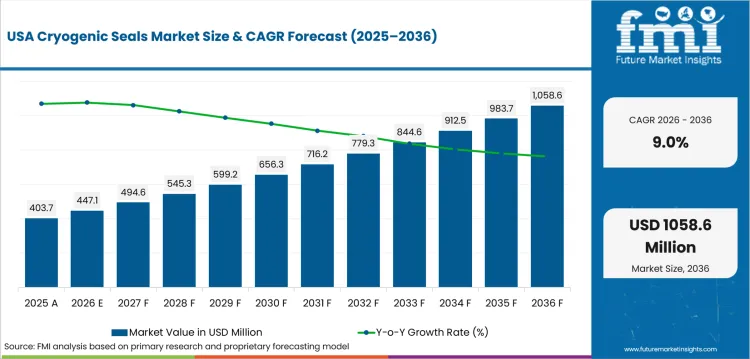
A 9.0% CAGR through 2036 reflects gulf coast lng export corridor supporting cryogenic seal demand.
Country Market Snapshot Table
| Parameter | Value |
|---|---|
| Market Size in 2025 (Value) | USD 180.0 million |
| Market Size in 2026 (Value) | USD 196.2 million |
| Market Forecast in 2036 (Value) | USD 464.0 million |
| CAGR (2026 to 2036) | 9.0% |
| Years Considered | 2021 to 2036 |
| Base Year | 2025 |
| Forecast Period | 2026 to 2036 |
| Units Considered | Value (USD million) |
| Leading Sub-Region | Gulf Coast LNG export corridor |
United States Cryogenic Seals Market Outlook
United States cryogenic seal demand is shaped by Gulf Coast export terminals, oxygen systems, aerospace testing, and early hydrogen packages. Buyers require seal data before commissioning because leakage can stop high-value cold equipment.
Suppliers with field service near LNG terminals and OEM pump relationships are positioned to secure repeat work. Product selection is expected to favor mechanical seals, metal seals, and spring-energized designs that can support scheduled turnarounds.
Key Growth Drivers
- DOE authorization activity supports LNG equipment buying. The U.S. Department of Energy reported 44 long-term LNG authorizations totaling 56.3 Bcf/d as of March 2026.
- Project approvals add first-fit seal demand for new trains and debottlenecking work. The U.S. Department of Energy approved Plaquemines LNG additional exports up to 0.45 Bcf/d in March 2026.
- NASA and commercial space activity support demand for high-integrity cryogenic static seals used in test stands, launch systems, and liquid propellant handling.
- Hydrogen storage pilots increase interest in low-permeation sealing materials that protect tanks, transfer lines, and pressure-control assemblies.
Key Restraints
- Hydrogen safety requirements raise documentation needs. NASA guidance updated in 2024 states that hydrogen-air mixtures are flammable across a wide range, making leak prevention central to system design.
- Terminal outages are tightly scheduled, which limits supplier switching during maintenance windows when seal changeouts must fit short shutdown plans.
- Oxygen service raises cleaning and traceability expectations because contamination control becomes part of the purchase decision for safety-sensitive applications.
What makes United States unique
The United States is unique because LNG export scale and aerospace cryogenic testing give suppliers two premium demand pools.
Key Companies
- John Crane
- Flowserve Corporation
- Parker Hannifin Corporation
- Garlock Sealing Technologies
- Trelleborg Sealing Solutions
- Technetics Group
- Flexaseal Engineered Seals and Systems
Sales & Marketing Channels
- Direct sales to LNG terminal operators
- OEM partnerships with pump and valve makers
- EPC specification during Gulf Coast projects
- Distributor and MRO networks
- Service contracts for rotating equipment
- Aerospace and government procurement routes
Country Segment Breakdown Table
| Segment | Sub-Segments |
|---|---|
| By Seal Type | Mechanical Seals · Elastomeric Seals · Metal C-rings / Spring Seals · Other |
| By Fluid | LNG · Liquid Hydrogen · Liquid Nitrogen / Oxygen · Other Cryogens |
| By End Use | LNG Infrastructure · Industrial Gas · Hydrogen · Aerospace / Other |
| By Temperature Range | Above -100°C · -100°C to -196°C · Below -196°C |
| By Sales Mix | OEM · Aftermarket |
| Key Sub-Regions Covered, Cryogenic Equipment Corridors | Gulf Coast · Texas · Louisiana · Florida · California · Pacific Northwest |
Frequently Asked Questions
How fast is United States cryogenic seals market growing?
Sales in United States are ready to scale at 9.0% CAGR from 2026 to 2036, guided by LNG and hydrogen-linked equipment demand.
Who leads United States cryogenic seals market?
John Crane, Flowserve Corporation, Parker Hannifin Corporation, Garlock Sealing Technologies compete based on cryogenic seal validation, service reach, and OEM channel access.
What is driving adoption in United States cryogenic seals market?
Adoption is being shaped by LNG equipment reliability, industrial gas maintenance, and hydrogen-ready material qualification.
How is the cryogenic seals market performing in the United Kingdom?
A 7.8% CAGR through 2036 reflects humber, teesside, and milford haven energy corridors supporting cryogenic seal demand.
Country Market Snapshot Table
| Parameter | Value |
|---|---|
| Market Size in 2025 (Value) | USD 42.5 million |
| Market Size in 2026 (Value) | USD 45.8 million |
| Market Forecast in 2036 (Value) | USD 97.3 million |
| CAGR (2026 to 2036) | 7.8% |
| Years Considered | 2021 to 2036 |
| Base Year | 2025 |
| Forecast Period | 2026 to 2036 |
| Units Considered | Value (USD million) |
| Leading Sub-Region | Humber, Teesside, and Milford Haven energy corridors |
United Kingdom Cryogenic Seals Market Outlook
United Kingdom cryogenic seal demand is service-led, with LNG import terminals and industrial gas networks shaping replacement work. Buyers often prioritize certification, local engineering support, and supplier continuity over broad catalog availability.
Hydrogen allocation projects add a future specification channel for cold-service components. Seals serving hydrogen storage, compression, and distribution systems will need strong documentation before wider procurement acceptance.
Key Growth Drivers
- Hydrogen project selection supports future component demand. The UK government shortlisted 27 electrolytic hydrogen projects across England, Scotland, and Wales in April 2025.
- Early project financing improves confidence in specialist supply chains. The UK hydrogen update reported more than £400 million of private capital committed by projects between 2024 and 2026.
- LNG import terminals need planned seal replacement for pumps, vaporizers, and transfer equipment serving national gas security needs.
- Nuclear-adjacent and industrial gas users support premium static sealing demand where qualification history carries strong procurement weight.
Key Restraints
- Project scale can limit inventory depth. The UK hydrogen update reported 125 MW of Hydrogen Allocation Round 1 electrolytic projects, which keeps near-term component demand focused on selective packages.
- High documentation needs make supplier switching slow for oxygen, hydrogen, and critical industrial gas applications.
- Smaller domestic project volumes reduce scale benefits for seal distributors that hold specialized cryogenic inventory.
What makes United Kingdom unique
The United Kingdom is unique because qualification records and technical service reach often outweigh unit price in cryogenic seal buying.
Key Companies
- John Crane
- James Walker
- Parker Hannifin
- Trelleborg Sealing Solutions
- EagleBurgmann UK
- Garlock Sealing Technologies
- Flexaseal Engineered Seals and Systems
Sales & Marketing Channels
- Direct sales to industrial gas operators
- OEM package routes
- Engineering contractor specifications
- Technical distributors
- Framework maintenance agreements
- Hydrogen pilot project procurement
Country Segment Breakdown Table
| Segment | Sub-Segments |
|---|---|
| By Seal Type | Mechanical Seals · Elastomeric Seals · Metal C-rings / Spring Seals · Other |
| By Fluid | LNG · Liquid Hydrogen · Liquid Nitrogen / Oxygen · Other Cryogens |
| By End Use | LNG Infrastructure · Industrial Gas · Hydrogen · Aerospace / Other |
| By Temperature Range | Above -100°C · -100°C to -196°C · Below -196°C |
| By Sales Mix | OEM · Aftermarket |
| Key Sub-Regions Covered, Cryogenic Equipment Corridors | Humber · Teesside · Milford Haven · Scotland industrial clusters · South East · Midlands |
Frequently Asked Questions
How fast is United Kingdom cryogenic seals market growing?
Sales in United Kingdom are ready to scale at 7.8% CAGR from 2026 to 2036, guided by LNG and hydrogen-linked equipment demand.
Who leads United Kingdom cryogenic seals market?
John Crane, James Walker, Parker Hannifin, Trelleborg Sealing Solutions compete based on cryogenic seal validation, service reach, and OEM channel access.
What is driving adoption in United Kingdom cryogenic seals market?
Adoption is being shaped by LNG equipment reliability, industrial gas maintenance, and hydrogen-ready material qualification.
How fast is the cryogenic seals market growing in Germany?
A 9.2% CAGR through 2036 reflects north sea lng and rhine-ruhr hydrogen corridors supporting cryogenic seal demand.
Country Market Snapshot Table
| Parameter | Value |
|---|---|
| Market Size in 2025 (Value) | USD 57.6 million |
| Market Size in 2026 (Value) | USD 62.9 million |
| Market Forecast in 2036 (Value) | USD 151.5 million |
| CAGR (2026 to 2036) | 9.2% |
| Years Considered | 2021 to 2036 |
| Base Year | 2025 |
| Forecast Period | 2026 to 2036 |
| Units Considered | Value (USD million) |
| Leading Sub-Region | North Sea LNG and Rhine-Ruhr hydrogen corridors |
Germany Cryogenic Seals Market Outlook
Germany is a specification-driven market where industrial gas systems, LNG supply security, and hydrogen infrastructure planning shape seal selection. Buyers require strong test data, material traceability, and documentation before approving new suppliers.
Domestic engineering depth gives local sealing suppliers a strong position in advanced applications. Procurement decisions are expected to favor validated products for valves, compressors, transfer systems, and hydrogen-exposed assemblies.
Key Growth Drivers
- LNG import infrastructure is creating a service base for cryogenic seals. Bundesnetzagentur reported 106 TWh of natural gas imported through German LNG terminals in 2025, equal to 10.3% of all imports.
- Hydrogen network planning raises sealing requirements for valves and compression assets. Bundesnetzagentur approved a hydrogen core network totaling 9,040 km with expected investment of €18.9bn.
- Industrial gas users in chemicals, steel, and manufacturing require reliable low-temperature sealing for liquid oxygen and nitrogen systems.
- Domestic sealing expertise supports early qualification of advanced elastomers, spring-energized products, and metallic sealing components.
Key Restraints
- System capacity planning can slow approvals. FNB Gas reported approved hydrogen core network feed-in capacity of around 101 GW and exit capacity of 87 GW, requiring coordinated component validation.
- Conservative buyer approval processes slow replacement of qualified incumbent suppliers in safety-sensitive cold-service applications.
- Material rules and sustainability requirements can affect elastomer selection for applications requiring high chemical resistance.
What makes Germany unique
Germany connects hydrogen infrastructure planning with a deep domestic sealing supplier base and conservative engineering approval culture.
Key Companies
- EagleBurgmann
- Freudenberg Sealing Technologies
- Trelleborg Sealing Solutions
- Parker Hannifin
- John Crane
- Garlock Sealing Technologies
- Technetics Group
Sales & Marketing Channels
- Direct OEM sales to pump makers
- Industrial gas operator accounts
- Chemical plant maintenance channels
- EPC specification routes
- Hydrogen infrastructure project teams
- Technical distributor networks
Country Segment Breakdown Table
| Segment | Sub-Segments |
|---|---|
| By Seal Type | Mechanical Seals · Elastomeric Seals · Metal C-rings / Spring Seals · Other |
| By Fluid | LNG · Liquid Hydrogen · Liquid Nitrogen / Oxygen · Other Cryogens |
| By End Use | LNG Infrastructure · Industrial Gas · Hydrogen · Aerospace / Other |
| By Temperature Range | Above -100°C · -100°C to -196°C · Below -196°C |
| By Sales Mix | OEM · Aftermarket |
| Key Sub-Regions Covered, Cryogenic Equipment Corridors | Rhine-Ruhr · Hamburg · Wilhelmshaven · Bavaria · Baden-Wurttemberg · Berlin-Brandenburg |
Frequently Asked Questions
How fast is Germany cryogenic seals market growing?
Sales in Germany are ready to scale at 9.2% CAGR from 2026 to 2036, guided by LNG and hydrogen-linked equipment demand.
Who leads Germany cryogenic seals market?
EagleBurgmann, Freudenberg Sealing Technologies, Trelleborg Sealing Solutions, Parker Hannifin compete based on cryogenic seal validation, service reach, and OEM channel access.
What is driving adoption in Germany cryogenic seals market?
Adoption is being shaped by LNG equipment reliability, industrial gas maintenance, and hydrogen-ready material qualification.
What is the cryogenic seals market outlook in France?
A 7.9% CAGR through 2036 reflects fos-sur-mer, dunkirk, and western lng corridors supporting cryogenic seal demand.
Country Market Snapshot Table
| Parameter | Value |
|---|---|
| Market Size in 2025 (Value) | USD 38.3 million |
| Market Size in 2026 (Value) | USD 41.3 million |
| Market Forecast in 2036 (Value) | USD 88.5 million |
| CAGR (2026 to 2036) | 7.9% |
| Years Considered | 2021 to 2036 |
| Base Year | 2025 |
| Forecast Period | 2026 to 2036 |
| Units Considered | Value (USD million) |
| Leading Sub-Region | Fos-sur-Mer, Dunkirk, and western LNG corridors |
France Cryogenic Seals Market Outlook
France cryogenic seal demand is supported by LNG import assets, industrial gas users, aerospace supply chains, and energy projects with high safety expectations. Buyers focus on supplier audits, product history, and service continuity for critical components.
The country is less volume-led than China or India, but qualification requirements can lift average value per order. Metal seals and validated polymers should gain attention in applications connected to hydrogen, aerospace, and regulated energy systems.
Key Growth Drivers
- Hydrogen infrastructure planning creates a medium-term component pathway. The European Hydrogen Observatory reported France targets 4.5 GW of electrolysis capacity by 2030 and 8 GW by 2035.
- LNG infrastructure remains relevant to European energy security. The Council of the European Union stated that EU LNG import capacity grew by 70 bcm in 2023-2024.
- Aerospace and advanced energy programs support demand for high-integrity metal seals and static sealing products.
- Large energy groups and engineering contractors shape supplier access through audits and qualification procedures.
Key Restraints
- Gas storage rule changes can alter procurement timing. The European Commission states that 2025-2027 rules use a 90% filling target window between October 1 and December 1 each year.
- Public and regulated procurement can stretch approval timelines for safety-related sealing components.
- Local buyers often require supplier audits before approving products for oxygen, hydrogen, or critical LNG applications.
What makes France unique
France stands out through aerospace and critical-energy sealing demand rather than pure LNG project scale.
Key Companies
- Technetics Group
- Trelleborg Sealing Solutions
- Parker Hannifin
- John Crane
- Flowserve Corporation
- Garlock Sealing Technologies
- Freudenberg Sealing Technologies
Sales & Marketing Channels
- Energy company procurement
- Aerospace supply chains
- Industrial distributor networks
- EPC specifications
- OEM pump and valve partnerships
- Maintenance framework contracts
Country Segment Breakdown Table
| Segment | Sub-Segments |
|---|---|
| By Seal Type | Mechanical Seals · Elastomeric Seals · Metal C-rings / Spring Seals · Other |
| By Fluid | LNG · Liquid Hydrogen · Liquid Nitrogen / Oxygen · Other Cryogens |
| By End Use | LNG Infrastructure · Industrial Gas · Hydrogen · Aerospace / Other |
| By Temperature Range | Above -100°C · -100°C to -196°C · Below -196°C |
| By Sales Mix | OEM · Aftermarket |
| Key Sub-Regions Covered, Cryogenic Equipment Corridors | Fos-sur-Mer · Dunkirk · Montoir-de-Bretagne · Paris Basin · Toulouse · Normandy |
Frequently Asked Questions
How fast is France cryogenic seals market growing?
Sales in France are ready to scale at 7.9% CAGR from 2026 to 2036, guided by LNG and hydrogen-linked equipment demand.
Who leads France cryogenic seals market?
Technetics Group, Trelleborg Sealing Solutions, Parker Hannifin, John Crane compete based on cryogenic seal validation, service reach, and OEM channel access.
What is driving adoption in France cryogenic seals market?
Adoption is being shaped by LNG equipment reliability, industrial gas maintenance, and hydrogen-ready material qualification.
What is the cryogenic seals market forecast for Japan?
A 8.4% CAGR through 2036 reflects tokyo bay and kansai lng-hydrogen corridors supporting cryogenic seal demand.
Country Market Snapshot Table
| Parameter | Value |
|---|---|
| Market Size in 2025 (Value) | USD 52.0 million |
| Market Size in 2026 (Value) | USD 56.4 million |
| Market Forecast in 2036 (Value) | USD 126.4 million |
| CAGR (2026 to 2036) | 8.4% |
| Years Considered | 2021 to 2036 |
| Base Year | 2025 |
| Forecast Period | 2026 to 2036 |
| Units Considered | Value (USD million) |
| Leading Sub-Region | Tokyo Bay and Kansai LNG-hydrogen corridors |
Japan Cryogenic Seals Market Outlook
Japan is a quality-intensive cryogenic seal market with LNG import reliance and liquid hydrogen ambition. Buyers emphasize reliability, long testing cycles, local support, and supplier continuity across critical cold-service systems.
Liquid hydrogen applications make material behavior central to the buying decision. Suppliers need patient technical support, local partners, and product evidence to win approvals in storage, transfer, and industrial hydrogen equipment.
Key Growth Drivers
- Policy support improves hydrogen project visibility. The International Energy Agency noted that Japan offers 15-year contracts for difference under the Hydrogen Society Promotion Act framework.
- LNG inventory monitoring keeps storage and transfer equipment under close operational review. JOGMEC reported Japan power-generation LNG inventories at 1.80 million tonnes as of 7 June 2026.
- LNG terminal maintenance creates steady seal replacement demand across pumps, transfer lines, and regasification systems.
- Fuel cell and industrial gas networks widen component-level opportunities for low-temperature valves, tanks, and pressure-control equipment.
Key Restraints
- Shared infrastructure rules can narrow eligible hydrogen projects. The International Energy Agency states that DEVEX support applies to shared infrastructure used by at least two users with a minimum 10 ktpa threshold.
- Domestic qualification can be slow for new foreign suppliers when buyers require long evidence cycles and local service confidence.
- High service expectations require local technical support and inventory for critical systems that cannot tolerate long part delays.
What makes Japan unique
Japan is one of the few markets where LNG maturity and liquid hydrogen policy directly meet in component procurement.
Key Companies
- Parker Hannifin
- Trelleborg Sealing Solutions
- EagleBurgmann
- John Crane
- Flowserve Corporation
- Freudenberg Sealing Technologies
- Local technical distributors
Sales & Marketing Channels
- Direct accounts with industrial gas firms
- OEM equipment maker partnerships
- Trading company routes
- Hydrogen project consortium channels
- LNG terminal maintenance contracts
- Aerospace and research procurement
Country Segment Breakdown Table
| Segment | Sub-Segments |
|---|---|
| By Seal Type | Mechanical Seals · Elastomeric Seals · Metal C-rings / Spring Seals · Other |
| By Fluid | LNG · Liquid Hydrogen · Liquid Nitrogen / Oxygen · Other Cryogens |
| By End Use | LNG Infrastructure · Industrial Gas · Hydrogen · Aerospace / Other |
| By Temperature Range | Above -100°C · -100°C to -196°C · Below -196°C |
| By Sales Mix | OEM · Aftermarket |
| Key Sub-Regions Covered, Cryogenic Equipment Corridors | Tokyo Bay · Kansai · Chubu · Kyushu · Hokkaido · Yokohama-Kawasaki |
Frequently Asked Questions
How fast is Japan cryogenic seals market growing?
Sales in Japan are ready to scale at 8.4% CAGR from 2026 to 2036, guided by LNG and hydrogen-linked equipment demand.
Who leads Japan cryogenic seals market?
Parker Hannifin, Trelleborg Sealing Solutions, EagleBurgmann, John Crane compete based on cryogenic seal validation, service reach, and OEM channel access.
What is driving adoption in Japan cryogenic seals market?
Adoption is being shaped by LNG equipment reliability, industrial gas maintenance, and hydrogen-ready material qualification.
How is the cryogenic seals market advancing in China?
A 9.4% CAGR through 2036 reflects coastal lng terminals and industrial gas clusters supporting cryogenic seal demand.
Country Market Snapshot Table
| Parameter | Value |
|---|---|
| Market Size in 2025 (Value) | USD 92.0 million |
| Market Size in 2026 (Value) | USD 100.6 million |
| Market Forecast in 2036 (Value) | USD 246.9 million |
| CAGR (2026 to 2036) | 9.4% |
| Years Considered | 2021 to 2036 |
| Base Year | 2025 |
| Forecast Period | 2026 to 2036 |
| Units Considered | Value (USD million) |
| Leading Sub-Region | Coastal LNG terminals and industrial gas clusters |
China Cryogenic Seals Market Outlook
China offers the broadest volume opportunity among selected Asian markets because LNG receiving assets, industrial gas systems, and local OEM activity shape equipment demand. State-backed projects and domestic pump makers influence access to sealing packages.
Global suppliers compete with local seal makers across standard applications. High-risk hydrogen, oxygen, and compressor duties still favor suppliers with stronger validation records and specialized material data.
Key Growth Drivers
- Gas demand expansion supports LNG and industrial equipment buying. The International Energy Agency stated in 2025 that China alone is projected to account for a quarter of global gas demand growth through 2030.
- Higher gas-use scenarios create additional cryogenic equipment needs. The International Energy Agency reported that China gas demand could grow by up to 30% by 2030.
- Coastal LNG terminals and petrochemical clusters create demand for seals used in pumps, vaporizers, valves, and transfer equipment.
- Local OEM integration supports broader availability of cryogenic packages across provincial industrial gas and energy projects.
Key Restraints
- Domestic gas development can change import-linked timing. China official data reported 103.3 bcm of natural gas output during January to May 2024, up 5.2%, which can alter LNG equipment scheduling.
- Price pressure is higher than in Japan or Germany, making imported advanced seals harder to place in standard-duty applications.
- Procurement preferences can favor local suppliers unless the application requires validated hydrogen, oxygen, or compressor sealing evidence.
What makes China unique
China combines LNG scale, industrial gas demand, and growing local OEM supply in one competitive market.
Key Companies
- EagleBurgmann
- John Crane
- Parker Hannifin
- Trelleborg Sealing Solutions
- Flowserve Corporation
- Freudenberg Sealing Technologies
- Domestic seal manufacturers
Sales & Marketing Channels
- State energy company procurement
- Local OEM integration
- Industrial distributor networks
- EPC specifications
- LNG terminal accounts
- Hydrogen pilot procurement
Country Segment Breakdown Table
| Segment | Sub-Segments |
|---|---|
| By Seal Type | Mechanical Seals · Elastomeric Seals · Metal C-rings / Spring Seals · Other |
| By Fluid | LNG · Liquid Hydrogen · Liquid Nitrogen / Oxygen · Other Cryogens |
| By End Use | LNG Infrastructure · Industrial Gas · Hydrogen · Aerospace / Other |
| By Temperature Range | Above -100°C · -100°C to -196°C · Below -196°C |
| By Sales Mix | OEM · Aftermarket |
| Key Sub-Regions Covered, Cryogenic Equipment Corridors | Shanghai · Guangdong · Tianjin · Shandong · Jiangsu · Zhejiang |
Frequently Asked Questions
How fast is China cryogenic seals market growing?
Sales in China are ready to scale at 9.4% CAGR from 2026 to 2036, guided by LNG and hydrogen-linked equipment demand.
Who leads China cryogenic seals market?
EagleBurgmann, John Crane, Parker Hannifin, Trelleborg Sealing Solutions compete based on cryogenic seal validation, service reach, and OEM channel access.
What is driving adoption in China cryogenic seals market?
Adoption is being shaped by LNG equipment reliability, industrial gas maintenance, and hydrogen-ready material qualification.
What supports cryogenic seals demand in South Korea?
A 8.3% CAGR through 2036 reflects ulsan, busan, and shipbuilding corridors supporting cryogenic seal demand.
Country Market Snapshot Table
| Parameter | Value |
|---|---|
| Market Size in 2025 (Value) | USD 36.2 million |
| Market Size in 2026 (Value) | USD 39.2 million |
| Market Forecast in 2036 (Value) | USD 87.0 million |
| CAGR (2026 to 2036) | 8.3% |
| Years Considered | 2021 to 2036 |
| Base Year | 2025 |
| Forecast Period | 2026 to 2036 |
| Units Considered | Value (USD million) |
| Leading Sub-Region | Ulsan, Busan, and shipbuilding corridors |
South Korea Cryogenic Seals Market Outlook
South Korea cryogenic seal demand is linked to LNG import systems, hydrogen infrastructure, industrial gas users, and advanced shipbuilding. Procurement often moves through engineering firms, shipyards, and technical distributors with strong quality requirements.
Suppliers with marine LNG experience and hydrogen component knowledge can gain access to higher-value applications. Local service support is important because shipbuilding schedules and terminal maintenance windows leave limited time for component delays.
Key Growth Drivers
- Hydrogen mobility infrastructure supports high-pressure and low-temperature component demand. The U.S. International Trade Administration reported approximately 400 hydrogen refueling stations in early 2025, up from 250 in 2024.
- Gas import exposure sustains LNG equipment relevance. The International Energy Agency reported net gas imports equaled 15.5% of Korea total gas supply in 2024.
- Advanced shipbuilding supports demand for LNG carrier components, bunker systems, and marine cryogenic sealing products.
- Industrial gas and semiconductor users require high-purity sealing for liquid nitrogen, oxygen, and specialty gas distribution systems.
Key Restraints
- LNG buying strategy can face price and contract risk. IEEFA reported South Korea imported 46.3 Mt of LNG in 2024, making procurement sensitive to price shifts and supplier concentration.
- Shipyard approval cycles can be demanding because component changes must fit vessel design rules and customer specifications.
- Domestic buyers often prefer suppliers with established service channels and proven records in marine or industrial gas systems.
What makes South Korea unique
South Korea links LNG import demand with advanced shipbuilding and hydrogen infrastructure, creating a marine-heavy channel for cryogenic seals.
Key Companies
- John Crane
- EagleBurgmann
- Parker Hannifin
- Trelleborg Sealing Solutions
- Technetics Group
- Flowserve Corporation
- Local technical distributors
Sales & Marketing Channels
- Shipyard procurement
- Industrial gas operator accounts
- OEM equipment routes
- LNG terminal maintenance contracts
- Technical distributors
- Hydrogen infrastructure projects
Country Segment Breakdown Table
| Segment | Sub-Segments |
|---|---|
| By Seal Type | Mechanical Seals · Elastomeric Seals · Metal C-rings / Spring Seals · Other |
| By Fluid | LNG · Liquid Hydrogen · Liquid Nitrogen / Oxygen · Other Cryogens |
| By End Use | LNG Infrastructure · Industrial Gas · Hydrogen · Aerospace / Other |
| By Temperature Range | Above -100°C · -100°C to -196°C · Below -196°C |
| By Sales Mix | OEM · Aftermarket |
| Key Sub-Regions Covered, Cryogenic Equipment Corridors | Ulsan · Busan · Geoje · Incheon · Seoul Capital Area · Gyeonggi |
Frequently Asked Questions
How fast is South Korea cryogenic seals market growing?
Sales in South Korea are ready to scale at 8.3% CAGR from 2026 to 2036, guided by LNG and hydrogen-linked equipment demand.
Who leads South Korea cryogenic seals market?
John Crane, EagleBurgmann, Parker Hannifin, Trelleborg Sealing Solutions compete based on cryogenic seal validation, service reach, and OEM channel access.
What is driving adoption in South Korea cryogenic seals market?
Adoption is being shaped by LNG equipment reliability, industrial gas maintenance, and hydrogen-ready material qualification.
Why is India the fastest-growing country in the cryogenic seals market?
A 9.6% CAGR through 2036 reflects western lng terminals and green hydrogen clusters supporting cryogenic seal demand.
Country Market Snapshot Table
| Parameter | Value |
|---|---|
| Market Size in 2025 (Value) | USD 31.0 million |
| Market Size in 2026 (Value) | USD 34.0 million |
| Market Forecast in 2036 (Value) | USD 84.9 million |
| CAGR (2026 to 2036) | 9.6% |
| Years Considered | 2021 to 2036 |
| Base Year | 2025 |
| Forecast Period | 2026 to 2036 |
| Units Considered | Value (USD million) |
| Leading Sub-Region | Western LNG terminals and green hydrogen clusters |
India Cryogenic Seals Market Outlook
India cryogenic seal demand is widening as LNG access, city gas infrastructure, industrial gas users, and green hydrogen programs create new equipment requirements. Buyers are expected to value durable products that reduce leakage and maintenance interruptions.
The country remains price-sensitive, but validated seals can gain preference in terminals, hydrogen pilots, and high-purity industrial gas systems. Suppliers with distributor coverage and OEM relationships should be better placed as project activity spreads beyond major ports.
Key Growth Drivers
- LNG infrastructure creates a larger installed base for seal replacement. India press information reported eight operational LNG regasification terminals with about 52.7 MMTPA capacity in August 2025.
- Green hydrogen awards create future demand for low-temperature components. India press information reported 862,000 tonnes of annual green hydrogen capacity allocated to 19 companies and 3,000 MW annual electrolyzer manufacturing awarded to 15 firms.
- Industrial gas use in steel, chemicals, healthcare, and electronics creates recurring demand for liquid nitrogen and oxygen sealing products.
- Domestic EPC and OEM channels support wider use of cryogenic seals in terminals, vaporizers, tanks, pumps, and loading systems.
Key Restraints
- Terminal utilization can pressure aftermarket timing. PNGRB reported India had around 52.7 MMTPA LNG terminal capacity against near 50% utilization in 2025.
- Price sensitivity can slow adoption of premium seals unless buyers link product quality to downtime reduction.
- Local inventory gaps can extend replacement lead times for specialized metal seals and spring-energized products.
What makes India unique
India stands out because LNG terminal capacity and green hydrogen awards are expanding alongside price-sensitive industrial gas demand.
Key Companies
- Trelleborg Sealing Solutions
- Parker Hannifin
- Freudenberg Sealing Technologies
- John Crane
- Flowserve Corporation
- Garlock Sealing Technologies
- EagleBurgmann
Sales & Marketing Channels
- Direct sales to LNG operators
- OEM pump and valve packages
- Industrial gas distributors
- EPC specification routes
- MRO and aftermarket channels
- Green hydrogen project procurement
Country Segment Breakdown Table
| Segment | Sub-Segments |
|---|---|
| By Seal Type | Mechanical Seals · Elastomeric Seals · Metal C-rings / Spring Seals · Other |
| By Fluid | LNG · Liquid Hydrogen · Liquid Nitrogen / Oxygen · Other Cryogens |
| By End Use | LNG Infrastructure · Industrial Gas · Hydrogen · Aerospace / Other |
| By Temperature Range | Above -100°C · -100°C to -196°C · Below -196°C |
| By Sales Mix | OEM · Aftermarket |
| Key Sub-Regions Covered, Cryogenic Equipment Corridors | Gujarat · Maharashtra · Tamil Nadu · Andhra Pradesh · Odisha · National Capital Region |
Frequently Asked Questions
How fast is India cryogenic seals market growing?
Sales in India are ready to scale at 9.6% CAGR from 2026 to 2036, guided by LNG and hydrogen-linked equipment demand.
Who leads India cryogenic seals market?
Trelleborg Sealing Solutions, Parker Hannifin, Freudenberg Sealing Technologies, John Crane compete based on cryogenic seal validation, service reach, and OEM channel access.
What is driving adoption in India cryogenic seals market?
Adoption is being shaped by LNG equipment reliability, industrial gas maintenance, and hydrogen-ready material qualification.
Who are the leading companies in the cryogenic seals market?
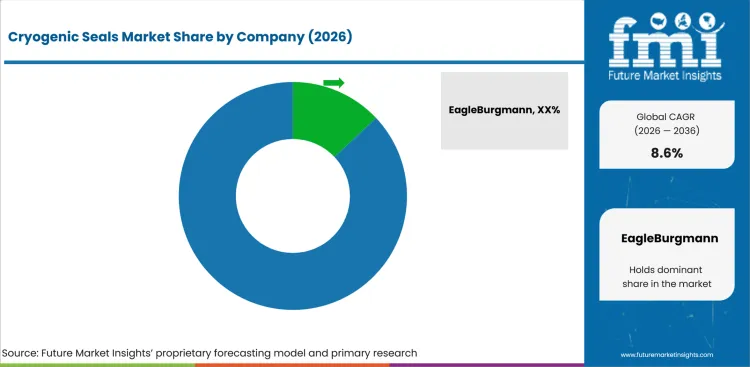
EagleBurgmann, John Crane, Flowserve, Trelleborg and Parker Hannifin.
- Established sealing companies hold an advantage through cryogenic test evidence and OEM equipment access.
- Specialist material suppliers gain project access by offering hydrogen-ready compounds and low-temperature validation.
- Aftermarket-focused suppliers gain acceptance by supporting field replacement during short maintenance windows.
- Retail-ready documentation supports procurement through clear fluid compatibility, temperature limits, and cleanliness records.
Cryogenic seal suppliers compete by combining material validation with cold-service application support. EagleBurgmann and John Crane hold strong positions in mechanical seals and dry gas sealing for LNG and process equipment. Flowserve strengthens access through pumps, valves, and sealing systems used in energy infrastructure. Buyers assess qualification records before price because seal failure can interrupt a much larger cryogenic asset.
Hydrogen readiness is becoming a stronger differentiator as liquid hydrogen storage and transfer systems require tighter leakage control. Trelleborg Sealing Solutions and Parker Hannifin have stronger positions in engineered polymers, spring-energized seals, and hydrogen-ready components. Freudenberg Sealing Technologies and Technetics Group add value where advanced elastomers and metallic seals are needed for demanding service conditions.
Smaller and specialist suppliers can win through service responsiveness and application-specific engineering. Garlock, James Walker, and Flexaseal remain relevant where static sealing, gaskets, and engineered mechanical seals are tied to maintenance cycles. Companies best positioned to win are those that support both first-fit OEM demand and recurring aftermarket replacement with clear test evidence.
How do top cryogenic seals companies compare?
EagleBurgmann and John Crane score strongest on mechanical seal depth while Trelleborg and Parker lead in hydrogen-ready material relevance.
| Company | Relevance to Market Title | Cryogenic Product Depth | Hydrogen Readiness | OEM Channel Strength | Aftermarket Reach | Geographic Footprint |
|---|---|---|---|---|---|---|
| EagleBurgmann | Very High | Very Strong | Strong | Very Strong | Strong | Global |
| John Crane | Very High | Very Strong | Strong | Very Strong | Very Strong | Global |
| Flowserve Corporation | High | Strong | Moderate | Very Strong | Very Strong | Global |
| Trelleborg Sealing Solutions | High | Strong | Very Strong | Strong | Strong | Global |
| Parker Hannifin Corporation | High | Strong | Very Strong | Strong | Strong | Global |
| Freudenberg Sealing Technologies | Moderate to High | Strong | Strong | Moderate | Moderate | Global |
| Technetics Group | High | Very Strong | Strong | Moderate | Moderate | Global |
| Garlock Sealing Technologies | Moderate to High | Strong | Moderate | Moderate | Strong | Global |
| James Walker | Moderate | Moderate | Moderate | Moderate | Strong | Europe-centered |
| Flexaseal Engineered Seals and Systems | Moderate | Strong | Moderate | Moderate | Moderate | North America and export |
Source: Future Market Insights competitive analysis, 2026.
Who are the key players in the cryogenic seals market?
EagleBurgmann, John Crane and Flowserve are listed with Trelleborg and Parker Hannifin among other suppliers.
Key global companies leading the cryogenic seals market include:
- EagleBurgmann
- John Crane
- Flowserve Corporation
- Trelleborg Sealing Solutions
- Parker Hannifin Corporation
- Freudenberg Sealing Technologies
- Technetics Group
- Garlock Sealing Technologies
- James Walker
- Flexaseal Engineered Seals and Systems
Key Developments in Cryogenic Seals Market
- In July 2024, Flowserve acquired LNG pumping technology from NexGen Cryo, adding cryogenic LNG pump and cold energy recovery technology to its Pumps Division and complementing its pumps, valves, and mechanical seals portfolio.
- In August 2024, Trelleborg Sealing Solutions launched the full H2Pro range with over 20 sealing compounds for hydrogen value-chain applications, supported by proprietary testing regimes for real-world hydrogen environments.
- In June 2025, John Crane introduced the Type 93AX Coaxial Separation Seal, a next-generation dry gas sealing solution designed to reduce nitrogen consumption by up to 80% compared with conventional radial separation seals.
Key Players in the Cryogenic Seals Market
Global Mechanical and Rotating Equipment Seal Leaders
- EagleBurgmann
- John Crane
- Flowserve Corporation
- Parker Hannifin Corporation
Hydrogen and Advanced Material Sealing Suppliers
- Trelleborg Sealing Solutions
- Freudenberg Sealing Technologies
- Technetics Group
Specialist Static and Engineered Seal Suppliers
- Garlock Sealing Technologies
- James Walker
- Flexaseal Engineered Seals and Systems
Cryogenic Seals Market - Report Scope
| Parameter | Details |
|---|---|
| Forecast period | 2026 to 2036 |
| Historical period | 2021 to 2025 |
| Quantitative unit | Revenue in USD million |
| By seal type | Mechanical seals, elastomeric seals, metal C-rings / spring seals, other |
| By fluid | LNG, liquid hydrogen, liquid nitrogen / oxygen, other cryogens |
| By end use | LNG infrastructure, industrial gas, hydrogen, aerospace / other |
| By temperature range | Above -100°C, -100°C to -196°C, below -196°C |
| By sales mix | OEM, aftermarket |
| Regions covered | North America, Latin America, Europe, East Asia, South Asia and Pacific, Middle East and Africa |
| Countries covered | United States, United Kingdom, Germany, France, Japan, China, South Korea, India |
| Key companies profiled | EagleBurgmann, John Crane, Flowserve Corporation, Trelleborg Sealing Solutions, Parker Hannifin, Freudenberg Sealing Technologies, Technetics Group, Garlock, James Walker, Flexaseal |
| Approach | Bottom-up product-boundary approach using seal revenue, OEM equipment placement, aftermarket cycles, application exposure, and country-level infrastructure signals |
Source: Future Market Insights, 2026.
Cryogenic Seals Market - Scope & Definition
| Attribute | Detail |
|---|---|
| Market Definition | Engineered sealing products used in equipment that handles cryogenic gases or liquids at very low temperatures. |
| Functions Covered | Leakage control, shaft sealing, static sealing, pressure retention, thermal cycling resistance, and fluid compatibility. |
| Applications Covered | Pumps, valves, compressors, tanks, transfer lines, loading arms, and aerospace cryogenic systems. |
| End-Use Industries | LNG infrastructure, industrial gas, hydrogen systems, aerospace, energy, chemicals, and advanced manufacturing. |
| Grades Covered | Above -100°C, -100°C to -196°C, and below -196°C service ranges across selected seal technologies. |
| Inclusions | Mechanical seals, elastomeric seals, metal C-rings, spring seals, OEM sales, aftermarket sales, LNG infrastructure, industrial gas equipment, hydrogen equipment, and aerospace systems. |
| Exclusions | Ambient-temperature hydraulic seals, standard automotive gaskets, non-cryogenic HVAC seals, commodity pipe gaskets, and general refrigeration seals. |
Cryogenic Seals Market - Research Methodology
| Method | Description |
|---|---|
| Primary Research | FMI analyst interviews with cryogenic equipment buyers, LNG terminal engineers, industrial gas distributors, hydrogen system integrators, and seal distributors across key markets. |
| Desk Research | Review of public energy data, LNG infrastructure trackers, hydrogen policy documents, safety standards, and company product information. |
| Market Sizing & Forecasting | Bottom-up product-boundary approach using seal volumes, average selling prices, equipment build rates, replacement cycles, and country-level infrastructure signals. |
| Data Validation | Cross-verification using cryogenic systems, mechanical shaft seals, industrial gases, LNG terminals, hydrogen equipment trends, and company portfolio checks. |
Cryogenic Seals Market Breakdown by Seal Type, Fluid, End Use, Temperature Range, Sales Mix, and Region
Cryogenic Seals Market Segmented by Seal Type:
- Mechanical Seals
- Elastomeric Seals
- Metal C-rings / Spring Seals
- Other
Cryogenic Seals Market Segmented by Fluid:
- LNG
- Liquid Hydrogen
- Liquid Nitrogen / Oxygen
- Other Cryogens
Cryogenic Seals Market Segmented by End Use:
- LNG Infrastructure
- Industrial Gas
- Hydrogen
- Aerospace / Other
Cryogenic Seals Market Segmented by Temperature Range:
- Above -100°C
- -100°C to -196°C
- Below -196°C
Cryogenic Seals Market Segmented by Sales Mix:
- OEM
- Aftermarket
Cryogenic Seals Market by Region:
- North America
- Latin America
- Europe
- East Asia
- South Asia and Pacific
- Middle East and Africa
Research Sources and Bibliography
- Agency for Natural Resources and Energy. (2024, September 10). Hydrogen Society Promotion Act enacted toward a hydrogen-based society.
- Bundesnetzagentur. (2024, October 22). Hydrogen core network.
- Bundesnetzagentur. (2026, January 12). Bundesnetzagentur publishes gas supply figures for 2025.
- Council of the European Union. (2025). Liquefied natural gas infrastructure in the EU.
- Department for Energy Security and Net Zero. (2024, February 27). Hydrogen net zero investment roadmap: Leading the way to net zero.
- Department for Energy Security and Net Zero. (2025, April 7). Hydrogen Allocation Round 2: Shortlisted projects.
- Department for Energy Security and Net Zero. (2025, July). Hydrogen update to the market.
- European Commission. (2025). Gas storage.
- European Hydrogen Observatory. (2025, June 23). France: National strategies.
- Eurostat. (2026, March 18). Energy in Europe: Imports dependency.
- FNB Gas. (2024, October 22). Hydrogen core network.
- Flowserve Corporation. (2024, July 23). Flowserve acquires LNG pumping technology from NexGen Cryo to accelerate decarbonization growth strategy.
- International Energy Agency. (2025). Hydrogen.
- International Energy Agency. (2025). Korea: Natural gas.
- International Energy Agency. (2025). Global Energy Review 2025: Natural gas.
- International Energy Agency. (2025, October). Gas 2025: Executive summary.
- International Energy Agency. (2025, September 5). Hydrogen Society Promotion Act.
- International Energy Agency. (2026). Global LNG Capacity Tracker.
- Institute for Energy Economics and Financial Analysis. (2025, June 23). Prioritizing economic viability in South Korea’s U.S. LNG import strategy.
- Japan Organization for Metals and Energy Security. (2026, June 10). Natural gas and LNG related information.
- John Crane. (2025, June 18). John Crane introduces versatile next-generation Coaxial Seal, engineered for success and efficiency.
- National Aeronautics and Space Administration. (2024). Safety standard for hydrogen and hydrogen systems.
- Petroleum and Natural Gas Regulatory Board. (2025, June 9). Natural gas projections: 2030 base case.
- Press Information Bureau. (2025, August 7). Government boosts LNG use with 100% FDI, new stations and cleaner transport.
- Press Information Bureau. (2025, November 12). Unlocking India’s green hydrogen production potential.
- State Council Information Office of the People’s Republic of China. (2024, June 17). China’s natural gas output maintains steady growth.
- Trelleborg Sealing Solutions. (2024, August 7). Trelleborg launches range of proven H2Pro solutions for hydrogen.
- U.S. Department of Energy. (2026, February 27). Energy Department approves export expansion at Corpus Christi LNG.
- U.S. Department of Energy. (2026, March 13). Energy Department approves immediate additional LNG exports at Plaquemines LNG.
- U.S. Department of Energy. (2026, March 31). Liquefied natural gas exports: March 2026.
- U.S. Energy Information Administration. (2026). Hydrogen explained.
- U.S. Energy Information Administration. (2026, April 16). U.S. natural gas exports to grow nearly 30% by 2027 as LNG capacity increases.
- U.S. International Trade Administration. (2025, September 30). South Korea hydrogen economy.
This bibliography is provided for reader reference and is not exhaustive. The full report contains the complete reference list and detailed citations.
This Report Answers
- Market size estimates for 2026 and forecasts through 2036 for the cryogenic seals market.
- Insights across more than 30 regional and country-level markets.
- Analysis of demand drivers, LNG infrastructure trends, hydrogen storage needs, and industrial gas maintenance patterns.
- Evaluation of key seal types, fluid categories, end-use applications, temperature ranges, and sales mix dynamics.
- Assessment of qualification requirements, oxygen cleaning constraints, and hydrogen-ready material validation needs.
- Identification of growth opportunities across mechanical seals, elastomeric seals, metal seals, and spring-energized products.
- Evaluation of supply chain dynamics, OEM specification trends, aftermarket replacement channels, and service structures.
- Country-level growth analysis covering the United States, United Kingdom, Germany, France, Japan, China, South Korea, and India.
- Assessment of the competitive landscape, including leading cryogenic seal manufacturers and other market participants.
- Analysis of buyer preferences, qualification barriers, service coverage needs, and emerging project opportunities.
- Regional outlooks across North America, Europe, East Asia, South Asia and Pacific, and other major regions.
- Delivery of market data, forecasts, and supporting analysis in PDF and Excel formats.
Frequently Asked Questions
What is the growth prospect for cryogenic seals?
Demand for cryogenic seals is expected to rise at a considerable pace as LNG, hydrogen, and industrial gas systems require validated low-temperature sealing products.
Which companies are expected to shape the cryogenic seals market?
EagleBurgmann, John Crane, Flowserve Corporation, Trelleborg Sealing Solutions, Parker Hannifin, Technetics Group, and Garlock are expected to shape market competition through cryogenic sealing portfolios and service reach.
Why are leading sealing companies investing in cryogenic seals?
Leading sealing companies are investing in cryogenic seals to serve LNG equipment, hydrogen storage, industrial gas systems, and aerospace applications requiring low-leakage performance.
Why are OEM channels important in the cryogenic seals market?
OEM channels support early seal specification because pumps, valves, tanks, and compressors require qualified sealing products before commissioning.
Which product formats are gaining attention in cryogenic seals?
Mechanical seals, metal C-rings, spring seals, and spring-energized polymer seals are gaining attention as buyers seek reliable low-temperature performance.
How do regulations influence cryogenic seal adoption?
Regulations and safety requirements influence adoption through oxygen cleaning, hydrogen leak control, material traceability, and documentation expectations.
Why is qualification important for cryogenic seals?
Qualification is important because tested sealing products help buyers reduce leakage risk, shutdown exposure, and maintenance uncertainty in critical systems.
What role does hydrogen play in cryogenic seal demand?
Hydrogen raises demand for advanced seals because low temperature service and small-molecule leakage require stronger material validation.
How do aftermarket channels support cryogenic seals?
Aftermarket channels support replacement demand by supplying seals for planned turnarounds, thermal cycling wear, and field maintenance across installed cryogenic equipment.
Preview the report firsthand - request a free sample
Get SampleGet the brochure for pricing and purchase details.
Get PDFTable of Content
- Executive Summary
- Global Market Outlook
- Demand-side Trends
- Supply-side Trends
- Technology Roadmap Analysis
- Analysis and Recommendations
- Market Overview
- Market Coverage / Taxonomy
- Market Definition / Scope / Limitations
- Research Methodology
- Research Design
- Primary Research
- Desk Research
- Market Sizing and Forecasting
- Data Validation
- Global Market Analysis 2021 to 2025 and Forecast, 2026 to 2036
- Historical Market Size Value (USD Million) Analysis, 2021 to 2025
- Current and Future Market Size Value (USD Million) Projections, 2026 to 2036
- Y-o-Y Growth Trend Analysis
- Absolute $ Opportunity Analysis
- Global Market Pricing Analysis 2021 to 2025 and Forecast 2026 to 2036
- Global Market Analysis 2021 to 2025 and Forecast 2026 to 2036, By Seal Type
- Introduction / Key Findings
- Historical Market Size Value (USD Million) Analysis By Seal Type, 2021 to 2025
- Current and Future Market Size Value (USD Million) Analysis By Seal Type, 2026 to 2036
- Global Market Analysis 2021 to 2025 and Forecast 2026 to 2036, By Fluid
- Introduction / Key Findings
- Historical Market Size Value (USD Million) Analysis By Fluid, 2021 to 2025
- Current and Future Market Size Value (USD Million) Analysis By Fluid, 2026 to 2036
- Global Market Analysis 2021 to 2025 and Forecast 2026 to 2036, By End Use
- Introduction / Key Findings
- Historical Market Size Value (USD Million) Analysis By End Use, 2021 to 2025
- Current and Future Market Size Value (USD Million) Analysis By End Use, 2026 to 2036
- Global Market Analysis 2021 to 2025 and Forecast 2026 to 2036, By Temperature Range
- Introduction / Key Findings
- Historical Market Size Value (USD Million) Analysis By Temperature Range, 2021 to 2025
- Current and Future Market Size Value (USD Million) Analysis By Temperature Range, 2026 to 2036
- Global Market Analysis 2021 to 2025 and Forecast 2026 to 2036, By Sales Mix
- Introduction / Key Findings
- Historical Market Size Value (USD Million) Analysis By Sales Mix, 2021 to 2025
- Current and Future Market Size Value (USD Million) Analysis By Sales Mix, 2026 to 2036
- Global Market Analysis 2021 to 2025 and Forecast 2026 to 2036, By Region
- Introduction / Key Findings
- Historical Market Size Value (USD Million) Analysis By Region, 2021 to 2025
- Current and Future Market Size Value (USD Million) Analysis By Region, 2026 to 2036
- North America Market Analysis 2021 to 2025 and Forecast 2026 to 2036
- Pricing Analysis
- Market Share Analysis, 2025
- By Country
- By Seal Type
- By Fluid
- By End Use
- By Temperature Range
- By Sales Mix
- Country-level Analysis
- United States
- Canada
- Latin America Market Analysis 2021 to 2025 and Forecast 2026 to 2036
- Pricing Analysis
- Market Share Analysis, 2025
- By Country
- By Seal Type
- By Fluid
- By End Use
- By Temperature Range
- By Sales Mix
- Country-level Analysis
- Brazil
- Mexico
- Rest of Latin America
- Western Europe Market Analysis 2021 to 2025 and Forecast 2026 to 2036
- Pricing Analysis
- Market Share Analysis, 2025
- By Country
- By Seal Type
- By Fluid
- By End Use
- By Temperature Range
- By Sales Mix
- Country-level Analysis
- Germany
- France
- United Kingdom
- Italy
- Spain
- BENELUX
- Nordics
- Rest of Western Europe
- Eastern Europe Market Analysis 2021 to 2025 and Forecast 2026 to 2036
- Pricing Analysis
- Market Share Analysis, 2025
- By Country
- By Seal Type
- By Fluid
- By End Use
- By Temperature Range
- By Sales Mix
- Country-level Analysis
- Russia
- Poland
- Rest of Eastern Europe
- East Asia Market Analysis 2021 to 2025 and Forecast 2026 to 2036
- Pricing Analysis
- Market Share Analysis, 2025
- By Country
- By Seal Type
- By Fluid
- By End Use
- By Temperature Range
- By Sales Mix
- Country-level Analysis
- China
- Japan
- South Korea
- South Asia and Pacific Market Analysis 2021 to 2025 and Forecast 2026 to 2036
- Pricing Analysis
- Market Share Analysis, 2025
- By Country
- By Seal Type
- By Fluid
- By End Use
- By Temperature Range
- By Sales Mix
- Country-level Analysis
- India
- ASEAN
- Australia & New Zealand
- Rest of South Asia and Pacific
- Middle East & Africa Market Analysis 2021 to 2025 and Forecast 2026 to 2036
- Pricing Analysis
- Market Share Analysis, 2025
- By Country
- By Seal Type
- By Fluid
- By End Use
- By Temperature Range
- By Sales Mix
- Country-level Analysis
- GCC Countries
- South Africa
- Turkey
- Rest of Middle East & Africa
- Market Structure Analysis
- Competition Dashboard
- Competition Benchmarking
- Market Share Analysis of Top Players
- By Region
- By Seal Type
- By Fluid
- By End Use
- By Temperature Range
- By Sales Mix
- Emerging Startups
- Innovation Benchmarking
- Competition Analysis
- Competition Deep Dive
- Company Profiles
- Case Studies
- Success Stories
- Recent Developments
- Assumptions & Acronyms Used
- List of Tables: Cryogenic Seals Market
- List of Figures: Cryogenic Seals Market


