

- Market Size (2026)
- USD 860.6 Mn
- Forecast (2036)
- USD 1892.7 Mn
- CAGR (2026 to 2036)
- 8.2%
How big is Docking Assist Sensors Market in 2026?
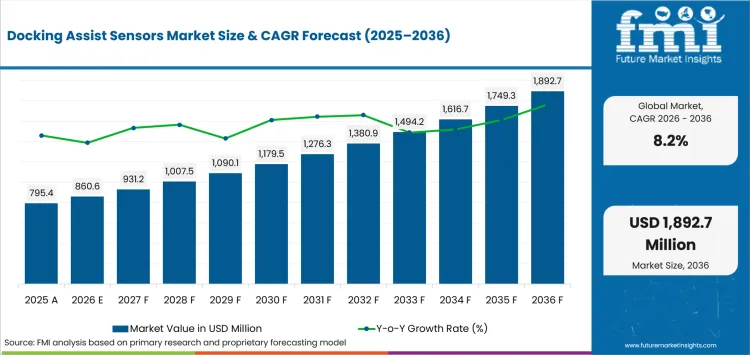
USD 860.6 million in 2026 and USD 1892.7 million by 2036 at an 8.2% CAGR.
Demand for docking assist sensors is projected to expand at 8.2% CAGR between 2026 and 2036, lifting value from USD 860.6 million to USD 1892.7 million. Adoption is rising in applications where low-speed position data can feed marine propulsion systems without forcing another isolated alarm at the helm. In January 2025, Dockmate redesigned DPS V2 for easier retrofit and integrated engine or thruster control. The receiver upgrade reduces installation work on boats whose owners want position assistance without replacing the complete helm.
Country conversion depends on installed boats and service access more than the approved growth rate alone. Sweden offers a large recreational boating retrofit pool because the Swedish Transport Agency counted nearly 1.3 million seaworthy recreational boats in September 2025. Japan carries the lowest approved CAGR among the seven profiled countries and a more selective replacement cycle centered on compact integration. Channel planning therefore follows vessel age and installer coverage instead of treating every national forecast as commercially equivalent.
Key Takeaways of Docking Assist Sensors Market
- Docking assist sensor demand rises as operators seek earlier clearance information during close-quarter maneuvers with restricted sightlines.
- Based on sensor type, ultrasonic sensors are projected to account for 26.0% in 2026 due to compact short-range ranging hardware.
- By system scope, sensor only is estimated to hold 22.0% in 2026 owing to modular fit with installed helm electronics.
- In 2026, yachts are expected to lead vessel type with 31.0% share because larger hulls increase blind-zone exposure.
- Vessel-specific placement and control compatibility raise installed cost because retrofit work requires cabling plus calibration before commissioning.
- Some of the key players in this market include Volvo Penta, Brunswick Corporation, Dockmate, Mercury Marine, Yamaha Motor Co., Ltd., Simrad Yachting (Navico Group), Furuno Electric Co., Ltd., and VETUS.
Analyst Perspective
"For docking assist sensors, the purchase decision starts with what the helm can see at walking speed and ends with available propulsion authority. Sensor accuracy loses commercial value if hull calibration or control compatibility makes commissioning unreliable on the vessel being upgraded."
- Nikhil Kaitwade, Principal Consultant, Future Market Insights
How is the Docking Assist Sensors Market segmented?
The docking assist sensors market is segmented by sensor type, system scope, vessel type, installation, function, and region.
Sensor type covers ultrasonic, radar, camera, LiDAR, and GNSS-assisted sensors. System scope includes sensor only, sensor plus display, and sensor plus automated control. Vessel type includes yachts, motorboats, sailboats, and commercial craft. Installation covers OEM fitment and retrofit. Function separates distance sensing, position holding, collision warning, and automated docking assistance.
Why does OEM fitment lead the Installation category?
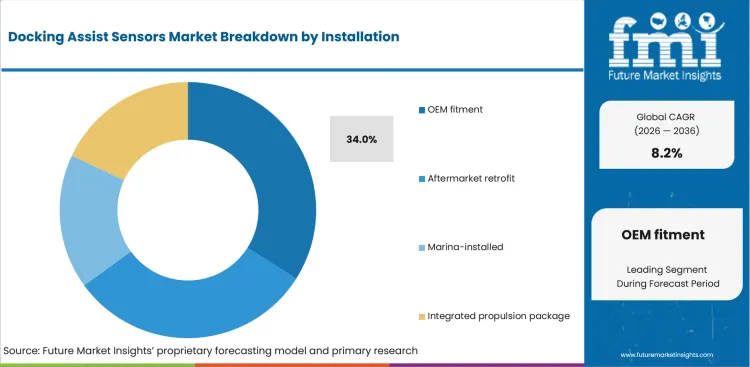
Factory fitment gives boatbuilders control over sensor location and cable routing before interior finishes restrict access. OEM engineering can also validate autonomous marine navigation functions against known steering response and propulsion authority before a model enters production.
- The installation category is forecast to be led by OEM fitment at 34.0% share in 2026 due to factory control over sensor placement and cabling.
- Factory installation gives developers one known hull and propulsion package for validating sensor placement before customer delivery. Brunswick presented an autonomous docking development system on a Boston Whaler 405 Conquest in January 2025 with live object tracking and classification.
Why do Ultrasonic sensors lead the Sensor type category?
Packages using ultrasonic sensors suit docking applications that need direct short-range clearance readings without processing a full imaging stack. Furuno placed a dedicated berthing aid system beside Doppler speed and navigation instruments at Nor-Shipping in May 2025, confirming continued commercial use of acoustic data during berth approach.
- By sensor type, ultrasonic sensors are forecast to represent 26.0% in 2026 driven by direct short-range ranging and compact installation.
- Compact transducers can feed warning or display layers without handing propulsion authority to the sensing module. Separating sensing from propulsion authority suits refits where owners want clearer clearance data but intend to keep existing helm controls.
Why does Sensor only lead the System scope category?
Sensor-only configurations suit boats that already carry capable marine electronics and need another perception layer without replacing the complete helm. The purchase decision therefore centers on network compatibility and mounting access rather than an additional proprietary display.
- Sensor only is set to lead the system scope with 22.0% share in 2026 due to modular integration with existing helm equipment.
- Existing helm displays give modular sensing packages a lower-disruption route into boats that already carry capable marine electronics. Simrad introduced AutoTrack for HALO 2000 and HALO 3000 radar in July 2025 with automated target detection and tracking.
Why do Yachts lead the Vessel type category?
Yachts justify dedicated docking assistance because hull length and superstructure can separate the helm from likely contact points. Volvo Penta documented a 48-meter custom Baglietto project in October 2025 using IPS Professional Platform with Assisted Docking and Dynamic Positioning, showing how maneuvering support is being designed into large-yacht propulsion packages.
- Yachts are projected to hold 31.0% share in 2026 owing to larger blind zones and higher repair exposure.
- Cameras and ranging sensors earn their cost by covering blind zones that crew cannot continuously observe from the helm. Higher repair exposure strengthens the case for dedicated clearance information during berth approach.
What are the drivers, restraints and opportunities in the Docking Assist Sensors Market?
Safety exposure raises demand for clearer low-speed awareness, vessel-specific integration limits retrofit economics, and modular control paths widen the addressable installed fleet.
- Driver: Collision exposure and restricted sightlines increase the value of earlier clearance information before a docking error becomes a repair event.
- Restraint: Sensor placement and control compatibility increase commissioning work because each hull presents different geometry and network constraints.
- Opportunity: Partner interfaces make more installed boats eligible for retrofit without requiring complete replacement of working helm equipment.
Collision losses raise the value of earlier clearance information
Close-quarter maneuvering concentrates risk because operators have limited sightlines and little time to correct a poor approach. The USA Coast Guard recorded 3,887 recreational boating incidents and about USD 88 million in property damage for 2024 in its June 2025 report. The statistics cover all boating accidents instead of docking alone, but they show why owners of expensive vessels pay for earlier clearance information before contact occurs.
Control architecture limits straightforward retrofit conversion
Higher-control docking packages depend on marine steering systems and propulsion architecture already installed on the vessel, because perception alone cannot command unsupported actuators. Volvo Penta stated in September 2025 that its new autopilot generation works with Assisted Docking but requires compatible Electronic Vessel Control packages. The EVC requirement raises engineering work on older boats before sensor price becomes decisive. Retrofit conversion therefore depends on a documented control path and installer access to the existing electronic network.
Partner interfaces make more installed boats eligible for retrofit
Retrofit revenue improves if maneuvering hardware can join propulsion and thruster systems through documented interfaces. VETUS stated in January 2025 that BOW PRO thrusters integrate with partner joystick systems for docking and its service network reaches 18 countries. The documented partner route reduces dependence on one propulsion brand and gives dealers a larger installed fleet. Installers still need a clear handoff between thruster calibration and remote-control commissioning before delivery.
Which country CAGRs are profiled in the Docking Assist Sensors Market?
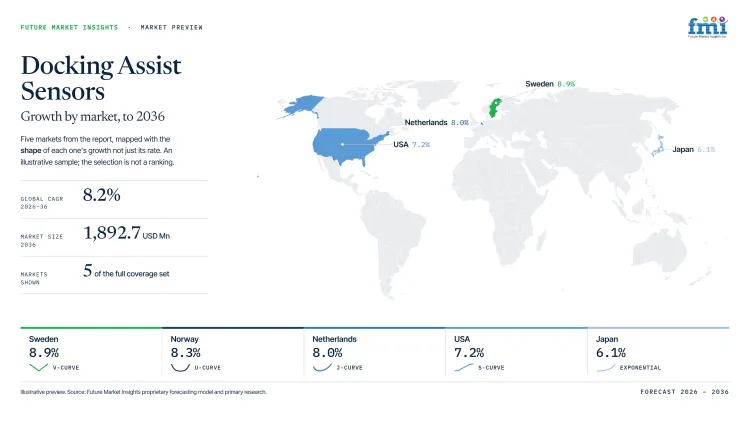
| Country | CAGR |
|---|---|
| Sweden | 8.9% |
| Norway | 8.3% |
| Netherlands | 8.0% |
| Australia | 7.5% |
| USA | 7.2% |
| Germany | 7.0% |
| Japan | 6.1% |
How do country-level CAGRs compare in the Docking Assist Sensors Market?
The forecasts span 2.8 percentage points from Sweden at 8.9% CAGR to Japan at 6.1%. Sweden, Norway and the Netherlands form the upper group because leisure boating and confined waterways increase low-speed maneuvering. Australia, the USA and Germany occupy the middle band. Japan follows a selective replacement path that favors compact helm integrations and controlled retrofit spending.
- Seasonal marina concentration keeps Swedish installation schedules tighter than markets with more evenly distributed service work.
- Popular cabin cruising raises repeated marina calls along established Norwegian coastal leisure routes during the main boating season.
- Lock traffic and berth turnover make short-range awareness useful on Dutch recreational craft that maneuver frequently between stops.
- Regional dealer coverage determines whether commissioning stays economical once Australian boats operate beyond the largest metropolitan hubs.
- High pre-owned boat turnover broadens USA retrofit potential and propulsion diversity increases diagnostic work for independent marine installers serving mixed fleets.
- Dense federal waterways keep service demand active on German recreational craft moving between inland and coastal operating environments.
- Compact harbor layouts favor Japanese upgrades that preserve helm space during refits on mature recreational vessels.
Installed-vessel age and commissioning access can outweigh narrow CAGR differences during market entry. The full report provides country-level CAGR analysis across North America, Latin America, Europe, East Asia, South Asia, Oceania and the Middle East and Africa.
Country-wise Analysis
- Archipelago marinas compress Swedish commissioning into a short spring window as older leisure boats return to the water. Docking assist sensor demand in Sweden is forecast to rise at 8.9% CAGR over the forecast period, aided by a large retrofit fleet and dense marine-electronics channels. Transportstyrelsen's September 2025 survey found that one-third of Sweden's population had used a recreational boat during the previous year, confirming frequent exposure to close-quarter handling. Seasonal haul-out capacity limits installation time for complex refits during spring service peaks. Modules with documented network compatibility therefore give dealers a practical conversion route without forcing complete helm replacement.
- Fjord marinas expose Norwegian recreational boats to crosswinds and current as service technicians cover a coastline broken by long travel distances. The Norwegian Maritime Authority recorded 17 recreational-boating deaths during 2025 in its January 2026 review, keeping maneuvering safety visible in operator decisions. Norway is estimated to post 8.3% CAGR over the forecast period, tied to intensive coastal use and demand for predictable low-speed control. Rugged controls and reliable heading information suit exposed berths, but calibration travel increases commissioning cost outside larger boating centers. Brands with mobile service teams gain an advantage where one dealer cannot economically cover the full coast.
- Dutch recreational craft pass through locks and narrow inland routes where close-quarter maneuvering is part of routine navigation. The country's dense marina network favors compact navigation and positioning installations that preserve helm space, while mixed canal and coastal fleets require flexible mounting. Statistics Netherlands and Rijkswaterstaat recorded 7,095 kilometers of navigable waterways for 2025 under the current classification, indicating repeated exposure to confined passages. Adoption of docking assist sensors in the Netherlands is estimated to expand at 8.0% CAGR through 2036, supported by frequent berth interaction and strong marine-electronics access. Integration limits differ by vessel age, so documented sensor placement can shorten commissioning without forcing a complete helm replacement.
- Australian marine-electronics installers cover long coastal service routes, making local commissioning capacity part of the purchase decision for low-speed maneuvering equipment. Australia's docking assist sensors outlook is anticipated to advance at 7.5% CAGR over the assessment period, driven by widespread coastal boating and continued onboard-control investment. Salt exposure and long travel distances favor durable hardware plus regional service partners. The Australian Maritime Safety Authority recorded 4,174 marine incident reports during 2025 in its June 2026 release, keeping safe maneuvering visible in operator risk reviews. Brands without trained regional installers face higher support costs once boats leave the largest metropolitan marinas.
- USA demand spans factory-equipped premium boats and a large pre-owned fleet served by independent marine dealers with very different rigging practices. NMMA reported 867,059 pre-owned boat sales in 2025 through its June 2026 statistical release, confirming a large installed base available for retrofit work. Docking assist sensor sales in the USA are forecast to expand at 7.2% CAGR by 2036, propelled by dealer access and continued adoption of integrated control packages. Propulsion networks and hull geometry vary widely between brands, which slows one-size installation procedures. Clear compatibility matrices therefore reduce dealer diagnosis time before sensor placement and calibration begin.
- Germany's waterway network mixes inland traffic with coastal leisure fleets and formal operator qualifications that shape routine boat handling. The Federal Ministry for Transport stated in October 2025 that federal waterways total about 10,000 kilometers and updated sport-boat licensing rules in the same announcement. Local service depth gives docking systems a practical commissioning route on mixed recreational craft. The German docking assist sensors sector is projected to record 7.0% CAGR during the assessment period, attributable to steady leisure use and repeated confined-waterway maneuvering. Vessel age and propulsion architecture still complicate retrofit economics, so standard commissioning procedures carry more weight than broad feature lists during dealer evaluation.
- Compact Japanese harbors leave limited helm space for added equipment and place a premium on predictable information during berth approach. By 2036, Japan is projected to grow at 6.1% CAGR, given replacement demand for compact systems and expectations for dependable marine electronics. Local dealers can integrate marine radar and positioning data into established displays, which favors staged upgrades on boats that do not justify full control replacement. Japan Transport Safety Board data updated in January 2026 recorded 151 pleasure boats among 741 vessels involved in marine accidents during 2025. Mature fleets keep replacement economics selective, making local service and compact installation more valuable than a broader automation package.
Who are the notable companies in the Docking Assist Sensors Market?
Volvo Penta, Brunswick Corporation, Dockmate, Mercury Marine, Yamaha Motor Co., Ltd., Simrad Yachting (Navico Group), Furuno Electric Co., Ltd., VETUS are the notable companies serving this market.
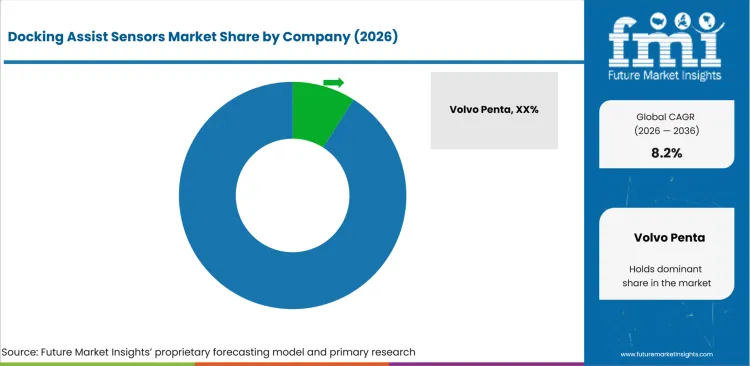
Competition is split between integrated marine groups, propulsion-control manufacturers, marine-electronics brands and retrofit specialists because each controls a different part of the docking chain. Brunswick Corporation owns Mercury Marine and Navico Group, but boatbuilders still specify propulsion and helm electronics as separate workstreams. Volvo Penta and Yamaha package maneuvering within proprietary controls. Dockmate and VETUS sell upgrade routes for mixed-age fleets, so global positioning systems and propulsion interfaces determine how far each company can move from warning functions into active docking control.
- Integrated factory platforms: Volvo Penta and Brunswick Corporation tie docking functions to propulsion, helm electronics and boat-level validation programs.
- Propulsion-control groups: Mercury Marine and Yamaha Motor Co., Ltd. extend joystick authority through defined engine, thruster and positioning interfaces.
- Sensor and retrofit specialists: Dockmate, Simrad Yachting (Navico Group), Furuno Electric Co., Ltd. and VETUS serve distinct sensing or upgrade routes.
Competitive Benchmarking: Docking Assist Sensors Market
| Company | Docking Awareness Inputs | Propulsion/Thruster Control Integration | Retrofit Accessibility | Geographic Reach |
|---|---|---|---|---|
| Volvo Penta | Medium | High | Medium | Global dealer network |
| Brunswick Corporation | High | High | Low | Global brand network |
| Dockmate | Medium | High | High | Europe and North America |
| Mercury Marine | Medium | High | High | Global dealer network |
| Yamaha Motor Co., Ltd. | Medium | High | Medium | Global marine distribution |
| Simrad Yachting (Navico Group) | High | High | Medium | More than 100 countries |
| Furuno Electric Co., Ltd. | High | Low | Low | Global electronics network |
| VETUS | Low | High | High | 18 countries plus distributors |
Scoring basis: High docking-awareness depth requires multiple documented perception or position inputs, Medium requires one primary input, and Low identifies control-led offers with no comparable sensing layer. High control integration requires direct engine or thruster authority, Medium depends on partner interfaces, and Low provides awareness without propulsion authority. High retrofit accessibility requires a documented dealer or upgrade path, Medium has stated compatibility limits, and Low is documented mainly for project or factory installation.
Key Developments in the Docking Assist Sensors Market
- In February 2025, Mercury Marine introduced Joystick Piloting for Single-Engine Outboards with Thruster, coordinating steering, throttle, shifting and a variable-speed bow thruster for 360-degree maneuvering.
- In March 2025, Yamaha Motor Co., Ltd. announced a new HARMO generation for Japan with Helm Master EX integration and joystick-based docking assistance for June 2025.
- In January 2025, Dockmate announced a MOLABO collaboration extending proportional remote control to compatible low-voltage electric marine propulsion systems.
Key Players in the Docking Assist Sensors Market
Integrated Autonomy and Helm Platforms
- Volvo Penta
- Brunswick Corporation
- Simrad Yachting (Navico Group)
Propulsion and Joystick Control
- Mercury Marine
- Yamaha Motor Co., Ltd.
- VETUS
Sensor and Retrofit Docking Control
- Dockmate
- Furuno Electric Co., Ltd.
Docking Assist Sensors Market - Report Scope
| Coverage field | Report scope |
|---|---|
| Market breakdown | By sensor type, system scope, vessel type, installation, function and region. |
| Quantitative Units | USD Million. |
| Market Definition | Revenue from vessel-mounted sensing and sensor-enabled modules sold specifically for docking assistance, including proximity, position and vision functions attributable to the defined package. |
| Regions Covered | North America, Latin America, Europe, East Asia, South Asia and Pacific, and Middle East and Africa. |
| Countries Covered | Sweden, Norway, Netherlands, Australia, USA, Germany, Japan, and 20+ countries included in the full report. |
| Key Companies Profiled | Volvo Penta, Brunswick Corporation, Dockmate, Mercury Marine, Yamaha Motor Co., Ltd., Simrad Yachting (Navico Group), Furuno Electric Co., Ltd., VETUS. |
| Forecast Period | 2026 to 2036. |
| Approach | Primary and secondary research with market triangulation. |
Docking Assist Sensors Market - Research Methodology
| Method | Approach |
|---|---|
| Primary Research | FMI analysts gathered input from manufacturers, service providers, technology developers, distributors, end users, procurement teams, and subject-matter experts. Interviews examined purchasing decisions, product or service evaluation, adoption barriers, approval requirements, pricing considerations, and expectations for technical or commercial support. Respondents were also asked what evidence is required before a trial, pilot, or initial order develops into regular purchasing. |
| Desk Research | Desk research covered government statistics, regulatory publications, trade data, industry associations, technical literature, standards, company filings, product information, and official corporate announcements. Sources were reviewed for relevance, publication date, geographic coverage, and consistency with the defined market scope. Claims relating to performance, applications, approvals, capacity, investment, and commercial activity were retained only when supported by credible public evidence. |
| Market Sizing and Forecasting | The market model combined the baseline value with historical performance, segment structure, pricing and volume indicators, adoption levels, company participation, and country-level demand conditions. Forecast assumptions considered economic activity, investment trends, regulatory developments, technology adoption, purchasing cycles, supply availability, and barriers to wider market use. Segment and regional estimates were reconciled before the final market total was calculated. |
| Data Validation | Estimates were checked against multiple independent indicators, including public data, company activity, trade patterns, industry developments, and findings from primary interviews. Validation also tested whether products, services, applications, and company revenues fell within the defined market boundaries. Adjacent categories, unsupported claims, overlapping revenues, and activities without direct market relevance were excluded to reduce double counting and maintain consistency across segments and countries. |
Docking Assist Sensors Market by Segments
Docking Assist Sensors Market segmented by Sensor Type:
- Ultrasonic sensors
- Radar sensors
- Camera sensors
- LiDAR sensors
- GNSS-assisted docking sensors
Docking Assist Sensors Market segmented by System Scope:
- Sensor only
- Sensor with display
- Sensor with joystick control
- Full docking assist package
Docking Assist Sensors Market segmented by Vessel Type:
- Yachts
- Recreational boats
- Pontoon boats
- Workboats
- Ferries
Docking Assist Sensors Market segmented by Installation:
- OEM fitment
- Aftermarket retrofit
- Marina-installed
- Integrated propulsion package
Docking Assist Sensors Market segmented by Function:
- Distance measurement
- Collision warning
- Auto-docking assist
- Berth alignment
- Low-speed maneuvering
Docking Assist Sensors Market by Region:
- North America
- United States
- Canada
- Latin America
- Brazil
- Mexico
- Chile
- Rest of Latin America
- Western Europe
- Germany
- United Kingdom
- Italy
- Spain
- France
- Nordics
- Benelux
- Rest of Western Europe
- Eastern Europe
- Russia
- Poland
- Hungary
- Balkan and Baltic States
- Rest of Eastern Europe
- East Asia
- China
- Japan
- South Korea
- South Asia and Pacific
- India
- ASEAN
- Australia and New Zealand
- Rest of South Asia and Pacific
- Middle East and Africa
- Kingdom of Saudi Arabia
- Other GCC Countries
- Türkiye
- South Africa
- Other African Union Countries
- Rest of Middle East and Africa
Research Sources and Bibliography
- Dockmate. (2025, January 17). Dockmate elevates user experience with dps v2
- Swedish Transport Agency. (2025, September 25). Båtlivsundersökningen 2025: Svenskarna vill ha skärpning på sjön
- Furuno Electric Co., Ltd. (2025, May 29). Furuno stand at Nor-Shipping 2025
- Navico Group. (2025, July 7). Simrad Yachting Introduces AutoTrack™ Feature for Simrad® HALO® 2000 & HALO® 3000 Radars
- Volvo Penta. (2025, October 31). IPS Professional Platform Powers New 48m Fully Custom Baglietto
- Brunswick Corporation. (2025, January 6). Brunswick Corporation Adds ‘Boating Intelligence’ to Technology Portfolio at 2025 Consumer Electronics Show
- USA Coast Guard. (2025, June 24). 2024 Recreational Boating Statistics
- Volvo Penta. (2025, September 2). Volvo Penta’s Autopilot takes seamless boating to a new level
- VETUS. (2025, January 14). VETUS previews its latest Electric Propulsion Solutions at Boot Düsseldorf 2025
- Norwegian Maritime Authority. (2026, January 9). Historisk lave dødstall i fritidsbåtulykker i 2025
- Statistics Netherlands & Rijkswaterstaat. (2026, January 30). Lengte van vaarwegen; vaarwegvaktype, regio
- Australian Maritime Safety Authority. (2026, June 25). Marine incident data highlights safety risks across Australia’s fleet
- National Marine Manufacturers Association. (2026, June 17). New NMMA Report Provides Insight Into 2025 Pre-Owned Boat Market
- Federal Ministry for Transport, Germany. (2025, October 17). Regeln für Sportbootführerscheine werden modernisiert
- Japan Transport Safety Board. (2026, January 31). Statistics of Marine Accident
- Mercury Marine. (2025, February 12). Mercury Introduces Joystick Piloting for Single-Engine Outboards with Thruster
- Yamaha Motor Co., Ltd. (2025, March 13). Yamaha Motor to Introduce New Next-Generation HARMO Boat Control System to Japanese Market
- Dockmate. (2025, January 17). Dockmate collaborates with MOLABO
- Avikus. (2025, December 20). AVIKUS EXPANDS EUROPEAN REACH WITH SAIM MARINE PARTNERSHIP FOR DISTRIBUTION IN ITALY
- Brunswick Corporation. (2026, January 5). Brunswick Corporation Unveils Its Largest-Ever Showcase of Marine Technology and AI-Driven Boating Experiences at CES® 2026
- Dockmate. (2026, February 10). DOCKMATE® DEBUTS DRIFT LOCK™ OPTION TO ENHANCE DPS SYSTEMS
- Simrad Marine Electronics. (2025, October 7). Simrad® Marine Electronics Unveils Simrad® AutoCaptain™
- Furuno Electric Co., Ltd. (2025, November 28). Furuno to exhibit at Marintec China 2025
- ClassNK. (2025, November 14). ClassNK grants Approval in Principle (AiP) and Innovation Endorsement for Products & Solutions to Berthing/Unberthing Assistance System developed by Kawasaki Heavy Industries
- Mercury Marine. (2026, February 11). Mercury Marine Unveils Integrated Suite of Digital and Control Innovations, Redefining the Future of Boating
- VETUS. (2025, September 29). VETUS and Maxwell set to connect with key OEM’s and stakeholders in Europe and North America
- Volvo Penta. (2025, December 11). Amer 42 Explorer superyacht with Volvo Penta IPS Professional Platform
This bibliography is provided for reader reference and is not exhaustive. The full report contains the complete reference list and detailed citations
This Report Answers
- What are the 2026 and 2036 values for the docking assist sensors market?
- Which close-quarter conditions increase demand for docking-specific sensing and control?
- Why do ultrasonic sensors lead the sensor type category?
- How does sensor-only scope affect integration cost and existing helm equipment?
- Why do yachts support dedicated docking-assistance economics?
- How do growth conditions differ among the seven profiled countries?
- Which companies compete in sensing, propulsion integration and retrofit control?
- Which compatibility conditions limit returns from vessel-specific docking systems?
Frequently Asked Questions
How big is the docking assist sensors market in 2026?
The docking assist sensors market is valued at USD 860.6 million in 2026 and is projected to reach USD 1,892.7 million by 2036. Operators specify docking sensors to improve low-speed clearance information during close-quarter maneuvers.
What is the CAGR of the docking assist sensors market from 2026 to 2036?
The docking assist sensors market is projected to grow at a CAGR of 8.2% between 2026 and 2036. Retrofit demand rises as position data reaches more helm and propulsion-control packages used during docking.
Which sensor type leads the docking assist sensors market?
The ultrasonic sensors segment is expected to hold 26.0% of the docking assist sensors market in 2026, driven by compact short-range ranging hardware. The sensing method suits warning-led packages that do not require a complete imaging or automated-object layer.
Which system scope leads the docking assist sensors market?
The sensor-only segment is estimated to hold 22.0% of the docking assist sensors market in 2026, owing to modular installation with existing helm electronics. Owners gain docking awareness without replacing displays and propulsion-control equipment already fitted to the vessel.
How much value will the docking assist sensors market add between 2026 and 2036?
The docking assist sensors market is expected to add USD 1,032.1 million in value between 2026 and 2036. Factory integration and compatible retrofit packages increase the number of vessels able to adopt docking-specific sensing.
Which countries are projected to record the highest growth in the docking assist sensors market?
Sweden is projected to grow at 8.9% CAGR, followed by Norway at 8.3% and the Netherlands at 8.0% through 2036. Frequent leisure boating and confined-waterway operation keep low-speed maneuvering equipment commercially relevant.
Which companies are active in the docking assist sensors market?
Key companies operating in the market include Volvo Penta, Brunswick Corporation, Dockmate, Mercury Marine, Yamaha Motor Co., Ltd., Simrad Yachting (Navico Group), Furuno Electric Co., Ltd., and VETUS. Their positions differ according to sensing depth, propulsion-control authority and access to retrofit installation channels.
Preview the report firsthand - request a free sample
Get SampleGet the brochure for pricing and purchase details.
Get PDFTable of Content
- Key Takeaways
- Market Size and CAGR
- Top Growth Driver
- Fastest Growing Segment
- Leading Region
- Key Companies
- Emerging Opportunities
- Executive Summary
- Global Market Outlook
- Demand-side Trends
- Supply-side Trends
- Technology Roadmap Analysis
- Analysis and Recommendations
- Analyst Perspective (What is happening? Why now? What should investors know?)
- Key Questions Answered
- How large is the market?
- What is the CAGR?
- What are key trends?
- Which region dominates?
- Who are the leaders?
- Market Overview
- Market Coverage / Taxonomy
- Market Definition / Scope / Limitations
- Research Methodology
- Chapter Orientation
- Analytical Lens and Working Hypotheses
- Market Structure, Signals, and Trend Drivers
- Benchmarking and Cross-market Comparability
- Market Sizing, Forecasting, and Opportunity Mapping
- Research Design and Evidence Framework
- Desk Research Programme (Secondary Evidence)
- Expert Input and Fieldwork (Primary Evidence)
- Tooling, Models, and Reference Databases
- Data Engineering and Model Build
- Quality Assurance and Audit Trail
- Market Background
- Market Dynamics (Drivers, Restraints, Opportunity, Trends)
- Scenario Forecast (Optimistic, Likely, Conservative)
- Impact Analysis
- AI Impact
- Sustainability Impact
- Regulatory Impact
- Technology Impact
- Consumer / Buyer Analysis
- Purchase Drivers
- Adoption Barriers
- Buyer Journey
- Opportunity Map Analysis
- Product Life Cycle Analysis
- Supply Chain Analysis
- Investment Feasibility Matrix
- Value Chain Analysis
- PESTLE and Porter's Analysis
- Regulatory Landscape
- Regional Parent Market Outlook
- Production and Consumption Statistics
- Import and Export Statistics
- Global Market Analysis and Forecast, 2021 to 2036
- Historical Market Size Value (USD Million) Analysis, 2021 to 2025
- Current and Future Market Size Value (USD Million) Projections, 2026 to 2036
- Y-o-Y Growth Trend Analysis
- Absolute $ Opportunity Analysis
- Global Market Pricing Analysis, 2021 to 2036
- Global Market Analysis and Forecast, By Sensor Type, 2021 to 2036
- Introduction / Key Findings
- Historical Market Size Value (USD Million) Analysis By Sensor Type, 2021 to 2025
- Current and Future Market Size Value (USD Million) Analysis and Forecast By Sensor Type, 2026 to 2036
- Ultrasonic sensors
- Radar sensors
- Camera sensors
- LiDAR sensors
- GNSS-assisted docking sensors
- Ultrasonic sensors
- Y-o-Y Growth Trend Analysis By Sensor Type, 2021 to 2025
- Absolute $ Opportunity Analysis By Sensor Type, 2026 to 2036
- Global Market Analysis and Forecast, By System Scope, 2021 to 2036
- Introduction / Key Findings
- Historical Market Size Value (USD Million) Analysis By System Scope, 2021 to 2025
- Current and Future Market Size Value (USD Million) Analysis and Forecast By System Scope, 2026 to 2036
- Sensor only
- Sensor with display
- Sensor with joystick control
- Full docking assist package
- Sensor only
- Y-o-Y Growth Trend Analysis By System Scope, 2021 to 2025
- Absolute $ Opportunity Analysis By System Scope, 2026 to 2036
- Global Market Analysis and Forecast, By Vessel Type, 2021 to 2036
- Introduction / Key Findings
- Historical Market Size Value (USD Million) Analysis By Vessel Type, 2021 to 2025
- Current and Future Market Size Value (USD Million) Analysis and Forecast By Vessel Type, 2026 to 2036
- Yachts
- Recreational boats
- Pontoon boats
- Workboats
- Ferries
- Yachts
- Y-o-Y Growth Trend Analysis By Vessel Type, 2021 to 2025
- Absolute $ Opportunity Analysis By Vessel Type, 2026 to 2036
- Global Market Analysis and Forecast, By Installation, 2021 to 2036
- Introduction / Key Findings
- Historical Market Size Value (USD Million) Analysis By Installation, 2021 to 2025
- Current and Future Market Size Value (USD Million) Analysis and Forecast By Installation, 2026 to 2036
- OEM fitment
- Aftermarket retrofit
- Marina-installed
- Integrated propulsion package
- OEM fitment
- Y-o-Y Growth Trend Analysis By Installation, 2021 to 2025
- Absolute $ Opportunity Analysis By Installation, 2026 to 2036
- Global Market Analysis and Forecast, By Function, 2021 to 2036
- Introduction / Key Findings
- Historical Market Size Value (USD Million) Analysis By Function, 2021 to 2025
- Current and Future Market Size Value (USD Million) Analysis and Forecast By Function, 2026 to 2036
- Distance measurement
- Collision warning
- Auto-docking assist
- Berth alignment
- Low-speed maneuvering
- Distance measurement
- Y-o-Y Growth Trend Analysis By Function, 2021 to 2025
- Absolute $ Opportunity Analysis By Function, 2026 to 2036
- Global Market Analysis and Forecast, By Region, 2021 to 2036
- Introduction
- Historical Market Size Value (USD Million) Analysis By Region, 2021 to 2025
- Current Market Size Value (USD Million) Analysis and Forecast By Region, 2026 to 2036
- North America
- Latin America
- Western Europe
- Eastern Europe
- East Asia
- South Asia and Pacific
- Middle East & Africa
- Market Attractiveness Analysis By Region
- North America Market Analysis and Forecast, By Country, 2021 to 2036
- Historical Market Size Value (USD Million) Trend Analysis By Market Taxonomy, 2021 to 2025
- Market Size Value (USD Million) Forecast By Market Taxonomy, 2026 to 2036
- By Country
- USA
- Canada
- By Sensor Type
- By System Scope
- By Vessel Type
- By Installation
- By Function
- By Country
- Market Attractiveness Analysis
- By Country
- By Sensor Type
- By System Scope
- By Vessel Type
- By Installation
- By Function
- Key Takeaways
- Latin America Market Analysis and Forecast, By Country
- Historical Market Size Value (USD Million) Trend Analysis By Market Taxonomy, 2021 to 2025
- Market Size Value (USD Million) Forecast By Market Taxonomy, 2026 to 2036
- By Country
- Brazil
- Mexico
- Chile
- Rest of Latin America
- By Sensor Type
- By System Scope
- By Vessel Type
- By Installation
- By Function
- By Country
- Market Attractiveness Analysis
- By Country
- By Sensor Type
- By System Scope
- By Vessel Type
- By Installation
- By Function
- Key Takeaways
- Western Europe Market Analysis and Forecast, By Country
- Historical Market Size Value (USD Million) Trend Analysis By Market Taxonomy, 2021 to 2025
- Market Size Value (USD Million) Forecast By Market Taxonomy, 2026 to 2036
- By Country
- Germany
- UK
- Italy
- Spain
- France
- Nordic
- BENELUX
- Rest of Western Europe
- By Sensor Type
- By System Scope
- By Vessel Type
- By Installation
- By Function
- By Country
- Market Attractiveness Analysis
- By Country
- By Sensor Type
- By System Scope
- By Vessel Type
- By Installation
- By Function
- Key Takeaways
- Eastern Europe Market Analysis and Forecast, By Country
- Historical Market Size Value (USD Million) Trend Analysis By Market Taxonomy, 2021 to 2025
- Market Size Value (USD Million) Forecast By Market Taxonomy, 2026 to 2036
- By Country
- Russia
- Poland
- Hungary
- Balkan & Baltic
- Rest of Eastern Europe
- By Sensor Type
- By System Scope
- By Vessel Type
- By Installation
- By Function
- By Country
- Market Attractiveness Analysis
- By Country
- By Sensor Type
- By System Scope
- By Vessel Type
- By Installation
- By Function
- Key Takeaways
- East Asia Market Analysis and Forecast, By Country
- Historical Market Size Value (USD Million) Trend Analysis By Market Taxonomy, 2021 to 2025
- Market Size Value (USD Million) Forecast By Market Taxonomy, 2026 to 2036
- By Country
- China
- Japan
- South Korea
- By Sensor Type
- By System Scope
- By Vessel Type
- By Installation
- By Function
- By Country
- Market Attractiveness Analysis
- By Country
- By Sensor Type
- By System Scope
- By Vessel Type
- By Installation
- By Function
- Key Takeaways
- South Asia and Pacific Market Analysis and Forecast, By Country
- Historical Market Size Value (USD Million) Trend Analysis By Market Taxonomy, 2021 to 2025
- Market Size Value (USD Million) Forecast By Market Taxonomy, 2026 to 2036
- By Country
- India
- ASEAN
- Australia & New Zealand
- Rest of South Asia and Pacific
- By Sensor Type
- By System Scope
- By Vessel Type
- By Installation
- By Function
- By Country
- Market Attractiveness Analysis
- By Country
- By Sensor Type
- By System Scope
- By Vessel Type
- By Installation
- By Function
- Key Takeaways
- Middle East & Africa Market Analysis and Forecast, By Country
- Historical Market Size Value (USD Million) Trend Analysis By Market Taxonomy, 2021 to 2025
- Market Size Value (USD Million) Forecast By Market Taxonomy, 2026 to 2036
- By Country
- Kingdom of Saudi Arabia
- Other GCC Countries
- Türkiye
- South Africa
- Other African Union
- Rest of Middle East & Africa
- By Sensor Type
- By System Scope
- By Vessel Type
- By Installation
- By Function
- By Country
- Market Attractiveness Analysis
- By Country
- By Sensor Type
- By System Scope
- By Vessel Type
- By Installation
- By Function
- Key Takeaways
- Key Countries Market Analysis
- USA
- Pricing Analysis
- Market Share Analysis, 2025
- By Sensor Type
- By System Scope
- By Vessel Type
- By Installation
- By Function
- Canada
- Pricing Analysis
- Market Share Analysis, 2025
- By Sensor Type
- By System Scope
- By Vessel Type
- By Installation
- By Function
- Mexico
- Pricing Analysis
- Market Share Analysis, 2025
- By Sensor Type
- By System Scope
- By Vessel Type
- By Installation
- By Function
- Brazil
- Pricing Analysis
- Market Share Analysis, 2025
- By Sensor Type
- By System Scope
- By Vessel Type
- By Installation
- By Function
- Chile
- Pricing Analysis
- Market Share Analysis, 2025
- By Sensor Type
- By System Scope
- By Vessel Type
- By Installation
- By Function
- Germany
- Pricing Analysis
- Market Share Analysis, 2025
- By Sensor Type
- By System Scope
- By Vessel Type
- By Installation
- By Function
- UK
- Pricing Analysis
- Market Share Analysis, 2025
- By Sensor Type
- By System Scope
- By Vessel Type
- By Installation
- By Function
- Italy
- Pricing Analysis
- Market Share Analysis, 2025
- By Sensor Type
- By System Scope
- By Vessel Type
- By Installation
- By Function
- Spain
- Pricing Analysis
- Market Share Analysis, 2025
- By Sensor Type
- By System Scope
- By Vessel Type
- By Installation
- By Function
- France
- Pricing Analysis
- Market Share Analysis, 2025
- By Sensor Type
- By System Scope
- By Vessel Type
- By Installation
- By Function
- India
- Pricing Analysis
- Market Share Analysis, 2025
- By Sensor Type
- By System Scope
- By Vessel Type
- By Installation
- By Function
- ASEAN
- Pricing Analysis
- Market Share Analysis, 2025
- By Sensor Type
- By System Scope
- By Vessel Type
- By Installation
- By Function
- Australia & New Zealand
- Pricing Analysis
- Market Share Analysis, 2025
- By Sensor Type
- By System Scope
- By Vessel Type
- By Installation
- By Function
- China
- Pricing Analysis
- Market Share Analysis, 2025
- By Sensor Type
- By System Scope
- By Vessel Type
- By Installation
- By Function
- Japan
- Pricing Analysis
- Market Share Analysis, 2025
- By Sensor Type
- By System Scope
- By Vessel Type
- By Installation
- By Function
- South Korea
- Pricing Analysis
- Market Share Analysis, 2025
- By Sensor Type
- By System Scope
- By Vessel Type
- By Installation
- By Function
- Russia
- Pricing Analysis
- Market Share Analysis, 2025
- By Sensor Type
- By System Scope
- By Vessel Type
- By Installation
- By Function
- Poland
- Pricing Analysis
- Market Share Analysis, 2025
- By Sensor Type
- By System Scope
- By Vessel Type
- By Installation
- By Function
- Hungary
- Pricing Analysis
- Market Share Analysis, 2025
- By Sensor Type
- By System Scope
- By Vessel Type
- By Installation
- By Function
- Kingdom of Saudi Arabia
- Pricing Analysis
- Market Share Analysis, 2025
- By Sensor Type
- By System Scope
- By Vessel Type
- By Installation
- By Function
- Türkiye
- Pricing Analysis
- Market Share Analysis, 2025
- By Sensor Type
- By System Scope
- By Vessel Type
- By Installation
- By Function
- South Africa
- Pricing Analysis
- Market Share Analysis, 2025
- By Sensor Type
- By System Scope
- By Vessel Type
- By Installation
- By Function
- USA
- Market Structure Analysis
- Competition Dashboard
- Competition Benchmarking
- Market Share Analysis of Top Players
- By Regional
- By Sensor Type
- By System Scope
- By Vessel Type
- By Installation
- By Function
- Emerging Startups
- Innovation Benchmarking
- Competition Analysis
- Competition Deep Dive
- Volvo Penta
- Overview
- Product Portfolio
- Profitability by Market Segments
- Sales Footprint
- Strategy Overview
- Marketing Strategy
- Product Strategy
- Channel Strategy
- Garmin
- Raymarine / Teledyne FLIR
- Dockmate
- Yacht Controller
- Brunswick
- Mercury Marine
- Furuno
- Vetus
- Side-Power / Sleipner
- Volvo Penta
- Case Studies
- Success Stories
- Recent Developments
- Competition Deep Dive
- Assumptions & Acronyms Used


