

- Market Size (2026)
- USD 3.8 Bn
- Forecast (2036)
- USD 7.6 Bn
- CAGR (2026 to 2036)
- 7.1%
How big is Automotive Battery Pack Crossmembers Market in 2026?
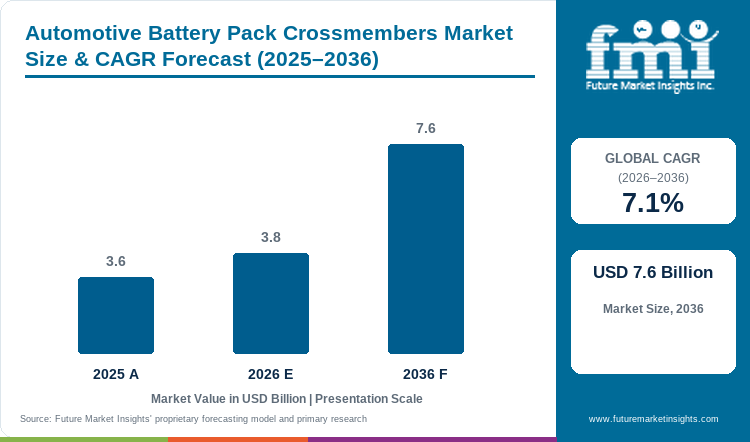
USD 3.8 Billion in 2026 and USD 7.6 Billion by 2036 at a 7.1% CAGR.
The Automotive Battery Pack Crossmembers Market was valued at USD 3.6 Billion in 2025. Sales of automotive battery pack crossmembers are estimated to grow at 7.1% from USD 3.8 Billion in 2026 to USD 7.6 Billion by 2036. Demand rises as battery packs become larger and take up more of the vehicle floor. This creates a greater need for transverse members that support the pack, reduce unsupported spans and help protect cells during a crash.
Crossmembers are also becoming more closely integrated with the battery enclosure. This connects demand with the wider Electric Vehicle Battery Housing Market and with structural requirements seen in the Vehicle Crossmember Assemblies Market. Suppliers gain more value when they can handle section design, forming, joining and dimensional control within the same vehicle program. Once the pack layout and crash targets are fixed, redesign becomes costly, so early supplier involvement matters.
Key Takeaways
- EV platform expansion increases crossmember content as battery packs become wider, heavier and more structurally integrated.
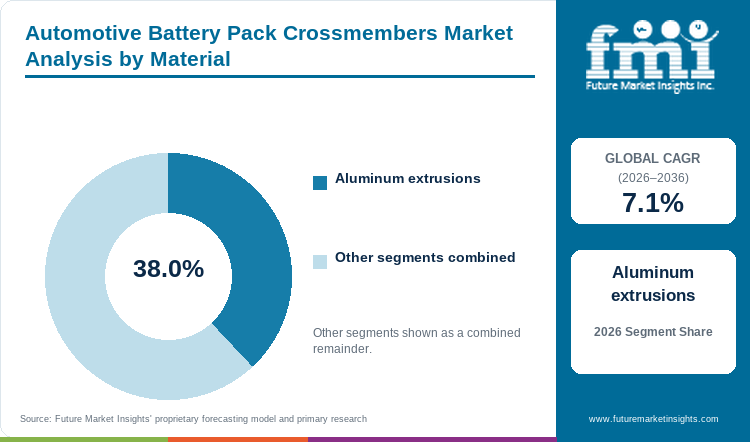
- Aluminum extrusions are expected to hold 38.0% of Material demand in 2026 because closed profiles can combine low mass with tunable stiffness.
- Skateboard EV packs account for 36.0% of Pack Type demand, while Battery electric cars represent 33.0% of Vehicle Type demand in 2026.
- Qualification remains a restraint because changes to section geometry or joining can alter crash response, sealing and dimensional stability.
- Canada records the fastest profiled CAGR at 8.0%, followed by Mexico at 7.5% and South Korea at 7.2%.
- Gestamp, Magna International, Novelis, Constellium, Benteler, Nemak, Martinrea International, Shape Corp., Sodecia, and Minth Group form the notable competitive set.
Analyst Perspective
“Battery pack crossmembers are moving closer to the center of vehicle architecture because the component now has to satisfy pack support, crash protection and floor-structure requirements at the same time. The strongest supplier position is created before tooling is committed. Companies that can translate a crash target into a manufacturable section, stable joining process and locally supported production program will capture more value than suppliers competing only on metal conversion.”
- Nikhil Kaitwade, Principal Consultant
How is the automotive battery pack crossmembers market segmented?
The automotive battery pack crossmembers market is segmented by Material, Pack Type, Vehicle Type, Function, Sales Channel, and Region.
By Material, the market includes Aluminum extrusions, Stamped steel, High-strength steel, Composite crossmembers, and Hybrid metal-composite structures. Pack Type includes Skateboard EV packs, Module-based packs, Structural battery packs, and Commercial EV packs. Vehicle Type covers Battery electric cars, Electric SUVs, Electric pickup trucks, Electric vans, and Electric buses/trucks. Function includes Crash load path, Battery tray reinforcement, Mounting support, and Torsional stiffness. Sales Channel includes Automaker captive supply, Body structure Tier-1s, Battery enclosure suppliers, and Aluminum extrusion suppliers.
Why do Aluminum extrusions lead demand within the Material category?
Aluminum extrusions give battery engineers more freedom to shape long structural members without adding unnecessary weight. Closed profiles, ribs and varying wall thickness can be built into the same section, which helps improve stiffness and manage crash loads across the width of the pack. This is one reason demand overlaps with the broader Aluminum Extrusion Market. In battery applications, however, the key issue is not just weight reduction. Suppliers also have to manage joining points, tight tolerances and crash performance. Steel remains attractive where cost and concentrated strength are more important, while composite and hybrid structures require different joining and repair methods.
- Aluminum extrusions are expected to account for 38.0% of Material demand in 2026.
- Closed and multi-void sections allow stiffness and energy absorption to be adjusted without making the complete member solid or excessively heavy.
Why do Skateboard EV packs lead demand within the Pack Type category?
Skateboard packs extend across much of the wheelbase, leaving a large floor area that needs support across the vehicle width. Crossmembers divide this wide enclosure into smaller structural sections, support cells or modules and help direct impact loads toward stronger areas of the pack. Growth in the Electric Vehicle Battery Market adds to this need as more battery platforms move into series production. Structural battery packs can absorb more body functions, while commercial EV packs often need more customized layouts.
- Skateboard EV packs are expected to account for 36.0% of Pack Type demand in 2026.
- Their repeatable underfloor layout allows suppliers to adapt crossmember length, internal ribs and mounting interfaces while retaining a common section concept.
Why do Battery electric cars lead demand within the Vehicle Type category?
Battery electric cars provide the broadest base for underfloor pack structures because passenger platforms are produced across a large number of models and usually use standardized battery layouts. Crossmembers support the pack during normal driving and help maintain space around the cells during impact. Expansion in the Battery Electric Vehicle Market also gives suppliers more opportunities to reuse proven section designs across related vehicle programs. Electric SUVs and pickups can use more crossmember material per vehicle, but their sections are often heavier and more platform-specific.
- Battery electric cars are expected to represent 33.0% of Vehicle Type demand in 2026.
- Light-duty vehicles accounted for more than 85% of global EV battery deployment in 2025, keeping passenger-vehicle architecture central to pack-structure demand.
Why does Crash load path lead demand within the Function category?
Crossmembers become especially important when they are part of the battery's crash structure. During a side impact or underbody strike, they can connect the side structures, spread forces across the pack and reduce local deformation before the cells are affected. Reinforcement and mounting functions are also important, but some of those loads can be handled through brackets or thicker panels. Crash performance is harder to change because the whole structure must work together at both component and vehicle level.
- Crash load path is expected to account for 34.0% of Function demand in 2026.
- Crossmembers assigned to battery protection gain engineering value because section collapse, attachment points and cell clearance must behave together during impact.
Why does Automaker captive supply lead demand within the Sales Channel category?
Automakers keep tighter control over crossmembers when the part is closely linked to the vehicle floor, battery clearances and crash performance. Body engineers define the rail positions and hard points, while battery teams set internal packaging and service requirements. Keeping these decisions within the automaker helps reduce conflicts when changes affect both the pack and the body. Tier-1 structure suppliers and enclosure specialists still play an important role, especially when complete assemblies are sourced outside the OEM.
- Automaker captive supply is expected to account for 37.0% of Sales Channel demand in 2026.
- Captive control is strongest where a crossmember change would force simultaneous revisions to the enclosure, vehicle floor and crash-validation program.
What are the drivers, restraints, and opportunities in the Automotive Battery Pack Crossmembers Market?
Rising EV battery deployment expands structural content, qualification limits late supplier substitution, and integrated lightweight pack structures create the clearest value opportunity.
- Driver: Higher electric vehicle output and larger underfloor packs increase the need for validated transverse structures.
- Restraint: Tooling, joining qualification and vehicle-level crash validation make late design changes expensive.
- Opportunity: Structural battery architectures and lower-carbon aluminum routes allow suppliers to combine weight reduction with higher-value engineering.
Global EV battery deployment reached 1.2 TWh in 2025. As battery packs become larger, the enclosure must carry more weight and manage higher impact loads. Larger passenger vehicles create wider spans, while vans and pickups add demands linked to cargo and towing. Crossmember demand therefore rises when extra battery capacity changes the structure needed around the cells, not simply because more cells are installed.
Qualification makes supplier switching difficult once a vehicle program moves beyond early engineering. A change in crossmember geometry can affect enclosure stiffness, weld distortion, sealing and cell clearance after impact. The automaker may then need more simulation and physical testing before approving the change. This gives an advantage to suppliers that can maintain stable dimensions and production quality from launch onward.
Structural integration gives suppliers another way to add value. Cell-to-pack and cell-to-body designs place more structural responsibility on the battery enclosure itself. Suppliers that can combine alloy selection, section design, forming and joining can take on a larger role in the program. High-recycled-content aluminum also creates an opening where automakers want to reduce embodied carbon without compromising crash performance or manufacturing consistency.
Which country CAGRs are profiled in the Automotive Battery Pack Crossmembers Market?
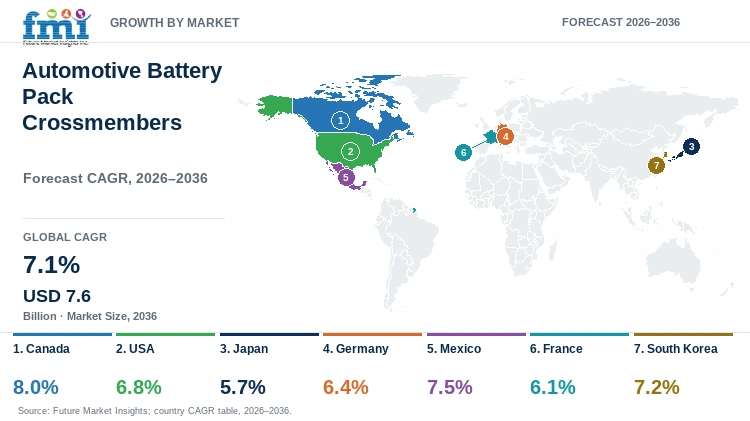
| Country | CAGR |
|---|---|
| Canada | 8.0% |
| USA | 6.8% |
| Japan | 5.7% |
| Germany | 6.4% |
| Mexico | 7.5% |
| France | 6.1% |
| South Korea | 7.2% |
How do country-level CAGRs compare in the Automotive Battery Pack Crossmembers Market?
The profiled country rates range from 8.0% in Canada to 5.7% in Japan, a spread of 2.3 percentage points. Canada, Mexico and South Korea form the faster-growth group above 7.0%. USA, Germany and France sit in the middle, while Japan grows at a slower pace. These differences matter because crossmember suppliers usually commit engineering and tooling well before vehicle production starts. A small gap in CAGR can therefore mean less than the timing and size of individual platform awards.
- Canada leads the profiled countries at 8.0%, reflecting faster expansion from a smaller installed EV production base.
- Mexico follows at 7.5%, supported by its role in North American vehicle manufacturing and export-oriented assembly.
- South Korea reaches 7.2%, where supplier entry depends on close alignment with domestic OEM engineering and production systems.
- USA, Germany, France and Japan range from 6.8% to 5.7%, with different vehicle mixes and battery-platform adoption patterns shaping crossmember demand.
Country-wise Analysis
- Canada: At 8.0% CAGR from 2026 to 2036, Canada is the fastest-growing country among the profiled markets, with incentive eligibility and regional production decisions strongly influencing the vehicle mix. The 2026 federal incentive structure provides support for eligible light-duty EV purchases while applying transaction-value and trade-related conditions. Crossmember suppliers benefit when vehicle programs are localized around Ontario assembly operations because large structural parts are costly to move over long distances.
- USA: Large electric SUV and pickup programs support a 6.8% CAGR for the USA from 2026 to 2036 and can raise structural crossmember content per awarded vehicle platform. The larger pack footprints used in these vehicles create demand for wider or thicker transverse members and stronger interfaces with the surrounding enclosure. Suppliers need to enter programs before crash geometry is frozen because redesign becomes significantly more expensive after tooling and validation begin.
- Japan: Japan's 5.7% CAGR from 2026 to 2036 reflects a slower transition toward full battery-electric platforms as hybrids retain a substantial role in new-car demand. This produces a slower turnover of dedicated battery-electric architectures than in several other developed markets. Suppliers are therefore pushed toward compact, tightly controlled components that can meet packaging targets without assuming the very large pack footprints used in some North American vehicles.
- Germany: A 6.4% CAGR from 2026 to 2036 places Germany in the middle of the profiled growth range, while mature body-structure engineering keeps vehicle mass and production stability central to sourcing decisions. Electric-car sales reached about 850,000 units in 2025, supporting continued platform conversion. Suppliers with European forming capacity and lower-carbon material routes are well placed for programs where freight distance, material traceability and manufacturing emissions influence sourcing decisions.
- Mexico: Mexico combines export-oriented vehicle assembly with increasing EV platform localization, supporting a 7.5% CAGR from 2026 to 2036. Electric-car sales also accelerated sharply during 2025. The commercial opportunity is tied less to domestic retail demand alone and more to whether battery-electric programs are localized at Mexican assembly plants. Crossmember suppliers need manufacturing footprints that can support North American nominations without creating long-distance logistics for bulky structural parts.
- France: Environmental scoring and preference for European battery production shape France's sourcing environment as the market advances at a 6.1% CAGR from 2026 to 2036. Consumer support continued into 2026, with additional emphasis on vehicles using batteries produced in Europe. This makes material origin and manufacturing footprint more commercially visible. Suppliers able to combine cost control with European production and lower-carbon aluminum or steel routes can strengthen their position in locally assembled EV programs.
- South Korea: Close integration between domestic OEM engineering and production supports South Korea's 7.2% CAGR from 2026 to 2036 and raises the importance of rapid design iteration during platform development. Electric-car sales grew strongly during 2025, while sourcing remains concentrated around major domestic vehicle groups. Suppliers need high-volume process capability and a local engineering interface rather than relying only on export supply from a distant plant.
Who are the notable companies in the Automotive Battery Pack Crossmembers Market?
Gestamp, Magna International, Novelis, Constellium, Benteler, Nemak, Martinrea International, Shape Corp., Sodecia, and Minth Group are the notable companies profiled in this market.
Competition is shaped by two main supplier strengths. One group integrates crossmembers into larger body and battery structures, while the other brings specialist expertise in materials and forming. Gestamp, Magna International, Benteler, Martinrea International, and Sodecia compete through body and structural assembly programs. Novelis and Constellium bring aluminum alloy and application engineering, while Shape Corp. adds roll-forming capability for closed structural sections. Nemak and Minth Group compete through large light-metal structures and battery-housing systems.
- Integrated body and enclosure program suppliers: Gestamp, Magna International, Benteler, Martinrea International, and Sodecia.
- Aluminum and roll-forming solution network: Novelis, Constellium, and Shape Corp.
- Battery-housing and cast-structure specialists: Nemak and Minth Group.
Competitive Benchmarking: Automotive Battery Pack Crossmembers Market
| Company | Pack-Structure Integration | Multi-Material Forming | Series EV Readiness | Geographic Reach |
|---|---|---|---|---|
| Gestamp | High | High | High | Europe, North America, Latin America, and Asia |
| Magna International | High | High | High | North America, Europe, and Asia |
| Novelis | Medium | High | High | North America, Europe, Asia, and South America |
| Constellium | Medium | High | Medium | Europe, North America, and Asia |
| Benteler | High | High | High | Europe, North America, and Asia |
| Nemak | High | High | High | North America, Europe, Asia, and Latin America |
| Martinrea International | Medium | High | High | North America, Europe, and Asia |
| Shape Corp. | Medium | High | Medium | North America, Europe, and Asia |
| Sodecia | Unscored | Medium | Medium | Europe, North America, South America, Africa, and Asia |
| Minth Group | High | Medium | High | Asia, Europe, and North America |
Pack-Structure Integration shows how widely a company works across battery enclosures or related structural systems. Multi-Material Forming reflects capability across aluminum, steel, casting, roll forming and joining. Series EV Readiness reflects experience with EV structure production. High indicates broad capability, while Medium indicates a more focused position.
Key Developments in the Automotive Battery Pack Crossmembers Market
- March 2025: Novelis, Shape Corp., and Metalsa announced a collaboration on aluminum roll-form-intensive EV battery tray concepts. The work combined alloy development, multi-cellular profiles and precision assembly, creating a route to lighter crossmember families with greater tooling reuse across platforms.
- September 2025: Constellium showcased advanced aluminum solutions from the CirConAl collaborative research project. Battery-enclosure prototypes used high-recycled-content aluminum while retaining automotive performance objectives, strengthening the commercial case for lower-carbon structural pack components.
- February 2026: Nemak completed the acquisition of GF Casting Solutions' automotive business after regulatory approvals. The transaction added production facilities and engineering capability across major automotive regions, broadening Nemak's position in large light-metal structures and battery-housing systems.
Key Players in the Automotive Battery Pack Crossmembers Market
Integrated Body and Enclosure Program Suppliers
- Gestamp
- Magna International
- Benteler
- Martinrea International
- Sodecia
Aluminum and Roll-Forming Solution Network
- Novelis
- Constellium
- Shape Corp.
Battery-Housing and Cast-Structure Specialists
- Nemak
- Minth Group
Automotive Battery Pack Crossmembers Market - Report Scope
| Coverage field | Report scope |
|---|---|
| Market breakdown | Material, Pack Type, Vehicle Type, Function, Sales Channel, and Region |
| Quantitative Units | USD Billion |
| Market Definition | Revenue from automotive battery pack crossmembers sold as dedicated transverse structural components or as attributable crossmember content within a battery tray or enclosure. Complete battery packs, cells, modules, thermal systems, full vehicle revenue, side rails, shields, and unrelated underbody structures are excluded. |
| Regions Covered | North America; Latin America; Western Europe; Eastern Europe; East Asia; South Asia and Pacific; Middle East and Africa |
| Countries Covered | Canada, USA, Japan, Germany, Mexico, France, South Korea, and more than twenty-five additional countries |
| Key Companies Profiled | Gestamp, Magna International, Novelis, Constellium, Benteler, Nemak, Martinrea International, Shape Corp., Sodecia, and Minth Group |
| Forecast Period | 2026 to 2036 |
| Approach | FMI applies a combined demand-side and supply-side framework covering vehicle programs, crossmember content, material economics, company participation, and country-level EV production conditions. |
Automotive Battery Pack Crossmembers Market - Research Methodology
| Method | Approach |
|---|---|
| Primary Research | FMI engages manufacturers, automaker engineering teams, battery-enclosure integrators, material suppliers, procurement specialists, and subject-matter experts. Discussions address buying criteria, qualification steps, pricing logic, program timing, material selection, and production constraints. |
| Desk Research | Analysis covers government vehicle statistics, safety regulations, policy documents, company filings, official product information, trade data, technical literature, and standards-related publications. |
| Market Sizing and Forecasting | Vehicle production and EV adoption are assessed alongside battery-pack architecture and crossmember content by vehicle type, material route, function, and sales channel. Forecast assumptions consider platform launches, regulation, material substitution, localized capacity, and program attrition. |
| Data Validation | Demand-side and supply-side indicators are compared to maintain consistency across market totals, segments, countries, and the defined component boundary. |
Automotive Battery Pack Crossmembers Market by Segments
Automotive Battery Pack Crossmembers Market segmented by Material:
- Aluminum extrusions
- Stamped steel
- High-strength steel
- Composite crossmembers
- Hybrid metal-composite
Automotive Battery Pack Crossmembers Market segmented by Pack Type:
- Skateboard EV packs
- Module-based packs
- Structural battery packs
- Commercial EV packs
Automotive Battery Pack Crossmembers Market segmented by Vehicle Type:
- Battery electric cars
- Electric SUVs
- Electric pickup trucks
- Electric vans
- Electric buses/trucks
Automotive Battery Pack Crossmembers Market segmented by Function:
- Crash load path
- Battery tray reinforcement
- Mounting support
- Torsional stiffness
Automotive Battery Pack Crossmembers Market segmented by Sales Channel:
- Automaker captive supply
- Body structure Tier-1s
- Battery enclosure suppliers
- Aluminum extrusion suppliers
Automotive Battery Pack Crossmembers Market by Region:
- North America
- United States
- Canada
- Latin America
- Brazil
- Mexico
- Argentina
- Chile
- Western Europe
- Germany
- France
- United Kingdom
- Italy
- Spain
- Benelux
- Nordics
- Eastern Europe
- Poland
- Czech Republic
- Romania
- Hungary
- East Asia
- China
- Japan
- South Korea
- South Asia and Pacific
- India
- ASEAN
- Australia and New Zealand
- Middle East and Africa
- GCC Countries
- South Africa
- Türkiye
- Israel
Research Sources and Bibliography
- International Energy Agency (2026, May 20). Trends in electric cars - Global EV Outlook 2026.
- International Energy Agency (2026, May 20). Electric vehicle batteries - Global EV Outlook 2026.
- U.S. Department of Transportation, National Highway Traffic Safety Administration (2024, December 20). Federal Motor Vehicle Safety Standards; FMVSS No. 305a, Electric-Powered Vehicles: Electric Powertrain Integrity Global Technical Regulation No. 20; Incorporation by Reference.
- Government of Canada (2026, July 22). Zero-emission vehicles - Incentives.
- International Energy Agency (2024, April 10). Fuel Economy Standards on Light-Duty Vehicles: Japan.
- Republic of Korea Policy Briefing (2024, December 21). 2025 electric vehicle subsidy guidelines will be implemented earlier than the prior schedule.
- The Federal Government of Germany (2025, October 15). Federal Cabinet extends tax exemption for e-cars.
- French Ministry for Ecological Transition (2025, November 26). The Government continues support for household purchases of 100% electric passenger cars.
- BMW Group (2024, May 3). Construction of high-voltage battery assembly gets underway at BMW Group Plant San Luis Potosi.
- Magna International (2023, February 13). Magna wins battery enclosures business on first-ever Chevrolet Silverado EV.
- Constellium (2024, January 4). Constellium to showcase cutting-edge solutions for aluminium automotive structures at CES 2024 in Las Vegas.
- Novelis (2025, March 12). Novelis, Shape Corp., and Metalsa partner to redefine EV battery enclosures.
- Magna International (2025, May 21). Test first, then enter the European market: Professional battery testing examines more than just the charging curve.
- Constellium (2025, September 3). Constellium to showcase advanced aluminum solutions from collaborative research project CirConAl at Cenex 2025.
- Nemak (2026, February 12). Nemak completes the acquisition of GF Casting Solutions' automotive business.
This bibliography is provided for reader reference and is not exhaustive. The full report contains the complete reference list and detailed citations.
This Report Answers
- What are the 2025, 2026 and 2036 values for the Automotive Battery Pack Crossmembers Market?
- Which EV production and battery-safety requirements support crossmember demand?
- Why do Aluminum extrusions lead the Material category?
- How do Skateboard EV packs influence transverse reinforcement requirements?
- Why do Battery electric cars lead the Vehicle Type category?
- How do growth rates differ across Canada, USA, Japan, Germany, Mexico, France, and South Korea?
- Which companies provide integrated structural, aluminum-forming, and battery-housing capabilities?
- How do tooling and vehicle-level qualification affect supplier switching?
Frequently Asked Questions
What is driving growth in the Automotive Battery Pack Crossmembers Market?
Growth follows rising battery-electric vehicle production and the larger structural load carried by underfloor battery packs. Crossmembers gain value as automakers need stronger crash paths, shorter tray spans and stable battery mounting without adding unnecessary vehicle mass.
Who are the key players in the Automotive Battery Pack Crossmembers Market?
Gestamp, Magna International, Novelis, Constellium, Benteler, Nemak, Martinrea International, Shape Corp., Sodecia, and Minth Group are among the notable companies active across body structures, battery enclosures, aluminum processing and related forming technologies.
What notable restraint affects the Automotive Battery Pack Crossmembers Market?
Vehicle-level qualification limits late supplier changes. A change in section geometry or joining can alter crash behavior, sealing and dimensional stability, forcing additional engineering and testing before production approval.
Why should executives track the Automotive Battery Pack Crossmembers Market?
The market is forecast to grow from USD 3.8 Billion in 2026 to USD 7.6 Billion by 2036. It shows how battery-electric architecture is shifting structural value toward the enclosure and the components that connect battery protection with the vehicle floor.
What business problem do automotive battery pack crossmembers solve?
Crossmembers support battery mass, reduce unsupported tray spans and provide transverse load paths across the pack. During a crash, they help control enclosure deformation and preserve clearance around cells or modules.
What limits return on investment for suppliers?
Dedicated tooling can become expensive when vehicle volumes fall below expectations or when platform redesign triggers repeated validation. Large-part freight, launch scrap, material-price movements and joining instability can also reduce margins after a program is awarded.
Preview the report firsthand - request a free sample
Get SampleGet the brochure for pricing and purchase details.
Get PDFTable of Content
- Key Takeaways
- Market Size and CAGR
- Top Growth Driver
- Fastest Growing Segment
- Leading Region
- Key Companies
- Emerging Opportunities
- Executive Summary
- Global Market Outlook
- Demand-side Trends
- Supply-side Trends
- Technology Roadmap Analysis
- Analysis and Recommendations
- Analyst Perspective (What is happening? Why now? What should investors know?)
- Key Questions Answered
- How large is the market?
- What is the CAGR?
- What are key trends?
- Which region dominates?
- Who are the leaders?
- Market Overview
- Market Coverage / Taxonomy
- Market Definition / Scope / Limitations
- Research Methodology
- Chapter Orientation
- Analytical Lens and Working Hypotheses
- Market Structure, Signals, and Trend Drivers
- Benchmarking and Cross-market Comparability
- Market Sizing, Forecasting, and Opportunity Mapping
- Research Design and Evidence Framework
- Desk Research Programme (Secondary Evidence)
- Expert Input and Fieldwork (Primary Evidence)
- Tooling, Models, and Reference Databases
- Data Engineering and Model Build
- Quality Assurance and Audit Trail
- Market Background
- Market Dynamics (Drivers, Restraints, Opportunity, Trends)
- Scenario Forecast (Optimistic, Likely, Conservative)
- Impact Analysis
- AI Impact
- Sustainability Impact
- Regulatory Impact
- Technology Impact
- Consumer / Buyer Analysis
- Purchase Drivers
- Adoption Barriers
- Buyer Journey
- Opportunity Map Analysis
- Product Life Cycle Analysis
- Supply Chain Analysis
- Investment Feasibility Matrix
- Value Chain Analysis
- PESTLE and Porter's Analysis
- Regulatory Landscape
- Regional Parent Market Outlook
- Production and Consumption Statistics
- Import and Export Statistics
- Global Market Analysis and Forecast, 2021 to 2036
- Historical Market Size Value (USD Billion) Analysis, 2021 to 2025
- Current and Future Market Size Value (USD Billion) Projections, 2026 to 2036
- Y-o-Y Growth Trend Analysis
- Absolute $ Opportunity Analysis
- Global Market Pricing Analysis, 2021 to 2036
- Global Market Analysis and Forecast, By Material, 2021 to 2036
- Introduction / Key Findings
- Historical Market Size Value (USD Billion) Analysis By Material, 2021 to 2025
- Current and Future Market Size Value (USD Billion) Analysis and Forecast By Material, 2026 to 2036
- Aluminum extrusions
- Stamped steel
- High-strength steel
- Composite crossmembers
- Hybrid metal-composite
- Y-o-Y Growth Trend Analysis By Material, 2021 to 2025
- Absolute $ Opportunity Analysis By Material, 2026 to 2036
- Global Market Analysis and Forecast, By Pack Type, 2021 to 2036
- Introduction / Key Findings
- Historical Market Size Value (USD Billion) Analysis By Pack Type, 2021 to 2025
- Current and Future Market Size Value (USD Billion) Analysis and Forecast By Pack Type, 2026 to 2036
- Skateboard EV packs
- Module-based packs
- Structural battery packs
- Commercial EV packs
- Y-o-Y Growth Trend Analysis By Pack Type, 2021 to 2025
- Absolute $ Opportunity Analysis By Pack Type, 2026 to 2036
- Global Market Analysis and Forecast, By Vehicle Type, 2021 to 2036
- Introduction / Key Findings
- Historical Market Size Value (USD Billion) Analysis By Vehicle Type, 2021 to 2025
- Current and Future Market Size Value (USD Billion) Analysis and Forecast By Vehicle Type, 2026 to 2036
- Battery electric cars
- Electric SUVs
- Electric pickup trucks
- Electric vans
- Electric buses/trucks
- Y-o-Y Growth Trend Analysis By Vehicle Type, 2021 to 2025
- Absolute $ Opportunity Analysis By Vehicle Type, 2026 to 2036
- Global Market Analysis and Forecast, By Function, 2021 to 2036
- Introduction / Key Findings
- Historical Market Size Value (USD Billion) Analysis By Function, 2021 to 2025
- Current and Future Market Size Value (USD Billion) Analysis and Forecast By Function, 2026 to 2036
- Crash load path
- Battery tray reinforcement
- Mounting support
- Torsional stiffness
- Y-o-Y Growth Trend Analysis By Function, 2021 to 2025
- Absolute $ Opportunity Analysis By Function, 2026 to 2036
- Global Market Analysis and Forecast, By Sales Channel, 2021 to 2036
- Introduction / Key Findings
- Historical Market Size Value (USD Billion) Analysis By Sales Channel, 2021 to 2025
- Current and Future Market Size Value (USD Billion) Analysis and Forecast By Sales Channel, 2026 to 2036
- Automaker captive supply
- Body structure Tier-1s
- Battery enclosure suppliers
- Aluminum extrusion suppliers
- Y-o-Y Growth Trend Analysis By Sales Channel, 2021 to 2025
- Absolute $ Opportunity Analysis By Sales Channel, 2026 to 2036
- Global Market Analysis and Forecast, By Region, 2021 to 2036
- Introduction
- Historical Market Size Value (USD Billion) Analysis By Region, 2021 to 2025
- Current Market Size Value (USD Billion) Analysis and Forecast By Region, 2026 to 2036
- North America
- Latin America
- Western Europe
- Eastern Europe
- East Asia
- South Asia and Pacific
- Middle East and Africa
- Market Attractiveness Analysis By Region
- North America Market Analysis and Forecast, By Country, 2021 to 2036
- Historical Market Size Value (USD Billion) Trend Analysis By Market Taxonomy, 2021 to 2025
- Market Size Value (USD Billion) Forecast By Market Taxonomy, 2026 to 2036
- By Country
- United States
- Canada
- By Material
- By Pack Type
- By Vehicle Type
- By Function
- By Sales Channel
- By Country
- Market Attractiveness Analysis
- By Country
- By Material
- By Pack Type
- By Vehicle Type
- By Function
- By Sales Channel
- Key Takeaways
- Latin America Market Analysis and Forecast, By Country
- Historical Market Size Value (USD Billion) Trend Analysis By Market Taxonomy, 2021 to 2025
- Market Size Value (USD Billion) Forecast By Market Taxonomy, 2026 to 2036
- By Country
- Brazil
- Mexico
- Argentina
- Chile
- By Material
- By Pack Type
- By Vehicle Type
- By Function
- By Sales Channel
- By Country
- Market Attractiveness Analysis
- By Country
- By Material
- By Pack Type
- By Vehicle Type
- By Function
- By Sales Channel
- Key Takeaways
- Western Europe Market Analysis and Forecast, By Country
- Historical Market Size Value (USD Billion) Trend Analysis By Market Taxonomy, 2021 to 2025
- Market Size Value (USD Billion) Forecast By Market Taxonomy, 2026 to 2036
- By Country
- Germany
- France
- United Kingdom
- Italy
- Spain
- Benelux
- Nordics
- By Material
- By Pack Type
- By Vehicle Type
- By Function
- By Sales Channel
- By Country
- Market Attractiveness Analysis
- By Country
- By Material
- By Pack Type
- By Vehicle Type
- By Function
- By Sales Channel
- Key Takeaways
- Eastern Europe Market Analysis and Forecast, By Country
- Historical Market Size Value (USD Billion) Trend Analysis By Market Taxonomy, 2021 to 2025
- Market Size Value (USD Billion) Forecast By Market Taxonomy, 2026 to 2036
- By Country
- Poland
- Czech Republic
- Romania
- Hungary
- By Material
- By Pack Type
- By Vehicle Type
- By Function
- By Sales Channel
- By Country
- Market Attractiveness Analysis
- By Country
- By Material
- By Pack Type
- By Vehicle Type
- By Function
- By Sales Channel
- Key Takeaways
- East Asia Market Analysis and Forecast, By Country
- Historical Market Size Value (USD Billion) Trend Analysis By Market Taxonomy, 2021 to 2025
- Market Size Value (USD Billion) Forecast By Market Taxonomy, 2026 to 2036
- By Country
- China
- Japan
- South Korea
- By Material
- By Pack Type
- By Vehicle Type
- By Function
- By Sales Channel
- By Country
- Market Attractiveness Analysis
- By Country
- By Material
- By Pack Type
- By Vehicle Type
- By Function
- By Sales Channel
- Key Takeaways
- South Asia and Pacific Market Analysis and Forecast, By Country
- Historical Market Size Value (USD Billion) Trend Analysis By Market Taxonomy, 2021 to 2025
- Market Size Value (USD Billion) Forecast By Market Taxonomy, 2026 to 2036
- By Country
- India
- ASEAN
- Australia and New Zealand
- By Material
- By Pack Type
- By Vehicle Type
- By Function
- By Sales Channel
- By Country
- Market Attractiveness Analysis
- By Country
- By Material
- By Pack Type
- By Vehicle Type
- By Function
- By Sales Channel
- Key Takeaways
- Middle East and Africa Market Analysis and Forecast, By Country
- Historical Market Size Value (USD Billion) Trend Analysis By Market Taxonomy, 2021 to 2025
- Market Size Value (USD Billion) Forecast By Market Taxonomy, 2026 to 2036
- By Country
- GCC Countries
- South Africa
- Türkiye
- Israel
- By Material
- By Pack Type
- By Vehicle Type
- By Function
- By Sales Channel
- By Country
- Market Attractiveness Analysis
- By Country
- By Material
- By Pack Type
- By Vehicle Type
- By Function
- By Sales Channel
- Key Takeaways
- Key Countries Market Analysis
- United States
- Pricing Analysis
- Market Share Analysis, 2025
- By Material
- By Pack Type
- By Vehicle Type
- By Function
- By Sales Channel
- Canada
- Pricing Analysis
- Market Share Analysis, 2025
- By Material
- By Pack Type
- By Vehicle Type
- By Function
- By Sales Channel
- Mexico
- Pricing Analysis
- Market Share Analysis, 2025
- By Material
- By Pack Type
- By Vehicle Type
- By Function
- By Sales Channel
- Brazil
- Pricing Analysis
- Market Share Analysis, 2025
- By Material
- By Pack Type
- By Vehicle Type
- By Function
- By Sales Channel
- Chile
- Pricing Analysis
- Market Share Analysis, 2025
- By Material
- By Pack Type
- By Vehicle Type
- By Function
- By Sales Channel
- Germany
- Pricing Analysis
- Market Share Analysis, 2025
- By Material
- By Pack Type
- By Vehicle Type
- By Function
- By Sales Channel
- United Kingdom
- Pricing Analysis
- Market Share Analysis, 2025
- By Material
- By Pack Type
- By Vehicle Type
- By Function
- By Sales Channel
- Italy
- Pricing Analysis
- Market Share Analysis, 2025
- By Material
- By Pack Type
- By Vehicle Type
- By Function
- By Sales Channel
- Spain
- Pricing Analysis
- Market Share Analysis, 2025
- By Material
- By Pack Type
- By Vehicle Type
- By Function
- By Sales Channel
- France
- Pricing Analysis
- Market Share Analysis, 2025
- By Material
- By Pack Type
- By Vehicle Type
- By Function
- By Sales Channel
- India
- Pricing Analysis
- Market Share Analysis, 2025
- By Material
- By Pack Type
- By Vehicle Type
- By Function
- By Sales Channel
- ASEAN
- Pricing Analysis
- Market Share Analysis, 2025
- By Material
- By Pack Type
- By Vehicle Type
- By Function
- By Sales Channel
- Australia and New Zealand
- Pricing Analysis
- Market Share Analysis, 2025
- By Material
- By Pack Type
- By Vehicle Type
- By Function
- By Sales Channel
- China
- Pricing Analysis
- Market Share Analysis, 2025
- By Material
- By Pack Type
- By Vehicle Type
- By Function
- By Sales Channel
- Japan
- Pricing Analysis
- Market Share Analysis, 2025
- By Material
- By Pack Type
- By Vehicle Type
- By Function
- By Sales Channel
- South Korea
- Pricing Analysis
- Market Share Analysis, 2025
- By Material
- By Pack Type
- By Vehicle Type
- By Function
- By Sales Channel
- Poland
- Pricing Analysis
- Market Share Analysis, 2025
- By Material
- By Pack Type
- By Vehicle Type
- By Function
- By Sales Channel
- Hungary
- Pricing Analysis
- Market Share Analysis, 2025
- By Material
- By Pack Type
- By Vehicle Type
- By Function
- By Sales Channel
- Türkiye
- Pricing Analysis
- Market Share Analysis, 2025
- By Material
- By Pack Type
- By Vehicle Type
- By Function
- By Sales Channel
- South Africa
- Pricing Analysis
- Market Share Analysis, 2025
- By Material
- By Pack Type
- By Vehicle Type
- By Function
- By Sales Channel
- United States
- Market Structure Analysis
- Competition Dashboard
- Competition Benchmarking
- Market Share Analysis of Top Players
- By Regional
- By Material
- By Pack Type
- By Vehicle Type
- By Function
- By Sales Channel
- Emerging Startups
- Innovation Benchmarking
- Competition Analysis
- Competition Deep Dive
- Gestamp
- Overview
- Product Portfolio
- Profitability by Market Segments
- Sales Footprint
- Strategy Overview
- Marketing Strategy
- Product Strategy
- Channel Strategy
- Magna International
- Novelis
- Constellium
- Benteler
- Nemak
- Martinrea International
- Shape Corp.
- Sodecia
- Minth Group
- Gestamp
- Case Studies
- Success Stories
- Recent Developments
- Competition Deep Dive
- Assumptions & Acronyms Used


