

- Market Size (2026)
- USD 1.7 Bn
- Forecast (2036)
- USD 2.8 Bn
- CAGR (2026 to 2036)
- 5.3%
How big is Automotive Rack Support Bushings Market in 2026?
USD 1.7 Billion in 2026 and USD 2.8 Billion by 2036 at a 5.3% CAGR.
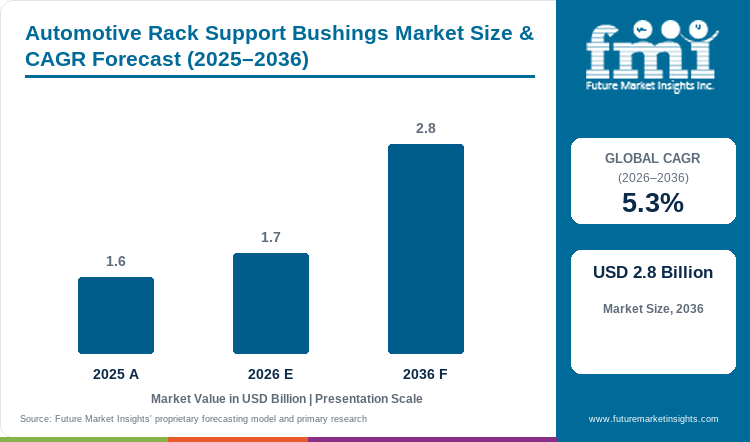
The Automotive Rack Support Bushings market stood at USD 1.6 Billion in 2025, is estimated at USD 1.7 Billion in 2026, and is forecast to reach USD 2.8 Billion by 2036 at a 5.3% CAGR from 2026 to 2036.
The market is forecast to expand from USD 1.7 Billion in 2026 to USD 2.8 Billion in 2036. Spending rises when steering teams move from generic mounting elastomers to application-specific rack supports that balance compliance, steering precision, and durability. Rack-support designs sit alongside automotive suspension systems in the vehicle-level noise and durability assessment.
In February 2023, Vibracoustic reported that current-generation battery electric vehicles can be 18% to 24% heavier than comparable internal-combustion vehicles. It also noted that quieter powertrains expose road and chassis noise that combustion engines previously masked.
Those conditions increase static preload and dynamic load at the chassis interface. They also narrow the acceptable stiffness window for a rack support bushing.
Electric power steering and steer-by-wire programs add another requirement because software-defined steering feel still depends on controlled mechanical support at the rack. OEM chassis teams therefore buy validated compounds and geometries rather than undifferentiated rubber parts.
Purchase decisions increasingly favor suppliers that can prove noise isolation, rack positioning, and durability together.
Country demand reflects the way vehicle programs are sourced and serviced. Czech plants serve export platforms at high volume. AutoSAP reported in January 2026 that 92.5% of the 1,445,776 passenger vehicles produced in 2025 went to foreign markets. Mexico has a similar export orientation.
INEGI recorded 309,453 light vehicles produced and 289,598 exported in July 2025. Germany places more emphasis on electrified-platform validation because the VDA reported 1.67 million electric passenger cars produced in 2025. The USA adds a deeper replacement channel.
S&P Global Mobility reported in May 2025 that the average light-vehicle age reached 12.8 years. These differences alter lot size, qualification timing, and service expectations. Interest converts into purchase only when the supplier proves correct fitment and stable stiffness.
Durable bonding and local program delivery must follow.
Key Takeaways
- The market is estimated at USD 1.7 Billion in 2026 and is forecast to reach USD 2.8 Billion by 2036 at a 5.3% CAGR.
- Rubber rack bushings lead the Bushing Type category in 2026. Electric power steering leads the Steering System category in 2026.
- Passenger cars lead the Vehicle Type category in 2026. OEM direct leads the Sales Channel category in 2026. Noise isolation leads the Function category in 2026.
- Driver: Electrified rack architectures and quieter cabins raise the value of tuned isolation with stable rack location.
- Restraint: Platform-specific validation and fitment complexity delay supplier changes even when a lower-cost part is available.
- Opportunity: Modular precision-molded designs can serve EV loads, replacement channels and emerging steer-by-wire interfaces. the Czech Republic has the highest profiled country CAGR at 6.0%, compared with Japan at 3.9%.
Analyst Perspective
Credible revenue capture depends on proving the complete mounting function rather than selling a low-cost elastomer alone. Suppliers must connect compound behavior to rack location, steering response, and cabin NVH.
- Nikhil Kaitwade, Principal Consultant, Future Market Insights
How is the Automotive Rack Support Bushings Market segmented?
The market is analyzed by Bushing Type, Steering System, Vehicle Type, Sales Channel, and Function.
Bushing Type separates material and construction choices. These choices alter stiffness and damping while shaping serviceability plus manufacturing cost. Steering System identifies the rack architecture that sets load paths and interface requirements.
Vehicle Type distinguishes the packaging envelope plus the expected balance between comfort and steering response. Sales Channel shows whether the bushing is specified inside a new vehicle program or selected later for repair and performance use.
Function identifies the principal engineering job assigned to the component. Together these axes explain why two bushings with similar dimensions can have very different commercial value. The decisive variables are compound behavior and geometry.
Rack retention, fitment control and validation ownership complete the buying case.
What makes Rubber rack bushings central to the Bushing Type category?
Rubber remains the default material when buyers need a controlled compromise between compliance and steering precision. The elastomer can be tuned through hardness and geometry. Void design plus bonding method can change behavior without major revisions to the rack housing or subframe.
That flexibility supports high-volume molding and repeatable assembly. It also helps OEM teams isolate road input while limiting rack movement under cornering and parking loads. Polyurethane can sharpen response but often transmits more vibration.
Hydraulic or split designs solve narrower use cases and carry added complexity. Rubber therefore retains the broadest specification window across mainstream vehicles and multiple steering architectures.
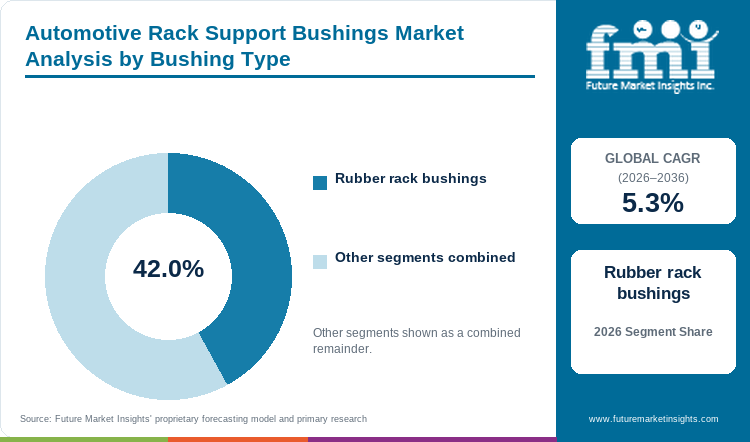
- Rubber rack bushings account for 42.0% of the Bushing Type category in 2026 because they combine tunable compliance, durable bonding, and scalable cost.
- Vibracoustic reported in February 2023 that optimized bushing designs and material compounds can address higher battery-electric vehicle preloads while preserving NVH performance.
Why does Electric power steering lead the Steering System category?
Electric power steering puts greater emphasis on controlled rack support because steering assist and road feel are managed through sensors and motors. Software operates against a defined mechanical interface. A bushing that allows excess rack motion can degrade response or create noise.
A bushing that is too stiff can transmit road texture into the cabin. EPS also spans compact cars through heavier SUVs and light commercial vehicles. This broadens the addressable load range. The architecture supports driver-assistance functions and continues to displace hydraulic assist in new programs.
This makes EPS-compatible rack support designs the largest recurring validation pool for suppliers.
- Electric power steering holds a 41.0% share of the Steering System category in 2026 because it combines efficient assist, software control, and broad vehicle coverage.
- Bosch documents belt-drive and second-pinion EPS alongside single-pinion and column variants. This breadth increases the need for application-specific support tuning.
How do Passenger cars sustain leadership in the Vehicle Type category?
Passenger cars combine the largest platform count with strict cabin-comfort expectations. Their lower mass and compact packaging make small changes in rack support stiffness easier for drivers to perceive through steering feel or audible knock.
OEMs also spread a common steering architecture across several models, which can extend a validated bushing design over meaningful production volume. SUVs and crossovers are growing but often require heavier-duty support or different subframe geometry.
Light commercial and performance vehicles use more specialized stiffness targets. Passenger cars therefore create the broadest recurring demand for balanced noise isolation, rack positioning, and cost discipline.
- Passenger cars represent 42.0% of the Vehicle Type category in 2026 because their platform scale and comfort targets favor high-volume tuned support bushings.
- AutoSAP reported in January 2026 that the Czech Republic produced 1,445,776 passenger vehicles in 2025. This illustrates the platform volume available to qualified component suppliers.
What supports OEM direct leadership in the Sales Channel category?
Rack support bushings are selected early because they affect steering-system packaging and fastener load. They also influence subframe interaction and warranty exposure. OEM chassis engineers define the steering-feel target. Steering Tier-1s translate that target into rack architecture and mounting loads.
Procurement teams then require material traceability plus production approval before launch. Changing the bushing later can trigger renewed vehicle-level NVH and durability work. This qualification burden favors direct program sourcing over spot purchasing.
Aftermarket demand remains important but usually follows the original fitment. Performance channels address sharper response and smaller volumes rather than the broad platform base.
- OEM direct accounts for 48.0% of the Sales Channel category in 2026 because the bushing is validated as part of a vehicle and steering program before series production.
- Nexteer reported in April 2026 that its first series-production steer-by-wire program achieved system-level functional safety certification with the vehicle manufacturer before launch.
What drives Noise isolation leadership in the Function category?
Noise isolation is the most visible function because rack mounts sit on a path between road input and the passenger compartment. The bushing must attenuate high-frequency excitation without allowing steering gear displacement that weakens response.
Electrified vehicles raise the stakes because the combustion-engine masking effect is reduced. Drivers can then hear road texture, actuator tones, or minor rack movement that previously went unnoticed.
Steering feel support and rack positioning remain essential but are often evaluated through the same tuned compliance window. Buyers therefore place noise isolation first while requiring the component to preserve geometry under load.
- Noise isolation represents 34.0% of the Function category in 2026 because cabin quietness makes steering-borne noise a direct quality signal.
- Continental explained in August 2021 that electric vehicles lack much of the sound-masking effect of combustion engines. It identified chassis mounting as an important isolation point.
What are the drivers, restraints, and opportunities in the Automotive Rack Support Bushings Market?
Demand rises as electrified steering tightens rack-support requirements, while lengthy validation limits switching and precision-molded fitment programs create new revenue paths.
- Driver: Electrified rack architectures and quieter cabins raise the value of tuned isolation with stable rack location.
- Restraint: Platform-specific validation and fitment complexity delay supplier changes even when a lower-cost part is available.
- Opportunity: Modular precision-molded designs can serve EV loads, replacement channels, and emerging steer-by-wire interfaces.
The principal driver is the combined shift toward EPS-intensive vehicles and stricter NVH targets. The VDA reported in February 2026 that Germany produced 1.67 million electric passenger cars in 2025. Four out of ten passenger cars made in the country were electrically powered.
Vibracoustic has linked battery-electric vehicle mass and reduced acoustic masking to higher preload plus tougher bushing demands. This mechanism moves spending toward application engineering rather than basic molding.
OEM and Tier-1 teams need a rack support that holds geometry during high assist loads while filtering road excitation. Suppliers that can connect material behavior to system targets gain access to longer vehicle-program revenue.
The binding restraint appears during qualification and fitment approval. Rack support stiffness affects steering feel and noise at the same time. It also changes fastener loading and rack displacement. A compound or geometry change can therefore require bench testing and vehicle-level confirmation.
ZF Aftermarket stated in October 2022 that replacing electric steering systems requires electronics expertise because the system is integrated with vehicle functions. Upstream sourcing carries a similar integration burden even when the bushing itself is passive.
The result is slow supplier switching and long payback on new tooling. Aftermarket buyers face another barrier when catalog data cannot resolve model-year or subframe differences.
The strongest opportunity is a modular bushing platform with controlled material options and verified fitment data. Continental announced in October 2025 that it had added more than 1,000 chassis and steering replacement items during the year. It also planned 27 new hydraulic bushings at the beginning of 2026.
That expansion shows how catalog depth can turn component engineering into channel access. Rack support suppliers can follow the same logic through common sleeves, adaptable elastomer geometries, and precise model mapping.
Companies with local tooling plus NVH simulation are best placed to act because they can shorten validation while serving OEM and replacement demand from related manufacturing assets.
Which country CAGRs are profiled in the Automotive Rack Support Bushings Market?
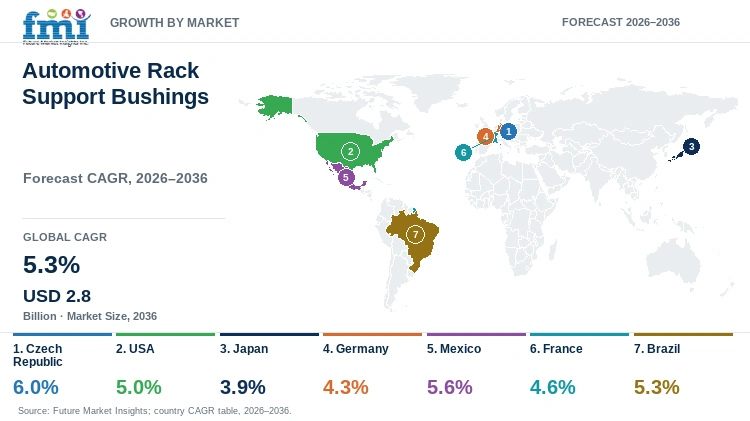
| Country | CAGR |
|---|---|
| Czech Republic | 6.0% |
| USA | 5.0% |
| Japan | 3.9% |
| Germany | 4.3% |
| Mexico | 5.6% |
| France | 4.6% |
| Brazil | 5.3% |
How do country-level CAGRs compare in the Automotive Rack Support Bushings Market?
The seven profiled countries span a 2.1 percentage-point range from the Czech Republic at 6.0% to Japan at 3.9% from 2026 to 2036. The Czech Republic and Mexico form the upper band because export-oriented assembly programs can pull qualified components into multiple destination markets.
Brazil and the USA form a middle band through different mechanisms. Brazil is shaped by localized vehicle investment while the USA combines new-platform content with replacement demand. France and Germany sit in a mature European band. Japan has the lowest rate but retains demanding quality thresholds.
These growth rates describe pace. They do not measure current country revenue.
- The Czech Republic leads Mexico by 0.4 percentage points. The gap favors early capacity alignment in Czech export programs while Mexico still requires close North American logistics planning.
- Mexico leads Brazil by 0.3 percentage points. Mexico rewards export-program responsiveness while Brazil places more weight on local production economics and regulatory alignment.
- Brazil leads the USA by 0.3 percentage points. Brazil offers faster localized program growth while the USA provides a broader mix of OEM and replacement-channel opportunities.
- France, Germany, and Japan range from 4.6% to 3.9%. Suppliers in this band should prioritize qualification depth and margin discipline over aggressive capacity assumptions.
CAGR alone cannot determine commercial priority. A slower-growing country may have a larger installed base or better aftermarket access. It may also require more engineering effort per program. Supplier decisions should therefore combine growth rate with vehicle output and steering architecture.
Model allocation, localization rules, channel structure and approval cost determine the commercial case. The full report evaluates these variables across the wider regional coverage.
In the Czech Republic, AutoSAP also reported 285,176 electrified passenger vehicles in 2025 and an export ratio above 92.5%.
Country-wise Analysis
- Steering-system suppliers in the Czech Republic sell largely into export-oriented OEM programs and must align with European platform timing. Demand for automotive rack support bushings in the Czech Republic is forecast to expand at a 6.0% CAGR from 2026 to 2036. AutoSAP reported in January 2026 that domestic plants produced 1,445,776 passenger vehicles in 2025. The main friction is exposure to external model allocation plus strict European qualification. Suppliers need local application engineering and rapid tooling response. Documented compound performance helps secure repeat nominations.
- Buyers in the USA split between OEM platform sourcing and a large independent replacement channel. Demand for automotive rack support bushings in the USA is forecast to rise at a 5.0% CAGR from 2026 to 2036. S&P Global Mobility reported in May 2025 that the average light-vehicle age reached 12.8 years and the vehicle fleet reached 289 million. Older vehicles widen the replacement pool but create fitment complexity across model years. Labor time and uncertain diagnosis can also limit repair conversion. Suppliers need accurate catalog data, dependable distribution, installation guidance and durable designs suited to long service lives.
- Japanese OEM and steering Tier-1 programs place strong emphasis on precise feel, documentation and long validation cycles. Demand for automotive rack support bushings in Japan is forecast to expand at a 3.9% CAGR from 2026 to 2036. JTEKT announced in May 2026 that its Syncusteer steer-by-wire system had been adopted in the Lexus RZ and Toyota e-Palette. The development shows that next-generation steering architecture is entering named vehicle programs. The friction is a mature supplier base with demanding approval standards and limited tolerance for fitment variation. Suppliers must bring local engineering support, stable rubber-metal bonding and traceable production control.
- German buyers evaluate rack support bushings within highly engineered steering and chassis programs. Demand for automotive rack support bushings in Germany is forecast to grow at a 4.3% CAGR from 2026 to 2036. The VDA reported in February 2026 that Germany produced 1.67 million electric passenger cars in 2025. Electric models represented 40% of domestic passenger-car output. The opportunity is technically attractive but the market remains below pre-crisis registration levels and approval costs are high. Suppliers need simulation-led tuning, local test support, and compounds that retain stiffness under higher electric-vehicle preload without transmitting unwanted noise.
- Vehicle plants in Mexico buy components against export schedules and North American content requirements. Demand for automotive rack support bushings in Mexico is forecast to expand at a 5.6% CAGR from 2026 to 2036. INEGI reported in August 2025 that 309,453 light vehicles were produced and 289,598 were exported during July. The ratio illustrates the dependence of local programs on external demand. Trade-policy uncertainty and model reallocation can change volume quickly. Suppliers should localize molding where feasible and document material origin. Short replenishment routes and coordinated engineering changes connect Mexican plants to regional steering-system customers.
- French procurement follows vehicle-platform allocation and increasingly weighs electrified-model content. Demand for automotive rack support bushings in France is forecast to rise at a 4.6% CAGR from 2026 to 2036. PFA data published by OICA in March 2026 placed French vehicle production at 1.46 million units in 2025. It also stated that electric vehicles represented one in five vehicles produced. Weak domestic registrations and shifting model allocation create a volume-planning challenge. Suppliers need flexible tooling, cost control, and validation packages that can move across passenger-car and light-commercial programs without compromising noise isolation or rack location.
- Brazilian OEM programs reward suppliers that combine local production with durability for varied road conditions. Demand for automotive rack support bushings in Brazil is forecast to expand at a 5.3% CAGR from 2026 to 2036. Brazil enacted Law No. 14,902 in June 2024 to establish the MOVER program. The framework links vehicle requirements and incentives to energy efficiency and structural performance. Driver-assistance technology and automotive research are also in scope. Imported component cost and local qualification remain barriers. Suppliers should develop regional compounds and validate dust and temperature resistance. Traceable rack support bushings can then serve locally engineered steering and chassis systems.
Who are the notable companies in the Automotive Rack Support Bushings Market?
Nexteer Automotive and JTEKT are profiled. Bosch and ZF Friedrichshafen are also covered. Mando and NSK Steering are also covered. Trelleborg and Vibracoustic are also covered. Continental and Yamashita Rubber complete the notable-company set.
Competition is shaped by where each company enters the steering value chain. Nexteer Automotive and JTEKT influence the rack-support interface through complete steering-system architecture. Bosch and ZF Friedrichshafen bring similar access to OEM program validation.
Mando and NSK Steering bring focused rack plus EPS engineering that can define mounting loads and packaging. Trelleborg and Vibracoustic compete through polymer formulation plus rubber-metal bonding. Yamashita Rubber adds vibration-control design.
Continental adds material expertise with a growing chassis and steering aftermarket route. No single capability is sufficient. Steering integrators need reliable elastomer partners. Component specialists need access to vehicle-level targets. Aftermarket participants need accurate fitment data and workshop support.
The most defensible position joins technical validation with a repeatable route to market.
- Integrated steering-system architects: Nexteer Automotive, JTEKT, Bosch and ZF Friedrichshafen shape rack architecture plus OEM validation requirements.
- Steering and chassis specialists: Mando and NSK Steering compete through focused EPS, rack, and program-engineering capability.
- Elastomer, NVH and replacement specialists: Trelleborg and Vibracoustic compete alongside Continental and Yamashita Rubber. Material tuning and channel reach distinguish their roles.
Competitive Benchmarking: Automotive Rack Support Bushings Market
| Company | Steering-System Integration | Rubber-Metal NVH Engineering | Replacement-Fitment Support | Geographic Reach |
|---|---|---|---|---|
| Nexteer Automotive | High | Medium | Low | North America, Europe, and Asia-Pacific |
| JTEKT | High | Medium | Low | Japan and Americas are covered. Coverage extends to Europe and Asia. |
| Bosch | High | Medium | Medium | Global automotive markets |
| ZF Friedrichshafen | High | Medium | High | Europe, Americas, and Asia-Pacific |
| Mando | High | Medium | Low | South Korea and Americas are covered. Coverage extends to Europe and China and India. |
| NSK Steering | High | Medium | Medium | Japan and Europe are covered. Coverage extends to Americas and Asia. |
| Trelleborg | Low | High | Medium | Europe, Americas, and Asia |
| Vibracoustic | Low | High | Medium | Europe, Americas, and Asia |
| Continental | Medium | High | High | Global automotive and aftermarket markets |
| Yamashita Rubber | Low | High | Low | Japan and North America are covered. Coverage extends to Mexico and Asia. |
Scoring basis: Steering-System Integration measures documented EPS, rack or steer-by-wire platform depth. Rubber-Metal NVH Engineering measures dedicated material development plus application-level damping capability. Replacement-Fitment Support measures catalog coverage, installation resources and channel access.
High indicates broad documented capability. Medium indicates credible but narrower coverage. Low indicates a documented specialization outside full-system integration rather than weak product quality. Unavailable public information is left low.
Key Developments in the Automotive Rack Support Bushings Market
- In April 2026, Nexteer Automotive started series production of its first steer-by-wire program on a passenger vehicle for a Chinese new-energy vehicle manufacturer. The system had received ASIL D functional safety certification in late 2025. The program moves linkless steering from validation into production and creates new rack-actuator load plus NVH envelopes for supporting components.
- In May 2026, JTEKT named its steer-by-wire system Syncusteer and filed a trademark application. JTEKT stated that the system had been adopted in the Lexus RZ and Toyota e-Palette. The action gives the architecture a commercial identity and signals continued customer proposals that can reshape mounting interfaces across future steering programs.
- In September 2025, NSK Ltd. completed the share acquisition that converted NSK Steering & Control into a consolidated subsidiary. The transaction brought the steering operation under full consolidated control. Closer ownership alignment can shorten capital and sourcing decisions for EPS platforms while giving component suppliers a clearer route into coordinated steering programs.
Key Players in the Automotive Rack Support Bushings Market
Global Steering-System Integrators
- Nexteer Automotive
- JTEKT
- Bosch
- ZF Friedrichshafen
Steering and Chassis Specialists
- Mando
- NSK Steering
Elastomer, NVH, and Replacement Specialists
- Trelleborg
- Vibracoustic
- Continental
- Yamashita Rubber
Automotive Rack Support Bushings Market - Report Scope
| Coverage field | Report scope |
|---|---|
| Market breakdown | Bushing Type; Steering System; Vehicle Type; Sales Channel; Function; Region |
| Quantitative Units | USD Billion |
| Market Definition | Revenue includes automotive rack support bushings sold as standalone components or as the attributable bushing value within a rack mounting assembly. Complete steering racks, EPS motors, control units, columns, tie rods, boots, labor, full vehicles, and adjacent chassis bushings are excluded. |
| Regions Covered | North America; Latin America; Western Europe; Eastern Europe; East Asia; South Asia and Pacific; Middle East and Africa |
| Countries Covered | Czech Republic, USA, Japan, Germany, Mexico, France, Brazil, and more than twenty-five additional countries in the full report |
| Key Companies Profiled | Nexteer Automotive, JTEKT, Bosch, ZF Friedrichshafen, Mando, NSK Steering, Trelleborg, Vibracoustic, Continental, Yamashita Rubber |
| Forecast Period | 2026 to 2036 |
| Approach | FMI applies a hybrid bottom-up and top-down sizing approach using attributable component value, vehicle and steering-system volumes, channel conditions, and validated forecast assumptions. |
Automotive Rack Support Bushings Market - Research Methodology
| Method | Approach |
|---|---|
| Primary Research | FMI consults bushing makers and steering-system suppliers. Repair professionals and OEM engineers explain fitment and qualification. The research tests purchase criteria and adoption barriers. |
| Desk Research | FMI reviews vehicle-production statistics and regulations. Company filings and technical publications support the market boundary. Sources are retained when they support the defined market boundary. |
| Market Sizing and Forecasting | FMI reconciles bushing value with steering-system mix and vehicle demand. Forecasts reflect replacement cycles and country conditions. Country conditions and channel structure are checked against the revenue boundary. |
| Data Validation | Findings are checked against independent evidence. The estimate excludes complete steering systems and installation labor. Duplicate assembly value and adjacent components are removed. |
Automotive Rack Support Bushings Market by Segments
Automotive Rack Support Bushings Market segmented by Bushing Type:
- Rubber rack bushings
- Polyurethane rack bushings
- Hydraulic rack bushings
- Split rack bushings
- Precision molded bushings
Automotive Rack Support Bushings Market segmented by Steering System:
- Electric power steering
- Hydraulic power steering
- Rack-and-pinion steering
- Steer-by-wire support
Automotive Rack Support Bushings Market segmented by Vehicle Type:
- Passenger cars
- SUVs/crossovers
- Light commercial vehicles
- Performance vehicles
Automotive Rack Support Bushings Market segmented by Sales Channel:
- OEM direct
- Steering Tier-1s
- Aftermarket replacement
- Performance aftermarket
Automotive Rack Support Bushings Market segmented by Function:
- Noise isolation
- Steering feel support
- Rack positioning
- Vibration damping
- North America
- United States
- Canada
- Latin America
- Brazil
- Mexico
- Argentina
- Chile
- Western Europe
- Germany
- France
- United Kingdom
- Italy
- Spain
- Benelux
- Nordics
- Eastern Europe
- Poland
- Czech Republic
- Romania
- Hungary
- East Asia
- China
- Japan
- South Korea
- South Asia and Pacific
- India
- ASEAN
- Australia and New Zealand
- Middle East and Africa
- GCC Countries
- South Africa
- Türkiye
- Israel
Research Sources and Bibliography
- AutoSAP (2026, January 27). 2025: Second strongest year in passenger car production, record year for bus production.
- S&P Global Mobility (2025, May 21). U.S. Vehicle Age Rises Again to 12.8 Years in 2025.
- German Association of the Automotive Industry (2026, February 3). New record: 40% electric share of passenger car production in 2025.
- INEGI (2025, August 7). Administrative Record of the Light Vehicle Automotive Industry, July 2025.
- PFA and OICA (2026, March 2). France Automotive Market and Analysis Letter.
- Presidency of the Federative Republic of Brazil (2024, June 27). Law No. 14,902 establishing the MOVER Program.
- Vibracoustic (2023, February 8). Vibracoustic optimizes chassis bushings for battery electric vehicles.
- Nexteer Automotive (2026, April 28). Nexteer Puts Steer-by-Wire into Series Production.
- JTEKT Corporation (2026, May 7). Named steer-by-wire system Syncusteer and propose it to customers.
- NSK Ltd. (2025, September 1). Notice Concerning Completion of Share Acquisition.
- Continental (2025, October 28). A thousand new parts: Continental continues to expand its spare parts portfolio for chassis and steering.
- Bosch Mobility (accessed 2026, September 1). Electric Power Steering Systems.
- ZF Friedrichshafen (2025, February 17). Start of series production for Steer-by-Wire steering at Chinese car manufacturer NIO.
- HL Mando and Yamashita Rubber (accessed 2026, September 1). Official rack-and-pinion, EPS, steer-by-wire, and automotive anti-vibration product profiles. | |
- Trelleborg (accessed 2026, September 1). Anti-vibration products and bonded rubber bushings. |
This bibliography is provided for reader reference and is not exhaustive. The full report contains the complete reference list and detailed citations.
This Report Answers
- What is the Automotive Rack Support Bushings Market size in 2026 and 2036?
- Which steering-architecture and NVH pressures support demand from 2026 to 2036?
- Why do Rubber rack bushings hold the leading position in Bushing Type?
- How does Electric power steering influence rack-support requirements and downstream demand?
- Why do Passenger cars retain the leading position in Vehicle Type?
- How do the profiled country growth rates compare for the Automotive Rack Support Bushings market?
- Which companies provide steering-system integration, elastomer engineering, or replacement-channel capability?
- How do validation cycles and fitment complexity limit adoption or supplier switching?
Frequently Asked Questions
What is driving growth in the Automotive Rack Support Bushings Market?
Growth is driven by wider electric power steering use and tighter control of steering-borne noise in quieter vehicles. Higher electric-vehicle loads also increase the value of compounds and geometries that preserve rack position without transmitting excessive vibration.
Who are the key players in the Automotive Rack Support Bushings Market?
The profiled steering-system companies are Nexteer Automotive; JTEKT; Bosch; ZF Friedrichshafen; Mando; and NSK Steering, while the material and channel specialists are Trelleborg; Vibracoustic; Continental; and Yamashita Rubber. Together they span steering integration and rack engineering as well as elastomer design, NVH control and aftermarket access.
What notable restraint affects the Automotive Rack Support Bushings Market?
The main restraint is the cost and duration of platform-specific validation because stiffness changes can affect steering feel, noise, and rack displacement together. Aftermarket conversion is also limited when model-year fitment data or installation guidance is incomplete.
Why should executives track the Automotive Rack Support Bushings Market?
The component is inexpensive relative to a steering system but can influence warranty risk and perceived vehicle quality. Executives should track it because electrified steering and quieter cabins increase the commercial cost of poor mounting decisions.
What business problem does the Automotive Rack Support Bushings Market address?
Rack support bushings hold the steering gear in a controlled position while filtering vibration and road noise. They solve the conflict between steering precision and cabin isolation without requiring the buyer to redesign the complete rack or subframe.
What should steering and chassis decision-makers evaluate in the Automotive Rack Support Bushings Market?
Decision-makers should evaluate dynamic stiffness and damping along with bonding durability plus temperature behavior. They should also confirm installation tolerance and exact vehicle fitment as well as support for bench validation, vehicle-level NVH work, traceability and local change control.
What limits return on investment in the Automotive Rack Support Bushings Market?
Return is reduced when low component value is paired with expensive tooling or repeated vehicle validation. Poor fitment data also creates installation errors and warranty claims while excess inventory or channel returns can erase the apparent purchase-price advantage.
What supports long-term commercial confidence in the Automotive Rack Support Bushings Market?
Long-term confidence comes from recurring steering-platform content and the replacement needs of an aging vehicle fleet. The outlook is strongest for suppliers that link material science to rack architecture and maintain fitment support across OEM plus aftermarket channels.
Preview the report firsthand - request a free sample
Get SampleGet the brochure for pricing and purchase details.
Get PDFTable of Content
- Key Takeaways
- Market Size and CAGR
- Top Growth Driver
- Fastest Growing Segment
- Leading Region
- Key Companies
- Emerging Opportunities
- Executive Summary
- Global Market Outlook
- Demand-side Trends
- Supply-side Trends
- Technology Roadmap Analysis
- Analysis and Recommendations
- Analyst Perspective (What is happening? Why now? What should investors know?)
- Key Questions Answered
- How large is the market?
- What is the CAGR?
- What are key trends?
- Which region dominates?
- Who are the leaders?
- Market Overview
- Market Coverage / Taxonomy
- Market Definition / Scope / Limitations
- Research Methodology
- Chapter Orientation
- Analytical Lens and Working Hypotheses
- Market Structure, Signals, and Trend Drivers
- Benchmarking and Cross-market Comparability
- Market Sizing, Forecasting, and Opportunity Mapping
- Research Design and Evidence Framework
- Desk Research Programme (Secondary Evidence)
- Expert Input and Fieldwork (Primary Evidence)
- Tooling, Models, and Reference Databases
- Data Engineering and Model Build
- Quality Assurance and Audit Trail
- Market Background
- Market Dynamics (Drivers, Restraints, Opportunity, Trends)
- Scenario Forecast (Optimistic, Likely, Conservative)
- Impact Analysis
- AI Impact
- Sustainability Impact
- Regulatory Impact
- Technology Impact
- Consumer / Buyer Analysis
- Purchase Drivers
- Adoption Barriers
- Buyer Journey
- Opportunity Map Analysis
- Product Life Cycle Analysis
- Supply Chain Analysis
- Investment Feasibility Matrix
- Value Chain Analysis
- PESTLE and Porter's Analysis
- Regulatory Landscape
- Regional Parent Market Outlook
- Production and Consumption Statistics
- Import and Export Statistics
- Global Market Analysis and Forecast, 2021 to 2036
- Historical Market Size Value (USD Billion) Analysis, 2021 to 2025
- Current and Future Market Size Value (USD Billion) Projections, 2026 to 2036
- Y-o-Y Growth Trend Analysis
- Absolute $ Opportunity Analysis
- Global Market Pricing Analysis, 2021 to 2036
- Global Market Analysis and Forecast, By Bushing Type, 2021 to 2036
- Introduction / Key Findings
- Historical Market Size Value (USD Billion) Analysis By Bushing Type, 2021 to 2025
- Current and Future Market Size Value (USD Billion) Analysis and Forecast By Bushing Type, 2026 to 2036
- Rubber rack bushings
- Polyurethane rack bushings
- Hydraulic rack bushings
- Split rack bushings
- Precision molded bushings
- Y-o-Y Growth Trend Analysis By Bushing Type, 2021 to 2025
- Absolute $ Opportunity Analysis By Bushing Type, 2026 to 2036
- Global Market Analysis and Forecast, By Steering System, 2021 to 2036
- Introduction / Key Findings
- Historical Market Size Value (USD Billion) Analysis By Steering System, 2021 to 2025
- Current and Future Market Size Value (USD Billion) Analysis and Forecast By Steering System, 2026 to 2036
- Electric power steering
- Hydraulic power steering
- Rack-and-pinion steering
- Steer-by-wire support
- Y-o-Y Growth Trend Analysis By Steering System, 2021 to 2025
- Absolute $ Opportunity Analysis By Steering System, 2026 to 2036
- Global Market Analysis and Forecast, By Vehicle Type, 2021 to 2036
- Introduction / Key Findings
- Historical Market Size Value (USD Billion) Analysis By Vehicle Type, 2021 to 2025
- Current and Future Market Size Value (USD Billion) Analysis and Forecast By Vehicle Type, 2026 to 2036
- Passenger cars
- SUVs/crossovers
- Light commercial vehicles
- Performance vehicles
- Y-o-Y Growth Trend Analysis By Vehicle Type, 2021 to 2025
- Absolute $ Opportunity Analysis By Vehicle Type, 2026 to 2036
- Global Market Analysis and Forecast, By Sales Channel, 2021 to 2036
- Introduction / Key Findings
- Historical Market Size Value (USD Billion) Analysis By Sales Channel, 2021 to 2025
- Current and Future Market Size Value (USD Billion) Analysis and Forecast By Sales Channel, 2026 to 2036
- OEM direct
- Steering Tier-1s
- Aftermarket replacement
- Performance aftermarket
- Y-o-Y Growth Trend Analysis By Sales Channel, 2021 to 2025
- Absolute $ Opportunity Analysis By Sales Channel, 2026 to 2036
- Global Market Analysis and Forecast, By Function, 2021 to 2036
- Introduction / Key Findings
- Historical Market Size Value (USD Billion) Analysis By Function, 2021 to 2025
- Current and Future Market Size Value (USD Billion) Analysis and Forecast By Function, 2026 to 2036
- Noise isolation
- Steering feel support
- Rack positioning
- Vibration damping
- Y-o-Y Growth Trend Analysis By Function, 2021 to 2025
- Absolute $ Opportunity Analysis By Function, 2026 to 2036
- Global Market Analysis and Forecast, By Region, 2021 to 2036
- Introduction
- Historical Market Size Value (USD Billion) Analysis By Region, 2021 to 2025
- Current Market Size Value (USD Billion) Analysis and Forecast By Region, 2026 to 2036
- North America
- Latin America
- Western Europe
- Eastern Europe
- East Asia
- South Asia and Pacific
- Middle East and Africa
- Market Attractiveness Analysis By Region
- North America Market Analysis and Forecast, By Country, 2021 to 2036
- Historical Market Size Value (USD Billion) Trend Analysis By Market Taxonomy, 2021 to 2025
- Market Size Value (USD Billion) Forecast By Market Taxonomy, 2026 to 2036
- By Country
- United States
- Canada
- By Bushing Type
- By Steering System
- By Vehicle Type
- By Sales Channel
- By Function
- By Country
- Market Attractiveness Analysis
- By Country
- By Bushing Type
- By Steering System
- By Vehicle Type
- By Sales Channel
- By Function
- Key Takeaways
- Latin America Market Analysis and Forecast, By Country
- Historical Market Size Value (USD Billion) Trend Analysis By Market Taxonomy, 2021 to 2025
- Market Size Value (USD Billion) Forecast By Market Taxonomy, 2026 to 2036
- By Country
- Brazil
- Mexico
- Argentina
- Chile
- By Bushing Type
- By Steering System
- By Vehicle Type
- By Sales Channel
- By Function
- By Country
- Market Attractiveness Analysis
- By Country
- By Bushing Type
- By Steering System
- By Vehicle Type
- By Sales Channel
- By Function
- Key Takeaways
- Western Europe Market Analysis and Forecast, By Country
- Historical Market Size Value (USD Billion) Trend Analysis By Market Taxonomy, 2021 to 2025
- Market Size Value (USD Billion) Forecast By Market Taxonomy, 2026 to 2036
- By Country
- Germany
- France
- United Kingdom
- Italy
- Spain
- Benelux
- Nordics
- By Bushing Type
- By Steering System
- By Vehicle Type
- By Sales Channel
- By Function
- By Country
- Market Attractiveness Analysis
- By Country
- By Bushing Type
- By Steering System
- By Vehicle Type
- By Sales Channel
- By Function
- Key Takeaways
- Eastern Europe Market Analysis and Forecast, By Country
- Historical Market Size Value (USD Billion) Trend Analysis By Market Taxonomy, 2021 to 2025
- Market Size Value (USD Billion) Forecast By Market Taxonomy, 2026 to 2036
- By Country
- Poland
- Czech Republic
- Romania
- Hungary
- By Bushing Type
- By Steering System
- By Vehicle Type
- By Sales Channel
- By Function
- By Country
- Market Attractiveness Analysis
- By Country
- By Bushing Type
- By Steering System
- By Vehicle Type
- By Sales Channel
- By Function
- Key Takeaways
- East Asia Market Analysis and Forecast, By Country
- Historical Market Size Value (USD Billion) Trend Analysis By Market Taxonomy, 2021 to 2025
- Market Size Value (USD Billion) Forecast By Market Taxonomy, 2026 to 2036
- By Country
- China
- Japan
- South Korea
- By Bushing Type
- By Steering System
- By Vehicle Type
- By Sales Channel
- By Function
- By Country
- Market Attractiveness Analysis
- By Country
- By Bushing Type
- By Steering System
- By Vehicle Type
- By Sales Channel
- By Function
- Key Takeaways
- South Asia and Pacific Market Analysis and Forecast, By Country
- Historical Market Size Value (USD Billion) Trend Analysis By Market Taxonomy, 2021 to 2025
- Market Size Value (USD Billion) Forecast By Market Taxonomy, 2026 to 2036
- By Country
- India
- ASEAN
- Australia and New Zealand
- By Bushing Type
- By Steering System
- By Vehicle Type
- By Sales Channel
- By Function
- By Country
- Market Attractiveness Analysis
- By Country
- By Bushing Type
- By Steering System
- By Vehicle Type
- By Sales Channel
- By Function
- Key Takeaways
- Middle East and Africa Market Analysis and Forecast, By Country
- Historical Market Size Value (USD Billion) Trend Analysis By Market Taxonomy, 2021 to 2025
- Market Size Value (USD Billion) Forecast By Market Taxonomy, 2026 to 2036
- By Country
- GCC Countries
- South Africa
- Türkiye
- Israel
- By Bushing Type
- By Steering System
- By Vehicle Type
- By Sales Channel
- By Function
- By Country
- Market Attractiveness Analysis
- By Country
- By Bushing Type
- By Steering System
- By Vehicle Type
- By Sales Channel
- By Function
- Key Takeaways
- Key Countries Market Analysis
- United States
- Pricing Analysis
- Market Share Analysis, 2025
- By Bushing Type
- By Steering System
- By Vehicle Type
- By Sales Channel
- By Function
- Canada
- Pricing Analysis
- Market Share Analysis, 2025
- By Bushing Type
- By Steering System
- By Vehicle Type
- By Sales Channel
- By Function
- Mexico
- Pricing Analysis
- Market Share Analysis, 2025
- By Bushing Type
- By Steering System
- By Vehicle Type
- By Sales Channel
- By Function
- Brazil
- Pricing Analysis
- Market Share Analysis, 2025
- By Bushing Type
- By Steering System
- By Vehicle Type
- By Sales Channel
- By Function
- Chile
- Pricing Analysis
- Market Share Analysis, 2025
- By Bushing Type
- By Steering System
- By Vehicle Type
- By Sales Channel
- By Function
- Germany
- Pricing Analysis
- Market Share Analysis, 2025
- By Bushing Type
- By Steering System
- By Vehicle Type
- By Sales Channel
- By Function
- United Kingdom
- Pricing Analysis
- Market Share Analysis, 2025
- By Bushing Type
- By Steering System
- By Vehicle Type
- By Sales Channel
- By Function
- Italy
- Pricing Analysis
- Market Share Analysis, 2025
- By Bushing Type
- By Steering System
- By Vehicle Type
- By Sales Channel
- By Function
- Spain
- Pricing Analysis
- Market Share Analysis, 2025
- By Bushing Type
- By Steering System
- By Vehicle Type
- By Sales Channel
- By Function
- France
- Pricing Analysis
- Market Share Analysis, 2025
- By Bushing Type
- By Steering System
- By Vehicle Type
- By Sales Channel
- By Function
- India
- Pricing Analysis
- Market Share Analysis, 2025
- By Bushing Type
- By Steering System
- By Vehicle Type
- By Sales Channel
- By Function
- ASEAN
- Pricing Analysis
- Market Share Analysis, 2025
- By Bushing Type
- By Steering System
- By Vehicle Type
- By Sales Channel
- By Function
- Australia and New Zealand
- Pricing Analysis
- Market Share Analysis, 2025
- By Bushing Type
- By Steering System
- By Vehicle Type
- By Sales Channel
- By Function
- China
- Pricing Analysis
- Market Share Analysis, 2025
- By Bushing Type
- By Steering System
- By Vehicle Type
- By Sales Channel
- By Function
- Japan
- Pricing Analysis
- Market Share Analysis, 2025
- By Bushing Type
- By Steering System
- By Vehicle Type
- By Sales Channel
- By Function
- South Korea
- Pricing Analysis
- Market Share Analysis, 2025
- By Bushing Type
- By Steering System
- By Vehicle Type
- By Sales Channel
- By Function
- Poland
- Pricing Analysis
- Market Share Analysis, 2025
- By Bushing Type
- By Steering System
- By Vehicle Type
- By Sales Channel
- By Function
- Hungary
- Pricing Analysis
- Market Share Analysis, 2025
- By Bushing Type
- By Steering System
- By Vehicle Type
- By Sales Channel
- By Function
- Türkiye
- Pricing Analysis
- Market Share Analysis, 2025
- By Bushing Type
- By Steering System
- By Vehicle Type
- By Sales Channel
- By Function
- South Africa
- Pricing Analysis
- Market Share Analysis, 2025
- By Bushing Type
- By Steering System
- By Vehicle Type
- By Sales Channel
- By Function
- Czech Republic
- Pricing Analysis
- Market Share Analysis, 2025
- By Bushing Type
- By Steering System
- By Vehicle Type
- By Sales Channel
- By Function
- United States
- Market Structure Analysis
- Competition Dashboard
- Competition Benchmarking
- Market Share Analysis of Top Players
- By Regional
- By Bushing Type
- By Steering System
- By Vehicle Type
- By Sales Channel
- By Function
- Emerging Startups
- Innovation Benchmarking
- Competition Analysis
- Competition Deep Dive
- Nexteer Automotive
- Overview
- Product Portfolio
- Profitability by Market Segments
- Sales Footprint
- Strategy Overview
- Marketing Strategy
- Product Strategy
- Channel Strategy
- JTEKT
- Bosch
- ZF Friedrichshafen
- Mando
- NSK Steering
- Trelleborg
- Vibracoustic
- Continental
- Yamashita Rubber
- Nexteer Automotive
- Case Studies
- Success Stories
- Recent Developments
- Competition Deep Dive
- Assumptions & Acronyms Used


